ℹ️ Skipped - page is already crawled
| Filter | Status | Condition | Details |
|---|---|---|---|
| HTTP status | PASS | download_http_code = 200 | HTTP 200 |
| Age cutoff | PASS | download_stamp > now() - 6 MONTH | 0.8 months ago |
| History drop | PASS | isNull(history_drop_reason) | No drop reason |
| Spam/ban | PASS | fh_dont_index != 1 AND ml_spam_score = 0 | ml_spam_score=0 |
| Canonical | PASS | meta_canonical IS NULL OR = '' OR = src_unparsed | Not set |
| Property | Value |
|---|---|
| URL | https://zabocat.substack.com/p/cutting-grass-and-eating-guava-without |
| Last Crawled | 2026-03-17 02:45:43 (23 days ago) |
| First Indexed | not set |
| HTTP Status Code | 200 |
| Meta Title | Cutting Grass & Eating Guava Without Google Translate |
| Meta Description | Stop 2: Calcutta, 1947 |
| Meta Canonical | null |
| Boilerpipe Text | Note: I’ve officially moved my family history letters over to my main Substack page,
The Long Way Home
. From now on, you’ll find my travel journals and these family stories side-by-side. If you’re coming over from the "Dear Dada" archive - welcome! I’m excited to continue this month long project to write 15 letters to my grandfather for his birthday - one for each of the cities he’s lived in across the globe.
Dear Dada,
I was pacing around outside of a store today, waiting for my sister to finish her errands. I had promised to write you a letter today, but the notes I had scribbled from our dinner a few days ago felt bare. Some inconsistencies were lingering.
So I called you. But you didn’t answer.
And you
always
answer.
I rang you once more, and then I texted you. As I started at the WhatsApp chat, I couldn’t fathom how I’d gather all the information I was attempting to seek about your past through a string of texts. Valuable details would fall through the cracks, and more importantly, I’d miss your facial expressions - which typically tell me more than words ever do, anyways.
Before I knew it, my car was screeching around the corner, my shoes tossed aside, and my hands knocking on your bedroom door.
It’s me! Wake up from your nap, old man!
You swung your door open, rubbing your eyes, claiming that you were
not
napping. You were merely resting after cleaning the barbecue grill in the patio for the past few hours.
A quick hug and we were upstairs. You showed me the clean grill. I asked if you were prepping to host a BBQ for us. With a chuckle you said what you always do:
you’re welcome anytime.
No chai today, because we were fasting and the sun had not dipped below the horizon quite yet.
Dada, I’m confused. Can you tell me about your time in Calcutta again?
You nod and repeat that your father, Nuruddin, was born and raised in Calcutta (present day Kolkata). After your birth in Mumbai, your parents were eager to return to Calcutta. Nuruddin had spent his entire life there - he was fluent in Bengali, studied at a local university, was growing the family business, and now had a brand new son. It was this very city that your sister, Rubab, was soon to be born.
My own sister, who was sitting on the couch half-listening, half-scrolling, chimed in:
But Dada, is it Calcutta or Kolkata?
I could tell by the glint in your eye that you were about to launch into a tale.
Apparently, there was a British trader, Job Charnock, that was passing by a rice field. Determined to create his own map, he asked his driver to inquire about the name of the land they were on. The driver approached a nearby farmer, and to an outsider, it would have seemed like they were arguing.
If only they had Google Translate.
In the end, so the tale goes, the farmer incorrectly believed that the driver was asking him:
When was the grass last cut?
Exhausted from a long day in the fields, he replied in Bengali:
Kal Kata
(cut yesterday).
The driver relayed this to the British trader who then anglicized the name to
Calcutta
, which became the name of the capital of India for over a century.
Dada, I believe your story. But - and don’t get mad at me - as I’m typing this letter with a growing number of tabs lining my screen, I can’t help but conclude that there is a bit more than just a
lost in translation
mistake to this history.
My fascination with the name runs deep - our surname has been
Calcuttawalla
for as long as I’ve known. I never thought to do a deep dive into where our name came from. All I knew was that it was some distant land in India that maybe I’d visit someday.
(Spoiler alert, I won’t)
In 2001, the city was renamed Kolkata, returning to its rightful Bengali roots.
“Kolkata was always called Kolkata in Bengali — derived from the name of one of the three villages said to have become the modern city of Kolkata.” -
Sandip Roy.
For some reason, the English thought renaming land (that wasn’t theirs) to Calcutta would make life easier for them. Apparently, the people who lived there at the time easily went back and forth between the two names, depending on what language they were speaking.
And yet, there’s only one version on your birth certificate - a name that was carried over oceans.
We sat in silence for a few moments.
Can I tell you a story about guava?
Of course.
Your mother and aunt were sitting by a window, chatting about their day. You must have been in your mother’s arms. Suddenly, a fruit vendor appears down below with a cart of bright green fruit.
Your aunt leaned outside of the window, and to get his attention, started calling out:
Oh, Peyara-wala! Oh! Peyara-walaaaaa!
Your mother stood frozen. Why was her sister-in-law calling out the Hindi word for
my love
to the fruit vendor?
And so that was the afternoon your mother learned the Bengali word for guava was
peyara -
not to be confused with
pyara,
the Hindi word for
my love.
I smiled at the story, thinking about all of the times I’ve stumbled through an unfamiliar language in a new land. It must have been a huge adjustment for your mother, with four young children. And not to mention, the tension of the looming Partition.
I know you were only a toddler at the time of the Partition, but did your parents ever tell you stories about it?
You shook your head. Your family never shared anything - you were simply too young, and the wounds too painful.
Without stories from you, my mind filled in the gaps. I imagined your parents staring at the ceiling, wide awake, without the faintest clue of how their homeland would be chopped up, what the future would hold for their four (and counting) young children, and where home would
really
be.
No one knew for sure what was going to happen - in fact, the official border wasn’t even announced until 2 full days after Independence. People living near the British-drawn imaginary lines didn’t know if tomorrow they’d be residents of Pakistan or India, a distinction that would forever change the trajectory of their entire family line.
Trying to connect the pieces, I asked if your move to East Pakistan
(present day Bangladesh)
the following year had anything to do with the rising tensions between Muslims and Hindus in Calcutta.
You were firm when you said no.
At first, you said that there wasn’t much violence where you lived. And then, you faltered. You weren’t actually sure. After all, while you were barely taking your first steps, your parents were busy locking away their scars to save future generations from holding on to their pain.
I nodded, finally accepting that all stories of my family during the Partition are gone forever.
Mahatma Gandhi was assassinated in January 1948. I can only imagine the worry lines forming deep creases on your father’s forehead as he navigated a city caught in the crossroads. As the number of Hindus living in Calcutta rapidly increased, the same number of Muslims left. Extreme religious violence had become the norm. And now, one of the most powerful advocates of Muslim minorities was killed.
In 1948, your grandfather asked your father to pursue a new branch of the family business in Dhaka.
That year would be the last time anyone from my family line would live in present day India.
We both glanced at the clock, breaking out of the spell.
It was time for you to rush to the
masjid.
I gathered the sticky-notes I had scribbled on, promised to see you for
Eid,
and softly closed the door behind me.
Apki Pyari,
Zahabiya
P.S. My first two letters are below, in case you want to read the beginning of the journey.
The 15 Stops: A Journey Through 80 Years
my great-grandmother & great-grandfather (back row, far left) and his siblings with their families.
No posts |
| Markdown | [](https://zabocat.substack.com/)
# [The Long Way Home](https://zabocat.substack.com/)
Subscribe
Sign in
[80 Years, 15 Cities](https://zabocat.substack.com/s/80-years-15-cities/?utm_source=substack&utm_medium=menu)
# Cutting Grass & Eating Guava Without Google Translate
### Stop 2: Calcutta, 1947
[](https://substack.com/@zabocat)
[Zahabiya Nuruddin](https://substack.com/@zabocat)
Mar 16, 2026
7
6
1
Share
> *Note: I’ve officially moved my family history letters over to my main Substack page, **The Long Way Home**. From now on, you’ll find my travel journals and these family stories side-by-side. If you’re coming over from the "Dear Dada" archive - welcome! I’m excited to continue this month long project to write 15 letters to my grandfather for his birthday - one for each of the cities he’s lived in across the globe.*
Dear Dada,
I was pacing around outside of a store today, waiting for my sister to finish her errands. I had promised to write you a letter today, but the notes I had scribbled from our dinner a few days ago felt bare. Some inconsistencies were lingering.
So I called you. But you didn’t answer.
And you *always* answer.
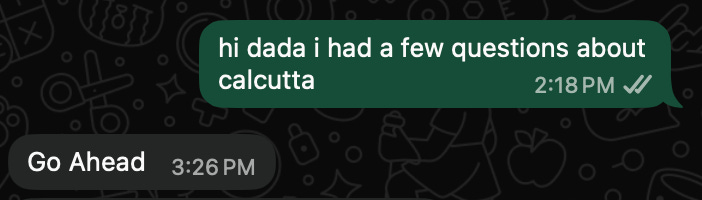
I rang you once more, and then I texted you. As I started at the WhatsApp chat, I couldn’t fathom how I’d gather all the information I was attempting to seek about your past through a string of texts. Valuable details would fall through the cracks, and more importantly, I’d miss your facial expressions - which typically tell me more than words ever do, anyways.
[](https://substackcdn.com/image/fetch/$s_!0p47!,f_auto,q_auto:good,fl_progressive:steep/https%3A%2F%2Fsubstack-post-media.s3.amazonaws.com%2Fpublic%2Fimages%2F564aea18-a396-412a-bef8-b3cd6d0a8ebe_702x200.png)
Before I knew it, my car was screeching around the corner, my shoes tossed aside, and my hands knocking on your bedroom door.
*It’s me! Wake up from your nap, old man\!*
You swung your door open, rubbing your eyes, claiming that you were *not* napping. You were merely resting after cleaning the barbecue grill in the patio for the past few hours.
A quick hug and we were upstairs. You showed me the clean grill. I asked if you were prepping to host a BBQ for us. With a chuckle you said what you always do: *you’re welcome anytime.*
No chai today, because we were fasting and the sun had not dipped below the horizon quite yet.
*Dada, I’m confused. Can you tell me about your time in Calcutta again?*
You nod and repeat that your father, Nuruddin, was born and raised in Calcutta (present day Kolkata). After your birth in Mumbai, your parents were eager to return to Calcutta. Nuruddin had spent his entire life there - he was fluent in Bengali, studied at a local university, was growing the family business, and now had a brand new son. It was this very city that your sister, Rubab, was soon to be born.
My own sister, who was sitting on the couch half-listening, half-scrolling, chimed in: *But Dada, is it Calcutta or Kolkata?*
I could tell by the glint in your eye that you were about to launch into a tale.
Apparently, there was a British trader, Job Charnock, that was passing by a rice field. Determined to create his own map, he asked his driver to inquire about the name of the land they were on. The driver approached a nearby farmer, and to an outsider, it would have seemed like they were arguing.
If only they had Google Translate.
In the end, so the tale goes, the farmer incorrectly believed that the driver was asking him: *When was the grass last cut?*
Exhausted from a long day in the fields, he replied in Bengali: ***Kal Kata** (cut yesterday).*
The driver relayed this to the British trader who then anglicized the name to **Calcutta**, which became the name of the capital of India for over a century.
Dada, I believe your story. But - and don’t get mad at me - as I’m typing this letter with a growing number of tabs lining my screen, I can’t help but conclude that there is a bit more than just a *lost in translation* mistake to this history.
My fascination with the name runs deep - our surname has been **Calcuttawalla** for as long as I’ve known. I never thought to do a deep dive into where our name came from. All I knew was that it was some distant land in India that maybe I’d visit someday.
[(Spoiler alert, I won’t)](https://zabocat.substack.com/p/a-visa-denied-a-journey-begins)
In 2001, the city was renamed Kolkata, returning to its rightful Bengali roots.
> “Kolkata was always called Kolkata in Bengali — derived from the name of one of the three villages said to have become the modern city of Kolkata.” - [Sandip Roy.](https://www.npr.org/sections/goatsandsoda/2016/09/02/492447039/tk)
For some reason, the English thought renaming land (that wasn’t theirs) to Calcutta would make life easier for them. Apparently, the people who lived there at the time easily went back and forth between the two names, depending on what language they were speaking.
And yet, there’s only one version on your birth certificate - a name that was carried over oceans.
We sat in silence for a few moments.
*Can I tell you a story about guava?*
*Of course.*
Your mother and aunt were sitting by a window, chatting about their day. You must have been in your mother’s arms. Suddenly, a fruit vendor appears down below with a cart of bright green fruit.
Your aunt leaned outside of the window, and to get his attention, started calling out: *Oh, Peyara-wala! Oh! Peyara-walaaaaa\!*
Your mother stood frozen. Why was her sister-in-law calling out the Hindi word for *my love* to the fruit vendor?
And so that was the afternoon your mother learned the Bengali word for guava was *peyara -* not to be confused with *pyara,* the Hindi word for *my love.*
I smiled at the story, thinking about all of the times I’ve stumbled through an unfamiliar language in a new land. It must have been a huge adjustment for your mother, with four young children. And not to mention, the tension of the looming Partition.
*I know you were only a toddler at the time of the Partition, but did your parents ever tell you stories about it?*
You shook your head. Your family never shared anything - you were simply too young, and the wounds too painful.
Without stories from you, my mind filled in the gaps. I imagined your parents staring at the ceiling, wide awake, without the faintest clue of how their homeland would be chopped up, what the future would hold for their four (and counting) young children, and where home would *really* be.
No one knew for sure what was going to happen - in fact, the official border wasn’t even announced until 2 full days after Independence. People living near the British-drawn imaginary lines didn’t know if tomorrow they’d be residents of Pakistan or India, a distinction that would forever change the trajectory of their entire family line.
Trying to connect the pieces, I asked if your move to East Pakistan *(present day Bangladesh)* the following year had anything to do with the rising tensions between Muslims and Hindus in Calcutta.
You were firm when you said no.
At first, you said that there wasn’t much violence where you lived. And then, you faltered. You weren’t actually sure. After all, while you were barely taking your first steps, your parents were busy locking away their scars to save future generations from holding on to their pain.
I nodded, finally accepting that all stories of my family during the Partition are gone forever.
Mahatma Gandhi was assassinated in January 1948. I can only imagine the worry lines forming deep creases on your father’s forehead as he navigated a city caught in the crossroads. As the number of Hindus living in Calcutta rapidly increased, the same number of Muslims left. Extreme religious violence had become the norm. And now, one of the most powerful advocates of Muslim minorities was killed.
In 1948, your grandfather asked your father to pursue a new branch of the family business in Dhaka.
That year would be the last time anyone from my family line would live in present day India.
We both glanced at the clock, breaking out of the spell.
It was time for you to rush to the *masjid.* I gathered the sticky-notes I had scribbled on, promised to see you for *Eid,* and softly closed the door behind me.
Apki Pyari,
Zahabiya
P.S. My first two letters are below, in case you want to read the beginning of the journey.
**The 15 Stops: A Journey Through 80 Years**
[](https://zabocat.substack.com/p/a-visa-denied-a-journey-begins)
[A Visa Denied, A Journey Begins](https://zabocat.substack.com/p/a-visa-denied-a-journey-begins)
[Zahabiya Nuruddin](https://substack.com/profile/24661344-zahabiya-nuruddin)
·
Mar 10
[Read full story](https://zabocat.substack.com/p/a-visa-denied-a-journey-begins)
[](https://zabocat.substack.com/p/a-story-of-milk-and-madness)
[A Story of Milk & Madness](https://zabocat.substack.com/p/a-story-of-milk-and-madness)
[Zahabiya Nuruddin](https://substack.com/profile/24661344-zahabiya-nuruddin)
·
Mar 12
[Read full story](https://zabocat.substack.com/p/a-story-of-milk-and-madness)
Thanks for reading The Long Way Home! Subscribe for free to receive new posts and support my work.
[](https://substackcdn.com/image/fetch/$s_!20B-!,f_auto,q_auto:good,fl_progressive:steep/https%3A%2F%2Fsubstack-post-media.s3.amazonaws.com%2Fpublic%2Fimages%2F5b1cbf8f-95a6-4cdc-94b2-592e25babc83_960x740.jpeg)
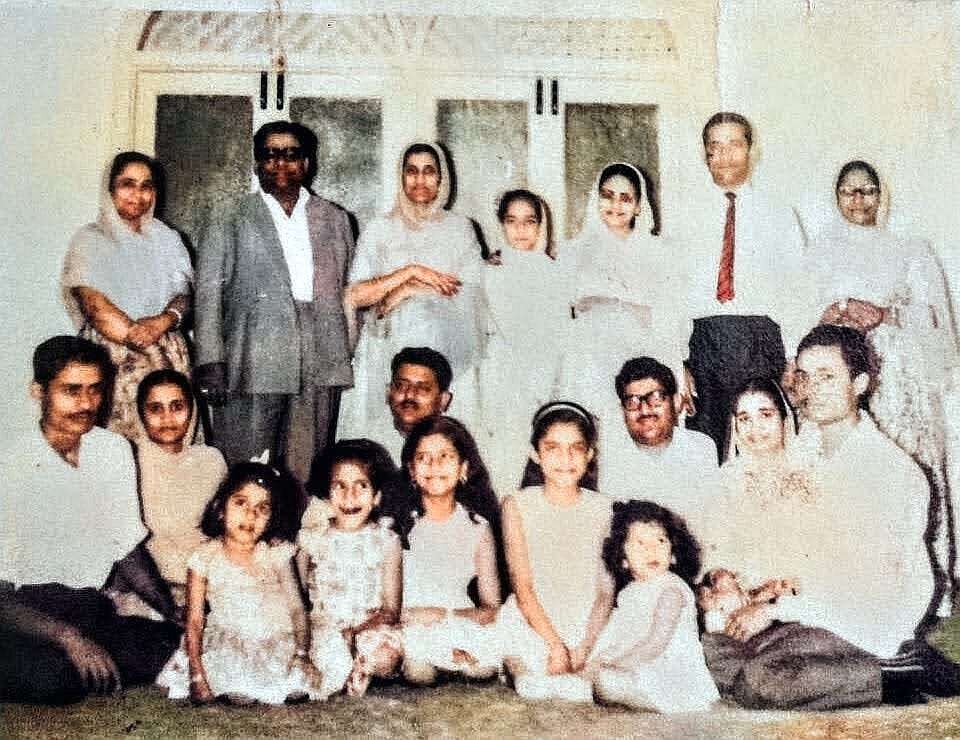
my great-grandmother & great-grandfather (back row, far left) and his siblings with their families.
7
6
1
Share
#### Discussion about this post
Comments
Restacks
[](https://substack.com/profile/344999522-fatema?utm_source=comment)
[Fatema](https://substack.com/profile/344999522-fatema?utm_source=substack-feed-item)
[11h](https://zabocat.substack.com/p/cutting-grass-and-eating-guava-without/comment/228667689 "Mar 16, 2026, 4:06 PM")
Liked by Zahabiya Nuruddin
Just loev these letters to Dada\!
[Reply]()
[Share]()
[1 reply by Zahabiya Nuruddin](https://zabocat.substack.com/p/cutting-grass-and-eating-guava-without/comment/228667689)
[](https://substack.com/profile/389163351-maryum-haidari?utm_source=comment)
[Maryum haidari](https://substack.com/profile/389163351-maryum-haidari?utm_source=substack-feed-item)
[13h](https://zabocat.substack.com/p/cutting-grass-and-eating-guava-without/comment/228602688 "Mar 16, 2026, 1:56 PM")
Liked by Zahabiya Nuruddin
Thanks for sharing 🥹 learned so many things I didn’t know
[Reply]()
[Share]()
[1 reply by Zahabiya Nuruddin](https://zabocat.substack.com/p/cutting-grass-and-eating-guava-without/comment/228602688)
[4 more comments...](https://zabocat.substack.com/p/cutting-grass-and-eating-guava-without/comments)
Top
Latest
Discussions
No posts
### Ready for more?
© 2026 Zahabiya Nuruddin · [Privacy](https://substack.com/privacy) ∙ [Terms](https://substack.com/tos) ∙ [Collection notice](https://substack.com/ccpa#personal-data-collected)
[Start your Substack](https://substack.com/signup?utm_source=substack&utm_medium=web&utm_content=footer)
[Get the app](https://substack.com/app/app-store-redirect?utm_campaign=app-marketing&utm_content=web-footer-button)
[Substack](https://substack.com/) is the home for great culture
This site requires JavaScript to run correctly. Please [turn on JavaScript](https://enable-javascript.com/) or unblock scripts |
| Readable Markdown | > *Note: I’ve officially moved my family history letters over to my main Substack page, **The Long Way Home**. From now on, you’ll find my travel journals and these family stories side-by-side. If you’re coming over from the "Dear Dada" archive - welcome! I’m excited to continue this month long project to write 15 letters to my grandfather for his birthday - one for each of the cities he’s lived in across the globe.*
Dear Dada,
I was pacing around outside of a store today, waiting for my sister to finish her errands. I had promised to write you a letter today, but the notes I had scribbled from our dinner a few days ago felt bare. Some inconsistencies were lingering.
So I called you. But you didn’t answer.
And you *always* answer.
I rang you once more, and then I texted you. As I started at the WhatsApp chat, I couldn’t fathom how I’d gather all the information I was attempting to seek about your past through a string of texts. Valuable details would fall through the cracks, and more importantly, I’d miss your facial expressions - which typically tell me more than words ever do, anyways.
[](https://substackcdn.com/image/fetch/$s_!0p47!,f_auto,q_auto:good,fl_progressive:steep/https%3A%2F%2Fsubstack-post-media.s3.amazonaws.com%2Fpublic%2Fimages%2F564aea18-a396-412a-bef8-b3cd6d0a8ebe_702x200.png)
Before I knew it, my car was screeching around the corner, my shoes tossed aside, and my hands knocking on your bedroom door.
*It’s me! Wake up from your nap, old man\!*
You swung your door open, rubbing your eyes, claiming that you were *not* napping. You were merely resting after cleaning the barbecue grill in the patio for the past few hours.
A quick hug and we were upstairs. You showed me the clean grill. I asked if you were prepping to host a BBQ for us. With a chuckle you said what you always do: *you’re welcome anytime.*
No chai today, because we were fasting and the sun had not dipped below the horizon quite yet.
*Dada, I’m confused. Can you tell me about your time in Calcutta again?*
You nod and repeat that your father, Nuruddin, was born and raised in Calcutta (present day Kolkata). After your birth in Mumbai, your parents were eager to return to Calcutta. Nuruddin had spent his entire life there - he was fluent in Bengali, studied at a local university, was growing the family business, and now had a brand new son. It was this very city that your sister, Rubab, was soon to be born.
My own sister, who was sitting on the couch half-listening, half-scrolling, chimed in: *But Dada, is it Calcutta or Kolkata?*
I could tell by the glint in your eye that you were about to launch into a tale.
Apparently, there was a British trader, Job Charnock, that was passing by a rice field. Determined to create his own map, he asked his driver to inquire about the name of the land they were on. The driver approached a nearby farmer, and to an outsider, it would have seemed like they were arguing.
If only they had Google Translate.
In the end, so the tale goes, the farmer incorrectly believed that the driver was asking him: *When was the grass last cut?*
Exhausted from a long day in the fields, he replied in Bengali: ***Kal Kata** (cut yesterday).*
The driver relayed this to the British trader who then anglicized the name to **Calcutta**, which became the name of the capital of India for over a century.
Dada, I believe your story. But - and don’t get mad at me - as I’m typing this letter with a growing number of tabs lining my screen, I can’t help but conclude that there is a bit more than just a *lost in translation* mistake to this history.
My fascination with the name runs deep - our surname has been **Calcuttawalla** for as long as I’ve known. I never thought to do a deep dive into where our name came from. All I knew was that it was some distant land in India that maybe I’d visit someday.
[(Spoiler alert, I won’t)](https://zabocat.substack.com/p/a-visa-denied-a-journey-begins)
In 2001, the city was renamed Kolkata, returning to its rightful Bengali roots.
> “Kolkata was always called Kolkata in Bengali — derived from the name of one of the three villages said to have become the modern city of Kolkata.” - [Sandip Roy.](https://www.npr.org/sections/goatsandsoda/2016/09/02/492447039/tk)
For some reason, the English thought renaming land (that wasn’t theirs) to Calcutta would make life easier for them. Apparently, the people who lived there at the time easily went back and forth between the two names, depending on what language they were speaking.
And yet, there’s only one version on your birth certificate - a name that was carried over oceans.
We sat in silence for a few moments.
*Can I tell you a story about guava?*
*Of course.*
Your mother and aunt were sitting by a window, chatting about their day. You must have been in your mother’s arms. Suddenly, a fruit vendor appears down below with a cart of bright green fruit.
Your aunt leaned outside of the window, and to get his attention, started calling out: *Oh, Peyara-wala! Oh! Peyara-walaaaaa\!*
Your mother stood frozen. Why was her sister-in-law calling out the Hindi word for *my love* to the fruit vendor?
And so that was the afternoon your mother learned the Bengali word for guava was *peyara -* not to be confused with *pyara,* the Hindi word for *my love.*
I smiled at the story, thinking about all of the times I’ve stumbled through an unfamiliar language in a new land. It must have been a huge adjustment for your mother, with four young children. And not to mention, the tension of the looming Partition.
*I know you were only a toddler at the time of the Partition, but did your parents ever tell you stories about it?*
You shook your head. Your family never shared anything - you were simply too young, and the wounds too painful.
Without stories from you, my mind filled in the gaps. I imagined your parents staring at the ceiling, wide awake, without the faintest clue of how their homeland would be chopped up, what the future would hold for their four (and counting) young children, and where home would *really* be.
No one knew for sure what was going to happen - in fact, the official border wasn’t even announced until 2 full days after Independence. People living near the British-drawn imaginary lines didn’t know if tomorrow they’d be residents of Pakistan or India, a distinction that would forever change the trajectory of their entire family line.
Trying to connect the pieces, I asked if your move to East Pakistan *(present day Bangladesh)* the following year had anything to do with the rising tensions between Muslims and Hindus in Calcutta.
You were firm when you said no.
At first, you said that there wasn’t much violence where you lived. And then, you faltered. You weren’t actually sure. After all, while you were barely taking your first steps, your parents were busy locking away their scars to save future generations from holding on to their pain.
I nodded, finally accepting that all stories of my family during the Partition are gone forever.
Mahatma Gandhi was assassinated in January 1948. I can only imagine the worry lines forming deep creases on your father’s forehead as he navigated a city caught in the crossroads. As the number of Hindus living in Calcutta rapidly increased, the same number of Muslims left. Extreme religious violence had become the norm. And now, one of the most powerful advocates of Muslim minorities was killed.
In 1948, your grandfather asked your father to pursue a new branch of the family business in Dhaka.
That year would be the last time anyone from my family line would live in present day India.
We both glanced at the clock, breaking out of the spell.
It was time for you to rush to the *masjid.* I gathered the sticky-notes I had scribbled on, promised to see you for *Eid,* and softly closed the door behind me.
Apki Pyari,
Zahabiya
P.S. My first two letters are below, in case you want to read the beginning of the journey.
**The 15 Stops: A Journey Through 80 Years**
[](https://zabocat.substack.com/p/a-visa-denied-a-journey-begins)
[](https://zabocat.substack.com/p/a-story-of-milk-and-madness)
[](https://substackcdn.com/image/fetch/$s_!20B-!,f_auto,q_auto:good,fl_progressive:steep/https%3A%2F%2Fsubstack-post-media.s3.amazonaws.com%2Fpublic%2Fimages%2F5b1cbf8f-95a6-4cdc-94b2-592e25babc83_960x740.jpeg)
my great-grandmother & great-grandfather (back row, far left) and his siblings with their families.
No posts |
| Shard | 76 (laksa) |
| Root Hash | 14862242593741677076 |
| Unparsed URL | com,substack!zabocat,/p/cutting-grass-and-eating-guava-without s443 |