ℹ️ Skipped - page is already crawled
| Filter | Status | Condition | Details |
|---|---|---|---|
| HTTP status | PASS | download_http_code = 200 | HTTP 200 |
| Age cutoff | PASS | download_stamp > now() - 6 MONTH | 0 months ago |
| History drop | PASS | isNull(history_drop_reason) | No drop reason |
| Spam/ban | PASS | fh_dont_index != 1 AND ml_spam_score = 0 | ml_spam_score=0 |
| Canonical | PASS | meta_canonical IS NULL OR = '' OR = src_unparsed | Not set |
| Property | Value |
|---|---|
| URL | https://www.zmescience.com/medicine/how-much-coffee-07022013/ |
| Last Crawled | 2026-04-12 19:15:59 (2 hours ago) |
| First Indexed | 2017-10-04 20:59:21 (8 years ago) |
| HTTP Status Code | 200 |
| Meta Title | How much coffee is too much? A new study shows 3 cups is maximum |
| Meta Description | The apparently evergrowing consumption of coffee and caffeinated products continues to worry scientists, and until now, a maximum safety level had not |
| Meta Canonical | null |
| Boilerpipe Text | The apparently evergrowing consumption of coffee and caffeinated products continues to worry scientists, and until now, a maximum safety level had not been established.
A common story
When Matthew Penbross woke on a morning in August 2007, he wanted to be prepared. A natural desire, considering he was competing in the motocross races near Port Macquarie, Australia; to pump up and improve his reactions, he drank a few Red Bull’s, just as he usually did.
After the first race however, he wasn’t feeling so well. He started feeling sharp chest pains, but despite these, he went on to actually win a race that day; 20 minutes after that, his heart stopped. He had no history of drug consumption or family history of heart disease – but he did drink a few energy drinks almost each day.
The number of stories like this has increased greatly in the past year – as have the sales, and the concern level, sometimes with coffee instead of the energy drink.
“People often don’t understand the potential risk of these beverages,” says Bruce A. Goldberger, director of forensic toxicology at the University of Florida’s pathology labs. Caffeine is a stimulant and, when consumed at high enough levels, can have negative effects.
How much is too much
If you take the word of coffee and energy drink producers, their products are perfectly safe. Monster energy has always been a firm supporter of this idea:
“Neither the science nor the facts support the allegations that have been made. Monster reiterates that its products are and have always been safe.”
But this is pretty much just not true.
“People often don’t understand the potential risk of these beverages,” says Bruce A. Goldberger, director of forensic toxicology at the University of Florida’s pathology labs.
Caffeine safety levels are quite hard to prove. Although scientists have established the toxic dose to be somewhere around 10 g, they say that the value can fluctuate depending on how a person processes the stimulant. Caffeine is filtered and eliminated through the body at different rates depending on each one’s metabolic system. Furthermore, physiological differences, as well as differences in the way people consume caffeine, have tied FDA in knots as it has debated how to regulate the substance.
Small, occasional quantities of coffee generally pose no threat for health and are actually benefic, but once this becomes a habit, and then, an addiction – this all starts to turn around.
×
“Whereas low-dose caffeine effects are wakefulness, a little bit of arousal, and slight euphoria,” Fredholm says, “high-dose effects are anxiety, irritation, and general mental discomfort—a completely different kettle of fish.”
Those effects are extremely dangerous, especially considering how the mechanism is not exactly well understood.
“High-dose caffeine effects are much more complex,” Fredholm explains. “It’s still unknown precisely what the primary mechanism of action is in the brain and elsewhere.”
Coffee producers will argue that the toxic level of caffeine, 10 g, is roughly the equivalent of imbibing 75 cups of brewed coffee – way over what people drink. But the toxic dose is not what you want to look at here, because it’s not the toxicity of the coffee per se that you want to avoid. There is a high variability depending on sex, other drug usage and many other factors, but the previous belief was that levels up to 600 mg of pure caffeine (four to seven cups of coffee) each day should not pose any significant danger.
A more accurate safety level
A team at Health Canada, a government regulatory agency, reviewed more than 200 studies about caffeine’s effects on human health; this was the biggest study of the kind ever conducted. Their conclusions?
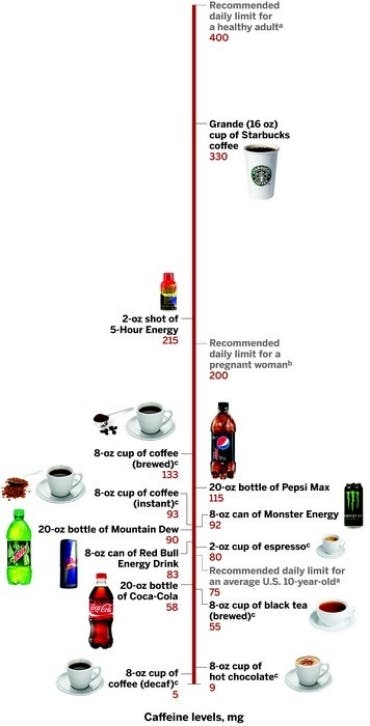
They concluded that 400 mg of caffeine per day (or about three 8-oz cups of brewed coffee) is a safe dose for healthy adults to consume, and below this level, the average user should not experience any health problem, and only vague psychological effects.
The team also set a limit of 2.5 mg per kg body weight per day for children. For an average 10-year-old in the U.S., that’s about 75 mg of caffeine, or two 12-oz cans of Coca-Cola.
Source |
| Markdown | [](https://www.zmescience.com/)
No Result
View All Result
[](https://www.zmescience.com/)
How much coffee is too much? A new study shows 3 cups is maximum
[Share](https://www.zmescience.com/medicine/how-much-coffee-07022013/ "Share this article")
Share this article
[Facebook](https://www.facebook.com/sharer/sharer.php?u=https%3A%2F%2Fwww.zmescience.com%2Fmedicine%2Fhow-much-coffee-07022013%2F)
[X](https://twitter.com/intent/tweet?text=How+much+coffee+is+too+much%3F+A+new+study+shows+3+cups+is+maximum&url=https%3A%2F%2Fwww.zmescience.com%2Fmedicine%2Fhow-much-coffee-07022013%2F)
[LinkedIn](https://www.linkedin.com/sharing/share-offsite/?url=https%3A%2F%2Fwww.zmescience.com%2Fmedicine%2Fhow-much-coffee-07022013%2F)
[Reddit](https://reddit.com/submit?url=https%3A%2F%2Fwww.zmescience.com%2Fmedicine%2Fhow-much-coffee-07022013%2F&title=How+much+coffee+is+too+much%3F+A+new+study+shows+3+cups+is+maximum)
[WhatsApp](https://api.whatsapp.com/send?text=How+much+coffee+is+too+much%3F+A+new+study+shows+3+cups+is+maximum%20https%3A%2F%2Fwww.zmescience.com%2Fmedicine%2Fhow-much-coffee-07022013%2F)
[Flipboard](https://share.flipboard.com/bookmarklet/popout?v=2&title=How+much+coffee+is+too+much%3F+A+new+study+shows+3+cups+is+maximum&url=https%3A%2F%2Fwww.zmescience.com%2Fmedicine%2Fhow-much-coffee-07022013%2F)
[Bluesky](https://bsky.app/intent/compose?text=How+much+coffee+is+too+much%3F+A+new+study+shows+3+cups+is+maximum%20https%3A%2F%2Fwww.zmescience.com%2Fmedicine%2Fhow-much-coffee-07022013%2F)
[Email](mailto:?subject=Check%20out%3A%20How%20much%20coffee%20is%20too%20much%3F%20A%20new%20study%20shows%203%20cups%20is%20maximum&body=How%20much%20coffee%20is%20too%20much%3F%20A%20new%20study%20shows%203%20cups%20is%20maximum%0A%0Ahttps%3A%2F%2Fwww.zmescience.com%2Fmedicine%2Fhow-much-coffee-07022013%2F)
[Copy Link](https://www.zmescience.com/medicine/how-much-coffee-07022013/)
[Comments](https://www.zmescience.com/medicine/how-much-coffee-07022013/#comments-anchor)
[](https://www.zmescience.com/)
[Home](https://www.zmescience.com/) → [Health](https://www.zmescience.com/medicine/) → [Diseases](https://www.zmescience.com/medicine/diseases-medicine/)
# How much coffee is too much? A new study shows 3 cups is maximum


by[Mihai Andrei](https://www.zmescience.com/author/osamik/)
[February 7, 2013](https://www.zmescience.com/medicine/how-much-coffee-07022013/)
in [Diseases](https://www.zmescience.com/medicine/diseases-medicine/), [Health](https://www.zmescience.com/medicine/)
A A
A
A
Reset
The apparently evergrowing consumption of coffee and caffeinated products continues to worry scientists, and until now, a maximum safety level had not been established.
### A common story
[](https://cdn.zmescience.com/wp-content/uploads/2013/02/coffee.jpg)When Matthew Penbross woke on a morning in August 2007, he wanted to be prepared. A natural desire, considering he was competing in the motocross races near Port Macquarie, Australia; to pump up and improve his reactions, he drank a few Red Bull’s, just as he usually did.
After the first race however, he wasn’t feeling so well. He started feeling sharp chest pains, but despite these, he went on to actually win a race that day; 20 minutes after that, his heart stopped. He had no history of drug consumption or family history of heart disease – but he did drink a few energy drinks almost each day.
The number of stories like this has increased greatly in the past year – as have the sales, and the concern level, sometimes with coffee instead of the energy drink.
> “People often don’t understand the potential risk of these beverages,” says Bruce A. Goldberger, director of forensic toxicology at the University of Florida’s pathology labs. Caffeine is a stimulant and, when consumed at high enough levels, can have negative effects.
### How much is too much
If you take the word of coffee and energy drink producers, their products are perfectly safe. Monster energy has always been a firm supporter of this idea:
> “Neither the science nor the facts support the allegations that have been made. Monster reiterates that its products are and have always been safe.”
But this is pretty much just not true.
> “People often don’t understand the potential risk of these beverages,” says Bruce A. Goldberger, director of forensic toxicology at the University of Florida’s pathology labs.
Caffeine safety levels are quite hard to prove. Although scientists have established the toxic dose to be somewhere around 10 g, they say that the value can fluctuate depending on how a person processes the stimulant. Caffeine is filtered and eliminated through the body at different rates depending on each one’s metabolic system. Furthermore, physiological differences, as well as differences in the way people consume caffeine, have tied FDA in knots as it has debated how to regulate the substance.
Small, occasional quantities of coffee generally pose no threat for health and are actually benefic, but once this becomes a habit, and then, an addiction – this all starts to turn around.
×
## Get smarter every day...
Stay ahead with ZME Science and subscribe.
## Thank you! One more thing...
Please check your inbox and confirm your subscription.
> “Whereas low-dose caffeine effects are wakefulness, a little bit of arousal, and slight euphoria,” Fredholm says, “high-dose effects are anxiety, irritation, and general mental discomfort—a completely different kettle of fish.”
Those effects are extremely dangerous, especially considering how the mechanism is not exactly well understood.
[ ](https://cdn.zmescience.com/wp-content/uploads/2013/02/coffee2.jpeg)
> “High-dose caffeine effects are much more complex,” Fredholm explains. “It’s still unknown precisely what the primary mechanism of action is in the brain and elsewhere.”
Coffee producers will argue that the toxic level of caffeine, 10 g, is roughly the equivalent of imbibing 75 cups of brewed coffee – way over what people drink. But the toxic dose is not what you want to look at here, because it’s not the toxicity of the coffee per se that you want to avoid. There is a high variability depending on sex, other drug usage and many other factors, but the previous belief was that levels up to 600 mg of pure caffeine (four to seven cups of coffee) each day should not pose any significant danger.
### Related**Posts**
[When organ donation meets religion](https://www.zmescience.com/medicine/when-organ-donation-meets-religion/)
[Trump is ordering a sweeping censorship of science, starting with climate and health](https://www.zmescience.com/science/trump-is-ordering-a-sweeping-censorship-of-science-starting-with-climate-and-health/)
[Cash 4 Weight Loss programme shown to work and make people excited about exercise](https://www.zmescience.com/medicine/rewards-for-exercise-works/)
[Tips for Staying Healthy as You Age](https://www.zmescience.com/medicine/tips-staying-healthy-age/)
### A more accurate safety level
A team at Health Canada, a government regulatory agency, reviewed more than 200 studies about caffeine’s effects on human health; this was the biggest study of the kind ever conducted. Their conclusions?
They concluded that 400 mg of caffeine per day (or about three 8-oz cups of brewed coffee) is a safe dose for healthy adults to consume, and below this level, the average user should not experience any health problem, and only vague psychological effects.
The team also set a limit of 2.5 mg per kg body weight per day for children. For an average 10-year-old in the U.S., that’s about 75 mg of caffeine, or two 12-oz cans of Coca-Cola.
[Source](http://cen.acs.org/articles/91/i5/Caffeine-Jitters.html)
[ ](https://www.google.com/preferences/source?q=https://www.zmescience.com)
[](https://news.google.com/publications/CAAqKQgKIiNDQklTRkFnTWFoQUtEbnB0WlhOamFXVnVZMlV1WTI5dEtBQVAB?hl=en-US&gl=US&ceid=US%3Aen)
Tags: [coffee](https://www.zmescience.com/tag/coffee/)[health](https://www.zmescience.com/tag/health/)


### [Mihai Andrei](https://www.zmescience.com/author/osamik/)
Dr. Andrei Mihai is a geophysicist and founder of ZME Science. He has a Ph.D. in geophysics and archaeology and has completed courses from prestigious universities (with programs ranging from climate and astronomy to chemistry and geology). He is passionate about making research more accessible to everyone and communicating news and features to a broad audience.
### Related **Posts**
[ ](https://www.zmescience.com/other/economics/american-maternal-health-is-in-a-state-of-emergency-a-higher-minimum-wage-could-save-the-lives/)
[Economics](https://www.zmescience.com/other/economics/)
### [American Maternal Health Is in a State of Emergency. A Higher Minimum Wage Could Save Lives](https://www.zmescience.com/other/economics/american-maternal-health-is-in-a-state-of-emergency-a-higher-minimum-wage-could-save-the-lives/)
by[Mihai Andrei](https://www.zmescience.com/author/osamik/)
[1 month ago](https://www.zmescience.com/other/economics/american-maternal-health-is-in-a-state-of-emergency-a-higher-minimum-wage-could-save-the-lives/)
[ ](https://www.zmescience.com/ecology/animals-ecology/why-elephant-gut-bacteria-makes-coffee-smooth/)
[Animals](https://www.zmescience.com/ecology/animals-ecology/)
### [Elephant “poop coffee” is a thing. Now, researchers have an idea about what makes it so delicious](https://www.zmescience.com/ecology/animals-ecology/why-elephant-gut-bacteria-makes-coffee-smooth/)
by[Tudor Tarita](https://www.zmescience.com/author/tudor/)
[3 months ago](https://www.zmescience.com/ecology/animals-ecology/why-elephant-gut-bacteria-makes-coffee-smooth/)
[ ](https://www.zmescience.com/medicine/when-lung-cancer-fears-emerged-in-the-1950s-kent-put-a-filter-on-their-cigarettes-it-was-made-from-asbestos/)
[Health](https://www.zmescience.com/medicine/)
### [When Lung Cancer Fears Emerged in the 1950s, Kent Put a Filter on their Cigarettes. It Was Made From Asbestos](https://www.zmescience.com/medicine/when-lung-cancer-fears-emerged-in-the-1950s-kent-put-a-filter-on-their-cigarettes-it-was-made-from-asbestos/)
by[Mihai Andrei](https://www.zmescience.com/author/osamik/)
[4 months ago](https://www.zmescience.com/medicine/when-lung-cancer-fears-emerged-in-the-1950s-kent-put-a-filter-on-their-cigarettes-it-was-made-from-asbestos/)
[ ](https://www.zmescience.com/medicine/nutrition-medicine/bananas-ruin-smoothie-flavanols-study/)
[News](https://www.zmescience.com/science/news-science/)
### [Study Reveals Why it’s a Bad Idea To Make a Banana and Berries Smoothie](https://www.zmescience.com/medicine/nutrition-medicine/bananas-ruin-smoothie-flavanols-study/)
by[Mihai Andrei](https://www.zmescience.com/author/osamik/)
[4 months ago](https://www.zmescience.com/medicine/nutrition-medicine/bananas-ruin-smoothie-flavanols-study/)
### Recent news
[ ](https://www.zmescience.com/medicine/car-t-therapy-3-autoimmune-diseases/)
### [Revolutionary Therapy Cured Three “Incurable” Autoimmune Diseases in a Patient](https://www.zmescience.com/medicine/car-t-therapy-3-autoimmune-diseases/)
April 11, 2026
[ ](https://www.zmescience.com/medicine/new-cell-type-uterus/)
### [Scientists Mapped the Womb in Unprecedented Detail and Discovered a Brand New Cell Type That Protects Pregnant Mothers](https://www.zmescience.com/medicine/new-cell-type-uterus/)
April 11, 2026
[ ](https://www.zmescience.com/science/news-science/artemis-ii-is-entering-its-most-dangerous-phase-four-astronauts-one-fireball-and-no-margin-for-error/)
### [Artemis II Is Entering Its Most Dangerous Phase: Four Astronauts, One Fireball, and No Margin for Error](https://www.zmescience.com/science/news-science/artemis-ii-is-entering-its-most-dangerous-phase-four-astronauts-one-fireball-and-no-margin-for-error/)
April 11, 2026
- [About](https://www.zmescience.com/about "About ZME Science")
- [Advertise](https://www.zmescience.com/advertise/ "Advertise on ZME Science")
- [Editorial Policy](https://www.zmescience.com/editorial-policy/)
- [Privacy Policy and Terms of Use](https://www.zmescience.com/privacy-policy/)
- [How we review products](https://www.zmescience.com/product-review-policy/)
- [Contact](https://www.zmescience.com/contact "Contact information for ZME Science")
© 2007-2025 ZME Science - Not exactly rocket science. All Rights Reserved.
No Result
View All Result
- [Science News](https://www.zmescience.com/science/)
- [Environment](https://www.zmescience.com/ecology/)
- [Health](https://www.zmescience.com/medicine/)
- [Space](https://www.zmescience.com/space/)
- [Future](https://www.zmescience.com/future/)
- [Features](https://www.zmescience.com/feature-post/)
- [Natural Sciences](https://www.zmescience.com/feature-post/natural-sciences/)
- [Physics](https://www.zmescience.com/feature-post/natural-sciences/physics-articles/)
- [Matter and Energy](https://www.zmescience.com/feature-post/natural-sciences/physics-articles/matter-and-energy/)
- [Quantum Mechanics](https://www.zmescience.com/feature-post/natural-sciences/physics-articles/quantum-mechanics/)
- [Thermodynamics](https://www.zmescience.com/feature-post/natural-sciences/physics-articles/thermodynamics/)
- [Chemistry](https://www.zmescience.com/feature-post/natural-sciences/chemistry-articles/)
- [Periodic Table](https://www.zmescience.com/feature-post/natural-sciences/chemistry-articles/periodic-table/)
- [Applied Chemistry](https://www.zmescience.com/feature-post/natural-sciences/chemistry-articles/applied-chemistry/)
- [Materials](https://www.zmescience.com/feature-post/natural-sciences/chemistry-articles/materials-1/)
- [Physical Chemistry](https://www.zmescience.com/feature-post/natural-sciences/chemistry-articles/physical-chemistry/)
- [Biology](https://www.zmescience.com/feature-post/natural-sciences/biology-reference/)
- [Anatomy](https://www.zmescience.com/feature-post/natural-sciences/biology-reference/anatomy-articles/)
- [Biochemistry](https://www.zmescience.com/feature-post/natural-sciences/biology-reference/biochemistry/)
- [Ecology](https://www.zmescience.com/feature-post/natural-sciences/biology-reference/ecology-articles/)
- [Genetics](https://www.zmescience.com/feature-post/natural-sciences/biology-reference/genetics/)
- [Microbiology](https://www.zmescience.com/feature-post/natural-sciences/biology-reference/microbiology/)
- [Plants and Fungi](https://www.zmescience.com/feature-post/natural-sciences/biology-reference/plants-fungi/)
- [Geology and Paleontology](https://www.zmescience.com/feature-post/natural-sciences/geology-and-paleontology/)
- [Planet Earth](https://www.zmescience.com/feature-post/natural-sciences/geology-and-paleontology/planet-earth/)
- [Earth Dynamics](https://www.zmescience.com/feature-post/natural-sciences/geology-and-paleontology/earth-dynamics/)
- [Rocks and Minerals](https://www.zmescience.com/feature-post/natural-sciences/geology-and-paleontology/rocks-and-minerals/)
- [Volcanoes](https://www.zmescience.com/feature-post/natural-sciences/geology-and-paleontology/volcanoes/)
- [Dinosaurs](https://www.zmescience.com/feature-post/natural-sciences/geology-and-paleontology/dinosaurs/)
- [Fossils](https://www.zmescience.com/feature-post/natural-sciences/geology-and-paleontology/fossils/)
- [Animals](https://www.zmescience.com/feature-post/natural-sciences/animals/)
- [Mammals](https://www.zmescience.com/feature-post/natural-sciences/animals/mammals/)
- [Birds](https://www.zmescience.com/feature-post/natural-sciences/animals/birds/)
- [Fish](https://www.zmescience.com/feature-post/natural-sciences/animals/fish/)
- [Amphibians](https://www.zmescience.com/feature-post/natural-sciences/animals/amphibians/)
- [Reptiles](https://www.zmescience.com/feature-post/natural-sciences/animals/reptiles/)
- [Invertebrates](https://www.zmescience.com/feature-post/natural-sciences/animals/invertebrates/)
- [Pets](https://www.zmescience.com/feature-post/natural-sciences/animals/pets/)
- [Conservation](https://www.zmescience.com/feature-post/natural-sciences/animals/conservation/)
- [Animal facts](https://www.zmescience.com/feature-post/natural-sciences/animals/animal-facts/)
- [Climate and Weather](https://www.zmescience.com/feature-post/natural-sciences/climate-and-weather/)
- [Climate change](https://www.zmescience.com/feature-post/natural-sciences/climate-and-weather/climate-change/)
- [Weather and atmosphere](https://www.zmescience.com/feature-post/natural-sciences/climate-and-weather/weather-and-atmosphere/)
- [Health](https://www.zmescience.com/feature-post/health/)
- [Drugs](https://www.zmescience.com/feature-post/health/drugs/)
- [Diseases and Conditions](https://www.zmescience.com/feature-post/health/diseases-and-conditions/)
- [Human Body](https://www.zmescience.com/feature-post/health/human-body/)
- [Mind and Brain](https://www.zmescience.com/feature-post/health/mind-brain/)
- [Food and Nutrition](https://www.zmescience.com/feature-post/health/food-and-nutrition/)
- [Wellness](https://www.zmescience.com/feature-post/health/wellness/)
- [History and Humanities](https://www.zmescience.com/feature-post/history-and-humanities/)
- [Anthropology](https://www.zmescience.com/feature-post/history-and-humanities/anthropology-articles/)
- [Archaeology](https://www.zmescience.com/feature-post/history-and-humanities/archaeology-articles/)
- [History](https://www.zmescience.com/feature-post/history-and-humanities/history/)
- [Economics](https://www.zmescience.com/feature-post/history-and-humanities/economics-articles/)
- [People](https://www.zmescience.com/feature-post/history-and-humanities/people/)
- [Sociology](https://www.zmescience.com/feature-post/history-and-humanities/sociology/)
- [Space & Astronomy](https://www.zmescience.com/feature-post/space-astronomy/)
- [The Solar System](https://www.zmescience.com/feature-post/space-astronomy/solar-system/)
- [Sun](https://www.zmescience.com/feature-post/space-astronomy/solar-system/sun/)
- [The Moon](https://www.zmescience.com/feature-post/space-astronomy/solar-system/moon/)
- [Planets](https://www.zmescience.com/feature-post/space-astronomy/solar-system/planets/)
- [Asteroids, meteors & comets](https://www.zmescience.com/feature-post/space-astronomy/solar-system/asteroids-meteors-comets/)
- [Astronomy](https://www.zmescience.com/feature-post/space-astronomy/astronomy-articles/)
- [Astrophysics](https://www.zmescience.com/feature-post/space-astronomy/astrophysics/)
- [Cosmology](https://www.zmescience.com/feature-post/space-astronomy/cosmology/)
- [Exoplanets & Alien Life](https://www.zmescience.com/feature-post/space-astronomy/exoplanets/)
- [Spaceflight and Exploration](https://www.zmescience.com/feature-post/space-astronomy/space-flight/)
- [Technology](https://www.zmescience.com/feature-post/technology-articles/)
- [Computer Science & IT](https://www.zmescience.com/feature-post/technology-articles/computer-science/)
- [Engineering](https://www.zmescience.com/feature-post/technology-articles/engineering/)
- [Inventions](https://www.zmescience.com/feature-post/technology-articles/inventions-1/)
- [Sustainability](https://www.zmescience.com/feature-post/technology-articles/sustainability/)
- [Renewable Energy](https://www.zmescience.com/feature-post/technology-articles/sustainability/renewable-energy/)
- [Green Living](https://www.zmescience.com/feature-post/technology-articles/sustainability/green-living-1/)
- [Culture](https://www.zmescience.com/feature-post/culture/)
- [Resources](https://www.zmescience.com/feature-post/resources/)
- [Videos](https://www.youtube.com/@zmescience415)
- [Reviews](https://www.zmescience.com/reviews/ "Reviews & Deals")
- [About Us](https://www.zmescience.com/about "About ZME, Staff, Advertise, Privacy Policy")
- [About](https://www.zmescience.com/about)
- [The Team](https://www.zmescience.com/authors/)
- [Advertise](https://www.zmescience.com/advertise/)
- [Contribute](https://www.zmescience.com/contribute/ "Contribute / Write for ZME Science")
- [Editorial policy](https://www.zmescience.com/editorial-policy/)
- [Privacy Policy](https://www.zmescience.com/privacy-policy/)
- [Contact](https://www.zmescience.com/contact)
© 2007-2025 ZME Science - Not exactly rocket science. All Rights Reserved.
Share
SHARE THIS ARTICLE
×
[Facebook](https://www.facebook.com/sharer/sharer.php?u=https%3A%2F%2Fwww.zmescience.com%2Fmedicine%2Fhow-much-coffee-07022013%2F)
[X (Twitter)](https://twitter.com/intent/tweet?url=https%3A%2F%2Fwww.zmescience.com%2Fmedicine%2Fhow-much-coffee-07022013%2F&text=How%20much%20coffee%20is%20too%20much%3F%20A%20new%20study%20shows%203%20cups%20is%20maximum)
[LinkedIn](https://www.linkedin.com/sharing/share-offsite/?url=https%3A%2F%2Fwww.zmescience.com%2Fmedicine%2Fhow-much-coffee-07022013%2F)
[Reddit](https://reddit.com/submit?url=https%3A%2F%2Fwww.zmescience.com%2Fmedicine%2Fhow-much-coffee-07022013%2F&title=How%20much%20coffee%20is%20too%20much%3F%20A%20new%20study%20shows%203%20cups%20is%20maximum)
[WhatsApp](https://api.whatsapp.com/send?text=How%20much%20coffee%20is%20too%20much%3F%20A%20new%20study%20shows%203%20cups%20is%20maximum%20https%3A%2F%2Fwww.zmescience.com%2Fmedicine%2Fhow-much-coffee-07022013%2F)
[Flipboard](https://share.flipboard.com/bookmarklet/popout?v=2&url=https%3A%2F%2Fwww.zmescience.com%2Fmedicine%2Fhow-much-coffee-07022013%2F&title=How%20much%20coffee%20is%20too%20much%3F%20A%20new%20study%20shows%203%20cups%20is%20maximum)
[Bluesky](https://bsky.app/intent/compose?text=How%20much%20coffee%20is%20too%20much%3F%20A%20new%20study%20shows%203%20cups%20is%20maximum%20https%3A%2F%2Fwww.zmescience.com%2Fmedicine%2Fhow-much-coffee-07022013%2F)
[Email](mailto:?subject=How%20much%20coffee%20is%20too%20much%3F%20A%20new%20study%20shows%203%20cups%20is%20maximum&body=https%3A%2F%2Fwww.zmescience.com%2Fmedicine%2Fhow-much-coffee-07022013%2F)
[Copy Link](https://www.zmescience.com/medicine/how-much-coffee-07022013/)
[Comments](https://www.zmescience.com/medicine/how-much-coffee-07022013/#comments-anchor) |
| Readable Markdown | The apparently evergrowing consumption of coffee and caffeinated products continues to worry scientists, and until now, a maximum safety level had not been established.
### A common story
[](https://cdn.zmescience.com/wp-content/uploads/2013/02/coffee.jpg)When Matthew Penbross woke on a morning in August 2007, he wanted to be prepared. A natural desire, considering he was competing in the motocross races near Port Macquarie, Australia; to pump up and improve his reactions, he drank a few Red Bull’s, just as he usually did.
After the first race however, he wasn’t feeling so well. He started feeling sharp chest pains, but despite these, he went on to actually win a race that day; 20 minutes after that, his heart stopped. He had no history of drug consumption or family history of heart disease – but he did drink a few energy drinks almost each day.
The number of stories like this has increased greatly in the past year – as have the sales, and the concern level, sometimes with coffee instead of the energy drink.
> “People often don’t understand the potential risk of these beverages,” says Bruce A. Goldberger, director of forensic toxicology at the University of Florida’s pathology labs. Caffeine is a stimulant and, when consumed at high enough levels, can have negative effects.
### How much is too much
If you take the word of coffee and energy drink producers, their products are perfectly safe. Monster energy has always been a firm supporter of this idea:
> “Neither the science nor the facts support the allegations that have been made. Monster reiterates that its products are and have always been safe.”
But this is pretty much just not true.
> “People often don’t understand the potential risk of these beverages,” says Bruce A. Goldberger, director of forensic toxicology at the University of Florida’s pathology labs.
Caffeine safety levels are quite hard to prove. Although scientists have established the toxic dose to be somewhere around 10 g, they say that the value can fluctuate depending on how a person processes the stimulant. Caffeine is filtered and eliminated through the body at different rates depending on each one’s metabolic system. Furthermore, physiological differences, as well as differences in the way people consume caffeine, have tied FDA in knots as it has debated how to regulate the substance.
Small, occasional quantities of coffee generally pose no threat for health and are actually benefic, but once this becomes a habit, and then, an addiction – this all starts to turn around.
×
> “Whereas low-dose caffeine effects are wakefulness, a little bit of arousal, and slight euphoria,” Fredholm says, “high-dose effects are anxiety, irritation, and general mental discomfort—a completely different kettle of fish.”
Those effects are extremely dangerous, especially considering how the mechanism is not exactly well understood.
[](https://cdn.zmescience.com/wp-content/uploads/2013/02/coffee2.jpeg)
> “High-dose caffeine effects are much more complex,” Fredholm explains. “It’s still unknown precisely what the primary mechanism of action is in the brain and elsewhere.”
Coffee producers will argue that the toxic level of caffeine, 10 g, is roughly the equivalent of imbibing 75 cups of brewed coffee – way over what people drink. But the toxic dose is not what you want to look at here, because it’s not the toxicity of the coffee per se that you want to avoid. There is a high variability depending on sex, other drug usage and many other factors, but the previous belief was that levels up to 600 mg of pure caffeine (four to seven cups of coffee) each day should not pose any significant danger.
### A more accurate safety level
A team at Health Canada, a government regulatory agency, reviewed more than 200 studies about caffeine’s effects on human health; this was the biggest study of the kind ever conducted. Their conclusions?
They concluded that 400 mg of caffeine per day (or about three 8-oz cups of brewed coffee) is a safe dose for healthy adults to consume, and below this level, the average user should not experience any health problem, and only vague psychological effects.
The team also set a limit of 2.5 mg per kg body weight per day for children. For an average 10-year-old in the U.S., that’s about 75 mg of caffeine, or two 12-oz cans of Coca-Cola.
[Source](http://cen.acs.org/articles/91/i5/Caffeine-Jitters.html) |
| Shard | 92 (laksa) |
| Root Hash | 14543206048787838692 |
| Unparsed URL | com,zmescience!www,/medicine/how-much-coffee-07022013/ s443 |