ℹ️ Skipped - page is already crawled
| Filter | Status | Condition | Details |
|---|---|---|---|
| HTTP status | PASS | download_http_code = 200 | HTTP 200 |
| Age cutoff | PASS | download_stamp > now() - 6 MONTH | 4.3 months ago |
| History drop | PASS | isNull(history_drop_reason) | No drop reason |
| Spam/ban | PASS | fh_dont_index != 1 AND ml_spam_score = 0 | ml_spam_score=0 |
| Canonical | PASS | meta_canonical IS NULL OR = '' OR = src_unparsed | Not set |
| Property | Value |
|---|---|
| URL | https://www.yalemedicine.org/news/when-loss-of-smell-and-taste-occurs-with-long-covid |
| Last Crawled | 2025-12-11 02:58:49 (4 months ago) |
| First Indexed | 2024-06-29 20:24:48 (1 year ago) |
| HTTP Status Code | 200 |
| Meta Title | When Loss of Smell and Taste Occurs with Long COVID | News | Yale Medicine |
| Meta Description | An estimated 60% of patients infected with SARS-Co-V2, the virus that causes COVID, lost some ability to taste or smell, according to one study. When these symptoms persist in those with Long COVID, it can rob them of an essential part of life. |
| Meta Canonical | null |
| Boilerpipe Text | null |
| Markdown | [Skip to Main Content](https://www.yalemedicine.org/news/when-loss-of-smell-and-taste-occurs-with-long-covid#page-container)
[1-877-YALEMDS](tel:+1-877-925-3637)
Search for
[Specialists](https://www.yalemedicine.org/search/specialists)[Fact Sheets](https://www.yalemedicine.org/conditions)[Departments](https://www.yalemedicine.org/departments)[Clinical Trials](https://www.yalemedicine.org/clinical-trials)[News](https://www.yalemedicine.org/news)[Patient Tools](https://www.yalemedicine.org/patient-tools)[For Medical Professionals](https://www.yalemedicine.org/for-medical-professionals)
***
[1-877-YALEMDS](tel:+1-877-925-3637)
[Long Covid Blog](https://www.yalemedicine.org/search/news?tagId=6)
# When Loss of Smell and Taste Occurs with Long COVID
BY Jon Klein June 24, 2024
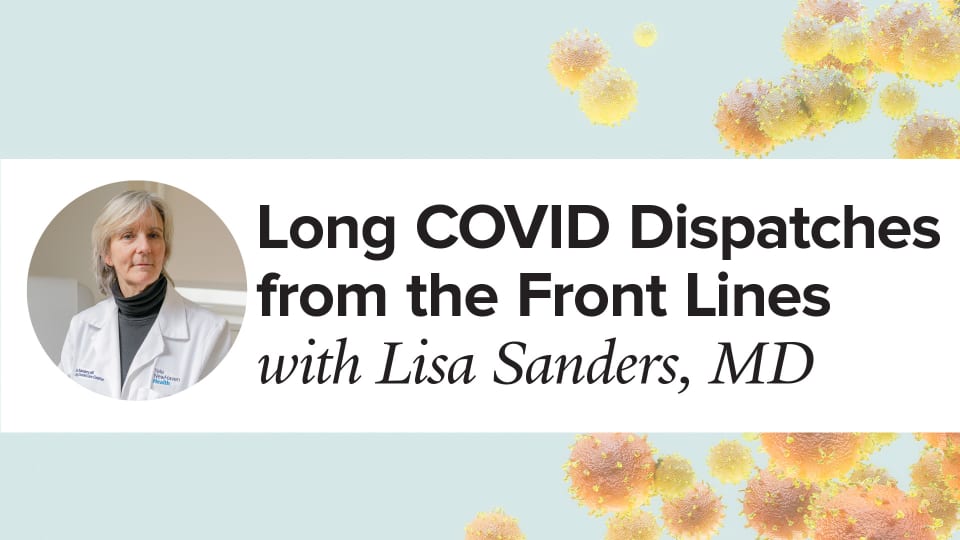
Patricia H.\* knew that something was wrong. “One night I sat down with my boyfriend to eat dinner and thought, ‘Did I not spice this chicken? Because it has no flavor.’” She then realized that she couldn’t smell her dinner either. “My boyfriend looked at me and said, ‘You have COVID!’” He was right. It was March 2020. Fortunately, Patricia didn’t have any other symptoms. But more than four years later, she still hasn’t regained her sense of taste and smell.
She’s certainly not alone. An estimated 60% of patients infected in 2021 with SARS-Co-V2, the virus that causes COVID, lost some ability to taste or smell, according to [research](https://pubmed.ncbi.nlm.nih.gov/37265267/) published in 2023. Even though such changes are usually transient, the research also found that one-quarter of those patients didn’t experience a full recovery and were left with a diminished sense of smell.
In our hierarchy of senses, vision is king, followed by hearing, then touch, and taste, with the sense of smell trailing at the end. In a recent [study](https://www.ncbi.nlm.nih.gov/pmc/articles/PMC8946147/), almost 25% of college-aged adults said that they would sacrifice their sense of smell completely for \$10,000 (at a meager \$0.00083 dollars per neuron). And yet despite the low value placed on this sense, its loss—a condition known as anosmia—can be one of the most frustrating and limiting consequences of many viral infections, including COVID-19.
Most patients recover their sense of smell within one to two years. For many of those who do not, anosmia can cause significant emotional distress and depression. And it’s not just the sense of smell that is affected by anosmia. As Patricia also experienced, taste is intimately linked to aromas. Our sense of taste is defined by the five types of taste buds in the mouth, which can perceive sweet, sour, bitter, salty, or umami (savory). But flavor is more than those five basics. The aromas from food join with the input from the taste buds to give our meals the complex pleasure that eating provides.
## Smell retraining as a therapeutic option
Clinical treatment options for anosmia following viral infections are currently limited and demonstrate mixed results. Therapeutic options have been hampered by the relatively small amount of research prior to the COVID-19 pandemic.
However, one option for patients is smell retraining. “Olfactory training is not new; we’ve been using it for a long time,” says [R. Peter Manes, MD](https://medicine.yale.edu/profile/rpeter-manes/), associate professor of surgery (otolaryngology) at Yale School of Medicine. “This is because you can lose your sense of smell from other viruses as well.”
First, a clinician will gauge the severity of the anosmia using testing such as the [University of Pennsylvania Smell Identification Test (UPSIT)](https://www.pennmedicine.org/updates/blogs/penn-physician-blog/2020/june/the-university-of-pennsylvania-smell-identification-test-upsit-for-covid-19). “It’s a scratch-and-sniff test, essentially,” says Manes. “Based on the number of correct answers, we can say whether someone’s loss of sense of smell is total, severe, moderate, mild, or normal.” Clinicians will also rule out other potential causes of anosmia, such as nasal polyps or certain kinds of tumors.
At the start of the nine-month anosmia treatment program, patients will receive four scents—lemon, rose, eucalyptus, and cloves. Twice a day, they will smell these scents for about 15 seconds each. Clinicians will encourage participants to try to imagine how they remember these scents smelling as they sniff them. After three months, clinicians will reevaluate the severity of anosmia and give patients four new odorants. They will repeat this step at six months. By the end of the program, patients will have received 12 scents in total. Other common scents that may be used in such testing include orange, banana, apple, coffee, cinnamon, garlic, leather, and peppermint.
## Patient groups lend crucial support
Perhaps of equal importance to clinical efforts to support individuals with anosmia are patient advocacy groups like [Fifth Sense](https://www.fifthsense.org.uk/longcovidhub/) and [abScent](https://abscent.org/covid-19), which have developed extensive networks to help support individuals with anosmia and connect them with resources and guides on living healthily and safely with anosmia. For instance, while many of us take for granted the ability to smell smoke from a distance or a gas leak during its earliest stages, individuals with anosmia need to take extra precautions to ensure their [safety](https://www.fifthsense.org.uk/safety-advice/) in the home and at work in ways that most of us never need to consider.
At its core, anosmia is an isolating and pernicious consequence of SARS-CoV-2 infection. When it persists beyond acute infection, becoming one symptom among a constellation in Long COVID, it robs us of an essential spark in the building and reliving of our memories. And yet it is also so hard to describe the nature of this loss to the people around us. What really is the impact of not being able to smell your morning coffee? Or how uncomfortable is it to miss out on the scent of a home-cooked meal escaping from an oven? How can we describe the awe of smelling a thunderstorm in the air? The truth is that the costs of anosmia are unique to every individual, and we owe it to those who struggle with their loss to listen, to understand, and to acknowledge just how their loss has affected them.
*\*Not the patient’s real name.*
*Jon Klein is an MD/PhD candidate at Yale School of Medicine.*
## The last word from Lisa Sanders, MD:
At my clinic, I’ve noticed that Long COVID patients who have lost their sense of smell and taste are often apologetic. They don’t like to make a fuss—a stink as it were—about the loss of these senses when they perceive so many others with Long COVID as being so much sicker. But this is not a contest. These are important losses to Patricia, as well as others dealing with the same problem, and that’s what matters.
Knowing how long Patricia has been dealing with her loss of smell and taste, I told her about an approach that had been mentioned to me by a patient I had seen not long after my clinic first opened. It’s called a stellate ganglion block (SGB). The stellate ganglion is a bundle of nerves—part of the sympathetic nervous system—located in the neck. It’s star-shaped, hence the name, and about the size of the head of a thumbtack. These nerves control pain, sweating, vasodilation and constriction, pupillary dilation, blushing and flushing. In other words, just about all the sympathetic nerve functions of the upper body.
Injection of an anesthetic into this tiny nerve bundle has been used for many years to address different forms of nerve pain. More recently, it has been looked at as a way to treat loss of smell and taste. When that early patient told me about SGB—a therapy she’d read about on some of the many blogs for those who have lost their sense of smell and taste—I’d never heard of it. I looked it up and, sure enough, there had been a few small studies done. In one [study](https://pubmed.ncbi.nlm.nih.gov/37162813/), 195 Long COVID patients who had either lost their sense of smell or had alterations in their sense of smell were treated with SGB. A week later, nearly 90% reported improvement. Other smaller case reports used [Sniffin’ Sticks](https://usneurologicals.com/Item/ST_SniffinSticks), an olfactory test used to measure change in the sense of smell and showed similar results.
I sent the patient who had first told me about SGB to Robert Chow, MD, an anesthesiologist and interventional pain specialist at Yale New Haven Hospital, who has used the outpatient procedure to treat pain. The patient sent me an email a few weeks later. She’d had the injection and smelled coffee that day for the first time in three years. I called Dr. Chow to ask how this might work. He described it as something like turning off your computer when it gets wonky. When it’s restarted, it resets, and the problem often goes away. These blockades, he speculates, let the nerves reset.
Most of medical literature on SGB for loss of smell or taste in patients with Long COVID is limited to case studies. A lot more research is needed, of course. There are no large, well-conducted studies published yet, though many are under way. When I recently told Patricia about SGB as a possible treatment for her loss of smell and taste, I explained how little we really know about its effectiveness. She wanted to think it over but is now scheduled to undergo the procedure. Patricia realizes that there’s no guarantee that SGB will be a cure for her symptoms. It could have [side effects](https://www.ncbi.nlm.nih.gov/pmc/articles/PMC10368190/), such as an altered sense of smell or taste, and isn’t covered by her insurance. Even so, she says she feels “hopeful that the SGB will return my ability to enjoy life to its fullest.”
***Read other installments of Long COVID Dispatches [here](https://ym.care/long-covid-blog).***
***If you’d like to share your experience with Long COVID for possible use in a future post (under a pseudonym), write to us at:*** [***LongCovid*****Dispatches@yale.edu**](mailto:LongCovidDispatches@yale.edu)
***Information provided in Yale Medicine content is for general informational purposes only. It should never be used as a substitute for medical advice from your doctor or other qualified clinician. Always seek the individual advice of your health care provider with any questions you have regarding a medical condition.***
[Read more Yale Medicine news](https://www.yalemedicine.org/news)
### Related Specialists
- [Mark Bianchi MD](https://www.yalemedicine.org/specialists/mark-bianchi)
- [R Peter Manes MD](https://www.yalemedicine.org/specialists/rpeter-manes)
- [Michael Lerner MD](https://www.yalemedicine.org/specialists/michael-lerner)
[More Related Specialists](https://www.yalemedicine.org/search/specialists?entityType=News&entityId=717&q=When%20Loss%20of%20Smell%20and%20Taste%20Occurs%20with%20Long%20COVID)
### Related Fact Sheets
- [Loss of Smell (Anosmia) Anosmia is a condition that causes a person to partially or completely lose his or her sense of smell. Learn about symptoms and treatment.](https://www.yalemedicine.org/conditions/smell-and-taste-disorders)
Related Terms:
[Smell and Taste Disorders](https://www.yalemedicine.org/clinical-keywords/smell-and-taste-disorders)
[Anosmia](https://www.yalemedicine.org/clinical-keywords/anosmia)
[Hyposmia (partial loss of smell)](https://www.yalemedicine.org/clinical-keywords/hyposmia)
## More news from Yale Medicine
- [Research & Innovation ](https://www.yalemedicine.org/news/prevent-loss-smell-covid)
- [Doctors & Advice, Family Health ](https://www.yalemedicine.org/news/what-is-cardiac-rehabilitation-and-how-does-it-help)
[More News From Yale Medicine](https://www.yalemedicine.org/news)
- [About Us](https://www.yalemedicine.org/about-us)
- [Contact Us](https://www.yalemedicine.org/about-us/contact-us)
- [Donate](https://givetoday.yale.edu/campaigns/67232/donations/new)
- [Referring Doctors](https://www.yalemedicine.org/for-medical-professionals)
- [Clinical Keywords](https://www.yalemedicine.org/clinical-keywords)
333 Cedar St.
New Haven, CT 06510
- [Yale School of Medicine](https://medicine.yale.edu/)
- [Yale University](https://www.yale.edu/)
- Website Feedback
Manage Cookie Preferences
- [Terms & Privacy Policies](https://www.yalemedicine.org/privacy)
- [Accessibility at YSM](https://medicine.yale.edu/myysm/policies/communications/accessibility/)
- [Patient Rights](http://hipaa.yale.edu/patient-rights)
- [HIPAA at Yale](http://hipaa.yale.edu/)
- [Non-discrimination Statement](https://www.yalemedicine.org/patient-tools/non-discrimination-statement)
Copyright 2025 Yale Medicine
\[2419,2835,9736\]
{"namedChunks":\["modules-news-news-details-components-NewsDetails-newsDetails"\]} |
| Readable Markdown | null |
| Shard | 140 (laksa) |
| Root Hash | 1108864629008845940 |
| Unparsed URL | org,yalemedicine!www,/news/when-loss-of-smell-and-taste-occurs-with-long-covid s443 |