ℹ️ Skipped - page is already crawled
| Filter | Status | Condition | Details |
|---|---|---|---|
| HTTP status | PASS | download_http_code = 200 | HTTP 200 |
| Age cutoff | PASS | download_stamp > now() - 6 MONTH | 4.1 months ago |
| History drop | PASS | isNull(history_drop_reason) | No drop reason |
| Spam/ban | PASS | fh_dont_index != 1 AND ml_spam_score = 0 | ml_spam_score=0 |
| Canonical | PASS | meta_canonical IS NULL OR = '' OR = src_unparsed | Not set |
| Property | Value |
|---|---|
| URL | https://www.yalemedicine.org/news/temperature-checks-covid |
| Last Crawled | 2025-12-11 04:01:49 (4 months ago) |
| First Indexed | 2020-11-17 21:28:04 (5 years ago) |
| HTTP Status Code | 200 |
| Meta Title | Is 98.6 Degrees Really a 'Normal' Temperature? | News | Yale Medicine |
| Meta Description | Yale Medicine experts explain what body temperature means, as screening becomes common during COVID-19. |
| Meta Canonical | null |
| Boilerpipe Text | null |
| Markdown | [Skip to Main Content](https://www.yalemedicine.org/news/temperature-checks-covid#page-container)
[1-877-YALEMDS](tel:+1-877-925-3637)
Search for
[Specialists](https://www.yalemedicine.org/search/specialists)[Fact Sheets](https://www.yalemedicine.org/conditions)[Departments](https://www.yalemedicine.org/departments)[Clinical Trials](https://www.yalemedicine.org/clinical-trials)[News](https://www.yalemedicine.org/news)[Patient Tools](https://www.yalemedicine.org/patient-tools)[For Medical Professionals](https://www.yalemedicine.org/for-medical-professionals)
***
[1-877-YALEMDS](tel:+1-877-925-3637)
[Doctors & Advice](https://www.yalemedicine.org/search/news?tagId=2), [Family Health](https://www.yalemedicine.org/search/news?tagId=4)
# Is 98.6 Degrees Really a 'Normal' Temperature?
BY [CARRIE MACMILLAN](https://medicine.yale.edu/profile/carrie-macmillan#links-details-section) July 30, 2020
Yale Medicine experts explain what body temperature means, as screening becomes common during COVID-19.
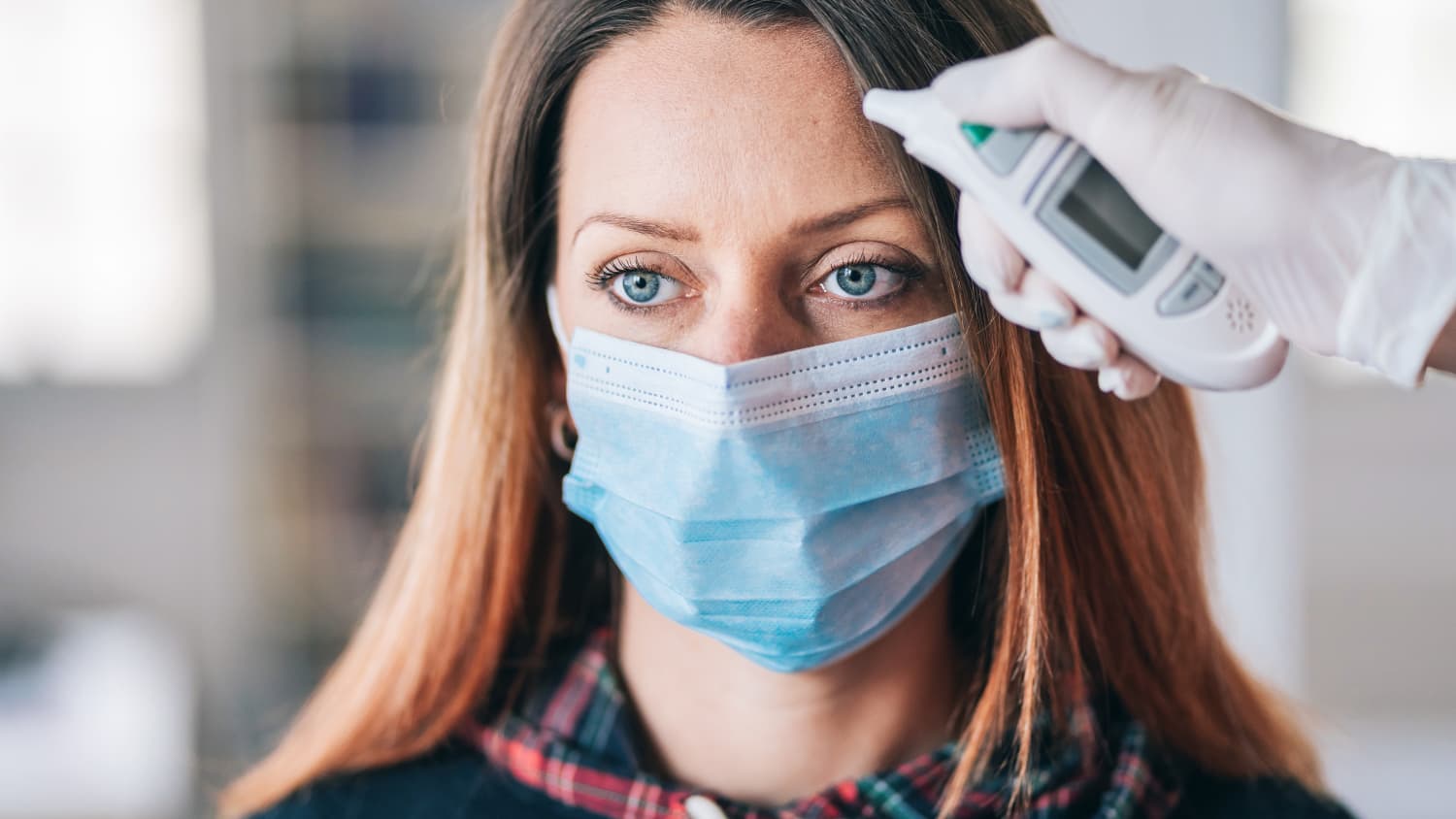
A quick temperature check is now common in the age of COVID-19. Many workplaces, medical offices, camps, and gyms are screening for fever—often with a non-contact thermometer that scans your forehead—before entry.
Body temperature is a hot topic because a fever is a common symptom of [COVID-19](https://www.yalemedicine.org/conditions/covid-19)—though not everyone who is infected will have one. And because rapid COVID-19 testing is not widely available or reliable, as parts of the country reopen, taking temperatures is one easily accessible screening tool.
But if you are expecting your body to read an exact 98.6 degrees Fahrenheit, think again. It turns out that number, which is considered to be the “normal” body temperature, may actually be a little too high.
## The origins of 98.6°F
In 1868, a German physician determined that 98.6° F was a normal body temperature after studying more than a million temperatures from 25,000 people. But researchers from Stanford University now suggest that the average body temperature has since declined by about 1.6° F. The [researchers examined](https://elifesciences.org/articles/49555) 27 modern studies about body temperature and found mean body temperature to be lower than 98.6° F across the board. One recent study that looked at 250,000 temperature measurements from 25,000 British patients found the average to be 97.9° F.
> A fever alerts you that something is going on and is the way the body makes itself a less hospitable environment for a pathogen.
>
> Elijah Paintsil, MD, Yale Medicine pediatric infectious disease specialist
The decline is likely due to changes in our environment and health, which have brought about physiological changes in the body, the researchers say.
“That original study in the 1860s was done before antibiotics were available. Therefore, many people had infections that couldn’t be treated, which would have affected temperatures if they were chronically sick,” says [Heidi Zapata, MD, PhD](https://www.yalemedicine.org/specialists/heidi-zapata), a Yale Medicine infectious disease specialist.
## What is a normal temperature?
A normal temperature is a range that can depend on numerous factors, including not only your health, but your age and time of day, says Elijah Paintsil, MD, a Yale Medicine pediatric infectious disease specialist.
“There is not going to be one single normal temperature for any given person,” he says. “For example, temperatures tend to be higher in the late afternoon and evening for everyone, and younger children and [infants can run higher temperatures](https://www.yalemedicine.org/conditions/fevers-in-infants) in general than older children and adults.”
In fact, it is easier to say what is not in the normal range—which would be anything above 100.4° F (a fever) or below 95° F (hypothermia, a medical emergency).
Normal temperature fluctuations throughout the day should span only a few degrees, researchers say, and are regulated by the body’s circadian rhythm, which controls sleep, metabolism, and other functions.
“Your temperature should remain fairly constant, often between 97 and 99 degrees, unless something is wrong,” Dr. Zapata explains.
And the fever itself, Dr. Paintsil notes, is not harmful.
“A fever can be alarming, but it’s the body’s way of responding to some sort of infection or inflammation, and we should be more concerned with what the underlying cause is,” he says. “A fever alerts you that something is going on and is the way the body makes itself a less hospitable environment for a pathogen.”
## What is the most accurate way to measure temperature?
Glass thermometers with mercury are no longer recommended and have been replaced by newer types, including digital thermometers that have probes you can place under the tongue, in the ear, or in the armpit. Some methods are considered more accurate than others.
A rectal temperature, which can be measured with a digital device, is considered the most accurate for all ages, but is often reserved for infants and young children (up to age 3). “For newborns especially, we always want the most accurate reading because a fever is more serious in this age group,” Dr. Paintsil explains. “They are not as good at fighting off infections as older children and adults.”
For older children and adults, an oral temperature is the next best option, he says. “You want to make sure you haven’t had anything to eat or drink 15 minutes before you take your temperature, as that can affect it,” he points out.
Other methods, such as measuring in the armpit, ear, or on the forehead (with a device that scans the temporal artery) are considered reasonably accurate, Dr. Paintsil says. “Many of these are convenient, but they tend to be less accurate than the oral or rectal method,” he notes. “For example, ear wax in the canal could affect the reading.”
For now, Dr. Paintsil doesn’t expect temperature-taking to go away. “It is a guideline at many places. As we learn more about this virus and have more tools at our disposal to fight it, that could change, but for now, everyone is taking temperatures,” he says.
“But I would also remember that there are many other reasons that a child or an adult can have a fever, and you should consult a physician any time you are concerned.”
[Read more Yale Medicine news](https://www.yalemedicine.org/news)
### Related Specialists
- [Heidi J Zapata MD, PhD](https://www.yalemedicine.org/specialists/heidi-zapata)
### Related Fact Sheets
- [Colds: How to Prevent Them The common cold is probably the most universal illness. It is a viral infection of the upper respiratory tract, which includes the nose and throat area.](https://www.yalemedicine.org/conditions/colds)
- [Coronavirus Coronavirus is a term describes a family of viruses, common in both animals and humans.](https://www.yalemedicine.org/conditions/coronavirus)
- [Croup A respiratory infection that mainly affects children and causes a barking cough, hoarseness, and breathing difficulties.](https://www.yalemedicine.org/conditions/croup)
Related Terms:
[Hyperthermia](https://www.yalemedicine.org/clinical-keywords/hyperthermia)
[Common Cold](https://www.yalemedicine.org/clinical-keywords/common-cold)
[Periodic Fever Syndromes](https://www.yalemedicine.org/clinical-keywords/periodic-fever-syndromes)
## More news from Yale Medicine
- [Family Health ](https://www.yalemedicine.org/news/hmpv-your-questions-answered)
- [Family Health ](https://www.yalemedicine.org/news/angelman-syndrome)
[More News From Yale Medicine](https://www.yalemedicine.org/news)
- [About Us](https://www.yalemedicine.org/about-us)
- [Contact Us](https://www.yalemedicine.org/about-us/contact-us)
- [Donate](https://givetoday.yale.edu/campaigns/67232/donations/new)
- [Referring Doctors](https://www.yalemedicine.org/for-medical-professionals)
- [Clinical Keywords](https://www.yalemedicine.org/clinical-keywords)
333 Cedar St.
New Haven, CT 06510
- [Yale School of Medicine](https://medicine.yale.edu/)
- [Yale University](https://www.yale.edu/)
- Website Feedback
Manage Cookie Preferences
- [Terms & Privacy Policies](https://www.yalemedicine.org/privacy)
- [Accessibility at YSM](https://medicine.yale.edu/myysm/policies/communications/accessibility/)
- [Patient Rights](http://hipaa.yale.edu/patient-rights)
- [HIPAA at Yale](http://hipaa.yale.edu/)
- [Non-discrimination Statement](https://www.yalemedicine.org/patient-tools/non-discrimination-statement)
Copyright 2025 Yale Medicine
\[2419,2835,9736\]
{"namedChunks":\["modules-news-news-details-components-NewsDetails-newsDetails"\]} |
| Readable Markdown | null |
| Shard | 140 (laksa) |
| Root Hash | 1108864629008845940 |
| Unparsed URL | org,yalemedicine!www,/news/temperature-checks-covid s443 |