ℹ️ Skipped - page is already crawled
| Filter | Status | Condition | Details |
|---|---|---|---|
| HTTP status | PASS | download_http_code = 200 | HTTP 200 |
| Age cutoff | PASS | download_stamp > now() - 6 MONTH | 1.5 months ago |
| History drop | PASS | isNull(history_drop_reason) | No drop reason |
| Spam/ban | PASS | fh_dont_index != 1 AND ml_spam_score = 0 | ml_spam_score=0 |
| Canonical | PASS | meta_canonical IS NULL OR = '' OR = src_unparsed | Not set |
| Property | Value |
|---|---|
| URL | https://www.whoi.edu/press-room/news-tip/faq-malaysia-airlines-flight-370/ |
| Last Crawled | 2026-03-03 01:37:52 (1 month ago) |
| First Indexed | 2019-05-13 08:10:02 (6 years ago) |
| HTTP Status Code | 200 |
| Meta Title | FAQ: Malaysia Airlines Flight 370 – Woods Hole Oceanographic Institution |
| Meta Description | The Woods Hole Oceanographic Institution has offered its expertise to the authorities responsible for the search for MH370. At this time, WHOI is not involved in the search. Until more information is available, we are limiting media interviews to those already booked., The Woods Hole Oceanographic Institution has offered its expertise to the authorities responsible for the search for MH370. At this time, WHOI is not involved in the search. Until more information is available, we are limiting media interviews to those already booked. |
| Meta Canonical | null |
| Boilerpipe Text | March 18, 2014
MEMBERS OF THE NEWS MEDIA, PLEASE NOTE: The Woods Hole Oceanographic Institution has offered its expertise to the authorities responsible for the search for MH370. At this time, WHOI is not involved in the search. Until more information is available, we are limiting media interviews to those already booked.
The fate of Malaysia Airlines flight 370 remains a mystery. Because the search for the airliner has involved searching the ocean, many have turned to those involved in the search for Air France flight 447 to learn from their experiences in that case and their expertise in detecting objects on the seafloor.
Woods Hole Oceanographic Institution Director of Special Projects
David Gallo
and Principal Engineer
Mike Purcell
co-led the search that found the missing aircraft,
Air France 447
in 2011. The search team deployed
unmanned underwater vehicles
to scan the 2.5-mile deep and rocky underwater terrain off Brazil’s northeast coast and located the wreck site two years after the plane disappeared.
Dr. Gallo and Mr. Purcell share their insight from the Air France 447 search and comment on the Malaysia Airlines Flight 370 (MH370).
How does Malaysia Airlines Flight 370 (MH370) compare to the Air France 447 search operation?
GALLO: During the Air France 447 search, the area was very remote, the sea very deep, and the seafloor was very rugged and mountainous. The search area was as deep as 4,000 meters and spread out over 5,000 square miles.
The potential MH370 search area is much larger and it must be reduced prior to starting any underwater search. The Indian Ocean seafloor is varied so it is possible that the terrain would be similar to the Air France 447 search.
How different is the southern Indian Ocean from the Atlantic Ocean?
GALLO: Topographically they are relatively similar. A 50,000-mile-long chain of underwater mountains with steep slopes and deep valleys called the Mid-Ocean Ridge runs through both oceans. At that depth, the ocean is pitch black, so the search would rely on the use of sonar. The southeast Indian Ridge ranges from about 2,500-4,000 meters deep. The bottom is comprised of hard volcanic rock.
However, the southern Indian Ocean has some of the roughest seas in the world, which can prolong any search operation at sea.
PURCELL: The Indian Ocean’s surface conditions would be an added challenge for any autonomous underwater vehicle (AUV) launch and recovery, and possibly for towed sonar systems. While we did not have to suspend operations during the AF447 search because of weather, it would be more likely to happen in the southern Indian Ocean where the weather can be more severe.
How would debris help lead you back to the potential wreck site?
PURCELL: After debris from the plane is located in the water or on a beach, the next step would be to project where it came from. This involves modeling the wind, waves, and currents and estimating how the located objects would drift in these conditions. The longer it takes to locate the debris, the harder it becomes to accurately project the accident location and thus the search area increases.
GALLO: Once debris is located, and ideally the aircraft’s Last Known Position (LKP) identified, scientists can back track where the debris came from by using sophisticated computer models. Wind on the sea surface and ocean currents below play significant roles in determining where and how debris will move in the ocean.
These models can estimate the debris path over the last 16 days fairly accurately. However, the more time passes without any debris found, the margin of error in the models widens.
What does a search at sea entail?
PURCELL: A search area location far from shore requires good planning. Because it can takes days to reach the search zone by ship, once you are at sea, you have to work with what you have brought with you. An underwater search is slow compared to a surface search for debris using many planes and ships. By contrast, the
autonomous underwater vehicles
(AUVs) or
towed systems
move much slower and the acoustic sensors (sonar) can see much shorter distances than radar systems used on planes.
It also depends on where the wreckage settles. In areas with a flat seafloor, it is relatively easy to identify the wreckage in the acoustic data. If it has settled in an area with rough terrain, it can be more difficult. Typically, potential sites first are identified from the sonar data and then pictures are taken to confirm if the target is the wreckage.
In the case of MH370, is the length of this search typical or expected?
GALLO: This is an extremely unusual case, because there has been no confirmed evidence of the plane at all.
PURCELL: The search is complicated by the fact the plane flew for a long time without transmitting its position. This has created a huge initial search area.
What do you think we can learn from the search for Air France 447?
PURCELL: From my viewpoint, we learned many things about conducting an underwater search that could be useful if such a search is required for MH370. Perhaps it is more important to understand that it took almost two years to locate the wreckage from the Air France accident. Determining what happened, deciding where to look, and then looking, can take a long time. |
| Markdown | [Skip to content](https://www.whoi.edu/press-room/news-tip/faq-malaysia-airlines-flight-370/#fl-main-content)
- [Shop](https://shop.whoi.edu/)
- [Join Us](https://www.whoi.edu/join-us/)
- [Press Room](https://www.whoi.edu/press-room/)
- [Directory](https://www.whoi.edu/directory/)
[](https://www.whoi.edu/)
MENUMENU
- [Who We Are](https://www.whoi.edu/who-we-are/)
- - - 
#### We are the world’s leading, independent, non-profit organization dedicated to ocean research, exploration, and education.
- - - [About WHOI](https://www.whoi.edu/who-we-are/about-us/)
- [Vision & Mission](https://www.whoi.edu/who-we-are/about-us/vision-mission/)
- [Leadership](https://www.whoi.edu/who-we-are/about-us/leadership/)
- [Our People](https://www.whoi.edu/who-we-are/about-us/people/)
- [History & Legacy](https://www.whoi.edu/who-we-are/about-us/history-legacy/)
- [Annual Reports](https://www.whoi.edu/who-we-are/about-us/brochures-publications/financial-reporting/)
- [WHOI Giving](https://www.whoi.edu/giving/)
- [Contact Us](https://www.whoi.edu/who-we-are/contact-us/)
- - - [Visit WHOI](https://www.whoi.edu/who-we-are/visit-whoi/)
- [Directions & Maps](https://www.whoi.edu/who-we-are/visit-whoi/directions/)
- [Discovery Center](https://www.whoi.edu/who-we-are/visit-whoi/ocean-science-discovery-center/)
- [WHOI Store](https://www.whoi.edu/who-we-are/visit-whoi/visitor-center/)
- [Events Calendar](https://www.whoi.edu/events)
- [Guided Tours](https://www.whoi.edu/who-we-are/visit-whoi/events-happenings/walking-tours/)
- [FAQs](https://www.whoi.edu/who-we-are/visit-whoi/faqs/)
- [Online Store](https://shopwhoi.myshopify.com/)
- - - [Work with WHOI](https://www.whoi.edu/who-we-are/work-with-whoi/)
- [WHOI OceanWorks](https://www.whoi.edu/oceanworks/)
- [Foundation Relations](https://www.whoi.edu/what-we-do/understand/foundation-relations/)
- [Scientific Services](https://www.whoi.edu/what-we-do/understand/scientific-facilities-services/)
- [Grants & Contracts](https://www.whoi.edu/who-we-are/work-with-whoi/gcs/)
- [Vendors & Contractors](https://www.whoi.edu/who-we-are/work-with-whoi/vendors-contractors/)
- [Bid Opportunities](https://www.whoi.edu/who-we-are/work-with-whoi/bid-opportunities/)
- [Careers at WHOI](https://careers.whoi.edu/)
- [What We Do](https://www.whoi.edu/what-we-do/)
- - - 

- - [Understand](https://www.whoi.edu/what-we-do/understand/)
- [Areas of Research](https://www.whoi.edu/what-we-do/understand/areas-of-research/)
- [Departments, Centers & Labs](https://www.whoi.edu/what-we-do/understand/departments-centers-labs/)
- [Programs & Projects](https://www.whoi.edu/what-we-do/understand/programs-projects/)
- [Facilities & Services](https://www.whoi.edu/what-we-do/understand/scientific-facilities-services/)
- [Data & Repositories](https://www.whoi.edu/what-we-do/understand/data/)
- [MBLWHOI Library](https://www.whoi.edu/what-we-do/educate/student-life/student-life-campus/mblwhoi-library/)
- - 
- - [Explore](https://www.whoi.edu/what-we-do/explore/)
- [Ships](https://www.whoi.edu/what-we-do/explore/ships/)
- [Underwater Vehicles](https://www.whoi.edu/what-we-do/explore/underwater-vehicles/)
- [Ocean Observatories](https://www.whoi.edu/what-we-do/explore/ocean-observatories/)
- [Instruments](https://www.whoi.edu/what-we-do/explore/instruments/)
- [Cruise Planning](https://www.whoi.edu/what-we-do/explore/cruise-planning/)
- [Expedition Blogs](https://www.whoi.edu/what-we-do/explore/blogs-expeditions/)
- - 

- - [Educate](https://www.whoi.edu/what-we-do/educate/)
- [Graduate](https://www.whoi.edu/what-we-do/educate/graduate-programs/)
- [Postdoctoral](https://www.whoi.edu/what-we-do/educate/postdoctoral/)
- [Undergraduate](https://www.whoi.edu/what-we-do/educate/undergraduate-programs/)
- [Guest Students](https://www.whoi.edu/what-we-do/educate/gueststudent/)
- [K-12 Resources](https://www.whoi.edu/what-we-do/educate/k-12-students-and-teachers/)
- [Academic Programs Office](https://www.whoi.edu/what-we-do/educate/apo/)
- - 


Solving business challenges with proven ocean expertise.
[Partner With Us](https://www.whoi.edu/oceanworks/)
- [Ocean Learning Hub](https://www.whoi.edu/ocean-learning-hub/)
- - - [](https://www.whoi.edu/ocean-learning-hub/ocean-topics/)
- - [Explore Ocean Topics](https://www.whoi.edu/ocean-learning-hub/ocean-topics/)
- [Corals](https://www.whoi.edu/ocean-learning-hub/ocean-topics/ocean-life/coral/)
- [Twilight Zone](https://www.whoi.edu/ocean-learning-hub/ocean-topics/how-the-ocean-works/ocean-zones/twilight-zone/)
- [Hydrothermal Vents](https://www.whoi.edu/ocean-learning-hub/ocean-topics/how-the-ocean-works/seafloor-below/hydrothermal-vents/)
- [Right Whales](https://www.whoi.edu/ocean-learning-hub/ocean-topics/ocean-life/marine-mammals/right-whales/)
- [Emperor Penguins](https://www.whoi.edu/ocean-learning-hub/ocean-topics/ocean-life/sea-birds/emperor-penguins/)
- - [](https://www.whoi.edu/ocean-learning-hub/ocean-facts)
- - [Ocean Facts](https://www.whoi.edu/ocean-learning-hub/ocean-facts)
- [Why are corals so colorful?](https://www.whoi.edu/ocean-learning-hub/ocean-facts/why-are-corals-so-colorful/)
- [How are seashells made?](https://www.whoi.edu/ocean-learning-hub/ocean-facts/how-are-seashells-made/)
- [Why is the ocean blue?](https://www.whoi.edu/ocean-learning-hub/ocean-facts/why-is-the-ocean-blue/)
- [What causes ocean waves?](https://www.whoi.edu/ocean-learning-hub/ocean-facts/what-causes-ocean-waves/)
- [How is beach sand created?](https://www.whoi.edu/ocean-learning-hub/ocean-facts/how-is-beach-sand-created/)
- - [](https://www.whoi.edu/ocean-learning-hub/multimedia)
- - [Multimedia](https://www.whoi.edu/ocean-learning-hub/multimedia)
- [Images](https://www.whoi.edu/ocean-learning-hub/search/?media_types=image)
- [Video](https://www.whoi.edu/ocean-learning-hub/search/?media_types=video)
- [Illustration](https://www.whoi.edu/ocean-learning-hub/search/?media_types=illustration)
- [Interactive Science](https://www.whoi.edu/ocean-learning-hub/search/?media_types=interactive-science)
- [Maps](https://www.whoi.edu/ocean-learning-hub/search/?media_types=maps)
- - [](https://www.whoi.edu/oceanus/issues/vol-60-no-2-winter-2025/)
[READ ABOUT OUR LATEST RESEARCH](https://www.whoi.edu/oceanus/issues/vol-60-no-2-winter-2025/)
- [News](https://www.whoi.edu/news-insights/)
- [Give Now](https://explore.whoi.edu/campaign)
- [Home](https://www.whoi.edu/)
- [Press Room](https://www.whoi.edu/press-room/)
- [News Tips](https://www.whoi.edu/press-room/news-tip/)
- FAQ: Malaysia Airlines Flight 370
# FAQ: Malaysia Airlines Flight 370
***
March 18, 2014
MEMBERS OF THE NEWS MEDIA, PLEASE NOTE: The Woods Hole Oceanographic Institution has offered its expertise to the authorities responsible for the search for MH370. At this time, WHOI is not involved in the search. Until more information is available, we are limiting media interviews to those already booked.
The fate of Malaysia Airlines flight 370 remains a mystery. Because the search for the airliner has involved searching the ocean, many have turned to those involved in the search for Air France flight 447 to learn from their experiences in that case and their expertise in detecting objects on the seafloor.
Woods Hole Oceanographic Institution Director of Special Projects **David Gallo** and Principal Engineer **Mike Purcell** co-led the search that found the missing aircraft, [Air France 447](https://www.whoi.edu/know-your-ocean/ocean-topics/ocean-human-lives/underwater-archaeology/air-france-flight-447/) in 2011. The search team deployed [unmanned underwater vehicles](https://www.whoi.edu/what-we-do/explore/underwater-vehicles/auvs/remus/) to scan the 2.5-mile deep and rocky underwater terrain off Brazil’s northeast coast and located the wreck site two years after the plane disappeared.
Dr. Gallo and Mr. Purcell share their insight from the Air France 447 search and comment on the Malaysia Airlines Flight 370 (MH370).
### How does Malaysia Airlines Flight 370 (MH370) compare to the Air France 447 search operation?
GALLO: During the Air France 447 search, the area was very remote, the sea very deep, and the seafloor was very rugged and mountainous. The search area was as deep as 4,000 meters and spread out over 5,000 square miles.
The potential MH370 search area is much larger and it must be reduced prior to starting any underwater search. The Indian Ocean seafloor is varied so it is possible that the terrain would be similar to the Air France 447 search.
### How different is the southern Indian Ocean from the Atlantic Ocean?
GALLO: Topographically they are relatively similar. A 50,000-mile-long chain of underwater mountains with steep slopes and deep valleys called the Mid-Ocean Ridge runs through both oceans. At that depth, the ocean is pitch black, so the search would rely on the use of sonar. The southeast Indian Ridge ranges from about 2,500-4,000 meters deep. The bottom is comprised of hard volcanic rock.
However, the southern Indian Ocean has some of the roughest seas in the world, which can prolong any search operation at sea.
PURCELL: The Indian Ocean’s surface conditions would be an added challenge for any autonomous underwater vehicle (AUV) launch and recovery, and possibly for towed sonar systems. While we did not have to suspend operations during the AF447 search because of weather, it would be more likely to happen in the southern Indian Ocean where the weather can be more severe.
### How would debris help lead you back to the potential wreck site?
PURCELL: After debris from the plane is located in the water or on a beach, the next step would be to project where it came from. This involves modeling the wind, waves, and currents and estimating how the located objects would drift in these conditions. The longer it takes to locate the debris, the harder it becomes to accurately project the accident location and thus the search area increases.
GALLO: Once debris is located, and ideally the aircraft’s Last Known Position (LKP) identified, scientists can back track where the debris came from by using sophisticated computer models. Wind on the sea surface and ocean currents below play significant roles in determining where and how debris will move in the ocean.
These models can estimate the debris path over the last 16 days fairly accurately. However, the more time passes without any debris found, the margin of error in the models widens.
### What does a search at sea entail?
PURCELL: A search area location far from shore requires good planning. Because it can takes days to reach the search zone by ship, once you are at sea, you have to work with what you have brought with you. An underwater search is slow compared to a surface search for debris using many planes and ships. By contrast, the [autonomous underwater vehicles](https://www.whoi.edu/what-we-do/explore/underwater-vehicles/auvs/) (AUVs) or [towed systems](https://www.whoi.edu/what-we-do/explore/underwater-vehicles/towed-vehicles/) move much slower and the acoustic sensors (sonar) can see much shorter distances than radar systems used on planes.
It also depends on where the wreckage settles. In areas with a flat seafloor, it is relatively easy to identify the wreckage in the acoustic data. If it has settled in an area with rough terrain, it can be more difficult. Typically, potential sites first are identified from the sonar data and then pictures are taken to confirm if the target is the wreckage.
### In the case of MH370, is the length of this search typical or expected?
GALLO: This is an extremely unusual case, because there has been no confirmed evidence of the plane at all.
PURCELL: The search is complicated by the fact the plane flew for a long time without transmitting its position. This has created a huge initial search area.
### What do you think we can learn from the search for Air France 447?
PURCELL: From my viewpoint, we learned many things about conducting an underwater search that could be useful if such a search is required for MH370. Perhaps it is more important to understand that it took almost two years to locate the wreckage from the Air France accident. Determining what happened, deciding where to look, and then looking, can take a long time.

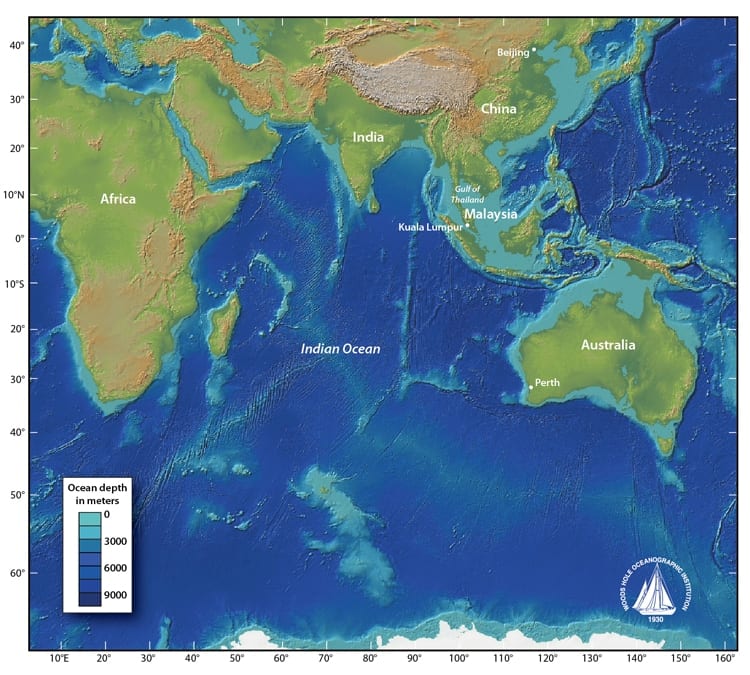
The Indian Ocean spans about 73.6 million square kilometers (28.4 million square miles). With mid-ocean ridges, deep ocean trenches, strong winds, and currents, it is a large and complex body of water to search and navigate. The deepest point of the Indian Ocean is the Diamantina Trench, which drops to 8,047 meters, or over 5 miles deep. (Map courtesy of Jack Cook, Graphic Services Group, Woods Hole Oceanographic Institution)

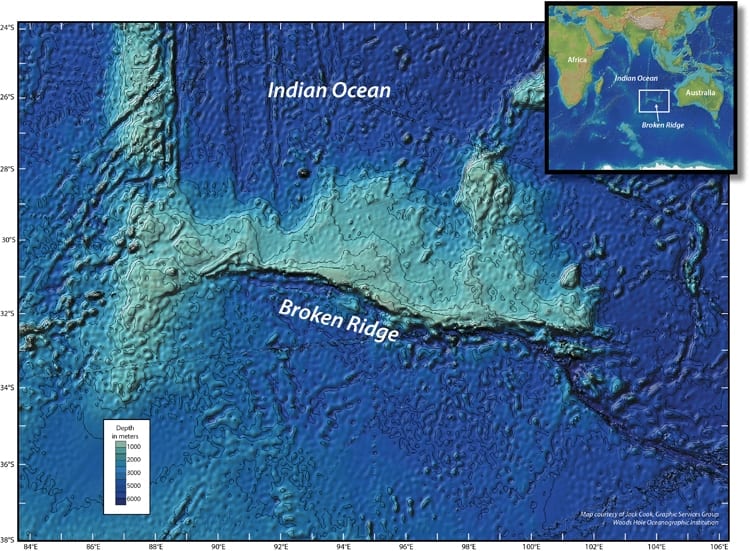
Southern Indian Ocean volcanic plateau, Broken Ridge, ranges from 800 to 3,000 meters deep. (Map courtesy of Jack Cook, Graphic Services Group, Woods Hole Oceanographic Institution)

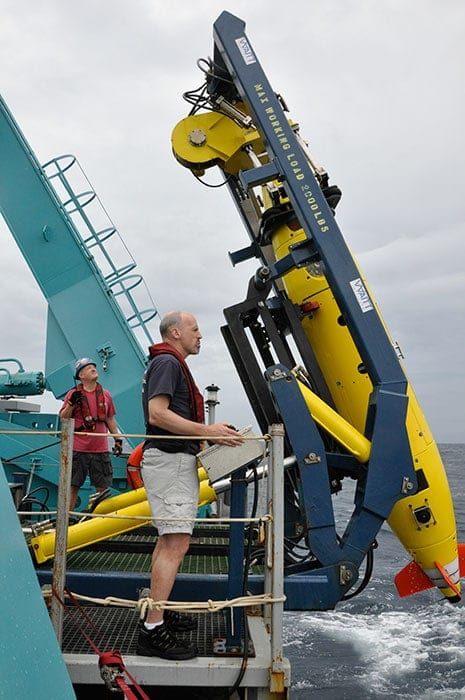
Principal engineer Mike Purcell deploys an unmanned underwater vehicle developed at Woods Hole Oceanographic Institution - the REMUS 6000 - to search for the Air France 447 aircraft. Purcell and his team successfully located the airplane crash site in 2011, two years after the plane went missing. (Photo courtesy of Woods Hole Oceanographic Institution)


David Gallo, director of special projects, co-led the Woods Hole Oceanographic Institution team that searched and discovered the missing Air France 447 plane off the coast of Brazil. (Photo courtesy of Woods Hole Oceanographic Institution)

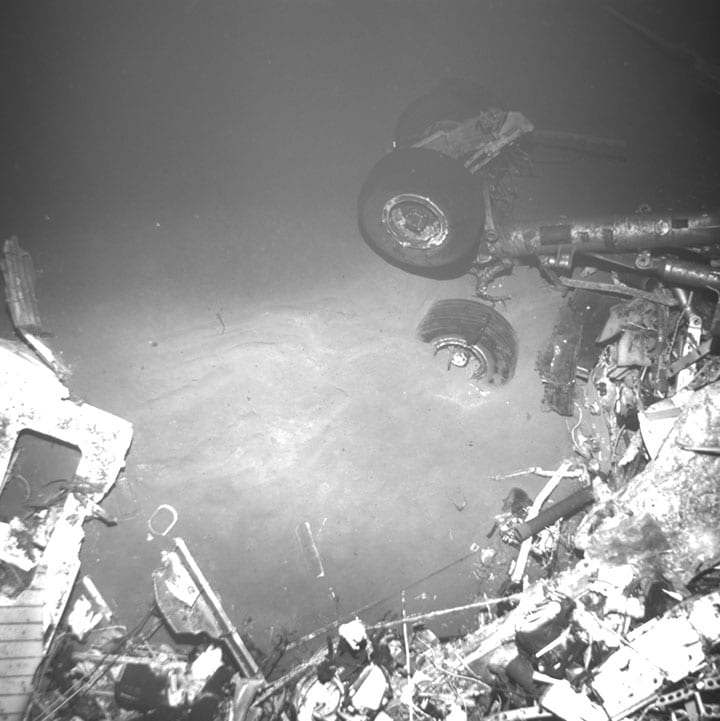
Air France flight 447 from Rio de Janeiro to Paris crashed several hundred miles off the northeastern coast of Brazil. On April 4, 2011, a search team led by the Woods Hole Oceanographic Institution (WHOI) located the wreckage of the Airbus jet some 3,900 meters (nearly 2.5 miles) below the surface of the Atlantic Ocean.
## See Also
- [Air France Flight 447](https://www.whoi.edu/know-your-ocean/ocean-topics/ocean-human-lives/underwater-archaeology/air-france-flight-447/)
- [WHOI Expertise, Technology, Tapped for Search for Air France Flight 447](https://www.whoi.edu/press-room/news-release/whoi-expertise-technology-tapped-for-search-for-air-france-flight-447/)
- [WHOI Conducts Latest Search for Air France Flight 447](https://www.whoi.edu/press-room/news-release/whoi-conducts-latest-search-for-air-france-flight-447/)
- [Ocean currents, gyres, and eddies](https://www.whoi.edu/know-your-ocean/ocean-topics/how-the-ocean-works/ocean-circulation/currents-gyres-eddies/)
Ocean currents, gyres and eddies play a crucial role in Earth’s global ocean circulation. Their effects can extend down for miles, in some places reaching the ocean bottom.


266 Woods Hole Road, Woods Hole, MA 02543-1050
Woods Hole Oceanographic Institution is a 501 (c)(3) organization. We are proud to be recognized as a financially accountable and transparent, 4-star charity organization by Charity Navigator.
[GIVE NOW](https://explore.whoi.edu/campaign)
#### Research
[Areas of Research](https://www.whoi.edu/what-we-do/understand/areas-of-research/)
[Departments & Centers](https://www.whoi.edu/what-we-do/understand/departments-centers-labs/)
[Programs & Projects](https://www.whoi.edu/what-we-do/understand/programs-projects/)
[Ships & Technology](https://www.whoi.edu/what-we-do/explore/ships/)
[Data & Repositories](https://www.whoi.edu/what-we-do/understand/data/)
[MBLWHOI Library](http://www.mblwhoilibrary.org/)
#### Around WHOI
[Directions & Maps](https://www.whoi.edu/who-we-are/visit-whoi/directions/)
[Events Calendar](https://www.whoi.edu/events)
[Visit WHOI](https://www.whoi.edu/who-we-are/visit-whoi/)
[Guided Tours](https://www.whoi.edu/who-we-are/visit-whoi/events-happenings/tours/)
[ShopWHOI](https://shop.whoi.edu/)
#### ACADEMICS
[Graduate](https://www.whoi.edu/what-we-do/educate/graduate-programs/)
[Postdoctoral](https://www.whoi.edu/what-we-do/educate/postdoctoral/)
[Undergraduate](https://www.whoi.edu/what-we-do/educate/undergraduate-programs/)
[Guest Students](https://www.whoi.edu/what-we-do/educate/gueststudent/)
[K-12 Resources](https://www.whoi.edu/what-we-do/educate/k-12-students-and-teachers/)
[Accreditation](https://www.whoi.edu/what-we-do/educate/apo/accreditation/)
#### RESOURCES
[Career Opportunities](https://careers.whoi.edu/)
[People Directory](https://www.whoi.edu/directory/)
[Community Housing](https://www.whoi.edu/what-we-do/educate/student-life/student-life-campus/housing/community-housing/)
[Annual Reports](https://www.whoi.edu/who-we-are/about-us/brochures-publications/financial-reporting/)
### GET THE OCEAN IN YOUR INBOX
We do not share email addresses. Read our [Privacy Policy](https://www-dev.whoi.edu/privacy-policy/).
### CONNECT
[](https://www.facebook.com/WoodsHoleOcean/)[](https://twitter.com/whoi)[](https://www.instagram.com/whoi.ocean/)[](https://www.youtube.com/user/WoodsHoleOceanInst)[](https://www.linkedin.com/school/woods-hole-oceanographic-institution/)
© 2026 Woods Hole Oceanographic Institution. All Rights Reserved. [Contact Us](https://www.whoi.edu/who-we-are/contact-us/) \| [Privacy Policy](https://www.whoi.edu/privacy-policy/)
General Information: [information@whoi.edu](mailto:information@whoi.edu) or (508) 548-1400 \| Website inquiries: [webdev@whoi.edu](mailto:webdev@whoi.edu) \| Media inquiries: [media@whoi.edu](mailto:media@whoi.edu)
Cookies Policy
To provide the best experience possible, we use [cookies](https://www.whoi.edu/cookie-policy-eu/) and other data for a number of reasons, such as keeping the Woods Hole Oceanographic Institution sites reliable and secure, providing social media features and to analyze how our sites are used.
To provide the best experience possible, we use [cookies](https://www.whoi.edu/cookie-policy-eu/) and other data for a number of reasons, such as keeping the WHOI sites reliable and secure, providing social media features and to analyze how our sites are used.
Functional
Functional
Always active
The technical storage or access is strictly necessary for the legitimate purpose of enabling the use of a specific service explicitly requested by the subscriber or user, or for the sole purpose of carrying out the transmission of a communication over an electronic communications network.
Preferences
Preferences
The technical storage or access is necessary for the legitimate purpose of storing preferences that are not requested by the subscriber or user.
Statistics
Statistics
The technical storage or access that is used exclusively for statistical purposes. The technical storage or access that is used exclusively for anonymous statistical purposes. Without a subpoena, voluntary compliance on the part of your Internet Service Provider, or additional records from a third party, information stored or retrieved for this purpose alone cannot usually be used to identify you.
Marketing
Marketing
The technical storage or access is required to create user profiles to send advertising, or to track the user on a website or across several websites for similar marketing purposes.
[Manage options](https://www.whoi.edu/press-room/news-tip/faq-malaysia-airlines-flight-370/) [Manage services](https://www.whoi.edu/press-room/news-tip/faq-malaysia-airlines-flight-370/) [Manage {vendor\_count} vendors](https://www.whoi.edu/press-room/news-tip/faq-malaysia-airlines-flight-370/) [Read more about these purposes](https://cookiedatabase.org/tcf/purposes/)
Accept all cookies
Necessary cookies only
Customize settings
Save preferences
[Customize settings](https://www.whoi.edu/press-room/news-tip/faq-malaysia-airlines-flight-370/)
[{title}](https://www.whoi.edu/press-room/news-tip/faq-malaysia-airlines-flight-370/) [{title}](https://www.whoi.edu/press-room/news-tip/faq-malaysia-airlines-flight-370/) [{title}](https://www.whoi.edu/press-room/news-tip/faq-malaysia-airlines-flight-370/)
Cookies Policy
To provide the best experience possible, we use [cookies](https://www.whoi.edu/cookie-policy-eu/) and other data for a number of reasons, such as keeping the Woods Hole Oceanographic Institution sites reliable and secure, providing social media features and to analyze how our sites are used.
To provide the best experience possible, we use [cookies](https://www.whoi.edu/cookie-policy-eu/) and other data for a number of reasons, such as keeping the WHOI sites reliable and secure, providing social media features and to analyze how our sites are used.
Functional
Functional
Always active
The technical storage or access is strictly necessary for the legitimate purpose of enabling the use of a specific service explicitly requested by the subscriber or user, or for the sole purpose of carrying out the transmission of a communication over an electronic communications network.
Preferences
Preferences
The technical storage or access is necessary for the legitimate purpose of storing preferences that are not requested by the subscriber or user.
Statistics
Statistics
The technical storage or access that is used exclusively for statistical purposes. The technical storage or access that is used exclusively for anonymous statistical purposes. Without a subpoena, voluntary compliance on the part of your Internet Service Provider, or additional records from a third party, information stored or retrieved for this purpose alone cannot usually be used to identify you.
Marketing
Marketing
The technical storage or access is required to create user profiles to send advertising, or to track the user on a website or across several websites for similar marketing purposes.
[Manage options](https://www.whoi.edu/press-room/news-tip/faq-malaysia-airlines-flight-370/) [Manage services](https://www.whoi.edu/press-room/news-tip/faq-malaysia-airlines-flight-370/) [Manage {vendor\_count} vendors](https://www.whoi.edu/press-room/news-tip/faq-malaysia-airlines-flight-370/) [Read more about these purposes](https://cookiedatabase.org/tcf/purposes/)
Accept All
Necessary cookies only
Customize settings
Save preferences
[Customize settings](https://www.whoi.edu/press-room/news-tip/faq-malaysia-airlines-flight-370/)
[{title}](https://www.whoi.edu/press-room/news-tip/faq-malaysia-airlines-flight-370/) [{title}](https://www.whoi.edu/press-room/news-tip/faq-malaysia-airlines-flight-370/) [{title}](https://www.whoi.edu/press-room/news-tip/faq-malaysia-airlines-flight-370/)
Manage consent
Manage consent
[Scroll To Top](https://www.whoi.edu/press-room/news-tip/faq-malaysia-airlines-flight-370/)
 |
| Readable Markdown | ***
March 18, 2014
MEMBERS OF THE NEWS MEDIA, PLEASE NOTE: The Woods Hole Oceanographic Institution has offered its expertise to the authorities responsible for the search for MH370. At this time, WHOI is not involved in the search. Until more information is available, we are limiting media interviews to those already booked.
The fate of Malaysia Airlines flight 370 remains a mystery. Because the search for the airliner has involved searching the ocean, many have turned to those involved in the search for Air France flight 447 to learn from their experiences in that case and their expertise in detecting objects on the seafloor.
Woods Hole Oceanographic Institution Director of Special Projects **David Gallo** and Principal Engineer **Mike Purcell** co-led the search that found the missing aircraft, [Air France 447](https://www.whoi.edu/know-your-ocean/ocean-topics/ocean-human-lives/underwater-archaeology/air-france-flight-447/) in 2011. The search team deployed [unmanned underwater vehicles](https://www.whoi.edu/what-we-do/explore/underwater-vehicles/auvs/remus/) to scan the 2.5-mile deep and rocky underwater terrain off Brazil’s northeast coast and located the wreck site two years after the plane disappeared.
Dr. Gallo and Mr. Purcell share their insight from the Air France 447 search and comment on the Malaysia Airlines Flight 370 (MH370).
### How does Malaysia Airlines Flight 370 (MH370) compare to the Air France 447 search operation?
GALLO: During the Air France 447 search, the area was very remote, the sea very deep, and the seafloor was very rugged and mountainous. The search area was as deep as 4,000 meters and spread out over 5,000 square miles.
The potential MH370 search area is much larger and it must be reduced prior to starting any underwater search. The Indian Ocean seafloor is varied so it is possible that the terrain would be similar to the Air France 447 search.
### How different is the southern Indian Ocean from the Atlantic Ocean?
GALLO: Topographically they are relatively similar. A 50,000-mile-long chain of underwater mountains with steep slopes and deep valleys called the Mid-Ocean Ridge runs through both oceans. At that depth, the ocean is pitch black, so the search would rely on the use of sonar. The southeast Indian Ridge ranges from about 2,500-4,000 meters deep. The bottom is comprised of hard volcanic rock.
However, the southern Indian Ocean has some of the roughest seas in the world, which can prolong any search operation at sea.
PURCELL: The Indian Ocean’s surface conditions would be an added challenge for any autonomous underwater vehicle (AUV) launch and recovery, and possibly for towed sonar systems. While we did not have to suspend operations during the AF447 search because of weather, it would be more likely to happen in the southern Indian Ocean where the weather can be more severe.
### How would debris help lead you back to the potential wreck site?
PURCELL: After debris from the plane is located in the water or on a beach, the next step would be to project where it came from. This involves modeling the wind, waves, and currents and estimating how the located objects would drift in these conditions. The longer it takes to locate the debris, the harder it becomes to accurately project the accident location and thus the search area increases.
GALLO: Once debris is located, and ideally the aircraft’s Last Known Position (LKP) identified, scientists can back track where the debris came from by using sophisticated computer models. Wind on the sea surface and ocean currents below play significant roles in determining where and how debris will move in the ocean.
These models can estimate the debris path over the last 16 days fairly accurately. However, the more time passes without any debris found, the margin of error in the models widens.
### What does a search at sea entail?
PURCELL: A search area location far from shore requires good planning. Because it can takes days to reach the search zone by ship, once you are at sea, you have to work with what you have brought with you. An underwater search is slow compared to a surface search for debris using many planes and ships. By contrast, the [autonomous underwater vehicles](https://www.whoi.edu/what-we-do/explore/underwater-vehicles/auvs/) (AUVs) or [towed systems](https://www.whoi.edu/what-we-do/explore/underwater-vehicles/towed-vehicles/) move much slower and the acoustic sensors (sonar) can see much shorter distances than radar systems used on planes.
It also depends on where the wreckage settles. In areas with a flat seafloor, it is relatively easy to identify the wreckage in the acoustic data. If it has settled in an area with rough terrain, it can be more difficult. Typically, potential sites first are identified from the sonar data and then pictures are taken to confirm if the target is the wreckage.
### In the case of MH370, is the length of this search typical or expected?
GALLO: This is an extremely unusual case, because there has been no confirmed evidence of the plane at all.
PURCELL: The search is complicated by the fact the plane flew for a long time without transmitting its position. This has created a huge initial search area.
### What do you think we can learn from the search for Air France 447?
PURCELL: From my viewpoint, we learned many things about conducting an underwater search that could be useful if such a search is required for MH370. Perhaps it is more important to understand that it took almost two years to locate the wreckage from the Air France accident. Determining what happened, deciding where to look, and then looking, can take a long time. |
| Shard | 184 (laksa) |
| Root Hash | 10741720190676136984 |
| Unparsed URL | edu,whoi!www,/press-room/news-tip/faq-malaysia-airlines-flight-370/ s443 |