ℹ️ Skipped - page is already crawled
| Filter | Status | Condition | Details |
|---|---|---|---|
| HTTP status | PASS | download_http_code = 200 | HTTP 200 |
| Age cutoff | PASS | download_stamp > now() - 6 MONTH | 2.9 months ago |
| History drop | PASS | isNull(history_drop_reason) | No drop reason |
| Spam/ban | PASS | fh_dont_index != 1 AND ml_spam_score = 0 | ml_spam_score=0 |
| Canonical | PASS | meta_canonical IS NULL OR = '' OR = src_unparsed | Not set |
| Property | Value |
|---|---|
| URL | https://www.webmd.com/brain/what-is-parosmia |
| Last Crawled | 2026-01-13 00:17:45 (2 months ago) |
| First Indexed | not set |
| HTTP Status Code | 200 |
| Meta Title | What Is Parosmia? |
| Meta Description | Parosmia affects how smells are perceived, often after viral infections. Find out what triggers it, how it’s diagnosed, and treatment options |
| Meta Canonical | null |
| Boilerpipe Text | Parosmia is a disorder in which the odors of certain things are distorted. It often makes things smell bad or even disgusting. For example, when you sniff a banana, instead of a fruity and pleasant aroma, it might smell like rotting flesh.
You get parosmia when smell receptor cells in your nose, called olfactory sensory neurons, don’t detect odors and translate them to
your brain
the way they should.
Bacterial or
viral infections,
including COVID-19, are the most common causes of parosmia. But head injuries and certain brain conditions can cause it, too.
Parosmia is usually temporary. But it can affect your appetite, state of mind, and quality of life.
When smell receptor cells in your nose get damaged, this changes the way your brain interprets scents.
“The analogy is, if you have a piano and cut some strings in the back, you’ll get a discordant sound instead of something pleasant,” says Richard Doty, PhD, director of the Smell and Taste Center at the University of Pennsylvania Medical Center.
Parosmia affects everyone differently. Most people find that it changes the way common foods, household items, and even body odor smell. For some people, things just smell a bit off. But for others, once-pleasant scents become unbearable, taking on a rotten, burnt, sewage, or metallic smell.
Since your sense of smell is closely connected to your sense of taste, parosmia can also change how food tastes.
Possible triggers for parosmia include:
Coffee
Onions
Garlic
Fried, roasted, or browned meat
Eggs
Toothpaste
Bell peppers
Cucumbers
Chocolate
Fruit, especially citrus fruits and melons
Gasoline
Tobacco
Perfume
Several things may cause parosmia. They can include:
Upper respiratory infections, such as
colds
Viruses such as the flu or COVID
Head injuries
Sinus
infections
Certain toxins
, including pollution and smoking
Some
drugs
, including cancer treatments, certain antidepressants, and benzodiazepines
Seizures
in a part of the brain called the temporal lobe
Constant
dry mouth
Brain tumors, though this is rare
Loss of smell or taste is a common symptom of COVID, especially in the early stages of the infection. Some people lose these senses completely, while others only have partial changes. Doctors have a few different terms to describe these kinds of changes:
Hyposmia: A partial loss of smell
Hypogeusia: A partial loss of taste
Anosmia
: A complete loss of smell
Ageusia: A complete loss of taste
Most people who have these symptoms of COVID find that their senses go back to normal over time. But for others, the changes stick around for weeks or even months after the infection.
Parosmia can also affect people who’ve had COVID, though it usually shows up after the initial infection. One study found that nearly half of the people who lost their sense of smell from COVID developed parosmia later on. On average, it shows up two to three months after an initial infection. But for many, smell disruptions can last at least six months.
Some people have described the “COVID smell” as “foul,” “rancid,” or similar to “rotting flesh.”
COVID is thought to cause parosmia by damaging nerves that help you detect odors. Both the virus itself and the inflammation it causes may lead to this damage.
“COVID is a two-edged sword,” says Doty. “The good news is that it has opened people’s realization of how important the sensory system is.”
Your senses affect so much of your daily life, from sharing meals with friends to simple routines, such as brewing a morning cup of coffee. Pleasant scents can lift your mood. But a distorted
sense of smell
can lead to problems such as:
Loss of appetite
Weight loss
Depression
Parosmia could make socializing unpleasant, especially in settings that involve food. It can also make household tasks like cooking and cleaning difficult. You might even feel repulsed by the smell of your own body.
A distorted sense of smell can also be a safety risk. You might not notice signs such as spoiled food, smoke, or a gas leak. For people whose jobs rely on a sharp sense of smell, such as chefs, perfumers, and firefighters, parosmia may make it harder to do their work.
If your doctor thinks you have parosmia, they’ll do a
physical exam
. They’ll ask about your medical history to check for recent illnesses, possible exposure to toxins, and medications that could be causing your symptoms.
They may also do a smell test, such as one that involves a booklet of pages that you “scratch and sniff” to see how well you can identify odors.
They may try to rule out a similar condition called phantosmia, in which your smell receptors “
hallucinate
” and detect odors that aren’t there. The smells may range from good to unpleasant.
Your doctor might recommend that you see a specialist to rule out more serious issues, such as:
An otolaryngologist, who specializes in
ear
, nose, and throat conditions
A neurologist, who focuses on conditions related to the
brain and nervous system
An allergist, who handles
allergies
and related issues
Depending on your symptoms, they may order more tests. These could include an MRI, a sinus CT scan, or a biopsy (in which they take a small sample of tissue from your sinus to look at under a microscope).
Getting a diagnosis of parosmia can sometimes be challenging, Doty says.
“A lot of doctors don’t know much about it, so people get battered around the medical system,” he says. “If the patient doesn’t feel like they’re being taken care of properly, it can add to the loneliness that they may already have.”
Damaged nerves in your nose and nasal cavity can grow back, so your sense of smell may come back on its own without treatment. For example, among people who get parosmia due to COVID, 80%-90% recover within two years.
If something you’re exposed to – such as cigarette smoke, chemicals, or medication – is causing parosmia, avoiding those triggers can help you recover your sense of smell.
Parosmia treatment includes medication, "smell training," and, in rare cases, surgery.
Medications for parosmia
Research has shown that these drugs may help ease parosmia symptoms:
Clonazepam
(
Klonopin
)
Phenytoin
(
Dilantin
,
Phenytek
, Phenytoin Infatabs)
Topiramate
(
Qudexy
XR,
Topamax
,
Trokendi XR
)
Valproic acid
Surgery for parosmia
If other treatments don’t work, your doctor might recommend surgery to remove the damaged sensory receptors (olfactory mucosa) in your nasal cavity. This is a complex procedure with major risks, so it should only be done as a last resort.
Surgery may also be an option if nasal polyps or a brain tumor are causing your parosmia.
A technique called olfactory training or smell training may also help you recover from parosmia. It involves exposing yourself to different scents to help your sense of smell improve gradually.
There’s no known cure for post-COVID parosmia, though it usually gets better over time.
Some studies suggest that the following treatments might help, but we need more research to be sure:
Olfactory training.
This involves smelling strong aromas — like rose, citrus, cloves, and eucalyptus — every day for several weeks or months while you focus on imagining what the scent normally smells like. This process is thought to help your brain "remember" and rebuild how to process smells. One small study showed that olfactory training improved parosmia symptoms, while other studies suggest it works best when combined with other therapies.
Intranasal steroids.
Corticosteroids such as mometasone or fluticasone (given as nasal sprays) may help improve your sense of smell after COVID. One study, which focused on people with anosmia, found that mometasone helped 23% of those who took it for more than two weeks.
Sinus rinses.
Using a saline rinse to flush your nose can reduce inflammation after a COVID infection, which may help you regain your sense of smell.
If you’re struggling with your appetite due to parosmia, lifestyle changes might help. Choose simple or bland foods to avoid triggering your parosmia. Eating food cold or at room temperature may also help, since steam carries smells directly to your nose.
When you have parosmia, you perceive certain smells as distorted and often foul. You get it when nerve cells in your nose are damaged by things such as infections, a head injury, drugs, or toxins. Parosmia can make food taste bad, lessen your appetite, and affect your well-being. It usually goes away on its own over time. Treatments include avoiding triggers, olfactory training, and medication.
What does parosmia smell like?
Parosmia affects everyone differently. But for many people, things that once smelled good may now smell foul, rotten, burnt, or like sewage.
What is the difference between phantosmia and parosmia?
Phantosmia is a condition in which you smell things that aren’t actually there, while parosmia makes things smell different from how they normally do.
What foods trigger parosmia?
Foods that may trigger parosmia include:
Chocolate
Onions
Garlic
Cooked meat
Eggs
Bell peppers
Cucumbers
Fruits
How long does parosmia last?
Depending on what caused your parosmia, it might last weeks to months. One study found that, for people with COVID, it lasted an average of about 3 1/2 months. |
| Markdown | [Skip to main content](https://www.webmd.com/brain/what-is-parosmia#main-container)
[](https://www.webmd.com/)
- [Home](https://www.webmd.com/)
- [Conditions]()
Back
Conditions[ View All](https://www.webmd.com/a-to-z-guides/health-topics)
- [ADD/ADHD](https://www.webmd.com/add-adhd/default.htm)
- [Allergies](https://www.webmd.com/allergies/default.htm)
- [Arthritis](https://www.webmd.com/arthritis/default.htm)
- [Atrial fibrillation](https://www.webmd.com/heart-disease/atrial-fibrillation/default.htm)
- [Breast Cancer](https://www.webmd.com/breast-cancer/default.htm)
- [Cancer](https://www.webmd.com/cancer/default.htm)
- [Crohn's Disease](https://www.webmd.com/ibd-crohns-disease/crohns-disease/default.htm)
- [Depression](https://www.webmd.com/depression/default.htm)
- [Diabetes](https://www.webmd.com/diabetes/default.htm)
- [DVT](https://www.webmd.com/dvt/default.htm)
- [Eczema](https://www.webmd.com/skin-problems-and-treatments/eczema/default.htm)
- [Eye Health](https://www.webmd.com/eye-health/default.htm)
- [Heart Disease](https://www.webmd.com/heart-disease/default.htm)
- [HIV & AIDS](https://www.webmd.com/hiv-aids/default.htm)
- [Hypertension](https://www.webmd.com/hypertension-high-blood-pressure/default.htm)
- [Lung Disease](https://www.webmd.com/lung/default.htm)
- [Lupus](https://www.webmd.com/lupus/default.htm)
- [Mental Health](https://www.webmd.com/mental-health/default.htm)
- [Multiple Sclerosis](https://www.webmd.com/multiple-sclerosis/default.htm)
- [Migraine](https://www.webmd.com/migraines-headaches/default.htm)
- [Pain Management](https://www.webmd.com/pain-management/default.htm)
- [Psoriasis](https://www.webmd.com/skin-problems-and-treatments/psoriasis/default.htm)
- [Psoriatic Arthritis](https://www.webmd.com/arthritis/psoriatic-arthritis/default.htm)
- [Rheumatoid Arthritis](https://www.webmd.com/rheumatoid-arthritis/default.htm)
- [Sexual Conditions](https://www.webmd.com/sexual-conditions/default.htm)
- [Skin Problems](https://www.webmd.com/skin-problems-and-treatments/default.htm)
- [Sleep Disorders](https://www.webmd.com/sleep-disorders/default.htm)
- [Ulcerative Colitis](https://www.webmd.com/ibd-crohns-disease/ulcerative-colitis/default.htm)
- [ View All](https://www.webmd.com/a-to-z-guides/health-topics)
- [Drugs & Supplements]()
Back
Drugs & Supplements
- [Drugs](https://www.webmd.com/drugs/2/index)
- [Supplements](https://www.webmd.com/vitamins/index)
- [Pill Identifier](https://www.webmd.com/pill-identification/default.htm)
- [Interaction Checker](https://www.webmd.com/interaction-checker/default.htm)
- [Pet Medications](https://www.webmd.com/pets/pet-meds)
- [Well-Being]()
Back
Well-Being
- [Aging Well](https://www.webmd.com/healthy-aging/default.htm)
- [Baby](https://www.webmd.com/parenting/baby/default.htm)
- [Birth Control](https://www.webmd.com/sex/birth-control/default.htm)
- [Children's Health](https://www.webmd.com/children/default.htm)
- [Diet & Weight Management](https://www.webmd.com/diet/default.htm)
- [Fitness & Exercise](https://www.webmd.com/fitness-exercise/default.htm)
- [Food & Recipes](https://www.webmd.com/food-recipes/default.htm)
- [Health & Balance](https://www.webmd.com/balance/default.htm)
- [Healthy Beauty](https://www.webmd.com/beauty/default.htm)
- [Men's Health](https://www.webmd.com/men/default.htm)
- [Parenting](https://www.webmd.com/parenting/default.htm)
- [Pet Health](https://www.webmd.com/pets/default.htm)
- [Pregnancy](https://www.webmd.com/baby/default.htm)
- [Sex & Relationships](https://www.webmd.com/sex-relationships/default.htm)
- [Teen Health](https://www.webmd.com/teens/default.htm)
- [Women's Health](https://www.webmd.com/women/default.htm)
- [Symptom Checker](https://symptoms.webmd.com/default.htm)
- [Find a Doctor](https://doctor.webmd.com/)
- [More]()
Back
More
- [News](https://www.webmd.com/news/default.htm)
- [Blogs](https://blogs.webmd.com/default.htm)
- [Podcasts](https://www.webmd.com/podcasts/default.htm)
- [Webinars](https://www.webmd.com/webinar/default.htm)
- [Newsletters](https://www.webmd.com/newsletters)
- [Videos](https://www.webmd.com/a-to-z-guides/videos)
- [WebMD Surveys](https://surveys.webmd.com/survey/lu3n6U0tmKKU?eid=webmdheader)
- [WebMD Magazine](https://www.webmd.com/magazine/default.htm)
- [Best Hospitals](https://doctor.webmd.com/choice-awards)
- [Support Groups](https://www.webmd.com/facebook-groups)
- [Privacy & More]()
Subscribe
[Log In](https://member.webmd.com/signin?appid=1&returl=https://www.webmd.com/brain/what-is-parosmia)
Subscribe
- [Brain & Nervous System](https://www.webmd.com/brain/default.htm)/
- [Reference](https://www.webmd.com/brain/medical-reference/default.htm)/
# What Is Parosmia?

Written by [Shishira Sreenivas](https://www.webmd.com/bio/shishira-sreenivas)
Medically Reviewed by [Shruthi N, MD](https://www.webmd.com/bio/shruthi-n) on June 09, 2025
- [Parosmia Definition](https://www.webmd.com/brain/what-is-parosmia#091e9c5e8214b33b-1-1)
- [How Does Parosmia Affect Your Sense of Smell?](https://www.webmd.com/brain/what-is-parosmia#091e9c5e8214b33b-1-2)
- [What Causes Parosmia?](https://www.webmd.com/brain/what-is-parosmia#091e9c5e8214b33b-2-4)
- [How Is Parosmia Linked to COVID?](https://www.webmd.com/brain/what-is-parosmia#091e9c5e8214b33b-3-5)
- [What Are the Complications of Parosmia?](https://www.webmd.com/brain/what-is-parosmia#091e9c5e8214b33b-4-8)
- [How Is Parosmia Diagnosed?](https://www.webmd.com/brain/what-is-parosmia#091e9c5e8214b33b-5-9)
- [How Is Parosmia Treated?](https://www.webmd.com/brain/what-is-parosmia#091e9c5e8214b33b-6-12)
- [How Do You Fix Parosmia After COVID?](https://www.webmd.com/brain/what-is-parosmia#091e9c5e8214b33b-7-14)
- [Takeaways](https://www.webmd.com/brain/what-is-parosmia#091e9c5e8214b33b-8-16)
- [Parosmia FAQs](https://www.webmd.com/brain/what-is-parosmia#091e9c5e8214b33b-9-17)
7 min read
## Parosmia Definition
Parosmia is a disorder in which the odors of certain things are distorted. It often makes things smell bad or even disgusting. For example, when you sniff a banana, instead of a fruity and pleasant aroma, it might smell like rotting flesh.
You get parosmia when smell receptor cells in your nose, called olfactory sensory neurons, don’t detect odors and translate them to [your brain](https://www.webmd.com/brain/brain-diseases) the way they should.
Bacterial or [viral infections,](https://www.webmd.com/a-to-z-guides/bacterial-and-viral-infections) including COVID-19, are the most common causes of parosmia. But head injuries and certain brain conditions can cause it, too.
Parosmia is usually temporary. But it can affect your appetite, state of mind, and quality of life.
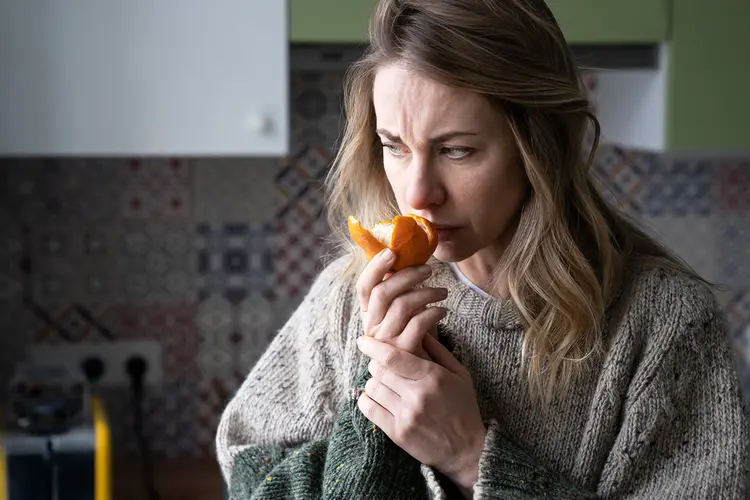
Parosmia is a condition that affects how you perceive smells. It may happen when you’re recovering from an infection. (Photo Credit: iStock/Getty Images)
## How Does Parosmia Affect Your Sense of Smell?
When smell receptor cells in your nose get damaged, this changes the way your brain interprets scents.
“The analogy is, if you have a piano and cut some strings in the back, you’ll get a discordant sound instead of something pleasant,” says Richard Doty, PhD, director of the Smell and Taste Center at the University of Pennsylvania Medical Center.
Parosmia affects everyone differently. Most people find that it changes the way common foods, household items, and even body odor smell. For some people, things just smell a bit off. But for others, once-pleasant scents become unbearable, taking on a rotten, burnt, sewage, or metallic smell.
Since your sense of smell is closely connected to your sense of taste, parosmia can also change how food tastes.
Possible triggers for parosmia include:
- Coffee
- Onions
- Garlic
- Fried, roasted, or browned meat
- Eggs
- Toothpaste
- Bell peppers
- Cucumbers
- Chocolate
- Fruit, especially citrus fruits and melons
- Gasoline
- Tobacco
- Perfume
## What Causes Parosmia?
Several things may cause parosmia. They can include:
- Upper respiratory infections, such as [colds](https://www.webmd.com/cold-and-flu/default.htm)
- Viruses such as the flu or COVID
- [Head injuries](https://www.webmd.com/fitness-exercise/head-injuries-causes-and-treatments)
- [Sinus](https://www.webmd.com/allergies/sinus-tips) infections
- Certain toxins, including pollution and smoking
- Some [drugs](https://www.webmd.com/drugs/index-drugs.aspx), including cancer treatments, certain antidepressants, and benzodiazepines
- [Seizures](https://www.webmd.com/epilepsy/understanding-seizures-basics) in a part of the brain called the temporal lobe
- Constant [dry mouth](https://www.webmd.com/oral-health/dental-health-dry-mouth)
- [Brain tumors, though this is rare](https://www.webmd.com/cancer/brain-cancer/brain-tumors-in-adults)
## How Is Parosmia Linked to COVID?
Loss of smell or taste is a common symptom of COVID, especially in the early stages of the infection. Some people lose these senses completely, while others only have partial changes. Doctors have a few different terms to describe these kinds of changes:
- Hyposmia: A partial loss of smell
- Hypogeusia: A partial loss of taste
- [Anosmia](https://www.webmd.com/brain/anosmia-loss-of-smell): A complete loss of smell
- Ageusia: A complete loss of taste
Most people who have these symptoms of COVID find that their senses go back to normal over time. But for others, the changes stick around for weeks or even months after the infection.
Parosmia can also affect people who’ve had COVID, though it usually shows up after the initial infection. One study found that nearly half of the people who lost their sense of smell from COVID developed parosmia later on. On average, it shows up two to three months after an initial infection. But for many, smell disruptions can last at least six months.
Some people have described the “COVID smell” as “foul,” “rancid,” or similar to “rotting flesh.”
COVID is thought to cause parosmia by damaging nerves that help you detect odors. Both the virus itself and the inflammation it causes may lead to this damage.
“COVID is a two-edged sword,” says Doty. “The good news is that it has opened people’s realization of how important the sensory system is.”
## What Are the Complications of Parosmia?
Your senses affect so much of your daily life, from sharing meals with friends to simple routines, such as brewing a morning cup of coffee. Pleasant scents can lift your mood. But a distorted [sense of smell](https://www.webmd.com/allergies/video/josephson-sense-smell) can lead to problems such as:
- Loss of appetite
- Weight loss
- [Depression](https://www.webmd.com/depression/default.htm)
Parosmia could make socializing unpleasant, especially in settings that involve food. It can also make household tasks like cooking and cleaning difficult. You might even feel repulsed by the smell of your own body.
A distorted sense of smell can also be a safety risk. You might not notice signs such as spoiled food, smoke, or a gas leak. For people whose jobs rely on a sharp sense of smell, such as chefs, perfumers, and firefighters, parosmia may make it harder to do their work.
## How Is Parosmia Diagnosed?
If your doctor thinks you have parosmia, they’ll do a [physical exam](https://www.webmd.com/a-to-z-guides/annual-physical-examinations). They’ll ask about your medical history to check for recent illnesses, possible exposure to toxins, and medications that could be causing your symptoms.
They may also do a smell test, such as one that involves a booklet of pages that you “scratch and sniff” to see how well you can identify odors.
They may try to rule out a similar condition called phantosmia, in which your smell receptors “[hallucinate](https://www.webmd.com/schizophrenia/what-are-hallucinations)” and detect odors that aren’t there. The smells may range from good to unpleasant.
Your doctor might recommend that you see a specialist to rule out more serious issues, such as:
- An otolaryngologist, who specializes in [ear](https://www.webmd.com/picture-of-the-ear), nose, and throat conditions
- A neurologist, who focuses on conditions related to the [brain and nervous system](https://www.webmd.com/brain)
- An allergist, who handles [allergies](https://www.webmd.com/allergies/default.htm) and related issues
Depending on your symptoms, they may order more tests. These could include an MRI, a sinus CT scan, or a biopsy (in which they take a small sample of tissue from your sinus to look at under a microscope).
Getting a diagnosis of parosmia can sometimes be challenging, Doty says.
“A lot of doctors don’t know much about it, so people get battered around the medical system,” he says. “If the patient doesn’t feel like they’re being taken care of properly, it can add to the loneliness that they may already have.”
## How Is Parosmia Treated?
Damaged nerves in your nose and nasal cavity can grow back, so your sense of smell may come back on its own without treatment. For example, among people who get parosmia due to COVID, 80%-90% recover within two years.
If something you’re exposed to – such as cigarette smoke, chemicals, or medication – is causing parosmia, avoiding those triggers can help you recover your sense of smell.
Parosmia treatment includes medication, "smell training," and, in rare cases, surgery.
### Medications for parosmia
Research has shown that these drugs may help ease parosmia symptoms:
- [Clonazepam](https://www.webmd.com/drugs/mono-6006-CLONAZEPAM+-+ORAL.aspx?drugid=14403&drugname=Clonazepam+Oral) ([Klonopin](https://www.webmd.com/drugs/2/drug-920/klonopin-oral/details))
- [Phenytoin](https://www.webmd.com/drugs/2/drug-4159-1057/phenytoin-oral/phenytoin-suspension-oral/details) ([Dilantin](https://www.webmd.com/drugs/2/drug-4157/dilantin-oral/details), Phenytek, Phenytoin Infatabs)
- [Topiramate](https://www.webmd.com/drugs/mono-6019-TOPIRAMATE+-+ORAL.aspx?drugid=14494&drugname=Topamax+Oral) ([Qudexy](https://www.webmd.com/drugs/2/drug-166405/qudexy-xr-oral/details) XR, [Topamax](https://www.webmd.com/drugs/2/drug-14494-6019/topamax-oral/topiramate-oral/details), [Trokendi XR](https://www.webmd.com/drugs/2/drug-164941/trokendi-xr-oral/details))
- Valproic acid
### Surgery for parosmia
If other treatments don’t work, your doctor might recommend surgery to remove the damaged sensory receptors (olfactory mucosa) in your nasal cavity. This is a complex procedure with major risks, so it should only be done as a last resort.
Surgery may also be an option if nasal polyps or a brain tumor are causing your parosmia.
A technique called olfactory training or smell training may also help you recover from parosmia. It involves exposing yourself to different scents to help your sense of smell improve gradually.
## How Do You Fix Parosmia After COVID?
There’s no known cure for post-COVID parosmia, though it usually gets better over time.
Some studies suggest that the following treatments might help, but we need more research to be sure:
**Olfactory training.** This involves smelling strong aromas — like rose, citrus, cloves, and eucalyptus — every day for several weeks or months while you focus on imagining what the scent normally smells like. This process is thought to help your brain "remember" and rebuild how to process smells. One small study showed that olfactory training improved parosmia symptoms, while other studies suggest it works best when combined with other therapies.
**Intranasal steroids.** Corticosteroids such as mometasone or fluticasone (given as nasal sprays) may help improve your sense of smell after COVID. One study, which focused on people with anosmia, found that mometasone helped 23% of those who took it for more than two weeks.
**Sinus rinses.** Using a saline rinse to flush your nose can reduce inflammation after a COVID infection, which may help you regain your sense of smell.
If you’re struggling with your appetite due to parosmia, lifestyle changes might help. Choose simple or bland foods to avoid triggering your parosmia. Eating food cold or at room temperature may also help, since steam carries smells directly to your nose.
## Takeaways
When you have parosmia, you perceive certain smells as distorted and often foul. You get it when nerve cells in your nose are damaged by things such as infections, a head injury, drugs, or toxins. Parosmia can make food taste bad, lessen your appetite, and affect your well-being. It usually goes away on its own over time. Treatments include avoiding triggers, olfactory training, and medication.
## Parosmia FAQs
### What does parosmia smell like?
Parosmia affects everyone differently. But for many people, things that once smelled good may now smell foul, rotten, burnt, or like sewage.
### What is the difference between phantosmia and parosmia?
Phantosmia is a condition in which you smell things that aren’t actually there, while parosmia makes things smell different from how they normally do.
### What foods trigger parosmia?
Foods that may trigger parosmia include:
- Chocolate
- Onions
- Garlic
- Cooked meat
- Eggs
- Bell peppers
- Cucumbers
- Fruits
### How long does parosmia last?
Depending on what caused your parosmia, it might last weeks to months. One study found that, for people with COVID, it lasted an average of about 3 1/2 months.
Sources
Update History
Share
Print
Save
SOURCES:
Richard Doty, PhD, professor, Department of Otorhinolaryngology: Head and Neck Surgery; director, Smell and Taste Center, University of Pennsylvania Medical Center.
Mayo Clinic: “[What causes olfactory hallucinations (phantosmia)](https://www.mayoclinic.org/diseases-conditions/temporal-lobe-seizure/expert-answers/phantosmia/faq-20058131)?”
Cleveland Clinic: “[Parosmia](https://my.clevelandclinic.org/health/diseases/23986-parosmia),” “[Loss of Taste and Smell](https://my.clevelandclinic.org/health/symptoms/16708-loss-of-taste-and-smell).”
*Chemical Senses*: “[More than smell – COVID-19 is associated with severe impairment of smell, taste, and chemesthesis](https://academic.oup.com/chemse/article/45/7/609/5860460).”
UpToDate: “[Taste and olfactory disorders in adults: Evaluation and management](https://www.uptodate.com/contents/taste-and-olfactory-disorders-in-adults-evaluation-and-management),” “[Clonazepam: Drug information,](https://www.uptodate.com/contents/clonazepam-drug-information)” “[Topiramate: Drug information](https://www.uptodate.com/contents/topiramate-drug-information),” “[Phenytoin: Drug information.”](https://www.uptodate.com/contents/phenytoin-drug-information)
*JAMA*: “[Long-term Follow-up of Surgically Treated Phantosmia](https://jamanetwork.com/journals/jamaotolaryngology/fullarticle/482912),” “[Distorted Odorant Perception Analysis of a Series of 56 Patients With Parosmia](https://jamanetwork.com/journals/jamaotolaryngology/fullarticle/648666).”
National Institute on Deafness and Other Communication Disorders: “[Smell Disorders.](https://www.nidcd.nih.gov/health/smell-disorders)”
*BMJ*: “[Sixty seconds on . . . parosmia,](https://www.bmj.com/content/bmj/371/bmj.m4332.full.pdf) “[Parosmia—a common consequence of covid-19](https://www.bmj.com/content/377/bmj-2021-069860).”
*Frontiers in Neurolog*y: “[Parosmia and Neurological Disorders: A Neglected Association](https://www.frontiersin.org/journals/neurology/articles/10.3389/fneur.2020.543275/full).”
SmellTaste: “[Post-Viral Olfactory Loss](https://www.smelltaste.org.uk/post-viral-olfactory-loss/).”
*European Archives of Oto-Rhino-Laryngology*: “P[ersistent COVID-19 parosmia and olfactory loss post olfactory training: randomized clinical trial comparing central and peripheral-acting therapeutics.](https://link.springer.com/article/10.1007/s00405-024-08548-6)”
*The American Journal of Rhinology & Allergy*: “[Qualitative Olfactory Dysfunction and COVID-19: An Evidence-Based Review with Recommendations for the Clinician](https://pmc.ncbi.nlm.nih.gov/articles/PMC9379596/).”
*JAMA Otolaryngology—Head & Neck Surgery*: “[Distorted Odorant Perception: Analysis of a Series of 56 Patients With Parosmia](https://jamanetwork.com/journals/jamaotolaryngology/fullarticle/648666).”
*Rhinology:* “[A follow-up on quantitative and qualitative olfactory dysfunction and other symptoms in patients recovering from COVID-19 smell loss](https://pmc.ncbi.nlm.nih.gov/articles/PMC11016179/),” “[Six month follow-up of self-reported loss of smell during the COVID-19 pandemic](https://pubmed.ncbi.nlm.nih.gov/33320115/).”
University of Utah: “[A Change in Smell After COVID-19 Infection: What You Need to Know,](https://healthcare.utah.edu/healthfeed/2022/09/change-smell-after-covid-19-infection-what-you-need-know)” “[How do you Treat Parosmia or Loss of Smell?](https://healthcare.utah.edu/the-scope/all/2022/09/how-do-you-treat-parosmia-or-loss-of-smell)” “[Parosmia After COVID-19: What Is It and How Long Will It Last?](https://healthcare.utah.edu/healthfeed/2021/09/parosmia-after-covid-19-what-it-and-how-long-will-it-last)”
*Indian Journal of Otolaryngology and Head & Neck Surgery*: “[Parosmia Due to COVID-19 Disease: A 268 Case Series](https://pmc.ncbi.nlm.nih.gov/articles/PMC8141364/).”
*Clinical Nutrition Open Science*: “[Parosmia and altered taste in patients recovering from Covid 19](https://pmc.ncbi.nlm.nih.gov/articles/PMC9731923/).”
*Frontiers in Human Neuroscience*: “[The effectiveness of olfactory training for chronic olfactory disorder following COVID-19: a systematic review](https://www.frontiersin.org/journals/human-neuroscience/articles/10.3389/fnhum.2024.1457527/full).”
*The Laryngoscope*: “[Intranasal Corticosteroid Treatment on Recovery of Long‐Term Olfactory Dysfunction Due to COVID‐19](https://pmc.ncbi.nlm.nih.gov/articles/PMC9538270/),” “[Modified Olfactory Training Is an Effective Treatment Method for COVID‐19 Induced Parosmia](https://pmc.ncbi.nlm.nih.gov/articles/PMC9088368/).”
[View privacy policy, copyright and trust info](https://www.webmd.com/about-webmd-policies/about-privacy-policy)
Share
Print
Save
[View privacy policy, copyright and trust info](https://www.webmd.com/about-webmd-policies/about-privacy-policy)
### More on Brain & Nervous System Disorders

[The Nervous System and How It Works](https://www.webmd.com/brain/what-is-nervous-system)
[Brain-Boosting Beverages](https://www.webmd.com/brain/ss/slideshow-brain-boosting-beverages)
[Top Exercises for the Right Brain](https://www.webmd.com/brain/top-exercises-right-brain)
Recommended
### Related Links
- [Brain & Nervous System News](https://www.webmd.com/brain/news-features)
- [Brain & Nervous System Reference](https://www.webmd.com/brain/medical-reference/default.htm)
- [Brain & Nervous System Slideshows](https://www.webmd.com/brain/ss/default.htm)
- [Brain & Nervous System Quizzes](https://www.webmd.com/brain/quiz/default.htm)
- [Brain & Nervous System Videos](https://www.webmd.com/brain/video/default.htm)
- [Find a Neurologist](https://doctor.webmd.com/providers/specialty/neurology)
- [ADHD](https://www.webmd.com/add-adhd/adhd-adults)
- [Alzheimer's Disease](https://www.webmd.com/alzheimers/understanding-alzheimers-disease-basics)
- [Autism](https://www.webmd.com/brain/autism/understanding-autism-basics)
- [Concussion](https://www.webmd.com/brain/concussion-traumatic-brain-injury-symptoms-causes-treatments)
- [Creutzfeldt-Jakob Disease](https://www.webmd.com/brain/what-is-creutzfeldt-jakob-disease)
- [Epilepsy](https://www.webmd.com/epilepsy/understanding-seizures-and-epilepsy)
- [Guillain-Barré Syndrome](https://www.webmd.com/brain/what-is-guillain-barre)
- [Amyotrophic Lateral Sclerosis (ALS)](https://www.webmd.com/brain/understanding-als-basics)
- [Multiple Sclerosis](https://www.webmd.com/multiple-sclerosis/what-is-multiple-sclerosis)
- [Parkinson's Disease](https://www.webmd.com/parkinsons-disease/parkinsons-disease-overview)
- [Restless Legs Syndrome](https://www.webmd.com/brain/restless-legs-syndrome/restless-legs-syndrome-rls)
- [Spinal Muscular Atrophy](https://www.webmd.com/brain/spinal-muscular-atrophy)
- [Stroke](https://www.webmd.com/stroke/stroke)
### Sign up for our free Good Health Newsletter
#### Get wellness tips to help you live happier and healthier

Subscribe

## Thanks for subscribing\!
###
By clicking Subscribe, I agree to the WebMD [Terms & Conditions](https://www.webmd.com/about-webmd-policies/about-terms-and-conditions-of-use) & [Privacy Policy](https://www.webmd.com/about-webmd-policies/about-privacy-policy) and understand that I may opt out of WebMD subscriptions at any time. This site is protected by reCAPTCHA and the Google [Privacy Policy](https://policies.google.com/privacy) and [Terms of Service](https://policies.google.com/terms) apply.
### Follow WebMD on Social Media
### Download WebMD App
[](https://taps.io/Bzg3Q)[](https://taps.io/Bzg2w)
[Policies]()
[About]()
[For Advertisers]()
- [Privacy Policy](https://www.webmd.com/about-webmd-policies/about-privacy-policy)
- [Cookie Policy](https://www.webmd.com/about-webmd-policies/cookie-policy)
- [Editorial Policy](https://www.webmd.com/about-webmd-policies/about-editorial-policy)
- [Advertising Policy](https://www.webmd.com/about-webmd-policies/about-advertising-policy)
- [Correction Policy](https://www.webmd.com/about-webmd-policies/webmd-corrections-policies)
- [Terms of Use](https://www.webmd.com/about-webmd-policies/about-terms-and-conditions-of-use)
- [Accessibility Statement](https://www.webmd.com/about-webmd-policies/accessibility-statement)
- [](https://privacy.truste.com/privacy-seal/validation?rid=07326333-3522-463d-81bf-f00fd7171fff)
- 
- 
© 2005 - 2026 WebMD LLC, an [Internet Brands](https://www.internetbrands.com/) company. All rights reserved. WebMD does not provide medical advice, diagnosis or treatment. [See additional information.](https://www.webmd.com/about-webmd-policies/additional-info)
[](https://www.webmd.com/)
 |
| Readable Markdown | null |
| Shard | 142 (laksa) |
| Root Hash | 18365360746078618142 |
| Unparsed URL | com,webmd!www,/brain/what-is-parosmia s443 |