ℹ️ Skipped - page is already crawled
| Filter | Status | Condition | Details |
|---|---|---|---|
| HTTP status | PASS | download_http_code = 200 | HTTP 200 |
| Age cutoff | PASS | download_stamp > now() - 6 MONTH | 0 months ago |
| History drop | PASS | isNull(history_drop_reason) | No drop reason |
| Spam/ban | PASS | fh_dont_index != 1 AND ml_spam_score = 0 | ml_spam_score=0 |
| Canonical | PASS | meta_canonical IS NULL OR = '' OR = src_unparsed | Not set |
| Property | Value |
|---|---|
| URL | https://www.wallstreetmojo.com/realized-volatility/ |
| Last Crawled | 2026-04-20 06:56:52 (1 day ago) |
| First Indexed | 2019-08-29 10:51:47 (6 years ago) |
| HTTP Status Code | 200 |
| Meta Title | Realized Volatility (Definition,Formula)| How to Calculate Realized Volatility |
| Meta Description | Guide to what is Realized Volatility and its definition. Here we discuss the formula to calculate realized volatility along with examples and explanations. |
| Meta Canonical | null |
| Boilerpipe Text | Example #1
The supposed realized volatility for two stocks with similar closing prices is calculated for 20, 50, and 100 days for stock and is annualized with values as follows:
Stock 1
Stock 2
RV
100
= 25%
RV
100
= 20%
RV
50
= 35%
RV
50
= 17%
RV
20
= 50%
RV
20
= 15%
Looking at the pattern of increasing volatility in the given time frame, one can infer that stock-1 has been trading with high price variation in recent times (i.e., 20 days), whereas stock-2 has been trading without any wild swings.
Example #2
Let us calculate the realized volatility of the dow index for 20 days. Then, one can extract details of the daily stock prices in
excel format
from online sites such as Yahoo! Finance.
The fluctuation in stock prices is depicted in the chart below.
As may be observed, the stock price is declining with a maximum price deviation of USD 6.
One may calculate the deviation in daily returns as follows:
Variance in daily returns is the square of daily deviations.
The calculated realized variance for 20 days is the aggregate return for 20 days. And the formula of realized volatility is the square root of realized variance.
The value is then annualized to make the result compared to other stocks. |
| Markdown | 
\| ELITE MEMBERSHIP \| BY EX-JPMORGAN \| 50% OFF
[Get Instant Access](https://www.wallstreetmojo.com/exclusive-offers/wallstreetmojo-membership-all-access/)

Ends in
11:58m:59s
\| ELITE MEMBERSHIP \| BY EX-JPMORGAN \| 50% OFF
[](https://www.wallstreetmojo.com/exclusive-offers/wallstreetmojo-membership-all-access/)

All Courses

[FLASH SALE]()
[FINANCIAL MODELING]()
[FREE COURSES](https://www.wallstreetmojo.com/all-courses/?type=free/)
[RESOURCES]()
[Login](https://wallstreetmojo.knorish.com/account/login/)
[All Blogs](https://www.wallstreetmojo.com/blog/)
[Statistics Resources](https://www.wallstreetmojo.com/blog/statistics/)
Realized Volatility
# Realized Volatility
Publication Date :
29 Aug, 2019
Blog Author :
[WallStreetMojo Team](https://www.wallstreetmojo.com/wallstreetmojo-team/wallstreetmojo-editorial-team/)
Edited by :
[Ashish Kumar Srivastav](https://www.wallstreetmojo.com/wallstreetmojo-team/ashish-kumar-srivastav/)
Reviewed by :
[Dheeraj Vaidya, CFA, FRM](https://www.wallstreetmojo.com/wallstreetmojo-team/dheeraj/)

Share
GET: WSM ALL COURSES ACCESS

Download FREE Realized Volatility Excel Template and Follow Along\!
Realized Volatility Excel Template.xlsx
Table Of Contents

## What is Realized Volatility?
> Realized volatility assesses variation in returns for an investment product by analyzing its historical returns within a defined period. Assessment of the degree of uncertainty and/or potential financial loss/gain from investing in a firm may be measured using variability/ volatility in the stock prices of the entity. In statistics, the most common measure is to determine variability in measuring the standard deviation, i.e., the variability of returns from the mean. It is an indicator of the actual price risk.
*You are free to use this image on your website, templates, etc..* [*Please provide us with an attribution link*](https://www.wallstreetmojo.com/realized-volatility/)
The realized volatility or actual volatility in the market is caused by two components: a continuous volatility component and a jump component, which influence the stock prices. Continuous volatility in a stock market is affected by intra-day trading volumes. For example, a single high-volume trade transaction can introduce a significant variation in the price of an instrument.
Analysts use high-frequency intraday data to determine volatility measures at hourly/daily/weekly, or monthly frequencies. One may then utilize the data to forecast the volatility in returns.
Key Takeaways
- Realized volatility is a measure of variation in returns for an investment product calculated by analyzing historical returns over a specific period.
- It helps determine the level of uncertainty and potential financial gain or loss associated with investing in a particular asset or firm.
- Standard deviation is a commonly used statistical tool to measure variability and assess the actual price risk in an investment. It provides insights into the volatility of an asset's prices.
- Realized volatility in the market is influenced by two components: continuous volatility, which represents ongoing fluctuations in stock prices, and the jump component, which accounts for sudden and significant price movements.
## Realized Volatility Formula
It measures calculating the standard deviation from the average price of an asset in a given period. Since volatility is non-linear, realized variance calculates first by converting returns from a stock/asset to logarithmic values and measuring the standard deviation of [log normal](https://www.wallstreetmojo.com/log-normal-distribution/) returns.
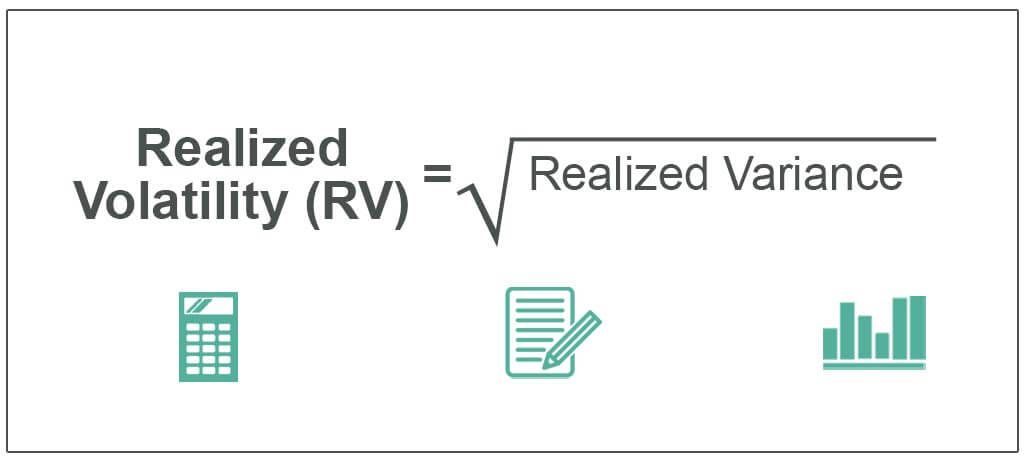
The formula of realized volatility is the square root of realized variance.
Variance in daily returns of the underlying calculated as follows:
**rt\= log(Pt)- log (Pt-1)**
- P= stock price
- t= time period
This approach assumes the mean to be set to zero, considering the upside and downside trend in the movement of stock prices.
Realized variance calculate by computing the aggregate of returns over the period defined:

Where N= number of observations (monthly/ weekly/ daily returns). Typically, calculates 20, 50, and 100-day returns.
**Realized Volatility (RV) Formula = √ Realized Variance**
Then, the results will [annualized](https://www.wallstreetmojo.com/annualize/). Realized volatility annualized by multiplying the daily realized variance by the number of trading days/weeks/ months in a year. The square root of the annualized realized variance is the realized volatility.
## Examples of Realized Volatility
#### Example \#1
The supposed realized volatility for two stocks with similar closing prices is calculated for 20, 50, and 100 days for stock and is annualized with values as follows:
| **Stock 1** | **Stock 2** |
|---|---|
| RV100 = 25% | RV100 = 20% |
| RV50 = 35% | RV50 = 17% |
| RV20 = 50% | RV20 = 15% |
Looking at the pattern of increasing volatility in the given time frame, one can infer that stock-1 has been trading with high price variation in recent times (i.e., 20 days), whereas stock-2 has been trading without any wild swings.
#### Example \#2
Let us calculate the realized volatility of the dow index for 20 days. Then, one can extract details of the daily stock prices in [excel format](https://www.wallstreetmojo.com/formatting-in-excel/) from online sites such as Yahoo! Finance.

The fluctuation in stock prices is depicted in the chart below.

As may be observed, the stock price is declining with a maximum price deviation of USD 6.
One may calculate the deviation in daily returns as follows:

Variance in daily returns is the square of daily deviations.

The calculated realized variance for 20 days is the aggregate return for 20 days. And the formula of realized volatility is the square root of realized variance.

The value is then annualized to make the result compared to other stocks.

## Advantages
- It measures the actual asset performance in the past. It helps to understand the stability of the asset based on its past performance.
- It indicates how an asset’s price changed in the past and the period in which it has changed.
- Higher the volatility, the higher the price risk associated with the stock. Therefore, a higher premium is attached to the stock.
- One may use the realized volatility of the asset to forecast future volatility, i.e., implied volatility of the asset. While entering into transactions with complex financial products such as [derivatives](https://www.wallstreetmojo.com/derivatives-in-finance/), [options](https://www.wallstreetmojo.com/what-are-options/), etc., the premiums are determined based on the underlying volatility and influence the prices of these products.
- It is the starting point for option pricing.
- Realized volatility is measured based on statistical methods and is, therefore, a reliable indicator of the volatility in asset value.
## Disadvantages
It is a measure of historical volatility and is therefore not forward-looking. It does not factor in any major “shocks” in the market that may arise in the future, affecting the underlying value.
## Limitation
- The volume of data used influences the results when calculating realized volatility. At least 20 observations are statistically required to calculate a valid value of realized volatility. Therefore, realized volatility is better used to measure longer-term price risk in the market (~ 1 month or more).
- Realized volatility calculations are directionless. i.e., it factors in upward and downward trends in price movements.
- It assumes that asset prices reflect all available information while measuring volatility.
## Important Points
- In order to calculate the [downside risk](https://www.wallstreetmojo.com/downside-risk/) associated with a stock, the realized volatility measurement may restrict downside price movements.
- An increase in realized volatility of a stock over time would imply a significant change in the stock's inherent value owing to external/internal factors.
- An increase in volatility implies a higher premium on option prices. The value of a stock can be inferred by comparing the realized volatility and estimated future volatility ([implied volatility](https://www.wallstreetmojo.com/implied-volatility/)) of the options.
- Comparing the volatility of a stock with the benchmark index helps determine the stability of the stock: the lower the volatility, the more predictable the asset's price.
- A decrease in the realized volatility of a stock over a while would indicate the stabilization of the stock.
Realized volatility measures help to quantify the inherent price risk arising out of volume fluctuations and external factors of a stock based on its historical performance. Combined with implied volatility, it also helps determine option prices based on the volatility in the underlying stock.
## Frequently Asked Questions (FAQs)
Realized Volatility FAQs
1
#### What is the difference between realized volatility and historical volatility?

2
#### What is the difference between GARCH and realized volatility?

3
#### What are the applications of realized volatility?

View all
[FINANCIAL MODELING & VALUATION (CORE + AI) BUNDLE @50% OFF – FLASH SALE](https://www.wallstreetmojo.com/ai-machine-learning/financial-modeling-valuation-core-ai-course-bundle/)
Master Financial Modeling, DCF & Valuation with AI \| Includes 7 Courses + McDonald’s & Netflix Case Studies \| Learn to Build Models & Pitch Decks Faster using ChatGPT.
Join WallStreetMojo YouTube
[](https://www.youtube.com/wallstreetmojo)
[INVESTMENT BANKING MASTERY PROGRAM @50% OFF – FLASH SALE](https://www.wallstreetmojo.com/investment-banking/investment-banking-mastery-program-certification-course-bundle/)
Experience the Exact Training Used by Top Investment Banks \| Learn FM, DCF, LBO, M\&A, Accounting & More \| Unlock Wall Street-Level Skills this Sale.
Join WallStreetMojo Instagram
[](https://www.instagram.com/wallstreetmojoofficial/)
[CHATGPT & AI FOR EXCEL COURSE @50% OFF – FLASH SALE](https://www.wallstreetmojo.com/excel/chatgpt-ai-excel-course/)
Boost Productivity 10X with AI-Powered Excel \| Automate Reports, Eliminate Errors & Advance Your Analytics Skills \| Transform Your Workflow this Sale.
Join WallStreetMojo LinkedIn
[](https://in.linkedin.com/company/wallstreetmojo)
[EXCEL ALL-IN-ONE BUNDLE COURSE @50% OFF – FLASH SALE](https://www.wallstreetmojo.com/excel/excel-all-in-one-bundle-course-bundle/)
Master Excel, VBA & Power BI Like a Pro \| 70+ Hours of Expert-Led Training \| Learn Real-World Applications & Earn Your Certification this Sale.
Join WallStreetMojo Facebook
[](https://www.facebook.com/wallstreetmojo)
Join WallStreetMojo X
[](https://x.com/wallstreetmojo)
Company
Our Policies
Resources
Partner with us
Support
Follow us on
[](https://www.youtube.com/wallstreetmojo)[](https://in.linkedin.com/company/wallstreetmojo)[](https://www.instagram.com/wallstreetmojoofficial/)[](https://x.com/wallstreetmojo)[](https://www.facebook.com/wallstreetmojo)[](https://in.pinterest.com/wallstreetmojo/)
Company

Our Policies

Resources

Partner with us

Support

Connect With Us
[](https://www.youtube.com/wallstreetmojo)[](https://in.linkedin.com/company/wallstreetmojo)[](https://www.instagram.com/wallstreetmojoofficial/)[](https://x.com/wallstreetmojo)[](https://www.facebook.com/wallstreetmojo)[](https://in.pinterest.com/wallstreetmojo/)
***
Top Categories

Blog Categories

Free Courses

[Dictionary](https://www.wallstreetmojo.com/dictionary/a/)
Course Categories
[Accounting Courses](https://www.wallstreetmojo.com/accounting/)
\|
[Alternative Investments Courses](https://www.wallstreetmojo.com/alternative-investments/)
\|
[Artificial Intelligence and Machine Learning Courses](https://www.wallstreetmojo.com/ai-machine-learning/)
\|
[Budgeting Courses](https://www.wallstreetmojo.com/budgeting/)
\|
[Derivatives Courses](https://www.wallstreetmojo.com/derivatives/)
\|
[Excel Courses](https://www.wallstreetmojo.com/excel/)
\|
[Finance for Non-Finance Courses](https://www.wallstreetmojo.com/finance-for-non-finance/)
\|
[Financial Modeling Courses](https://www.wallstreetmojo.com/financial-modeling/)
\|
[Fixed Income Courses](https://www.wallstreetmojo.com/fixed-income/)
\|
[Investment Banking Courses](https://www.wallstreetmojo.com/investment-banking/)
\|
[Power BI Courses](https://www.wallstreetmojo.com/power-bi/)
\|
[Technical Analysis Courses](https://www.wallstreetmojo.com/technical-analysis/)
\|
[Valuation Courses](https://www.wallstreetmojo.com/valuation/)
\|
[VBA Courses](https://www.wallstreetmojo.com/vba/)
Blog Categories
[Accounting Resources](https://www.wallstreetmojo.com/blog/accounting/)
\|
[Asset Management Resources](https://www.wallstreetmojo.com/blog/asset-management/)
\|
[Audit Resources](https://www.wallstreetmojo.com/blog/audit/)
\|
[Banking Resources](https://www.wallstreetmojo.com/blog/banking/)
\|
[Budgeting Resources](https://www.wallstreetmojo.com/blog/budgeting/)
\|
[Capital Budgeting Resources](https://www.wallstreetmojo.com/blog/capital-budgeting/)
\|
[Corporate Finance Resources](https://www.wallstreetmojo.com/blog/corporate-finance/)
\|
[Derivatives Resources](https://www.wallstreetmojo.com/blog/derivatives/)
\|
[Economics Resources](https://www.wallstreetmojo.com/blog/economics/)
\|
[Excel Resources](https://www.wallstreetmojo.com/blog/excel/)
\|
[Finance Certification Resources](https://www.wallstreetmojo.com/blog/finance-certification/)
\|
[Financial Market Resources](https://www.wallstreetmojo.com/blog/financial-market/)
\|
[Financial Modeling Resources](https://www.wallstreetmojo.com/blog/financial-modeling/)
\|
[Financial Statement Analysis Resources](https://www.wallstreetmojo.com/blog/financial-statement-analysis/)
\|
[Fintech Resources](https://www.wallstreetmojo.com/blog/fintech/)
\|
[Fixed Income Resources](https://www.wallstreetmojo.com/blog/fixed-income/)
\|
[Investment Banking Resources](https://www.wallstreetmojo.com/blog/investment-banking/)
\|
[Power BI Resources](https://www.wallstreetmojo.com/blog/power-bi/)
\|
[Management Resources](https://www.wallstreetmojo.com/blog/management/)
\|
[Marketing Resources](https://www.wallstreetmojo.com/blog/marketing/)
\|
[Mergers and Acquisitions Resources](https://www.wallstreetmojo.com/blog/mergers-and-acquisitions/)
\|
[Personal Finance Resources](https://www.wallstreetmojo.com/blog/personal-finance/)
\|
[Private Equity Resources](https://www.wallstreetmojo.com/blog/private-equity/)
\|
[Risk Management Resources](https://www.wallstreetmojo.com/blog/risk-management/)
\|
[Statistics Resources](https://www.wallstreetmojo.com/blog/statistics/)
\|
[Tax Resources](https://www.wallstreetmojo.com/blog/tax/)
\|
[Technical Analysis Resources](https://www.wallstreetmojo.com/blog/technical-analysis/)
\|
[Valuation Resources](https://www.wallstreetmojo.com/blog/valuation/)
\|
[VBA Resources](https://www.wallstreetmojo.com/blog/vba/)
Free Courses
[Free Investment Banking Course](https://www.wallstreetmojo.com/investment-banking/free-investment-banking-course/)
\|
[Free Corporate Finance Course](https://www.wallstreetmojo.com/investment-banking/free-corporate-finance-course/)
\|
[Free Excel Course](https://www.wallstreetmojo.com/excel/free-excel-course/)
[Dictionary](https://www.wallstreetmojo.com/dictionary/a/)
[A](https://www.wallstreetmojo.com/dictionary/a/)[B](https://www.wallstreetmojo.com/dictionary/b/)[C](https://www.wallstreetmojo.com/dictionary/c/)[D](https://www.wallstreetmojo.com/dictionary/d/)[E](https://www.wallstreetmojo.com/dictionary/e/)[F](https://www.wallstreetmojo.com/dictionary/f/)[G](https://www.wallstreetmojo.com/dictionary/g/)[H](https://www.wallstreetmojo.com/dictionary/h/)[I](https://www.wallstreetmojo.com/dictionary/i/)[J](https://www.wallstreetmojo.com/dictionary/j/)[K](https://www.wallstreetmojo.com/dictionary/k/)[L](https://www.wallstreetmojo.com/dictionary/l/)[M](https://www.wallstreetmojo.com/dictionary/m/)[N](https://www.wallstreetmojo.com/dictionary/n/)[O](https://www.wallstreetmojo.com/dictionary/o/)[P](https://www.wallstreetmojo.com/dictionary/p/)[Q](https://www.wallstreetmojo.com/dictionary/q/)[R](https://www.wallstreetmojo.com/dictionary/r/)[S](https://www.wallstreetmojo.com/dictionary/s/)[T](https://www.wallstreetmojo.com/dictionary/t/)[U](https://www.wallstreetmojo.com/dictionary/u/)[V](https://www.wallstreetmojo.com/dictionary/v/)[W](https://www.wallstreetmojo.com/dictionary/w/)[X](https://www.wallstreetmojo.com/dictionary/x/)[Y](https://www.wallstreetmojo.com/dictionary/y/)[Z](https://www.wallstreetmojo.com/dictionary/z/)
[\#0](https://www.wallstreetmojo.com/dictionary/0/)[\#1](https://www.wallstreetmojo.com/dictionary/1/)[\#2](https://www.wallstreetmojo.com/dictionary/2/)[\#3](https://www.wallstreetmojo.com/dictionary/3/)[\#4](https://www.wallstreetmojo.com/dictionary/4/)[\#5](https://www.wallstreetmojo.com/dictionary/5/)[\#6](https://www.wallstreetmojo.com/dictionary/6/)[\#7](https://www.wallstreetmojo.com/dictionary/7/)[\#8](https://www.wallstreetmojo.com/dictionary/8/)[\#9](https://www.wallstreetmojo.com/dictionary/9/)
Disclaimer: Copyright © 2024. CFA Institute Does Not Endorse, Promote Or Warrant The Accuracy Or Quality Of WallStreetMojo. CFA® And Chartered Financial Analyst® Are Registered Trademarks Owned By CFA Institute.
***
[Our Privacy Policy]()© 2020-24 Wall Street Mojo. All Rights Reserved |
| Readable Markdown | #### Example \#1
The supposed realized volatility for two stocks with similar closing prices is calculated for 20, 50, and 100 days for stock and is annualized with values as follows:
| **Stock 1** | **Stock 2** |
|---|---|
| RV100 = 25% | RV100 = 20% |
| RV50 = 35% | RV50 = 17% |
| RV20 = 50% | RV20 = 15% |
Looking at the pattern of increasing volatility in the given time frame, one can infer that stock-1 has been trading with high price variation in recent times (i.e., 20 days), whereas stock-2 has been trading without any wild swings.
#### Example \#2
Let us calculate the realized volatility of the dow index for 20 days. Then, one can extract details of the daily stock prices in [excel format](https://www.wallstreetmojo.com/formatting-in-excel/) from online sites such as Yahoo! Finance.

The fluctuation in stock prices is depicted in the chart below.

As may be observed, the stock price is declining with a maximum price deviation of USD 6.
One may calculate the deviation in daily returns as follows:

Variance in daily returns is the square of daily deviations.

The calculated realized variance for 20 days is the aggregate return for 20 days. And the formula of realized volatility is the square root of realized variance.

The value is then annualized to make the result compared to other stocks.
 |
| Shard | 87 (laksa) |
| Root Hash | 3767058624888957887 |
| Unparsed URL | com,wallstreetmojo!www,/realized-volatility/ s443 |