ℹ️ Skipped - page is already crawled
| Filter | Status | Condition | Details |
|---|---|---|---|
| HTTP status | PASS | download_http_code = 200 | HTTP 200 |
| Age cutoff | PASS | download_stamp > now() - 6 MONTH | 0.1 months ago |
| History drop | PASS | isNull(history_drop_reason) | No drop reason |
| Spam/ban | PASS | fh_dont_index != 1 AND ml_spam_score = 0 | ml_spam_score=0 |
| Canonical | PASS | meta_canonical IS NULL OR = '' OR = src_unparsed | Not set |
| Property | Value | |||||||||||||||
|---|---|---|---|---|---|---|---|---|---|---|---|---|---|---|---|---|
| URL | https://www.visualcapitalist.com/saying-bye-to-facebook-why-companies-change-their-name/ | |||||||||||||||
| Last Crawled | 2026-04-24 10:16:31 (2 days ago) | |||||||||||||||
| First Indexed | 2021-10-27 20:47:50 (4 years ago) | |||||||||||||||
| HTTP Status Code | 200 | |||||||||||||||
| Content | ||||||||||||||||
| Meta Title | Saying Bye to Facebook: Why Companies Change Their Name | |||||||||||||||
| Meta Description | Facebook's impending rebrand will impact the company's future. Why do companies change their name, and what can we learn from past examples? | |||||||||||||||
| Meta Canonical | null | |||||||||||||||
| Boilerpipe Text | As anyone who’s started a company knows, choosing a name is no easy task.
There are many considerations, such as:
Are the social handles and domain name available?
Is there a competitor already using a similar name?
Can people spell, pronounce, and remember the name?
Are there cultural or symbolic interpretations that could be problematic?
The list goes on. These considerations are amplified when a company is already established, and even more difficult when your company serves billions of users around the globe.
Facebook
(the parent company, not the social network) has changed its name to
Meta
, and we’ll examine some probable reasons for the rebrand. But first we’ll look at historical corporate name changes in recent history, exploring the various motivations behind why a company might change its name. Below are some of the categories of rebranding that stand out the most.
Social Pressure
Societal perceptions can change fast, and companies do their best to anticipate these changes in advance. Or, if they don’t change in time, their hands might get forced.
As time goes on, companies with more overt negative externalities have come under pressure—particularly in the era of
ESG investing
. Social pressure was behind the name changes at
Total
and
Philip Morris
. In the case of the former, the switch to
TotalEnergies
was meant to signal the company’s shift beyond oil and gas to include renewable energy.
In some cases, the reason why companies change their name is more subtle.
GMAC
(General Motors Acceptance Corporation) didn’t want to be associated with subprime lending and the subsequent multi-billion dollar bailout from the U.S. government, and a name change was one way of starting with a “clean slate”. The financial services company rebranded to
Ally
in 2010.
Hitting the Reset Button
Brands can become unpopular over time because of scandals, a decline in quality, or countless other reasons. When this happens, a name change can be a way of getting customers to shed those old, negative connotations.
Internet and TV providers rank
dead last
in customer satisfaction ratings, so it’s no surprise that many have changed their names in recent years.
We Do More
This is a very common scenario, particularly as companies go through a rapid expansion or find success with new product offerings. After a period of sustained growth and change, a company may find that the current name is too limiting or no longer accurately reflects what the company has become.
Both
Apple
and
Starbucks
have simplified their company names over the years. The former dropped “Computers” from its name in 2007, and Starbucks dropped “Coffee” from its name in 2011. In both these cases, the name change meant disassociating the company with what initially made them successful, but in both cases it was a gamble that paid off.
One of the biggest name changes in recent years is the switch from
Google
to
Alphabet
. This name change signaled the company’s desire to expand beyond internet search and advertising.
Square
also found itself in a similar situation. The “Square” brand had become synonymous with its commerce solutions, so the parent company became
Block
to help the company signal a shift into other areas of business.
The Start-Up Name Pivot
Another very common name change scenario is the early-stage name change.
In the world of music, there’s speculation that limited melodies and subconscious plagiarism will make creating new music increasingly difficult in the future. Similarly, there are millions of companies in the world and only so many short and snappy names. (That’s how we end up with companies called Quibi.)
Many of the popular digital services we use today started with very different names. The
Google
we know today was once called Backrub.
Instagram
began life as Bourbn, and
Twitter
began life as “Twittr” before finding a spare E in the scrabble pile.
Trademark Problems
As mentioned above, many companies start out as speculative experiments or passion projects, when a viable, well-vetted name isn’t high on the priority list. As a result, new companies can run into trademark problems.
This was the case when Picaboo, the precursor of
Snapchat
, was forced to change their name in 2011. The existing Picaboo—a photobook company—was not thrilled to share a name with an app that was primarily associated with
sexting
at the time.
The fight over the name WWF was a more unique scenario. In 1994, the
World Wildlife Fund
and the
World Wrestling Federation
had a mutual agreement that the latter would stop using the initials internationally, except for fleeting uses such as “WWF champion”. In the end though, the agreement was largely ignored, and the issue became a sticking point when the wrestling company registered wwf.com. Eventually, the company rebranded as WWE (World Wrestling Entertainment) after losing a lawsuit.
Course Correction
To err is human, and rebranding exercises don’t always hit the mark. When a name change is universally panned or, perhaps worse, not relevant, it’s time to course correct.
Tribune Publishing
was forced to backtrack after their name change to
Tronc
in 2016. The
widely-panned
name, which was stylized in all lower case, was seen as a clumsy attempt to become a digital-first publisher.
Why Is Facebook Changing Its Name?
Facebook undertook this name change for a number of reasons, but chief among them is that the brand is irrevocably associated with scandals, negative externalities, and Mark Zuckerberg.
Even before the most recent outage and whistle-blowing scandal, Facebook was already the
least-trusted
tech company by a long shot. Mark Zuckerberg was once the
most admired CEO
in Silicon Valley, but has since fallen from grace.
It’s easy to focus on the negative triggers for the impending name change, but there is some substance behind the change as well. For one, Facebook recognizes that privacy issues have put their primary
source of revenue
at risk. The company’s ad-driven model built upon its users’ data is coming under increasing scrutiny with each passing year.
As well, there is substance behind the metaverse hype. Facebook first signaled their ambitions in 2014, when it acquired the virtual reality headset maker
Oculus
. A sizable portion of the company’s workforce is already working on making the metaverse concept a reality, and there are plans to hire 10,000 more people in Europe over the next five years.
It remains to be seen whether this immense gamble pays off, but for the near future, Zuckerberg and Facebook’s investors will be keeping a close eye on how the media and public react to the new Meta name and how the transition plays out. After all, there are billions of dollars at stake. | |||||||||||||||
| Markdown | [](https://www.visualcapitalist.com/category/technology/ai/)
[](https://www.visualcapitalist.com/)
- [Subscribe to our Daily Newsletter](https://www.visualcapitalist.com/subscribe_pages/main/)
- [Browse Topics]()
- [AI Week](https://www.visualcapitalist.com/category/technology/ai/)
- [Markets](https://www.visualcapitalist.com/category/markets/)
- [Technology](https://www.visualcapitalist.com/category/technology/)
- [Money](https://www.visualcapitalist.com/category/money-2/)
- [Energy](https://www.visualcapitalist.com/category/energy/)
- [Healthcare](https://www.visualcapitalist.com/category/healthcare/)
- [Maps](https://www.visualcapitalist.com/category/misc/maps/)
- [Mining](https://www.visualcapitalist.com/category/mining/)
- [Green](https://www.visualcapitalist.com/category/green/)
- [Politics](https://www.visualcapitalist.com/category/politics/)
- [Partner With Us](https://www.visualcapitalist.com/partnerwithus/)
- [VC+](https://www.visualcapitalist.com/saying-bye-to-facebook-why-companies-change-their-name/)
- [Get VC+](https://www.visualcapitalist.com/get-more-vc/)
- [VC+ Archive](https://www.visualcapitalist.com/vc-archive/)
- [My account](https://www.visualcapitalist.com/my-account/)
- [Licensing](https://licensing.visualcapitalist.com/)
- [ Creator Program](https://www.visualcapitalist.com/saying-bye-to-facebook-why-companies-change-their-name/)
- [Creator Stream](https://www.visualcapitalist.com/cp/)
- [Creator Community](https://www.visualcapitalist.com/creators/)
- [Creator Hub](https://www.visualcapitalist.com/creator-hub/)
- [Submission Guidelines & FAQs](https://www.visualcapitalist.com/creator-hub/faqs/)
- [Ad-Free](https://www.visualcapitalist.com/saying-bye-to-facebook-why-companies-change-their-name/)
- [My Account](https://www.visualcapitalist.com/my-account/)
- [Log Out](https://www.visualcapitalist.com/wp-login.php?action=logout&_wpnonce=a9d8fcb2e5)
- [Purchase Ad-Free](https://store.visualcapitalist.com/ad-free/)
- [Reports](https://www.visualcapitalist.com/saying-bye-to-facebook-why-companies-change-their-name/)
- [Global Forecast Report 2024 (VC+ Exclusive)](https://store.visualcapitalist.com/vc-archive/vc-reports/)
- [Election 2024: Charting the Key Issues (Exclusive VC+ eBook)](https://store.visualcapitalist.com/vc-archive/vc-reports/)
- [NPUC Annual Utility Decarbonization Report](http://www.decarbonizationreport.com/)
- [Generational Power Index](https://www.visualcapitalist.com/gpi/)
- [Contact Us](https://www.visualcapitalist.com/contact-us/)
- [About](https://www.visualcapitalist.com/about/)
- []()
- [](https://voronoiapp.com/)
- [](https://www.visualcapitalist.com/terzo-markets-in-a-minute/)
- [](https://www.visualcapitalist.com/plasma-money-2/)
- [](https://decarbonization.visualcapitalist.com/)
- [](https://elements.visualcapitalist.com/)
- [](https://wealth.visualcapitalist.com/)
- [](https://money.visualcapitalist.com/)
Connect with us
[](https://www.visualcapitalist.com/) [](https://www.visualcapitalist.com/)
## Visual Capitalist
#### Saying Bye to Facebook: Why Companies Change Their Name
- [VC+](https://www.visualcapitalist.com/vc-archive/)
- [Get VC+](https://www.visualcapitalist.com/get-more-vc/)
- [VC+ Archive](https://www.visualcapitalist.com/vc-archive/)
- [My Account](https://www.visualcapitalist.com/my-account/edit-account/)
- [Log In](https://www.visualcapitalist.com/wp-login.php)
- [Partner with Us](https://www.visualcapitalist.com/partnerwithus/)
[SUBSCRIBE](https://www.visualcapitalist.com/subscribe_pages/main/)
[](https://www.visualcapitalist.com/) [](https://www.visualcapitalist.com/)
## Visual Capitalist
#### Saying Bye to Facebook: Why Companies Change Their Name
- [AI Week](https://www.visualcapitalist.com/category/technology/ai/)
- [Ranked: AI Models U.S. Businesses Pay For](https://www.visualcapitalist.com/ranked-ai-models-u-s-businesses-pay-for/)
- [Ranked: The Companies That Sell the Most AI Chips](https://www.visualcapitalist.com/ranked-the-companies-that-sell-the-most-ai-chips/)
- [Ranked: The World’s Biggest Memory Chip Makers](https://www.visualcapitalist.com/ranked-the-worlds-biggest-memory-chip-makers/)
- [Charted: Compute Costs More Than Talent in AI](https://www.visualcapitalist.com/visualized-the-costs-of-ai-companies/)
- [Mapped: AI Adoption Across Europe](https://www.visualcapitalist.com/mapped-ai-adoption-across-europe/)
- [Markets](https://www.visualcapitalist.com/category/markets/)
- [Every S\&P 500 Company in One Giant Chart](https://www.visualcapitalist.com/the-entire-sp-500-in-2026-in-one-chart/)
- [SpaceX’s IPO Would Make It a Top 10 Company Globally](https://www.visualcapitalist.com/spacex-ipo-top-10-company-market-cap/)
- [Charted: The Global Stock Selloff as Oil Fears Rise](https://www.visualcapitalist.com/rocky-month-for-global-stock-indexes/)
- [Warren Buffett vs. the S\&P 500: Growth of \$100 (1965–2025)](https://www.visualcapitalist.com/warren-buffett-vs-the-sp-500-growth-of-100-1965-2025/)
- [Mapped: The World’s Riskiest Markets in 2026](https://www.visualcapitalist.com/mapped-the-worlds-riskiest-markets-in-2026/)
- [Economy](https://www.visualcapitalist.com/category/economy/)
- [Mapped: Where Americans Spend the Most on Gas](https://www.visualcapitalist.com/monthly-cost-of-driving-in-every-u-s-state/)
- [Mapped: The Happiest States in America](https://www.visualcapitalist.com/happiest-states-in-america-map/)
- [Ranked: The World’s Largest Exporters in 2025](https://www.visualcapitalist.com/the-worlds-largest-exporters-in-2025/)
- [Mapped: The Top Trade Partner of Every European Country](https://www.visualcapitalist.com/mapped-europes-largest-trade-partners/)
- [Mapped: The States Where Living Costs the Most—and Least](https://www.visualcapitalist.com/cost-of-living-in-every-u-s-state/)
- [Technology](https://www.visualcapitalist.com/category/technology/)
- [Ranked: AI Models U.S. Businesses Pay For](https://www.visualcapitalist.com/ranked-ai-models-u-s-businesses-pay-for/)
- [Ranked: The Companies That Sell the Most AI Chips](https://www.visualcapitalist.com/ranked-the-companies-that-sell-the-most-ai-chips/)
- [Ranked: The World’s Biggest Memory Chip Makers](https://www.visualcapitalist.com/ranked-the-worlds-biggest-memory-chip-makers/)
- [Charted: Compute Costs More Than Talent in AI](https://www.visualcapitalist.com/visualized-the-costs-of-ai-companies/)
- [Mapped: AI Adoption Across Europe](https://www.visualcapitalist.com/mapped-ai-adoption-across-europe/)
- [Money](https://www.visualcapitalist.com/category/money-2/)
- [Ranked: Central Banks Buying and Selling Gold in 2026](https://www.visualcapitalist.com/ranked-central-banks-buying-and-selling-gold-in-2026/)
- [Mapped: Average Rent Across 100 U.S. Cities (2026)](https://www.visualcapitalist.com/mapped-average-rent-across-100-u-s-cities-2026/)
- [Mapped: What It Takes to Be Upper-Middle Class in Every State](https://www.visualcapitalist.com/income-needed-to-be-upper-middle-class-by-state/)
- [Mapped: Europe’s Homeownership Divide](https://www.visualcapitalist.com/mapped-europes-homeownership-divide/)
- [Mapped: The Salary Needed to Live Comfortably in U.S. Cities](https://www.visualcapitalist.com/mapped-the-salary-needed-to-live-comfortably-in-u-s-cities/)
- [Healthcare](https://www.visualcapitalist.com/category/healthcare/)
- [Mapped: Life Expectancy by U.S. State](https://www.visualcapitalist.com/mapped-us-life-expectancy-by-state/)
- [Mapped: U.S. States With the Highest Diabetes Rates](https://www.visualcapitalist.com/mapped-highest-diabetes-rates-by-state/)
- [Mapped: Adult Obesity Rates Across All 50 U.S. States](https://www.visualcapitalist.com/mapped-obesity-rates-highest-in-usa/)
- [Ranked: The World’s 10 Deadliest Viruses by Fatality Rate](https://www.visualcapitalist.com/ranked-the-worlds-10-deadliest-viruses-by-fatality-rate/)
- [Mapped: Health Insurance Costs by U.S. State in 2026](https://www.visualcapitalist.com/map-health-insurance-costs-in-every-u-s-state-in-2026/)
- [Demographics](https://www.visualcapitalist.com/category/demographics/)
- [Mapped: Where Populations Are Booming and Shrinking by 2050](https://www.visualcapitalist.com/mapped-how-the-worlds-population-will-change-by-country/)
- [Mapped: How Much U.S. Population Growth Comes From Immigration](https://www.visualcapitalist.com/immigrations-share-of-population-growth-by-u-s-state-2021-2025/)
- [Ranked: Where Population Growth Has Been Fastest Since 2000](https://www.visualcapitalist.com/ranked-fastest-growing-countries-since-2000/)
- [Ranked: The World’s Fastest-Growing and Shrinking Populations (2000-2025)](https://www.visualcapitalist.com/ranked-countries-fastest-population-growth-decline-2000-2025/)
- [Mapped: Population Growth in Every Country (2000–2025)](https://www.visualcapitalist.com/mapped-population-growth-by-country-2000-2025/)
- [Energy](https://www.visualcapitalist.com/category/energy/)
- [Mapped: Where Americans Spend the Most on Gas](https://www.visualcapitalist.com/monthly-cost-of-driving-in-every-u-s-state/)
- [Ranked: The World’s Biggest Natural Gas Producers](https://www.visualcapitalist.com/ranked-worlds-biggest-natural-gas-producers-2024/)
- [Charted: The Rise of Silicon in EV Batteries](https://www.visualcapitalist.com/charted-the-rise-of-silicon-in-ev-batteries/)
- [Ranked: The Countries Building the Most Nuclear Power](https://www.visualcapitalist.com/expected-nuclear-capacity-by-country/)
- [Half the World’s Oil Comes From Just Five Countries](https://www.visualcapitalist.com/half-the-worlds-oil-just-five-countries/)
- [Maps](https://www.visualcapitalist.com/category/misc/maps/)
- [Mapped: Where Americans Spend the Most on Gas](https://www.visualcapitalist.com/monthly-cost-of-driving-in-every-u-s-state/)
- [Mapped: How Much U.S. Population Growth Comes From Immigration](https://www.visualcapitalist.com/immigrations-share-of-population-growth-by-u-s-state-2021-2025/)
- [Mapped: AI Adoption Across Europe](https://www.visualcapitalist.com/mapped-ai-adoption-across-europe/)
- [Mapped: Internet Freedom Around the World in 2026](https://www.visualcapitalist.com/mapped-internet-freedom-around-the-world/)
- [Mapped: Average Rent Across 100 U.S. Cities (2026)](https://www.visualcapitalist.com/mapped-average-rent-across-100-u-s-cities-2026/)
- [Mining](https://www.visualcapitalist.com/category/mining/)
- [These Countries Hold Most of the World’s Copper](https://www.visualcapitalist.com/countries-control-most-of-the-worlds-copper/)
- [Ranked: Central Banks Buying and Selling Gold in 2026](https://www.visualcapitalist.com/ranked-central-banks-buying-and-selling-gold-in-2026/)
- [Ranked: U.S. Import Reliance for 37 Critical Minerals](https://www.visualcapitalist.com/ranked-u-s-import-reliance-on-critical-minerals/)
- [Visualizing the Critical Minerals Powering the AI Boom](https://www.visualcapitalist.com/the-critical-minerals-powering-the-ai-boom/)
- [Ranked: The Critical Minerals Lost to U.S. Mining Waste, by Tonnage](https://www.visualcapitalist.com/ranked-the-critical-minerals-lost-to-u-s-mining-waste-by-tonnage/)
- [Green](https://www.visualcapitalist.com/category/green/)
- [Mapped: Only One Country Can Feed Itself Fully](https://www.visualcapitalist.com/mapped-only-one-country-can-feed-itself-fully/)
- [Ranked: The Countries Building the Most Nuclear Power](https://www.visualcapitalist.com/expected-nuclear-capacity-by-country/)
- [Ranked: CO2 Emissions Per Person by Major Economy](https://www.visualcapitalist.com/ranked-co2-per-capita-by-major-economy/)
- [Mapped: The World’s Most Water-Stressed Countries](https://www.visualcapitalist.com/mapped-the-worlds-most-water-stressed-countries/)
- [Ranked: Which Countries Shut Down the Most Nuclear Power?](https://www.visualcapitalist.com/ranked-which-countries-shut-down-the-most-nuclear-power/)
### [Technology](https://www.visualcapitalist.com/category/technology/)
# Saying Bye to Facebook: Why Companies Change Their Name

Published
4 years ago
on
October 27, 2021
By
[Nick Routley](https://www.visualcapitalist.com/author/nick/ "Posts by Nick Routley")
## Editing
- ### [Lydia Adeli](https://www.visualcapitalist.com/author/lydia)
- [Twitter](https://www.visualcapitalist.com/saying-bye-to-facebook-why-companies-change-their-name/)
- [Facebook](https://www.visualcapitalist.com/saying-bye-to-facebook-why-companies-change-their-name/)
- [LinkedIn](https://www.visualcapitalist.com/saying-bye-to-facebook-why-companies-change-their-name/)
- [Reddit](https://www.visualcapitalist.com/saying-bye-to-facebook-why-companies-change-their-name/)
- [Pinterest](https://www.visualcapitalist.com/saying-bye-to-facebook-why-companies-change-their-name/)
- [Email](https://www.visualcapitalist.com/saying-bye-to-facebook-why-companies-change-their-name/)
As anyone who’s started a company knows, choosing a name is no easy task.
There are many considerations, such as:
- Are the social handles and domain name available?
- Is there a competitor already using a similar name?
- Can people spell, pronounce, and remember the name?
- Are there cultural or symbolic interpretations that could be problematic?
The list goes on. These considerations are amplified when a company is already established, and even more difficult when your company serves billions of users around the globe.
**Facebook** (the parent company, not the social network) has changed its name to **Meta**, and we’ll examine some probable reasons for the rebrand. But first we’ll look at historical corporate name changes in recent history, exploring the various motivations behind why a company might change its name. Below are some of the categories of rebranding that stand out the most.
### Social Pressure
Societal perceptions can change fast, and companies do their best to anticipate these changes in advance. Or, if they don’t change in time, their hands might get forced.

As time goes on, companies with more overt negative externalities have come under pressure—particularly in the era of [ESG investing](https://www.visualcapitalist.com/7-esg-essentials-investors-need-to-know/). Social pressure was behind the name changes at **Total** and **Philip Morris**. In the case of the former, the switch to **TotalEnergies** was meant to signal the company’s shift beyond oil and gas to include renewable energy.
In some cases, the reason why companies change their name is more subtle. **GMAC** (General Motors Acceptance Corporation) didn’t want to be associated with subprime lending and the subsequent multi-billion dollar bailout from the U.S. government, and a name change was one way of starting with a “clean slate”. The financial services company rebranded to **Ally** in 2010.
### Hitting the Reset Button
Brands can become unpopular over time because of scandals, a decline in quality, or countless other reasons. When this happens, a name change can be a way of getting customers to shed those old, negative connotations.

Internet and TV providers rank [dead last](https://www.theacsi.org/index.php?option=com_content&view=article&id=148&Itemid=213) in customer satisfaction ratings, so it’s no surprise that many have changed their names in recent years.
### We Do More
This is a very common scenario, particularly as companies go through a rapid expansion or find success with new product offerings. After a period of sustained growth and change, a company may find that the current name is too limiting or no longer accurately reflects what the company has become.

Both **Apple** and **Starbucks** have simplified their company names over the years. The former dropped “Computers” from its name in 2007, and Starbucks dropped “Coffee” from its name in 2011. In both these cases, the name change meant disassociating the company with what initially made them successful, but in both cases it was a gamble that paid off.
One of the biggest name changes in recent years is the switch from **Google** to **Alphabet**. This name change signaled the company’s desire to expand beyond internet search and advertising.
**Square** also found itself in a similar situation. The “Square” brand had become synonymous with its commerce solutions, so the parent company became **Block** to help the company signal a shift into other areas of business.
### The Start-Up Name Pivot
Another very common name change scenario is the early-stage name change.

In the world of music, there’s speculation that limited melodies and subconscious plagiarism will make creating new music increasingly difficult in the future. Similarly, there are millions of companies in the world and only so many short and snappy names. (That’s how we end up with companies called Quibi.)
Many of the popular digital services we use today started with very different names. The **Google** we know today was once called Backrub. **Instagram** began life as Bourbn, and **Twitter** began life as “Twittr” before finding a spare E in the scrabble pile.
### Trademark Problems
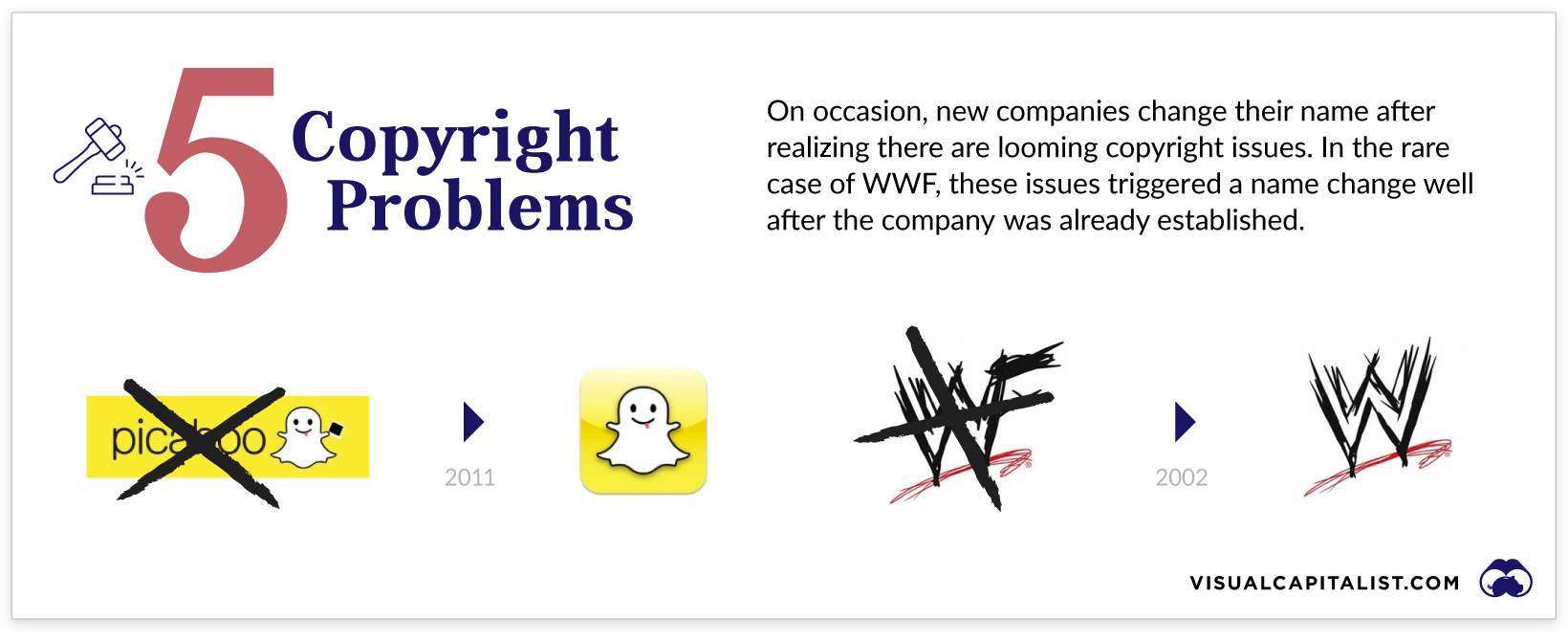
As mentioned above, many companies start out as speculative experiments or passion projects, when a viable, well-vetted name isn’t high on the priority list. As a result, new companies can run into trademark problems.

This was the case when Picaboo, the precursor of [Snapchat](https://www.visualcapitalist.com/timeline-looking-back-at-10-years-of-snapchat/), was forced to change their name in 2011. The existing Picaboo—a photobook company—was not thrilled to share a name with an app that was primarily associated with [sexting](https://en.wikipedia.org/wiki/Sexting) at the time.
The fight over the name WWF was a more unique scenario. In 1994, the **World Wildlife Fund** and the **World Wrestling Federation** had a mutual agreement that the latter would stop using the initials internationally, except for fleeting uses such as “WWF champion”. In the end though, the agreement was largely ignored, and the issue became a sticking point when the wrestling company registered wwf.com. Eventually, the company rebranded as WWE (World Wrestling Entertainment) after losing a lawsuit.
### Course Correction
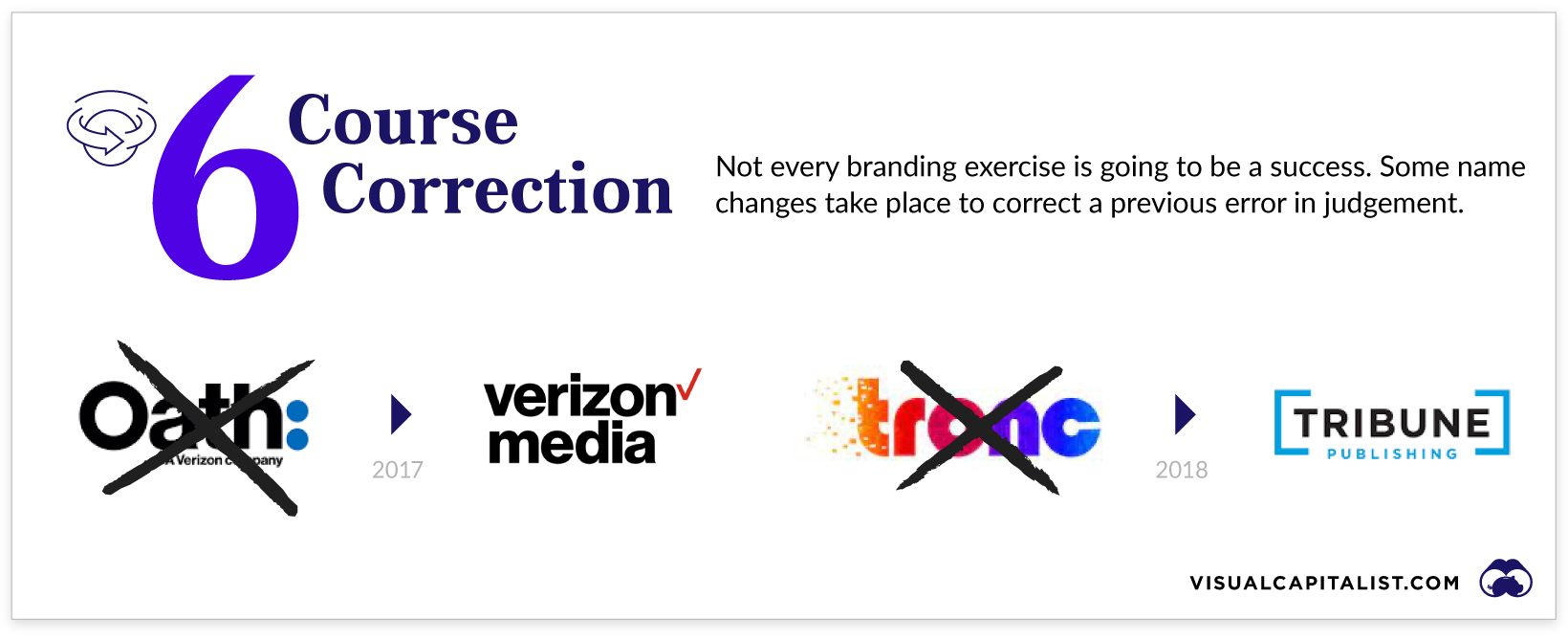
To err is human, and rebranding exercises don’t always hit the mark. When a name change is universally panned or, perhaps worse, not relevant, it’s time to course correct.

**Tribune Publishing** was forced to backtrack after their name change to **Tronc** in 2016. The [widely-panned](https://www.theverge.com/2016/6/2/11846538/tribune-tronc-rebranding-lol-ayfkm) name, which was stylized in all lower case, was seen as a clumsy attempt to become a digital-first publisher.
### Why Is Facebook Changing Its Name?
Facebook undertook this name change for a number of reasons, but chief among them is that the brand is irrevocably associated with scandals, negative externalities, and Mark Zuckerberg.
Even before the most recent outage and whistle-blowing scandal, Facebook was already the [least-trusted](https://www.vox.com/2018/4/10/17220060/facebook-trust-major-tech-company) tech company by a long shot. Mark Zuckerberg was once the [most admired CEO](https://www.macgasm.net/wp-content/uploads/2013/03/10-Highest-Rated-Tech-CEOs.jpg) in Silicon Valley, but has since fallen from grace.
It’s easy to focus on the negative triggers for the impending name change, but there is some substance behind the change as well. For one, Facebook recognizes that privacy issues have put their primary [source of revenue](https://www.visualcapitalist.com/how-big-tech-makes-their-billions-2020/) at risk. The company’s ad-driven model built upon its users’ data is coming under increasing scrutiny with each passing year.
As well, there is substance behind the metaverse hype. Facebook first signaled their ambitions in 2014, when it acquired the virtual reality headset maker **Oculus**. A sizable portion of the company’s workforce is already working on making the metaverse concept a reality, and there are plans to hire 10,000 more people in Europe over the next five years.
It remains to be seen whether this immense gamble pays off, but for the near future, Zuckerberg and Facebook’s investors will be keeping a close eye on how the media and public react to the new Meta name and how the transition plays out. After all, there are billions of dollars at stake.

Related Topics:[facebook](https://www.visualcapitalist.com/tag/facebook/)[startups](https://www.visualcapitalist.com/tag/startups/)[corporate name changes](https://www.visualcapitalist.com/tag/corporate-name-changes/)[rebranding](https://www.visualcapitalist.com/tag/rebranding/)
[Up Next Pandemic Recovery: Have North American Downtowns Bounced Back?](https://www.visualcapitalist.com/pandemic-recovery-have-north-american-downtowns-bounced-back/)
[Don't Miss Visualizing Social Risk in the World’s Top Investment Hubs](https://www.visualcapitalist.com/visualizing-social-risk-in-the-worlds-top-investment-hubs/)
#### You may also like
### [AI](https://www.visualcapitalist.com/category/technology/ai/)
# Ranked: AI Models U.S. Businesses Pay For
OpenAI has long been the leader for paid usage by U.S. businesses, but Anthropic has closed the gap with tools like Claude Code and Cowork.


Published
15 hours ago
on
April 23, 2026
By
[Niccolo Conte](https://www.visualcapitalist.com/author/niccolo/ "Posts by Niccolo Conte")

## Ranked: AI Models U.S. Businesses Pay For
*See visuals like this from many other data creators on our [Voronoi app](https://www.voronoiapp.com/). Download it for free on [iOS](https://apps.apple.com/ca/app/voronoi-app/id6447905904) or [Android](https://play.google.com/store/apps/details?id=com.voronoi.organization.app&pli=1) and discover incredible data-driven charts from a variety of trusted sources.*
### Key Takeaways
- OpenAI leads paid AI adoption among U.S. businesses at 35%, but Anthropic has surged to 30% in just over a year.
- Anthropic’s growth has been driven by enterprise tools like Claude Code and Cowork.
- Google, xAI, and others remain far behind, each used by less than 5% of businesses.
Anthropic is rapidly closing the gap with OpenAI in the race for paid AI adoption among U.S. businesses.
As of March 2026, 35% of companies pay for OpenAI’s models, compared to 30% for Anthropic—a sharp shift from early 2025, when the gap was nearly three times wider. The change highlights how quickly enterprise demand is consolidating around a small number of AI providers.
This chart, a part of Visual Capitalist’s [AI Week](https://www.visualcapitalist.com/category/technology/ai/) sponsored by [Terzo](https://terzo.ai/?utm_source=visualcapitalist&utm_medium=referral&utm_campaign=ai_week&utm_content=publication), uses anonymized spend data from over 50,000 U.S. businesses on the [Ramp](https://ramp.com/data/ai-index) platform, capturing only paid subscriptions and excluding free-tier usage.
## OpenAI Leads, But Anthropic Is Closing In Fast
OpenAI remains the most widely paid-for AI provider among U.S. businesses, reaching 35.2% of companies in March 2026. Anthropic sits just behind at 30.6%—a gap of only 4.5 percentage points.
The data table below shows the share of U.S. businesses paying for AI models from different providers from January 2023 to March of 2026:
| Share of U.S. Businesses Paying for an AI Subscription | | | | |
|---|---|---|---|---|
| Date | OpenAI | Anthropic | Google | xAI |
| 1/1/2023 | 0\.4% | 0\.0% | 1\.7% | 0\.0% |
| 2/1/2023 | 1\.5% | 0\.0% | 1\.6% | 0\.0% |
| 3/1/2023 | 3\.6% | 0\.0% | 1\.7% | 0\.0% |
| 4/1/2023 | 5\.7% | 0\.0% | 1\.8% | 0\.0% |
| 5/1/2023 | 6\.1% | 0\.0% | 1\.8% | 0\.0% |
| 6/1/2023 | 5\.9% | 0\.0% | 1\.9% | 0\.0% |
| 7/1/2023 | 6\.8% | 0\.1% | 1\.7% | 0\.0% |
| 8/1/2023 | 7\.2% | 0\.1% | 1\.7% | 0\.0% |
| 9/1/2023 | 7\.8% | 0\.2% | 1\.8% | 0\.0% |
| 10/1/2023 | 8\.1% | 0\.3% | 1\.8% | 0\.0% |
| 11/1/2023 | 8\.2% | 0\.2% | 2\.4% | 0\.0% |
| 12/1/2023 | 9\.3% | 0\.3% | 2\.4% | 0\.0% |
| 1/1/2024 | 10\.2% | 0\.4% | 2\.5% | 0\.0% |
| 2/1/2024 | 10\.2% | 0\.4% | 2\.6% | 0\.0% |
| 3/1/2024 | 11\.0% | 1\.2% | 3\.0% | 0\.0% |
| 4/1/2024 | 10\.6% | 1\.4% | 3\.3% | 0\.0% |
| 5/1/2024 | 11\.3% | 1\.4% | 3\.4% | 0\.0% |
| 6/1/2024 | 11\.0% | 1\.5% | 3\.2% | 0\.0% |
| 7/1/2024 | 11\.8% | 2\.3% | 3\.4% | 0\.0% |
| 8/1/2024 | 12\.5% | 2\.5% | 3\.5% | 0\.0% |
| 9/1/2024 | 12\.7% | 2\.7% | 3\.6% | 0\.0% |
| 10/1/2024 | 13\.7% | 3\.0% | 3\.7% | 0\.0% |
| 11/1/2024 | 13\.4% | 3\.2% | 3\.9% | 0\.0% |
| 12/1/2024 | 14\.8% | 3\.6% | 4\.0% | 0\.0% |
| 1/1/2025 | 16\.8% | 4\.1% | 4\.2% | 0\.0% |
| 2/1/2025 | 18\.2% | 4\.4% | 4\.2% | 0\.2% |
| 3/1/2025 | 26\.4% | 7\.0% | 2\.5% | 0\.4% |
| 4/1/2025 | 32\.0% | 7\.9% | 3\.2% | 0\.5% |
| 5/1/2025 | 33\.6% | 8\.9% | 4\.3% | 0\.5% |
| 6/1/2025 | 33\.4% | 9\.6% | 4\.0% | 0\.6% |
| 7/1/2025 | 35\.0% | 11\.1% | 3\.4% | 1\.5% |
| 8/1/2025 | 36\.5% | 12\.1% | 3\.0% | 1\.5% |
| 9/1/2025 | 35\.5% | 12\.2% | 3\.3% | 1\.3% |
| 10/1/2025 | 35\.8% | 14\.3% | 3\.3% | 1\.6% |
| 11/1/2025 | 34\.8% | 15\.1% | 4\.0% | 1\.8% |
| 12/1/2025 | 36\.8% | 16\.7% | 4\.3% | 1\.9% |
| 1/1/2026 | 35\.9% | 19\.5% | 4\.5% | 2\.0% |
| 2/1/2026 | 34\.4% | 24\.4% | 4\.7% | 1\.9% |
| 3/1/2026 | 35\.2% | 30\.6% | 4\.3% | 1\.9% |
That gap looked very different a year ago. In January 2025, OpenAI was used by 16.8% of U.S. businesses while Anthropic sat at 4.1%, a spread of nearly 13 points. [Anthropic](https://www.visualcapitalist.com/mapped-where-americans-use-claude-ai-the-most/) has since grown more than sevenfold in 14 months, while OpenAI roughly doubled over the same period.
The remaining providers remain distant in paid business adoption. Google’s AI products—spanning Gemini, Vertex AI, and Workspace add-ons—have hovered between 3% and 4.5% of U.S. businesses for most of the past three years, barely moving despite heavy investment.
xAI has climbed from effectively zero in early 2024 to 1.9% in March 2026, a meaningful but still small footprint.
## Claude Code and Cowork Drove the Anthropic Surge
Anthropic’s rapid rise in business adoption tracks its push into enterprise developer and knowledge-work tools.
Claude Code, the company’s coding assistant, and Cowork, its workflow collaboration platform, were both scaled aggressively across late 2025 and 2026—the period that coincides with the steepest part of Anthropic’s curve.
The pattern suggests that enterprise-native tooling, rather than general chatbot access, is now the key driver of paid seat growth. OpenAI has responded with its own developer coding tool, Codex, but Anthropic’s focus on developer workflows has clearly found traction in corporate procurement.
While Codex launched months after Claude Code, it has rapidly gained adoption among developers and knowledge workers, reaching [four million active users](https://x.com/thsottiaux/status/2046602907077038501?s=20) as of April 21, 2026.

[Continue Reading](https://www.visualcapitalist.com/ranked-ai-models-u-s-businesses-pay-for/)
### [AI](https://www.visualcapitalist.com/category/technology/ai/)
# Ranked: The Companies That Sell the Most AI Chips
See AI chip sales by company in Q4 2025, ranked by H100-equivalent compute capacity using data from Epoch AI.


Published
18 hours ago
on
April 23, 2026
By
[Niccolo Conte](https://www.visualcapitalist.com/author/niccolo/ "Posts by Niccolo Conte")

## Ranked: The Companies That Sell the Most AI Chips
*See visuals like this from many other data creators on our [Voronoi app](https://www.voronoiapp.com/). Download it for free on [iOS](https://apps.apple.com/ca/app/voronoi-app/id6447905904) or [Android](https://play.google.com/store/apps/details?id=com.voronoi.organization.app&pli=1) and discover incredible data-driven charts from a variety of trusted sources.*
### Key Takeaways
- Nvidia supplied nearly two-thirds of AI compute capacity in Q4 2025, far ahead of all rivals combined.
- Google ranked a distant second, with less than one-third of Nvidia’s output.
- AMD, Amazon, and Huawei form a smaller second tier, highlighting how concentrated AI compute remains.
Nvidia’s grip on the AI boom remains overwhelming.
In Q4 2025, the company shipped nearly two-thirds of all measured AI compute capacity—more than its closest competitors combined. While Google, Amazon, and others are scaling up their own chips, the gap between first and second place remains striking.
This visualization, part of Visual Capitalist’s [AI Week](https://www.visualcapitalist.com/category/technology/ai/) sponsored by [Terzo](https://terzo.ai/?utm_source=visualcapitalist&utm_medium=referral&utm_campaign=ai_week&utm_content=publication), ranks the world’s largest AI chip designers using data from [Epoch AI’s](https://epoch.ai/data/ai-chip-sales?view=graph&tab=h100_equivalents) Chip Sales database, which estimates compute capacity across leading architectures.
## The Biggest AI Chip Sellers
Even as more companies entered the AI chip market, one still towered over the rest in Q4 2025: Nvidia.
To make different chips comparable, the data is converted into “H100 equivalents”—a standardized measure based on Nvidia’s flagship AI GPU.
| Rank | Manufacturer | Q4 2025 Chip Sales (H100 equivalents) |
|---|---|---|
| 1 | Nvidia | 2,957,362 |
| 2 | Google | 976,313 |
| 3 | AMD | 226,485 |
| 4 | Amazon | 221,354 |
| 5 | Huawei | 131,964 |
[Nvidia](https://www.visualcapitalist.com/how-nvidias-market-cap-stacks-up-against-entire-countries/) didn’t just lead—it dominated. Its **2\.96 million** H100-equivalent shipments in Q4 2025 exceeded the combined total of every other company in this ranking.
AMD (**226k**) and Amazon (**221k**) formed a much smaller second tier, followed by Huawei (**132k**). Together, the rankings show that while the market is broadening, AI compute shipments remain highly concentrated at the top.
As demand for AI infrastructure accelerates, the key question is whether competitors can meaningfully close this gap or whether Nvidia’s early lead will translate into long-term dominance of the AI stack.
## What H100 Equivalent Compute Measures
This chart measures compute capacity, not units sold or revenue. Epoch AI defines H100e as H100-equivalent compute capacity, converting each chip’s peak dense 8-bit operations into the equivalent number of Nvidia H100 GPUs.
Epoch AI uses this measure because it is more intuitive than citing raw operations per second across different chip families.
Still, the firm notes that H100e is an imperfect proxy, since real-world performance also depends on factors like memory bandwidth, software ecosystems, and how chips are networked into servers and clusters.
## Inside the Methodology
These figures are estimates rather than exact reported sales. Epoch AI says chipmakers do not consistently disclose precise volumes, and most of its uncertainty ranges span roughly a factor of 2x around the median estimate.
The dataset also does not track all AI chip production. Instead, it focuses on the largest designers of dedicated AI accelerators—Nvidia, Google, Amazon, AMD, and Huawei—which Epoch AI says account for the large majority of global AI compute capacity.
## Learn More on the Voronoi App 
If you enjoyed today’s post, check out [The Global Semiconductor Industry, by Market Cap](https://www.voronoiapp.com/markets/The-Global-Semiconductor-Industry-by-Market-Cap-3552) on Voronoi.

[Continue Reading](https://www.visualcapitalist.com/ranked-the-companies-that-sell-the-most-ai-chips/)
#### Popular
[](https://www.visualcapitalist.com/)
- [𝕏](https://www.twitter.com/visualcap)
- [About](https://www.visualcapitalist.com/about/)
- [Subscribe](https://www.visualcapitalist.com/subscribe_pages/main/)
- [VC+](https://www.visualcapitalist.com/get-more-vc/)
- [Voronoi](https://www.voronoiapp.com/)
- [Masthead](https://www.visualcapitalist.com/masthead/)
- [Press Center](https://www.visualcapitalist.com/press-center/)
- [Careers](https://www.visualcapitalist.com/careers/)
- [Contact Us](https://www.visualcapitalist.com/contact-us/)
- [FAQ](https://www.visualcapitalist.com/frequently-asked-questions/)
- [Use Our Visualizations](https://www.visualcapitalist.com/use-our-visualizations/)
- [Licensing](https://licensing.visualcapitalist.com/)
- [Partner With Us](https://www.visualcapitalist.com/partnerwithus/)
- [Content Calendar](https://www.visualcapitalist.com/partnerwithus/contentcalendar/)
Copyright © 2026 Visual Capitalist \| [Privacy Policy](https://www.visualcapitalist.com/privacy-policy/)

 | |||||||||||||||
| Readable Markdown | As anyone who’s started a company knows, choosing a name is no easy task.
There are many considerations, such as:
- Are the social handles and domain name available?
- Is there a competitor already using a similar name?
- Can people spell, pronounce, and remember the name?
- Are there cultural or symbolic interpretations that could be problematic?
The list goes on. These considerations are amplified when a company is already established, and even more difficult when your company serves billions of users around the globe.
**Facebook** (the parent company, not the social network) has changed its name to **Meta**, and we’ll examine some probable reasons for the rebrand. But first we’ll look at historical corporate name changes in recent history, exploring the various motivations behind why a company might change its name. Below are some of the categories of rebranding that stand out the most.
### Social Pressure
Societal perceptions can change fast, and companies do their best to anticipate these changes in advance. Or, if they don’t change in time, their hands might get forced.
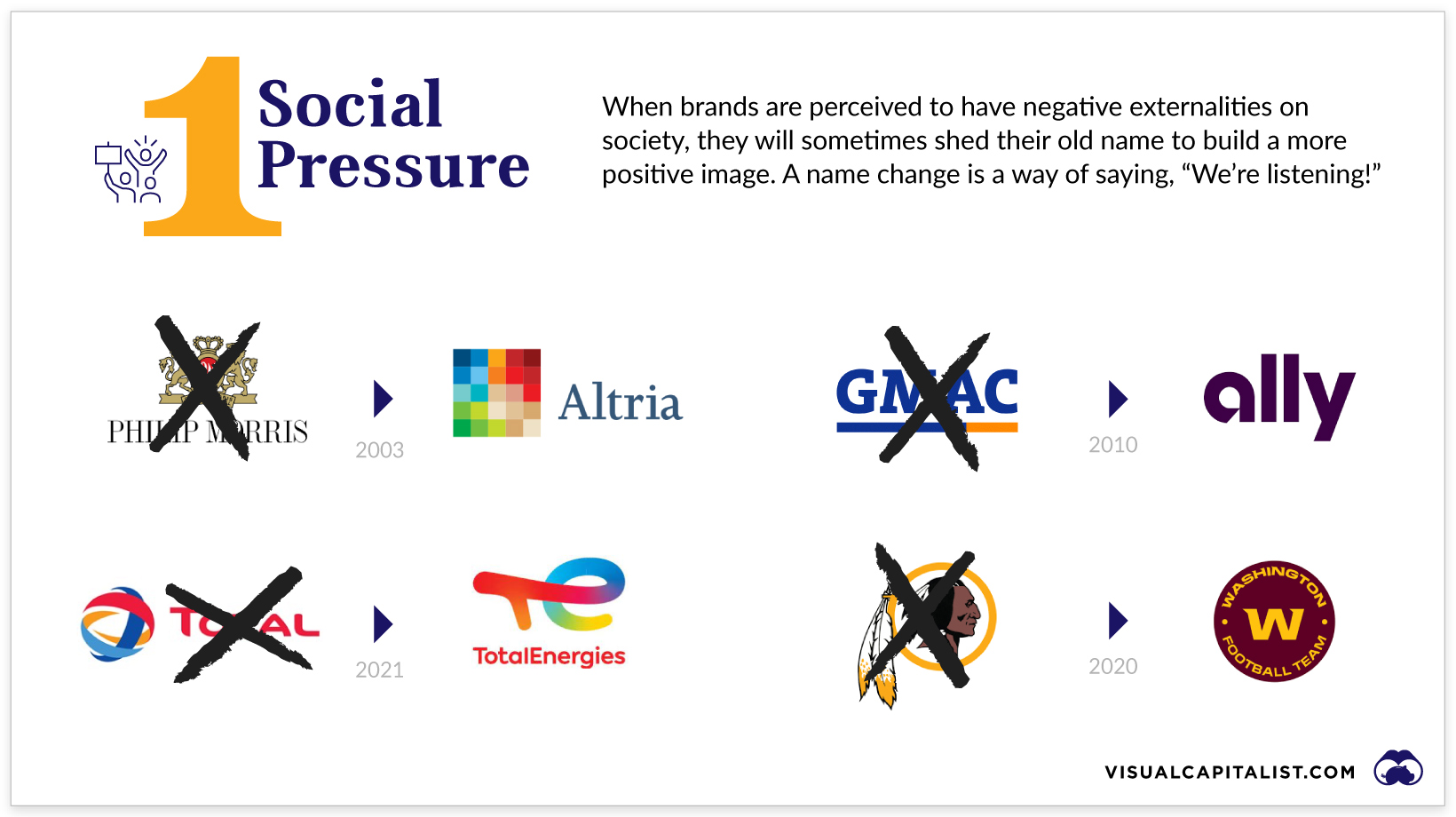
As time goes on, companies with more overt negative externalities have come under pressure—particularly in the era of [ESG investing](https://www.visualcapitalist.com/7-esg-essentials-investors-need-to-know/). Social pressure was behind the name changes at **Total** and **Philip Morris**. In the case of the former, the switch to **TotalEnergies** was meant to signal the company’s shift beyond oil and gas to include renewable energy.
In some cases, the reason why companies change their name is more subtle. **GMAC** (General Motors Acceptance Corporation) didn’t want to be associated with subprime lending and the subsequent multi-billion dollar bailout from the U.S. government, and a name change was one way of starting with a “clean slate”. The financial services company rebranded to **Ally** in 2010.
### Hitting the Reset Button
Brands can become unpopular over time because of scandals, a decline in quality, or countless other reasons. When this happens, a name change can be a way of getting customers to shed those old, negative connotations.
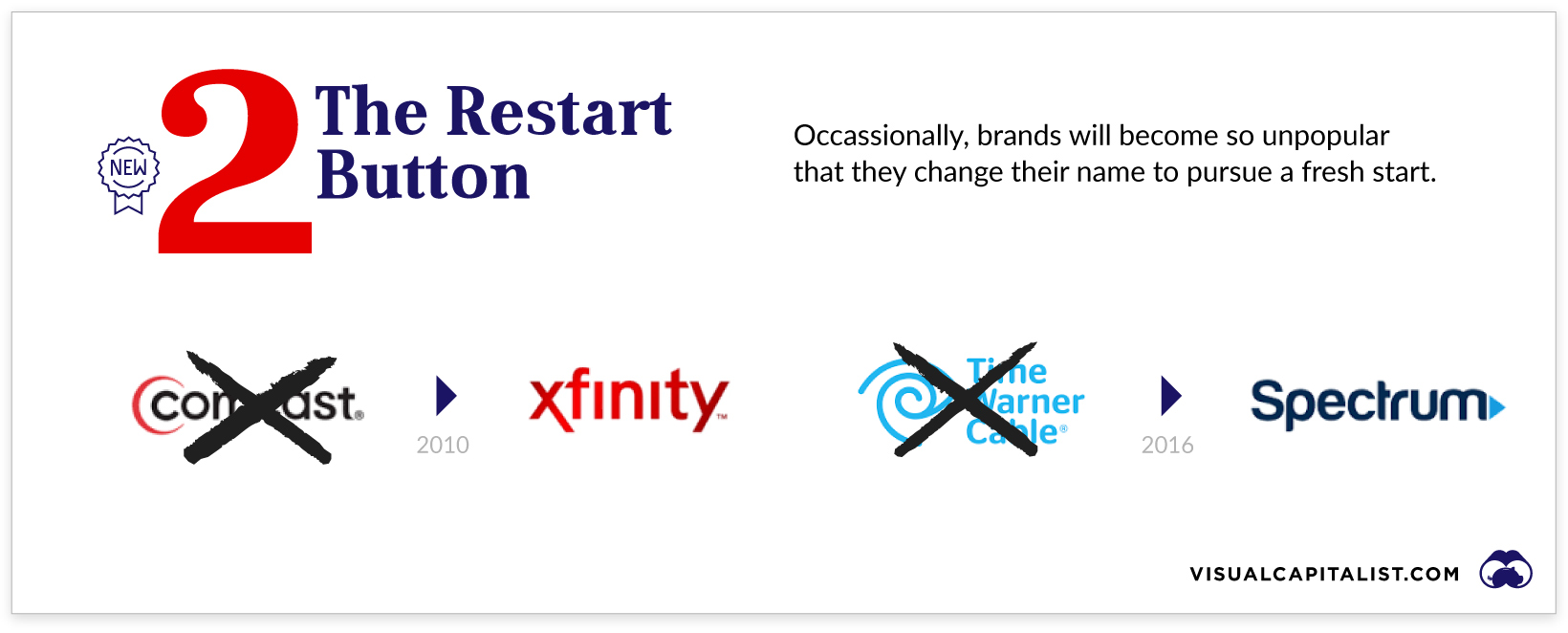
Internet and TV providers rank [dead last](https://www.theacsi.org/index.php?option=com_content&view=article&id=148&Itemid=213) in customer satisfaction ratings, so it’s no surprise that many have changed their names in recent years.
### We Do More
This is a very common scenario, particularly as companies go through a rapid expansion or find success with new product offerings. After a period of sustained growth and change, a company may find that the current name is too limiting or no longer accurately reflects what the company has become.
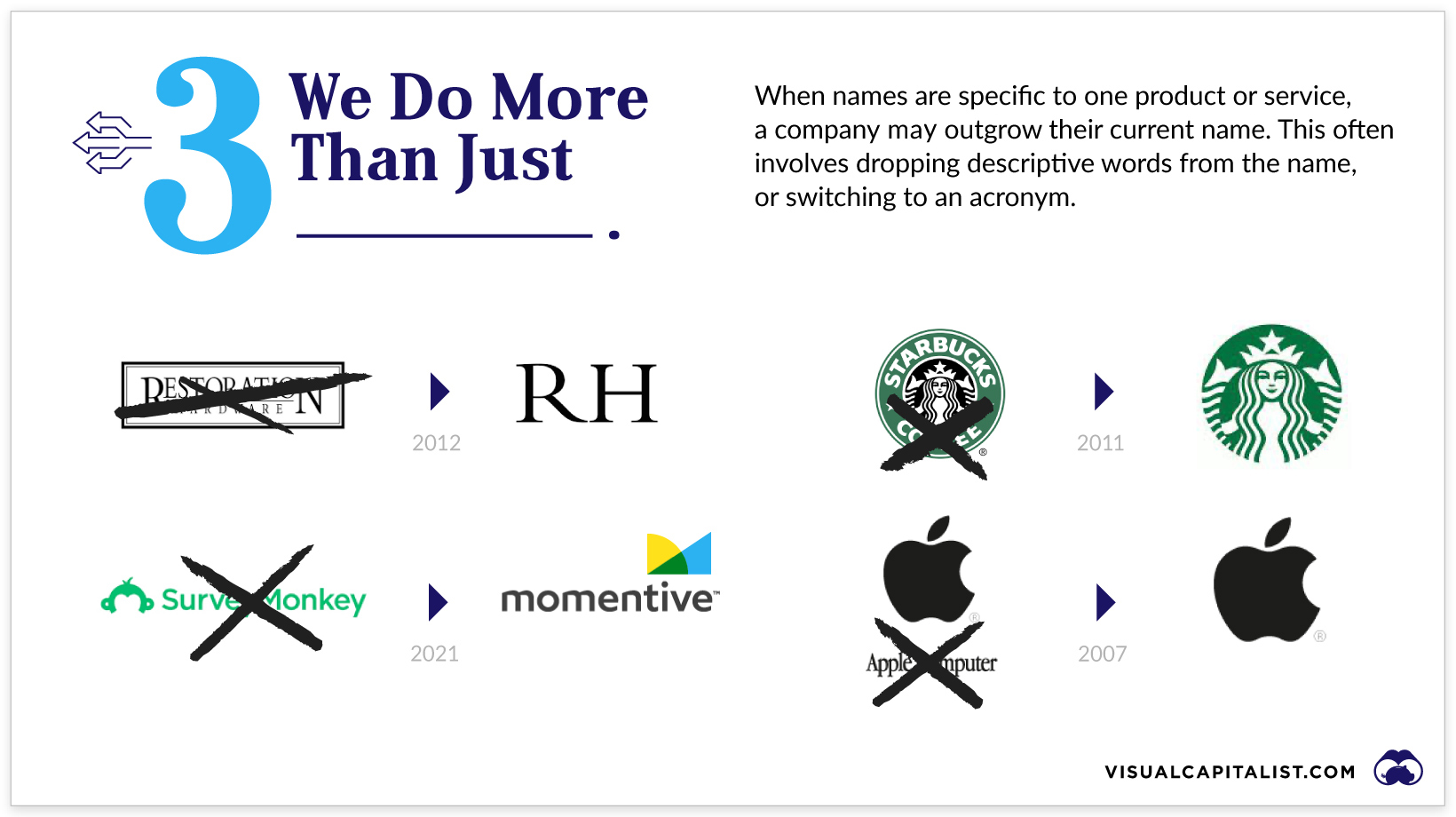
Both **Apple** and **Starbucks** have simplified their company names over the years. The former dropped “Computers” from its name in 2007, and Starbucks dropped “Coffee” from its name in 2011. In both these cases, the name change meant disassociating the company with what initially made them successful, but in both cases it was a gamble that paid off.
One of the biggest name changes in recent years is the switch from **Google** to **Alphabet**. This name change signaled the company’s desire to expand beyond internet search and advertising.
**Square** also found itself in a similar situation. The “Square” brand had become synonymous with its commerce solutions, so the parent company became **Block** to help the company signal a shift into other areas of business.
### The Start-Up Name Pivot
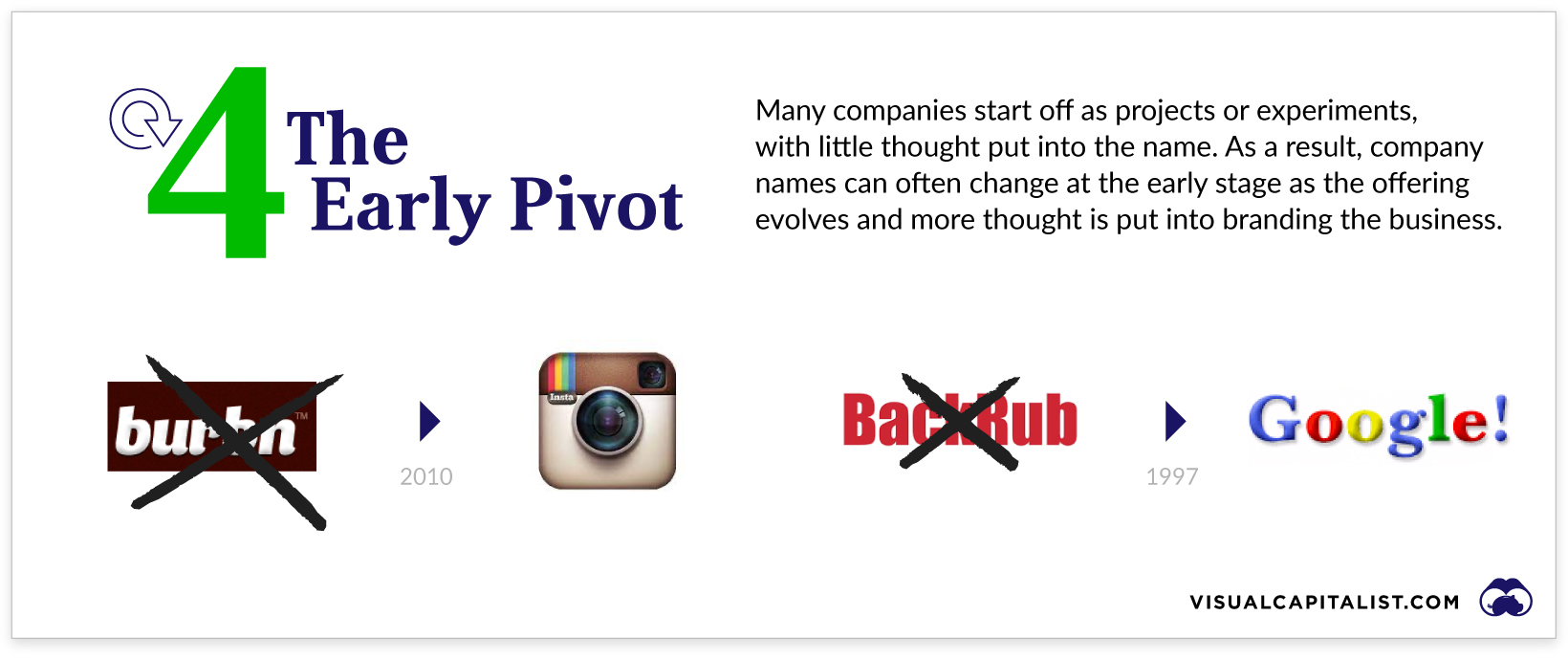
Another very common name change scenario is the early-stage name change.
In the world of music, there’s speculation that limited melodies and subconscious plagiarism will make creating new music increasingly difficult in the future. Similarly, there are millions of companies in the world and only so many short and snappy names. (That’s how we end up with companies called Quibi.)
Many of the popular digital services we use today started with very different names. The **Google** we know today was once called Backrub. **Instagram** began life as Bourbn, and **Twitter** began life as “Twittr” before finding a spare E in the scrabble pile.
### Trademark Problems
As mentioned above, many companies start out as speculative experiments or passion projects, when a viable, well-vetted name isn’t high on the priority list. As a result, new companies can run into trademark problems.
This was the case when Picaboo, the precursor of [Snapchat](https://www.visualcapitalist.com/timeline-looking-back-at-10-years-of-snapchat/), was forced to change their name in 2011. The existing Picaboo—a photobook company—was not thrilled to share a name with an app that was primarily associated with [sexting](https://en.wikipedia.org/wiki/Sexting) at the time.
The fight over the name WWF was a more unique scenario. In 1994, the **World Wildlife Fund** and the **World Wrestling Federation** had a mutual agreement that the latter would stop using the initials internationally, except for fleeting uses such as “WWF champion”. In the end though, the agreement was largely ignored, and the issue became a sticking point when the wrestling company registered wwf.com. Eventually, the company rebranded as WWE (World Wrestling Entertainment) after losing a lawsuit.
### Course Correction
To err is human, and rebranding exercises don’t always hit the mark. When a name change is universally panned or, perhaps worse, not relevant, it’s time to course correct.
**Tribune Publishing** was forced to backtrack after their name change to **Tronc** in 2016. The [widely-panned](https://www.theverge.com/2016/6/2/11846538/tribune-tronc-rebranding-lol-ayfkm) name, which was stylized in all lower case, was seen as a clumsy attempt to become a digital-first publisher.
### Why Is Facebook Changing Its Name?
Facebook undertook this name change for a number of reasons, but chief among them is that the brand is irrevocably associated with scandals, negative externalities, and Mark Zuckerberg.
Even before the most recent outage and whistle-blowing scandal, Facebook was already the [least-trusted](https://www.vox.com/2018/4/10/17220060/facebook-trust-major-tech-company) tech company by a long shot. Mark Zuckerberg was once the [most admired CEO](https://www.macgasm.net/wp-content/uploads/2013/03/10-Highest-Rated-Tech-CEOs.jpg) in Silicon Valley, but has since fallen from grace.
It’s easy to focus on the negative triggers for the impending name change, but there is some substance behind the change as well. For one, Facebook recognizes that privacy issues have put their primary [source of revenue](https://www.visualcapitalist.com/how-big-tech-makes-their-billions-2020/) at risk. The company’s ad-driven model built upon its users’ data is coming under increasing scrutiny with each passing year.
As well, there is substance behind the metaverse hype. Facebook first signaled their ambitions in 2014, when it acquired the virtual reality headset maker **Oculus**. A sizable portion of the company’s workforce is already working on making the metaverse concept a reality, and there are plans to hire 10,000 more people in Europe over the next five years.
It remains to be seen whether this immense gamble pays off, but for the near future, Zuckerberg and Facebook’s investors will be keeping a close eye on how the media and public react to the new Meta name and how the transition plays out. After all, there are billions of dollars at stake. | |||||||||||||||
| ML Classification | ||||||||||||||||
| ML Categories |
Raw JSON{
"/Business_and_Industrial": 954,
"/Business_and_Industrial/Business_Operations": 672,
"/Business_and_Industrial/Business_Operations/Management": 513,
"/Internet_and_Telecom": 203,
"/Internet_and_Telecom/Web_Services": 180
} | |||||||||||||||
| ML Page Types |
Raw JSON{
"/Article": 995,
"/Article/Thought_Leadership": 350
} | |||||||||||||||
| ML Intent Types |
Raw JSON{
"Informational": 999
} | |||||||||||||||
| Content Metadata | ||||||||||||||||
| Language | en-us | |||||||||||||||
| Author | Nick Routley | |||||||||||||||
| Publish Time | 2021-10-27 20:38:57 (4 years ago) | |||||||||||||||
| Original Publish Time | 2021-10-27 20:38:57 (4 years ago) | |||||||||||||||
| Republished | No | |||||||||||||||
| Word Count (Total) | 3,250 | |||||||||||||||
| Word Count (Content) | 1,102 | |||||||||||||||
| Links | ||||||||||||||||
| External Links | 26 | |||||||||||||||
| Internal Links | 119 | |||||||||||||||
| Technical SEO | ||||||||||||||||
| Meta Nofollow | No | |||||||||||||||
| Meta Noarchive | No | |||||||||||||||
| JS Rendered | No | |||||||||||||||
| Redirect Target | null | |||||||||||||||
| Performance | ||||||||||||||||
| Download Time (ms) | 317 | |||||||||||||||
| TTFB (ms) | 250 | |||||||||||||||
| Download Size (bytes) | 92,935 | |||||||||||||||
| Shard | 133 (laksa) | |||||||||||||||
| Root Hash | 14085349958231439733 | |||||||||||||||
| Unparsed URL | com,visualcapitalist!www,/saying-bye-to-facebook-why-companies-change-their-name/ s443 | |||||||||||||||