ℹ️ Skipped - page is already crawled
| Filter | Status | Condition | Details |
|---|---|---|---|
| HTTP status | PASS | download_http_code = 200 | HTTP 200 |
| Age cutoff | PASS | download_stamp > now() - 6 MONTH | 0.5 months ago |
| History drop | PASS | isNull(history_drop_reason) | No drop reason |
| Spam/ban | PASS | fh_dont_index != 1 AND ml_spam_score = 0 | ml_spam_score=0 |
| Canonical | PASS | meta_canonical IS NULL OR = '' OR = src_unparsed | Not set |
| Property | Value |
|---|---|
| URL | https://www.vibemusicacademy.com/blog/a-beginners-guide-to-the-trumpet |
| Last Crawled | 2026-04-07 06:43:36 (16 days ago) |
| First Indexed | 2022-02-08 12:56:14 (4 years ago) |
| HTTP Status Code | 200 |
| Content | |
| Meta Title | A Beginner's Guide to the Trumpet - Music Education Blog for Parents and Students | Vibe Music Academy |
| Meta Description | null |
| Meta Canonical | null |
| Boilerpipe Text | If you're reading this, you have probably just started playing the trumpet. If so, congratulations! The trumpet is a magnificent instrument that I have had the privilege of playing for over 15 years, and I’m excited to see you take the first step in your journey of learning how to play it. Playing the trumpet can be fun and challenging, but starting with a solid foundation will give you all the tools you need to succeed.
Begin with the Breath
Because it is a wind instrument, learning the correct breathing technique is essential to playing the trumpet well.
Beginners often make the mistake of taking shallow breaths in the chest, but
to play trumpet with a rich tone, your breaths must go deep into your belly.
This type of breathing is called “diaphragmatic breathing,” which actively engages the diaphragm muscle that supports the lungs to produce a much deeper breath.
You can practice diaphragmatic breathing by:
Sitting in front of a mirror and wrapping your hands around your sides with your thumbs and index fingers resting on the base of your rib cage.
Inhale, focusing on breathing into your belly and expanding it like a balloon. You should feel your sides expand beneath your hands, and as you look at your reflection, your shoulders should not rise. Take a few breaths this way.
Breathe normally and observe the differences. You should notice that the diaphragmatic breath makes your lungs feel much fuller, and this fullness is the exact kind of breath support you need to play the trumpet.
Posture and Positioning
Once you’ve mastered the diaphragmatic breath, you can move on to your posture.
To achieve proper trumpet playing posture:
Seat yourself toward the edge of your chair with both feet flat on the floor.
Sit up straight with your shoulders back in a position that should be neither stiff nor slouching.
Raise the trumpet so it is parallel to the floor or angled down slightly.
Again, you want your posture to be comfortable, but don’t allow the horn angle to dip too much or you’ll constrict the airflow by pinching your throat.
To achieve proper positioning:
Wrap your right hand around the valve casings with your thumb in the first valve saddle and your index and middle fingers wrapping around the other side.
Slide your right ring finger into the 3rd valve ring and rest your pinky on the ring’s far side.
With your left hand, tuck your thumb under the lead pipe and rest it between the first and second valve casings.
Then, place your index, middle, and ring fingers on the three buttons.
Trumpet players debate whether the left pinky should rest on top of the saddle or inside it, as having the pinky tucked limits the other fingers' dexterity in playing quick passages, but the choice is ultimately up to the individual player. However, it is important to
press the buttons with your fingertips
because using your finger pads will significantly limit your speed and dexterity.
The “Buzz” about Trumpet
Now that you’ve learned how to breathe, sit, and hold your instrument correctly, you’re ready to play! But before you start playing the horn, you need to learn the "buzz" about the trumpet.
To learn to buzz:
Form your lips as if to say the letter “m,” (with the center of your lips pressed together and the corners of your mouth tight).
Loosen the center of your lips so that a stream of air can pass through, then gradually tighten them until you create a buzzing sound.
*This part of learning the trumpet takes some trial and error, so be patient with yourself as you experiment.
Once you’ve learned to buzz, place your mouthpiece on the center of your lips both vertically and horizontally.
Depending on the positioning of your teeth, you may need to shift your position a little, but deviating too much from the center will cause problems with your playing later.
Now buzz into the mouthpiece and experiment with tightening and loosening your lips, noticing how the pitch produced changes.
Trumpet players use these lip adjustments to expand their range of pitches, tightening to play higher pitches and loosening to play lower ones.
And now you’re ready to go! Test out your breathing, posture, hand positioning, and buzzing on the full instrument, and try some notes. Now that you’ve nailed the basics, you’re ready to explore the full range of this truly magnificent instrument.
Feb 12, 2026
Nov 20, 2025
Oct 9, 2025 |
| Markdown | Why Vibe?
[Expert Teachers](https://www.vibemusicacademy.com/teachers)
[Location Flexibility](https://www.vibemusicacademy.com/location-flexibility)
["Musician Making"](https://www.vibemusicacademy.com/ourapproach)
[Student Experiences](https://www.vibemusicacademy.com/experiences)
[Reviews](https://www.vibemusicacademy.com/reviews)
Instruments
[Piano & Keyboard](https://www.vibemusicacademy.com/teachers/piano)
[Guitar & Ukulele](https://www.vibemusicacademy.com/teachers/guitar)
[Drums & Percussion](https://www.vibemusicacademy.com/teachers/drums-percussion)
[Voice](https://www.vibemusicacademy.com/teachers/voice)
[Strings](https://www.vibemusicacademy.com/teachers/strings)
[Woodwinds](https://www.vibemusicacademy.com/teachers/woodwinds)
[Brass](https://www.vibemusicacademy.com/teachers/brass)
[Theory & Composition](https://www.vibemusicacademy.com/teachers/theory-composition)
[View All](https://www.vibemusicacademy.com/teachers/all-instruments)
[Music Lessons](https://www.vibemusicacademy.com/lessons)
[Events](https://www.vibemusicacademy.com/events)
[Blog](https://www.vibemusicacademy.com/blog)
[Jobs](https://www.vibemusicacademy.com/jobs)
[Contact](https://www.vibemusicacademy.com/getinfo)
[Book a Lesson](https://www.vibemusicacademy.com/contact)
# [](https://www.vibemusicacademy.com/)
Why Vibe?
[Expert Teachers](https://www.vibemusicacademy.com/teachers)
[Location Flexibility](https://www.vibemusicacademy.com/location-flexibility)
["Musician Making"](https://www.vibemusicacademy.com/ourapproach)
[Student Experiences](https://www.vibemusicacademy.com/experiences)
[Reviews](https://www.vibemusicacademy.com/reviews)
Instruments
[Piano & Keyboard](https://www.vibemusicacademy.com/teachers/piano)
[Guitar & Ukulele](https://www.vibemusicacademy.com/teachers/guitar)
[Drums & Percussion](https://www.vibemusicacademy.com/teachers/drums-percussion)
[Voice](https://www.vibemusicacademy.com/teachers/voice)
[Strings](https://www.vibemusicacademy.com/teachers/strings)
[Woodwinds](https://www.vibemusicacademy.com/teachers/woodwinds)
[Brass](https://www.vibemusicacademy.com/teachers/brass)
[Theory & Composition](https://www.vibemusicacademy.com/teachers/theory-composition)
[View All](https://www.vibemusicacademy.com/teachers/all-instruments)
[Music Lessons](https://www.vibemusicacademy.com/lessons)
[Events](https://www.vibemusicacademy.com/events)
[Blog](https://www.vibemusicacademy.com/blog)
[Jobs](https://www.vibemusicacademy.com/jobs)
[Contact](https://www.vibemusicacademy.com/getinfo)
[Book a Lesson](https://www.vibemusicacademy.com/contact)
![A Beginner's Guide to the Trumpet]()
February 5, 2022
[Guest User](https://www.vibemusicacademy.com/blog?author=62fedc8acdab626b2b645fb0)
A Beginner's Guide to the Trumpet
[Guest User](https://www.vibemusicacademy.com/blog?author=62fedc8acdab626b2b645fb0)
[February 5, 2022](https://www.vibemusicacademy.com/blog/a-beginners-guide-to-the-trumpet)
# [A Beginner's Guide to the Trumpet](https://www.vibemusicacademy.com/blog/a-beginners-guide-to-the-trumpet)
[Guest User](https://www.vibemusicacademy.com/blog?author=62fedc8acdab626b2b645fb0)
[February 5, 2022](https://www.vibemusicacademy.com/blog/a-beginners-guide-to-the-trumpet)
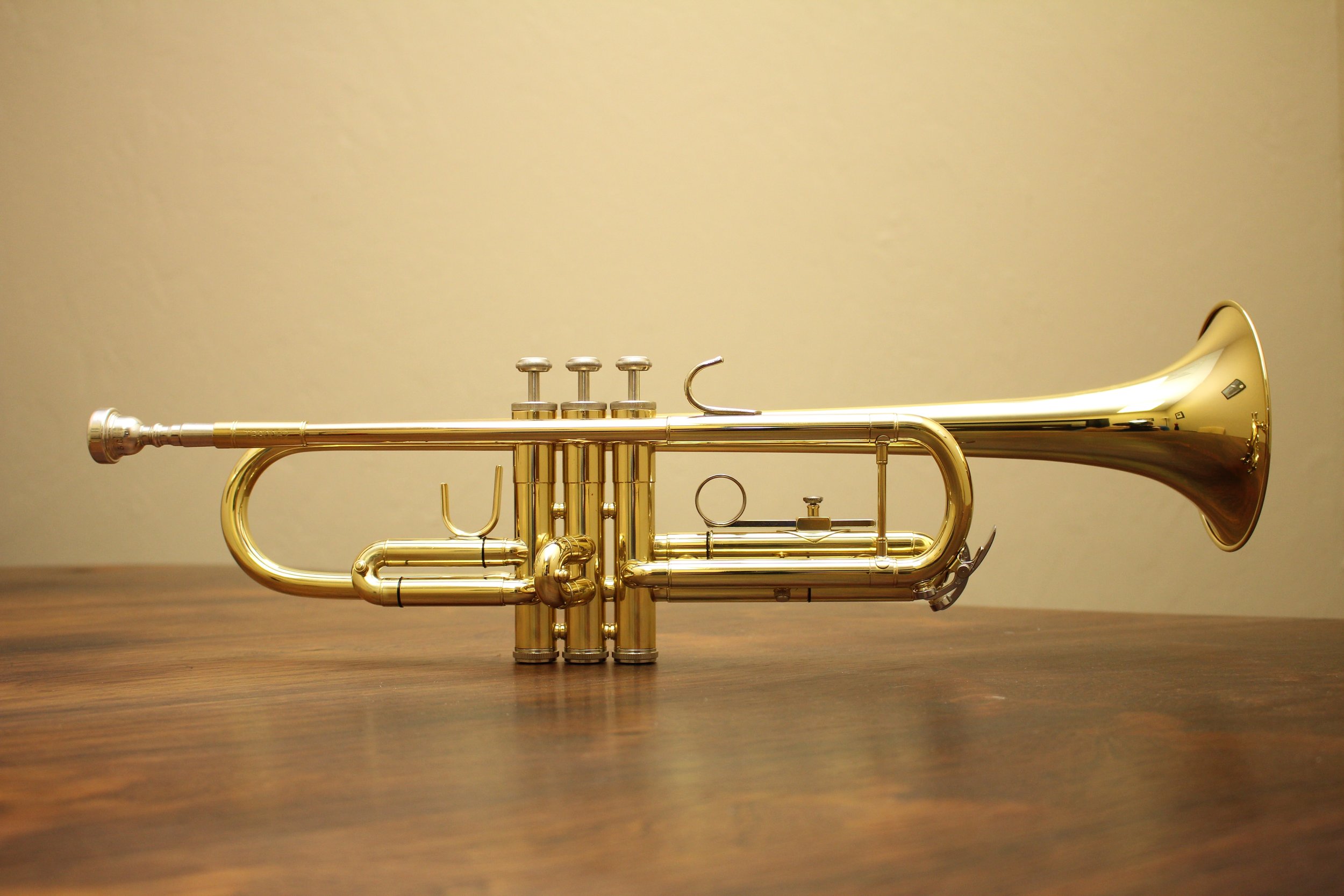
If you're reading this, you have probably just started playing the trumpet. If so, congratulations! The trumpet is a magnificent instrument that I have had the privilege of playing for over 15 years, and I’m excited to see you take the first step in your journey of learning how to play it. Playing the trumpet can be fun and challenging, but starting with a solid foundation will give you all the tools you need to succeed.
# **Begin with the Breath**
Because it is a wind instrument, learning the correct breathing technique is essential to playing the trumpet well.
Beginners often make the mistake of taking shallow breaths in the chest, but **to play trumpet with a rich tone, your breaths must go deep into your belly.** This type of breathing is called “diaphragmatic breathing,” which actively engages the diaphragm muscle that supports the lungs to produce a much deeper breath.
You can practice diaphragmatic breathing by:
1. Sitting in front of a mirror and wrapping your hands around your sides with your thumbs and index fingers resting on the base of your rib cage.
2. Inhale, focusing on breathing into your belly and expanding it like a balloon. You should feel your sides expand beneath your hands, and as you look at your reflection, your shoulders should not rise. Take a few breaths this way.
3. Breathe normally and observe the differences. You should notice that the diaphragmatic breath makes your lungs feel much fuller, and this fullness is the exact kind of breath support you need to play the trumpet.

# **Posture and Positioning**
Once you’ve mastered the diaphragmatic breath, you can move on to your posture.
To achieve proper trumpet playing posture:
1. Seat yourself toward the edge of your chair with both feet flat on the floor.
2. Sit up straight with your shoulders back in a position that should be neither stiff nor slouching.
3. Raise the trumpet so it is parallel to the floor or angled down slightly.
Again, you want your posture to be comfortable, but don’t allow the horn angle to dip too much or you’ll constrict the airflow by pinching your throat.
To achieve proper positioning:
1. Wrap your right hand around the valve casings with your thumb in the first valve saddle and your index and middle fingers wrapping around the other side.
2. Slide your right ring finger into the 3rd valve ring and rest your pinky on the ring’s far side.
3. With your left hand, tuck your thumb under the lead pipe and rest it between the first and second valve casings.
4. Then, place your index, middle, and ring fingers on the three buttons.
Trumpet players debate whether the left pinky should rest on top of the saddle or inside it, as having the pinky tucked limits the other fingers' dexterity in playing quick passages, but the choice is ultimately up to the individual player. However, it is important to **press the buttons with your fingertips** because using your finger pads will significantly limit your speed and dexterity.

# **The “Buzz” about Trumpet**
Now that you’ve learned how to breathe, sit, and hold your instrument correctly, you’re ready to play! But before you start playing the horn, you need to learn the "buzz" about the trumpet.
To learn to buzz:
1. Form your lips as if to say the letter “m,” (with the center of your lips pressed together and the corners of your mouth tight).
2. Loosen the center of your lips so that a stream of air can pass through, then gradually tighten them until you create a buzzing sound.
\*This part of learning the trumpet takes some trial and error, so be patient with yourself as you experiment.
3. Once you’ve learned to buzz, place your mouthpiece on the center of your lips both vertically and horizontally.
Depending on the positioning of your teeth, you may need to shift your position a little, but deviating too much from the center will cause problems with your playing later.
4. Now buzz into the mouthpiece and experiment with tightening and loosening your lips, noticing how the pitch produced changes.
Trumpet players use these lip adjustments to expand their range of pitches, tightening to play higher pitches and loosening to play lower ones.
And now you’re ready to go! Test out your breathing, posture, hand positioning, and buzzing on the full instrument, and try some notes. Now that you’ve nailed the basics, you’re ready to explore the full range of this truly magnificent instrument.
***
\-[Jordan Koehlinger](https://www.vibemusicacademy.com/teachers/jordan-koehlinger), Instructor at Vibe Music Academy
Featured
[![unsplash-image-OA1Gc9zOJq8.jpg]()](https://www.vibemusicacademy.com/blog/2026/2/12/healthy-hands-injury-prevention-for-young-musicians)
Feb 12, 2026
[Healthy Hands: Injury Prevention for Young Musicians](https://www.vibemusicacademy.com/blog/2026/2/12/healthy-hands-injury-prevention-for-young-musicians)
Feb 12, 2026
Feb 12, 2026
[![unsplash-image-RWytwNueNng.jpg]()](https://www.vibemusicacademy.com/blog/2025/11/20/digital-vs-acoustic-pianos-what-teachers-wish-parents-knew)
Nov 20, 2025
[Digital vs. Acoustic Pianos: What Teachers Wish Parents Knew](https://www.vibemusicacademy.com/blog/2025/11/20/digital-vs-acoustic-pianos-what-teachers-wish-parents-knew)
Nov 20, 2025
Nov 20, 2025
[![unsplash-image-igLbkeDmQl4.jpg]()](https://www.vibemusicacademy.com/blog/2025/10/9/whats-in-my-music-bag)
Oct 9, 2025
[What's in My Music Bag?](https://www.vibemusicacademy.com/blog/2025/10/9/whats-in-my-music-bag)
Oct 9, 2025
Oct 9, 2025
Newer Post[What is Music Therapy? 5 Things You Should Know Before Signing Up](https://www.vibemusicacademy.com/blog/what-is-music-therapy)
Older Post[5 Songs to Ease Your Winter Blues](https://www.vibemusicacademy.com/blog/5-song-to-ease-your-winter-blues)
## [Instruments](https://www.vibemusicacademy.com/teachers/piano/)
[Piano & Keyboard](https://www.vibemusicacademy.com/teachers/piano)
[Guitar & Ukulele](https://www.vibemusicacademy.com/teachers/guitar-ukulele)
[Drums & Percussion](https://www.vibemusicacademy.com/teachers/drums-percussion)
[Voice](https://www.vibemusicacademy.com/teachers/voice)
[Strings](https://www.vibemusicacademy.com/teachers/strings)
[Woodwinds](https://www.vibemusicacademy.com/teachers/woodwinds)
[Brass](https://www.vibemusicacademy.com/teachers/brass)
[Theory & Composition](https://www.vibemusicacademy.com/teachers/theory-composition)
## [Teachers](https://www.vibemusicacademy.com/teachers)
## [music lessons](https://www.vibemusicacademy.com/lessons)
## [reviews](https://www.vibemusicacademy.com/reviews)
## [EVENTS](https://www.vibemusicacademy.com/events)
## [blog](https://www.vibemusicacademy.com/blog)
## [jobs](https://www.vibemusicacademy.com/jobs)
[](https://www.vibemusicacademy.com/home)
## **(317) 395-3001**
[book a lesson](https://www.vibemusicacademy.com/contact)
[Get Info](https://www.vibemusicacademy.com/getinfo)
[Back to Top](https://www.vibemusicacademy.com/blog/a-beginners-guide-to-the-trumpet#header) |
| Readable Markdown | If you're reading this, you have probably just started playing the trumpet. If so, congratulations! The trumpet is a magnificent instrument that I have had the privilege of playing for over 15 years, and I’m excited to see you take the first step in your journey of learning how to play it. Playing the trumpet can be fun and challenging, but starting with a solid foundation will give you all the tools you need to succeed.

## **Begin with the Breath**
Because it is a wind instrument, learning the correct breathing technique is essential to playing the trumpet well.
Beginners often make the mistake of taking shallow breaths in the chest, but **to play trumpet with a rich tone, your breaths must go deep into your belly.** This type of breathing is called “diaphragmatic breathing,” which actively engages the diaphragm muscle that supports the lungs to produce a much deeper breath.
You can practice diaphragmatic breathing by:
1. Sitting in front of a mirror and wrapping your hands around your sides with your thumbs and index fingers resting on the base of your rib cage.
2. Inhale, focusing on breathing into your belly and expanding it like a balloon. You should feel your sides expand beneath your hands, and as you look at your reflection, your shoulders should not rise. Take a few breaths this way.
3. Breathe normally and observe the differences. You should notice that the diaphragmatic breath makes your lungs feel much fuller, and this fullness is the exact kind of breath support you need to play the trumpet.

## **Posture and Positioning**
Once you’ve mastered the diaphragmatic breath, you can move on to your posture.
To achieve proper trumpet playing posture:
1. Seat yourself toward the edge of your chair with both feet flat on the floor.
2. Sit up straight with your shoulders back in a position that should be neither stiff nor slouching.
3. Raise the trumpet so it is parallel to the floor or angled down slightly.
Again, you want your posture to be comfortable, but don’t allow the horn angle to dip too much or you’ll constrict the airflow by pinching your throat.
To achieve proper positioning:
1. Wrap your right hand around the valve casings with your thumb in the first valve saddle and your index and middle fingers wrapping around the other side.
2. Slide your right ring finger into the 3rd valve ring and rest your pinky on the ring’s far side.
3. With your left hand, tuck your thumb under the lead pipe and rest it between the first and second valve casings.
4. Then, place your index, middle, and ring fingers on the three buttons.
Trumpet players debate whether the left pinky should rest on top of the saddle or inside it, as having the pinky tucked limits the other fingers' dexterity in playing quick passages, but the choice is ultimately up to the individual player. However, it is important to **press the buttons with your fingertips** because using your finger pads will significantly limit your speed and dexterity.

## **The “Buzz” about Trumpet**
Now that you’ve learned how to breathe, sit, and hold your instrument correctly, you’re ready to play! But before you start playing the horn, you need to learn the "buzz" about the trumpet.
To learn to buzz:
1. Form your lips as if to say the letter “m,” (with the center of your lips pressed together and the corners of your mouth tight).
2. Loosen the center of your lips so that a stream of air can pass through, then gradually tighten them until you create a buzzing sound.
\*This part of learning the trumpet takes some trial and error, so be patient with yourself as you experiment.
3. Once you’ve learned to buzz, place your mouthpiece on the center of your lips both vertically and horizontally.
Depending on the positioning of your teeth, you may need to shift your position a little, but deviating too much from the center will cause problems with your playing later.
4. Now buzz into the mouthpiece and experiment with tightening and loosening your lips, noticing how the pitch produced changes.
Trumpet players use these lip adjustments to expand their range of pitches, tightening to play higher pitches and loosening to play lower ones.
And now you’re ready to go! Test out your breathing, posture, hand positioning, and buzzing on the full instrument, and try some notes. Now that you’ve nailed the basics, you’re ready to explore the full range of this truly magnificent instrument.
[](https://www.vibemusicacademy.com/blog/2026/2/12/healthy-hands-injury-prevention-for-young-musicians)
Feb 12, 2026
[](https://www.vibemusicacademy.com/blog/2025/11/20/digital-vs-acoustic-pianos-what-teachers-wish-parents-knew)
Nov 20, 2025
[](https://www.vibemusicacademy.com/blog/2025/10/9/whats-in-my-music-bag)
Oct 9, 2025 |
| ML Classification | |
| ML Categories | null |
| ML Page Types | null |
| ML Intent Types | null |
| Content Metadata | |
| Language | en-us |
| Author | null |
| Publish Time | 2022-02-06 03:02:52 (4 years ago) |
| Original Publish Time | 2022-02-06 03:02:52 (4 years ago) |
| Republished | No |
| Word Count (Total) | 981 |
| Word Count (Content) | 750 |
| Links | |
| External Links | 2 |
| Internal Links | 32 |
| Technical SEO | |
| Meta Nofollow | No |
| Meta Noarchive | No |
| JS Rendered | No |
| Redirect Target | null |
| Performance | |
| Download Time (ms) | 201 |
| TTFB (ms) | 189 |
| Download Size (bytes) | 25,811 |
| Shard | 8 (laksa) |
| Root Hash | 7133114521286352808 |
| Unparsed URL | com,vibemusicacademy!www,/blog/a-beginners-guide-to-the-trumpet s443 |