ℹ️ Skipped - page is already crawled
| Filter | Status | Condition | Details |
|---|---|---|---|
| HTTP status | PASS | download_http_code = 200 | HTTP 200 |
| Age cutoff | PASS | download_stamp > now() - 6 MONTH | 0.4 months ago |
| History drop | PASS | isNull(history_drop_reason) | No drop reason |
| Spam/ban | PASS | fh_dont_index != 1 AND ml_spam_score = 0 | ml_spam_score=0 |
| Canonical | PASS | meta_canonical IS NULL OR = '' OR = src_unparsed | Not set |
| Property | Value |
|---|---|
| URL | https://www.uvahealth.com/healthy-balance/loss-of-smell-taste/ |
| Last Crawled | 2026-04-12 09:57:41 (12 days ago) |
| First Indexed | 2025-12-13 00:34:24 (4 months ago) |
| HTTP Status Code | 200 |
| Content | |
| Meta Title | Q&A: When Smell & Taste Loss Could Mean Something Serious |
| Meta Description | Learn more about smell and taste loss disorders, including what causes them and what you can do about them. |
| Meta Canonical | null |
| Boilerpipe Text | During the height of the COVID pandemic, the oddest symptom began to hit headlines. People in the flush of infection and for months after lost their sense of smell. Others stopped wanting to eat, as their sense of taste disappeared. Compared to the other impacts of COVID, like brain fog, lung damage, and death, loss of smell and taste didn't seem so bad.
But it turns out that losing your sense of smell and taste can lead to serious problems. Changes in these senses can also point to underlying disease.
We spoke with
Jose Mattos, MD
, and Steven Munger, PhD, leading experts in smell and taste disorders, to understand more.
Do a lot of people have smell and taste disorders?
Munger:
Yes. These are very common disorders. Probably about 20% of adults are affected by a smell or taste disorder. Many people first notice smell loss. Smell disorders are much more common than taste disorders, although both are certainly impactful for patients.
How much do we know about what causes smell and taste disorders?
Munger:
There are many different types of causes. One that got a lot of attention over the last few years was viruses that affect the oral and nasal cavities. With viruses like COVID-19, a lot of people lost their sense of smell. The flu and the common cold can do that as well.
But there are many other causes:
Head trauma
Chemo
Head and neck focused radiation
Medications
Parkinson's disease
Alzheimer's disease
Inflammatory disease of the nose
Surgical issues, especially in dental surgeries for taste
Allergies
What are some of the most common symptoms that may signal you have a smell or taste disorder, other than the obvious — either you smell nothing or you can't taste things?
Munger:
Your senses of smell and taste work together to give you a perception of flavor. Sweet and sour and bitter, these types of things are taste primarily. You can't tell the difference between a lemon and a lime without the different odors that go along with them.
So a lot of people will first come to their doctor noting that food just doesn't taste right. And that's often what sends you down the road of investigating if this is a smell or taste disorder.
What are some of the potential health effects of having one of these disorders?
Mattos:
The primary impacts are around quality of life and enjoyment of daily activities. Eating and drinking are very social events. If food doesn't taste right, and people don't want to engage in those activities, it can be socially isolating. Folks who have smell and taste disorders can develop depression or anxiety.
And then there's physical health consequences people can develop, particularly the elderly. If they really diminish their intake of food, they lose nutrition.
There are also safety consequences. Our sense of smell is for more than just detecting pleasant things. We also use it for detecting hazards in our environment, like:
Spoiled or rotten food
Smoke or burning
Gas and propane leaks
And there are issues with detecting one's own personal hygiene.
Can smell and taste disorders can sometimes point to underlying health issues?
Munger:
Yes. They can signal a developing neurodegenerative disorder like Parkinson's, Alzheimer's, or multiple sclerosis. And certain tumors can impinge on areas that are important for the sense of smell or taste.
Mattos:
They can also be a sign of underlying inflammatory conditions as well, like allergies or hay fever, chronic sinusitis, etc.
What services are available for people with smell and taste loss?
Munger:
Our approach at UVA Health includes helping patients with strategies to cope with the effects of smell or taste loss. This includes advice about diet, safety, and how to think about the interactions you have with the world around you that are normally mediated by smell and taste.
Mattos:
We take a very thorough course history and do a physical exam. Many times, just by asking key questions we can get to the bottom of the most likely cause.
Having Trouble With Smell or Taste?
Get a diagnosis at one of our ENT clinics.
But most patients also need to have what's called a nasal endoscopy. That's when we put a small camera inside the nostrils to look inside the nose and the sinuses to make sure that there's no other disease like the ones we've been discussing or nasal polyps or any growths or tumors or structural issues that might be causing it.
To get a sense of how severe the smell and taste disorder is, we can give patients smell and taste tests. Once we know the underlying cause, we can use different medications or surgeries to treat it, or we can refer patients to other specialists.
One of the things that's been shown to be most effective is what's called smell retraining therapy. I like to think of it as physical therapy for the nose. We give patients exercises to do it home that involve smelling different odors in a specific way at specific times of day. We usually pair it with a medication for the nose.
What advice would you have for families and friends on how to be supportive and help somebody who is experiencing smell and taste loss?
Munger:
The first reaction should be, "let's investigate this further, because this is a real disorder." Believe their story.
Then the second should be to recognize that it's not a trivial loss or distortion. These issues really do impact the way you interact with others. Think of how social interactions that often surround food and drink. Or other things, like smelling your baby’s freshly washed head.
These types of things are emotionally very important. Recognizing that this isn't just a one-off inconvenience, but an emotionally important change to that person's life is a key thing I think friends and loved ones can do to offer support.
Subscribe to Healthy Balance
Get timely health and wellness tips from UVA Health experts. Plus, stories that will move you. |
| Markdown | [Skip to main content](https://www.uvahealth.com/healthy-balance/loss-of-smell-taste/#main-content)
- Patients
- Healthcare Professionals
- Research
- Education
- [About UVA Health](https://www.uvahealth.com/about)
- [MyChart](https://mychart.healthsystem.virginia.edu/mychart/Authentication/Login)
- I want to...
- [Careers](https://careers.uvahealth.org/us/en)
- [Donate](https://www.givecampus.com/campaigns/18150/donations/new?a=4319347)
- Translate
[logo of University of Virginia Health System](https://www.uvahealth.com/)
[Healthy Balance](https://www.uvahealth.com/healthy-balance)
# Q\&A: Loss of Smell & Taste? When Smell & Taste Loss Could Mean Something Serious
January 29, 2025
by Megan E. Davis
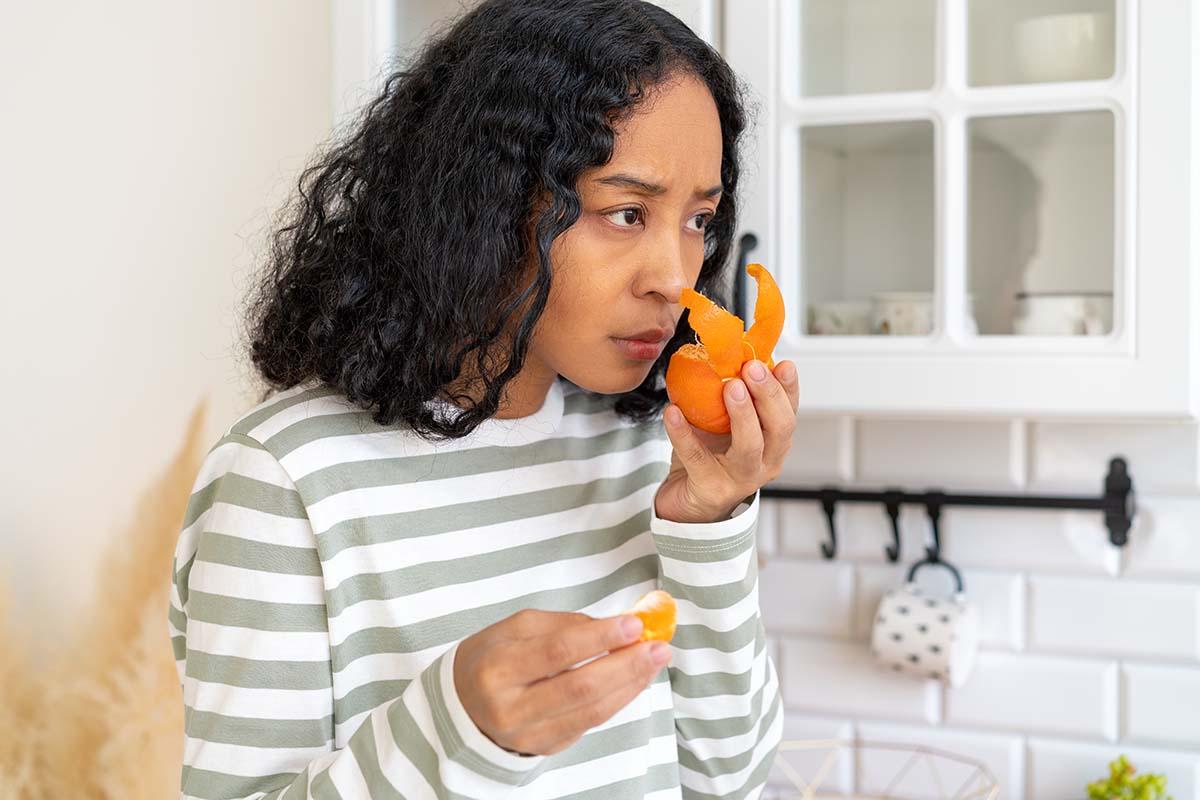
During the height of the COVID pandemic, the oddest symptom began to hit headlines. People in the flush of infection and for months after lost their sense of smell. Others stopped wanting to eat, as their sense of taste disappeared. Compared to the other impacts of COVID, like brain fog, lung damage, and death, loss of smell and taste didn't seem so bad.
But it turns out that losing your sense of smell and taste can lead to serious problems. Changes in these senses can also point to underlying disease.
We spoke with [Jose Mattos, MD](https://uvahealth.com/providers/jose-mattos-1508151887), and Steven Munger, PhD, leading experts in smell and taste disorders, to understand more.
## Do a lot of people have smell and taste disorders?
**Munger:** Yes. These are very common disorders. Probably about 20% of adults are affected by a smell or taste disorder. Many people first notice smell loss. Smell disorders are much more common than taste disorders, although both are certainly impactful for patients.
## How much do we know about what causes smell and taste disorders?
**Munger:** There are many different types of causes. One that got a lot of attention over the last few years was viruses that affect the oral and nasal cavities. With viruses like COVID-19, a lot of people lost their sense of smell. The flu and the common cold can do that as well.
But there are many other causes:
- Head trauma
- Chemo
- Head and neck focused radiation
- Medications
- Parkinson's disease
- Alzheimer's disease
- Inflammatory disease of the nose
- Surgical issues, especially in dental surgeries for taste
- Allergies
## What are some of the most common symptoms that may signal you have a smell or taste disorder, other than the obvious — either you smell nothing or you can't taste things?
**Munger:** Your senses of smell and taste work together to give you a perception of flavor. Sweet and sour and bitter, these types of things are taste primarily. You can't tell the difference between a lemon and a lime without the different odors that go along with them.
So a lot of people will first come to their doctor noting that food just doesn't taste right. And that's often what sends you down the road of investigating if this is a smell or taste disorder.
## What are some of the potential health effects of having one of these disorders?
**Mattos:** The primary impacts are around quality of life and enjoyment of daily activities. Eating and drinking are very social events. If food doesn't taste right, and people don't want to engage in those activities, it can be socially isolating. Folks who have smell and taste disorders can develop depression or anxiety.
And then there's physical health consequences people can develop, particularly the elderly. If they really diminish their intake of food, they lose nutrition.
There are also safety consequences. Our sense of smell is for more than just detecting pleasant things. We also use it for detecting hazards in our environment, like:
- Spoiled or rotten food
- Smoke or burning
- Gas and propane leaks
And there are issues with detecting one's own personal hygiene.
## Can smell and taste disorders can sometimes point to underlying health issues?
**Munger:** Yes. They can signal a developing neurodegenerative disorder like Parkinson's, Alzheimer's, or multiple sclerosis. And certain tumors can impinge on areas that are important for the sense of smell or taste.
**Mattos:** They can also be a sign of underlying inflammatory conditions as well, like allergies or hay fever, chronic sinusitis, etc.
## What services are available for people with smell and taste loss?
**Munger:** Our approach at UVA Health includes helping patients with strategies to cope with the effects of smell or taste loss. This includes advice about diet, safety, and how to think about the interactions you have with the world around you that are normally mediated by smell and taste.
**Mattos:** We take a very thorough course history and do a physical exam. Many times, just by asking key questions we can get to the bottom of the most likely cause.
## Having Trouble With Smell or Taste?
Get a diagnosis at one of our ENT clinics.
[Make an Appointment](https://uvahealth.com/treatments/smell-taste-disorders)
But most patients also need to have what's called a nasal endoscopy. That's when we put a small camera inside the nostrils to look inside the nose and the sinuses to make sure that there's no other disease like the ones we've been discussing or nasal polyps or any growths or tumors or structural issues that might be causing it.
To get a sense of how severe the smell and taste disorder is, we can give patients smell and taste tests. Once we know the underlying cause, we can use different medications or surgeries to treat it, or we can refer patients to other specialists.
One of the things that's been shown to be most effective is what's called smell retraining therapy. I like to think of it as physical therapy for the nose. We give patients exercises to do it home that involve smelling different odors in a specific way at specific times of day. We usually pair it with a medication for the nose.
## What advice would you have for families and friends on how to be supportive and help somebody who is experiencing smell and taste loss?
**Munger:** The first reaction should be, "let's investigate this further, because this is a real disorder." Believe their story.
Then the second should be to recognize that it's not a trivial loss or distortion. These issues really do impact the way you interact with others. Think of how social interactions that often surround food and drink. Or other things, like smelling your baby’s freshly washed head.
These types of things are emotionally very important. Recognizing that this isn't just a one-off inconvenience, but an emotionally important change to that person's life is a key thing I think friends and loved ones can do to offer support.
## Subscribe to Healthy Balance
Get timely health and wellness tips from UVA Health experts. Plus, stories that will move you.
[Sign Up Now](https://www.uvahealth.com/forms/subscribe-to-healthy-balance)
## Article Topics
[Treatments](https://www.uvahealth.com/search?tab=news-and-videos&topics=Treatments)
## Related Articles
[](https://www.uvahealth.com/healthy-balance/early-signs-of-parkinsons-disease)
April 25, 2024
[Do You Have These Early Signs of Parkinson’s Disease?](https://www.uvahealth.com/healthy-balance/early-signs-of-parkinsons-disease)
[General Health](https://www.uvahealth.com/search?tab=news-and-videos&topics=General+Health)[Treatments](https://www.uvahealth.com/search?tab=news-and-videos&topics=Treatments)
[](https://www.uvahealth.com/healthy-balance/preventing-alzheimers-in-women)
June 30, 2022
[7 Tips for Preventing Alzheimer's in Women](https://www.uvahealth.com/healthy-balance/preventing-alzheimers-in-women)
[General Health](https://www.uvahealth.com/search?tab=news-and-videos&topics=General+Health)[Prevention](https://www.uvahealth.com/search?tab=news-and-videos&topics=Prevention)
[](https://www.uvahealth.com/healthy-balance/early-signs-of-parkinsons-disease)
April 25, 2024
[Do You Have These Early Signs of Parkinson’s Disease?](https://www.uvahealth.com/healthy-balance/early-signs-of-parkinsons-disease)
[General Health](https://www.uvahealth.com/search?tab=news-and-videos&topics=General+Health)[Treatments](https://www.uvahealth.com/search?tab=news-and-videos&topics=Treatments)
[](https://www.uvahealth.com/healthy-balance/preventing-alzheimers-in-women)
June 30, 2022
[7 Tips for Preventing Alzheimer's in Women](https://www.uvahealth.com/healthy-balance/preventing-alzheimers-in-women)
[General Health](https://www.uvahealth.com/search?tab=news-and-videos&topics=General+Health)[Prevention](https://www.uvahealth.com/search?tab=news-and-videos&topics=Prevention)
logo of University of Virginia Health System
1215 Lee Street
Charlottesville, VA 22903
### UVA Health
### Community
### Patients & Visitors
### UVA Health System
### UVA Health
[About](https://www.uvahealth.com/about)
[Clinical Trials](https://www.uvahealth.com/clinical-trials)
[Who We Are](https://www.uvahealth.com/about/who-we-are)
[News & Stories](https://www.uvahealth.com/news-and-stories)
[Find Care](https://www.uvahealth.com/find-care)
[Quality & Safety](https://www.uvahealth.com/about/quality-safety)
### Community
[Careers](https://careers.uvahealth.org/)
[Donate](https://www.givecampus.com/campaigns/18150/donations/new?a=4319347)
[Volunteer](https://www.uvahealth.com/support/volunteer)
[Patient Referrals](https://www.uvahealth.com/support/patient-referrals)
[Request Privileges](https://www.medicalcenter.virginia.edu/clinicalstaff/quick-links/application-request/)
### Patients & Visitors
[Contact a Patient](https://www.uvahealth.com/patients-and-visitors/contact-a-patient)
[Give Feedback](https://www.uvahealth.com/forms/give-us-feedback/)
[Access Medical Records](https://www.uvahealth.com/patients-and-visitors/your-medical-records)
[Pay Your Bill](https://www.uvahealth.com/support/billing-and-insurance)
[Get Financial Assistance](https://www.uvahealth.com/support/billing-and-insurance/financial-aid)
### UVA Health System
[UVA Health](https://www.uvahealth.com/)
[UVA Health Children's](https://childrens.uvahealth.com/)
[School of Medicine](https://med.virginia.edu/)
[School of Nursing](https://www.nursing.virginia.edu/)
[Health Foundation](https://giving.uvahealth.com/)
[University of Virginia](https://www.virginia.edu/)
[Non-Discrimination Notice](https://www.uvahealth.com/about/non-discrimination)[Patient Rights & Policies](https://www.uvahealth.com/patient-rights)[Web Privacy](https://www.uvahealth.com/privacy-policy)[Report Accessibility Barrier](https://reportabarrier.virginia.edu/)[Price Transparency](https://www.uvahealth.com/support/billing-and-insurance/pricing)
© 2026 Rector and Visitors of the University of Virginia |
| Readable Markdown | During the height of the COVID pandemic, the oddest symptom began to hit headlines. People in the flush of infection and for months after lost their sense of smell. Others stopped wanting to eat, as their sense of taste disappeared. Compared to the other impacts of COVID, like brain fog, lung damage, and death, loss of smell and taste didn't seem so bad.
But it turns out that losing your sense of smell and taste can lead to serious problems. Changes in these senses can also point to underlying disease.
We spoke with [Jose Mattos, MD](https://uvahealth.com/providers/jose-mattos-1508151887), and Steven Munger, PhD, leading experts in smell and taste disorders, to understand more.
## Do a lot of people have smell and taste disorders?
**Munger:** Yes. These are very common disorders. Probably about 20% of adults are affected by a smell or taste disorder. Many people first notice smell loss. Smell disorders are much more common than taste disorders, although both are certainly impactful for patients.
## How much do we know about what causes smell and taste disorders?
**Munger:** There are many different types of causes. One that got a lot of attention over the last few years was viruses that affect the oral and nasal cavities. With viruses like COVID-19, a lot of people lost their sense of smell. The flu and the common cold can do that as well.
But there are many other causes:
- Head trauma
- Chemo
- Head and neck focused radiation
- Medications
- Parkinson's disease
- Alzheimer's disease
- Inflammatory disease of the nose
- Surgical issues, especially in dental surgeries for taste
- Allergies
## What are some of the most common symptoms that may signal you have a smell or taste disorder, other than the obvious — either you smell nothing or you can't taste things?
**Munger:** Your senses of smell and taste work together to give you a perception of flavor. Sweet and sour and bitter, these types of things are taste primarily. You can't tell the difference between a lemon and a lime without the different odors that go along with them.
So a lot of people will first come to their doctor noting that food just doesn't taste right. And that's often what sends you down the road of investigating if this is a smell or taste disorder.
## What are some of the potential health effects of having one of these disorders?
**Mattos:** The primary impacts are around quality of life and enjoyment of daily activities. Eating and drinking are very social events. If food doesn't taste right, and people don't want to engage in those activities, it can be socially isolating. Folks who have smell and taste disorders can develop depression or anxiety.
And then there's physical health consequences people can develop, particularly the elderly. If they really diminish their intake of food, they lose nutrition.
There are also safety consequences. Our sense of smell is for more than just detecting pleasant things. We also use it for detecting hazards in our environment, like:
- Spoiled or rotten food
- Smoke or burning
- Gas and propane leaks
And there are issues with detecting one's own personal hygiene.
## Can smell and taste disorders can sometimes point to underlying health issues?
**Munger:** Yes. They can signal a developing neurodegenerative disorder like Parkinson's, Alzheimer's, or multiple sclerosis. And certain tumors can impinge on areas that are important for the sense of smell or taste.
**Mattos:** They can also be a sign of underlying inflammatory conditions as well, like allergies or hay fever, chronic sinusitis, etc.
## What services are available for people with smell and taste loss?
**Munger:** Our approach at UVA Health includes helping patients with strategies to cope with the effects of smell or taste loss. This includes advice about diet, safety, and how to think about the interactions you have with the world around you that are normally mediated by smell and taste.
**Mattos:** We take a very thorough course history and do a physical exam. Many times, just by asking key questions we can get to the bottom of the most likely cause.
## Having Trouble With Smell or Taste?
Get a diagnosis at one of our ENT clinics.
But most patients also need to have what's called a nasal endoscopy. That's when we put a small camera inside the nostrils to look inside the nose and the sinuses to make sure that there's no other disease like the ones we've been discussing or nasal polyps or any growths or tumors or structural issues that might be causing it.
To get a sense of how severe the smell and taste disorder is, we can give patients smell and taste tests. Once we know the underlying cause, we can use different medications or surgeries to treat it, or we can refer patients to other specialists.
One of the things that's been shown to be most effective is what's called smell retraining therapy. I like to think of it as physical therapy for the nose. We give patients exercises to do it home that involve smelling different odors in a specific way at specific times of day. We usually pair it with a medication for the nose.
## What advice would you have for families and friends on how to be supportive and help somebody who is experiencing smell and taste loss?
**Munger:** The first reaction should be, "let's investigate this further, because this is a real disorder." Believe their story.
Then the second should be to recognize that it's not a trivial loss or distortion. These issues really do impact the way you interact with others. Think of how social interactions that often surround food and drink. Or other things, like smelling your baby’s freshly washed head.
These types of things are emotionally very important. Recognizing that this isn't just a one-off inconvenience, but an emotionally important change to that person's life is a key thing I think friends and loved ones can do to offer support.
## Subscribe to Healthy Balance
Get timely health and wellness tips from UVA Health experts. Plus, stories that will move you. |
| ML Classification | |
| ML Categories | null |
| ML Page Types | null |
| ML Intent Types | null |
| Content Metadata | |
| Language | en |
| Author | Megan E. Davis |
| Publish Time | not set |
| Original Publish Time | 2025-12-13 00:34:24 (4 months ago) |
| Republished | No |
| Word Count (Total) | 1,257 |
| Word Count (Content) | 1,003 |
| Links | |
| External Links | 20 |
| Internal Links | 32 |
| Technical SEO | |
| Meta Nofollow | No |
| Meta Noarchive | No |
| JS Rendered | No |
| Redirect Target | null |
| Performance | |
| Download Time (ms) | 452 |
| TTFB (ms) | 451 |
| Download Size (bytes) | 26,619 |
| Shard | 62 (laksa) |
| Root Hash | 16953978485358274262 |
| Unparsed URL | com,uvahealth!www,/healthy-balance/loss-of-smell-taste/ s443 |