ℹ️ Skipped - page is already crawled
| Filter | Status | Condition | Details |
|---|---|---|---|
| HTTP status | PASS | download_http_code = 200 | HTTP 200 |
| Age cutoff | PASS | download_stamp > now() - 6 MONTH | 0.1 months ago |
| History drop | PASS | isNull(history_drop_reason) | No drop reason |
| Spam/ban | PASS | fh_dont_index != 1 AND ml_spam_score = 0 | ml_spam_score=0 |
| Canonical | PASS | meta_canonical IS NULL OR = '' OR = src_unparsed | Not set |
| Property | Value | |||||||||
|---|---|---|---|---|---|---|---|---|---|---|
| URL | https://www.usbank.com/investing/financial-perspectives/investing-insights/etfs-vs-mutual-fund.html | |||||||||
| Last Crawled | 2026-04-20 02:25:02 (2 days ago) | |||||||||
| First Indexed | 2024-12-04 22:07:12 (1 year ago) | |||||||||
| HTTP Status Code | 200 | |||||||||
| Content | ||||||||||
| Meta Title | ETF vs. Mutual Fund: What’s the Difference? | U.S. Bank | |||||||||
| Meta Description | ETFs or mutual funds? Both are professionally managed and built to meet investment goals, but the similarities end there. Read about mutual funds & ETFs. | |||||||||
| Meta Canonical | null | |||||||||
| Boilerpipe Text | Key takeaways
Mutual funds and exchanged-traded funds (ETFs) are similar in a few ways, including that they are both a “basket of securities” that are designed to meet specific objectives.
Differences between ETFs and mutual funds include trading flexibility, management style and expense ratios.
A financial professional can help you build a portfolio that will help you achieve your goals, or you can invest in mutual funds or ETFs directly from an investment company.
Mutual funds and exchange traded funds (ETFs) are two types of investment vehicles available to individual investors. While similar, there are also important differences between them that you should understand as you build your investment portfolio.
Mutual fund vs ETF: How are they similar?
First, let’s look at the three main ways in which ETFs and mutual funds are similar:
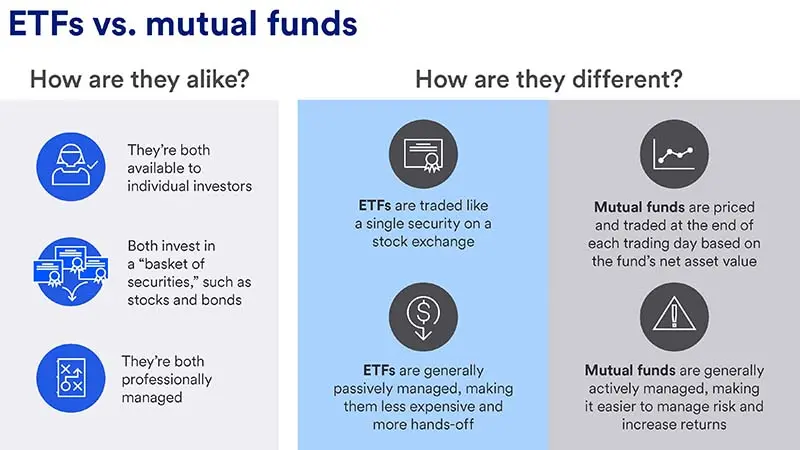
Mutual funds and ETFs invest in what’s typically called a “basket of securities.”
These are comprised of stocks and bonds. They are designed to meet specific objectives by investing in certain types of securities, such as U.S. stocks or the stocks of companies located in certain regions of the world.
Mutual funds and ETFs come with professional management.
This means you don’t have to try to build your own portfolio of securities that will meet your risk and return objectives — a complex proposition given how many different types of securities there are to choose from.
Mutual funds and ETFs give you diversified exposure to a particular segment of the market
without having to buy and sell hundreds of different securities yourself.
There are several different types of mutual funds and ETFs
, including stock, bond, balanced, income, money market, regional funds and international funds.
Now, let’s dive into how each of these investment vehicles work.
What is an ETF?
An ETF allows investors to buy and sell shares on a stock exchange. ETFs are either passively or actively managed.
Passive ETFs
are required to track a specific index, investing in a basket of securities that replicate the performance of the index the fund tracks. Conversely,
active ETFs
aren’t required to track an index.
ETFs offer several notable advantages for investors looking for both long and short-term solutions.
ETFs are tax efficient,
since capital gains can be deferred.
ETFs are flexible.
They can be bought and sold like common stocks throughout the day through a brokerage account.
ETFs typically offer lower fees
than mutual funds, along with intraday liquidity.
What is a mutual fund?
A mutual fund is an investment vehicle that pools funds from many individual investors to purchase a diversified portfolio of securities (for example, stocks and bonds) in alignment with the fund’s objectives. With a mutual fund, you can benefit from economies of scale while diversifying risk across a wide range of investment securities.
A fund manager oversees the portfolio and decides how funds should be allocated across different sectors and businesses to meet the fund’s objectives. That’s one of the biggest benefits of mutual funds: They allow you to access a much broader range of different investments than you could if you bought securities on your own. Returns are based on the fund’s performance, less fees and expenses.
What’s the difference between ETFs and mutual funds?
The differences between ETFs and mutual funds involve how they’re constructed and traded.
Trading flexibility and timing
Even though they contain a basket of securities, ETFs are traded like a single security on a major U.S. stock exchange. ETFs can be bought and sold intra-day, just like any security. In contrast, mutual funds are priced and traded at the end of each trading day based on the fund’s net asset value (NAV). This means there’s less flexibility in terms of timing and price with mutual funds.
ETFs give you more control over when to enter the market and at what price. On the flip side, you may need to pay a trading commission when you invest in an ETF, something that usually doesn’t apply to mutual funds.
Management style and tax efficiency
Most ETFs are passively managed. In other words, they’re designed to automatically track a market index, like the S&P 500. Most mutual funds, on the other hand, are actively managed, with the goal of outperforming a market index.
ETFs are usually more tax-efficient than mutual funds due to what’s referred to as the “creation/destruction” feature, where institutional investors can contribute or receive securities in exchange for ETF shares. As a result, the ETF does not need to realize gains to meet these investors’ redemption requests. This avoids taxable gains that would be passed to the remaining investors.
Expense ratios
The expense ratios for ETFs tend to be lower than mutual funds due to their passive management. In 2024, the average fund cost for actively managed funds was 1.00%, compared with 0.52% for passively managed funds, according to the
Morningstar 2024 U.S. Fund Fee Study
.
With their active trading, mutual funds tend to generate more capital gains than ETFs, which has tax implications for investors. When securities in a mutual fund are sold at a gain, the gain is passed on to shareholders, who must pay
capital gains tax
even if they don’t sell their mutual fund shares.
For this reason, mutual funds may often be held in tax-advantaged accounts like IRAs and 401(k)s, while ETFs are often held in taxable accounts, such as brokerage accounts.
Should I buy a mutual fund or an ETF?
The type of investment that’s right for you depends on your investing goals and objectives.
Consider an ETF if you want to minimize investing costs and capital gains taxes. ETFs provide more straightforward exposure to a market for investors who are cost-conscious and less concerned about picking and choosing individual securities. They’re a cost-efficient way to get broad market exposure and diversify your portfolio.
Conversely, consider a mutual fund if you want to automatically invest a set amount of money at certain intervals, such as monthly. This strategy, commonly known as dollar-cost averaging, is often used to build wealth over a long period of time to meet long-term objectives like saving for retirement. Mutual funds also tend to be a good choice if you want to not just track but attempt to beat the returns of market indices. Mutual funds offer the opportunity to manage risk and increase returns.
How to buy ETFs and mutual funds
If you want to research and construct an investment portfolio yourself, you can purchase ETFs and mutual funds directly from the investment companies that market and sell them. Or you can work with a financial professional to build a customized portfolio.
There are so many options when it comes to choosing ETFs and mutual funds that it can be overwhelming for some investors. A financial professional can help you narrow down the options and choose the right funds based on your investing goals, risk tolerance and time horizon.
Whether you want to invest on your own or with personalized financial guidance, we have
investing options to meet your needs
. | |||||||||
| Markdown | [Skip to main content](https://www.usbank.com/investing/financial-perspectives/investing-insights/etfs-vs-mutual-fund.html#bodyContent)
[](https://www.usbank.com/wealth-management.html)
[Log in](https://onlinebanking.usbank.com/auth/login/)
[About us](https://www.usbank.com/about-us-bank.html) [Financial education](https://www.usbank.com/financialiq.html)
[Support](https://www.usbank.com/customer-service.html) [Locations](https://www.usbank.com/locations/search/)
[Log in](https://onlinebanking.usbank.com/auth/login/)
- [](https://www.usbank.com/wealth-management.html)
- [Locations](https://www.usbank.com/locations/search/)
- [Support](https://www.usbank.com/customer-service.html)
- [Financial Education](https://www.usbank.com/financialiq.html)
- [About us](https://www.usbank.com/about-us-bank.html)
- [Personal](https://www.usbank.com/index.html)
- Wealth Management
- Return to Main Menu
- Wealth Management
- Work with an advisor
- Return to Wealth Management
- Work with an advisor
- Wealth Connect
Wealth Connect Net worth up to \$250,000
- Return to Work with an advisor
- Wealth Connect
- [Start investing](https://www.usbank.com/investing/online-investing.html)
- [Explore Wealth Connect](https://www.usbank.com/wealth-management/wealth-advisors-and-teams/wealth-connect.html)
- Wealth Management
Wealth Management Net worth \$250,000 to \$3 million
- Return to Work with an advisor
- Wealth Management
- [Our wealth management approach](https://www.usbank.com/wealth-management/wealth-advisors-and-teams/approach.html)
- [Find an advisor](https://www.usbank.com/wealth-management/find-an-advisor/)
- [Explore Wealth Management](https://www.usbank.com/wealth-management.html)
- Private Wealth Management
Private Wealth Management Net worth \$3 to \$75 million
- Return to Work with an advisor
- Private Wealth Management
- [Our private wealth approach](https://www.usbank.com/wealth-management/private-wealth-management/defining-private-wealth-management.html)
- [Find a private wealth office](https://www.usbank.com/wealth-management/private-wealth-management/near-me/)
- [Explore Private Wealth Management](https://www.usbank.com/wealth-management/private-wealth-management.html)
- Ascent Private Capital Management
Ascent Private Capital Management Net worth more than \$75 million
- Return to Work with an advisor
- Ascent Private Capital Management
- [Our Ascent approach](https://www.usbank.com/wealth-management/ascent/wealth-strategy.html)
- [Find a regional team office](https://www.usbank.com/wealth-management/ascent/family-offices.html)
- [Explore Ascent](https://www.usbank.com/wealth-management/ascent.html)
- - [Get personalized guidance](https://www.usbank.com/wealth-management/wealth-advisors-and-teams.html)
- [Find an advisor](https://www.usbank.com/wealth-management/find-an-advisor/)
- Investing & retirement
- Return to Wealth Management
- Investing & retirement
- Investing
Investing
- Return to Investing & retirement
- Investing
- [Start investing](https://www.usbank.com/investing/online-investing.html)
- [Work with an advisor](https://www.usbank.com/wealth-management/wealth-advisors-and-teams.html)
- [Invest on your own](https://www.usbank.com/investing/online-investing/self-directed-investing.html)
- [Investment management](https://www.usbank.com/investing/investment-management.html)
- [Explore investing options](https://www.usbank.com/investing.html)
- Retirement
Retirement
- Return to Investing & retirement
- Retirement
- [Open an IRA](https://www.usbank.com/retirement-planning/open-an-ira.html)
- [401(k) rollover](https://www.usbank.com/retirement-planning/open-an-ira/401k-rollovers.html)
- [Retirement income](https://www.usbank.com/retirement-planning/retirement-income.html)
- [Retirement savings](https://www.usbank.com/retirement-planning/saving-for-retirement.html)
- [Explore retirement planning](https://www.usbank.com/retirement-planning.html)
- Major life events
Major life events
- Return to Investing & retirement
- Major life events
- [Plan for retirement](https://www.usbank.com/retirement-planning.html)
- [Fund an education](https://www.usbank.com/investing/financial-goals/529-plans.html)
- [Plan for a major purchase](https://www.usbank.com/investing/financial-goals/life-events.html)
- [Leave a legacy](https://www.usbank.com/wealth-management/trusts-and-estates/legacy-wealth-management.html)
- [Explore all financial goals](https://www.usbank.com/investing/financial-goals.html)
- Retirement Planning
Still have that 401K at your previous company?
Learn how to consolidate and help your money do more with our investment options and guidance. Explore your options
[Explore your options](https://www.usbank.com/retirement-planning/open-an-ira/401k-rollovers.html)
- - [Find an advisor](https://www.usbank.com/wealth-management/find-an-advisor/)
- Wealth services
- Return to Wealth Management
- Wealth services
- Investment management
Investment management
- Return to Wealth services
- Investment management
- [Asset allocation](https://www.usbank.com/investing/investment-management/diversification.html)
- [Investment selection](https://www.usbank.com/investing/investment-management/investment-selection.html)
- [Investment portfolios](https://www.usbank.com/investing/investment-management/investment-portfolios.html)
- [Explore all investment management](https://www.usbank.com/investing/investment-management.html)
- Trust & estate planning
Trust & estate planning
- Return to Wealth services
- Trust & estate planning
- [Revocable trusts](https://www.usbank.com/wealth-management/trusts-and-estates/living-trust.html)
- [Irrevocable trusts](https://www.usbank.com/wealth-management/trusts-and-estates/irrevocable-trust.html)
- [Trust administration](https://www.usbank.com/wealth-management/trusts-and-estates/what-is-a-trust.html)
- [Explore trust & estate planning](https://www.usbank.com/wealth-management/trusts-and-estates.html)
- Wealth strategies
Wealth strategies
- Return to Wealth services
- Wealth strategies
- [Wealth planning](https://www.usbank.com/wealth-management/wealth-planning.html)
- [Wealth banking](https://www.usbank.com/wealth-management/personal-banking.html)
- [Charitable giving](https://www.usbank.com/wealth-management/charitable-giving.html)
- [Insurance](https://www.usbank.com/wealth-management/insurance-protection.html)
- [Explore all services](https://www.usbank.com/wealth-management/wealth-management-services.html)
- Tailored financial guidance
Ready for the future but not sure where to start?
Our planning checklist takes the stress out of your first meeting prep.
[Read our guide](https://www.usbank.com/wealth-management/wealth-advisors-and-teams/meeting-with-a-financial-advisor.html)
- - [Find an advisor](https://www.usbank.com/wealth-management/find-an-advisor/)
- News & insights
- Return to Wealth Management
- News & insights
- Market commentary
Market commentary
- Return to News & insights
- Market commentary
- [Weekly market analysis](https://www.usbank.com/investing/financial-perspectives/market-news/market-analysis.html)
- [Quarterly economic outlook](https://www.usbank.com/investing/financial-perspectives/market-news/economic-news.html)
- [Market news](https://www.usbank.com/investing/financial-perspectives/market-news.html)
- Investing insights
Investing insights
- Return to News & insights
- Investing insights
- [Investing fundamentals](https://www.usbank.com/investing/financial-perspectives/investing-fundamentals.html)
- [Investing strategies](https://www.usbank.com/investing/financial-perspectives/investing-insights.html)
- Planning insights
Planning insights
- Return to News & insights
- Planning insights
- [Financial planning](https://www.usbank.com/wealth-management/financial-perspectives/financial-planning.html)
- [Retirement strategies](https://www.usbank.com/retirement-planning/financial-perspectives.html)
- [Trust & estate planning](https://www.usbank.com/wealth-management/financial-perspectives/trust-and-estate-planning.html)
- [Tax strategies](https://www.usbank.com/wealth-management/financial-perspectives/tax-planning-resources.html)
- Wealth management
Navigate dynamic markets with confidence
Act now to capitalize on opportunities. Create a plan tailored to today's evolving market.
[Schedule a review](https://www.usbank.com/splash/wealth-management/maximize-my-wealth.html)
- - [Read all news & insights](https://www.usbank.com/wealth-management/financial-perspectives.html)
- [Find an advisor](https://www.usbank.com/wealth-management/find-an-advisor/)
- [Business](https://www.usbank.com/business-banking.html)
- [Corporate & Commercial](https://www.usbank.com/corporate-and-commercial-banking.html)
- [Institutional](https://www.usbank.com/investment-services.html)
Close Main Menu
- Location
- Locations
- Branch
- Branches
- ATM locations
- ATM locator
Start investing today with U.S. Bancorp Advisors.
Investment products and services are: Not a deposit \| Not FDIC insured \| May lose value
[Explore investing options](https://www.usbank.com/wealth-management/wealth-advisors-and-teams/wealth-connect.html?icid=PB_404118)
- [Financial perspectives](https://www.usbank.com/wealth-management/financial-perspectives.html) /
- [Investing insights](https://www.usbank.com/investing/financial-perspectives/investing-insights.html) /
- ETF vs. mutual fund: What’s the difference?
[Financial perspectives](https://www.usbank.com/wealth-management/financial-perspectives.html) /
[Investing insights](https://www.usbank.com/investing/financial-perspectives/investing-insights.html) /
ETF vs. mutual fund: What’s the difference?
Article
# ETF vs. mutual fund: What’s the difference?
7-min read
Share:
[Copy link to clipboard](https://www.usbank.com/investing/financial-perspectives/investing-insights/etfs-vs-mutual-fund.html)

Key takeaways
- Mutual funds and exchanged-traded funds (ETFs) are similar in a few ways, including that they are both a “basket of securities” that are designed to meet specific objectives.
- Differences between ETFs and mutual funds include trading flexibility, management style and expense ratios.
- A financial professional can help you build a portfolio that will help you achieve your goals, or you can invest in mutual funds or ETFs directly from an investment company.
Mutual funds and exchange traded funds (ETFs) are two types of investment vehicles available to individual investors. While similar, there are also important differences between them that you should understand as you build your investment portfolio.
## Mutual fund vs ETF: How are they similar?
First, let’s look at the three main ways in which ETFs and mutual funds are similar:
- **Mutual funds and ETFs invest in what’s typically called a “basket of securities.”** These are comprised of stocks and bonds. They are designed to meet specific objectives by investing in certain types of securities, such as U.S. stocks or the stocks of companies located in certain regions of the world.
- **Mutual funds and ETFs come with professional management.** This means you don’t have to try to build your own portfolio of securities that will meet your risk and return objectives — a complex proposition given how many different types of securities there are to choose from.
- **Mutual funds and ETFs give you diversified exposure to a particular segment of the market** without having to buy and sell hundreds of different securities yourself.
- **There are several different types of mutual funds and ETFs**, including stock, bond, balanced, income, money market, regional funds and international funds.
Now, let’s dive into how each of these investment vehicles work.
### What is an ETF?
An ETF allows investors to buy and sell shares on a stock exchange. ETFs are either passively or actively managed. **Passive ETFs** are required to track a specific index, investing in a basket of securities that replicate the performance of the index the fund tracks. Conversely, **active ETFs** aren’t required to track an index.
ETFs offer several notable advantages for investors looking for both long and short-term solutions.
- **ETFs are tax efficient,** since capital gains can be deferred.
- **ETFs are flexible.** They can be bought and sold like common stocks throughout the day through a brokerage account.
- **ETFs typically offer lower fees** than mutual funds, along with intraday liquidity.
### What is a mutual fund?
A mutual fund is an investment vehicle that pools funds from many individual investors to purchase a diversified portfolio of securities (for example, stocks and bonds) in alignment with the fund’s objectives. With a mutual fund, you can benefit from economies of scale while diversifying risk across a wide range of investment securities.
A fund manager oversees the portfolio and decides how funds should be allocated across different sectors and businesses to meet the fund’s objectives. That’s one of the biggest benefits of mutual funds: They allow you to access a much broader range of different investments than you could if you bought securities on your own. Returns are based on the fund’s performance, less fees and expenses.
## What’s the difference between ETFs and mutual funds?
The differences between ETFs and mutual funds involve how they’re constructed and traded.
### Trading flexibility and timing
Even though they contain a basket of securities, ETFs are traded like a single security on a major U.S. stock exchange. ETFs can be bought and sold intra-day, just like any security. In contrast, mutual funds are priced and traded at the end of each trading day based on the fund’s net asset value (NAV). This means there’s less flexibility in terms of timing and price with mutual funds.
ETFs give you more control over when to enter the market and at what price. On the flip side, you may need to pay a trading commission when you invest in an ETF, something that usually doesn’t apply to mutual funds.
### Management style and tax efficiency
Most ETFs are passively managed. In other words, they’re designed to automatically track a market index, like the S\&P 500. Most mutual funds, on the other hand, are actively managed, with the goal of outperforming a market index.
ETFs are usually more tax-efficient than mutual funds due to what’s referred to as the “creation/destruction” feature, where institutional investors can contribute or receive securities in exchange for ETF shares. As a result, the ETF does not need to realize gains to meet these investors’ redemption requests. This avoids taxable gains that would be passed to the remaining investors.
### Expense ratios
The expense ratios for ETFs tend to be lower than mutual funds due to their passive management. In 2024, the average fund cost for actively managed funds was 1.00%, compared with 0.52% for passively managed funds, according to the [Morningstar 2024 U.S. Fund Fee Study](https://www.morningstar.com/business/insights/blog/funds/us-fund-fee-study).
With their active trading, mutual funds tend to generate more capital gains than ETFs, which has tax implications for investors. When securities in a mutual fund are sold at a gain, the gain is passed on to shareholders, who must pay [capital gains tax](https://www.usbank.com/wealth-management/financial-perspectives/financial-planning/capital-gains-tax-explained.html "Capital gains tax explained") even if they don’t sell their mutual fund shares.
For this reason, mutual funds may often be held in tax-advantaged accounts like IRAs and 401(k)s, while ETFs are often held in taxable accounts, such as brokerage accounts.
## Should I buy a mutual fund or an ETF?
The type of investment that’s right for you depends on your investing goals and objectives.
Consider an ETF if you want to minimize investing costs and capital gains taxes. ETFs provide more straightforward exposure to a market for investors who are cost-conscious and less concerned about picking and choosing individual securities. They’re a cost-efficient way to get broad market exposure and diversify your portfolio.
Conversely, consider a mutual fund if you want to automatically invest a set amount of money at certain intervals, such as monthly. This strategy, commonly known as dollar-cost averaging, is often used to build wealth over a long period of time to meet long-term objectives like saving for retirement. Mutual funds also tend to be a good choice if you want to not just track but attempt to beat the returns of market indices. Mutual funds offer the opportunity to manage risk and increase returns.
## How to buy ETFs and mutual funds
If you want to research and construct an investment portfolio yourself, you can purchase ETFs and mutual funds directly from the investment companies that market and sell them. Or you can work with a financial professional to build a customized portfolio.
There are so many options when it comes to choosing ETFs and mutual funds that it can be overwhelming for some investors. A financial professional can help you narrow down the options and choose the right funds based on your investing goals, risk tolerance and time horizon.
## Frequently asked questions about ETFs and mutual funds
### Why buy an ETF instead of a mutual fund?
ETFs may be a good option for you if you’re looking to minimize investing costs and capital gains taxes. They’re a cost-efficient way to diversify your portfolio and get broad market exposure.
### Why would I choose a mutual fund over an ETF?
A mutual fund may be a good option if you are investing for long-term goals and want to automatically invest a set amount of money at certain intervals, such as monthly. Mutual funds could also be a good choice if you want to try to beat the returns of market indices.
### Are ETFs more tax-efficient than mutual funds?
Because ETFs are passively managed and designed to automatically track a market index, they’re usually more tax efficient than mutual funds since there’s less turnover in securities and lower trading costs.
*Whether you want to invest on your own or with personalized financial guidance, we have* [*investing options to meet your needs*](https://www.usbank.com/investing.html)*.*
### Tags:
[Investing](https://www.usbank.com/wealth-management/financial-perspectives/browse-all.topic-Investing.start-0.html)
## Explore more

### Understanding how a diversification strategy can help your investment portfolio
Diversification is a key part of risk management, with the goal to enhance and preserve your investment portfolio’s value.
[Read more](https://www.usbank.com/investing/financial-perspectives/investing-insights/diversification-strategy.html)

### Personalized investing guidance aligned with your goals.
Let us help you craft a portfolio that reflects your goals, time-horizon and values.
[Read more](https://www.usbank.com/investing/investment-management.html)
[Find an advisor or banker](https://www.usbank.com/wealth-management/find-an-advisor/)
### Disclosures
Start of disclosure content
Investment and insurance products and services including annuities are:
Not a deposit • Not FDIC insured • May lose value • Not bank guaranteed • Not insured by any federal government agency.
U.S. Wealth Management – U.S. Bank is a marketing logo for U.S. Bank.
Start of disclosure content
U.S. Bank and its representatives do not provide tax or legal advice. Your tax and financial situation is unique. You should consult your tax and/or legal advisor for advice and information concerning your particular situation.
The information provided represents the opinion of U.S. Bank and is not intended to be a forecast of future events or guarantee of future results. It is not intended to provide specific investment advice and should not be construed as an offering of securities or recommendation to invest. Not for use as a primary basis of investment decisions. Not to be construed to meet the needs of any particular investor. Not a representation or solicitation or an offer to sell/buy any security. Investors should consult with their investment professional for advice concerning their particular situation.
U.S. Bank does not offer insurance products but may refer you to an affiliated or third party insurance provider.
 Equal Housing Lender. Deposit products are offered by U.S. Bank National Association. Member FDIC. Mortgage, Home Equity and Credit products are offered by U.S. Bank National Association. Loan approval is subject to credit approval and program guidelines. Not all loan programs are available in all states for all loan amounts. Interest rates and program terms are subject to change without notice.
Start of disclosure content
**Mutual fund** investing involves risk and principal loss is possible. Investing in certain funds involves special risks, such as those related to investments in small- and mid-capitalization stocks, foreign, debt and high-yield securities and funds that focus their investments in a particular industry. Please refer to the fund prospectus for additional details pertaining to these risks.
**Exchange-traded funds (ETFs)** are baskets of securities that are traded on an exchange like individual stocks at negotiated prices and are not individually redeemable. ETFs are designed to generally track a market index and shares may trade at a premium or a discount to the net asset value of the underlying securities.
[Support](https://www.usbank.com/customer-service.html)
[Security](https://www.usbank.com/customer-service/online-security.html)
[Financial education](https://www.usbank.com/financialiq.html)
[Site map](https://www.usbank.com/site-map.html)
[Careers](https://careers.usbank.com/)
[Accessibility](https://www.usbank.com/about-us-bank/accessibility.html)
[Online tracking & advertising](https://www.usbank.com/about-us-bank/privacy/security.html#tracking)
[Alumni](https://www.usbank.com/about-us-bank/alumni.html)
[Privacy](https://www.usbank.com/about-us-bank/privacy.html)
[Your privacy choices ](https://www.usbank.com/investing/financial-perspectives/investing-insights/etfs-vs-mutual-fund.html#cpra)
[Cobrowse](https://www.usbank.com/investing/financial-perspectives/investing-insights/etfs-vs-mutual-fund.html)
U.S. Bank
800 Nicollet Mall
Minneapolis, MN 55402
© 2026 U.S. Bank
end of main | |||||||||
| Readable Markdown | Key takeaways
- Mutual funds and exchanged-traded funds (ETFs) are similar in a few ways, including that they are both a “basket of securities” that are designed to meet specific objectives.
- Differences between ETFs and mutual funds include trading flexibility, management style and expense ratios.
- A financial professional can help you build a portfolio that will help you achieve your goals, or you can invest in mutual funds or ETFs directly from an investment company.
Mutual funds and exchange traded funds (ETFs) are two types of investment vehicles available to individual investors. While similar, there are also important differences between them that you should understand as you build your investment portfolio.
## Mutual fund vs ETF: How are they similar?
First, let’s look at the three main ways in which ETFs and mutual funds are similar:
- **Mutual funds and ETFs invest in what’s typically called a “basket of securities.”** These are comprised of stocks and bonds. They are designed to meet specific objectives by investing in certain types of securities, such as U.S. stocks or the stocks of companies located in certain regions of the world.
- **Mutual funds and ETFs come with professional management.** This means you don’t have to try to build your own portfolio of securities that will meet your risk and return objectives — a complex proposition given how many different types of securities there are to choose from.
- **Mutual funds and ETFs give you diversified exposure to a particular segment of the market** without having to buy and sell hundreds of different securities yourself.
- **There are several different types of mutual funds and ETFs**, including stock, bond, balanced, income, money market, regional funds and international funds.
Now, let’s dive into how each of these investment vehicles work.
### What is an ETF?
An ETF allows investors to buy and sell shares on a stock exchange. ETFs are either passively or actively managed. **Passive ETFs** are required to track a specific index, investing in a basket of securities that replicate the performance of the index the fund tracks. Conversely, **active ETFs** aren’t required to track an index.
ETFs offer several notable advantages for investors looking for both long and short-term solutions.
- **ETFs are tax efficient,** since capital gains can be deferred.
- **ETFs are flexible.** They can be bought and sold like common stocks throughout the day through a brokerage account.
- **ETFs typically offer lower fees** than mutual funds, along with intraday liquidity.
### What is a mutual fund?
A mutual fund is an investment vehicle that pools funds from many individual investors to purchase a diversified portfolio of securities (for example, stocks and bonds) in alignment with the fund’s objectives. With a mutual fund, you can benefit from economies of scale while diversifying risk across a wide range of investment securities.
A fund manager oversees the portfolio and decides how funds should be allocated across different sectors and businesses to meet the fund’s objectives. That’s one of the biggest benefits of mutual funds: They allow you to access a much broader range of different investments than you could if you bought securities on your own. Returns are based on the fund’s performance, less fees and expenses.
## What’s the difference between ETFs and mutual funds?
The differences between ETFs and mutual funds involve how they’re constructed and traded.
### Trading flexibility and timing
Even though they contain a basket of securities, ETFs are traded like a single security on a major U.S. stock exchange. ETFs can be bought and sold intra-day, just like any security. In contrast, mutual funds are priced and traded at the end of each trading day based on the fund’s net asset value (NAV). This means there’s less flexibility in terms of timing and price with mutual funds.
ETFs give you more control over when to enter the market and at what price. On the flip side, you may need to pay a trading commission when you invest in an ETF, something that usually doesn’t apply to mutual funds.
### Management style and tax efficiency
Most ETFs are passively managed. In other words, they’re designed to automatically track a market index, like the S\&P 500. Most mutual funds, on the other hand, are actively managed, with the goal of outperforming a market index.
ETFs are usually more tax-efficient than mutual funds due to what’s referred to as the “creation/destruction” feature, where institutional investors can contribute or receive securities in exchange for ETF shares. As a result, the ETF does not need to realize gains to meet these investors’ redemption requests. This avoids taxable gains that would be passed to the remaining investors.
### Expense ratios
The expense ratios for ETFs tend to be lower than mutual funds due to their passive management. In 2024, the average fund cost for actively managed funds was 1.00%, compared with 0.52% for passively managed funds, according to the [Morningstar 2024 U.S. Fund Fee Study](https://www.morningstar.com/business/insights/blog/funds/us-fund-fee-study).
With their active trading, mutual funds tend to generate more capital gains than ETFs, which has tax implications for investors. When securities in a mutual fund are sold at a gain, the gain is passed on to shareholders, who must pay [capital gains tax](https://www.usbank.com/wealth-management/financial-perspectives/financial-planning/capital-gains-tax-explained.html "Capital gains tax explained") even if they don’t sell their mutual fund shares.
For this reason, mutual funds may often be held in tax-advantaged accounts like IRAs and 401(k)s, while ETFs are often held in taxable accounts, such as brokerage accounts.
## Should I buy a mutual fund or an ETF?
The type of investment that’s right for you depends on your investing goals and objectives.
Consider an ETF if you want to minimize investing costs and capital gains taxes. ETFs provide more straightforward exposure to a market for investors who are cost-conscious and less concerned about picking and choosing individual securities. They’re a cost-efficient way to get broad market exposure and diversify your portfolio.
Conversely, consider a mutual fund if you want to automatically invest a set amount of money at certain intervals, such as monthly. This strategy, commonly known as dollar-cost averaging, is often used to build wealth over a long period of time to meet long-term objectives like saving for retirement. Mutual funds also tend to be a good choice if you want to not just track but attempt to beat the returns of market indices. Mutual funds offer the opportunity to manage risk and increase returns.
## How to buy ETFs and mutual funds
If you want to research and construct an investment portfolio yourself, you can purchase ETFs and mutual funds directly from the investment companies that market and sell them. Or you can work with a financial professional to build a customized portfolio.
There are so many options when it comes to choosing ETFs and mutual funds that it can be overwhelming for some investors. A financial professional can help you narrow down the options and choose the right funds based on your investing goals, risk tolerance and time horizon.
*Whether you want to invest on your own or with personalized financial guidance, we have* [*investing options to meet your needs*](https://www.usbank.com/investing.html)*.* | |||||||||
| ML Classification | ||||||||||
| ML Categories |
Raw JSON{
"/Finance": 998,
"/Finance/Investing": 996,
"/Finance/Investing/Funds": 976
} | |||||||||
| ML Page Types |
Raw JSON{
"/Article": 980,
"/Article/Comparisons": 813
} | |||||||||
| ML Intent Types |
Raw JSON{
"Informational": 998
} | |||||||||
| Content Metadata | ||||||||||
| Language | en | |||||||||
| Author | null | |||||||||
| Publish Time | 2024-11-27 18:36:00 (1 year ago) | |||||||||
| Original Publish Time | 2024-11-27 18:36:00 (1 year ago) | |||||||||
| Republished | No | |||||||||
| Word Count (Total) | 2,629 | |||||||||
| Word Count (Content) | 1,167 | |||||||||
| Links | ||||||||||
| External Links | 4 | |||||||||
| Internal Links | 71 | |||||||||
| Technical SEO | ||||||||||
| Meta Nofollow | No | |||||||||
| Meta Noarchive | No | |||||||||
| JS Rendered | No | |||||||||
| Redirect Target | null | |||||||||
| Performance | ||||||||||
| Download Time (ms) | 333 | |||||||||
| TTFB (ms) | 328 | |||||||||
| Download Size (bytes) | 26,910 | |||||||||
| Shard | 187 (laksa) | |||||||||
| Root Hash | 11967376118193126787 | |||||||||
| Unparsed URL | com,usbank!www,/investing/financial-perspectives/investing-insights/etfs-vs-mutual-fund.html s443 | |||||||||