ℹ️ Skipped - page is already crawled
| Filter | Status | Condition | Details |
|---|---|---|---|
| HTTP status | PASS | download_http_code = 200 | HTTP 200 |
| Age cutoff | PASS | download_stamp > now() - 6 MONTH | 0 months ago |
| History drop | PASS | isNull(history_drop_reason) | No drop reason |
| Spam/ban | PASS | fh_dont_index != 1 AND ml_spam_score = 0 | ml_spam_score=0 |
| Canonical | PASS | meta_canonical IS NULL OR = '' OR = src_unparsed | Not set |
| Property | Value |
|---|---|
| URL | https://www.todaysparent.com/family/parenting/how-to-build-your-childs-self-esteem/ |
| Last Crawled | 2026-04-20 01:05:57 (14 hours ago) |
| First Indexed | 2017-04-10 17:58:29 (9 years ago) |
| HTTP Status Code | 200 |
| Meta Title | 11 tips on building self-esteem in children - Today's Parent |
| Meta Description | Simply praising your child can actually do more harm than good. Here’s a comprehensive guide on how to build self confidence in a child. |
| Meta Canonical | null |
| Boilerpipe Text | Last week, my son Aaron made the school soccer team. Boy, was I proud. And I couldn’t stop saying so. “Good job, buddy! You’re the best!” I beamed, he beamed, and all seemed right with the world.
It’s not the first time my kids have heard me shout their praises. I’m the resident cheering section, their biggest fan, a back-patter extraordinaire. These days, you can find me handing out compliments as if they’re sticks of gum—when my kids practise guitar, score a goal or help with dishes. The mom logic goes like this: The kid does well (or well enough for me), so I make him feel great about himself. It’s called boosting
self-esteem
. Or so I thought. Here are some things you may not have considered about building self-esteem in children.
1. Step back
As it turns out, there are better ways to build self-esteem than heaping on praise for everything kids do—starting with helping them become competent in the world, says Jim Taylor, author of the book
Your Kids Are Listening: Nine Messages They Need to Hear from You
. To do so, though, you have to learn to step back and let your child take risks, make choices, solve problems and stick with what they start.
Jose Luis Pelaez Inc/ Getty Images
2. Over-praising kids does more harm than good
Self-esteem comes from feeling loved and secure, and from
developing competence
, Taylor says, and although parents often shower their kids with the first two ingredients, competence—becoming good at things—takes time and effort. “As much as we may want to, we can’t praise our kids into competence,” he says.
In fact, by over-praising kids, we’re doing more harm than good. “We’re lowering the bar for them,” Taylor says. “If you keep telling your child she is already doing a fantastic job, you’re saying she no longer needs to push herself. But confidence comes from doing, from trying and failing and trying again—from practice.”
Samantha MacLeod, who has four boys, ages one to nine, believes constant complimenting can actually erode self-esteem. Either kids start thinking they’re perfect, or they
try to be perfect all the time
—an impossible standard. And inaccurate praise confuses them, she says. “If my son can’t spell and I tell him he’s doing terrific, he learns not to trust his own instincts. He also learns that praise is just flat-out lying.”
Plus, Taylor adds, telling your child he’s the best, the smartest, or the most talented is setting him up for some very bad news down the road. You’re creating an egomaniac who thinks his scribbles are Rothkos but, sooner or later, he’ll discover he’s not all that after all.
3. Let your child take healthy risks
Start by forcing yourself to stand back while your child takes healthy risks, says Victoria Sopik, CEO of Kids & Company, a corporate childcare service in Toronto, and a mother of eight. “To build confidence in the world, kids have to take chances, make choices and take responsibility for them,” Sopik says. She sees too many parents trying to rescue their kids from failure all the time.
Sopik remembers staring from across the room as her two-year-old son, Fraser, lifted a huge jug of orange pop at a fancy party. “He was about to pour it into a glass, and I just stood there, holding my breath,” Sopik recalls. Rather than trying to save her son before he had a chance to try, Sopik watched as Fraser spilled the pop all over the floor.
Then came the best part: Fraser found a waitress, asked for a paper towel and cleaned up his own mess. “He solved his own problem—just like we do as successful adults,” Sopik says.
Maria Korneeva/ Getty Images
4. Let kids make their own choices
When kids make their own age-appropriate choices, they feel more powerful, says Sopik, pointing out that kids as young as two can start considering the consequences of their decisions. Sopik always let her kids decide on their own whether to
wear a coat, hat and mittens in winter
. “Once they knew the difference between warm and cold, it was up to them. They should have control over their bodies and take responsibility for their choices,” she says. Considering letting your child go without a coat in winter? Bring their winter wear in an inconspicuous bag. It's okay to show them you've got their back when they make decisions that don't work out.
Marilyn Nieves/ Getty Images
5. Let them help around the house
In building self-esteem, kids also need opportunities to demonstrate their competence and feel that their contribution is valuable, says Taylor. At home, that means asking them, even when they’re toddlers, to help with cooking, setting the table and making beds.
aquaArts studio/ Getty Images
6. Encourage them to pursue their interests (fully)
Another surefire way to boost confidence in kids is to encourage them to take on tasks they show interest in, then make sure they follow through to completion. It doesn’t matter what the task is—it could be anything from swimming laps to beating levels in video games. The point is for them to stick with what they start, so they feel that hit of accomplishment at the end.
FG Trade/ Getty Images
07
Model self-compassion out loud
Kids don’t just learn confidence from what we say to them; they absorb how we talk to ourselves. When parents openly acknowledge mistakes without spiralling into shame, kids learn that messing up isn’t a character flaw; it’s part of being human.
That can be as simple as narrating your own process:
“
Ugh, I burned dinner. That’s frustrating—but it happens. I’ll try something different next time.
”
Or admitting when you don’t know something and showing how you figure it out. This teaches kids that confidence isn’t about being perfect, it’s about trusting yourself to recover.
Research consistently shows that self-compassion is linked to greater resilience and motivation than harsh self-criticism. When kids see you treat yourself with patience and humour, they learn to extend that same kindness inward when things don’t go their way.
What to do when children struggle or fail
What if your child’s self-esteem plummets when she gets cut from the gymnastics team or can’t memorize multiplication tables?
PIKSEL/ Getty Images
1. Don’t lose sleep over it
“So many parents have it backward," Taylor says. "They think struggles and failure will hurt their kids’ self-esteem, but it’s actually a golden opportunity to help build it.”
VioletaStoimenova/ Getty Images
2. Make clear that your love is unconditional
Let your child know you love her even when she fails or makes bad decisions. If all you talk about is performance, Sopik points out, she will think you only love her for her report card or the lead she got in the play.
Erdark/ Getty Images
3. Make sure your child’s goals are within reach, at a level appropriate for his ability
That may mean suggesting he join house league, where he can feel like a star rather than being the last one picked on the AA team. MacLeod learned this lesson when her son, Alex, was in grade two. Feeling like a failure at reading, Alex was ready to give up when MacLeod brought home some Magic Tree House books, which were slightly below Alex’s level. “He read one every two days and was so proud of himself that he went on to read the Goosebumps series, no problem,” she recalls. Afterward, mother and son talked about how Alex’s choice to practise paid off, and she praised his perseverance.
Jose Luis Pelaez Inc/ Getty Images
4. Offer appropriate praise
Although praise is often misused, when it’s specific and earned, it is a valuable self-esteem builder, Taylor says.
Lorna Crosse, a former music teacher, remembers asking her choir students to keep a “brag file” full of praise they earned. Any time they saw their names in a program or newspaper article or received a complimentary note, they were to put it inside. “When the kids had a bad day, they would take out those words of praise and read all the neat things they had done, and it would make them feel better about themselves.”
The brag file works because it shows kids specific ways they’re special and teaches them that practise reaps rewards, Taylor says. And it’s the practise—the effort—that should be the focus of praise, Sopik says. “Don’t just say ‘great play’. Tell him it was awesome how he passed the ball to his teammate.”
And keep in mind that a little indirect praise, such as stars on a
chore chart
, can work wonders. Mom Nancy Botelho gets even more inventive. She makes sure her kids “overhear” a little boasting. “I’ll tell my friends how the teacher said Margaret is so kind, or how I saw Bridget working so hard at tying her shoes. The kids just shine. Since they were spying, they know I mean it, and I’m not just trying to make them feel good.”
RyanJLane/ Getty Images
Your self-esteem checklist
Here are some of the things that the Canadian Mental Health Association says you can do to help raise confident—not coddled—kids:
Feel special.
It’s important for you to help your children discover their own unique talents and qualities, and to value their own strengths. But also teach them that feeling special doesn’t mean feeling better than others.
Set goals.
Teach your kids to work towards a goal and to have pride in their accomplishments. Provide them with opportunities for success.
Try, try again.
Encourage your children to try things their own way, face challenges and take risks.
SDI Productions/ Getty Images
This article was originally published on May 01, 2020
Modern parenting,
made easier
Expert tips, stories and support straight to your inbox. |
| Markdown | - [Pregnancy](https://www.todaysparent.com/pregnancy/)
- [Trying](https://www.todaysparent.com/getting-pregnant/trying-to-conceive/)
- [Being Pregnant](https://www.todaysparent.com/pregnancy/being-pregnant/)
- [Giving Birth](https://www.todaysparent.com/pregnancy/giving-birth/)
- [Postpartum](https://www.todaysparent.com/baby/postpartum-care/)
- [Infertility](https://www.todaysparent.com/getting-pregnant/infertility/)
- [Baby](https://www.todaysparent.com/baby/)
- [Feeding](https://www.todaysparent.com/baby/feeding-baby/)
- [Sleeping](https://www.todaysparent.com/baby/baby-sleep/)
- [Teething](https://www.todaysparent.com/baby/teething/)
- [Baby Health](https://www.todaysparent.com/baby/baby-health/)
- [Kids](https://www.todaysparent.com/kids/)
- [Toddler](https://www.todaysparent.com/toddler/)
- [Little Kids](https://www.todaysparent.com/kids/little-kids/)
- [Bigger Kids](https://www.todaysparent.com/kids/bigger-kids/)
- [Education](https://www.todaysparent.com/family/education/)
- [The Private School Guide](https://www.todaysparent.com/hub/the-private-school-guide-fall-2025/)
- [Family](https://www.todaysparent.com/family/)
- [Food](https://www.todaysparent.com/recipes/)
- [Parenting](https://www.todaysparent.com/family/parenting/)
- [Travel](https://www.todaysparent.com/family/travel/)
- [Home](https://www.todaysparent.com/family/home-family/)
- [Fun](https://www.todaysparent.com/family/activities/)
- [Product Recalls](https://www.todaysparent.com/family/recalls/)
- [Shopping](https://www.todaysparent.com/shopping/)
- [Product Reviews](https://www.todaysparent.com/hub/todays-parent-approved/)
- [Gift Guides](https://www.todaysparent.com/tag/gift-guide/)
- [Gear](https://www.todaysparent.com/shopping/gear/)
- [You](https://www.todaysparent.com/you/)
- [Women's Health](https://www.todaysparent.com/family/womens-health/)
- [Sex and Relationships](https://www.todaysparent.com/you/sex-and-relationships/)
- [Style and Beauty](https://www.todaysparent.com/you/style-and-beauty/)
- [Newsletters](https://www.todaysparent.com/newsletter/)
Sign in
/
15
15
1x
Advertisement
[Bigger Kids](https://www.todaysparent.com/kids/bigger-kids/)
# 11 Tips For Building Self-Esteem In Children
Simply praising your child can actually do more harm than good. Here's a comprehensive guide on how to build self confidence in a child.
By Randi Chapnik Myers
Updated Jan 21, 2026
Listen to this article

Last week, my son Aaron made the school soccer team. Boy, was I proud. And I couldn’t stop saying so. “Good job, buddy! You’re the best!” I beamed, he beamed, and all seemed right with the world.
It’s not the first time my kids have heard me shout their praises. I’m the resident cheering section, their biggest fan, a back-patter extraordinaire. These days, you can find me handing out compliments as if they’re sticks of gum—when my kids practise guitar, score a goal or help with dishes. The mom logic goes like this: The kid does well (or well enough for me), so I make him feel great about himself. It’s called boosting [self-esteem](https://www.todaysparent.com/family/parenting/self-esteem-tips/). Or so I thought. Here are some things you may not have considered about building self-esteem in children.
## **1\. Step back**
As it turns out, there are better ways to build self-esteem than heaping on praise for everything kids do—starting with helping them become competent in the world, says Jim Taylor, author of the book *Your Kids Are Listening: Nine Messages They Need to Hear from You*. To do so, though, you have to learn to step back and let your child take risks, make choices, solve problems and stick with what they start.

Jose Luis Pelaez Inc/ Getty Images
## **2\. Over-praising kids does more harm than good**
Self-esteem comes from feeling loved and secure, and from [developing competence](https://www.todaysparent.com/parenting/how-to-raise-a-self-sufficient-kid/), Taylor says, and although parents often shower their kids with the first two ingredients, competence—becoming good at things—takes time and effort. “As much as we may want to, we can’t praise our kids into competence,” he says.
Advertisement
In fact, by over-praising kids, we’re doing more harm than good. “We’re lowering the bar for them,” Taylor says. “If you keep telling your child she is already doing a fantastic job, you’re saying she no longer needs to push herself. But confidence comes from doing, from trying and failing and trying again—from practice.”
Samantha MacLeod, who has four boys, ages one to nine, believes constant complimenting can actually erode self-esteem. Either kids start thinking they’re perfect, or they [try to be perfect all the time](https://www.todaysparent.com/family/family-health/nobodys-perfect-how-to-handle-your-childs-perfectionism/)—an impossible standard. And inaccurate praise confuses them, she says. “If my son can’t spell and I tell him he’s doing terrific, he learns not to trust his own instincts. He also learns that praise is just flat-out lying.”
Plus, Taylor adds, telling your child he’s the best, the smartest, or the most talented is setting him up for some very bad news down the road. You’re creating an egomaniac who thinks his scribbles are Rothkos but, sooner or later, he’ll discover he’s not all that after all.
## **3\. Let your child take healthy risks**
Start by forcing yourself to stand back while your child takes healthy risks, says Victoria Sopik, CEO of Kids & Company, a corporate childcare service in Toronto, and a mother of eight. “To build confidence in the world, kids have to take chances, make choices and take responsibility for them,” Sopik says. She sees too many parents trying to rescue their kids from failure all the time.
Advertisement
Sopik remembers staring from across the room as her two-year-old son, Fraser, lifted a huge jug of orange pop at a fancy party. “He was about to pour it into a glass, and I just stood there, holding my breath,” Sopik recalls. Rather than trying to save her son before he had a chance to try, Sopik watched as Fraser spilled the pop all over the floor.
Then came the best part: Fraser found a waitress, asked for a paper towel and cleaned up his own mess. “He solved his own problem—just like we do as successful adults,” Sopik says.

Maria Korneeva/ Getty Images
## **4\. Let kids make their own choices**
When kids make their own age-appropriate choices, they feel more powerful, says Sopik, pointing out that kids as young as two can start considering the consequences of their decisions. Sopik always let her kids decide on their own whether to [wear a coat, hat and mittens in winter](https://www.todaysparent.com/toddler/how-to-get-your-toddler-to-wear-winter-clothes/). “Once they knew the difference between warm and cold, it was up to them. They should have control over their bodies and take responsibility for their choices,” she says. Considering letting your child go without a coat in winter? Bring their winter wear in an inconspicuous bag. It's okay to show them you've got their back when they make decisions that don't work out.

Marilyn Nieves/ Getty Images
## **5\. Let them help around the house**
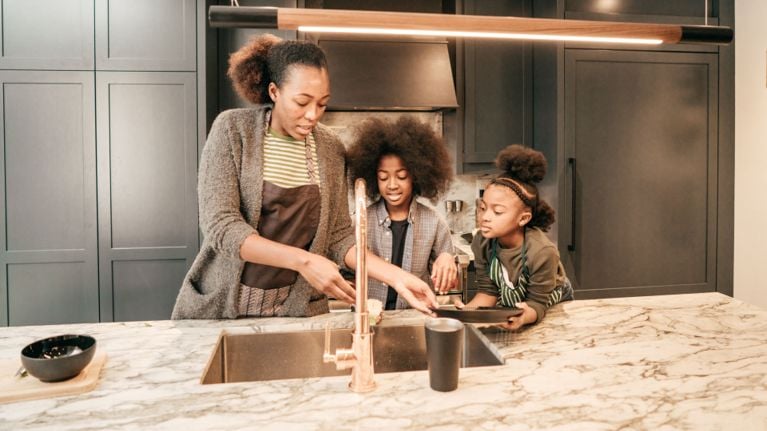
In building self-esteem, kids also need opportunities to demonstrate their competence and feel that their contribution is valuable, says Taylor. At home, that means asking them, even when they’re toddlers, to help with cooking, setting the table and making beds.
Advertisement

aquaArts studio/ Getty Images
## **6\. Encourage them to pursue their interests (fully)**
Another surefire way to boost confidence in kids is to encourage them to take on tasks they show interest in, then make sure they follow through to completion. It doesn’t matter what the task is—it could be anything from swimming laps to beating levels in video games. The point is for them to stick with what they start, so they feel that hit of accomplishment at the end.

FG Trade/ Getty Images
## 07Model self-compassion out loud
Kids don’t just learn confidence from what we say to them; they absorb how we talk to ourselves. When parents openly acknowledge mistakes without spiralling into shame, kids learn that messing up isn’t a character flaw; it’s part of being human.
That can be as simple as narrating your own process: *“*Ugh, I burned dinner. That’s frustrating—but it happens. I’ll try something different next time.*”* Or admitting when you don’t know something and showing how you figure it out. This teaches kids that confidence isn’t about being perfect, it’s about trusting yourself to recover.
Research consistently shows that self-compassion is linked to greater resilience and motivation than harsh self-criticism. When kids see you treat yourself with patience and humour, they learn to extend that same kindness inward when things don’t go their way.
Advertisement
## **What to do when children struggle or fail**
What if your child’s self-esteem plummets when she gets cut from the gymnastics team or can’t memorize multiplication tables?

PIKSEL/ Getty Images
## **1\. Don’t lose sleep over it**
“So many parents have it backward," Taylor says. "They think struggles and failure will hurt their kids’ self-esteem, but it’s actually a golden opportunity to help build it.”

VioletaStoimenova/ Getty Images
## **2\. Make clear that your love is unconditional**
Let your child know you love her even when she fails or makes bad decisions. If all you talk about is performance, Sopik points out, she will think you only love her for her report card or the lead she got in the play.
Advertisement

Erdark/ Getty Images
## **3\. Make sure your child’s goals are within reach, at a level appropriate for his ability**
That may mean suggesting he join house league, where he can feel like a star rather than being the last one picked on the AA team. MacLeod learned this lesson when her son, Alex, was in grade two. Feeling like a failure at reading, Alex was ready to give up when MacLeod brought home some Magic Tree House books, which were slightly below Alex’s level. “He read one every two days and was so proud of himself that he went on to read the Goosebumps series, no problem,” she recalls. Afterward, mother and son talked about how Alex’s choice to practise paid off, and she praised his perseverance.

Jose Luis Pelaez Inc/ Getty Images
## **4\. Offer appropriate praise**
Although praise is often misused, when it’s specific and earned, it is a valuable self-esteem builder, Taylor says.
Lorna Crosse, a former music teacher, remembers asking her choir students to keep a “brag file” full of praise they earned. Any time they saw their names in a program or newspaper article or received a complimentary note, they were to put it inside. “When the kids had a bad day, they would take out those words of praise and read all the neat things they had done, and it would make them feel better about themselves.”
The brag file works because it shows kids specific ways they’re special and teaches them that practise reaps rewards, Taylor says. And it’s the practise—the effort—that should be the focus of praise, Sopik says. “Don’t just say ‘great play’. Tell him it was awesome how he passed the ball to his teammate.”
Advertisement
And keep in mind that a little indirect praise, such as stars on a [chore chart](https://www.todaysparent.com/family/parenting/printable-age-by-age-chore-chart/), can work wonders. Mom Nancy Botelho gets even more inventive. She makes sure her kids “overhear” a little boasting. “I’ll tell my friends how the teacher said Margaret is so kind, or how I saw Bridget working so hard at tying her shoes. The kids just shine. Since they were spying, they know I mean it, and I’m not just trying to make them feel good.”

RyanJLane/ Getty Images
## **Your self-esteem checklist**
Here are some of the things that the Canadian Mental Health Association says you can do to help raise confident—not coddled—kids:
**Feel special.** It’s important for you to help your children discover their own unique talents and qualities, and to value their own strengths. But also teach them that feeling special doesn’t mean feeling better than others.
**Set goals.** Teach your kids to work towards a goal and to have pride in their accomplishments. Provide them with opportunities for success.
Advertisement
**Try, try again.** Encourage your children to try things their own way, face challenges and take risks.

SDI Productions/ Getty Images
This article was originally published on May 01, 2020
### Modern parenting, made easier
Expert tips, stories and support straight to your inbox.
FILED UNDER:
[Mental health](https://www.todaysparent.com/tag/mental-health/)[Parenting](https://www.todaysparent.com/tag/parenting/)[app-neonate and teen](https://www.todaysparent.com/tag/app-neonate-and-teen/)
Advertisement
Advertisement
Advertisement
Advertisement
Advertisement
Advertisement
Advertisement
Advertisement
Copy link
More Like This
[Family](https://www.todaysparent.com/family/)
[Why Parents Are So Focused On Executive Function Right Now You're ready to go out the door, but your kid is still sockless? It might be time to brush up on their executive functioning skills.](https://www.todaysparent.com/family/what-is-executive-function/)
[Sponsored](https://www.todaysparent.com/sponsored/)
[10 Moms Share Their Most Memorable Little Moments Of Motherhood Magical dolphin letters, the quiet peace of a sleeping toddler and the tiny rituals in between big milestones: Here’s to remembering to celebrate the small parenting moments that mean so much.](https://www.todaysparent.com/sponsored/little-bellies-moments-of-motherhood/)
[Parenting](https://www.todaysparent.com/family/parenting/)
[Parents Are Yelling “Jessica” Mid-Tantrum—And, Weirdly, It Kind Of Works A viral social media trend has moms and dads calling out a random name to snap toddlers out of meltdowns.](https://www.todaysparent.com/family/parenting/parents-are-yelling-jessica/)
[Family](https://www.todaysparent.com/family/)
[What My Passport Panic Taught Me About Parental Overload I like to think that I have it all together. Every day in my work as a family therapist, I help clients develop self-awareness and...](https://www.todaysparent.com/family/parental-overload/)
© 2026 SJC.
- [About Us](https://www.todaysparent.com/about-us/)
- [Contact Us](https://www.todaysparent.com/contact-us/)
- [Privacy Policy](https://www.todaysparent.com/privacy-policy/)
- [Terms of Use](https://www.todaysparent.com/terms/)
- [Index](https://www.todaysparent.com/chronodex/2026/)
- [Search](https://www.todaysparent.com/search/) |
| Readable Markdown | 
Last week, my son Aaron made the school soccer team. Boy, was I proud. And I couldn’t stop saying so. “Good job, buddy! You’re the best!” I beamed, he beamed, and all seemed right with the world.
It’s not the first time my kids have heard me shout their praises. I’m the resident cheering section, their biggest fan, a back-patter extraordinaire. These days, you can find me handing out compliments as if they’re sticks of gum—when my kids practise guitar, score a goal or help with dishes. The mom logic goes like this: The kid does well (or well enough for me), so I make him feel great about himself. It’s called boosting [self-esteem](https://www.todaysparent.com/family/parenting/self-esteem-tips/). Or so I thought. Here are some things you may not have considered about building self-esteem in children.
## **1\. Step back**
As it turns out, there are better ways to build self-esteem than heaping on praise for everything kids do—starting with helping them become competent in the world, says Jim Taylor, author of the book *Your Kids Are Listening: Nine Messages They Need to Hear from You*. To do so, though, you have to learn to step back and let your child take risks, make choices, solve problems and stick with what they start.

Jose Luis Pelaez Inc/ Getty Images
## **2\. Over-praising kids does more harm than good**
Self-esteem comes from feeling loved and secure, and from [developing competence](https://www.todaysparent.com/parenting/how-to-raise-a-self-sufficient-kid/), Taylor says, and although parents often shower their kids with the first two ingredients, competence—becoming good at things—takes time and effort. “As much as we may want to, we can’t praise our kids into competence,” he says.
In fact, by over-praising kids, we’re doing more harm than good. “We’re lowering the bar for them,” Taylor says. “If you keep telling your child she is already doing a fantastic job, you’re saying she no longer needs to push herself. But confidence comes from doing, from trying and failing and trying again—from practice.”
Samantha MacLeod, who has four boys, ages one to nine, believes constant complimenting can actually erode self-esteem. Either kids start thinking they’re perfect, or they [try to be perfect all the time](https://www.todaysparent.com/family/family-health/nobodys-perfect-how-to-handle-your-childs-perfectionism/)—an impossible standard. And inaccurate praise confuses them, she says. “If my son can’t spell and I tell him he’s doing terrific, he learns not to trust his own instincts. He also learns that praise is just flat-out lying.”
Plus, Taylor adds, telling your child he’s the best, the smartest, or the most talented is setting him up for some very bad news down the road. You’re creating an egomaniac who thinks his scribbles are Rothkos but, sooner or later, he’ll discover he’s not all that after all.
## **3\. Let your child take healthy risks**
Start by forcing yourself to stand back while your child takes healthy risks, says Victoria Sopik, CEO of Kids & Company, a corporate childcare service in Toronto, and a mother of eight. “To build confidence in the world, kids have to take chances, make choices and take responsibility for them,” Sopik says. She sees too many parents trying to rescue their kids from failure all the time.
Sopik remembers staring from across the room as her two-year-old son, Fraser, lifted a huge jug of orange pop at a fancy party. “He was about to pour it into a glass, and I just stood there, holding my breath,” Sopik recalls. Rather than trying to save her son before he had a chance to try, Sopik watched as Fraser spilled the pop all over the floor.
Then came the best part: Fraser found a waitress, asked for a paper towel and cleaned up his own mess. “He solved his own problem—just like we do as successful adults,” Sopik says.

Maria Korneeva/ Getty Images
## **4\. Let kids make their own choices**
When kids make their own age-appropriate choices, they feel more powerful, says Sopik, pointing out that kids as young as two can start considering the consequences of their decisions. Sopik always let her kids decide on their own whether to [wear a coat, hat and mittens in winter](https://www.todaysparent.com/toddler/how-to-get-your-toddler-to-wear-winter-clothes/). “Once they knew the difference between warm and cold, it was up to them. They should have control over their bodies and take responsibility for their choices,” she says. Considering letting your child go without a coat in winter? Bring their winter wear in an inconspicuous bag. It's okay to show them you've got their back when they make decisions that don't work out.

Marilyn Nieves/ Getty Images
## **5\. Let them help around the house**
In building self-esteem, kids also need opportunities to demonstrate their competence and feel that their contribution is valuable, says Taylor. At home, that means asking them, even when they’re toddlers, to help with cooking, setting the table and making beds.

aquaArts studio/ Getty Images
## **6\. Encourage them to pursue their interests (fully)**
Another surefire way to boost confidence in kids is to encourage them to take on tasks they show interest in, then make sure they follow through to completion. It doesn’t matter what the task is—it could be anything from swimming laps to beating levels in video games. The point is for them to stick with what they start, so they feel that hit of accomplishment at the end.

FG Trade/ Getty Images
## 07Model self-compassion out loud
Kids don’t just learn confidence from what we say to them; they absorb how we talk to ourselves. When parents openly acknowledge mistakes without spiralling into shame, kids learn that messing up isn’t a character flaw; it’s part of being human.
That can be as simple as narrating your own process: *“*Ugh, I burned dinner. That’s frustrating—but it happens. I’ll try something different next time.*”* Or admitting when you don’t know something and showing how you figure it out. This teaches kids that confidence isn’t about being perfect, it’s about trusting yourself to recover.
Research consistently shows that self-compassion is linked to greater resilience and motivation than harsh self-criticism. When kids see you treat yourself with patience and humour, they learn to extend that same kindness inward when things don’t go their way.

## **What to do when children struggle or fail**
What if your child’s self-esteem plummets when she gets cut from the gymnastics team or can’t memorize multiplication tables?

PIKSEL/ Getty Images
## **1\. Don’t lose sleep over it**
“So many parents have it backward," Taylor says. "They think struggles and failure will hurt their kids’ self-esteem, but it’s actually a golden opportunity to help build it.”

VioletaStoimenova/ Getty Images
## **2\. Make clear that your love is unconditional**
Let your child know you love her even when she fails or makes bad decisions. If all you talk about is performance, Sopik points out, she will think you only love her for her report card or the lead she got in the play.

Erdark/ Getty Images
## **3\. Make sure your child’s goals are within reach, at a level appropriate for his ability**
That may mean suggesting he join house league, where he can feel like a star rather than being the last one picked on the AA team. MacLeod learned this lesson when her son, Alex, was in grade two. Feeling like a failure at reading, Alex was ready to give up when MacLeod brought home some Magic Tree House books, which were slightly below Alex’s level. “He read one every two days and was so proud of himself that he went on to read the Goosebumps series, no problem,” she recalls. Afterward, mother and son talked about how Alex’s choice to practise paid off, and she praised his perseverance.

Jose Luis Pelaez Inc/ Getty Images
## **4\. Offer appropriate praise**
Although praise is often misused, when it’s specific and earned, it is a valuable self-esteem builder, Taylor says.
Lorna Crosse, a former music teacher, remembers asking her choir students to keep a “brag file” full of praise they earned. Any time they saw their names in a program or newspaper article or received a complimentary note, they were to put it inside. “When the kids had a bad day, they would take out those words of praise and read all the neat things they had done, and it would make them feel better about themselves.”
The brag file works because it shows kids specific ways they’re special and teaches them that practise reaps rewards, Taylor says. And it’s the practise—the effort—that should be the focus of praise, Sopik says. “Don’t just say ‘great play’. Tell him it was awesome how he passed the ball to his teammate.”
And keep in mind that a little indirect praise, such as stars on a [chore chart](https://www.todaysparent.com/family/parenting/printable-age-by-age-chore-chart/), can work wonders. Mom Nancy Botelho gets even more inventive. She makes sure her kids “overhear” a little boasting. “I’ll tell my friends how the teacher said Margaret is so kind, or how I saw Bridget working so hard at tying her shoes. The kids just shine. Since they were spying, they know I mean it, and I’m not just trying to make them feel good.”

RyanJLane/ Getty Images
## **Your self-esteem checklist**
Here are some of the things that the Canadian Mental Health Association says you can do to help raise confident—not coddled—kids:
**Feel special.** It’s important for you to help your children discover their own unique talents and qualities, and to value their own strengths. But also teach them that feeling special doesn’t mean feeling better than others.
**Set goals.** Teach your kids to work towards a goal and to have pride in their accomplishments. Provide them with opportunities for success.
**Try, try again.** Encourage your children to try things their own way, face challenges and take risks.

SDI Productions/ Getty Images
This article was originally published on May 01, 2020
### Modern parenting, made easier
Expert tips, stories and support straight to your inbox. |
| Shard | 148 (laksa) |
| Root Hash | 11879699926746782748 |
| Unparsed URL | com,todaysparent!www,/family/parenting/how-to-build-your-childs-self-esteem/ s443 |