ℹ️ Skipped - page is already crawled
| Filter | Status | Condition | Details |
|---|---|---|---|
| HTTP status | PASS | download_http_code = 200 | HTTP 200 |
| Age cutoff | PASS | download_stamp > now() - 6 MONTH | 0.1 months ago |
| History drop | PASS | isNull(history_drop_reason) | No drop reason |
| Spam/ban | PASS | fh_dont_index != 1 AND ml_spam_score = 0 | ml_spam_score=0 |
| Canonical | PASS | meta_canonical IS NULL OR = '' OR = src_unparsed | Not set |
| Property | Value |
|---|---|
| URL | https://www.thekitchn.com/skills-showdown-how-to-keep-apples-from-browning-23244847 |
| Last Crawled | 2026-04-17 22:07:10 (3 days ago) |
| First Indexed | 2021-11-24 13:41:10 (4 years ago) |
| HTTP Status Code | 200 |
| Meta Title | The Best Way to Keep Apples from Browning | The Kitchn |
| Meta Description | Keep your apple slices fresh, crisp, and most importantly, tasting just like they should with this cheap and easy method. |
| Meta Canonical | null |
| Boilerpipe Text | Skills
Freezing & Storing Food
Casey Barber
Casey Barber
Casey Barber is a food writer, illustrator, and photographer; author of Pierogi Love: New Takes on an Old-World Comfort Food and Classic Snacks Made from Scratch: 70 Homemade Versions of Your Favorite Brand Name Treats; and editor of Good. Food. Stories.. When she’s not…
read more
Follow
updated
Sep 2, 2023
This is the best way to keep apples from browning. Don't worry — they won't taste at all like salt!
Prep
10 minutes
Cook Mode+
Save this to your Recipe Box — so everything you want to cook is in one place!
We
independently
select these products—if you buy from one of our links, we may earn a commission. All prices were accurate at the time of publishing.
I’m a big fan of prepping ingredients in advance, but it can be tricky to keep some ingredients fresh until you need them. Case in point: apples. Once cut and exposed to air, the apple’s flesh begins to brown due to oxidation. And whether you’re
packing up lunch
for yourself or your kids, or you want to cut apples ahead to make
apple pie
or
apple crisp
, nobody wants brown apples.
The only way to stop oxidation is to create a protective barrier between the cut fruit and the air. Acid — usually in the form of citrus juice — has commonly been used to slow down this reaction, but there are a few other popular methods that use natural ingredients to interfere with the process.
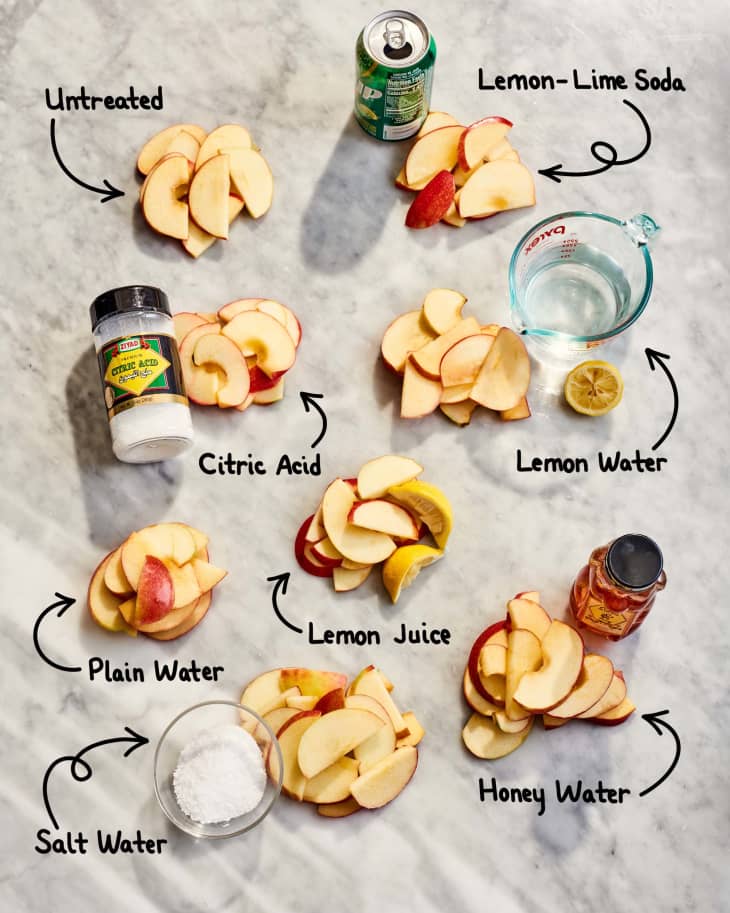
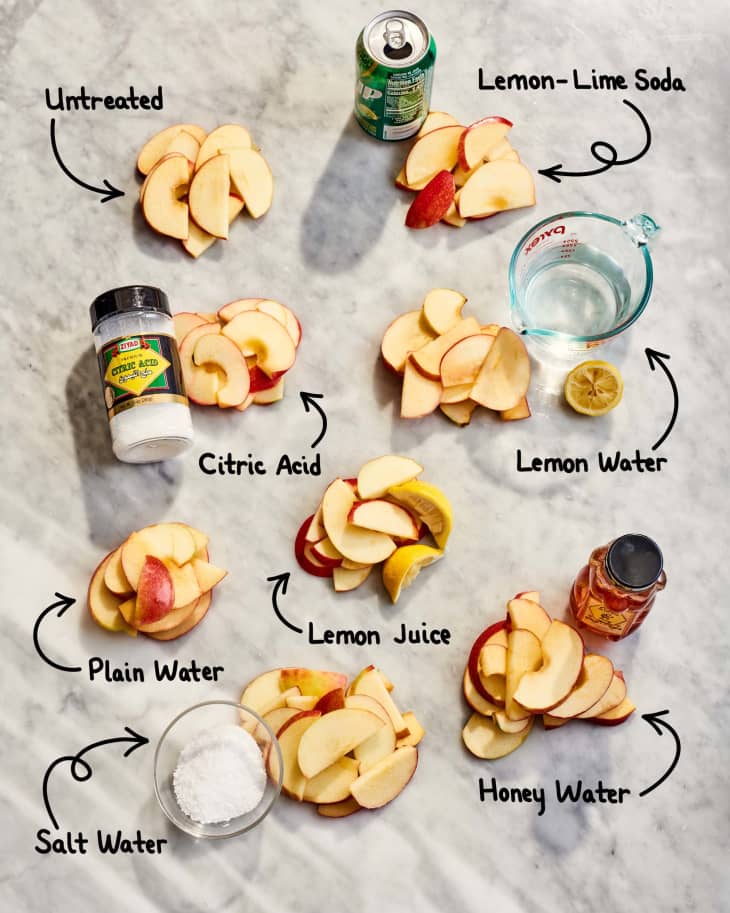
To find out the best way to keep apples from browning, I tested six methods for treating the cut fruit based on common kitchen wisdom and popular methods found online, and then I compared the results side-by-side. The winner worked almost shockingly well.
Quick Overview
So, What Is the Best Way to Keep Apples from Browning?
After a lot of in-depth testing and experimenting, we found that the best way to keep apples from browning was to
submerge the sliced apples in a large bowl of salted water.
Use a ratio of 1/2 teaspoon of kosher salt for every cup of room-temperature tap water.
Soak the apples in the solution for about five minutes, and then rinse them in a colander under running tap water.
Read on to learn more about why this particular method worked the best, as well as other methods that did a decent job in preventing the apples from browning.
Credit: Photo: Joe Lingeman; Food Styling: Jesse Szewczyk
How We Found the Best Way to Keep Apples from Browning
Apples
: For consistency, I used the same variety of apple (Pazazz, in this case) for each test, and cut each apple into 1/2-inch-thick slices.
Tests:
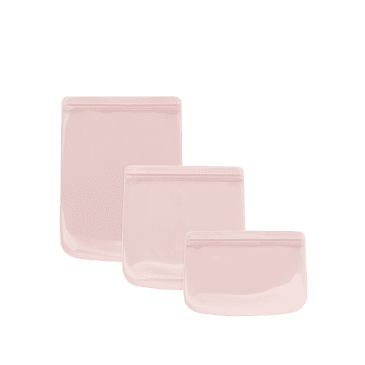
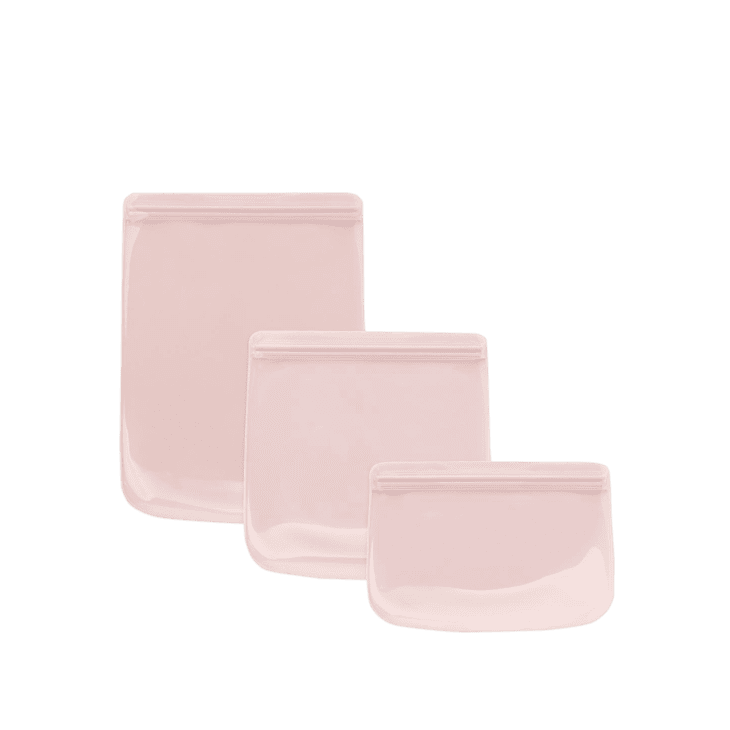
For all methods, apple slices were treated and then tested two ways: left exposed to air at room temperature, and placed in a zip-top bag with as much air pressed out as possible. (Tip: While I used clear zip-top bags for my test, these methods would work just as well with a reusable silicone bag if you prefer those.)
For each method — with the exception of storing apple slices in water until ready to use — I soaked the apple slices for five minutes (or allowed the treatment to penetrate for five minutes) and then rinsed off with tap water before leaving the apples at room temperature.
As a control group, I left untreated apple slices on a plate as well as stored in a zip-top bag.
Ratings:
Success was measured by the length of time before the apple began to brown and how the method affected the taste and texture of the slices.
Credit: Photo: Joe Lingeman; Food Styling: Jesse Szewczyk
Apple Treatment Method: Control Group (Untreated)
Rating
: 1/10
With no treatment, both the in-bag and on-a-plate apple slices started to brown within 15 minutes. So, as we already knew, this method is only good if you’re snacking on or cooking with the apple slices
tout suite
.
Credit: Photo: Joe Lingeman; Food Styling: Jesse Szewczyk
Apple Treatment Method: Lemon Water
Rating:
3/10
Lemon water has been one of the most common solutions for home cooks trying to stop apples from browning for hundreds of years. So it has to work well, right? Wrong! I used 1 tablespoon of freshly squeezed lemon juice per cup of water. I soaked the apple slices in the water for five minutes, then rinsed in a colander under running tap water.
The lemon water-dipped slices stayed fresher in the zip-top bag than they did on a plate. Left exposed to air, they barely made it to the two-hour mark before starting to develop brown edges. In the bag, they stayed un-browned for another hour, which seems like a highly disappointing showing for one of the most well-known browning prevention methods.
Credit: Photo: Joe Lingeman; Food Styling: Jesse Szewczyk
Apple Treatment Method: Citric Acid
Rating:
4/10
Citric acid
might not be something that everyday cooks keep in their kitchen. This sour powder is most frequently used for canning and preserving, and also makes an ideal vinegar or lemon juice substitute if you’re making
homemade ricotta
. You can
buy citric acid
online
or in the canning equipment section of many supermarkets and big-box stores.
Some food professionals recommend sprinkling citric acid on apples to prevent browning. I sprinkled 1/2 teaspoon of the powder over the apples and tossed them in a bowl to cover the slices evenly, then rinsed off with tap water in a colander after five minutes. And while it did stop the oxidation process in its tracks, keeping the apples un-browned for a full 12 hours, it also made the apple slices incredibly tart — even hours after the citric acid had been rinsed off.
This method works from a looks perspective, but I would only use it for apples that will be baked or cooked to hide the acidic taste.
Credit: Photo: Joe Lingeman; Food Styling: Jesse Szewczyk
Apple Treatment Method: Lemon Juice
Rating:
5/10
Citric acid also comes in a non-powdered form, aka citrus juice. For this test, I treated apples with undiluted fresh lemon juice, squeezing half a fresh lemon over half a sliced apple and tossing in a bowl to coat the slices evenly. After letting the slices rest for five minutes, I rinsed the juice off in a colander under running tap water. These slices fared almost as well as the citric acid-treated ones did — the lemon juice stopped the browning for almost seven hours.
Taste-wise, the slices retained a lemon-fresh tartness, but were not as strongly acidic as those with citric acid. Lemon juice is better than citric acid from a taste perspective, although citric acid stops the browning longer. Plus, chances are you’ll have fresh lemons and not citric acid in the cupboard anyway, so I would choose the lemon juice treatment over the citric acid option. Just keep in mind that with both lemon juice and citric acid, the apples may be better suited for baking or cooking.
Credit: Photo: Joe Lingeman; Food Styling: Jesse Szewczyk
Apple Treatment Method: Lemon-Lime Soda
Rating:
6/10
I had an ancient can of 7-Up in the fridge, so why not try the internet-recommended hack of soaking apple slices in lemon-lime soda to prevent browning? There is citric acid in the ingredient list, after all (behind water and high fructose corn syrup). I soaked the slices in soda for five minutes, then rinsed in a colander under running tap water.
Surprisingly, this worked much better than using lemon water. The slices on the plate looked fresh for nearly three hours, and in the bag for nearly six hours. This a good method, if you happen to have lemon-lime soda in your pantry, but don’t rush out and buy some just to keep your apples from browning — there are cheaper methods that work better!
Credit: Photo: Joe Lingeman; Food Styling: Jesse Szewczyk
Apple Treatment Method: Plain Water
Rating:
8/10
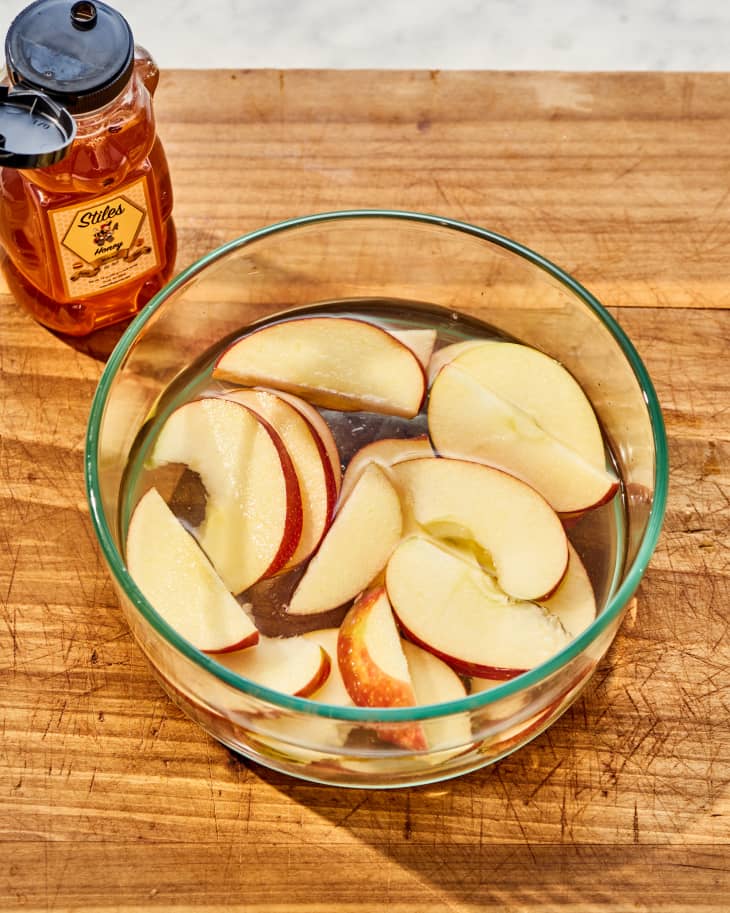
If you’re slicing apples in the morning to be eaten at lunch, this is the easiest method. No pre-soaking or rinsing required here — you can prep while you’re half asleep. Simply slice the apples and store them submerged in tap water in a lidded container or sealed baggie at room temperature.
Sealed in a bag, the apple slices lasted a whopping six hours before starting to brown, and retained their crunch and taste. I also tested a batch submerged in water in a bowl without a cover, as you might do if you were slicing apples to make pie — this batch started to brown after four hours, presumably because without a lid the apples were still exposed to some air.
Credit: Photo: Joe Lingeman; Food Styling: Jesse Szewczyk
Apple Treatment Method: Honey Water
Rating: 9.5/10
Honey is a natural preservative, with
an acidic pH level
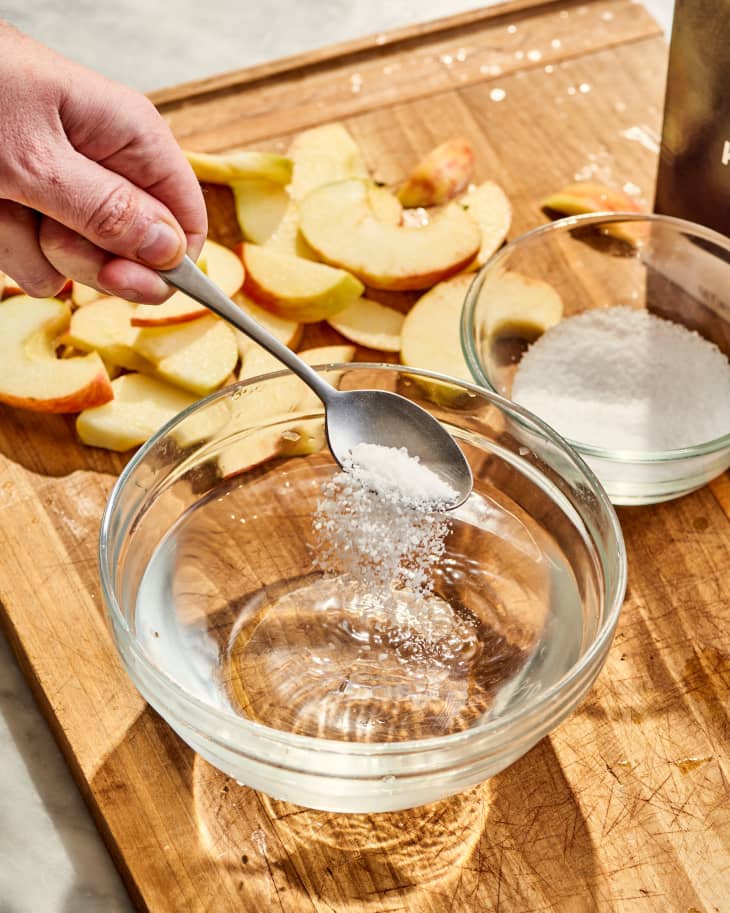
, so in theory it would work to prevent apple slices from browning just as well as citrus fruit. And boy, did it come through with flying colors. For this method, I stirred in 1 tablespoon of honey per cup of room-temperature tap water, soaked the slices for five minutes, then rinsed them in a colander under running tap water.
The apple slices stayed fresh for 12 hours, both on a plate and in a bag. If there was any residual sweetness from the honey, I didn’t taste it; but then, honey and apples are a sweet pairing regardless. Because the apples still looked great after a day at room temperature, I put them in the fridge and let them rest overnight just to see if they would still be fresh in the morning. The bagged apples were still crisp and edible; the plated slices had shriveled slightly from the cold air.
The only reason I wouldn’t use this method again is because honey is more expensive than salt (see the winner below) and while I tend to hoard my honey for tea drinking and baking, I can always spare some cheap kosher salt.
Credit: Photo: Joe Lingeman; Food Styling: Jesse Szewczyk
Apple Treatment Method: Salt Water
Rating: 10/10
For this method, I followed these instructions for the
best way to keep apple slices from browning
and dissolved 1/2 teaspoon of kosher salt per cup of room-temperature tap water, soaked the apples in the solution for five minutes, and then rinsed them in a colander under running tap water.
Just like the honey-treated apples, these slices didn’t get a hint of browning after 12 hours at room temperature, and did not taste at all like salt. Along with the honey-treated apples, I stored the salt-treated apples in the fridge overnight, and the bagged slices were still perfectly crisp and intact. (The plated slices had shriveled a bit, just like the honey apples.) This is my personal favorite method for preventing apple browning, and the one I’ll be using in the future.
This is the best way to keep apples from browning. Don't worry — they won't taste at all like salt!
Ingredients
Apples (any variety)
Kosher salt
Add at least 1 cup of room-temperature tap water to a large bowl and stir in 1/2 teaspoon of kosher salt (use a ratio of 1/2 teaspoon of kosher salt for every cup of water).
Slice your apples into quarters on a cutting board using a chef’s knife. Discard the core.
Slice each of the quarters into 1/2-inch-thick slices and submerge in the bowl of salt water. Let the apple slices sit for about five minutes. Then, rinse the apple slices in a colander under running tap water. Drain and then keep them in the bowl until ready to use.
Final Takeaways
Since most of the methods kept apples from browning for about two hours at room temperature, you can use whatever you have on hand for a short-term fix. After seven hours, all of the out-of-bag methods, except for citric acid, honey water, and salt water, showed some signs of browning. Kept in zip-top bags, the apples that had been treated in salt water and honey water lasted through the night in the refrigerator.
Filed in:
More to Love from The Kitchn
The 5 Best Apples for Baking
Ready to get baking with apples this fall? Pick one of these five varieties for the best results.
Lisa Appleton
Oct 4, 2023 |
| Markdown | 
[The logomark and logotype for the Kitchn brand.](https://www.thekitchn.com/)
[Newsletter](https://www.thekitchn.com/email)
[Join for free](https://www.thekitchn.com/join)[Sign In](https://www.thekitchn.com/sign-in)
- [Dinner Tonight](https://www.thekitchn.com/collection/dinner)
[See all Dinner](https://www.thekitchn.com/collection/dinner)
Editor Faves
- [Our Most Popular Dinner Recipes](https://www.thekitchn.com/most-popular-dinner-recipes-23749145)
- [Best Chicken Recipes](https://www.thekitchn.com/collection/chicken)
- [20-Minute Pastas](https://www.thekitchn.com/collection/pasta-noodles/20-minute-recipes)
- [Cozy Soups & Stews](https://www.thekitchn.com/collection/soups-stews)
Quick & Easy
- [One-Pot Wonders](https://www.thekitchn.com/one-pot-meals-for-dinner-23745120)
- [Ready in 30 Minutes](https://www.thekitchn.com/collection/dinner/30-minute-recipes)
- [Vegetarian](https://www.thekitchn.com/10-dinners-that-are-mostly-vegetables-250208)
- [Kid-Friendly](https://www.thekitchn.com/family-dinner-ideas-265030)
- [Slow Cooker Chicken](https://www.thekitchn.com/best-slow-cooker-chicken-recipes-23746316)
- [Recipes](https://www.thekitchn.com/recipes)
[See all Recipes](https://www.thekitchn.com/recipes)
By Meal
- [Dinner](https://www.thekitchn.com/collection/dinner)
- [Sides](https://www.thekitchn.com/collection/side-dish)
- [Desserts](https://www.thekitchn.com/collection/desserts)
- [Apps & Snacks](https://www.thekitchn.com/collection/appetizers-snacks)
- [Breakfast & Brunch](https://www.thekitchn.com/collection/breakfast)
- [Cocktails](https://www.thekitchn.com/collection/cocktails)
Popular Ingredients
- [Chicken](https://www.thekitchn.com/collection/chicken)
- [Beef](https://www.thekitchn.com/collection/beef)
- [Fish & Seafood](https://www.thekitchn.com/collection/fish-seafood)
- [Pork](https://www.thekitchn.com/collection/pork)
- [Eggs](https://www.thekitchn.com/collection/eggs)
- [Rice & Grains](https://www.thekitchn.com/collection/rice-grains)
- [Potatoes](https://www.thekitchn.com/collection/potatoes)
- [Broccoli](https://www.thekitchn.com/collection/broccoli)
- [Mushrooms](https://www.thekitchn.com/collection/mushrooms)
- [Cabbage](https://www.thekitchn.com/collection/cabbage)
Holidays & Parties
- [Thanksgiving](https://www.thekitchn.com/collection/thanksgiving)
- [Hanukkah](https://www.thekitchn.com/collection/hanukkah)
- [Christmas](https://www.thekitchn.com/collection/christmas)
- [Party Food](https://www.thekitchn.com/party-appetizers-23748009)
- [Easy Cocktails](https://www.thekitchn.com/collection/cocktails)
- [Groceries](https://www.thekitchn.com/groceries)
[See all Groceries](https://www.thekitchn.com/groceries)
- [Grocery Reviews](https://www.thekitchn.com/groceries/product-review)
- [Costco Favorites & Store News](https://www.thekitchn.com/collection/costco)
- [Aldi Favorites & Store News](https://www.thekitchn.com/collection/aldi)
- [Trader Joe's Favorites & Store News](https://www.thekitchn.com/collection/trader-joes)
- [Grocery Diaries](https://www.thekitchn.com/collection/grocery-diaries)
- [Budget & Shopping Tips](https://www.thekitchn.com/collection/shopping-advice)
- [In the Kitchen](https://www.thekitchn.com/kitchen)
[See all Kitchen](https://www.thekitchn.com/kitchen)
- [Cleaning](https://www.thekitchn.com/collection/cleaning)
- [Organizing & Storage](https://www.thekitchn.com/collection/organizing-storage)
- [Design & Renovation](https://www.thekitchn.com/collection/home-design-renovation)
- [Ingredient Substitutions](https://www.thekitchn.com/collection/substitutions)
- [Knife Skills](https://www.thekitchn.com/collection/cutting-peeling)
- [Food Storage 101](https://www.thekitchn.com/collection/freezing-storing)
- [Shopping](https://www.thekitchn.com/collection/shopping)
[See all Shopping](https://www.thekitchn.com/collection/shopping)
- [The Gift List](https://www.thekitchn.com/collection/gift-ideas)
- [Sales & Deals](https://www.thekitchn.com/collection/sales-events)
- [Grocery Reviews](https://www.thekitchn.com/groceries/product-review)
- [What's Cooking](https://www.thekitchn.com/whats-cooking)
**[Get our 26 best spring recipes in our digital issue\!](https://www.thekitchn.com/special-issue/spring-gatherings)**
- [Skills](https://www.thekitchn.com/skills)
- [Freezing & Storing Food](https://www.thekitchn.com/collection/freezing-storing)
# We Tried 7 Methods to Keep Apple Slices from Browning and the Winner Actually Shocked Us

[Casey Barber](https://www.thekitchn.com/authors/casey-barber)
[Casey Barber](https://www.thekitchn.com/authors/casey-barber)
Casey Barber is a food writer, illustrator, and photographer; author of Pierogi Love: New Takes on an Old-World Comfort Food and Classic Snacks Made from Scratch: 70 Homemade Versions of Your Favorite Brand Name Treats; and editor of Good. Food. Stories.. When she’s not…[read more](https://www.thekitchn.com/authors/casey-barber)
Follow
updated Sep 2, 2023
[skills showdown](https://www.thekitchn.com/collection/skills-showdown)
[(17)](https://www.thekitchn.com/skills-showdown-how-to-keep-apples-from-browning-23244847#comments-23244847)
[Read reviews\!](https://www.thekitchn.com/skills-showdown-how-to-keep-apples-from-browning-23244847#comments-23244847)
This is the best way to keep apples from browning. Don't worry — they won't taste at all like salt\!
[Prep10 minutes](https://www.thekitchn.com/skills-showdown-how-to-keep-apples-from-browning-23244847#post-recipe-546400009)
Cook Mode+
Save
Save this to your Recipe Box — so everything you want to cook is in one place\!
Send to Me
Print
Share
[Jump to Recipe](https://www.thekitchn.com/skills-showdown-how-to-keep-apples-from-browning-23244847#post-recipe-546400009)
We [independently](https://www.thekitchn.com/about/the-kitchn-commerce-guidelines) select these products—if you buy from one of our links, we may earn a commission. All prices were accurate at the time of publishing.
More Videos
Volume 0%
Press shift question mark to access a list of keyboard shortcuts
Keyboard Shortcuts
EnabledDisabled
Play/PauseSPACE
Increase Volume↑
Decrease Volume↓
Seek Forward→
Seek Backward←
Captions On/Offc
Fullscreen/Exit Fullscreenf
Mute/Unmutem
Seek %0-9
Next Up
Easy Apple Cobbler
01:47
H.264 320px
H.264 480px
H.264 720px
H.264 1280px
AAC Audio
H.264 1920px
H.264 1080px
Live
00:00
00:26
00:26
More Videos
01:47
Easy Apple Cobbler
00:15
How to Make an Apple Pie in an Apple
00:45
Brown Rice
01:05
How To Make Spiced Apple Cider In An Apple
00:58
Classic Hasselback Apples
01:09
Easy One Bowl Apple Bundt Cake
Close
This video file cannot be played.(Error Code: 224003)
X
I’m a big fan of prepping ingredients in advance, but it can be tricky to keep some ingredients fresh until you need them. Case in point: apples. Once cut and exposed to air, the apple’s flesh begins to brown due to oxidation. And whether you’re [packing up lunch](https://www.thekitchn.com/30-make-ahead-lunches-you-can-pack-tonight-235200) for yourself or your kids, or you want to cut apples ahead to make [apple pie](https://www.thekitchn.com/apple-pie-22943691) or [apple crisp](https://www.thekitchn.com/apple-crisp-recipe-reviews-23245042), nobody wants brown apples.
The only way to stop oxidation is to create a protective barrier between the cut fruit and the air. Acid — usually in the form of citrus juice — has commonly been used to slow down this reaction, but there are a few other popular methods that use natural ingredients to interfere with the process.
To find out the best way to keep apples from browning, I tested six methods for treating the cut fruit based on common kitchen wisdom and popular methods found online, and then I compared the results side-by-side. The winner worked almost shockingly well.
Quick Overview
## So, What Is the Best Way to Keep Apples from Browning?
After a lot of in-depth testing and experimenting, we found that the best way to keep apples from browning was to **submerge the sliced apples in a large bowl of salted water.**
- Use a ratio of 1/2 teaspoon of kosher salt for every cup of room-temperature tap water.
- Soak the apples in the solution for about five minutes, and then rinse them in a colander under running tap water.
Read on to learn more about why this particular method worked the best, as well as other methods that did a decent job in preventing the apples from browning.
Credit: Photo: Joe Lingeman; Food Styling: Jesse Szewczyk
## How We Found the Best Way to Keep Apples from Browning
**Apples**: For consistency, I used the same variety of apple (Pazazz, in this case) for each test, and cut each apple into 1/2-inch-thick slices.
**Tests:** For all methods, apple slices were treated and then tested two ways: left exposed to air at room temperature, and placed in a zip-top bag with as much air pressed out as possible. (Tip: While I used clear zip-top bags for my test, these methods would work just as well with a reusable silicone bag if you prefer those.)
[ ](https://atmedia.link/product?url=https%3A%2F%2Fwandp.com%2Fcollections%2Fporter-bags%2Fproducts%2Fporter-bags-lay-flat-bundle%3Fvariant%3D32334353891393&referralSource=&id=23244847&site=KT&refUrl=https%3A%2F%2Fwww.thekitchn.com%2Fskills-showdown-how-to-keep-apples-from-browning-23244847)
[Porter Bags Bundle\$43\$40](https://atmedia.link/product?url=https%3A%2F%2Fwandp.com%2Fcollections%2Fporter-bags%2Fproducts%2Fporter-bags-lay-flat-bundle%3Fvariant%3D32334353891393&referralSource=&id=23244847&site=KT&refUrl=https%3A%2F%2Fwww.thekitchn.com%2Fskills-showdown-how-to-keep-apples-from-browning-23244847)
[Buy at W\&P](https://atmedia.link/product?url=https%3A%2F%2Fwandp.com%2Fcollections%2Fporter-bags%2Fproducts%2Fporter-bags-lay-flat-bundle%3Fvariant%3D32334353891393&referralSource=&id=23244847&site=KT&refUrl=https%3A%2F%2Fwww.thekitchn.com%2Fskills-showdown-how-to-keep-apples-from-browning-23244847)
For each method — with the exception of storing apple slices in water until ready to use — I soaked the apple slices for five minutes (or allowed the treatment to penetrate for five minutes) and then rinsed off with tap water before leaving the apples at room temperature.
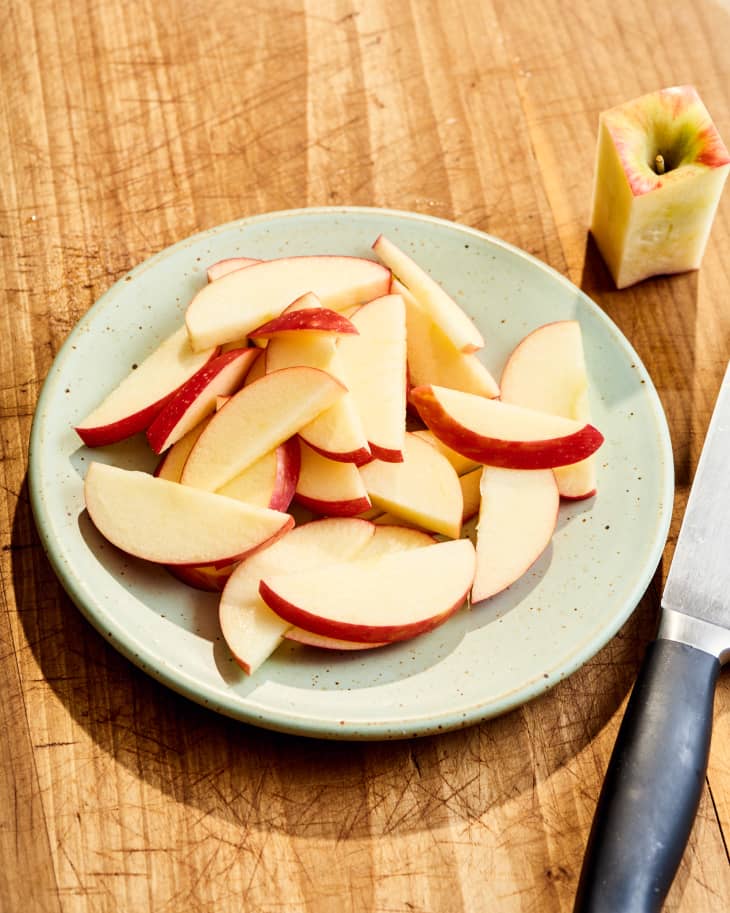
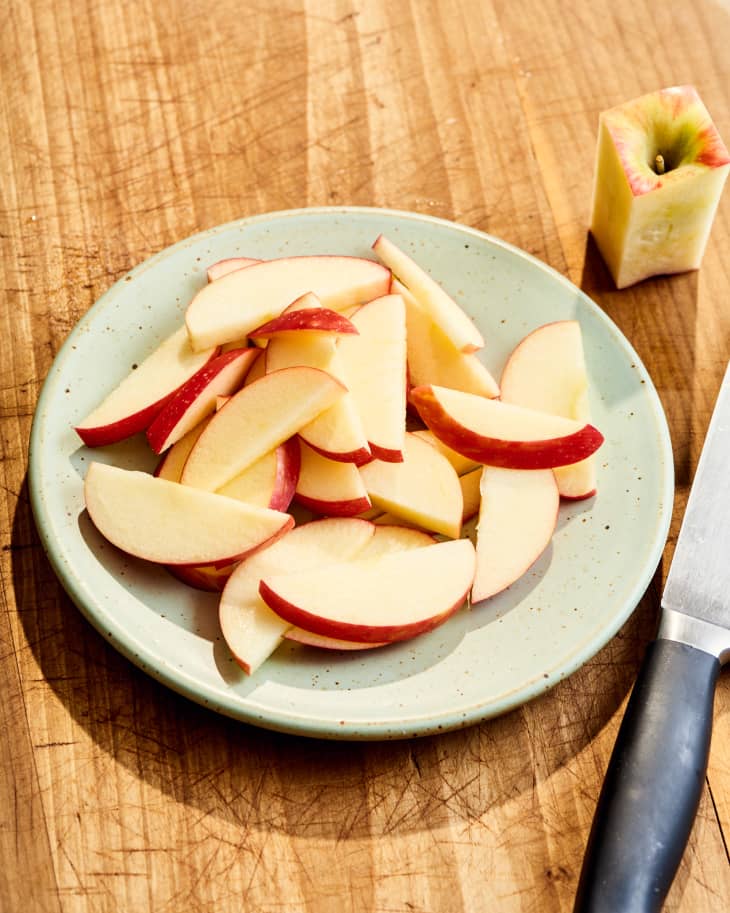
As a control group, I left untreated apple slices on a plate as well as stored in a zip-top bag.
**Ratings:** Success was measured by the length of time before the apple began to brown and how the method affected the taste and texture of the slices.
Credit: Photo: Joe Lingeman; Food Styling: Jesse Szewczyk
## Apple Treatment Method: Control Group (Untreated)
- **Rating**: 1/10
With no treatment, both the in-bag and on-a-plate apple slices started to brown within 15 minutes. So, as we already knew, this method is only good if you’re snacking on or cooking with the apple slices *tout suite*.
Credit: Photo: Joe Lingeman; Food Styling: Jesse Szewczyk
## Apple Treatment Method: Lemon Water
- **Rating:** 3/10
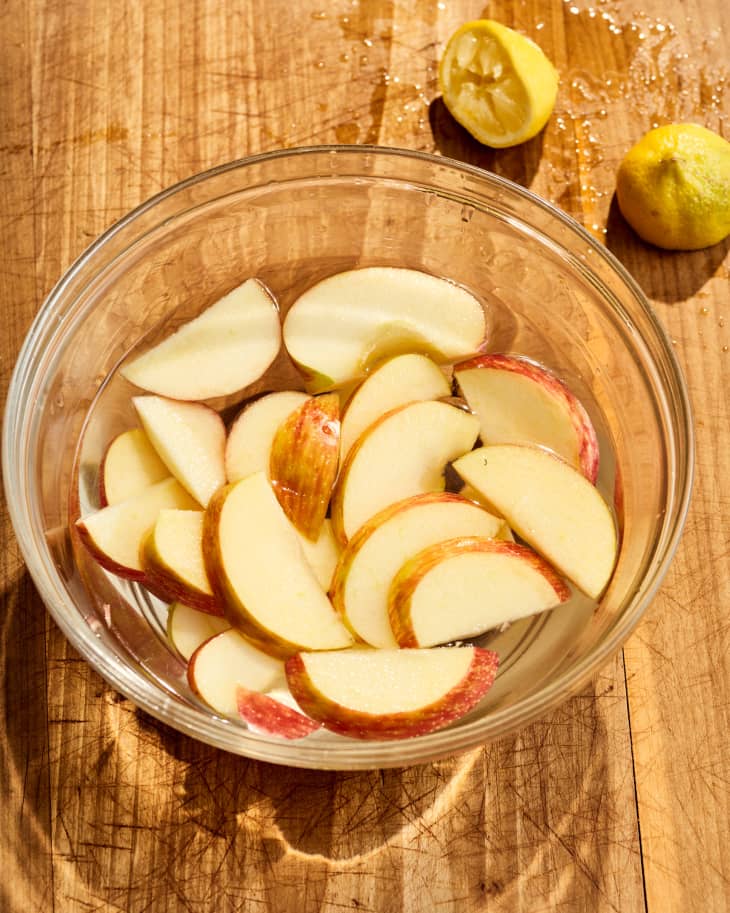
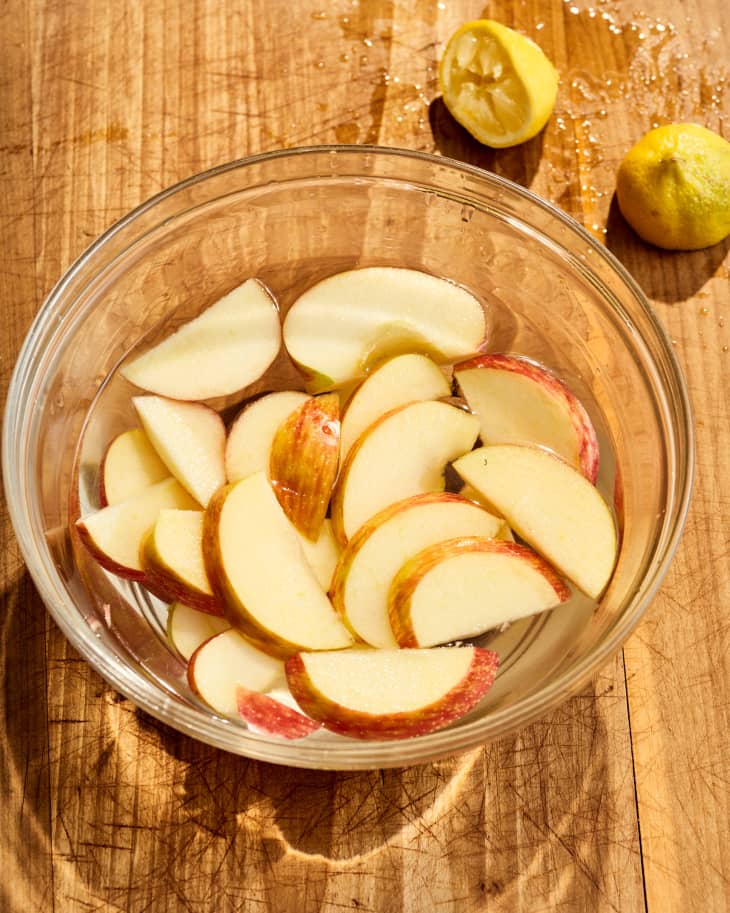
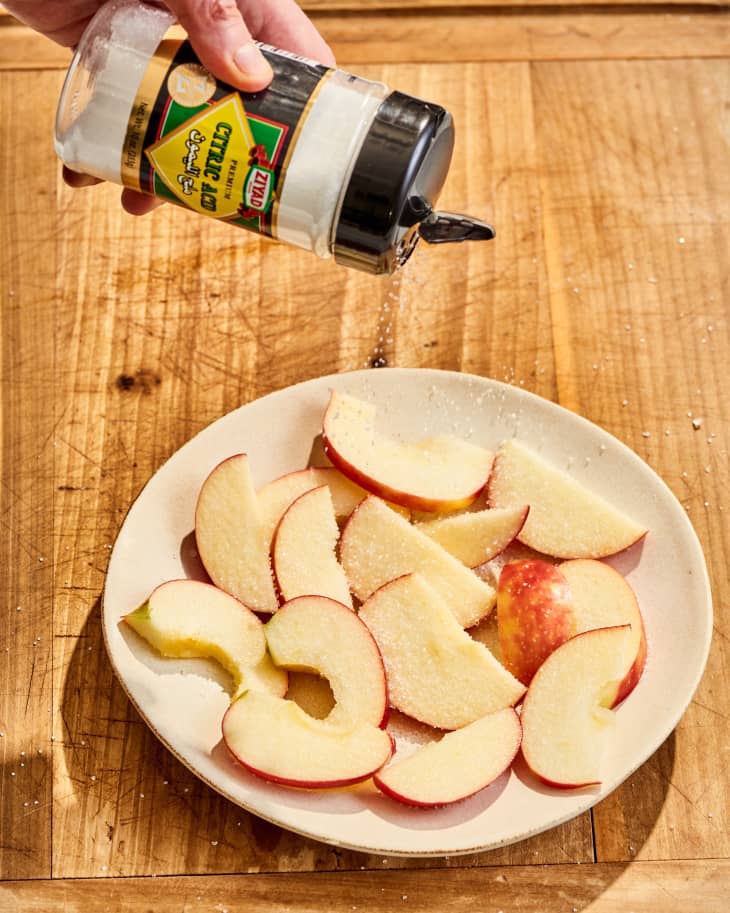
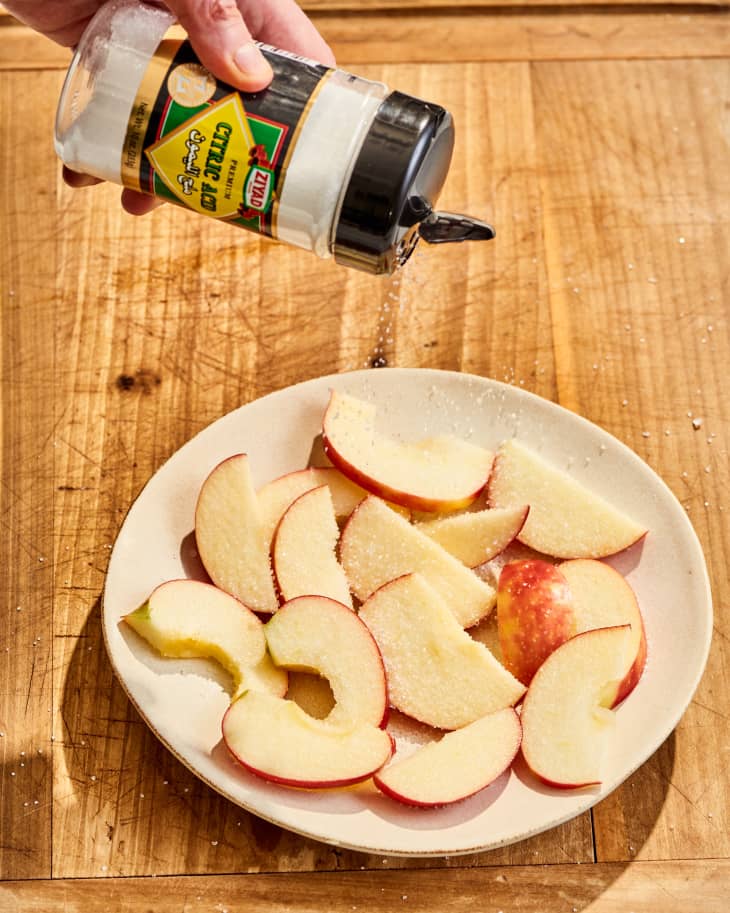
Lemon water has been one of the most common solutions for home cooks trying to stop apples from browning for hundreds of years. So it has to work well, right? Wrong! I used 1 tablespoon of freshly squeezed lemon juice per cup of water. I soaked the apple slices in the water for five minutes, then rinsed in a colander under running tap water.
The lemon water-dipped slices stayed fresher in the zip-top bag than they did on a plate. Left exposed to air, they barely made it to the two-hour mark before starting to develop brown edges. In the bag, they stayed un-browned for another hour, which seems like a highly disappointing showing for one of the most well-known browning prevention methods.
Credit: Photo: Joe Lingeman; Food Styling: Jesse Szewczyk
## Apple Treatment Method: Citric Acid
- **Rating:** 4/10
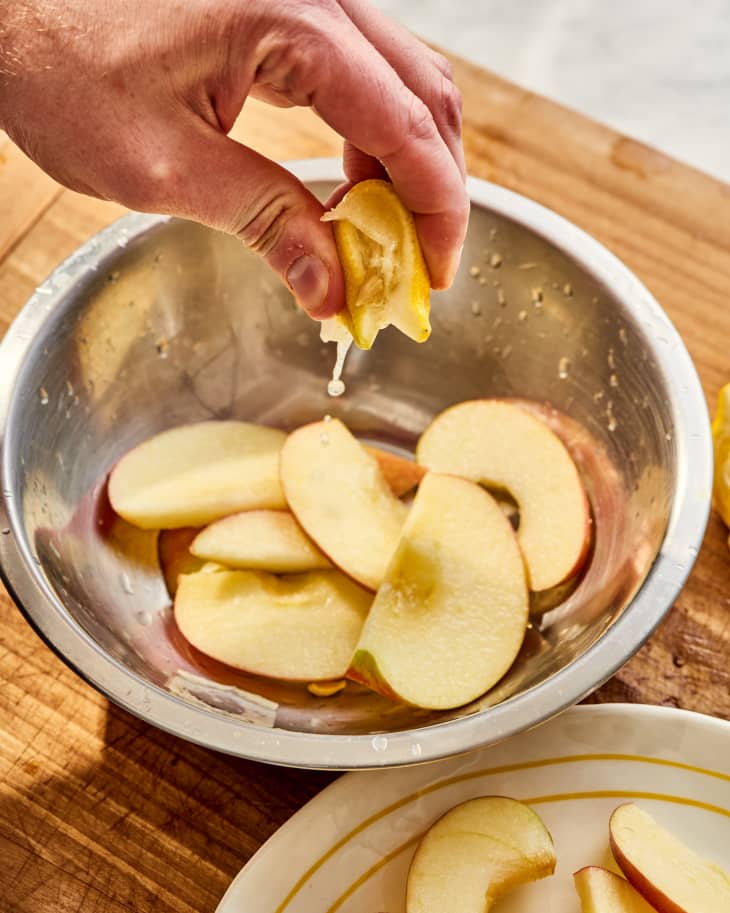
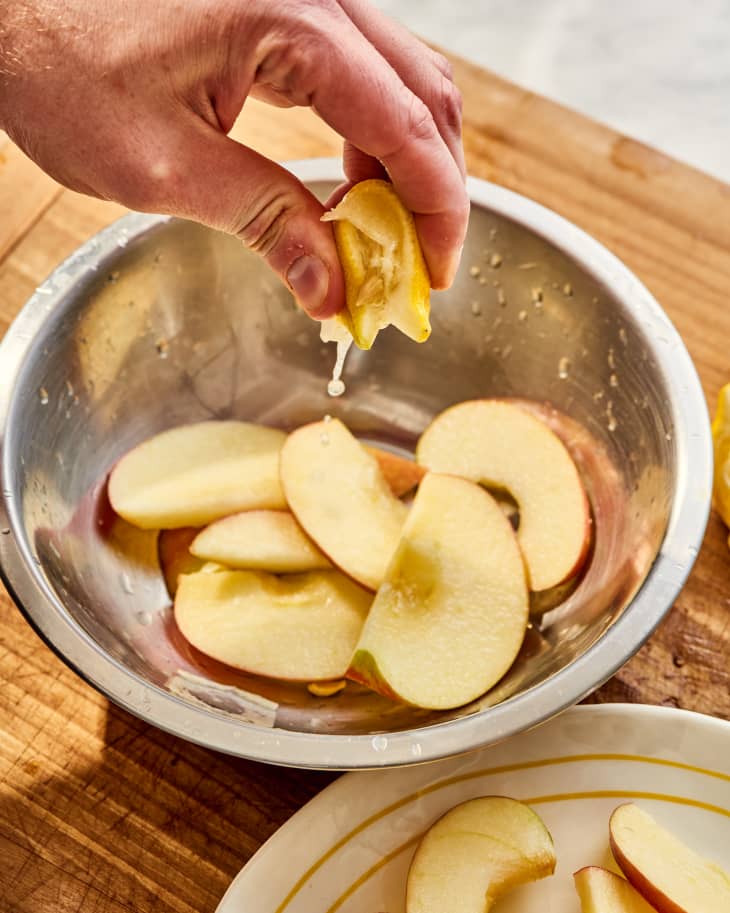
[Citric acid](https://www.thekitchn.com/whats-the-deal-with-citric-aci-116326) might not be something that everyday cooks keep in their kitchen. This sour powder is most frequently used for canning and preserving, and also makes an ideal vinegar or lemon juice substitute if you’re making [homemade ricotta](https://www.thekitchn.com/how-to-make-homemade-ricotta-cheese-cooking-lessons-from-the-kitchn-23326). You can [buy citric acid](https://www.amazon.com/Milliard-Citric-Acid-Pound-VERIFIED/dp/B00EYFKKZC/?asc_campaign=KT-23244847&asc_refurl=https%3A%2F%2Fwww.thekitchn.com%2Fskills-showdown-how-to-keep-apples-from-browning-23244847&asc_source=&tag=kitchn-20) [online](https://www.amazon.com/Milliard-Citric-Acid-Pound-VERIFIED/dp/B00EYFKKZC/?asc_campaign=KT-23244847&asc_refurl=https%3A%2F%2Fwww.thekitchn.com%2Fskills-showdown-how-to-keep-apples-from-browning-23244847&asc_source=&tag=kitchn-20) or in the canning equipment section of many supermarkets and big-box stores.
Some food professionals recommend sprinkling citric acid on apples to prevent browning. I sprinkled 1/2 teaspoon of the powder over the apples and tossed them in a bowl to cover the slices evenly, then rinsed off with tap water in a colander after five minutes. And while it did stop the oxidation process in its tracks, keeping the apples un-browned for a full 12 hours, it also made the apple slices incredibly tart — even hours after the citric acid had been rinsed off.
This method works from a looks perspective, but I would only use it for apples that will be baked or cooked to hide the acidic taste.
Credit: Photo: Joe Lingeman; Food Styling: Jesse Szewczyk
## Apple Treatment Method: Lemon Juice
- **Rating:** 5/10
Citric acid also comes in a non-powdered form, aka citrus juice. For this test, I treated apples with undiluted fresh lemon juice, squeezing half a fresh lemon over half a sliced apple and tossing in a bowl to coat the slices evenly. After letting the slices rest for five minutes, I rinsed the juice off in a colander under running tap water. These slices fared almost as well as the citric acid-treated ones did — the lemon juice stopped the browning for almost seven hours.
Taste-wise, the slices retained a lemon-fresh tartness, but were not as strongly acidic as those with citric acid. Lemon juice is better than citric acid from a taste perspective, although citric acid stops the browning longer. Plus, chances are you’ll have fresh lemons and not citric acid in the cupboard anyway, so I would choose the lemon juice treatment over the citric acid option. Just keep in mind that with both lemon juice and citric acid, the apples may be better suited for baking or cooking.
Credit: Photo: Joe Lingeman; Food Styling: Jesse Szewczyk
## Apple Treatment Method: Lemon-Lime Soda
- **Rating:** 6/10
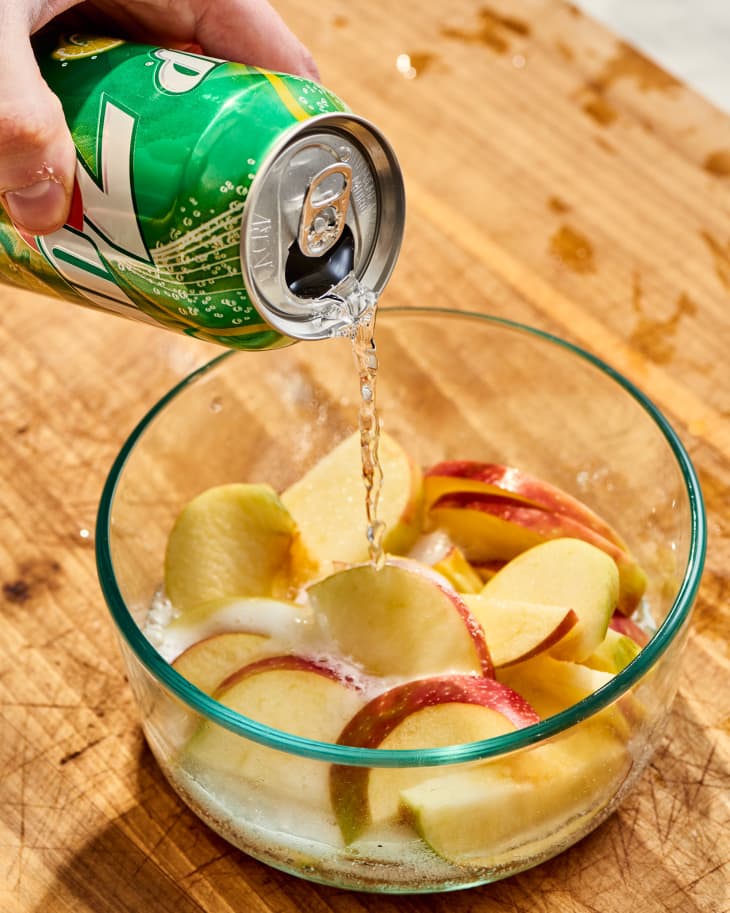
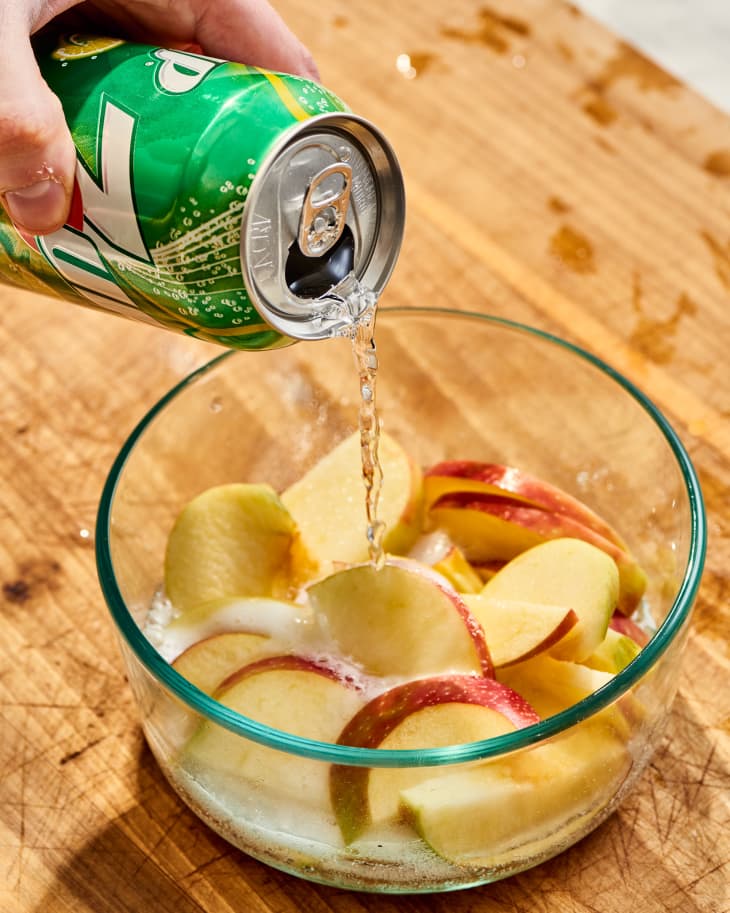
I had an ancient can of 7-Up in the fridge, so why not try the internet-recommended hack of soaking apple slices in lemon-lime soda to prevent browning? There is citric acid in the ingredient list, after all (behind water and high fructose corn syrup). I soaked the slices in soda for five minutes, then rinsed in a colander under running tap water.
Surprisingly, this worked much better than using lemon water. The slices on the plate looked fresh for nearly three hours, and in the bag for nearly six hours. This a good method, if you happen to have lemon-lime soda in your pantry, but don’t rush out and buy some just to keep your apples from browning — there are cheaper methods that work better\!
Credit: Photo: Joe Lingeman; Food Styling: Jesse Szewczyk
## Apple Treatment Method: Plain Water
- **Rating:** 8/10
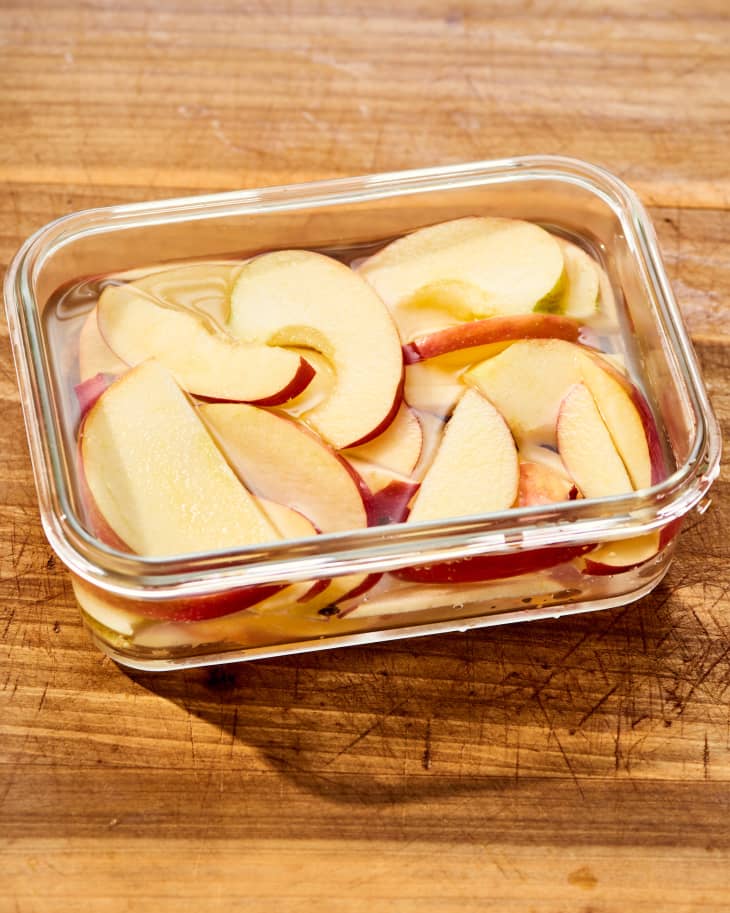
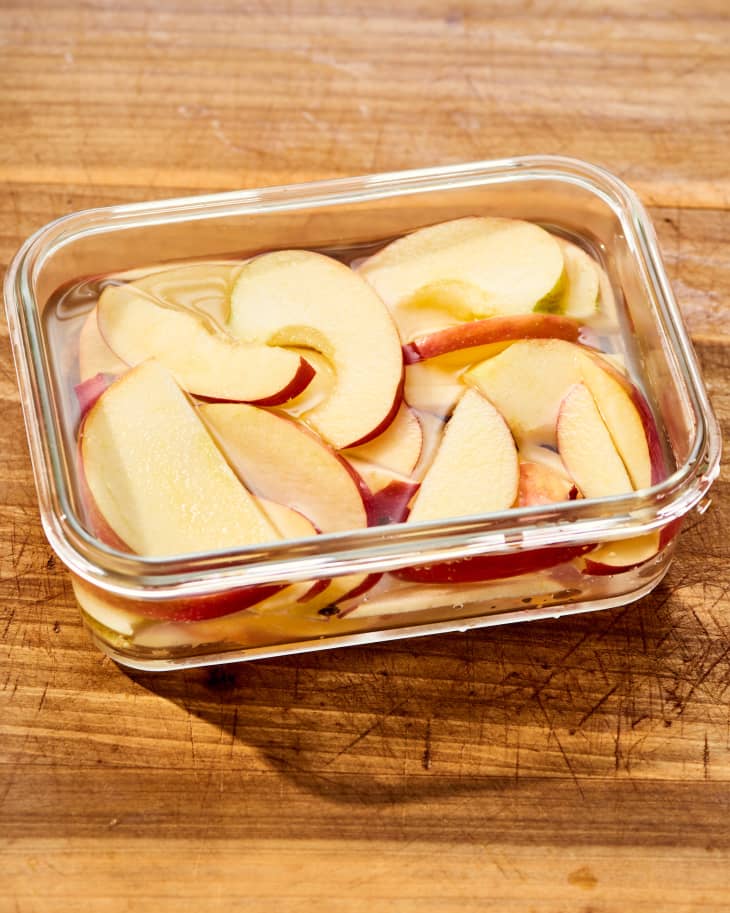
If you’re slicing apples in the morning to be eaten at lunch, this is the easiest method. No pre-soaking or rinsing required here — you can prep while you’re half asleep. Simply slice the apples and store them submerged in tap water in a lidded container or sealed baggie at room temperature.
Sealed in a bag, the apple slices lasted a whopping six hours before starting to brown, and retained their crunch and taste. I also tested a batch submerged in water in a bowl without a cover, as you might do if you were slicing apples to make pie — this batch started to brown after four hours, presumably because without a lid the apples were still exposed to some air.
Credit: Photo: Joe Lingeman; Food Styling: Jesse Szewczyk
## Apple Treatment Method: Honey Water
Rating: 9.5/10
Honey is a natural preservative, with [an acidic pH level](https://www.smithsonianmag.com/science-nature/the-science-behind-honeys-eternal-shelf-life-1218690/), so in theory it would work to prevent apple slices from browning just as well as citrus fruit. And boy, did it come through with flying colors. For this method, I stirred in 1 tablespoon of honey per cup of room-temperature tap water, soaked the slices for five minutes, then rinsed them in a colander under running tap water.
The apple slices stayed fresh for 12 hours, both on a plate and in a bag. If there was any residual sweetness from the honey, I didn’t taste it; but then, honey and apples are a sweet pairing regardless. Because the apples still looked great after a day at room temperature, I put them in the fridge and let them rest overnight just to see if they would still be fresh in the morning. The bagged apples were still crisp and edible; the plated slices had shriveled slightly from the cold air.
The only reason I wouldn’t use this method again is because honey is more expensive than salt (see the winner below) and while I tend to hoard my honey for tea drinking and baking, I can always spare some cheap kosher salt.
Credit: Photo: Joe Lingeman; Food Styling: Jesse Szewczyk
## Apple Treatment Method: Salt Water
- Rating: 10/10
For this method, I followed these instructions for the [best way to keep apple slices from browning](https://www.thekitchn.com/keep-sliced-apples-from-browning-260265) and dissolved 1/2 teaspoon of kosher salt per cup of room-temperature tap water, soaked the apples in the solution for five minutes, and then rinsed them in a colander under running tap water.
Just like the honey-treated apples, these slices didn’t get a hint of browning after 12 hours at room temperature, and did not taste at all like salt. Along with the honey-treated apples, I stored the salt-treated apples in the fridge overnight, and the bagged slices were still perfectly crisp and intact. (The plated slices had shriveled a bit, just like the honey apples.) This is my personal favorite method for preventing apple browning, and the one I’ll be using in the future.
[Comments](https://www.thekitchn.com/skills-showdown-how-to-keep-apples-from-browning-23244847#comments-23244847)
[(17)](https://www.thekitchn.com/skills-showdown-how-to-keep-apples-from-browning-23244847#comments-23244847)
[Read reviews\!](https://www.thekitchn.com/skills-showdown-how-to-keep-apples-from-browning-23244847#comments-23244847)
## How to Keep Apples from Browning
This is the best way to keep apples from browning. Don't worry — they won't taste at all like salt\!
Prep time 10 minutes
### Ingredients
- Apples (any variety)
- Kosher salt
### Instructions
1. Add at least 1 cup of room-temperature tap water to a large bowl and stir in 1/2 teaspoon of kosher salt (use a ratio of 1/2 teaspoon of kosher salt for every cup of water).
2. Slice your apples into quarters on a cutting board using a chef’s knife. Discard the core.
3. Slice each of the quarters into 1/2-inch-thick slices and submerge in the bowl of salt water. Let the apple slices sit for about five minutes. Then, rinse the apple slices in a colander under running tap water. Drain and then keep them in the bowl until ready to use.
## Final Takeaways
Since most of the methods kept apples from browning for about two hours at room temperature, you can use whatever you have on hand for a short-term fix. After seven hours, all of the out-of-bag methods, except for citric acid, honey water, and salt water, showed some signs of browning. Kept in zip-top bags, the apples that had been treated in salt water and honey water lasted through the night in the refrigerator.
Reviews (17)
Filed in:
[Skills](https://www.thekitchn.com/skills)
[recipe](https://www.thekitchn.com/collection/recipe)
[appetizers & snacks](https://www.thekitchn.com/collection/appetizers-snacks)
[apples](https://www.thekitchn.com/collection/apples)
[baking](https://www.thekitchn.com/collection/baking)
## More to Love from The Kitchn
[For the Creamiest, Fluffiest Whipped Cream, Only One Recipe Is Worth Your Time](https://www.thekitchn.com/skills-showdown-the-best-way-to-make-whipped-cream-23245056)
So light and fluffy.
Casey Barber
Aug 7, 2025
[These Old-School Ice Cream Sandwiches Are Exactly What We Want This Summer](https://www.thekitchn.com/ice-cream-sandwiches-recipe-23199749)
They're the ultimate nostalgic treat.
Sheela Prakash
Aug 14, 2021
[A Guide to 12 Types of Chinese Noodles](https://www.thekitchn.com/types-of-chinese-noodles-23494538)
Chinese noodles have become an integral part of Chinese regional cuisines, and they have evolved over the years.
Apple Mandy
Jan 14, 2023
[I Tested 8 Buttermilk Substitutes and I've Been Doing It All Wrong](https://www.thekitchn.com/best-buttermilk-substitute-skills-showdown-23312908)
My go-to sub was beaten out by a surprising choice.
Patty Catalano
May 2, 2022
[The Best Way to Store Apples to Keep Them Fresh for Over Six Weeks](https://www.thekitchn.com/how-to-store-apples-23682573)
Turns out there's no rush to use your apple picking bounty.
Ann Taylor Pittman
Sep 27, 2024
[14 Types of Lettuce and the Best Way to Use Them](https://www.thekitchn.com/types-of-lettuce-explainer-23312912)
Get yourself the right greens for the job.
Casey Barber
Jul 24, 2025
[The 15 Best Types of Pie You Should Know About](https://www.thekitchn.com/types-of-pie-23436693)
What's your favorite slice?
Cory Fernandez
Nov 7, 2023
[What Is a Persimmon — And How Exactly Do I Eat It?](https://www.thekitchn.com/how-to-eat-persimmon-23457687)
How you eat a persimmon depends on the variety.
Rochelle Bilow
Nov 14, 2022
[The 5 Best Apples for Baking](https://www.thekitchn.com/the-5-best-apples-for-baking-2-23568669)
Ready to get baking with apples this fall? Pick one of these five varieties for the best results.
Lisa Appleton
Oct 4, 2023
[12 Delicious Tropical Fruits Worth Seeking Out](https://www.thekitchn.com/tropical-fruit-types-23409182)
Load your shopping basket with these delicious fruits.
Rachel Ng
Oct 29, 2022
[30 Things You Should Know About Veggies by the Time You’re 30](https://www.thekitchn.com/30-things-you-should-know-about-veggies-23186593)
One of the most delicious parts of adulthood.
Meleyna Nomura
Jul 29, 2021
[Martha Stewart Taught Me the Secret to Better Chocolate Cake](https://www.thekitchn.com/martha-stewart-chocolate-cake-tip-23631137)
It makes such a big difference.
Emma Taubenfeld
Feb 24, 2024
[How to Reheat Brisket to Keep It Juicy (I Tested 3 Methods)](https://www.thekitchn.com/how-to-reheat-brisket-23697955)
No dry meat here.
Ivy Manning
Dec 14, 2024
[What Is SPAM Made of and How Do You Cook It?](https://www.thekitchn.com/what-is-spam-made-of-23591459)
The recipe options are endless\!
Apple Mandy
Oct 29, 2023
[The 4 Best Ways to Fix a Dry Cake](https://www.thekitchn.com/ways-to-fix-dry-cake-23534896)
Accidentally ending up with a dry cake is common, but salvaging it is possible\!
Apple Mandy
May 14, 2023
[This Is the Easiest Way to Cut an Apple](https://www.thekitchn.com/how-to-cut-apple-23386032)
Follow our step-by-step guide to cut apples for snacking and baking.
Rochelle Bilow
Oct 4, 2023
[The wordmark and logotype for the Kitchn brand.](https://www.thekitchn.com/)
More From Us
- [Our Team](https://www.thekitchn.com/team)
- [About Us](https://www.thekitchn.com/about/about-us)
- [Contact](https://www.thekitchn.com/about/contact)
- [Site Map](https://www.thekitchn.com/sitemap)
Follow along
GET ON THE LIST
Our daily email is filled with delicious recipes, trusted cooking tips, must-have groceries, and so much more.
[The logomark and logotype for the Apartment Therapy brand.](https://www.apartmenttherapy.com/)
[The logomark and logotype for the Kitchn brand.](https://www.thekitchn.com/)
[The logomark and logotype for the Cubby brand.](https://www.cubbyathome.com/)
[The logomark for the Dorm Therapy brand.](https://www.dormtherapy.com/)
AT Media's Family of Brands
[Logo for the corporate Apartment Therapy Media brand.](https://www.apartmenttherapymedia.com/)
- [About AT Media](https://www.apartmenttherapymedia.com/about-us/our-story)
- [Jobs](https://www.apartmenttherapymedia.com/jobs/)
- [Partner with Us](https://www.apartmenttherapymedia.com/partner-with-us/homemade-studios)
© 2026 Apartment Therapy, LLC / [Terms of Use](https://www.thekitchn.com/about/terms)[Privacy Policy](https://www.thekitchn.com/about/privacy-policy)[EU and US State Data Subject Requests](https://privacyportal.onetrust.com/webform/aca0e9e8-93f2-47a5-ba3f-00029564ca26/2828b2f1-a01b-4c03-b487-2e8d4ffd63f3)[Manage Preferences](https://www.thekitchn.com/skills-showdown-how-to-keep-apples-from-browning-23244847) |
| Readable Markdown | - [Skills](https://www.thekitchn.com/skills)
- [Freezing & Storing Food](https://www.thekitchn.com/collection/freezing-storing)

[Casey Barber](https://www.thekitchn.com/authors/casey-barber)
[Casey Barber](https://www.thekitchn.com/authors/casey-barber)
Casey Barber is a food writer, illustrator, and photographer; author of Pierogi Love: New Takes on an Old-World Comfort Food and Classic Snacks Made from Scratch: 70 Homemade Versions of Your Favorite Brand Name Treats; and editor of Good. Food. Stories.. When she’s not…[read more](https://www.thekitchn.com/authors/casey-barber)
Follow
updated Sep 2, 2023
This is the best way to keep apples from browning. Don't worry — they won't taste at all like salt\!
[Prep10 minutes](https://www.thekitchn.com/skills-showdown-how-to-keep-apples-from-browning-23244847#post-recipe-546400009)
Cook Mode+
Save this to your Recipe Box — so everything you want to cook is in one place\!
We [independently](https://www.thekitchn.com/about/the-kitchn-commerce-guidelines) select these products—if you buy from one of our links, we may earn a commission. All prices were accurate at the time of publishing.
I’m a big fan of prepping ingredients in advance, but it can be tricky to keep some ingredients fresh until you need them. Case in point: apples. Once cut and exposed to air, the apple’s flesh begins to brown due to oxidation. And whether you’re [packing up lunch](https://www.thekitchn.com/30-make-ahead-lunches-you-can-pack-tonight-235200) for yourself or your kids, or you want to cut apples ahead to make [apple pie](https://www.thekitchn.com/apple-pie-22943691) or [apple crisp](https://www.thekitchn.com/apple-crisp-recipe-reviews-23245042), nobody wants brown apples.
The only way to stop oxidation is to create a protective barrier between the cut fruit and the air. Acid — usually in the form of citrus juice — has commonly been used to slow down this reaction, but there are a few other popular methods that use natural ingredients to interfere with the process.
To find out the best way to keep apples from browning, I tested six methods for treating the cut fruit based on common kitchen wisdom and popular methods found online, and then I compared the results side-by-side. The winner worked almost shockingly well.
Quick Overview
## So, What Is the Best Way to Keep Apples from Browning?
After a lot of in-depth testing and experimenting, we found that the best way to keep apples from browning was to **submerge the sliced apples in a large bowl of salted water.**
- Use a ratio of 1/2 teaspoon of kosher salt for every cup of room-temperature tap water.
- Soak the apples in the solution for about five minutes, and then rinse them in a colander under running tap water.
Read on to learn more about why this particular method worked the best, as well as other methods that did a decent job in preventing the apples from browning.

Credit: Photo: Joe Lingeman; Food Styling: Jesse Szewczyk
How We Found the Best Way to Keep Apples from Browning
**Apples**: For consistency, I used the same variety of apple (Pazazz, in this case) for each test, and cut each apple into 1/2-inch-thick slices.
**Tests:** For all methods, apple slices were treated and then tested two ways: left exposed to air at room temperature, and placed in a zip-top bag with as much air pressed out as possible. (Tip: While I used clear zip-top bags for my test, these methods would work just as well with a reusable silicone bag if you prefer those.)
[](https://atmedia.link/product?url=https%3A%2F%2Fwandp.com%2Fcollections%2Fporter-bags%2Fproducts%2Fporter-bags-lay-flat-bundle%3Fvariant%3D32334353891393&referralSource=&id=23244847&site=KT&refUrl=https%3A%2F%2Fwww.thekitchn.com%2Fskills-showdown-how-to-keep-apples-from-browning-23244847)
For each method — with the exception of storing apple slices in water until ready to use — I soaked the apple slices for five minutes (or allowed the treatment to penetrate for five minutes) and then rinsed off with tap water before leaving the apples at room temperature.
As a control group, I left untreated apple slices on a plate as well as stored in a zip-top bag.
**Ratings:** Success was measured by the length of time before the apple began to brown and how the method affected the taste and texture of the slices.

Credit: Photo: Joe Lingeman; Food Styling: Jesse Szewczyk
Apple Treatment Method: Control Group (Untreated)
- **Rating**: 1/10
With no treatment, both the in-bag and on-a-plate apple slices started to brown within 15 minutes. So, as we already knew, this method is only good if you’re snacking on or cooking with the apple slices *tout suite*.

Credit: Photo: Joe Lingeman; Food Styling: Jesse Szewczyk
Apple Treatment Method: Lemon Water
- **Rating:** 3/10
Lemon water has been one of the most common solutions for home cooks trying to stop apples from browning for hundreds of years. So it has to work well, right? Wrong! I used 1 tablespoon of freshly squeezed lemon juice per cup of water. I soaked the apple slices in the water for five minutes, then rinsed in a colander under running tap water.
The lemon water-dipped slices stayed fresher in the zip-top bag than they did on a plate. Left exposed to air, they barely made it to the two-hour mark before starting to develop brown edges. In the bag, they stayed un-browned for another hour, which seems like a highly disappointing showing for one of the most well-known browning prevention methods.

Credit: Photo: Joe Lingeman; Food Styling: Jesse Szewczyk
Apple Treatment Method: Citric Acid
- **Rating:** 4/10
[Citric acid](https://www.thekitchn.com/whats-the-deal-with-citric-aci-116326) might not be something that everyday cooks keep in their kitchen. This sour powder is most frequently used for canning and preserving, and also makes an ideal vinegar or lemon juice substitute if you’re making [homemade ricotta](https://www.thekitchn.com/how-to-make-homemade-ricotta-cheese-cooking-lessons-from-the-kitchn-23326). You can [buy citric acid](https://www.amazon.com/Milliard-Citric-Acid-Pound-VERIFIED/dp/B00EYFKKZC/?asc_campaign=KT-23244847&asc_refurl=https%3A%2F%2Fwww.thekitchn.com%2Fskills-showdown-how-to-keep-apples-from-browning-23244847&asc_source=&tag=kitchn-20) [online](https://www.amazon.com/Milliard-Citric-Acid-Pound-VERIFIED/dp/B00EYFKKZC/?asc_campaign=KT-23244847&asc_refurl=https%3A%2F%2Fwww.thekitchn.com%2Fskills-showdown-how-to-keep-apples-from-browning-23244847&asc_source=&tag=kitchn-20) or in the canning equipment section of many supermarkets and big-box stores.
Some food professionals recommend sprinkling citric acid on apples to prevent browning. I sprinkled 1/2 teaspoon of the powder over the apples and tossed them in a bowl to cover the slices evenly, then rinsed off with tap water in a colander after five minutes. And while it did stop the oxidation process in its tracks, keeping the apples un-browned for a full 12 hours, it also made the apple slices incredibly tart — even hours after the citric acid had been rinsed off.
This method works from a looks perspective, but I would only use it for apples that will be baked or cooked to hide the acidic taste.

Credit: Photo: Joe Lingeman; Food Styling: Jesse Szewczyk
Apple Treatment Method: Lemon Juice
- **Rating:** 5/10
Citric acid also comes in a non-powdered form, aka citrus juice. For this test, I treated apples with undiluted fresh lemon juice, squeezing half a fresh lemon over half a sliced apple and tossing in a bowl to coat the slices evenly. After letting the slices rest for five minutes, I rinsed the juice off in a colander under running tap water. These slices fared almost as well as the citric acid-treated ones did — the lemon juice stopped the browning for almost seven hours.
Taste-wise, the slices retained a lemon-fresh tartness, but were not as strongly acidic as those with citric acid. Lemon juice is better than citric acid from a taste perspective, although citric acid stops the browning longer. Plus, chances are you’ll have fresh lemons and not citric acid in the cupboard anyway, so I would choose the lemon juice treatment over the citric acid option. Just keep in mind that with both lemon juice and citric acid, the apples may be better suited for baking or cooking.

Credit: Photo: Joe Lingeman; Food Styling: Jesse Szewczyk
Apple Treatment Method: Lemon-Lime Soda
- **Rating:** 6/10
I had an ancient can of 7-Up in the fridge, so why not try the internet-recommended hack of soaking apple slices in lemon-lime soda to prevent browning? There is citric acid in the ingredient list, after all (behind water and high fructose corn syrup). I soaked the slices in soda for five minutes, then rinsed in a colander under running tap water.
Surprisingly, this worked much better than using lemon water. The slices on the plate looked fresh for nearly three hours, and in the bag for nearly six hours. This a good method, if you happen to have lemon-lime soda in your pantry, but don’t rush out and buy some just to keep your apples from browning — there are cheaper methods that work better\!

Credit: Photo: Joe Lingeman; Food Styling: Jesse Szewczyk
Apple Treatment Method: Plain Water
- **Rating:** 8/10
If you’re slicing apples in the morning to be eaten at lunch, this is the easiest method. No pre-soaking or rinsing required here — you can prep while you’re half asleep. Simply slice the apples and store them submerged in tap water in a lidded container or sealed baggie at room temperature.
Sealed in a bag, the apple slices lasted a whopping six hours before starting to brown, and retained their crunch and taste. I also tested a batch submerged in water in a bowl without a cover, as you might do if you were slicing apples to make pie — this batch started to brown after four hours, presumably because without a lid the apples were still exposed to some air.
Credit: Photo: Joe Lingeman; Food Styling: Jesse Szewczyk
Apple Treatment Method: Honey Water
Rating: 9.5/10
Honey is a natural preservative, with [an acidic pH level](https://www.smithsonianmag.com/science-nature/the-science-behind-honeys-eternal-shelf-life-1218690/), so in theory it would work to prevent apple slices from browning just as well as citrus fruit. And boy, did it come through with flying colors. For this method, I stirred in 1 tablespoon of honey per cup of room-temperature tap water, soaked the slices for five minutes, then rinsed them in a colander under running tap water.
The apple slices stayed fresh for 12 hours, both on a plate and in a bag. If there was any residual sweetness from the honey, I didn’t taste it; but then, honey and apples are a sweet pairing regardless. Because the apples still looked great after a day at room temperature, I put them in the fridge and let them rest overnight just to see if they would still be fresh in the morning. The bagged apples were still crisp and edible; the plated slices had shriveled slightly from the cold air.
The only reason I wouldn’t use this method again is because honey is more expensive than salt (see the winner below) and while I tend to hoard my honey for tea drinking and baking, I can always spare some cheap kosher salt.
Credit: Photo: Joe Lingeman; Food Styling: Jesse Szewczyk
Apple Treatment Method: Salt Water
- Rating: 10/10
For this method, I followed these instructions for the [best way to keep apple slices from browning](https://www.thekitchn.com/keep-sliced-apples-from-browning-260265) and dissolved 1/2 teaspoon of kosher salt per cup of room-temperature tap water, soaked the apples in the solution for five minutes, and then rinsed them in a colander under running tap water.
Just like the honey-treated apples, these slices didn’t get a hint of browning after 12 hours at room temperature, and did not taste at all like salt. Along with the honey-treated apples, I stored the salt-treated apples in the fridge overnight, and the bagged slices were still perfectly crisp and intact. (The plated slices had shriveled a bit, just like the honey apples.) This is my personal favorite method for preventing apple browning, and the one I’ll be using in the future.
This is the best way to keep apples from browning. Don't worry — they won't taste at all like salt\!
### Ingredients
- Apples (any variety)
- Kosher salt
1. Add at least 1 cup of room-temperature tap water to a large bowl and stir in 1/2 teaspoon of kosher salt (use a ratio of 1/2 teaspoon of kosher salt for every cup of water).
2. Slice your apples into quarters on a cutting board using a chef’s knife. Discard the core.
3. Slice each of the quarters into 1/2-inch-thick slices and submerge in the bowl of salt water. Let the apple slices sit for about five minutes. Then, rinse the apple slices in a colander under running tap water. Drain and then keep them in the bowl until ready to use.
Final Takeaways
Since most of the methods kept apples from browning for about two hours at room temperature, you can use whatever you have on hand for a short-term fix. After seven hours, all of the out-of-bag methods, except for citric acid, honey water, and salt water, showed some signs of browning. Kept in zip-top bags, the apples that had been treated in salt water and honey water lasted through the night in the refrigerator.
Filed in:
## More to Love from The Kitchn

[The 5 Best Apples for Baking](https://www.thekitchn.com/the-5-best-apples-for-baking-2-23568669)
Ready to get baking with apples this fall? Pick one of these five varieties for the best results.
Lisa Appleton
Oct 4, 2023 |
| Shard | 150 (laksa) |
| Root Hash | 1151582128824893550 |
| Unparsed URL | com,thekitchn!www,/skills-showdown-how-to-keep-apples-from-browning-23244847 s443 |