ℹ️ Skipped - page is already crawled
| Filter | Status | Condition | Details |
|---|---|---|---|
| HTTP status | PASS | download_http_code = 200 | HTTP 200 |
| Age cutoff | PASS | download_stamp > now() - 6 MONTH | 1.1 months ago |
| History drop | PASS | isNull(history_drop_reason) | No drop reason |
| Spam/ban | PASS | fh_dont_index != 1 AND ml_spam_score = 0 | ml_spam_score=0 |
| Canonical | PASS | meta_canonical IS NULL OR = '' OR = src_unparsed | Not set |
| Property | Value | |||||||||||||||||||||
|---|---|---|---|---|---|---|---|---|---|---|---|---|---|---|---|---|---|---|---|---|---|---|
| URL | https://www.straitstimes.com/singapore/st-explains-why-are-public-transport-fares-going-up-again | |||||||||||||||||||||
| Last Crawled | 2026-03-21 14:37:53 (1 month ago) | |||||||||||||||||||||
| First Indexed | 2024-10-24 21:27:46 (1 year ago) | |||||||||||||||||||||
| HTTP Status Code | 200 | |||||||||||||||||||||
| Content | ||||||||||||||||||||||
| Meta Title | ST Explains: Why are public transport fares going up again? | The Straits Times | |||||||||||||||||||||
| Meta Description | This is the fourth successive year of fare increases. Read more at straitstimes.com. | |||||||||||||||||||||
| Meta Canonical | null | |||||||||||||||||||||
| Boilerpipe Text | SINGAPORE – From Dec 28, public transport fares for adults paying by card will
rise by 10 cents per journey
, the Public Transport Council (PTC) said on Sept 9 as part of its yearly fare review exercise.
This is the fourth successive year of fare increases. In 2023, adult card fares rose by
up to 11 cents
, and in 2022, the increase was
up to five cents
. In 2021, fares went up by
up to four cents
.
The Straits Times explains how public transport fares are determined and why they are increasing again.
Fares will increase by 10 cents for adults who pay by card, and four cents for concession card holders, from Dec 28, translating to a 6 per cent increase in the cost of bus and train rides.
The 2024 adjustment was largely driven by core inflation and wage growth in 2023, but it was partially moderated by falling energy prices, said PTC.
The council has been limiting the fare increase to reduce the impact on commuters. In 2024, for instance, fares could have risen by up to 18.9 per cent, comprising a 3.3 per cent adjustment for the year and a 15.6 per cent hike rolled over from the 2023 exercise.
Cash fares, and the cost of adult monthly travel passes and concession passes, will stay unchanged.
Since 1998, public transport fares have been reviewed annually based on a fare formula.
This is to balance the need to keep the system financially sustainable, while ensuring that fare adjustments remain affordable, said PTC.
The fare formula accounts for changes in workers’ wages, energy costs and the operating costs of providing public transport services.
PTC needs to adjust fares every year so that they are brought in step with changes in operating costs. This keeps operators financially sustainable and enables them to provide reliable services, while paying their workers good wages.
Yearly adjustments are derived from the fare formula, which is reviewed every five years so that it remains relevant and responsive to changes within the public transport sector and external environment.
It considers key cost factors in public transport, such as general operating, labour and energy costs.
In 2023, PTC adopted a
new fare formula.
Besides taking into account year-on-year changes in core inflation, wages and energy prices, a key change was how it incorporates a fixed “capacity adjustment factor” of 1.1 per cent each year to account for costs related to expanding the system. This includes the improved connectivity and faster journey times arising from the opening of the Thomson-East Coast MRT Line, noted PTC. This fixed component is based on actual and planned capacity improvements to the network from 2020 to 2026.
The formula will apply till 2027.
However, the new Bus Connectivity Enhancement Programme (BCEP) announced in July, which will see up to $900 million set aside over eight years to improve the bus network, will not be considered in fare review exercises before 2028.
Asked how the costs of BCEP will be covered, PTC chief executive Leow Yew Chin said at a press conference on Sept 9 that fares are still being collected, so there will still be some cost recovery and the Government will not be subsidising the programme entirely. The capacity increases from BCEP and capacity decreases from efforts to rationalise other bus services will be properly accounted for from 2028 when a new fare formula is set.
The other notable change in the formula is how productivity gains made by public transport operators are considered.
Instead of a “productivity extraction” in the previous formula that was meant to share the operators’ productivity gains with travellers, it was tweaked to a “productivity contribution” by way of a 0.1 per cent reduction to fare adjustments.
It is a target operators are expected to reach. Put another way, operators are expected to make up for the 0.1 per cent reduction in potential fare revenue by improving their cost efficiency.
The council also limits the allowable fare adjustment to prevent operators from passing on their costs to passengers in full.
PTC puts a cap on the fare adjustments that can be granted each year, while still keeping pace with cost changes in the industry.
As a result, the council defers a portion of fare adjustments to moderate the impact of large fare increases on the public.
This deferred fare increase, which reflects cost increases already experienced by the public transport system, has not been accounted for in fares and needs to be covered by extra government subsidies. Ignoring it means there will be a permanent gap between fares and costs.
In October 2023, Transport Minister Chee Hong Tat
pushed back against suggestions by MPs
in Parliament to freeze future hikes or scrap deferred fare increases, describing these moves as “not sound” and “populist”.
He said these proposals would enlarge the existing funding gap for buses and trains, and lead to an even bigger bill for taxpayers in future.
In Singapore, adults will pay between $1.19 (up to 3.2km) and $2.47 (over 40.2 km) for both trunk bus and MRT services from Dec 28.
Hong Kong’s public transport system also uses distance-based fares, which range from HK$4.90 (82 Singapore cents) to HK$33.80 for rail rides and HK$4.50 to HK$10.10 for bus trips.
In Seoul, South Korea, rail fares are distance-based and start at 1,400 won (S$1.36) for the first 10km, before increasing by 100 won for every subsequent 5km (up to 50km), and then rising by 100 won for every 8km (after 50km). Seoul’s bus fares range from 1,200 won to 3,000 won for various bus services.
In Tokyo, Japan, rail fares cost anywhere from ¥180 to ¥330 (S$1.60 to S$3) depending on distance travelled, while buses charge a flat fee of ¥210.
Public transport in Sydney, Australia, goes by distance-based charging, with peak-hour fees costing A$4.20 to A$10.33 (S$3.70 to S$9.10) for a train ride, and A$3.20 to A$5.60 for a bus trip.
The Government will provide a public transport voucher worth $60 to each lower-income household. Resident households with a monthly income per person of up to $1,800 will qualify for a voucher.
Separately, PTC will allow graduating students to
continue paying concessionary fares for four months
to support them before they enter their next stage of education or the workforce.
This will benefit about 75,000 students from institutions such as secondary schools, junior colleges, the Institute of Technical Education and polytechnics yearly.
Additionally, workers earning up to $3,000 a month will be eligible for a monthly hybrid concession travel pass for low-wage workers from Dec 28, up from a maximum income of $2,500. This will allow more workers to take advantage of the passes.
At $96, it allows unlimited travel on all public transport modes except express buses. | |||||||||||||||||||||
| Markdown | [](https://www.straitstimes.com/)
myST+
Menu
Choose edition
Singapore
International
[Search](https://www.straitstimes.com/search)
[singapore](https://www.straitstimes.com/singapore)
[asia](https://www.straitstimes.com/asia)
[world](https://www.straitstimes.com/world)
[opinion](https://www.straitstimes.com/opinion)
[life](https://www.straitstimes.com/life)
[business](https://www.straitstimes.com/business)
[sport](https://www.straitstimes.com/sport)
[Visual](https://www.straitstimes.com/visual)
[Podcasts](https://www.straitstimes.com/st-podcasts)
[SPH Rewards](https://rewards.sph.com.sg/)
[STClassifieds](https://www.stclassifieds.sg/?utm_source=Straits%20Times&utm_medium=banner&utm_campaign=ST_link_20131219)
[Paid press releases](https://www.straitstimes.com/paid-press-releases)
[Advertise with us](https://www.sph.com.sg/advertising-solutions)
[FAQs](https://consumerfaq.sph.com.sg/kb?lang=en)
[Contact us](<mailto:stics@sph.com.sg?subject=Reach%20Us&body=--%0D%0A Your browser info has automatically been included so that we can place your feedback in context; no personal data will be shared:%0D %0D%0AUser type : Anonymous %0D%0AVisitor ID : -nil- %0D%0ADevice Code : Web %0D%0A>)
# ST Explains: Why are public transport fares going up again?
[Sign up now:](https://www.straitstimes.com/newsletter-signup?ref=inline-article) Get ST's newsletters delivered to your inbox
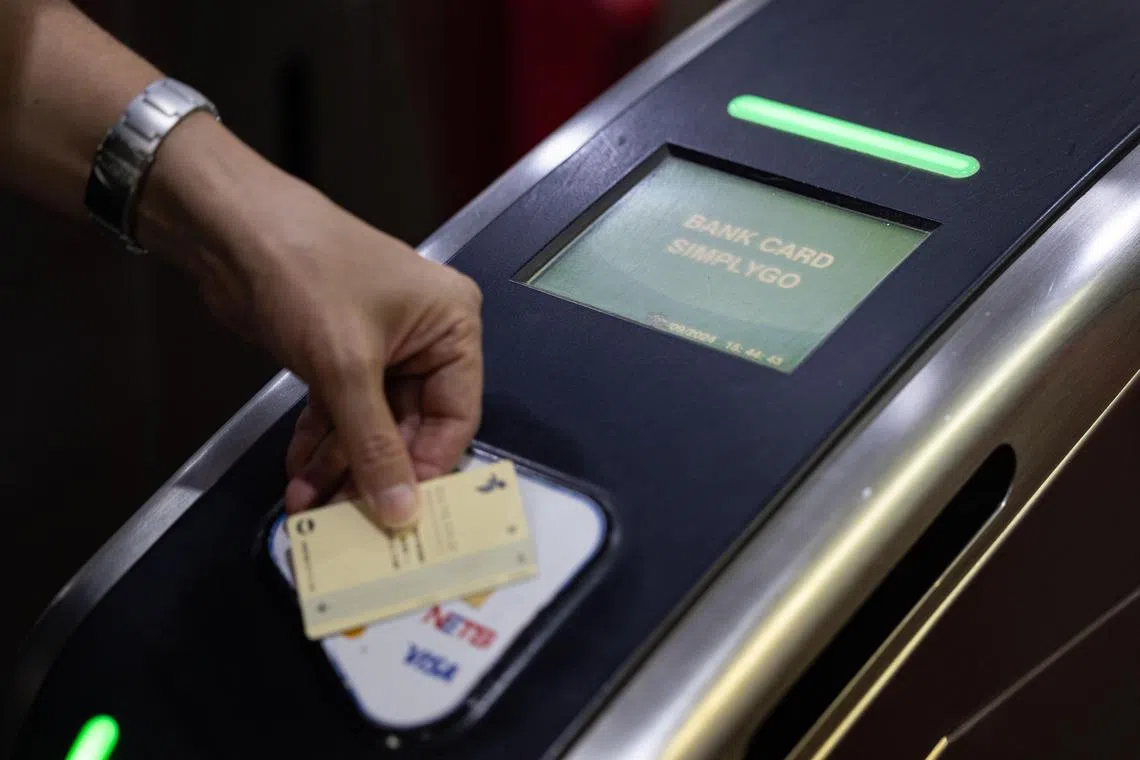
The 2024 adjustment was largely driven by core inflation and wage growth in 2023, but it was partially moderated by falling energy prices.
ST PHOTO: BRIAN TEO
[Esther Loi](https://www.straitstimes.com/authors/esther-loi?ref=article-byline)
[](https://google.com/preferences/source?q=https://www.straitstimes.com)
Published Sep 09, 2024, 10:25 PM
Updated Sep 19, 2024, 01:40 PM
SINGAPORE – From Dec 28, public transport fares for adults paying by card will [rise by 10 cents per journey](https://www.straitstimes.com/singapore/transport/mrt-bus-fares-to-go-up-by-10-cents-for-adults-who-pay-by-card-from-dec-28?ref=inline-article), the Public Transport Council (PTC) said on Sept 9 as part of its yearly fare review exercise.
This is the fourth successive year of fare increases. In 2023, adult card fares rose by [up to 11 cents](https://www.straitstimes.com/singapore/transport/bus-train-fares-to-rise-by-up-to-11-cents-for-adults-new-96-concession-pass-for-low-wage-workers?ref=inline-article), and in 2022, the increase was [up to five cents](https://www.straitstimes.com/singapore/transport/public-transport-fares-to-rise-by-4-to-5-cents-for-adults-from-dec-26?ref=inline-article). In 2021, fares went up by [up to four cents](https://www.straitstimes.com/singapore/transport/public-transport-fares-to-rise-by-3-to-4-cents-for-adults-from-dec-26?ref=inline-article).
The Straits Times explains how public transport fares are determined and why they are increasing again.
## 1\. What’s the fare increase for 2024, and why are fares going up?
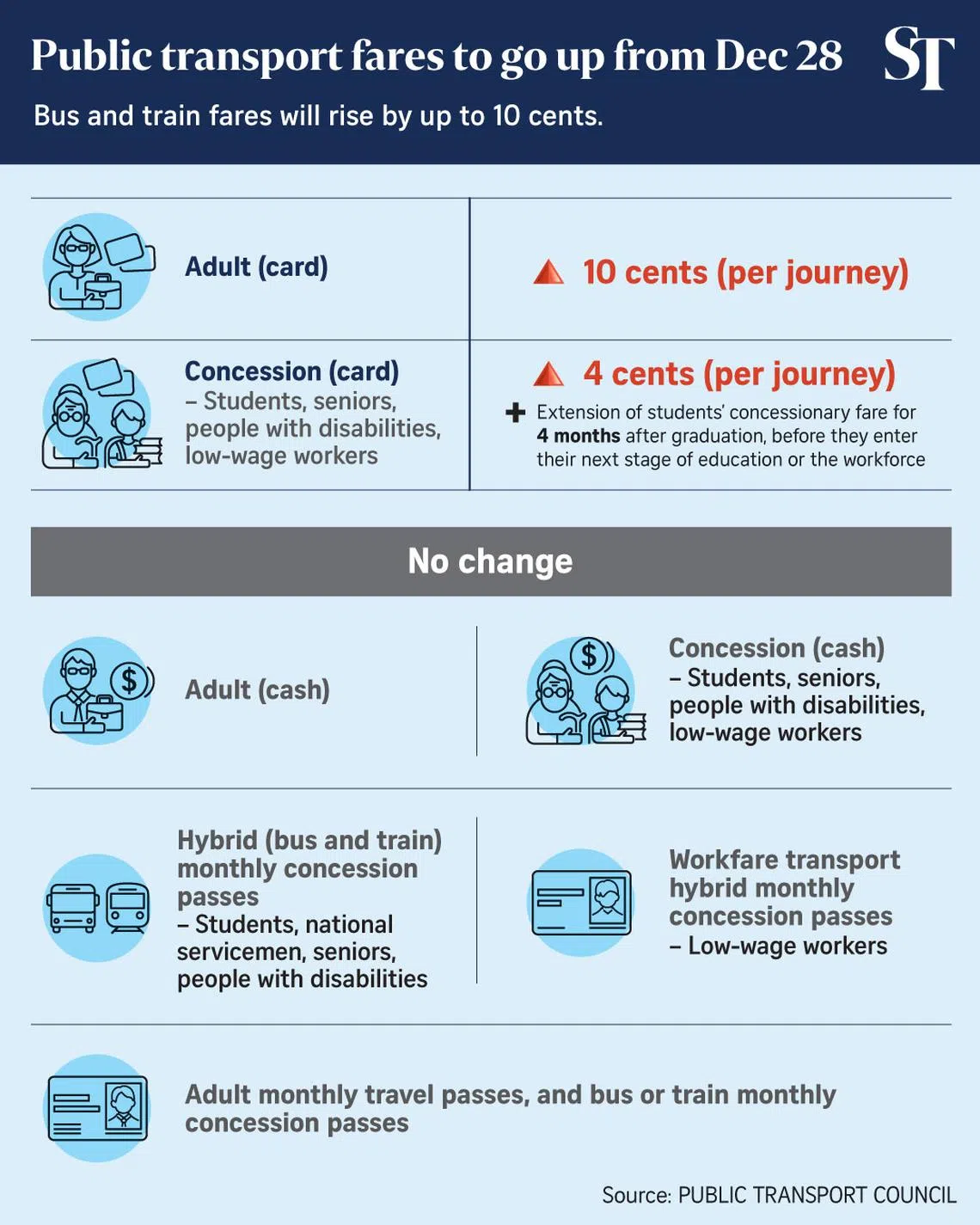
Fares will increase by 10 cents for adults who pay by card, and four cents for concession card holders, from Dec 28, translating to a 6 per cent increase in the cost of bus and train rides.
The 2024 adjustment was largely driven by core inflation and wage growth in 2023, but it was partially moderated by falling energy prices, said PTC.
The council has been limiting the fare increase to reduce the impact on commuters. In 2024, for instance, fares could have risen by up to 18.9 per cent, comprising a 3.3 per cent adjustment for the year and a 15.6 per cent hike rolled over from the 2023 exercise.
Cash fares, and the cost of adult monthly travel passes and concession passes, will stay unchanged.
## 2\. Why do fares have to be adjusted yearly?
Since 1998, public transport fares have been reviewed annually based on a fare formula.
This is to balance the need to keep the system financially sustainable, while ensuring that fare adjustments remain affordable, said PTC.
The fare formula accounts for changes in workers’ wages, energy costs and the operating costs of providing public transport services.
PTC needs to adjust fares every year so that they are brought in step with changes in operating costs. This keeps operators financially sustainable and enables them to provide reliable services, while paying their workers good wages.
## 3\. How are fares determined?
Yearly adjustments are derived from the fare formula, which is reviewed every five years so that it remains relevant and responsive to changes within the public transport sector and external environment.
It considers key cost factors in public transport, such as general operating, labour and energy costs.
In 2023, PTC adopted a [new fare formula.](https://www.straitstimes.com/singapore/transport/public-transport-fare-formula-tweaked-to-make-fare-changes-more-predictable-for-passengers?ref=inline-article)
Besides taking into account year-on-year changes in core inflation, wages and energy prices, a key change was how it incorporates a fixed “capacity adjustment factor” of 1.1 per cent each year to account for costs related to expanding the system. This includes the improved connectivity and faster journey times arising from the opening of the Thomson-East Coast MRT Line, noted PTC. This fixed component is based on actual and planned capacity improvements to the network from 2020 to 2026.
The formula will apply till 2027.
However, the new Bus Connectivity Enhancement Programme (BCEP) announced in July, which will see up to \$900 million set aside over eight years to improve the bus network, will not be considered in fare review exercises before 2028.
Asked how the costs of BCEP will be covered, PTC chief executive Leow Yew Chin said at a press conference on Sept 9 that fares are still being collected, so there will still be some cost recovery and the Government will not be subsidising the programme entirely. The capacity increases from BCEP and capacity decreases from efforts to rationalise other bus services will be properly accounted for from 2028 when a new fare formula is set.
The other notable change in the formula is how productivity gains made by public transport operators are considered.
Instead of a “productivity extraction” in the previous formula that was meant to share the operators’ productivity gains with travellers, it was tweaked to a “productivity contribution” by way of a 0.1 per cent reduction to fare adjustments.
It is a target operators are expected to reach. Put another way, operators are expected to make up for the 0.1 per cent reduction in potential fare revenue by improving their cost efficiency.
The council also limits the allowable fare adjustment to prevent operators from passing on their costs to passengers in full.
###### More on this topic
[MRT, bus fares to go up by 10 cents for adults who pay by card from Dec 28](https://www.straitstimes.com/singapore/transport/mrt-bus-fares-to-go-up-by-10-cents-for-adults-who-pay-by-card-from-dec-28?ref=more-on-this-topic)
[Graduating students can pay concessionary bus, train fares for 4 months after studies from Dec 28](https://www.straitstimes.com/singapore/transport/graduating-students-can-pay-concessionary-fares-for-4-months-after-studies-from-dec-28?ref=more-on-this-topic)
## 4\. Why can’t the Government scrap deferred fare hikes?
PTC puts a cap on the fare adjustments that can be granted each year, while still keeping pace with cost changes in the industry.
As a result, the council defers a portion of fare adjustments to moderate the impact of large fare increases on the public.
This deferred fare increase, which reflects cost increases already experienced by the public transport system, has not been accounted for in fares and needs to be covered by extra government subsidies. Ignoring it means there will be a permanent gap between fares and costs.
In October 2023, Transport Minister Chee Hong Tat [pushed back against suggestions by MPs](https://www.straitstimes.com/singapore/politics/calls-by-mps-to-expunge-or-freeze-future-fare-hikes-not-sound-chee-hong-tat?ref=inline-article) in Parliament to freeze future hikes or scrap deferred fare increases, describing these moves as “not sound” and “populist”.
He said these proposals would enlarge the existing funding gap for buses and trains, and lead to an even bigger bill for taxpayers in future.
## 5\. How do Singapore’s public transport fares compare with those in other countries?
In Singapore, adults will pay between \$1.19 (up to 3.2km) and \$2.47 (over 40.2 km) for both trunk bus and MRT services from Dec 28.
Hong Kong’s public transport system also uses distance-based fares, which range from HK\$4.90 (82 Singapore cents) to HK\$33.80 for rail rides and HK\$4.50 to HK\$10.10 for bus trips.
In Seoul, South Korea, rail fares are distance-based and start at 1,400 won (S\$1.36) for the first 10km, before increasing by 100 won for every subsequent 5km (up to 50km), and then rising by 100 won for every 8km (after 50km). Seoul’s bus fares range from 1,200 won to 3,000 won for various bus services.
In Tokyo, Japan, rail fares cost anywhere from ¥180 to ¥330 (S\$1.60 to S\$3) depending on distance travelled, while buses charge a flat fee of ¥210.
Public transport in Sydney, Australia, goes by distance-based charging, with peak-hour fees costing A\$4.20 to A\$10.33 (S\$3.70 to S\$9.10) for a train ride, and A\$3.20 to A\$5.60 for a bus trip.
###### More on this topic
[Trade-offs between convenience, affordability in public transport need to be carefully managed: Chee](https://www.straitstimes.com/singapore/trade-offs-between-convenience-affordability-in-public-transport-need-to-be-carefully-managed-chee?ref=more-on-this-topic)
[Analysis: \$900m to beef up bus services is much-needed investment so let’s make the most of it](https://www.straitstimes.com/singapore/transport/900m-to-beef-up-bus-services-is-a-much-needed-investment-let-s-make-the-most-of-it?ref=more-on-this-topic)
## 6\. What help will the public get to manage public transport expenses?
The Government will provide a public transport voucher worth \$60 to each lower-income household. Resident households with a monthly income per person of up to \$1,800 will qualify for a voucher.
Separately, PTC will allow graduating students to [continue paying concessionary fares for four months](https://www.straitstimes.com/singapore/transport/graduating-students-can-pay-concessionary-fares-for-4-months-after-studies-from-dec-28?ref=inline-article) to support them before they enter their next stage of education or the workforce.
This will benefit about 75,000 students from institutions such as secondary schools, junior colleges, the Institute of Technical Education and polytechnics yearly.
Additionally, workers earning up to \$3,000 a month will be eligible for a monthly hybrid concession travel pass for low-wage workers from Dec 28, up from a maximum income of \$2,500. This will allow more workers to take advantage of the passes.
At \$96, it allows unlimited travel on all public transport modes except express buses.
###### More on this topic
[New formula for calculating train, bus fares: What this means for passengers](https://www.straitstimes.com/singapore/transport/new-formula-for-calculating-train-bus-fares-what-this-means-for-passengers?ref=more-on-this-topic)
[Cost and revenue in public transport will never meet](https://www.straitstimes.com/singapore/transport/on-the-ground-cost-and-revenue-in-public-transport-will-never-meet?ref=more-on-this-topic)
###### See more on
[ST Explains](https://www.straitstimes.com/tags/st-explains?ref=see-more-on)
[Public transport](https://www.straitstimes.com/tags/public-transport?ref=see-more-on)
[Buses](https://www.straitstimes.com/tags/buses?ref=see-more-on)
[MRT](https://www.straitstimes.com/tags/mrt?ref=see-more-on)
Back to top
[E-paper](https://e-paper.sph.com.sg/st)
[Newsletters](https://www.straitstimes.com/newsletter-signup)
[Podcasts](https://www.straitstimes.com/st-podcasts)
[RSS Feed](https://www.straitstimes.com/RSS-Feeds)
[About Us](https://www.straitstimes.com/singapore/about-the-straits-times-leadership)
[Terms & Conditions](https://www.sph.com.sg/legal/website_tnc/)
[Personal Data Protection Notice](https://www.sph.com.sg/tnc/pdpa/)
[Need help? Reach us here.](<mailto:stics@sph.com.sg?subject=Reach%20Us&body=--%0D%0A Your browser info has automatically been included so that we can place your feedback in context; no personal data will be shared:%0D %0D%0AUser type : Anonymous %0D%0AVisitor ID : -nil- %0D%0ADevice Code : Web %0D%0A>)
[Advertise with us](https://www.sph.com.sg/advertising-solutions)
Download the app
Get unlimited access to exclusive stories and incisive insights from the ST newsroom
Subscribe
[](https://subscribe.sph.com.sg/publications-st/?utm_campaign=st_subscription&utm_medium=sph-publication&utm_source=st&utm_content=subscribebutton-footer)
MDDI (P) 046/10/2025. Published by SPH Media Limited, Co. Regn. No.202120748H. Copyright © 2026 SPH Media Limited. All rights reserved. | |||||||||||||||||||||
| Readable Markdown | SINGAPORE – From Dec 28, public transport fares for adults paying by card will [rise by 10 cents per journey](https://www.straitstimes.com/singapore/transport/mrt-bus-fares-to-go-up-by-10-cents-for-adults-who-pay-by-card-from-dec-28?ref=inline-article), the Public Transport Council (PTC) said on Sept 9 as part of its yearly fare review exercise.
This is the fourth successive year of fare increases. In 2023, adult card fares rose by [up to 11 cents](https://www.straitstimes.com/singapore/transport/bus-train-fares-to-rise-by-up-to-11-cents-for-adults-new-96-concession-pass-for-low-wage-workers?ref=inline-article), and in 2022, the increase was [up to five cents](https://www.straitstimes.com/singapore/transport/public-transport-fares-to-rise-by-4-to-5-cents-for-adults-from-dec-26?ref=inline-article). In 2021, fares went up by [up to four cents](https://www.straitstimes.com/singapore/transport/public-transport-fares-to-rise-by-3-to-4-cents-for-adults-from-dec-26?ref=inline-article).
The Straits Times explains how public transport fares are determined and why they are increasing again.
Fares will increase by 10 cents for adults who pay by card, and four cents for concession card holders, from Dec 28, translating to a 6 per cent increase in the cost of bus and train rides.
The 2024 adjustment was largely driven by core inflation and wage growth in 2023, but it was partially moderated by falling energy prices, said PTC.
The council has been limiting the fare increase to reduce the impact on commuters. In 2024, for instance, fares could have risen by up to 18.9 per cent, comprising a 3.3 per cent adjustment for the year and a 15.6 per cent hike rolled over from the 2023 exercise.
Cash fares, and the cost of adult monthly travel passes and concession passes, will stay unchanged.
Since 1998, public transport fares have been reviewed annually based on a fare formula.
This is to balance the need to keep the system financially sustainable, while ensuring that fare adjustments remain affordable, said PTC.
The fare formula accounts for changes in workers’ wages, energy costs and the operating costs of providing public transport services.
PTC needs to adjust fares every year so that they are brought in step with changes in operating costs. This keeps operators financially sustainable and enables them to provide reliable services, while paying their workers good wages.
Yearly adjustments are derived from the fare formula, which is reviewed every five years so that it remains relevant and responsive to changes within the public transport sector and external environment.
It considers key cost factors in public transport, such as general operating, labour and energy costs.
In 2023, PTC adopted a [new fare formula.](https://www.straitstimes.com/singapore/transport/public-transport-fare-formula-tweaked-to-make-fare-changes-more-predictable-for-passengers?ref=inline-article)
Besides taking into account year-on-year changes in core inflation, wages and energy prices, a key change was how it incorporates a fixed “capacity adjustment factor” of 1.1 per cent each year to account for costs related to expanding the system. This includes the improved connectivity and faster journey times arising from the opening of the Thomson-East Coast MRT Line, noted PTC. This fixed component is based on actual and planned capacity improvements to the network from 2020 to 2026.
The formula will apply till 2027.

However, the new Bus Connectivity Enhancement Programme (BCEP) announced in July, which will see up to \$900 million set aside over eight years to improve the bus network, will not be considered in fare review exercises before 2028.
Asked how the costs of BCEP will be covered, PTC chief executive Leow Yew Chin said at a press conference on Sept 9 that fares are still being collected, so there will still be some cost recovery and the Government will not be subsidising the programme entirely. The capacity increases from BCEP and capacity decreases from efforts to rationalise other bus services will be properly accounted for from 2028 when a new fare formula is set.
The other notable change in the formula is how productivity gains made by public transport operators are considered.
Instead of a “productivity extraction” in the previous formula that was meant to share the operators’ productivity gains with travellers, it was tweaked to a “productivity contribution” by way of a 0.1 per cent reduction to fare adjustments.
It is a target operators are expected to reach. Put another way, operators are expected to make up for the 0.1 per cent reduction in potential fare revenue by improving their cost efficiency.
The council also limits the allowable fare adjustment to prevent operators from passing on their costs to passengers in full.
PTC puts a cap on the fare adjustments that can be granted each year, while still keeping pace with cost changes in the industry.
As a result, the council defers a portion of fare adjustments to moderate the impact of large fare increases on the public.
This deferred fare increase, which reflects cost increases already experienced by the public transport system, has not been accounted for in fares and needs to be covered by extra government subsidies. Ignoring it means there will be a permanent gap between fares and costs.
In October 2023, Transport Minister Chee Hong Tat [pushed back against suggestions by MPs](https://www.straitstimes.com/singapore/politics/calls-by-mps-to-expunge-or-freeze-future-fare-hikes-not-sound-chee-hong-tat?ref=inline-article) in Parliament to freeze future hikes or scrap deferred fare increases, describing these moves as “not sound” and “populist”.
He said these proposals would enlarge the existing funding gap for buses and trains, and lead to an even bigger bill for taxpayers in future.
In Singapore, adults will pay between \$1.19 (up to 3.2km) and \$2.47 (over 40.2 km) for both trunk bus and MRT services from Dec 28.
Hong Kong’s public transport system also uses distance-based fares, which range from HK\$4.90 (82 Singapore cents) to HK\$33.80 for rail rides and HK\$4.50 to HK\$10.10 for bus trips.
In Seoul, South Korea, rail fares are distance-based and start at 1,400 won (S\$1.36) for the first 10km, before increasing by 100 won for every subsequent 5km (up to 50km), and then rising by 100 won for every 8km (after 50km). Seoul’s bus fares range from 1,200 won to 3,000 won for various bus services.
In Tokyo, Japan, rail fares cost anywhere from ¥180 to ¥330 (S\$1.60 to S\$3) depending on distance travelled, while buses charge a flat fee of ¥210.
Public transport in Sydney, Australia, goes by distance-based charging, with peak-hour fees costing A\$4.20 to A\$10.33 (S\$3.70 to S\$9.10) for a train ride, and A\$3.20 to A\$5.60 for a bus trip.
The Government will provide a public transport voucher worth \$60 to each lower-income household. Resident households with a monthly income per person of up to \$1,800 will qualify for a voucher.
Separately, PTC will allow graduating students to [continue paying concessionary fares for four months](https://www.straitstimes.com/singapore/transport/graduating-students-can-pay-concessionary-fares-for-4-months-after-studies-from-dec-28?ref=inline-article) to support them before they enter their next stage of education or the workforce.
This will benefit about 75,000 students from institutions such as secondary schools, junior colleges, the Institute of Technical Education and polytechnics yearly.
Additionally, workers earning up to \$3,000 a month will be eligible for a monthly hybrid concession travel pass for low-wage workers from Dec 28, up from a maximum income of \$2,500. This will allow more workers to take advantage of the passes.
At \$96, it allows unlimited travel on all public transport modes except express buses. | |||||||||||||||||||||
| ML Classification | ||||||||||||||||||||||
| ML Categories |
Raw JSON{
"/Travel_and_Transportation": 750,
"/Travel_and_Transportation/Transportation": 747,
"/Travel_and_Transportation/Transportation/Urban_Transit": 661,
"/News": 202,
"/Finance": 156,
"/Law_and_Government": 131,
"/Law_and_Government/Government": 103
} | |||||||||||||||||||||
| ML Page Types |
Raw JSON{
"/Article": 997,
"/Article/News_Update": 618
} | |||||||||||||||||||||
| ML Intent Types |
Raw JSON{
"Informational": 999
} | |||||||||||||||||||||
| Content Metadata | ||||||||||||||||||||||
| Language | en | |||||||||||||||||||||
| Author | Esther Loi | |||||||||||||||||||||
| Publish Time | 2024-09-09 14:25:00 (1 year ago) | |||||||||||||||||||||
| Original Publish Time | 2024-09-09 14:25:00 (1 year ago) | |||||||||||||||||||||
| Republished | No | |||||||||||||||||||||
| Word Count (Total) | 1,471 | |||||||||||||||||||||
| Word Count (Content) | 1,129 | |||||||||||||||||||||
| Links | ||||||||||||||||||||||
| External Links | 24 | |||||||||||||||||||||
| Internal Links | 52 | |||||||||||||||||||||
| Technical SEO | ||||||||||||||||||||||
| Meta Nofollow | No | |||||||||||||||||||||
| Meta Noarchive | No | |||||||||||||||||||||
| JS Rendered | No | |||||||||||||||||||||
| Redirect Target | null | |||||||||||||||||||||
| Performance | ||||||||||||||||||||||
| Download Time (ms) | 333 | |||||||||||||||||||||
| TTFB (ms) | 331 | |||||||||||||||||||||
| Download Size (bytes) | 34,957 | |||||||||||||||||||||
| Shard | 196 (laksa) | |||||||||||||||||||||
| Root Hash | 3908856208180310596 | |||||||||||||||||||||
| Unparsed URL | com,straitstimes!www,/singapore/st-explains-why-are-public-transport-fares-going-up-again s443 | |||||||||||||||||||||