ℹ️ Skipped - page is already crawled
| Filter | Status | Condition | Details |
|---|---|---|---|
| HTTP status | PASS | download_http_code = 200 | HTTP 200 |
| Age cutoff | PASS | download_stamp > now() - 6 MONTH | 0.2 months ago |
| History drop | PASS | isNull(history_drop_reason) | No drop reason |
| Spam/ban | PASS | fh_dont_index != 1 AND ml_spam_score = 0 | ml_spam_score=0 |
| Canonical | PASS | meta_canonical IS NULL OR = '' OR = src_unparsed | Not set |
| Property | Value | |||||||||
|---|---|---|---|---|---|---|---|---|---|---|
| URL | https://www.stjohnvic.com.au/news/first-aid-hypothermia-treatment/ | |||||||||
| Last Crawled | 2026-04-19 19:56:09 (4 days ago) | |||||||||
| First Indexed | 2020-02-02 12:45:25 (6 years ago) | |||||||||
| HTTP Status Code | 200 | |||||||||
| Content | ||||||||||
| Meta Title | Frostbite & Hypothermia Treatment Essential Tips | St John Vic | |||||||||
| Meta Description | Hypothermia treatment is not as straightforward as warming them up - follow our guide on how to identify and manage hypothermia and frostbite. | |||||||||
| Meta Canonical | null | |||||||||
| Boilerpipe Text | What is Hypothermia?
Hypothermia is a condition which is triggered when the body’s warming abilities fail or are overwhelmed. This causes the body temperature to drop below 35°C, under the normal average of 37°C.
With the onset of winter, Victorians are exposed to colder, wetter and windier weather conditions. You could find yourself in a situation where hypothermia arises and if the condition is not identified and managed within the early stages, it could potentially be life-threatening.
Warning Signs For Hypothermia
When the body temperature falls initially, early warning signs may include:
Feeling cold
Shivering
Clumsiness and slurred speech
Apathy and irrational behaviour
As the body temperature continues to drop, signs to look for include:
Shivering usually stops
Pulse may be difficult to find
Heart rate may slow
Level of consciousness continues to decline
As the body temperature drops below 30°C, warning signs include:
Loss of consciousness
Irregular heart rhythm
As the body temperature continues to fall further, the heart may arrest, resulting in death.
Preventing Hypothermia
Hypothermia occurs when the body’s warming mechanisms fail and the body temperature drops below 35°C. In order to avoid falling susceptible to hypothermia you must:
Avoid extremely cold, wet or windy weather conditions
When entering cold, wet or windy environments always dress appropriately. Clothing items may include; thermals, woollen socks, beanies, gloves, heavy-duty boots, waterproof pants and jacket.
Pay extra attention to children and the elderly in cold, wet or windy environments. Children and the elderly are more vulnerable to colder temperatures and may not be able to tolerate conditions as well as adolescents and adults.
Always ensure babies are dressed weather appropriately. Babies have the ability to become hypothermic in temperatures which adults would not be impacted by.
Important note: Babies lose heat very easily. A
baby may look healthy and happy
with the only signs of hypothermia being cold skin, unusual quietness, drowsiness or lack of appetite.
If someone is showing the signs of hypothermia it is imperative you follow the DRSABCD plan immediately. You can refresh your memory of
DRSABCD here.
Once you have applied DRSABCD you must follow these steps for hypothermia treatment:
Move the person to a warm, dry place
Help the patient to lie down in a comfortable position. Handle the person gently when moving - avoid excess activity or movement
Remove any wet clothing
Place the person in a blanket or sleeping bag and wrap them in an
emergency blanket
Cover the head to retain as much body heat as possible
If conscious, give the patient warm drinks (NOT alcohol)
Provide warmth to the person with hot water bottles or heat packs to the neck, armpits and groin - be careful to
avoid burns
If hypothermia is severe, call Triple Zero and stay with the person until medical aid arrives
What is Frostbite?
Frostbite occurs when they skin and underlying tissues become frozen because of exposure to below-freezing (sub-zero) temperatures. It is a progressive injury that will become worse without treatment. There are threetypes of frostbite: frostnip, superficial frostbite, and deep frostbite.
If only the top layer of skin is frozen, it is usually called frostnip. The skin turns pale and rhe patient experiences numbness or tingling in the affected part.
With superficial frostbite, the full thickness of the skin that is frozen, resulting in skin that is white and waxy-looking, firm to touch (but the tissue underneath is soft), and painful at first, followed by numbness.
In deep frostbite, the skin and the tissues underneath are frozen - sometimes to the bone. Unlike superficial frostbite, the skin is no longer mobile in relation to the underlying tissue. The skin is white and waxy-looking, and could turn greyish-blue as the frostbite progresses. It is also cold, hard, and numb.
Frostnip and Superficial Frostbite Treatment
If someone is showing the signs of Superficial Frostbite like any other First Aid event you must follow the DRSABCD plan. You can refresh your memory of
DRSABCD here.
Once you have applied DRSABCD you must follow these steps:
Move the person to a warm, dry place
Rewarm the frostbitten area with body heat by placing the area in yours or the patient's own armpit or warm hands
Prevent affected areas from freezing by ensuring that the person stops exposing themselves and the area to potential causes. This includes avoiding exposure to cold water or dressing inappropriately in cold weather
Deep Frostbite Treatment
If someone is displaying signs of Deep Frostbite you must follow the DRSABCD plan instantly.
Call Triple Zero (000) for an ambulance
Move the patient to a warm, dry place. If the feet or legs are frozen, do not let the patient walk.
Gently remove the patient's clothing and jewellery from the affected limb. Handle the frozen area gently to avoid any further tissue damage.
Fill a large container with warm water and put the whole frozen limb in the water.
Keep adding warm water to maintain a constant temperature.
Keep the affected area in the water until it is pink. This can take up to 40 minutes and may be painful for the person
Keep the area raised and warm. Do not burst any blisters that form.
At the beginning of winter, people are often unprepared for the harsh weather conditions approaching. When leaving the house ensure you have taken all the preventative measures listed above to avoid falling susceptible to hypothermia or frostbite.
Online
Exposure to extreme hot or cold temperatures can be deadly without prompt action.
Learn how to successfully provide emergency first aid to a casualty suffering from heat or cold induced illnesses.
This is a non-accredited course | |||||||||
| Markdown | Close
[First Aid Training](https://www.stjohnvic.com.au/first-aid-training/first-aid-courses/)
- [Onsite Training](https://www.stjohnvic.com.au/first-aid-training/onsite/)
- [Info for Participants](https://www.stjohnvic.com.au/first-aid-training/info-for-participants/)
- [Mental Health Courses](https://www.stjohnvic.com.au/first-aid-training/mental-health-courses/)
- [Online First Aid Training](https://www.stjohnvic.com.au/first-aid-training/online-first-aid-training/)
- [FAQ](https://www.stjohnvic.com.au/first-aid-training/faq/)
- [USI](https://www.stjohnvic.com.au/first-aid-training/usi/)
- [Training Locations](https://www.stjohnvic.com.au/first-aid-training/training-locations/)
- [Why St John](https://www.stjohnvic.com.au/first-aid-training/whytrain/)
[Diplomas & Certificate Courses](https://www.stjohnvic.com.au/first-aid-training/certificate-courses/)
[First Aid Products](https://www.stjohnvic.com.au/products/)
- [Defibrillators (AED)](https://www.stjohnvic.com.au/products/defibrillators-aed/)
- [Kits, Supplies & Refills](https://www.stjohnvic.com.au/products/kits-supplies-refills/)
- [Kit Servicing](https://www.stjohnvic.com.au/products/restock/)
- [PPE](https://www.stjohnvic.com.au/products/ppe/)
- [Corporate products & Cobranding](https://www.stjohnvic.com.au/products/kits-for-gifts/)
- [Our Retailers](https://www.stjohnvic.com.au/products/our-retailers/)
[First Aid at Events](https://www.stjohnvic.com.au/event-health-services/)
- [Types of Events](https://www.stjohnvic.com.au/event-health-services/types-of-events/)
- [Our Teams](https://www.stjohnvic.com.au/event-health-services/our-teams/)
- [Our Capabilities](https://www.stjohnvic.com.au/event-health-services/our-capabilities/)
- [FAQs](https://www.stjohnvic.com.au/event-health-services/faqs/)
- [First Aid Licensing](https://www.stjohnvic.com.au/event-health-services/first-aid-licensing/)
[Transport Services](https://www.stjohnvic.com.au/transport-services/)
- [Patient Transport](https://www.stjohnvic.com.au/transport-services/ambulance-patient-transport/)
- [Community Transport](https://www.stjohnvic.com.au/transport-services/community-transport/)
- [HLT31120 Certificate III Non-Emergency Patient Transport](https://www.stjohnvic.com.au/first-aid-training/first-aid-courses/hlt31120-certificate-iii-non-emergency-patient-transport/)
[Community Programs](https://www.stjohnvic.com.au/community-programs/)
- [First Aid in Schools](https://www.stjohnvic.com.au/community-programs/first-aid-in-schools/)
- [CPR Lab](https://www.stjohnvic.com.au/community-programs/cpr-lab/)
- [Party Ready](https://www.stjohnvic.com.au/community-programs/party-ready/)
- [Defib in Your Street](https://www.stjohnvic.com.au/community-programs/defib-in-your-street/)
[Join St John](https://www.stjohnvic.com.au/join-st-john/)
- [Volunteering](https://www.stjohnvic.com.au/community-programs/volunteers/)
- [St John Youth](https://www.stjohnvic.com.au/community-programs/st-john-youth/)
- [Careers](https://www.stjohnvic.com.au/join-st-john/career-opportunities/)
[Donate](https://appeal.stjohnvic.com.au/)
[For Business](https://www.stjohnvic.com.au/for-business/)
[For Individuals & Families](https://www.stjohnvic.com.au/for-individuals-families/)
[For Educators & Schools](https://www.stjohnvic.com.au/for-educators-schools/)
[About St John](https://www.stjohnvic.com.au/about/)
[News](https://www.stjohnvic.com.au/news/)
[Get Involved](https://www.stjohnvic.com.au/support-us/)
[eGift Cards](https://www.stjohnvic.com.au/egift-card/)
[Subscribe](https://www.stjohnvic.com.au/subscribe/)
[Contact](https://www.stjohnvic.com.au/contact/)
[Youth & Child Safety in St John](https://www.stjohnvic.com.au/about/child-safety-at-st-john/)
[Complaints & Compliments](https://www.stjohnvic.com.au/complaints-and-compliments-form/)
[Volunteer Login](https://intranet.stjohnvic.com.au/wp-login.php)
[](https://www.facebook.com/stjohnvic/ "https://www.facebook.com/stjohnvic/")
[](https://www.instagram.com/stjohnvic/ "https://www.instagram.com/stjohnvic/")
[](https://www.linkedin.com/company/st-john-ambulance-australia-vic-/ "https://www.linkedin.com/company/st-john-ambulance-australia-vic-/")
[](https://www.youtube.com/StJohnVictoria "https://www.youtube.com/StJohnVictoria")
[](https://www.tiktok.com/@stjohnvic "https://www.tiktok.com/@stjohnvic")
# [](https://www.stjohnvic.com.au/)
[Contact Us](https://www.stjohnvic.com.au/contact/) [Login](https://www.stjohnvic.com.au/account/) [Donate](https://appeal.stjohnvic.com.au/)
Menu
Menu
[Home](https://www.stjohnvic.com.au/)
[News](https://www.stjohnvic.com.au/news/)
First Aid for Overex...
# First Aid for Overexposure to the Cold: 9 Essential Tips for Hypothermia and Frostbite Treatment
30 Jun 2023

## **What is Hypothermia?**
Hypothermia is a condition which is triggered when the body’s warming abilities fail or are overwhelmed. This causes the body temperature to drop below 35°C, under the normal average of 37°C.
With the onset of winter, Victorians are exposed to colder, wetter and windier weather conditions. You could find yourself in a situation where hypothermia arises and if the condition is not identified and managed within the early stages, it could potentially be life-threatening.
## **Warning Signs For Hypothermia**
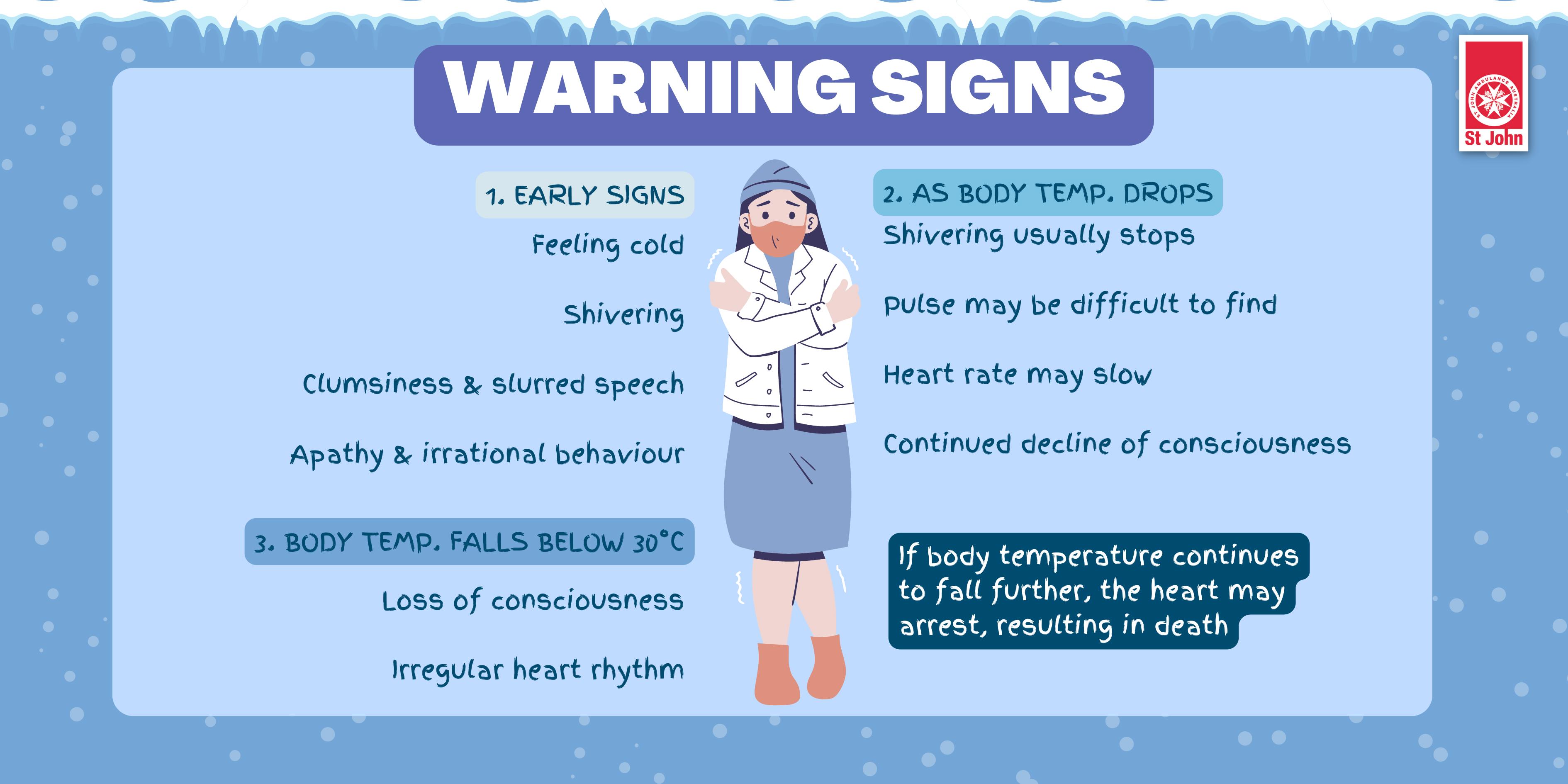
### When the body temperature falls initially, early warning signs may include:
- Feeling cold
- Shivering
- Clumsiness and slurred speech
- Apathy and irrational behaviour
### As the body temperature continues to drop, signs to look for include:
- Shivering usually stops
- Pulse may be difficult to find
- Heart rate may slow
- Level of consciousness continues to decline
### As the body temperature drops below 30°C, warning signs include:
- Loss of consciousness
- Irregular heart rhythm
### As the body temperature continues to fall further, the heart may arrest, resulting in death.
## **Preventing Hypothermia**
Hypothermia occurs when the body’s warming mechanisms fail and the body temperature drops below 35°C. In order to avoid falling susceptible to hypothermia you must:
- Avoid extremely cold, wet or windy weather conditions
- When entering cold, wet or windy environments always dress appropriately. Clothing items may include; thermals, woollen socks, beanies, gloves, heavy-duty boots, waterproof pants and jacket.
- Pay extra attention to children and the elderly in cold, wet or windy environments. Children and the elderly are more vulnerable to colder temperatures and may not be able to tolerate conditions as well as adolescents and adults.
- Always ensure babies are dressed weather appropriately. Babies have the ability to become hypothermic in temperatures which adults would not be impacted by.

Important note: Babies lose heat very easily. A [baby may look healthy and happy](https://www.stjohnvic.com.au/first-aid-training/first-aid-courses/caring-for-babies-and-kids/) with the only signs of hypothermia being cold skin, unusual quietness, drowsiness or lack of appetite.
## **Hypothermia Treatment**
If someone is showing the signs of hypothermia it is imperative you follow the DRSABCD plan immediately. You can refresh your memory of [**DRSABCD here.**](https://www.stjohnvic.com.au/news/7-words-will-save-life-drsabcd/ "7 Words That Will Save a Life – The DRSABCD")
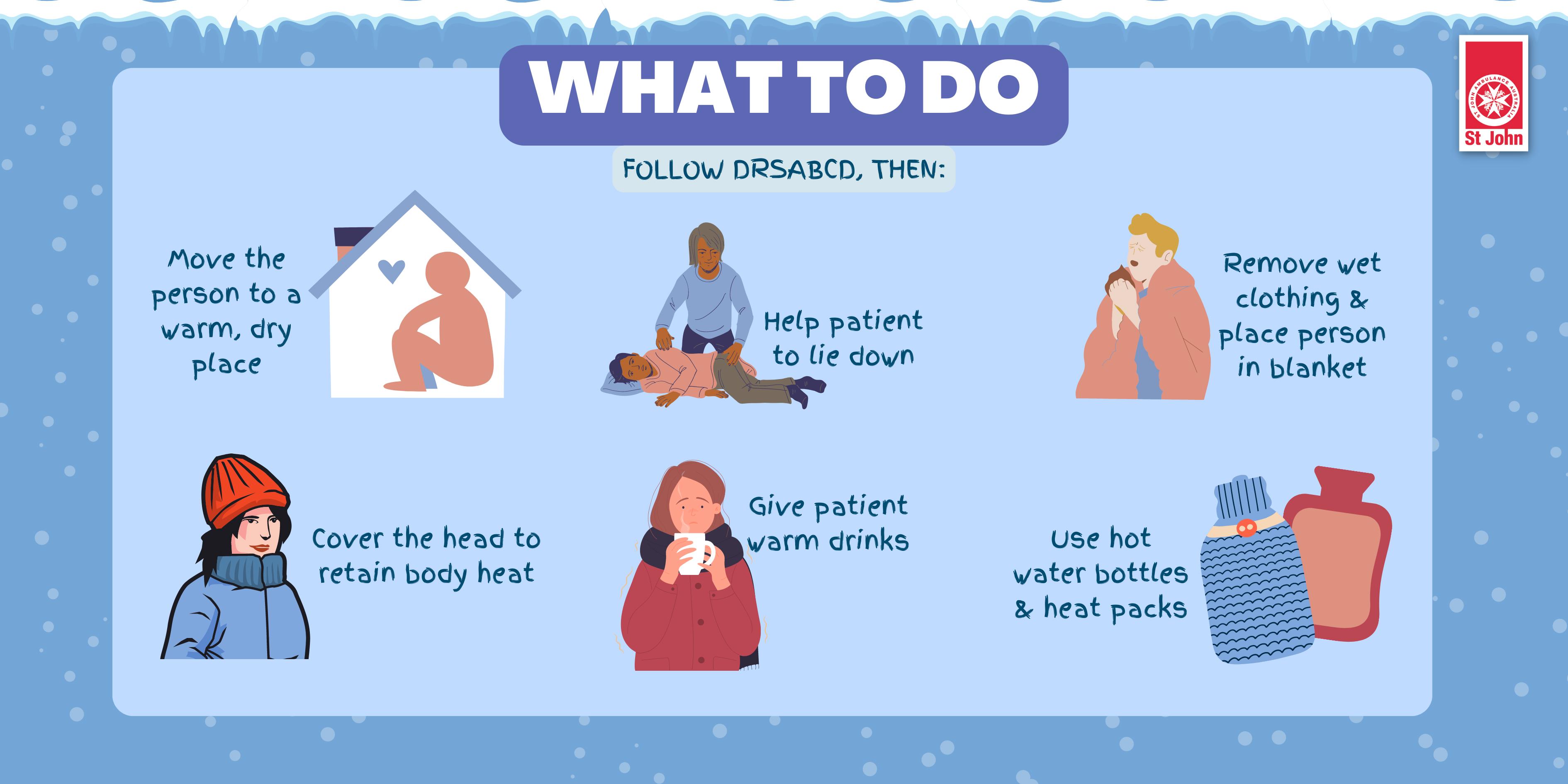
Once you have applied DRSABCD you must follow these steps for hypothermia treatment:
1. Move the person to a warm, dry place
2. Help the patient to lie down in a comfortable position. Handle the person gently when moving - avoid excess activity or movement
3. Remove any wet clothing
4. Place the person in a blanket or sleeping bag and wrap them in an [emergency blanket](https://shop.stjohn.org.au/products/emergency-accident-blanket)
5. Cover the head to retain as much body heat as possible
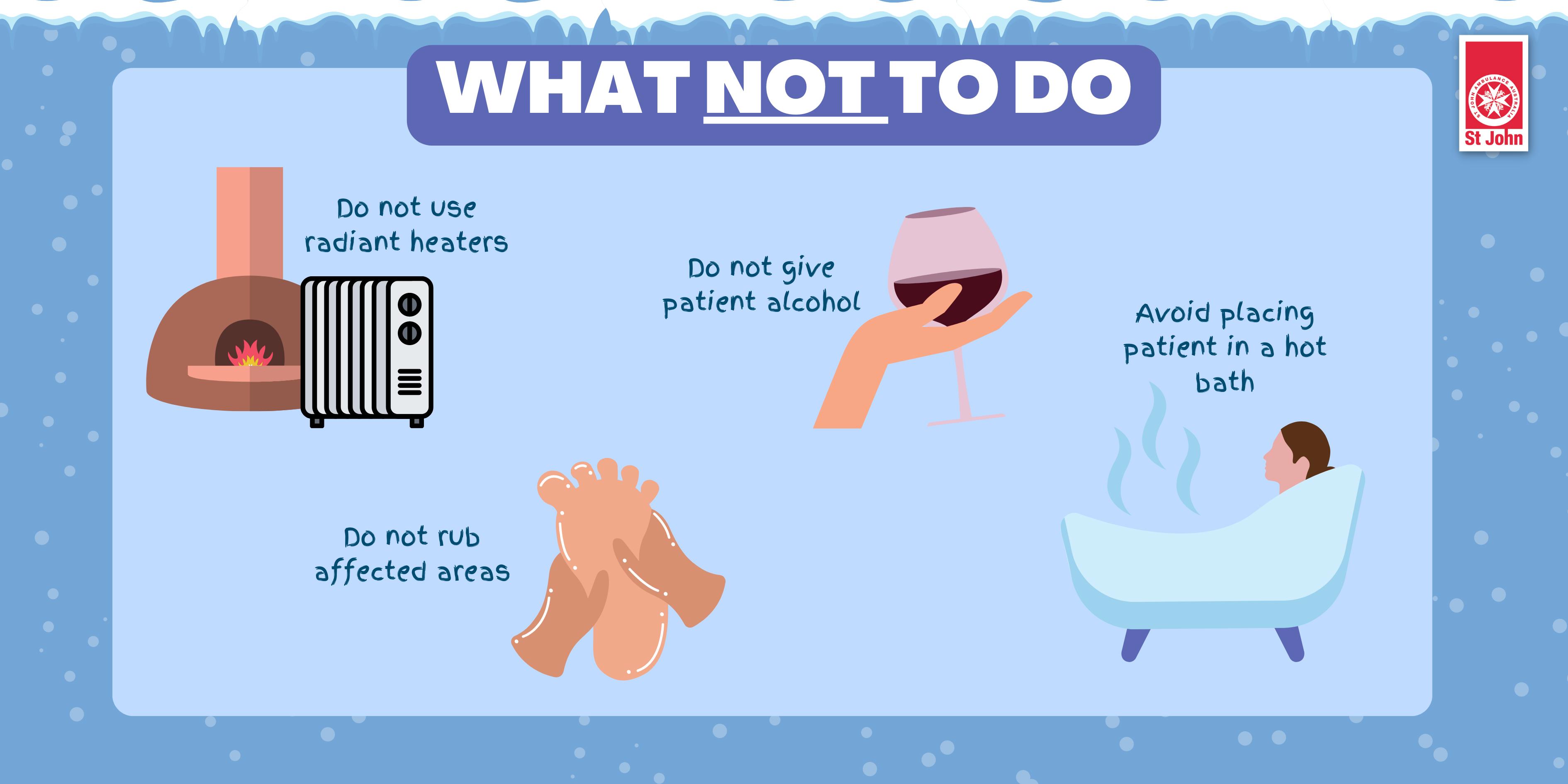
6. If conscious, give the patient warm drinks (NOT alcohol)
7. Provide warmth to the person with hot water bottles or heat packs to the neck, armpits and groin - be careful to [avoid burns](https://www.stjohnvic.com.au/news/how-to-treat-and-recognise-a-burn-effective-first-aid-for-burns/)
8. If hypothermia is severe, call Triple Zero and stay with the person until medical aid arrives
## **What is Frostbite?**
Frostbite occurs when they skin and underlying tissues become frozen because of exposure to below-freezing (sub-zero) temperatures. It is a progressive injury that will become worse without treatment. There are threetypes of frostbite: frostnip, superficial frostbite, and deep frostbite.
If only the top layer of skin is frozen, it is usually called frostnip. The skin turns pale and rhe patient experiences numbness or tingling in the affected part.
With superficial frostbite, the full thickness of the skin that is frozen, resulting in skin that is white and waxy-looking, firm to touch (but the tissue underneath is soft), and painful at first, followed by numbness.
In deep frostbite, the skin and the tissues underneath are frozen - sometimes to the bone. Unlike superficial frostbite, the skin is no longer mobile in relation to the underlying tissue. The skin is white and waxy-looking, and could turn greyish-blue as the frostbite progresses. It is also cold, hard, and numb.
## **Frostnip and Superficial Frostbite Treatment**
If someone is showing the signs of Superficial Frostbite like any other First Aid event you must follow the DRSABCD plan. You can refresh your memory of [**DRSABCD here.**](https://www.stjohnvic.com.au/news/7-words-will-save-life-drsabcd/ "7 Words That Will Save a Life – The DRSABCD")
Once you have applied DRSABCD you must follow these steps:
1. Move the person to a warm, dry place
2. Rewarm the frostbitten area with body heat by placing the area in yours or the patient's own armpit or warm hands
3. Prevent affected areas from freezing by ensuring that the person stops exposing themselves and the area to potential causes. This includes avoiding exposure to cold water or dressing inappropriately in cold weather
## **Deep Frostbite Treatment**
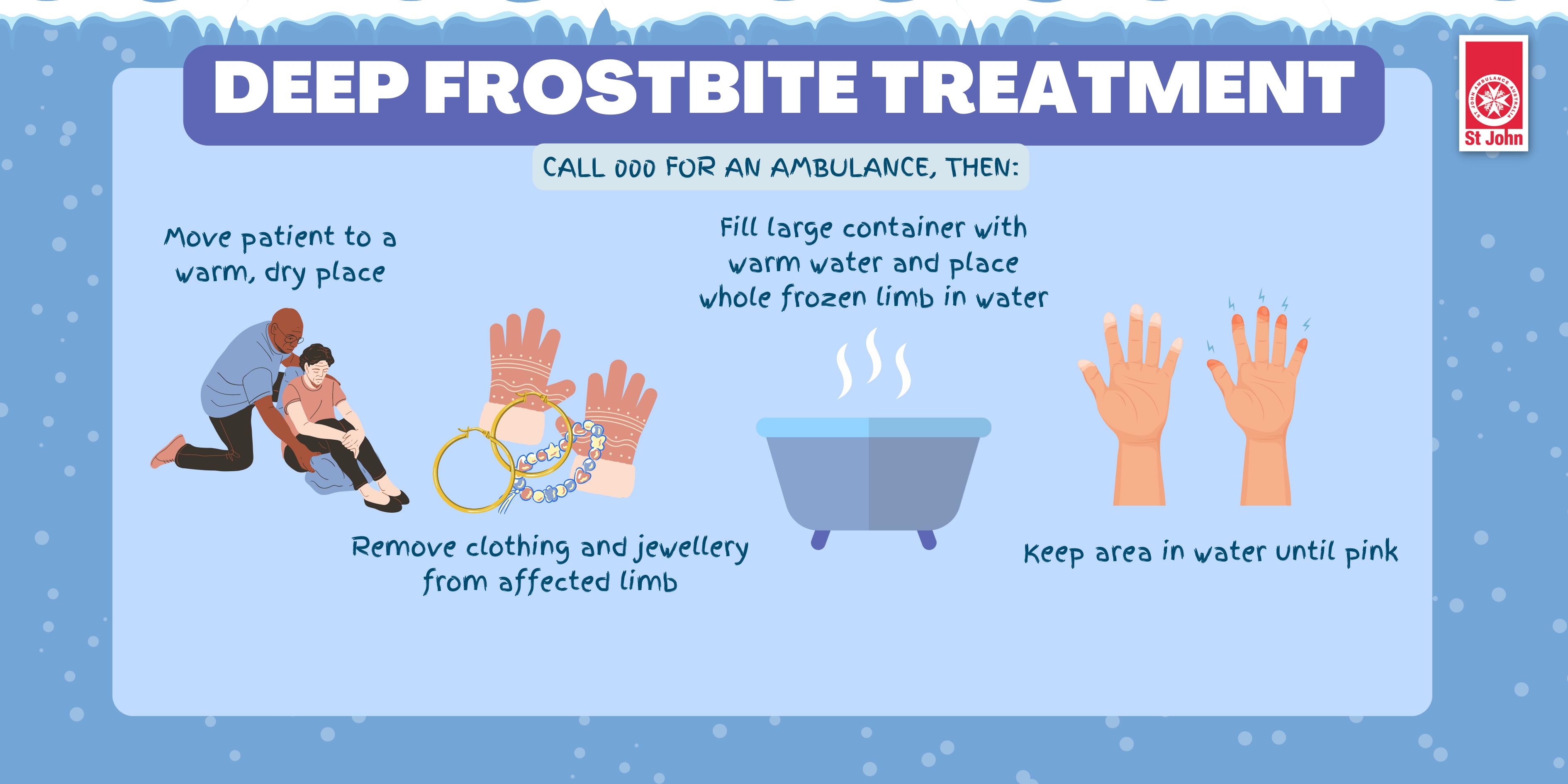
If someone is displaying signs of Deep Frostbite you must follow the DRSABCD plan instantly.
1. Call Triple Zero (000) for an ambulance
2. Move the patient to a warm, dry place. If the feet or legs are frozen, do not let the patient walk.
3. Gently remove the patient's clothing and jewellery from the affected limb. Handle the frozen area gently to avoid any further tissue damage.
4. Fill a large container with warm water and put the whole frozen limb in the water.
5. Keep adding warm water to maintain a constant temperature.
6. Keep the affected area in the water until it is pink. This can take up to 40 minutes and may be painful for the person
7. Keep the area raised and warm. Do not burst any blisters that form.
![]()
At the beginning of winter, people are often unprepared for the harsh weather conditions approaching. When leaving the house ensure you have taken all the preventative measures listed above to avoid falling susceptible to hypothermia or frostbite.
Online
[](https://www.stjohnvic.com.au/first-aid-training/first-aid-courses/bitesize-elearning-course-heat-and-cold-induced-illnesses/)
[Bitesize eLearning Course: Heat and Cold Induced Illnesses](https://www.stjohnvic.com.au/first-aid-training/first-aid-courses/bitesize-elearning-course-heat-and-cold-induced-illnesses/)
Exposure to extreme hot or cold temperatures can be deadly without prompt action.
Learn how to successfully provide emergency first aid to a casualty suffering from heat or cold induced illnesses.
*This is a non-accredited course*
[Book Now](https://www.stjohnvic.com.au/first-aid-training/first-aid-courses/bitesize-elearning-course-heat-and-cold-induced-illnesses/)
## PROVIDE FIRST AID
Learn how to manage a range of common first aid scenarios.
[Learn More](https://www.stjohnvic.com.au/first-aid-training/first-aid-courses/hltaid011-provide-first-aid/)

## CARING FOR BABIES AND KIDS
Designed for parents and carers. Learn to manage basic first aid situations specific to babies and kids up to 7.
[Learn more](https://www.stjohnvic.com.au/first-aid-training/first-aid-courses/caring-for-babies-and-kids/)
## ASTHMA & ANAPHYLAXIS
Get the confidence, knowledge and skills to recognise and manage asthmatic and anaphylactic emergencies including the use of the asthma inhaler and the adrenaline auto-injector.
[Learn more](https://www.stjohnvic.com.au/first-aid-training/first-aid-courses/asthma-anaphylaxis/)
- [First Aid Training](https://www.stjohnvic.com.au/first-aid-training/first-aid-courses/)
- [First Aid Products](https://www.stjohnvic.com.au/products/)
- [First Aid at Events](https://www.stjohnvic.com.au/event-health-services/)
- [Diploma & Certificate Courses](https://www.stjohnvic.com.au/first-aid-training/certificate-courses/)
- [Transport Services](https://www.stjohnvic.com.au/transport-services/)
- [Community Programs](https://www.stjohnvic.com.au/community-programs/)
- [Seniors Community Care](https://www.stjohnvic.com.au/seniors-community-care/)
- [About](https://www.stjohnvic.com.au/about/)
- [News](https://www.stjohnvic.com.au/news/)
- [Join St John](https://www.stjohnvic.com.au/join-st-john/)
- [Search](https://www.stjohnvic.com.au/search/)
- [Subscribe](https://www.stjohnvic.com.au/subscribe/)
- [Contact](https://www.stjohnvic.com.au/contact/)
- [Privacy & Legal](https://www.stjohnvic.com.au/privacy-legal/)
- [For Business](https://www.stjohnvic.com.au/for-business/)
- [For Individuals & Families](https://www.stjohnvic.com.au/for-individuals-families/)
- [For Educators & Schools](https://www.stjohnvic.com.au/for-educators-schools/)
- [Volunteer Login](https://intranet.stjohnvic.com.au/wp-login.php)
- [Complaints & Compliments](https://www.stjohnvic.com.au/complaints-and-compliments-form/)
[](https://www.facebook.com/stjohnvic/ "https://www.facebook.com/stjohnvic/")
[](https://www.instagram.com/stjohnvic/ "https://www.instagram.com/stjohnvic/")
[](https://www.linkedin.com/company/st-john-ambulance-australia-vic-/ "https://www.linkedin.com/company/st-john-ambulance-australia-vic-/")
[](https://www.youtube.com/StJohnVictoria "https://www.youtube.com/StJohnVictoria")
[](https://www.tiktok.com/@stjohnvic "https://www.tiktok.com/@stjohnvic")
Copyright © St John Ambulance Australia (Vic) Ltd
ABN: 69 061 844 380 ACN: 688 490 851
Registered charity: 10096
St John Ambulance (VIC) delivers nationally recognised training and assessment on behalf of St John Ambulance Australia (RTO 88041)




 | |||||||||
| Readable Markdown | ## **What is Hypothermia?**
Hypothermia is a condition which is triggered when the body’s warming abilities fail or are overwhelmed. This causes the body temperature to drop below 35°C, under the normal average of 37°C.
With the onset of winter, Victorians are exposed to colder, wetter and windier weather conditions. You could find yourself in a situation where hypothermia arises and if the condition is not identified and managed within the early stages, it could potentially be life-threatening.
## **Warning Signs For Hypothermia**
### When the body temperature falls initially, early warning signs may include:
- Feeling cold
- Shivering
- Clumsiness and slurred speech
- Apathy and irrational behaviour
### As the body temperature continues to drop, signs to look for include:
- Shivering usually stops
- Pulse may be difficult to find
- Heart rate may slow
- Level of consciousness continues to decline
### As the body temperature drops below 30°C, warning signs include:
- Loss of consciousness
- Irregular heart rhythm
### As the body temperature continues to fall further, the heart may arrest, resulting in death.
## **Preventing Hypothermia**
Hypothermia occurs when the body’s warming mechanisms fail and the body temperature drops below 35°C. In order to avoid falling susceptible to hypothermia you must:
- Avoid extremely cold, wet or windy weather conditions
- When entering cold, wet or windy environments always dress appropriately. Clothing items may include; thermals, woollen socks, beanies, gloves, heavy-duty boots, waterproof pants and jacket.
- Pay extra attention to children and the elderly in cold, wet or windy environments. Children and the elderly are more vulnerable to colder temperatures and may not be able to tolerate conditions as well as adolescents and adults.
- Always ensure babies are dressed weather appropriately. Babies have the ability to become hypothermic in temperatures which adults would not be impacted by.
Important note: Babies lose heat very easily. A [baby may look healthy and happy](https://www.stjohnvic.com.au/first-aid-training/first-aid-courses/caring-for-babies-and-kids/) with the only signs of hypothermia being cold skin, unusual quietness, drowsiness or lack of appetite.
If someone is showing the signs of hypothermia it is imperative you follow the DRSABCD plan immediately. You can refresh your memory of [**DRSABCD here.**](https://www.stjohnvic.com.au/news/7-words-will-save-life-drsabcd/ "7 Words That Will Save a Life – The DRSABCD")
Once you have applied DRSABCD you must follow these steps for hypothermia treatment:
1. Move the person to a warm, dry place
2. Help the patient to lie down in a comfortable position. Handle the person gently when moving - avoid excess activity or movement
3. Remove any wet clothing
4. Place the person in a blanket or sleeping bag and wrap them in an [emergency blanket](https://shop.stjohn.org.au/products/emergency-accident-blanket)
5. Cover the head to retain as much body heat as possible
6. If conscious, give the patient warm drinks (NOT alcohol)
7. Provide warmth to the person with hot water bottles or heat packs to the neck, armpits and groin - be careful to [avoid burns](https://www.stjohnvic.com.au/news/how-to-treat-and-recognise-a-burn-effective-first-aid-for-burns/)
8. If hypothermia is severe, call Triple Zero and stay with the person until medical aid arrives
## **What is Frostbite?**
Frostbite occurs when they skin and underlying tissues become frozen because of exposure to below-freezing (sub-zero) temperatures. It is a progressive injury that will become worse without treatment. There are threetypes of frostbite: frostnip, superficial frostbite, and deep frostbite.
If only the top layer of skin is frozen, it is usually called frostnip. The skin turns pale and rhe patient experiences numbness or tingling in the affected part.
With superficial frostbite, the full thickness of the skin that is frozen, resulting in skin that is white and waxy-looking, firm to touch (but the tissue underneath is soft), and painful at first, followed by numbness.
In deep frostbite, the skin and the tissues underneath are frozen - sometimes to the bone. Unlike superficial frostbite, the skin is no longer mobile in relation to the underlying tissue. The skin is white and waxy-looking, and could turn greyish-blue as the frostbite progresses. It is also cold, hard, and numb.
## **Frostnip and Superficial Frostbite Treatment**
If someone is showing the signs of Superficial Frostbite like any other First Aid event you must follow the DRSABCD plan. You can refresh your memory of [**DRSABCD here.**](https://www.stjohnvic.com.au/news/7-words-will-save-life-drsabcd/ "7 Words That Will Save a Life – The DRSABCD")
Once you have applied DRSABCD you must follow these steps:
1. Move the person to a warm, dry place
2. Rewarm the frostbitten area with body heat by placing the area in yours or the patient's own armpit or warm hands
3. Prevent affected areas from freezing by ensuring that the person stops exposing themselves and the area to potential causes. This includes avoiding exposure to cold water or dressing inappropriately in cold weather
## **Deep Frostbite Treatment**
If someone is displaying signs of Deep Frostbite you must follow the DRSABCD plan instantly.
1. Call Triple Zero (000) for an ambulance
2. Move the patient to a warm, dry place. If the feet or legs are frozen, do not let the patient walk.
3. Gently remove the patient's clothing and jewellery from the affected limb. Handle the frozen area gently to avoid any further tissue damage.
4. Fill a large container with warm water and put the whole frozen limb in the water.
5. Keep adding warm water to maintain a constant temperature.
6. Keep the affected area in the water until it is pink. This can take up to 40 minutes and may be painful for the person
7. Keep the area raised and warm. Do not burst any blisters that form.
![]()
At the beginning of winter, people are often unprepared for the harsh weather conditions approaching. When leaving the house ensure you have taken all the preventative measures listed above to avoid falling susceptible to hypothermia or frostbite.
Online
[](https://www.stjohnvic.com.au/first-aid-training/first-aid-courses/bitesize-elearning-course-heat-and-cold-induced-illnesses/)
Exposure to extreme hot or cold temperatures can be deadly without prompt action.
Learn how to successfully provide emergency first aid to a casualty suffering from heat or cold induced illnesses.
*This is a non-accredited course* | |||||||||
| ML Classification | ||||||||||
| ML Categories |
Raw JSON{
"/Health": 998,
"/Health/Health_Conditions": 731,
"/Health/Health_Conditions/Respiratory_Conditions": 457
} | |||||||||
| ML Page Types |
Raw JSON{
"/Article": 997,
"/Article/How_to": 635
} | |||||||||
| ML Intent Types |
Raw JSON{
"Informational": 999
} | |||||||||
| Content Metadata | ||||||||||
| Language | en | |||||||||
| Author | null | |||||||||
| Publish Time | not set | |||||||||
| Original Publish Time | 2020-02-02 12:45:25 (6 years ago) | |||||||||
| Republished | No | |||||||||
| Word Count (Total) | 1,276 | |||||||||
| Word Count (Content) | 937 | |||||||||
| Links | ||||||||||
| External Links | 7 | |||||||||
| Internal Links | 62 | |||||||||
| Technical SEO | ||||||||||
| Meta Nofollow | No | |||||||||
| Meta Noarchive | No | |||||||||
| JS Rendered | Yes | |||||||||
| Redirect Target | null | |||||||||
| Performance | ||||||||||
| Download Time (ms) | 901 | |||||||||
| TTFB (ms) | 901 | |||||||||
| Download Size (bytes) | 13,609 | |||||||||
| Shard | 197 (laksa) | |||||||||
| Root Hash | 15692047017589026397 | |||||||||
| Unparsed URL | au,com,stjohnvic!www,/news/first-aid-hypothermia-treatment/ s443 | |||||||||