ℹ️ Skipped - page is already crawled
| Filter | Status | Condition | Details |
|---|---|---|---|
| HTTP status | PASS | download_http_code = 200 | HTTP 200 |
| Age cutoff | PASS | download_stamp > now() - 6 MONTH | 0 months ago |
| History drop | PASS | isNull(history_drop_reason) | No drop reason |
| Spam/ban | PASS | fh_dont_index != 1 AND ml_spam_score = 0 | ml_spam_score=0 |
| Canonical | PASS | meta_canonical IS NULL OR = '' OR = src_unparsed | Not set |
| Property | Value | |||||||||
|---|---|---|---|---|---|---|---|---|---|---|
| URL | https://www.statisticshowto.com/beta-distribution/ | |||||||||
| Last Crawled | 2026-04-22 07:50:31 (8 hours ago) | |||||||||
| First Indexed | 2020-04-05 02:41:07 (6 years ago) | |||||||||
| HTTP Status Code | 200 | |||||||||
| Content | ||||||||||
| Meta Title | Beta Distribution: Definition, Calculation - Statistics How To | |||||||||
| Meta Description | Beta distribution definition. Represents a family of probabilities and is a way to represent outcomes for percentages or proportions. | |||||||||
| Meta Canonical | null | |||||||||
| Boilerpipe Text | <
Probability Distributions
>
Beta Distribution
Contents:
What is a Beta Distribution?
Properties
Software Options: Mathematica and R
Excel Beta Distribution: BETA.DIST & INV.BETA
Applications of the Beta Density Function
What is a Beta Distribution?
The
beta distribution
(also called the
beta distribution of the first kind
) is a family of
continuous probability distributions
defined on [0, 1]. This distribution is similar to the
binomial distribution
, except where the binomial models the
number
of successes (x), the beta models the
probability
(p) of success.
A beta distribution is a versatile way to represent outcomes for percentages or proportions. For example, how likely is it that a rogue candidate will win the next Presidential election? You might think the probability is 0.2. Your friend might think it’s 0.15. The beta distribution gives you a way to describe this. One reason that the beta distribution can be confusing to work with is that there are three “Betas” to contend with, and they all have different meanings:
Beta(α, β): the
name
of the probability distribution.
B(α, β ): the name of a function in the denominator of the
pdf
. This acts as a “
normalizing constant
” to ensure that the area under the curve of the pdf equals 1.
β: the name of the second
shape parameter
in the pdf.
The basic beta distribution is also called the
beta distribution of the first kind
. Beta distribution of the second kind is another name for the
beta prime distribution
.
Properties
The general formula for the
probability density function (pdf)
is:
where:
α and β are two positive
shape parameters
which control the shape of the distribution.
The graph of the beta density function can take on a variety of shapes. For example, if α < 1 and Β < 1, the graph will be a U shaped distribution, and if α = 1 and Β = 2, the graph is a straight line.
The Beta Distribution pdf.
The general formula for the
cumulative distribution function (CDF)
is:
which includes the
regularized beta function
:
Software Options
Most software packages have options for the beta distribution.
Mathematica
Implement a beta distribution by typing BetaDistribution[alpha,beta].
R
dbeta(x, shape1, shape2, ncp = 0, log = FALSE) pbeta(q, shape1, shape2, ncp = 0, lower.tail = TRUE, log.p = FALSE) qbeta(p, shape1, shape2, ncp = 0, lower.tail = TRUE, log.p = FALSE) rbeta(n, shape1, shape2, ncp = 0)
where:
x, q = vector of
quantiles
. p = vector of probabilities.
n = # of observations.
shape1, shape2 =
shape parameters
α and β
ncp =
non-centrality parameter
.
log, log.p = logical; if TRUE, probabilities p are given as log(p).
lower.tail = logical; if TRUE (default), probabilities are P[X ≤ x], otherwise, P[X > x].
Excel Beta Distribution: BETA.DIST & INV.BETA
Watch the video for an example of BETA.DIST:
Can’t see the video?
Click here
to watch it on YouTube. The Microsoft Excel beta distribution format depends on which version of
Excel
you are using; Excel 2010 and later uses the BETA.DIST function, while earlier versions use BETADIST. You’ll need to know alpha and beta, both of which refer to the parameters describing the distribution. Five inputs are needed:
The value where you want to
evaluate the function
.
Alpha and Beta, the parameters of the distribution which determine shape.
The lower and upper bound.
An extra input is needed for the Excel 2010 Beta Distribution: cumulative. Cumulative is a logical value that determines the function’s form and can either be TRUE (returns the cumulative distribution function) or FALSE (returns the probability density function).
Example problem:
Calculate a
cumulative distribution function
for a beta distribution in Excel at 0.5 with an alpha of 9, a beta of 10, a
lower bound
of 0 and an
upper bound
of 1.
Excel 2007 and Earlier:
Type the value where you want to evaluate the function in cell A1.
For this example, type “.5” in cell A1.
Type the value for alpha in cell A2
and then type the value for beta in cell A1. For this example, type “9” in cell A2 and then type “10” in cell A3.
Type the lower bound in cell A4
and then
type the upper bound in cell A5.
For this example, type “0” in cell A4 and then type “1” in cell A5
Type the beta distribution function into cell A6.
The format of the function is =BETADIST(value,alpha,beta,lower bound,upper bound). For this example, type “=BETADIST(A1,A2,A3,A4,A5)” into cell A6. Press “Enter” to see the result for the beta distribution, which is 0.592735.
Excel 2010 and later
Excel 2010 and later uses the BETA.DIST function. If you’re using earlier versions, use BETADIST instead. Inputs are as follows:
A value where you want to evaluate the function.
Alpha (α) and Beta (β), which determine the distribution’s shape.
The lower and upper bound.
“Cumulative” — a logical value (TRUE/FALSE) that determines the function’s form. TRUE returns the CDF and FALSE returns the PDF.
Example problem:
Calculate a
cumulative distribution function
for a beta distribution at 0.5 with α
=
9, β
=
10,
lower bound = 0 and upper bound = 1.
Applications of the Beta Density Function
The beta distribution is used for a variety of applications for modeling the behavior of
random variables
limited to intervals of finite length. Uses include:
Bayesian inference, as the conjugate prior probability distribution for the Bernoulli, binomial, geometric and negative binomial distributions.
The Rule of Succession (such as Pierre-Simon Laplace’s treatment of the sunrise problem),
Task duration modeling.
Project/planning control systems like PERT and CPM.
In project management for the “three-point technique,” (also called the beta distribution technique), which recognizes uncertainty in estimated project time [1]. The three-point estimation technique is used to account for uncertainty in project time estimates. By applying this method, project managers can leverage powerful quantitative tools to identify tasks with the highest risk. It also facilitates effective management of overall project completion time.
References
3-Points Estimating
https://www.projectmanagement.com/contentPages/wiki.cfm?ID=368763&thisPageURL=/wikis/368763/3-Points-Estimating#_=_ | |||||||||
| Markdown | [Skip to content](https://www.statisticshowto.com/beta-distribution/#content "Skip to content")
[Statistics How To](https://www.statisticshowto.com/)
Menu
- [Home](https://www.statisticshowto.com/)
- [Tables](https://www.statisticshowto.com/tables/)
- [Binomial Distribution Table](https://www.statisticshowto.com/tables/binomial-distribution-table/)
- [F Table](https://www.statisticshowto.com/tables/f-table/)
- [Inverse T Distribution Table](https://www.statisticshowto.com/tables/inverse-t-distribution-table/)
- [PPMC Critical Values](https://www.statisticshowto.com/tables/ppmc-critical-values/)
- [T-Distribution Table (One Tail and Two-Tails)](https://www.statisticshowto.com/tables/t-distribution-table/)
- [Chi Squared Table (Right Tail)](https://www.statisticshowto.com/tables/chi-squared-table-right-tail/)
- [Z-table (Right of Curve or Left)](https://www.statisticshowto.com/tables/z-table/)
- [Probability and Statistics](https://www.statisticshowto.com/probability-and-statistics/)
- [Binomials](https://www.statisticshowto.com/probability-and-statistics/binomial-theorem/)
- [Chi-Square Statistic](https://www.statisticshowto.com/probability-and-statistics/chi-square/)
- [Expected Value](https://www.statisticshowto.com/probability-and-statistics/expected-value/)
- [Hypothesis Testing](https://www.statisticshowto.com/probability-and-statistics/hypothesis-testing/)
- [Non Normal Distribution](https://www.statisticshowto.com/probability-and-statistics/non-normal-distributions/)
- [Normal Distributions](https://www.statisticshowto.com/probability-and-statistics/normal-distributions/)
- [Probability](https://www.statisticshowto.com/probability-and-statistics/probability-main-index/)
- [Regression Analysis](https://www.statisticshowto.com/probability-and-statistics/regression-analysis/)
- [Statistics Basics](https://www.statisticshowto.com/statistics-basics/)
- [T-Distribution](https://www.statisticshowto.com/probability-and-statistics/t-distribution/)
- [Multivariate Analysis & Independent Component](https://www.statisticshowto.com/probability-and-statistics/multivariate-analysis/)
- [Sampling](https://www.statisticshowto.com/probability-and-statistics/sampling-in-statistics/)
- [Calculators](https://www.statisticshowto.com/calculators/)
- [Variance and Standard Deviation Calculator](https://www.statisticshowto.com/calculators/variance-and-standard-deviation-calculator/)
- [Tdist Calculator](https://www.statisticshowto.com/calculators/tdist-calculator/)
- [Permutation Calculator / Combination Calculator](https://www.statisticshowto.com/calculators/permutation-calculator-and-combination-calculator/)
- [Interquartile Range Calculator](https://www.statisticshowto.com/calculators/interquartile-range-calculator/)
- [Linear Regression Calculator](https://www.statisticshowto.com/calculators/linear-regression-calculator/)
- [Expected Value Calculator](https://www.statisticshowto.com/calculators/expected-value-calculator/)
- [Binomial Distribution Calculator](https://www.statisticshowto.com/calculators/binomial-distribution-calculator/)
- [Matrices](https://www.statisticshowto.com/matrices-and-matrix-algebra/)
- [Experimental Design](https://www.statisticshowto.com/experimental-design/)
- [Calculus Based Statistics](https://www.statisticshowto.com/probability-and-statistics/calculus-based-statistics/)
[Statistics How To](https://www.statisticshowto.com/)
Menu
- [Home](https://www.statisticshowto.com/)
- [Tables](https://www.statisticshowto.com/tables/)
- [Binomial Distribution Table](https://www.statisticshowto.com/tables/binomial-distribution-table/)
- [F Table](https://www.statisticshowto.com/tables/f-table/)
- [Inverse T Distribution Table](https://www.statisticshowto.com/tables/inverse-t-distribution-table/)
- [PPMC Critical Values](https://www.statisticshowto.com/tables/ppmc-critical-values/)
- [T-Distribution Table (One Tail and Two-Tails)](https://www.statisticshowto.com/tables/t-distribution-table/)
- [Chi Squared Table (Right Tail)](https://www.statisticshowto.com/tables/chi-squared-table-right-tail/)
- [Z-table (Right of Curve or Left)](https://www.statisticshowto.com/tables/z-table/)
- [Probability and Statistics](https://www.statisticshowto.com/probability-and-statistics/)
- [Binomials](https://www.statisticshowto.com/probability-and-statistics/binomial-theorem/)
- [Chi-Square Statistic](https://www.statisticshowto.com/probability-and-statistics/chi-square/)
- [Expected Value](https://www.statisticshowto.com/probability-and-statistics/expected-value/)
- [Hypothesis Testing](https://www.statisticshowto.com/probability-and-statistics/hypothesis-testing/)
- [Non Normal Distribution](https://www.statisticshowto.com/probability-and-statistics/non-normal-distributions/)
- [Normal Distributions](https://www.statisticshowto.com/probability-and-statistics/normal-distributions/)
- [Probability](https://www.statisticshowto.com/probability-and-statistics/probability-main-index/)
- [Regression Analysis](https://www.statisticshowto.com/probability-and-statistics/regression-analysis/)
- [Statistics Basics](https://www.statisticshowto.com/statistics-basics/)
- [T-Distribution](https://www.statisticshowto.com/probability-and-statistics/t-distribution/)
- [Multivariate Analysis & Independent Component](https://www.statisticshowto.com/probability-and-statistics/multivariate-analysis/)
- [Sampling](https://www.statisticshowto.com/probability-and-statistics/sampling-in-statistics/)
- [Calculators](https://www.statisticshowto.com/calculators/)
- [Variance and Standard Deviation Calculator](https://www.statisticshowto.com/calculators/variance-and-standard-deviation-calculator/)
- [Tdist Calculator](https://www.statisticshowto.com/calculators/tdist-calculator/)
- [Permutation Calculator / Combination Calculator](https://www.statisticshowto.com/calculators/permutation-calculator-and-combination-calculator/)
- [Interquartile Range Calculator](https://www.statisticshowto.com/calculators/interquartile-range-calculator/)
- [Linear Regression Calculator](https://www.statisticshowto.com/calculators/linear-regression-calculator/)
- [Expected Value Calculator](https://www.statisticshowto.com/calculators/expected-value-calculator/)
- [Binomial Distribution Calculator](https://www.statisticshowto.com/calculators/binomial-distribution-calculator/)
- [Matrices](https://www.statisticshowto.com/matrices-and-matrix-algebra/)
- [Experimental Design](https://www.statisticshowto.com/experimental-design/)
- [Calculus Based Statistics](https://www.statisticshowto.com/probability-and-statistics/calculus-based-statistics/)
# Beta Distribution: Definition, Calculation
\< [Probability Distributions](https://www.statisticshowto.com/probability-and-statistics/statistics-definitions/probability-distribution/) \> *Beta Distribution*
**Contents:**
1. 1. [What is a Beta Distribution?](https://www.statisticshowto.com/beta-distribution/#whatis)
2. [Properties](https://www.statisticshowto.com/beta-distribution/#properties)
3. [Software Options: Mathematica and R](https://www.statisticshowto.com/beta-distribution/#software)
4. [Excel Beta Distribution: BETA.DIST & INV.BETA](https://www.statisticshowto.com/beta-distribution/#excel)
5. [Applications of the Beta Density Function](https://www.statisticshowto.com/beta-distribution/#applications)
## What is a Beta Distribution?
The **beta distribution** (also called the *beta distribution of the first kind*) is a family of [continuous probability distributions](https://www.statisticshowto.com/continuous-probability-distribution/) defined on \[0, 1\]. This distribution is similar to the [binomial distribution](https://www.statisticshowto.com/probability-and-statistics/binomial-theorem/binomial-distribution-formula/), except where the binomial models the *number* of successes (x), the beta models the *probability* (p) of success.
A beta distribution is a versatile way to represent outcomes for percentages or proportions. For example, how likely is it that a rogue candidate will win the next Presidential election? You might think the probability is 0.2. Your friend might think it’s 0.15. The beta distribution gives you a way to describe this. One reason that the beta distribution can be confusing to work with is that there are three “Betas” to contend with, and they all have different meanings:
1. 1. - Beta(α, β): the *name* of the probability distribution.
- B(α, β ): the name of a function in the denominator of the [pdf](https://www.statisticshowto.com/probability-density-function/). This acts as a “[normalizing constant](https://www.statisticshowto.com/normalizing-constant-definition/)” to ensure that the area under the curve of the pdf equals 1.
- β: the name of the second [shape parameter](https://www.statisticshowto.com/shape-parameter/) in the pdf.
The basic beta distribution is also called the *beta distribution of the first kind*. Beta distribution of the second kind is another name for the [beta prime distribution](https://www.statisticshowto.com/beta-prime-distribution/).
## Properties
The general formula for the [probability density function (pdf)](https://www.statisticshowto.com/probability-density-function-definition-examples/) is: 
where:
1. 1. - α and β are two positive [shape parameters](https://www.statisticshowto.com/shape-parameter/) which control the shape of the distribution.
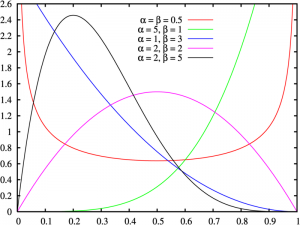
The graph of the beta density function can take on a variety of shapes. For example, if α \< 1 and Β \< 1, the graph will be a U shaped distribution, and if α = 1 and Β = 2, the graph is a straight line.
[](https://www.statisticshowto.com/wp-content/uploads/2010/09/800px-Beta_distribution_pdf.png)
The Beta Distribution pdf.
The general formula for the [cumulative distribution function (CDF)](https://www.statisticshowto.com/cumulative-distribution-function-cdf/) is: 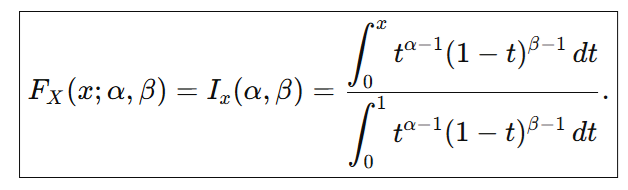 which includes the [regularized beta function](https://www.statisticshowto.com/regularized-incomplete-beta-function/): 
## [Software Options]()
Most software packages have options for the beta distribution.
**[Mathematica](http://www.wolfram.com/mathematica/)**
Implement a beta distribution by typing BetaDistribution\[alpha,beta\].
**R**
dbeta(x, shape1, shape2, ncp = 0, log = FALSE) pbeta(q, shape1, shape2, ncp = 0, lower.tail = TRUE, log.p = FALSE) qbeta(p, shape1, shape2, ncp = 0, lower.tail = TRUE, log.p = FALSE) rbeta(n, shape1, shape2, ncp = 0)
where:
1. 1. - x, q = vector of [quantiles](https://www.statisticshowto.com/quantile-definition-find-easy-steps/). p = vector of probabilities.
- n = \# of observations.
- shape1, shape2 = [shape parameters](https://www.statisticshowto.com/shape-parameter/) α and β
- ncp = [non-centrality parameter](https://www.statisticshowto.com/non-centrality-parameter-ncp/).
- log, log.p = logical; if TRUE, probabilities p are given as log(p).
- lower.tail = logical; if TRUE (default), probabilities are P\[X ≤ x\], otherwise, P\[X \> x\].
## [Excel Beta Distribution: BETA.DIST & INV.BETA]()
Watch the video for an example of BETA.DIST:
[ Watch this video on YouTube](https://youtu.be/ct1rhj4M54o)
Can’t see the video? [Click here](https://youtu.be/ct1rhj4M54o?si=zzBQWjgDzHSHJJlg) to watch it on YouTube. The Microsoft Excel beta distribution format depends on which version of [Excel](http://office.microsoft.com/en-us/excel/) you are using; Excel 2010 and later uses the BETA.DIST function, while earlier versions use BETADIST. You’ll need to know alpha and beta, both of which refer to the parameters describing the distribution. Five inputs are needed:
1. 1. - The value where you want to [evaluate the function](https://www.statisticshowto.com/evaluating-a-function/).
- Alpha and Beta, the parameters of the distribution which determine shape.
- The lower and upper bound.
An extra input is needed for the Excel 2010 Beta Distribution: cumulative. Cumulative is a logical value that determines the function’s form and can either be TRUE (returns the cumulative distribution function) or FALSE (returns the probability density function). **Example problem:** *Calculate a [cumulative distribution function](https://www.statisticshowto.com/cumulative-distribution-function-cdf/) for a beta distribution in Excel at 0.5 with an alpha of 9, a beta of 10, a [lower bound](https://www.statisticshowto.com/lower-bound-greatest-glb-infimum/) of 0 and an [upper bound](https://www.statisticshowto.com/upper-bound/) of 1.*
## Excel 2007 and Earlier:
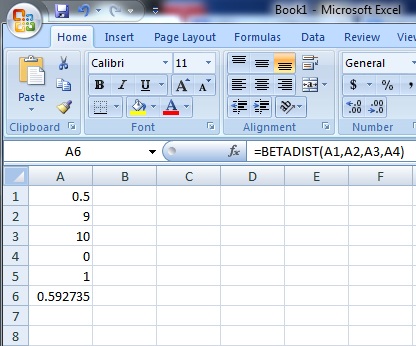
1. 1. 1. **Type the value where you want to evaluate the function in cell A1.** For this example, type “.5” in cell A1.
2. **Type the value for alpha in cell A2** and then type the value for beta in cell A1. For this example, type “9” in cell A2 and then type “10” in cell A3.
3. **Type the lower bound in cell A4** and then **type the upper bound in cell A5.** For this example, type “0” in cell A4 and then type “1” in cell A5
4. **Type the beta distribution function into cell A6.** The format of the function is =BETADIST(value,alpha,beta,lower bound,upper bound). For this example, type “=BETADIST(A1,A2,A3,A4,A5)” into cell A6. Press “Enter” to see the result for the beta distribution, which is 0.592735.
[](https://www.statisticshowto.com/how-to-calculate-a-microsoft-excel-beta-distribution/)
## Excel 2010 and later
Excel 2010 and later uses the BETA.DIST function. If you’re using earlier versions, use BETADIST instead. Inputs are as follows:
1. 1. - A value where you want to evaluate the function.
- Alpha (α) and Beta (β), which determine the distribution’s shape.
- The lower and upper bound.
- “Cumulative” — a logical value (TRUE/FALSE) that determines the function’s form. TRUE returns the CDF and FALSE returns the PDF.
**Example problem:** *Calculate a [cumulative distribution function](https://probabilityhowto.com/cumulative-distribution-function-2/) for a beta distribution at 0.5 with α* = *9, β* = *10,* lower bound = 0 and upper bound = 1.
## [Applications of the Beta Density Function]()
The beta distribution is used for a variety of applications for modeling the behavior of [random variables](https://www.statisticshowto.com/random-variable/) limited to intervals of finite length. Uses include:
1. 1. - Bayesian inference, as the conjugate prior probability distribution for the Bernoulli, binomial, geometric and negative binomial distributions.
- The Rule of Succession (such as Pierre-Simon Laplace’s treatment of the sunrise problem),
- Task duration modeling.
- Project/planning control systems like PERT and CPM.
- In project management for the “three-point technique,” (also called the beta distribution technique), which recognizes uncertainty in estimated project time \[1\]. The three-point estimation technique is used to account for uncertainty in project time estimates. By applying this method, project managers can leverage powerful quantitative tools to identify tasks with the highest risk. It also facilitates effective management of overall project completion time.
References
1. 1. 3-Points Estimating <https://www.projectmanagement.com/contentPages/wiki.cfm?ID=368763&thisPageURL=/wikis/368763/3-Points-Estimating#_=_>
[Bipolar Distribution](https://www.statisticshowto.com/bipolar-distribution/)
[Exponential Distribution / Negative Exponential: Definition, Examples](https://www.statisticshowto.com/exponential-distribution/)
**Comments? Need to post a correction?** Please [***Contact Us***](https://www.statisticshowto.com/contact/).
Check out our **["Practically Cheating Statistics Handbook](https://www.statisticshowto.com/?page_id=15743&preview=true")**, which gives you hundreds of easy-to-follow answers in a convenient e-book.
[](https://www.statisticshowto.com/?page_id=15743&preview=true)
***
**Readers are calling it suspenseful, haunting, and unforgettable. Check out Stephanie’s debut post-apocalyptic novel — available now on Amazon.**
[](https://amzn.to/3LLzICB)
Looking for elementary [**statistics help**](https://www.statisticshowto.com/help-with-statistics-equations/)? You’ve come to the right place. **Statistics How To** has more than 1,000 articles and **videos** for elementary statistics, probability, AP and advanced statistics topics. **Looking for a specific topic?** Type it into the search box at the top of the page.
Latest articles
- [Hedges’ g: Definition, Formula](https://www.statisticshowto.com/hedges-g/)
- [Kaiser-Meyer-Olkin (KMO) Test for Sampling Adequacy](https://www.statisticshowto.com/kaiser-meyer-olkin/)
- [Benjamini-Hochberg Procedure](https://www.statisticshowto.com/benjamini-hochberg-procedure/)
- [Tetrachoric Correlation: Definition, Examples, Formula](https://www.statisticshowto.com/tetrachoric-correlation/)
- [Random Variable: What is it in Statistics?](https://www.statisticshowto.com/random-variable/)
- [Maximum Likelihood and Maximum Likelihood Estimation](https://www.statisticshowto.com/maximum-likelihood-estimation/)
- [What is a Parameter in Statistics?](https://www.statisticshowto.com/what-is-a-parameter-in-statistics/)
- [Beta Level: Definition & Examples](https://www.statisticshowto.com/beta-level/)
- [Pairwise Independent, Mutually Independent: Definition, Example](https://www.statisticshowto.com/pairwise-independent-mutually/)
- [Population Mean Definition, Example, Formula](https://www.statisticshowto.com/population-mean/)
- [Dispersion / Measures of Dispersion: Definition](https://www.statisticshowto.com/dispersion/)
- [Serial Correlation / Autocorrelation: Definition, Tests](https://www.statisticshowto.com/serial-correlation-autocorrelation/)
© 2026 [**Statistics How To**](https://www.statisticshowto.com/) \| [About Us](https://www.statisticshowto.com/contact/) \| [Privacy Policy](https://www.statisticshowto.com/privacy-policy/) \| [Terms of Use](https://www.statisticshowto.com/terms-of-use/) | |||||||||
| Readable Markdown | \< [Probability Distributions](https://www.statisticshowto.com/probability-and-statistics/statistics-definitions/probability-distribution/) \> *Beta Distribution*
**Contents:**
1. 1. [What is a Beta Distribution?](https://www.statisticshowto.com/beta-distribution/#whatis)
2. [Properties](https://www.statisticshowto.com/beta-distribution/#properties)
3. [Software Options: Mathematica and R](https://www.statisticshowto.com/beta-distribution/#software)
4. [Excel Beta Distribution: BETA.DIST & INV.BETA](https://www.statisticshowto.com/beta-distribution/#excel)
5. [Applications of the Beta Density Function](https://www.statisticshowto.com/beta-distribution/#applications)
## What is a Beta Distribution?
The **beta distribution** (also called the *beta distribution of the first kind*) is a family of [continuous probability distributions](https://www.statisticshowto.com/continuous-probability-distribution/) defined on \[0, 1\]. This distribution is similar to the [binomial distribution](https://www.statisticshowto.com/probability-and-statistics/binomial-theorem/binomial-distribution-formula/), except where the binomial models the *number* of successes (x), the beta models the *probability* (p) of success.
A beta distribution is a versatile way to represent outcomes for percentages or proportions. For example, how likely is it that a rogue candidate will win the next Presidential election? You might think the probability is 0.2. Your friend might think it’s 0.15. The beta distribution gives you a way to describe this. One reason that the beta distribution can be confusing to work with is that there are three “Betas” to contend with, and they all have different meanings:
1. 1. - Beta(α, β): the *name* of the probability distribution.
- B(α, β ): the name of a function in the denominator of the [pdf](https://www.statisticshowto.com/probability-density-function/). This acts as a “[normalizing constant](https://www.statisticshowto.com/normalizing-constant-definition/)” to ensure that the area under the curve of the pdf equals 1.
- β: the name of the second [shape parameter](https://www.statisticshowto.com/shape-parameter/) in the pdf.
The basic beta distribution is also called the *beta distribution of the first kind*. Beta distribution of the second kind is another name for the [beta prime distribution](https://www.statisticshowto.com/beta-prime-distribution/).
## Properties
The general formula for the [probability density function (pdf)](https://www.statisticshowto.com/probability-density-function-definition-examples/) is: 
where:
1. 1. - α and β are two positive [shape parameters](https://www.statisticshowto.com/shape-parameter/) which control the shape of the distribution.
The graph of the beta density function can take on a variety of shapes. For example, if α \< 1 and Β \< 1, the graph will be a U shaped distribution, and if α = 1 and Β = 2, the graph is a straight line.
[](https://www.statisticshowto.com/wp-content/uploads/2010/09/800px-Beta_distribution_pdf.png)
The Beta Distribution pdf.
The general formula for the [cumulative distribution function (CDF)](https://www.statisticshowto.com/cumulative-distribution-function-cdf/) is:  which includes the [regularized beta function](https://www.statisticshowto.com/regularized-incomplete-beta-function/): 
## [Software Options]()
Most software packages have options for the beta distribution.
**[Mathematica](http://www.wolfram.com/mathematica/)**
Implement a beta distribution by typing BetaDistribution\[alpha,beta\].
**R**
dbeta(x, shape1, shape2, ncp = 0, log = FALSE) pbeta(q, shape1, shape2, ncp = 0, lower.tail = TRUE, log.p = FALSE) qbeta(p, shape1, shape2, ncp = 0, lower.tail = TRUE, log.p = FALSE) rbeta(n, shape1, shape2, ncp = 0)
where:
1. 1. - x, q = vector of [quantiles](https://www.statisticshowto.com/quantile-definition-find-easy-steps/). p = vector of probabilities.
- n = \# of observations.
- shape1, shape2 = [shape parameters](https://www.statisticshowto.com/shape-parameter/) α and β
- ncp = [non-centrality parameter](https://www.statisticshowto.com/non-centrality-parameter-ncp/).
- log, log.p = logical; if TRUE, probabilities p are given as log(p).
- lower.tail = logical; if TRUE (default), probabilities are P\[X ≤ x\], otherwise, P\[X \> x\].
## [Excel Beta Distribution: BETA.DIST & INV.BETA]()
Watch the video for an example of BETA.DIST:
Can’t see the video? [Click here](https://youtu.be/ct1rhj4M54o?si=zzBQWjgDzHSHJJlg) to watch it on YouTube. The Microsoft Excel beta distribution format depends on which version of [Excel](http://office.microsoft.com/en-us/excel/) you are using; Excel 2010 and later uses the BETA.DIST function, while earlier versions use BETADIST. You’ll need to know alpha and beta, both of which refer to the parameters describing the distribution. Five inputs are needed:
1. 1. - The value where you want to [evaluate the function](https://www.statisticshowto.com/evaluating-a-function/).
- Alpha and Beta, the parameters of the distribution which determine shape.
- The lower and upper bound.
An extra input is needed for the Excel 2010 Beta Distribution: cumulative. Cumulative is a logical value that determines the function’s form and can either be TRUE (returns the cumulative distribution function) or FALSE (returns the probability density function). **Example problem:** *Calculate a [cumulative distribution function](https://www.statisticshowto.com/cumulative-distribution-function-cdf/) for a beta distribution in Excel at 0.5 with an alpha of 9, a beta of 10, a [lower bound](https://www.statisticshowto.com/lower-bound-greatest-glb-infimum/) of 0 and an [upper bound](https://www.statisticshowto.com/upper-bound/) of 1.*
## Excel 2007 and Earlier:
1. 1. 1. **Type the value where you want to evaluate the function in cell A1.** For this example, type “.5” in cell A1.
2. **Type the value for alpha in cell A2** and then type the value for beta in cell A1. For this example, type “9” in cell A2 and then type “10” in cell A3.
3. **Type the lower bound in cell A4** and then **type the upper bound in cell A5.** For this example, type “0” in cell A4 and then type “1” in cell A5
4. **Type the beta distribution function into cell A6.** The format of the function is =BETADIST(value,alpha,beta,lower bound,upper bound). For this example, type “=BETADIST(A1,A2,A3,A4,A5)” into cell A6. Press “Enter” to see the result for the beta distribution, which is 0.592735.
[](https://www.statisticshowto.com/how-to-calculate-a-microsoft-excel-beta-distribution/)
## Excel 2010 and later
Excel 2010 and later uses the BETA.DIST function. If you’re using earlier versions, use BETADIST instead. Inputs are as follows:
1. 1. - A value where you want to evaluate the function.
- Alpha (α) and Beta (β), which determine the distribution’s shape.
- The lower and upper bound.
- “Cumulative” — a logical value (TRUE/FALSE) that determines the function’s form. TRUE returns the CDF and FALSE returns the PDF.
**Example problem:** *Calculate a [cumulative distribution function](https://probabilityhowto.com/cumulative-distribution-function-2/) for a beta distribution at 0.5 with α* = *9, β* = *10,* lower bound = 0 and upper bound = 1.
## [Applications of the Beta Density Function]()
The beta distribution is used for a variety of applications for modeling the behavior of [random variables](https://www.statisticshowto.com/random-variable/) limited to intervals of finite length. Uses include:
1. 1. - Bayesian inference, as the conjugate prior probability distribution for the Bernoulli, binomial, geometric and negative binomial distributions.
- The Rule of Succession (such as Pierre-Simon Laplace’s treatment of the sunrise problem),
- Task duration modeling.
- Project/planning control systems like PERT and CPM.
- In project management for the “three-point technique,” (also called the beta distribution technique), which recognizes uncertainty in estimated project time \[1\]. The three-point estimation technique is used to account for uncertainty in project time estimates. By applying this method, project managers can leverage powerful quantitative tools to identify tasks with the highest risk. It also facilitates effective management of overall project completion time.
References
1. 1. 3-Points Estimating <https://www.projectmanagement.com/contentPages/wiki.cfm?ID=368763&thisPageURL=/wikis/368763/3-Points-Estimating#_=_> | |||||||||
| ML Classification | ||||||||||
| ML Categories |
Raw JSON{
"/Science": 919,
"/Science/Mathematics": 910,
"/Science/Mathematics/Statistics": 909
} | |||||||||
| ML Page Types |
Raw JSON{
"/Article": 996,
"/Article/Definitions": 697
} | |||||||||
| ML Intent Types |
Raw JSON{
"Informational": 999
} | |||||||||
| Content Metadata | ||||||||||
| Language | en-us | |||||||||
| Author | null | |||||||||
| Publish Time | 2024-12-22 09:03:03 (1 year ago) | |||||||||
| Original Publish Time | 2020-04-05 02:41:07 (6 years ago) | |||||||||
| Republished | Yes | |||||||||
| Word Count (Total) | 1,383 | |||||||||
| Word Count (Content) | 999 | |||||||||
| Links | ||||||||||
| External Links | 16 | |||||||||
| Internal Links | 74 | |||||||||
| Technical SEO | ||||||||||
| Meta Nofollow | No | |||||||||
| Meta Noarchive | No | |||||||||
| JS Rendered | Yes | |||||||||
| Redirect Target | null | |||||||||
| Performance | ||||||||||
| Download Time (ms) | 580 | |||||||||
| TTFB (ms) | 579 | |||||||||
| Download Size (bytes) | 20,927 | |||||||||
| Shard | 150 (laksa) | |||||||||
| Root Hash | 12746512124316119150 | |||||||||
| Unparsed URL | com,statisticshowto!www,/beta-distribution/ s443 | |||||||||