ℹ️ Skipped - page is already crawled
| Filter | Status | Condition | Details |
|---|---|---|---|
| HTTP status | PASS | download_http_code = 200 | HTTP 200 |
| Age cutoff | PASS | download_stamp > now() - 6 MONTH | 0.5 months ago |
| History drop | PASS | isNull(history_drop_reason) | No drop reason |
| Spam/ban | PASS | fh_dont_index != 1 AND ml_spam_score = 0 | ml_spam_score=0 |
| Canonical | PASS | meta_canonical IS NULL OR = '' OR = src_unparsed | Not set |
| Property | Value | ||||||
|---|---|---|---|---|---|---|---|
| URL | https://www.space.com/first-black-hole-photo-by-event-horizon-telescope.html | ||||||
| Last Crawled | 2026-04-08 21:14:06 (15 days ago) | ||||||
| First Indexed | 2019-04-10 13:50:19 (7 years ago) | ||||||
| HTTP Status Code | 200 | ||||||
| Content | |||||||
| Meta Title | Eureka! Black Hole Photographed for 1st Time | Space | ||||||
| Meta Description | For the first time ever, humanity has photographed a black hole, shining light on an exotic realm that had long been beyond our ken. | ||||||
| Meta Canonical | null | ||||||
| Boilerpipe Text | The Event Horizon Telescope, a planet-scale array of eight ground-based radio telescopes forged through international collaboration, captured this image of the supermassive black hole in the center of the galaxy M87 and its shadow.
(Image credit: EHT Collaboration)
Black holes
have finally been dragged out of the shadows.
For the first time ever, humanity has photographed one of these elusive cosmic beasts, shining light on an exotic space-time realm that had long been beyond our ken.
"We have seen what we thought was unseeable," Sheperd Doeleman, of Harvard University and the Harvard-Smithsonian Center for Astrophysics, said today (April 10) during a press conference at the National Press Club in Washington, D.C.
"There's really a new field to explore," Peter Galison, a professor of physics and the history of science at Harvard, said in
an EHT talk last month
at the South by Southwest (SXSW) festival in Austin, Texas. "And that's ultimately what's so exciting about this."
Breaking space news, the latest updates on rocket launches, skywatching events and more!
Galison, who co-founded Harvard's interdisciplinary Black Hole Initiative (BHI), compared the imagery's potential impact to that of the drawings made by English scientist Robert Hooke in the 1600s. These illustrations showed people what insects and plants look like through a microscope.
"It opened a world," Galison said of Hooke's work.
A telescope the size of Earth
The EHT is a consortium of more than 200 scientists that has been in the works for about two decades. It's a truly international endeavor; funding over the years has come from the U.S. National Science Foundation and many other organizations in countries around the world.
The project takes its name from a black hole's famed point of no return — the boundary beyond which nothing, not even light, can escape the object's gravitational clutches.
"The
event horizon
is the ultimate prison wall," BHI founding director Avi Loeb, the chair of Harvard's astronomy department, told Space.com. (Loeb is not part of the EHT team.) "Once you're in, you can never get out."
It's therefore impossible to photograph the interior of a black hole, unless you somehow manage to get in there yourself. (You and your pictures couldn't make it back to the outside world, of course.)
So, the EHT images the event horizon, mapping out the black hole's dark silhouette. (The disk of fast-moving gas swirling around and into black holes emits lots of radiation, so such silhouettes stand out.)
"We're looking for the loss of photons," EHT science council member Dan Marrone, an associate professor of astronomy at the University of Arizona, told Space.com.
The project has been scrutinizing two black holes — the M87 behemoth, which harbors about 6.5 billion times the mass of Earth's sun, and our own Milky Way galaxy's central black hole, known as
Sagittarius A*
. This latter object, while still a supermassive black hole, is a runt compared to M87's beast, containing a mere 4.3 million solar masses.
Both of these objects are tough targets because of their immense distance from Earth. Sagittarius A* lies about 26,000 light-years from us, and M87's black hole is a whopping 53.5 million light-years away.
From our perspective, Sagittarius A*'s event horizon "is so small that it's the equivalent of seeing an orange on the moon or being able to read the newspaper in Los Angeles while you're sitting in New York City," Doeleman said during the SXSW event last month.
No single telescope on Earth can make that observation, so Doeleman and the rest of the EHT team had to get creative. The researchers have linked up radio telescopes in Arizona, Spain, Mexico, Antarctica and other places around the world, forming a virtual instrument the size of Earth.
Related:
Images: Black Holes of the Universe
So much data
The EHT team has used this megascope to study the two
supermassive black holes
for two weeklong stretches to date — once in April 2017 and again the following year. The new imagery comes from the first observing run.
There are good reasons why it's taken two years for the project's first result to come out. For one thing, each night of observing generated about 1 petabyte of data, resulting in such a haul that the team has to move its information from place to place the old-fashioned way.
"There's no way that we can transfer this data through the internet," EHT project scientist Dimitrios Psaltis, an astronomy professor at the University of Arizona, said at the SXSW event. "So, what we actually do is, we take our hard drives and we FedEx them from place to place. This is much faster than any cable that you can ever find."
This slows and complicates analysis, of course. Data from the EHT scope near the South Pole, for example, couldn't get off Antarctica until December 2017, when it was warm enough for planes to go in and out, Marrone said.
Correlating and calibrating the data was also tricky, he added. And the team took great care with this work, given the momentous nature of the find.
"If you're going to come with a big claim of imaging a black hole, you have to have big evidence, very strong evidence," Doeleman said at the SXSW event (which served as an explainer of the EHT effort but did not announce any results).
"And on our project, we often think that people like [Albert] Einstein, [Arthur] Eddington [and Karl] Schwarzschild are kind of looking over our shoulders," he added, referring to physicists who helped pioneer our understanding of black holes. "And when you have luminaries kind of virtually checking your work, you really want to get it right."
Related:
The Strangest Black Holes in the Universe
A simulated image by the University of Arizona shows the turbulent plasma in the extreme environment around a supermassive black hole.
(Image credit: University of Arizona)
What it all means
The EHT project has two main goals, Psaltis said: to image an event horizon for the first time ever and to help determine if
Einstein's theory of general relativity
needs any revisions.
Before Einstein came along, gravity was generally regarded as a mysterious force at a distance. But general relativity describes it as the warping of space-time: Massive objects such as planets, stars and black holes create a sort of sag in space-time, much as a bowling ball would if placed on a trampoline. Nearby objects follow this curve and get funneled toward the central mass.
General relativity has held up incredibly well over the century since its introduction, passing every test that scientists have thrown at it. But the EHT's observations provide another trial, in an extreme realm where predictions may not match reality. That's because astronomers can calculate the expected size and shape of an event horizon using general relativity, Psaltis explained.
If the observed silhouette matches the theory-informed simulations, "then Einstein was 100% right," Psaltis said. "If the answer is no, then we have to tweak his theory in order to make it work with experiments. This is how science goes."
And we learned today that no tweaks are needed, at least at the moment: EHT's M87 observations are consistent with general relativity, team members said. Namely, the event horizon is nearly circular and is the "right" size for a black hole of that immense mass.
"I have to admit, I was a little stunned that it matched so closely the predictions that we had made," EHT team member Avery Broderick, of the University of Waterloo and the Perimeter Institute for Theoretical Physics in Canada, said during today's news conference.
Such ground-truthing is vital to the scientific process, of course. Indeed, providing better information to feed into theories and simulations will likely be one of the EHT's biggest contributions, Loeb said.
"Doing physics is a dialog with nature," he said. "We test our ideas by comparing them to experiments; experimental data is crucial."
The new results should also help scientists get a better handle on black holes, he and other researchers said. For example, EHT imagery will likely shine significant light on how gas spirals down into a black hole's maw. This accretion process, which can lead to the generation of powerful jets of radiation, is poorly understood, Loeb said.
In addition, the shape of an event horizon can reveal whether a black hole is spinning, said Fiona Harrison of the California Institute of Technology, the principal investigator of NASA's black-hole-studying
Nuclear Spectroscopic Telescope Array
(NuSTAR) mission.
"We've inferred the spin of black holes indirectly," Harrison, who's not part of the EHT team, told Space.com. EHT imagery provides "a direct test, which is very exciting," she added.
EHT's data revealed the M87 black hole is spinning clockwise, team members said today.
The project should also show how matter is distributed around a black hole, and EHT observations could eventually teach astronomers a great deal about how supermassive black holes shape the evolution of their host galaxies over long time scales, Harrison said.
EHT's results also mesh well with those of the
Laser Interferometer Gravitational-Wave Observatory
(LIGO), which has detected the space-time ripples generated by mergers involving black holes just a few dozen times more massive than the sun.
"Despite varying across a factor of billion in mass, known black holes are all consistent with a single description," Broderick said today. "Black holes big and small are analogous in important ways. What we learn from one [type] necessarily applies to the other."
And in case you're wondering about Sagittarius A*: The EHT team hopes to get imagery of that supermassive black hole soon, Doeleman said today. The researchers looked at M87 first, and it's a bit easier to resolve than Sagittarius A* because it's less variable over short timescales, he explained.
A new perspective?
Then there's the broader appeal of the newly released imagery — how it speaks to those of us who aren't astrophysicists.
The contributions in this arena could be significant, EHT team members and outside scientists said. Photos can change the way we think about ourselves and our place in the universe, Marrone noted, citing the famous "Earthrise" photo taken by Apollo 8 astronaut Bill Anders in December 1968. This image, which gave the masses a glimpse of our planet as it really is — a lonely outpost of life in an infinite sea of darkness — is widely credited with helping to spur the environmental movement.
Seeing a real-life black hole — or its silhouette, anyway — "is the stuff of science fiction," Harrison said. And we've seen just the project's first few photos, she added: "They're only going to get better."
Astronomers to Peer into a Black Hole for 1st Time with Event Horizon Telescope
This Huge Black Hole Is Spinning at Half the Speed of Light!
8 Baffling Astronomy Mysteries
Mike Wall's book about the search for alien life, "
Out There
" (Grand Central Publishing, 2018; illustrated by
Karl Tate
), is out now. Follow him on Twitter
@michaeldwall
. Follow us on Twitter
@Spacedotcom
or
Facebook
.
Share your thoughts
0
0
0
0
Join the community
Join the Space.com Family! The best way to keep in touch and to be informed of our latest quizzes and competitions, as well as news and offers.
Already have an account?
Log in
Log In
Forgotten your password?
Reset it
Not got an account?
Register
My Details
Update your details below...
Keep in the Know
Would you like to be kept informed about new quizzes and offers from Future and its partners?
Validate Your Mobile No.
We have sent a code to
. Please enter it below to verify your account.
Update mobile number
Resend code
Update Your Mobile No.
You may enter a new mobile number below. You will be sent a verification code to the phone number you provide.
Cancel
embed-reactions.hint_heading
embed-reactions.hint_subheading
Validate Your Email Address
We have sent a code to
. Please enter it below to verify your account.
Update email address
Resend code
Update Your Email Address
You may enter a new email address below. You will be sent a verification code to the address you provide.
Cancel
Create a Username
This will be publicly viewable so make it something you like!
Reset your password
Enter your email address below. If it is registered with us, we will email you a code that will allow you to reset your password.
Check your inbox
If your email address was found in our system, you should receive an email in the next few minutes containing a code. Enter that code below to reset your password.
Set new password
Please enter your new password below.
Leaderboard
Rank
Player
Score
Time
Michael Wall is the Spaceflight and Tech Editor for
Space.com
and joined the team in 2010. He primarily covers human and robotic spaceflight, military space, and exoplanets, but has been known to dabble in the space art beat. His book about the search for alien life, "Out There," was published on Nov. 13, 2018. Before becoming a science writer, Michael worked as a herpetologist and wildlife biologist. He has a Ph.D. in evolutionary biology from the University of Sydney, Australia, a bachelor's degree from the University of Arizona, and a graduate certificate in science writing from the University of California, Santa Cruz. To find out what his latest project is, you can follow Michael on Twitter. | ||||||
| Markdown | 
[Skip to main content](https://www.space.com/first-black-hole-photo-by-event-horizon-telescope.html#main)
Open menu
[ Space](https://www.space.com/)
[Sign up to our newsletter Newsletter](https://www.space.com/newsletter)
[RSS](https://www.space.com/feeds.xml)
Sign in
- View Profile
- Sign out
Search
- [Space Exploration](https://www.space.com/space-exploration)
- [Launches & Spacecraft](https://www.space.com/space-exploration/launches-spacecraft)
- [Private spaceflight](https://www.space.com/space-exploration/private-spaceflight)
- [Human spaceflight](https://www.space.com/space-exploration/human-spaceflight)
- [SpaceX](https://www.space.com/tag/spacex)
- [Blue Origin](https://www.space.com/tag/blue-origin)
- [Virgin Galactic](https://www.space.com/tag/virgin-galactic)
- [United Launch Alliance](https://www.space.com/tag/united-launch-alliance)
- [Search for Life](https://www.space.com/space-exploration/search-for-life)
- [Exoplanets](https://www.space.com/astronomy/exoplanets)
- [SETI](https://www.space.com/tag/seti)
- [Aliens](https://www.space.com/tag/aliens)
- [Missions](https://www.space.com/space-exploration/missions)
- [International Space Station](https://www.space.com/space-exploration/missions/international-space-station)
- [Space Shuttle](https://www.space.com/space-exploration/missions/space-shuttle)
- [Apollo](https://www.space.com/space-exploration/missions/apollo)
- [Artemis](https://www.space.com/space-exploration/missions/artemis)
- [Voyager](https://www.space.com/space-exploration/missions/voyager)
- [Asteroid & Comet Missions](https://www.space.com/space-exploration/missions/asteroid-comet-missions)
- [Mars rovers](https://www.space.com/space-exploration/missions/mars-rovers)
- [New Horizons](https://www.space.com/space-exploration/missions/new-horizons)
- [Parker Solar Probe](https://www.space.com/space-exploration/missions/asteroid-comet-missions)
- [Satellites](https://www.space.com/space-exploration/satellites)
- [Astronomy](https://www.space.com/astronomy)
- [Solar System](https://www.space.com/astronomy/solar-system)
- [The Sun](https://www.space.com/astronomy/solar-system/sun)
- [Asteroids](https://www.space.com/astronomy/solar-system/asteroids)
- [Mars](https://www.space.com/astronomy/solar-system/mars)
- [Comets](https://www.space.com/astronomy/solar-system/comets)
- [Mercury](https://www.space.com/astronomy/solar-system/mercury)
- [Jupiter](https://www.space.com/astronomy/solar-system/jupiter)
- [Saturn](https://www.space.com/astronomy/solar-system/saturn)
- [Pluto](https://www.space.com/astronomy/solar-system/pluto)
- [Venus](https://www.space.com/astronomy/solar-system/venus)
- [Dwarf Planets](https://www.space.com/astronomy/solar-system/dwarf-planets)
- [Neptune](https://www.space.com/astronomy/solar-system/neptune)
- [Uranus](https://www.space.com/astronomy/solar-system/uranus)
- [The Moon](https://www.space.com/astronomy/solar-system/moon)
- [Moon Phases](https://www.space.com/tag/moon-phases)
- [The Earth](https://www.space.com/astronomy/solar-system/earth)
- [Live 4K video from space](https://www.space.com/astronomy/earth/live-4k-video-from-space-see-earth-from-the-iss-with-sharp-eyed-sen-cameras)
- [Climate Change](https://www.space.com/science/climate-change)
- [Weather](https://www.space.com/science/weather)
- [The Universe](https://www.space.com/tag/universe)
- [Stars](https://www.space.com/astronomy/stars)
- [Black Holes](https://www.space.com/astronomy/black-holes)
- [Dark Universe](https://www.space.com/astronomy/dark-universe)
- [Galaxies](https://www.space.com/astronomy/galaxies)
- [Deep Space](https://www.space.com/tag/deep-space)
- [James Webb Space Telescope](https://www.space.com/astronomy/james-webb-space-telescope)
- [Hubble Space Telescope](https://www.space.com/astronomy/hubble-space-telescope)
- [Stargazing](https://www.space.com/stargazing)
- [Skywatching Kit](https://www.space.com/stargazing/skywatching-kit)
- [Telescopes](https://www.space.com/tag/telescopes)
- [Cameras](https://www.space.com/tag/cameras)
- [Astrophotography](https://www.space.com/stargazing/astrophotography)
- [Eclipses](https://www.space.com/stargazing/eclipses)
- [Lunar Eclipses](https://www.space.com/stargazing/eclipses/lunar-eclipses)
- [Solar Eclipses](https://www.space.com/stargazing/eclipses/solar-eclipses)
- [Entertainment](https://www.space.com/entertainment)
- [Space Movies & Shows](https://www.space.com/entertainment/space-movies-shows)
- [Star Trek](https://www.space.com/tag/star-trek)
- [Star Wars](https://www.space.com/tag/star-wars)
- [Space Games](https://www.space.com/entertainment/space-games)
- [Space Toys & Lego](https://www.space.com/entertainment/space-toys-lego)
- [Space Books](https://www.space.com/entertainment/space-books)
- Tech & Science
- [Technology](https://www.space.com/technology)
- [Drones](https://www.space.com/technology/drones)
- [Aerospace](https://www.space.com/technology/aerospace)
- [Science](https://www.space.com/science)
- [Particle Physics](https://www.space.com/science/particle-physics)
- [Astrophysics](https://www.space.com/science/astrophysics)
- [Videos](https://videos.space.com/)
- More
- [Subscribe to our Newsletters](https://www.space.com/newsletter)
- [About Us](https://www.space.com/41418-about-us.html)
- [Web Notifications](https://www.space.com/how-to-turn-off-web-notifications-for-chrome-macos.html)
- [home](https://www.space.com/)
- [Space Exploration](https://www.space.com/space-exploration)
- [View Space Exploration](https://www.space.com/space-exploration)
- [Launches & Spacecraft](https://www.space.com/space-exploration/launches-spacecraft)
- [View Launches & Spacecraft](https://www.space.com/space-exploration/launches-spacecraft)
- [Private spaceflight](https://www.space.com/space-exploration/private-spaceflight)
- [Human spaceflight](https://www.space.com/space-exploration/human-spaceflight)
- [SpaceX](https://www.space.com/tag/spacex)
- [Blue Origin](https://www.space.com/tag/blue-origin)
- [Virgin Galactic](https://www.space.com/tag/virgin-galactic)
- [United Launch Alliance](https://www.space.com/tag/united-launch-alliance)
- [Search for Life](https://www.space.com/space-exploration/search-for-life)
- [View Search for Life](https://www.space.com/space-exploration/search-for-life)
- [Exoplanets](https://www.space.com/astronomy/exoplanets)
- [SETI](https://www.space.com/tag/seti)
- [Aliens](https://www.space.com/tag/aliens)
- [Missions](https://www.space.com/space-exploration/missions)
- [View Missions](https://www.space.com/space-exploration/missions)
- [International Space Station](https://www.space.com/space-exploration/missions/international-space-station)
- [Space Shuttle](https://www.space.com/space-exploration/missions/space-shuttle)
- [Apollo](https://www.space.com/space-exploration/missions/apollo)
- [Artemis](https://www.space.com/space-exploration/missions/artemis)
- [Voyager](https://www.space.com/space-exploration/missions/voyager)
- [Asteroid & Comet Missions](https://www.space.com/space-exploration/missions/asteroid-comet-missions)
- [Mars rovers](https://www.space.com/space-exploration/missions/mars-rovers)
- [New Horizons](https://www.space.com/space-exploration/missions/new-horizons)
- [Parker Solar Probe](https://www.space.com/space-exploration/missions/asteroid-comet-missions)
- [Satellites](https://www.space.com/space-exploration/satellites)
- [Astronomy](https://www.space.com/astronomy)
- [View Astronomy](https://www.space.com/astronomy)
- [Solar System](https://www.space.com/astronomy/solar-system)
- [View Solar System](https://www.space.com/astronomy/solar-system)
- [The Sun](https://www.space.com/astronomy/solar-system/sun)
- [Asteroids](https://www.space.com/astronomy/solar-system/asteroids)
- [Mars](https://www.space.com/astronomy/solar-system/mars)
- [Comets](https://www.space.com/astronomy/solar-system/comets)
- [Mercury](https://www.space.com/astronomy/solar-system/mercury)
- [Jupiter](https://www.space.com/astronomy/solar-system/jupiter)
- [Saturn](https://www.space.com/astronomy/solar-system/saturn)
- [Pluto](https://www.space.com/astronomy/solar-system/pluto)
- [Venus](https://www.space.com/astronomy/solar-system/venus)
- [Dwarf Planets](https://www.space.com/astronomy/solar-system/dwarf-planets)
- [Neptune](https://www.space.com/astronomy/solar-system/neptune)
- [Uranus](https://www.space.com/astronomy/solar-system/uranus)
- [The Moon](https://www.space.com/astronomy/solar-system/moon)
- [View The Moon](https://www.space.com/astronomy/solar-system/moon)
- [Moon Phases](https://www.space.com/tag/moon-phases)
- [The Earth](https://www.space.com/astronomy/solar-system/earth)
- [View The Earth](https://www.space.com/astronomy/solar-system/earth)
- [Live 4K video from space](https://www.space.com/astronomy/earth/live-4k-video-from-space-see-earth-from-the-iss-with-sharp-eyed-sen-cameras)
- [Climate Change](https://www.space.com/science/climate-change)
- [Weather](https://www.space.com/science/weather)
- [The Universe](https://www.space.com/tag/universe)
- [View The Universe](https://www.space.com/tag/universe)
- [Stars](https://www.space.com/astronomy/stars)
- [Black Holes](https://www.space.com/astronomy/black-holes)
- [Dark Universe](https://www.space.com/astronomy/dark-universe)
- [Galaxies](https://www.space.com/astronomy/galaxies)
- [Deep Space](https://www.space.com/tag/deep-space)
- [View Deep Space](https://www.space.com/tag/deep-space)
- [James Webb Space Telescope](https://www.space.com/astronomy/james-webb-space-telescope)
- [Hubble Space Telescope](https://www.space.com/astronomy/hubble-space-telescope)
- [Stargazing](https://www.space.com/stargazing)
- [View Stargazing](https://www.space.com/stargazing)
- [Skywatching Kit](https://www.space.com/stargazing/skywatching-kit)
- [View Skywatching Kit](https://www.space.com/stargazing/skywatching-kit)
- [Telescopes](https://www.space.com/tag/telescopes)
- [Cameras](https://www.space.com/tag/cameras)
- [Astrophotography](https://www.space.com/stargazing/astrophotography)
- [Eclipses](https://www.space.com/stargazing/eclipses)
- [View Eclipses](https://www.space.com/stargazing/eclipses)
- [Lunar Eclipses](https://www.space.com/stargazing/eclipses/lunar-eclipses)
- [Solar Eclipses](https://www.space.com/stargazing/eclipses/solar-eclipses)
- [Entertainment](https://www.space.com/entertainment)
- [View Entertainment](https://www.space.com/entertainment)
- [Space Movies & Shows](https://www.space.com/entertainment/space-movies-shows)
- [View Space Movies & Shows](https://www.space.com/entertainment/space-movies-shows)
- [Star Trek](https://www.space.com/tag/star-trek)
- [Star Wars](https://www.space.com/tag/star-wars)
- [Space Games](https://www.space.com/entertainment/space-games)
- [Space Toys & Lego](https://www.space.com/entertainment/space-toys-lego)
- [Space Books](https://www.space.com/entertainment/space-books)
- Tech & Science
- [Technology](https://www.space.com/technology)
- [View Technology](https://www.space.com/technology)
- [Drones](https://www.space.com/technology/drones)
- [Aerospace](https://www.space.com/technology/aerospace)
- [Science](https://www.space.com/science)
- [View Science](https://www.space.com/science)
- [Particle Physics](https://www.space.com/science/particle-physics)
- [Astrophysics](https://www.space.com/science/astrophysics)
- [Videos](https://videos.space.com/)
- More
- [Subscribe to our Newsletters](https://www.space.com/newsletter)
- [About Us](https://www.space.com/41418-about-us.html)
- [Web Notifications](https://www.space.com/how-to-turn-off-web-notifications-for-chrome-macos.html)
Don't miss these
[ Astrophotography 'Project Hail Mary' end credits showcase stunning nebula photos captured over 400 hours by a single astrophotographer — here's the inside story](https://www.space.com/stargazing/astrophotography/project-hail-mary-end-credits-showcase-stunning-nebula-photos-captured-over-400-hours-by-a-single-astrophotographer-heres-the-inside-story "'Project Hail Mary' end credits showcase stunning nebula photos captured over 400 hours by a single astrophotographer — here's the inside story")
[ Galaxies Record-breaking 'space laser' erupts from merging galaxies 8 billion light-years away](https://www.space.com/astronomy/galaxies/record-breaking-space-laser-erupts-from-merging-galaxies-8-billion-light-years-away "Record-breaking 'space laser' erupts from merging galaxies 8 billion light-years away")
[ Astrophotography Astrophotographer captures spectacular photo of Antennae Galaxies dueling in deep space](https://www.space.com/stargazing/astrophotography/astrophotographer-captures-spectacular-photo-of-antennae-galaxies-dueling-in-deep-space "Astrophotographer captures spectacular photo of Antennae Galaxies dueling in deep space")
[ Search for Life Disclosure day: If ET made contact, how would we handle the news?](https://www.space.com/space-exploration/search-for-life/disclosure-day-if-et-made-contact-how-would-we-handle-the-news "Disclosure day: If ET made contact, how would we handle the news?")
[ Galaxies Space telescopes capture breathtaking galactic hug \| Space photo of the day for Jan. 8, 2026](https://www.space.com/astronomy/galaxies/space-telescopes-capture-breathtaking-galactic-hug-space-photo-of-the-day-for-jan-8-2026 "Space telescopes capture breathtaking galactic hug | Space photo of the day for Jan. 8, 2026")
[ Astronomy Astronomers unveil largest 3D universe map of its kind, illuminating 'hidden' cosmic structures](https://www.space.com/astronomy/astronomers-unveil-largest-3d-map-yet-of-hydrogen-light-in-the-early-universe-illuminating-hidden-cosmic-structures "Astronomers unveil largest 3D universe map of its kind, illuminating 'hidden' cosmic structures")
[ Stars Astronomers just watched a star 1,540 times the size of our sun transform into a hypergiant. Will it go supernova?](https://www.space.com/astronomy/stars/astronomers-just-watched-a-star-1-540-times-the-size-of-our-sun-transform-into-a-hypergiant-will-it-go-supernova "Astronomers just watched a star 1,540 times the size of our sun transform into a hypergiant. Will it go supernova?")
[ Astronomy Astronomers missed a space explosion as powerful as a billion suns — until they spotted its echo](https://www.space.com/astronomy/astronomers-missed-a-space-explosion-as-powerful-as-a-billion-suns-until-they-spotted-its-echo "Astronomers missed a space explosion as powerful as a billion suns — until they spotted its echo")
[ James Webb Space Telescope James Webb Space Telescope reveals new origin story for the universe's 1st supermassive black holes](https://www.space.com/astronomy/james-webb-space-telescope/james-webb-space-telescope-data-backs-new-origin-story-for-the-universes-1st-supermassive-black-holes "James Webb Space Telescope reveals new origin story for the universe's 1st supermassive black holes")
[ Dark Universe Could the Milky Way galaxy's supermassive black hole actually be a clump of dark matter?](https://www.space.com/astronomy/dark-universe/could-the-milky-way-galaxys-supermassive-black-hole-actually-be-a-clump-of-dark-matter "Could the Milky Way galaxy's supermassive black hole actually be a clump of dark matter?")
[ Dark Universe How astronomers are unveiling the 'skeleton' of the universe](https://www.space.com/astronomy/dark-universe/how-astronomers-are-unveiling-the-skeleton-of-the-universe "How astronomers are unveiling the 'skeleton' of the universe")
[ Stars The Milky Way may be hiding a big secret at its heart: an extremely magnetic dead star](https://www.space.com/astronomy/stars/the-milky-way-may-be-hiding-a-big-secret-at-its-heart-an-extremely-magnetic-dead-star "The Milky Way may be hiding a big secret at its heart: an extremely magnetic dead star")
[ Astronomy How fast is the universe actually expanding? Ripples in spacetime could finally solve 'Hubble tension'](https://www.space.com/astronomy/how-fast-is-the-universe-actually-expanding-ripples-in-spacetime-could-finally-solve-hubble-tension "How fast is the universe actually expanding? Ripples in spacetime could finally solve 'Hubble tension'")
[ Black Holes Astronomers watch 1st black hole ever imaged launch a 3,000‑light‑year‑long cosmic jet from its glowing 'shadow'](https://www.space.com/astronomy/black-holes/astronomers-watch-1st-black-hole-ever-imaged-launch-a-3-000-light-year-long-cosmic-jet-from-its-glowing-shadow "Astronomers watch 1st black hole ever imaged launch a 3,000‑light‑year‑long cosmic jet from its glowing 'shadow'")
[ Launches & Spacecraft Scientists measure air pollution from reentering SpaceX rocket in real-time: 'It's never been done before'](https://www.space.com/space-exploration/launches-spacecraft/scientists-measure-air-pollution-from-reentering-spacex-rocket-in-real-time-its-never-been-done-before "Scientists measure air pollution from reentering SpaceX rocket in real-time: 'It's never been done before'")
Trending
- [Artemis 2 LIVE: Moon mission updates](https://www.space.com/news/live/artemis-2-nasa-moon-mission-updates-april-5-2026#mrfhud=true)
- [Amazon Spring Sale space deals](https://www.space.com/technology/amazon-spring-sale-deals-for-stargazing-2026-huge-savings-on-telescopes-binoculars-and-cameras)
- [Night sky tonight\!](https://www.space.com/news/live/night-sky-what-you-can-see-tonight-april-2)
- [Aurora Forecast](https://www.space.com/live/aurora-forecast-northern-lights-possible-tonight-and-easter-weekend-april-2-6)
- [Space Calendar](https://www.space.com/32286-space-calendar.html)
- [Live 4K Sen video from space\!](https://www.space.com/astronomy/earth/live-4k-video-from-space-see-earth-from-the-iss-with-sharp-eyed-sen-cameras)
- [Best Drones](https://www.space.com/best-drones)
- [Lego Star Wars deals](https://www.space.com/lego-star-wars-deals)
- [Next Full Moon](https://www.space.com/16830-full-moon-calendar.html)
- [Best Telescopes](https://www.space.com/15693-telescopes-beginners-telescope-reviews-buying-guide.html)
- [Solar System Planets](https://www.space.com/16080-solar-system-planets.html)
- [Best Star Projectors](https://www.space.com/best-star-projectors)
- [Best Binoculars](https://www.space.com/26021-best-binoculars.html)
1. [Astronomy](https://www.space.com/astronomy)
2. [Black Holes](https://www.space.com/astronomy/black-holes)
# Eureka! Scientists Photograph a Black Hole for the 1st Time
[News](https://www.space.com/news)
By [Mike Wall](https://www.space.com/author/mike-wall)
published
April 10, 2019
Black holes have finally been dragged out of the shadows.
When you purchase through links on our site, we may earn an affiliate commission. [Here’s how it works](https://www.space.com/41418-about-us.html#section-affiliate-advertising-disclosure).
Click for next article
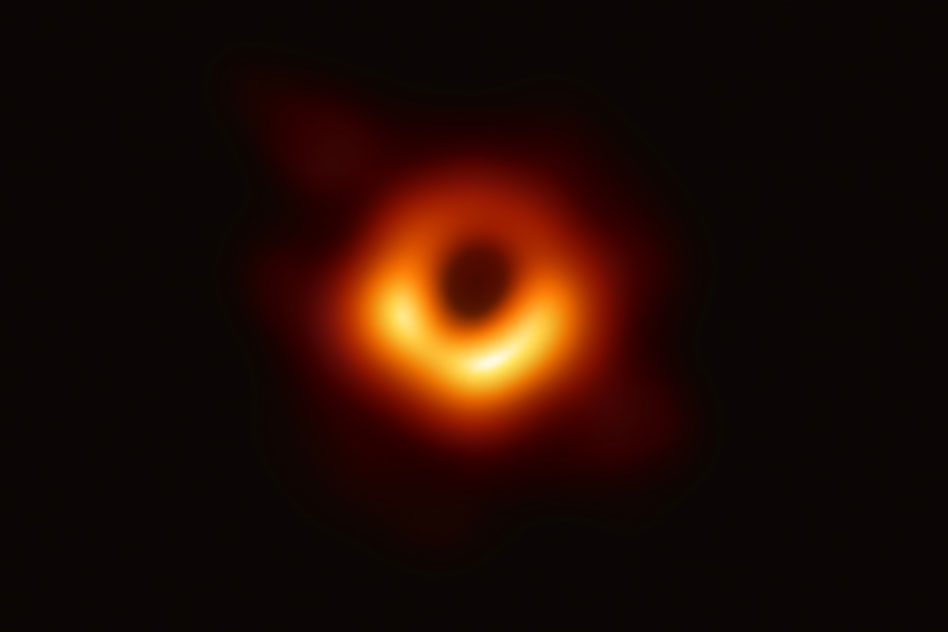
The Event Horizon Telescope, a planet-scale array of eight ground-based radio telescopes forged through international collaboration, captured this image of the supermassive black hole in the center of the galaxy M87 and its shadow. (Image credit: EHT Collaboration)
Share
- Copy link
- [Facebook](https://www.facebook.com/sharer/sharer.php?u=https%3A%2F%2Fwww.space.com%2Ffirst-black-hole-photo-by-event-horizon-telescope.html)
- [X](https://twitter.com/intent/tweet?text=Eureka%21+Scientists+Photograph+a+Black+Hole+for+the+1st+Time&url=https%3A%2F%2Fwww.space.com%2Ffirst-black-hole-photo-by-event-horizon-telescope.html)
- [Whatsapp](whatsapp://send?text=Eureka%21+Scientists+Photograph+a+Black+Hole+for+the+1st+Time+https%3A%2F%2Fwww.space.com%2Ffirst-black-hole-photo-by-event-horizon-telescope.html?fwa)
- [Reddit](https://www.reddit.com/submit?url=https%3A%2F%2Fwww.space.com%2Ffirst-black-hole-photo-by-event-horizon-telescope.html&title=Eureka%21+Scientists+Photograph+a+Black+Hole+for+the+1st+Time)
- [Pinterest](https://pinterest.com/pin/create/button/?url=https%3A%2F%2Fwww.space.com%2Ffirst-black-hole-photo-by-event-horizon-telescope.html&media=https%3A%2F%2Fcdn.mos.cms.futurecdn.net%2FjTVzX3HFWeZTNJJVtLESbU.jpg)
- [Flipboard](https://share.flipboard.com/bookmarklet/popout?title=Eureka%21+Scientists+Photograph+a+Black+Hole+for+the+1st+Time&url=https%3A%2F%2Fwww.space.com%2Ffirst-black-hole-photo-by-event-horizon-telescope.html)
- [Email](mailto:?subject=I%20found%20this%20webpage&body=Hi,%20I%20found%20this%20webpage%20and%20thought%20you%20might%20like%20it%20https://www.space.com/first-black-hole-photo-by-event-horizon-telescope.html)
Share this article
Join the conversation
[Follow us](https://google.com/preferences/source?q=space.com)
Add us as a preferred source on Google
Newsletter
Get the Space.com Newsletter
Breaking space news, the latest updates on rocket launches, skywatching events and more\!
***
By signing up, you agree to our [Terms of services](https:\/\/futureplc.com\/terms-conditions\/) and acknowledge that you have read our [Privacy Notice](https:\/\/futureplc.com\/privacy-policy\/). You also agree to receive marketing emails from us that may include promotions from our trusted partners and sponsors, which you can unsubscribe from at any time.
You are now subscribed
Your newsletter sign-up was successful
***
Want to add more newsletters?
Delivered daily
Daily Newsletter
Breaking space news, the latest updates on rocket launches, skywatching events and more\!
Subscribe +
Once a month
Watch This Space
Sign up to our monthly entertainment newsletter to keep up with all our coverage of the latest sci-fi and space movies, tv shows, games and books.
Subscribe +
Once a week
Night Sky This Week
Discover this week's must-see night sky events, moon phases, and stunning astrophotos. Sign up for our skywatching newsletter and explore the universe with us\!
Subscribe +

Twice a month
Strange New Words
Space.com's Sci-Fi Reader's Club. Read a sci-fi short story every month and join a virtual community of fellow science fiction fans\!
Subscribe +
***
An account already exists for this email address, please log in.
Subscribe to our newsletter
[Black holes](https://www.space.com/15421-black-holes-facts-formation-discovery-sdcmp.html) have finally been dragged out of the shadows.
For the first time ever, humanity has photographed one of these elusive cosmic beasts, shining light on an exotic space-time realm that had long been beyond our ken.
"We have seen what we thought was unseeable," Sheperd Doeleman, of Harvard University and the Harvard-Smithsonian Center for Astrophysics, said today (April 10) during a press conference at the National Press Club in Washington, D.C.
You may like
- [ NASA X-ray spacecraft stares into the 'eye of the storm' swirling around supermassive black holes](https://www.space.com/astronomy/black-holes/nasa-x-ray-spacecraft-stares-into-the-eye-of-the-storm-swirling-around-supermassive-black-holes)
- [ Astronomers watch 1st black hole ever imaged launch a 3,000‑light‑year‑long cosmic jet from its glowing 'shadow'](https://www.space.com/astronomy/black-holes/astronomers-watch-1st-black-hole-ever-imaged-launch-a-3-000-light-year-long-cosmic-jet-from-its-glowing-shadow)
- [ James Webb Space Telescope reveals new origin story for the universe's 1st supermassive black holes](https://www.space.com/astronomy/james-webb-space-telescope/james-webb-space-telescope-data-backs-new-origin-story-for-the-universes-1st-supermassive-black-holes)
**Related:** [**What Exactly Is a Black Hole Event Horizon (and What Happens There)?**](https://www.space.com/black-holes-event-horizon-explained.html)
Doeleman directs the [Event Horizon Telescope](https://www.space.com/event-horizon-telescope-is-trying-to-photograph-black-holes.html) (EHT) project, which captured the epic imagery. These four photos, which were unveiled today at press events around the world and in a series of published papers, outline the contours of the monster black hole lurking at the heart of the elliptical galaxy M87.
The imagery is mind-blowing enough in its own right. But even more significant is the trail the new results will likely blaze, researchers said.
"There's really a new field to explore," Peter Galison, a professor of physics and the history of science at Harvard, said in [an EHT talk last month](https://www.space.com/event-horizon-telescope-is-trying-to-photograph-black-holes.html) at the South by Southwest (SXSW) festival in Austin, Texas. "And that's ultimately what's so exciting about this."
Get the Space.com Newsletter
Breaking space news, the latest updates on rocket launches, skywatching events and more\!
By signing up, you agree to our [Terms of services](https:\/\/futureplc.com\/terms-conditions\/) and acknowledge that you have read our [Privacy Notice](https:\/\/futureplc.com\/privacy-policy\/). You also agree to receive marketing emails from us that may include promotions from our trusted partners and sponsors, which you can unsubscribe from at any time.
Galison, who co-founded Harvard's interdisciplinary Black Hole Initiative (BHI), compared the imagery's potential impact to that of the drawings made by English scientist Robert Hooke in the 1600s. These illustrations showed people what insects and plants look like through a microscope.
"It opened a world," Galison said of Hooke's work.
[Click here for more Space.com videos...](https://videos.space.com/m/bMS8JtGr/how-to-photograph-a-black-hole-event-horizon-telescope-explained?list=9wzCTV4g)
## A telescope the size of Earth
The EHT is a consortium of more than 200 scientists that has been in the works for about two decades. It's a truly international endeavor; funding over the years has come from the U.S. National Science Foundation and many other organizations in countries around the world.
What to read next
- [ Scientists may have found a 'missing-link' black hole ripping up and devouring a star](https://www.space.com/astronomy/black-holes/scientists-may-have-found-a-missing-link-black-hole-ripping-up-and-devouring-a-star)
- [ Could the Milky Way galaxy's supermassive black hole actually be a clump of dark matter?](https://www.space.com/astronomy/dark-universe/could-the-milky-way-galaxys-supermassive-black-hole-actually-be-a-clump-of-dark-matter)
- [ Astronomers watch 2 supermassive black holes caught in a twisted dance with never-before-seen jet behavior](https://www.space.com/astronomy/black-holes/astronomers-watch-2-supermassive-black-holes-caught-in-a-twisted-dance-with-never-before-seen-jet-behavior)
The project takes its name from a black hole's famed point of no return — the boundary beyond which nothing, not even light, can escape the object's gravitational clutches.
"The [event horizon](https://www.space.com/black-holes-event-horizon-explained.html) is the ultimate prison wall," BHI founding director Avi Loeb, the chair of Harvard's astronomy department, told Space.com. (Loeb is not part of the EHT team.) "Once you're in, you can never get out."
It's therefore impossible to photograph the interior of a black hole, unless you somehow manage to get in there yourself. (You and your pictures couldn't make it back to the outside world, of course.)
So, the EHT images the event horizon, mapping out the black hole's dark silhouette. (The disk of fast-moving gas swirling around and into black holes emits lots of radiation, so such silhouettes stand out.)
"We're looking for the loss of photons," EHT science council member Dan Marrone, an associate professor of astronomy at the University of Arizona, told Space.com.
The project has been scrutinizing two black holes — the M87 behemoth, which harbors about 6.5 billion times the mass of Earth's sun, and our own Milky Way galaxy's central black hole, known as [Sagittarius A\*](https://www.space.com/42317-milky-way-supermassive-black-hole-stuff-circling-drain.html). This latter object, while still a supermassive black hole, is a runt compared to M87's beast, containing a mere 4.3 million solar masses.
Both of these objects are tough targets because of their immense distance from Earth. Sagittarius A\* lies about 26,000 light-years from us, and M87's black hole is a whopping 53.5 million light-years away.
From our perspective, Sagittarius A\*'s event horizon "is so small that it's the equivalent of seeing an orange on the moon or being able to read the newspaper in Los Angeles while you're sitting in New York City," Doeleman said during the SXSW event last month.
No single telescope on Earth can make that observation, so Doeleman and the rest of the EHT team had to get creative. The researchers have linked up radio telescopes in Arizona, Spain, Mexico, Antarctica and other places around the world, forming a virtual instrument the size of Earth.
**Related:** [**Images: Black Holes of the Universe**](https://www.space.com/31-black-holes-universe.html)
[Click here for more Space.com videos...](https://videos.space.com/m/mT90GSQM/event-horizon-telescope-aims-to-capture-black-hole-photo?list=9wzCTV4g)
## So much data
The EHT team has used this megascope to study the two [supermassive black holes](https://www.space.com/43091-supermassive-black-hole-formation-early-universe.html) for two weeklong stretches to date — once in April 2017 and again the following year. The new imagery comes from the first observing run.
There are good reasons why it's taken two years for the project's first result to come out. For one thing, each night of observing generated about 1 petabyte of data, resulting in such a haul that the team has to move its information from place to place the old-fashioned way.
"There's no way that we can transfer this data through the internet," EHT project scientist Dimitrios Psaltis, an astronomy professor at the University of Arizona, said at the SXSW event. "So, what we actually do is, we take our hard drives and we FedEx them from place to place. This is much faster than any cable that you can ever find."
This slows and complicates analysis, of course. Data from the EHT scope near the South Pole, for example, couldn't get off Antarctica until December 2017, when it was warm enough for planes to go in and out, Marrone said.
Correlating and calibrating the data was also tricky, he added. And the team took great care with this work, given the momentous nature of the find.
"If you're going to come with a big claim of imaging a black hole, you have to have big evidence, very strong evidence," Doeleman said at the SXSW event (which served as an explainer of the EHT effort but did not announce any results).
"And on our project, we often think that people like \[Albert\] Einstein, \[Arthur\] Eddington \[and Karl\] Schwarzschild are kind of looking over our shoulders," he added, referring to physicists who helped pioneer our understanding of black holes. "And when you have luminaries kind of virtually checking your work, you really want to get it right."
**Related:** [**The Strangest Black Holes in the Universe**](https://www.space.com/15941-strangest-black-holes-universe-countdown.html)

A simulated image by the University of Arizona shows the turbulent plasma in the extreme environment around a supermassive black hole. (Image credit: University of Arizona)
## What it all means
The EHT project has two main goals, Psaltis said: to image an event horizon for the first time ever and to help determine if [Einstein's theory of general relativity](https://www.space.com/17661-theory-general-relativity.html) needs any revisions.
Before Einstein came along, gravity was generally regarded as a mysterious force at a distance. But general relativity describes it as the warping of space-time: Massive objects such as planets, stars and black holes create a sort of sag in space-time, much as a bowling ball would if placed on a trampoline. Nearby objects follow this curve and get funneled toward the central mass.
General relativity has held up incredibly well over the century since its introduction, passing every test that scientists have thrown at it. But the EHT's observations provide another trial, in an extreme realm where predictions may not match reality. That's because astronomers can calculate the expected size and shape of an event horizon using general relativity, Psaltis explained.
If the observed silhouette matches the theory-informed simulations, "then Einstein was 100% right," Psaltis said. "If the answer is no, then we have to tweak his theory in order to make it work with experiments. This is how science goes."
And we learned today that no tweaks are needed, at least at the moment: EHT's M87 observations are consistent with general relativity, team members said. Namely, the event horizon is nearly circular and is the "right" size for a black hole of that immense mass.
"I have to admit, I was a little stunned that it matched so closely the predictions that we had made," EHT team member Avery Broderick, of the University of Waterloo and the Perimeter Institute for Theoretical Physics in Canada, said during today's news conference.
[Click here for more Space.com videos...](https://videos.space.com/m/Jk3aNiek/black-hole-image-explained-by-theoretical-physicist?list=9wzCTV4g)
Such ground-truthing is vital to the scientific process, of course. Indeed, providing better information to feed into theories and simulations will likely be one of the EHT's biggest contributions, Loeb said.
"Doing physics is a dialog with nature," he said. "We test our ideas by comparing them to experiments; experimental data is crucial."
The new results should also help scientists get a better handle on black holes, he and other researchers said. For example, EHT imagery will likely shine significant light on how gas spirals down into a black hole's maw. This accretion process, which can lead to the generation of powerful jets of radiation, is poorly understood, Loeb said.
In addition, the shape of an event horizon can reveal whether a black hole is spinning, said Fiona Harrison of the California Institute of Technology, the principal investigator of NASA's black-hole-studying [Nuclear Spectroscopic Telescope Array](https://www.space.com/37182-nasa-nustar-black-hole-observatory-5-images-5-years.html) (NuSTAR) mission.
"We've inferred the spin of black holes indirectly," Harrison, who's not part of the EHT team, told Space.com. EHT imagery provides "a direct test, which is very exciting," she added.
EHT's data revealed the M87 black hole is spinning clockwise, team members said today.
The project should also show how matter is distributed around a black hole, and EHT observations could eventually teach astronomers a great deal about how supermassive black holes shape the evolution of their host galaxies over long time scales, Harrison said.
EHT's results also mesh well with those of the [Laser Interferometer Gravitational-Wave Observatory](https://www.space.com/25423-ligo-gravitational-waves-observatory-photos.html) (LIGO), which has detected the space-time ripples generated by mergers involving black holes just a few dozen times more massive than the sun.
"Despite varying across a factor of billion in mass, known black holes are all consistent with a single description," Broderick said today. "Black holes big and small are analogous in important ways. What we learn from one \[type\] necessarily applies to the other."
And in case you're wondering about Sagittarius A\*: The EHT team hopes to get imagery of that supermassive black hole soon, Doeleman said today. The researchers looked at M87 first, and it's a bit easier to resolve than Sagittarius A\* because it's less variable over short timescales, he explained.
[Click here for more Space.com videos...](https://videos.space.com/m/0gEcwi00/first-ever-black-hole-image-released?list=9wzCTV4g)
## A new perspective?
Then there's the broader appeal of the newly released imagery — how it speaks to those of us who aren't astrophysicists.
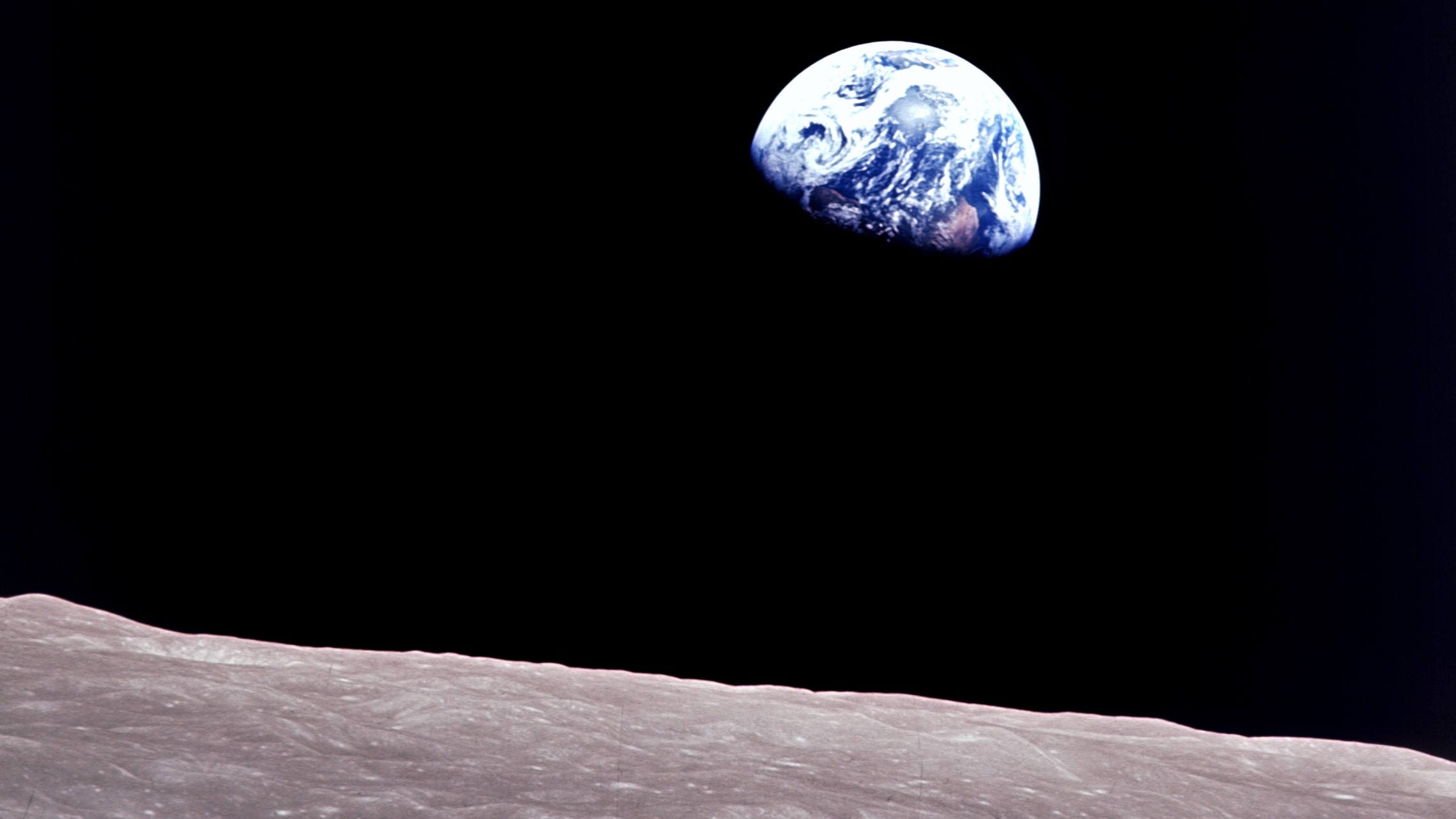
The contributions in this arena could be significant, EHT team members and outside scientists said. Photos can change the way we think about ourselves and our place in the universe, Marrone noted, citing the famous "Earthrise" photo taken by Apollo 8 astronaut Bill Anders in December 1968. This image, which gave the masses a glimpse of our planet as it really is — a lonely outpost of life in an infinite sea of darkness — is widely credited with helping to spur the environmental movement.
Seeing a real-life black hole — or its silhouette, anyway — "is the stuff of science fiction," Harrison said. And we've seen just the project's first few photos, she added: "They're only going to get better."
- [Astronomers to Peer into a Black Hole for 1st Time with Event Horizon Telescope](https://www.space.com/36209-astronomers-will-peer-inside-black-event-horizon-telescope.html)
- [This Huge Black Hole Is Spinning at Half the Speed of Light\!](https://www.space.com/42953-black-hole-spins-at-half-light-speed.html)
- [8 Baffling Astronomy Mysteries](https://www.space.com/15936-astronomy-mysteries-science-countdown.html)
*Mike Wall's book about the search for alien life, "*[*Out There*](https://target.georiot.com/Proxy.ashx?tsid=72128&GR_URL=https%3A%2F%2Famazon.com%2FOut-There-Scientific-Antimatter-Cosmically%2Fdp%2F1538729377%3Ftag%3Dhawk-future-20%26ascsubtag%3Dspace-us-2738472146419429680-20)*" (Grand Central Publishing, 2018; illustrated by*[*Karl Tate*](http://www.karltate.com/)*), is out now. Follow him on Twitter* [*@michaeldwall*](http://twitter.com/michaeldwall)*. Follow us on Twitter*[*@Spacedotcom*](http://twitter.com/spacedotcom) *or*[*Facebook*](https://www.facebook.com/spacecom)*.*
**Share your thoughts**
0
0
0
0
Random QuizPlay a Random Quiz
Filter by Category
Join the community
Join the Space.com Family! The best way to keep in touch and to be informed of our latest quizzes and competitions, as well as news and offers.
I'm in\!
Not right now
Already have an account? Log in
This page will close automatically once you have completed the authorisation process
My Details
Update your details below...
Keep in the Know
Would you like to be kept informed about new quizzes and offers from Future and its partners?
OK
Validate Your Mobile No.
We have sent a code to . Please enter it below to verify your account.
Update Your Mobile No.
You may enter a new mobile number below. You will be sent a verification code to the phone number you provide.
embed-reactions.hint\_heading
embed-reactions.hint\_subheading
Validate Your Email Address
We have sent a code to . Please enter it below to verify your account.
Update Your Email Address
You may enter a new email address below. You will be sent a verification code to the address you provide.
Create a Username
This will be publicly viewable so make it something you like\!
Reset your password
Enter your email address below. If it is registered with us, we will email you a code that will allow you to reset your password.
Check your inbox
If your email address was found in our system, you should receive an email in the next few minutes containing a code. Enter that code below to reset your password.
Set new password
Please enter your new password below.
Leaderboard
| Rank | Player | Score | Time |
|---|---|---|---|
Log In or Register
More Quizzes
Log Out

[Mike Wall](https://www.space.com/author/mike-wall)
Social Links Navigation
Spaceflight and Tech Editor
Michael Wall is the Spaceflight and Tech Editor for [Space.com](https://www.space.com/) and joined the team in 2010. He primarily covers human and robotic spaceflight, military space, and exoplanets, but has been known to dabble in the space art beat. His book about the search for alien life, "Out There," was published on Nov. 13, 2018. Before becoming a science writer, Michael worked as a herpetologist and wildlife biologist. He has a Ph.D. in evolutionary biology from the University of Sydney, Australia, a bachelor's degree from the University of Arizona, and a graduate certificate in science writing from the University of California, Santa Cruz. To find out what his latest project is, you can follow Michael on Twitter.
Read more
[ Black Holes NASA X-ray spacecraft stares into the 'eye of the storm' swirling around supermassive black holes](https://www.space.com/astronomy/black-holes/nasa-x-ray-spacecraft-stares-into-the-eye-of-the-storm-swirling-around-supermassive-black-holes "NASA X-ray spacecraft stares into the 'eye of the storm' swirling around supermassive black holes")
[ Black Holes Astronomers watch 1st black hole ever imaged launch a 3,000‑light‑year‑long cosmic jet from its glowing 'shadow'](https://www.space.com/astronomy/black-holes/astronomers-watch-1st-black-hole-ever-imaged-launch-a-3-000-light-year-long-cosmic-jet-from-its-glowing-shadow "Astronomers watch 1st black hole ever imaged launch a 3,000‑light‑year‑long cosmic jet from its glowing 'shadow'")
[ James Webb Space Telescope James Webb Space Telescope reveals new origin story for the universe's 1st supermassive black holes](https://www.space.com/astronomy/james-webb-space-telescope/james-webb-space-telescope-data-backs-new-origin-story-for-the-universes-1st-supermassive-black-holes "James Webb Space Telescope reveals new origin story for the universe's 1st supermassive black holes")
[ Black Holes Scientists may have found a 'missing-link' black hole ripping up and devouring a star](https://www.space.com/astronomy/black-holes/scientists-may-have-found-a-missing-link-black-hole-ripping-up-and-devouring-a-star "Scientists may have found a 'missing-link' black hole ripping up and devouring a star")
[ Dark Universe Could the Milky Way galaxy's supermassive black hole actually be a clump of dark matter?](https://www.space.com/astronomy/dark-universe/could-the-milky-way-galaxys-supermassive-black-hole-actually-be-a-clump-of-dark-matter "Could the Milky Way galaxy's supermassive black hole actually be a clump of dark matter?")
[ Black Holes Astronomers watch 2 supermassive black holes caught in a twisted dance with never-before-seen jet behavior](https://www.space.com/astronomy/black-holes/astronomers-watch-2-supermassive-black-holes-caught-in-a-twisted-dance-with-never-before-seen-jet-behavior "Astronomers watch 2 supermassive black holes caught in a twisted dance with never-before-seen jet behavior")
Latest in Black Holes
[ Black Holes Could our universe exist because black holes ate up all the antimatter?](https://www.space.com/astronomy/black-holes/could-our-universe-exist-because-black-holes-ate-up-all-the-antimatter "Could our universe exist because black holes ate up all the antimatter?")
[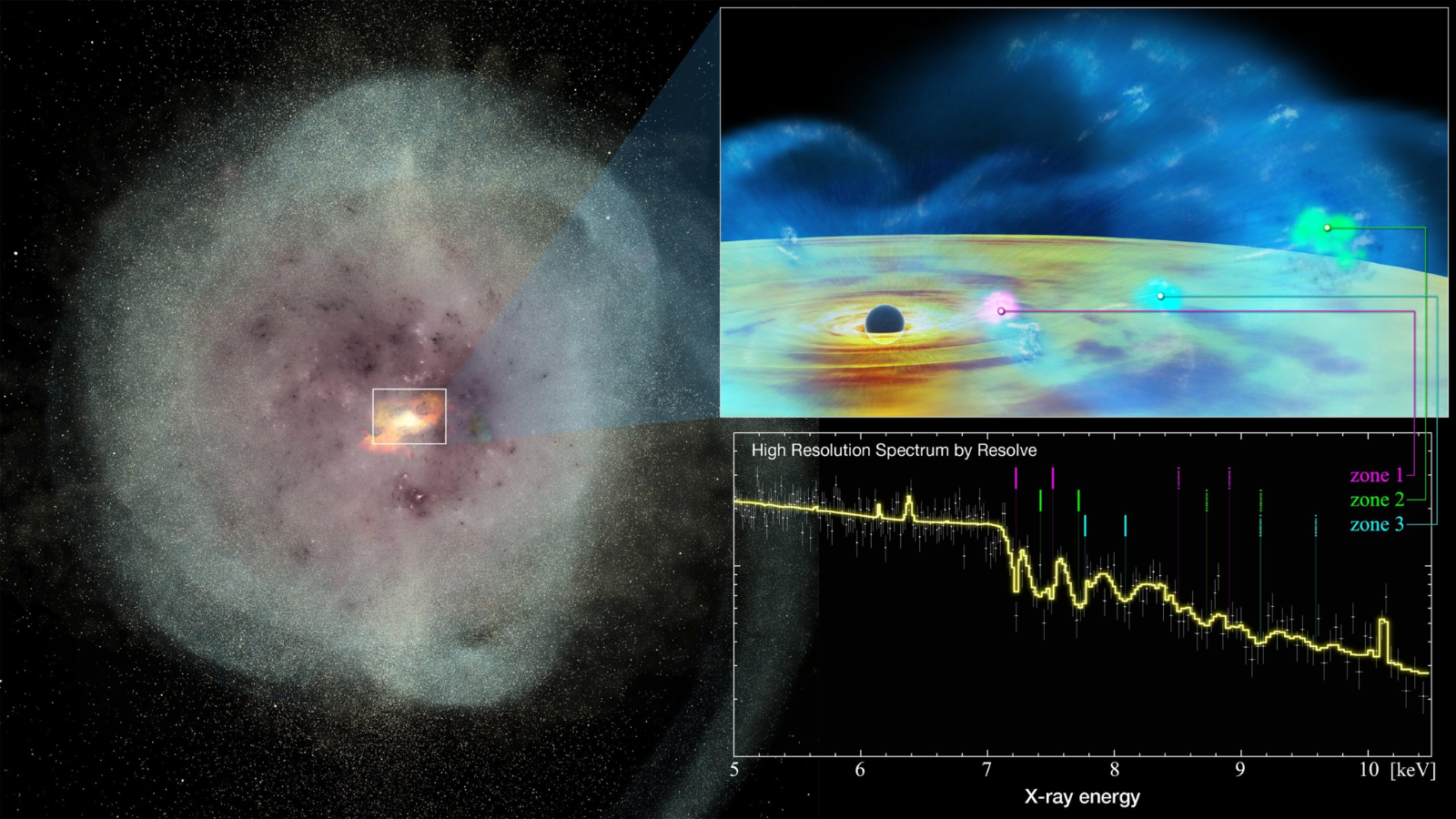 Black Holes X-ray spacecraft watches monster black hole wake up and fire cosmic bullets at starburst galaxy](https://www.space.com/astronomy/black-holes/x-ray-spacecraft-watches-monster-black-hole-wake-up-and-fire-cosmic-bullets-at-starburst-galaxy "X-ray spacecraft watches monster black hole wake up and fire cosmic bullets at starburst galaxy")
[ Black Holes Black hole and neutron star mergers push the laws of physics with their odd orbits](https://www.space.com/astronomy/black-holes/black-hole-and-neutron-star-mergers-push-the-laws-of-physics-with-their-odd-orbits "Black hole and neutron star mergers push the laws of physics with their odd orbits")
[ Black Holes The universe is humming with ripples in spacetime: Scientists just doubled our catalog of black hole and neutron star collisions](https://www.space.com/astronomy/black-holes/the-universe-is-humming-with-ripples-in-spacetime-scientists-just-doubled-our-catalog-of-black-hole-and-neutron-star-collisions "The universe is humming with ripples in spacetime: Scientists just doubled our catalog of black hole and neutron star collisions")
[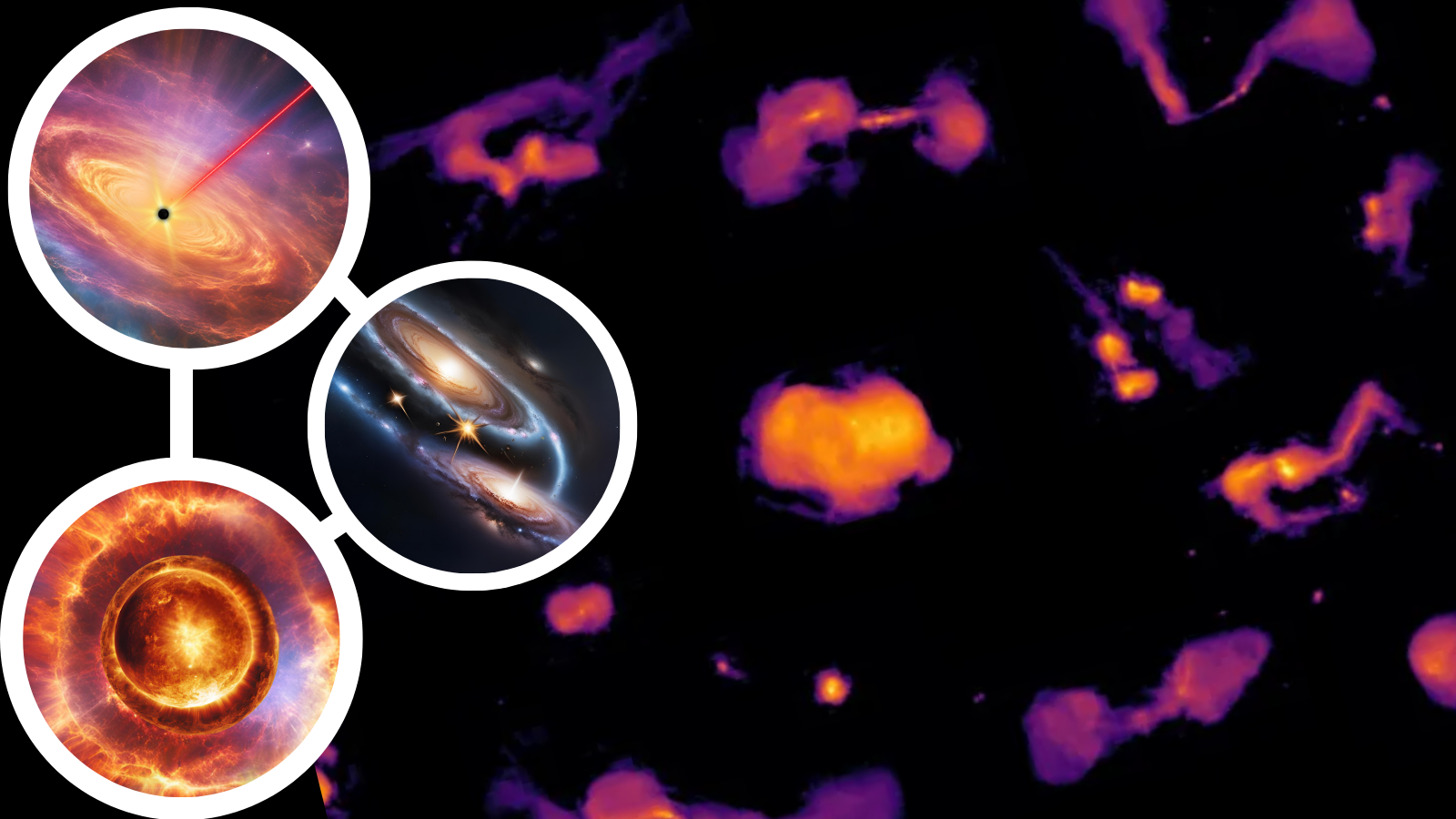 Black Holes Black holes! Supernovas! Merging galaxies! Oh my! Largest radio survey of the cosmos ever reveals 13.7 million powerful cosmic objects and events](https://www.space.com/astronomy/black-holes/black-holes-supernovas-merging-galaxies-oh-my-largest-radio-survey-of-the-cosmos-ever-reveals-13-7-million-powerful-cosmic-objects-and-events "Black holes! Supernovas! Merging galaxies! Oh my! Largest radio survey of the cosmos ever reveals 13.7 million powerful cosmic objects and events")
[ Black Holes Starlight warped in the fabric of spacetime could help us find hidden black holes dancing together](https://www.space.com/astronomy/black-holes/starlight-warped-in-the-fabric-of-spacetime-could-help-us-find-hidden-black-holes-dancing-together "Starlight warped in the fabric of spacetime could help us find hidden black holes dancing together")
Latest in News
[ Artemis When the moon hits your eye from your Orion ship up high, that's a 'mare' for Artemis 2](https://www.space.com/space-exploration/artemis/when-the-moon-hits-your-eye-from-your-orion-ship-up-high-thats-a-mare "When the moon hits your eye from your Orion ship up high, that's a 'mare' for Artemis 2")
[ Artemis The breakout star of NASA's Artemis 2 moon mission isn't an astronaut — it's the space toilet](https://www.space.com/space-exploration/artemis/the-breakout-star-of-nasas-artemis-2-mission-to-the-moon-isnt-an-astronaut-its-the-space-toilet "The breakout star of NASA's Artemis 2 moon mission isn't an astronaut — it's the space toilet")
[ Artemis Artemis 2 astronauts are about to see one of the rarest skywatching sights of all — a solar eclipse from beyond the moon](https://www.space.com/space-exploration/artemis/artemis-2-astronauts-are-about-to-see-one-of-the-rarest-skywatching-sights-of-all-a-solar-eclipse-from-beyond-the-moon "Artemis 2 astronauts are about to see one of the rarest skywatching sights of all — a solar eclipse from beyond the moon")
[ Artemis This is the inspiring Easter message an Artemis 2 astronaut has for Earth while traveling to the moon (video)](https://www.space.com/space-exploration/artemis/artemis-2-astronaut-victor-glover-delivers-inspiring-easter-message-on-the-way-to-the-moon-video "This is the inspiring Easter message an Artemis 2 astronaut has for Earth while traveling to the moon (video)")
[ Artemis Artemis 2 astronauts — now halfway to the moon — report 'burning smell' from toilet, but everything's fine](https://www.space.com/space-exploration/artemis/artemis-2-astronauts-now-halfway-to-the-moon-report-burning-smell-from-toilet-but-everythings-fine "Artemis 2 astronauts — now halfway to the moon — report 'burning smell' from toilet, but everything's fine")
[ Artemis Artemis 2 moon astronauts will try to recreate Apollo 8's historic 'Earthrise' photo during April 6 flyby](https://www.space.com/space-exploration/artemis/artemis-2-moon-astronauts-will-try-to-recreate-apollo-8s-historic-earthrise-photo-during-april-6-flyby "Artemis 2 moon astronauts will try to recreate Apollo 8's historic 'Earthrise' photo during April 6 flyby")
MORE FROM SPACE...
1. [](https://www.space.com/space-exploration/artemis/when-the-moon-hits-your-eye-from-your-orion-ship-up-high-thats-a-mare "When the moon hits your eye from your Orion ship up high, that's a 'mare' for Artemis 2")
1
[When the moon hits your eye from your Orion ship up high, that's a 'mare' for Artemis 2](https://www.space.com/space-exploration/artemis/when-the-moon-hits-your-eye-from-your-orion-ship-up-high-thats-a-mare)
2. 2
[Artemis 2 astronauts are about to see one of the rarest skywatching sights of all — a solar eclipse from beyond the moon](https://www.space.com/space-exploration/artemis/artemis-2-astronauts-are-about-to-see-one-of-the-rarest-skywatching-sights-of-all-a-solar-eclipse-from-beyond-the-moon)
3. 3
[The breakout star of NASA's Artemis 2 moon mission isn't an astronaut — it's the space toilet](https://www.space.com/space-exploration/artemis/the-breakout-star-of-nasas-artemis-2-mission-to-the-moon-isnt-an-astronaut-its-the-space-toilet)
4. 4
[The powerful new Rubin Observatory just found 11,000 new asteroids and measured 'tens of thousands more'](https://www.space.com/astronomy/asteroids/the-powerful-new-rubin-observatory-just-found-11-000-new-asteroids-and-measured-tens-of-thousands-more)
5. 5
[Artemis 2 moon astronauts will try to recreate Apollo 8's historic 'Earthrise' photo during April 6 flyby](https://www.space.com/space-exploration/artemis/artemis-2-moon-astronauts-will-try-to-recreate-apollo-8s-historic-earthrise-photo-during-april-6-flyby)
Space is part of Future US Inc, an international media group and leading digital publisher. [Visit our corporate site](https://futureplc.com/).
[ Add as a preferred source on Google](https://google.com/preferences/source?q=space.com)
- [About Us](https://www.space.com/41418-about-us.html)
- [Contact Future's experts](https://futureplc.com/contact/)
- [Terms and conditions](https://futureplc.com/terms-conditions/)
- [Privacy policy](https://futureplc.com/privacy-policy/)
- [Cookies policy](https://futureplc.com/cookies-policy/)
- [Accessibility Statement](https://futureplc.com/accessibility-statement/)
- [Advertise with us](https://go.future-advertising.com/Spacecom-Media-Kit.html)
- [Web notifications](https://www.space.com/how-to-turn-off-web-notifications-for-chrome-macos.html)
- [Careers](https://futureplc.com/careers/)
- [Do not sell or share my personal information](https://www.space.com/privacy-portal)
© Future US, Inc. Full 7th Floor, 130 West 42nd Street, New York, NY 10036.
Close
Please login or signup to comment
Please wait...
Login
Sign Up | ||||||
| Readable Markdown | 
The Event Horizon Telescope, a planet-scale array of eight ground-based radio telescopes forged through international collaboration, captured this image of the supermassive black hole in the center of the galaxy M87 and its shadow. (Image credit: EHT Collaboration)
[Black holes](https://www.space.com/15421-black-holes-facts-formation-discovery-sdcmp.html) have finally been dragged out of the shadows.
For the first time ever, humanity has photographed one of these elusive cosmic beasts, shining light on an exotic space-time realm that had long been beyond our ken.
"We have seen what we thought was unseeable," Sheperd Doeleman, of Harvard University and the Harvard-Smithsonian Center for Astrophysics, said today (April 10) during a press conference at the National Press Club in Washington, D.C.
"There's really a new field to explore," Peter Galison, a professor of physics and the history of science at Harvard, said in [an EHT talk last month](https://www.space.com/event-horizon-telescope-is-trying-to-photograph-black-holes.html) at the South by Southwest (SXSW) festival in Austin, Texas. "And that's ultimately what's so exciting about this."
Breaking space news, the latest updates on rocket launches, skywatching events and more\!
Galison, who co-founded Harvard's interdisciplinary Black Hole Initiative (BHI), compared the imagery's potential impact to that of the drawings made by English scientist Robert Hooke in the 1600s. These illustrations showed people what insects and plants look like through a microscope.
"It opened a world," Galison said of Hooke's work.
## A telescope the size of Earth
The EHT is a consortium of more than 200 scientists that has been in the works for about two decades. It's a truly international endeavor; funding over the years has come from the U.S. National Science Foundation and many other organizations in countries around the world.
The project takes its name from a black hole's famed point of no return — the boundary beyond which nothing, not even light, can escape the object's gravitational clutches.
"The [event horizon](https://www.space.com/black-holes-event-horizon-explained.html) is the ultimate prison wall," BHI founding director Avi Loeb, the chair of Harvard's astronomy department, told Space.com. (Loeb is not part of the EHT team.) "Once you're in, you can never get out."
It's therefore impossible to photograph the interior of a black hole, unless you somehow manage to get in there yourself. (You and your pictures couldn't make it back to the outside world, of course.)
So, the EHT images the event horizon, mapping out the black hole's dark silhouette. (The disk of fast-moving gas swirling around and into black holes emits lots of radiation, so such silhouettes stand out.)
"We're looking for the loss of photons," EHT science council member Dan Marrone, an associate professor of astronomy at the University of Arizona, told Space.com.
The project has been scrutinizing two black holes — the M87 behemoth, which harbors about 6.5 billion times the mass of Earth's sun, and our own Milky Way galaxy's central black hole, known as [Sagittarius A\*](https://www.space.com/42317-milky-way-supermassive-black-hole-stuff-circling-drain.html). This latter object, while still a supermassive black hole, is a runt compared to M87's beast, containing a mere 4.3 million solar masses.
Both of these objects are tough targets because of their immense distance from Earth. Sagittarius A\* lies about 26,000 light-years from us, and M87's black hole is a whopping 53.5 million light-years away.
From our perspective, Sagittarius A\*'s event horizon "is so small that it's the equivalent of seeing an orange on the moon or being able to read the newspaper in Los Angeles while you're sitting in New York City," Doeleman said during the SXSW event last month.
No single telescope on Earth can make that observation, so Doeleman and the rest of the EHT team had to get creative. The researchers have linked up radio telescopes in Arizona, Spain, Mexico, Antarctica and other places around the world, forming a virtual instrument the size of Earth.
**Related:** [**Images: Black Holes of the Universe**](https://www.space.com/31-black-holes-universe.html)
## So much data
The EHT team has used this megascope to study the two [supermassive black holes](https://www.space.com/43091-supermassive-black-hole-formation-early-universe.html) for two weeklong stretches to date — once in April 2017 and again the following year. The new imagery comes from the first observing run.
There are good reasons why it's taken two years for the project's first result to come out. For one thing, each night of observing generated about 1 petabyte of data, resulting in such a haul that the team has to move its information from place to place the old-fashioned way.
"There's no way that we can transfer this data through the internet," EHT project scientist Dimitrios Psaltis, an astronomy professor at the University of Arizona, said at the SXSW event. "So, what we actually do is, we take our hard drives and we FedEx them from place to place. This is much faster than any cable that you can ever find."
This slows and complicates analysis, of course. Data from the EHT scope near the South Pole, for example, couldn't get off Antarctica until December 2017, when it was warm enough for planes to go in and out, Marrone said.
Correlating and calibrating the data was also tricky, he added. And the team took great care with this work, given the momentous nature of the find.
"If you're going to come with a big claim of imaging a black hole, you have to have big evidence, very strong evidence," Doeleman said at the SXSW event (which served as an explainer of the EHT effort but did not announce any results).
"And on our project, we often think that people like \[Albert\] Einstein, \[Arthur\] Eddington \[and Karl\] Schwarzschild are kind of looking over our shoulders," he added, referring to physicists who helped pioneer our understanding of black holes. "And when you have luminaries kind of virtually checking your work, you really want to get it right."
**Related:** [**The Strangest Black Holes in the Universe**](https://www.space.com/15941-strangest-black-holes-universe-countdown.html)

A simulated image by the University of Arizona shows the turbulent plasma in the extreme environment around a supermassive black hole. (Image credit: University of Arizona)
## What it all means
The EHT project has two main goals, Psaltis said: to image an event horizon for the first time ever and to help determine if [Einstein's theory of general relativity](https://www.space.com/17661-theory-general-relativity.html) needs any revisions.
Before Einstein came along, gravity was generally regarded as a mysterious force at a distance. But general relativity describes it as the warping of space-time: Massive objects such as planets, stars and black holes create a sort of sag in space-time, much as a bowling ball would if placed on a trampoline. Nearby objects follow this curve and get funneled toward the central mass.
General relativity has held up incredibly well over the century since its introduction, passing every test that scientists have thrown at it. But the EHT's observations provide another trial, in an extreme realm where predictions may not match reality. That's because astronomers can calculate the expected size and shape of an event horizon using general relativity, Psaltis explained.
If the observed silhouette matches the theory-informed simulations, "then Einstein was 100% right," Psaltis said. "If the answer is no, then we have to tweak his theory in order to make it work with experiments. This is how science goes."
And we learned today that no tweaks are needed, at least at the moment: EHT's M87 observations are consistent with general relativity, team members said. Namely, the event horizon is nearly circular and is the "right" size for a black hole of that immense mass.
"I have to admit, I was a little stunned that it matched so closely the predictions that we had made," EHT team member Avery Broderick, of the University of Waterloo and the Perimeter Institute for Theoretical Physics in Canada, said during today's news conference.
Such ground-truthing is vital to the scientific process, of course. Indeed, providing better information to feed into theories and simulations will likely be one of the EHT's biggest contributions, Loeb said.
"Doing physics is a dialog with nature," he said. "We test our ideas by comparing them to experiments; experimental data is crucial."
The new results should also help scientists get a better handle on black holes, he and other researchers said. For example, EHT imagery will likely shine significant light on how gas spirals down into a black hole's maw. This accretion process, which can lead to the generation of powerful jets of radiation, is poorly understood, Loeb said.
In addition, the shape of an event horizon can reveal whether a black hole is spinning, said Fiona Harrison of the California Institute of Technology, the principal investigator of NASA's black-hole-studying [Nuclear Spectroscopic Telescope Array](https://www.space.com/37182-nasa-nustar-black-hole-observatory-5-images-5-years.html) (NuSTAR) mission.
"We've inferred the spin of black holes indirectly," Harrison, who's not part of the EHT team, told Space.com. EHT imagery provides "a direct test, which is very exciting," she added.
EHT's data revealed the M87 black hole is spinning clockwise, team members said today.
The project should also show how matter is distributed around a black hole, and EHT observations could eventually teach astronomers a great deal about how supermassive black holes shape the evolution of their host galaxies over long time scales, Harrison said.
EHT's results also mesh well with those of the [Laser Interferometer Gravitational-Wave Observatory](https://www.space.com/25423-ligo-gravitational-waves-observatory-photos.html) (LIGO), which has detected the space-time ripples generated by mergers involving black holes just a few dozen times more massive than the sun.
"Despite varying across a factor of billion in mass, known black holes are all consistent with a single description," Broderick said today. "Black holes big and small are analogous in important ways. What we learn from one \[type\] necessarily applies to the other."
And in case you're wondering about Sagittarius A\*: The EHT team hopes to get imagery of that supermassive black hole soon, Doeleman said today. The researchers looked at M87 first, and it's a bit easier to resolve than Sagittarius A\* because it's less variable over short timescales, he explained.
## A new perspective?
Then there's the broader appeal of the newly released imagery — how it speaks to those of us who aren't astrophysicists.
The contributions in this arena could be significant, EHT team members and outside scientists said. Photos can change the way we think about ourselves and our place in the universe, Marrone noted, citing the famous "Earthrise" photo taken by Apollo 8 astronaut Bill Anders in December 1968. This image, which gave the masses a glimpse of our planet as it really is — a lonely outpost of life in an infinite sea of darkness — is widely credited with helping to spur the environmental movement.
Seeing a real-life black hole — or its silhouette, anyway — "is the stuff of science fiction," Harrison said. And we've seen just the project's first few photos, she added: "They're only going to get better."
- [Astronomers to Peer into a Black Hole for 1st Time with Event Horizon Telescope](https://www.space.com/36209-astronomers-will-peer-inside-black-event-horizon-telescope.html)
- [This Huge Black Hole Is Spinning at Half the Speed of Light\!](https://www.space.com/42953-black-hole-spins-at-half-light-speed.html)
- [8 Baffling Astronomy Mysteries](https://www.space.com/15936-astronomy-mysteries-science-countdown.html)
*Mike Wall's book about the search for alien life, "*[*Out There*](https://target.georiot.com/Proxy.ashx?tsid=72128&GR_URL=https%3A%2F%2Famazon.com%2FOut-There-Scientific-Antimatter-Cosmically%2Fdp%2F1538729377%3Ftag%3Dhawk-future-20%26ascsubtag%3Dspace-us-2738472146419429680-20)*" (Grand Central Publishing, 2018; illustrated by*[*Karl Tate*](http://www.karltate.com/)*), is out now. Follow him on Twitter* [*@michaeldwall*](http://twitter.com/michaeldwall)*. Follow us on Twitter*[*@Spacedotcom*](http://twitter.com/spacedotcom) *or*[*Facebook*](https://www.facebook.com/spacecom)*.*
**Share your thoughts**
0
0
0
0
Join the community
Join the Space.com Family! The best way to keep in touch and to be informed of our latest quizzes and competitions, as well as news and offers.
Already have an account? Log in
My Details
Update your details below...
Keep in the Know
Would you like to be kept informed about new quizzes and offers from Future and its partners?
Validate Your Mobile No.
We have sent a code to . Please enter it below to verify your account.
Update Your Mobile No.
You may enter a new mobile number below. You will be sent a verification code to the phone number you provide.
embed-reactions.hint\_heading
embed-reactions.hint\_subheading
Validate Your Email Address
We have sent a code to . Please enter it below to verify your account.
Update Your Email Address
You may enter a new email address below. You will be sent a verification code to the address you provide.
Create a Username
This will be publicly viewable so make it something you like\!
Reset your password
Enter your email address below. If it is registered with us, we will email you a code that will allow you to reset your password.
Check your inbox
If your email address was found in our system, you should receive an email in the next few minutes containing a code. Enter that code below to reset your password.
Set new password
Please enter your new password below.
Leaderboard
| Rank | Player | Score | Time |
|---|---|---|---|
Michael Wall is the Spaceflight and Tech Editor for [Space.com](https://www.space.com/) and joined the team in 2010. He primarily covers human and robotic spaceflight, military space, and exoplanets, but has been known to dabble in the space art beat. His book about the search for alien life, "Out There," was published on Nov. 13, 2018. Before becoming a science writer, Michael worked as a herpetologist and wildlife biologist. He has a Ph.D. in evolutionary biology from the University of Sydney, Australia, a bachelor's degree from the University of Arizona, and a graduate certificate in science writing from the University of California, Santa Cruz. To find out what his latest project is, you can follow Michael on Twitter. | ||||||
| ML Classification | |||||||
| ML Categories |
Raw JSON{
"/Science": 995,
"/Science/Astronomy": 975
} | ||||||
| ML Page Types |
Raw JSON{
"/Article": 995,
"/Article/News_Update": 969
} | ||||||
| ML Intent Types |
Raw JSON{
"Informational": 999
} | ||||||
| Content Metadata | |||||||
| Language | en | ||||||
| Author | Mike Wall | ||||||
| Publish Time | 2019-04-10 13:32:59 (7 years ago) | ||||||
| Original Publish Time | 2019-04-10 13:32:59 (7 years ago) | ||||||
| Republished | No | ||||||
| Word Count (Total) | 4,145 | ||||||
| Word Count (Content) | 2,224 | ||||||
| Links | |||||||
| External Links | 27 | ||||||
| Internal Links | 151 | ||||||
| Technical SEO | |||||||
| Meta Nofollow | No | ||||||
| Meta Noarchive | No | ||||||
| JS Rendered | Yes | ||||||
| Redirect Target | null | ||||||
| Performance | |||||||
| Download Time (ms) | 940 | ||||||
| TTFB (ms) | 762 | ||||||
| Download Size (bytes) | 252,251 | ||||||
| Shard | 8 (laksa) | ||||||
| Root Hash | 7770394665477845008 | ||||||
| Unparsed URL | com,space!www,/first-black-hole-photo-by-event-horizon-telescope.html s443 | ||||||