ℹ️ Skipped - page is already crawled
| Filter | Status | Condition | Details |
|---|---|---|---|
| HTTP status | PASS | download_http_code = 200 | HTTP 200 |
| Age cutoff | PASS | download_stamp > now() - 6 MONTH | 0.1 months ago |
| History drop | PASS | isNull(history_drop_reason) | No drop reason |
| Spam/ban | PASS | fh_dont_index != 1 AND ml_spam_score = 0 | ml_spam_score=0 |
| Canonical | PASS | meta_canonical IS NULL OR = '' OR = src_unparsed | Not set |
| Property | Value |
|---|---|
| URL | https://www.space.com/event-horizon-black-hole-image-tests |
| Last Crawled | 2026-04-05 14:17:32 (3 days ago) |
| First Indexed | 2024-09-05 20:19:11 (1 year ago) |
| HTTP Status Code | 200 |
| Meta Title | The 1st Milky Way black hole image was groundbreaking — the next could be even better | Space |
| Meta Description | By demonstrating the ability for joint observations at the short radio wavelength of 0.87mm, the Event Horizon Telescope has improved its observational acuity by half. |
| Meta Canonical | null |
| Boilerpipe Text | The
Event Horizon Telescope
(EHT), which is a collaboration of radio telescopes all around the world that operate in unison to image
supermassive black holes
, has achieved its finest resolution yet. In the future, this accomplishment could lead to images of the ring of light around a
black hole's
event horizon
that are 50% sharper, resolving hitherto unseen details and producing movies of how the black holes change as they spin.
The EHT works on the principle of "very long baseline interferometry," or VLBI for short. This involves tapping into a network of telescopes across continents that all work collectively to observe the same object, combining their data in the process. The wider the distance between the two farthest telescopes in the network, the greater the resolution, and the more telescopes there are in the network, the greater the sensitivity.
The EHT managed to
image
the black hole in the center of our
Milky Way galaxy
,
Sagittarius A*
, as well as the black hole in the center of the elliptical galaxy M87, M87* — marking the first two black hole images captured by humanity — because it has a huge baseline. Think of the baseline as being the telescope's aperture. The EHT's most southern telescope is the South Pole Telescope, while its most northern station is the Greenland Telescope, which means the network spans almost top to bottom of the planet.
Article continues below
Along with the baseline factor, wavelength has a role to play, with lower wavelengths achieving higher resolution. The historic images of the black hole at the center of our galaxy and M87 were captured at a radio wavelength of 1.3mm. At this wavelength, the "photon ring," which is the torus of emission around the event horizon with the black hole's dark shadow inside it, appears blurred — particularly in the case of Sagittarius A*. This is because the radio emission coming from the black hole is being partially scattered by ionized gas in the
interstellar medium
between us and the object itself. This results in the light becoming smeared across an angular scale, comparable to the resolution of the EHT at 1.3mm. The smearing effect would be drastically less apparent at shorter wavelengths.
Related:
Stunning Photos of Our Milky Way Galaxy (Gallery)
To this end, for the first time ever, the EHT has been able to conduct VLBI at a shorter wavelength of 0.87mm.
"With the EHT, we saw the first images of black holes by detecting radio waves at the 1.3mm wavelength, but the bright ring we saw, formed by light bending in the black hole's
gravity
, still looked blurry because we were at the absolute limits of how sharp we could make the images," said Alexander Raymond, of NASA's
Jet Propulsion Laboratory
, in a
statement
. "At 0.87mm, our images will be sharper and more detailed, which in turn will likely reveal new properties, both those that were previously predicted and maybe some that weren't."
Breaking space news, the latest updates on rocket launches, skywatching events and more!
Achieving VLBI at 0.87mm is not an easy thing, hence why it hasn't been accomplished before. One of the difficulties has to do with water vapor in the atmosphere tending to absorb radio waves at this short wavelength, so weather would have to be very dry at all the EHT's observing sites.
The locations of the observatories that participated in the groundbreaking Event Horizon Telescope very long baseline interferometry experiment at the short wavelength of 0.87mm.
(Image credit: ESO/M. Kornmesser)
As for those observing sites, this particular VLBI experiment involved both the Atacama Large Millimeter/submillimeter Array (
ALMA
) and the Atacama Pathfinder Experiment in Chile, the Institute for Radio Astronomy in the Millimeter Range (IRAM) 30-meter telescope in Spain, the Northern Extended Millimeter Array (NOEMA) in France, the Submillimeter Array (SMA) on Mauna Kea in Hawaii and the Greenland Telescope, all of which are stations for the EHT. Probing numerous
quasars
at 0.87mm, they achieved a resolution of 19 microarcseconds.
How small is 19 microarcseconds? Well, the sky is divided into 360 degrees, with each degree consisting of 60 arcminutes, and each arcminute is further subdivided into 60 arcseconds. A microarcsecond is a millionth of an arcsecond, so 19 microarcseconds is like being able to resolve a bottle-top on the surface of
the moon
. It's the greatest resolution for an astronomical image ever achieved solely from the surface of the
Earth
(although combinations of ground- and space-based telescopes have achieved similar resolutions in the past). Raymond and his colleagues actually think the EHT could resolve down to just 13 arcseconds when operating at full capacity (for example, with the inclusion of the South Pole Telescope, which was not involved in the 0.87mm test).
The Event Horizon Telescope’s image of our Milky Way’s supermassive black hole, at a wavelength of 1.3mm.
(Image credit: EHT Collaboration)
The intention now is to apply this breakthrough while taking new images of Sagittarius A* and the supermassive black hole in M87.
"The time is right, as the new detections prove, to advance to 0.87mm," said Remo Tilanus of the University of Arizona, who is the EHT's Operations Manager.
The greater resolution won't just sharpen the image of the photon ring around each black hole, but also more precisely depict their shape and size, allowing more accurate estimates of the black holes' spin rates and angle to us. It will also bring into range supermassive black holes in other galaxies, and allow us to see closer to the base of relativistic jets shooting out from active black holes such as in quasars. This could provide more answers into how a black hole's
magnetic field
produces jets that move at almost the
speed of light
and extend out into deep space for thousands of
light-years
.
A simulation showing the difference in sharpness between observations of a black hole at 1.3mm and at 0.87mm.
(Image credit: Christian M. Fromm, Julius-Maximilian University, Würzburg)
In addition to now being able to operate at a shorter wavelength, there are plans in place for major modifications to the EHT, in a program called "next generation EHT," or "ngEHT" for short. This will add new telescopes to the existing EHT infrastructure at locations around the world optimized to provide the greatest baselines and sensitivity, as well as improve detector facilities at the existing members of the collaboration so they can observe black holes at multiple wavelengths between 3mm and 0.87mm simultaneously.
Related Stories:
All in all, the next generation EHT is expected to increase the sharpness and clarity of black hole images by a factor of 10, perhaps even enabling high-resolution movies showing changes in the photon ring around a black hole's event horizon over
time
as the black hole spins and accretes more matter from the surrounding
space
.
"These VLBI signal detections at 0.87mm are groundbreaking since they open a new observing window for the study of supermassive black holes," said Thomas Krichbaum of the Max Planck Institute for Radio Astronomy in Germany in a
statement
issued by the European Southern Observatory.
The results of this groundbreaking VLBI experiment were published on Aug. 27 in
The Astronomical Journal
.
Share your thoughts
0
0
0
0
Join the community
Join the Space.com Family! The best way to keep in touch and to be informed of our latest quizzes and competitions, as well as news and offers.
Already have an account?
Log in
Log In
Forgotten your password?
Reset it
Not got an account?
Register
My Details
Update your details below...
Keep in the Know
Would you like to be kept informed about new quizzes and offers from Future and its partners?
Validate Your Mobile No.
We have sent a code to
. Please enter it below to verify your account.
Update mobile number
Resend code
Update Your Mobile No.
You may enter a new mobile number below. You will be sent a verification code to the phone number you provide.
Cancel
embed-reactions.hint_heading
embed-reactions.hint_subheading
Validate Your Email Address
We have sent a code to
. Please enter it below to verify your account.
Update email address
Resend code
Update Your Email Address
You may enter a new email address below. You will be sent a verification code to the address you provide.
Cancel
Create a Username
This will be publicly viewable so make it something you like!
Reset your password
Enter your email address below. If it is registered with us, we will email you a code that will allow you to reset your password.
Check your inbox
If your email address was found in our system, you should receive an email in the next few minutes containing a code. Enter that code below to reset your password.
Set new password
Please enter your new password below.
Leaderboard
Rank
Player
Score
Time
Keith Cooper is a freelance science journalist and editor in the United Kingdom, and has a degree in physics and astrophysics from the University of Manchester. He's the author of "The Contact Paradox: Challenging Our Assumptions in the Search for Extraterrestrial Intelligence" (Bloomsbury Sigma, 2020) and has written articles on astronomy, space, physics and astrobiology for a multitude of magazines and websites. |
| Markdown | 
[Skip to main content](https://www.space.com/event-horizon-black-hole-image-tests#main)
Open menu
[ Space](https://www.space.com/)
[Sign up to our newsletter Newsletter](https://www.space.com/newsletter)
[RSS](https://www.space.com/feeds.xml)
Sign in
- View Profile
- Sign out
Search
- [Space Exploration](https://www.space.com/space-exploration)
- [Launches & Spacecraft](https://www.space.com/space-exploration/launches-spacecraft)
- [Private spaceflight](https://www.space.com/space-exploration/private-spaceflight)
- [Human spaceflight](https://www.space.com/space-exploration/human-spaceflight)
- [SpaceX](https://www.space.com/tag/spacex)
- [Blue Origin](https://www.space.com/tag/blue-origin)
- [Virgin Galactic](https://www.space.com/tag/virgin-galactic)
- [United Launch Alliance](https://www.space.com/tag/united-launch-alliance)
- [Search for Life](https://www.space.com/space-exploration/search-for-life)
- [Exoplanets](https://www.space.com/astronomy/exoplanets)
- [SETI](https://www.space.com/tag/seti)
- [Aliens](https://www.space.com/tag/aliens)
- [Missions](https://www.space.com/space-exploration/missions)
- [International Space Station](https://www.space.com/space-exploration/missions/international-space-station)
- [Space Shuttle](https://www.space.com/space-exploration/missions/space-shuttle)
- [Apollo](https://www.space.com/space-exploration/missions/apollo)
- [Artemis](https://www.space.com/space-exploration/missions/artemis)
- [Voyager](https://www.space.com/space-exploration/missions/voyager)
- [Asteroid & Comet Missions](https://www.space.com/space-exploration/missions/asteroid-comet-missions)
- [Mars rovers](https://www.space.com/space-exploration/missions/mars-rovers)
- [New Horizons](https://www.space.com/space-exploration/missions/new-horizons)
- [Parker Solar Probe](https://www.space.com/space-exploration/missions/asteroid-comet-missions)
- [Satellites](https://www.space.com/space-exploration/satellites)
- [Astronomy](https://www.space.com/astronomy)
- [Solar System](https://www.space.com/astronomy/solar-system)
- [The Sun](https://www.space.com/astronomy/solar-system/sun)
- [Asteroids](https://www.space.com/astronomy/solar-system/asteroids)
- [Mars](https://www.space.com/astronomy/solar-system/mars)
- [Comets](https://www.space.com/astronomy/solar-system/comets)
- [Mercury](https://www.space.com/astronomy/solar-system/mercury)
- [Jupiter](https://www.space.com/astronomy/solar-system/jupiter)
- [Saturn](https://www.space.com/astronomy/solar-system/saturn)
- [Pluto](https://www.space.com/astronomy/solar-system/pluto)
- [Venus](https://www.space.com/astronomy/solar-system/venus)
- [Dwarf Planets](https://www.space.com/astronomy/solar-system/dwarf-planets)
- [Neptune](https://www.space.com/astronomy/solar-system/neptune)
- [Uranus](https://www.space.com/astronomy/solar-system/uranus)
- [The Moon](https://www.space.com/astronomy/solar-system/moon)
- [Moon Phases](https://www.space.com/tag/moon-phases)
- [The Earth](https://www.space.com/astronomy/solar-system/earth)
- [Live 4K video from space](https://www.space.com/astronomy/earth/live-4k-video-from-space-see-earth-from-the-iss-with-sharp-eyed-sen-cameras)
- [Climate Change](https://www.space.com/science/climate-change)
- [Weather](https://www.space.com/science/weather)
- [The Universe](https://www.space.com/tag/universe)
- [Stars](https://www.space.com/astronomy/stars)
- [Black Holes](https://www.space.com/astronomy/black-holes)
- [Dark Universe](https://www.space.com/astronomy/dark-universe)
- [Galaxies](https://www.space.com/astronomy/galaxies)
- [Deep Space](https://www.space.com/tag/deep-space)
- [James Webb Space Telescope](https://www.space.com/astronomy/james-webb-space-telescope)
- [Hubble Space Telescope](https://www.space.com/astronomy/hubble-space-telescope)
- [Stargazing](https://www.space.com/stargazing)
- [Skywatching Kit](https://www.space.com/stargazing/skywatching-kit)
- [Telescopes](https://www.space.com/tag/telescopes)
- [Cameras](https://www.space.com/tag/cameras)
- [Astrophotography](https://www.space.com/stargazing/astrophotography)
- [Eclipses](https://www.space.com/stargazing/eclipses)
- [Lunar Eclipses](https://www.space.com/stargazing/eclipses/lunar-eclipses)
- [Solar Eclipses](https://www.space.com/stargazing/eclipses/solar-eclipses)
- [Entertainment](https://www.space.com/entertainment)
- [Space Movies & Shows](https://www.space.com/entertainment/space-movies-shows)
- [Star Trek](https://www.space.com/tag/star-trek)
- [Star Wars](https://www.space.com/tag/star-wars)
- [Space Games](https://www.space.com/entertainment/space-games)
- [Space Toys & Lego](https://www.space.com/entertainment/space-toys-lego)
- [Space Books](https://www.space.com/entertainment/space-books)
- Tech & Science
- [Technology](https://www.space.com/technology)
- [Drones](https://www.space.com/technology/drones)
- [Aerospace](https://www.space.com/technology/aerospace)
- [Science](https://www.space.com/science)
- [Particle Physics](https://www.space.com/science/particle-physics)
- [Astrophysics](https://www.space.com/science/astrophysics)
- [Videos](https://videos.space.com/)
- More
- [Subscribe to our Newsletters](https://www.space.com/newsletter)
- [About Us](https://www.space.com/41418-about-us.html)
- [Web Notifications](https://www.space.com/how-to-turn-off-web-notifications-for-chrome-macos.html)
- [home](https://www.space.com/)
- [Space Exploration](https://www.space.com/space-exploration)
- [View Space Exploration](https://www.space.com/space-exploration)
- [Launches & Spacecraft](https://www.space.com/space-exploration/launches-spacecraft)
- [View Launches & Spacecraft](https://www.space.com/space-exploration/launches-spacecraft)
- [Private spaceflight](https://www.space.com/space-exploration/private-spaceflight)
- [Human spaceflight](https://www.space.com/space-exploration/human-spaceflight)
- [SpaceX](https://www.space.com/tag/spacex)
- [Blue Origin](https://www.space.com/tag/blue-origin)
- [Virgin Galactic](https://www.space.com/tag/virgin-galactic)
- [United Launch Alliance](https://www.space.com/tag/united-launch-alliance)
- [Search for Life](https://www.space.com/space-exploration/search-for-life)
- [View Search for Life](https://www.space.com/space-exploration/search-for-life)
- [Exoplanets](https://www.space.com/astronomy/exoplanets)
- [SETI](https://www.space.com/tag/seti)
- [Aliens](https://www.space.com/tag/aliens)
- [Missions](https://www.space.com/space-exploration/missions)
- [View Missions](https://www.space.com/space-exploration/missions)
- [International Space Station](https://www.space.com/space-exploration/missions/international-space-station)
- [Space Shuttle](https://www.space.com/space-exploration/missions/space-shuttle)
- [Apollo](https://www.space.com/space-exploration/missions/apollo)
- [Artemis](https://www.space.com/space-exploration/missions/artemis)
- [Voyager](https://www.space.com/space-exploration/missions/voyager)
- [Asteroid & Comet Missions](https://www.space.com/space-exploration/missions/asteroid-comet-missions)
- [Mars rovers](https://www.space.com/space-exploration/missions/mars-rovers)
- [New Horizons](https://www.space.com/space-exploration/missions/new-horizons)
- [Parker Solar Probe](https://www.space.com/space-exploration/missions/asteroid-comet-missions)
- [Satellites](https://www.space.com/space-exploration/satellites)
- [Astronomy](https://www.space.com/astronomy)
- [View Astronomy](https://www.space.com/astronomy)
- [Solar System](https://www.space.com/astronomy/solar-system)
- [View Solar System](https://www.space.com/astronomy/solar-system)
- [The Sun](https://www.space.com/astronomy/solar-system/sun)
- [Asteroids](https://www.space.com/astronomy/solar-system/asteroids)
- [Mars](https://www.space.com/astronomy/solar-system/mars)
- [Comets](https://www.space.com/astronomy/solar-system/comets)
- [Mercury](https://www.space.com/astronomy/solar-system/mercury)
- [Jupiter](https://www.space.com/astronomy/solar-system/jupiter)
- [Saturn](https://www.space.com/astronomy/solar-system/saturn)
- [Pluto](https://www.space.com/astronomy/solar-system/pluto)
- [Venus](https://www.space.com/astronomy/solar-system/venus)
- [Dwarf Planets](https://www.space.com/astronomy/solar-system/dwarf-planets)
- [Neptune](https://www.space.com/astronomy/solar-system/neptune)
- [Uranus](https://www.space.com/astronomy/solar-system/uranus)
- [The Moon](https://www.space.com/astronomy/solar-system/moon)
- [View The Moon](https://www.space.com/astronomy/solar-system/moon)
- [Moon Phases](https://www.space.com/tag/moon-phases)
- [The Earth](https://www.space.com/astronomy/solar-system/earth)
- [View The Earth](https://www.space.com/astronomy/solar-system/earth)
- [Live 4K video from space](https://www.space.com/astronomy/earth/live-4k-video-from-space-see-earth-from-the-iss-with-sharp-eyed-sen-cameras)
- [Climate Change](https://www.space.com/science/climate-change)
- [Weather](https://www.space.com/science/weather)
- [The Universe](https://www.space.com/tag/universe)
- [View The Universe](https://www.space.com/tag/universe)
- [Stars](https://www.space.com/astronomy/stars)
- [Black Holes](https://www.space.com/astronomy/black-holes)
- [Dark Universe](https://www.space.com/astronomy/dark-universe)
- [Galaxies](https://www.space.com/astronomy/galaxies)
- [Deep Space](https://www.space.com/tag/deep-space)
- [View Deep Space](https://www.space.com/tag/deep-space)
- [James Webb Space Telescope](https://www.space.com/astronomy/james-webb-space-telescope)
- [Hubble Space Telescope](https://www.space.com/astronomy/hubble-space-telescope)
- [Stargazing](https://www.space.com/stargazing)
- [View Stargazing](https://www.space.com/stargazing)
- [Skywatching Kit](https://www.space.com/stargazing/skywatching-kit)
- [View Skywatching Kit](https://www.space.com/stargazing/skywatching-kit)
- [Telescopes](https://www.space.com/tag/telescopes)
- [Cameras](https://www.space.com/tag/cameras)
- [Astrophotography](https://www.space.com/stargazing/astrophotography)
- [Eclipses](https://www.space.com/stargazing/eclipses)
- [View Eclipses](https://www.space.com/stargazing/eclipses)
- [Lunar Eclipses](https://www.space.com/stargazing/eclipses/lunar-eclipses)
- [Solar Eclipses](https://www.space.com/stargazing/eclipses/solar-eclipses)
- [Entertainment](https://www.space.com/entertainment)
- [View Entertainment](https://www.space.com/entertainment)
- [Space Movies & Shows](https://www.space.com/entertainment/space-movies-shows)
- [View Space Movies & Shows](https://www.space.com/entertainment/space-movies-shows)
- [Star Trek](https://www.space.com/tag/star-trek)
- [Star Wars](https://www.space.com/tag/star-wars)
- [Space Games](https://www.space.com/entertainment/space-games)
- [Space Toys & Lego](https://www.space.com/entertainment/space-toys-lego)
- [Space Books](https://www.space.com/entertainment/space-books)
- Tech & Science
- [Technology](https://www.space.com/technology)
- [View Technology](https://www.space.com/technology)
- [Drones](https://www.space.com/technology/drones)
- [Aerospace](https://www.space.com/technology/aerospace)
- [Science](https://www.space.com/science)
- [View Science](https://www.space.com/science)
- [Particle Physics](https://www.space.com/science/particle-physics)
- [Astrophysics](https://www.space.com/science/astrophysics)
- [Videos](https://videos.space.com/)
- More
- [Subscribe to our Newsletters](https://www.space.com/newsletter)
- [About Us](https://www.space.com/41418-about-us.html)
- [Web Notifications](https://www.space.com/how-to-turn-off-web-notifications-for-chrome-macos.html)
Don't miss these
[ Saturn Incredible new NASA images reveal Saturn in a new light — and it's all thanks to a telescope team-up from Webb and Hubble](https://www.space.com/astronomy/saturn/incredible-new-nasa-images-reveal-saturn-in-a-new-light-and-its-all-thanks-to-a-telescope-team-up-from-webb-and-hubble "Incredible new NASA images reveal Saturn in a new light — and it's all thanks to a telescope team-up from Webb and Hubble")
[ Astrophotography Astrophotographer captures spectacular photo of Antennae Galaxies dueling in deep space](https://www.space.com/stargazing/astrophotography/astrophotographer-captures-spectacular-photo-of-antennae-galaxies-dueling-in-deep-space "Astrophotographer captures spectacular photo of Antennae Galaxies dueling in deep space")
[ Astronomy Astronomers missed a space explosion as powerful as a billion suns — until they spotted its echo](https://www.space.com/astronomy/astronomers-missed-a-space-explosion-as-powerful-as-a-billion-suns-until-they-spotted-its-echo "Astronomers missed a space explosion as powerful as a billion suns — until they spotted its echo")
[ Galaxies Are mysterious 'Little Red Dots' discovered by the James Webb Space Telescope actually baby galaxies under construction?](https://www.space.com/astronomy/galaxies/are-mysterious-little-red-dots-discovered-by-the-james-webb-space-telescope-actually-baby-galaxies-under-construction "Are mysterious 'Little Red Dots' discovered by the James Webb Space Telescope actually baby galaxies under construction?")
[ Galaxies Space telescopes capture breathtaking galactic hug \| Space photo of the day for Jan. 8, 2026](https://www.space.com/astronomy/galaxies/space-telescopes-capture-breathtaking-galactic-hug-space-photo-of-the-day-for-jan-8-2026 "Space telescopes capture breathtaking galactic hug | Space photo of the day for Jan. 8, 2026")
[ Stars Astronomers just watched a star 1,540 times the size of our sun transform into a hypergiant. Will it go supernova?](https://www.space.com/astronomy/stars/astronomers-just-watched-a-star-1-540-times-the-size-of-our-sun-transform-into-a-hypergiant-will-it-go-supernova "Astronomers just watched a star 1,540 times the size of our sun transform into a hypergiant. Will it go supernova?")
[ Black Holes Did astronomers see a black hole explode? An 'impossible' particle that hit Earth in 2023 may tell us](https://www.space.com/astronomy/black-holes/did-astronomers-see-a-black-hole-explode-an-impossible-particle-that-hit-earth-in-2023-may-tell-us "Did astronomers see a black hole explode? An 'impossible' particle that hit Earth in 2023 may tell us")
[ James Webb Space Telescope These 70 dusty galaxies at the edge of our universe could rewrite our understanding of the cosmos](https://www.space.com/astronomy/james-webb-space-telescope/these-70-dusty-galaxies-at-the-edge-of-our-universe-could-rewrite-our-understanding-of-the-cosmos "These 70 dusty galaxies at the edge of our universe could rewrite our understanding of the cosmos")
[ Astronomy Astronomers unveil largest 3D universe map of its kind, illuminating 'hidden' cosmic structures](https://www.space.com/astronomy/astronomers-unveil-largest-3d-map-yet-of-hydrogen-light-in-the-early-universe-illuminating-hidden-cosmic-structures "Astronomers unveil largest 3D universe map of its kind, illuminating 'hidden' cosmic structures")
[ Astronomy Lasers beam 'artificial stars' above Chile \| Space photo of the day for Feb. 17, 2026](https://www.space.com/astronomy/lasers-beam-artificial-stars-above-chile-space-photo-of-the-day-for-feb-17-2026 "Lasers beam 'artificial stars' above Chile | Space photo of the day for Feb. 17, 2026")
[ James Webb Space Telescope James Webb Space Telescope reveals new origin story for the universe's 1st supermassive black holes](https://www.space.com/astronomy/james-webb-space-telescope/james-webb-space-telescope-data-backs-new-origin-story-for-the-universes-1st-supermassive-black-holes "James Webb Space Telescope reveals new origin story for the universe's 1st supermassive black holes")
[ Stars Astronomers witness colossal supernova explosion create one of the most magnetic stars in the universe for the first time](https://www.space.com/astronomy/stars/astronomers-witness-colossal-supernova-explosion-create-one-of-the-most-magnetic-stars-in-the-universe-for-the-first-time "Astronomers witness colossal supernova explosion create one of the most magnetic stars in the universe for the first time")
[ Black Holes What are 'dark' stars? Scientists think they could explain 3 big mysteries in the universe](https://www.space.com/astronomy/black-holes/what-are-dark-stars-scientists-think-they-could-explain-3-big-mysteries-in-the-universe "What are 'dark' stars? Scientists think they could explain 3 big mysteries in the universe")
[ Black Holes X-ray spacecraft watches monster black hole wake up and fire cosmic bullets at starburst galaxy](https://www.space.com/astronomy/black-holes/x-ray-spacecraft-watches-monster-black-hole-wake-up-and-fire-cosmic-bullets-at-starburst-galaxy "X-ray spacecraft watches monster black hole wake up and fire cosmic bullets at starburst galaxy")
[ Dark Universe Could the Milky Way galaxy's supermassive black hole actually be a clump of dark matter?](https://www.space.com/astronomy/dark-universe/could-the-milky-way-galaxys-supermassive-black-hole-actually-be-a-clump-of-dark-matter "Could the Milky Way galaxy's supermassive black hole actually be a clump of dark matter?")
Trending
- [Artemis 2 moon launch: Live updates](https://www.space.com/news/live/artemis-2-nasa-moon-mission-launch-updates-march-30-2026#mrfhud=true)
- [Amazon Spring Sale space deals](https://www.space.com/technology/amazon-spring-sale-deals-for-stargazing-2026-huge-savings-on-telescopes-binoculars-and-cameras)
- [Night sky tonight\!](https://www.space.com/news/live/night-sky-what-you-can-see-tonight-march-30)
- [Aurora Forecast](https://www.space.com/live/aurora-forecast-northern-lights-possible-tonight-march-27-29)
- [Space Calendar](https://www.space.com/32286-space-calendar.html)
- [Live 4K Sen video from space\!](https://www.space.com/astronomy/earth/live-4k-video-from-space-see-earth-from-the-iss-with-sharp-eyed-sen-cameras)
- [Best Drones](https://www.space.com/best-drones)
- [Lego Star Wars deals](https://www.space.com/lego-star-wars-deals)
- [Next Full Moon](https://www.space.com/16830-full-moon-calendar.html)
- [Best Telescopes](https://www.space.com/15693-telescopes-beginners-telescope-reviews-buying-guide.html)
- [Solar System Planets](https://www.space.com/16080-solar-system-planets.html)
- [Best Star Projectors](https://www.space.com/best-star-projectors)
- [Best Binoculars](https://www.space.com/26021-best-binoculars.html)
1. [Astronomy](https://www.space.com/astronomy)
2. [Black Holes](https://www.space.com/astronomy/black-holes)
# The 1st Milky Way black hole image was groundbreaking — the next could be even better
[News](https://www.space.com/news)
By [Keith Cooper](https://www.space.com/author/keith-cooper)
published
September 5, 2024
The Event Horizon Telescope’s new abilities will help it see more details in the ring of light surrounding a black hole’s shadow.
When you purchase through links on our site, we may earn an affiliate commission. [Here’s how it works](https://www.space.com/41418-about-us.html#section-affiliate-advertising-disclosure).
Click for next article
Share
- Copy link
- [Facebook](https://www.facebook.com/sharer/sharer.php?u=https%3A%2F%2Fwww.space.com%2Fevent-horizon-black-hole-image-tests)
- [X](https://twitter.com/intent/tweet?text=The+1st+Milky+Way+black+hole+image+was+groundbreaking+%E2%80%94+the+next+could+be+even+better&url=https%3A%2F%2Fwww.space.com%2Fevent-horizon-black-hole-image-tests)
- [Whatsapp](whatsapp://send?text=The+1st+Milky+Way+black+hole+image+was+groundbreaking+%E2%80%94+the+next+could+be+even+better+https%3A%2F%2Fwww.space.com%2Fevent-horizon-black-hole-image-tests?fwa)
- [Reddit](https://www.reddit.com/submit?url=https%3A%2F%2Fwww.space.com%2Fevent-horizon-black-hole-image-tests&title=The+1st+Milky+Way+black+hole+image+was+groundbreaking+%E2%80%94+the+next+could+be+even+better)
- [Pinterest](https://pinterest.com/pin/create/button/?url=https%3A%2F%2Fwww.space.com%2Fevent-horizon-black-hole-image-tests&media=https%3A%2F%2Fcdn.mos.cms.futurecdn.net%2FyMquMe4srNd7YKaBJUmqw6.png)
- [Flipboard](https://share.flipboard.com/bookmarklet/popout?title=The+1st+Milky+Way+black+hole+image+was+groundbreaking+%E2%80%94+the+next+could+be+even+better&url=https%3A%2F%2Fwww.space.com%2Fevent-horizon-black-hole-image-tests)
- [Email](mailto:?subject=I%20found%20this%20webpage&body=Hi,%20I%20found%20this%20webpage%20and%20thought%20you%20might%20like%20it%20https://www.space.com/event-horizon-black-hole-image-tests)
Share this article
Join the conversation
[Follow us](https://google.com/preferences/source?q=space.com)
Add us as a preferred source on Google
Newsletter
Get the Space.com Newsletter
Breaking space news, the latest updates on rocket launches, skywatching events and more\!
***
By signing up, you agree to our [Terms of services](https:\/\/futureplc.com\/terms-conditions\/) and acknowledge that you have read our [Privacy Notice](https:\/\/futureplc.com\/privacy-policy\/). You also agree to receive marketing emails from us that may include promotions from our trusted partners and sponsors, which you can unsubscribe from at any time.
You are now subscribed
Your newsletter sign-up was successful
***
Want to add more newsletters?
Delivered daily
Daily Newsletter
Breaking space news, the latest updates on rocket launches, skywatching events and more\!
Subscribe +
Once a month
Watch This Space
Sign up to our monthly entertainment newsletter to keep up with all our coverage of the latest sci-fi and space movies, tv shows, games and books.
Subscribe +
Once a week
Night Sky This Week
Discover this week's must-see night sky events, moon phases, and stunning astrophotos. Sign up for our skywatching newsletter and explore the universe with us\!
Subscribe +

Twice a month
Strange New Words
Space.com's Sci-Fi Reader's Club. Read a sci-fi short story every month and join a virtual community of fellow science fiction fans\!
Subscribe +
***
An account already exists for this email address, please log in.
Subscribe to our newsletter
The [Event Horizon Telescope](https://www.space.com/event-horizon-telescope.html) (EHT), which is a collaboration of radio telescopes all around the world that operate in unison to image [supermassive black holes](https://www.space.com/supermassive-black-hole), has achieved its finest resolution yet. In the future, this accomplishment could lead to images of the ring of light around a [black hole's](https://www.space.com/15421-black-holes-facts-formation-discovery-sdcmp.html) [event horizon](https://www.space.com/black-holes-event-horizon-explained.html) that are 50% sharper, resolving hitherto unseen details and producing movies of how the black holes change as they spin.
The EHT works on the principle of "very long baseline interferometry," or VLBI for short. This involves tapping into a network of telescopes across continents that all work collectively to observe the same object, combining their data in the process. The wider the distance between the two farthest telescopes in the network, the greater the resolution, and the more telescopes there are in the network, the greater the sensitivity.
The EHT managed to [image](https://www.space.com/milky-way-black-hole-sagittarius-a-pictures) the black hole in the center of our [Milky Way galaxy](https://www.space.com/19915-milky-way-galaxy.html), [Sagittarius A\*](https://www.space.com/sagittarius-a), as well as the black hole in the center of the elliptical galaxy M87, M87\* — marking the first two black hole images captured by humanity — because it has a huge baseline. Think of the baseline as being the telescope's aperture. The EHT's most southern telescope is the South Pole Telescope, while its most northern station is the Greenland Telescope, which means the network spans almost top to bottom of the planet.
Article continues below
You may like
- [ Astronomers watch 1st black hole ever imaged launch a 3,000‑light‑year‑long cosmic jet from its glowing 'shadow'](https://www.space.com/astronomy/black-holes/astronomers-watch-1st-black-hole-ever-imaged-launch-a-3-000-light-year-long-cosmic-jet-from-its-glowing-shadow)
- [ Could the Milky Way galaxy's supermassive black hole actually be a clump of dark matter?](https://www.space.com/astronomy/dark-universe/could-the-milky-way-galaxys-supermassive-black-hole-actually-be-a-clump-of-dark-matter)
- [ World's largest radio telescope array pierces heart of our Milky Way: 'This is just the beginning'](https://www.space.com/astronomy/galaxies/worlds-largest-radio-telescope-array-pierces-heart-of-our-milky-way-this-is-just-the-beginning)
Along with the baseline factor, wavelength has a role to play, with lower wavelengths achieving higher resolution. The historic images of the black hole at the center of our galaxy and M87 were captured at a radio wavelength of 1.3mm. At this wavelength, the "photon ring," which is the torus of emission around the event horizon with the black hole's dark shadow inside it, appears blurred — particularly in the case of Sagittarius A\*. This is because the radio emission coming from the black hole is being partially scattered by ionized gas in the [interstellar medium](https://www.space.com/interstellar-space-definition-explanation) between us and the object itself. This results in the light becoming smeared across an angular scale, comparable to the resolution of the EHT at 1.3mm. The smearing effect would be drastically less apparent at shorter wavelengths.
**Related:** [**Stunning Photos of Our Milky Way Galaxy (Gallery)**](https://www.space.com/14249-milkyway-galaxy-photos.html)
To this end, for the first time ever, the EHT has been able to conduct VLBI at a shorter wavelength of 0.87mm.
"With the EHT, we saw the first images of black holes by detecting radio waves at the 1.3mm wavelength, but the bright ring we saw, formed by light bending in the black hole's [gravity](https://www.space.com/classical-gravity.html), still looked blurry because we were at the absolute limits of how sharp we could make the images," said Alexander Raymond, of NASA's [Jet Propulsion Laboratory](https://www.space.com/16952-nasa-jet-propulsion-laboratory.html), in a [statement](https://eventhorizontelescope.org/blog/eht-makes-highest-resolution-black-hole-detections-earth). "At 0.87mm, our images will be sharper and more detailed, which in turn will likely reveal new properties, both those that were previously predicted and maybe some that weren't."
Get the Space.com Newsletter
Breaking space news, the latest updates on rocket launches, skywatching events and more\!
By signing up, you agree to our [Terms of services](https:\/\/futureplc.com\/terms-conditions\/) and acknowledge that you have read our [Privacy Notice](https:\/\/futureplc.com\/privacy-policy\/). You also agree to receive marketing emails from us that may include promotions from our trusted partners and sponsors, which you can unsubscribe from at any time.
Achieving VLBI at 0.87mm is not an easy thing, hence why it hasn't been accomplished before. One of the difficulties has to do with water vapor in the atmosphere tending to absorb radio waves at this short wavelength, so weather would have to be very dry at all the EHT's observing sites.
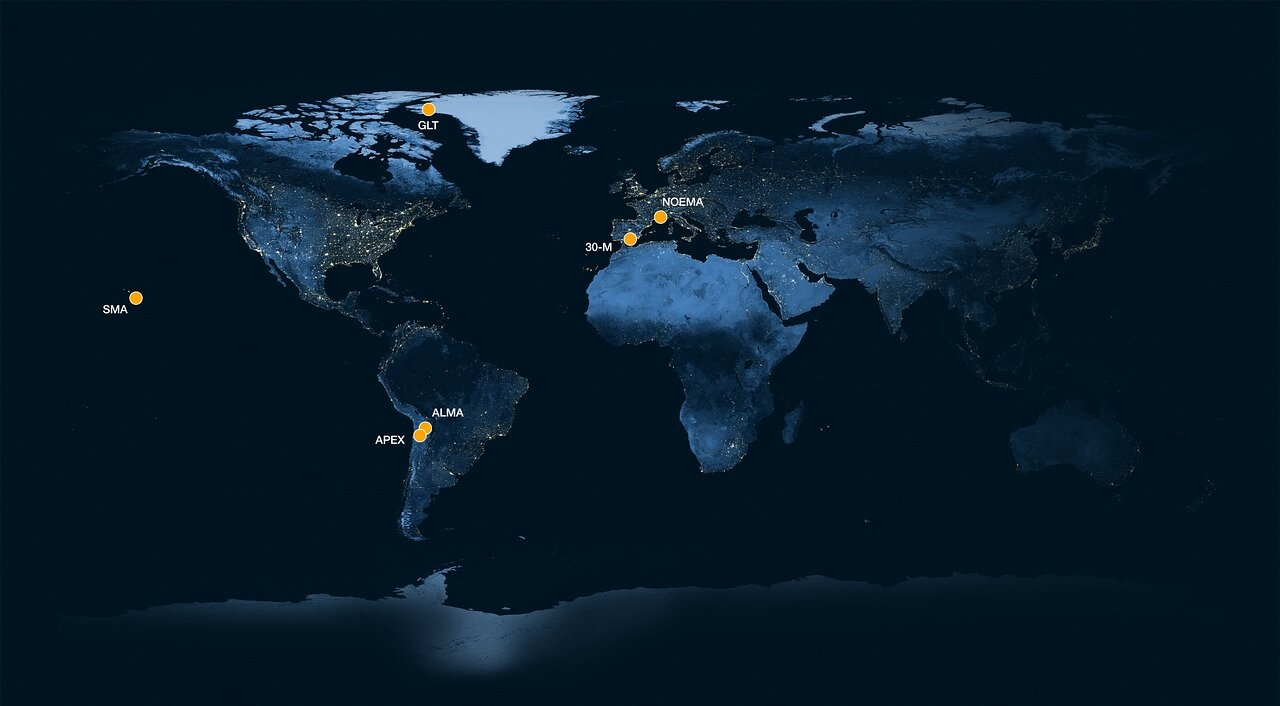
The locations of the observatories that participated in the groundbreaking Event Horizon Telescope very long baseline interferometry experiment at the short wavelength of 0.87mm. (Image credit: ESO/M. Kornmesser)
As for those observing sites, this particular VLBI experiment involved both the Atacama Large Millimeter/submillimeter Array ([ALMA](https://www.space.com/25534-alma.html)) and the Atacama Pathfinder Experiment in Chile, the Institute for Radio Astronomy in the Millimeter Range (IRAM) 30-meter telescope in Spain, the Northern Extended Millimeter Array (NOEMA) in France, the Submillimeter Array (SMA) on Mauna Kea in Hawaii and the Greenland Telescope, all of which are stations for the EHT. Probing numerous [quasars](https://www.space.com/17262-quasar-definition.html) at 0.87mm, they achieved a resolution of 19 microarcseconds.
How small is 19 microarcseconds? Well, the sky is divided into 360 degrees, with each degree consisting of 60 arcminutes, and each arcminute is further subdivided into 60 arcseconds. A microarcsecond is a millionth of an arcsecond, so 19 microarcseconds is like being able to resolve a bottle-top on the surface of [the moon](https://www.space.com/55-earths-moon-formation-composition-and-orbit.html). It's the greatest resolution for an astronomical image ever achieved solely from the surface of the [Earth](https://www.space.com/54-earth-history-composition-and-atmosphere.html) (although combinations of ground- and space-based telescopes have achieved similar resolutions in the past). Raymond and his colleagues actually think the EHT could resolve down to just 13 arcseconds when operating at full capacity (for example, with the inclusion of the South Pole Telescope, which was not involved in the 0.87mm test).
What to read next
- [ NASA X-ray spacecraft stares into the 'eye of the storm' swirling around supermassive black holes](https://www.space.com/astronomy/black-holes/nasa-x-ray-spacecraft-stares-into-the-eye-of-the-storm-swirling-around-supermassive-black-holes)
- [ This is the sharpest view ever seen of a black hole's dusty disk](https://www.space.com/astronomy/james-webb-space-telescope/this-is-the-sharpest-view-ever-seen-of-a-black-holes-dusty-disk)
- [ Astronomers watch 2 supermassive black holes caught in a twisted dance with never-before-seen jet behavior](https://www.space.com/astronomy/black-holes/astronomers-watch-2-supermassive-black-holes-caught-in-a-twisted-dance-with-never-before-seen-jet-behavior)
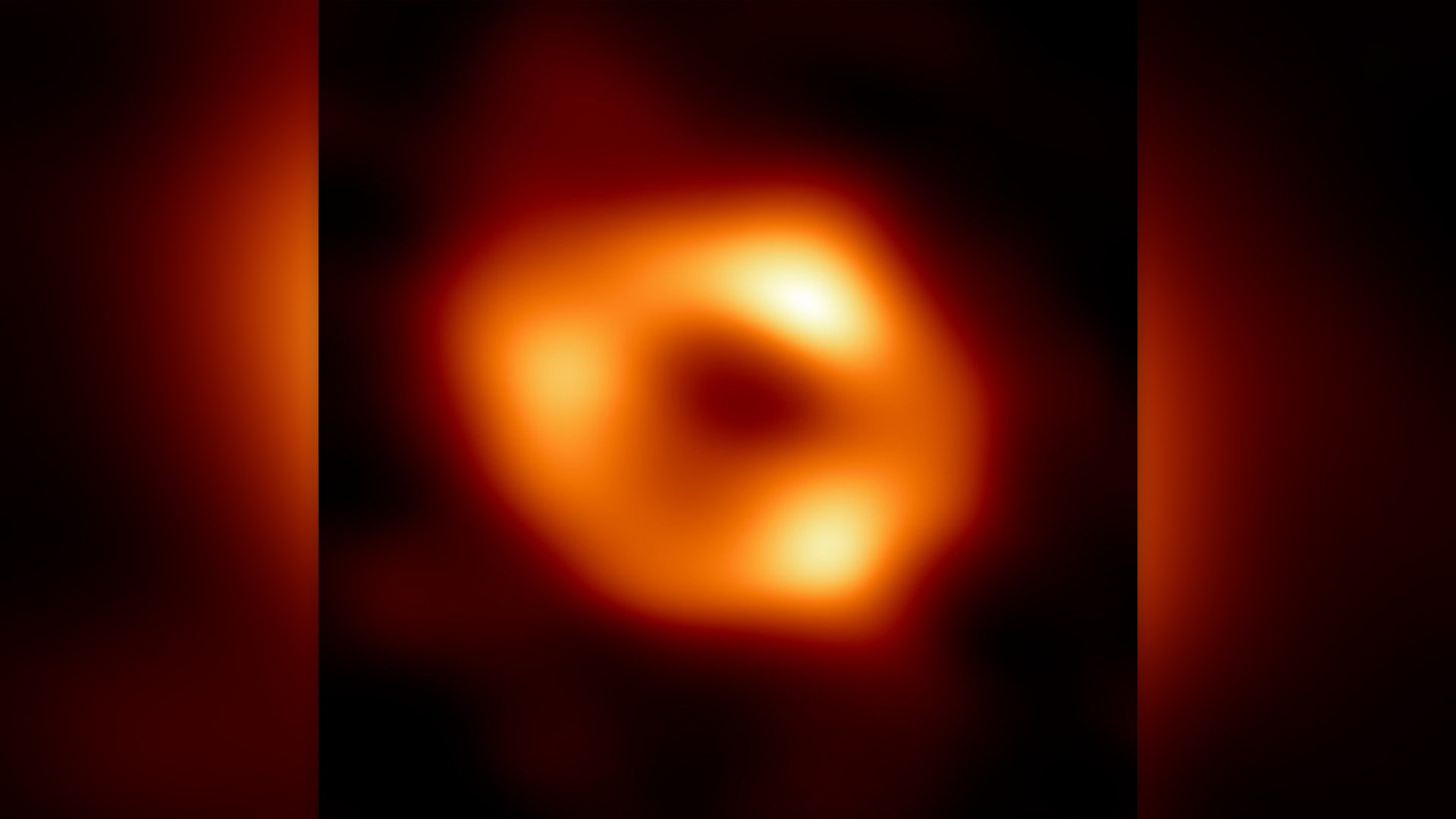
The Event Horizon Telescope’s image of our Milky Way’s supermassive black hole, at a wavelength of 1.3mm. (Image credit: EHT Collaboration)
The intention now is to apply this breakthrough while taking new images of Sagittarius A\* and the supermassive black hole in M87.
"The time is right, as the new detections prove, to advance to 0.87mm," said Remo Tilanus of the University of Arizona, who is the EHT's Operations Manager.
The greater resolution won't just sharpen the image of the photon ring around each black hole, but also more precisely depict their shape and size, allowing more accurate estimates of the black holes' spin rates and angle to us. It will also bring into range supermassive black holes in other galaxies, and allow us to see closer to the base of relativistic jets shooting out from active black holes such as in quasars. This could provide more answers into how a black hole's [magnetic field](https://www.space.com/earths-magnetic-field-explained) produces jets that move at almost the [speed of light](https://www.space.com/15830-light-speed.html) and extend out into deep space for thousands of [light-years](https://www.space.com/light-year.html).
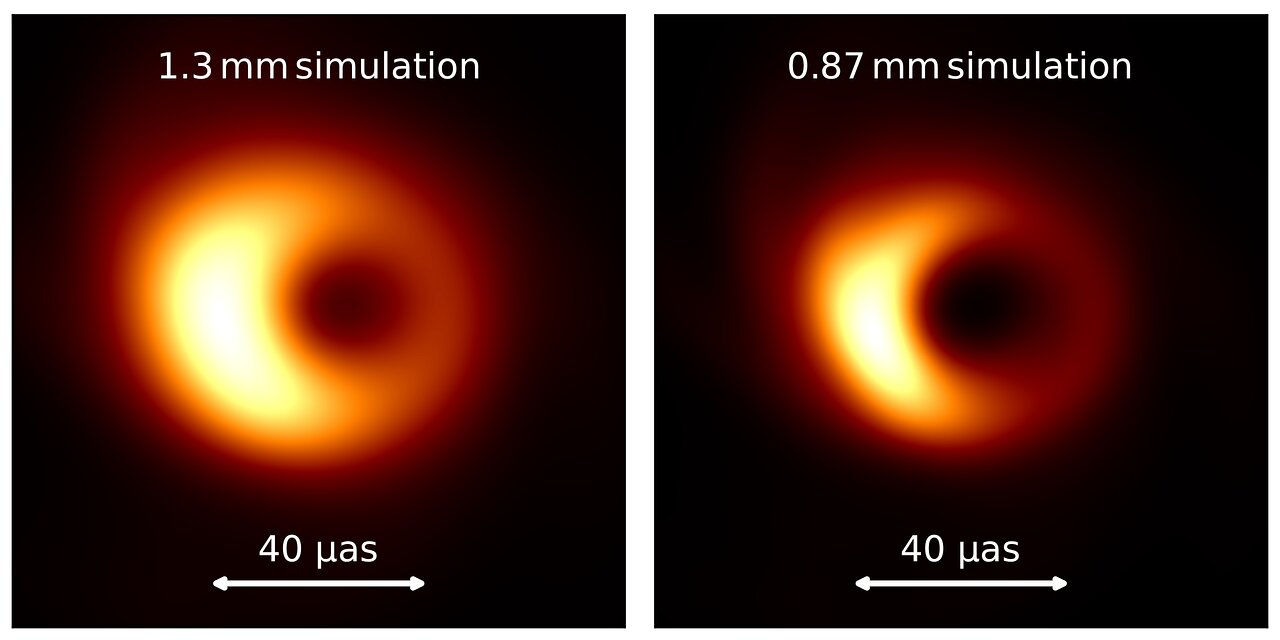
A simulation showing the difference in sharpness between observations of a black hole at 1.3mm and at 0.87mm. (Image credit: Christian M. Fromm, Julius-Maximilian University, Würzburg)
In addition to now being able to operate at a shorter wavelength, there are plans in place for major modifications to the EHT, in a program called "next generation EHT," or "ngEHT" for short. This will add new telescopes to the existing EHT infrastructure at locations around the world optimized to provide the greatest baselines and sensitivity, as well as improve detector facilities at the existing members of the collaboration so they can observe black holes at multiple wavelengths between 3mm and 0.87mm simultaneously.
Related Stories:
— [Event Horizon Telescope spies jets erupting from nearby supermassive black hole](https://www.space.com/supermassive-black-hole-eruption-gravity-battles-magnetism)
— [New view of the supermassive black hole at the heart of the Milky Way hints at an exciting hidden feature (image)](https://www.space.com/black-hole-milky-way-new-image-hidden-feature)
— [In the last 25 years, black hole physicists have uncovered the unimaginable](https://www.space.com/black-hole-25th-anniversary-space)
All in all, the next generation EHT is expected to increase the sharpness and clarity of black hole images by a factor of 10, perhaps even enabling high-resolution movies showing changes in the photon ring around a black hole's event horizon over [time](https://www.space.com/time-how-it-works) as the black hole spins and accretes more matter from the surrounding [space](https://www.space.com/24870-what-is-space.html).
"These VLBI signal detections at 0.87mm are groundbreaking since they open a new observing window for the study of supermassive black holes," said Thomas Krichbaum of the Max Planck Institute for Radio Astronomy in Germany in a [statement](https://www.eso.org/public/unitedkingdom/news/eso2411/) issued by the European Southern Observatory.
The results of this groundbreaking VLBI experiment were published on Aug. 27 in [The Astronomical Journal](https://iopscience.iop.org/article/10.3847/1538-3881/ad5bdb).
**Share your thoughts**
0
0
0
0
Random QuizPlay a Random Quiz
Filter by Category
Join the community
Join the Space.com Family! The best way to keep in touch and to be informed of our latest quizzes and competitions, as well as news and offers.
I'm in\!
Not right now
Already have an account? Log in
This page will close automatically once you have completed the authorisation process
My Details
Update your details below...
Keep in the Know
Would you like to be kept informed about new quizzes and offers from Future and its partners?
OK
Validate Your Mobile No.
We have sent a code to . Please enter it below to verify your account.
Update Your Mobile No.
You may enter a new mobile number below. You will be sent a verification code to the phone number you provide.
embed-reactions.hint\_heading
embed-reactions.hint\_subheading
Validate Your Email Address
We have sent a code to . Please enter it below to verify your account.
Update Your Email Address
You may enter a new email address below. You will be sent a verification code to the address you provide.
Create a Username
This will be publicly viewable so make it something you like\!
Reset your password
Enter your email address below. If it is registered with us, we will email you a code that will allow you to reset your password.
Check your inbox
If your email address was found in our system, you should receive an email in the next few minutes containing a code. Enter that code below to reset your password.
Set new password
Please enter your new password below.
Leaderboard
| Rank | Player | Score | Time |
|---|---|---|---|
Log In or Register
More Quizzes
Log Out

[Keith Cooper](https://www.space.com/author/keith-cooper)
Social Links Navigation
Contributing writer
Keith Cooper is a freelance science journalist and editor in the United Kingdom, and has a degree in physics and astrophysics from the University of Manchester. He's the author of "The Contact Paradox: Challenging Our Assumptions in the Search for Extraterrestrial Intelligence" (Bloomsbury Sigma, 2020) and has written articles on astronomy, space, physics and astrobiology for a multitude of magazines and websites.
Read more
[ Black Holes Astronomers watch 1st black hole ever imaged launch a 3,000‑light‑year‑long cosmic jet from its glowing 'shadow'](https://www.space.com/astronomy/black-holes/astronomers-watch-1st-black-hole-ever-imaged-launch-a-3-000-light-year-long-cosmic-jet-from-its-glowing-shadow "Astronomers watch 1st black hole ever imaged launch a 3,000‑light‑year‑long cosmic jet from its glowing 'shadow'")
[ Dark Universe Could the Milky Way galaxy's supermassive black hole actually be a clump of dark matter?](https://www.space.com/astronomy/dark-universe/could-the-milky-way-galaxys-supermassive-black-hole-actually-be-a-clump-of-dark-matter "Could the Milky Way galaxy's supermassive black hole actually be a clump of dark matter?")
[ Galaxies World's largest radio telescope array pierces heart of our Milky Way: 'This is just the beginning'](https://www.space.com/astronomy/galaxies/worlds-largest-radio-telescope-array-pierces-heart-of-our-milky-way-this-is-just-the-beginning "World's largest radio telescope array pierces heart of our Milky Way: 'This is just the beginning'")
[ Black Holes NASA X-ray spacecraft stares into the 'eye of the storm' swirling around supermassive black holes](https://www.space.com/astronomy/black-holes/nasa-x-ray-spacecraft-stares-into-the-eye-of-the-storm-swirling-around-supermassive-black-holes "NASA X-ray spacecraft stares into the 'eye of the storm' swirling around supermassive black holes")
[ James Webb Space Telescope This is the sharpest view ever seen of a black hole's dusty disk](https://www.space.com/astronomy/james-webb-space-telescope/this-is-the-sharpest-view-ever-seen-of-a-black-holes-dusty-disk "This is the sharpest view ever seen of a black hole's dusty disk")
[ Black Holes Astronomers watch 2 supermassive black holes caught in a twisted dance with never-before-seen jet behavior](https://www.space.com/astronomy/black-holes/astronomers-watch-2-supermassive-black-holes-caught-in-a-twisted-dance-with-never-before-seen-jet-behavior "Astronomers watch 2 supermassive black holes caught in a twisted dance with never-before-seen jet behavior")
Latest in Black Holes
[ Black Holes Could our universe exist because black holes ate up all the antimatter?](https://www.space.com/astronomy/black-holes/could-our-universe-exist-because-black-holes-ate-up-all-the-antimatter "Could our universe exist because black holes ate up all the antimatter?")
[ Black Holes X-ray spacecraft watches monster black hole wake up and fire cosmic bullets at starburst galaxy](https://www.space.com/astronomy/black-holes/x-ray-spacecraft-watches-monster-black-hole-wake-up-and-fire-cosmic-bullets-at-starburst-galaxy "X-ray spacecraft watches monster black hole wake up and fire cosmic bullets at starburst galaxy")
[ Black Holes Black hole and neutron star mergers push the laws of physics with their odd orbits](https://www.space.com/astronomy/black-holes/black-hole-and-neutron-star-mergers-push-the-laws-of-physics-with-their-odd-orbits "Black hole and neutron star mergers push the laws of physics with their odd orbits")
[ Black Holes The universe is humming with ripples in spacetime: Scientists just doubled our catalog of black hole and neutron star collisions](https://www.space.com/astronomy/black-holes/the-universe-is-humming-with-ripples-in-spacetime-scientists-just-doubled-our-catalog-of-black-hole-and-neutron-star-collisions "The universe is humming with ripples in spacetime: Scientists just doubled our catalog of black hole and neutron star collisions")
[ Black Holes Black holes! Supernovas! Merging galaxies! Oh my! Largest radio survey of the cosmos ever reveals 13.7 million powerful cosmic objects and events](https://www.space.com/astronomy/black-holes/black-holes-supernovas-merging-galaxies-oh-my-largest-radio-survey-of-the-cosmos-ever-reveals-13-7-million-powerful-cosmic-objects-and-events "Black holes! Supernovas! Merging galaxies! Oh my! Largest radio survey of the cosmos ever reveals 13.7 million powerful cosmic objects and events")
[ Black Holes Starlight warped in the fabric of spacetime could help us find hidden black holes dancing together](https://www.space.com/astronomy/black-holes/starlight-warped-in-the-fabric-of-spacetime-could-help-us-find-hidden-black-holes-dancing-together "Starlight warped in the fabric of spacetime could help us find hidden black holes dancing together")
Latest in News
[ Missions 'We are ready': NASA still on track to launch Artemis 2 astronauts to the moon April 1](https://www.space.com/space-exploration/missions/we-are-ready-nasa-still-on-track-to-launch-artemis-2-astronauts-to-the-moon-april-1 "'We are ready': NASA still on track to launch Artemis 2 astronauts to the moon April 1")
[ Space Movies & Shows This Week In Space podcast: Episode 203 — China Rising](https://www.space.com/entertainment/space-movies-shows/this-week-in-space-podcast-episode-203-china-rising "This Week In Space podcast: Episode 203 — China Rising")
[ Artemis What time is NASA's Artemis 2 moon launch on April 1?](https://www.space.com/space-exploration/artemis/nasa-artemis-2-moon-launch-what-time "What time is NASA's Artemis 2 moon launch on April 1?")
[ Space Movies & Shows Where should we send a real 'Hail Mary' spacecraft? A new study has the answers](https://www.space.com/entertainment/space-movies-shows/where-could-we-send-a-real-hail-mary-spacecraft-a-new-study-has-the-answers "Where should we send a real 'Hail Mary' spacecraft? A new study has the answers")
[ Human Spaceflight Can humans have babies in space? It may be harder than expected](https://www.space.com/space-exploration/human-spaceflight/having-babies-in-space-may-be-harder-than-expected "Can humans have babies in space? It may be harder than expected")
[ Saturn Are Saturn's rings made of a lost, shattered moon? New evidence arises for the case](https://www.space.com/astronomy/saturn/are-saturns-rings-made-of-a-lost-shattered-moon-new-evidence-arises-for-the-case "Are Saturn's rings made of a lost, shattered moon? New evidence arises for the case")
MORE FROM SPACE...
1. [](https://www.space.com/space-exploration/artemis/how-will-artemis-2-be-different-from-nasas-apollo-moon-missions "How will Artemis 2 be different from NASA's Apollo moon missions?")
1
[How will Artemis 2 be different from NASA's Apollo moon missions?](https://www.space.com/space-exploration/artemis/how-will-artemis-2-be-different-from-nasas-apollo-moon-missions)
2. 2
[Finished Starfleet Academy? Explore the animated antics of Star Trek: Lower Decks for just \$2.99 a month](https://www.space.com/entertainment/space-movies-shows/finished-starfleet-academy-explore-the-animated-antics-of-star-trek-lower-decks-for-just-2-99-a-month)
3. 3
[Watch SpaceX launch 119 payloads to orbit from California early on March 30](https://www.space.com/space-exploration/launches-spacecraft/spacex-transporter-16-rideshare-mission-launch)
4. 4
['We are ready': NASA still on track to launch Artemis 2 astronauts to the moon April 1](https://www.space.com/space-exploration/missions/we-are-ready-nasa-still-on-track-to-launch-artemis-2-astronauts-to-the-moon-april-1)
5. 5
['Warhammer 40,000: Dawn of War 4': Release date, plot, factions, & everything else we know about the upcoming 40K strategy game](https://www.space.com/entertainment/space-games/warhammer-40-000-dawn-of-war-4-release-date-plot-factions-and-everything-else-we-know-about-the-upcoming-40k-strategy-game)
Space is part of Future US Inc, an international media group and leading digital publisher. [Visit our corporate site](https://futureplc.com/).
[ Add as a preferred source on Google](https://google.com/preferences/source?q=space.com)
- [About Us](https://www.space.com/41418-about-us.html)
- [Contact Future's experts](https://futureplc.com/contact/)
- [Terms and conditions](https://futureplc.com/terms-conditions/)
- [Privacy policy](https://futureplc.com/privacy-policy/)
- [Cookies policy](https://futureplc.com/cookies-policy/)
- [Accessibility Statement](https://futureplc.com/accessibility-statement/)
- [Advertise with us](https://go.future-advertising.com/Spacecom-Media-Kit.html)
- [Web notifications](https://www.space.com/how-to-turn-off-web-notifications-for-chrome-macos.html)
- [Careers](https://futureplc.com/careers/)
- [Do not sell or share my personal information](https://www.space.com/privacy-portal)
© Future US, Inc. Full 7th Floor, 130 West 42nd Street, New York, NY 10036.
Close
Please login or signup to comment
Please wait...
Login
Sign Up |
| Readable Markdown | The [Event Horizon Telescope](https://www.space.com/event-horizon-telescope.html) (EHT), which is a collaboration of radio telescopes all around the world that operate in unison to image [supermassive black holes](https://www.space.com/supermassive-black-hole), has achieved its finest resolution yet. In the future, this accomplishment could lead to images of the ring of light around a [black hole's](https://www.space.com/15421-black-holes-facts-formation-discovery-sdcmp.html) [event horizon](https://www.space.com/black-holes-event-horizon-explained.html) that are 50% sharper, resolving hitherto unseen details and producing movies of how the black holes change as they spin.
The EHT works on the principle of "very long baseline interferometry," or VLBI for short. This involves tapping into a network of telescopes across continents that all work collectively to observe the same object, combining their data in the process. The wider the distance between the two farthest telescopes in the network, the greater the resolution, and the more telescopes there are in the network, the greater the sensitivity.
The EHT managed to [image](https://www.space.com/milky-way-black-hole-sagittarius-a-pictures) the black hole in the center of our [Milky Way galaxy](https://www.space.com/19915-milky-way-galaxy.html), [Sagittarius A\*](https://www.space.com/sagittarius-a), as well as the black hole in the center of the elliptical galaxy M87, M87\* — marking the first two black hole images captured by humanity — because it has a huge baseline. Think of the baseline as being the telescope's aperture. The EHT's most southern telescope is the South Pole Telescope, while its most northern station is the Greenland Telescope, which means the network spans almost top to bottom of the planet.
Article continues below
Along with the baseline factor, wavelength has a role to play, with lower wavelengths achieving higher resolution. The historic images of the black hole at the center of our galaxy and M87 were captured at a radio wavelength of 1.3mm. At this wavelength, the "photon ring," which is the torus of emission around the event horizon with the black hole's dark shadow inside it, appears blurred — particularly in the case of Sagittarius A\*. This is because the radio emission coming from the black hole is being partially scattered by ionized gas in the [interstellar medium](https://www.space.com/interstellar-space-definition-explanation) between us and the object itself. This results in the light becoming smeared across an angular scale, comparable to the resolution of the EHT at 1.3mm. The smearing effect would be drastically less apparent at shorter wavelengths.
**Related:** [**Stunning Photos of Our Milky Way Galaxy (Gallery)**](https://www.space.com/14249-milkyway-galaxy-photos.html)
To this end, for the first time ever, the EHT has been able to conduct VLBI at a shorter wavelength of 0.87mm.
"With the EHT, we saw the first images of black holes by detecting radio waves at the 1.3mm wavelength, but the bright ring we saw, formed by light bending in the black hole's [gravity](https://www.space.com/classical-gravity.html), still looked blurry because we were at the absolute limits of how sharp we could make the images," said Alexander Raymond, of NASA's [Jet Propulsion Laboratory](https://www.space.com/16952-nasa-jet-propulsion-laboratory.html), in a [statement](https://eventhorizontelescope.org/blog/eht-makes-highest-resolution-black-hole-detections-earth). "At 0.87mm, our images will be sharper and more detailed, which in turn will likely reveal new properties, both those that were previously predicted and maybe some that weren't."
Breaking space news, the latest updates on rocket launches, skywatching events and more\!
Achieving VLBI at 0.87mm is not an easy thing, hence why it hasn't been accomplished before. One of the difficulties has to do with water vapor in the atmosphere tending to absorb radio waves at this short wavelength, so weather would have to be very dry at all the EHT's observing sites.

The locations of the observatories that participated in the groundbreaking Event Horizon Telescope very long baseline interferometry experiment at the short wavelength of 0.87mm. (Image credit: ESO/M. Kornmesser)
As for those observing sites, this particular VLBI experiment involved both the Atacama Large Millimeter/submillimeter Array ([ALMA](https://www.space.com/25534-alma.html)) and the Atacama Pathfinder Experiment in Chile, the Institute for Radio Astronomy in the Millimeter Range (IRAM) 30-meter telescope in Spain, the Northern Extended Millimeter Array (NOEMA) in France, the Submillimeter Array (SMA) on Mauna Kea in Hawaii and the Greenland Telescope, all of which are stations for the EHT. Probing numerous [quasars](https://www.space.com/17262-quasar-definition.html) at 0.87mm, they achieved a resolution of 19 microarcseconds.
How small is 19 microarcseconds? Well, the sky is divided into 360 degrees, with each degree consisting of 60 arcminutes, and each arcminute is further subdivided into 60 arcseconds. A microarcsecond is a millionth of an arcsecond, so 19 microarcseconds is like being able to resolve a bottle-top on the surface of [the moon](https://www.space.com/55-earths-moon-formation-composition-and-orbit.html). It's the greatest resolution for an astronomical image ever achieved solely from the surface of the [Earth](https://www.space.com/54-earth-history-composition-and-atmosphere.html) (although combinations of ground- and space-based telescopes have achieved similar resolutions in the past). Raymond and his colleagues actually think the EHT could resolve down to just 13 arcseconds when operating at full capacity (for example, with the inclusion of the South Pole Telescope, which was not involved in the 0.87mm test).

The Event Horizon Telescope’s image of our Milky Way’s supermassive black hole, at a wavelength of 1.3mm. (Image credit: EHT Collaboration)
The intention now is to apply this breakthrough while taking new images of Sagittarius A\* and the supermassive black hole in M87.
"The time is right, as the new detections prove, to advance to 0.87mm," said Remo Tilanus of the University of Arizona, who is the EHT's Operations Manager.
The greater resolution won't just sharpen the image of the photon ring around each black hole, but also more precisely depict their shape and size, allowing more accurate estimates of the black holes' spin rates and angle to us. It will also bring into range supermassive black holes in other galaxies, and allow us to see closer to the base of relativistic jets shooting out from active black holes such as in quasars. This could provide more answers into how a black hole's [magnetic field](https://www.space.com/earths-magnetic-field-explained) produces jets that move at almost the [speed of light](https://www.space.com/15830-light-speed.html) and extend out into deep space for thousands of [light-years](https://www.space.com/light-year.html).

A simulation showing the difference in sharpness between observations of a black hole at 1.3mm and at 0.87mm. (Image credit: Christian M. Fromm, Julius-Maximilian University, Würzburg)
In addition to now being able to operate at a shorter wavelength, there are plans in place for major modifications to the EHT, in a program called "next generation EHT," or "ngEHT" for short. This will add new telescopes to the existing EHT infrastructure at locations around the world optimized to provide the greatest baselines and sensitivity, as well as improve detector facilities at the existing members of the collaboration so they can observe black holes at multiple wavelengths between 3mm and 0.87mm simultaneously.
Related Stories:
All in all, the next generation EHT is expected to increase the sharpness and clarity of black hole images by a factor of 10, perhaps even enabling high-resolution movies showing changes in the photon ring around a black hole's event horizon over [time](https://www.space.com/time-how-it-works) as the black hole spins and accretes more matter from the surrounding [space](https://www.space.com/24870-what-is-space.html).
"These VLBI signal detections at 0.87mm are groundbreaking since they open a new observing window for the study of supermassive black holes," said Thomas Krichbaum of the Max Planck Institute for Radio Astronomy in Germany in a [statement](https://www.eso.org/public/unitedkingdom/news/eso2411/) issued by the European Southern Observatory.
The results of this groundbreaking VLBI experiment were published on Aug. 27 in [The Astronomical Journal](https://iopscience.iop.org/article/10.3847/1538-3881/ad5bdb).
**Share your thoughts**
0
0
0
0
Join the community
Join the Space.com Family! The best way to keep in touch and to be informed of our latest quizzes and competitions, as well as news and offers.
Already have an account? Log in
My Details
Update your details below...
Keep in the Know
Would you like to be kept informed about new quizzes and offers from Future and its partners?
Validate Your Mobile No.
We have sent a code to . Please enter it below to verify your account.
Update Your Mobile No.
You may enter a new mobile number below. You will be sent a verification code to the phone number you provide.
embed-reactions.hint\_heading
embed-reactions.hint\_subheading
Validate Your Email Address
We have sent a code to . Please enter it below to verify your account.
Update Your Email Address
You may enter a new email address below. You will be sent a verification code to the address you provide.
Create a Username
This will be publicly viewable so make it something you like\!
Reset your password
Enter your email address below. If it is registered with us, we will email you a code that will allow you to reset your password.
Check your inbox
If your email address was found in our system, you should receive an email in the next few minutes containing a code. Enter that code below to reset your password.
Set new password
Please enter your new password below.
Leaderboard
| Rank | Player | Score | Time |
|---|---|---|---|
Keith Cooper is a freelance science journalist and editor in the United Kingdom, and has a degree in physics and astrophysics from the University of Manchester. He's the author of "The Contact Paradox: Challenging Our Assumptions in the Search for Extraterrestrial Intelligence" (Bloomsbury Sigma, 2020) and has written articles on astronomy, space, physics and astrobiology for a multitude of magazines and websites. |
| Shard | 8 (laksa) |
| Root Hash | 7770394665477845008 |
| Unparsed URL | com,space!www,/event-horizon-black-hole-image-tests s443 |