ℹ️ Skipped - page is already crawled
| Filter | Status | Condition | Details |
|---|---|---|---|
| HTTP status | PASS | download_http_code = 200 | HTTP 200 |
| Age cutoff | PASS | download_stamp > now() - 6 MONTH | 0 months ago |
| History drop | PASS | isNull(history_drop_reason) | No drop reason |
| Spam/ban | PASS | fh_dont_index != 1 AND ml_spam_score = 0 | ml_spam_score=0 |
| Canonical | PASS | meta_canonical IS NULL OR = '' OR = src_unparsed | Not set |
| Property | Value |
|---|---|
| URL | https://www.space.com/black-hole-milky-way-new-image-hidden-feature |
| Last Crawled | 2026-04-09 00:00:50 (1 day ago) |
| First Indexed | 2024-03-27 13:01:12 (2 years ago) |
| HTTP Status Code | 200 |
| Meta Title | New view of the supermassive black hole at the heart of the Milky Way hints at an exciting hidden feature (photo) | Space |
| Meta Description | Astronomers have for the first time imaged the powerful magnetic fields that dwell around the supermassive black hole at the heart of the Milky Way, Sagittarius A*. |
| Meta Canonical | null |
| Boilerpipe Text | Astronomers have captured the first view of polarized light and the magnetic fields that surround Sagittarius A* (Sgr A*), the supermassive black hole at the heart of the Milly Way.
The new EHT observation of
Sgr A*
, therefore, suggests that strong and well-organized magnetic fields could be common to all black holes. Also, because M87*'s magnetic fields drive powerful outflows or "jets," the results hint that Sgr A* could have a hidden and faint jet all of its own.
Related:
James Webb Space Telescope finds 'extremely red' supermassive black hole growing in the early universe
The supermassive black hole at the heart of the Milky Way Sgr A* seen in polarized light for the first time.
(Image credit: EHT Collaboration)
"This new image of the black hole at the center of our Milky Way, Sgr A*, tells us that near the black hole are strong, twisted, and ordered magnetic fields," Sara Issaoun, research co-leader and NASA Hubble Fellowship Program Einstein Fellow at the Center for Astrophysics (CfA) at Harvard & Smithsonian told Space.com "For a while, we've believed that magnetic fields play a key role in how black holes feed and eject matter in powerful jets.
"This new image, along with a strikingly similar polarization structure seen in the much larger and more powerful M87* black hole, shows that strong and ordered magnetic fields are critical to how black holes interact with the gas and matter around them."
Comparing the magnetism of two monster black holes
The EHT is comprised of many telescopes across the globe, including the
Atacama Large Millimeter/submillimeter Array (ALMA)
, which come together to form an Earth-sized telescope that is no stranger to making scientific history.
Breaking space news, the latest updates on rocket launches, skywatching events and more!
In 2017, the EHT captured the first image of a black hole and its environment,
imaging M87*
located around 53.5 million light-years from Earth. Two years after this image was revealed to the public in 2019, the EHT collaboration revealed the first look at
polarized light around a black hole, M87*
, once again.
Polarization happens when the orientation waves of light are directed at a particular angle. The magnetic fields generated by plasma whipping around black holes polarize light at a 90-degree angle to themselves. That means observing the polarization around M87* allowed scientists to "see" the magnetic fields around a black hole for the first time.
The Event Horizon Telescope's first image of the supermassive black hole M87*.
(Image credit: EHT Collaboration)
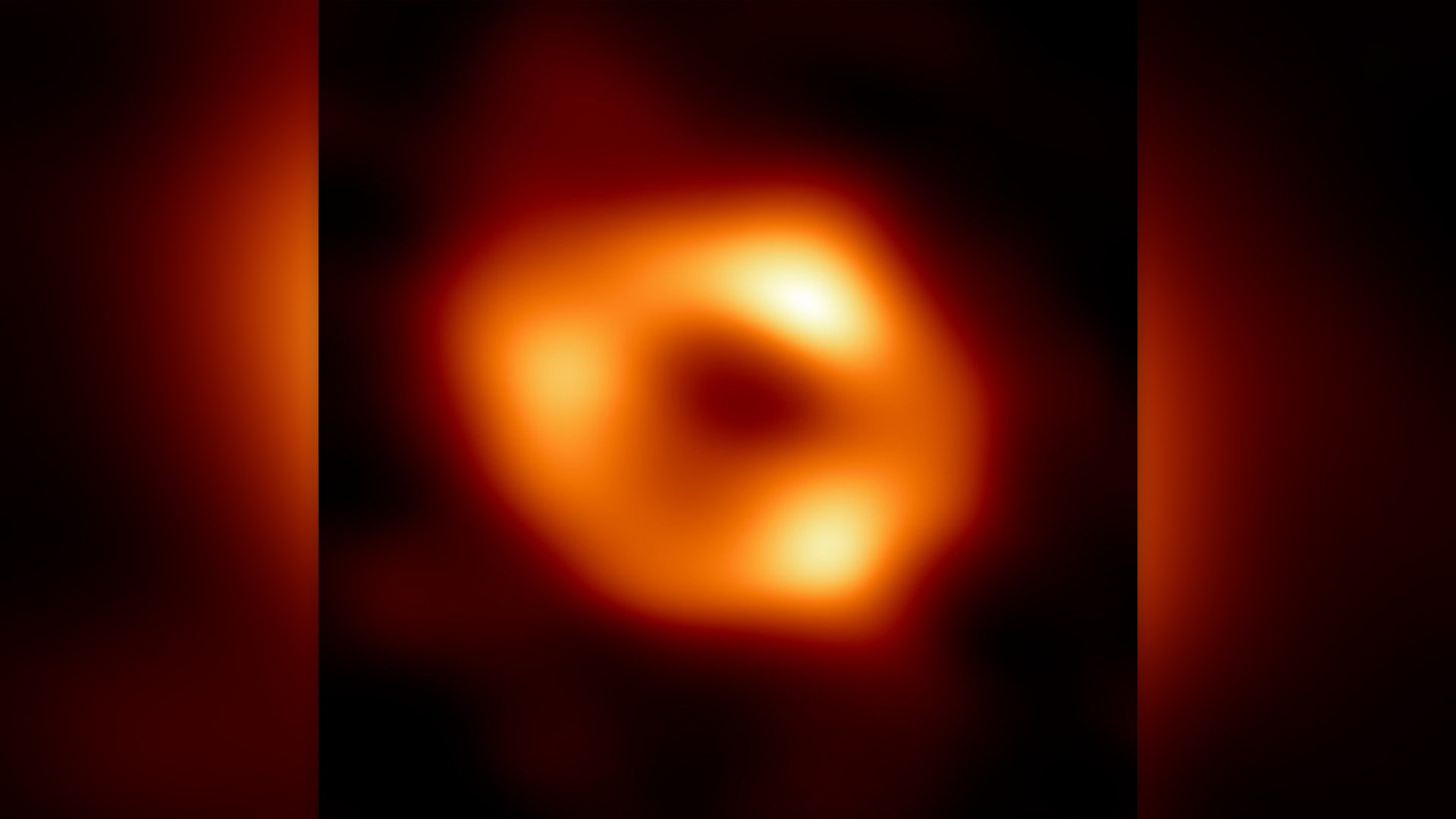
This was followed in 2022 by the revelation that the EHT had also imaged a supermassive black hole much closer to
Earth
at just 27,000 light-years away, Sgr A*, the black hole around which the Milky Way is sculpted.
An image of Sagittarius A*, the supermassive black hole at the heart of the Milky Way taken using the Event Horizon Telescope.
(Image credit: EHT Collaboration)
Now, the EHT has finally provided scientists with an image of polarized light and, thus, the magnetic fields around this supermassive black hole.
"Polarized light is what teaches us about magnetic fields, the properties of the gas, and mechanisms that take place as a black hole feeds," Issaoun said. "Given the additional challenges to image Sgr A*, it is honestly surprising enough that we were able to get a polarization image in the first place!"
These challenges arose despite Sgr A* being closer to Earth, because the smaller size of the Milky Way's supermassive black hole means that the material that whips around it at near
light-speeds
is difficult to image. M87* is much larger, meaning the material, while traveling at the same speed, more or less, takes much longer to complete a circuit, making it easier for the EHT to capture.
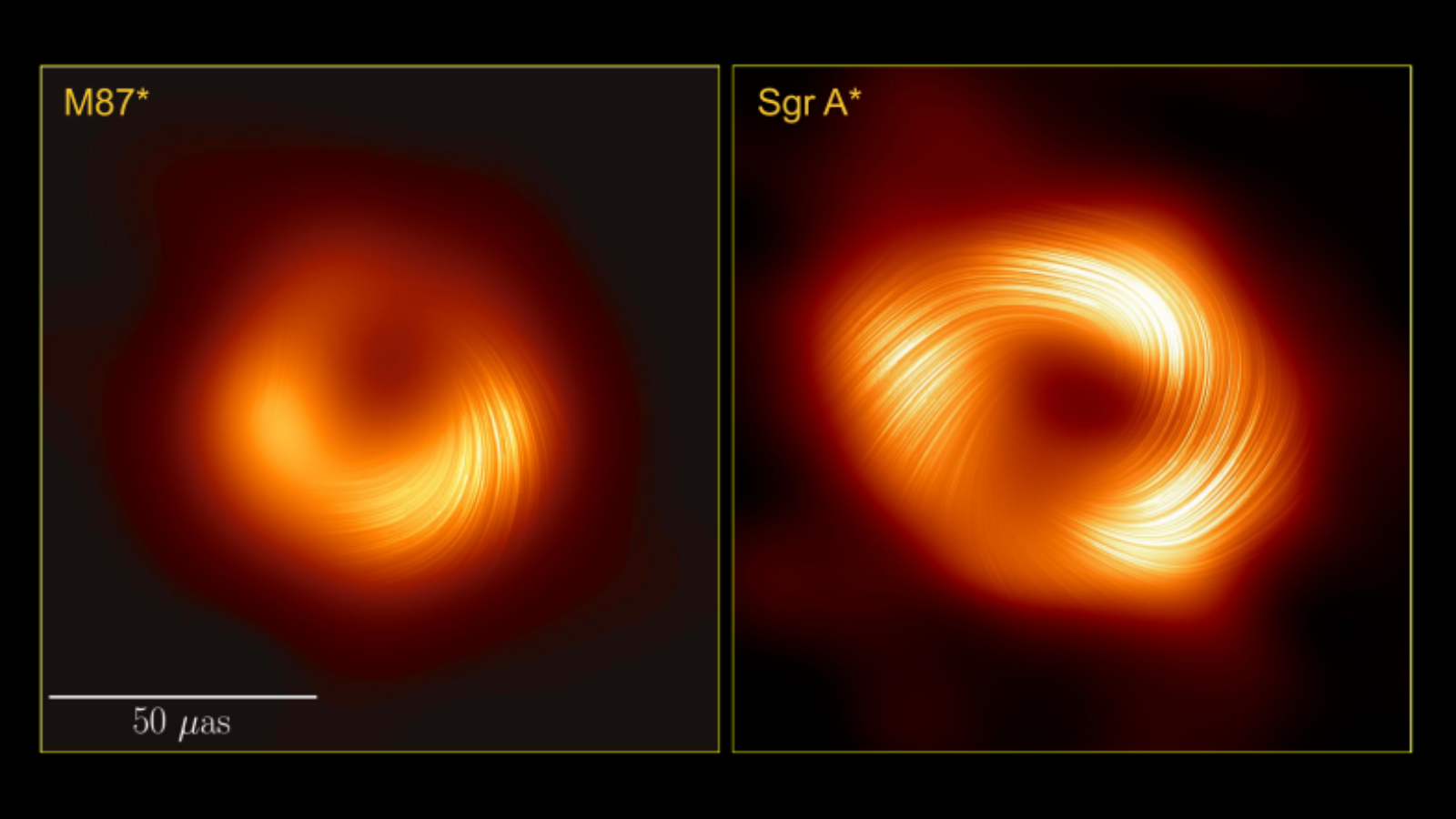
Overcoming these difficulties means a comparison can now be made between two black holes at the opposite ends of the supermassive black hole spectrum, one with billions of times the mass of the sun and another with a mass millions of times that of our star. The initial conclusion is these magnetic fields are remarkably similar to one another.
(Left) the black hole at the heart of M87 seen in polarized light. (Right) Sgr A* in polarized light showing similarities with the much more massive M87*
(Image credit: EHT Collaboration)
"This similarity was especially surprising because M87* and Sgr A* are very different
black holes
," Issaoun said. "M87* is quite a special black hole: It is 6 billion solar masses, it lives in a giant elliptical galaxy, and it ejects a powerful jet of plasma visible at all wavelengths.
"Sgr A*, on the other hand, is extremely common: It is 4 million solar masses, it lives in our ordinary spiral Milky Way galaxy, and it doesn’t seem to have a jet at all."
Issaoun explained that just by looking at the portion of the light that is polarized, the team had expected to learn about the different properties of the magnetic fields of M87* and Sgr A*.
"Perhaps one would be more ordered and strong, and the other more disordered and weak," Issaoun added. "However, because they look similar again, it is now quite clear that these two different classes of black holes have very similar magnetic field geometry!"
The results suggest a deeper investigation of Sgr A* may uncover hitherto undiscovered features.
The polarization of light and neat and strong magnetic fields of Sgr A*, and the fact that they closely resemble that of M87*, may indicate that our central black hole has been hiding a secret from us until now.
"We expect strong and ordered magnetic fields to be directly linked to the launching of jets as we observed for M87*," Issaoun explained. "Since Sgr A*, with no observed jet, seems to have a very similar geometry, perhaps there is also a jet lurking in Sgr A* waiting to be observed, which would be super exciting!"
Astronomers hadn't been terribly surprised not to see a jet from Sgr A*. That's because
M87* is surrounded by so much gas and dust
that it consumes the equivalent of two or three suns each year. That means plenty of material for its magnetic fields to channel to its poles and blast out as jets.
Sgr A*, on the other hand, consumes so little matter it is equivalent to a
human being eating one grain of rice every million years
. These observations suggest that our dieting supermassive black hole may still have a jet; it is just difficult to see.
"There is a lot of evidence of possible outflows and even jets powered by the black hole in the past, yet a jet in Sgr A* has never been imaged due to the difficult environment of the
galactic center
," Issaoun said."Finding a jet would be a major revelation about our black hole and a link to its history within our
Milky Way
."
She added that the process that launches these jets is the most energetic mechanism in the entire universe, dramatically affecting the heart of galaxies by, for instance, clearing out the gas and dust needed to birth stars and influencing how galaxies grow and evolve. That means discovering a jet emerging from Sgr A* would influence our understanding of how the
Milky Way evolved to take the shape
astronomers observe today.
"It is so striking that such large-scale damage can be caused by such a small nucleus in a galaxy, and it all starts at the edge of the central black hole, where these magnetic fields rule," Issaoun continued.
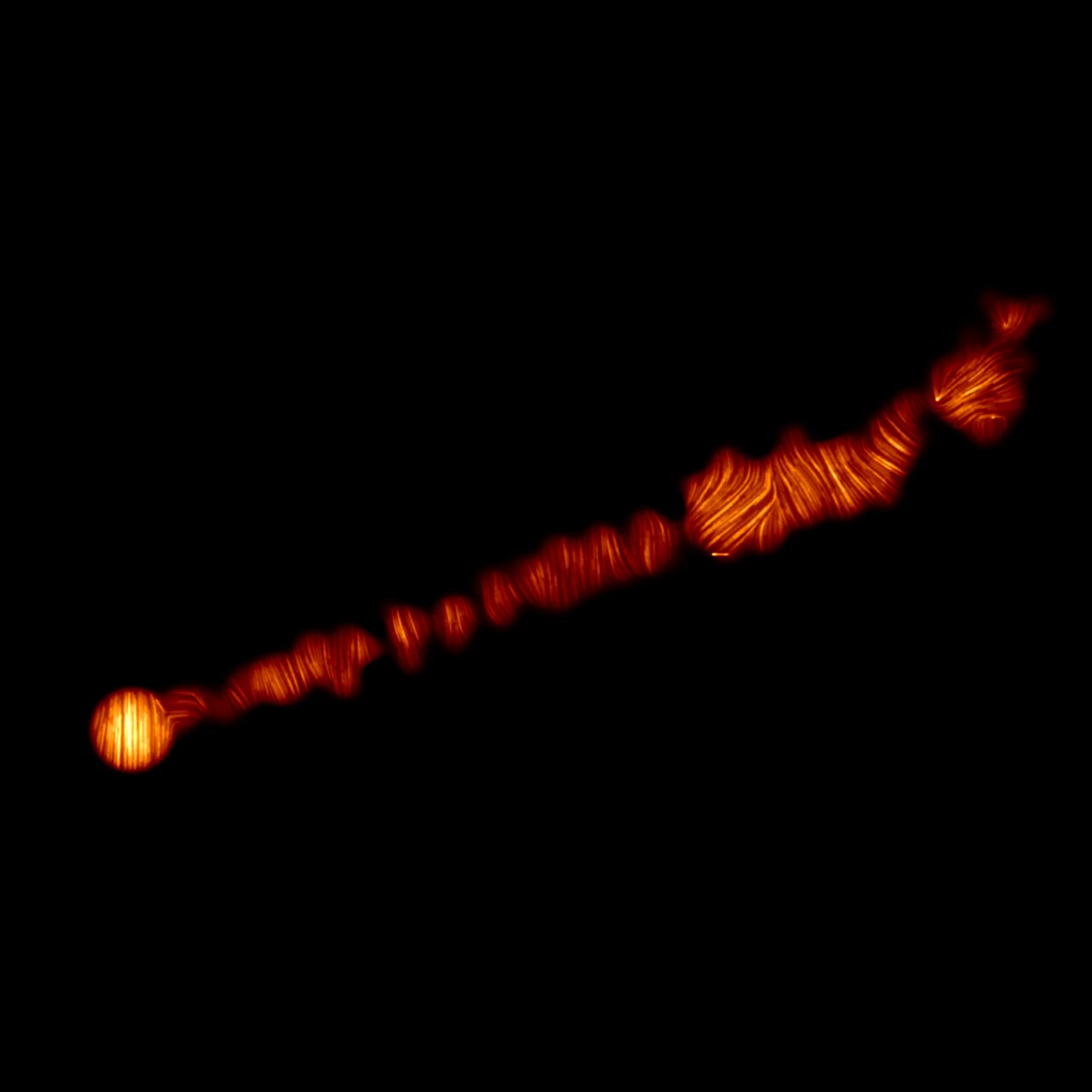
This image shows the jet in the M87 galaxy in polarized light, as captured by ALMA. This image reveals the structure of the magnetic field along the jet.
(Image credit: ALMA (ESO/NAOJ/NRAO), Goddi et al.)
Issaoun said that with these two polarized images of very different black holes, scientists now have very compelling evidence that strong magnetic fields are ubiquitous to these cosmic titans.
"The next step," she said, "involves figuring out how that geometry connects to how these systems move, evolve, and flare."
The EHT will kick off its 2024 observing campaign in early April, with the collaboration hoping to get multi-color views of familiar black holes like M87* and Sgr A* by observing them in different frequencies of light.
"In the next decade, the next-generation EHT effort aims to add more telescopes to fill in our
Earth-sized virtual mirror
and observe a lot more often," Issaoun added. "With these expansions of the EHT, we will be able to make polarized movies of black holes and will directly observe the dynamics between the M87* black hole and its jet."
Related Stories
Additionally, the CfA researcher said the EHT could eventually get some space-based help observing black holes and their dynamics. One proposed mission that could assist in this is the Black Hole Explorer (BHEX) mission concept, which adds a single space telescope to the Earth-based EHT array.
"How much black holes rotate, their spin is believed to be directly connected to why magnetic fields near the black hole look the way they look and how they can launch jets," Issaoun concluded. "With BHEX, we could image the sharp photon ring signature of black holes. This photon ring encodes properties of the spacetime around the black hole, including the black hole's spin!"
The EHT team's research was published on Wednesday (March 27) in the
Astrophysical Journal Letters
.
Share your thoughts
0
0
0
0
Join the community
Join the Space.com Family! The best way to keep in touch and to be informed of our latest quizzes and competitions, as well as news and offers.
Already have an account?
Log in
Log In
Forgotten your password?
Reset it
Not got an account?
Register
My Details
Update your details below...
Keep in the Know
Would you like to be kept informed about new quizzes and offers from Future and its partners?
Validate Your Mobile No.
We have sent a code to
. Please enter it below to verify your account.
Update mobile number
Resend code
Update Your Mobile No.
You may enter a new mobile number below. You will be sent a verification code to the phone number you provide.
Cancel
embed-reactions.hint_heading
embed-reactions.hint_subheading
Validate Your Email Address
We have sent a code to
. Please enter it below to verify your account.
Update email address
Resend code
Update Your Email Address
You may enter a new email address below. You will be sent a verification code to the address you provide.
Cancel
Create a Username
This will be publicly viewable so make it something you like!
Reset your password
Enter your email address below. If it is registered with us, we will email you a code that will allow you to reset your password.
Check your inbox
If your email address was found in our system, you should receive an email in the next few minutes containing a code. Enter that code below to reset your password.
Set new password
Please enter your new password below.
Leaderboard
Rank
Player
Score
Time
Robert Lea is a science journalist in the U.K. whose articles have been published in Physics World, New Scientist, Astronomy Magazine, All About Space, Newsweek and ZME Science. He also writes about science communication for Elsevier and the European Journal of Physics. Rob holds a bachelor of science degree in physics and astronomy from the U.K.’s Open University. Follow him on Twitter @sciencef1rst. |
| Markdown | 
[Skip to main content](https://www.space.com/black-hole-milky-way-new-image-hidden-feature#main)
Open menu
[ Space](https://www.space.com/)
[Sign up to our newsletter Newsletter](https://www.space.com/newsletter)
[RSS](https://www.space.com/feeds.xml)
Sign in
- View Profile
- Sign out
Search
- [Space Exploration](https://www.space.com/space-exploration)
- [Launches & Spacecraft](https://www.space.com/space-exploration/launches-spacecraft)
- [Private spaceflight](https://www.space.com/space-exploration/private-spaceflight)
- [Human spaceflight](https://www.space.com/space-exploration/human-spaceflight)
- [SpaceX](https://www.space.com/tag/spacex)
- [Blue Origin](https://www.space.com/tag/blue-origin)
- [Virgin Galactic](https://www.space.com/tag/virgin-galactic)
- [United Launch Alliance](https://www.space.com/tag/united-launch-alliance)
- [Search for Life](https://www.space.com/space-exploration/search-for-life)
- [Exoplanets](https://www.space.com/astronomy/exoplanets)
- [SETI](https://www.space.com/tag/seti)
- [Aliens](https://www.space.com/tag/aliens)
- [Missions](https://www.space.com/space-exploration/missions)
- [International Space Station](https://www.space.com/space-exploration/missions/international-space-station)
- [Space Shuttle](https://www.space.com/space-exploration/missions/space-shuttle)
- [Apollo](https://www.space.com/space-exploration/missions/apollo)
- [Artemis](https://www.space.com/space-exploration/missions/artemis)
- [Voyager](https://www.space.com/space-exploration/missions/voyager)
- [Asteroid & Comet Missions](https://www.space.com/space-exploration/missions/asteroid-comet-missions)
- [Mars rovers](https://www.space.com/space-exploration/missions/mars-rovers)
- [New Horizons](https://www.space.com/space-exploration/missions/new-horizons)
- [Parker Solar Probe](https://www.space.com/space-exploration/missions/asteroid-comet-missions)
- [Satellites](https://www.space.com/space-exploration/satellites)
- [Astronomy](https://www.space.com/astronomy)
- [Solar System](https://www.space.com/astronomy/solar-system)
- [The Sun](https://www.space.com/astronomy/solar-system/sun)
- [Asteroids](https://www.space.com/astronomy/solar-system/asteroids)
- [Mars](https://www.space.com/astronomy/solar-system/mars)
- [Comets](https://www.space.com/astronomy/solar-system/comets)
- [Mercury](https://www.space.com/astronomy/solar-system/mercury)
- [Jupiter](https://www.space.com/astronomy/solar-system/jupiter)
- [Saturn](https://www.space.com/astronomy/solar-system/saturn)
- [Pluto](https://www.space.com/astronomy/solar-system/pluto)
- [Venus](https://www.space.com/astronomy/solar-system/venus)
- [Dwarf Planets](https://www.space.com/astronomy/solar-system/dwarf-planets)
- [Neptune](https://www.space.com/astronomy/solar-system/neptune)
- [Uranus](https://www.space.com/astronomy/solar-system/uranus)
- [The Moon](https://www.space.com/astronomy/solar-system/moon)
- [Moon Phases](https://www.space.com/tag/moon-phases)
- [The Earth](https://www.space.com/astronomy/solar-system/earth)
- [Live 4K video from space](https://www.space.com/astronomy/earth/live-4k-video-from-space-see-earth-from-the-iss-with-sharp-eyed-sen-cameras)
- [Climate Change](https://www.space.com/science/climate-change)
- [Weather](https://www.space.com/science/weather)
- [The Universe](https://www.space.com/tag/universe)
- [Stars](https://www.space.com/astronomy/stars)
- [Black Holes](https://www.space.com/astronomy/black-holes)
- [Dark Universe](https://www.space.com/astronomy/dark-universe)
- [Galaxies](https://www.space.com/astronomy/galaxies)
- [Deep Space](https://www.space.com/tag/deep-space)
- [James Webb Space Telescope](https://www.space.com/astronomy/james-webb-space-telescope)
- [Hubble Space Telescope](https://www.space.com/astronomy/hubble-space-telescope)
- [Stargazing](https://www.space.com/stargazing)
- [Skywatching Kit](https://www.space.com/stargazing/skywatching-kit)
- [Telescopes](https://www.space.com/tag/telescopes)
- [Cameras](https://www.space.com/tag/cameras)
- [Astrophotography](https://www.space.com/stargazing/astrophotography)
- [Eclipses](https://www.space.com/stargazing/eclipses)
- [Lunar Eclipses](https://www.space.com/stargazing/eclipses/lunar-eclipses)
- [Solar Eclipses](https://www.space.com/stargazing/eclipses/solar-eclipses)
- [Entertainment](https://www.space.com/entertainment)
- [Space Movies & Shows](https://www.space.com/entertainment/space-movies-shows)
- [Star Trek](https://www.space.com/tag/star-trek)
- [Star Wars](https://www.space.com/tag/star-wars)
- [Space Games](https://www.space.com/entertainment/space-games)
- [Space Toys & Lego](https://www.space.com/entertainment/space-toys-lego)
- [Space Books](https://www.space.com/entertainment/space-books)
- Tech & Science
- [Technology](https://www.space.com/technology)
- [Drones](https://www.space.com/technology/drones)
- [Aerospace](https://www.space.com/technology/aerospace)
- [Science](https://www.space.com/science)
- [Particle Physics](https://www.space.com/science/particle-physics)
- [Astrophysics](https://www.space.com/science/astrophysics)
- [Videos](https://videos.space.com/)
- More
- [Subscribe to our Newsletters](https://www.space.com/newsletter)
- [About Us](https://www.space.com/41418-about-us.html)
- [Web Notifications](https://www.space.com/how-to-turn-off-web-notifications-for-chrome-macos.html)
- [home](https://www.space.com/)
- [Space Exploration](https://www.space.com/space-exploration)
- [View Space Exploration](https://www.space.com/space-exploration)
- [Launches & Spacecraft](https://www.space.com/space-exploration/launches-spacecraft)
- [View Launches & Spacecraft](https://www.space.com/space-exploration/launches-spacecraft)
- [Private spaceflight](https://www.space.com/space-exploration/private-spaceflight)
- [Human spaceflight](https://www.space.com/space-exploration/human-spaceflight)
- [SpaceX](https://www.space.com/tag/spacex)
- [Blue Origin](https://www.space.com/tag/blue-origin)
- [Virgin Galactic](https://www.space.com/tag/virgin-galactic)
- [United Launch Alliance](https://www.space.com/tag/united-launch-alliance)
- [Search for Life](https://www.space.com/space-exploration/search-for-life)
- [View Search for Life](https://www.space.com/space-exploration/search-for-life)
- [Exoplanets](https://www.space.com/astronomy/exoplanets)
- [SETI](https://www.space.com/tag/seti)
- [Aliens](https://www.space.com/tag/aliens)
- [Missions](https://www.space.com/space-exploration/missions)
- [View Missions](https://www.space.com/space-exploration/missions)
- [International Space Station](https://www.space.com/space-exploration/missions/international-space-station)
- [Space Shuttle](https://www.space.com/space-exploration/missions/space-shuttle)
- [Apollo](https://www.space.com/space-exploration/missions/apollo)
- [Artemis](https://www.space.com/space-exploration/missions/artemis)
- [Voyager](https://www.space.com/space-exploration/missions/voyager)
- [Asteroid & Comet Missions](https://www.space.com/space-exploration/missions/asteroid-comet-missions)
- [Mars rovers](https://www.space.com/space-exploration/missions/mars-rovers)
- [New Horizons](https://www.space.com/space-exploration/missions/new-horizons)
- [Parker Solar Probe](https://www.space.com/space-exploration/missions/asteroid-comet-missions)
- [Satellites](https://www.space.com/space-exploration/satellites)
- [Astronomy](https://www.space.com/astronomy)
- [View Astronomy](https://www.space.com/astronomy)
- [Solar System](https://www.space.com/astronomy/solar-system)
- [View Solar System](https://www.space.com/astronomy/solar-system)
- [The Sun](https://www.space.com/astronomy/solar-system/sun)
- [Asteroids](https://www.space.com/astronomy/solar-system/asteroids)
- [Mars](https://www.space.com/astronomy/solar-system/mars)
- [Comets](https://www.space.com/astronomy/solar-system/comets)
- [Mercury](https://www.space.com/astronomy/solar-system/mercury)
- [Jupiter](https://www.space.com/astronomy/solar-system/jupiter)
- [Saturn](https://www.space.com/astronomy/solar-system/saturn)
- [Pluto](https://www.space.com/astronomy/solar-system/pluto)
- [Venus](https://www.space.com/astronomy/solar-system/venus)
- [Dwarf Planets](https://www.space.com/astronomy/solar-system/dwarf-planets)
- [Neptune](https://www.space.com/astronomy/solar-system/neptune)
- [Uranus](https://www.space.com/astronomy/solar-system/uranus)
- [The Moon](https://www.space.com/astronomy/solar-system/moon)
- [View The Moon](https://www.space.com/astronomy/solar-system/moon)
- [Moon Phases](https://www.space.com/tag/moon-phases)
- [The Earth](https://www.space.com/astronomy/solar-system/earth)
- [View The Earth](https://www.space.com/astronomy/solar-system/earth)
- [Live 4K video from space](https://www.space.com/astronomy/earth/live-4k-video-from-space-see-earth-from-the-iss-with-sharp-eyed-sen-cameras)
- [Climate Change](https://www.space.com/science/climate-change)
- [Weather](https://www.space.com/science/weather)
- [The Universe](https://www.space.com/tag/universe)
- [View The Universe](https://www.space.com/tag/universe)
- [Stars](https://www.space.com/astronomy/stars)
- [Black Holes](https://www.space.com/astronomy/black-holes)
- [Dark Universe](https://www.space.com/astronomy/dark-universe)
- [Galaxies](https://www.space.com/astronomy/galaxies)
- [Deep Space](https://www.space.com/tag/deep-space)
- [View Deep Space](https://www.space.com/tag/deep-space)
- [James Webb Space Telescope](https://www.space.com/astronomy/james-webb-space-telescope)
- [Hubble Space Telescope](https://www.space.com/astronomy/hubble-space-telescope)
- [Stargazing](https://www.space.com/stargazing)
- [View Stargazing](https://www.space.com/stargazing)
- [Skywatching Kit](https://www.space.com/stargazing/skywatching-kit)
- [View Skywatching Kit](https://www.space.com/stargazing/skywatching-kit)
- [Telescopes](https://www.space.com/tag/telescopes)
- [Cameras](https://www.space.com/tag/cameras)
- [Astrophotography](https://www.space.com/stargazing/astrophotography)
- [Eclipses](https://www.space.com/stargazing/eclipses)
- [View Eclipses](https://www.space.com/stargazing/eclipses)
- [Lunar Eclipses](https://www.space.com/stargazing/eclipses/lunar-eclipses)
- [Solar Eclipses](https://www.space.com/stargazing/eclipses/solar-eclipses)
- [Entertainment](https://www.space.com/entertainment)
- [View Entertainment](https://www.space.com/entertainment)
- [Space Movies & Shows](https://www.space.com/entertainment/space-movies-shows)
- [View Space Movies & Shows](https://www.space.com/entertainment/space-movies-shows)
- [Star Trek](https://www.space.com/tag/star-trek)
- [Star Wars](https://www.space.com/tag/star-wars)
- [Space Games](https://www.space.com/entertainment/space-games)
- [Space Toys & Lego](https://www.space.com/entertainment/space-toys-lego)
- [Space Books](https://www.space.com/entertainment/space-books)
- Tech & Science
- [Technology](https://www.space.com/technology)
- [View Technology](https://www.space.com/technology)
- [Drones](https://www.space.com/technology/drones)
- [Aerospace](https://www.space.com/technology/aerospace)
- [Science](https://www.space.com/science)
- [View Science](https://www.space.com/science)
- [Particle Physics](https://www.space.com/science/particle-physics)
- [Astrophysics](https://www.space.com/science/astrophysics)
- [Videos](https://videos.space.com/)
- More
- [Subscribe to our Newsletters](https://www.space.com/newsletter)
- [About Us](https://www.space.com/41418-about-us.html)
- [Web Notifications](https://www.space.com/how-to-turn-off-web-notifications-for-chrome-macos.html)
Don't miss these
[ Galaxies Record-breaking 'space laser' erupts from merging galaxies 8 billion light-years away](https://www.space.com/astronomy/galaxies/record-breaking-space-laser-erupts-from-merging-galaxies-8-billion-light-years-away "Record-breaking 'space laser' erupts from merging galaxies 8 billion light-years away")
[ Stars Dozens of hidden star streams found in the outskirts of our Milky Way galaxy](https://www.space.com/astronomy/stars/dozens-of-hidden-star-streams-found-in-the-outskirts-of-our-milky-way-galaxy "Dozens of hidden star streams found in the outskirts of our Milky Way galaxy")
[ James Webb Space Telescope Stunning new James Webb Space Telescope images reveal 'hidden' stars being born](https://www.space.com/astronomy/james-webb-space-telescope/stunning-new-james-webb-space-telescope-images-reveal-hidden-stars-being-born "Stunning new James Webb Space Telescope images reveal 'hidden' stars being born")
[ Galaxies This star-forming galaxy is blowing out powerful winds topping 2 million mph](https://www.space.com/astronomy/galaxies/this-star-forming-galaxy-is-blowing-out-powerful-winds-topping-2-million-mph "This star-forming galaxy is blowing out powerful winds topping 2 million mph")
[ Stars Pulsars to the extreme: Spinning dead stars found blasting radio signals from the 'edge of their magnetic reach'](https://www.space.com/astronomy/stars/pulsars-to-the-extreme-spinning-dead-stars-found-blasting-radio-signals-from-the-edge-of-their-magnetic-reach "Pulsars to the extreme: Spinning dead stars found blasting radio signals from the 'edge of their magnetic reach'")
[ James Webb Space Telescope Spectacular spiral galaxy revealed by James Webb Space Telescope \| Space photo of the day for March 4, 2026](https://www.space.com/astronomy/james-webb-space-telescope/spectacular-spiral-galaxy-revealed-by-james-webb-space-telescope-space-photo-of-the-day-for-march-4-2026 "Spectacular spiral galaxy revealed by James Webb Space Telescope | Space photo of the day for March 4, 2026")
[ The Sun Sun storms are powered by a magnetic engine 16 Earths deep, study finds](https://www.space.com/astronomy/sun/sun-storms-are-powered-by-a-magnetic-engine-16-earths-deep-study-finds "Sun storms are powered by a magnetic engine 16 Earths deep, study finds")
[ Astronomy Astronomers unveil largest 3D universe map of its kind, illuminating 'hidden' cosmic structures](https://www.space.com/astronomy/astronomers-unveil-largest-3d-map-yet-of-hydrogen-light-in-the-early-universe-illuminating-hidden-cosmic-structures "Astronomers unveil largest 3D universe map of its kind, illuminating 'hidden' cosmic structures")
[ Galaxies Space telescopes capture breathtaking galactic hug \| Space photo of the day for Jan. 8, 2026](https://www.space.com/astronomy/galaxies/space-telescopes-capture-breathtaking-galactic-hug-space-photo-of-the-day-for-jan-8-2026 "Space telescopes capture breathtaking galactic hug | Space photo of the day for Jan. 8, 2026")
[ Stars Astronomers just watched a star 1,540 times the size of our sun transform into a hypergiant. Will it go supernova?](https://www.space.com/astronomy/stars/astronomers-just-watched-a-star-1-540-times-the-size-of-our-sun-transform-into-a-hypergiant-will-it-go-supernova "Astronomers just watched a star 1,540 times the size of our sun transform into a hypergiant. Will it go supernova?")
[ Dark Universe How astronomers are unveiling the 'skeleton' of the universe](https://www.space.com/astronomy/dark-universe/how-astronomers-are-unveiling-the-skeleton-of-the-universe "How astronomers are unveiling the 'skeleton' of the universe")
[ Dark Universe Could the Milky Way galaxy's supermassive black hole actually be a clump of dark matter?](https://www.space.com/astronomy/dark-universe/could-the-milky-way-galaxys-supermassive-black-hole-actually-be-a-clump-of-dark-matter "Could the Milky Way galaxy's supermassive black hole actually be a clump of dark matter?")
[ James Webb Space Telescope James Webb Space Telescope reveals new origin story for the universe's 1st supermassive black holes](https://www.space.com/astronomy/james-webb-space-telescope/james-webb-space-telescope-data-backs-new-origin-story-for-the-universes-1st-supermassive-black-holes "James Webb Space Telescope reveals new origin story for the universe's 1st supermassive black holes")
[ Astronomy Astronomers missed a space explosion as powerful as a billion suns — until they spotted its echo](https://www.space.com/astronomy/astronomers-missed-a-space-explosion-as-powerful-as-a-billion-suns-until-they-spotted-its-echo "Astronomers missed a space explosion as powerful as a billion suns — until they spotted its echo")
[ Stars The Milky Way may be hiding a big secret at its heart: an extremely magnetic dead star](https://www.space.com/astronomy/stars/the-milky-way-may-be-hiding-a-big-secret-at-its-heart-an-extremely-magnetic-dead-star "The Milky Way may be hiding a big secret at its heart: an extremely magnetic dead star")
Trending
- [Artemis 2 LIVE: Moon flyby mission updates](https://www.space.com/news/live/artemis-2-nasa-moon-mission-updates-april-6-2026#mrfhud=true)
- [Amazon Spring Sale space deals](https://www.space.com/technology/amazon-spring-sale-deals-for-stargazing-2026-huge-savings-on-telescopes-binoculars-and-cameras)
- [Night sky tonight\!](https://www.space.com/news/live/night-sky-what-you-can-see-tonight-april-2)
- [Aurora Forecast](https://www.space.com/live/aurora-forecast-northern-lights-possible-tonight-and-easter-weekend-april-2-6)
- [Space Calendar](https://www.space.com/32286-space-calendar.html)
- [Live 4K Sen video from space\!](https://www.space.com/astronomy/earth/live-4k-video-from-space-see-earth-from-the-iss-with-sharp-eyed-sen-cameras)
- [Best Drones](https://www.space.com/best-drones)
- [Lego Star Wars deals](https://www.space.com/lego-star-wars-deals)
- [Next Full Moon](https://www.space.com/16830-full-moon-calendar.html)
- [Best Telescopes](https://www.space.com/15693-telescopes-beginners-telescope-reviews-buying-guide.html)
- [Solar System Planets](https://www.space.com/16080-solar-system-planets.html)
- [Best Star Projectors](https://www.space.com/best-star-projectors)
- [Best Binoculars](https://www.space.com/26021-best-binoculars.html)
1. [Astronomy](https://www.space.com/astronomy)
2. [Black Holes](https://www.space.com/astronomy/black-holes)
# New view of the supermassive black hole at the heart of the Milky Way hints at an exciting hidden feature (image)
[News](https://www.space.com/news)
By [Robert Lea](https://www.space.com/author/robert-lea)
published
March 27, 2024
"Perhaps there is also a jet lurking in Sagittarius A\* waiting to be observed, which would be super exciting!"
When you purchase through links on our site, we may earn an affiliate commission. [Here’s how it works](https://www.space.com/41418-about-us.html#section-affiliate-advertising-disclosure).
Click for next article
Share
- Copy link
- [Facebook](https://www.facebook.com/sharer/sharer.php?u=https%3A%2F%2Fwww.space.com%2Fblack-hole-milky-way-new-image-hidden-feature)
- [X](https://twitter.com/intent/tweet?text=New+view+of+the+supermassive+black+hole+at+the+heart+of+the+Milky+Way+hints+at+an+exciting+hidden+feature+%28image%29&url=https%3A%2F%2Fwww.space.com%2Fblack-hole-milky-way-new-image-hidden-feature)
- [Whatsapp](whatsapp://send?text=New+view+of+the+supermassive+black+hole+at+the+heart+of+the+Milky+Way+hints+at+an+exciting+hidden+feature+%28image%29+https%3A%2F%2Fwww.space.com%2Fblack-hole-milky-way-new-image-hidden-feature?fwa)
- [Reddit](https://www.reddit.com/submit?url=https%3A%2F%2Fwww.space.com%2Fblack-hole-milky-way-new-image-hidden-feature&title=New+view+of+the+supermassive+black+hole+at+the+heart+of+the+Milky+Way+hints+at+an+exciting+hidden+feature+%28image%29)
- [Pinterest](https://pinterest.com/pin/create/button/?url=https%3A%2F%2Fwww.space.com%2Fblack-hole-milky-way-new-image-hidden-feature&media=https%3A%2F%2Fcdn.mos.cms.futurecdn.net%2FyMquMe4srNd7YKaBJUmqw6.png)
- [Flipboard](https://share.flipboard.com/bookmarklet/popout?title=New+view+of+the+supermassive+black+hole+at+the+heart+of+the+Milky+Way+hints+at+an+exciting+hidden+feature+%28image%29&url=https%3A%2F%2Fwww.space.com%2Fblack-hole-milky-way-new-image-hidden-feature)
- [Email](mailto:?subject=I%20found%20this%20webpage&body=Hi,%20I%20found%20this%20webpage%20and%20thought%20you%20might%20like%20it%20https://www.space.com/black-hole-milky-way-new-image-hidden-feature)
Share this article
Join the conversation
[Follow us](https://google.com/preferences/source?q=space.com)
Add us as a preferred source on Google
Newsletter
Get the Space.com Newsletter
Breaking space news, the latest updates on rocket launches, skywatching events and more\!
***
By signing up, you agree to our [Terms of services](https:\/\/futureplc.com\/terms-conditions\/) and acknowledge that you have read our [Privacy Notice](https:\/\/futureplc.com\/privacy-policy\/). You also agree to receive marketing emails from us that may include promotions from our trusted partners and sponsors, which you can unsubscribe from at any time.
You are now subscribed
Your newsletter sign-up was successful
***
Want to add more newsletters?
Delivered daily
Daily Newsletter
Breaking space news, the latest updates on rocket launches, skywatching events and more\!
Subscribe +
Once a month
Watch This Space
Sign up to our monthly entertainment newsletter to keep up with all our coverage of the latest sci-fi and space movies, tv shows, games and books.
Subscribe +
Once a week
Night Sky This Week
Discover this week's must-see night sky events, moon phases, and stunning astrophotos. Sign up for our skywatching newsletter and explore the universe with us\!
Subscribe +

Twice a month
Strange New Words
Space.com's Sci-Fi Reader's Club. Read a sci-fi short story every month and join a virtual community of fellow science fiction fans\!
Subscribe +
***
An account already exists for this email address, please log in.
Subscribe to our newsletter
Astronomers have captured the first view of polarized light and the magnetic fields that surround Sagittarius A\* (Sgr A\*), the supermassive black hole at the heart of the Milly Way.
The historic observation made with the [Event Horizon Telescope (EHT)](https://www.space.com/event-horizon-telescope.html) has revealed the neatly ordered magnetic fields have similarities with those that surround the supermassive [black hole](https://www.space.com/15421-black-holes-facts-formation-discovery-sdcmp.html) at the heart of the [galaxy M87](https://www.space.com/historic-donut-black-hole-is-spinning-new-study-finds). This is surprising given that Sgr A\* has a mass of around 4.3 million times that of the sun, but M87\* is much more monstrous, with a mass equivalent to around 6.5 billion suns.
The new EHT observation of [Sgr A\*](https://www.space.com/sagittarius-a), therefore, suggests that strong and well-organized magnetic fields could be common to all black holes. Also, because M87\*'s magnetic fields drive powerful outflows or "jets," the results hint that Sgr A\* could have a hidden and faint jet all of its own.
You may like
- [ Could the Milky Way galaxy's supermassive black hole actually be a clump of dark matter?](https://www.space.com/astronomy/dark-universe/could-the-milky-way-galaxys-supermassive-black-hole-actually-be-a-clump-of-dark-matter)
- [ NASA X-ray spacecraft stares into the 'eye of the storm' swirling around supermassive black holes](https://www.space.com/astronomy/black-holes/nasa-x-ray-spacecraft-stares-into-the-eye-of-the-storm-swirling-around-supermassive-black-holes)
- [ Astronomers watch 1st black hole ever imaged launch a 3,000‑light‑year‑long cosmic jet from its glowing 'shadow'](https://www.space.com/astronomy/black-holes/astronomers-watch-1st-black-hole-ever-imaged-launch-a-3-000-light-year-long-cosmic-jet-from-its-glowing-shadow)
**Related:** [James Webb Space Telescope finds 'extremely red' supermassive black hole growing in the early universe](https://www.space.com/james-webb-space-telescope-extremely-red-supermassive-black-hole)
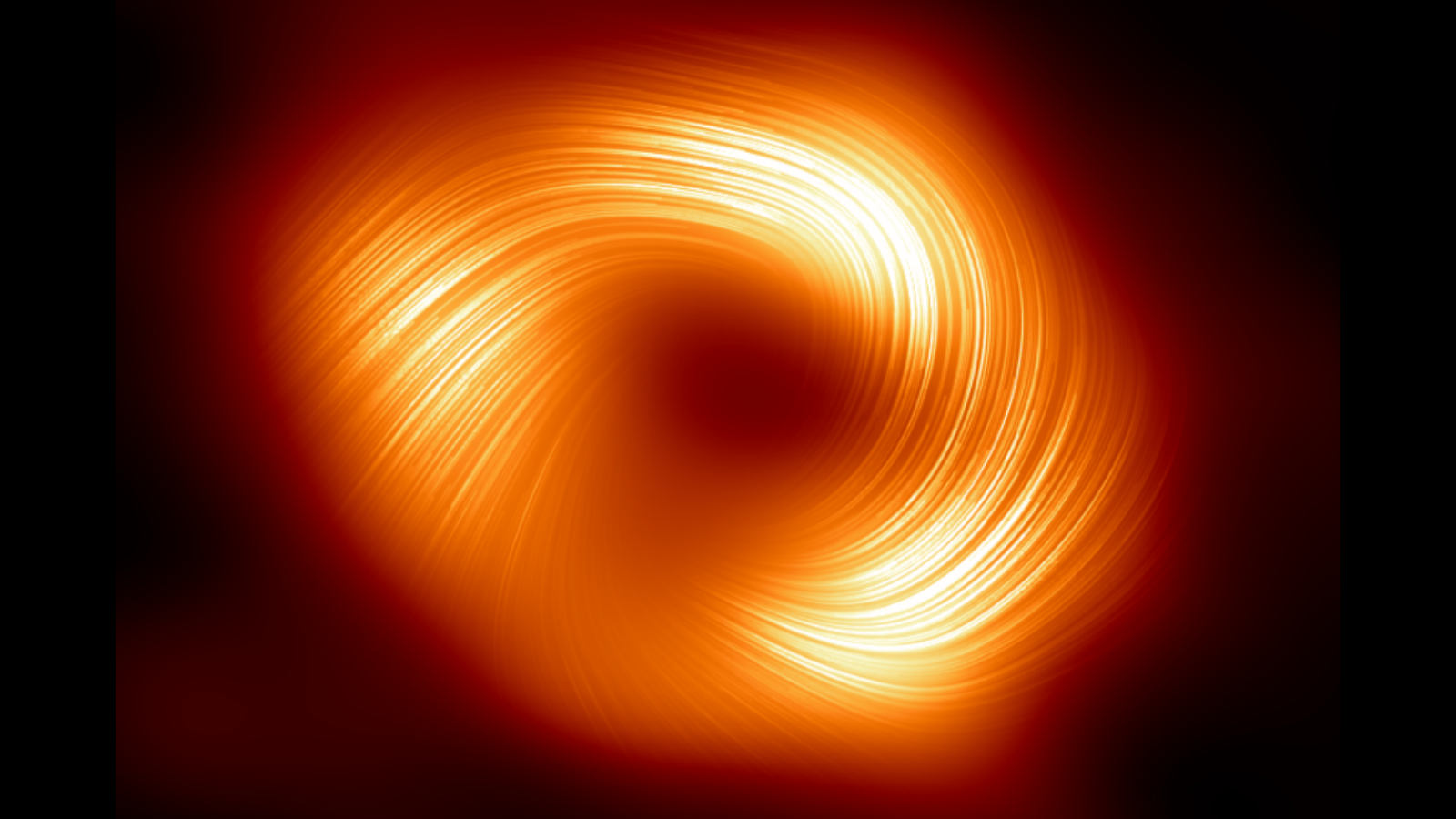
The supermassive black hole at the heart of the Milky Way Sgr A\* seen in polarized light for the first time. (Image credit: EHT Collaboration)
"This new image of the black hole at the center of our Milky Way, Sgr A\*, tells us that near the black hole are strong, twisted, and ordered magnetic fields," Sara Issaoun, research co-leader and NASA Hubble Fellowship Program Einstein Fellow at the Center for Astrophysics (CfA) at Harvard & Smithsonian told Space.com "For a while, we've believed that magnetic fields play a key role in how black holes feed and eject matter in powerful jets.
"This new image, along with a strikingly similar polarization structure seen in the much larger and more powerful M87\* black hole, shows that strong and ordered magnetic fields are critical to how black holes interact with the gas and matter around them."
## Comparing the magnetism of two monster black holes
The EHT is comprised of many telescopes across the globe, including the [Atacama Large Millimeter/submillimeter Array (ALMA)](https://www.space.com/20130-alma-telescope-cool-facts.html), which come together to form an Earth-sized telescope that is no stranger to making scientific history.
Get the Space.com Newsletter
Breaking space news, the latest updates on rocket launches, skywatching events and more\!
By signing up, you agree to our [Terms of services](https:\/\/futureplc.com\/terms-conditions\/) and acknowledge that you have read our [Privacy Notice](https:\/\/futureplc.com\/privacy-policy\/). You also agree to receive marketing emails from us that may include promotions from our trusted partners and sponsors, which you can unsubscribe from at any time.
In 2017, the EHT captured the first image of a black hole and its environment, [imaging M87\*](https://www.space.com/first-ever-black-hole-image-ai-makeover) located around 53.5 million light-years from Earth. Two years after this image was revealed to the public in 2019, the EHT collaboration revealed the first look at [polarized light around a black hole, M87\*](https://www.space.com/first-black-hole-image-polarized-m87), once again.
Polarization happens when the orientation waves of light are directed at a particular angle. The magnetic fields generated by plasma whipping around black holes polarize light at a 90-degree angle to themselves. That means observing the polarization around M87\* allowed scientists to "see" the magnetic fields around a black hole for the first time.
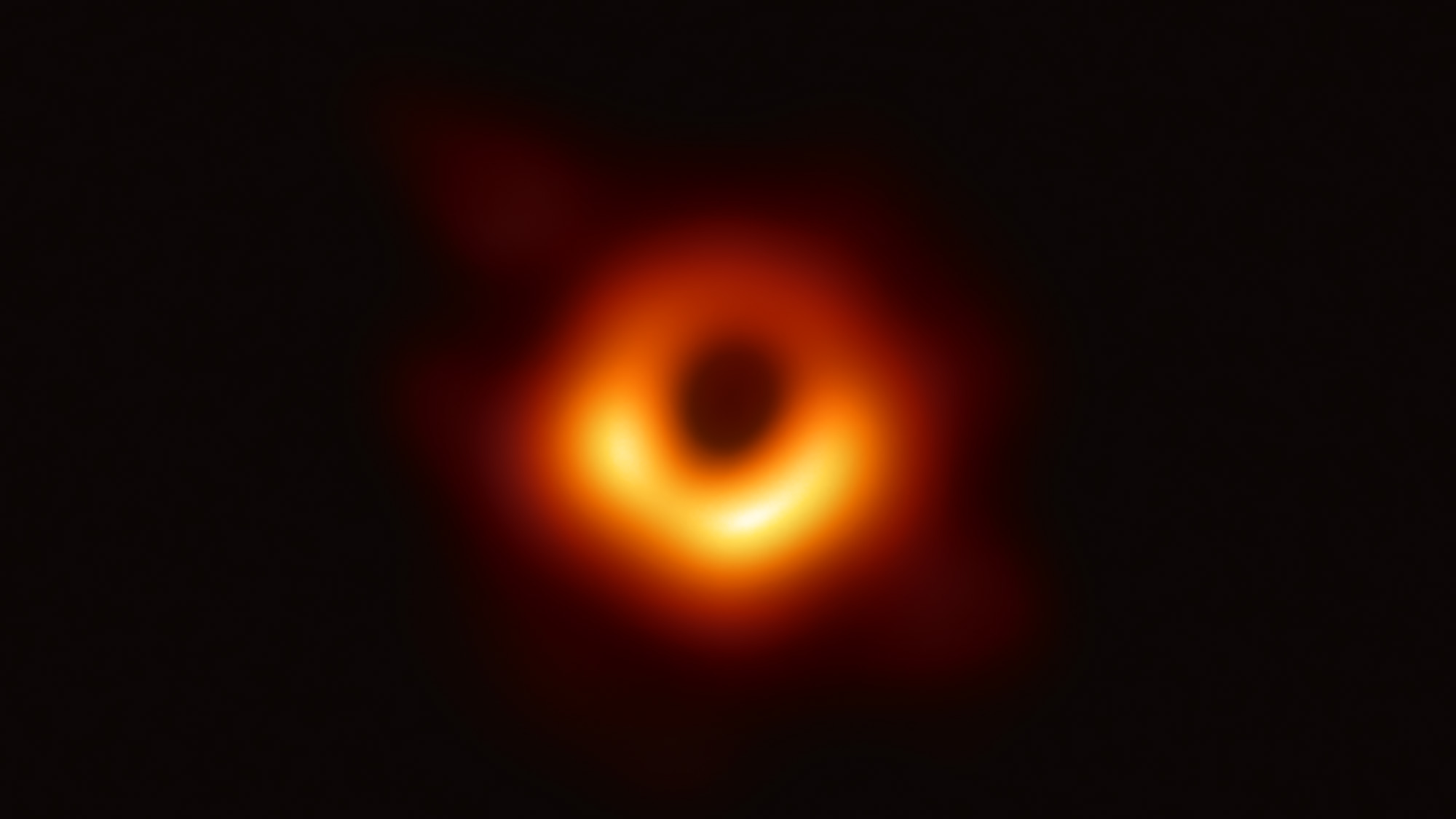
The Event Horizon Telescope's first image of the supermassive black hole M87\*. (Image credit: EHT Collaboration)
This was followed in 2022 by the revelation that the EHT had also imaged a supermassive black hole much closer to [Earth](https://www.space.com/54-earth-history-composition-and-atmosphere.html) at just 27,000 light-years away, Sgr A\*, the black hole around which the Milky Way is sculpted.
What to read next
- [ Astronomers watch 2 supermassive black holes caught in a twisted dance with never-before-seen jet behavior](https://www.space.com/astronomy/black-holes/astronomers-watch-2-supermassive-black-holes-caught-in-a-twisted-dance-with-never-before-seen-jet-behavior)
- [ World's largest radio telescope array pierces heart of our Milky Way: 'This is just the beginning'](https://www.space.com/astronomy/galaxies/worlds-largest-radio-telescope-array-pierces-heart-of-our-milky-way-this-is-just-the-beginning)
- [ The 'invisible giant' at the heart of our galaxy \| Space photo of the day for March 11, 2026](https://www.space.com/astronomy/stars/the-invisible-giant-at-the-heart-of-our-galaxy-space-photo-of-the-day-for-march-11-2026)
An image of Sagittarius A\*, the supermassive black hole at the heart of the Milky Way taken using the Event Horizon Telescope. (Image credit: EHT Collaboration)
Now, the EHT has finally provided scientists with an image of polarized light and, thus, the magnetic fields around this supermassive black hole.
"Polarized light is what teaches us about magnetic fields, the properties of the gas, and mechanisms that take place as a black hole feeds," Issaoun said. "Given the additional challenges to image Sgr A\*, it is honestly surprising enough that we were able to get a polarization image in the first place!"
These challenges arose despite Sgr A\* being closer to Earth, because the smaller size of the Milky Way's supermassive black hole means that the material that whips around it at near [light-speeds](https://www.space.com/15830-light-speed.html) is difficult to image. M87\* is much larger, meaning the material, while traveling at the same speed, more or less, takes much longer to complete a circuit, making it easier for the EHT to capture.
Overcoming these difficulties means a comparison can now be made between two black holes at the opposite ends of the supermassive black hole spectrum, one with billions of times the mass of the sun and another with a mass millions of times that of our star. The initial conclusion is these magnetic fields are remarkably similar to one another.
(Left) the black hole at the heart of M87 seen in polarized light. (Right) Sgr A\* in polarized light showing similarities with the much more massive M87\* (Image credit: EHT Collaboration)
"This similarity was especially surprising because M87\* and Sgr A\* are very different [black holes](https://www.space.com/15421-black-holes-facts-formation-discovery-sdcmp.html)," Issaoun said. "M87\* is quite a special black hole: It is 6 billion solar masses, it lives in a giant elliptical galaxy, and it ejects a powerful jet of plasma visible at all wavelengths.
"Sgr A\*, on the other hand, is extremely common: It is 4 million solar masses, it lives in our ordinary spiral Milky Way galaxy, and it doesn’t seem to have a jet at all."
Issaoun explained that just by looking at the portion of the light that is polarized, the team had expected to learn about the different properties of the magnetic fields of M87\* and Sgr A\*.
"Perhaps one would be more ordered and strong, and the other more disordered and weak," Issaoun added. "However, because they look similar again, it is now quite clear that these two different classes of black holes have very similar magnetic field geometry!"
The results suggest a deeper investigation of Sgr A\* may uncover hitherto undiscovered features.
## Is the Milky Way's supermassive black hole launching a hidden jet?
The polarization of light and neat and strong magnetic fields of Sgr A\*, and the fact that they closely resemble that of M87\*, may indicate that our central black hole has been hiding a secret from us until now.
"We expect strong and ordered magnetic fields to be directly linked to the launching of jets as we observed for M87\*," Issaoun explained. "Since Sgr A\*, with no observed jet, seems to have a very similar geometry, perhaps there is also a jet lurking in Sgr A\* waiting to be observed, which would be super exciting!"
Astronomers hadn't been terribly surprised not to see a jet from Sgr A\*. That's because [M87\* is surrounded by so much gas and dust](https://www.space.com/6807-real-whopper-black-hole-massive.html) that it consumes the equivalent of two or three suns each year. That means plenty of material for its magnetic fields to channel to its poles and blast out as jets.
Sgr A\*, on the other hand, consumes so little matter it is equivalent to a [human being eating one grain of rice every million years](https://www.space.com/milky-way-monster-black-hole-first-image-eht). These observations suggest that our dieting supermassive black hole may still have a jet; it is just difficult to see.
"There is a lot of evidence of possible outflows and even jets powered by the black hole in the past, yet a jet in Sgr A\* has never been imaged due to the difficult environment of the [galactic center](https://www.space.com/galactic-center-vr-black-hole-visualization.html)," Issaoun said."Finding a jet would be a major revelation about our black hole and a link to its history within our [Milky Way](https://www.space.com/19915-milky-way-galaxy.html)."
She added that the process that launches these jets is the most energetic mechanism in the entire universe, dramatically affecting the heart of galaxies by, for instance, clearing out the gas and dust needed to birth stars and influencing how galaxies grow and evolve. That means discovering a jet emerging from Sgr A\* would influence our understanding of how the [Milky Way evolved to take the shape](https://www.space.com/galaxy-shape-shifting-milky-way-mystery-solved) astronomers observe today.
"It is so striking that such large-scale damage can be caused by such a small nucleus in a galaxy, and it all starts at the edge of the central black hole, where these magnetic fields rule," Issaoun continued.
This image shows the jet in the M87 galaxy in polarized light, as captured by ALMA. This image reveals the structure of the magnetic field along the jet. (Image credit: ALMA (ESO/NAOJ/NRAO), Goddi et al.)
Issaoun said that with these two polarized images of very different black holes, scientists now have very compelling evidence that strong magnetic fields are ubiquitous to these cosmic titans.
"The next step," she said, "involves figuring out how that geometry connects to how these systems move, evolve, and flare."
The EHT will kick off its 2024 observing campaign in early April, with the collaboration hoping to get multi-color views of familiar black holes like M87\* and Sgr A\* by observing them in different frequencies of light.
"In the next decade, the next-generation EHT effort aims to add more telescopes to fill in our [Earth-sized virtual mirror](https://www.space.com/14278-black-hole-photos-event-horizon-telescope.html) and observe a lot more often," Issaoun added. "With these expansions of the EHT, we will be able to make polarized movies of black holes and will directly observe the dynamics between the M87\* black hole and its jet."
Related Stories
— [How do some black holes get so big? The James Webb Space Telescope may have an answer](https://www.space.com/supermassive-black-hole-growth-mystery-james-webb-space-telescope)
— [Brightest quasar ever seen is powered by black hole that eats a 'sun a day'](https://www.space.com/brightest-quasar-ever-powered-black-hole-solar-mass-accretion-disk)
—[Black hole-like 'gravastars' could be stacked like Russian tea dolls](https://www.space.com/the-universe/stars/black-hole-like-gravastars-could-be-stacked-like-russian-tea-dolls)
Additionally, the CfA researcher said the EHT could eventually get some space-based help observing black holes and their dynamics. One proposed mission that could assist in this is the Black Hole Explorer (BHEX) mission concept, which adds a single space telescope to the Earth-based EHT array.
"How much black holes rotate, their spin is believed to be directly connected to why magnetic fields near the black hole look the way they look and how they can launch jets," Issaoun concluded. "With BHEX, we could image the sharp photon ring signature of black holes. This photon ring encodes properties of the spacetime around the black hole, including the black hole's spin!"
The EHT team's research was published on Wednesday (March 27) in the [Astrophysical Journal Letters](https://doi.org/10.3847/2041-8213/ad2df0).
**Share your thoughts**
0
0
0
0
Random QuizPlay a Random Quiz
Filter by Category
Join the community
Join the Space.com Family! The best way to keep in touch and to be informed of our latest quizzes and competitions, as well as news and offers.
I'm in\!
Not right now
Already have an account? Log in
This page will close automatically once you have completed the authorisation process
My Details
Update your details below...
Keep in the Know
Would you like to be kept informed about new quizzes and offers from Future and its partners?
OK
Validate Your Mobile No.
We have sent a code to . Please enter it below to verify your account.
Update Your Mobile No.
You may enter a new mobile number below. You will be sent a verification code to the phone number you provide.
embed-reactions.hint\_heading
embed-reactions.hint\_subheading
Validate Your Email Address
We have sent a code to . Please enter it below to verify your account.
Update Your Email Address
You may enter a new email address below. You will be sent a verification code to the address you provide.
Create a Username
This will be publicly viewable so make it something you like\!
Reset your password
Enter your email address below. If it is registered with us, we will email you a code that will allow you to reset your password.
Check your inbox
If your email address was found in our system, you should receive an email in the next few minutes containing a code. Enter that code below to reset your password.
Set new password
Please enter your new password below.
Leaderboard
| Rank | Player | Score | Time |
|---|---|---|---|
Log In or Register
More Quizzes
Log Out

[Robert Lea](https://www.space.com/author/robert-lea)
Social Links Navigation
Senior Writer
Robert Lea is a science journalist in the U.K. whose articles have been published in Physics World, New Scientist, Astronomy Magazine, All About Space, Newsweek and ZME Science. He also writes about science communication for Elsevier and the European Journal of Physics. Rob holds a bachelor of science degree in physics and astronomy from the U.K.’s Open University. Follow him on Twitter @sciencef1rst.
Read more
[ Dark Universe Could the Milky Way galaxy's supermassive black hole actually be a clump of dark matter?](https://www.space.com/astronomy/dark-universe/could-the-milky-way-galaxys-supermassive-black-hole-actually-be-a-clump-of-dark-matter "Could the Milky Way galaxy's supermassive black hole actually be a clump of dark matter?")
[ Black Holes NASA X-ray spacecraft stares into the 'eye of the storm' swirling around supermassive black holes](https://www.space.com/astronomy/black-holes/nasa-x-ray-spacecraft-stares-into-the-eye-of-the-storm-swirling-around-supermassive-black-holes "NASA X-ray spacecraft stares into the 'eye of the storm' swirling around supermassive black holes")
[ Black Holes Astronomers watch 1st black hole ever imaged launch a 3,000‑light‑year‑long cosmic jet from its glowing 'shadow'](https://www.space.com/astronomy/black-holes/astronomers-watch-1st-black-hole-ever-imaged-launch-a-3-000-light-year-long-cosmic-jet-from-its-glowing-shadow "Astronomers watch 1st black hole ever imaged launch a 3,000‑light‑year‑long cosmic jet from its glowing 'shadow'")
[ Black Holes Astronomers watch 2 supermassive black holes caught in a twisted dance with never-before-seen jet behavior](https://www.space.com/astronomy/black-holes/astronomers-watch-2-supermassive-black-holes-caught-in-a-twisted-dance-with-never-before-seen-jet-behavior "Astronomers watch 2 supermassive black holes caught in a twisted dance with never-before-seen jet behavior")
[ Galaxies World's largest radio telescope array pierces heart of our Milky Way: 'This is just the beginning'](https://www.space.com/astronomy/galaxies/worlds-largest-radio-telescope-array-pierces-heart-of-our-milky-way-this-is-just-the-beginning "World's largest radio telescope array pierces heart of our Milky Way: 'This is just the beginning'")
[ Stars The 'invisible giant' at the heart of our galaxy \| Space photo of the day for March 11, 2026](https://www.space.com/astronomy/stars/the-invisible-giant-at-the-heart-of-our-galaxy-space-photo-of-the-day-for-march-11-2026 "The 'invisible giant' at the heart of our galaxy | Space photo of the day for March 11, 2026")
Latest in Black Holes
[ Black Holes Could our universe exist because black holes ate up all the antimatter?](https://www.space.com/astronomy/black-holes/could-our-universe-exist-because-black-holes-ate-up-all-the-antimatter "Could our universe exist because black holes ate up all the antimatter?")
[ Black Holes X-ray spacecraft watches monster black hole wake up and fire cosmic bullets at starburst galaxy](https://www.space.com/astronomy/black-holes/x-ray-spacecraft-watches-monster-black-hole-wake-up-and-fire-cosmic-bullets-at-starburst-galaxy "X-ray spacecraft watches monster black hole wake up and fire cosmic bullets at starburst galaxy")
[ Black Holes Black hole and neutron star mergers push the laws of physics with their odd orbits](https://www.space.com/astronomy/black-holes/black-hole-and-neutron-star-mergers-push-the-laws-of-physics-with-their-odd-orbits "Black hole and neutron star mergers push the laws of physics with their odd orbits")
[ Black Holes The universe is humming with ripples in spacetime: Scientists just doubled our catalog of black hole and neutron star collisions](https://www.space.com/astronomy/black-holes/the-universe-is-humming-with-ripples-in-spacetime-scientists-just-doubled-our-catalog-of-black-hole-and-neutron-star-collisions "The universe is humming with ripples in spacetime: Scientists just doubled our catalog of black hole and neutron star collisions")
[ Black Holes Black holes! Supernovas! Merging galaxies! Oh my! Largest radio survey of the cosmos ever reveals 13.7 million powerful cosmic objects and events](https://www.space.com/astronomy/black-holes/black-holes-supernovas-merging-galaxies-oh-my-largest-radio-survey-of-the-cosmos-ever-reveals-13-7-million-powerful-cosmic-objects-and-events "Black holes! Supernovas! Merging galaxies! Oh my! Largest radio survey of the cosmos ever reveals 13.7 million powerful cosmic objects and events")
[ Black Holes Starlight warped in the fabric of spacetime could help us find hidden black holes dancing together](https://www.space.com/astronomy/black-holes/starlight-warped-in-the-fabric-of-spacetime-could-help-us-find-hidden-black-holes-dancing-together "Starlight warped in the fabric of spacetime could help us find hidden black holes dancing together")
Latest in News
[ Astronomy Deja vu: Trump proposes cutting NASA science funding by 47% again](https://www.space.com/astronomy/deja-vu-trump-proposes-cutting-nasa-science-funding-by-47-percent-again "Deja vu: Trump proposes cutting NASA science funding by 47% again")
[ Artemis NASA Artemis 2 astronauts to make historic moon flyby today. Here's what to expect hour by hour (timeline)](https://www.space.com/space-exploration/artemis/nasa-artemis-2-astronauts-to-make-historic-moon-flyby-today-heres-what-to-expect-hour-by-hour-timeline "NASA Artemis 2 astronauts to make historic moon flyby today. Here's what to expect hour by hour (timeline)")
[ Artemis Humanity is back at the moon! Artemis 2 astronauts arrive in lunar space](https://www.space.com/space-exploration/artemis/humanity-is-back-at-the-moon-artemis-2-astronauts-arrive-in-lunar-space "Humanity is back at the moon! Artemis 2 astronauts arrive in lunar space")
[ Space Movies & Shows 'Star Wars: Maul – Shadow Lord' is Lucasfilm's darkest and most focused animated show yet (review)](https://www.space.com/entertainment/space-movies-shows/star-wars-maul-shadow-lord-is-lucasfilms-darkest-and-most-focused-animated-show-yet-review "'Star Wars: Maul – Shadow Lord' is Lucasfilm's darkest and most focused animated show yet (review)")
[ Artemis When the moon hits your eye from your Orion ship up high, that's a 'mare' for Artemis 2](https://www.space.com/space-exploration/artemis/when-the-moon-hits-your-eye-from-your-orion-ship-up-high-thats-a-mare "When the moon hits your eye from your Orion ship up high, that's a 'mare' for Artemis 2")
[ Artemis The breakout star of NASA's Artemis 2 moon mission isn't an astronaut — it's the space toilet](https://www.space.com/space-exploration/artemis/the-breakout-star-of-nasas-artemis-2-mission-to-the-moon-isnt-an-astronaut-its-the-space-toilet "The breakout star of NASA's Artemis 2 moon mission isn't an astronaut — it's the space toilet")
MORE FROM SPACE...
1. [](https://www.space.com/astronomy/deja-vu-trump-proposes-cutting-nasa-science-funding-by-47-percent-again "Deja vu: Trump proposes cutting NASA science funding by 47% again")
1
[Deja vu: Trump proposes cutting NASA science funding by 47% again](https://www.space.com/astronomy/deja-vu-trump-proposes-cutting-nasa-science-funding-by-47-percent-again)
2. 2
[Astronaut Victor Glover is the latest in a long line of Black American explorers − including York, the enslaved man who played a key role in the Lewis and Clark expedition](https://www.space.com/space-exploration/human-spaceflight/astronaut-victor-glover-is-the-latest-in-a-long-line-of-black-american-explorers-including-york-the-enslaved-man-who-played-a-key-role-in-the-lewis-and-clark-expedition)
3. 3
[NASA Artemis 2 astronauts to make historic moon flyby today. Here's what to expect hour by hour (timeline)](https://www.space.com/space-exploration/artemis/nasa-artemis-2-astronauts-to-make-historic-moon-flyby-today-heres-what-to-expect-hour-by-hour-timeline)
4. 4
[Humanity is back at the moon! Artemis 2 astronauts arrive in lunar space](https://www.space.com/space-exploration/artemis/humanity-is-back-at-the-moon-artemis-2-astronauts-arrive-in-lunar-space)
5. 5
[When the moon hits your eye from your Orion ship up high, that's a 'mare' for Artemis 2](https://www.space.com/space-exploration/artemis/when-the-moon-hits-your-eye-from-your-orion-ship-up-high-thats-a-mare)
Space is part of Future US Inc, an international media group and leading digital publisher. [Visit our corporate site](https://futureplc.com/).
[ Add as a preferred source on Google](https://google.com/preferences/source?q=space.com)
- [About Us](https://www.space.com/41418-about-us.html)
- [Contact Future's experts](https://futureplc.com/contact/)
- [Terms and conditions](https://futureplc.com/terms-conditions/)
- [Privacy policy](https://futureplc.com/privacy-policy/)
- [Cookies policy](https://futureplc.com/cookies-policy/)
- [Accessibility Statement](https://futureplc.com/accessibility-statement/)
- [Advertise with us](https://go.future-advertising.com/Spacecom-Media-Kit.html)
- [Web notifications](https://www.space.com/how-to-turn-off-web-notifications-for-chrome-macos.html)
- [Careers](https://futureplc.com/careers/)
- [Do not sell or share my personal information](https://www.space.com/privacy-portal)
© Future US, Inc. Full 7th Floor, 130 West 42nd Street, New York, NY 10036.
Close
Please login or signup to comment
Please wait...
Login
Sign Up |
| Readable Markdown | Astronomers have captured the first view of polarized light and the magnetic fields that surround Sagittarius A\* (Sgr A\*), the supermassive black hole at the heart of the Milly Way.
The new EHT observation of [Sgr A\*](https://www.space.com/sagittarius-a), therefore, suggests that strong and well-organized magnetic fields could be common to all black holes. Also, because M87\*'s magnetic fields drive powerful outflows or "jets," the results hint that Sgr A\* could have a hidden and faint jet all of its own.
**Related:** [James Webb Space Telescope finds 'extremely red' supermassive black hole growing in the early universe](https://www.space.com/james-webb-space-telescope-extremely-red-supermassive-black-hole)

The supermassive black hole at the heart of the Milky Way Sgr A\* seen in polarized light for the first time. (Image credit: EHT Collaboration)
"This new image of the black hole at the center of our Milky Way, Sgr A\*, tells us that near the black hole are strong, twisted, and ordered magnetic fields," Sara Issaoun, research co-leader and NASA Hubble Fellowship Program Einstein Fellow at the Center for Astrophysics (CfA) at Harvard & Smithsonian told Space.com "For a while, we've believed that magnetic fields play a key role in how black holes feed and eject matter in powerful jets.
"This new image, along with a strikingly similar polarization structure seen in the much larger and more powerful M87\* black hole, shows that strong and ordered magnetic fields are critical to how black holes interact with the gas and matter around them."
## Comparing the magnetism of two monster black holes
The EHT is comprised of many telescopes across the globe, including the [Atacama Large Millimeter/submillimeter Array (ALMA)](https://www.space.com/20130-alma-telescope-cool-facts.html), which come together to form an Earth-sized telescope that is no stranger to making scientific history.
Breaking space news, the latest updates on rocket launches, skywatching events and more\!
In 2017, the EHT captured the first image of a black hole and its environment, [imaging M87\*](https://www.space.com/first-ever-black-hole-image-ai-makeover) located around 53.5 million light-years from Earth. Two years after this image was revealed to the public in 2019, the EHT collaboration revealed the first look at [polarized light around a black hole, M87\*](https://www.space.com/first-black-hole-image-polarized-m87), once again.
Polarization happens when the orientation waves of light are directed at a particular angle. The magnetic fields generated by plasma whipping around black holes polarize light at a 90-degree angle to themselves. That means observing the polarization around M87\* allowed scientists to "see" the magnetic fields around a black hole for the first time.

The Event Horizon Telescope's first image of the supermassive black hole M87\*. (Image credit: EHT Collaboration)
This was followed in 2022 by the revelation that the EHT had also imaged a supermassive black hole much closer to [Earth](https://www.space.com/54-earth-history-composition-and-atmosphere.html) at just 27,000 light-years away, Sgr A\*, the black hole around which the Milky Way is sculpted.

An image of Sagittarius A\*, the supermassive black hole at the heart of the Milky Way taken using the Event Horizon Telescope. (Image credit: EHT Collaboration)
Now, the EHT has finally provided scientists with an image of polarized light and, thus, the magnetic fields around this supermassive black hole.
"Polarized light is what teaches us about magnetic fields, the properties of the gas, and mechanisms that take place as a black hole feeds," Issaoun said. "Given the additional challenges to image Sgr A\*, it is honestly surprising enough that we were able to get a polarization image in the first place!"
These challenges arose despite Sgr A\* being closer to Earth, because the smaller size of the Milky Way's supermassive black hole means that the material that whips around it at near [light-speeds](https://www.space.com/15830-light-speed.html) is difficult to image. M87\* is much larger, meaning the material, while traveling at the same speed, more or less, takes much longer to complete a circuit, making it easier for the EHT to capture.
Overcoming these difficulties means a comparison can now be made between two black holes at the opposite ends of the supermassive black hole spectrum, one with billions of times the mass of the sun and another with a mass millions of times that of our star. The initial conclusion is these magnetic fields are remarkably similar to one another.

(Left) the black hole at the heart of M87 seen in polarized light. (Right) Sgr A\* in polarized light showing similarities with the much more massive M87\* (Image credit: EHT Collaboration)
"This similarity was especially surprising because M87\* and Sgr A\* are very different [black holes](https://www.space.com/15421-black-holes-facts-formation-discovery-sdcmp.html)," Issaoun said. "M87\* is quite a special black hole: It is 6 billion solar masses, it lives in a giant elliptical galaxy, and it ejects a powerful jet of plasma visible at all wavelengths.
"Sgr A\*, on the other hand, is extremely common: It is 4 million solar masses, it lives in our ordinary spiral Milky Way galaxy, and it doesn’t seem to have a jet at all."
Issaoun explained that just by looking at the portion of the light that is polarized, the team had expected to learn about the different properties of the magnetic fields of M87\* and Sgr A\*.
"Perhaps one would be more ordered and strong, and the other more disordered and weak," Issaoun added. "However, because they look similar again, it is now quite clear that these two different classes of black holes have very similar magnetic field geometry!"
The results suggest a deeper investigation of Sgr A\* may uncover hitherto undiscovered features.
The polarization of light and neat and strong magnetic fields of Sgr A\*, and the fact that they closely resemble that of M87\*, may indicate that our central black hole has been hiding a secret from us until now.
"We expect strong and ordered magnetic fields to be directly linked to the launching of jets as we observed for M87\*," Issaoun explained. "Since Sgr A\*, with no observed jet, seems to have a very similar geometry, perhaps there is also a jet lurking in Sgr A\* waiting to be observed, which would be super exciting!"
Astronomers hadn't been terribly surprised not to see a jet from Sgr A\*. That's because [M87\* is surrounded by so much gas and dust](https://www.space.com/6807-real-whopper-black-hole-massive.html) that it consumes the equivalent of two or three suns each year. That means plenty of material for its magnetic fields to channel to its poles and blast out as jets.
Sgr A\*, on the other hand, consumes so little matter it is equivalent to a [human being eating one grain of rice every million years](https://www.space.com/milky-way-monster-black-hole-first-image-eht). These observations suggest that our dieting supermassive black hole may still have a jet; it is just difficult to see.
"There is a lot of evidence of possible outflows and even jets powered by the black hole in the past, yet a jet in Sgr A\* has never been imaged due to the difficult environment of the [galactic center](https://www.space.com/galactic-center-vr-black-hole-visualization.html)," Issaoun said."Finding a jet would be a major revelation about our black hole and a link to its history within our [Milky Way](https://www.space.com/19915-milky-way-galaxy.html)."
She added that the process that launches these jets is the most energetic mechanism in the entire universe, dramatically affecting the heart of galaxies by, for instance, clearing out the gas and dust needed to birth stars and influencing how galaxies grow and evolve. That means discovering a jet emerging from Sgr A\* would influence our understanding of how the [Milky Way evolved to take the shape](https://www.space.com/galaxy-shape-shifting-milky-way-mystery-solved) astronomers observe today.
"It is so striking that such large-scale damage can be caused by such a small nucleus in a galaxy, and it all starts at the edge of the central black hole, where these magnetic fields rule," Issaoun continued.

This image shows the jet in the M87 galaxy in polarized light, as captured by ALMA. This image reveals the structure of the magnetic field along the jet. (Image credit: ALMA (ESO/NAOJ/NRAO), Goddi et al.)
Issaoun said that with these two polarized images of very different black holes, scientists now have very compelling evidence that strong magnetic fields are ubiquitous to these cosmic titans.
"The next step," she said, "involves figuring out how that geometry connects to how these systems move, evolve, and flare."
The EHT will kick off its 2024 observing campaign in early April, with the collaboration hoping to get multi-color views of familiar black holes like M87\* and Sgr A\* by observing them in different frequencies of light.
"In the next decade, the next-generation EHT effort aims to add more telescopes to fill in our [Earth-sized virtual mirror](https://www.space.com/14278-black-hole-photos-event-horizon-telescope.html) and observe a lot more often," Issaoun added. "With these expansions of the EHT, we will be able to make polarized movies of black holes and will directly observe the dynamics between the M87\* black hole and its jet."
Related Stories
Additionally, the CfA researcher said the EHT could eventually get some space-based help observing black holes and their dynamics. One proposed mission that could assist in this is the Black Hole Explorer (BHEX) mission concept, which adds a single space telescope to the Earth-based EHT array.
"How much black holes rotate, their spin is believed to be directly connected to why magnetic fields near the black hole look the way they look and how they can launch jets," Issaoun concluded. "With BHEX, we could image the sharp photon ring signature of black holes. This photon ring encodes properties of the spacetime around the black hole, including the black hole's spin!"
The EHT team's research was published on Wednesday (March 27) in the [Astrophysical Journal Letters](https://doi.org/10.3847/2041-8213/ad2df0).
**Share your thoughts**
0
0
0
0
Join the community
Join the Space.com Family! The best way to keep in touch and to be informed of our latest quizzes and competitions, as well as news and offers.
Already have an account? Log in
My Details
Update your details below...
Keep in the Know
Would you like to be kept informed about new quizzes and offers from Future and its partners?
Validate Your Mobile No.
We have sent a code to . Please enter it below to verify your account.
Update Your Mobile No.
You may enter a new mobile number below. You will be sent a verification code to the phone number you provide.
embed-reactions.hint\_heading
embed-reactions.hint\_subheading
Validate Your Email Address
We have sent a code to . Please enter it below to verify your account.
Update Your Email Address
You may enter a new email address below. You will be sent a verification code to the address you provide.
Create a Username
This will be publicly viewable so make it something you like\!
Reset your password
Enter your email address below. If it is registered with us, we will email you a code that will allow you to reset your password.
Check your inbox
If your email address was found in our system, you should receive an email in the next few minutes containing a code. Enter that code below to reset your password.
Set new password
Please enter your new password below.
Leaderboard
| Rank | Player | Score | Time |
|---|---|---|---|
Robert Lea is a science journalist in the U.K. whose articles have been published in Physics World, New Scientist, Astronomy Magazine, All About Space, Newsweek and ZME Science. He also writes about science communication for Elsevier and the European Journal of Physics. Rob holds a bachelor of science degree in physics and astronomy from the U.K.’s Open University. Follow him on Twitter @sciencef1rst. |
| Shard | 8 (laksa) |
| Root Hash | 7770394665477845008 |
| Unparsed URL | com,space!www,/black-hole-milky-way-new-image-hidden-feature s443 |