ℹ️ Skipped - page is already crawled
| Filter | Status | Condition | Details |
|---|---|---|---|
| HTTP status | PASS | download_http_code = 200 | HTTP 200 |
| Age cutoff | PASS | download_stamp > now() - 6 MONTH | 0.1 months ago |
| History drop | PASS | isNull(history_drop_reason) | No drop reason |
| Spam/ban | PASS | fh_dont_index != 1 AND ml_spam_score = 0 | ml_spam_score=0 |
| Canonical | PASS | meta_canonical IS NULL OR = '' OR = src_unparsed | Not set |
| Property | Value |
|---|---|
| URL | https://www.snexplores.org/article/black-hole-first-photo-event-horizon-telescope |
| Last Crawled | 2026-04-18 13:39:35 (2 days ago) |
| First Indexed | 2022-07-21 03:37:03 (3 years ago) |
| HTTP Status Code | 200 |
| Meta Title | Here’s the first picture of a black hole |
| Meta Description | The Event Horizon Telescope imaged the supermassive beast lying some 55 million light-years away in a galaxy called M87. |
| Meta Canonical | null |
| Boilerpipe Text | This is what a black hole looks like.
A black hole isn’t really a hole. It’s an object in space with incredible mass packed into a very small area. All that mass creates such a huge gravitational tug that nothing can escape a black hole, including light.
Explainer: What are black holes?
The newly imaged supermassive monster lies in a galaxy called M87. A world-spanning network of observatories called the
Event Horizon Telescope
, or EHT, zoomed in on M87 to create this first-ever picture of a black hole.
“We have seen what we thought was unseeable,” Sheperd Doeleman said April 10 in Washington, D.C. “We have seen and taken a picture of a black hole,” he reported at one of seven concurrent news conferences. Doeleman is EHT’s director. He also is an astrophysicist at the Harvard-Smithsonian Center for Astrophysics in Cambridge, Mass. Results from his team’s work appear in six papers in the
Astrophysical Journal Letters
.
The concept of a black hole was first hinted at back in the 1780s. The mathematics behind them came from Albert Einstein’s 1915 general theory of relativity. And the phenomenon got its name “black hole” in the 1960s. But until now, all “pictures” of black holes have been illustrations or simulations.
“We’ve been studying black holes so long, sometimes it’s easy to forget that none of us have actually seen one.”
— France Córdova, director of the National Science Foundation
“We’ve been studying black holes so long, sometimes it’s easy to forget that none of us have actually seen one,” France Córdova said in the Washington, D.C., news conference. She is director of the National Science Foundation. Seeing a black hole “is a Herculean task,” she said.
The galaxy M87 sits about 55 million light-years from Earth in the constellation Virgo. Unlike the Milky Way’s stunning spirals, M87 is a blobby giant elliptical galaxy. The Event Horizon Telescope just took the first image of the black hole at the center of M87.
That’s because black holes are famously hard to see. Their gravity is so extreme that nothing, not even light, can escape across the boundary at a black hole’s edge. That edge is known as the event horizon. But some black holes, especially supermassive ones dwelling in galaxies’ centers, stand out. They gather bright disks of gas and other material that surrounds the black hole. The EHT image reveals the shadow of M87’s black hole on its accretion disk. That disk looks like a fuzzy, asymmetrical ring. It unveils for the first time the dark abyss of one of the universe’s most mysterious objects.
“It’s been such a buildup,” Doeleman said. “It was just astonishment and wonder… to know that you’ve uncovered a part of the universe that was off limits to us.”
The much-anticipated big reveal of the image “lives up to the hype, that’s for sure,” says Priyamvada Natarajan. This astrophysicist at Yale University, in New Haven, Conn., is not on the EHT team. “It really brings home how fortunate we are as a species at this particular time, with the capacity of the human mind to comprehend the universe, to have built all the science and technology to make it happen.”
Einstein was right
The new image aligns with what physicists expected a black hole to look like based on the theory of general
relativity
by Albert Einstein. That theory predicts how
spacetime
is warped by the extreme mass of a black hole. The picture is “one more strong piece of evidence supporting the existence of black holes. And that, of course, helps verify general relativity,” says Clifford Will. He’s a physicist at the University of Florida in Gainesville, who is not on the EHT team. “Being able to actually see this shadow and to detect it is a tremendous first step.”
Studies in the past have tested general relativity by looking at the motions of stars or gas clouds near a black hole, but never at its edge. “It’s as good as it gets,” Will says. Tiptoe any closer and you’d be inside the black hole. And then you’d be unable to report back on the results of any experiments.
“Black hole environments are a likely place where general relativity would break down,” says EHT team member Feryal Özel. She is an astrophysicist who works at the University of Arizona in Tucson. So testing general relativity in such extreme conditions could reveal things that don’t seem to support Einstein’s predictions.
Explainer: Quantum is the world of the super small
However, she adds, just because this first image upholds general relativity “doesn’t mean general relativity is completely fine.” Many physicists think that general relativity won’t be the last word on gravity. That’s because it’s incompatible with another essential physics theory,
quantum mechanics
. This theory describes physics on very small scales.
The new image provided a new measurement of the size and heft of M87’s black hole. “Our mass determination by just directly looking at the shadow has helped resolve a longstanding controversy,” Sera Markoff said in the Washington, D.C., news conference. She’s a theoretical astrophysicist at the University of Amsterdam in the Netherlands. Estimates made using different techniques have ranged between 3.5 billion and 7.22 billion times the mass of the sun. New EHT measurements show that the mass of this black hole is about 6.5 billion solar masses.
The team also has figured out the behemoth’s size. Its diameter stretches 38 billion kilometers (24 billion miles). And the black hole spins clockwise. “M87 is a monster even by supermassive black hole standards,” Markoff said.
Scientists have been speculating for years about what a black hole would actually look like. Now, they finally know the answer.
Science News/YouTube
Looking ahead
EHT trained its sights on both M87’s black hole and Sagittarius A*. That second supermassive black hole sits at the center of our galaxy, the Milky Way. But, the scientists found it easier to image M87’s monster, even though it’s about 2,000 times as far away as Sgr A*.
M87’s black hole sits about 55 million light-years from Earth in the constellation Virgo. But it’s also about 1,000 times as massive as the Milky Way’s giant. Sgr A* only weighs the equivalent of roughly 4 million suns. M87’s extra heft nearly compensates for its greater distance. The size it covers in our sky “is pretty darn similar,” says EHT team member Özel.
Because M87’s black hole is bigger and has more gravity, gases swirling around it move and vary in brightness more slowly than they do around Sgr A*. And here’s why that’s important. “During a single observation, Sgr A* doesn’t sit still, whereas M87 does,” says Özel. “Just based on this ‘Does the black hole sit still and pose for me?’ point of view, we knew M87 would cooperate more.”
With more data analysis, the team hopes to solve some long-standing mysteries about black holes. These include how M87’s black hole spews such a bright jet of charged particles many thousands of light-years into space.
Some black holes launch jets of charged particles thousands of light-years into space, such as the one shown in this image from a simulation. Data collected to create the first image of a black hole, the one in galaxy M87, may help reveal how these jets are produced.
This first image is like the “shot heard round the world” that kicked off the American Revolutionary War, says Avi Loeb. He is an astrophysicist at Harvard University in Cambridge, Mass. “It’s very significant. It gives a glimpse of what the future might hold. But it doesn’t give us all the information that we want.”
The team does not yet have a picture of Sgr A*. But the researchers were able to collect some data on it. They are continuing to analyze those data in the hopes of adding to a new gallery of black hole portraits. Since the appearance of that black hole changes so quickly, the team is having to develop new techniques to analyze the data from it.
“The Milky Way is a very different galaxy from M87,” Loeb notes. Studying such different environments could reveal more details of how black holes behave, he says.
The next look at the M87 and Milky Way behemoths will have to wait, though. Scientists got a lucky stretch of good weather at all eight sites that made up the Event Horizon Telescope in 2017. Then there was bad weather in 2018. (Water vapor in the atmosphere can interfere with the telescope’s measurements.) Technical difficulties cancelled this year’s observing run.
The good news is that by 2020, EHT will include 11 observatories. The Greenland Telescope joined the consortium in 2018. The Kitt Peak National Observatory outside Tucson, Ariz., and the NOrthern Extended Millimeter Array (NOEMA) in the French Alps will join EHT in 2020.
Adding more telescopes should allow the team to extend the image. That would let EHT better capture the jets that spew from the black hole. The researchers also plan to make observations using light having a slightly higher frequency. That can further sharpen the image. And even bigger plans are on the horizon — adding telescopes that orbit Earth. “World domination is not enough for us. We also want to go to space,” Doeleman quipped.
These extra eyes may be just what’s needed to bring black holes into even greater focus.
Staff writer Maria Temming contributed to this story.
Power Words
More About Power Words
align
(noun: alignment) To place or organize things in a patterned order, following an apparent line.
astrophysics
An area of astronomy that deals with understanding the physical nature of stars and other objects in space. People who work in this field are known as
astrophysicists
.
behemoth
A term for anything that is amazingly big. The term comes from a monstrous animal described in the Bible’s book of Job.
black hole
A region of space having a gravitational field so intense that no matter or radiation (including light) can escape.
consortium
A group or association of independent organizations.
constellation
Patterns formed by prominent stars that lie close to each other in the night sky. Modern astronomers divide the sky into 88 constellations, 12 of which (known as the zodiac) lie along the sun’s path through the sky over the course of a year. Cancri, the original Greek name for the constellation Cancer, is one of those 12 zodiac constellations.
diameter
The length of a straight line that runs through the center of a circle or spherical object, starting at the edge on one side and ending at the edge on the far side.
event horizon
An imaginary sphere that surrounds a black hole. The more massive the black hole, the bigger the sphere. Anything that happens inside the event horizon is invisible, because gravity is so strong that under normal circumstances even light can’t escape. But according to some theories of physics, in certain situations small amounts of radiation can escape.
galaxy
A massive group of stars bound together by gravity. Galaxies, which each typically include between 10 million and 100 trillion stars, also include clouds of gas, dust and the remnants of exploded stars.
gravity
The force that attracts anything with mass, or bulk, toward any other thing with mass. The more mass that something has, the greater its gravity.
light-year
The distance light travels in one year, about 9.48 trillion kilometers (almost 6 trillion miles). To get some idea of this length, imagine a rope long enough to wrap around the Earth. It would be a little over 40,000 kilometers (24,900 miles) long. Lay it out straight. Now lay another 236 million more that are the same length, end-to-end, right after the first. The total distance they now span would equal one light-year.
mass
A number that shows how much an object resists speeding up and slowing down — basically a measure of how much matter that object is made from.
mechanics
The study of how things move.
Milky Way
The galaxy in which Earth’s solar system resides.
National Science Foundation
The U.S. Congress created this independent federal agency in 1950 to promote the advancement of science; national health, prosperity and welfare; and the nation’s defense. This agency funds nearly one-fourth of all federally supported basic research in U.S. colleges and universities. In many fields such as mathematics, computer science and the social sciences, NSF is the major source of federal funding.
network
A group of interconnected people or things. (v.) The act of connecting with other people who work in a given area or do similar thing (such as artists, business leaders or medical-support groups), often by going to gatherings where such people would be expected, and then chatting them up. (n. networking)
observatory
(in astronomy) The building or structure (such as a satellite) that houses one or more telescopes.
particle
A minute amount of something.
physics
The scientific study of the nature and properties of matter and energy. Classical physics is an explanation of the nature and properties of matter and energy that relies on descriptions such as Newton’s laws of motion. Quantum physics, a field of study that emerged later, is a more accurate way of explaining the motions and behavior of matter. A scientist who works in such areas is known as a
physicist
.
quantum
(pl. quanta) A term that refers to the smallest amount of anything, especially of energy or subatomic mass.
quantum mechanics
A branch of physics dealing with the behavior of matter on the scale of atoms or subatomic particles.
relativity
(in physics) A theory developed by physicist Albert Einstein showing that neither space nor time are constant, but instead affected by one’s velocity and the mass of things in your vicinity.
spacetime
A term made essential by Einstein’s theory of relativity, it describes a designation for some spot given in terms of its three-dimensional coordinates in space, along with a fourth coordinate corresponding to time.
standards
(in research) The values or materials used as benchmarks against which other things can be compared.
star
The basic building block from which galaxies are made. Stars develop when gravity compacts clouds of gas. When they become dense enough to sustain nuclear-fusion reactions, stars will emit light and sometimes other forms of electromagnetic radiation. The sun is our closest star.
sun
The star at the center of Earth’s solar system. It’s an average size star about 26,000 light-years from the center of the Milky Way galaxy. Also a term for any sunlike star.
telescope
Usually a light-collecting instrument that makes distant objects appear nearer through the use of lenses or a combination of curved mirrors and lenses. Some, however, collect radio emissions (energy from a different portion of the electromagnetic spectrum) through a network of antennas.
theoretical
An adjective for an analysis or assessment of something that based on pre-existing knowledge of how things behave. It is not based on experimental trials. Theoretical research tends to use math — usually performed by computers — to predict how or what will occur for some specified series of conditions. Experimental testing or observations of natural systems will then be needed to confirm what had been predicted.
theory
(in science) A description of some aspect of the natural world based on extensive observations, tests and reason. A theory can also be a way of organizing a broad body of knowledge that applies in a broad range of circumstances to explain what will happen. Unlike the common definition of theory, a theory in science is not just a hunch. Ideas or conclusions that are based on a theory — and not yet on firm data or observations — are referred to as theoretical. Scientists who use mathematics and/or existing data to project what might happen in new situations are known as theorists.
universe
The entire cosmos: All things that exist throughout space and time. It has been expanding since its formation during an event known as the Big Bang, some 13.8 billion years ago (give or take a few hundred million years).
verify
(n. verification) To demonstrate or confirm in some way that a particular claim or suspicion is true.
weather
Conditions in the atmosphere at a localized place and a particular time. It is usually described in terms of particular features, such as air pressure, humidity, moisture, any precipitation (rain, snow or ice), temperature and wind speed. Weather constitutes the actual conditions that occur at any time and place. It’s different from climate, which is a description of the conditions that tend to occur in some general region during a particular month or season.
Lisa Grossman is the astronomy writer at
Science News
. She has a degree in astronomy from Cornell University and a graduate certificate in science writing from University of California, Santa Cruz. She lives near Boston.
Science News
physics writer Emily Conover studied physics at the University of Chicago. She loves physics for its ability to reveal the secret rules about how stuff works, from tiny atoms to the vast cosmos. |
| Markdown | [Skip to content](https://www.snexplores.org/article/black-hole-first-photo-event-horizon-telescope#content)
### It’s a wonderful world — and universe — out there.
**Come explore with us\!**
[Subscribe / Renew Now](https://www.snexplores.org/magazine)
Menu
- [All Topics](https://www.snexplores.org/topics/)
- [Life](https://www.snexplores.org/topic/life)
- [Animals](https://www.snexplores.org/topic/animals)
- [Brain](https://www.snexplores.org/topic/brain)
- [Plants](https://www.snexplores.org/topic/plants)
- [Fossils](https://www.snexplores.org/topic/fossils)
- [Ecosystems](https://www.snexplores.org/topic/ecosystems)
- [Microbes](https://www.snexplores.org/topic/microbes)
- [Genetics](https://www.snexplores.org/topic/genetics)
- [View All](https://www.snexplores.org/topic/life)
- [Humans](https://www.snexplores.org/topic/humans)
- [Health & Medicine](https://www.snexplores.org/topic/health-medicine)
- [Psychology](https://www.snexplores.org/topic/psychology)
- [Archaeology](https://www.snexplores.org/topic/archaeology)
- [View All](https://www.snexplores.org/topic/humans)
- [Earth](https://www.snexplores.org/topic/earth)
- [Environment](https://www.snexplores.org/topic/environment)
- [Climate](https://www.snexplores.org/topic/climate)
- [Oceans](https://www.snexplores.org/topic/oceans)
- [Agriculture](https://www.snexplores.org/topic/agriculture)
- [View All](https://www.snexplores.org/topic/earth)
- [Space](https://www.snexplores.org/topic/space)
- [Planets](https://www.snexplores.org/topic/planets)
- [Planetary Science](https://www.snexplores.org/topic/planetary-science)
- [View All](https://www.snexplores.org/topic/space)
- [Tech](https://www.snexplores.org/topic/tech)
- [Computing](https://www.snexplores.org/topic/computing)
- [Artificial Intelligence](https://www.snexplores.org/topic/artificial-intelligence)
- [View All](https://www.snexplores.org/topic/tech)
- [Science News](https://www.sciencenews.org/)
- [Menu](https://www.snexplores.org/article/black-hole-first-photo-event-horizon-telescope)
- [All Stories](https://www.snexplores.org/all-stories)
- [Collections](https://www.snexplores.org/collections)
- [Explainers](https://www.snexplores.org/collections/explainers)
- [Word of the Week](https://www.snexplores.org/article-type/scientists-say)
- [Experiments](https://www.snexplores.org/collections/experiments)
- [Comics](https://www.snexplores.org/collections/comics)
- [Analyze This](https://www.snexplores.org/article-type/analyze-this)
- [Technically Fiction](https://www.snexplores.org/article-type/technically-fiction)
- [Action for Earth](https://www.snexplores.org/collections/action-for-earth-climate)
- [Cool Jobs](https://www.snexplores.org/collections/cool-jobs)
- [Invention & Innovation](https://www.snexplores.org/collections/invention-innovation)
- [Classroom Questions](https://www.snexplores.org/classroom-question)
- [About Us](https://www.snexplores.org/about-us)
- [Education Resources](https://www.snexplores.org/how-to-use)
Open search Close search
[Donate](https://www.snexplores.org/give)
[Science News Explores](https://www.snexplores.org/)
[Science News Explores](https://www.snexplores.org/)
- [All Topics](https://www.snexplores.org/topics/)
- [Earth](https://www.snexplores.org/topic/earth)
- [Environment](https://www.snexplores.org/topic/environment)
- [Climate](https://www.snexplores.org/topic/climate)
- [Oceans](https://www.snexplores.org/topic/oceans)
- [Agriculture](https://www.snexplores.org/topic/agriculture)
- [Humans](https://www.snexplores.org/topic/humans)
- [Health & Medicine](https://www.snexplores.org/topic/health-medicine)
- [Psychology](https://www.snexplores.org/topic/psychology)
- [Archaeology](https://www.snexplores.org/topic/archaeology)
- [Life](https://www.snexplores.org/topic/life)
- [Animals](https://www.snexplores.org/topic/animals)
- [Brain](https://www.snexplores.org/topic/brain)
- [Plants](https://www.snexplores.org/topic/plants)
- [Fossils](https://www.snexplores.org/topic/fossils)
- [Ecosystems](https://www.snexplores.org/topic/ecosystems)
- [Microbes](https://www.snexplores.org/topic/microbes)
- [Genetics](https://www.snexplores.org/topic/genetics)
- [Physics](https://www.snexplores.org/topic/physics)
- [Materials Science](https://www.snexplores.org/topic/materials-science)
- [Space](https://www.snexplores.org/topic/space)
- [Planets](https://www.snexplores.org/topic/planets)
- [Planetary Science](https://www.snexplores.org/topic/planetary-science)
- [Tech](https://www.snexplores.org/topic/tech)
- [Computing](https://www.snexplores.org/topic/computing)
- [Artificial Intelligence](https://www.snexplores.org/topic/artificial-intelligence)
- [Chemistry](https://www.snexplores.org/topic/chemistry)
- [Math](https://www.snexplores.org/topic/math)
- [Science & Society](https://www.snexplores.org/topic/science-society)
- [Life](https://www.snexplores.org/topic/life)
- [Life](https://www.snexplores.org/topic/life)
- [Animals](https://www.snexplores.org/topic/animals)
- [Brain](https://www.snexplores.org/topic/brain)
- [Plants](https://www.snexplores.org/topic/plants)
- [Fossils](https://www.snexplores.org/topic/fossils)
- [Ecosystems](https://www.snexplores.org/topic/ecosystems)
- [Microbes](https://www.snexplores.org/topic/microbes)
- [Genetics](https://www.snexplores.org/topic/genetics)
- ## Recent posts in Life
- [Animals](https://www.snexplores.org/topic/animals)
### [This tool-using cow stunned scientists with her smarts](https://www.snexplores.org/article/first-cow-tool-use)
By [Erin Garcia de Jesús](https://www.snexplores.org/author/erin-garcia-de-jesus "Posts by Erin Garcia de Jesús")
April 17, 2026
- [Environment](https://www.snexplores.org/topic/environment)
### [Teen engineer finds eco-friendly way to fight harmful algal blooms](https://www.snexplores.org/article/peroxide-fight-algal-blooms)
By [Maria Temming](https://www.snexplores.org/author/maria-temming "Posts by Maria Temming")
April 14, 2026
- [Animals](https://www.snexplores.org/topic/animals)
### [Flat-faced dogs often struggle to breathe easy](https://www.snexplores.org/article/flat-faced-dogs-pugs-breathing-problems)
By [Jake Buehler](https://www.snexplores.org/author/jake-buehler "Posts by Jake Buehler")
April 14, 2026
- [Humans](https://www.snexplores.org/topic/humans)
- [Humans](https://www.snexplores.org/topic/humans)
- [Health & Medicine](https://www.snexplores.org/topic/health-medicine)
- [Psychology](https://www.snexplores.org/topic/psychology)
- [Archaeology](https://www.snexplores.org/topic/archaeology)
- ## Recent posts in Humans
- [Health & Medicine](https://www.snexplores.org/topic/health-medicine)
### [Meet CLA, a naturally ‘healthy’ fat in burgers, ice cream and more](https://www.snexplores.org/article/cla-trans-fat-heatlh)
By [Janet Raloff](https://www.snexplores.org/author/janet-raloff "Posts by Janet Raloff")
April 16, 2026
- [Health & Medicine](https://www.snexplores.org/topic/health-medicine)
### [Here’s what nutrition experts say about dietary fat](https://www.snexplores.org/article/dietary-fat-nutrition)
By [Tina Hesman Saey](https://www.snexplores.org/author/tina-hesman-saey "Posts by Tina Hesman Saey")
April 16, 2026
- [Health & Medicine](https://www.snexplores.org/topic/health-medicine)
### [Explainer: What are ultraprocessed foods?](https://www.snexplores.org/article/what-are-ultraprocessed-foods)
By [RJ Mackenzie](https://www.snexplores.org/author/rj-mackenzie "Posts by RJ Mackenzie")
April 15, 2026
- [Earth](https://www.snexplores.org/topic/earth)
- [Earth](https://www.snexplores.org/topic/earth)
- [Environment](https://www.snexplores.org/topic/environment)
- [Climate](https://www.snexplores.org/topic/climate)
- [Oceans](https://www.snexplores.org/topic/oceans)
- [Agriculture](https://www.snexplores.org/topic/agriculture)
- ## Recent posts in Earth
- [Environment](https://www.snexplores.org/topic/environment)
### [Teen engineer finds eco-friendly way to fight harmful algal blooms](https://www.snexplores.org/article/peroxide-fight-algal-blooms)
By [Maria Temming](https://www.snexplores.org/author/maria-temming "Posts by Maria Temming")
April 14, 2026
- [Life](https://www.snexplores.org/topic/life)
### [After the dino-killer asteroid, life bounced back quickly](https://www.snexplores.org/article/fast-life-evolution-dino-killer-asteroid)
By [Elie Dolgin](https://www.snexplores.org/author/elie-dolgin "Posts by Elie Dolgin")
April 10, 2026
- [Environment](https://www.snexplores.org/topic/environment)
### [Human-built ‘beaver’ dams help save struggling streams](https://www.snexplores.org/article/human-beaver-dams-healthy-streams)
By [Stephen Ornes](https://www.snexplores.org/author/stephen-ornes "Posts by Stephen Ornes")
April 9, 2026
- [Space](https://www.snexplores.org/topic/space)
- [Space](https://www.snexplores.org/topic/space)
- [Planets](https://www.snexplores.org/topic/planets)
- [Planetary Science](https://www.snexplores.org/topic/planetary-science)
- ## Recent posts in Space
- [Space](https://www.snexplores.org/topic/space)
### [Check out some of the best pics from the Artemis II mission](https://www.snexplores.org/article/artemis-pics-moon-images)
By [Maria Temming](https://www.snexplores.org/author/maria-temming "Posts by Maria Temming")
April 13, 2026
- [Space](https://www.snexplores.org/topic/space)
### [Artemis II just made a historic loop around the moon](https://www.snexplores.org/article/artemis-orion-loop-farside-moon)
By [Lisa Grossman](https://www.snexplores.org/author/lisa-grossman "Posts by Lisa Grossman")
April 7, 2026
- [Space](https://www.snexplores.org/topic/space)
### [Astronauts are flying to the moon aboard Artemis II](https://www.snexplores.org/article/artemis-mission-astronauts-moon-launch)
By [Nikk Ogasa](https://www.snexplores.org/author/nikk-ogasa "Posts by Nikk Ogasa")
April 1, 2026
- [Tech](https://www.snexplores.org/topic/tech)
- [Tech](https://www.snexplores.org/topic/tech)
- [Computing](https://www.snexplores.org/topic/computing)
- [Artificial Intelligence](https://www.snexplores.org/topic/artificial-intelligence)
- ## Recent posts in Tech
- [Environment](https://www.snexplores.org/topic/environment)
### [Teen engineer finds eco-friendly way to fight harmful algal blooms](https://www.snexplores.org/article/peroxide-fight-algal-blooms)
By [Maria Temming](https://www.snexplores.org/author/maria-temming "Posts by Maria Temming")
April 14, 2026
- [Tech](https://www.snexplores.org/topic/tech)
### [Backyard leafhoppers inspire next-generation cloaking tech](https://www.snexplores.org/article/leafhoppers-invisibility-cloaking-tech)
By [Pragathi Ravi](https://www.snexplores.org/author/pragathi-ravi "Posts by Pragathi Ravi")
April 13, 2026
- [Tech](https://www.snexplores.org/topic/tech)
### [This Band Aid-like device could let you ‘feel’ the virtual world](https://www.snexplores.org/article/touch-virtual-texture-haptic-device)
By [Stephen Ornes](https://www.snexplores.org/author/stephen-ornes "Posts by Stephen Ornes")
April 8, 2026
[Physics](https://www.snexplores.org/topic/physics)
# Here’s the first picture of a black hole
The supermassive beast lies some 55 million light-years away in a galaxy called M87
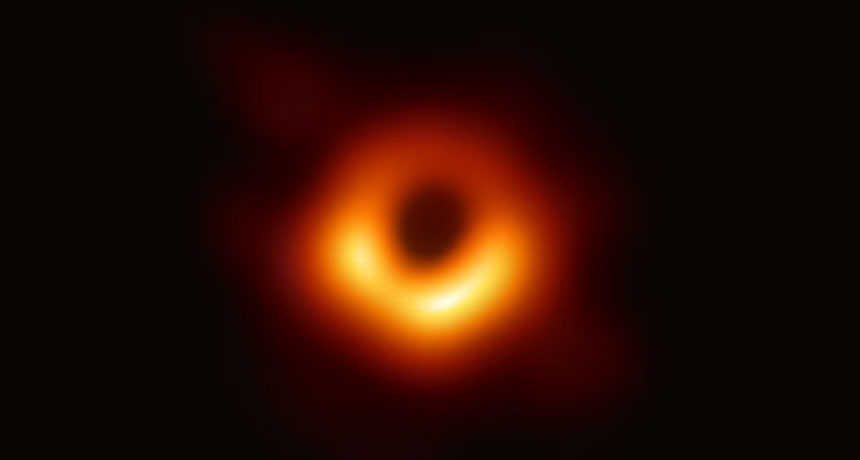
The first image of a black hole shows a bright ring with a dark, central spot. That ring is a bright disk of gas orbiting the supermassive behemoth in the galaxy M87. The spot is the black hole’s shadow.
Event Horizon Telescope Collaboration
## Share this:
- [Share via email (Opens in new window) Email](mailto:?subject=Here%E2%80%99s%20the%20first%20picture%20of%20a%20black%20hole&body=I%20saw%20this%20on%20Science%20News%3A%20https%3A%2F%2Fwww.snexplores.org%2Farticle%2Fblack-hole-first-photo-event-horizon-telescope%3Futm_source%3Dinternal%26utm_medium%3Demail%26utm_campaign%3Demail_share)
- [Share on Facebook (Opens in new window) Facebook](https://www.snexplores.org/article/black-hole-first-photo-event-horizon-telescope?share=facebook&nb=1)
- [Share on X (Opens in new window) X](https://www.snexplores.org/article/black-hole-first-photo-event-horizon-telescope?share=twitter&nb=1)
- [Share on Pinterest (Opens in new window) Pinterest](https://www.snexplores.org/article/black-hole-first-photo-event-horizon-telescope?share=pinterest&nb=1)
- [Share on Reddit (Opens in new window) Reddit](https://www.snexplores.org/article/black-hole-first-photo-event-horizon-telescope?share=reddit&nb=1)
- [Share to Google Classroom (Opens in new window) Google Classroom](https://classroom.google.com/share?url=https%3A%2F%2Fwww.snexplores.org%2Farticle%2Fblack-hole-first-photo-event-horizon-telescope)
- [Print (Opens in new window) Print](https://www.snexplores.org/article/black-hole-first-photo-event-horizon-telescope#print?share=print&nb=1)
By [Lisa Grossman](https://www.snexplores.org/author/lisa-grossman "Posts by Lisa Grossman") and [Emily Conover](https://www.snexplores.org/author/emily-conover "Posts by Emily Conover")
April 10, 2019 at 3:15 pm
This is what a black hole looks like.
A black hole isn’t really a hole. It’s an object in space with incredible mass packed into a very small area. All that mass creates such a huge gravitational tug that nothing can escape a black hole, including light.
#### [Explainer: What are black holes?](https://www.sciencenewsforstudents.org/article/explainer-what-are-black-holes)
The newly imaged supermassive monster lies in a galaxy called M87. A world-spanning network of observatories called the [Event Horizon Telescope](https://eventhorizontelescope.org/), or EHT, zoomed in on M87 to create this first-ever picture of a black hole.
“We have seen what we thought was unseeable,” Sheperd Doeleman said April 10 in Washington, D.C. “We have seen and taken a picture of a black hole,” he reported at one of seven concurrent news conferences. Doeleman is EHT’s director. He also is an astrophysicist at the Harvard-Smithsonian Center for Astrophysics in Cambridge, Mass. Results from his team’s work appear in six papers in the *Astrophysical Journal Letters*.
The concept of a black hole was first hinted at back in the 1780s. The mathematics behind them came from Albert Einstein’s 1915 general theory of relativity. And the phenomenon got its name “black hole” in the 1960s. But until now, all “pictures” of black holes have been illustrations or simulations.
#### “We’ve been studying black holes so long, sometimes it’s easy to forget that none of us have actually seen one.”
###### — France Córdova, director of the National Science Foundation
“We’ve been studying black holes so long, sometimes it’s easy to forget that none of us have actually seen one,” France Córdova said in the Washington, D.C., news conference. She is director of the National Science Foundation. Seeing a black hole “is a Herculean task,” she said.
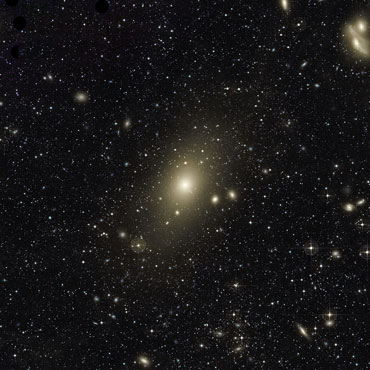
The galaxy M87 sits about 55 million light-years from Earth in the constellation Virgo. Unlike the Milky Way’s stunning spirals, M87 is a blobby giant elliptical galaxy. The Event Horizon Telescope just took the first image of the black hole at the center of M87.
That’s because black holes are famously hard to see. Their gravity is so extreme that nothing, not even light, can escape across the boundary at a black hole’s edge. That edge is known as the event horizon. But some black holes, especially supermassive ones dwelling in galaxies’ centers, stand out. They gather bright disks of gas and other material that surrounds the black hole. The EHT image reveals the shadow of M87’s black hole on its accretion disk. That disk looks like a fuzzy, asymmetrical ring. It unveils for the first time the dark abyss of one of the universe’s most mysterious objects.
“It’s been such a buildup,” Doeleman said. “It was just astonishment and wonder… to know that you’ve uncovered a part of the universe that was off limits to us.”
The much-anticipated big reveal of the image “lives up to the hype, that’s for sure,” says Priyamvada Natarajan. This astrophysicist at Yale University, in New Haven, Conn., is not on the EHT team. “It really brings home how fortunate we are as a species at this particular time, with the capacity of the human mind to comprehend the universe, to have built all the science and technology to make it happen.”
#### **Einstein was right**
The new image aligns with what physicists expected a black hole to look like based on the theory of general [*relativity*](https://www.sciencenewsforstudents.org/article/einstein-taught-us-its-all-relative) by Albert Einstein. That theory predicts how *spacetime* is warped by the extreme mass of a black hole. The picture is “one more strong piece of evidence supporting the existence of black holes. And that, of course, helps verify general relativity,” says Clifford Will. He’s a physicist at the University of Florida in Gainesville, who is not on the EHT team. “Being able to actually see this shadow and to detect it is a tremendous first step.”
Studies in the past have tested general relativity by looking at the motions of stars or gas clouds near a black hole, but never at its edge. “It’s as good as it gets,” Will says. Tiptoe any closer and you’d be inside the black hole. And then you’d be unable to report back on the results of any experiments.
“Black hole environments are a likely place where general relativity would break down,” says EHT team member Feryal Özel. She is an astrophysicist who works at the University of Arizona in Tucson. So testing general relativity in such extreme conditions could reveal things that don’t seem to support Einstein’s predictions.
#### [Explainer: Quantum is the world of the super small](https://www.sciencenewsforstudents.org/article/explainer-quantum-world-super-small)
However, she adds, just because this first image upholds general relativity “doesn’t mean general relativity is completely fine.” Many physicists think that general relativity won’t be the last word on gravity. That’s because it’s incompatible with another essential physics theory, *quantum mechanics*. This theory describes physics on very small scales.
The new image provided a new measurement of the size and heft of M87’s black hole. “Our mass determination by just directly looking at the shadow has helped resolve a longstanding controversy,” Sera Markoff said in the Washington, D.C., news conference. She’s a theoretical astrophysicist at the University of Amsterdam in the Netherlands. Estimates made using different techniques have ranged between 3.5 billion and 7.22 billion times the mass of the sun. New EHT measurements show that the mass of this black hole is about 6.5 billion solar masses.
The team also has figured out the behemoth’s size. Its diameter stretches 38 billion kilometers (24 billion miles). And the black hole spins clockwise. “M87 is a monster even by supermassive black hole standards,” Markoff said.
Scientists have been speculating for years about what a black hole would actually look like. Now, they finally know the answer.
Science News/YouTube
#### **Looking ahead**
EHT trained its sights on both M87’s black hole and Sagittarius A\*. That second supermassive black hole sits at the center of our galaxy, the Milky Way. But, the scientists found it easier to image M87’s monster, even though it’s about 2,000 times as far away as Sgr A\*.
M87’s black hole sits about 55 million light-years from Earth in the constellation Virgo. But it’s also about 1,000 times as massive as the Milky Way’s giant. Sgr A\* only weighs the equivalent of roughly 4 million suns. M87’s extra heft nearly compensates for its greater distance. The size it covers in our sky “is pretty darn similar,” says EHT team member Özel.
Because M87’s black hole is bigger and has more gravity, gases swirling around it move and vary in brightness more slowly than they do around Sgr A\*. And here’s why that’s important. “During a single observation, Sgr A\* doesn’t sit still, whereas M87 does,” says Özel. “Just based on this ‘Does the black hole sit still and pose for me?’ point of view, we knew M87 would cooperate more.”
With more data analysis, the team hopes to solve some long-standing mysteries about black holes. These include how M87’s black hole spews such a bright jet of charged particles many thousands of light-years into space.
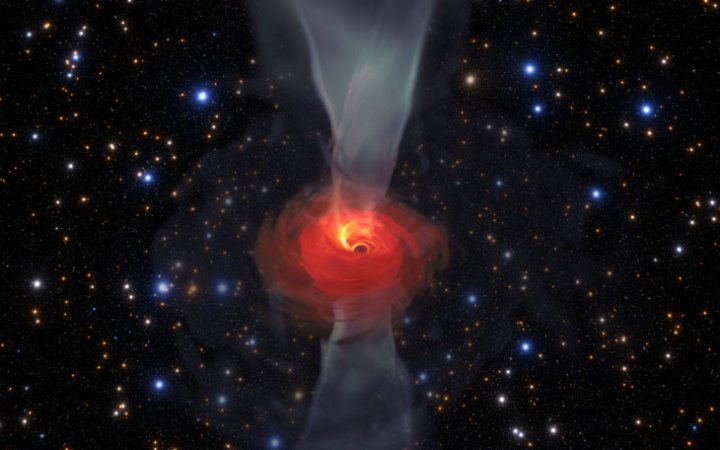
Some black holes launch jets of charged particles thousands of light-years into space, such as the one shown in this image from a simulation. Data collected to create the first image of a black hole, the one in galaxy M87, may help reveal how these jets are produced.
This first image is like the “shot heard round the world” that kicked off the American Revolutionary War, says Avi Loeb. He is an astrophysicist at Harvard University in Cambridge, Mass. “It’s very significant. It gives a glimpse of what the future might hold. But it doesn’t give us all the information that we want.”
The team does not yet have a picture of Sgr A\*. But the researchers were able to collect some data on it. They are continuing to analyze those data in the hopes of adding to a new gallery of black hole portraits. Since the appearance of that black hole changes so quickly, the team is having to develop new techniques to analyze the data from it.
“The Milky Way is a very different galaxy from M87,” Loeb notes. Studying such different environments could reveal more details of how black holes behave, he says.
The next look at the M87 and Milky Way behemoths will have to wait, though. Scientists got a lucky stretch of good weather at all eight sites that made up the Event Horizon Telescope in 2017. Then there was bad weather in 2018. (Water vapor in the atmosphere can interfere with the telescope’s measurements.) Technical difficulties cancelled this year’s observing run.
The good news is that by 2020, EHT will include 11 observatories. The Greenland Telescope joined the consortium in 2018. The Kitt Peak National Observatory outside Tucson, Ariz., and the NOrthern Extended Millimeter Array (NOEMA) in the French Alps will join EHT in 2020.
Adding more telescopes should allow the team to extend the image. That would let EHT better capture the jets that spew from the black hole. The researchers also plan to make observations using light having a slightly higher frequency. That can further sharpen the image. And even bigger plans are on the horizon — adding telescopes that orbit Earth. “World domination is not enough for us. We also want to go to space,” Doeleman quipped.
These extra eyes may be just what’s needed to bring black holes into even greater focus.
*Staff writer Maria Temming contributed to this story.*
### Power Words
[More About Power Words](https://www.snexplores.org/power-words-aid-stem-literacy/)
**align** (noun: alignment) To place or organize things in a patterned order, following an apparent line.
**astrophysics** An area of astronomy that deals with understanding the physical nature of stars and other objects in space. People who work in this field are known as **astrophysicists**.
**behemoth** A term for anything that is amazingly big. The term comes from a monstrous animal described in the Bible’s book of Job.
**black hole** A region of space having a gravitational field so intense that no matter or radiation (including light) can escape.
**consortium** A group or association of independent organizations.
**constellation** Patterns formed by prominent stars that lie close to each other in the night sky. Modern astronomers divide the sky into 88 constellations, 12 of which (known as the zodiac) lie along the sun’s path through the sky over the course of a year. Cancri, the original Greek name for the constellation Cancer, is one of those 12 zodiac constellations.
**diameter** The length of a straight line that runs through the center of a circle or spherical object, starting at the edge on one side and ending at the edge on the far side.
**event horizon** An imaginary sphere that surrounds a black hole. The more massive the black hole, the bigger the sphere. Anything that happens inside the event horizon is invisible, because gravity is so strong that under normal circumstances even light can’t escape. But according to some theories of physics, in certain situations small amounts of radiation can escape.
**galaxy** A massive group of stars bound together by gravity. Galaxies, which each typically include between 10 million and 100 trillion stars, also include clouds of gas, dust and the remnants of exploded stars.
**gravity** The force that attracts anything with mass, or bulk, toward any other thing with mass. The more mass that something has, the greater its gravity.
**light-year** The distance light travels in one year, about 9.48 trillion kilometers (almost 6 trillion miles). To get some idea of this length, imagine a rope long enough to wrap around the Earth. It would be a little over 40,000 kilometers (24,900 miles) long. Lay it out straight. Now lay another 236 million more that are the same length, end-to-end, right after the first. The total distance they now span would equal one light-year.
**mass** A number that shows how much an object resists speeding up and slowing down — basically a measure of how much matter that object is made from.
**mechanics** The study of how things move.
**Milky Way** The galaxy in which Earth’s solar system resides.
**National Science Foundation** The U.S. Congress created this independent federal agency in 1950 to promote the advancement of science; national health, prosperity and welfare; and the nation’s defense. This agency funds nearly one-fourth of all federally supported basic research in U.S. colleges and universities. In many fields such as mathematics, computer science and the social sciences, NSF is the major source of federal funding.
**network** A group of interconnected people or things. (v.) The act of connecting with other people who work in a given area or do similar thing (such as artists, business leaders or medical-support groups), often by going to gatherings where such people would be expected, and then chatting them up. (n. networking)
**observatory** (in astronomy) The building or structure (such as a satellite) that houses one or more telescopes.
**particle** A minute amount of something.
**physics** The scientific study of the nature and properties of matter and energy. Classical physics is an explanation of the nature and properties of matter and energy that relies on descriptions such as Newton’s laws of motion. Quantum physics, a field of study that emerged later, is a more accurate way of explaining the motions and behavior of matter. A scientist who works in such areas is known as a **physicist**.
**quantum** (pl. quanta) A term that refers to the smallest amount of anything, especially of energy or subatomic mass.
**quantum mechanics** A branch of physics dealing with the behavior of matter on the scale of atoms or subatomic particles.
**relativity** (in physics) A theory developed by physicist Albert Einstein showing that neither space nor time are constant, but instead affected by one’s velocity and the mass of things in your vicinity.
**spacetime** A term made essential by Einstein’s theory of relativity, it describes a designation for some spot given in terms of its three-dimensional coordinates in space, along with a fourth coordinate corresponding to time.
**standards** (in research) The values or materials used as benchmarks against which other things can be compared.
**star** The basic building block from which galaxies are made. Stars develop when gravity compacts clouds of gas. When they become dense enough to sustain nuclear-fusion reactions, stars will emit light and sometimes other forms of electromagnetic radiation. The sun is our closest star.
**sun** The star at the center of Earth’s solar system. It’s an average size star about 26,000 light-years from the center of the Milky Way galaxy. Also a term for any sunlike star.
**telescope** Usually a light-collecting instrument that makes distant objects appear nearer through the use of lenses or a combination of curved mirrors and lenses. Some, however, collect radio emissions (energy from a different portion of the electromagnetic spectrum) through a network of antennas.
**theoretical** An adjective for an analysis or assessment of something that based on pre-existing knowledge of how things behave. It is not based on experimental trials. Theoretical research tends to use math — usually performed by computers — to predict how or what will occur for some specified series of conditions. Experimental testing or observations of natural systems will then be needed to confirm what had been predicted.
**theory** (in science) A description of some aspect of the natural world based on extensive observations, tests and reason. A theory can also be a way of organizing a broad body of knowledge that applies in a broad range of circumstances to explain what will happen. Unlike the common definition of theory, a theory in science is not just a hunch. Ideas or conclusions that are based on a theory — and not yet on firm data or observations — are referred to as theoretical. Scientists who use mathematics and/or existing data to project what might happen in new situations are known as theorists.
**universe** The entire cosmos: All things that exist throughout space and time. It has been expanding since its formation during an event known as the Big Bang, some 13.8 billion years ago (give or take a few hundred million years).
**verify** (n. verification) To demonstrate or confirm in some way that a particular claim or suspicion is true.
**weather** Conditions in the atmosphere at a localized place and a particular time. It is usually described in terms of particular features, such as air pressure, humidity, moisture, any precipitation (rain, snow or ice), temperature and wind speed. Weather constitutes the actual conditions that occur at any time and place. It’s different from climate, which is a description of the conditions that tend to occur in some general region during a particular month or season.
### Citations
**Journal:** The Event Horizon Telescope Collaboration et al. [First M87 Event Horizon Telescope Results. I. The Shadow of the Supermassive Black Hole](https://iopscience.iop.org/article/10.3847/2041-8213/ab0ec7). *The Astrophysical Journal Letters*. Published online April 10, 2019. doi:10.3847/2041-8213/ab0cc7.
**Journal:** The Event Horizon Telescope Collaboration et al. [First M87 Event Horizon Telescope Results. II. Array and Instrumentation](https://iopscience.iop.org/article/10.3847/2041-8213/ab0c96). *The Astrophysical Journal Letters*. Published online April 10, 2019. doi:10.3847/2041-8213/ab0c96.
**Journal:** The Event Horizon Telescope Collaboration et al. [First M87 Event Horizon Telescope Results. III. Data Processing and Calibration](https://iopscience.iop.org/article/10.3847/2041-8213/ab0c57). *The Astrophysical Journal Letters*. Published online April 10, 2019. doi:10.3847/2041-8213/ab0c57.
**Journal:** The Event Horizon Telescope Collaboration et al. [First M87 Event Horizon Telescope Results. IV. Imaging the Central Supermassive Black Hole](https://iopscience.iop.org/article/10.3847/2041-8213/ab0e85). *The Astrophysical Journal Letters*. Published online April 10, 2019. doi:10.3847/2041-8213/ab0e85.
**Journal:** The Event Horizon Telescope Collaboration et al*.* [First M87 Event Horizon Telescope Results. V. Physical Origin of the Asymmetric Ring](https://iopscience.iop.org/article/10.3847/2041-8213/ab0f43). *The Astrophysical Journal Letters*. Published online April 10, 2019. doi:10.3847/2041-8213/ab0f43.
**Journal:** The Event Horizon Telescope Collaboration et al*.* [First M87 Event Horizon Telescope Results. VI. The Shadow and Mass of the Central Black Hole](https://iopscience.iop.org/article/10.3847/2041-8213/ab1141). *The Astrophysical Journal Letters*. Published online April 10, 2019. doi:10.3847/2041-8213/ab1141.
[](https://www.snexplores.org/author/lisa-grossman)
### About [Lisa Grossman](https://www.snexplores.org/author/lisa-grossman "Posts by Lisa Grossman")
- [E-mail](mailto:lgrossman@sciencenews.org)
- [X](https://x.com/astrolisa)
Lisa Grossman is the astronomy writer at *Science News*. She has a degree in astronomy from Cornell University and a graduate certificate in science writing from University of California, Santa Cruz. She lives near Boston.
[](https://www.snexplores.org/author/emily-conover)
### About [Emily Conover](https://www.snexplores.org/author/emily-conover "Posts by Emily Conover")
- [E-mail](mailto:econover@sciencenews.org)
- [X](https://x.com/emcconover)
*Science News* physics writer Emily Conover studied physics at the University of Chicago. She loves physics for its ability to reveal the secret rules about how stuff works, from tiny atoms to the vast cosmos.
### Classroom Resources for This Article
- [Power Words](https://www.snexplores.org/article/black-hole-first-photo-event-horizon-telescope#power-words)
Readability Score: 7.8
[Read another version of this article at Science News](https://www.sciencenews.org/article/black-hole-first-picture-event-horizon-telescope)
### Related Stories
1. [](https://www.snexplores.org/article/short-history-of-black-holes)
[Physics](https://www.snexplores.org/topic/physics)
### [A short history of black holes](https://www.snexplores.org/article/short-history-of-black-holes)
By [Emily Conover](https://www.snexplores.org/author/emily-conover "Posts by Emily Conover")
April 10, 2019
2. [](https://www.snexplores.org/article/how-virtual-telescope-got-first-black-hole-picture)
[Physics](https://www.snexplores.org/topic/physics)
### [It took a ‘virtual’ telescope to actually picture a black hole](https://www.snexplores.org/article/how-virtual-telescope-got-first-black-hole-picture)
By [Maria Temming](https://www.snexplores.org/author/maria-temming "Posts by Maria Temming")
April 10, 2019
3. [](https://www.snexplores.org/article/black-hole-mysteries)
[Physics](https://www.snexplores.org/topic/physics)
### [Black hole mysteries](https://www.snexplores.org/article/black-hole-mysteries)
By [Stephen Ornes](https://www.snexplores.org/author/stephen-ornes "Posts by Stephen Ornes")
May 29, 2013
## More Stories from Science News Explores on [Physics](https://www.snexplores.org/topic/physics)
1. [](https://www.snexplores.org/article/scientists-say-entropy-definition-pronunciation)
[Physics](https://www.snexplores.org/topic/physics)
### [Scientists Say: Entropy](https://www.snexplores.org/article/scientists-say-entropy-definition-pronunciation)
By [Katie Grace Carpenter](https://www.snexplores.org/author/katie-grace-carpenter "Posts by Katie Grace Carpenter")
April 13, 2026
2. [](https://www.snexplores.org/article/leafhoppers-invisibility-cloaking-tech)
[Tech](https://www.snexplores.org/topic/tech)
### [Backyard leafhoppers inspire next-generation cloaking tech](https://www.snexplores.org/article/leafhoppers-invisibility-cloaking-tech)
By [Pragathi Ravi](https://www.snexplores.org/author/pragathi-ravi "Posts by Pragathi Ravi")
April 13, 2026
3. [](https://www.snexplores.org/article/touch-virtual-texture-haptic-device)
[Tech](https://www.snexplores.org/topic/tech)
### [This Band Aid-like device could let you ‘feel’ the virtual world](https://www.snexplores.org/article/touch-virtual-texture-haptic-device)
By [Stephen Ornes](https://www.snexplores.org/author/stephen-ornes "Posts by Stephen Ornes")
April 8, 2026
4. [](https://www.snexplores.org/article/scientists-say-technofossil-definition-pronunciation)
[Tech](https://www.snexplores.org/topic/tech)
### [Scientists Say: Technofossil](https://www.snexplores.org/article/scientists-say-technofossil-definition-pronunciation)
By [Katie Grace Carpenter](https://www.snexplores.org/author/katie-grace-carpenter "Posts by Katie Grace Carpenter")
April 6, 2026
5. [](https://www.snexplores.org/article/sneakers-squeak-basketball-court-physics)
[Physics](https://www.snexplores.org/topic/physics)
### [Physics explains why sneakers squeak on the basketball court](https://www.snexplores.org/article/sneakers-squeak-basketball-court-physics)
By [Emily Conover](https://www.snexplores.org/author/emily-conover "Posts by Emily Conover")
March 31, 2026
6. [▶](https://www.snexplores.org/article/supermassive-black-holes-ancient-stars)
[Space](https://www.snexplores.org/topic/space)
### [Supermassive black holes might trace back to huge, ancient stars](https://www.snexplores.org/article/supermassive-black-holes-ancient-stars)
By [Maria Temming](https://www.snexplores.org/author/maria-temming "Posts by Maria Temming")
March 31, 2026
7. [](https://www.snexplores.org/article/scientists-say-discharge-definition-pronunciation)
[Physics](https://www.snexplores.org/topic/physics)
### [Scientists Say: Discharge](https://www.snexplores.org/article/scientists-say-discharge-definition-pronunciation)
By [Katie Grace Carpenter](https://www.snexplores.org/author/katie-grace-carpenter "Posts by Katie Grace Carpenter")
March 30, 2026
8. [](https://www.snexplores.org/article/lightsaber-star-wars-physics)
[Physics](https://www.snexplores.org/topic/physics)
### [Could a *Star Wars* lightsaber work?](https://www.snexplores.org/article/lightsaber-star-wars-physics)
By [Tejasri Gururaj](https://www.snexplores.org/author/tejasri-gururaj "Posts by Tejasri Gururaj")
March 30, 2026
[Science News Explores](https://www.snexplores.org/)
Founded in 2003, Science News Explores is a free, award-winning online publication dedicated to providing age-appropriate science news to learners, parents and educators. The publication, as well as Science News magazine, are published by the Society for Science, a nonprofit 501(c)(3) membership organization dedicated to public engagement in scientific research and education.
- [Science News](https://www.sciencenews.org/)
- [Science News Learning](https://www.sciencenews.org/learning/)
### Subscriber Services
- [Subscribe](https://www.snexplores.org/subscribe?utm_source=snexplores&utm_medium=footer&utm_campaign=sne-footer&tfa_3134=sne-footer)
- [Renew](https://sfsdata.com/subscriberservices/AccountStart.html?PUB=SCE)
- [Give a Gift Subscription](https://www.snexplores.org/subscription-gift?utm_source=snexplores&utm_medium=footer&utm_campaign=sne-footer&tfa_3134=sne-footer)
- [Customer Service](https://sfsdata.com/subscriberservices/AccountStart.html?PUB=SCE)
- [Follow Science News Explores on Facebook](https://www.facebook.com/SN.Explores)
- [Follow Science News Explores on X](https://twitter.com/SN_Explores)
- [Follow Science News Explores via RSS](https://www.snexplores.org/feed/)
- [Follow Science News Explores on Instagram](https://www.instagram.com/sn.explores/)
- [Follow Science News Explores on Threads](https://www.threads.com/@sn.explores)
- [Follow Science News Explores on Bluesky](https://bsky.app/profile/snexplores.bsky.social)
- [Follow Science News Explores on SoundCloud](https://soundcloud.com/science_news_explores)
### More Information
- [Using Science News Explores in the Classroom](https://www.snexplores.org/how-to-use)
- [Rights & Permissions](https://www.sciencenews.org/permission-republish)
- [Newsletters](https://www.sciencenews.org/newsletters)
### Society for Science
- [About the Society](https://www.societyforscience.org/)
- [Donate](https://www.snexplores.org/give)
- [Careers](https://www.societyforscience.org/jobs-and-internships)
© Society for Science & the Public 2000–2026. All rights reserved.
1776 Massachusetts Ave NW, Washington, DC 20036 [202\.785.2255](tel:202.785.2255)
[Terms of Service](https://www.sciencenews.org/terms-of-service) [Privacy Policy](https://www.sciencenews.org/privacy-policy)
Use up and down arrow keys to explore.Use right arrow key to move into the list.Use left arrow key to move back to the parent list.Use tab key to enter the current list item.Use escape to exit the menu.Use the Shift key with the Tab key to tab back to the search input. |
| Readable Markdown | This is what a black hole looks like.
A black hole isn’t really a hole. It’s an object in space with incredible mass packed into a very small area. All that mass creates such a huge gravitational tug that nothing can escape a black hole, including light.
[Explainer: What are black holes?](https://www.sciencenewsforstudents.org/article/explainer-what-are-black-holes)
The newly imaged supermassive monster lies in a galaxy called M87. A world-spanning network of observatories called the [Event Horizon Telescope](https://eventhorizontelescope.org/), or EHT, zoomed in on M87 to create this first-ever picture of a black hole.
“We have seen what we thought was unseeable,” Sheperd Doeleman said April 10 in Washington, D.C. “We have seen and taken a picture of a black hole,” he reported at one of seven concurrent news conferences. Doeleman is EHT’s director. He also is an astrophysicist at the Harvard-Smithsonian Center for Astrophysics in Cambridge, Mass. Results from his team’s work appear in six papers in the *Astrophysical Journal Letters*.
The concept of a black hole was first hinted at back in the 1780s. The mathematics behind them came from Albert Einstein’s 1915 general theory of relativity. And the phenomenon got its name “black hole” in the 1960s. But until now, all “pictures” of black holes have been illustrations or simulations.
#### “We’ve been studying black holes so long, sometimes it’s easy to forget that none of us have actually seen one.”
— France Córdova, director of the National Science Foundation
“We’ve been studying black holes so long, sometimes it’s easy to forget that none of us have actually seen one,” France Córdova said in the Washington, D.C., news conference. She is director of the National Science Foundation. Seeing a black hole “is a Herculean task,” she said.

The galaxy M87 sits about 55 million light-years from Earth in the constellation Virgo. Unlike the Milky Way’s stunning spirals, M87 is a blobby giant elliptical galaxy. The Event Horizon Telescope just took the first image of the black hole at the center of M87.
That’s because black holes are famously hard to see. Their gravity is so extreme that nothing, not even light, can escape across the boundary at a black hole’s edge. That edge is known as the event horizon. But some black holes, especially supermassive ones dwelling in galaxies’ centers, stand out. They gather bright disks of gas and other material that surrounds the black hole. The EHT image reveals the shadow of M87’s black hole on its accretion disk. That disk looks like a fuzzy, asymmetrical ring. It unveils for the first time the dark abyss of one of the universe’s most mysterious objects.
“It’s been such a buildup,” Doeleman said. “It was just astonishment and wonder… to know that you’ve uncovered a part of the universe that was off limits to us.”
The much-anticipated big reveal of the image “lives up to the hype, that’s for sure,” says Priyamvada Natarajan. This astrophysicist at Yale University, in New Haven, Conn., is not on the EHT team. “It really brings home how fortunate we are as a species at this particular time, with the capacity of the human mind to comprehend the universe, to have built all the science and technology to make it happen.”
#### **Einstein was right**
The new image aligns with what physicists expected a black hole to look like based on the theory of general [*relativity*](https://www.sciencenewsforstudents.org/article/einstein-taught-us-its-all-relative) by Albert Einstein. That theory predicts how *spacetime* is warped by the extreme mass of a black hole. The picture is “one more strong piece of evidence supporting the existence of black holes. And that, of course, helps verify general relativity,” says Clifford Will. He’s a physicist at the University of Florida in Gainesville, who is not on the EHT team. “Being able to actually see this shadow and to detect it is a tremendous first step.”
Studies in the past have tested general relativity by looking at the motions of stars or gas clouds near a black hole, but never at its edge. “It’s as good as it gets,” Will says. Tiptoe any closer and you’d be inside the black hole. And then you’d be unable to report back on the results of any experiments.
“Black hole environments are a likely place where general relativity would break down,” says EHT team member Feryal Özel. She is an astrophysicist who works at the University of Arizona in Tucson. So testing general relativity in such extreme conditions could reveal things that don’t seem to support Einstein’s predictions.
[Explainer: Quantum is the world of the super small](https://www.sciencenewsforstudents.org/article/explainer-quantum-world-super-small)
However, she adds, just because this first image upholds general relativity “doesn’t mean general relativity is completely fine.” Many physicists think that general relativity won’t be the last word on gravity. That’s because it’s incompatible with another essential physics theory, *quantum mechanics*. This theory describes physics on very small scales.
The new image provided a new measurement of the size and heft of M87’s black hole. “Our mass determination by just directly looking at the shadow has helped resolve a longstanding controversy,” Sera Markoff said in the Washington, D.C., news conference. She’s a theoretical astrophysicist at the University of Amsterdam in the Netherlands. Estimates made using different techniques have ranged between 3.5 billion and 7.22 billion times the mass of the sun. New EHT measurements show that the mass of this black hole is about 6.5 billion solar masses.
The team also has figured out the behemoth’s size. Its diameter stretches 38 billion kilometers (24 billion miles). And the black hole spins clockwise. “M87 is a monster even by supermassive black hole standards,” Markoff said.
Scientists have been speculating for years about what a black hole would actually look like. Now, they finally know the answer.
Science News/YouTube
#### **Looking ahead**
EHT trained its sights on both M87’s black hole and Sagittarius A\*. That second supermassive black hole sits at the center of our galaxy, the Milky Way. But, the scientists found it easier to image M87’s monster, even though it’s about 2,000 times as far away as Sgr A\*.
M87’s black hole sits about 55 million light-years from Earth in the constellation Virgo. But it’s also about 1,000 times as massive as the Milky Way’s giant. Sgr A\* only weighs the equivalent of roughly 4 million suns. M87’s extra heft nearly compensates for its greater distance. The size it covers in our sky “is pretty darn similar,” says EHT team member Özel.
Because M87’s black hole is bigger and has more gravity, gases swirling around it move and vary in brightness more slowly than they do around Sgr A\*. And here’s why that’s important. “During a single observation, Sgr A\* doesn’t sit still, whereas M87 does,” says Özel. “Just based on this ‘Does the black hole sit still and pose for me?’ point of view, we knew M87 would cooperate more.”
With more data analysis, the team hopes to solve some long-standing mysteries about black holes. These include how M87’s black hole spews such a bright jet of charged particles many thousands of light-years into space.

Some black holes launch jets of charged particles thousands of light-years into space, such as the one shown in this image from a simulation. Data collected to create the first image of a black hole, the one in galaxy M87, may help reveal how these jets are produced.
This first image is like the “shot heard round the world” that kicked off the American Revolutionary War, says Avi Loeb. He is an astrophysicist at Harvard University in Cambridge, Mass. “It’s very significant. It gives a glimpse of what the future might hold. But it doesn’t give us all the information that we want.”
The team does not yet have a picture of Sgr A\*. But the researchers were able to collect some data on it. They are continuing to analyze those data in the hopes of adding to a new gallery of black hole portraits. Since the appearance of that black hole changes so quickly, the team is having to develop new techniques to analyze the data from it.
“The Milky Way is a very different galaxy from M87,” Loeb notes. Studying such different environments could reveal more details of how black holes behave, he says.
The next look at the M87 and Milky Way behemoths will have to wait, though. Scientists got a lucky stretch of good weather at all eight sites that made up the Event Horizon Telescope in 2017. Then there was bad weather in 2018. (Water vapor in the atmosphere can interfere with the telescope’s measurements.) Technical difficulties cancelled this year’s observing run.
The good news is that by 2020, EHT will include 11 observatories. The Greenland Telescope joined the consortium in 2018. The Kitt Peak National Observatory outside Tucson, Ariz., and the NOrthern Extended Millimeter Array (NOEMA) in the French Alps will join EHT in 2020.
Adding more telescopes should allow the team to extend the image. That would let EHT better capture the jets that spew from the black hole. The researchers also plan to make observations using light having a slightly higher frequency. That can further sharpen the image. And even bigger plans are on the horizon — adding telescopes that orbit Earth. “World domination is not enough for us. We also want to go to space,” Doeleman quipped.
These extra eyes may be just what’s needed to bring black holes into even greater focus.
*Staff writer Maria Temming contributed to this story.*
### Power Words
[More About Power Words](https://www.snexplores.org/power-words-aid-stem-literacy/)
**align** (noun: alignment) To place or organize things in a patterned order, following an apparent line.
**astrophysics** An area of astronomy that deals with understanding the physical nature of stars and other objects in space. People who work in this field are known as **astrophysicists**.
**behemoth** A term for anything that is amazingly big. The term comes from a monstrous animal described in the Bible’s book of Job.
**black hole** A region of space having a gravitational field so intense that no matter or radiation (including light) can escape.
**consortium** A group or association of independent organizations.
**constellation** Patterns formed by prominent stars that lie close to each other in the night sky. Modern astronomers divide the sky into 88 constellations, 12 of which (known as the zodiac) lie along the sun’s path through the sky over the course of a year. Cancri, the original Greek name for the constellation Cancer, is one of those 12 zodiac constellations.
**diameter** The length of a straight line that runs through the center of a circle or spherical object, starting at the edge on one side and ending at the edge on the far side.
**event horizon** An imaginary sphere that surrounds a black hole. The more massive the black hole, the bigger the sphere. Anything that happens inside the event horizon is invisible, because gravity is so strong that under normal circumstances even light can’t escape. But according to some theories of physics, in certain situations small amounts of radiation can escape.
**galaxy** A massive group of stars bound together by gravity. Galaxies, which each typically include between 10 million and 100 trillion stars, also include clouds of gas, dust and the remnants of exploded stars.
**gravity** The force that attracts anything with mass, or bulk, toward any other thing with mass. The more mass that something has, the greater its gravity.
**light-year** The distance light travels in one year, about 9.48 trillion kilometers (almost 6 trillion miles). To get some idea of this length, imagine a rope long enough to wrap around the Earth. It would be a little over 40,000 kilometers (24,900 miles) long. Lay it out straight. Now lay another 236 million more that are the same length, end-to-end, right after the first. The total distance they now span would equal one light-year.
**mass** A number that shows how much an object resists speeding up and slowing down — basically a measure of how much matter that object is made from.
**mechanics** The study of how things move.
**Milky Way** The galaxy in which Earth’s solar system resides.
**National Science Foundation** The U.S. Congress created this independent federal agency in 1950 to promote the advancement of science; national health, prosperity and welfare; and the nation’s defense. This agency funds nearly one-fourth of all federally supported basic research in U.S. colleges and universities. In many fields such as mathematics, computer science and the social sciences, NSF is the major source of federal funding.
**network** A group of interconnected people or things. (v.) The act of connecting with other people who work in a given area or do similar thing (such as artists, business leaders or medical-support groups), often by going to gatherings where such people would be expected, and then chatting them up. (n. networking)
**observatory** (in astronomy) The building or structure (such as a satellite) that houses one or more telescopes.
**particle** A minute amount of something.
**physics** The scientific study of the nature and properties of matter and energy. Classical physics is an explanation of the nature and properties of matter and energy that relies on descriptions such as Newton’s laws of motion. Quantum physics, a field of study that emerged later, is a more accurate way of explaining the motions and behavior of matter. A scientist who works in such areas is known as a **physicist**.
**quantum** (pl. quanta) A term that refers to the smallest amount of anything, especially of energy or subatomic mass.
**quantum mechanics** A branch of physics dealing with the behavior of matter on the scale of atoms or subatomic particles.
**relativity** (in physics) A theory developed by physicist Albert Einstein showing that neither space nor time are constant, but instead affected by one’s velocity and the mass of things in your vicinity.
**spacetime** A term made essential by Einstein’s theory of relativity, it describes a designation for some spot given in terms of its three-dimensional coordinates in space, along with a fourth coordinate corresponding to time.
**standards** (in research) The values or materials used as benchmarks against which other things can be compared.
**star** The basic building block from which galaxies are made. Stars develop when gravity compacts clouds of gas. When they become dense enough to sustain nuclear-fusion reactions, stars will emit light and sometimes other forms of electromagnetic radiation. The sun is our closest star.
**sun** The star at the center of Earth’s solar system. It’s an average size star about 26,000 light-years from the center of the Milky Way galaxy. Also a term for any sunlike star.
**telescope** Usually a light-collecting instrument that makes distant objects appear nearer through the use of lenses or a combination of curved mirrors and lenses. Some, however, collect radio emissions (energy from a different portion of the electromagnetic spectrum) through a network of antennas.
**theoretical** An adjective for an analysis or assessment of something that based on pre-existing knowledge of how things behave. It is not based on experimental trials. Theoretical research tends to use math — usually performed by computers — to predict how or what will occur for some specified series of conditions. Experimental testing or observations of natural systems will then be needed to confirm what had been predicted.
**theory** (in science) A description of some aspect of the natural world based on extensive observations, tests and reason. A theory can also be a way of organizing a broad body of knowledge that applies in a broad range of circumstances to explain what will happen. Unlike the common definition of theory, a theory in science is not just a hunch. Ideas or conclusions that are based on a theory — and not yet on firm data or observations — are referred to as theoretical. Scientists who use mathematics and/or existing data to project what might happen in new situations are known as theorists.
**universe** The entire cosmos: All things that exist throughout space and time. It has been expanding since its formation during an event known as the Big Bang, some 13.8 billion years ago (give or take a few hundred million years).
**verify** (n. verification) To demonstrate or confirm in some way that a particular claim or suspicion is true.
**weather** Conditions in the atmosphere at a localized place and a particular time. It is usually described in terms of particular features, such as air pressure, humidity, moisture, any precipitation (rain, snow or ice), temperature and wind speed. Weather constitutes the actual conditions that occur at any time and place. It’s different from climate, which is a description of the conditions that tend to occur in some general region during a particular month or season.
Lisa Grossman is the astronomy writer at *Science News*. She has a degree in astronomy from Cornell University and a graduate certificate in science writing from University of California, Santa Cruz. She lives near Boston.
*Science News* physics writer Emily Conover studied physics at the University of Chicago. She loves physics for its ability to reveal the secret rules about how stuff works, from tiny atoms to the vast cosmos. |
| Shard | 138 (laksa) |
| Root Hash | 10963673681106489938 |
| Unparsed URL | org,snexplores!www,/article/black-hole-first-photo-event-horizon-telescope s443 |