ℹ️ Skipped - page is already crawled
| Filter | Status | Condition | Details |
|---|---|---|---|
| HTTP status | PASS | download_http_code = 200 | HTTP 200 |
| Age cutoff | PASS | download_stamp > now() - 6 MONTH | 0.6 months ago |
| History drop | PASS | isNull(history_drop_reason) | No drop reason |
| Spam/ban | PASS | fh_dont_index != 1 AND ml_spam_score = 0 | ml_spam_score=0 |
| Canonical | PASS | meta_canonical IS NULL OR = '' OR = src_unparsed | Not set |
| Property | Value |
|---|---|
| URL | https://www.skyatnightmagazine.com/space-science/sagittarius-a-black-hole-images |
| Last Crawled | 2026-04-01 03:20:07 (17 days ago) |
| First Indexed | 2025-07-15 21:13:37 (9 months ago) |
| HTTP Status Code | 200 |
| Meta Title | Astronomers have captured multiple images of the black hole at the centre of our Galaxy. Here are some of the best | BBC Sky at Night Magazine |
| Meta Description | A selection of the best images showing Sagittarius A*, the supermassive black hole located at the centre of our Milky Way galaxy. |
| Meta Canonical | null |
| Boilerpipe Text | There's a supermassive black hole at the centre of our Galaxy, the Milky Way, and it's called Sagittarius A*.
It's the closest supermassive black hole to Earth, and astronomers have been able to capture images of it using some of humanity's most powerful telescopes.
To be more precise, astronomers have managed to capture images showing the effects of Sagittarius A*, but not directly image the black hole itself.
Time-lapse video by the ESO Very Large Telescope showing stars orbiting the supermassive black hole at the heart of the Milky Way over a period of nearly 20 years. Credit: ESO/MPE
An image of the supermassive black hole at the centre of the Milky Way, captured by the MeerKAT radio telescope. Credit: NASA, ESA, CSA, STScI, SARAO, Samuel Crowe (UVA), John Bally (CU), Ruben Fedriani (IAA-CSIC), Ian Heywood (Oxford)
That's because black holes are objects from which not even light can escape, meaning they can't be directly observed or photographed.
But as matter falls in towards a black hole, it heats up and glows in different wavelengths of light like X-ray, radio and infrared.
Image showing D9 the first star pair ever found near Sagittarius A*, the supermassive black hole at the centre of the Milky Way. Credit: ESO/F. Peißker et al.
Black holes for beginners
Black holes are common throughout the Universe.
They aren’t holes, portals or cosmic vacuums either: they’re the result of infinitely dense points that cause
spacetime
to warp around them, so not even light can escape.
Black holes range in size from masses a few times that of our Sun to giants with billions of times that mass.
As a result, there are a few different types of black hole, and they likely form in very different ways.
Image of the region near the centre of the Milky Way galaxy showing the supermassive black hole Sagittarius A*, a chimney and a vent funnelling cosmic material outwards. Captured by the Chandra X-Ray Observatory and the MeerKAT telescope. Credit: X-ray: NASA/CXC/Univ. of Chicago/S.C. Mackey et al.; Radio: NRF/SARAO/MeerKAT; Image Processing: NASA/CXC/SAO/N. Wolk
Stellar-mass black holes
are the last stage of stellar evolution for massive stars.
When these massive balls of gas run out of fuel, they no longer experience an outwards pressure resisting the pull of their own gravity.
They collapse, creating a singularity – a point of infinite density – while their outer layers rebound in a
supernova
explosion.
A stellar-mass black hole is typically five to 10 times the mass of our own Sun.
Magnetic fields at Sagittarius A*, captured by SOFIA, Herschel Space Observatory, Hubble Space Telescope, 2 June 2020
Intermediate-mass black holes
are around 100 to 100,000 times the mass of our Sun.
Scientists theorise they could come about through several stellar-mass black holes merging, or from the collision of multiple massive stars in
globular clusters
.
The largest are
supermassive black holes
, which are millions or even billions of times the mass of our Sun and are thought to lie at the centre of most major galaxies.
Our own Galaxy, the Milky Way, has a supermassive black hole at its centre, which is known as Sagittarius A* (Sgr A*).
The centre of our galaxy focusing on Sagittarius A*, a supermassive black hole and a bright radio source. Without radio astronomy, little would be known about this compact object. Credit: NRAO/AUI/NSF
Discovery of Sagittarius A*
The supermassive black hole at the centre of our Galaxy, Sagittarius A* has a mass of about four million suns, which is quite small for a supermassive black hole.
It's over 26,000 lightyears from Earth, but is still our closest supermassive black hole.
Sagittarius A* was first observed as a mysterious radio source in the constellation of Sagittarius.
By the 1980s, it was considered likely to be a black hole, and that was confirmed by Andrea Gherz and Reinhard Genzel, who won the Nobel prize for the discovery in 2020.
Image of supermassive black hole Sagittarius A* captured by the Chandra X-ray Observatory. Credit: NASA/CXC/Univ. of Wisconsin/Y.Bai, et al.
Observing and photographing black holes
We can't see black holes because they're invisible to the human eye, but we can pinpoint them because of their effect on nearby space and matter.
And this is true of Sagittarius A* at the centre of our Galaxy, as the images here show.
There are a few ways of indirectly observing our supermassive black hole, from the glow of in-falling matter, to the black hole's effect on spacetime or even by observing stars in orbit around it.
A sequence of images of a star orbiting the supermassive black hole at the centre of the Milky Way. Credit: ESO
Black holes pull in material at rapid speeds, causing that material to glow in different wavelengths of light.
The Chandra X-ray Observatory, for example, has captured multiple images showing material spiralling into our Galaxy's supermassive black hole and glowing in X-ray light.
We're not seeing the black hole itself directly, but we're seeing the brightness caused by that material glowing in X-ray.
An image of our Galaxy’s core with Sagittarius A* at its centre, made from X-ray observations by the Swift Observatory from 2006-13. Credit: NASA/Swift/N. Degenaar
Or we can also see supermassive black holes through the effects of
gravitational lensing
, whereby light from a more distant object is bent by the gravity of a closer black hole on its way to our telescopes.
Black holes are also known to fire out jets or flares of material into space, and these can be seen too.
The James Webb Space Telescope, for example, captured images of
flares erupting from Sagittarius A*, glowing in infrared
.
A bright flare coming from the supermassive black hole at the centre of our Galaxy, as seen by the James Webb Space Telescope. Credit: Farhad Yusef-Zadeh/Northwestern University
Where black holes come from
The origin of supermassive black holes is still uncertain, but observations of very distant (and therefore very old) galaxies show that they existed within the first billion years of the Universe.
There are two main theories: either they began from the black holes left by supermassive stars in the early Universe and grew over time, or they formed directly from the collapse of giant gas clouds.
The most massive could be the result of two supermassive black holes merging in a violent collision of galaxies.
A collection of black holes near the centre of the Milky Way, just 3 lightyears from Sagittarius A*, captured by the Chandra X-ray Observatory. Credit: NASA/CXC/Columbia Univ./C. Hailey et al.
When black holes glow
As we've said, black holes are difficult to observe, precisely because they don’t reflect light or emit it.
Their gravitational pull is so extreme that beyond a certain point, the event horizon, not even light can escape the black hole.
Any matter that crosses this point will inevitably end up at the singularity.
As they don’t emit light, we can only observe black holes indirectly, by measuring their effect on spacetime and on things we can see.
Black hole Sagittarius A*. Credit: X-Ray: NASA/CXC/UMass/D.Wang et al.; Radio: SARAO/MeerKAT
Around the event horizon, a swirling ring of hot gas and dust orbits the black hole: the accretion disc.
This ring is superheated because of the black hole’s intense gravitational pull, which makes it ‘glow’ and emit electromagnetic radiation.
At the ‘last photon orbit’, particles of light walk a narrow tightrope, skirting around the black hole without plunging into it.
These are what cause the glowing orange doughnuts visible in the famous images taken by the
Event Horizon Telescope of Sgr A*
at the centre of the Milky Way and
M87* in the Messier 87 galaxy
.
These are probably the most famous images showing the effects of black holes ever captured, and made headlines around the world when they were released.
The Event Horizon black hole images
The most famous image of Sagittarius A*, the supermassive black hole at the centre of our Galaxy, was captured by the Event Horizon Telescope. Credit: EHT Collaboration
As bodies move through the Universe, they emit
gravitational waves
that stretch and squeeze anything they pass through by a tiny amount.
When two black holes merge, they create immense gravitational radiation, which can be picked up by gravitational-wave detectors on Earth.
These detectors have two 4km-long (2.5-mile) arms. Light travels down each arm and is reflected back at the end, before both beams are picked up by the detector.
By comparing the two light beams using a technique called interferometry, the detector can see if they’ve been stretched or squeezed by passing gravitational waves.
This allows astronomers to reveal the properties of the black holes that created the waves.
In 2019, the first direct images of a black hole were taken by the Event Horizon Telescope (EHT).
This is a global network of up to 11 radio telescopes, working together to create a telescope with the effective diameter of Earth.
Before the Event Horizon Telescope image of Sagittarius A*, the EHT captured an image of the supermassive black hole at the centre of galaxy M87. Credit: EHT Collaboration
As the angular resolution of a telescope depends on its diameter, this was able to resolve the ‘shadow’ of a black hole’s event horizon.
The team were able to capture the supermassive black hole in giant galaxy M87, as well as the one at the heart of our own Milky Way Galaxy.
Black holes can also produce relativistic jets as a result of feeding upon nearby stars, gas and dust.
These near-lightspeed beams of particles and radiation extend far into space and are detected on Earth as sudden bursts of radiation as we cross the line of the beam.
Seeing images of black holes would have been unthinkable not so long ago.
While they are still phenomena shrouded in mystery, who knows where the science might take us next? |
| Markdown | - Podcast
- TV show
- Newsletter
- BBC Astronomy
- Subscribe
- Earth from space
- Reviews[![]()](https://www.skyatnightmagazine.com/reviews)
- Advice[![]()](https://www.skyatnightmagazine.com/advice)
- Science
- Virtual Events[![]()](https://www.skyatnightmagazine.com/virtual-events)
- Astronomy news[![]()](https://www.skyatnightmagazine.com/news)
- Astrophotography[![]()](https://www.skyatnightmagazine.com/astrophotography)
- Subscribe[![]()](https://www.skyatnightmagazine.com/subscribe/?utm_term=main-menu-sub)
- Newsletter
Home
Science
Astronomers have captured multiple images of the black hole at the centre of our Galaxy. Here are some of the best
# Astronomers have captured multiple images of the black hole at the centre of our Galaxy. Here are some of the best
[Get monthly inspiration to your door with BBC Sky At Night Magazine - subscribe today](https://www.ourmediashop.com/bbc-sky-at-night-magazine-B20?utm_source=skyatnightmagazine.com&utm_medium=brandsite&utm_campaign=sponsor-link_b20&utm_content=promotional-link&style=brand)
[Iain Todd](https://www.skyatnightmagazine.com/author/iain-toddourmedia-co-uk)
[Katie Sawers](https://www.skyatnightmagazine.com/author/katie-sawers)
Published: September 12, 2025 at 6:59 am
***
There's a supermassive black hole at the centre of our Galaxy, the Milky Way, and it's called Sagittarius A\*.
It's the closest supermassive black hole to Earth, and astronomers have been able to capture images of it using some of humanity's most powerful telescopes.
To be more precise, astronomers have managed to capture images showing the effects of Sagittarius A\*, but not directly image the black hole itself.
Time-lapse video by the ESO Very Large Telescope showing stars orbiting the supermassive black hole at the heart of the Milky Way over a period of nearly 20 years. Credit: ESO/MPE

An image of the supermassive black hole at the centre of the Milky Way, captured by the MeerKAT radio telescope. Credit: NASA, ESA, CSA, STScI, SARAO, Samuel Crowe (UVA), John Bally (CU), Ruben Fedriani (IAA-CSIC), Ian Heywood (Oxford)
That's because black holes are objects from which not even light can escape, meaning they can't be directly observed or photographed.
But as matter falls in towards a black hole, it heats up and glows in different wavelengths of light like X-ray, radio and infrared.

Image showing D9 the first star pair ever found near Sagittarius A\*, the supermassive black hole at the centre of the Milky Way. Credit: ESO/F. Peißker et al.
## **Black holes for beginners**
Black holes are common throughout the Universe.
They aren’t holes, portals or cosmic vacuums either: they’re the result of infinitely dense points that cause [spacetime](https://www.skyatnightmagazine.com/space-science/what-is-spacetime) to warp around them, so not even light can escape.
Black holes range in size from masses a few times that of our Sun to giants with billions of times that mass.
As a result, there are a few different types of black hole, and they likely form in very different ways.

Image of the region near the centre of the Milky Way galaxy showing the supermassive black hole Sagittarius A\*, a chimney and a vent funnelling cosmic material outwards. Captured by the Chandra X-Ray Observatory and the MeerKAT telescope. Credit: X-ray: NASA/CXC/Univ. of Chicago/S.C. Mackey et al.; Radio: NRF/SARAO/MeerKAT; Image Processing: NASA/CXC/SAO/N. Wolk
**Stellar-mass black holes** are the last stage of stellar evolution for massive stars.
When these massive balls of gas run out of fuel, they no longer experience an outwards pressure resisting the pull of their own gravity.
They collapse, creating a singularity – a point of infinite density – while their outer layers rebound in a [supernova](https://www.skyatnightmagazine.com/space-science/when-stars-collapse-what-is-a-supernova) explosion.
A stellar-mass black hole is typically five to 10 times the mass of our own Sun.
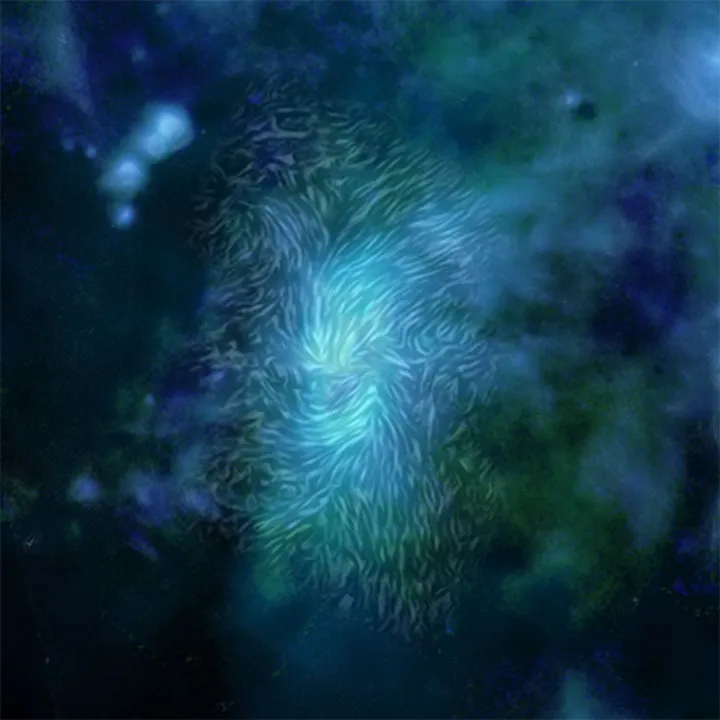
Magnetic fields at Sagittarius A\*, captured by SOFIA, Herschel Space Observatory, Hubble Space Telescope, 2 June 2020
**Intermediate-mass black holes** are around 100 to 100,000 times the mass of our Sun.
Scientists theorise they could come about through several stellar-mass black holes merging, or from the collision of multiple massive stars in [globular clusters](https://www.skyatnightmagazine.com/astrophotography/stars/star-clusters/globular-clusters).
The largest are **supermassive black holes**, which are millions or even billions of times the mass of our Sun and are thought to lie at the centre of most major galaxies.
Our own Galaxy, the Milky Way, has a supermassive black hole at its centre, which is known as Sagittarius A\* (Sgr A\*).
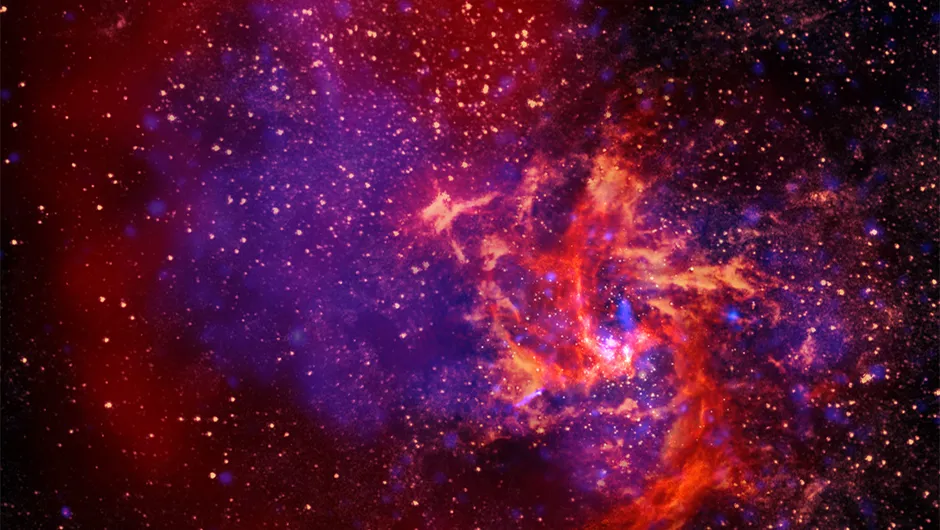
The centre of our galaxy focusing on Sagittarius A\*, a supermassive black hole and a bright radio source. Without radio astronomy, little would be known about this compact object. Credit: NRAO/AUI/NSF
## **Discovery of Sagittarius A\***
The supermassive black hole at the centre of our Galaxy, Sagittarius A\* has a mass of about four million suns, which is quite small for a supermassive black hole.
It's over 26,000 lightyears from Earth, but is still our closest supermassive black hole.
Sagittarius A\* was first observed as a mysterious radio source in the constellation of Sagittarius.
By the 1980s, it was considered likely to be a black hole, and that was confirmed by Andrea Gherz and Reinhard Genzel, who won the Nobel prize for the discovery in 2020.
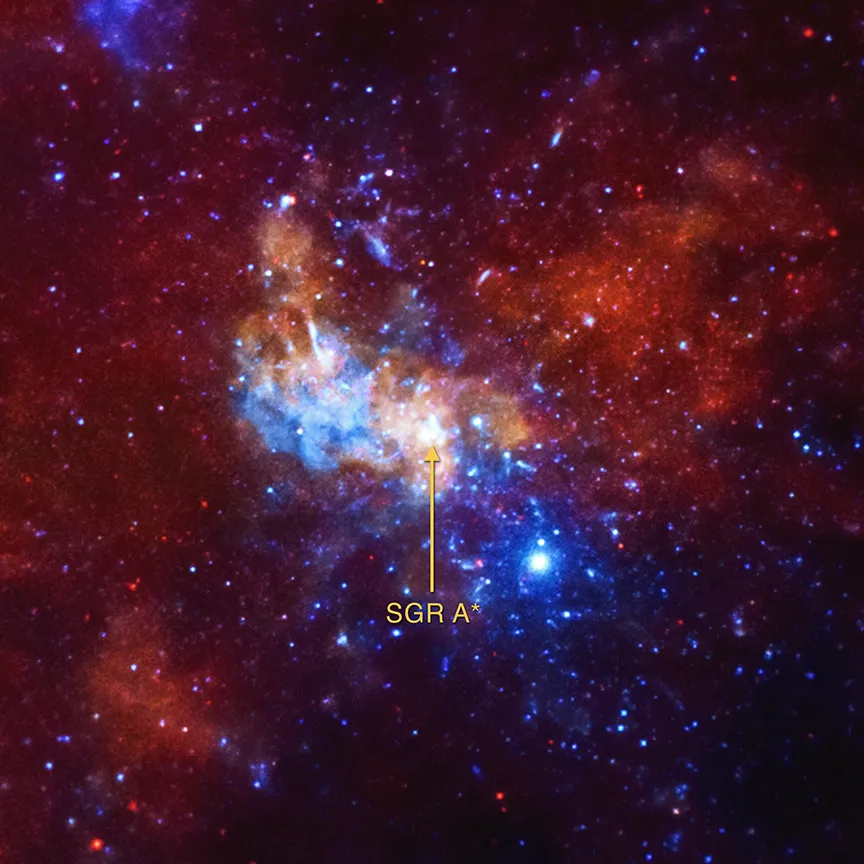
Image of supermassive black hole Sagittarius A\* captured by the Chandra X-ray Observatory. Credit: NASA/CXC/Univ. of Wisconsin/Y.Bai, et al.
## **Observing and photographing black holes**
We can't see black holes because they're invisible to the human eye, but we can pinpoint them because of their effect on nearby space and matter.
And this is true of Sagittarius A\* at the centre of our Galaxy, as the images here show.
There are a few ways of indirectly observing our supermassive black hole, from the glow of in-falling matter, to the black hole's effect on spacetime or even by observing stars in orbit around it.
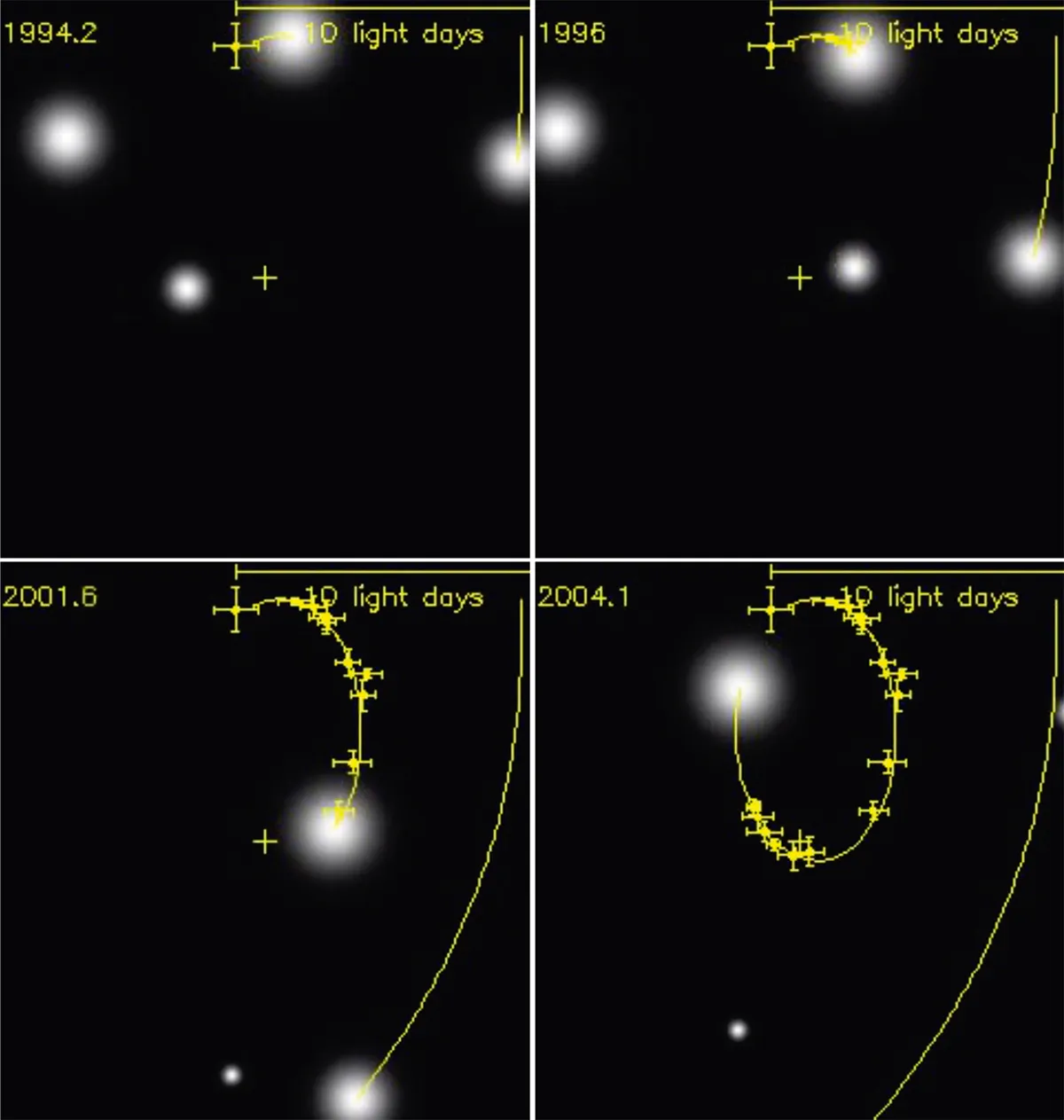
A sequence of images of a star orbiting the supermassive black hole at the centre of the Milky Way. Credit: ESO
Black holes pull in material at rapid speeds, causing that material to glow in different wavelengths of light.
The Chandra X-ray Observatory, for example, has captured multiple images showing material spiralling into our Galaxy's supermassive black hole and glowing in X-ray light.
We're not seeing the black hole itself directly, but we're seeing the brightness caused by that material glowing in X-ray.

An image of our Galaxy’s core with Sagittarius A\* at its centre, made from X-ray observations by the Swift Observatory from 2006-13. Credit: NASA/Swift/N. Degenaar
Or we can also see supermassive black holes through the effects of [gravitational lensing](https://www.skyatnightmagazine.com/space-science/a-guide-to-gravitational-lensing), whereby light from a more distant object is bent by the gravity of a closer black hole on its way to our telescopes.
Black holes are also known to fire out jets or flares of material into space, and these can be seen too.
The James Webb Space Telescope, for example, captured images of [flares erupting from Sagittarius A\*, glowing in infrared](https://www.skyatnightmagazine.com/news/webb-telescope-sees-flares-from-sagittarius-a).

A bright flare coming from the supermassive black hole at the centre of our Galaxy, as seen by the James Webb Space Telescope. Credit: Farhad Yusef-Zadeh/Northwestern University
## **Where black holes come from**
The origin of supermassive black holes is still uncertain, but observations of very distant (and therefore very old) galaxies show that they existed within the first billion years of the Universe.
There are two main theories: either they began from the black holes left by supermassive stars in the early Universe and grew over time, or they formed directly from the collapse of giant gas clouds.
The most massive could be the result of two supermassive black holes merging in a violent collision of galaxies.
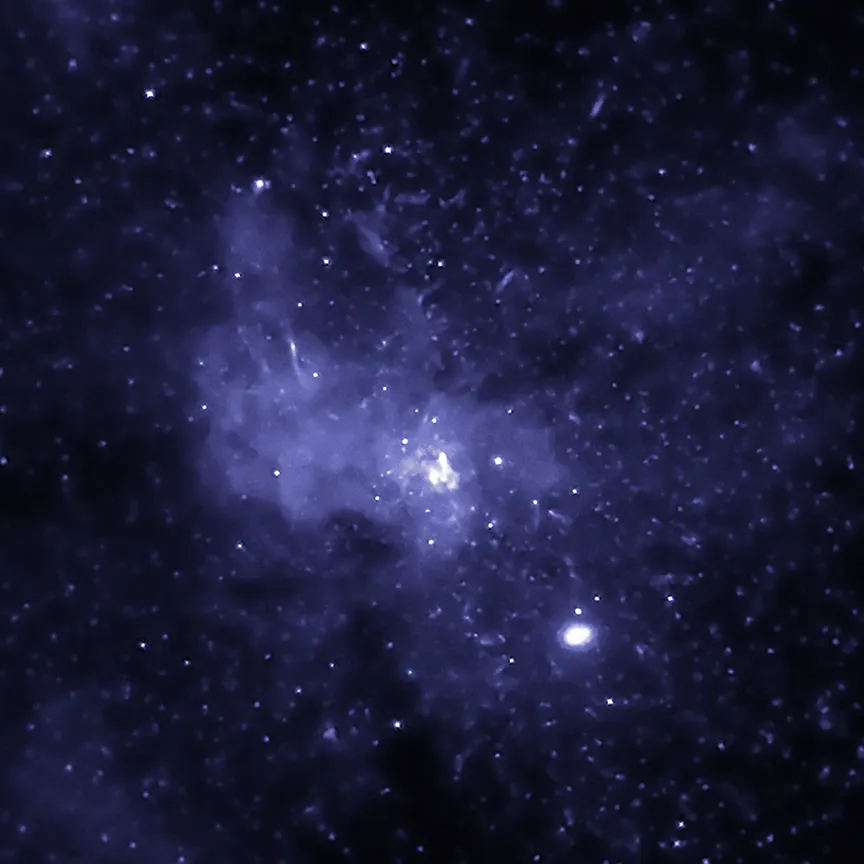
A collection of black holes near the centre of the Milky Way, just 3 lightyears from Sagittarius A\*, captured by the Chandra X-ray Observatory. Credit: NASA/CXC/Columbia Univ./C. Hailey et al.
## **When black holes glow**
As we've said, black holes are difficult to observe, precisely because they don’t reflect light or emit it.
Their gravitational pull is so extreme that beyond a certain point, the event horizon, not even light can escape the black hole.
Any matter that crosses this point will inevitably end up at the singularity.
As they don’t emit light, we can only observe black holes indirectly, by measuring their effect on spacetime and on things we can see.
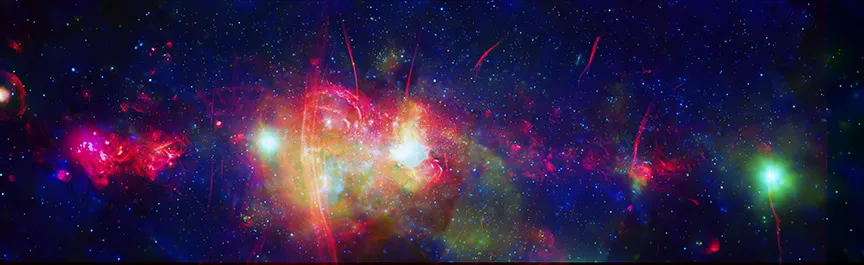
Black hole Sagittarius A\*. Credit: X-Ray: NASA/CXC/UMass/D.Wang et al.; Radio: SARAO/MeerKAT
Around the event horizon, a swirling ring of hot gas and dust orbits the black hole: the accretion disc.
This ring is superheated because of the black hole’s intense gravitational pull, which makes it ‘glow’ and emit electromagnetic radiation.
At the ‘last photon orbit’, particles of light walk a narrow tightrope, skirting around the black hole without plunging into it.
These are what cause the glowing orange doughnuts visible in the famous images taken by the [Event Horizon Telescope of Sgr A\*](https://www.skyatnightmagazine.com/news/first-image-black-hole-centre-our-galaxy) at the centre of the Milky Way and [M87\* in the Messier 87 galaxy](https://www.skyatnightmagazine.com/space-science/supermassive-black-hole-imaged-for-first-time).
These are probably the most famous images showing the effects of black holes ever captured, and made headlines around the world when they were released.
## **The Event Horizon black hole images**
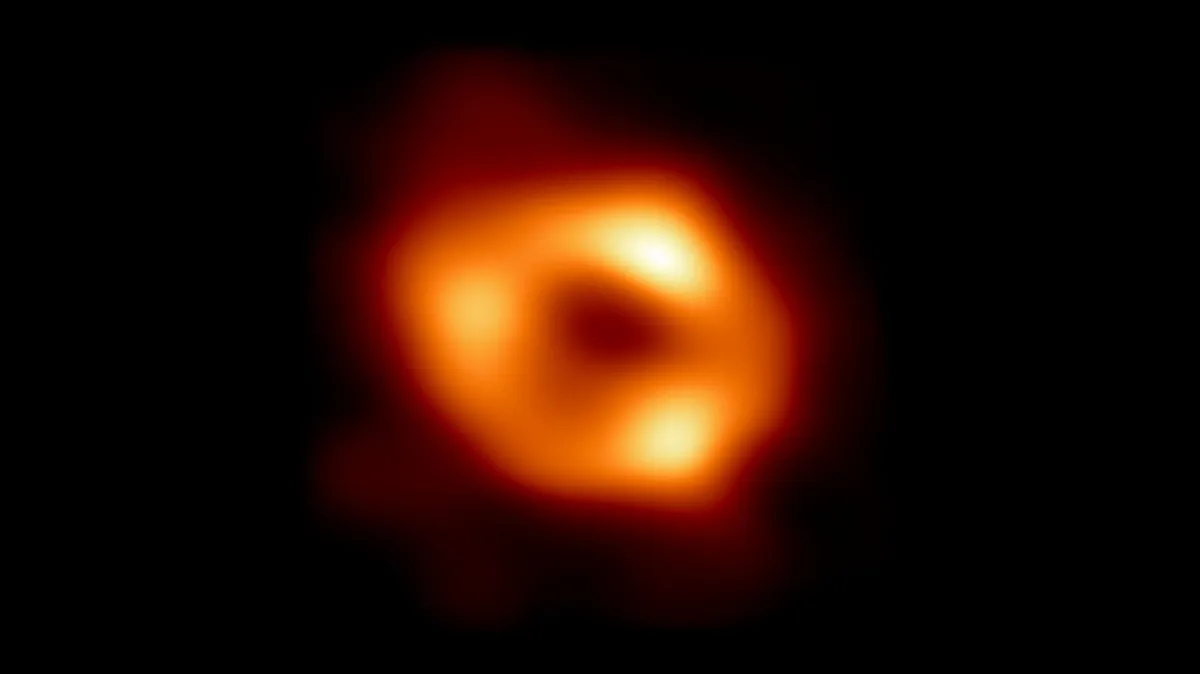
The most famous image of Sagittarius A\*, the supermassive black hole at the centre of our Galaxy, was captured by the Event Horizon Telescope. Credit: EHT Collaboration
As bodies move through the Universe, they emit [gravitational waves](https://www.skyatnightmagazine.com/news/what-are-gravitational-waves) that stretch and squeeze anything they pass through by a tiny amount.
When two black holes merge, they create immense gravitational radiation, which can be picked up by gravitational-wave detectors on Earth.
These detectors have two 4km-long (2.5-mile) arms. Light travels down each arm and is reflected back at the end, before both beams are picked up by the detector.
By comparing the two light beams using a technique called interferometry, the detector can see if they’ve been stretched or squeezed by passing gravitational waves.
This allows astronomers to reveal the properties of the black holes that created the waves.
In 2019, the first direct images of a black hole were taken by the Event Horizon Telescope (EHT).
This is a global network of up to 11 radio telescopes, working together to create a telescope with the effective diameter of Earth.
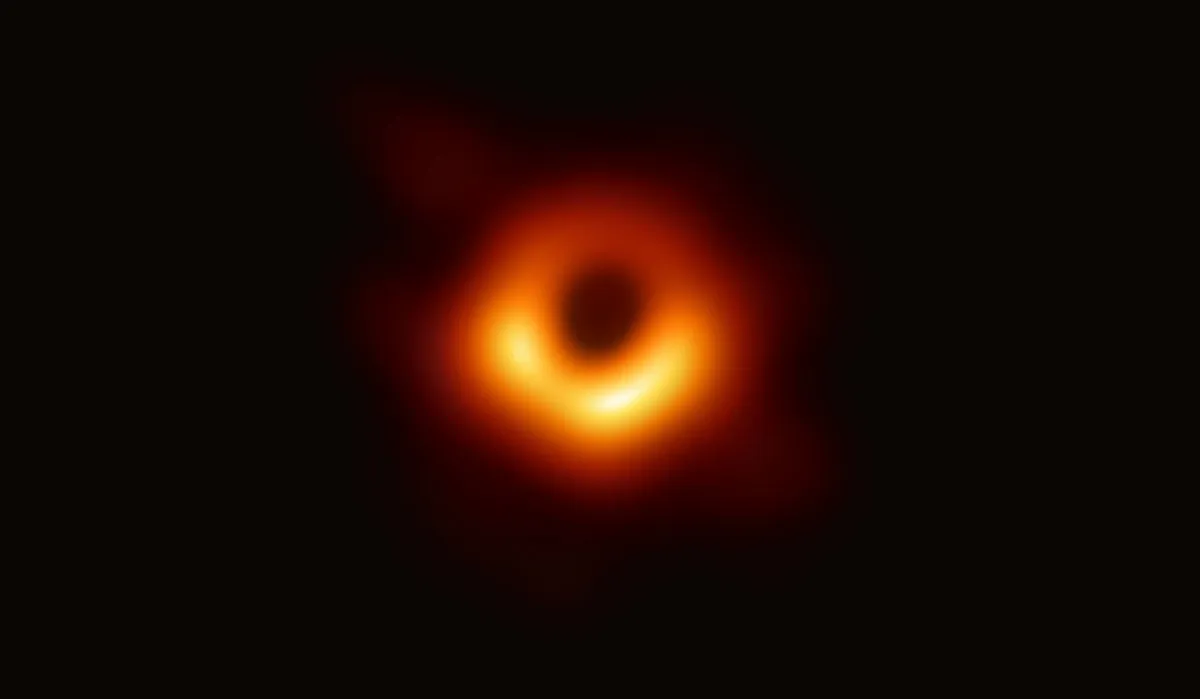
Before the Event Horizon Telescope image of Sagittarius A\*, the EHT captured an image of the supermassive black hole at the centre of galaxy M87. Credit: EHT Collaboration
As the angular resolution of a telescope depends on its diameter, this was able to resolve the ‘shadow’ of a black hole’s event horizon.
The team were able to capture the supermassive black hole in giant galaxy M87, as well as the one at the heart of our own Milky Way Galaxy.
Black holes can also produce relativistic jets as a result of feeding upon nearby stars, gas and dust.
These near-lightspeed beams of particles and radiation extend far into space and are detected on Earth as sudden bursts of radiation as we cross the line of the beam.
Seeing images of black holes would have been unthinkable not so long ago.
While they are still phenomena shrouded in mystery, who knows where the science might take us next?
![Placeholder]()
![Placeholder]()
![Placeholder]()
![Placeholder]()
![Placeholder]()
![Placeholder]()
![Placeholder]()
![Placeholder]()
![Placeholder]()
![Placeholder]()
![Placeholder]()
![Placeholder]()
![Placeholder]()
[](https://www.skyatnightmagazine.com/author/iain-toddourmedia-co-uk)
[Iain Todd]()
Science journalist
Iain Todd is BBC Sky at Night Magazine's Content Editor who has been writing about astronomy and space science for over a decade. He has covered major stargazing events, space launches and the latest news in cosmology, astrophysics, planetary and space science.
[](https://www.skyatnightmagazine.com/author/katie-sawers)
[Katie Sawers]()
Science writer
Katie Sawers is a science writer and associate editor at IOP Publishing.
![An image of the supermassive black hole at the centre of the Milky Way, captured by the MeerKAT radio telescope. Credit: NASA, ESA, CSA, STScI, SARAO, Samuel Crowe (UVA), John Bally (CU), Ruben Fedriani (IAA-CSIC), Ian Heywood (Oxford)]()
An image of the supermassive black hole at the centre of the Milky Way, captured by the MeerKAT radio telescope. Credit: NASA, ESA, CSA, STScI, SARAO, Samuel Crowe (UVA), John Bally (CU), Ruben Fedriani (IAA-CSIC), Ian Heywood (Oxford)
[](https://www.ourmediashop.com/bbc-sky-at-night-magazine-EAST26BRA?utm_source=skyatnightmagazine.com&utm_medium=brandsite&utm_campaign=EAST26BRA_EAST26BRA&utm_content=display-banner&style=brand)
[Discover more about the Universe, and how to see it, every month with a subscription to BBC Sky at Night magazine](https://www.ourmediashop.com/bbc-sky-at-night-magazine-EAST26BRA?utm_source=skyatnightmagazine.com&utm_medium=brandsite&utm_campaign=EAST26BRA_EAST26BRA&utm_content=display-banner&style=brand)
[SUBSCRIBE](https://www.ourmediashop.com/bbc-sky-at-night-magazine-EAST26BRA?utm_source=skyatnightmagazine.com&utm_medium=brandsite&utm_campaign=EAST26BRA_EAST26BRA&utm_content=display-banner&style=brand)
[](https://www.ourmediashop.com/bbc-sky-at-night-magazine-EAST26BRA?utm_source=skyatnightmagazine.com&utm_medium=brandsite&utm_campaign=EAST26BRA_EAST26BRA&utm_content=display-banner&style=brand)
- [](https://www.facebook.com/SkyatNightMagazine/)Facebook
- [](https://twitter.com/skyatnightmag)X-Platform
- [](https://www.instagram.com/bbcskyatnightmag/)Instagram
- [](https://www.youtube.com/channel/UCNXzteckwM7bKNNLwWu5OLw)Youtube
- Contact us
- Brands
- Cookies
- Privacy
- Terms and conditions
- Licensing
- Subscribe
- Manage preferences
This website is owned and published by Our Media Ltd. www.ourmedia.co.uk
© Our Media 2026
 |
| Readable Markdown | There's a supermassive black hole at the centre of our Galaxy, the Milky Way, and it's called Sagittarius A\*.
It's the closest supermassive black hole to Earth, and astronomers have been able to capture images of it using some of humanity's most powerful telescopes.
To be more precise, astronomers have managed to capture images showing the effects of Sagittarius A\*, but not directly image the black hole itself.
Time-lapse video by the ESO Very Large Telescope showing stars orbiting the supermassive black hole at the heart of the Milky Way over a period of nearly 20 years. Credit: ESO/MPE

An image of the supermassive black hole at the centre of the Milky Way, captured by the MeerKAT radio telescope. Credit: NASA, ESA, CSA, STScI, SARAO, Samuel Crowe (UVA), John Bally (CU), Ruben Fedriani (IAA-CSIC), Ian Heywood (Oxford)
That's because black holes are objects from which not even light can escape, meaning they can't be directly observed or photographed.
But as matter falls in towards a black hole, it heats up and glows in different wavelengths of light like X-ray, radio and infrared.

Image showing D9 the first star pair ever found near Sagittarius A\*, the supermassive black hole at the centre of the Milky Way. Credit: ESO/F. Peißker et al.
## **Black holes for beginners**
Black holes are common throughout the Universe.
They aren’t holes, portals or cosmic vacuums either: they’re the result of infinitely dense points that cause [spacetime](https://www.skyatnightmagazine.com/space-science/what-is-spacetime) to warp around them, so not even light can escape.
Black holes range in size from masses a few times that of our Sun to giants with billions of times that mass.
As a result, there are a few different types of black hole, and they likely form in very different ways.

Image of the region near the centre of the Milky Way galaxy showing the supermassive black hole Sagittarius A\*, a chimney and a vent funnelling cosmic material outwards. Captured by the Chandra X-Ray Observatory and the MeerKAT telescope. Credit: X-ray: NASA/CXC/Univ. of Chicago/S.C. Mackey et al.; Radio: NRF/SARAO/MeerKAT; Image Processing: NASA/CXC/SAO/N. Wolk
**Stellar-mass black holes** are the last stage of stellar evolution for massive stars.
When these massive balls of gas run out of fuel, they no longer experience an outwards pressure resisting the pull of their own gravity.
They collapse, creating a singularity – a point of infinite density – while their outer layers rebound in a [supernova](https://www.skyatnightmagazine.com/space-science/when-stars-collapse-what-is-a-supernova) explosion.
A stellar-mass black hole is typically five to 10 times the mass of our own Sun.

Magnetic fields at Sagittarius A\*, captured by SOFIA, Herschel Space Observatory, Hubble Space Telescope, 2 June 2020
**Intermediate-mass black holes** are around 100 to 100,000 times the mass of our Sun.
Scientists theorise they could come about through several stellar-mass black holes merging, or from the collision of multiple massive stars in [globular clusters](https://www.skyatnightmagazine.com/astrophotography/stars/star-clusters/globular-clusters).
The largest are **supermassive black holes**, which are millions or even billions of times the mass of our Sun and are thought to lie at the centre of most major galaxies.
Our own Galaxy, the Milky Way, has a supermassive black hole at its centre, which is known as Sagittarius A\* (Sgr A\*).

The centre of our galaxy focusing on Sagittarius A\*, a supermassive black hole and a bright radio source. Without radio astronomy, little would be known about this compact object. Credit: NRAO/AUI/NSF
## **Discovery of Sagittarius A\***
The supermassive black hole at the centre of our Galaxy, Sagittarius A\* has a mass of about four million suns, which is quite small for a supermassive black hole.
It's over 26,000 lightyears from Earth, but is still our closest supermassive black hole.
Sagittarius A\* was first observed as a mysterious radio source in the constellation of Sagittarius.
By the 1980s, it was considered likely to be a black hole, and that was confirmed by Andrea Gherz and Reinhard Genzel, who won the Nobel prize for the discovery in 2020.

Image of supermassive black hole Sagittarius A\* captured by the Chandra X-ray Observatory. Credit: NASA/CXC/Univ. of Wisconsin/Y.Bai, et al.
## **Observing and photographing black holes**
We can't see black holes because they're invisible to the human eye, but we can pinpoint them because of their effect on nearby space and matter.
And this is true of Sagittarius A\* at the centre of our Galaxy, as the images here show.
There are a few ways of indirectly observing our supermassive black hole, from the glow of in-falling matter, to the black hole's effect on spacetime or even by observing stars in orbit around it.

A sequence of images of a star orbiting the supermassive black hole at the centre of the Milky Way. Credit: ESO
Black holes pull in material at rapid speeds, causing that material to glow in different wavelengths of light.
The Chandra X-ray Observatory, for example, has captured multiple images showing material spiralling into our Galaxy's supermassive black hole and glowing in X-ray light.
We're not seeing the black hole itself directly, but we're seeing the brightness caused by that material glowing in X-ray.

An image of our Galaxy’s core with Sagittarius A\* at its centre, made from X-ray observations by the Swift Observatory from 2006-13. Credit: NASA/Swift/N. Degenaar
Or we can also see supermassive black holes through the effects of [gravitational lensing](https://www.skyatnightmagazine.com/space-science/a-guide-to-gravitational-lensing), whereby light from a more distant object is bent by the gravity of a closer black hole on its way to our telescopes.
Black holes are also known to fire out jets or flares of material into space, and these can be seen too.
The James Webb Space Telescope, for example, captured images of [flares erupting from Sagittarius A\*, glowing in infrared](https://www.skyatnightmagazine.com/news/webb-telescope-sees-flares-from-sagittarius-a).

A bright flare coming from the supermassive black hole at the centre of our Galaxy, as seen by the James Webb Space Telescope. Credit: Farhad Yusef-Zadeh/Northwestern University
## **Where black holes come from**
The origin of supermassive black holes is still uncertain, but observations of very distant (and therefore very old) galaxies show that they existed within the first billion years of the Universe.
There are two main theories: either they began from the black holes left by supermassive stars in the early Universe and grew over time, or they formed directly from the collapse of giant gas clouds.
The most massive could be the result of two supermassive black holes merging in a violent collision of galaxies.

A collection of black holes near the centre of the Milky Way, just 3 lightyears from Sagittarius A\*, captured by the Chandra X-ray Observatory. Credit: NASA/CXC/Columbia Univ./C. Hailey et al.
## **When black holes glow**
As we've said, black holes are difficult to observe, precisely because they don’t reflect light or emit it.
Their gravitational pull is so extreme that beyond a certain point, the event horizon, not even light can escape the black hole.
Any matter that crosses this point will inevitably end up at the singularity.
As they don’t emit light, we can only observe black holes indirectly, by measuring their effect on spacetime and on things we can see.

Black hole Sagittarius A\*. Credit: X-Ray: NASA/CXC/UMass/D.Wang et al.; Radio: SARAO/MeerKAT
Around the event horizon, a swirling ring of hot gas and dust orbits the black hole: the accretion disc.
This ring is superheated because of the black hole’s intense gravitational pull, which makes it ‘glow’ and emit electromagnetic radiation.
At the ‘last photon orbit’, particles of light walk a narrow tightrope, skirting around the black hole without plunging into it.
These are what cause the glowing orange doughnuts visible in the famous images taken by the [Event Horizon Telescope of Sgr A\*](https://www.skyatnightmagazine.com/news/first-image-black-hole-centre-our-galaxy) at the centre of the Milky Way and [M87\* in the Messier 87 galaxy](https://www.skyatnightmagazine.com/space-science/supermassive-black-hole-imaged-for-first-time).
These are probably the most famous images showing the effects of black holes ever captured, and made headlines around the world when they were released.
## **The Event Horizon black hole images**

The most famous image of Sagittarius A\*, the supermassive black hole at the centre of our Galaxy, was captured by the Event Horizon Telescope. Credit: EHT Collaboration
As bodies move through the Universe, they emit [gravitational waves](https://www.skyatnightmagazine.com/news/what-are-gravitational-waves) that stretch and squeeze anything they pass through by a tiny amount.
When two black holes merge, they create immense gravitational radiation, which can be picked up by gravitational-wave detectors on Earth.
These detectors have two 4km-long (2.5-mile) arms. Light travels down each arm and is reflected back at the end, before both beams are picked up by the detector.
By comparing the two light beams using a technique called interferometry, the detector can see if they’ve been stretched or squeezed by passing gravitational waves.
This allows astronomers to reveal the properties of the black holes that created the waves.
In 2019, the first direct images of a black hole were taken by the Event Horizon Telescope (EHT).
This is a global network of up to 11 radio telescopes, working together to create a telescope with the effective diameter of Earth.

Before the Event Horizon Telescope image of Sagittarius A\*, the EHT captured an image of the supermassive black hole at the centre of galaxy M87. Credit: EHT Collaboration
As the angular resolution of a telescope depends on its diameter, this was able to resolve the ‘shadow’ of a black hole’s event horizon.
The team were able to capture the supermassive black hole in giant galaxy M87, as well as the one at the heart of our own Milky Way Galaxy.
Black holes can also produce relativistic jets as a result of feeding upon nearby stars, gas and dust.
These near-lightspeed beams of particles and radiation extend far into space and are detected on Earth as sudden bursts of radiation as we cross the line of the beam.
Seeing images of black holes would have been unthinkable not so long ago.
While they are still phenomena shrouded in mystery, who knows where the science might take us next? |
| Shard | 0 (laksa) |
| Root Hash | 17272759835737108600 |
| Unparsed URL | com,skyatnightmagazine!www,/space-science/sagittarius-a-black-hole-images s443 |