ℹ️ Skipped - page is already crawled
| Filter | Status | Condition | Details |
|---|---|---|---|
| HTTP status | PASS | download_http_code = 200 | HTTP 200 |
| Age cutoff | PASS | download_stamp > now() - 6 MONTH | 0.4 months ago |
| History drop | PASS | isNull(history_drop_reason) | No drop reason |
| Spam/ban | PASS | fh_dont_index != 1 AND ml_spam_score = 0 | ml_spam_score=0 |
| Canonical | PASS | meta_canonical IS NULL OR = '' OR = src_unparsed | Not set |
| Property | Value | ||||||
|---|---|---|---|---|---|---|---|
| URL | https://www.scientificamerican.com/article/see-the-sharp-new-image-of-an-iconic-black-hole/ | ||||||
| Last Crawled | 2026-04-10 17:22:40 (12 days ago) | ||||||
| First Indexed | 2023-04-13 11:23:11 (3 years ago) | ||||||
| HTTP Status Code | 200 | ||||||
| Content | |||||||
| Meta Title | See the Sharp New Image of an Iconic Black Hole | Scientific American | ||||||
| Meta Description | Using machine learning, researchers have now created a much sharper portrait of the supermassive black hole at the center of the galaxy M87 | ||||||
| Meta Canonical | null | ||||||
| Boilerpipe Text | The iconic
first-ever view of a supermassive black hole
sports a dramatic new look, thanks to machine learning.
The picture that captivated the world in 2019 showed a bright, blurry doughnut of light. But research published in the
Astrophysical Journal Letters
on April 13 sharpens that view into a
narrow ring against a stark, black background
. The new image lays the groundwork for future advances in our understanding of black holes, scientists say.
“I think they really are in this nice niche where you develop a specific algorithm for a specific problem and put in physical knowledge and make significant progress,” says Tiziana Di Matteo, an astrophysicist at Carnegie Mellon University, who uses machine learning in her own work and wasn’t involved in the new research. “This is a beautiful example of how things can improve, how you can see further, how you can see sharper, literally,” she says.
On supporting science journalism
If you're enjoying this article, consider supporting our award-winning journalism by
subscribing
. By purchasing a subscription you are helping to ensure the future of impactful stories about the discoveries and ideas shaping our world today.
The galaxy M87 is located some 54 million light-years away from Earth. At its heart is a black hole that contains some 6.5 billion times the mass of our sun. That behemoth is one of two main targets of the
Event Horizon Telescope (EHT), a coalition of radio observatories located around the globe
. By combining data from these sources, scientists essentially constructed a telescope the size of Earth—powerful enough to capture details of bright matter swirling around the black hole.
But the EHT has a fundamental problem: its data are spotty, like a scene observed through a dirty window where light streamed through only a few patches. The 2019 image and its new companion were both based on data gathered from only a handful of locations on the planet, leaving big gaps in scientists’ view of the black hole.
That’s where machine learning comes in. Behind both the 2019 original and today’s enhanced view of M87’s black hole are imaging techniques that use machine learning to act as a sort of “mathematical detective,” says Kazunori Akiyama, an astrophysicist at the Massachusetts Institute of Technology’s Haystack Observatory, who is a member of the Event Horizon Telescope Collaboration but did not take part in the new research.
When scientists created the initial image, they relied on a generic machine-learning system to fill in the gaps. (Such a system, for instance, might decide that two neighboring pixels are more likely to be about the same brightness rather than vastly different.) When a distinctive ring-shaped image emerged from that process, that helped convince scientists that they were truly looking at a black hole. But the ring’s blurriness made learning more about the black hole difficult.
“Our thinking—and rightfully so—was that this is the very first time that anybody has seen a black hole, and we really wanted to not make any assumptions about that,” says Lia Medeiros, an astrophysicist at the Institute for Advanced Study in Princeton, N.J., and an author of the new research, who also helped create the 2019 image. “No human has ever seen this before, and so we didn’t want to assume that it’s going to be consistent with our theories.”
Confident that the EHT’s initial artificial-intelligence-augmented method had worked well for the 2019 image, Medeiros and her colleagues decided to up the ante with a subtly different and arguably more sophisticated substitute: a machine-learning approach they call principal-component interferometric modeling (PRIMO).
PRIMO runs on rules derived from what scientists expect black holes to look like, which the algorithm gleaned from training on a host of simulated black holes with varying characteristics—different masses, different spins, and so on. The result is a much more specialized algorithm.
“This is a completely new method,” Akiyama says. “They are using a different assumption for what kind of image is likely.”
Then Medeiros and her colleagues applied PRIMO to the same initial EHT data. The more physics-minded rules create a much sharper image depicting a narrower ring encircling a truly black center. And because scientists believe characteristics such as the ring’s width reflect fundamental features of the black hole, the sharper view could change scientists’ understanding of the massive object. The new research doesn’t delve deep into those potential implications, however. Papers that will do so are still in the works, Medeiros says.
And just like the iconic 2019 image, the new PRIMO image won’t be our last portrait of M87’s black hole. Akiyama wants to see the PRIMO algorithm tested more thoroughly, and Di Matteo emphasizes that the approach will become stronger as scientists continue to hone their understanding of the physics that govern black holes.
Ziri Younsi, an astrophysicist at University College London, who is a member of the Event Horizon Telescope Collaboration but did not take part in the new research, agrees. “Obviously, there’s more work which needs to be done to look at this algorithm and do more tests, but it’s potentially a very exciting result,” he says.
It’s Time to Stand Up for Science
If you enjoyed this article, I’d like to ask for your support.
Scientific American
has served as an advocate for science and industry for 180 years, and right now may be the most critical moment in that two-century history.
I’ve been a
Scientific American
subscriber since I was 12 years old, and it helped shape the way I look at the world.
SciAm
always educates and delights me, and inspires a sense of awe for our vast, beautiful universe. I hope it does that for you, too.
If you
subscribe to
Scientific American
, you help ensure that our coverage is centered on meaningful research and discovery; that we have the resources to report on the decisions that threaten labs across the U.S.; and that we support both budding and working scientists at a time when the value of science itself too often goes unrecognized.
In return, you get essential news,
captivating podcasts
, brilliant infographics,
can't-miss newsletters
, must-watch videos,
challenging games
, and the science world's best writing and reporting. You can even
gift someone a subscription
.
There has never been a more important time for us to stand up and show why science matters. I hope you’ll support us in that mission. | ||||||
| Markdown | [Skip to main content](https://www.scientificamerican.com/article/see-the-sharp-new-image-of-an-iconic-black-hole/#main)
[Scientific American](https://www.scientificamerican.com/)
April 13, 2023
4 min read
[ Add Us On GoogleAdd SciAm](https://www.google.com/preferences/source?q=scientificamerican.com)
# See the Sharp New Image of an Iconic Black Hole
Using machine learning, researchers have now created a much sharper portrait of the supermassive black hole at the center of the galaxy M87
By [Meghan Bartels](https://www.scientificamerican.com/author/meghan-bartels/) edited by [Lee Billings](https://www.scientificamerican.com/author/lee-billings/)
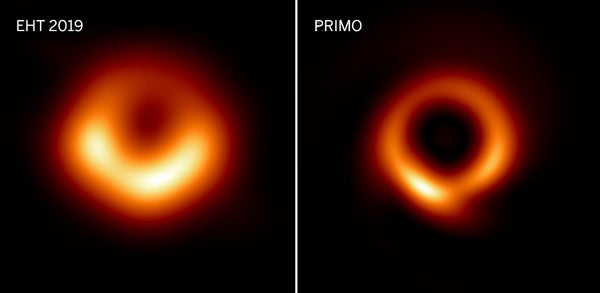
An image of the supermassive black hole in the galaxy M87 that was originally published by the Event Horizon Telescope collaboration in 2019 (*left*). A new image of the black hole that was generated by the principal-component interferometric modeling (PRIMO) algorithm using the same data set (*right*).
[EHT Collaboration](https://www.eso.org/public/images/eso1907a/) (*left*); [“The Image of the M87 Black Hole Reconstructed with PRIMO,” by Lia Medeiros et al., in Astrophysical Journal Letters, Vol. 97, No. 1. Published online April 13, 2023](https://iopscience.iop.org/article/10.3847/2041-8213/acc32d) (*right*)
The iconic [first-ever view of a supermassive black hole](https://www.scientificamerican.com/article/at-last-a-black-holes-image-revealed/) sports a dramatic new look, thanks to machine learning.
The picture that captivated the world in 2019 showed a bright, blurry doughnut of light. But research published in the *Astrophysical Journal Letters* on April 13 sharpens that view into a [narrow ring against a stark, black background](https://iopscience.iop.org/article/10.3847/2041-8213/acc32d). The new image lays the groundwork for future advances in our understanding of black holes, scientists say.
“I think they really are in this nice niche where you develop a specific algorithm for a specific problem and put in physical knowledge and make significant progress,” says Tiziana Di Matteo, an astrophysicist at Carnegie Mellon University, who uses machine learning in her own work and wasn’t involved in the new research. “This is a beautiful example of how things can improve, how you can see further, how you can see sharper, literally,” she says.
***
## On supporting science journalism
If you're enjoying this article, consider supporting our award-winning journalism by [subscribing](https://www.scientificamerican.com/getsciam/). By purchasing a subscription you are helping to ensure the future of impactful stories about the discoveries and ideas shaping our world today.
***
The galaxy M87 is located some 54 million light-years away from Earth. At its heart is a black hole that contains some 6.5 billion times the mass of our sun. That behemoth is one of two main targets of the [Event Horizon Telescope (EHT), a coalition of radio observatories located around the globe](https://www.scientificamerican.com/article/an-exit-chute-from-the-universe-the-story-of-a-historic-effort-to-image-a-black-hole/). By combining data from these sources, scientists essentially constructed a telescope the size of Earth—powerful enough to capture details of bright matter swirling around the black hole.
But the EHT has a fundamental problem: its data are spotty, like a scene observed through a dirty window where light streamed through only a few patches. The 2019 image and its new companion were both based on data gathered from only a handful of locations on the planet, leaving big gaps in scientists’ view of the black hole.
That’s where machine learning comes in. Behind both the 2019 original and today’s enhanced view of M87’s black hole are imaging techniques that use machine learning to act as a sort of “mathematical detective,” says Kazunori Akiyama, an astrophysicist at the Massachusetts Institute of Technology’s Haystack Observatory, who is a member of the Event Horizon Telescope Collaboration but did not take part in the new research.
When scientists created the initial image, they relied on a generic machine-learning system to fill in the gaps. (Such a system, for instance, might decide that two neighboring pixels are more likely to be about the same brightness rather than vastly different.) When a distinctive ring-shaped image emerged from that process, that helped convince scientists that they were truly looking at a black hole. But the ring’s blurriness made learning more about the black hole difficult.
“Our thinking—and rightfully so—was that this is the very first time that anybody has seen a black hole, and we really wanted to not make any assumptions about that,” says Lia Medeiros, an astrophysicist at the Institute for Advanced Study in Princeton, N.J., and an author of the new research, who also helped create the 2019 image. “No human has ever seen this before, and so we didn’t want to assume that it’s going to be consistent with our theories.”
Confident that the EHT’s initial artificial-intelligence-augmented method had worked well for the 2019 image, Medeiros and her colleagues decided to up the ante with a subtly different and arguably more sophisticated substitute: a machine-learning approach they call principal-component interferometric modeling (PRIMO).
PRIMO runs on rules derived from what scientists expect black holes to look like, which the algorithm gleaned from training on a host of simulated black holes with varying characteristics—different masses, different spins, and so on. The result is a much more specialized algorithm.
“This is a completely new method,” Akiyama says. “They are using a different assumption for what kind of image is likely.”
Then Medeiros and her colleagues applied PRIMO to the same initial EHT data. The more physics-minded rules create a much sharper image depicting a narrower ring encircling a truly black center. And because scientists believe characteristics such as the ring’s width reflect fundamental features of the black hole, the sharper view could change scientists’ understanding of the massive object. The new research doesn’t delve deep into those potential implications, however. Papers that will do so are still in the works, Medeiros says.
And just like the iconic 2019 image, the new PRIMO image won’t be our last portrait of M87’s black hole. Akiyama wants to see the PRIMO algorithm tested more thoroughly, and Di Matteo emphasizes that the approach will become stronger as scientists continue to hone their understanding of the physics that govern black holes.
Ziri Younsi, an astrophysicist at University College London, who is a member of the Event Horizon Telescope Collaboration but did not take part in the new research, agrees. “Obviously, there’s more work which needs to be done to look at this algorithm and do more tests, but it’s potentially a very exciting result,” he says.
[Rights & Permissions](https://s100.copyright.com/AppDispatchServlet?publisherName=sciam&publication=sciam&title=See+the+Sharp+New+Image+of+an+Iconic+Black+Hole&publicationDate=2023-04-13&contentID=BA783BBF-19FB-49C8-B978E8770D13C47F&orderBeanReset=true&author=Meghan+Bartels©right=Copyright+2023+Scientific+American%2C+Inc.)
**[Meghan Bartels](https://www.scientificamerican.com/author/meghan-bartels/)** is a science journalist based in New York City. She joined *Scientific American* in 2023 and is now a senior reporter there. Previously, she spent more than four years as a writer and editor at Space.com, as well as nearly a year as a science reporter at *Newsweek,* where she focused on space and Earth science. Her writing has also appeared in *Audubon, Nautilus, Astronomy* and *Smithsonian,* among other publications. She attended Georgetown University and earned a master’s degree in journalism at New York University’s Science, Health and Environmental Reporting Program.
[More by Meghan Bartels](https://www.scientificamerican.com/author/meghan-bartels/)
## It’s Time to Stand Up for Science
If you enjoyed this article, I’d like to ask for your support. Scientific American has served as an advocate for science and industry for 180 years, and right now may be the most critical moment in that two-century history.
I’ve been a Scientific American subscriber since I was 12 years old, and it helped shape the way I look at the world. SciAm always educates and delights me, and inspires a sense of awe for our vast, beautiful universe. I hope it does that for you, too.
If you [subscribe to Scientific American](https://www.scientificamerican.com/getsciam/), you help ensure that our coverage is centered on meaningful research and discovery; that we have the resources to report on the decisions that threaten labs across the U.S.; and that we support both budding and working scientists at a time when the value of science itself too often goes unrecognized.
In return, you get essential news, [captivating podcasts](https://www.scientificamerican.com/podcasts/), brilliant infographics, [can't-miss newsletters](https://www.scientificamerican.com/newsletters/), must-watch videos, [challenging games](https://www.scientificamerican.com/games/), and the science world's best writing and reporting. You can even [gift someone a subscription](https://www.scientificamerican.com/getsciam/gift/).
There has never been a more important time for us to stand up and show why science matters. I hope you’ll support us in that mission.

Thank you,
David M. Ewalt, Editor in Chief, Scientific American
[Subscribe](https://www.scientificamerican.com/getsciam/?utm_source=site&utm_medium=display&utm_term=eic_stand_up_for_science)
Subscribe to *Scientific American* to learn and share the most exciting discoveries, innovations and ideas shaping our world today.
[Subscription Plans](https://www.scientificamerican.com/getsciam/)[Give a Gift Subscription](https://www.scientificamerican.com/getsciam/gift/)
- **Explore SciAm**
- [Latest Issue](https://www.scientificamerican.com/latest-issue/)
- [News](https://www.scientificamerican.com/)
- [Opinion](https://www.scientificamerican.com/opinion/)
- [Newsletters](https://www.scientificamerican.com/newsletters/)
- [Podcasts](https://www.scientificamerican.com/podcasts/)
- [Games](https://www.scientificamerican.com/games/)
- [Travel](https://www.scientificamerican.com/travel/)
- **Company**
- [About](https://www.scientificamerican.com/page/about-scientific-american/)
- [Press Room](https://www.scientificamerican.com/pressroom/)
- [FAQs](https://www.scientificamerican.com/page/frequently-asked-questions/subscriptions-products/)
- [Contact Us](https://www.scientificamerican.com/page/contact-us/customer-service/)
- [Standards & Ethics](https://www.scientificamerican.com/standards-and-ethics/)
- [International Editions](https://www.scientificamerican.com/page/international/)
- [Advertise](https://www.scientificamerican.com/mediakit/)
- **More**
- [Accessibility](https://www.scientificamerican.com/accessibility-statement/)
- [Terms of Use](https://www.scientificamerican.com/page/terms-of-use/)
- [Privacy Policy](https://www.scientificamerican.com/page/privacy-policy/)
- [US State Privacy Rights](https://www.scientificamerican.com/page/us-state-privacy-rights/)
- [Use of cookies/Do not sell my data](https://www.scientificamerican.com/article/see-the-sharp-new-image-of-an-iconic-black-hole/)
- [Return & Refund Policy](https://www.scientificamerican.com/page/return-refund-policy/)
Scientific American is part of Springer Nature, which owns or has commercial relations with thousands of scientific publications (many of them can be found at www.springernature.com/us). Scientific American maintains a strict policy of editorial independence in reporting developments in science to our readers.
© 2026 SCIENTIFIC AMERICAN, A DIVISION OF SPRINGER NATURE AMERICA, INC.
ALL RIGHTS RESERVED. | ||||||
| Readable Markdown | The iconic [first-ever view of a supermassive black hole](https://www.scientificamerican.com/article/at-last-a-black-holes-image-revealed/) sports a dramatic new look, thanks to machine learning.
The picture that captivated the world in 2019 showed a bright, blurry doughnut of light. But research published in the *Astrophysical Journal Letters* on April 13 sharpens that view into a [narrow ring against a stark, black background](https://iopscience.iop.org/article/10.3847/2041-8213/acc32d). The new image lays the groundwork for future advances in our understanding of black holes, scientists say.
“I think they really are in this nice niche where you develop a specific algorithm for a specific problem and put in physical knowledge and make significant progress,” says Tiziana Di Matteo, an astrophysicist at Carnegie Mellon University, who uses machine learning in her own work and wasn’t involved in the new research. “This is a beautiful example of how things can improve, how you can see further, how you can see sharper, literally,” she says.
***
## On supporting science journalism
If you're enjoying this article, consider supporting our award-winning journalism by [subscribing](https://www.scientificamerican.com/getsciam/). By purchasing a subscription you are helping to ensure the future of impactful stories about the discoveries and ideas shaping our world today.
***
The galaxy M87 is located some 54 million light-years away from Earth. At its heart is a black hole that contains some 6.5 billion times the mass of our sun. That behemoth is one of two main targets of the [Event Horizon Telescope (EHT), a coalition of radio observatories located around the globe](https://www.scientificamerican.com/article/an-exit-chute-from-the-universe-the-story-of-a-historic-effort-to-image-a-black-hole/). By combining data from these sources, scientists essentially constructed a telescope the size of Earth—powerful enough to capture details of bright matter swirling around the black hole.
But the EHT has a fundamental problem: its data are spotty, like a scene observed through a dirty window where light streamed through only a few patches. The 2019 image and its new companion were both based on data gathered from only a handful of locations on the planet, leaving big gaps in scientists’ view of the black hole.
That’s where machine learning comes in. Behind both the 2019 original and today’s enhanced view of M87’s black hole are imaging techniques that use machine learning to act as a sort of “mathematical detective,” says Kazunori Akiyama, an astrophysicist at the Massachusetts Institute of Technology’s Haystack Observatory, who is a member of the Event Horizon Telescope Collaboration but did not take part in the new research.
When scientists created the initial image, they relied on a generic machine-learning system to fill in the gaps. (Such a system, for instance, might decide that two neighboring pixels are more likely to be about the same brightness rather than vastly different.) When a distinctive ring-shaped image emerged from that process, that helped convince scientists that they were truly looking at a black hole. But the ring’s blurriness made learning more about the black hole difficult.
“Our thinking—and rightfully so—was that this is the very first time that anybody has seen a black hole, and we really wanted to not make any assumptions about that,” says Lia Medeiros, an astrophysicist at the Institute for Advanced Study in Princeton, N.J., and an author of the new research, who also helped create the 2019 image. “No human has ever seen this before, and so we didn’t want to assume that it’s going to be consistent with our theories.”
Confident that the EHT’s initial artificial-intelligence-augmented method had worked well for the 2019 image, Medeiros and her colleagues decided to up the ante with a subtly different and arguably more sophisticated substitute: a machine-learning approach they call principal-component interferometric modeling (PRIMO).
PRIMO runs on rules derived from what scientists expect black holes to look like, which the algorithm gleaned from training on a host of simulated black holes with varying characteristics—different masses, different spins, and so on. The result is a much more specialized algorithm.
“This is a completely new method,” Akiyama says. “They are using a different assumption for what kind of image is likely.”
Then Medeiros and her colleagues applied PRIMO to the same initial EHT data. The more physics-minded rules create a much sharper image depicting a narrower ring encircling a truly black center. And because scientists believe characteristics such as the ring’s width reflect fundamental features of the black hole, the sharper view could change scientists’ understanding of the massive object. The new research doesn’t delve deep into those potential implications, however. Papers that will do so are still in the works, Medeiros says.
And just like the iconic 2019 image, the new PRIMO image won’t be our last portrait of M87’s black hole. Akiyama wants to see the PRIMO algorithm tested more thoroughly, and Di Matteo emphasizes that the approach will become stronger as scientists continue to hone their understanding of the physics that govern black holes.
Ziri Younsi, an astrophysicist at University College London, who is a member of the Event Horizon Telescope Collaboration but did not take part in the new research, agrees. “Obviously, there’s more work which needs to be done to look at this algorithm and do more tests, but it’s potentially a very exciting result,” he says.
## It’s Time to Stand Up for Science
If you enjoyed this article, I’d like to ask for your support. Scientific American has served as an advocate for science and industry for 180 years, and right now may be the most critical moment in that two-century history.
I’ve been a Scientific American subscriber since I was 12 years old, and it helped shape the way I look at the world. SciAm always educates and delights me, and inspires a sense of awe for our vast, beautiful universe. I hope it does that for you, too.
If you [subscribe to Scientific American](https://www.scientificamerican.com/getsciam/), you help ensure that our coverage is centered on meaningful research and discovery; that we have the resources to report on the decisions that threaten labs across the U.S.; and that we support both budding and working scientists at a time when the value of science itself too often goes unrecognized.
In return, you get essential news, [captivating podcasts](https://www.scientificamerican.com/podcasts/), brilliant infographics, [can't-miss newsletters](https://www.scientificamerican.com/newsletters/), must-watch videos, [challenging games](https://www.scientificamerican.com/games/), and the science world's best writing and reporting. You can even [gift someone a subscription](https://www.scientificamerican.com/getsciam/gift/).
There has never been a more important time for us to stand up and show why science matters. I hope you’ll support us in that mission. | ||||||
| ML Classification | |||||||
| ML Categories |
Raw JSON{
"/Science": 997,
"/Science/Astronomy": 967
} | ||||||
| ML Page Types |
Raw JSON{
"/Article": 997,
"/Article/News_Update": 833
} | ||||||
| ML Intent Types |
Raw JSON{
"Informational": 999
} | ||||||
| Content Metadata | |||||||
| Language | en | ||||||
| Author | Meghan Bartels | ||||||
| Publish Time | not set | ||||||
| Original Publish Time | 2023-04-13 11:23:11 (3 years ago) | ||||||
| Republished | No | ||||||
| Word Count (Total) | 1,457 | ||||||
| Word Count (Content) | 1,062 | ||||||
| Links | |||||||
| External Links | 11 | ||||||
| Internal Links | 28 | ||||||
| Technical SEO | |||||||
| Meta Nofollow | No | ||||||
| Meta Noarchive | No | ||||||
| JS Rendered | No | ||||||
| Redirect Target | null | ||||||
| Performance | |||||||
| Download Time (ms) | 830 | ||||||
| TTFB (ms) | 827 | ||||||
| Download Size (bytes) | 18,921 | ||||||
| Shard | 66 (laksa) | ||||||
| Root Hash | 15343250200200202866 | ||||||
| Unparsed URL | com,scientificamerican!www,/article/see-the-sharp-new-image-of-an-iconic-black-hole/ s443 | ||||||