ℹ️ Skipped - page is already crawled
| Filter | Status | Condition | Details |
|---|---|---|---|
| HTTP status | PASS | download_http_code = 200 | HTTP 200 |
| Age cutoff | PASS | download_stamp > now() - 6 MONTH | 0.5 months ago |
| History drop | PASS | isNull(history_drop_reason) | No drop reason |
| Spam/ban | PASS | fh_dont_index != 1 AND ml_spam_score = 0 | ml_spam_score=0 |
| Canonical | PASS | meta_canonical IS NULL OR = '' OR = src_unparsed | Not set |
| Property | Value | |||||||||
|---|---|---|---|---|---|---|---|---|---|---|
| URL | https://www.scientificamerican.com/article/scientists-pick-the-most-beautiful-equations/ | |||||||||
| Last Crawled | 2026-04-12 14:50:04 (15 days ago) | |||||||||
| First Indexed | 2016-10-20 05:08:07 (9 years ago) | |||||||||
| HTTP Status Code | 200 | |||||||||
| Content | ||||||||||
| Meta Title | Scientists Pick the Most Beautiful Equations | Scientific American | |||||||||
| Meta Description | Mathematicians often see more than cold logic in symbols and numbers. They see the sublime | |||||||||
| Meta Canonical | null | |||||||||
| Boilerpipe Text | Are equations beautiful? To scientists, formulas' ability to represent fundamental truths or concisely capture complexity is indeed exquisite. To many in the public, though, they can be the opposite of beautiful—intimidating, utilitarian and opaque. Yet for others, the very mystery can be alluring: even when we cannot understand what equations say, we can be moved by knowing they have meanings beyond our comprehension. And mathematicians and nonmathematicians alike can be drawn in by the purely aesthetic appeal of these expressions, whose graceful and sometimes inscrutable symbols combine in visually satisfying ways.
To explore both the inherent and visual beauty of math, mathematician Daniel Rockmore of Dartmouth College teamed up with Bob Feldman of Parasol Press, which publishes fine art prints. They asked 10 famous mathematicians and physicists to write out what they conceived of as the “most beautiful mathematical expression” and had the print shop Harlan & Weaver turn the responses into 22-by-30-inch etchings called aquatints. “I was careful to not give any instruction beyond that sentence,” Rockmore says. “As the 10 prints show, it means different things to different people.”
Many picked classic equations, such as the famous formula by Isaac Newton that was Stephen Smale's choice (
page 73
). Others selected expressions closer to home, including equations they discovered themselves that are deeply tied to their lifelong research interests—for example, the MacDonald equation chosen by Freeman Dyson (
page 72
). “I love Dyson's,” Rockmore says. “It's thin, and it's sleek; visually, it's so sharp. And with those little exclamation points for the factorials, it's beautiful.”
On supporting science journalism
If you're enjoying this article, consider supporting our award-winning journalism by
subscribing
. By purchasing a subscription you are helping to ensure the future of impactful stories about the discoveries and ideas shaping our world today.
The project is called Concinnitas, after the word used by Italian Renaissance scholar Leon Battista Alberti to describe the balance of elements necessary for beautiful art. The collection premiered in December 2014 at the Annemarie Verna Gallery in Zurich and has since been shown at five more galleries, with plans to travel elsewhere in the coming months. Here we show five of the prints.
Ampère’s Law
Chosen by Simon Donaldson, Stony Brook University
Instead of selecting a single equation, Donaldson listed three and drew a picture of a wire tied in a knot. The current (
J
) running through the wire toward the large arrows creates a magnetic field (
B
) in the direction indicated with small arrows. The three equations are Ampère’s law, which describes how a current generates a magnetic field. Together the image and the equations represent the connection between electromagnetism and topology—the branch of mathematics concerned with knots and spatial relations. Donaldson says he finds beauty in revealing such “new connections between things that one previously thought of as quite different.” For example, by applying some of the ideas and mathematics of electromagnetism to the study of knots, researchers have found new ways to determine whether different knots are fundamentally the same, the way a doughnut and a coffee mug are essentially the same shape deformed to look different.
Editor's Note (1/21/16): The graphic above from the original print article includes an error in the middle equation in the lower right corner. The correct equation is: Jy = ∂Bx/2z – ∂Bz/∂x.
MacDonald Equation
Chosen by Freeman Dyson, Institute for Advanced Study, Princeton, N.J.
Dyson derived this equation—a reformulation of a classic called the tau function, famously studied by Indian mathematician Srinivasa Ramanujan—shortly after another mathematician, Ian MacDonald, independently arrived at it. In it, five variables—a, b, c, d and e—are subtracted from one another in 10 combinations. The differences are multiplied together and divided by the product of the factorials for 1, 2, 3 and 4 (for example, 4 factorial, expressed as 4! = 1 × 2 × 3 × 4). The elegance of this formulation appeals to Dyson because it reveals a kind of symmetry, or balance, among the five variables in the tau function. The equation is also beautiful in a more indefinable way, he says. “It doesn’t particularly tell you anything true about the universe—it just stands for itself, like a piece of music,” he notes. “Asking what it means is rather like asking what a Beethoven trio means. You just have to listen to it.” The equation belongs to the branch of pure mathematics called number theory.
Moduli Space of Curves of Genus
g
Chosen by David Mumford, Brown University
Our universe has just three dimensions of space, but mathematicians can imagine it containing many more. This equation describes a space with dimensions numbering
3g − 3
and shows that if
g
is large enough, the shape of the space is negatively curved, like the surface of a saddle.* When Mumford discovered the formula, he recalls, “I thought it was a startling result, especially that strange number 13 that came up.” Most fundamental mathematical expressions consist only of variables, operators and small whole numbers such as 1 and 2, making the relatively large quantity 13 in this equation an aberration. To Mumford, the strangeness of the equation makes it beautiful. “As a mathematician, you feel you’re discovering these logically determined facts—they have to be this way and no other way,” he says. “And suddenly you come up with a strange number, and you think, ‘Why did it have to be
this
way?’”
*Editor's Note (1/26/16): This sentence from the print article was edited after it was posted online to correct the equation.
Newton’s Method
Chosen by Stephen Smale, City University of Hong Kong
A mathematical trick, known as Newton’s method, approximates the solution to an equation—
f(x)
—whose exact answer cannot be calculated, such as the square root of 2 (which is the irrational number 1.4142 ...). It works by starting with any real number,
x
, and subtracting the function
f(x)
divided by the derivative of that function,
f′(x)
, to get a new
x
. Every time this process repeats, x gets closer and closer to an estimation of the solution. The method is very handy, yet even Newton lacked a good theory for why it works. That mystery is what makes this equation so appealing to Smale. “So much of my work is devoted to understanding Newton’s equation—under what conditions it works,” he says. “My own feeling is that a great problem is never solved; it just becomes the focus of more and more work.”
The Lagrangian of the Electroweak Theory
Chosen by Steven Weinberg, University of Texas at Austin
Two of nature’s four fundamental forces—electromagnetism and the weak force (responsible for radioactive decay)—unite in this equation, revealing themselves to be two sides of a single coin. The formula, which Weinberg devised in 1967, established that at certain energies, electromagnetism and the weak force act as one, the “electroweak” force—a discovery that later won him the Nobel Prize in Physics. Here the
L
represents the Lagrangian density, essentially the energy density of the fields associated with the force, which are denoted by
A
and
B
. “I think the shape of the symbols on the page has nothing to do with its beauty,” Weinberg says. “It is the fact that the theory is rigid, that it can’t be changed without screwing it up, that makes the theory beautiful. Its details are fixed by some underlying fundamental principle.”
COURTESY OF PARASOL PRESS (
all equation images
) | |||||||||
| Markdown | [Skip to main content](https://www.scientificamerican.com/article/scientists-pick-the-most-beautiful-equations/#main)
[Scientific American](https://www.scientificamerican.com/)
January 1, 2016
6 min read
[ Add Us On GoogleAdd SciAm](https://www.google.com/preferences/source?q=scientificamerican.com)
# Scientists Pick the Most Beautiful Equations
Mathematicians often see more than cold logic in symbols and numbers. They see the sublime
By [Clara Moskowitz](https://www.scientificamerican.com/author/clara-moskowitz/)
©iStock.com
Are equations beautiful? To scientists, formulas' ability to represent fundamental truths or concisely capture complexity is indeed exquisite. To many in the public, though, they can be the opposite of beautiful—intimidating, utilitarian and opaque. Yet for others, the very mystery can be alluring: even when we cannot understand what equations say, we can be moved by knowing they have meanings beyond our comprehension. And mathematicians and nonmathematicians alike can be drawn in by the purely aesthetic appeal of these expressions, whose graceful and sometimes inscrutable symbols combine in visually satisfying ways.
To explore both the inherent and visual beauty of math, mathematician Daniel Rockmore of Dartmouth College teamed up with Bob Feldman of Parasol Press, which publishes fine art prints. They asked 10 famous mathematicians and physicists to write out what they conceived of as the “most beautiful mathematical expression” and had the print shop Harlan & Weaver turn the responses into 22-by-30-inch etchings called aquatints. “I was careful to not give any instruction beyond that sentence,” Rockmore says. “As the 10 prints show, it means different things to different people.”
Many picked classic equations, such as the famous formula by Isaac Newton that was Stephen Smale's choice (*page 73*). Others selected expressions closer to home, including equations they discovered themselves that are deeply tied to their lifelong research interests—for example, the MacDonald equation chosen by Freeman Dyson (*page 72*). “I love Dyson's,” Rockmore says. “It's thin, and it's sleek; visually, it's so sharp. And with those little exclamation points for the factorials, it's beautiful.”
***
## On supporting science journalism
If you're enjoying this article, consider supporting our award-winning journalism by [subscribing](https://www.scientificamerican.com/getsciam/). By purchasing a subscription you are helping to ensure the future of impactful stories about the discoveries and ideas shaping our world today.
***
The project is called Concinnitas, after the word used by Italian Renaissance scholar Leon Battista Alberti to describe the balance of elements necessary for beautiful art. The collection premiered in December 2014 at the Annemarie Verna Gallery in Zurich and has since been shown at five more galleries, with plans to travel elsewhere in the coming months. Here we show five of the prints.
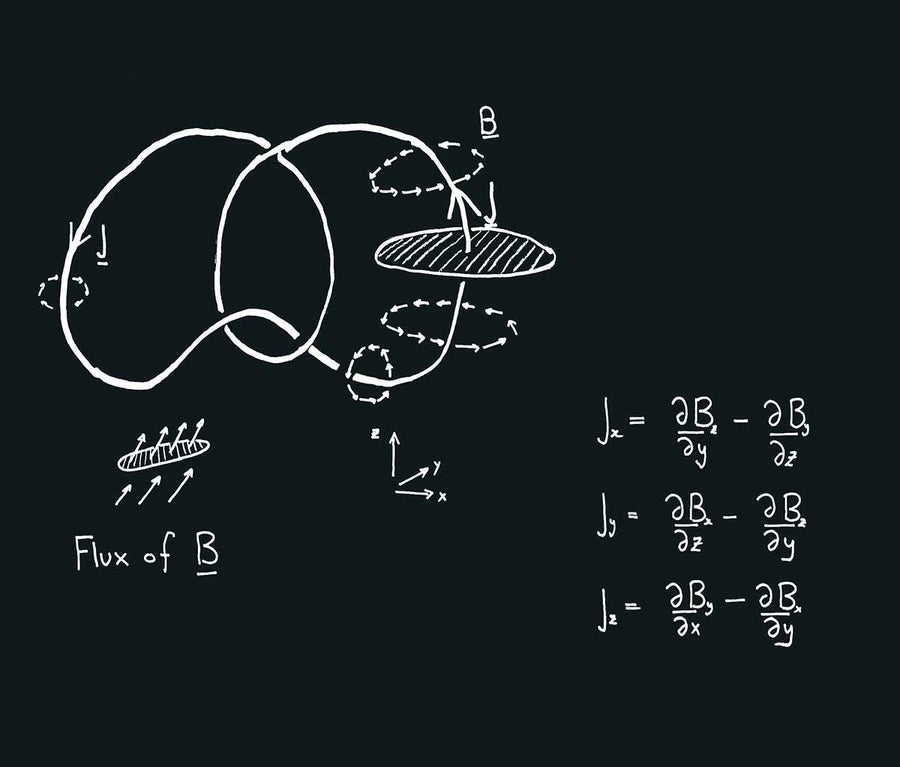
**Ampère’s Law** *Chosen by Simon Donaldson, Stony Brook University*
Instead of selecting a single equation, Donaldson listed three and drew a picture of a wire tied in a knot. The current (*J*) running through the wire toward the large arrows creates a magnetic field (*B*) in the direction indicated with small arrows. The three equations are Ampère’s law, which describes how a current generates a magnetic field. Together the image and the equations represent the connection between electromagnetism and topology—the branch of mathematics concerned with knots and spatial relations. Donaldson says he finds beauty in revealing such “new connections between things that one previously thought of as quite different.” For example, by applying some of the ideas and mathematics of electromagnetism to the study of knots, researchers have found new ways to determine whether different knots are fundamentally the same, the way a doughnut and a coffee mug are essentially the same shape deformed to look different.
*Editor's Note (1/21/16): The graphic above from the original print article includes an error in the middle equation in the lower right corner. The correct equation is: Jy = ∂Bx/2z – ∂Bz/∂x.*
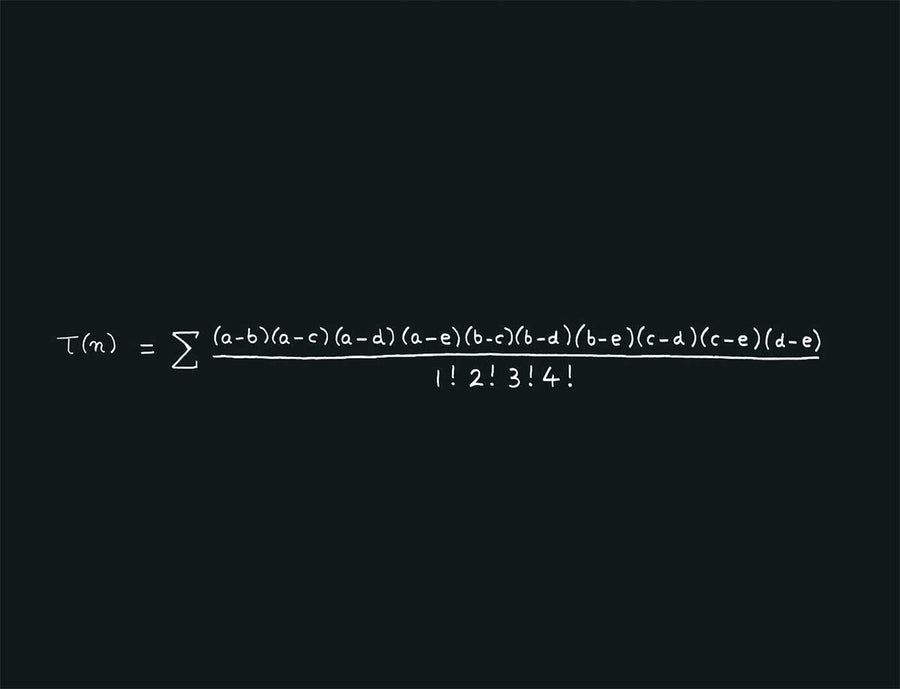
**MacDonald Equation** *Chosen by Freeman Dyson, Institute for Advanced Study, Princeton, N.J.*
Dyson derived this equation—a reformulation of a classic called the tau function, famously studied by Indian mathematician Srinivasa Ramanujan—shortly after another mathematician, Ian MacDonald, independently arrived at it. In it, five variables—a, b, c, d and e—are subtracted from one another in 10 combinations. The differences are multiplied together and divided by the product of the factorials for 1, 2, 3 and 4 (for example, 4 factorial, expressed as 4! = 1 × 2 × 3 × 4). The elegance of this formulation appeals to Dyson because it reveals a kind of symmetry, or balance, among the five variables in the tau function. The equation is also beautiful in a more indefinable way, he says. “It doesn’t particularly tell you anything true about the universe—it just stands for itself, like a piece of music,” he notes. “Asking what it means is rather like asking what a Beethoven trio means. You just have to listen to it.” The equation belongs to the branch of pure mathematics called number theory.

**Moduli Space of Curves of Genus** ***g*** *Chosen by David Mumford, Brown University*
Our universe has just three dimensions of space, but mathematicians can imagine it containing many more. This equation describes a space with dimensions numbering *3g − 3* and shows that if *g* is large enough, the shape of the space is negatively curved, like the surface of a saddle.\* When Mumford discovered the formula, he recalls, “I thought it was a startling result, especially that strange number 13 that came up.” Most fundamental mathematical expressions consist only of variables, operators and small whole numbers such as 1 and 2, making the relatively large quantity 13 in this equation an aberration. To Mumford, the strangeness of the equation makes it beautiful. “As a mathematician, you feel you’re discovering these logically determined facts—they have to be this way and no other way,” he says. “And suddenly you come up with a strange number, and you think, ‘Why did it have to be *this* way?’”
*\*Editor's Note (1/26/16): This sentence from the print article was edited after it was posted online to correct the equation.*
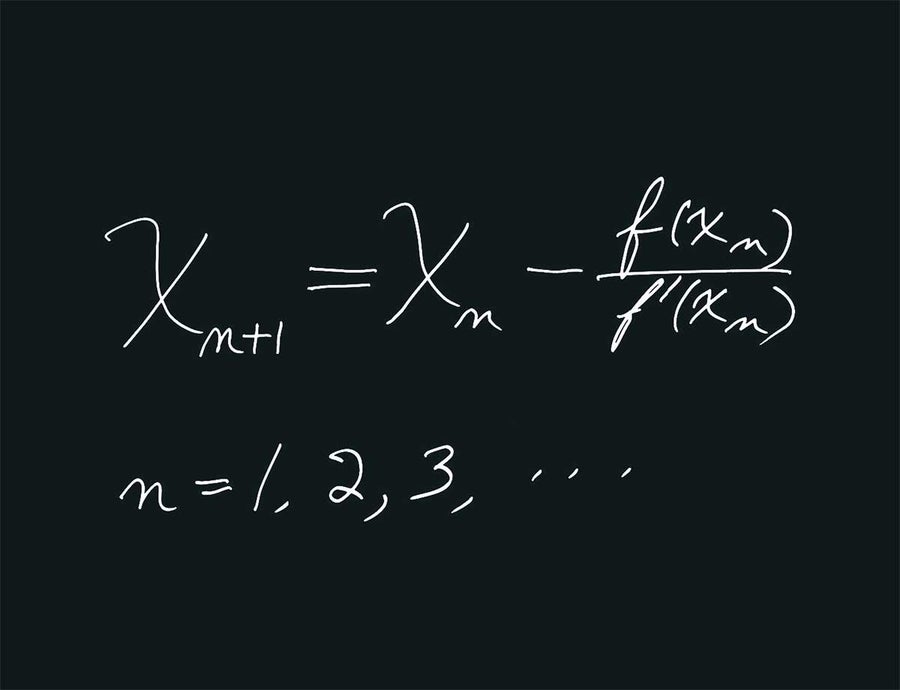
**Newton’s Method** *Chosen by Stephen Smale, City University of Hong Kong*
A mathematical trick, known as Newton’s method, approximates the solution to an equation—*f(x)*—whose exact answer cannot be calculated, such as the square root of 2 (which is the irrational number 1.4142 ...). It works by starting with any real number, *x*, and subtracting the function *f(x)* divided by the derivative of that function, *f′(x)*, to get a new *x*. Every time this process repeats, x gets closer and closer to an estimation of the solution. The method is very handy, yet even Newton lacked a good theory for why it works. That mystery is what makes this equation so appealing to Smale. “So much of my work is devoted to understanding Newton’s equation—under what conditions it works,” he says. “My own feeling is that a great problem is never solved; it just becomes the focus of more and more work.”
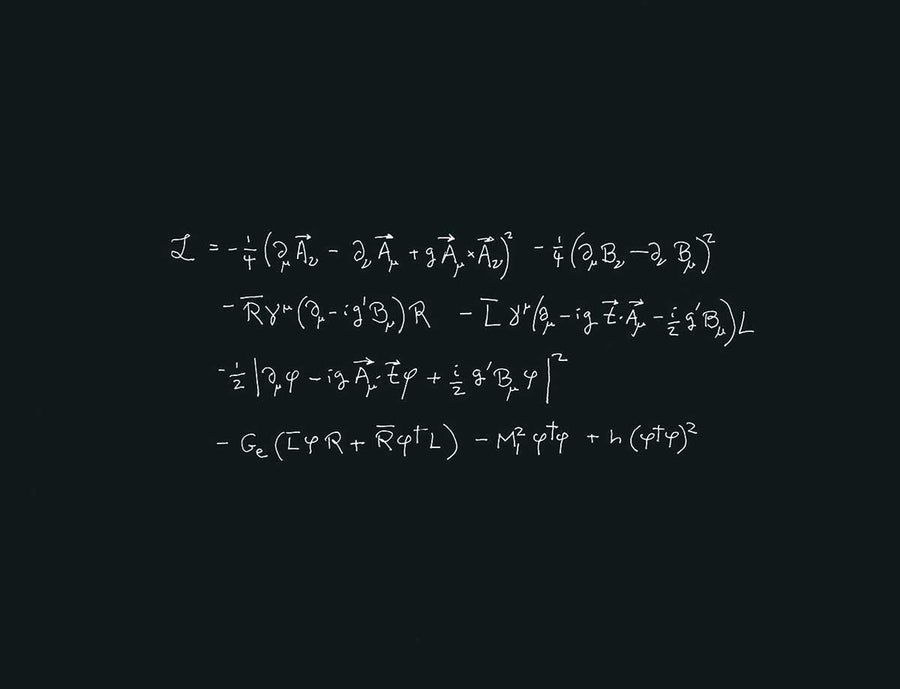
**The Lagrangian of the Electroweak Theory** *Chosen by Steven Weinberg, University of Texas at Austin*
Two of nature’s four fundamental forces—electromagnetism and the weak force (responsible for radioactive decay)—unite in this equation, revealing themselves to be two sides of a single coin. The formula, which Weinberg devised in 1967, established that at certain energies, electromagnetism and the weak force act as one, the “electroweak” force—a discovery that later won him the Nobel Prize in Physics. Here the *L* represents the Lagrangian density, essentially the energy density of the fields associated with the force, which are denoted by *A* and *B*. “I think the shape of the symbols on the page has nothing to do with its beauty,” Weinberg says. “It is the fact that the theory is rigid, that it can’t be changed without screwing it up, that makes the theory beautiful. Its details are fixed by some underlying fundamental principle.”
COURTESY OF PARASOL PRESS (*all equation images*)
[Rights & Permissions](https://s100.copyright.com/AppDispatchServlet?publisherName=sciam&publication=sciam&title=Elegant+Equations&publicationDate=2016-01-01&contentID=ABD7F896-93B7-4D48-903DF025B50C1D25&orderBeanReset=true&author=Clara+Moskowitz&volume=314&startPage=70©right=Copyright+2016+Scientific+American%2C+Inc.)
### MORE TO EXPLORE
**Math Is Beautiful, But Is It Art?** Jen Christiansen in [ScientificAmerican.com](http://scientificamerican.com/) SA Visual blog. Published online January 27, 2015. <http://blogs.scientificamerican.com/sa-visual/math-is-beautiful-but-is-it-art>
**Mathematics and Art: A Cultural History.** Lynn Gamwell. Princeton University Press, 2015.
Full set of Concinnitas prints: [www.concinnitasproject.org](http://www.concinnitasproject.org/)
### ***FROM OUR ARCHIVES***
[**The Mass of the Photon**](http://www.scientificamerican.com/article/the-mass-of-the-photon/)**.** Alfred Scharff Goldhaber and Michael Martin Nieto; May 1976.
**[Clara Moskowitz](https://www.scientificamerican.com/author/clara-moskowitz/)** is chief of reporters at *Scientific American,* where she covers astronomy, space, physics and mathematics. She has been at *Scientific American* for more than a decade; previously she worked at Space.com. Moskowitz has reported live from rocket launches, space shuttle liftoffs and landings, suborbital spaceflight training, mountaintop observatories, and more. She has a bachelor’s degree in astronomy and physics from Wesleyan University and a graduate degree in science communication from the University of California, Santa Cruz.
[More by Clara Moskowitz](https://www.scientificamerican.com/author/clara-moskowitz/)
[](https://www.scientificamerican.com/issue/sa/2016/01-01/)
This article was published with the title “Elegant Equations” in
*Scientific American Magazine* Vol. 314 No. 1 (
January 2016
), p. 70
doi:10.1038/scientificamerican0116-70
[View This Issue](https://www.scientificamerican.com/issue/sa/2016/01-01/)
## It’s Time to Stand Up for Science
If you enjoyed this article, I’d like to ask for your support. Scientific American has served as an advocate for science and industry for 180 years, and right now may be the most critical moment in that two-century history.
I’ve been a Scientific American subscriber since I was 12 years old, and it helped shape the way I look at the world. SciAm always educates and delights me, and inspires a sense of awe for our vast, beautiful universe. I hope it does that for you, too.
If you [subscribe to Scientific American](https://www.scientificamerican.com/getsciam/), you help ensure that our coverage is centered on meaningful research and discovery; that we have the resources to report on the decisions that threaten labs across the U.S.; and that we support both budding and working scientists at a time when the value of science itself too often goes unrecognized.
In return, you get essential news, [captivating podcasts](https://www.scientificamerican.com/podcasts/), brilliant infographics, [can't-miss newsletters](https://www.scientificamerican.com/newsletters/), must-watch videos, [challenging games](https://www.scientificamerican.com/games/), and the science world's best writing and reporting. You can even [gift someone a subscription](https://www.scientificamerican.com/getsciam/gift/).
There has never been a more important time for us to stand up and show why science matters. I hope you’ll support us in that mission.

Thank you,
David M. Ewalt, Editor in Chief, Scientific American
[Subscribe](https://www.scientificamerican.com/getsciam/?utm_source=site&utm_medium=display&utm_term=eic_stand_up_for_science)
Subscribe to *Scientific American* to learn and share the most exciting discoveries, innovations and ideas shaping our world today.
[Subscription Plans](https://www.scientificamerican.com/getsciam/)[Give a Gift Subscription](https://www.scientificamerican.com/getsciam/gift/)
- **Explore SciAm**
- [Latest Issue](https://www.scientificamerican.com/latest-issue/)
- [News](https://www.scientificamerican.com/)
- [Opinion](https://www.scientificamerican.com/opinion/)
- [Newsletters](https://www.scientificamerican.com/newsletters/)
- [Podcasts](https://www.scientificamerican.com/podcasts/)
- [Games](https://www.scientificamerican.com/games/)
- [Travel](https://www.scientificamerican.com/travel/)
- **Company**
- [About](https://www.scientificamerican.com/page/about-scientific-american/)
- [Press Room](https://www.scientificamerican.com/pressroom/)
- [FAQs](https://www.scientificamerican.com/page/frequently-asked-questions/subscriptions-products/)
- [Contact Us](https://www.scientificamerican.com/page/contact-us/customer-service/)
- [Standards & Ethics](https://www.scientificamerican.com/standards-and-ethics/)
- [International Editions](https://www.scientificamerican.com/page/international/)
- [Advertise](https://www.scientificamerican.com/mediakit/)
- **More**
- [Accessibility](https://www.scientificamerican.com/accessibility-statement/)
- [Terms of Use](https://www.scientificamerican.com/page/terms-of-use/)
- [Privacy Policy](https://www.scientificamerican.com/page/privacy-policy/)
- [US State Privacy Rights](https://www.scientificamerican.com/page/us-state-privacy-rights/)
- [Use of cookies/Do not sell my data](https://www.scientificamerican.com/article/scientists-pick-the-most-beautiful-equations/)
- [Return & Refund Policy](https://www.scientificamerican.com/page/return-refund-policy/)
Scientific American is part of Springer Nature, which owns or has commercial relations with thousands of scientific publications (many of them can be found at www.springernature.com/us). Scientific American maintains a strict policy of editorial independence in reporting developments in science to our readers.
© 2026 SCIENTIFIC AMERICAN, A DIVISION OF SPRINGER NATURE AMERICA, INC.
ALL RIGHTS RESERVED. | |||||||||
| Readable Markdown | Are equations beautiful? To scientists, formulas' ability to represent fundamental truths or concisely capture complexity is indeed exquisite. To many in the public, though, they can be the opposite of beautiful—intimidating, utilitarian and opaque. Yet for others, the very mystery can be alluring: even when we cannot understand what equations say, we can be moved by knowing they have meanings beyond our comprehension. And mathematicians and nonmathematicians alike can be drawn in by the purely aesthetic appeal of these expressions, whose graceful and sometimes inscrutable symbols combine in visually satisfying ways.
To explore both the inherent and visual beauty of math, mathematician Daniel Rockmore of Dartmouth College teamed up with Bob Feldman of Parasol Press, which publishes fine art prints. They asked 10 famous mathematicians and physicists to write out what they conceived of as the “most beautiful mathematical expression” and had the print shop Harlan & Weaver turn the responses into 22-by-30-inch etchings called aquatints. “I was careful to not give any instruction beyond that sentence,” Rockmore says. “As the 10 prints show, it means different things to different people.”
Many picked classic equations, such as the famous formula by Isaac Newton that was Stephen Smale's choice (*page 73*). Others selected expressions closer to home, including equations they discovered themselves that are deeply tied to their lifelong research interests—for example, the MacDonald equation chosen by Freeman Dyson (*page 72*). “I love Dyson's,” Rockmore says. “It's thin, and it's sleek; visually, it's so sharp. And with those little exclamation points for the factorials, it's beautiful.”
***
## On supporting science journalism
If you're enjoying this article, consider supporting our award-winning journalism by [subscribing](https://www.scientificamerican.com/getsciam/). By purchasing a subscription you are helping to ensure the future of impactful stories about the discoveries and ideas shaping our world today.
***
The project is called Concinnitas, after the word used by Italian Renaissance scholar Leon Battista Alberti to describe the balance of elements necessary for beautiful art. The collection premiered in December 2014 at the Annemarie Verna Gallery in Zurich and has since been shown at five more galleries, with plans to travel elsewhere in the coming months. Here we show five of the prints.

**Ampère’s Law** *Chosen by Simon Donaldson, Stony Brook University*
Instead of selecting a single equation, Donaldson listed three and drew a picture of a wire tied in a knot. The current (*J*) running through the wire toward the large arrows creates a magnetic field (*B*) in the direction indicated with small arrows. The three equations are Ampère’s law, which describes how a current generates a magnetic field. Together the image and the equations represent the connection between electromagnetism and topology—the branch of mathematics concerned with knots and spatial relations. Donaldson says he finds beauty in revealing such “new connections between things that one previously thought of as quite different.” For example, by applying some of the ideas and mathematics of electromagnetism to the study of knots, researchers have found new ways to determine whether different knots are fundamentally the same, the way a doughnut and a coffee mug are essentially the same shape deformed to look different.
*Editor's Note (1/21/16): The graphic above from the original print article includes an error in the middle equation in the lower right corner. The correct equation is: Jy = ∂Bx/2z – ∂Bz/∂x.*

**MacDonald Equation** *Chosen by Freeman Dyson, Institute for Advanced Study, Princeton, N.J.*
Dyson derived this equation—a reformulation of a classic called the tau function, famously studied by Indian mathematician Srinivasa Ramanujan—shortly after another mathematician, Ian MacDonald, independently arrived at it. In it, five variables—a, b, c, d and e—are subtracted from one another in 10 combinations. The differences are multiplied together and divided by the product of the factorials for 1, 2, 3 and 4 (for example, 4 factorial, expressed as 4! = 1 × 2 × 3 × 4). The elegance of this formulation appeals to Dyson because it reveals a kind of symmetry, or balance, among the five variables in the tau function. The equation is also beautiful in a more indefinable way, he says. “It doesn’t particularly tell you anything true about the universe—it just stands for itself, like a piece of music,” he notes. “Asking what it means is rather like asking what a Beethoven trio means. You just have to listen to it.” The equation belongs to the branch of pure mathematics called number theory.

**Moduli Space of Curves of Genus** ***g*** *Chosen by David Mumford, Brown University*
Our universe has just three dimensions of space, but mathematicians can imagine it containing many more. This equation describes a space with dimensions numbering *3g − 3* and shows that if *g* is large enough, the shape of the space is negatively curved, like the surface of a saddle.\* When Mumford discovered the formula, he recalls, “I thought it was a startling result, especially that strange number 13 that came up.” Most fundamental mathematical expressions consist only of variables, operators and small whole numbers such as 1 and 2, making the relatively large quantity 13 in this equation an aberration. To Mumford, the strangeness of the equation makes it beautiful. “As a mathematician, you feel you’re discovering these logically determined facts—they have to be this way and no other way,” he says. “And suddenly you come up with a strange number, and you think, ‘Why did it have to be *this* way?’”
*\*Editor's Note (1/26/16): This sentence from the print article was edited after it was posted online to correct the equation.*

**Newton’s Method** *Chosen by Stephen Smale, City University of Hong Kong*
A mathematical trick, known as Newton’s method, approximates the solution to an equation—*f(x)*—whose exact answer cannot be calculated, such as the square root of 2 (which is the irrational number 1.4142 ...). It works by starting with any real number, *x*, and subtracting the function *f(x)* divided by the derivative of that function, *f′(x)*, to get a new *x*. Every time this process repeats, x gets closer and closer to an estimation of the solution. The method is very handy, yet even Newton lacked a good theory for why it works. That mystery is what makes this equation so appealing to Smale. “So much of my work is devoted to understanding Newton’s equation—under what conditions it works,” he says. “My own feeling is that a great problem is never solved; it just becomes the focus of more and more work.”

**The Lagrangian of the Electroweak Theory** *Chosen by Steven Weinberg, University of Texas at Austin*
Two of nature’s four fundamental forces—electromagnetism and the weak force (responsible for radioactive decay)—unite in this equation, revealing themselves to be two sides of a single coin. The formula, which Weinberg devised in 1967, established that at certain energies, electromagnetism and the weak force act as one, the “electroweak” force—a discovery that later won him the Nobel Prize in Physics. Here the *L* represents the Lagrangian density, essentially the energy density of the fields associated with the force, which are denoted by *A* and *B*. “I think the shape of the symbols on the page has nothing to do with its beauty,” Weinberg says. “It is the fact that the theory is rigid, that it can’t be changed without screwing it up, that makes the theory beautiful. Its details are fixed by some underlying fundamental principle.”
COURTESY OF PARASOL PRESS (*all equation images*) | |||||||||
| ML Classification | ||||||||||
| ML Categories |
Raw JSON{
"/Science": 988,
"/Science/Mathematics": 972,
"/Science/Mathematics/Other": 829
} | |||||||||
| ML Page Types |
Raw JSON{
"/Article": 990,
"/Article/Story": 280
} | |||||||||
| ML Intent Types |
Raw JSON{
"Informational": 999
} | |||||||||
| Content Metadata | ||||||||||
| Language | en | |||||||||
| Author | Clara Moskowitz | |||||||||
| Publish Time | 2016-01-01 00:00:00 (10 years ago) | |||||||||
| Original Publish Time | 2016-01-01 00:00:00 (10 years ago) | |||||||||
| Republished | No | |||||||||
| Word Count (Total) | 1,811 | |||||||||
| Word Count (Content) | 1,238 | |||||||||
| Links | ||||||||||
| External Links | 10 | |||||||||
| Internal Links | 34 | |||||||||
| Technical SEO | ||||||||||
| Meta Nofollow | No | |||||||||
| Meta Noarchive | No | |||||||||
| JS Rendered | No | |||||||||
| Redirect Target | null | |||||||||
| Performance | ||||||||||
| Download Time (ms) | 2,034 | |||||||||
| TTFB (ms) | 2,030 | |||||||||
| Download Size (bytes) | 22,388 | |||||||||
| Shard | 66 (laksa) | |||||||||
| Root Hash | 15343250200200202866 | |||||||||
| Unparsed URL | com,scientificamerican!www,/article/scientists-pick-the-most-beautiful-equations/ s443 | |||||||||