ℹ️ Skipped - page is already crawled
| Filter | Status | Condition | Details |
|---|---|---|---|
| HTTP status | PASS | download_http_code = 200 | HTTP 200 |
| Age cutoff | PASS | download_stamp > now() - 6 MONTH | 0 months ago |
| History drop | PASS | isNull(history_drop_reason) | No drop reason |
| Spam/ban | PASS | fh_dont_index != 1 AND ml_spam_score = 0 | ml_spam_score=0 |
| Canonical | PASS | meta_canonical IS NULL OR = '' OR = src_unparsed | Not set |
| Property | Value |
|---|---|
| URL | https://www.sciencenews.org/article/black-hole-picture-magnetic-fields-event-horizon-telescope |
| Last Crawled | 2026-04-16 00:15:31 (16 hours ago) |
| First Indexed | 2021-03-24 14:03:46 (5 years ago) |
| HTTP Status Code | 200 |
| Meta Title | A new black hole image reveals the behemoth’s magnetic fields |
| Meta Description | A new analysis of Event Horizon Telescope data from 2017 brings to light the magnetic fields twisted around the black hole at the core of galaxy M87. |
| Meta Canonical | null |
| Boilerpipe Text | Event Horizon Telescope data show the orientation of light emitted near M87’s black hole
A new Event Horizon Telescope image of the galaxy M87’s black hole (pictured) traces the polarization (bright lines), or orientation, of light waves emitted by material swirling around the black hole. That polarization is related to the black hole’s magnetic fields.
EHT collaboration
Astronomers have gotten their first glimpse of the magnetic fields tangled around a black hole.
The Event Horizon Telescope has unveiled
the magnetism of the hot, glowing gas
around the supermassive black hole at the heart of galaxy M87, researchers report in two studies published online March 24 in the
Astrophysical Journal Letters
. These magnetic fields are thought to play a crucial role in how the black hole scarfs down matter and
launches powerful plasma jets
thousands of light-years into space (
SN: 3/29/19
).
“We’ve known for decades that jets are in some sense powered by accretion onto supermassive black holes, and that the in-spiraling gas and the outflowing plasma are highly magnetized — but there was a lot of uncertainty in the exact details,” says Eileen Meyer, an astrophysicist at the University of Maryland, Baltimore County not involved in the work. “The magnetic field structure of the plasma near the event horizon [of a black hole] is a completely new piece of information.”
The supermassive black hole inside M87 was the
first black hole to get its picture taken
(
SN: 4/10/19
). That image showed the black hole’s shadow against its accretion disk — the bright eddy of superhot gas spiraling around the black hole’s dark center. It was created using observations taken in April 2017 by a global network of observatories, which collectively
form one virtual, Earth-sized radio dish
called the Event Horizon Telescope (
SN: 4/10/19
).
Using data from 2017, scientists created the first real picture of the supermassive black hole at the center of galaxy M87. How? We explain.
The new analysis uses the same observations. But unlike the black hole’s initial portrait, the new image accounts for the polarization of the light waves emitted by gas around the black hole. Polarization measures a light wave’s orientation — whether it wiggles up and down, left and right or at an angle — and can be affected by the magnetic field where the light originated. So, by
mapping the polarization of light
around the edge of M87’s black hole, researchers were able to trace the structure of the underlying magnetic fields.
The team found evidence that some magnetic fields loop around the black hole along with the disk of material swirling into it. That’s to be expected because “when gas is rotating, it’s basically able to carry along the magnetic field with it,” says Jason Dexter, an astrophysicist at the University of Colorado Boulder.
But, he says, “there’s some interesting component of this magnetic field which is not just following the motion of the gas.” At least some of the magnetic field lines are sticking up or down perpendicularly from the accretion disk, or pointing directly toward or away from the black hole, Dexter and colleagues found. These magnetic fields must be very strong to resist being dragged around by the whirl of infalling gas, he says.
Such strong magnetic fields may actually push back against some of the material spiraling in toward the black hole, helping it resist gravity’s pull, says study coauthor Monika Mościbrodzka, an astrophysicist at Radboud University in Nijmegen, the Netherlands. Magnetic fields pointed up and down from the accretion disk could also help launch the black hole’s plasma jets, by channeling material toward the black hole’s poles and giving it a boost in speed, she says.
Sign up for our newsletter
We summarize the week's scientific breakthroughs every Thursday.
More Stories from Science News on
Astronomy |
| Markdown | [Skip to content](https://www.sciencenews.org/article/black-hole-picture-magnetic-fields-event-horizon-telescope#content)
**Subscribe today**
Every print subscription comes with full digital access
[Subscribe Now](https://www.sciencenews.org/subscribe1?key=9MNAVBNA&utm_source=banner&utm_medium=site&utm_campaign=full_digital_access)
Menu
- [All Topics](https://www.sciencenews.org/topics/)
- [Health](https://www.sciencenews.org/topic/health-medicine)
- [Humans](https://www.sciencenews.org/topic/humans)
- [Anthropology](https://www.sciencenews.org/topic/anthropology)
- [Health & Medicine](https://www.sciencenews.org/topic/health-medicine)
- [Archaeology](https://www.sciencenews.org/topic/archaeology)
- [Psychology](https://www.sciencenews.org/topic/psychology)
- [View All](https://www.sciencenews.org/topic/humans)
- [Life](https://www.sciencenews.org/topic/life)
- [Animals](https://www.sciencenews.org/topic/animals)
- [Plants](https://www.sciencenews.org/topic/plants)
- [Ecosystems](https://www.sciencenews.org/topic/ecosystems)
- [Paleontology](https://www.sciencenews.org/topic/paleontology)
- [Neuroscience](https://www.sciencenews.org/topic/neuroscience)
- [Genetics](https://www.sciencenews.org/topic/genetics)
- [Microbes](https://www.sciencenews.org/topic/microbes)
- [View All](https://www.sciencenews.org/topic/life)
- [Earth](https://www.sciencenews.org/topic/earth)
- [Agriculture](https://www.sciencenews.org/topic/agriculture)
- [Climate](https://www.sciencenews.org/topic/climate)
- [Oceans](https://www.sciencenews.org/topic/oceans)
- [Environment](https://www.sciencenews.org/topic/environment)
- [View All](https://www.sciencenews.org/topic/earth)
- [Physics](https://www.sciencenews.org/topic/physics)
- [Materials Science](https://www.sciencenews.org/topic/materials-science)
- [Quantum Physics](https://www.sciencenews.org/topic/quantum-physics)
- [Particle Physics](https://www.sciencenews.org/topic/particle-physics)
- [View All](https://www.sciencenews.org/topic/physics)
- [Space](https://www.sciencenews.org/topic/space)
- [Astronomy](https://www.sciencenews.org/topic/astronomy)
- [Planetary Science](https://www.sciencenews.org/topic/planetary-science)
- [Cosmology](https://www.sciencenews.org/topic/cosmology)
- [View All](https://www.sciencenews.org/topic/space)
- [Magazine](https://www.sciencenews.org/sn-magazine)
- [Menu](https://www.sciencenews.org/article/black-hole-picture-magnetic-fields-event-horizon-telescope)
- [All Stories](https://www.sciencenews.org/all-stories)
- [Multimedia](https://www.sciencenews.org/article/tag/multimedia)
- [Reviews](https://www.sciencenews.org/article-type/reviews-previews)
- [Puzzles](https://www.sciencenews.org/article-type/puzzles)
- [Collections](https://www.sciencenews.org/collections)
- [Educator Portal](https://www.sciencenews.org/learning)
- [Century of Science](https://www.sciencenews.org/century)
- [Unsung characters](https://www.sciencenews.org/century/connection/unsung-characters)
- [Coronavirus Outbreak](https://www.sciencenews.org/collections/2019-novel-coronavirus-outbreak)
- [Newsletters](https://www.sciencenews.org/newsletters)
- [Investors Lab](https://www.sciencenews.org/investors-lab)
- [About](https://www.sciencenews.org/about-science-news)
- [SN Explores](https://www.snexplores.org/)
- [Our Store](https://www.societyforscience.org/store/)
Open search Close search
SIGN IN
[Donate](https://www.sciencenews.org/give?key=9MDONBUT)
[Home INDEPENDENT JOURNALISM SINCE 1921](https://www.sciencenews.org/)
[SIGN IN](https://www.sciencenews.org/sign-in)
[Home INDEPENDENT JOURNALISM SINCE 1921](https://www.sciencenews.org/)
- [All Topics](https://www.sciencenews.org/topics/)
- [Earth](https://www.sciencenews.org/topic/earth)
- [Agriculture](https://www.sciencenews.org/topic/agriculture)
- [Climate](https://www.sciencenews.org/topic/climate)
- [Oceans](https://www.sciencenews.org/topic/oceans)
- [Environment](https://www.sciencenews.org/topic/environment)
- [Humans](https://www.sciencenews.org/topic/humans)
- [Anthropology](https://www.sciencenews.org/topic/anthropology)
- [Health & Medicine](https://www.sciencenews.org/topic/health-medicine)
- [Archaeology](https://www.sciencenews.org/topic/archaeology)
- [Psychology](https://www.sciencenews.org/topic/psychology)
- [Life](https://www.sciencenews.org/topic/life)
- [Animals](https://www.sciencenews.org/topic/animals)
- [Plants](https://www.sciencenews.org/topic/plants)
- [Ecosystems](https://www.sciencenews.org/topic/ecosystems)
- [Paleontology](https://www.sciencenews.org/topic/paleontology)
- [Neuroscience](https://www.sciencenews.org/topic/neuroscience)
- [Genetics](https://www.sciencenews.org/topic/genetics)
- [Microbes](https://www.sciencenews.org/topic/microbes)
- [Physics](https://www.sciencenews.org/topic/physics)
- [Materials Science](https://www.sciencenews.org/topic/materials-science)
- [Quantum Physics](https://www.sciencenews.org/topic/quantum-physics)
- [Particle Physics](https://www.sciencenews.org/topic/particle-physics)
- [Space](https://www.sciencenews.org/topic/space)
- [Astronomy](https://www.sciencenews.org/topic/astronomy)
- [Planetary Science](https://www.sciencenews.org/topic/planetary-science)
- [Cosmology](https://www.sciencenews.org/topic/cosmology)
- [Tech](https://www.sciencenews.org/topic/tech)
- [Computing](https://www.sciencenews.org/topic/computing)
- [Artificial Intelligence](https://www.sciencenews.org/topic/artificial-intelligence)
- [Chemistry](https://www.sciencenews.org/topic/chemistry)
- [Math](https://www.sciencenews.org/topic/math)
- [Science & Society](https://www.sciencenews.org/topic/science-society)
- [Health](https://www.sciencenews.org/topic/health-medicine)
- [Humans](https://www.sciencenews.org/topic/humans)
- [Humans](https://www.sciencenews.org/topic/humans)
- [Anthropology](https://www.sciencenews.org/topic/anthropology)
- [Health & Medicine](https://www.sciencenews.org/topic/health-medicine)
- [Archaeology](https://www.sciencenews.org/topic/archaeology)
- [Psychology](https://www.sciencenews.org/topic/psychology)
- ## Recent posts in Humans
- [Health & Medicine](https://www.sciencenews.org/topic/health-medicine)
### [Breath carries clues to gut health](https://www.sciencenews.org/article/breath-tests-clues-to-gut-health)
By [Meghan Rosen](https://www.sciencenews.org/author/meghan-rosen "Posts by Meghan Rosen")
7 hours ago
- [Health & Medicine](https://www.sciencenews.org/topic/health-medicine)
### [Some GLP-1 drugs are more effective for those with specific gene variants](https://www.sciencenews.org/article/glp-1-weight-loss-genetics-side-effects)
By [Tina Hesman Saey](https://www.sciencenews.org/author/tina-hesman-saey "Posts by Tina Hesman Saey")
9 hours ago
- [Health & Medicine](https://www.sciencenews.org/topic/health-medicine)
### [New mutations help the H5N1 bird flu virus infect cows but not people](https://www.sciencenews.org/article/mutations-h5n1-bird-flu-adapt-cows)
By [Tina Hesman Saey](https://www.sciencenews.org/author/tina-hesman-saey "Posts by Tina Hesman Saey")
April 14, 2026
- [Life](https://www.sciencenews.org/topic/life)
- [Life](https://www.sciencenews.org/topic/life)
- [Animals](https://www.sciencenews.org/topic/animals)
- [Plants](https://www.sciencenews.org/topic/plants)
- [Ecosystems](https://www.sciencenews.org/topic/ecosystems)
- [Paleontology](https://www.sciencenews.org/topic/paleontology)
- [Neuroscience](https://www.sciencenews.org/topic/neuroscience)
- [Genetics](https://www.sciencenews.org/topic/genetics)
- [Microbes](https://www.sciencenews.org/topic/microbes)
- ## Recent posts in Life
- [Health & Medicine](https://www.sciencenews.org/topic/health-medicine)
### [Some GLP-1 drugs are more effective for those with specific gene variants](https://www.sciencenews.org/article/glp-1-weight-loss-genetics-side-effects)
By [Tina Hesman Saey](https://www.sciencenews.org/author/tina-hesman-saey "Posts by Tina Hesman Saey")
9 hours ago
- [Health & Medicine](https://www.sciencenews.org/topic/health-medicine)
### [New mutations help the H5N1 bird flu virus infect cows but not people](https://www.sciencenews.org/article/mutations-h5n1-bird-flu-adapt-cows)
By [Tina Hesman Saey](https://www.sciencenews.org/author/tina-hesman-saey "Posts by Tina Hesman Saey")
April 14, 2026
- [Life](https://www.sciencenews.org/topic/life)
### [Smithsonian secrets most likely to blow your mind](https://www.sciencenews.org/article/smithsonian-secrets-life-photography)
By [Meghan Rosen](https://www.sciencenews.org/author/meghan-rosen "Posts by Meghan Rosen") and [Stephen Voss](https://www.sciencenews.org/author/stephen-voss "Posts by Stephen Voss")
April 14, 2026
- [Earth](https://www.sciencenews.org/topic/earth)
- [Earth](https://www.sciencenews.org/topic/earth)
- [Agriculture](https://www.sciencenews.org/topic/agriculture)
- [Climate](https://www.sciencenews.org/topic/climate)
- [Oceans](https://www.sciencenews.org/topic/oceans)
- [Environment](https://www.sciencenews.org/topic/environment)
- ## Recent posts in Earth
- [Animals](https://www.sciencenews.org/topic/animals)
### [For gray whales, San Francisco Bay is becoming a deadly pit stop](https://www.sciencenews.org/article/gray-whale-deaths-boat-strikes-sf)
By [Gennaro Tomma](https://www.sciencenews.org/author/gennaro-tomma "Posts by Gennaro Tomma")
April 13, 2026
- [Climate](https://www.sciencenews.org/topic/climate)
### [Emperor penguins are marching toward extinction. Antarctica fur seals too](https://www.sciencenews.org/article/emperor-penguins-endangered-extinction-iucn)
By [Carolyn Gramling](https://www.sciencenews.org/author/carolyn-gramling "Posts by Carolyn Gramling")
April 9, 2026
- [Environment](https://www.sciencenews.org/topic/environment)
### [Hawaii is turning ocean plastic into roads to fight pollution](https://www.sciencenews.org/article/hawaii-plastic-pollution-recycle-roads)
By [Sara Novak](https://www.sciencenews.org/author/sara-novak "Posts by Sara Novak")
April 8, 2026
- [Physics](https://www.sciencenews.org/topic/physics)
- [Physics](https://www.sciencenews.org/topic/physics)
- [Materials Science](https://www.sciencenews.org/topic/materials-science)
- [Quantum Physics](https://www.sciencenews.org/topic/quantum-physics)
- [Particle Physics](https://www.sciencenews.org/topic/particle-physics)
- ## Recent posts in Physics
- [Cosmology](https://www.sciencenews.org/topic/cosmology)
### [Exploding black holes could explain an antimatter mystery](https://www.sciencenews.org/article/exploding-black-holes-antimatter)
By [Emily Conover](https://www.sciencenews.org/author/emily-conover "Posts by Emily Conover")
April 10, 2026
- [Quantum Physics](https://www.sciencenews.org/topic/quantum-physics)
### [Just 10,000 quantum bits might crack internet encryption schemes](https://www.sciencenews.org/article/quantum-bits-crack-internet-encryption)
By [Emily Conover](https://www.sciencenews.org/author/emily-conover "Posts by Emily Conover")
April 1, 2026
- [Quantum Physics](https://www.sciencenews.org/topic/quantum-physics)
### [Quantum physics can confirm where someone is located](https://www.sciencenews.org/article/quantum-physics-location-security)
By [Emily Conover](https://www.sciencenews.org/author/emily-conover "Posts by Emily Conover")
March 30, 2026
- [Space](https://www.sciencenews.org/topic/space)
- [Space](https://www.sciencenews.org/topic/space)
- [Astronomy](https://www.sciencenews.org/topic/astronomy)
- [Planetary Science](https://www.sciencenews.org/topic/planetary-science)
- [Cosmology](https://www.sciencenews.org/topic/cosmology)
- ## Recent posts in Space
- [Space](https://www.sciencenews.org/topic/space)
### [Artemis II ends its historic lunar journey](https://www.sciencenews.org/article/artemis-ii-moon-finale)
By [Lisa Grossman](https://www.sciencenews.org/author/lisa-grossman "Posts by Lisa Grossman")
April 10, 2026
- [Cosmology](https://www.sciencenews.org/topic/cosmology)
### [Exploding black holes could explain an antimatter mystery](https://www.sciencenews.org/article/exploding-black-holes-antimatter)
By [Emily Conover](https://www.sciencenews.org/author/emily-conover "Posts by Emily Conover")
April 10, 2026
- [Space](https://www.sciencenews.org/topic/space)
### [Even before splashdown, Artemis II is delivering a scientific treasure trove](https://www.sciencenews.org/article/splashdown-artemis-ii-science-moon)
By [Lisa Grossman](https://www.sciencenews.org/author/lisa-grossman "Posts by Lisa Grossman")
April 8, 2026
[News](https://www.sciencenews.org/article-type/news) [Astronomy](https://www.sciencenews.org/topic/astronomy)
# A new black hole image reveals the behemoth’s magnetic fields
Event Horizon Telescope data show the orientation of light emitted near M87’s black hole
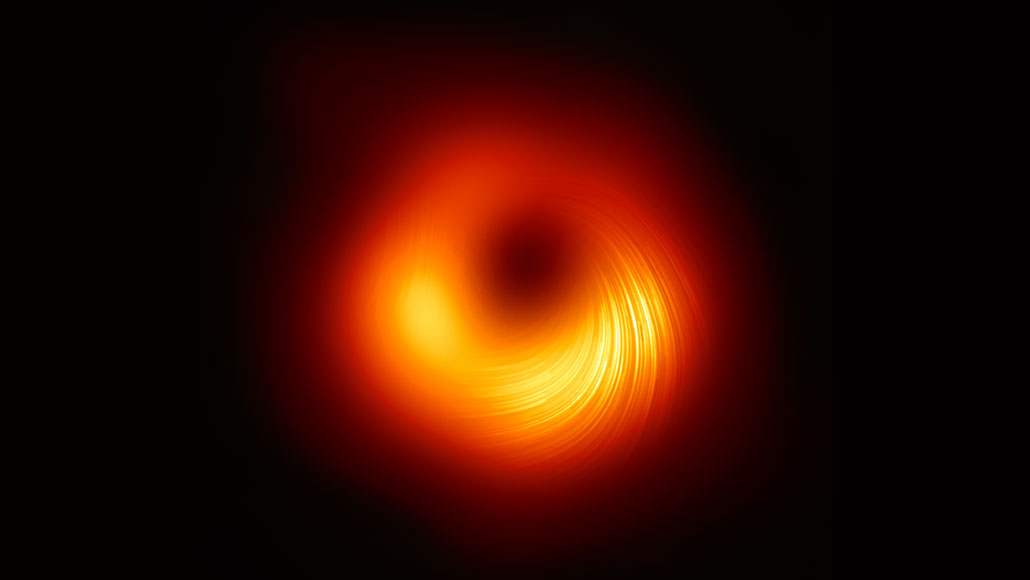
A new Event Horizon Telescope image of the galaxy M87’s black hole (pictured) traces the polarization (bright lines), or orientation, of light waves emitted by material swirling around the black hole. That polarization is related to the black hole’s magnetic fields.
EHT collaboration
By [Maria Temming](https://www.sciencenews.org/author/maria-temming "Posts by Maria Temming")
March 24, 2021 at 10:00 am - More than **2 years ago**
## Share this:
- [Share](https://www.sciencenews.org/article/black-hole-picture-magnetic-fields-event-horizon-telescope)
- [Share via email (Opens in new window) Email](mailto:?subject=A%20new%20black%20hole%20image%20reveals%20the%20behemoth%E2%80%99s%20magnetic%20fields&body=I%20saw%20this%20on%20Science%20News%3A%20https%3A%2F%2Fwww.sciencenews.org%2Farticle%2Fblack-hole-picture-magnetic-fields-event-horizon-telescope%3Futm_source%3Dinternal%26utm_medium%3Demail%26utm_campaign%3Demail_share)
- [Share on Facebook (Opens in new window) Facebook](https://www.sciencenews.org/article/black-hole-picture-magnetic-fields-event-horizon-telescope?share=facebook)
- [Share on Reddit (Opens in new window) Reddit](https://www.sciencenews.org/article/black-hole-picture-magnetic-fields-event-horizon-telescope?share=reddit)
- [Share on X (Opens in new window) X](https://www.sciencenews.org/article/black-hole-picture-magnetic-fields-event-horizon-telescope?share=twitter)
- [Print (Opens in new window) Print](https://www.sciencenews.org/article/black-hole-picture-magnetic-fields-event-horizon-telescope#print?share=print)
Astronomers have gotten their first glimpse of the magnetic fields tangled around a black hole.
The Event Horizon Telescope has unveiled [the magnetism of the hot, glowing gas](https://doi.org/10.3847/2041-8213/abe4de) around the supermassive black hole at the heart of galaxy M87, researchers report in two studies published online March 24 in the *Astrophysical Journal Letters*. These magnetic fields are thought to play a crucial role in how the black hole scarfs down matter and [launches powerful plasma jets](https://www.sciencenews.org/article/event-horizon-telescope-first-image-black-hole-questions) thousands of light-years into space (*SN: 3/29/19*).
“We’ve known for decades that jets are in some sense powered by accretion onto supermassive black holes, and that the in-spiraling gas and the outflowing plasma are highly magnetized — but there was a lot of uncertainty in the exact details,” says Eileen Meyer, an astrophysicist at the University of Maryland, Baltimore County not involved in the work. “The magnetic field structure of the plasma near the event horizon \[of a black hole\] is a completely new piece of information.”
The supermassive black hole inside M87 was the [first black hole to get its picture taken](https://www.sciencenews.org/article/black-hole-first-picture-event-horizon-telescope) (*SN: 4/10/19*). That image showed the black hole’s shadow against its accretion disk — the bright eddy of superhot gas spiraling around the black hole’s dark center. It was created using observations taken in April 2017 by a global network of observatories, which collectively [form one virtual, Earth-sized radio dish](https://www.sciencenews.org/article/event-horizon-telescope-black-hole-picture) called the Event Horizon Telescope (*SN: 4/10/19*).
Using data from 2017, scientists created the first real picture of the supermassive black hole at the center of galaxy M87. How? We explain.
The new analysis uses the same observations. But unlike the black hole’s initial portrait, the new image accounts for the polarization of the light waves emitted by gas around the black hole. Polarization measures a light wave’s orientation — whether it wiggles up and down, left and right or at an angle — and can be affected by the magnetic field where the light originated. So, by [mapping the polarization of light](https://doi.org/10.3847/2041-8213/abe71d) around the edge of M87’s black hole, researchers were able to trace the structure of the underlying magnetic fields.
The team found evidence that some magnetic fields loop around the black hole along with the disk of material swirling into it. That’s to be expected because “when gas is rotating, it’s basically able to carry along the magnetic field with it,” says Jason Dexter, an astrophysicist at the University of Colorado Boulder.
But, he says, “there’s some interesting component of this magnetic field which is not just following the motion of the gas.” At least some of the magnetic field lines are sticking up or down perpendicularly from the accretion disk, or pointing directly toward or away from the black hole, Dexter and colleagues found. These magnetic fields must be very strong to resist being dragged around by the whirl of infalling gas, he says.
Such strong magnetic fields may actually push back against some of the material spiraling in toward the black hole, helping it resist gravity’s pull, says study coauthor Monika Mościbrodzka, an astrophysicist at Radboud University in Nijmegen, the Netherlands. Magnetic fields pointed up and down from the accretion disk could also help launch the black hole’s plasma jets, by channeling material toward the black hole’s poles and giving it a boost in speed, she says.
### Sign up for our newsletter
We summarize the week's scientific breakthroughs every Thursday.
Questions or comments on this article? E-mail us at [feedback@sciencenews.org](mailto:feedback@sciencenews.org) \| [Reprints FAQ](https://www.sciencenews.org/permission-republish)
A version of this article appears in the [April 24, 2021](https://www.sciencenews.org/sn-magazine/april-24-2021) issue of Science News.
### Citations
K. Akiyama *et al*. [First M87 Event Horizon Telescope results VII: polarization of the ring](https://doi.org/10.3847/2041-8213/abe71d). *Astrophysical Journal Letters*. Published online March 24, 2021. doi: 10.3847/2041-8213/abe71d.
K. Akiyama *et al*. [First M87 Event Horizon Telescope results VIII: magnetic field structure near the event horizon](https://doi.org/10.3847/2041-8213/abe4de). *Astrophysical Journal Letters*. Published online March 24, 2021. doi: 10.3847/2041-8213/abe4de.
[](https://www.sciencenews.org/author/maria-temming)
### About [Maria Temming](https://www.sciencenews.org/author/maria-temming "Posts by Maria Temming")
- [E-mail](mailto:mtemming@sciencenews.org)
- [X](https://x.com/TemmingMaria)
Previously the staff writer for physical sciences at *Science News*, Maria Temming is the assistant managing editor at *Science News Explores*. She has bachelor's degrees in physics and English, and a master's in science writing.
We are at a critical time and ***supporting science journalism is more important than ever***. Science News and our parent organization, the Society for Science, need your help to strengthen scientific literacy and ensure that important societal decisions are made with science in mind.
Please [subscribe to Science News and **add \$16**](https://www.sciencenews.org/subscribe1-print-digital?key=9MENDCON&utm_source=end-of-article&utm_medium=site&utm_campaign=non-sub-control) to expand science literacy and understanding.
### Popular Stories
1. [](https://www.sciencenews.org/article/glp1-medications-microdose-longevity)
[Health & Medicine](https://www.sciencenews.org/topic/health-medicine)
### [GLP-1 microdosers are chasing longevity](https://www.sciencenews.org/article/glp1-medications-microdose-longevity)
By [Jamie Ducharme](https://www.sciencenews.org/author/jamie-ducharme "Posts by Jamie Ducharme")
March 20, 2026
2. [](https://www.sciencenews.org/article/quantum-physics-location-security)
[Quantum Physics](https://www.sciencenews.org/topic/quantum-physics)
### [Quantum physics can confirm where someone is located](https://www.sciencenews.org/article/quantum-physics-location-security)
By [Emily Conover](https://www.sciencenews.org/author/emily-conover "Posts by Emily Conover")
March 30, 2026
3. [](https://www.sciencenews.org/article/moon-new-crater-nasa-orbiter)
[Space](https://www.sciencenews.org/topic/space)
### [In a rare event, the moon got a massive new crater](https://www.sciencenews.org/article/moon-new-crater-nasa-orbiter)
By [Lisa Grossman](https://www.sciencenews.org/author/lisa-grossman "Posts by Lisa Grossman")
March 23, 2026
## More Stories from Science News on [Astronomy](https://www.sciencenews.org/topic/astronomy)
1. [](https://www.sciencenews.org/article/primitive-star-galaxy-early-universe)
[Astronomy](https://www.sciencenews.org/topic/astronomy)
### [A rare star in a tiny galaxy preserves a record of the early universe](https://www.sciencenews.org/article/primitive-star-galaxy-early-universe)
By [Jay Bennett](https://www.sciencenews.org/author/jay-bennett "Posts by Jay Bennett")
March 27, 2026
2. [](https://www.sciencenews.org/article/superluminous-supernova-magnetar)
[Astronomy](https://www.sciencenews.org/topic/astronomy)
### [A strange ‘chirp’ in a brilliant stellar blast points to a magnetar](https://www.sciencenews.org/article/superluminous-supernova-magnetar)
By [Jay Bennett](https://www.sciencenews.org/author/jay-bennett "Posts by Jay Bennett")
March 11, 2026
3. [](https://www.sciencenews.org/article/venus-massive-lava-tube-caves)
[Planetary Science](https://www.sciencenews.org/topic/planetary-science)
### [Venus has a massive lava tube](https://www.sciencenews.org/article/venus-massive-lava-tube-caves)
By [Tom Metcalfe](https://www.sciencenews.org/author/tom-metcalfe "Posts by Tom Metcalfe")
February 23, 2026
4. [](https://www.sciencenews.org/article/inside-out-planetary-system)
[Astronomy](https://www.sciencenews.org/topic/astronomy)
### [This inside-out planetary system has astronomers scratching their heads](https://www.sciencenews.org/article/inside-out-planetary-system)
By [Adam Mann](https://www.sciencenews.org/author/adam-mann "Posts by Adam Mann")
February 12, 2026
5. [](https://www.sciencenews.org/article/dark-matter-clump-milky-way)
[Physics](https://www.sciencenews.org/topic/physics)
### [A massive clump of dark matter may lurk in the Milky Way](https://www.sciencenews.org/article/dark-matter-clump-milky-way)
By [Emily Conover](https://www.sciencenews.org/author/emily-conover "Posts by Emily Conover")
January 29, 2026
6. [](https://www.sciencenews.org/article/double-explosion-by-star-superkilonova)
[Astronomy](https://www.sciencenews.org/topic/astronomy)
### [A double cosmic explosion could be the first known ‘superkilonova’](https://www.sciencenews.org/article/double-explosion-by-star-superkilonova)
By [Lisa Grossman](https://www.sciencenews.org/author/lisa-grossman "Posts by Lisa Grossman")
January 9, 2026
7. [](https://www.sciencenews.org/article/betelgeuse-supergiant-star-brightness)
[Space](https://www.sciencenews.org/topic/space)
### [Betelgeuse’s buddy leaves a wake in the giant star’s atmosphere](https://www.sciencenews.org/article/betelgeuse-supergiant-star-brightness)
By [Lisa Grossman](https://www.sciencenews.org/author/lisa-grossman "Posts by Lisa Grossman")
January 7, 2026
8. [](https://www.sciencenews.org/article/polar-structure-galaxies-stars-disks)
[Astronomy](https://www.sciencenews.org/topic/astronomy)
### [Galaxies with ‘hoop skirts’ are more common than we thought](https://www.sciencenews.org/article/polar-structure-galaxies-stars-disks)
By [Lisa Grossman](https://www.sciencenews.org/author/lisa-grossman "Posts by Lisa Grossman")
January 7, 2026
[Science News](https://www.sciencenews.org/)
Science News was founded in 1921 as an independent, nonprofit source of accurate information on the latest news of science, medicine and technology. Today, our mission remains the same: to empower people to evaluate the news and the world around them. It is published by the Society for Science, a nonprofit 501(c)(3) membership organization dedicated to public engagement in scientific research and education (EIN 53-0196483).
- [Science News Explores](https://www.snexplores.org/)
- [Science News Learning](https://www.sciencenews.org/learning/)
### Subscriber Services
- [Subscribe](https://www.sciencenews.org/subscribe1?key=9MFSUB&utm_source=sciencenews&utm_medium=footer&utm_campaign=sn-footer&tfa_3134=sn-footer)
- [Renew](https://sfsdata.com/SubscriberServices/AccountStart.html?PUB=SCN)
- [Give a Gift Subscription](https://www.sciencenews.org/give-a-gift?key=9MFGIFT&utm_source=link&utm_medium=footer&utm_campaign=gift)
- [Customer Service](https://sfsdata.com/SubscriberServices/AccountStart.html?PUB=SCN)
- [Follow Science News on Facebook](https://facebook.com/sciencenews)
- [Follow Science News on X](https://twitter.com/sciencenews)
- [Follow Science News via RSS](https://www.sciencenews.org/feed/)
- [Follow Science News on Instagram](https://www.instagram.com/sciencenewsmagazine/)
- [Follow Science News on YouTube](https://www.youtube.com/channel/UCBX5er6E37_yWB3gCM32p3g)
- [Follow Science News on TikTok](https://www.tiktok.com/@sciencenewsofficial)
- [Follow Science News on Reddit](https://www.reddit.com/u/Science_News)
- [Follow Science News on Threads](https://www.threads.com/@sciencenewsmagazine)
### More Information
- [FAQ](https://www.sciencenews.org/about-science-news/frequently-asked-questions)
- [Newsletters](https://www.sciencenews.org/newsletters)
- [Rights & Permissions](https://www.sciencenews.org/permission-republish)
- [Advertise](https://www.sciencenews.org/advertise-science-news)
- [Contact](https://www.sciencenews.org/about-science-news/contact-us)
### Society for Science
- [About the Society](https://www.societyforscience.org/)
- [Society Store](https://www.societyforscience.org/store/)
- [Donate](https://www.sciencenews.org/give)
- [Careers](https://www.societyforscience.org/jobs-and-internships)
© Society for Science & the Public 2000–2026. All rights reserved.
1776 Massachusetts Ave NW, Washington, DC 20036 [202\.785.2255](tel:202.785.2255)
[Terms of Service](https://www.sciencenews.org/terms-of-service) [Privacy Policy](https://www.sciencenews.org/privacy-policy)
Privacy Manager
Close
## Log in
Subscribers, enter your e-mail address for full access to the *Science News* archives and digital editions.
Not a subscriber?
[Become one now](https://www.sciencenews.org/subscription?utm_source=sciencenews&utm_medium=login&utm_campaign=sn-login&tfa_3134=sn-login).
Use up and down arrow keys to explore.Use right arrow key to move into the list.Use left arrow key to move back to the parent list.Use tab key to enter the current list item.Use escape to exit the menu.Use the Shift key with the Tab key to tab back to the search input.

## Looks like your ad blocker is on.
×
We rely on ads to keep creating quality content for you to enjoy for free.
Please support our site by disabling your ad blocker.
Disable
Continue without supporting us
#### Choose your Ad Blocker
- Adblock Plus
- Adblock
- Adguard
- Ad Remover
- Brave
- Ghostery
- uBlock Origin
- uBlock
- UltraBlock
- Other
1. In the extension bar, click the AdBlock Plus icon
2. Click the large blue toggle for this website
3. Click refresh
1. In the extension bar, click the AdBlock icon
2. Under "Pause on this site" click "Always"
1. In the extension bar, click on the Adguard icon
2. Click on the large green toggle for this website
1. In the extension bar, click on the Ad Remover icon
2. Click "Disable on This Website"
1. In the extension bar, click on the orange lion icon
2. Click the toggle on the top right, shifting from "Up" to "Down"
1. In the extension bar, click on the Ghostery icon
2. Click the "Anti-Tracking" shield so it says "Off"
3. Click the "Ad-Blocking" stop sign so it says "Off"
4. Refresh the page
1. In the extension bar, click on the uBlock Origin icon
2. Click on the big, blue power button
3. Refresh the page
1. In the extension bar, click on the uBlock icon
2. Click on the big, blue power button
3. Refresh the page
1. In the extension bar, click on the UltraBlock icon
2. Check the "Disable UltraBlock" checkbox
1. Please disable your Ad Blocker
2. Disable any DNS blocking tools such as AdGuardDNS or NextDNS
3. Disable any privacy or tracking protection extensions such as Firefox Enhanced Tracking Protection or DuckDuckGo Privacy.
If the prompt is still appearing, please disable any tools or services you are using that block internet ads (e.g. DNS Servers, tracking protection or privacy extensions).
Go Back |
| Readable Markdown | Event Horizon Telescope data show the orientation of light emitted near M87’s black hole

A new Event Horizon Telescope image of the galaxy M87’s black hole (pictured) traces the polarization (bright lines), or orientation, of light waves emitted by material swirling around the black hole. That polarization is related to the black hole’s magnetic fields.
EHT collaboration
Astronomers have gotten their first glimpse of the magnetic fields tangled around a black hole.
The Event Horizon Telescope has unveiled [the magnetism of the hot, glowing gas](https://doi.org/10.3847/2041-8213/abe4de) around the supermassive black hole at the heart of galaxy M87, researchers report in two studies published online March 24 in the *Astrophysical Journal Letters*. These magnetic fields are thought to play a crucial role in how the black hole scarfs down matter and [launches powerful plasma jets](https://www.sciencenews.org/article/event-horizon-telescope-first-image-black-hole-questions) thousands of light-years into space (*SN: 3/29/19*).
“We’ve known for decades that jets are in some sense powered by accretion onto supermassive black holes, and that the in-spiraling gas and the outflowing plasma are highly magnetized — but there was a lot of uncertainty in the exact details,” says Eileen Meyer, an astrophysicist at the University of Maryland, Baltimore County not involved in the work. “The magnetic field structure of the plasma near the event horizon \[of a black hole\] is a completely new piece of information.”
The supermassive black hole inside M87 was the [first black hole to get its picture taken](https://www.sciencenews.org/article/black-hole-first-picture-event-horizon-telescope) (*SN: 4/10/19*). That image showed the black hole’s shadow against its accretion disk — the bright eddy of superhot gas spiraling around the black hole’s dark center. It was created using observations taken in April 2017 by a global network of observatories, which collectively [form one virtual, Earth-sized radio dish](https://www.sciencenews.org/article/event-horizon-telescope-black-hole-picture) called the Event Horizon Telescope (*SN: 4/10/19*).
Using data from 2017, scientists created the first real picture of the supermassive black hole at the center of galaxy M87. How? We explain.
The new analysis uses the same observations. But unlike the black hole’s initial portrait, the new image accounts for the polarization of the light waves emitted by gas around the black hole. Polarization measures a light wave’s orientation — whether it wiggles up and down, left and right or at an angle — and can be affected by the magnetic field where the light originated. So, by [mapping the polarization of light](https://doi.org/10.3847/2041-8213/abe71d) around the edge of M87’s black hole, researchers were able to trace the structure of the underlying magnetic fields.
The team found evidence that some magnetic fields loop around the black hole along with the disk of material swirling into it. That’s to be expected because “when gas is rotating, it’s basically able to carry along the magnetic field with it,” says Jason Dexter, an astrophysicist at the University of Colorado Boulder.
But, he says, “there’s some interesting component of this magnetic field which is not just following the motion of the gas.” At least some of the magnetic field lines are sticking up or down perpendicularly from the accretion disk, or pointing directly toward or away from the black hole, Dexter and colleagues found. These magnetic fields must be very strong to resist being dragged around by the whirl of infalling gas, he says.
Such strong magnetic fields may actually push back against some of the material spiraling in toward the black hole, helping it resist gravity’s pull, says study coauthor Monika Mościbrodzka, an astrophysicist at Radboud University in Nijmegen, the Netherlands. Magnetic fields pointed up and down from the accretion disk could also help launch the black hole’s plasma jets, by channeling material toward the black hole’s poles and giving it a boost in speed, she says.
Sign up for our newsletter
We summarize the week's scientific breakthroughs every Thursday.
## More Stories from Science News on [Astronomy](https://www.sciencenews.org/topic/astronomy) |
| Shard | 70 (laksa) |
| Root Hash | 11628747150769427070 |
| Unparsed URL | org,sciencenews!www,/article/black-hole-picture-magnetic-fields-event-horizon-telescope s443 |