ℹ️ Skipped - page is already crawled
| Filter | Status | Condition | Details |
|---|---|---|---|
| HTTP status | PASS | download_http_code = 200 | HTTP 200 |
| Age cutoff | PASS | download_stamp > now() - 6 MONTH | 0.1 months ago |
| History drop | PASS | isNull(history_drop_reason) | No drop reason |
| Spam/ban | PASS | fh_dont_index != 1 AND ml_spam_score = 0 | ml_spam_score=0 |
| Canonical | PASS | meta_canonical IS NULL OR = '' OR = src_unparsed | Not set |
| Property | Value |
|---|---|
| URL | https://www.rchsd.org/health-article/fever-high-temperature-in-kids/ |
| Last Crawled | 2026-04-17 08:16:03 (1 day ago) |
| First Indexed | 2024-07-25 23:06:19 (1 year ago) |
| HTTP Status Code | 200 |
| Meta Title | Fever (High Temperature) In Kids | Rady Children's Health |
| Meta Description | Fevers happen when the body's internal |
| Meta Canonical | null |
| Boilerpipe Text | Ver en Español
All kids get a fever from time to time. Usually, a fever isn’t dangerous or bad for kids. It can even be a good thing because it can help the
immune system
fight infection.
Still, parents might be unsure about how to handle a fever at home and when to call the doctor. Here are some tips.
What Is a Fever?
In general, a fever means the body’s temperature is 100.4°F (38°C) or higher. Different ways of
measuring a temperature
— rectal, armpit, ear, forehead, mouth — get a slightly different number, so the number that means a child has a fever is a little different too.
What Causes Fevers?
Fevers in kids are usually caused by an infection. A fever helps the body by stimulating the immune system to fight the infection. Doctors also think the higher temperature makes it harder for the germs to grow.
A few other reasons kids can have a fever:
Overdressing:
Infants, especially newborns, may get fevers if they’re overdressed, wrapped in a blanket, or in a hot environment because they don’t regulate their body temperature as well as older kids. But because fevers in newborns can be a sign of a serious infection, even infants who are overdressed must be checked by a doctor if they have a fever.
Immunizations:
Babies and kids sometimes get a mild fever that lasts about a day after getting vaccinated.
A child who is
teething
might have a slight rise in body temperature, but it’s probably not the cause if the temperature is higher than 100°F (37.8°C).
When Is a Fever a Sign of Something Serious?
In most healthy kids who are acting well, a fever isn’t serious.
But a fever can be serious for:
Infants younger than 3 months:
If an infant younger than 3 months has a rectal temperature of 100.4°F (38°C) or higher, call your doctor or go to the emergency department right away.
Kids with some health conditions: If your child has an ongoing health issue, make sure you know if the doctor should be called for fever.
A fever is probably not serious if your child is 3 months or older and:
is still interested in playing
is drinking well
is alert and smiling
has a normal skin color
looks well when their temperature comes down
Don’t worry too much about a child with a fever who doesn’t want to eat. This is common with infections that cause fever. For kids who still drink and urinate (pee) normally, not eating as much as usual is OK.
What Are the Signs of a Fever?
Kids with a fever might:
feel warm
act differently (they might be fussy or cranky, or quieter than usual)
breathe a little faster or have a faster heart rate than normal
have a headache
have chills or sweating
have red or flushed skin
For any of these signs, take your child’s temperature to know if they really have a fever.
If your child feels warm or is acting unwell, use a
digital thermometer
to confirm a fever. Different ways of taking the temperature are more accurate than others at measuring the true body temperature.
The best way to take a temperature:
for kids 3 years old and younger: a
rectal temperature
for kids 4 or older who can cooperate: an
oral temperature
(by mouth)
for any age: under the armpit (
axillary
) and temporal artery (forehead) are easiest but less accurate. Tympanic (in the ear) is OK for kids 6 months and older.
It’s a fever when a child’s temperature is at or above one of these levels:
rectal (in the bottom), tympanic (in the ear), or temporal artery (across the forehead): 100.4°F (38°C)
oral (in the mouth): 100°F (37.8°C)
axillary (under the arm): 99°F (37.2°C)
How Can I Help My Child Feel Better?
No treatment is needed if a child is still playing and drinking normally and doesn’t have pain.
Treating a fever with medicine isn’t needed if a child is still playing and drinking normally and doesn’t have pain. Give medicine
only
when a fever causes a child discomfort or keeps them from drinking.
While kids
have a fever
, keep an eye on them, help them to rest, and keep offering fluids to drink. They need to drink a little extra to make up for the fluids they lose from sweating.
Home Care Measures
Medicines
If your child is uncomfortable from a fever or not drinking fluids well, you can give one of these medicines:
acetaminophen
(such as Tylenol or a store brand)
or
ibuprofen
(such as Advil, Motrin, or a store brand). Do not give to children under 6 months old.
Follow the package directions for how much to give and how often. If you don’t know the recommended dose
or your child is younger than 2 years old
, call the doctor to find out what to use and how much to give.
If your child has any medical problems, check with the doctor to see which medicine to use.
Unless instructed to by a doctor, never give aspirin to a child. Such use is linked to
Reye syndrome
, a rare but serious illness.
Do not give any medicine for fever to infants younger than 3 months old unless instructed to by a doctor.
Staying Comfortable
If your child has a fever:
Have them wear lightweight clothing and stay covered with a light sheet or blanket. Heavy clothes and blankets can keep the body from cooling, which can make your child uncomfortable.
Keep the room at a comfortable temperature — not too hot or too cold.
Make sure they get plenty of rest. Staying in bed all day isn’t necessary, but a sick child should take it easy.
They should stay home from school or childcare until their temperature has been normal for 24 hours.
Lukewarm sponge baths to lower a fever generally are not recommended. In fact, sponge baths can make kids uncomfortable from shivering. Never use rubbing alcohol (it can cause poisoning when absorbed through the skin) or ice packs/cold baths (they can cause chills that can raise body temperature).
Food and Drinks
Offer plenty of fluids to avoid
dehydration
because fevers make kids lose fluids faster than usual. Oral rehydration solutions (like Pedialyle, Enfalyte, or store brands) are a good choice. You also can give water, soup, ice pops, and flavored gelatin. Avoid drinks with caffeine, including colas and tea, which can make dehydration worse by making kids pee more often.
Let kids eat what they want (in reasonable amounts), but don’t force it if they don’t feel like eating much.
When Should I Call the Doctor?
The temperature that should trigger a call to the doctor depends on a child’s age, the illness, and whether they have other symptoms. You might ask if your doctor has specific guidelines on when to call about a fever.
In general, call the doctor if your child is:
younger than 3 months old with a rectal temperature of 100.4°F (38°C) or higher
3 months or older with a temperature higher than 102.2°F (39°C)
any age but has a health problem like cancer or sickle cell disease and has a fever
Also call if a child 3 months or older has a fever and:
refuses fluids or seems too ill to drink enough
has lasting
diarrhea
or repeated
vomiting
has any signs of dehydration (peeing less than usual, not having tears when crying, less alert and less active than usual)
has a specific complaint (like a
sore throat
or earache)
still has a fever after 2–3 days
has a rash
has pain while peeing
Get
emergency care
if your child shows any of these signs:
crying that won’t stop
extreme irritability or fussiness
sluggishness and trouble waking up
a rash or purple spots that look like bruises on the skin (that were not there before your child got sick)
blue lips, tongue, or nails
in an infant, the soft spot on the head seems to be bulging out or sunken in
stiff neck
severe headache
limpness or refusal to move
trouble breathing that doesn’t get better when the nose is cleared
leaning forward and drooling
seizure
moderate to severe belly pain
What Else Should I Know?
All kids get fevers, and in most cases they’re back to normal within a few days. For older babies and kids, the way they act can be more important than the reading on your thermometer. Everyone gets a little cranky when they have a fever. This is normal and should be expected.
But if you’re ever in doubt about what to do or what a fever might mean, or if your child is acting ill in a way that concerns you even with no fever, always call your doctor for advice.
Note: All information is for educational purposes only. For specific medical advice, diagnoses, and treatment, consult your doctor.
© 1995-2026 KidsHealth® All rights reserved. Images provided by The Nemours Foundation, iStock, Getty Images, Veer, Shutterstock, and Clipart.com. |
| Markdown | [Vaccine Facts and Information — Read More](https://www.rchsd.org/vaccines/)
[](https://www.rchsd.org/ "Rady Children's Health Home")
- [Programs & Services](https://www.rchsd.org/programs-services/)
- [Behavioral Health](https://www.rchsd.org/programs-services/behavioral-health)
- [Community Programs](https://www.rchsd.org/programs-services/center-for-healthier-communities/)
- [International & Destination Health Services](https://www.rchsd.org/programs-services/international-services/)
- [Support Groups & Services](https://www.rchsd.org/programs-services/support-groups-services/)
- [Video Visits: Telemedicine](https://www.rchsd.org/programs-services/video-visits-telemedicine/)
- [All Programs & Services](https://www.rchsd.org/programs-services/)
- [Patients / Visitors](https://www.rchsd.org/patients-visitors/)
- [Your Child’s Hospital Stay](https://www.rchsd.org/patients-visitors/your-childs-hospital-stay/)
- [Your Child’s Specialty Clinic Visit](https://www.rchsd.org/patients-visitors/your-childs-specialty-clinic-visit/)
- [Safe Sleep Practices](https://www.rchsd.org/patients-visitors/safe-sleep-practices/)
- [Help Paying Your Bill](https://www.rchsd.org/patients-visitors/pay-your-bill/)
- [Financial Assistance](https://www.rchsd.org/patients-visitors/financial-assistance/)
- [Medical Records](https://www.rchsd.org/patients-visitors/medical-records/)
- [MyChart](http://mychartatradychildrens.org/)
- [Health & Safety](https://www.rchsd.org/health-safety/)
- [Symptom Checker](https://www.rchsd.org/health-safety/symptoms/)
- [Health Library](https://www.rchsd.org/health-library/)
- [Vaccine Facts & Info](https://www.rchsd.org/health-safety/vaccines/)
- [Health Alerts: Flu](https://www.rchsd.org/health-safety/the-flu-protecting-your-child/)
- [Health Alerts: Surge in Respiratory Viruses](https://www.rchsd.org/health-safety/health-alert-surge-in-respiratory-viruses/)
- [Respiratory Syncytial Virus (RSV)](https://www.rchsd.org/health-article/respiratory-syncytial-virus-rsv/)
- [Safety Store at Rady Children’s](https://www.rchsd.org/health-safety/safety-store-at-rady-childrens/)
- [Injury Prevention](https://www.rchsd.org/health-safety/injury-prevention/)
- [Community Health Needs Assessment](https://www.rchsd.org/health-safety/community-health-needs-assessment)
- [Health Equity Report](https://www.rchsd.org/equity-report/)
- [Locations](https://www.rchsd.org/locations/)
- [Main Campus](https://www.rchsd.org/locations/main-campus/)
- [Satellite Locations](https://www.rchsd.org/locations/satellite-locations/)
- [Emergency Care](https://www.rchsd.org/locations/emergency-urgent-care/)
- [Urgent Care](https://www.rchsd.org/programs-services/urgent-care/)
- [Wait Times](https://www.rchsd.org/wait-times/)
- [About Us](https://www.rchsd.org/about-us/)
- [Who We Are](https://www.rchsd.org/about-us/who-we-are/)
- [Newsroom](https://www.rchsd.org/about-us/newsroom/)
- [Patient Stories](https://www.rchsd.org/about-us/patient-stories/)
- [Careers](https://jobs.rchsd.org/)
- [Kite Insights Blog](https://www.rchsd.org/blog/)
- [Get Involved](https://www.rchsd.org/about-us/get-involved/)
- [Events](https://www.rchsd.org/about-us/events/)
- [Publications](https://www.rchsd.org/about-us/publications/)
[Find a Doctor](https://www.rchsd.org/find-a-doctor "Find a Doctor")
[858\.576.1700](tel:858-576-1700 "Call Us")
[](https://www.rchsd.org/ "Rady Children's Health")
- [Contact Us](https://www.rchsd.org/contact-us/)
- [Careers](https://jobs.rchsd.org/)
- [Medical Professionals](https://www.rchsd.org/medical-professionals/)
- [CME](https://www.rchsd.org/continuing-medical-education-cme/)
- [Research](https://www.rchsd.org/research/)
- [Donate](https://radyfoundation.org/donate-rchsd-nav)
[Search](https://www.rchsd.org/?s= "Search")
[P 858.576.1700](tel:858-576-1700 "Call Us")
- [Programs & Services](https://www.rchsd.org/programs-services/)
- [Behavioral Health](https://www.rchsd.org/programs-services/behavioral-health)
- [Community Programs](https://www.rchsd.org/programs-services/center-for-healthier-communities/)
- [International & Destination Health Services](https://www.rchsd.org/programs-services/international-services/)
- [Support Groups & Services](https://www.rchsd.org/programs-services/support-groups-services/)
- [Video Visits: Telemedicine](https://www.rchsd.org/programs-services/video-visits-telemedicine/)
- [All Programs & Services](https://www.rchsd.org/programs-services/)
- [Patients / Visitors](https://www.rchsd.org/patients-visitors/)
- [Your Child’s Hospital Stay](https://www.rchsd.org/patients-visitors/your-childs-hospital-stay/)
- [Your Child’s Specialty Clinic Visit](https://www.rchsd.org/patients-visitors/your-childs-specialty-clinic-visit/)
- [Safe Sleep Practices](https://www.rchsd.org/patients-visitors/safe-sleep-practices/)
- [Help Paying Your Bill](https://www.rchsd.org/patients-visitors/pay-your-bill/)
- [Financial Assistance](https://www.rchsd.org/patients-visitors/financial-assistance/)
- [Medical Records](https://www.rchsd.org/patients-visitors/medical-records/)
- [MyChart](http://mychartatradychildrens.org/)
- [Health & Safety](https://www.rchsd.org/health-safety/)
- [Symptom Checker](https://www.rchsd.org/health-safety/symptoms/)
- [Health Library](https://www.rchsd.org/health-library/)
- [Vaccine Facts & Info](https://www.rchsd.org/health-safety/vaccines/)
- [Health Alerts: Flu](https://www.rchsd.org/health-safety/the-flu-protecting-your-child/)
- [Health Alerts: Surge in Respiratory Viruses](https://www.rchsd.org/health-safety/health-alert-surge-in-respiratory-viruses/)
- [Respiratory Syncytial Virus (RSV)](https://www.rchsd.org/health-article/respiratory-syncytial-virus-rsv/)
- [Safety Store at Rady Children’s](https://www.rchsd.org/health-safety/safety-store-at-rady-childrens/)
- [Injury Prevention](https://www.rchsd.org/health-safety/injury-prevention/)
- [Community Health Needs Assessment](https://www.rchsd.org/health-safety/community-health-needs-assessment)
- [Health Equity Report](https://www.rchsd.org/equity-report/)
- [Locations](https://www.rchsd.org/locations/)
- [Main Campus](https://www.rchsd.org/locations/main-campus/)
- [Satellite Locations](https://www.rchsd.org/locations/satellite-locations/)
- [Emergency Care](https://www.rchsd.org/locations/emergency-urgent-care/)
- [Urgent Care](https://www.rchsd.org/programs-services/urgent-care/)
- [Wait Times](https://www.rchsd.org/wait-times/)
- [About Us](https://www.rchsd.org/about-us/)
- [Who We Are](https://www.rchsd.org/about-us/who-we-are/)
- [Newsroom](https://www.rchsd.org/about-us/newsroom/)
- [Patient Stories](https://www.rchsd.org/about-us/patient-stories/)
- [Careers](https://jobs.rchsd.org/)
- [Kite Insights Blog](https://www.rchsd.org/blog/)
- [Get Involved](https://www.rchsd.org/about-us/get-involved/)
- [Events](https://www.rchsd.org/about-us/events/)
- [Publications](https://www.rchsd.org/about-us/publications/)
[Find a Doctor](https://www.rchsd.org/find-a-doctor "Find a Doctor")
# Health Library
Aches, Pains & Injuries
- [Health Library](https://www.rchsd.org/health-library/)
- [A to Z](https://www.rchsd.org/health-category/en/a-to-z)
- [Allergies](https://www.rchsd.org/health-category/en/allergies)
- [Asthma Center Content List](https://www.rchsd.org/health-category/en/asthma-center-content-list)
- [Cancer Center Content List](https://www.rchsd.org/health-category/en/cancer-center-content-list)
- [Condition Centers](https://www.rchsd.org/health-category/en/condition-centers)
- [Diabetes Center Content List](https://www.rchsd.org/health-category/en/diabetes-center-content-list)
- [Diseases & Conditions](https://www.rchsd.org/health-category/en/diseases-conditions)
- [Doctors & Hospitals](https://www.rchsd.org/health-category/en/doctors-hospitals)
- [Emotions & Behavior](https://www.rchsd.org/health-category/en/emotions-behavior)
- [Factsheets (for Educators)](https://www.rchsd.org/health-category/en/factsheets-for-educators)
- [First Aid & Safety](https://www.rchsd.org/health-category/en/first-aid-safety)
- [Flu Center Content List](https://www.rchsd.org/health-category/en/flu-center-content-list)
- [Food Allergies](https://www.rchsd.org/health-category/en/food-allergies)
- [General Health](https://www.rchsd.org/health-category/en/general-health)
- [Aches, Pains & Injuries](https://www.rchsd.org/health-category/en/general-health/aches-pains-injuries)
- [Body Basics](https://www.rchsd.org/health-category/en/general-health/body-basics)
- [Sick Kids](https://www.rchsd.org/health-category/en/general-health/sick-kids)
- [Your Kid's Body](https://www.rchsd.org/health-category/en/general-health/your-kids-body)
- [Your Kid's Eyes, Ears, Nose & Throat](https://www.rchsd.org/health-category/en/general-health/your-kids-eyes-ears-nose-throat)
- [Your Kid's Sleep](https://www.rchsd.org/health-category/en/general-health/your-kids-sleep)
- [Your Kid's Teeth](https://www.rchsd.org/health-category/en/general-health/your-kids-teeth)
- [Growth & Development](https://www.rchsd.org/health-category/en/growth-development)
- [Heart Health Content List](https://www.rchsd.org/health-category/en/heart-health-content-list)
- [Heart Loop Recorder](https://www.rchsd.org/health-category/en/heart-loop-recorder)
- [Helping With Homework](https://www.rchsd.org/health-category/en/helping-with-homework)
- [Infections](https://www.rchsd.org/health-category/en/infections)
- [KidsHealth Videos](https://www.rchsd.org/health-category/en/kidshealth-videos)
- [Lic. General](https://www.rchsd.org/health-category/en/lic-general)
- [Nutrition & Fitness](https://www.rchsd.org/health-category/en/nutrition-fitness)
- [Play & Learn Center Content List](https://www.rchsd.org/health-category/en/play-learn-center-content-list)
- [Pregnancy & Baby](https://www.rchsd.org/health-category/en/pregnancy-baby)
- [Pregnancy & Newborn Center Content List](https://www.rchsd.org/health-category/en/pregnancy-newborn-center-content-list)
- [Pregnancy Calendar](https://www.rchsd.org/health-category/en/pregnancy-calendar)
- [Preventing Premature Birth Content List](https://www.rchsd.org/health-category/en/preventing-premature-birth-content-list)
- [Q\&A](https://www.rchsd.org/health-category/en/qa)
- [Recipes](https://www.rchsd.org/health-category/en/recipes)
- [School & Family Life](https://www.rchsd.org/health-category/en/school-family-life)
- [Sports Medicine Center Content List](https://www.rchsd.org/health-category/en/sports-medicine-center-content-list)
- [Summer Safety Content List](https://www.rchsd.org/health-category/en/summer-safety-content-list)
[Ver en Español](https://www.rchsd.org/health-article/fiebre)
## Fever (High Temperature) In Kids
All kids get a fever from time to time. Usually, a fever isn’t dangerous or bad for kids. It can even be a good thing because it can help the [immune system](https://www.rchsd.org/health-article/immune-system) fight infection.
Still, parents might be unsure about how to handle a fever at home and when to call the doctor. Here are some tips.
### What Is a Fever?
In general, a fever means the body’s temperature is 100.4°F (38°C) or higher. Different ways of [measuring a temperature](https://www.rchsd.org/health-article/taking-your-childs-temperature) — rectal, armpit, ear, forehead, mouth — get a slightly different number, so the number that means a child has a fever is a little different too.
### What Causes Fevers?
Fevers in kids are usually caused by an infection. A fever helps the body by stimulating the immune system to fight the infection. Doctors also think the higher temperature makes it harder for the germs to grow.
A few other reasons kids can have a fever:
**Overdressing:** Infants, especially newborns, may get fevers if they’re overdressed, wrapped in a blanket, or in a hot environment because they don’t regulate their body temperature as well as older kids. But because fevers in newborns can be a sign of a serious infection, even infants who are overdressed must be checked by a doctor if they have a fever.
**Immunizations:** Babies and kids sometimes get a mild fever that lasts about a day after getting vaccinated.
A child who is [teething](https://www.rchsd.org/health-article/teething-tots) might have a slight rise in body temperature, but it’s probably not the cause if the temperature is higher than 100°F (37.8°C).
### When Is a Fever a Sign of Something Serious?
In most healthy kids who are acting well, a fever isn’t serious.
**But a fever can be serious for:**
- Infants younger than 3 months: **If an infant younger than 3 months has a rectal temperature of 100.4°F (38°C) or higher, call your doctor or go to the emergency department right away.**
- Kids with some health conditions: If your child has an ongoing health issue, make sure you know if the doctor should be called for fever.
A fever is probably not serious if your child is 3 months or older and:
- is still interested in playing
- is drinking well
- is alert and smiling
- has a normal skin color
- looks well when their temperature comes down
Don’t worry too much about a child with a fever who doesn’t want to eat. This is common with infections that cause fever. For kids who still drink and urinate (pee) normally, not eating as much as usual is OK.
### What Are the Signs of a Fever?
Kids with a fever might:
- feel warm
- act differently (they might be fussy or cranky, or quieter than usual)
- breathe a little faster or have a faster heart rate than normal
- have a headache
- have chills or sweating
- have red or flushed skin
For any of these signs, take your child’s temperature to know if they really have a fever.
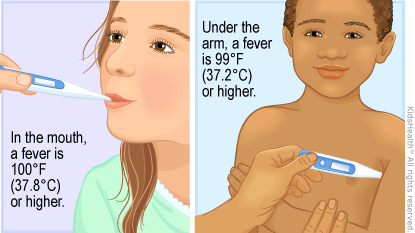
If your child feels warm or is acting unwell, use a **digital thermometer** to confirm a fever. Different ways of taking the temperature are more accurate than others at measuring the true body temperature.
The best way to take a temperature:
- for kids 3 years old and younger: a [rectal temperature](https://www.rchsd.org/health-article/how-to-take-a-rectal-temperature)
- for kids 4 or older who can cooperate: an [oral temperature](https://www.rchsd.org/health-article/how-to-take-an-oral-temperature) (by mouth)
- for any age: under the armpit ([axillary](https://www.rchsd.org/health-article/how-to-take-an-axillary-armpit-temperature)) and temporal artery (forehead) are easiest but less accurate. Tympanic (in the ear) is OK for kids 6 months and older.
It’s a fever when a child’s temperature is at or above one of these levels:
- rectal (in the bottom), tympanic (in the ear), or temporal artery (across the forehead): 100.4°F (38°C)
- oral (in the mouth): 100°F (37.8°C)
- axillary (under the arm): 99°F (37.2°C)
### How Can I Help My Child Feel Better?
No treatment is needed if a child is still playing and drinking normally and doesn’t have pain.
Treating a fever with medicine isn’t needed if a child is still playing and drinking normally and doesn’t have pain. Give medicine **only** when a fever causes a child discomfort or keeps them from drinking.
While kids [have a fever](https://www.rchsd.org/health-article/what-can-i-do-about-a-fever-high-temperature), keep an eye on them, help them to rest, and keep offering fluids to drink. They need to drink a little extra to make up for the fluids they lose from sweating.
### Home Care Measures
#### Medicines
If your child is uncomfortable from a fever or not drinking fluids well, you can give one of these medicines:
- [acetaminophen](https://www.rchsd.org/health-article/how-to-safely-give-acetaminophen) (such as Tylenol or a store brand)
or
- [ibuprofen](https://www.rchsd.org/health-article/how-to-safely-give-ibuprofen) (such as Advil, Motrin, or a store brand). Do not give to children under 6 months old.
Follow the package directions for how much to give and how often. If you don’t know the recommended dose **or your child is younger than 2 years old**, call the doctor to find out what to use and how much to give.
- If your child has any medical problems, check with the doctor to see which medicine to use.
- Unless instructed to by a doctor, never give aspirin to a child. Such use is linked to [Reye syndrome](https://www.rchsd.org/health-article/reye-syndrome), a rare but serious illness.
**Do not give any medicine for fever to infants younger than 3 months old unless instructed to by a doctor.**
#### **Staying Comfortable**
If your child has a fever:
- Have them wear lightweight clothing and stay covered with a light sheet or blanket. Heavy clothes and blankets can keep the body from cooling, which can make your child uncomfortable.
- Keep the room at a comfortable temperature — not too hot or too cold.
- Make sure they get plenty of rest. Staying in bed all day isn’t necessary, but a sick child should take it easy.
- They should stay home from school or childcare until their temperature has been normal for 24 hours.
Lukewarm sponge baths to lower a fever generally are not recommended. In fact, sponge baths can make kids uncomfortable from shivering. Never use rubbing alcohol (it can cause poisoning when absorbed through the skin) or ice packs/cold baths (they can cause chills that can raise body temperature).
#### **Food and Drinks**
Offer plenty of fluids to avoid [dehydration](https://www.rchsd.org/health-article/dehydration) because fevers make kids lose fluids faster than usual. Oral rehydration solutions (like Pedialyle, Enfalyte, or store brands) are a good choice. You also can give water, soup, ice pops, and flavored gelatin. Avoid drinks with caffeine, including colas and tea, which can make dehydration worse by making kids pee more often.
Let kids eat what they want (in reasonable amounts), but don’t force it if they don’t feel like eating much.
### When Should I Call the Doctor?
The temperature that should trigger a call to the doctor depends on a child’s age, the illness, and whether they have other symptoms. You might ask if your doctor has specific guidelines on when to call about a fever.
In general, call the doctor if your child is:
- younger than 3 months old with a rectal temperature of 100.4°F (38°C) or higher
- 3 months or older with a temperature higher than 102.2°F (39°C)
- any age but has a health problem like cancer or sickle cell disease and has a fever
Also call if a child 3 months or older has a fever and:
- refuses fluids or seems too ill to drink enough
- has lasting [diarrhea](https://www.rchsd.org/health-article/what-to-do-about-diarrhea) or repeated [vomiting](https://www.rchsd.org/health-article/how-to-handle-vomiting)
- has any signs of dehydration (peeing less than usual, not having tears when crying, less alert and less active than usual)
- has a specific complaint (like a [sore throat](https://www.rchsd.org/health-article/what-to-do-about-a-sore-throat) or earache)
- still has a fever after 2–3 days
- has a rash
- has pain while peeing
Get [emergency care](https://www.rchsd.org/health-article/going-to-the-emergency-room) if your child shows any of these signs:
- crying that won’t stop
- extreme irritability or fussiness
- sluggishness and trouble waking up
- a rash or purple spots that look like bruises on the skin (that were not there before your child got sick)
- blue lips, tongue, or nails
- in an infant, the soft spot on the head seems to be bulging out or sunken in
- stiff neck
- severe headache
- limpness or refusal to move
- trouble breathing that doesn’t get better when the nose is cleared
- leaning forward and drooling
- [seizure](https://www.rchsd.org/health-article/seizures)
- moderate to severe belly pain
### What Else Should I Know?
All kids get fevers, and in most cases they’re back to normal within a few days. For older babies and kids, the way they act can be more important than the reading on your thermometer. Everyone gets a little cranky when they have a fever. This is normal and should be expected.
But if you’re ever in doubt about what to do or what a fever might mean, or if your child is acting ill in a way that concerns you even with no fever, always call your doctor for advice.
*Note: All information is for educational purposes only. For specific medical advice, diagnoses, and treatment, consult your doctor.*
*[](https://kidshealth.org/)© 1995-2026 KidsHealth® All rights reserved. Images provided by The Nemours Foundation, iStock, Getty Images, Veer, Shutterstock, and Clipart.com.*
## Rady Children's Health
[3020 Children's Way, San Diego, CA 92123](http://maps.google.com/?daddr=3020%20Children's%20Way,%20San%20Diego,%20CA%2092123) [Main Phone: 858-576-1700](tel:858-576-1700) [Customer Service & Referrals: 800-788-9029](tel:800-788-9029) [Wait Times](https://www.rchsd.org/wait-times)
[Contact Us](https://www.rchsd.org/contact-us)
[Contact Us](https://www.rchsd.org/contact-us)
[Make a Donation](https://radyfoundation.org/donate-rchsd-footer%20)
[Thank a Nurse](https://www.rchsd.org/patients-visitors/daisy-awards)
## Connect with Rady Children's Health
[Thank a Staff Member](https://www.rchsd.org/patients-visitors/feedback/bee-award) [Thank a Nurse](https://www.rchsd.org/patients-visitors/daisy-awards)
[Make a Donation](https://radyfoundation.org/donate-rchsd-footer)
- [Rady Children’s Specialists of San Diego](https://www.rchsd.org/rcssd)
- \|
- [Rady Children’s Hospital Foundation](http://www.radyfoundation.org/)
- \|
- [Privacy Information / Forms](https://www.rchsd.org/privacy/)
- \|
- [Joint Notice of Privacy Practices](https://www.rchsd.org/documents/2016/08/joint-notice-of-privacy-practices.pdf/)
- \|
- [Price Transparency](https://www.rchsd.org/patients-visitors/price-transparency/)
- \|
- [Nondiscrimination](https://www.rchsd.org/patients-visitors/summary-notice-of-nondiscrimination/)
- \|
- [DRA Notice](https://www.rchsd.org/deficit-reduction-act-dra-notice/)
- \|
- [Accessibility](https://www.rchsd.org/accessibility/)
- \|
- [Warrranty Disclaimer](https://www.rchsd.org/disclaimer/)
- \|
© 2026 Rady Children's Health |
| Readable Markdown | [Ver en Español](https://www.rchsd.org/health-article/fiebre)
All kids get a fever from time to time. Usually, a fever isn’t dangerous or bad for kids. It can even be a good thing because it can help the [immune system](https://www.rchsd.org/health-article/immune-system) fight infection.
Still, parents might be unsure about how to handle a fever at home and when to call the doctor. Here are some tips.
### What Is a Fever?
In general, a fever means the body’s temperature is 100.4°F (38°C) or higher. Different ways of [measuring a temperature](https://www.rchsd.org/health-article/taking-your-childs-temperature) — rectal, armpit, ear, forehead, mouth — get a slightly different number, so the number that means a child has a fever is a little different too.
### What Causes Fevers?
Fevers in kids are usually caused by an infection. A fever helps the body by stimulating the immune system to fight the infection. Doctors also think the higher temperature makes it harder for the germs to grow.
A few other reasons kids can have a fever:
**Overdressing:** Infants, especially newborns, may get fevers if they’re overdressed, wrapped in a blanket, or in a hot environment because they don’t regulate their body temperature as well as older kids. But because fevers in newborns can be a sign of a serious infection, even infants who are overdressed must be checked by a doctor if they have a fever.
**Immunizations:** Babies and kids sometimes get a mild fever that lasts about a day after getting vaccinated.
A child who is [teething](https://www.rchsd.org/health-article/teething-tots) might have a slight rise in body temperature, but it’s probably not the cause if the temperature is higher than 100°F (37.8°C).
### When Is a Fever a Sign of Something Serious?
In most healthy kids who are acting well, a fever isn’t serious.
**But a fever can be serious for:**
- Infants younger than 3 months: **If an infant younger than 3 months has a rectal temperature of 100.4°F (38°C) or higher, call your doctor or go to the emergency department right away.**
- Kids with some health conditions: If your child has an ongoing health issue, make sure you know if the doctor should be called for fever.
A fever is probably not serious if your child is 3 months or older and:
- is still interested in playing
- is drinking well
- is alert and smiling
- has a normal skin color
- looks well when their temperature comes down
Don’t worry too much about a child with a fever who doesn’t want to eat. This is common with infections that cause fever. For kids who still drink and urinate (pee) normally, not eating as much as usual is OK.
### What Are the Signs of a Fever?
Kids with a fever might:
- feel warm
- act differently (they might be fussy or cranky, or quieter than usual)
- breathe a little faster or have a faster heart rate than normal
- have a headache
- have chills or sweating
- have red or flushed skin
For any of these signs, take your child’s temperature to know if they really have a fever.

If your child feels warm or is acting unwell, use a **digital thermometer** to confirm a fever. Different ways of taking the temperature are more accurate than others at measuring the true body temperature.
The best way to take a temperature:
- for kids 3 years old and younger: a [rectal temperature](https://www.rchsd.org/health-article/how-to-take-a-rectal-temperature)
- for kids 4 or older who can cooperate: an [oral temperature](https://www.rchsd.org/health-article/how-to-take-an-oral-temperature) (by mouth)
- for any age: under the armpit ([axillary](https://www.rchsd.org/health-article/how-to-take-an-axillary-armpit-temperature)) and temporal artery (forehead) are easiest but less accurate. Tympanic (in the ear) is OK for kids 6 months and older.
It’s a fever when a child’s temperature is at or above one of these levels:
- rectal (in the bottom), tympanic (in the ear), or temporal artery (across the forehead): 100.4°F (38°C)
- oral (in the mouth): 100°F (37.8°C)
- axillary (under the arm): 99°F (37.2°C)
### How Can I Help My Child Feel Better?
No treatment is needed if a child is still playing and drinking normally and doesn’t have pain.
Treating a fever with medicine isn’t needed if a child is still playing and drinking normally and doesn’t have pain. Give medicine **only** when a fever causes a child discomfort or keeps them from drinking.
While kids [have a fever](https://www.rchsd.org/health-article/what-can-i-do-about-a-fever-high-temperature), keep an eye on them, help them to rest, and keep offering fluids to drink. They need to drink a little extra to make up for the fluids they lose from sweating.
### Home Care Measures
#### Medicines
If your child is uncomfortable from a fever or not drinking fluids well, you can give one of these medicines:
- [acetaminophen](https://www.rchsd.org/health-article/how-to-safely-give-acetaminophen) (such as Tylenol or a store brand)
or
- [ibuprofen](https://www.rchsd.org/health-article/how-to-safely-give-ibuprofen) (such as Advil, Motrin, or a store brand). Do not give to children under 6 months old.
Follow the package directions for how much to give and how often. If you don’t know the recommended dose **or your child is younger than 2 years old**, call the doctor to find out what to use and how much to give.
- If your child has any medical problems, check with the doctor to see which medicine to use.
- Unless instructed to by a doctor, never give aspirin to a child. Such use is linked to [Reye syndrome](https://www.rchsd.org/health-article/reye-syndrome), a rare but serious illness.
**Do not give any medicine for fever to infants younger than 3 months old unless instructed to by a doctor.**
#### **Staying Comfortable**
If your child has a fever:
- Have them wear lightweight clothing and stay covered with a light sheet or blanket. Heavy clothes and blankets can keep the body from cooling, which can make your child uncomfortable.
- Keep the room at a comfortable temperature — not too hot or too cold.
- Make sure they get plenty of rest. Staying in bed all day isn’t necessary, but a sick child should take it easy.
- They should stay home from school or childcare until their temperature has been normal for 24 hours.
Lukewarm sponge baths to lower a fever generally are not recommended. In fact, sponge baths can make kids uncomfortable from shivering. Never use rubbing alcohol (it can cause poisoning when absorbed through the skin) or ice packs/cold baths (they can cause chills that can raise body temperature).
#### **Food and Drinks**
Offer plenty of fluids to avoid [dehydration](https://www.rchsd.org/health-article/dehydration) because fevers make kids lose fluids faster than usual. Oral rehydration solutions (like Pedialyle, Enfalyte, or store brands) are a good choice. You also can give water, soup, ice pops, and flavored gelatin. Avoid drinks with caffeine, including colas and tea, which can make dehydration worse by making kids pee more often.
Let kids eat what they want (in reasonable amounts), but don’t force it if they don’t feel like eating much.
### When Should I Call the Doctor?
The temperature that should trigger a call to the doctor depends on a child’s age, the illness, and whether they have other symptoms. You might ask if your doctor has specific guidelines on when to call about a fever.
In general, call the doctor if your child is:
- younger than 3 months old with a rectal temperature of 100.4°F (38°C) or higher
- 3 months or older with a temperature higher than 102.2°F (39°C)
- any age but has a health problem like cancer or sickle cell disease and has a fever
Also call if a child 3 months or older has a fever and:
- refuses fluids or seems too ill to drink enough
- has lasting [diarrhea](https://www.rchsd.org/health-article/what-to-do-about-diarrhea) or repeated [vomiting](https://www.rchsd.org/health-article/how-to-handle-vomiting)
- has any signs of dehydration (peeing less than usual, not having tears when crying, less alert and less active than usual)
- has a specific complaint (like a [sore throat](https://www.rchsd.org/health-article/what-to-do-about-a-sore-throat) or earache)
- still has a fever after 2–3 days
- has a rash
- has pain while peeing
Get [emergency care](https://www.rchsd.org/health-article/going-to-the-emergency-room) if your child shows any of these signs:
- crying that won’t stop
- extreme irritability or fussiness
- sluggishness and trouble waking up
- a rash or purple spots that look like bruises on the skin (that were not there before your child got sick)
- blue lips, tongue, or nails
- in an infant, the soft spot on the head seems to be bulging out or sunken in
- stiff neck
- severe headache
- limpness or refusal to move
- trouble breathing that doesn’t get better when the nose is cleared
- leaning forward and drooling
- [seizure](https://www.rchsd.org/health-article/seizures)
- moderate to severe belly pain
### What Else Should I Know?
All kids get fevers, and in most cases they’re back to normal within a few days. For older babies and kids, the way they act can be more important than the reading on your thermometer. Everyone gets a little cranky when they have a fever. This is normal and should be expected.
But if you’re ever in doubt about what to do or what a fever might mean, or if your child is acting ill in a way that concerns you even with no fever, always call your doctor for advice.
*Note: All information is for educational purposes only. For specific medical advice, diagnoses, and treatment, consult your doctor.*
*[](https://kidshealth.org/)© 1995-2026 KidsHealth® All rights reserved. Images provided by The Nemours Foundation, iStock, Getty Images, Veer, Shutterstock, and Clipart.com.* |
| Shard | 138 (laksa) |
| Root Hash | 12415810940652138738 |
| Unparsed URL | org,rchsd!www,/health-article/fever-high-temperature-in-kids/ s443 |