ℹ️ Skipped - page is already crawled
| Filter | Status | Condition | Details |
|---|---|---|---|
| HTTP status | PASS | download_http_code = 200 | HTTP 200 |
| Age cutoff | PASS | download_stamp > now() - 6 MONTH | 0 months ago |
| History drop | PASS | isNull(history_drop_reason) | No drop reason |
| Spam/ban | PASS | fh_dont_index != 1 AND ml_spam_score = 0 | ml_spam_score=0 |
| Canonical | PASS | meta_canonical IS NULL OR = '' OR = src_unparsed | Not set |
| Property | Value |
|---|---|
| URL | https://www.pressenza.com/2026/02/meaning-of-life-in-a-civilization-without-one/ |
| Last Crawled | 2026-04-20 21:02:43 (7 hours ago) |
| First Indexed | 2026-02-14 19:20:15 (2 months ago) |
| HTTP Status Code | 200 |
| Meta Title | Meaning of Life in a Civilization Without One |
| Meta Description | In the kingdom of non-meaning in which we live, it becomes difficult to even understand what the meaning of life might be. In this historical moment, and |
| Meta Canonical | null |
| Boilerpipe Text | In the kingdom of non-meaning in which we live, it becomes difficult to even understand what the
meaning of life
might be. In this historical moment, and on this side of the planet, there is almost nothing that carries genuine meaning. One is forced to ask:
Is there anything in this system with enough value to which I can dedicate my life?
By Dennis Redmond and David Andersson
Just a few decades ago, even temporary forms of meaning—such as family—still had a living dynamic. You were there for the family, and the family was there for you. A minimum of reciprocity existed. For some, work carried a similar charge: a sense of contribution, identity, and belonging.
Today, much of this has dissolved. Everything feels manipulated, directionless, stripped of real human connection. The current wave of what is labeled
mental illness
—depression, suicide, loneliness—does not come from nowhere. The figures are explicit: about 23.4% of U.S. adults (roughly 61.5 million people) experienced some form of mental illness in the past year, ranging from mild to severe. Of these, 5.6% experienced serious mental illness, significantly interfering with daily life.
Instead of addressing this as a crisis of meaning, the system prefers to frame it as an individual pathology. It proposes a medicalized psychology, creating a closed circuit of mental-health professionals, diagnoses, and medications. In doing so, suffering is integrated into the economic machinery of the system itself. The U.S. federal government alone allocates tens of billions of dollars per year to mental-health and treatment-oriented approaches—still a relatively small share of overall U.S. health spending, yet enough to sustain a vast therapeutic industry.
From a humanist perspective, this framing misses the core of the problem. What we are witnessing is not simply illness, but mental suffering as a rational response to systemic violence.
This was articulated with remarkable clarity by Silo in his talk
“The Meaning of Life”
(Mexico City, October 10, 1980):
Suffering, on the other hand, is mental in nature. It is not a sensory fact of the same kind as pain. Frustration, resentment, and fear are states that we also experience, but which we cannot locate in a specific organ, or in a set of organs.
Even though they are of a different nature, do pain and suffering act upon one another? Certainly, pain can also give rise to suffering. In this sense, social progress and the advance of science reduce one aspect of suffering. But specifically, where shall we find the solution to making suffering recede? We shall find it in the meaning of life. And there is no reform nor scientific advance that can eliminate the suffering produced by frustration, resentment, fear of death, and fear in general.
The meaning of life is a direction toward the future that gives coherence to life, that provides a framework for its activities, and that fully justifies them.
And what are the sources of human suffering? They are those that produce contradiction. One suffers from living contradictory situations. But one also suffers from remembering contradictory situations. And from imagining contradictory situations.
For some, this may sound like an overly simplistic answer to a complex crisis. But consider what Silo articulates: in the light of meaning, suffering in general—and even pain in its mental component—retreats and grows smaller as one comes to understand these experiences as something that can be surpassed. What makes meaning transformative is not that it eliminates hardship, but that it reorganizes one’s relationship to it entirely. When life has direction and coherence, when one’s activities connect to something beyond immediate gratification, the contradictions that generate suffering begin to lose their grip.
This is not a poetic abstraction—it is an internal register that appears when one’s existence stops being a passive reaction to external stimuli and becomes instead an active expression of an inner direction into the world.
The difficulty with this vision is precisely that it does not fit the dominant model. A civilization organized around meaning in life rather than consumption and control would require nothing less than a profound restructuring of our social relationships and our understanding of what it means to be human. But meaning is not measured by external structures to begin with. It is not validated by applause, income, recognition, institutional power, or visibility. A person may achieve all of these and yet live in deep contradiction. Another may live quietly, without status or acclaim, and yet experience a growing internal solidity. Meaning is measured by coherence—by the degree to which thought, feeling, and action converge toward a desired future.
What is being built internally is not an abstract belief but a structure of intention and permanence. Each act aligned with one’s chosen direction strengthens that structure; each act of contradiction weakens it. The daily application of meaning in life—the dedication, the persistence, the strength required to resist the constant pull back into fragmentation when the entire system is designed to divide attention and erode depth—demands everything one can give. The practice is exacting and requires consistency over time. It asks for the courage to endure misunderstanding and the discipline to build coherence when incoherence is normalized.
In a civilization without shared meaning, this inner construction becomes quietly revolutionary. Not because it withdraws from the world, but because it refuses to let the world dictate the core of one’s life. Meaning is not something we find in the system; it is something we generate. And when that internal coherence begins to grow—person by person—the possibility of a different future is no longer theoretical. It is already being built.
Dennis Redmond
is a longtime nonviolence advocate, currently serving as Coordinator for the
Community for Human Development
in the United States and as a co-founder of the
Hudson Valley Park of Study and Reflection
. As Coordinator for the Community for Human Development, Redmond has played a central role in organizing and advancing initiatives that promote nonviolence, social justice, and ethical engagement in communities—most notably in events such as the
New York City Walk for Nonviolence
. |
| Markdown | [Mastodon](https://mastodon.uno/@pressenza_italia) [Skip to content](https://www.pressenza.com/2026/02/meaning-of-life-in-a-civilization-without-one/#content)
[](https://www.pressenza.com/)
[Newsletter](https://www.pressenza.com/2026/02/meaning-of-life-in-a-civilization-without-one/#newsletter) \| [Donation](https://www.pressenza.com/2026/02/meaning-of-life-in-a-civilization-without-one/#donation)
- [English](https://www.pressenza.com/2026/02/meaning-of-life-in-a-civilization-without-one/)
- [Español](https://www.pressenza.com/es/2026/02/el-sentido-de-la-vida-en-una-civilizacion-carente-de-el/)
- [Deutsch](https://www.pressenza.com/de/)
- [Français](https://www.pressenza.com/fr/2026/02/le-sens-de-la-vie-dans-une-civilisation-sans-sens/)
- [العربية](https://www.pressenza.com/ar/)
- [Català](https://www.pressenza.com/ca/)
- [Ελληνικα](https://www.pressenza.com/el/)
- [Italiano](https://www.pressenza.com/it/)
- [Português](https://www.pressenza.com/pt-pt/)
- [Русский](https://www.pressenza.com/ru/2026/02/%D1%81%D0%BC%D1%8B%D1%81%D0%BB-%D0%B6%D0%B8%D0%B7%D0%BD%D0%B8-%D0%B2-%D1%86%D0%B8%D0%B2%D0%B8%D0%BB%D0%B8%D0%B7%D0%B0%D1%86%D0%B8%D0%B8-%D0%BB%D0%B8%D1%88%D0%B5%D0%BD%D0%BD%D0%BE%D0%B9-%D1%81%D0%BC/)
- [বাংলা](https://www.pressenza.com/bn/)
[×]()
- [International](https://www.pressenza.com/-/international/)
- [Region](https://www.pressenza.com/-/region/)
- [Africa](https://www.pressenza.com/-/region/africa/)
- [Asia](https://www.pressenza.com/-/region/asia/)
- [Central America](https://www.pressenza.com/-/region/central-america/)
- [Europe](https://www.pressenza.com/-/region/europe/)
- [Middle East](https://www.pressenza.com/-/region/middle-east/)
- [North America](https://www.pressenza.com/-/region/north-america/)
- [Oceania](https://www.pressenza.com/-/region/oceania-region/)
- [South America](https://www.pressenza.com/-/region/south-america/)
- [Section](https://www.pressenza.com/-/topic/)
- [Culture and Media](https://www.pressenza.com/-/topic/culture/)
- [Diversity](https://www.pressenza.com/-/topic/diversity/)
- [Ecology and Environment](https://www.pressenza.com/-/topic/environment-ecology/)
- [Economics](https://www.pressenza.com/-/topic/economy/)
- [Education](https://www.pressenza.com/-/topic/education/)
- [Gender and Feminisms](https://www.pressenza.com/-/topic/gender-and-feminisms/)
- [Health](https://www.pressenza.com/-/topic/health/)
- [Human Rights](https://www.pressenza.com/-/topic/human-rights/)
- [Humanism and Spirituality](https://www.pressenza.com/-/topic/humanism-spirituality/)
- [Indigenous peoples](https://www.pressenza.com/-/topic/aboriginal-people/)
- [International issues](https://www.pressenza.com/-/topic/foreign-affairs/)
- [Migrants](https://www.pressenza.com/-/topic/migrants/)
- [Nonviolence](https://www.pressenza.com/-/topic/nonviolence-topic/)
- [Peace and Disarmament](https://www.pressenza.com/-/topic/disarmament/)
- [Politics](https://www.pressenza.com/-/topic/politics/)
- [Science and Technology](https://www.pressenza.com/-/topic/science-technology/)
- [Youth issues](https://www.pressenza.com/-/topic/youth-issues/)
- [News](https://www.pressenza.com/-/news/)
- [Interviews](https://www.pressenza.com/-/interviews/)
- [Opinions](https://www.pressenza.com/-/opinions/)
- [Press Releases](https://www.pressenza.com/-/press-releases/)
- [News in pictures](https://www.pressenza.com/-/news-in-pictures/)
- [Radio](https://www.pressenza.com/-/radio-en/)
- [Video](https://www.pressenza.com/-/video-en/)
- [Pressenza](https://www.pressenza.com/2026/02/meaning-of-life-in-a-civilization-without-one/)
- [About us](https://www.pressenza.com/about-us/)
- [Partners](https://www.pressenza.com/partners/)
- [Work with us](https://www.pressenza.com/work-us/)
- [Contact](https://www.pressenza.com/contact/)
- [Pressenza In The World](https://www.pressenza.com/pressenza-in-the-world/)
- [Imprint](https://www.pressenza.com/imprint/)
### Search
[×]()
[](https://www.pressenza.com/)
- [English](https://www.pressenza.com/2026/02/meaning-of-life-in-a-civilization-without-one/)
- [Español](https://www.pressenza.com/es/2026/02/el-sentido-de-la-vida-en-una-civilizacion-carente-de-el/)
- [Deutsch](https://www.pressenza.com/de/)
- [Français](https://www.pressenza.com/fr/2026/02/le-sens-de-la-vie-dans-une-civilisation-sans-sens/)
- [العربية](https://www.pressenza.com/ar/)
- [Català](https://www.pressenza.com/ca/)
- [Ελληνικα](https://www.pressenza.com/el/)
- [Italiano](https://www.pressenza.com/it/)
- [Português](https://www.pressenza.com/pt-pt/)
- [Русский](https://www.pressenza.com/ru/2026/02/%D1%81%D0%BC%D1%8B%D1%81%D0%BB-%D0%B6%D0%B8%D0%B7%D0%BD%D0%B8-%D0%B2-%D1%86%D0%B8%D0%B2%D0%B8%D0%BB%D0%B8%D0%B7%D0%B0%D1%86%D0%B8%D0%B8-%D0%BB%D0%B8%D1%88%D0%B5%D0%BD%D0%BD%D0%BE%D0%B9-%D1%81%D0%BC/)
- [বাংলা](https://www.pressenza.com/bn/)
# Meaning of Life in a Civilization Without One
14\.02.26
\- New York - [David Andersson](https://www.pressenza.com/author/david-andersson/)
This post is also available in: [Spanish](https://www.pressenza.com/es/2026/02/el-sentido-de-la-vida-en-una-civilizacion-carente-de-el/), [French](https://www.pressenza.com/fr/2026/02/le-sens-de-la-vie-dans-une-civilisation-sans-sens/), [Russian](https://www.pressenza.com/ru/2026/02/%D1%81%D0%BC%D1%8B%D1%81%D0%BB-%D0%B6%D0%B8%D0%B7%D0%BD%D0%B8-%D0%B2-%D1%86%D0%B8%D0%B2%D0%B8%D0%BB%D0%B8%D0%B7%D0%B0%D1%86%D0%B8%D0%B8-%D0%BB%D0%B8%D1%88%D0%B5%D0%BD%D0%BD%D0%BE%D0%B9-%D1%81%D0%BC/)
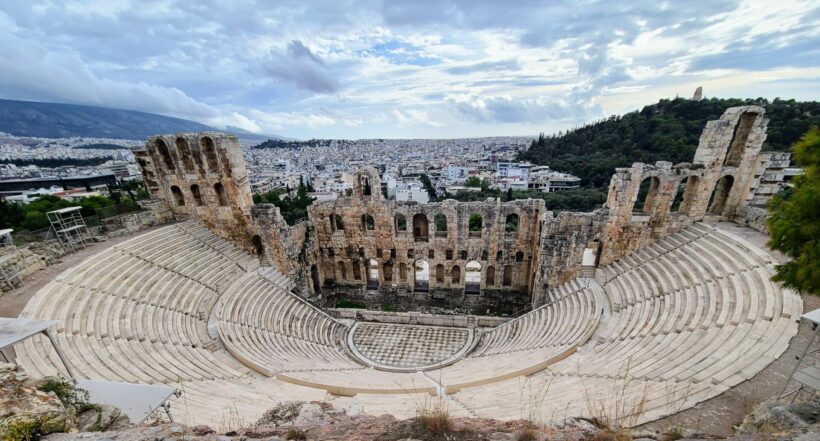
Odeon of Herodes Atticus at Acropolis in Athens, Greece (Image by David Andersson)
In the kingdom of non-meaning in which we live, it becomes difficult to even understand what the *meaning of life* might be. In this historical moment, and on this side of the planet, there is almost nothing that carries genuine meaning. One is forced to ask: *Is there anything in this system with enough value to which I can dedicate my life?*
By Dennis Redmond and David Andersson
Just a few decades ago, even temporary forms of meaning—such as family—still had a living dynamic. You were there for the family, and the family was there for you. A minimum of reciprocity existed. For some, work carried a similar charge: a sense of contribution, identity, and belonging.
Today, much of this has dissolved. Everything feels manipulated, directionless, stripped of real human connection. The current wave of what is labeled *mental illness*—depression, suicide, loneliness—does not come from nowhere. The figures are explicit: about 23.4% of U.S. adults (roughly 61.5 million people) experienced some form of mental illness in the past year, ranging from mild to severe. Of these, 5.6% experienced serious mental illness, significantly interfering with daily life.
Instead of addressing this as a crisis of meaning, the system prefers to frame it as an individual pathology. It proposes a medicalized psychology, creating a closed circuit of mental-health professionals, diagnoses, and medications. In doing so, suffering is integrated into the economic machinery of the system itself. The U.S. federal government alone allocates tens of billions of dollars per year to mental-health and treatment-oriented approaches—still a relatively small share of overall U.S. health spending, yet enough to sustain a vast therapeutic industry.
From a humanist perspective, this framing misses the core of the problem. What we are witnessing is not simply illness, but mental suffering as a rational response to systemic violence.
This was articulated with remarkable clarity by Silo in his talk *“The Meaning of Life”* (Mexico City, October 10, 1980):
> *Suffering, on the other hand, is mental in nature. It is not a sensory fact of the same kind as pain. Frustration, resentment, and fear are states that we also experience, but which we cannot locate in a specific organ, or in a set of organs.*
>
> *Even though they are of a different nature, do pain and suffering act upon one another? Certainly, pain can also give rise to suffering. In this sense, social progress and the advance of science reduce one aspect of suffering. But specifically, where shall we find the solution to making suffering recede? We shall find it in the meaning of life. And there is no reform nor scientific advance that can eliminate the suffering produced by frustration, resentment, fear of death, and fear in general.*
>
> *The meaning of life is a direction toward the future that gives coherence to life, that provides a framework for its activities, and that fully justifies them.*
>
> *And what are the sources of human suffering? They are those that produce contradiction. One suffers from living contradictory situations. But one also suffers from remembering contradictory situations. And from imagining contradictory situations.*
For some, this may sound like an overly simplistic answer to a complex crisis. But consider what Silo articulates: in the light of meaning, suffering in general—and even pain in its mental component—retreats and grows smaller as one comes to understand these experiences as something that can be surpassed. What makes meaning transformative is not that it eliminates hardship, but that it reorganizes one’s relationship to it entirely. When life has direction and coherence, when one’s activities connect to something beyond immediate gratification, the contradictions that generate suffering begin to lose their grip. **This is not a poetic abstraction—it is an internal register that appears when one’s existence stops being a passive reaction to external stimuli and becomes instead an active expression of an inner direction into the world.**
The difficulty with this vision is precisely that it does not fit the dominant model. A civilization organized around meaning in life rather than consumption and control would require nothing less than a profound restructuring of our social relationships and our understanding of what it means to be human. But meaning is not measured by external structures to begin with. It is not validated by applause, income, recognition, institutional power, or visibility. A person may achieve all of these and yet live in deep contradiction. Another may live quietly, without status or acclaim, and yet experience a growing internal solidity. Meaning is measured by coherence—by the degree to which thought, feeling, and action converge toward a desired future.
What is being built internally is not an abstract belief but a structure of intention and permanence. Each act aligned with one’s chosen direction strengthens that structure; each act of contradiction weakens it. The daily application of meaning in life—the dedication, the persistence, the strength required to resist the constant pull back into fragmentation when the entire system is designed to divide attention and erode depth—demands everything one can give. The practice is exacting and requires consistency over time. It asks for the courage to endure misunderstanding and the discipline to build coherence when incoherence is normalized.
In a civilization without shared meaning, this inner construction becomes quietly revolutionary. Not because it withdraws from the world, but because it refuses to let the world dictate the core of one’s life. Meaning is not something we find in the system; it is something we generate. And when that internal coherence begins to grow—person by person—the possibility of a different future is no longer theoretical. It is already being built.
***
**Dennis Redmond** is a longtime nonviolence advocate, currently serving as Coordinator for the *Community for Human Development* in the United States and as a co-founder of the *Hudson Valley Park of Study and Reflection*. As Coordinator for the Community for Human Development, Redmond has played a central role in organizing and advancing initiatives that promote nonviolence, social justice, and ethical engagement in communities—most notably in events such as the *New York City Walk for Nonviolence*.
Categories: [Feature](https://www.pressenza.com/-/feature/), [Humanism and Spirituality](https://www.pressenza.com/-/topic/humanism-spirituality/), [North America](https://www.pressenza.com/-/region/north-america/)
Tags: [meaning of life](https://www.pressenza.com/tag/meaning-of-life/), [medicalized psychology](https://www.pressenza.com/tag/medicalized-psychology/), [mental health](https://www.pressenza.com/tag/mental-health/), [Mental Illness](https://www.pressenza.com/tag/mental-illness/), [Silo](https://www.pressenza.com/tag/silo/)

***[David Andersson](https://www.pressenza.com/author/david-andersson/)** David Andersson is a writer and humanist based in New York City. He focuses on issues of global justice, collective consciousness, and nonviolent transformation. English Editor with Pressenza International Press Agency and is the author of The White-West: A Look in the Mirror, a collection of op-eds examining the dynamics of Western identity and its global impact. CounterPunch, denikreferendum.cz, Mobilized News, Countercurrents, LA Progressive, and Dissident Voice have published his recent work. Many of his articles have been translated into more than five languages.*
## Newsletter
Enter your e-mail address to subscribe to our daily news service.
## Donation
Support our Peace and Nonviolence journalism with your donation.
[Make a donation](https://www.pressenza.com/donation/)
Recommended Articles
Display recommended
Category: 1232
Exclude ID: 2676483
Pressenza Productions
### Book catalogue
[](https://www.pressenza.com/es/catalogo_de_libros/)
### Training in Nonviolent Journalism
[](https://www.pressenza.com/nonviolent-journalism/nonviolent-journalism-training/)
### Documentary Catalogue
[](https://www.pressenza.com/documentaries-catalogue/)
### Every Sunday
[](https://www.pressenza.com/tag/culture-and-arts-notebook/)
Campaigns
**Pressenza**
An international news agency dedicated to news about peace and nonviolence with offices in Athens, Barcelona, Berlin, Bogotá, Bordeaux, Brussels, Budapest, Buenos Aires, Córdoba (Argentina), Florence, Lima, London, Madrid, Manila, Mar del Plata, Mexico City, Milan, Montreal, Moscow, Munich, New Delhi, New York, Palermo, Paris, Porto, Quito, Rome, San José de Costa Rica, Santiago de Chile, Sao Paulo, Turin, Valencia and Vienna.
- [About us](https://www.pressenza.com/about-us/)
- [Contact](https://www.pressenza.com/contact/)
- [Declaration of data protection](https://www.pressenza.com/declaration-of-data-protection/)
- [Imprint](https://www.pressenza.com/imprint/)
- [Stock images are partly provided by Depositphotos](https://depositphotos.com/stock-photography.html)
## We value your privacy.
We use cookies to analyse our traffic and to embed third party content. By clicking "Accept", you agree to the use of cookies.
Accept
Refuse |
| Readable Markdown | In the kingdom of non-meaning in which we live, it becomes difficult to even understand what the *meaning of life* might be. In this historical moment, and on this side of the planet, there is almost nothing that carries genuine meaning. One is forced to ask: *Is there anything in this system with enough value to which I can dedicate my life?*
By Dennis Redmond and David Andersson
Just a few decades ago, even temporary forms of meaning—such as family—still had a living dynamic. You were there for the family, and the family was there for you. A minimum of reciprocity existed. For some, work carried a similar charge: a sense of contribution, identity, and belonging.
Today, much of this has dissolved. Everything feels manipulated, directionless, stripped of real human connection. The current wave of what is labeled *mental illness*—depression, suicide, loneliness—does not come from nowhere. The figures are explicit: about 23.4% of U.S. adults (roughly 61.5 million people) experienced some form of mental illness in the past year, ranging from mild to severe. Of these, 5.6% experienced serious mental illness, significantly interfering with daily life.
Instead of addressing this as a crisis of meaning, the system prefers to frame it as an individual pathology. It proposes a medicalized psychology, creating a closed circuit of mental-health professionals, diagnoses, and medications. In doing so, suffering is integrated into the economic machinery of the system itself. The U.S. federal government alone allocates tens of billions of dollars per year to mental-health and treatment-oriented approaches—still a relatively small share of overall U.S. health spending, yet enough to sustain a vast therapeutic industry.
From a humanist perspective, this framing misses the core of the problem. What we are witnessing is not simply illness, but mental suffering as a rational response to systemic violence.
This was articulated with remarkable clarity by Silo in his talk *“The Meaning of Life”* (Mexico City, October 10, 1980):
> *Suffering, on the other hand, is mental in nature. It is not a sensory fact of the same kind as pain. Frustration, resentment, and fear are states that we also experience, but which we cannot locate in a specific organ, or in a set of organs.*
>
> *Even though they are of a different nature, do pain and suffering act upon one another? Certainly, pain can also give rise to suffering. In this sense, social progress and the advance of science reduce one aspect of suffering. But specifically, where shall we find the solution to making suffering recede? We shall find it in the meaning of life. And there is no reform nor scientific advance that can eliminate the suffering produced by frustration, resentment, fear of death, and fear in general.*
>
> *The meaning of life is a direction toward the future that gives coherence to life, that provides a framework for its activities, and that fully justifies them.*
>
> *And what are the sources of human suffering? They are those that produce contradiction. One suffers from living contradictory situations. But one also suffers from remembering contradictory situations. And from imagining contradictory situations.*
For some, this may sound like an overly simplistic answer to a complex crisis. But consider what Silo articulates: in the light of meaning, suffering in general—and even pain in its mental component—retreats and grows smaller as one comes to understand these experiences as something that can be surpassed. What makes meaning transformative is not that it eliminates hardship, but that it reorganizes one’s relationship to it entirely. When life has direction and coherence, when one’s activities connect to something beyond immediate gratification, the contradictions that generate suffering begin to lose their grip. **This is not a poetic abstraction—it is an internal register that appears when one’s existence stops being a passive reaction to external stimuli and becomes instead an active expression of an inner direction into the world.**
The difficulty with this vision is precisely that it does not fit the dominant model. A civilization organized around meaning in life rather than consumption and control would require nothing less than a profound restructuring of our social relationships and our understanding of what it means to be human. But meaning is not measured by external structures to begin with. It is not validated by applause, income, recognition, institutional power, or visibility. A person may achieve all of these and yet live in deep contradiction. Another may live quietly, without status or acclaim, and yet experience a growing internal solidity. Meaning is measured by coherence—by the degree to which thought, feeling, and action converge toward a desired future.
What is being built internally is not an abstract belief but a structure of intention and permanence. Each act aligned with one’s chosen direction strengthens that structure; each act of contradiction weakens it. The daily application of meaning in life—the dedication, the persistence, the strength required to resist the constant pull back into fragmentation when the entire system is designed to divide attention and erode depth—demands everything one can give. The practice is exacting and requires consistency over time. It asks for the courage to endure misunderstanding and the discipline to build coherence when incoherence is normalized.
In a civilization without shared meaning, this inner construction becomes quietly revolutionary. Not because it withdraws from the world, but because it refuses to let the world dictate the core of one’s life. Meaning is not something we find in the system; it is something we generate. And when that internal coherence begins to grow—person by person—the possibility of a different future is no longer theoretical. It is already being built.
***
**Dennis Redmond** is a longtime nonviolence advocate, currently serving as Coordinator for the *Community for Human Development* in the United States and as a co-founder of the *Hudson Valley Park of Study and Reflection*. As Coordinator for the Community for Human Development, Redmond has played a central role in organizing and advancing initiatives that promote nonviolence, social justice, and ethical engagement in communities—most notably in events such as the *New York City Walk for Nonviolence*. |
| Shard | 92 (laksa) |
| Root Hash | 5372516126443978092 |
| Unparsed URL | com,pressenza!www,/2026/02/meaning-of-life-in-a-civilization-without-one/ s443 |