ℹ️ Skipped - page is already crawled
| Filter | Status | Condition | Details |
|---|---|---|---|
| HTTP status | PASS | download_http_code = 200 | HTTP 200 |
| Age cutoff | PASS | download_stamp > now() - 6 MONTH | 0.1 months ago |
| History drop | PASS | isNull(history_drop_reason) | No drop reason |
| Spam/ban | PASS | fh_dont_index != 1 AND ml_spam_score = 0 | ml_spam_score=0 |
| Canonical | PASS | meta_canonical IS NULL OR = '' OR = src_unparsed | Not set |
| Property | Value |
|---|---|
| URL | https://www.popularmechanics.com/space/moon-mars/a26967/history-of-the-solar-eclipse/ |
| Last Crawled | 2026-04-19 05:52:52 (2 days ago) |
| First Indexed | 2018-01-31 11:13:05 (8 years ago) |
| HTTP Status Code | 200 |
| Meta Title | Solar Eclipse History - Timeline of Total Solar Eclipses Around the World |
| Meta Description | For millennia, humans have used solar eclipses to learn about the universe. We are still learning. |
| Meta Canonical | null |
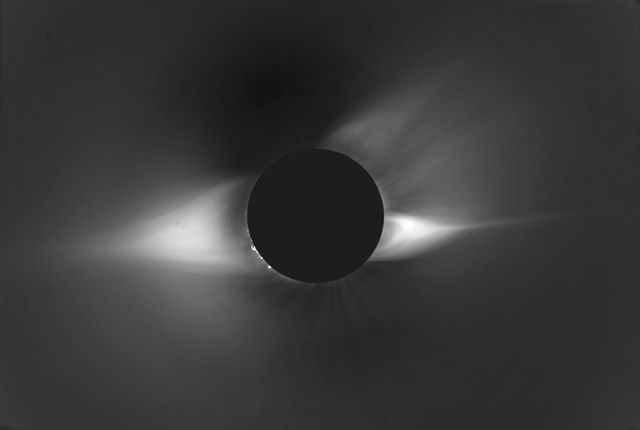
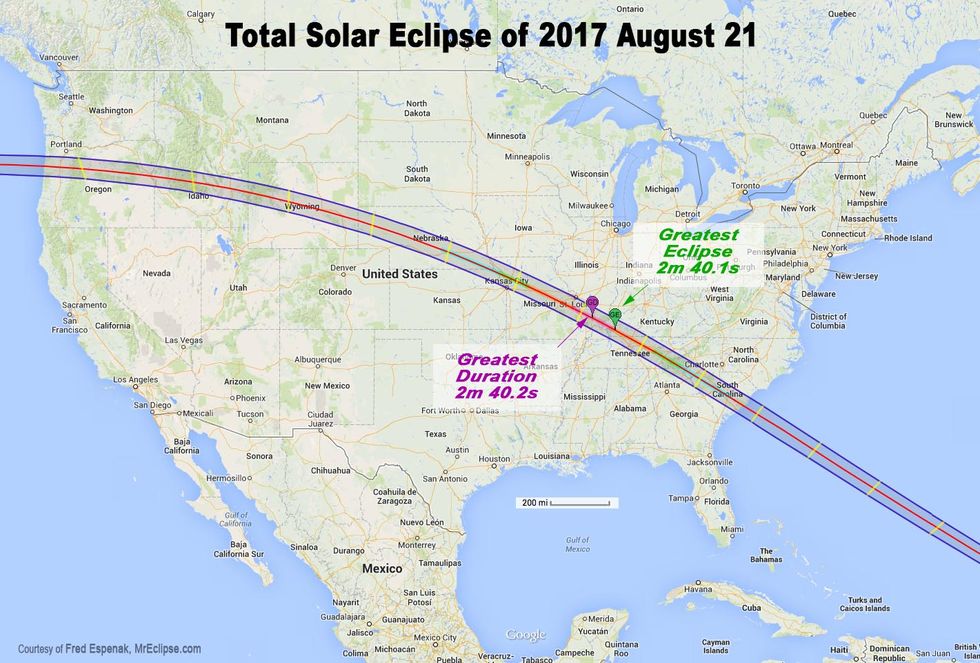
| Boilerpipe Text | For a couple minutes on August 21, 2017, day will turn into night.
The Great American Solar Eclipse
, as it's being called, is unlike any eclipse that most of us have ever seen—or will ever see—in our lifetimes. For the first time in nearly a century, a total solar eclipse will cross the entirety of the continental United States, with a band of totality stretching from South Carolina to Oregon.
A solar eclipse happens when the moon passes directly between the sun and earth, blotting out the bright yellow disk and darkening the sky for several minutes. While breathtaking to behold, this natural phenomenon isn't all that rare with a total solar eclipse visible somewhere on Earth
on average every 18 months
.
Today, we know all about these cosmic machinations. But for much of human existence, those who experienced them had no idea what they were seeing. The sun going dark in the middle of the day understandably frightened our ancient (and not so ancient) ancestors. To make sense of a seemingly apocalyptic event they could not explain, ancient civilizations often relied on mythology.
In South America, a celestial jaguar was thought to have eaten the Sun. The ancient Chinese believed a dragon was responsible for devouring the bright yellow ball in the sky. In fact, the Chinese word for
solar eclipse is "chih," which also means "to eat."
In Scandinavia, it was
a demon sky wolf named Skoll who wanted the Sun for his next meal
and it was up to those on Earth to make noise to scare him off. Ancient Mesopotamians saw it as a sign that the king was nearing death. In Indian mythology, the
Hindu demon Rahu spent his days chasing the Moon and Sun
. Every once in awhile, he caught and swallowed them, but since he was only a head, the Sun and Moon slide right back out after only a few moments. In other civilizations, a solar eclipse meant evil was close by, the end of times was approaching, and
that vampires were near
.
Around the 8th century BCE, this line of thinking began to change. Those who were looking up at the sky started recording their observations and came to some pretty game-changing conclusions. "People realized that there were patterns," says Tyler Nordgren, author of the book
Sun Moon Earth: The History of Solar Eclipses from Omens of Doom to Einstein and Exoplanets
, "Once you realize that there are patterns in nature, that allows you make to predictions about it... If it is a dragon eating the sun, then evidently the dragon works on a timetable."
The evolution of how humans have come to understand solar eclipses is the story of how we as a species have attempted to comprehend our universe.
2100 BCE: A solar eclipse beheading
Time Life Pictures
//
Getty Images
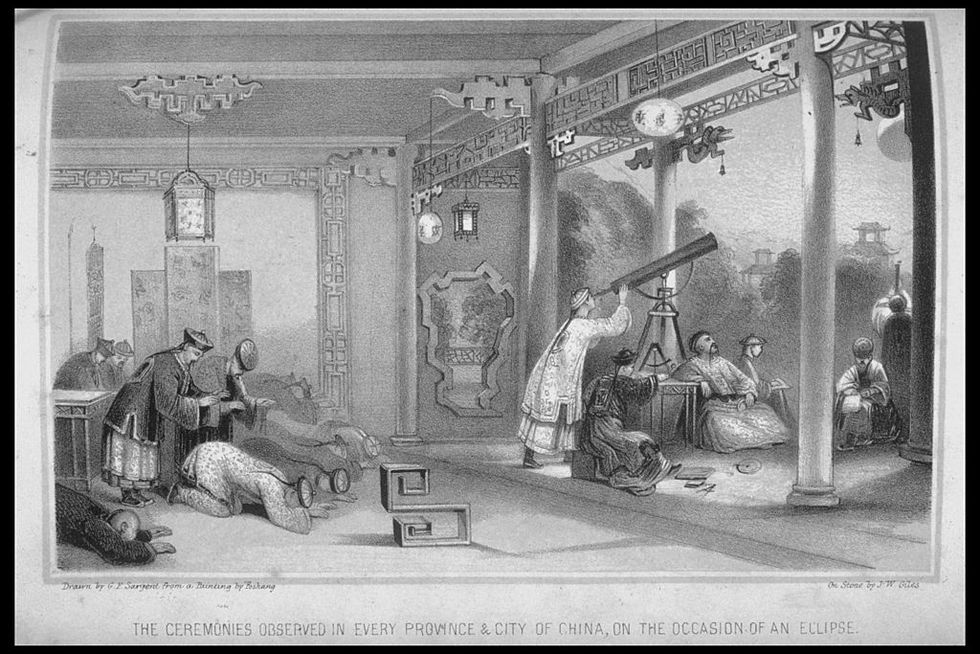
China astronomers observe a solar eclipse, an event that held religious significance.
While scholars have not been able to verify the story, there's a Chinese myth that when court astrologers Xi and He were unable to explain or predict why the sun had suddenly disappeared (possibly because they were always drunk),
Emperor Zhong Kang had them beheaded
.
1223 BCE: The Ugarit Eclipse
In 1948, archeologists uncovered a clay tablet from the ruins of the ancient Syrian port city of Ugarit that is
likely the first written record of a solar eclipse
. Written in Ugaritic, the text and symbols roughly translated to "On the...day of the new moon in (the month) hiyaru, the Sun went down, its gatekeeper was (God) Rašap." While it's clear these ancient peoples didn't know what caused the sun to go dark, they were perhaps the first to record the phenomenon. Also of note: For years historians thought this eclipse occurred in 1375 BCE, but
further study and dating revealed it happened 152 years later
.
763 BCE: In the Bible
In
Amos 8:9 of the King James Bible
reads, "And it shall come to pass in that day, saith the Lord God, that I will cause the sun to go down at noon, and I will darken the earth in the clear day." According to researchers, this is a reference to the
Assyrian eclipse that took place in the 8th century
BCE in what is
now Iraq
.
Appx. 600 BCE: The Saros Cycle
Science & Society Picture Library
//
Getty Images
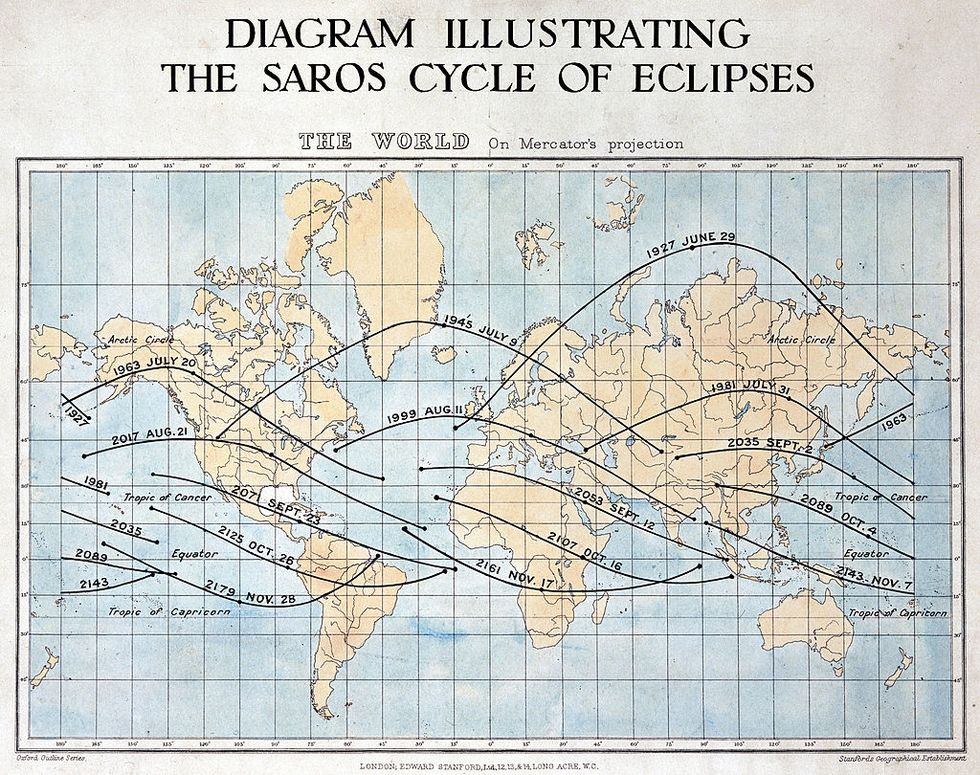
A 1927 map depicted the Chaldean saros cycle of total solar eclipses through 2164. You can see this year\'s solar eclipse cutting across North America.
The first civilization to discover there was a pattern to both lunar and solar eclipses were the Chaldeans, who had a short-lived reign over Babylon. We know from the Greeks that
they kept daily astronomical diaries,
including recording the position of the moon, stars, and Sun. Because of their meticulous record-keeping, ancient astronomers discovered that eclipses followed what they called the "Saros cycle,"
a period of approximately 18 years
(18 years, 11 days & 8 hours, to be exact).
May 28, 585 BCE: The first prediction of a solar eclipse
According to Herodotus's
Histories,
written in 450 BCE, Greek philosopher Thales of Miletus was the first
to accurately predict the time and place of a solar eclipse
, which legend has it halted a
five-year war between the Lydians and Medes
. It's unclear his exact methods or if he used the Saros cycle, but the tale at the very least reveals that by Herodotus's time in the 5th century BCE, eclipses were no longer thought to be the works of demons or gods.
February 17, 478 BCE: Crowdsourcing the moon theory
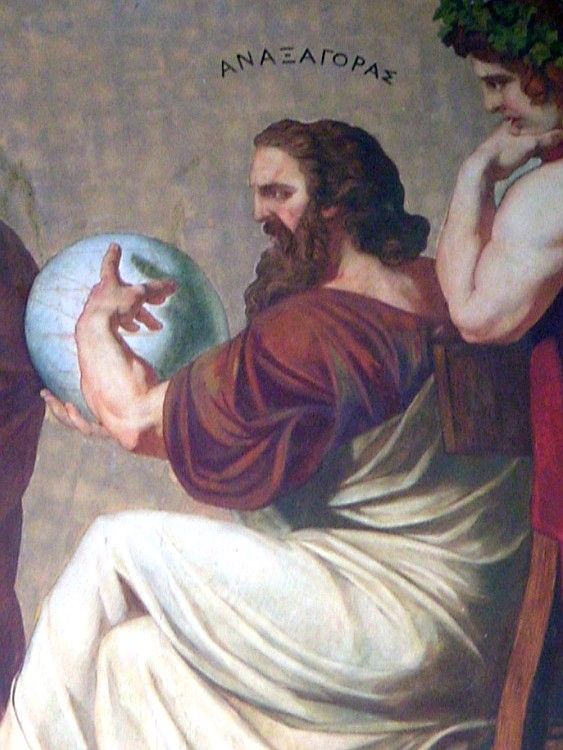
Pre-socratic philosopher Anaxagoras
Watching in Athens, scientist
Anaxagoras of Clazomenae
wonders what is causing the enormous shadow blotting out the sun. So, he goes down to the nearby port and crowdsources information from the numerous fishermen and sailors that observed the same spectacle as him, but from different vantage points. From these tidbits, he's able to roughly calculate the size of the object, which
he later determines is likely the moon
. Hence, he becomes the first to discover that solar eclipses are caused by the moon passing between the sun and the earth.
Appx. 200 BCE: The "Antikythera Mechanism"
Dated to approximately the 3rd century BCE, the
"Antikythera Mechanism"
is the oldest device ever found that tracks the paths of celestial bodies for calculating the date and times of future eclipses. It was
found in 1901 in an ancient shipwreck
off the coast of a Greek island. It's possible there are more devices of this nature somewhere at the bottom of the Mediterranean Sea.
150 CE: Ptolemy's The Almagest
Using the written observations from the ancient Babylonians and his own calculations, Egyptian mathematician Ptolemy is able
to accurately describe 19 solar eclipses
that go back centuries. The complex writings and math of
The Almagest
become the definitive tome for
predicting the positions of celestial bodies and eclipses
up until the time of Galileo—so, for the next 1,500 years.
Appx. 1000: Seeing a solar eclipse safely
Today, we know the safest way to observe a solar eclipse is through a "camera obscura," an optic phenomenon when an image is projected through a tiny pinhole, which is then reversed and inverted. In the 2nd century, Islamic scholar Alhazen became the first to build and use camera obscura in observing and measuring solar eclipses. In his manuscript
"On the Shape of the Eclipse,"
he correctly identifies that the moon, sun, and Earth vary in shapes and that it is unsafe to stare directly at the sun during an eclipse.
1543: Revolving around the sun
Time Life Pictures
//
Getty Images
Representation of Nicholas Copernicus\
Copernicus was able to observe
at least four solar eclipses during his life
, often through a camera obscura. In 1543, as Copernicus lay on his deathbed, this research contributed to one of astronomy's greatest revelations: It was the sun, not the Earth, that was
the center of our solar system
.
1695: Earth is slowing down
While producing what may be the
oldest eclipse map in existence
, Edmund Halley discovered that his calculations in mapping ancient eclipses did not correlate with the historic written record. This lead Haley in making the astonishing discovery that the
Earth's rotation rate is gradually slowing down
(while increasing the length of our planet's day by 2.3 milliseconds per century) and the Moon's orbit is gradually accelerating. Two decades later, Halley comes within four minutes of predicting the exact time of totality of the 1715 solar eclipse that passed over London.
May 15, 1836: Baily's Beads
English astronomer Francis Baily observed that right before the moment of totality, several rays of sunshine shine through the lunar topography of valleys and mountains causing a beautiful speckle of light. Naturally, Baily named the phenomenon
Baily's Beads
. He found this sight so spectacular that it became his life's work to travel around the world to witness solar eclipses. According to Nordgren, it was Baily who began "the golden age of solar eclipse chasing," an era we are still in today.
July 18, 1860" Photographic evidence
UniversalImagesGroup
//
Getty Images
Warren de la Rue\'s photograph of solar eclipse, the first one ever taken, 1860.
Even in its infancy, it was pretty clear that photography would lead to a revolution for science.
Warren De Le Rue
may not have been the first to photograph a solar eclipse, but
it's his photos
that are still studied by astronomers today. Later, De Le Rue would say that he wished he wasn't always encumbered by his work and equipment. He wanted the
opportunity to "just look" at a solar eclipse
without needing to take any photographs.
May 29, 1919: Einstein becomes a star
Science & Society Picture Library
//
Getty Images
Taken in Brazil during the 1919 solar eclipse, images like these helped prove Albert Einstein\'s Theory of Relativity.
In 1915, Einstein announced his General Theory of Relativity that, in part, said light in spacetime
does not travel in a perfectly straight line
, but bends in relation to an object's gravitational field. Four years later, Einstein and his supporters used a solar eclipse to prove it.
Due to the darkness brought on by a solar eclipse, astronomers were able to observe and
accurately measure the gravity-shifted positions of starlight
as it made its way through the sun's gravitational field on the way to Earth. With headlines blaring "Revolution in Science - New Theory in Universe. Newton's Ideas Overturned," an assistant asked Einstein what would he have done
if the solar eclipse proved him wrong
.
"Then I would feel sorry for the dear Lord," Einstein supposedly said, "The theory is correct anyway."
June 30, 1973: Chasing darkness
Flying twice the speed of the sound in a prototype
Concorde
, a group of astronomers chased the darkness
by following a solar eclipse from 55,000 feet in the air
. Traveling at the same speed as the Moon's shadow moving across Earth, the scientists were able to observe from the sky a record-breaking 74 minutes of dark totality.
February 26, 1979: The last North American solar eclipse
Bill Wunsch
//
Getty Images
1979 eclipse viewed in Glasgow, Montana.
The
last total solar eclipse to pass over the continental United States
was when Jimmy Carter was in the White House. While the northwest path of the solar eclipse covered North Dakota to Washington, many who tried to observe it
were disappointed due to cloudy winter skies
.
August 21, 2017:s The drought ends
NASA
The path of the 2017 solar eclipse as it crosses the U.S. on August 21.
After going through a four-decade long total solar eclipse drought, the continental United States will once again experience totality. Nordgren says that this solar eclipse will be unlike any other because of the number of people who are going to see it. While over 12 million people live in the path of totality, one estimate says that
upwards of 20 million will travel
to observe day turn into night. With the omnipresence of social media and cameras, Nordgren believes that the Great American Solar Eclipse "will be the most photographed event in human history."
Perhaps the best part is that this just the first of several total solar eclipses that
will pass through the U.S. over the next four decades
. In fact, we don't have to wait all that long for the next one. On April 8, 2024, a total solar eclipse will follow a
northern path through Texas to Maine
- however, it won't cross the entire country like the one in August of this year.
There's still much to be learned from solar eclipses. The summer will give scientists an unprecedented chance to
study the inner workings of the corona
, still a relative mystery to researchers. Using high resolution cameras and the fact that amatuer astronmers across the country can help provide observations and data, this eclipse is going to provide a "
scientific bonanza."
We've come a long way in the 3,000 years since humans first wrote down their solar eclipses observations. As history lurches forward, there's little doubt that we will keep using solar eclipses to expand our knowledge about the Sun and the celestial bodies that surround it.
Matt is a history, science, and travel writer who is always searching for the mysterious and hidden. He's written for Smithsonian Magazine, Washingtonian, Atlas Obscura, and Arlington Magazine. He calls Washington D.C. home and probably tells way too many cat jokes. |
| Markdown | [Search](https://www.popularmechanics.com/search/)

***
- [Newsletter](https://popularmechanics.com/email/popularmechanics-newsletter)
- [Pop Mech Pro](https://www.popularmechanics.com/about/a40180523/pop-mech-pro-membership-news-benefits/)
- [Subscribe](https://shop.popularmechanics.com/popular-mechanics-all-access-3499.html?cds_tracking_code=poppanelnav)
- [Home and DIY](https://www.popularmechanics.com/home/)
- [Power Tools](https://www.popularmechanics.com/home/tools/)
- [Cars](https://www.popularmechanics.com/cars/)
- [Technology](https://www.popularmechanics.com/technology/)
- [Military](https://www.popularmechanics.com/military/)
- [Science](https://www.popularmechanics.com/science/)
- [Adventure](https://www.popularmechanics.com/adventure/)
- [Sci-Fi](https://www.popularmechanics.com/culture/)
- [Airplanes](https://www.popularmechanics.com/flight/)
- [Space](https://www.popularmechanics.com/space/)
- [Gifts](https://www.popularmechanics.com/holiday-gift-guide/)
- [Deals](https://www.popularmechanics.com/sales-and-deals/)
- [Visual Stories](https://www.popularmechanics.com/interactive/stories/)
- [Promotions](https://www.popularmechanics.com/promotions/)
- [Shop](https://shop.popularmechanics.com/?source=pop_hamburger)
- [Follow](https://www.popularmechanics.com/space/moon-mars/a26967/history-of-the-solar-eclipse/#follow)
- [My Bookmarks](https://www.popularmechanics.com/my-stuff/)
[Privacy Notice](https://www.hearst.com/-/us-magazines-privacy-notice)[Terms Of Use](https://www.hearst.com/-/us-magazines-terms-of-use)
[Skip to Content](https://www.popularmechanics.com/space/moon-mars/a26967/history-of-the-solar-eclipse/#main-content)
[sign in](https://www.popularmechanics.com/auth/csrf?action=login&return_url=https%3A%2F%2Fwww.popularmechanics.com%2Fspace%2Fmoon-mars%2Fa26967%2Fhistory-of-the-solar-eclipse%2F)
[Subscribe](https://shop.popularmechanics.com/popular-mechanics-all-access-3499.html?cds_tracking_code=poptopnav)
[](https://www.popularmechanics.com/)
[sign in](https://www.popularmechanics.com/auth/csrf?action=login&return_url=https%3A%2F%2Fwww.popularmechanics.com%2Fspace%2Fmoon-mars%2Fa26967%2Fhistory-of-the-solar-eclipse%2F)
[Subscribe](https://shop.popularmechanics.com/popular-mechanics-all-access-3499.html?cds_tracking_code=poptopnav)
[](https://www.popularmechanics.com/search/)

[](https://www.popularmechanics.com/)
- [Science](https://www.popularmechanics.com/space/moon-mars/a26967/history-of-the-solar-eclipse/)
- [Home & DIY](https://www.popularmechanics.com/space/moon-mars/a26967/history-of-the-solar-eclipse/)
- [Technology](https://www.popularmechanics.com/space/moon-mars/a26967/history-of-the-solar-eclipse/)
- [Gear Reviews](https://www.popularmechanics.com/space/moon-mars/a26967/history-of-the-solar-eclipse/)
- [Military](https://www.popularmechanics.com/space/moon-mars/a26967/history-of-the-solar-eclipse/)
- [Transportation](https://www.popularmechanics.com/space/moon-mars/a26967/history-of-the-solar-eclipse/)
- [Culture & Curiosities](https://www.popularmechanics.com/space/moon-mars/a26967/history-of-the-solar-eclipse/)
- [About](https://www.popularmechanics.com/space/moon-mars/a26967/history-of-the-solar-eclipse/)
- [My Bookmarks](https://www.popularmechanics.com/my-stuff)
- [Newsletter](https://www.popularmechanics.com/email/popularmechanics-newsletter)
- [Privacy Notice](https://www.hearst.com/-/us-magazines-privacy-notice)[Terms Of Use](https://www.hearst.com/-/us-magazines-terms-of-use)
[](https://x.com/PopMech)
[](https://www.tiktok.com/@popularmechanics?lang=en)
[](https://www.youtube.com/c/popularmechanics?sub_confirmation=1)
[](https://www.facebook.com/popularmechanics)
[](https://www.instagram.com/popularmechanics/)
[](https://www.pinterest.com/popmech/?auto_follow=1)
[sign in](https://www.popularmechanics.com/auth/csrf?action=login&return_url=https%3A%2F%2Fwww.popularmechanics.com%2Fspace%2Fmoon-mars%2Fa26967%2Fhistory-of-the-solar-eclipse%2F)
[Subscribe](https://shop.popularmechanics.com/popular-mechanics-all-access-3499.html?cds_tracking_code=poptopnav)
- [Science](https://www.popularmechanics.com/science/)
- [Home & DIY](https://www.popularmechanics.com/home/)
- [Technology](https://www.popularmechanics.com/technology/)
- [Gear Reviews](https://www.popularmechanics.com/product-reviews/)
- [Military](https://www.popularmechanics.com/military/)
- [Transportation](https://www.popularmechanics.com/transportation/)
- [Culture & Curiosities](https://www.popularmechanics.com/culture/)
- [About](https://www.popularmechanics.com/about/a45/about-us/)
- [More](https://www.popularmechanics.com/space/moon-mars/a26967/history-of-the-solar-eclipse/)
1. [Space](https://www.popularmechanics.com/space/)
2. [Moon and Mars](https://www.popularmechanics.com/space/moon-mars/)
3. [What 4,000 Years of Solar Eclipses Taught Us About the Universe](https://www.popularmechanics.com/space/moon-mars/a26967/history-of-the-solar-eclipse/)
# What 4,000 Years of Solar Eclipses Taught Us About the Universe
For millennia, humans have used solar eclipses to learn about the universe. We are still learning.
By [Matt Blitz](https://www.popularmechanics.com/author/15483/matt-blitz/ "Matt Blitz")
Published: Jun 21, 2017 11:43 AM EDT


Gear-obsessed editors choose every product we review. We may earn commission if you buy from a link. [Why Trust Us?](https://www.popularmechanics.com/about/a29149305/popular-mechanics-gear-reviews/)
For a couple minutes on August 21, 2017, day will turn into night. [The Great American Solar Eclipse](https://www.greatamericaneclipse.com/20th-century/), as it's being called, is unlike any eclipse that most of us have ever seen—or will ever see—in our lifetimes. For the first time in nearly a century, a total solar eclipse will cross the entirety of the continental United States, with a band of totality stretching from South Carolina to Oregon.
A solar eclipse happens when the moon passes directly between the sun and earth, blotting out the bright yellow disk and darkening the sky for several minutes. While breathtaking to behold, this natural phenomenon isn't all that rare with a total solar eclipse visible somewhere on Earth [on average every 18 months](http://www.space.com/25644-total-solar-eclipses-frequency-explained.html).
Today, we know all about these cosmic machinations. But for much of human existence, those who experienced them had no idea what they were seeing. The sun going dark in the middle of the day understandably frightened our ancient (and not so ancient) ancestors. To make sense of a seemingly apocalyptic event they could not explain, ancient civilizations often relied on mythology.
In South America, a celestial jaguar was thought to have eaten the Sun. The ancient Chinese believed a dragon was responsible for devouring the bright yellow ball in the sky. In fact, the Chinese word for [solar eclipse is "chih," which also means "to eat."](https://sunearthday.nasa.gov/2008/TTT/63_eclipse.php) In Scandinavia, it was [a demon sky wolf named Skoll who wanted the Sun for his next meal](http://www.cbsnews.com/news/solar-eclipses-inspired-superstition/) and it was up to those on Earth to make noise to scare him off. Ancient Mesopotamians saw it as a sign that the king was nearing death. In Indian mythology, the [Hindu demon Rahu spent his days chasing the Moon and Sun](https://www.nationalgeographic.com/). Every once in awhile, he caught and swallowed them, but since he was only a head, the Sun and Moon slide right back out after only a few moments. In other civilizations, a solar eclipse meant evil was close by, the end of times was approaching, and [that vampires were near](http://www.livescience.com/53961-solar-eclipse-myths-and-superstitions.html).
Around the 8th century BCE, this line of thinking began to change. Those who were looking up at the sky started recording their observations and came to some pretty game-changing conclusions. "People realized that there were patterns," says Tyler Nordgren, author of the book [*Sun Moon Earth: The History of Solar Eclipses from Omens of Doom to Einstein and Exoplanets*](https://www.amazon.com/Sun-Moon-Earth-Eclipses-Exoplanets/dp/0465060927?tag=popularmechanics_auto-append-20), "Once you realize that there are patterns in nature, that allows you make to predictions about it... If it is a dragon eating the sun, then evidently the dragon works on a timetable."
The evolution of how humans have come to understand solar eclipses is the story of how we as a species have attempted to comprehend our universe.
## 2100 BCE: A solar eclipse beheading
[](https://pinterest.com/pin/create/button/?url=https://www.popularmechanics.com/space/moon-mars/a26967/history-of-the-solar-eclipse/&description=&media=https://hips.hearstapps.com/pop.h-cdn.co/assets/17/25/1497995583-gettyimages-50698936.jpg?resize=1600:*)
Time Life Pictures//Getty Images
China astronomers observe a solar eclipse, an event that held religious significance.
While scholars have not been able to verify the story, there's a Chinese myth that when court astrologers Xi and He were unable to explain or predict why the sun had suddenly disappeared (possibly because they were always drunk), [Emperor Zhong Kang had them beheaded](https://www.nationalgeographic.com/).
## 1223 BCE: The Ugarit Eclipse
In 1948, archeologists uncovered a clay tablet from the ruins of the ancient Syrian port city of Ugarit that is [likely the first written record of a solar eclipse](https://books.google.com/books?id=TiSMDgAAQBAJ&pg=PT72&lpg=PT72&dq=Ugarit+ruins+1948+solar+eclipse&source=bl&ots=e1G0GwIv6T&sig=py9mJE7VcGjcUaGsYZuFUldMsro&hl=en&sa=X&ved=0ahUKEwijoL7q9KnUAhUTxCYKHRxTBy4Q6AEIPTAH#v=onepage&q=Ugarit%20ruins%201948%20solar%20eclipse&f=false). Written in Ugaritic, the text and symbols roughly translated to "On the...day of the new moon in (the month) hiyaru, the Sun went down, its gatekeeper was (God) Rašap." While it's clear these ancient peoples didn't know what caused the sun to go dark, they were perhaps the first to record the phenomenon. Also of note: For years historians thought this eclipse occurred in 1375 BCE, but [further study and dating revealed it happened 152 years later](https://go.redirectingat.com/?id=74968X1525083&url=http%3A%2F%2Fwww.nature.com%2Fnature%2Fjournal%2Fv338%2Fn6212%2Fabs%2F338238a0.html).
## 763 BCE: In the Bible
In [Amos 8:9 of the King James Bible](https://www.kingjamesbibleonline.org/Amos-8-9/) reads, "And it shall come to pass in that day, saith the Lord God, that I will cause the sun to go down at noon, and I will darken the earth in the clear day." According to researchers, this is a reference to the [Assyrian eclipse that took place in the 8th century](https://eclipse.gsfc.nasa.gov/SEhistory/SEhistory.html) BCE in what is [now Iraq](http://www.cbsnews.com/pictures/solar-eclipses-in-history/4/).
## Appx. 600 BCE: The Saros Cycle
[](https://pinterest.com/pin/create/button/?url=https://www.popularmechanics.com/space/moon-mars/a26967/history-of-the-solar-eclipse/&description=&media=https://hips.hearstapps.com/pop.h-cdn.co/assets/17/25/1497899807-gettyimages-90732313.jpg?resize=1600:*)
Science & Society Picture Library//Getty Images
A 1927 map depicted the Chaldean saros cycle of total solar eclipses through 2164. You can see this year\\'s solar eclipse cutting across North America.
The first civilization to discover there was a pattern to both lunar and solar eclipses were the Chaldeans, who had a short-lived reign over Babylon. We know from the Greeks that [they kept daily astronomical diaries,](http://www.jstor.org/stable/1006543?seq=6#page_scan_tab_contents) including recording the position of the moon, stars, and Sun. Because of their meticulous record-keeping, ancient astronomers discovered that eclipses followed what they called the "Saros cycle," [a period of approximately 18 years](https://eclipse.gsfc.nasa.gov/SEsaros/SEsaros.html) (18 years, 11 days & 8 hours, to be exact).
## May 28, 585 BCE: The first prediction of a solar eclipse
According to Herodotus's *Histories,* written in 450 BCE, Greek philosopher Thales of Miletus was the first [to accurately predict the time and place of a solar eclipse](http://www.iep.utm.edu/thales/), which legend has it halted a[five-year war between the Lydians and Medes](https://helix-sleep.tkjf.net/c/3006986/605588/9928?u=https%3A%2F%2Fwww.wired.com%2F2008%2F05%2Fmay-28-585-bc-predicted-solar-eclipse-stops-battle%2F&subId1=pop&subid3=xid:{xid}). It's unclear his exact methods or if he used the Saros cycle, but the tale at the very least reveals that by Herodotus's time in the 5th century BCE, eclipses were no longer thought to be the works of demons or gods.
## February 17, 478 BCE: Crowdsourcing the moon theory
[](https://pinterest.com/pin/create/button/?url=https://www.popularmechanics.com/space/moon-mars/a26967/history-of-the-solar-eclipse/&description=&media=https://hips.hearstapps.com/pop.h-cdn.co/assets/17/25/1497900845-anaxagoras-lebiedzki-rahl.jpg?resize=1600:*)
Pre-socratic philosopher Anaxagoras
Watching in Athens, scientist [Anaxagoras of Clazomenae](http://www.iep.utm.edu/anaxagor/) wonders what is causing the enormous shadow blotting out the sun. So, he goes down to the nearby port and crowdsources information from the numerous fishermen and sailors that observed the same spectacle as him, but from different vantage points. From these tidbits, he's able to roughly calculate the size of the object, which [he later determines is likely the moon](https://books.google.com/books?id=W9mLBQAAQBAJ&pg=PA47&lpg=PA47&dq=anaxagoras+measuring+moon+solar+eclipse&source=bl&ots=QVS-38hh2B&sig=3Bn5y-DewPE_dVHTnEPH-gMGf98&hl=en&sa=X&ved=0ahUKEwj1pefEkarUAhULslQKHUegC2UQ6AEIQDAF#v=onepage&q=anaxagoras%20measuring%20moon%20solar%20eclipse&f=false). Hence, he becomes the first to discover that solar eclipses are caused by the moon passing between the sun and the earth.
## Appx. 200 BCE: The "Antikythera Mechanism"
Dated to approximately the 3rd century BCE, the["Antikythera Mechanism"](http://www.smithsonianmag.com/history/decoding-antikythera-mechanism-first-computer-180953979/) is the oldest device ever found that tracks the paths of celestial bodies for calculating the date and times of future eclipses. It was [found in 1901 in an ancient shipwreck](http://antikythera.whoi.edu/history/1900-1901/) off the coast of a Greek island. It's possible there are more devices of this nature somewhere at the bottom of the Mediterranean Sea.
## 150 CE: Ptolemy's The Almagest
Using the written observations from the ancient Babylonians and his own calculations, Egyptian mathematician Ptolemy is able [to accurately describe 19 solar eclipses](https://oup.silverchair-cdn.com/oup/backfile/Content_public/Journal/astrogeo/46/5/10.1111/j.1468-4004.2005.46511.x/2/46-5-5.11.pdf?Expires=1496881139&Signature=WGZ8BD9HxM6aF1R7GTFr6~ae-pNRFs5boWvGl9jf9kDbjUXRASet6ZXUYUSGdHKvaIr97jKxCU0xgGXSV1EoinrebK~rORgGWPqX98dw6xaiBZ1mPnupg9-kJHyzBhRGvAHqb2bDpfzjrmKpscbtTiC82KsusCJeQYKXdjKrLiG09FFrdUZtSR3GWK6Z0Qv79VrBNWWsEx8tVo5rpjruzBf4s-hlXpnV2ED4zmJzVZNvc0FZcJoZyr3-6hOwJ~2YnP94pMuGPCRG0dpNT~8tmo-oFCw216ujPuKWTFlqcGhn27QUf39osE9L38p-hh-HRq8xTej7lk-jGri2WH-xKw__&Key-Pair-Id=APKAIUCZBIA4LVPAVW3Q) that go back centuries. The complex writings and math of [*The Almagest*](http://www.maa.org/press/periodicals/convergence/mathematical-treasure-ptolemy-s-almagest) become the definitive tome for [predicting the positions of celestial bodies and eclipses](https://academic.oup.com/astrogeo/article/46/5/5.11/182915/Ptolemy-Babylon-and-the-rotation-of-the-Earth) up until the time of Galileo—so, for the next 1,500 years.
## Appx. 1000: Seeing a solar eclipse safely
Today, we know the safest way to observe a solar eclipse is through a "camera obscura," an optic phenomenon when an image is projected through a tiny pinhole, which is then reversed and inverted. In the 2nd century, Islamic scholar Alhazen became the first to build and use camera obscura in observing and measuring solar eclipses. In his manuscript ["On the Shape of the Eclipse,"](https://books.google.com/books?id=y9mCDQAAQBAJ&pg=PA16&lpg=PA16&dq=Ibn+al-Haytham's+On+the+Shape+of+the+Eclipse+written+when&source=bl&ots=-zyqrj5pZd&sig=xHnKNMelIBmkC3QfaXkfWRpR92s&hl=en&sa=X&ved=0ahUKEwiBpbagkqzUAhUFVj4KHWY_CycQ6AEINDAD#v=onepage&q=Ibn%20al-Haytham's%20On%20the%20Shape%20of%20the%20Eclipse%20written%20when&f=false) he correctly identifies that the moon, sun, and Earth vary in shapes and that it is unsafe to stare directly at the sun during an eclipse.
## 1543: Revolving around the sun
[](https://pinterest.com/pin/create/button/?url=https://www.popularmechanics.com/space/moon-mars/a26967/history-of-the-solar-eclipse/&description=&media=https://hips.hearstapps.com/pop.h-cdn.co/assets/17/25/1497901313-gettyimages-50691656.jpg?resize=1600:*)
Time Life Pictures//Getty Images
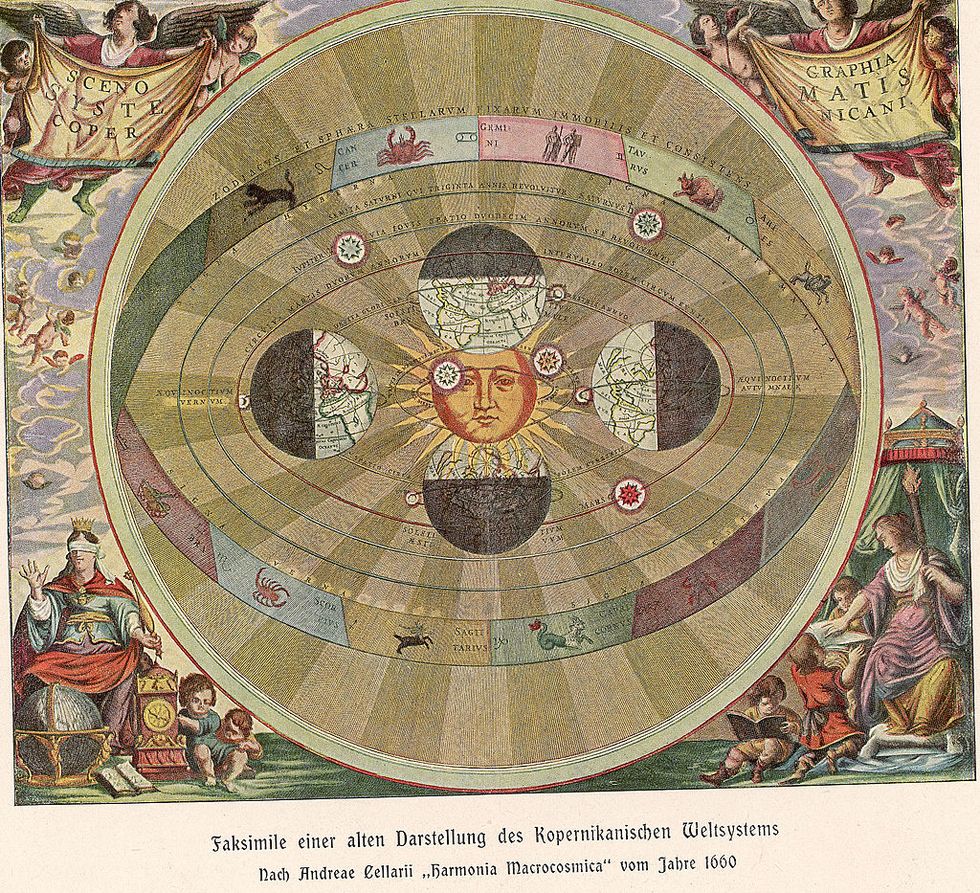
Representation of Nicholas Copernicus\\
Copernicus was able to observe [at least four solar eclipses during his life](http://journals.sagepub.com/doi/abs/10.1177/002182860703800306?journalCode=jhaa), often through a camera obscura. In 1543, as Copernicus lay on his deathbed, this research contributed to one of astronomy's greatest revelations: It was the sun, not the Earth, that was [the center of our solar system](http://ads.harvard.edu/books/1543droc.book/).
## 1695: Earth is slowing down
While producing what may be the[oldest eclipse map in existence](https://eclipse.gsfc.nasa.gov/SEhelp/image/HalleyMap.GIF), Edmund Halley discovered that his calculations in mapping ancient eclipses did not correlate with the historic written record. This lead Haley in making the astonishing discovery that the [Earth's rotation rate is gradually slowing down](https://eclipse.gsfc.nasa.gov/SEhelp/rotation.html) (while increasing the length of our planet's day by 2.3 milliseconds per century) and the Moon's orbit is gradually accelerating. Two decades later, Halley comes within four minutes of predicting the exact time of totality of the 1715 solar eclipse that passed over London.
## May 15, 1836: Baily's Beads
English astronomer Francis Baily observed that right before the moment of totality, several rays of sunshine shine through the lunar topography of valleys and mountains causing a beautiful speckle of light. Naturally, Baily named the phenomenon [Baily's Beads](https://eclipse2017.nasa.gov/baileys-beads-effect). He found this sight so spectacular that it became his life's work to travel around the world to witness solar eclipses. According to Nordgren, it was Baily who began "the golden age of solar eclipse chasing," an era we are still in today.
## July 18, 1860" Photographic evidence
[](https://pinterest.com/pin/create/button/?url=https://www.popularmechanics.com/space/moon-mars/a26967/history-of-the-solar-eclipse/&description=&media=https://hips.hearstapps.com/pop.h-cdn.co/assets/17/25/1497901583-gettyimages-113635495.jpg?resize=1600:*)
UniversalImagesGroup//Getty Images
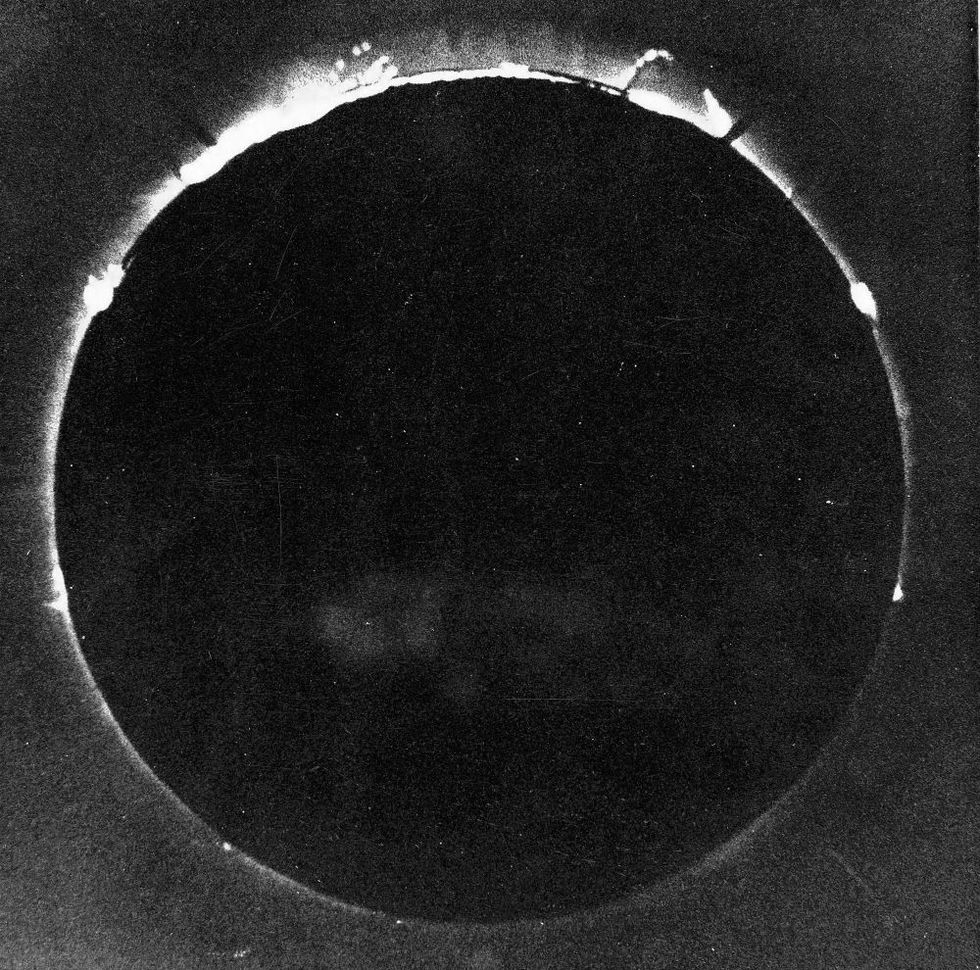
Warren de la Rue\\'s photograph of solar eclipse, the first one ever taken, 1860.
Even in its infancy, it was pretty clear that photography would lead to a revolution for science. [Warren De Le Rue](http://articles.adsabs.harvard.edu/cgi-bin/nph-iarticle_query?bibcode=2011AntAs...5...14L&db_key=AST&page_ind=0&plate_select=NO&data_type=GIF&type=SCREEN_GIF&classic=YES) may not have been the first to photograph a solar eclipse, but [it's his photos](https://go.redirectingat.com/?id=74968X1525083&url=http%3A%2F%2Fwww.gettyimages.com%2Fdetail%2Fnews-photo%2Fwarren-de-la-rues-photograph-of-total-solar-eclipse-at-news-photo%2F463908753%3F%23warren-de-la-rues-photograph-of-total-solar-eclipse-at-rivabellosa-picture-id463908753) that are still studied by astronomers today. Later, De Le Rue would say that he wished he wasn't always encumbered by his work and equipment. He wanted the [opportunity to "just look" at a solar eclipse](http://articles.adsabs.harvard.edu/cgi-bin/nph-iarticle_query?bibcode=2001A%26G....42a..18H&db_key=AST&page_ind=2&plate_select=NO&data_type=GIF&type=SCREEN_GIF&classic=YES) without needing to take any photographs.
## May 29, 1919: Einstein becomes a star
[](https://pinterest.com/pin/create/button/?url=https://www.popularmechanics.com/space/moon-mars/a26967/history-of-the-solar-eclipse/&description=&media=https://hips.hearstapps.com/pop.h-cdn.co/assets/17/25/1497994498-gettyimages-90763802.jpg?resize=1600:*)
Science & Society Picture Library//Getty Images
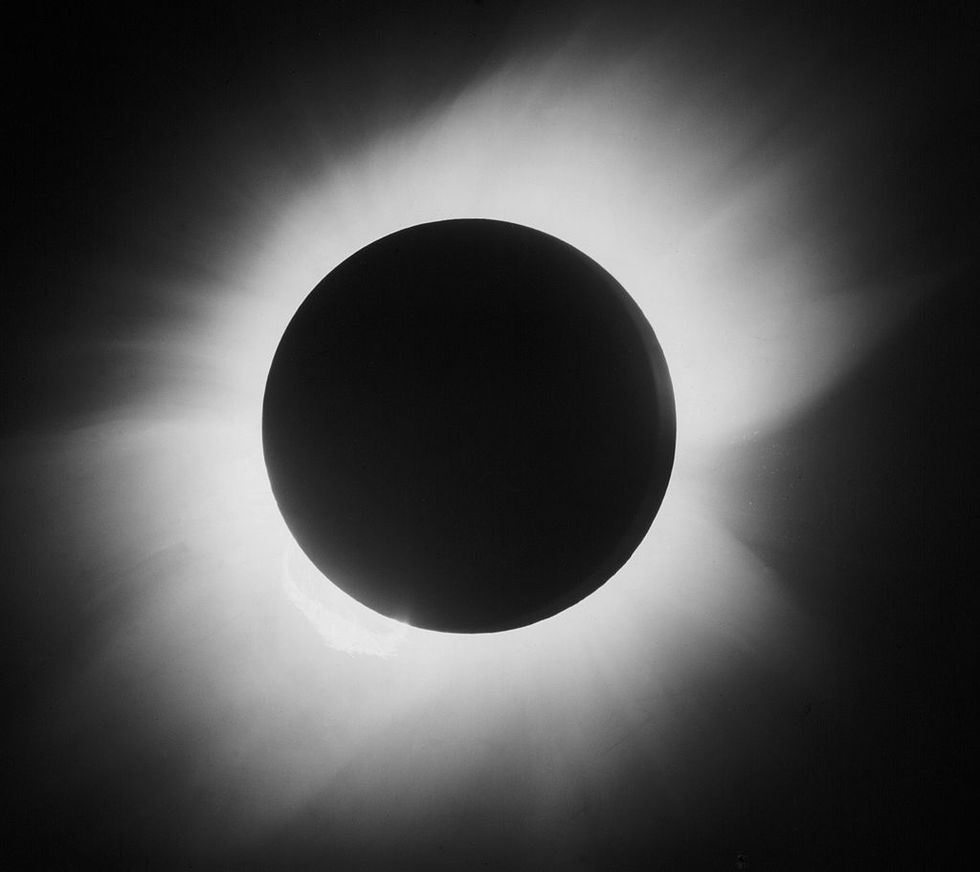
Taken in Brazil during the 1919 solar eclipse, images like these helped prove Albert Einstein\\'s Theory of Relativity.
In 1915, Einstein announced his General Theory of Relativity that, in part, said light in spacetime [does not travel in a perfectly straight line](https://helix-sleep.tkjf.net/c/3006986/605588/9928?u=https%3A%2F%2Fwww.wired.com%2F2009%2F05%2Fdayintech_0529%2F&subId1=pop&subid3=xid:{xid}), but bends in relation to an object's gravitational field. Four years later, Einstein and his supporters used a solar eclipse to prove it.
Due to the darkness brought on by a solar eclipse, astronomers were able to observe and [accurately measure the gravity-shifted positions of starlight](https://helix-sleep.tkjf.net/c/3006986/605588/9928?u=https%3A%2F%2Fwww.wired.com%2F2009%2F05%2Fdayintech_0529%2F&subId1=pop&subid3=xid:{xid}) as it made its way through the sun's gravitational field on the way to Earth. With headlines blaring "Revolution in Science - New Theory in Universe. Newton's Ideas Overturned," an assistant asked Einstein what would he have done[if the solar eclipse proved him wrong](https://www.aps.org/publications/apsnews/201605/physicshistory.cfm).
"Then I would feel sorry for the dear Lord," Einstein supposedly said, "The theory is correct anyway."
## June 30, 1973: Chasing darkness
[View full post on YouTube](https://www.youtube.com/watch?v=zHLyypLk-0w)
Flying twice the speed of the sound in a prototype [Concorde](https://www.popularmechanics.com/flight/airlines/a25144/the-last-concorde-gets-its-final-resting-place/), a group of astronomers chased the darkness [by following a solar eclipse from 55,000 feet in the air](https://motherboard.vice.com/en_us/article/the-concorde-and-the-longest-solar-eclipse). Traveling at the same speed as the Moon's shadow moving across Earth, the scientists were able to observe from the sky a record-breaking 74 minutes of dark totality.
## February 26, 1979: The last North American solar eclipse
[](https://pinterest.com/pin/create/button/?url=https://www.popularmechanics.com/space/moon-mars/a26967/history-of-the-solar-eclipse/&description=&media=https://hips.hearstapps.com/pop.h-cdn.co/assets/17/25/1497991673-gettyimages-162065338.jpg?resize=1600:*)
Bill Wunsch//Getty Images
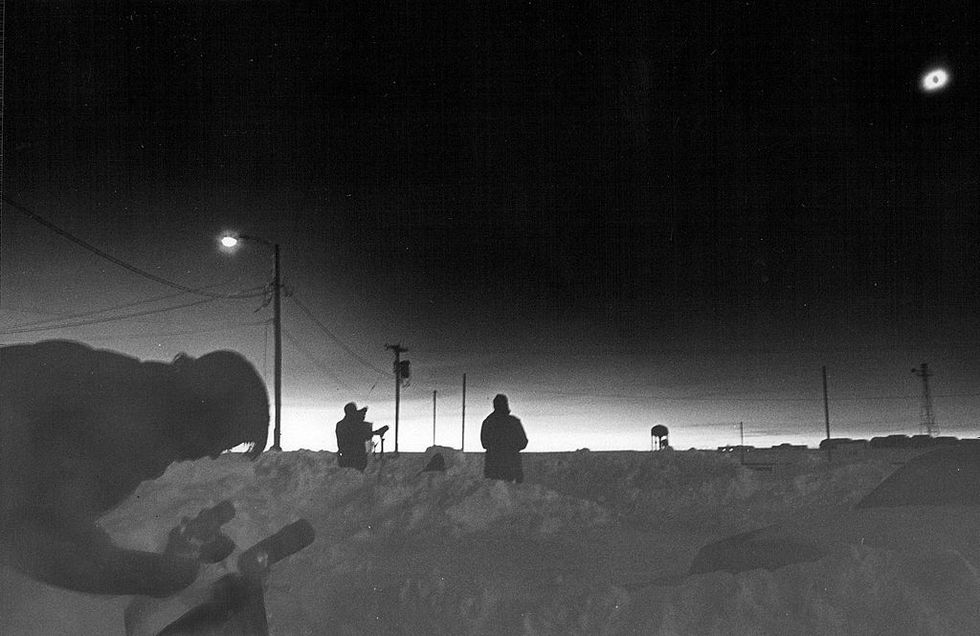
1979 eclipse viewed in Glasgow, Montana.
The [last total solar eclipse to pass over the continental United States](https://www.greatamericaneclipse.com/20th-century/)was when Jimmy Carter was in the White House. While the northwest path of the solar eclipse covered North Dakota to Washington, many who tried to observe it [were disappointed due to cloudy winter skies](https://news.google.com/newspapers?id=qVQgAAAAIBAJ&sjid=79IEAAAAIBAJ&pg=4277,5082143).
## August 21, 2017:s The drought ends
[](https://pinterest.com/pin/create/button/?url=https://www.popularmechanics.com/space/moon-mars/a26967/history-of-the-solar-eclipse/&description=&media=https://hips.hearstapps.com/pop.h-cdn.co/assets/17/25/1497901919-tse2017-usa.jpg?resize=1600:*)
NASA
The path of the 2017 solar eclipse as it crosses the U.S. on August 21.
After going through a four-decade long total solar eclipse drought, the continental United States will once again experience totality. Nordgren says that this solar eclipse will be unlike any other because of the number of people who are going to see it. While over 12 million people live in the path of totality, one estimate says that [upwards of 20 million will travel](https://www.greatamericaneclipse.com/statistics/) to observe day turn into night. With the omnipresence of social media and cameras, Nordgren believes that the Great American Solar Eclipse "will be the most photographed event in human history."
Perhaps the best part is that this just the first of several total solar eclipses that [will pass through the U.S. over the next four decades](https://www.greatamericaneclipse.com/future/). In fact, we don't have to wait all that long for the next one. On April 8, 2024, a total solar eclipse will follow a [northern path through Texas to Maine](https://eclipse.gsfc.nasa.gov/SEgoogle/SEgoogle2001/SE2024Apr08Tgoogle.html) - however, it won't cross the entire country like the one in August of this year.
There's still much to be learned from solar eclipses. The summer will give scientists an unprecedented chance to [study the inner workings of the corona](https://www.nasa.gov/feature/goddard/2017/eclipse-2017-nasa-supports-a-unique-opportunity-for-science-in-the-shadow), still a relative mystery to researchers. Using high resolution cameras and the fact that amatuer astronmers across the country can help provide observations and data, this eclipse is going to provide a "[scientific bonanza."](https://www.aps.org/publications/apsnews/201703/eclipse.cfm)
We've come a long way in the 3,000 years since humans first wrote down their solar eclipses observations. As history lurches forward, there's little doubt that we will keep using solar eclipses to expand our knowledge about the Sun and the celestial bodies that surround it.

[Matt Blitz](https://www.popularmechanics.com/author/15483/matt-blitz/)
Matt is a history, science, and travel writer who is always searching for the mysterious and hidden. He's written for Smithsonian Magazine, Washingtonian, Atlas Obscura, and Arlington Magazine. He calls Washington D.C. home and probably tells way too many cat jokes.
Advertisement - Continue Reading Below
## [Total Solar Eclipse 2017 Guide](https://www.popularmechanics.com/total-solar-eclipse-2017/)
[Couple Sues Amazon Over Bad Eclipse Glasses](https://www.popularmechanics.com/space/moon-mars/news/a28044/couple-sues-amazon-over-eclipse-glasses/)
[Eclipse Crowds Doubled Wyoming's Population](https://www.popularmechanics.com/space/moon-mars/a27882/eclipse-crowds-wyoming/)
[Donate Eclipse Glasses to Kids Around the World](https://www.popularmechanics.com/space/solar-system/news/a27870/donate-your-eclipse-glasses/)
[The Cosmic Weirdness of Solar Eclipse Totality](https://www.popularmechanics.com/space/solar-system/news/a27856/field-notes-from-eclipse-tennessee/)
Advertisement - Continue Reading Below
[The Best Solar Eclipse Photos From the Internet](https://www.popularmechanics.com/space/moon-mars/news/a27846/best-solar-eclipse-photos/)
[See Four Planets During the Total Solar Eclipse](https://www.popularmechanics.com/space/solar-system/news/a27841/see-four-planets-during-total-solar-eclipse/)
[Watch the Total Solar Eclipse Live Right Here](https://www.popularmechanics.com/space/moon-mars/news/a27843/watch-the-total-solar-eclipse-live/)
[The Shadow of the Moon Will Cross the Earth Today](https://www.popularmechanics.com/space/solar-system/news/a27842/total-solar-eclipse-shadow-of-the-moon-cross-the-earth/)
[The Eclipse Hunters](https://www.popularmechanics.com/space/moon-mars/a27811/eclipse-hunters/)
[Your Weather Forecast Guide for Solar Eclipse 2017](https://www.popularmechanics.com/space/moon-mars/a27820/solar-eclipse-2017-weather-forecast/)
[One Man's Dire Warning About the Solar Eclipse](https://www.popularmechanics.com/space/moon-mars/a27831/solar-eclipse-possible-eye-damage/)
[One Day There Will Be No More Total Solar Eclipses](https://www.popularmechanics.com/space/moon-mars/a27824/when-is-last-total-solar-eclipse/)
Advertisement - Continue Reading Below
[](https://www.popularmechanics.com/)
[](https://x.com/PopMech)
[](https://www.tiktok.com/@popularmechanics?lang=en)
[](https://www.youtube.com/c/popularmechanics?sub_confirmation=1)
[](https://www.facebook.com/popularmechanics)
[](https://www.instagram.com/popularmechanics/)
[](https://www.pinterest.com/popmech/?auto_follow=1)
[Newsletter](https://www.popularmechanics.com/newsletter)[About Us](https://www.popularmechanics.com/about/a45/about-us/)[Media Kit](http://www.popularmechanicsmediakit.com/r5/home.asp)[Writer Guidelines](https://www.popularmechanics.com/about/a34246962/how-to-pitch-popular-mechanics/)[Press Room](http://www.hearst.com/news)[Contact Us](https://www.popularmechanics.com/about/a2922/contact-us/)[Community Guidelines](https://www.popularmechanics.com/about/a3024/community-guidelines/)[Advertise Online](https://www.advertising.hearstmagazines.com/brands/popular-mechanics)[Customer Service](https://www.popularmechanics.com/service)[Subscribe](https://shop.popularmechanics.com/popular-mechanics-all-access-3.html?cds_tracking_code=popfooter)[Digital Issues](https://www.popularmechanics.com/promotions/a40118846/download-exclusive-pop-mech-digital-issues/)[PopMech Pro Membership Perks](https://www.popularmechanics.com/about/a46147319/pop-mech-pro-membership/)

A Part of Hearst Digital Media
We may earn commission from links on this page, but we only recommend products we back.
©2026 Hearst Magazine Media, Inc. All Rights Reserved.
[Privacy Notice](https://www.hearst.com/-/us-magazines-privacy-notice)[CA Notice at Collection](https://www.hearst.com/-/us-magazines-privacy-notice#_ADDITIONAL_INFO)[Your CA Privacy Rights/Shine the Light](https://www.hearst.com/-/us-magazines-privacy-notice#_ADDITIONAL_INFO)[DAA Industry Opt Out](https://www.hearst.com/-/us-magazines-privacy-notice#_OPT_OUTS)[Terms of Use](https://www.hearst.com/-/us-magazines-terms-of-use)[Site Map](https://www.popularmechanics.com/sitemap/)
[Cookies Choices](https://www.popularmechanics.com/space/moon-mars/a26967/history-of-the-solar-eclipse/ "Cookies Choices") |
| Readable Markdown | For a couple minutes on August 21, 2017, day will turn into night. [The Great American Solar Eclipse](https://www.greatamericaneclipse.com/20th-century/), as it's being called, is unlike any eclipse that most of us have ever seen—or will ever see—in our lifetimes. For the first time in nearly a century, a total solar eclipse will cross the entirety of the continental United States, with a band of totality stretching from South Carolina to Oregon.
A solar eclipse happens when the moon passes directly between the sun and earth, blotting out the bright yellow disk and darkening the sky for several minutes. While breathtaking to behold, this natural phenomenon isn't all that rare with a total solar eclipse visible somewhere on Earth [on average every 18 months](http://www.space.com/25644-total-solar-eclipses-frequency-explained.html).
Today, we know all about these cosmic machinations. But for much of human existence, those who experienced them had no idea what they were seeing. The sun going dark in the middle of the day understandably frightened our ancient (and not so ancient) ancestors. To make sense of a seemingly apocalyptic event they could not explain, ancient civilizations often relied on mythology.
In South America, a celestial jaguar was thought to have eaten the Sun. The ancient Chinese believed a dragon was responsible for devouring the bright yellow ball in the sky. In fact, the Chinese word for [solar eclipse is "chih," which also means "to eat."](https://sunearthday.nasa.gov/2008/TTT/63_eclipse.php) In Scandinavia, it was [a demon sky wolf named Skoll who wanted the Sun for his next meal](http://www.cbsnews.com/news/solar-eclipses-inspired-superstition/) and it was up to those on Earth to make noise to scare him off. Ancient Mesopotamians saw it as a sign that the king was nearing death. In Indian mythology, the [Hindu demon Rahu spent his days chasing the Moon and Sun](https://www.nationalgeographic.com/). Every once in awhile, he caught and swallowed them, but since he was only a head, the Sun and Moon slide right back out after only a few moments. In other civilizations, a solar eclipse meant evil was close by, the end of times was approaching, and [that vampires were near](http://www.livescience.com/53961-solar-eclipse-myths-and-superstitions.html).
Around the 8th century BCE, this line of thinking began to change. Those who were looking up at the sky started recording their observations and came to some pretty game-changing conclusions. "People realized that there were patterns," says Tyler Nordgren, author of the book [*Sun Moon Earth: The History of Solar Eclipses from Omens of Doom to Einstein and Exoplanets*](https://www.amazon.com/Sun-Moon-Earth-Eclipses-Exoplanets/dp/0465060927?tag=popularmechanics_auto-append-20), "Once you realize that there are patterns in nature, that allows you make to predictions about it... If it is a dragon eating the sun, then evidently the dragon works on a timetable."
The evolution of how humans have come to understand solar eclipses is the story of how we as a species have attempted to comprehend our universe.
## 2100 BCE: A solar eclipse beheading
[](https://pinterest.com/pin/create/button/?url=https://www.popularmechanics.com/space/moon-mars/a26967/history-of-the-solar-eclipse/&description=&media=https://hips.hearstapps.com/pop.h-cdn.co/assets/17/25/1497995583-gettyimages-50698936.jpg?resize=1600:*)
Time Life Pictures//Getty Images
China astronomers observe a solar eclipse, an event that held religious significance.
While scholars have not been able to verify the story, there's a Chinese myth that when court astrologers Xi and He were unable to explain or predict why the sun had suddenly disappeared (possibly because they were always drunk), [Emperor Zhong Kang had them beheaded](https://www.nationalgeographic.com/).
## 1223 BCE: The Ugarit Eclipse
In 1948, archeologists uncovered a clay tablet from the ruins of the ancient Syrian port city of Ugarit that is [likely the first written record of a solar eclipse](https://books.google.com/books?id=TiSMDgAAQBAJ&pg=PT72&lpg=PT72&dq=Ugarit+ruins+1948+solar+eclipse&source=bl&ots=e1G0GwIv6T&sig=py9mJE7VcGjcUaGsYZuFUldMsro&hl=en&sa=X&ved=0ahUKEwijoL7q9KnUAhUTxCYKHRxTBy4Q6AEIPTAH#v=onepage&q=Ugarit%20ruins%201948%20solar%20eclipse&f=false). Written in Ugaritic, the text and symbols roughly translated to "On the...day of the new moon in (the month) hiyaru, the Sun went down, its gatekeeper was (God) Rašap." While it's clear these ancient peoples didn't know what caused the sun to go dark, they were perhaps the first to record the phenomenon. Also of note: For years historians thought this eclipse occurred in 1375 BCE, but [further study and dating revealed it happened 152 years later](https://go.redirectingat.com/?id=74968X1525083&url=http%3A%2F%2Fwww.nature.com%2Fnature%2Fjournal%2Fv338%2Fn6212%2Fabs%2F338238a0.html).
## 763 BCE: In the Bible
In [Amos 8:9 of the King James Bible](https://www.kingjamesbibleonline.org/Amos-8-9/) reads, "And it shall come to pass in that day, saith the Lord God, that I will cause the sun to go down at noon, and I will darken the earth in the clear day." According to researchers, this is a reference to the [Assyrian eclipse that took place in the 8th century](https://eclipse.gsfc.nasa.gov/SEhistory/SEhistory.html) BCE in what is [now Iraq](http://www.cbsnews.com/pictures/solar-eclipses-in-history/4/).
## Appx. 600 BCE: The Saros Cycle
[](https://pinterest.com/pin/create/button/?url=https://www.popularmechanics.com/space/moon-mars/a26967/history-of-the-solar-eclipse/&description=&media=https://hips.hearstapps.com/pop.h-cdn.co/assets/17/25/1497899807-gettyimages-90732313.jpg?resize=1600:*)
Science & Society Picture Library//Getty Images
A 1927 map depicted the Chaldean saros cycle of total solar eclipses through 2164. You can see this year\\'s solar eclipse cutting across North America.
The first civilization to discover there was a pattern to both lunar and solar eclipses were the Chaldeans, who had a short-lived reign over Babylon. We know from the Greeks that [they kept daily astronomical diaries,](http://www.jstor.org/stable/1006543?seq=6#page_scan_tab_contents) including recording the position of the moon, stars, and Sun. Because of their meticulous record-keeping, ancient astronomers discovered that eclipses followed what they called the "Saros cycle," [a period of approximately 18 years](https://eclipse.gsfc.nasa.gov/SEsaros/SEsaros.html) (18 years, 11 days & 8 hours, to be exact).
## May 28, 585 BCE: The first prediction of a solar eclipse
According to Herodotus's *Histories,* written in 450 BCE, Greek philosopher Thales of Miletus was the first [to accurately predict the time and place of a solar eclipse](http://www.iep.utm.edu/thales/), which legend has it halted a[five-year war between the Lydians and Medes](https://helix-sleep.tkjf.net/c/3006986/605588/9928?u=https%3A%2F%2Fwww.wired.com%2F2008%2F05%2Fmay-28-585-bc-predicted-solar-eclipse-stops-battle%2F&subId1=pop&subid3=xid:{xid}). It's unclear his exact methods or if he used the Saros cycle, but the tale at the very least reveals that by Herodotus's time in the 5th century BCE, eclipses were no longer thought to be the works of demons or gods.
## February 17, 478 BCE: Crowdsourcing the moon theory
[](https://pinterest.com/pin/create/button/?url=https://www.popularmechanics.com/space/moon-mars/a26967/history-of-the-solar-eclipse/&description=&media=https://hips.hearstapps.com/pop.h-cdn.co/assets/17/25/1497900845-anaxagoras-lebiedzki-rahl.jpg?resize=1600:*)
Pre-socratic philosopher Anaxagoras
Watching in Athens, scientist [Anaxagoras of Clazomenae](http://www.iep.utm.edu/anaxagor/) wonders what is causing the enormous shadow blotting out the sun. So, he goes down to the nearby port and crowdsources information from the numerous fishermen and sailors that observed the same spectacle as him, but from different vantage points. From these tidbits, he's able to roughly calculate the size of the object, which [he later determines is likely the moon](https://books.google.com/books?id=W9mLBQAAQBAJ&pg=PA47&lpg=PA47&dq=anaxagoras+measuring+moon+solar+eclipse&source=bl&ots=QVS-38hh2B&sig=3Bn5y-DewPE_dVHTnEPH-gMGf98&hl=en&sa=X&ved=0ahUKEwj1pefEkarUAhULslQKHUegC2UQ6AEIQDAF#v=onepage&q=anaxagoras%20measuring%20moon%20solar%20eclipse&f=false). Hence, he becomes the first to discover that solar eclipses are caused by the moon passing between the sun and the earth.
## Appx. 200 BCE: The "Antikythera Mechanism"
Dated to approximately the 3rd century BCE, the["Antikythera Mechanism"](http://www.smithsonianmag.com/history/decoding-antikythera-mechanism-first-computer-180953979/) is the oldest device ever found that tracks the paths of celestial bodies for calculating the date and times of future eclipses. It was [found in 1901 in an ancient shipwreck](http://antikythera.whoi.edu/history/1900-1901/) off the coast of a Greek island. It's possible there are more devices of this nature somewhere at the bottom of the Mediterranean Sea.
## 150 CE: Ptolemy's The Almagest
Using the written observations from the ancient Babylonians and his own calculations, Egyptian mathematician Ptolemy is able [to accurately describe 19 solar eclipses](https://oup.silverchair-cdn.com/oup/backfile/Content_public/Journal/astrogeo/46/5/10.1111/j.1468-4004.2005.46511.x/2/46-5-5.11.pdf?Expires=1496881139&Signature=WGZ8BD9HxM6aF1R7GTFr6~ae-pNRFs5boWvGl9jf9kDbjUXRASet6ZXUYUSGdHKvaIr97jKxCU0xgGXSV1EoinrebK~rORgGWPqX98dw6xaiBZ1mPnupg9-kJHyzBhRGvAHqb2bDpfzjrmKpscbtTiC82KsusCJeQYKXdjKrLiG09FFrdUZtSR3GWK6Z0Qv79VrBNWWsEx8tVo5rpjruzBf4s-hlXpnV2ED4zmJzVZNvc0FZcJoZyr3-6hOwJ~2YnP94pMuGPCRG0dpNT~8tmo-oFCw216ujPuKWTFlqcGhn27QUf39osE9L38p-hh-HRq8xTej7lk-jGri2WH-xKw__&Key-Pair-Id=APKAIUCZBIA4LVPAVW3Q) that go back centuries. The complex writings and math of [*The Almagest*](http://www.maa.org/press/periodicals/convergence/mathematical-treasure-ptolemy-s-almagest) become the definitive tome for [predicting the positions of celestial bodies and eclipses](https://academic.oup.com/astrogeo/article/46/5/5.11/182915/Ptolemy-Babylon-and-the-rotation-of-the-Earth) up until the time of Galileo—so, for the next 1,500 years.
## Appx. 1000: Seeing a solar eclipse safely
Today, we know the safest way to observe a solar eclipse is through a "camera obscura," an optic phenomenon when an image is projected through a tiny pinhole, which is then reversed and inverted. In the 2nd century, Islamic scholar Alhazen became the first to build and use camera obscura in observing and measuring solar eclipses. In his manuscript ["On the Shape of the Eclipse,"](https://books.google.com/books?id=y9mCDQAAQBAJ&pg=PA16&lpg=PA16&dq=Ibn+al-Haytham's+On+the+Shape+of+the+Eclipse+written+when&source=bl&ots=-zyqrj5pZd&sig=xHnKNMelIBmkC3QfaXkfWRpR92s&hl=en&sa=X&ved=0ahUKEwiBpbagkqzUAhUFVj4KHWY_CycQ6AEINDAD#v=onepage&q=Ibn%20al-Haytham's%20On%20the%20Shape%20of%20the%20Eclipse%20written%20when&f=false) he correctly identifies that the moon, sun, and Earth vary in shapes and that it is unsafe to stare directly at the sun during an eclipse.
## 1543: Revolving around the sun
[](https://pinterest.com/pin/create/button/?url=https://www.popularmechanics.com/space/moon-mars/a26967/history-of-the-solar-eclipse/&description=&media=https://hips.hearstapps.com/pop.h-cdn.co/assets/17/25/1497901313-gettyimages-50691656.jpg?resize=1600:*)
Time Life Pictures//Getty Images
Representation of Nicholas Copernicus\\
Copernicus was able to observe [at least four solar eclipses during his life](http://journals.sagepub.com/doi/abs/10.1177/002182860703800306?journalCode=jhaa), often through a camera obscura. In 1543, as Copernicus lay on his deathbed, this research contributed to one of astronomy's greatest revelations: It was the sun, not the Earth, that was [the center of our solar system](http://ads.harvard.edu/books/1543droc.book/).
## 1695: Earth is slowing down
While producing what may be the[oldest eclipse map in existence](https://eclipse.gsfc.nasa.gov/SEhelp/image/HalleyMap.GIF), Edmund Halley discovered that his calculations in mapping ancient eclipses did not correlate with the historic written record. This lead Haley in making the astonishing discovery that the [Earth's rotation rate is gradually slowing down](https://eclipse.gsfc.nasa.gov/SEhelp/rotation.html) (while increasing the length of our planet's day by 2.3 milliseconds per century) and the Moon's orbit is gradually accelerating. Two decades later, Halley comes within four minutes of predicting the exact time of totality of the 1715 solar eclipse that passed over London.
## May 15, 1836: Baily's Beads
English astronomer Francis Baily observed that right before the moment of totality, several rays of sunshine shine through the lunar topography of valleys and mountains causing a beautiful speckle of light. Naturally, Baily named the phenomenon [Baily's Beads](https://eclipse2017.nasa.gov/baileys-beads-effect). He found this sight so spectacular that it became his life's work to travel around the world to witness solar eclipses. According to Nordgren, it was Baily who began "the golden age of solar eclipse chasing," an era we are still in today.
## July 18, 1860" Photographic evidence
[](https://pinterest.com/pin/create/button/?url=https://www.popularmechanics.com/space/moon-mars/a26967/history-of-the-solar-eclipse/&description=&media=https://hips.hearstapps.com/pop.h-cdn.co/assets/17/25/1497901583-gettyimages-113635495.jpg?resize=1600:*)
UniversalImagesGroup//Getty Images
Warren de la Rue\\'s photograph of solar eclipse, the first one ever taken, 1860.
Even in its infancy, it was pretty clear that photography would lead to a revolution for science. [Warren De Le Rue](http://articles.adsabs.harvard.edu/cgi-bin/nph-iarticle_query?bibcode=2011AntAs...5...14L&db_key=AST&page_ind=0&plate_select=NO&data_type=GIF&type=SCREEN_GIF&classic=YES) may not have been the first to photograph a solar eclipse, but [it's his photos](https://go.redirectingat.com/?id=74968X1525083&url=http%3A%2F%2Fwww.gettyimages.com%2Fdetail%2Fnews-photo%2Fwarren-de-la-rues-photograph-of-total-solar-eclipse-at-news-photo%2F463908753%3F%23warren-de-la-rues-photograph-of-total-solar-eclipse-at-rivabellosa-picture-id463908753) that are still studied by astronomers today. Later, De Le Rue would say that he wished he wasn't always encumbered by his work and equipment. He wanted the [opportunity to "just look" at a solar eclipse](http://articles.adsabs.harvard.edu/cgi-bin/nph-iarticle_query?bibcode=2001A%26G....42a..18H&db_key=AST&page_ind=2&plate_select=NO&data_type=GIF&type=SCREEN_GIF&classic=YES) without needing to take any photographs.
## May 29, 1919: Einstein becomes a star
[](https://pinterest.com/pin/create/button/?url=https://www.popularmechanics.com/space/moon-mars/a26967/history-of-the-solar-eclipse/&description=&media=https://hips.hearstapps.com/pop.h-cdn.co/assets/17/25/1497994498-gettyimages-90763802.jpg?resize=1600:*)
Science & Society Picture Library//Getty Images
Taken in Brazil during the 1919 solar eclipse, images like these helped prove Albert Einstein\\'s Theory of Relativity.
In 1915, Einstein announced his General Theory of Relativity that, in part, said light in spacetime [does not travel in a perfectly straight line](https://helix-sleep.tkjf.net/c/3006986/605588/9928?u=https%3A%2F%2Fwww.wired.com%2F2009%2F05%2Fdayintech_0529%2F&subId1=pop&subid3=xid:{xid}), but bends in relation to an object's gravitational field. Four years later, Einstein and his supporters used a solar eclipse to prove it.
Due to the darkness brought on by a solar eclipse, astronomers were able to observe and [accurately measure the gravity-shifted positions of starlight](https://helix-sleep.tkjf.net/c/3006986/605588/9928?u=https%3A%2F%2Fwww.wired.com%2F2009%2F05%2Fdayintech_0529%2F&subId1=pop&subid3=xid:{xid}) as it made its way through the sun's gravitational field on the way to Earth. With headlines blaring "Revolution in Science - New Theory in Universe. Newton's Ideas Overturned," an assistant asked Einstein what would he have done[if the solar eclipse proved him wrong](https://www.aps.org/publications/apsnews/201605/physicshistory.cfm).
"Then I would feel sorry for the dear Lord," Einstein supposedly said, "The theory is correct anyway."
## June 30, 1973: Chasing darkness
Flying twice the speed of the sound in a prototype [Concorde](https://www.popularmechanics.com/flight/airlines/a25144/the-last-concorde-gets-its-final-resting-place/), a group of astronomers chased the darkness [by following a solar eclipse from 55,000 feet in the air](https://motherboard.vice.com/en_us/article/the-concorde-and-the-longest-solar-eclipse). Traveling at the same speed as the Moon's shadow moving across Earth, the scientists were able to observe from the sky a record-breaking 74 minutes of dark totality.
## February 26, 1979: The last North American solar eclipse
[](https://pinterest.com/pin/create/button/?url=https://www.popularmechanics.com/space/moon-mars/a26967/history-of-the-solar-eclipse/&description=&media=https://hips.hearstapps.com/pop.h-cdn.co/assets/17/25/1497991673-gettyimages-162065338.jpg?resize=1600:*)
Bill Wunsch//Getty Images
1979 eclipse viewed in Glasgow, Montana.
The [last total solar eclipse to pass over the continental United States](https://www.greatamericaneclipse.com/20th-century/)was when Jimmy Carter was in the White House. While the northwest path of the solar eclipse covered North Dakota to Washington, many who tried to observe it [were disappointed due to cloudy winter skies](https://news.google.com/newspapers?id=qVQgAAAAIBAJ&sjid=79IEAAAAIBAJ&pg=4277,5082143).
## August 21, 2017:s The drought ends
[](https://pinterest.com/pin/create/button/?url=https://www.popularmechanics.com/space/moon-mars/a26967/history-of-the-solar-eclipse/&description=&media=https://hips.hearstapps.com/pop.h-cdn.co/assets/17/25/1497901919-tse2017-usa.jpg?resize=1600:*)
NASA
The path of the 2017 solar eclipse as it crosses the U.S. on August 21.
After going through a four-decade long total solar eclipse drought, the continental United States will once again experience totality. Nordgren says that this solar eclipse will be unlike any other because of the number of people who are going to see it. While over 12 million people live in the path of totality, one estimate says that [upwards of 20 million will travel](https://www.greatamericaneclipse.com/statistics/) to observe day turn into night. With the omnipresence of social media and cameras, Nordgren believes that the Great American Solar Eclipse "will be the most photographed event in human history."
Perhaps the best part is that this just the first of several total solar eclipses that [will pass through the U.S. over the next four decades](https://www.greatamericaneclipse.com/future/). In fact, we don't have to wait all that long for the next one. On April 8, 2024, a total solar eclipse will follow a [northern path through Texas to Maine](https://eclipse.gsfc.nasa.gov/SEgoogle/SEgoogle2001/SE2024Apr08Tgoogle.html) - however, it won't cross the entire country like the one in August of this year.
There's still much to be learned from solar eclipses. The summer will give scientists an unprecedented chance to [study the inner workings of the corona](https://www.nasa.gov/feature/goddard/2017/eclipse-2017-nasa-supports-a-unique-opportunity-for-science-in-the-shadow), still a relative mystery to researchers. Using high resolution cameras and the fact that amatuer astronmers across the country can help provide observations and data, this eclipse is going to provide a "[scientific bonanza."](https://www.aps.org/publications/apsnews/201703/eclipse.cfm)
We've come a long way in the 3,000 years since humans first wrote down their solar eclipses observations. As history lurches forward, there's little doubt that we will keep using solar eclipses to expand our knowledge about the Sun and the celestial bodies that surround it.

Matt is a history, science, and travel writer who is always searching for the mysterious and hidden. He's written for Smithsonian Magazine, Washingtonian, Atlas Obscura, and Arlington Magazine. He calls Washington D.C. home and probably tells way too many cat jokes. |
| Shard | 162 (laksa) |
| Root Hash | 11125021743305196162 |
| Unparsed URL | com,popularmechanics!www,/space/moon-mars/a26967/history-of-the-solar-eclipse/ s443 |