ℹ️ Skipped - page is already crawled
| Filter | Status | Condition | Details |
|---|---|---|---|
| HTTP status | PASS | download_http_code = 200 | HTTP 200 |
| Age cutoff | PASS | download_stamp > now() - 6 MONTH | 0.1 months ago |
| History drop | PASS | isNull(history_drop_reason) | No drop reason |
| Spam/ban | PASS | fh_dont_index != 1 AND ml_spam_score = 0 | ml_spam_score=0 |
| Canonical | PASS | meta_canonical IS NULL OR = '' OR = src_unparsed | Not set |
| Property | Value |
|---|---|
| URL | https://www.popsci.com/event-horizon-black-hole-image/ |
| Last Crawled | 2026-04-05 22:10:16 (2 days ago) |
| First Indexed | 2019-07-12 17:56:17 (6 years ago) |
| HTTP Status Code | 200 |
| Meta Title | How scientists saw the ‘invisible’—and captured the first image of a black hole |
| Meta Description | Scientists with the Event Horizon Telescope (EHT) announced Wednesday that they’ve successfully imaged the event horizon of a supermassive black hole at the heart of the Messier 87 galaxy. |
| Meta Canonical | null |
| Boilerpipe Text | Get the Popular Science daily newsletter💡
Breakthroughs, discoveries, and DIY tips sent six days a week.
Scientists with the Event Horizon Telescope (EHT) announced Wednesday that they’ve successfully imaged the event horizon of a supermassive black hole at the heart of the Messier 87 galaxy, nearly 55 million light-years away from Earth. A fiery maelstrom, the new image comes two years after the team initially captured their data, and ends a long wait for one of the most exciting astrophysical endeavors in modern memory.
“Black holes are the most mysterious objects in the universe,” Sheperd Doeleman, the director of EHT and a scientist at the Harvard–Smithsonian Center for Astrophysics, told the audience at a National Science Foundation press conference in Washington, D.C. “Because they are so small, we’ve never seen one. We are delighted to be able to report to you today that we have seen, and taken an image, of a black hole.”
The
gravity exerted by a black hole
is so powerful that light cannot even escape it, which obviously makes it nigh impossible to actually take a picture of one. But black holes possess what’s called an
event horizon
: a boundary designating the point of no return. Light and matter that cross this threshold will not escape the black hole, but spacetime is warped at the event horizon such that it creates a glowing circle of accreting matter. It creates a sort of silhouette of the object—that’s what the EHT captured.
Despite the name, EHT is actually a project comprised of eight different telescopes at different observatories around the world operating in synchronicity to image the black holes in the center of M87 as well as the supermassive black hole at the
center of our own Milky Way galaxy, Sagittarius A*
. EHT made its first data capture in 2006, and has since added more and more observatories to its network, which now includes submillimeter telescopes in Hawaii, Arizona, Chile, Antarctica, Mexico, and Spain. Doeleman explained that M87’s supermassive black hole was the first source they imaged, but they are currently working to image Sagittarius A*.
The new picture comes from data captured over a span of nine days in April 2017. It’s taken two years to actually unpack and analyze all of the observatories’ data, in part because the files are too massive to transfer digitally. Hard drives had to be physically ferried from the observatories in order for scientists to process the data. The Antarctic dataset, in particular, remained inaccessible for months because of extreme weather.
Roger Blandford, a theoretical astrophysicist at Stanford University who was not involved with EHT, told
Popular Science
the image is a “tribute to the hard work by the team and 50 years of ingenuity by radio astronomers before them honing the craft of interferometry.”
The different observatories that make up the EHT are all can make different radiofrequency observations of different objects in space. In this instance, they were all aligned to look at the radiation emitted by each black hole’s event horizon, working in concert to provide the sort of extreme optical resolution necessary to image something so small and so far away. Daniel Marrone, an astronomer at the University of Arizona and a member of the EHT team, told the audience at Wednesday’s press conference that while the black hole is 6.5 billion times the mass of the sun, the event horizon is basically just one-and-a-half light-
days
across. For reference, M87 itself, already an impressive body to image at 55 million light-years away, is 120 light-years in diameter. Doeleman calls the feat the “equivalent of being able to read the date on a quarter in LA when we’re standing here in Washington, D.C.”
Before the announcement, it wasn’t quite clear exactly what EHT was going to reveal to the world. Andrea Isella, a Rice University astronomer who was not involved with the project, told
Popular Science
beforehand that while we’ve obviously never had direct observations of Sagittarius A*, we’ve known about its existence for decades. We can observe its gravitational effects on objects in the vicinity. “We see stars orbiting around something that doesn’t meet any optical light,” he says. “From this motion, we can measure the mass of the black hole—estimations on the order of millions of solar masses.”
Blandford previously highlighted the image’s potential for affirming whether
Einstein’s theory of general relativity
—the model for how we characterize the relationship of gravity and spacetime—could correctly describe how gravity works in relation to these ultra-massive behemoths, perhaps shedding more light on the properties of black holes themselves. While general relativity has already been tested many times through weaker situations
like gravitational lensing (how light bends when it crosses massive objects)
, it’s never been tested in a strong gravitational field like a black hole.
The EHT team on Wednesday affirmed that the new data is consistent with previous models used to characterize both black holes and general relativity. Avery Broderick from University of Waterloo explains that were Einstein wrong, the silhouette of the black hole could have looked very different—misshapen, or even missing entirely. Instead, it was circular and conformed to structural expectations.
“Today, general relativity has passed another crucial test,” says Broderick.
“To some extent, black holes are actually very simple objects,” says Isella. They are defined by what he explains are two major parameters: mass (which is already estimated through the orbit of the stars around it), and rotational spin. An image of a black hole can give you a direct line into figuring out these parameters. Any significant deviations from what we expect mean that there is some critical missing piece we haven’t yet considered. But the new image is encouraging news that everything we’ve learned about black holes, without even having seen one, has been on point.
The new findings will influence myriad astrophysical and cosmological investigations. In the immediate future, Blandford hopes “they will help us understand what happens to gas and magnetic fields outside the event horizon, how the disks of gas swirling around the black hole behave, and how relativistic jets [ionized matter expelled at the speed of light] are made.” Broderick explained the data has already been used to determined M87’s black hole spins clockwise, and possesses a bright crescent-like feature with a dark interior.
Down the road, Blandford thinks astronomers could use the data to get a better glimpse of the behavior of individual stars orbiting the galactic center, and the role of hot gas just outside black holes in influencing the spin of the objects themselves. EHT team member Sera Markoff from the University of Amsterdam discussed how this type of work can be used to better understand how jets of radiation and particles expelled by black holes affect galactic growth and evolution.
But besides the scientific relevance of the image, there’s also a technological milestone here worth highlighting. EHT is, in many ways, a kind of proof-of-concept for acquiring high-resolution images of a celestial object that’s very small and very far away. Accomplishing this type of feat basically opens up a whole methodology for conducting more audacious astronomical investigations.
“A big chunk of investigations in astronomy deal with trying to image very small objects,” says Isella. “The implication is, we should be able to add more telescopes and achieve better quality images moving forward, as well as image other black holes,” said Isella.
That may not be greatly apparent on first glance of the image, which is certainly blurrier than most of the public might have hoped. The image is compressed a million times over from 5,000 terabytes’ worth of data, and the sharpness unfortunately still seems to fall off. But it could be made better through different approaches in follow-up observations, like in employing new algorithms, and the addition of more telescopes with higher frequency.
In fact, astronomy is already well-used to that sort of step-by-step process. Take a planet like Pluto, for example.
Our very first view of the dwarf planet
was an absolute mess by today’s standards, but with time, we managed to find something that much more
closely resembled an actual planet with surface features
. And it wouldn’t be until the New Horizons flyby, 85 years after we snagged the first image of Pluto, that we could
finally see its hazy atmosphere, rock formations, and true surface colors
.
The team will have 11 telescopes under the project by 2020, and Doeleman and his colleagues expressed a desire to eventually put a telescope in space to further their efforts. While the new image of M87’s supermassive black hole has not radically changed our understanding of the universe, it helps open the door to a whole new view of space.
“We’ve exposed part of the universe that we thought were invisible to us before,” said Doeleman. “Nature has conspired to let us see something that we thought was invisible.”
2025 PopSci Best of What’s New
The 50 most important innovations of the year
|
| Markdown | **🛍️ [Amazon Big Spring Sale: 100+ editor-approved deals worth buying right now](https://www.popsci.com/gear/best-deals-amazon-big-spring-sale-2026/) 🛍️**
[](https://www.popsci.com/)
[](https://www.popsci.com/)
- [Science](https://www.popsci.com/category/science/)
- [Archaeology](https://www.popsci.com/category/archaeology/)
- [Ask Us Anything](https://www.popsci.com/category/ask-us-anything/)
- [Biology](https://www.popsci.com/category/biology/)
- [Dinosaurs](https://www.popsci.com/category/dinosaurs/)
- [Physics](https://www.popsci.com/category/physics/)
- [Popular Science Videos](https://www.popsci.com/category/popular-science-videos/)
- [Space](https://www.popsci.com/category/space/)
- [The Weirdest Thing I Learned This Week](https://www.popsci.com/category/weirdest-thing-i-learned-this-week/)
- [Technology](https://www.popsci.com/category/technology/)
- [AI](https://www.popsci.com/category/ai/)
- [Aviation](https://www.popsci.com/category/aviation/)
- [Engineering](https://www.popsci.com/category/engineering/)
- [Internet](https://www.popsci.com/category/internet/)
- [Military](https://www.popsci.com/category/military/)
- [Photography](https://www.popsci.com/category/photography/)
- [Robots](https://www.popsci.com/category/robots/)
- [Security](https://www.popsci.com/category/security/)
- [Best of What's New](https://www.popsci.com/gear/best-of-whats-new-2025/)
- [Vehicles](https://www.popsci.com/category/vehicles/)
- [Environment](https://www.popsci.com/category/environment/)
- [Agriculture](https://www.popsci.com/category/agriculture/)
- [Animals](https://www.popsci.com/category/animals/)
- [Climate Change](https://www.popsci.com/category/climate-change/)
- [Conservation](https://www.popsci.com/category/conservation/)
- [Energy](https://www.popsci.com/category/energy/)
- [Sustainability](https://www.popsci.com/category/sustainability/)
- [Weather](https://www.popsci.com/category/weather/)
- [DIY](https://www.popsci.com/category/diy/)
- [Life Skills](https://www.popsci.com/category/life-skills/)
- [Projects](https://www.popsci.com/category/projects/)
- [Tech Hacks](https://www.popsci.com/category/tech-hacks/)
- [Gear](https://www.popsci.com/category/gear/)
- [Audio](https://www.popsci.com/category/audio/)
- [Cameras](https://www.popsci.com/category/cameras/)
- [Computers](https://www.popsci.com/category/computers/)
- [Fitness Gear](https://www.popsci.com/category/fitness-gear/)
- [Gaming](https://www.popsci.com/category/gaming/)
- [Gift Guides](https://www.popsci.com/category/gift-guides/)
- [Home](https://www.popsci.com/category/home/)
- [Home Theater](https://www.popsci.com/category/home-theater/)
- [Outdoor Gear](https://www.popsci.com/category/outdoor-gear/)
- [Phones](https://www.popsci.com/category/phones/)
- [Tablets](https://www.popsci.com/category/tablets/)
- [Wearables](https://www.popsci.com/category/wearables/)
- [MERCH](https://store.popsci.com/)
- [Cover Art](https://popularscienceprints.com/)
- [Store](https://store.popsci.com/)
- [Newsletter](https://www.popsci.com/email-signup/)
[Science](https://www.popsci.com/category/science/) [Space](https://www.popsci.com/category/space/)
# How scientists saw the ‘invisible’—and captured the first image of a black hole
The Event Horizon Telescope peered into the Messier 87 galaxy.
By [Neel V. Patel](https://www.popsci.com/authors/neel-v-patel/)
Updated Mar 22, 2021 12:39 AM EDT
[Add Popular Science (opens in a new tab)](https://www.google.com/preferences/source?q=popsci.com)
Adding us as a Preferred Source in Google by using this link indicates that you would like to see more of our content in Google News results.
## Get the Popular Science daily newsletter💡
Breakthroughs, discoveries, and DIY tips sent six days a week.
[Terms of Service](https://recurrent.io/terms-and-conditions/) and [Privacy Policy.](https://recurrent.io/privacy-policy/)
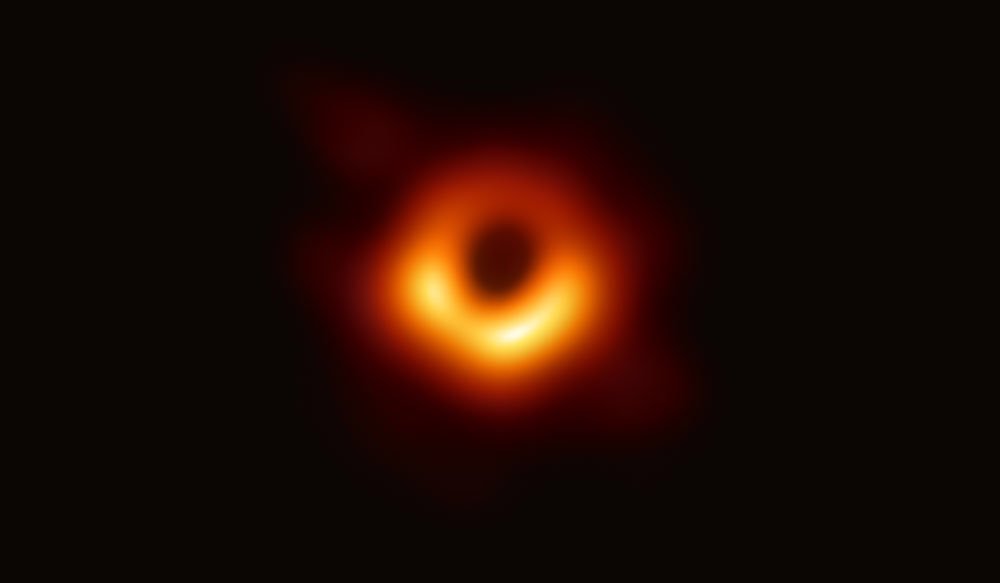
Scientists with the Event Horizon Telescope (EHT) announced Wednesday that they’ve successfully imaged the event horizon of a supermassive black hole at the heart of the Messier 87 galaxy, nearly 55 million light-years away from Earth. A fiery maelstrom, the new image comes two years after the team initially captured their data, and ends a long wait for one of the most exciting astrophysical endeavors in modern memory.
“Black holes are the most mysterious objects in the universe,” Sheperd Doeleman, the director of EHT and a scientist at the Harvard–Smithsonian Center for Astrophysics, told the audience at a National Science Foundation press conference in Washington, D.C. “Because they are so small, we’ve never seen one. We are delighted to be able to report to you today that we have seen, and taken an image, of a black hole.”
The [gravity exerted by a black hole](https://www.popsci.com/black-hole-birth-growth-death/) is so powerful that light cannot even escape it, which obviously makes it nigh impossible to actually take a picture of one. But black holes possess what’s called an [event horizon](https://www.popsci.com/how-it-works-death-black-hole/): a boundary designating the point of no return. Light and matter that cross this threshold will not escape the black hole, but spacetime is warped at the event horizon such that it creates a glowing circle of accreting matter. It creates a sort of silhouette of the object—that’s what the EHT captured.
Despite the name, EHT is actually a project comprised of eight different telescopes at different observatories around the world operating in synchronicity to image the black holes in the center of M87 as well as the supermassive black hole at the [center of our own Milky Way galaxy, Sagittarius A\*](https://www.popsci.com/category/space/). EHT made its first data capture in 2006, and has since added more and more observatories to its network, which now includes submillimeter telescopes in Hawaii, Arizona, Chile, Antarctica, Mexico, and Spain. Doeleman explained that M87’s supermassive black hole was the first source they imaged, but they are currently working to image Sagittarius A\*.
The new picture comes from data captured over a span of nine days in April 2017. It’s taken two years to actually unpack and analyze all of the observatories’ data, in part because the files are too massive to transfer digitally. Hard drives had to be physically ferried from the observatories in order for scientists to process the data. The Antarctic dataset, in particular, remained inaccessible for months because of extreme weather.
Roger Blandford, a theoretical astrophysicist at Stanford University who was not involved with EHT, told *Popular Science* the image is a “tribute to the hard work by the team and 50 years of ingenuity by radio astronomers before them honing the craft of interferometry.”
The different observatories that make up the EHT are all can make different radiofrequency observations of different objects in space. In this instance, they were all aligned to look at the radiation emitted by each black hole’s event horizon, working in concert to provide the sort of extreme optical resolution necessary to image something so small and so far away. Daniel Marrone, an astronomer at the University of Arizona and a member of the EHT team, told the audience at Wednesday’s press conference that while the black hole is 6.5 billion times the mass of the sun, the event horizon is basically just one-and-a-half light-*days* across. For reference, M87 itself, already an impressive body to image at 55 million light-years away, is 120 light-years in diameter. Doeleman calls the feat the “equivalent of being able to read the date on a quarter in LA when we’re standing here in Washington, D.C.”
Before the announcement, it wasn’t quite clear exactly what EHT was going to reveal to the world. Andrea Isella, a Rice University astronomer who was not involved with the project, told *Popular Science* beforehand that while we’ve obviously never had direct observations of Sagittarius A\*, we’ve known about its existence for decades. We can observe its gravitational effects on objects in the vicinity. “We see stars orbiting around something that doesn’t meet any optical light,” he says. “From this motion, we can measure the mass of the black hole—estimations on the order of millions of solar masses.”
Blandford previously highlighted the image’s potential for affirming whether [Einstein’s theory of general relativity](https://www.popsci.com/100-years-general-relativity-why-einstein-still-stands/)—the model for how we characterize the relationship of gravity and spacetime—could correctly describe how gravity works in relation to these ultra-massive behemoths, perhaps shedding more light on the properties of black holes themselves. While general relativity has already been tested many times through weaker situations [like gravitational lensing (how light bends when it crosses massive objects)](https://www.popsci.com/warped-space-time-supernova/), it’s never been tested in a strong gravitational field like a black hole.
The EHT team on Wednesday affirmed that the new data is consistent with previous models used to characterize both black holes and general relativity. Avery Broderick from University of Waterloo explains that were Einstein wrong, the silhouette of the black hole could have looked very different—misshapen, or even missing entirely. Instead, it was circular and conformed to structural expectations.
“Today, general relativity has passed another crucial test,” says Broderick.
“To some extent, black holes are actually very simple objects,” says Isella. They are defined by what he explains are two major parameters: mass (which is already estimated through the orbit of the stars around it), and rotational spin. An image of a black hole can give you a direct line into figuring out these parameters. Any significant deviations from what we expect mean that there is some critical missing piece we haven’t yet considered. But the new image is encouraging news that everything we’ve learned about black holes, without even having seen one, has been on point.
The new findings will influence myriad astrophysical and cosmological investigations. In the immediate future, Blandford hopes “they will help us understand what happens to gas and magnetic fields outside the event horizon, how the disks of gas swirling around the black hole behave, and how relativistic jets \[ionized matter expelled at the speed of light\] are made.” Broderick explained the data has already been used to determined M87’s black hole spins clockwise, and possesses a bright crescent-like feature with a dark interior.
Down the road, Blandford thinks astronomers could use the data to get a better glimpse of the behavior of individual stars orbiting the galactic center, and the role of hot gas just outside black holes in influencing the spin of the objects themselves. EHT team member Sera Markoff from the University of Amsterdam discussed how this type of work can be used to better understand how jets of radiation and particles expelled by black holes affect galactic growth and evolution.
But besides the scientific relevance of the image, there’s also a technological milestone here worth highlighting. EHT is, in many ways, a kind of proof-of-concept for acquiring high-resolution images of a celestial object that’s very small and very far away. Accomplishing this type of feat basically opens up a whole methodology for conducting more audacious astronomical investigations.
“A big chunk of investigations in astronomy deal with trying to image very small objects,” says Isella. “The implication is, we should be able to add more telescopes and achieve better quality images moving forward, as well as image other black holes,” said Isella.
That may not be greatly apparent on first glance of the image, which is certainly blurrier than most of the public might have hoped. The image is compressed a million times over from 5,000 terabytes’ worth of data, and the sharpness unfortunately still seems to fall off. But it could be made better through different approaches in follow-up observations, like in employing new algorithms, and the addition of more telescopes with higher frequency.
In fact, astronomy is already well-used to that sort of step-by-step process. Take a planet like Pluto, for example. [Our very first view of the dwarf planet](https://solarsystem.nasa.gov/multimedia/display.cfm?IM_ID=19989) was an absolute mess by today’s standards, but with time, we managed to find something that much more [closely resembled an actual planet with surface features](https://hubblesite.org/news_release/news/2010-06/76-pluto/). And it wouldn’t be until the New Horizons flyby, 85 years after we snagged the first image of Pluto, that we could [finally see its hazy atmosphere, rock formations, and true surface colors](https://www.popsci.com/pluto-is-way-cooler-than-it-should-be-and-now-we-might-know-why/).
The team will have 11 telescopes under the project by 2020, and Doeleman and his colleagues expressed a desire to eventually put a telescope in space to further their efforts. While the new image of M87’s supermassive black hole has not radically changed our understanding of the universe, it helps open the door to a whole new view of space.
“We’ve exposed part of the universe that we thought were invisible to us before,” said Doeleman. “Nature has conspired to let us see something that we thought was invisible.”

### 2025 PopSci Best of What’s New
The 50 most important innovations of the year
[See it](https://www.popsci.com/gear/best-of-whats-new-2025/)
## [Neel V. Patel](https://www.popsci.com/authors/neel-v-patel/)
***
- [Science](https://www.popsci.com/category/science/)
- [Space](https://www.popsci.com/category/space/)
## Trending
[](https://www.popsci.com/environment/what-to-do-with-clothes-you-cant-donate/)
[Sustainability](https://www.popsci.com/category/sustainability/)
[What to do with clothes you can’t donate](https://www.popsci.com/environment/what-to-do-with-clothes-you-cant-donate/)
By [Debbie Wolfe](https://www.popsci.com/authors/debbie-wolfe/)
[](https://www.popsci.com/technology/moving-sidewalks-history/)
[Engineering](https://www.popsci.com/category/engineering/)
[In 1871, cities almost got moving sidewalks. Why are we still waiting?](https://www.popsci.com/technology/moving-sidewalks-history/)
By [Bill Gourgey](https://www.popsci.com/authors/bill-gourgey/)
## More in Space
[](https://www.popsci.com/science/astronomers-photography-black-hole-magnetic-field/)
[Astronomers used telescopic ‘sunglasses’ to photograph a black hole’s magnetic field](https://www.popsci.com/science/astronomers-photography-black-hole-magnetic-field/)
By [Charlie Wood](https://www.popsci.com/authors/charlie-wood/)
[](https://www.popsci.com/science/black-hole-jets-best-photo/)
[Black hole jets got some stellar glam shots thanks to this giant telescope](https://www.popsci.com/science/black-hole-jets-best-photo/)
By [Charlie Wood](https://www.popsci.com/authors/charlie-wood/)
[](https://www.popsci.com/why-scientists-study-black-holes/)
[That groundbreaking photo of a black hole has raised some mighty big questions](https://www.popsci.com/why-scientists-study-black-holes/)
By [Neel V. Patel](https://www.popsci.com/authors/neel-v-patel/)
[](https://www.popsci.com/science/einstein-prediction-light-signals-behind-black-holes-confirmed/)
[One of Einstein’s predictions on black holes has finally been confirmed](https://www.popsci.com/science/einstein-prediction-light-signals-behind-black-holes-confirmed/)
By [Hannah Seo](https://www.popsci.com/authors/hannah-seo/)
[](https://www.popsci.com/story/space/taking-sharper-black-hole-pictures/)
[Last year, we finally photographed a black hole. Now what?](https://www.popsci.com/story/space/taking-sharper-black-hole-pictures/)
By [Charlie Wood](https://www.popsci.com/authors/charlie-wood/)
[](https://www.popsci.com/story/space/black-hole-map/)
[Check out the most extensive map of black holes ever](https://www.popsci.com/story/space/black-hole-map/)
By [Erin Fennessy](https://www.popsci.com/authors/erin-fennessy/)
[](https://www.popsci.com/science/black-hole-milky-way-center/)
[Gaze upon the supermassive black hole at the center of our galaxy](https://www.popsci.com/science/black-hole-milky-way-center/)
By [Leto Sapunar](https://www.popsci.com/authors/leto-sapunar/)
[](https://www.popsci.com/story/science/2020-nobel-prize-physics/)
[The Nobel Prize in physics honors insights on black holes—including the one in our own galaxy](https://www.popsci.com/story/science/2020-nobel-prize-physics/)
By [Jessica Boddy](https://www.popsci.com/authors/jessica-boddy/)
[SEE MORE](https://www.popsci.com/category/space/)
## More in Science
[](https://www.popsci.com/science/first-black-hole-image-ai/)
[You saw the first image of a black hole. Now see it better with AI.](https://www.popsci.com/science/first-black-hole-image-ai/)
By [Purbita Saha](https://www.popsci.com/authors/purbita-saha/)
[](https://www.popsci.com/event-horizon-telescope-black-hole-watch/)
[Here’s the first-ever direct image of a black hole](https://www.popsci.com/event-horizon-telescope-black-hole-watch/)
By [Neel V. Patel](https://www.popsci.com/authors/neel-v-patel/)
[](https://www.popsci.com/space/africa-millimeter-telescope-astronomy/)
[With the arrival of Africa’s next radio telescope, Namibia sees a new dawn in astronomy](https://www.popsci.com/space/africa-millimeter-telescope-astronomy/)
By [Tatyana Woodall](https://www.popsci.com/authors/tatyana-woodall/)
[](https://www.popsci.com/space/black-holes-history/)
[We’re still in the dark about a key black hole paradox](https://www.popsci.com/space/black-holes-history/)
By [Leto Sapunar](https://www.popsci.com/authors/leto-sapunar/)
[](https://www.popsci.com/space/black-hole-sound-space-sonification/)
[NASA recorded a black hole’s song, and you can listen to it](https://www.popsci.com/space/black-hole-sound-space-sonification/)
By [Tatyana Woodall](https://www.popsci.com/authors/tatyana-woodall/)
[](https://www.popsci.com/science/m87-black-hole-jets/)
[This supermassive black hole sucks big time](https://www.popsci.com/science/m87-black-hole-jets/)
By [Jon Kelvey](https://www.popsci.com/authors/jon-kelvey/)
[](https://www.popsci.com/science/chandra-xray-observatory-spots-clover-shaped-spots/)
[NASA’s Chandra spacecraft spies clover-shaped voids left by supermassive black holes](https://www.popsci.com/science/chandra-xray-observatory-spots-clover-shaped-spots/)
By [Leto Sapunar](https://www.popsci.com/authors/leto-sapunar/)
[](https://www.popsci.com/space/black-holes-help-star-birth/)
[Black holes have a reputation as devourers. But they can help spawn stars, too.](https://www.popsci.com/space/black-holes-help-star-birth/)
By [Shi En Kim](https://www.popsci.com/authors/shi-en-kim/)
[SEE MORE](https://www.popsci.com/category/science/)
[](https://www.popsci.com/)
## Get the Popular Science daily newsletter💡
Breakthroughs, discoveries, and DIY tips sent six days a week.
[Terms of Service](https://recurrent.io/terms-and-conditions/) and [Privacy Policy.](https://recurrent.io/privacy-policy/)
- [Editorial Standards](https://www.popsci.com/editorial-standards/)
- [How We Test and Review Products](https://www.popsci.com/product-testing-and-review-guidelines/)
- [About Us](https://www.popsci.com/about-us/)
- [Contact Us](https://www.popsci.com/contact/)
- [TV Channel](https://underknown.com/popularscience/)
- [Privacy Policy](https://recurrent.io/privacy-policy/)
- [Terms & Conditions](https://recurrent.io/terms-and-conditions/)
- [Affiliate Disclosure](https://www.popsci.com/affiliate-disclosure/)
- [Sitemap](https://www.popsci.com/sitemap/)
- [Deposit Photos](https://go.skimresources.com/?id=138113X1700773&isjs=1&jv=15.7.1&sref=https%3A%2F%2Fwww.popsci.com%2F&url=https%3A%2F%2Fdepositphotos.com%2F&xs=1&xtz=240&xuuid=8b0cd3c294016e919484397db9a10f62&xcust=5peiZeEsEiJ6EMmspVrAAol&xjsf=other_click__contextmenu%20%5B2%5D)
## FOLLOW US
### DISCLAIMER(S)
Articles may contain affiliate links which enable us to share in the revenue of any purchases made.Registration on or use of this site constitutes acceptance of our Terms of Service.
© 2026 [Recurrent](https://recurrent.io/). All rights reserved.
[Do Not Sell or Share My Personal Information]().
- [Science](https://www.popsci.com/category/science/)
- [Technology](https://www.popsci.com/category/technology/)
- [Environment](https://www.popsci.com/category/environment/)
- [DIY](https://www.popsci.com/category/diy/)
- [Gear](https://www.popsci.com/category/gear/)
- [Merch](https://store.popsci.com/)
- [SHOP](https://shop.popsci.com/) |
| Readable Markdown | 
## Get the Popular Science daily newsletter💡
Breakthroughs, discoveries, and DIY tips sent six days a week.
Scientists with the Event Horizon Telescope (EHT) announced Wednesday that they’ve successfully imaged the event horizon of a supermassive black hole at the heart of the Messier 87 galaxy, nearly 55 million light-years away from Earth. A fiery maelstrom, the new image comes two years after the team initially captured their data, and ends a long wait for one of the most exciting astrophysical endeavors in modern memory.
“Black holes are the most mysterious objects in the universe,” Sheperd Doeleman, the director of EHT and a scientist at the Harvard–Smithsonian Center for Astrophysics, told the audience at a National Science Foundation press conference in Washington, D.C. “Because they are so small, we’ve never seen one. We are delighted to be able to report to you today that we have seen, and taken an image, of a black hole.”
The [gravity exerted by a black hole](https://www.popsci.com/black-hole-birth-growth-death/) is so powerful that light cannot even escape it, which obviously makes it nigh impossible to actually take a picture of one. But black holes possess what’s called an [event horizon](https://www.popsci.com/how-it-works-death-black-hole/): a boundary designating the point of no return. Light and matter that cross this threshold will not escape the black hole, but spacetime is warped at the event horizon such that it creates a glowing circle of accreting matter. It creates a sort of silhouette of the object—that’s what the EHT captured.
Despite the name, EHT is actually a project comprised of eight different telescopes at different observatories around the world operating in synchronicity to image the black holes in the center of M87 as well as the supermassive black hole at the [center of our own Milky Way galaxy, Sagittarius A\*](https://www.popsci.com/category/space/). EHT made its first data capture in 2006, and has since added more and more observatories to its network, which now includes submillimeter telescopes in Hawaii, Arizona, Chile, Antarctica, Mexico, and Spain. Doeleman explained that M87’s supermassive black hole was the first source they imaged, but they are currently working to image Sagittarius A\*.
The new picture comes from data captured over a span of nine days in April 2017. It’s taken two years to actually unpack and analyze all of the observatories’ data, in part because the files are too massive to transfer digitally. Hard drives had to be physically ferried from the observatories in order for scientists to process the data. The Antarctic dataset, in particular, remained inaccessible for months because of extreme weather.
Roger Blandford, a theoretical astrophysicist at Stanford University who was not involved with EHT, told *Popular Science* the image is a “tribute to the hard work by the team and 50 years of ingenuity by radio astronomers before them honing the craft of interferometry.”
The different observatories that make up the EHT are all can make different radiofrequency observations of different objects in space. In this instance, they were all aligned to look at the radiation emitted by each black hole’s event horizon, working in concert to provide the sort of extreme optical resolution necessary to image something so small and so far away. Daniel Marrone, an astronomer at the University of Arizona and a member of the EHT team, told the audience at Wednesday’s press conference that while the black hole is 6.5 billion times the mass of the sun, the event horizon is basically just one-and-a-half light-*days* across. For reference, M87 itself, already an impressive body to image at 55 million light-years away, is 120 light-years in diameter. Doeleman calls the feat the “equivalent of being able to read the date on a quarter in LA when we’re standing here in Washington, D.C.”
Before the announcement, it wasn’t quite clear exactly what EHT was going to reveal to the world. Andrea Isella, a Rice University astronomer who was not involved with the project, told *Popular Science* beforehand that while we’ve obviously never had direct observations of Sagittarius A\*, we’ve known about its existence for decades. We can observe its gravitational effects on objects in the vicinity. “We see stars orbiting around something that doesn’t meet any optical light,” he says. “From this motion, we can measure the mass of the black hole—estimations on the order of millions of solar masses.”
Blandford previously highlighted the image’s potential for affirming whether [Einstein’s theory of general relativity](https://www.popsci.com/100-years-general-relativity-why-einstein-still-stands/)—the model for how we characterize the relationship of gravity and spacetime—could correctly describe how gravity works in relation to these ultra-massive behemoths, perhaps shedding more light on the properties of black holes themselves. While general relativity has already been tested many times through weaker situations [like gravitational lensing (how light bends when it crosses massive objects)](https://www.popsci.com/warped-space-time-supernova/), it’s never been tested in a strong gravitational field like a black hole.
The EHT team on Wednesday affirmed that the new data is consistent with previous models used to characterize both black holes and general relativity. Avery Broderick from University of Waterloo explains that were Einstein wrong, the silhouette of the black hole could have looked very different—misshapen, or even missing entirely. Instead, it was circular and conformed to structural expectations.
“Today, general relativity has passed another crucial test,” says Broderick.
“To some extent, black holes are actually very simple objects,” says Isella. They are defined by what he explains are two major parameters: mass (which is already estimated through the orbit of the stars around it), and rotational spin. An image of a black hole can give you a direct line into figuring out these parameters. Any significant deviations from what we expect mean that there is some critical missing piece we haven’t yet considered. But the new image is encouraging news that everything we’ve learned about black holes, without even having seen one, has been on point.
The new findings will influence myriad astrophysical and cosmological investigations. In the immediate future, Blandford hopes “they will help us understand what happens to gas and magnetic fields outside the event horizon, how the disks of gas swirling around the black hole behave, and how relativistic jets \[ionized matter expelled at the speed of light\] are made.” Broderick explained the data has already been used to determined M87’s black hole spins clockwise, and possesses a bright crescent-like feature with a dark interior.
Down the road, Blandford thinks astronomers could use the data to get a better glimpse of the behavior of individual stars orbiting the galactic center, and the role of hot gas just outside black holes in influencing the spin of the objects themselves. EHT team member Sera Markoff from the University of Amsterdam discussed how this type of work can be used to better understand how jets of radiation and particles expelled by black holes affect galactic growth and evolution.
But besides the scientific relevance of the image, there’s also a technological milestone here worth highlighting. EHT is, in many ways, a kind of proof-of-concept for acquiring high-resolution images of a celestial object that’s very small and very far away. Accomplishing this type of feat basically opens up a whole methodology for conducting more audacious astronomical investigations.
“A big chunk of investigations in astronomy deal with trying to image very small objects,” says Isella. “The implication is, we should be able to add more telescopes and achieve better quality images moving forward, as well as image other black holes,” said Isella.
That may not be greatly apparent on first glance of the image, which is certainly blurrier than most of the public might have hoped. The image is compressed a million times over from 5,000 terabytes’ worth of data, and the sharpness unfortunately still seems to fall off. But it could be made better through different approaches in follow-up observations, like in employing new algorithms, and the addition of more telescopes with higher frequency.
In fact, astronomy is already well-used to that sort of step-by-step process. Take a planet like Pluto, for example. [Our very first view of the dwarf planet](https://solarsystem.nasa.gov/multimedia/display.cfm?IM_ID=19989) was an absolute mess by today’s standards, but with time, we managed to find something that much more [closely resembled an actual planet with surface features](https://hubblesite.org/news_release/news/2010-06/76-pluto/). And it wouldn’t be until the New Horizons flyby, 85 years after we snagged the first image of Pluto, that we could [finally see its hazy atmosphere, rock formations, and true surface colors](https://www.popsci.com/pluto-is-way-cooler-than-it-should-be-and-now-we-might-know-why/).
The team will have 11 telescopes under the project by 2020, and Doeleman and his colleagues expressed a desire to eventually put a telescope in space to further their efforts. While the new image of M87’s supermassive black hole has not radically changed our understanding of the universe, it helps open the door to a whole new view of space.
“We’ve exposed part of the universe that we thought were invisible to us before,” said Doeleman. “Nature has conspired to let us see something that we thought was invisible.”

### 2025 PopSci Best of What’s New
The 50 most important innovations of the year |
| Shard | 174 (laksa) |
| Root Hash | 1151996776091235174 |
| Unparsed URL | com,popsci!www,/event-horizon-black-hole-image/ s443 |