ℹ️ Skipped - page is already crawled
| Filter | Status | Condition | Details |
|---|---|---|---|
| HTTP status | PASS | download_http_code = 200 | HTTP 200 |
| Age cutoff | PASS | download_stamp > now() - 6 MONTH | 0 months ago |
| History drop | PASS | isNull(history_drop_reason) | No drop reason |
| Spam/ban | PASS | fh_dont_index != 1 AND ml_spam_score = 0 | ml_spam_score=0 |
| Canonical | PASS | meta_canonical IS NULL OR = '' OR = src_unparsed | Not set |
| Property | Value |
|---|---|
| URL | https://www.pewresearch.org/short-reads/2023/07/12/8-facts-about-black-lives-matter/ |
| Last Crawled | 2026-04-14 01:35:52 (18 hours ago) |
| First Indexed | 2023-07-12 15:11:43 (2 years ago) |
| HTTP Status Code | 200 |
| Meta Title | 8 facts about Black Lives Matter | Pew Research Center |
| Meta Description | As we mark 10 years since the #BlackLivesMatter hashtag first appeared on social media, here are eight facts about the Black Lives Matter movement. |
| Meta Canonical | null |
| Boilerpipe Text | In the 10 years since the #BlackLivesMatter hashtag was first used on social media, it has appeared in more than 44 million tweets, according to
a recent Pew Research Center report
. On a typical (median) day, #BlackLivesMatter appears in about 3,000 tweets as users discuss topics such as racism, violence and the criminal justice system.
Use of the hashtag has often surged around specific acts of violence against Black Americans. The hashtag first appeared in July 2013, after George Zimmerman was acquitted in the 2012 shooting death of 17-year-old Trayvon Martin in Florida. Its use peaked at over 1.2 million tweets per day after Minneapolis police officer Derek Chauvin murdered George Floyd in May 2020.
As we mark 10 years since the hashtag originated, here are eight facts about the Black Lives Matter movement.
How we did this
Pew Research Center sought to explore the impact and reach of the Black Lives Matter movement 10 years after the #BlackLivesMatter hashtag originated on Twitter. This post includes survey findings from Center studies conducted from 2021 to 2023, as well as a Center analysis of Twitter activity from July 2013 to March 2023. Links to the methodology for each publication, including the questions asked in each survey, can be found in the text of this analysis.
About half of adults in the United States (51%) say they support the Black Lives Matter movement,
according to
a 2023 Center survey
. This includes 22% who strongly support it and 29% who somewhat support it.
There are significant differences in opinion by race and ethnicity, political party, and age. About eight-in-ten Black Americans (81%) support the movement, compared with 63% of Asian, 61% of Hispanic and 42% of White Americans. Democrats and those who lean toward the Democratic Party are about five times as likely as Republicans and Republican leaners to support Black Lives Matter (84% vs. 17%). And whereas most adults ages 18 to 29 (64%) support the movement, 41% of those ages 65 and older do.
Support for Black Lives Matter has decreased significantly among U.S. adults since June 2020,
the same Center survey shows. Two-thirds of adults strongly or somewhat supported the movement in June 2020 – shortly after Floyd was murdered – but that share fell to 56% in March 2022 and 51% in April 2023.
The decline is largely due to a smaller share of White adults supporting the movement. In June 2020, 60% of White adults said they supported Black Lives Matter, but that share fell to 50% in 2022 and 42% this year. Support among Asian and Hispanic adults has also fallen since 2020, but not as sharply as it has among White adults. In contrast, about 80% or more of Black adults have expressed support for the movement every year since 2020.
Most teenagers support the Black Lives Matter movement,
according to
a separate Center survey conducted in 2022
. Seven-in-ten Americans ages 13 to 17 said they strongly or somewhat support the movement.
Black and Democratic teenagers were especially likely to support the movement. Some 92% of Black teenagers said they support it, compared with 82% of Hispanic and 57% of White teenagers. (There were not enough Asian teens in the sample to allow for separate analysis.) And 94% of Democratic teens said they support Black Lives Matter – more than twice the share of Republican teens who said the same (42%).
Among U.S. adults, 7% say they have ever attended a Black Lives Matter protest,
according to
the 2023 Center report
. Even among the demographic groups that are most likely to support Black Lives Matter, the shares of people who have attended a protest are low.
Some 15% of Black adults say they have attended a Black Lives Matter protest; they are more likely than Hispanic, Asian or White adults to say they have done so. Similarly, adults ages 18 to 29 are about twice as likely as those 30 to 49 and five times as likely as those 50 and older to have attended a Black Lives Matter protest. And Democrats are four times as likely as Republicans to have done this.
Many Black adults in the U.S. say Black Lives Matter has done the most to help Black people in recent years.
About four-in-ten Black adults (39%) said this in
a 2021 Center survey
. That far exceeded the share of Black adults who said the same about any other entity asked about in the survey, including the NAACP, Black churches or other religious organizations, the Congressional Black Caucus and the National Urban League. (This survey did not specify whether Black Lives Matter referred to an organization or the broader movement.)
The public is divided on how effective the Black Lives Matter movement has been at bringing attention to racism against Black people in the U.S.
About a third of adults (32%) say the movement has been extremely or very effective at this. Some 35% say it has been somewhat effective, while 30% say it has been not too or not at all effective, according to
the 2023 Center survey
.
Black and Asian adults are more likely than other racial and ethnic groups to say the movement has been extremely or very effective at bringing attention to racism in the country. Some 48% of Black adults and 46% of Asian adults say this, compared with 33% of Hispanic and 27% of White adults.
The public gives the Black Lives Matter movement lower marks on some other questions. Only 14% of U.S. adults say the movement has been extremely or very effective at increasing police accountability; 8% say it has been effective at improving the lives of Black people; and 7% say it has improved race relations.
A large majority of social media users in the U.S. (77%) say they have seen content on social media related to Black Lives Matter, but far fewer report having ever posted or shared something about this topic,
according to
the 2023 Center report
. Some 24% of social media users say they have posted or shared content supporting Black Lives Matter, while 10% have shared content opposing it.
Black social media users are particularly likely to have posted in support of Black Lives Matter: 52% have done so, compared with 24% of Hispanic, 22% of Asian and 18% of White users. Younger users are also more likely than older users to have posted or shared something in support of Black Lives Matter, as are Democrats when compared with Republicans.
On Twitter specifically, millions of people first engaged with the #BlackLivesMatter hashtag following Floyd’s murder. Between May and September 2020, 5.8 million distinct users shared a tweet that contained the hashtag for the first time.
A majority of social media posts that use the #BlackLivesMatter hashtag are supportive,
the same report
finds. Between July 2013 and March 2023, about seven-in-ten publicly available tweets that used the hashtag (72%) were positive toward the movement. Another 17% were neutral and 11% were negative.
Supportive tweets commonly include words such as
together
,
justice
,
change
,
brutality
and
murder
, whereas negative tweets often use words such as
riot
,
assault
,
criminal
and
violent
. |
| Markdown | Numbers, Facts and Trends Shaping Your World
- [Newsletters](https://www.pewresearch.org/follow-us/)
- [Press](https://www.pewresearch.org/press/)
- [My Account](https://www.pewresearch.org/my-account)
- [Donate](https://pewresearchcenter.networkforgood.com/)
- [Contacted By Us?](https://www.pewresearch.org/contactedbyus/)
Read our research on:
- [Beliefs & Practices](https://www.pewresearch.org/topic/religion/beliefs-practices/)
- [Donald Trump](https://www.pewresearch.org/topic/politics-policy/leaders/donald-trump/)
- [Middle East](https://www.pewresearch.org/regions-countries/middle-east-north-africa/)
[](https://www.pewresearch.org/)
- Research Topics
##### Topics
[Politics & Policy](https://www.pewresearch.org/topic/politics-policy/)
[International Affairs](https://www.pewresearch.org/topic/international-affairs/)
[Immigration & Migration](https://www.pewresearch.org/topic/immigration-migration/)
[Race & Ethnicity](https://www.pewresearch.org/topic/race-ethnicity/)
[Religion](https://www.pewresearch.org/topic/religion/)
[Age & Generations](https://www.pewresearch.org/topic/generations-age/)
[Gender & LGBTQ](https://www.pewresearch.org/topic/gender-lgbtq/)
[Family & Relationships](https://www.pewresearch.org/topic/family-relationships/)
[Economy & Work](https://www.pewresearch.org/topic/economy-work/)
[Science](https://www.pewresearch.org/topic/science/)
[Internet & Technology](https://www.pewresearch.org/topic/internet-technology/)
[News Habits & Media](https://www.pewresearch.org/topic/news-habits-media/)
[Methodological Research](https://www.pewresearch.org/topic/methodological-research/)
[Full Topic List](https://www.pewresearch.org/topics-categorized/)
##### Regions & Countries
[Asia & the Pacific](https://www.pewresearch.org/regions-countries/asia-pacific/)
[Europe & Russia](https://www.pewresearch.org/regions-countries/europe-russia/)
[Latin America](https://www.pewresearch.org/regions-countries/latin-america/)
[Middle East & North Africa](https://www.pewresearch.org/regions-countries/middle-east-north-africa/)
[North America](https://www.pewresearch.org/regions-countries/north-america/)
[Sub-Saharan Africa](https://www.pewresearch.org/regions-countries/sub-saharan-africa/)
[Multiple Regions / Worldwide](https://www.pewresearch.org/regions-countries/multiple-regions-worldwide/)
##### Formats
[Feature](https://www.pewresearch.org/publications/?_formats=feature)
[Fact Sheet](https://www.pewresearch.org/publications/?_formats=fact-sheet)
[Video](https://www.pewresearch.org/publications/?_formats=video)
[Data Essay](https://www.pewresearch.org/publications/?_formats=data-essay)
- [Publications](https://www.pewresearch.org/publications/)
- [Our Methods](https://www.pewresearch.org/our-methods/)
- [Short Reads](https://www.pewresearch.org/short-reads/)
- [Tools & Datasets](https://www.pewresearch.org/tools-and-datasets/)
- [Experts](https://www.pewresearch.org/experts/)
- [About Us](https://www.pewresearch.org/about/)
- - [Research Topics](https://www.pewresearch.org/topics/)
- [Publications](https://www.pewresearch.org/publications/)
- [Short Reads](https://www.pewresearch.org/short-reads/)
- [Tools & Datasets](https://www.pewresearch.org/tools-and-resources/)
- [About Pew Research Center](https://www.pewresearch.org/about/)
- [Newsletters](https://www.pewresearch.org/newsletters/)
- [Press](https://www.pewresearch.org/about/press/)
- [My Account](https://www.pewresearch.org/my-account/)
- [Contacted By Us?](https://www.pewresearch.org/contactedbyus/)
[](https://www.pewresearch.org/)
- Read Our Research On:
- [Beliefs & Practices](https://www.pewresearch.org/topic/religion/beliefs-practices/)
- [Donald Trump](https://www.pewresearch.org/topic/politics-policy/leaders/donald-trump/)
- [Middle East](https://www.pewresearch.org/regions-countries/middle-east-north-africa/)
[Home](https://www.pewresearch.org/)
\>
[Research Topics](https://www.pewresearch.org/topics)
\>
[Race & Ethnicity](https://www.pewresearch.org/topic/race-ethnicity/)
\>
[Racial & Ethnic Groups](https://www.pewresearch.org/topic/race-ethnicity/racial-ethnic-groups/)
\>
[Black Americans](https://www.pewresearch.org/topic/race-ethnicity/racial-ethnic-groups/black-americans/)
- Short Reads
\|
July 12, 2023
# 8 facts about Black Lives Matter
- [Mail](https://%mail%)
By [Jenn Hatfield](https://www.pewresearch.org/staff/jenn-hatfield/)
In the 10 years since the \#BlackLivesMatter hashtag was first used on social media, it has appeared in more than 44 million tweets, according to [a recent Pew Research Center report](https://www.pewresearch.org/internet/2023/06/29/blacklivesmatter-turns-10/). On a typical (median) day, \#BlackLivesMatter appears in about 3,000 tweets as users discuss topics such as racism, violence and the criminal justice system.
Use of the hashtag has often surged around specific acts of violence against Black Americans. The hashtag first appeared in July 2013, after George Zimmerman was acquitted in the 2012 shooting death of 17-year-old Trayvon Martin in Florida. Its use peaked at over 1.2 million tweets per day after Minneapolis police officer Derek Chauvin murdered George Floyd in May 2020.
As we mark 10 years since the hashtag originated, here are eight facts about the Black Lives Matter movement.
How we did this
Pew Research Center sought to explore the impact and reach of the Black Lives Matter movement 10 years after the \#BlackLivesMatter hashtag originated on Twitter. This post includes survey findings from Center studies conducted from 2021 to 2023, as well as a Center analysis of Twitter activity from July 2013 to March 2023. Links to the methodology for each publication, including the questions asked in each survey, can be found in the text of this analysis.
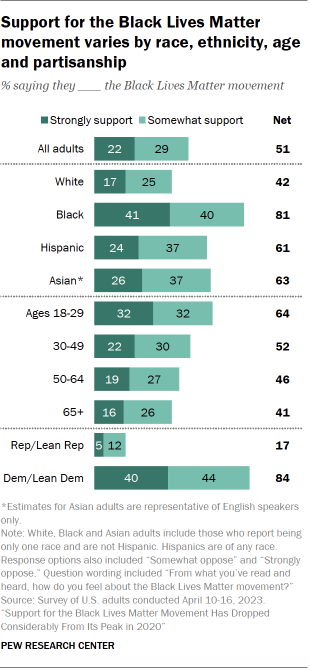
**About half of adults in the United States (51%) say they support the Black Lives Matter movement,** according to [a 2023 Center survey](https://www.pewresearch.org/social-trends/2023/06/14/views-on-the-black-lives-matter-movement/). This includes 22% who strongly support it and 29% who somewhat support it.
[](https://www.pewresearch.org/short-reads/2023/07/12/8-facts-about-black-lives-matter/sr_23-07-05_blm-facts_1-png/)
There are significant differences in opinion by race and ethnicity, political party, and age. About eight-in-ten Black Americans (81%) support the movement, compared with 63% of Asian, 61% of Hispanic and 42% of White Americans. Democrats and those who lean toward the Democratic Party are about five times as likely as Republicans and Republican leaners to support Black Lives Matter (84% vs. 17%). And whereas most adults ages 18 to 29 (64%) support the movement, 41% of those ages 65 and older do.
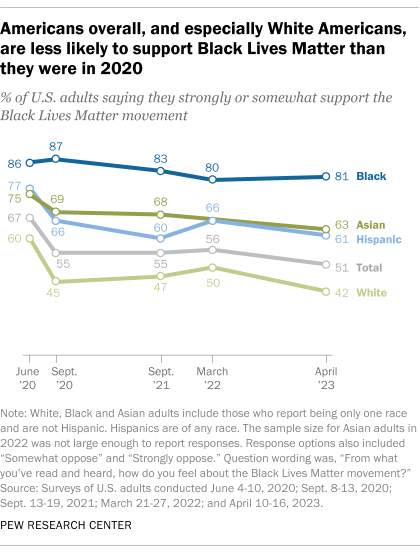
**Support for Black Lives Matter has decreased significantly among U.S. adults since June 2020,** the same Center survey shows. Two-thirds of adults strongly or somewhat supported the movement in June 2020 – shortly after Floyd was murdered – but that share fell to 56% in March 2022 and 51% in April 2023.
[](https://www.pewresearch.org/short-reads/2023/07/12/8-facts-about-black-lives-matter/sr_23-07-05_blm-facts_2-png/)
The decline is largely due to a smaller share of White adults supporting the movement. In June 2020, 60% of White adults said they supported Black Lives Matter, but that share fell to 50% in 2022 and 42% this year. Support among Asian and Hispanic adults has also fallen since 2020, but not as sharply as it has among White adults. In contrast, about 80% or more of Black adults have expressed support for the movement every year since 2020.
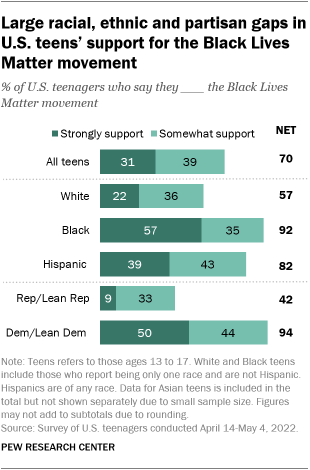
**Most teenagers support the Black Lives Matter movement,** according to [a separate Center survey conducted in 2022](https://www.pewresearch.org/short-reads/2022/06/15/u-s-teens-are-more-likely-than-adults-to-support-the-black-lives-matter-movement/). Seven-in-ten Americans ages 13 to 17 said they strongly or somewhat support the movement.
[](https://www.pewresearch.org/short-reads/2023/07/12/8-facts-about-black-lives-matter/sr_23-07-05_blm-facts_3-png/)
Black and Democratic teenagers were especially likely to support the movement. Some 92% of Black teenagers said they support it, compared with 82% of Hispanic and 57% of White teenagers. (There were not enough Asian teens in the sample to allow for separate analysis.) And 94% of Democratic teens said they support Black Lives Matter – more than twice the share of Republican teens who said the same (42%).
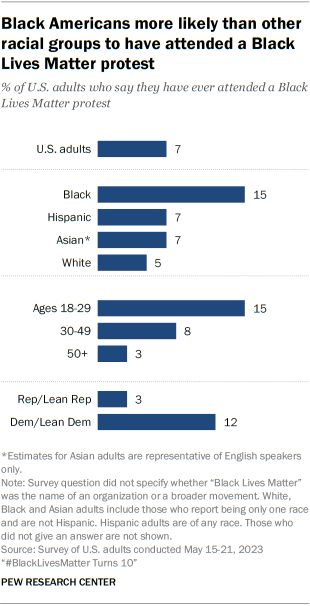
**Among U.S. adults, 7% say they have ever attended a Black Lives Matter protest,** according to [the 2023 Center report](https://www.pewresearch.org/internet/2023/06/29/americans-views-of-and-experiences-with-activism-on-social-media/#Attending-Black-Lives-Matter-protests). Even among the demographic groups that are most likely to support Black Lives Matter, the shares of people who have attended a protest are low.
[](https://www.pewresearch.org/short-reads/2023/07/12/8-facts-about-black-lives-matter/sr_23-07-05_blm-facts_4-png/)
Some 15% of Black adults say they have attended a Black Lives Matter protest; they are more likely than Hispanic, Asian or White adults to say they have done so. Similarly, adults ages 18 to 29 are about twice as likely as those 30 to 49 and five times as likely as those 50 and older to have attended a Black Lives Matter protest. And Democrats are four times as likely as Republicans to have done this.
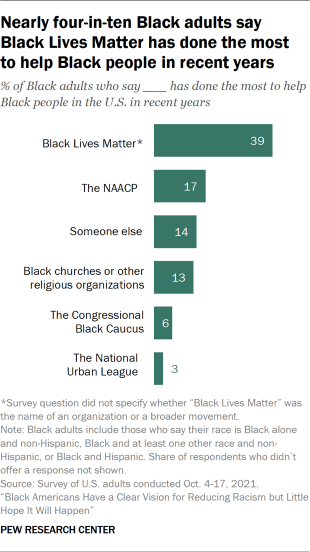
**Many Black adults in the U.S. say Black Lives Matter has done the most to help Black people in recent years.** About four-in-ten Black adults (39%) said this in [a 2021 Center survey](https://www.pewresearch.org/short-reads/2022/10/10/black-lives-matter-tops-list-of-groups-that-black-americans-see-as-helping-them-most-in-recent-years/). That far exceeded the share of Black adults who said the same about any other entity asked about in the survey, including the NAACP, Black churches or other religious organizations, the Congressional Black Caucus and the National Urban League. (This survey did not specify whether Black Lives Matter referred to an organization or the broader movement.)
[](https://www.pewresearch.org/short-reads/2023/07/12/8-facts-about-black-lives-matter/sr_23-07-05_blm-facts_5-png/)
**The public is divided on how effective the Black Lives Matter movement has been at bringing attention to racism against Black people in the U.S.** About a third of adults (32%) say the movement has been extremely or very effective at this. Some 35% say it has been somewhat effective, while 30% say it has been not too or not at all effective, according to [the 2023 Center survey](https://www.pewresearch.org/social-trends/2023/06/14/views-on-the-black-lives-matter-movement/).
[](https://www.pewresearch.org/short-reads/2023/07/12/8-facts-about-black-lives-matter/sr_23-07-05_blm-facts_6-png/)
Black and Asian adults are more likely than other racial and ethnic groups to say the movement has been extremely or very effective at bringing attention to racism in the country. Some 48% of Black adults and 46% of Asian adults say this, compared with 33% of Hispanic and 27% of White adults.
The public gives the Black Lives Matter movement lower marks on some other questions. Only 14% of U.S. adults say the movement has been extremely or very effective at increasing police accountability; 8% say it has been effective at improving the lives of Black people; and 7% say it has improved race relations.
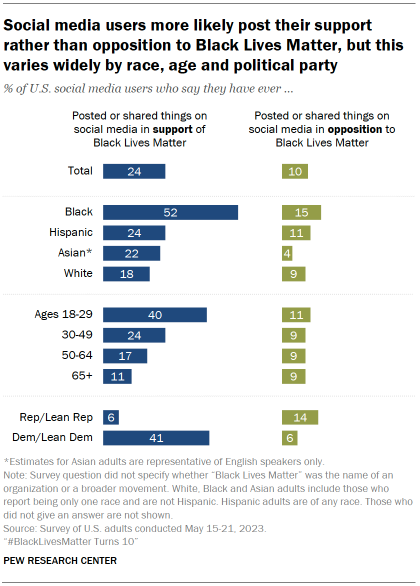
**A large majority of social media users in the U.S. (77%) say they have seen content on social media related to Black Lives Matter, but far fewer report having ever posted or shared something about this topic,** according to [the 2023 Center report](https://www.pewresearch.org/internet/2023/06/29/americans-views-of-and-experiences-with-activism-on-social-media/#Support-for-and-opposition-to-Black-Lives-Matter-on-social-media). Some 24% of social media users say they have posted or shared content supporting Black Lives Matter, while 10% have shared content opposing it.
[](https://www.pewresearch.org/short-reads/2023/07/12/8-facts-about-black-lives-matter/sr_23-07-05_blm-facts_7-png/)
Black social media users are particularly likely to have posted in support of Black Lives Matter: 52% have done so, compared with 24% of Hispanic, 22% of Asian and 18% of White users. Younger users are also more likely than older users to have posted or shared something in support of Black Lives Matter, as are Democrats when compared with Republicans.
On Twitter specifically, millions of people first engaged with the \#BlackLivesMatter hashtag following Floyd’s murder. Between May and September 2020, 5.8 million distinct users shared a tweet that contained the hashtag for the first time.
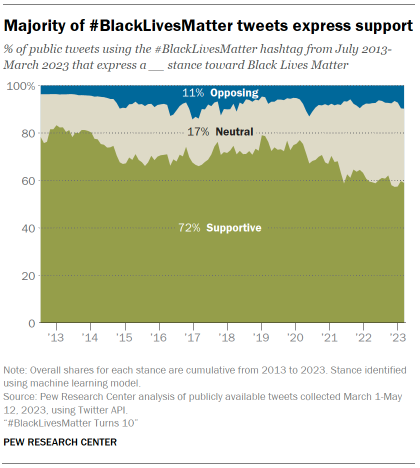
**A majority of social media posts that use the \#BlackLivesMatter hashtag are supportive,** [the same report](https://www.pewresearch.org/internet/2023/06/29/ten-years-of-blacklivesmatter-on-twitter/#Expressions-of-support-and-opposition-to-the-BlackLivesMatter-movement-over-time) finds. Between July 2013 and March 2023, about seven-in-ten publicly available tweets that used the hashtag (72%) were positive toward the movement. Another 17% were neutral and 11% were negative.
[](https://www.pewresearch.org/short-reads/2023/07/12/8-facts-about-black-lives-matter/sr_23-07-05_blm-facts_8-png/)
Supportive tweets commonly include words such as *together*, *justice*, *change*, *brutality* and *murder*, whereas negative tweets often use words such as *riot*, *assault*, *criminal* and *violent*.
Topics
- [Black Americans](https://www.pewresearch.org/topic/race-ethnicity/racial-ethnic-groups/black-americans/)
- [Race Relations](https://www.pewresearch.org/topic/race-ethnicity/race-relations/)
- [Racial Bias & Discrimination](https://www.pewresearch.org/topic/race-ethnicity/racial-bias-discrimination/)

[Jenn Hatfield](https://www.pewresearch.org/staff/jenn-hatfield/) is a writer/editor at Pew Research Center.
## Related
report
Feb 25, 2026
## [For Many Black Americans, Family Extends Beyond Birth and Legal Ties](https://www.pewresearch.org/race-and-ethnicity/2026/02/25/for-many-black-americans-family-extends-beyond-birth-and-legal-ties/)
short reads
Feb 5, 2026
## [Key facts about the U.S. Black population](https://www.pewresearch.org/short-reads/2026/02/05/key-facts-about-black-americans/)
short reads
Dec 2, 2025
## [Key facts about Black Americans and religion](https://www.pewresearch.org/short-reads/2025/12/02/key-facts-about-black-americans-and-religion/)
short reads
Oct 2, 2024
## [A look at historically Black colleges and universities in the U.S.](https://www.pewresearch.org/short-reads/2024/10/02/a-look-at-historically-black-colleges-and-universities-in-the-u-s/)
short reads
Sep 30, 2024
## [On most issues, Black voters are more confident in Harris than Trump](https://www.pewresearch.org/short-reads/2024/09/30/on-most-issues-black-voters-are-more-confident-in-harris-than-trump/)
## Topics
- [Black Americans](https://www.pewresearch.org/topic/race-ethnicity/racial-ethnic-groups/black-americans/)
- [Race Relations](https://www.pewresearch.org/topic/race-ethnicity/race-relations/)
- [Racial Bias & Discrimination](https://www.pewresearch.org/topic/race-ethnicity/racial-bias-discrimination/)
## Most Popular
1
[What Do Americans Consider Immoral?](https://www.pewresearch.org/religion/2026/03/19/what-do-americans-consider-immoral/)
2
[U.S.-style birthright citizenship is uncommon around the world](https://www.pewresearch.org/short-reads/2026/03/31/us-style-birthright-citizenship-is-uncommon-around-the-world/)
3
[Americans Broadly Disapprove of U.S. Military Action in Iran](https://www.pewresearch.org/politics/2026/03/25/americans-broadly-disapprove-of-u-s-military-action-in-iran/)
4
[Negative views of Israel, Netanyahu continue to rise among Americans – especially young people](https://www.pewresearch.org/short-reads/2026/04/07/negative-views-of-israel-netanyahu-continue-to-rise-among-americans-especially-young-people/)
5
[Are you in the American middle class? Find out with our income calculator](https://www.pewresearch.org/short-reads/2024/09/16/are-you-in-the-american-middle-class/)
[](https://www.pewresearch.org/)
901 E St. NW, Suite 300
Washington, DC 20004
USA
[(+1) 202-419-4300 \| Main](tel:+12024194300)
[(+1) 202-857-8562 \| Fax](tel:+12028578562)
[(+1) 202-419-4372 \| **Media Inquiries**](tel:+12024194372)
## Research Topics
[Politics & Policy](https://www.pewresearch.org/topic/politics-policy/)
[International Affairs](https://www.pewresearch.org/topic/international-affairs/)
[Immigration & Migration](https://www.pewresearch.org/topic/immigration-migration/)
[Race & Ethnicity](https://www.pewresearch.org/topic/race-ethnicity/)
[Religion](https://www.pewresearch.org/topic/religion/)
[Age & Generations](https://www.pewresearch.org/topic/generations-age/)
[Gender & LGBTQ](https://www.pewresearch.org/topic/gender-lgbtq/)
[Family & Relationships](https://www.pewresearch.org/topic/family-relationships/)
[Economy & Work](https://www.pewresearch.org/topic/economy-work/)
[Science](https://www.pewresearch.org/topic/science/)
[Internet & Technology](https://www.pewresearch.org/topic/internet-technology/)
[News Habits & Media](https://www.pewresearch.org/topic/news-habits-media/)
[Methodological Research](https://www.pewresearch.org/topic/methodological-research/)
## Follow Us
- [Email Newsletters](https://www.pewresearch.org/about/follow-us/)
- [YouTube](https://www.youtube.com/user/PewResearchCenter/featured/)
- [Instagram](https://www.instagram.com/pewresearch/)
- [Facebook](https://www.facebook.com/pewresearch/)
- [LinkedIn](https://www.linkedin.com/company/pew-research-center/)
- [X](https://x.com/pewresearch)
- [Bluesky](https://bsky.app/profile/pewresearch.org)
- [Threads](https://www.threads.com/@pewresearch)
- [RSS Feed](https://www.pewresearch.org/feed/)
**[ABOUT PEW RESEARCH CENTER](https://www.pewresearch.org/about)** Pew Research Center is a nonpartisan, nonadvocacy fact tank that informs the public about the issues, attitudes and trends shaping the world. It does not take policy positions. The Center conducts public opinion polling, demographic research, computational social science research and other data-driven research. Pew Research Center is a subsidiary of [The Pew Charitable Trusts](https://www.pew.org/), its primary funder.
© 2026 Pew Research Center
- [About](https://www.pewresearch.org/about/)
- [Terms & Conditions](https://www.pewresearch.org/about/terms-and-conditions/)
- [Privacy Policy](https://www.pewresearch.org/about/privacy-policy/)
- [Cookie Policy](https://www.pewresearch.org/about/cookie-policy/)
- [Feedback](https://www.pewresearch.org/contact-form/)
- [Careers](https://www.pewresearch.org/about/careers/)
- [Contact Us](https://www.pewresearch.org/about/contact/)
### Privacy Notice
We use cookies and other technologies to help improve your experience; some are necessary for the site to work, and some are optional. Learn more in our [privacy policy](https://www.pewresearch.org/about/privacy-policy/).
Essential Cookies
These cookies are required for the website to function and cannot be switched off.
Analytics Cookies
These cookies are used to collect information about how you use our website.
Marketing Cookies
These cookies are used to track your activity and show you personalized content.
Preferences
These cookies allow the website to remember choices you make.
Accept All Cookies
Accept only necessary cookies
Cookie Settings
Save Preferences |
| Readable Markdown | In the 10 years since the \#BlackLivesMatter hashtag was first used on social media, it has appeared in more than 44 million tweets, according to [a recent Pew Research Center report](https://www.pewresearch.org/internet/2023/06/29/blacklivesmatter-turns-10/). On a typical (median) day, \#BlackLivesMatter appears in about 3,000 tweets as users discuss topics such as racism, violence and the criminal justice system.
Use of the hashtag has often surged around specific acts of violence against Black Americans. The hashtag first appeared in July 2013, after George Zimmerman was acquitted in the 2012 shooting death of 17-year-old Trayvon Martin in Florida. Its use peaked at over 1.2 million tweets per day after Minneapolis police officer Derek Chauvin murdered George Floyd in May 2020.
As we mark 10 years since the hashtag originated, here are eight facts about the Black Lives Matter movement.
How we did this
Pew Research Center sought to explore the impact and reach of the Black Lives Matter movement 10 years after the \#BlackLivesMatter hashtag originated on Twitter. This post includes survey findings from Center studies conducted from 2021 to 2023, as well as a Center analysis of Twitter activity from July 2013 to March 2023. Links to the methodology for each publication, including the questions asked in each survey, can be found in the text of this analysis.
**About half of adults in the United States (51%) say they support the Black Lives Matter movement,** according to [a 2023 Center survey](https://www.pewresearch.org/social-trends/2023/06/14/views-on-the-black-lives-matter-movement/). This includes 22% who strongly support it and 29% who somewhat support it.
[](https://www.pewresearch.org/short-reads/2023/07/12/8-facts-about-black-lives-matter/sr_23-07-05_blm-facts_1-png/)
There are significant differences in opinion by race and ethnicity, political party, and age. About eight-in-ten Black Americans (81%) support the movement, compared with 63% of Asian, 61% of Hispanic and 42% of White Americans. Democrats and those who lean toward the Democratic Party are about five times as likely as Republicans and Republican leaners to support Black Lives Matter (84% vs. 17%). And whereas most adults ages 18 to 29 (64%) support the movement, 41% of those ages 65 and older do.
**Support for Black Lives Matter has decreased significantly among U.S. adults since June 2020,** the same Center survey shows. Two-thirds of adults strongly or somewhat supported the movement in June 2020 – shortly after Floyd was murdered – but that share fell to 56% in March 2022 and 51% in April 2023.
[](https://www.pewresearch.org/short-reads/2023/07/12/8-facts-about-black-lives-matter/sr_23-07-05_blm-facts_2-png/)
The decline is largely due to a smaller share of White adults supporting the movement. In June 2020, 60% of White adults said they supported Black Lives Matter, but that share fell to 50% in 2022 and 42% this year. Support among Asian and Hispanic adults has also fallen since 2020, but not as sharply as it has among White adults. In contrast, about 80% or more of Black adults have expressed support for the movement every year since 2020.
**Most teenagers support the Black Lives Matter movement,** according to [a separate Center survey conducted in 2022](https://www.pewresearch.org/short-reads/2022/06/15/u-s-teens-are-more-likely-than-adults-to-support-the-black-lives-matter-movement/). Seven-in-ten Americans ages 13 to 17 said they strongly or somewhat support the movement.
[](https://www.pewresearch.org/short-reads/2023/07/12/8-facts-about-black-lives-matter/sr_23-07-05_blm-facts_3-png/)
Black and Democratic teenagers were especially likely to support the movement. Some 92% of Black teenagers said they support it, compared with 82% of Hispanic and 57% of White teenagers. (There were not enough Asian teens in the sample to allow for separate analysis.) And 94% of Democratic teens said they support Black Lives Matter – more than twice the share of Republican teens who said the same (42%).
**Among U.S. adults, 7% say they have ever attended a Black Lives Matter protest,** according to [the 2023 Center report](https://www.pewresearch.org/internet/2023/06/29/americans-views-of-and-experiences-with-activism-on-social-media/#Attending-Black-Lives-Matter-protests). Even among the demographic groups that are most likely to support Black Lives Matter, the shares of people who have attended a protest are low.
[](https://www.pewresearch.org/short-reads/2023/07/12/8-facts-about-black-lives-matter/sr_23-07-05_blm-facts_4-png/)
Some 15% of Black adults say they have attended a Black Lives Matter protest; they are more likely than Hispanic, Asian or White adults to say they have done so. Similarly, adults ages 18 to 29 are about twice as likely as those 30 to 49 and five times as likely as those 50 and older to have attended a Black Lives Matter protest. And Democrats are four times as likely as Republicans to have done this.
**Many Black adults in the U.S. say Black Lives Matter has done the most to help Black people in recent years.** About four-in-ten Black adults (39%) said this in [a 2021 Center survey](https://www.pewresearch.org/short-reads/2022/10/10/black-lives-matter-tops-list-of-groups-that-black-americans-see-as-helping-them-most-in-recent-years/). That far exceeded the share of Black adults who said the same about any other entity asked about in the survey, including the NAACP, Black churches or other religious organizations, the Congressional Black Caucus and the National Urban League. (This survey did not specify whether Black Lives Matter referred to an organization or the broader movement.)
[](https://www.pewresearch.org/short-reads/2023/07/12/8-facts-about-black-lives-matter/sr_23-07-05_blm-facts_5-png/)
**The public is divided on how effective the Black Lives Matter movement has been at bringing attention to racism against Black people in the U.S.** About a third of adults (32%) say the movement has been extremely or very effective at this. Some 35% say it has been somewhat effective, while 30% say it has been not too or not at all effective, according to [the 2023 Center survey](https://www.pewresearch.org/social-trends/2023/06/14/views-on-the-black-lives-matter-movement/).
[](https://www.pewresearch.org/short-reads/2023/07/12/8-facts-about-black-lives-matter/sr_23-07-05_blm-facts_6-png/)
Black and Asian adults are more likely than other racial and ethnic groups to say the movement has been extremely or very effective at bringing attention to racism in the country. Some 48% of Black adults and 46% of Asian adults say this, compared with 33% of Hispanic and 27% of White adults.
The public gives the Black Lives Matter movement lower marks on some other questions. Only 14% of U.S. adults say the movement has been extremely or very effective at increasing police accountability; 8% say it has been effective at improving the lives of Black people; and 7% say it has improved race relations.
**A large majority of social media users in the U.S. (77%) say they have seen content on social media related to Black Lives Matter, but far fewer report having ever posted or shared something about this topic,** according to [the 2023 Center report](https://www.pewresearch.org/internet/2023/06/29/americans-views-of-and-experiences-with-activism-on-social-media/#Support-for-and-opposition-to-Black-Lives-Matter-on-social-media). Some 24% of social media users say they have posted or shared content supporting Black Lives Matter, while 10% have shared content opposing it.
[](https://www.pewresearch.org/short-reads/2023/07/12/8-facts-about-black-lives-matter/sr_23-07-05_blm-facts_7-png/)
Black social media users are particularly likely to have posted in support of Black Lives Matter: 52% have done so, compared with 24% of Hispanic, 22% of Asian and 18% of White users. Younger users are also more likely than older users to have posted or shared something in support of Black Lives Matter, as are Democrats when compared with Republicans.
On Twitter specifically, millions of people first engaged with the \#BlackLivesMatter hashtag following Floyd’s murder. Between May and September 2020, 5.8 million distinct users shared a tweet that contained the hashtag for the first time.
**A majority of social media posts that use the \#BlackLivesMatter hashtag are supportive,** [the same report](https://www.pewresearch.org/internet/2023/06/29/ten-years-of-blacklivesmatter-on-twitter/#Expressions-of-support-and-opposition-to-the-BlackLivesMatter-movement-over-time) finds. Between July 2013 and March 2023, about seven-in-ten publicly available tweets that used the hashtag (72%) were positive toward the movement. Another 17% were neutral and 11% were negative.
[](https://www.pewresearch.org/short-reads/2023/07/12/8-facts-about-black-lives-matter/sr_23-07-05_blm-facts_8-png/)
Supportive tweets commonly include words such as *together*, *justice*, *change*, *brutality* and *murder*, whereas negative tweets often use words such as *riot*, *assault*, *criminal* and *violent*. |
| Shard | 74 (laksa) |
| Root Hash | 4302129426480924274 |
| Unparsed URL | org,pewresearch!www,/short-reads/2023/07/12/8-facts-about-black-lives-matter/ s443 |