ℹ️ Skipped - page is already crawled
| Filter | Status | Condition | Details |
|---|---|---|---|
| HTTP status | PASS | download_http_code = 200 | HTTP 200 |
| Age cutoff | PASS | download_stamp > now() - 6 MONTH | 0.4 months ago |
| History drop | PASS | isNull(history_drop_reason) | No drop reason |
| Spam/ban | PASS | fh_dont_index != 1 AND ml_spam_score = 0 | ml_spam_score=0 |
| Canonical | PASS | meta_canonical IS NULL OR = '' OR = src_unparsed | Not set |
| Property | Value | |||||||||
|---|---|---|---|---|---|---|---|---|---|---|
| URL | https://www.osfhealthcare.org/blog/pcr-vs-rapid-covid-19-test-whats-the-difference | |||||||||
| Last Crawled | 2026-04-10 19:50:27 (12 days ago) | |||||||||
| First Indexed | 2025-03-13 19:51:00 (1 year ago) | |||||||||
| HTTP Status Code | 200 | |||||||||
| Content | ||||||||||
| Meta Title | PCR vs. rapid COVID-19 test: What’s the difference? | |||||||||
| Meta Description | null | |||||||||
| Meta Canonical | null | |||||||||
| Boilerpipe Text | Last updated May 9, 2025
Getting tested if you’re experiencing symptoms or have been exposed to COVID-19 is the first step against stopping the spread of the virus.
When to test for COVID
Knowing when to test for COVID is important.
If you have
symptoms
, test immediately.
If you were exposed to COVID-19 and are not experiencing any symptoms, wait at least five days after your exposure before testing. If you test too early, you may be more likely to get an inaccurate result.
If you test positive for COVID-19, isolate and take
precautions
to protect others from getting infected.
Tell people you had recent contact with that they may have been exposed.
Monitor your symptoms. If you have experience serious illness, seek emergency care immediately.
Consider contacting your health care provider to learn about that you may qualify to receive. Treatment must be started within several days after you first develop symptoms to be effective
Types of COVID-19 tests
There are two types of
COVID-19 tests
: the polymerase chain reaction (PCR) test and the antigen test, known as the rapid test. Both tests require a sample from the patient, usually a nasal swab.
PCR test
How it works
The PCR test takes a sample of ribonucleic acid (RNA) and “amplifies” it with the help of lab technologies. Amplifying RNA helps to make even small traces of the COVID-19 virus visible in the test sample. Even if you have a small trace of the virus in your system, the PCR test will detect it.
Benefits
“PCR tests are more reliable and accurate due to testing the specific genetic material of the virus, eliminating the interference from other viruses,” said Heather Seyko, a Laboratory Services manager for OSF HealthCare.
Drawbacks
While a PCR test is the preferred method of detecting COVID-19, it must be done by a health care provider. These tests don’t produce immediate results, which means you may be waiting a few days to know if you’re positive or negative.
The
Centers for Disease Control and Prevention
notes while tests are best used early in the course of illness to diagnose COVID-19, they can’t evaluate the duration of infectiousness. PCR tests sometimes can stay positive for weeks after you’ve had COVID. This is because the PCR test is so sensitive it can detect even dead virus.
Antigen test
How it works
The rapid test, called an antigen test, checks for proteins that are found on the outside of the virus.
The antigen test mimics what antibodies do.
Antibodies
are the “good guys” that attach to the antigen protein (the “bad guys”) and fight the virus. When you give your nasal swab sample, it’s put into a liquid and then onto a test strip.
The test strip acts like an antibody – if there are any COVID-19 antigen “bad guys” in your system, the molecules in the liquid will attach to those antigens, and a line will appear on the test strip. This means you’re positive for COVID-19. If there are no antigens detected in your system, the liquid doesn’t respond and no line will appear, often meaning you are negative for the virus.
Benefits
Results in about 15 minutes
Easy enough to do on your own at home. There’s always a little room for user error, but as long as you closely follow the directions, anyone can test themselves with an antigen test.
Helps slow the
spread of contagious viruses
like COVID-19 with quicker results
Drawbacks
“Unlike the PCR test, the antigen test can only determine if you have an active virus in your body. The rapid test can’t detect small amounts of the virus or asymptomatic cases as accurately as the PCR test can,” Heather said.
So how accurate are home COVID-19 tests? The rapid test is less accurate and there is a greater chance for a false negative, not a false positive. The test only picks up if the virus is active in your body, meaning asymptomatic cases. If someone doesn’t have any symptoms, those cases are harder to identify with the antigen test.
Choosing a PCR or antigen test
If you’re visiting a health care provider to get tested, it’s likely you won’t get to choose which test you get. This is for a few reasons. First, it could just be a matter of what test is readily available or in greater supply. Second, tests are chosen based on probability of having the virus.
“PCR would be chosen where there is a low likelihood of having the virus, but we want to be certain the patient doesn’t have it. Antigen would be chosen if there is a high probability the patient has the virus (i.e. is experiencing symptoms), and we need to screen the patient as positive or negative,” Heather said.
Getting tested is an important part of slowing the spread of COVID-19. With more accurate results, PCR tests are the preferred way to go, but antigen tests work for rapid results, as well.
Antibody testing
Antibody testing is also available and is designed to identify people who have recovered from the virus.
An antibody test could yield two results:
If you test positive for antibodies
, this means you have been previously infected with COVID-19, and you have recovered. This does not necessarily mean you are immune from contracting the virus again.
If you test negative for antibodies
, this means the lab could not detect antibodies for COVID-19. This means you are still susceptible to the virus.
Your provider might recommend this blood test if you have previously shown symptoms and want to know if they were caused by COVID-19.
About the author
Katie Faley
Katie Faley is a Writing Coordinator for OSF HealthCare. She graduated from Illinois State University with a degree in English Studies. Before joining OSF HealthCare in 2021, she worked in magazine editing, digital marketing and freelance writing.
Katie is often found listening to ‘60s folk music, deciding on a new skill to learn, losing track of time in a library or spending time with her family and friends. | |||||||||
| Markdown | [Back to OSF HealthCare](https://www.osfhealthcare.org/)
[Back to OSF HealthCare](https://www.osfhealthcare.org/)
[](https://www.osfhealthcare.org/ "OSF HealthCare Home Page")
[](https://www.osfhealthcare.org/ "OSF HealthCare Home Page")
[Providers](https://www.osfhealthcare.org/providers)
[Locations](https://www.osfhealthcare.org/locations)
Patients & Visitors
Patients & Visitors
Programs & Services
Programs & Services
Health & Wellness
Health & Wellness
[Get Care Now](https://www.osfhealthcare.org/care)
[Ways to Give](https://www.osfhealthcare.org/foundation)[Billing Information](https://www.osfhealthcare.org/patients-visitors/billing-insurance)[OSF MyChart](https://www.osfhealthcare.org/patients-visitors/osf-mychart)[Careers](https://www.osfcareers.org/)
- [Blog](https://www.osfhealthcare.org/blog)
- PCR vs. rapid COVID-19 test: What’s the difference?
# PCR vs. rapid COVID-19 test: What’s the difference?
Last updated May 9, 2025
Getting tested if you’re experiencing symptoms or have been exposed to COVID-19 is the first step against stopping the spread of the virus.
## When to test for COVID
Schedule a COVID-19 test
[Find a location near you](https://www.osfhealthcare.org/covid19/testing/)
Knowing when to test for COVID is important.
- If you have [symptoms](http://osfhealthcare.org/covid19), test immediately.
- If you were exposed to COVID-19 and are not experiencing any symptoms, wait at least five days after your exposure before testing. If you test too early, you may be more likely to get an inaccurate result.
If you test positive for COVID-19, isolate and take [precautions](https://www.osfhealthcare.org/blog/what-to-do-if-you-think-you-have-covid-19/) to protect others from getting infected.
- Tell people you had recent contact with that they may have been exposed.
- Monitor your symptoms. If you have experience serious illness, seek emergency care immediately.
- Consider contacting your health care provider to learn about that you may qualify to receive. Treatment must be started within several days after you first develop symptoms to be effective
## Types of COVID-19 tests
There are two types of [COVID-19 tests](https://www.cdc.gov/covid/testing/index.html): the polymerase chain reaction (PCR) test and the antigen test, known as the rapid test. Both tests require a sample from the patient, usually a nasal swab.
## PCR test
### How it works
The PCR test takes a sample of ribonucleic acid (RNA) and “amplifies” it with the help of lab technologies. Amplifying RNA helps to make even small traces of the COVID-19 virus visible in the test sample. Even if you have a small trace of the virus in your system, the PCR test will detect it.
### Benefits
“PCR tests are more reliable and accurate due to testing the specific genetic material of the virus, eliminating the interference from other viruses,” said Heather Seyko, a Laboratory Services manager for OSF HealthCare.
### Drawbacks
While a PCR test is the preferred method of detecting COVID-19, it must be done by a health care provider. These tests don’t produce immediate results, which means you may be waiting a few days to know if you’re positive or negative.
The [Centers for Disease Control and Prevention](https://www.cdc.gov/) notes while tests are best used early in the course of illness to diagnose COVID-19, they can’t evaluate the duration of infectiousness. PCR tests sometimes can stay positive for weeks after you’ve had COVID. This is because the PCR test is so sensitive it can detect even dead virus.
## Antigen test
### How it works
The rapid test, called an antigen test, checks for proteins that are found on the outside of the virus.
The antigen test mimics what antibodies do. [Antibodies](https://healthlibrary.osfhealthcare.org/Search/90,P01665) are the “good guys” that attach to the antigen protein (the “bad guys”) and fight the virus. When you give your nasal swab sample, it’s put into a liquid and then onto a test strip.
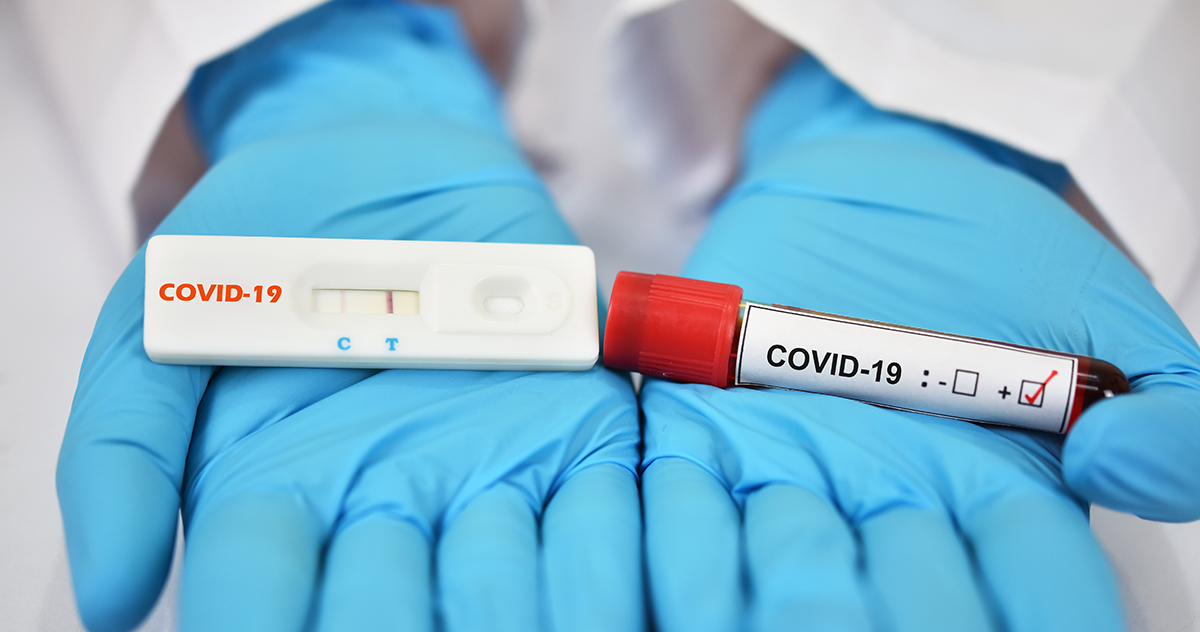
The test strip acts like an antibody – if there are any COVID-19 antigen “bad guys” in your system, the molecules in the liquid will attach to those antigens, and a line will appear on the test strip. This means you’re positive for COVID-19. If there are no antigens detected in your system, the liquid doesn’t respond and no line will appear, often meaning you are negative for the virus.
### Benefits
- Results in about 15 minutes
- Easy enough to do on your own at home. There’s always a little room for user error, but as long as you closely follow the directions, anyone can test themselves with an antigen test.
- Helps slow the [spread of contagious viruses](https://healthlibrary.osfhealthcare.org/MultimediaRoom/VideoLibrary/?e=0#player:198,t4337) like COVID-19 with quicker results
### Drawbacks
“Unlike the PCR test, the antigen test can only determine if you have an active virus in your body. The rapid test can’t detect small amounts of the virus or asymptomatic cases as accurately as the PCR test can,” Heather said.
So how accurate are home COVID-19 tests? The rapid test is less accurate and there is a greater chance for a false negative, not a false positive. The test only picks up if the virus is active in your body, meaning asymptomatic cases. If someone doesn’t have any symptoms, those cases are harder to identify with the antigen test.
## Choosing a PCR or antigen test
If you’re visiting a health care provider to get tested, it’s likely you won’t get to choose which test you get. This is for a few reasons. First, it could just be a matter of what test is readily available or in greater supply. Second, tests are chosen based on probability of having the virus.
“PCR would be chosen where there is a low likelihood of having the virus, but we want to be certain the patient doesn’t have it. Antigen would be chosen if there is a high probability the patient has the virus (i.e. is experiencing symptoms), and we need to screen the patient as positive or negative,” Heather said.
Getting tested is an important part of slowing the spread of COVID-19. With more accurate results, PCR tests are the preferred way to go, but antigen tests work for rapid results, as well.
## Antibody testing
Antibody testing is also available and is designed to identify people who have recovered from the virus.
An antibody test could yield two results:
- **If you test positive for antibodies**, this means you have been previously infected with COVID-19, and you have recovered. This does not necessarily mean you are immune from contracting the virus again.
- **If you test negative for antibodies**, this means the lab could not detect antibodies for COVID-19. This means you are still susceptible to the virus.
Your provider might recommend this blood test if you have previously shown symptoms and want to know if they were caused by COVID-19.
#### Explore more:
[COVID](https://www.osfhealthcare.org/blog?category-tag=COVID)[Preventive Health](https://www.osfhealthcare.org/blog?category-tag=Preventive%20Health)[Testing](https://www.osfhealthcare.org/blog?category-tag=testing)[Infection prevention](https://www.osfhealthcare.org/blog?category-tag=infection%20prevention)
#### About the author [Katie Faley](https://www.osfhealthcare.org/blog?author=Katie%20Faley)
Katie Faley is a Writing Coordinator for OSF HealthCare. She graduated from Illinois State University with a degree in English Studies. Before joining OSF HealthCare in 2021, she worked in magazine editing, digital marketing and freelance writing.
Katie is often found listening to ‘60s folk music, deciding on a new skill to learn, losing track of time in a library or spending time with her family and friends.
#### Share this story
## Related
[01/09/2026 Should I Still Wear a Mask During Respiratory Illness Season?](https://www.osfhealthcare.org/blog//should-i-still-wear-a-mask)
[03/10/2026 COVID-19, flu, RSV, cold or allergies? How to tell the difference](https://www.osfhealthcare.org/blog//cold-flu-allergies-or-covid-19-how-to-tell-the-difference)
[01/02/2026 Coping With Body Aches from Illnesses Like COVID-19](https://www.osfhealthcare.org/blog//muscle-and-joint-pain-from-covid-19)
[05/09/2025 PCR vs. rapid COVID-19 test: What’s the difference?](https://www.osfhealthcare.org/blog//pcr-vs-rapid-covid-19-test-whats-the-difference)
[](https://www.osfhealthcare.org/blog/pcr-vs-rapid-covid-19-test-whats-the-difference)
*In the spirit of Christ and the example of Francis of Assisi, the Mission of OSF HealthCare is to serve persons with the greatest care and love in a community that celebrates the Gift of Life.*
##### About OSF
- [About Us](https://www.osfhealthcare.org/patients-visitors/about "About OSF HealthCare")
- [Annual Report](https://osf-p-001.sitecorecontenthub.cloud/api/public/content/4deba56061954cdb9c84fa8763546200?v=be3c4982)
- [Community Health](https://www.osfhealthcare.org/patients-visitors/about/community-health)
- [Contact Us](https://www.osfhealthcare.org/patients-visitors/contact)
- [Facts & Figures](https://www.osfhealthcare.org/patients-visitors/about/facts-figures)
- [Mission, Vision & Values](https://www.osfhealthcare.org/patients-visitors/about/mission-vision-values)
- [Newsroom](https://newsroom.osfhealthcare.org/)
- [Sustainability Report](https://osf-p-001.sitecorecontenthub.cloud/api/public/content/OSF_SustainabiltyReport2023.pdf?v=a67fd9ac)
##### Resources
- [Accountable Care](https://www.osfhealthcare.org/patients-visitors/accountable-care)
- [Catholic Health Care](https://www.osfhealthcare.org/patients-visitors/about/catholic-health-care)
- [Colleges & Schools](https://www.osfhealthcare.org/education)
- [Direct Access Network](https://www.osfhealthcare.org/patients-visitors/direct-access-network)
- [Employee Resources](https://www.osfhealthcare.org/patients-visitors/mission-partner-resources)
- [Provider CME Request](https://forms.office.com/pages/responsepage.aspx?id=MKbW7yS-9kKsIOEe1Gshk9VCB5FWCy5CqzIztjI0qTFURFZQMURTUzFZRFJVNkRPVFNQWU1IM0VTSi4u)
- [Price Transparency](https://www.osfhealthcare.org/patients-visitors/billing-insurance/price-transparency)
- [Primary Source Verification](https://www.osfhealthcare.org/patients-visitors/primary-source-verification)
- [Provider Application Fee](https://paylink.paytrace.com/?m=eyJhbGciOiJBMjU2S1ciLCJlbmMiOiJBMTI4R0NNIn0.DJ-jwcfH6P1FvXH8OcvV5udjfTMPsdC1.qInnuW9xLNcg9vSn.L0y5Kp6aIEBH_BlLtZqA4vEh6X_jCKEFBK17s5qY1tJ6UqEgGghmLLnuERndNm_2_MsqQWzFjhWZk8LMFLXF7-QL5Qc9q8w27ScCG2FnmX-TJ51FQ4lnMD0w-8amjy2sd8RPrCtso6tppOawjvrdcueH14o_E3RiGCQy9QLxw_h8T_tOFdceed7arMTOdCCGXSxIAsyOVqpizZfdMJLtFL-8N9NfaiFFKbl3tDApWE7u8cMyt4UhxD6NQ6ZcN2RraxTd34SU7JKpupO6xhs0BhWlNGmXVs88GP1OKgE.ZUyhR-aGIiRXlMuaCOPP5w&amount=&invoice=)
##### Sites
- [OSF HealthCare](https://www.osfhealthcare.org/)
- [OSF Careers](https://www.osfcareers.org/)
- [OSF HealthCare Foundation](https://www.osfhealthcare.org/foundation)
- [OSF Innovation](https://osfinnovation.org/)
- [OSF Libraries](https://www.osfhealthcare.org/education/library)
- [OSF OnCall Digital Health](https://www.osfhealthcare.org/oncall/partner)
- [The Sisters of the Third Order of St. Francis](https://franciscansisterspeoria.org/)
Copyright © 2026 OSF Healthcare System
[Compliance](https://www.osfhealthcare.org/patients-visitors/compliance)
[Terms & Conditions](https://www.osfhealthcare.org/patients-visitors/terms-conditions)
[Privacy Policy](https://www.osfhealthcare.org/patients-visitors/privacy-policy) | |||||||||
| Readable Markdown | 
Last updated May 9, 2025
Getting tested if you’re experiencing symptoms or have been exposed to COVID-19 is the first step against stopping the spread of the virus.
## When to test for COVID
Knowing when to test for COVID is important.
- If you have [symptoms](http://osfhealthcare.org/covid19), test immediately.
- If you were exposed to COVID-19 and are not experiencing any symptoms, wait at least five days after your exposure before testing. If you test too early, you may be more likely to get an inaccurate result.
If you test positive for COVID-19, isolate and take [precautions](https://www.osfhealthcare.org/blog/what-to-do-if-you-think-you-have-covid-19/) to protect others from getting infected.
- Tell people you had recent contact with that they may have been exposed.
- Monitor your symptoms. If you have experience serious illness, seek emergency care immediately.
- Consider contacting your health care provider to learn about that you may qualify to receive. Treatment must be started within several days after you first develop symptoms to be effective
## Types of COVID-19 tests
There are two types of [COVID-19 tests](https://www.cdc.gov/covid/testing/index.html): the polymerase chain reaction (PCR) test and the antigen test, known as the rapid test. Both tests require a sample from the patient, usually a nasal swab.
## PCR test
### How it works
The PCR test takes a sample of ribonucleic acid (RNA) and “amplifies” it with the help of lab technologies. Amplifying RNA helps to make even small traces of the COVID-19 virus visible in the test sample. Even if you have a small trace of the virus in your system, the PCR test will detect it.
### Benefits
“PCR tests are more reliable and accurate due to testing the specific genetic material of the virus, eliminating the interference from other viruses,” said Heather Seyko, a Laboratory Services manager for OSF HealthCare.
### Drawbacks
While a PCR test is the preferred method of detecting COVID-19, it must be done by a health care provider. These tests don’t produce immediate results, which means you may be waiting a few days to know if you’re positive or negative.
The [Centers for Disease Control and Prevention](https://www.cdc.gov/) notes while tests are best used early in the course of illness to diagnose COVID-19, they can’t evaluate the duration of infectiousness. PCR tests sometimes can stay positive for weeks after you’ve had COVID. This is because the PCR test is so sensitive it can detect even dead virus.
## Antigen test
### How it works
The rapid test, called an antigen test, checks for proteins that are found on the outside of the virus.
The antigen test mimics what antibodies do. [Antibodies](https://healthlibrary.osfhealthcare.org/Search/90,P01665) are the “good guys” that attach to the antigen protein (the “bad guys”) and fight the virus. When you give your nasal swab sample, it’s put into a liquid and then onto a test strip.
The test strip acts like an antibody – if there are any COVID-19 antigen “bad guys” in your system, the molecules in the liquid will attach to those antigens, and a line will appear on the test strip. This means you’re positive for COVID-19. If there are no antigens detected in your system, the liquid doesn’t respond and no line will appear, often meaning you are negative for the virus.
### Benefits
- Results in about 15 minutes
- Easy enough to do on your own at home. There’s always a little room for user error, but as long as you closely follow the directions, anyone can test themselves with an antigen test.
- Helps slow the [spread of contagious viruses](https://healthlibrary.osfhealthcare.org/MultimediaRoom/VideoLibrary/?e=0#player:198,t4337) like COVID-19 with quicker results
### Drawbacks
“Unlike the PCR test, the antigen test can only determine if you have an active virus in your body. The rapid test can’t detect small amounts of the virus or asymptomatic cases as accurately as the PCR test can,” Heather said.
So how accurate are home COVID-19 tests? The rapid test is less accurate and there is a greater chance for a false negative, not a false positive. The test only picks up if the virus is active in your body, meaning asymptomatic cases. If someone doesn’t have any symptoms, those cases are harder to identify with the antigen test.
## Choosing a PCR or antigen test
If you’re visiting a health care provider to get tested, it’s likely you won’t get to choose which test you get. This is for a few reasons. First, it could just be a matter of what test is readily available or in greater supply. Second, tests are chosen based on probability of having the virus.
“PCR would be chosen where there is a low likelihood of having the virus, but we want to be certain the patient doesn’t have it. Antigen would be chosen if there is a high probability the patient has the virus (i.e. is experiencing symptoms), and we need to screen the patient as positive or negative,” Heather said.
Getting tested is an important part of slowing the spread of COVID-19. With more accurate results, PCR tests are the preferred way to go, but antigen tests work for rapid results, as well.
## Antibody testing
Antibody testing is also available and is designed to identify people who have recovered from the virus.
An antibody test could yield two results:
- **If you test positive for antibodies**, this means you have been previously infected with COVID-19, and you have recovered. This does not necessarily mean you are immune from contracting the virus again.
- **If you test negative for antibodies**, this means the lab could not detect antibodies for COVID-19. This means you are still susceptible to the virus.
Your provider might recommend this blood test if you have previously shown symptoms and want to know if they were caused by COVID-19.
#### About the author [Katie Faley](https://www.osfhealthcare.org/blog?author=Katie%20Faley)
Katie Faley is a Writing Coordinator for OSF HealthCare. She graduated from Illinois State University with a degree in English Studies. Before joining OSF HealthCare in 2021, she worked in magazine editing, digital marketing and freelance writing.
Katie is often found listening to ‘60s folk music, deciding on a new skill to learn, losing track of time in a library or spending time with her family and friends. | |||||||||
| ML Classification | ||||||||||
| ML Categories |
Raw JSON{
"/Health": 991,
"/Health/Public_Health": 459,
"/Health/Public_Health/Health_Policy": 416
} | |||||||||
| ML Page Types |
Raw JSON{
"/Article": 998,
"/Article/Comparisons": 696
} | |||||||||
| ML Intent Types |
Raw JSON{
"Informational": 999
} | |||||||||
| Content Metadata | ||||||||||
| Language | en | |||||||||
| Author | null | |||||||||
| Publish Time | not set | |||||||||
| Original Publish Time | 2025-03-13 19:51:00 (1 year ago) | |||||||||
| Republished | No | |||||||||
| Word Count (Total) | 1,248 | |||||||||
| Word Count (Content) | 1,011 | |||||||||
| Links | ||||||||||
| External Links | 14 | |||||||||
| Internal Links | 45 | |||||||||
| Technical SEO | ||||||||||
| Meta Nofollow | No | |||||||||
| Meta Noarchive | No | |||||||||
| JS Rendered | Yes | |||||||||
| Redirect Target | null | |||||||||
| Performance | ||||||||||
| Download Time (ms) | 263 | |||||||||
| TTFB (ms) | 249 | |||||||||
| Download Size (bytes) | 24,920 | |||||||||
| Shard | 1 (laksa) | |||||||||
| Root Hash | 14679846965994378201 | |||||||||
| Unparsed URL | org,osfhealthcare!www,/blog/pcr-vs-rapid-covid-19-test-whats-the-difference s443 | |||||||||