ℹ️ Skipped - page is already crawled
| Filter | Status | Condition | Details |
|---|---|---|---|
| HTTP status | PASS | download_http_code = 200 | HTTP 200 |
| Age cutoff | PASS | download_stamp > now() - 6 MONTH | 1.3 months ago |
| History drop | PASS | isNull(history_drop_reason) | No drop reason |
| Spam/ban | PASS | fh_dont_index != 1 AND ml_spam_score = 0 | ml_spam_score=0 |
| Canonical | PASS | meta_canonical IS NULL OR = '' OR = src_unparsed | Not set |
| Property | Value |
|---|---|
| URL | https://www.onepeloton.com/blog/postpartum-core-exercises |
| Last Crawled | 2026-02-27 13:16:39 (1 month ago) |
| First Indexed | 2025-02-16 05:43:08 (1 year ago) |
| HTTP Status Code | 200 |
| Meta Title | 10 Best Postpartum Core Exercises, According to Robin Arzón | The Output by Peloton |
| Meta Description | Learn more about postpartum core exercises: when and how you should do them, plus how to do them safely. Peloton instructor Robin Arzón shares 10 safe and effective postpartum core exercises. |
| Meta Canonical | null |
| Boilerpipe Text | Pregnancy is not easy on the body generally, but the core is specifically challenged by prenatal changes. After all, there is a
lot
going on around the core muscles during pregnancy as the abdomen makes room for a growing baby. Something’s got to give in the process, and that something is often the strength of the core. These changes matter, which is why you may be considering trying postpartum core exercises.
Discover more ways to reach your goals with Peloton
Core strength
helps stabilize the lower back and improve
balance
,
posture
, and
flexibility
. It also makes everyday tasks easier and lowers the risk of chronic pain and injury.
For these reasons, it’s important to prioritize re-strengthening the core post-pregnancy, but returning to core workouts after having a baby can be daunting. Things do not look or feel as they did before, and the last thing you want to do is injure an already delicate area by making the wrong moves.
Below, experts unpack everything you need to know in order to safely engage in postpartum core exercises.
Here’s Why and How Your Core Changes During Pregnancy
Core changes during pregnancy aren’t just aesthetic. According to
Dr. Lucky Sekhon
, Double Board Certified REI & OBGYN at
RMA of New York
and founding member of
Doctors for Fertility
, the core muscles undergo significant physical changes to accommodate the growing fetus. “The abdominal muscles, including the rectus abdominis, may stretch and separate to make room for the expanding uterus,” she says. Additionally, hormonal changes loosen ligaments, which can affect stability in the core area, she says. Some women also develop a core-related condition called diastasis recti during pregnancy.
What Is Diastasis Recti?
Diastasis recti is a condition characterized by separation of the abdominal muscles, specifically the rectus abdominis. “It often develops during pregnancy due to the stretching and thinning of the linea alba, the connective tissue that runs down the midline of the abdomen,” says Dr. Sekhon. “This can result in a visible bulge or indentation in the midsection.” While some cases of diastasis recti may improve on their own after birth, others may persist. “To check for diastasis recti, you can lie on your back with knees bent, then lift your head and shoulders off the ground while placing fingers above and below the belly button to feel for any separation,” Dr. Sekhon says.
Can You Do Core Exercises During Pregnancy?
Conventional wisdom holds that it’s safe to continue any workout you were doing prior to pregnancy while pregnant, with appropriate modifications. This includes core work, which Dr. Sekhon says you can and should do (after checking in with your doctor). “Regular core exercise during pregnancy may help maintain strength and stability in the abdominal muscles, potentially aiding in postpartum recovery,” she says.
Core exercises are just going to look a bit different than they did in your pre-pregnancy workouts. “Primarily, the core should be exercised through deep breathwork—360 breathing,” says
Robin Arzón
, Peloton Head Instructor and VP of Fitness Programming. (More on that in a bit.) And while you can still do normal ab exercises in the first trimester in most cases—it’s best to check with your doctor for specific recommendations—by the second and third trimesters, or whenever you have a visible belly, Robin says you’ll generally want to avoid crunching.
You can continue
planks
, if you were doing them pre-pregnancy and have no pregnancy complications, but they’ll need to be modified at some point, she says. Typically, that point is in the second trimester, but exact timing will vary according to the individual.
Such modifications generally involve elevating your hands to a higher surface for an incline plank, dropping your knees, or engaging the abs while seated on a large medicine ball. “You just want to make sure that you're not coning, doming, or leaking [a.ka. experiencing urinary incontinence] throughout the movement, as that's going to be an indication there's too much intra abdominal pressure,” she says. Coning, or doming, is when the Linea alba pushes out further than the rest of the abdominal wall, resulting in a tent or triangle shape of the abdomen.
Is It Safe to Do Postpartum Core Exercises After Giving Birth?
The postpartum period is one of the most physically delicate periods of a woman’s life—if not
the
most—and the thought of doing any kind of ab work in those early days post-birth can be a scary one. And while you shouldn’t fear
returning to exercise after baby
, it’s also incredibly important not to rush the transition. A safe return to core work is possible, but proper consultation and education is critical. Below, Dr. Sekhon explains how and when it’s safe to re-
engage your core
in the postpartum period.
How Soon Can You Do Core Exercises Postpartum?
According to Dr. Sekhon, the timing for resuming core exercises postpartum varies depending on individual factors such as delivery type, recovery, and overall fitness level. “Generally, it's recommended to wait until after the postpartum check-up, which typically occurs around six weeks after vaginal delivery and longer after a cesarean section to account for the time needed for the surgical incision to heal,” she says. “Women with diastasis recti, pelvic floor issues, or other postpartum complications should approach core exercises with caution.“ It is crucial for all postpartum women to check in with a healthcare provider before starting any prenatal exercise regimen, she says.
Remember how to check for diastasis recti? Lie on your back with knees bent, then lift your head and shoulders off the ground while placing fingers above and below the belly button to feel for any separation. If the condition persists after childbirth, it may require specific exercises tailored to help strengthen and close the gap in the abdominal muscles. “Traditional core exercises like crunches or planks may need to be modified or avoided until the condition improves,” Dr. Sekhon says. Again, she recommends checking in with a health care provider or physical therapist for professional guidance.
According to Robin, you may also want to see a pelvic floor specialist, no matter what kind of birth you’ve had. “The
pelvic floor
is part of the core and can be affected post-pregnancy,” she says.
The Benefits of Strengthening Your Core After Having a Baby
In general, it’s important to resume exercise post-pregnancy when cleared to do so by your doctor. This is due not only to the physical benefits of moving your body but also the mental benefits, which can be hugely important in this emotionally delicate time. “As a new parent, taking time for yourself to remember that you're a whole person is incredibly important, even if it's five or 10 minutes,” says Robin.
It’s specifically “crucial” she says, to train and strengthen your core post-pregnancy because the core stabilizes the entire body. “All functional movements—sitting, standing, squatting, walking, and running—involve core stability,” she says. And yes, that definitely includes lifting and carrying a quickly growing baby (and all the stuff that comes with them!).
The good news is that no matter what shape your core is in post-pregnancy, it can and will bounce back. “Our stabilizer muscles are incredibly resilient,” says Robin.
10 Best Postpartum Core Exercises (And How to Do Them Safely)
One of the best features of postnatal core workouts is that they don’t require equipment, which makes them easier to squeeze in under whatever circumstances you might be able to do so with a new baby forever beckoning. “Postpartum folks should only use bodyweight in their core workouts,” says Robin. “No need to add on weights just yet.”
Below, she shares 10 of her favorite postpartum core exercises that will help you reclaim core strength after baby. “Whether you’re six weeks or six years postpartum, these are great, diastasis-safe exercises,” she says.
360 Diaphragmatic Breathing
Robin always begins her postnatal workouts with 360 diaphragmatic breathing, which is a deep breathing technique where your breath is used to create expansion in your abdomen and rib cage. “This is the same type of deep breathing that would have been recommended throughout pregnancy,” she says. “It is one of the most, if not
the
most, effective ways to re-strengthen the neural pathways of the core and to close diastasis, and it can be done in the early postpartum period after you’ve been cleared for movement.”
To perform this type of breathing, start by lying flat on your back (you can also do this move from a seated position) and placing your hands around your lower rib cage, with your fingers in the front and your thumbs in the back.
Inhale through your nose to expand your rib cage 360 degrees, pushing it into your hands in all directions.
Exhale through your lips—”as if you’re blowing out one thousand birthday candles,” says Robin. “The rib cage contracts, and the front of your body and the back of your body get closer together,” she says. “So it’s not a sucking in of the belly, it’s as if someone is wrapping you in mummy tape.”
Repeat for several breaths.
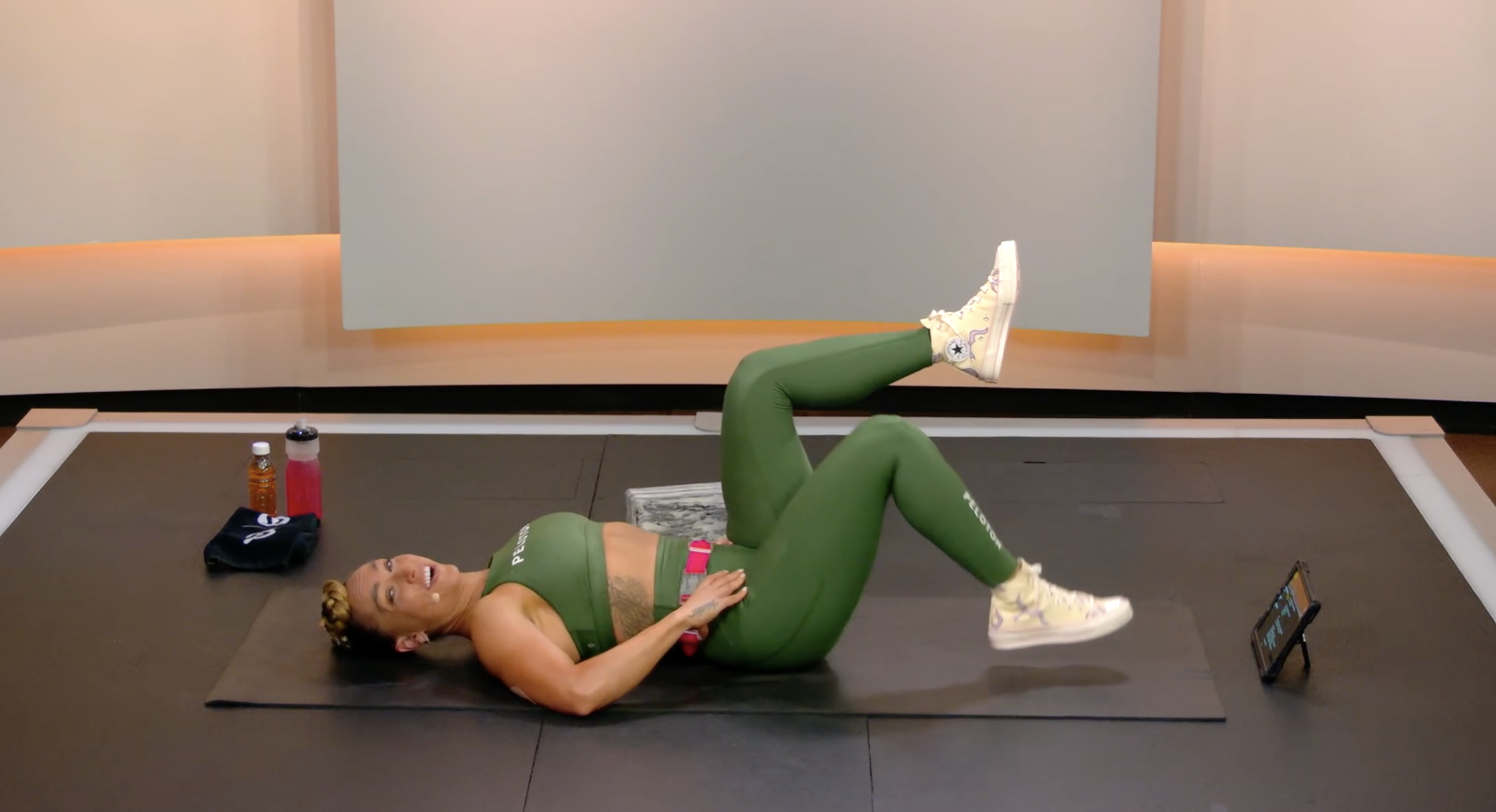
Heel Slides
Lie on your back with your knees bent and feet planted on the ground.
Slowly extend one leg all the way flat, leading with the heel, while exhaling.
Inhale as you bring the heel slowly back in.
Alternate to the other leg, and repeat for several reps.
Eleganza/E+ via Getty Images
Glute Bridge
Lie on your back with your knees bent and your feet planted on the ground.
Tighten your glute and abdominal muscles by pushing your lower back into the floor.
Slowly lift your hips off the ground until you’ve formed a straight diagonal line from your knees to your shoulders.
Pull your belly button to your spine and hold for 30 seconds. “Find a diamond position with your hands, place them on the lower abdomen, exhale, and imagine your hips are magnetizing toward each other while your pelvic floor is drawing up,” says Robin.
Tuck even more as you lower your hips, pausing halfway down to take another inhale and deep exhale for a total of two breaths as your hips descend.
Repeat for several reps.
Heel Taps
Lie on your back. Beginners can start with both feet planted on the floor.
On the inhale, slowly and gently tap your right heel to the mat.
On the exhale, use your abdominals to lift your leg back up to tabletop position.
Alternate legs and repeat for several reps.
To level up, start with both legs in tabletop position and then slowly tap one heel at a time down to the ground, alternating legs. Repeat for several reps.
And for even more of a challenge, begin with both legs in tabletop. Then, lower both legs simultaneously to tap both heels to the ground at the same time. Repeat for several reps.
Modified
Dead Bug
Lie on your back.
Bring your legs to tabletop position and extend your arms so they point straight up to the ceiling.
Beginners can start with arm work only. Inhale while extending one arm at a time towards the floor above your head.
Exhale as you return your arm to its starting position.
Alternate arms and repeat for several reps.
If this feels too challenging, you can plant both feet on the floor and lift just one leg into tabletop at a time, moving the same arm as leg (e.g. both on the right or left side). Repeat for several reps.
Another modification is to lay on your back with your legs in tabletop and your arms extended out to the ceiling, and only extend the legs out, one leg at a time. The lower the extended leg, the more challenging the work.
Once that feels secure—no coning or discomfort—you can move into traditional dead bug. To do so, add alternating arm extensions, extending opposite arm and leg simultaneously, and then switching to the other arm and leg (e.g. left arm, right leg, then switch).
Leg Extensions
Lie on your back and bring your legs into tabletop position.
Extend one leg out straight to a 45-degree angle. Beginners can lift the leg higher up to 90-degrees—the lower the leg, the more challenging the exercise. Keep your lower back planted to the ground without arching throughout.
Alternate with the other leg.
Repeat for several reps.
Leg Circles
Lie on your back and bring your legs into tabletop.
Inhale and extend one leg to the ceiling.
Exhale and lower the leg out to the side and back up to the starting position in a circling motion, keeping it slow and controlled the entire time. If that feels too challenging, you can do the circles with your knee bent instead. “The goal here is only to take it as wide in the circle as you can while maintaining the stability of the pelvis,” says Robin.
Repeat for several reps, and then switch sides.
Then, do each leg again, circling the legs in the opposite direction from the direction you did on the first set of reps.
Repeat for several reps.
Bird-Dog
Begin on all fours in the tabletop position, placing your knees under your hips and your hands under your shoulders.
Keep your spine neutral.
Extend your right arm forward and left leg backward, keeping your shoulders and hips parallel to the floor.
Tuck your chin into your chest so your gaze is at the floor.
Hold for a few seconds and then lower back to your starting position.
Switch to the left arm and right leg and repeat.
Return to the starting position.
Modified Side Plank
Sit on one hip with your legs folded.
Prop yourself up to 90 degrees on the arm that’s on the same side as the hip you’re sitting on.
Slowly lift up the hips and hold for 30 seconds, inhaling and exhaling slowly.
For more of a challenge, extend your top arm overhead. Then, “thread the needle” by moving it into the space between your ribs and your extended arm, finding a twist in the rib cage and shoulders.
Alternate to the other side.
Rolling Plank
Begin on all fours in the tabletop position, placing your knees under your hips and your hands under your shoulder.
Tuck your toes.
Drop one knee down to the ground, and then the other knee.
Bring both knees up.
Repeat for several reps.
Once you’re ready for more of a challenge, you can hold both knees up, or extend both legs into full plank.
Postpartum Core Strength Phases: 1-4
If you’d prefer to have professional guidance as you return to and transition through postpartum core exercises, Robin’s new Peloton Postnatal Core Strength Series is phased out to help you safely rebuild core strength after pregnancy. “Each phase is going to build on the one prior,” she says. “The idea is that you repeat a class until you feel ready to take the next one.” Some signs you might be ready are if you’re effectively “bracing”—a.k.a. activating the muscles of the core by contracting the deep abdominal muscles—to provide a solid foundation for movement and protect against injury and aren’t feeling any discomfort, coning, or uterine prolapse.
As a reminder, Robin says it’s best to check in with your healthcare provider before beginning any of her classes, and notes that you’re always welcome to modify any move.
Phase One:
The first phase is the gentlest. It begins with 360 breathing. From there, Robin moves through heel slides, articulated bridge, toe taps, leg extension, and modified dead bug. At this level, she notes, core work will not burn as you may be used to it doing, but it is working nonetheless!
Phase Two:
In the second phase, Robin begins to layer in different patterns of movement, but all exercises remain on your back. The workout begins with deep breathing and then moves through single leg stretches, tabletop leg circles, modified dead bug, modified side plank, butterfly exercises with a miniband, wide leg heel taps, and
glute bridge
.
Phase Three:
By phase three, moves begin to challenge the core more intensely, and some are done off of your back. After deep breathing exercises, Robin moves into bird dog, bear hover, wide leg toe taps, leg scissors, and wide leg circles.
Phase four:
Phase four, says Robin, serves as a bridge to the rest of Peloton’s regular strength classes and content. As such, it’s the most challenging. It begins with 360 deep breathing and then moves into glute bridge, one-legged glute bridge, alternating crunches, rolling plank, modified plank, and full plank.
Mistakes to Avoid When Doing Postpartum Core Exercises
Proper form and caution is more important than ever when it comes to postpartum core exercises. Here are two mistakes Robin says it’s crucial to avoid making:
Rushing it:
One common mistake Robin says she sees women making is returning to crunching and planking too soon. These core exercises should be gradually worked up to, as demonstrated in Robin’s four-phase Peloton Postnatal Core series.
Not going deep:
“You want to make sure that you're really activating and working on the deep core muscles,” she says. “So that’s not the superficial abs, it’s deeper, and that’s what the 360 breathing really gets at.”
How to Integrate Postpartum Core Exercises Into Your Workout Routine
Robin believes you should be doing postpartum core exercises or deep breathing every single day. “With postpartum core exercises, little by little will amount to a lot,” she says. “Small moments, even just a few minutes a day, are going to go a long way.”
And if you’re wondering when, exactly, it is safe to resume your pre-pregnancy core workouts, Dr. Sekhon says there is no exact timeline for when someone is no longer considered postpartum as it varies person to person, but that it’s best to ease in that direction over time. “It's essential to listen to your body and gradually reintroduce exercises, taking into account any postpartum considerations or modifications needed.” Robin’s four-phase postnatal core series offers a safe and effective way to do this—by the time you’ve completed phase four comfortably, you should be good to go!
Recommended
Peloton App
Access thousands of classes with no equipment needed.
This content is for informational and educational purposes only and does not constitute individualized advice. It is not intended to replace professional medical evaluation, diagnosis, or treatment. Seek the advice of your physician for questions you may have regarding your health or a medical condition. If you are having a medical emergency, call your physician or 911 immediately.
This content is for informational and educational purposes only and does not constitute individualized advice. It is not intended to replace professional medical evaluation, diagnosis, or treatment. Seek the advice of your physician for questions you may have regarding your health or a medical condition. If you are having a medical emergency, call your physician or 911 immediately. |
| Markdown | Cookies Preference Center
When you visit our website, we and our third party partners store cookies, pixels, beacons and similar technologies (“Cookies”) on your browser or device to collect information about you, your preferences, or your device. We and our third party partners use Cookies for purposes including making the site work as you expect, providing you a personalized web experience, providing streaming services, enhancing and analyzing site navigation and usage, and for our advertising and social media efforts, including to serve you targeted advertising through third parties. Some states allow you to opt out of the sale/use of your personal data for cross-site advertising; to exercise your opt-out rights, turn off Analytics & Advertising Cookies below. To opt out of other Cookies, which may impact your experience and the services we are able to offer, click on the different category headings below. You cannot opt-out of Strictly Necessary Cookies, which are necessary or essential for the website to function or to provide you with the services you have requested. Use of our websites is governed by our [Terms of Service](https://www.onepeloton.com/terms-of-service). For more details on the data we process and how to exercise your rights, see our [Privacy Policy](https://www.onepeloton.com/privacy-policy) and our [Cookies Policy](https://www.onepeloton.com/cookies-policy).
Strictly Necessary
On
These cookies are necessary to make our website work and to provide you with its core features, such as access to secure areas. Without these cookies, we could not provide you with the service you have requested (like retaining your privacy preferences or login details). You can set your browser to block or alert you to these cookies, but if you do so parts of our website will not work.
***
Social Media
On
These cookies are set by a range of social media services that we have added to the site to enable you to share our content with your friends and networks. They are capable of tracking your browser across other sites and building up a profile of your interests. This may impact the content and messages you see on other websites you visit. If you do not allow these cookies you may not be able to use or see these sharing tools.
***
Performance
On
These cookies allow us to count visits and traffic sources so we can measure and improve the performance of our site. They help us to know which pages are the most and least popular and see how visitors move around the site. All information these cookies collect is aggregated and may be anonymous. If you do not allow these cookies we will not know when you have visited our site and will not be able to monitor its performance.
***
Functional
On
These cookies enable the website to provide enhanced functionality and personalisation. They may be set by us or by third party providers whose services we have added to our pages. If you do not allow these cookies then some or all of these services may not function properly.
***
Advertising
On
We use advertising cookies to track your online activity to help advertisers to deliver more relevant advertising to you or to limit how many times you see an ad. These cookies may be set through our site by our advertising partners. They may be used by those companies to build a profile of your interests and show you relevant adverts on other sites. If you do not allow these cookies, you will experience less targeted advertising.
Confirm My Choices
Reject All
Accept All
[Powered by](https://ethyca.com/)
Peloton Cookie Notice
We and our third party partners use cookies and similar tracking technology on this website, and via the browser and your device to enhance user experience and to analyze performance and traffic on our website. We also share information about your use of our site with our social media, advertising and analytics partners. The information collected may relate to you, your preferences, or your device (including cursor movements, clicks, video viewing activity and screen recordings) and is used to make this site work as you expect, and to provide a personalized experience. This technology is used and shared for various purposes such as streaming, enhancing and analyzing site navigation and usage, and assisting our advertising and social media efforts, including targeted advertising through third parties. By continuing to use our website, you agree to this use and disclosure of your information, in accordance with our [Terms of Service](https://www.onepeloton.com/terms-of-service), our [Privacy Policy](https://www.onepeloton.com/privacy-policy) and our [Cookie Policy](https://www.onepeloton.com/cookies-policy)
Acknowledge
Manage Cookie Settings
[Train](https://www.onepeloton.com/blog/topic/train)[Recover](https://www.onepeloton.com/blog/topic/recover)[Level Up](https://www.onepeloton.com/blog/topic/level-up)[Connect](https://www.onepeloton.com/blog/topic/connect)
[Shop](https://www.onepeloton.com/)
[Train](https://www.onepeloton.com/blog/topic/train)
- [Bike](https://www.onepeloton.com/blog/topic/train/cycling)
- [Row](https://www.onepeloton.com/blog/topic/train/rowing)
- [Run](https://www.onepeloton.com/blog/topic/train/running)
- [Sculpt](https://www.onepeloton.com/blog/topic/train/sculpt)
- [Strength Train](https://www.onepeloton.com/blog/topic/train/strength-training)
- [Beginners](https://www.onepeloton.com/blog/topic/train/beginners)
- [Yoga](https://www.onepeloton.com/blog/topic/train/yoga)
- [Cardio](https://www.onepeloton.com/blog/topic/train/cardio)
[Recover](https://www.onepeloton.com/blog/topic/recover)
- [Nutrition](https://www.onepeloton.com/blog/topic/recover/nutrition)
- [Meditation](https://www.onepeloton.com/blog/topic/recover/meditation)
- [Sleep](https://www.onepeloton.com/blog/topic/recover/sleep)
- [Stretching + Mobility](https://www.onepeloton.com/blog/topic/recover/stretching-mobility)
[Level Up](https://www.onepeloton.com/blog/topic/level-up)
- [Mindset](https://www.onepeloton.com/blog/topic/level-up/mindset)
- [Mental Health](https://www.onepeloton.com/blog/topic/level-up/mental-health)
- [Health](https://www.onepeloton.com/blog/topic/level-up/health)
- [Marathon + Racing](https://www.onepeloton.com/blog/topic/level-up/race-training)
- [Equipment](https://www.onepeloton.com/blog/topic/level-up/fitness-equipment)
[Connect](https://www.onepeloton.com/blog/topic/connect)
- [Member Tips](https://www.onepeloton.com/blog/topic/connect/member-tips)
- [Member Stories](https://www.onepeloton.com/blog/topic/connect/member-stories)
- [Meet Instructors](https://www.onepeloton.com/blog/topic/connect/instructors)
- [Inspiration](https://www.onepeloton.com/blog/topic/connect/inspiration)
- [Member News](https://www.onepeloton.com/blog/topic/connect/news)
### Shop Peloton
[ Peloton App Try 30 days free](https://www.onepeloton.com/app)
[ Treadmills Shop Now](https://www.onepeloton.com/treadmills)
[ Bikes Shop Now](https://www.onepeloton.com/exercise-bikes)
Social
[Shop Peloton](https://www.onepeloton.com/)
1. [Home](https://www.onepeloton.com/blog)
2. [Train](https://www.onepeloton.com/blog/topic/train)
3. [Strength Train](https://www.onepeloton.com/blog/topic/train/strength-training)
# How to Safely Work Your Core After Pregnancy—Plus Why It's So Important
Robin Arzón shares what you need to know about safe and effective postnatal core workouts.
By [Erin Bunch](https://www.onepeloton.com/blog/author/erin-bunch) •May 3, 2024
Share:
[In this article](https://www.onepeloton.com/blog/postpartum-core-exercises)
- [Here’s Why and How Your Core Changes During Pregnancy](https://www.onepeloton.com/blog/#article-content-block-5)
- [Is It Safe to Do Postpartum Core Exercises After Giving Birth?](https://www.onepeloton.com/blog/#article-content-block-14)
- [How Soon Can You Do Core Exercises Postpartum?](https://www.onepeloton.com/blog/#article-content-block-16)
- [The Benefits of Strengthening Your Core After Having a Baby](https://www.onepeloton.com/blog/#article-content-block-20)
- [10 Best Postpartum Core Exercises (And How to Do Them Safely)](https://www.onepeloton.com/blog/#article-content-block-25)
- [Postpartum Core Strength Phases: 1-4](https://www.onepeloton.com/blog/#article-content-block-50)
- [Mistakes to Avoid When Doing Postpartum Core Exercises](https://www.onepeloton.com/blog/#article-content-block-57)
- [How to Integrate Postpartum Core Exercises Into Your Workout Routine](https://www.onepeloton.com/blog/#article-content-block-61)
***
Pregnancy is not easy on the body generally, but the core is specifically challenged by prenatal changes. After all, there is a *lot* going on around the core muscles during pregnancy as the abdomen makes room for a growing baby. Something’s got to give in the process, and that something is often the strength of the core. These changes matter, which is why you may be considering trying postpartum core exercises.
### Discover more ways to reach your goals with Peloton
[ Get stronger](https://www.onepeloton.com/get-stronger)
[ Improve endurance](https://www.onepeloton.com/improve-endurance)
[ Support weight goals](https://www.onepeloton.com/support-weight-goals)
[ Healthy aging](https://www.onepeloton.com/healthy-aging)
[ Build a routine](https://www.onepeloton.com/build-a-routine)
[Core strength](https://www.onepeloton.com/blog/core-strength-benefits) helps stabilize the lower back and improve [balance](https://www.onepeloton.com/blog/how-to-improve-balance), [posture](https://www.onepeloton.com/blog/posture-exercises), and [flexibility](https://www.onepeloton.com/blog/mobility-vs-flexibility). It also makes everyday tasks easier and lowers the risk of chronic pain and injury.
For these reasons, it’s important to prioritize re-strengthening the core post-pregnancy, but returning to core workouts after having a baby can be daunting. Things do not look or feel as they did before, and the last thing you want to do is injure an already delicate area by making the wrong moves.
Below, experts unpack everything you need to know in order to safely engage in postpartum core exercises.
## Here’s Why and How Your Core Changes During Pregnancy
Core changes during pregnancy aren’t just aesthetic. According to [Dr. Lucky Sekhon](https://www.instagram.com/lucky.sekhon), Double Board Certified REI & OBGYN at [RMA of New York](https://www.rmany.com/our-team/physicians/dr-lucky-sekhon)and founding member of [Doctors for Fertility](https://www.linkedin.com/company/doctors-for-fertility), the core muscles undergo significant physical changes to accommodate the growing fetus. “The abdominal muscles, including the rectus abdominis, may stretch and separate to make room for the expanding uterus,” she says. Additionally, hormonal changes loosen ligaments, which can affect stability in the core area, she says. Some women also develop a core-related condition called diastasis recti during pregnancy.
### What Is Diastasis Recti?
Diastasis recti is a condition characterized by separation of the abdominal muscles, specifically the rectus abdominis. “It often develops during pregnancy due to the stretching and thinning of the linea alba, the connective tissue that runs down the midline of the abdomen,” says Dr. Sekhon. “This can result in a visible bulge or indentation in the midsection.” While some cases of diastasis recti may improve on their own after birth, others may persist. “To check for diastasis recti, you can lie on your back with knees bent, then lift your head and shoulders off the ground while placing fingers above and below the belly button to feel for any separation,” Dr. Sekhon says.
### Can You Do Core Exercises During Pregnancy?
Conventional wisdom holds that it’s safe to continue any workout you were doing prior to pregnancy while pregnant, with appropriate modifications. This includes core work, which Dr. Sekhon says you can and should do (after checking in with your doctor). “Regular core exercise during pregnancy may help maintain strength and stability in the abdominal muscles, potentially aiding in postpartum recovery,” she says.
Core exercises are just going to look a bit different than they did in your pre-pregnancy workouts. “Primarily, the core should be exercised through deep breathwork—360 breathing,” says [Robin Arzón](https://www.onepeloton.com/instructors/robin), Peloton Head Instructor and VP of Fitness Programming. (More on that in a bit.) And while you can still do normal ab exercises in the first trimester in most cases—it’s best to check with your doctor for specific recommendations—by the second and third trimesters, or whenever you have a visible belly, Robin says you’ll generally want to avoid crunching.
You can continue [planks](https://www.onepeloton.com/blog/1-minute-plank-every-day), if you were doing them pre-pregnancy and have no pregnancy complications, but they’ll need to be modified at some point, she says. Typically, that point is in the second trimester, but exact timing will vary according to the individual.
Such modifications generally involve elevating your hands to a higher surface for an incline plank, dropping your knees, or engaging the abs while seated on a large medicine ball. “You just want to make sure that you're not coning, doming, or leaking \[a.ka. experiencing urinary incontinence\] throughout the movement, as that's going to be an indication there's too much intra abdominal pressure,” she says. Coning, or doming, is when the Linea alba pushes out further than the rest of the abdominal wall, resulting in a tent or triangle shape of the abdomen.
## Is It Safe to Do Postpartum Core Exercises After Giving Birth?
The postpartum period is one of the most physically delicate periods of a woman’s life—if not *the* most—and the thought of doing any kind of ab work in those early days post-birth can be a scary one. And while you shouldn’t fear [returning to exercise after baby](https://www.onepeloton.com/blog/postpartum-fitness), it’s also incredibly important not to rush the transition. A safe return to core work is possible, but proper consultation and education is critical. Below, Dr. Sekhon explains how and when it’s safe to re-[engage your core](https://www.onepeloton.com/blog/how-to-engage-your-core) in the postpartum period.
## How Soon Can You Do Core Exercises Postpartum?
According to Dr. Sekhon, the timing for resuming core exercises postpartum varies depending on individual factors such as delivery type, recovery, and overall fitness level. “Generally, it's recommended to wait until after the postpartum check-up, which typically occurs around six weeks after vaginal delivery and longer after a cesarean section to account for the time needed for the surgical incision to heal,” she says. “Women with diastasis recti, pelvic floor issues, or other postpartum complications should approach core exercises with caution.“ It is crucial for all postpartum women to check in with a healthcare provider before starting any prenatal exercise regimen, she says.
Remember how to check for diastasis recti? Lie on your back with knees bent, then lift your head and shoulders off the ground while placing fingers above and below the belly button to feel for any separation. If the condition persists after childbirth, it may require specific exercises tailored to help strengthen and close the gap in the abdominal muscles. “Traditional core exercises like crunches or planks may need to be modified or avoided until the condition improves,” Dr. Sekhon says. Again, she recommends checking in with a health care provider or physical therapist for professional guidance.
According to Robin, you may also want to see a pelvic floor specialist, no matter what kind of birth you’ve had. “The [pelvic floor](https://www.onepeloton.com/blog/pelvic-floor-explained) is part of the core and can be affected post-pregnancy,” she says.
## The Benefits of Strengthening Your Core After Having a Baby
In general, it’s important to resume exercise post-pregnancy when cleared to do so by your doctor. This is due not only to the physical benefits of moving your body but also the mental benefits, which can be hugely important in this emotionally delicate time. “As a new parent, taking time for yourself to remember that you're a whole person is incredibly important, even if it's five or 10 minutes,” says Robin.
It’s specifically “crucial” she says, to train and strengthen your core post-pregnancy because the core stabilizes the entire body. “All functional movements—sitting, standing, squatting, walking, and running—involve core stability,” she says. And yes, that definitely includes lifting and carrying a quickly growing baby (and all the stuff that comes with them!).
The good news is that no matter what shape your core is in post-pregnancy, it can and will bounce back. “Our stabilizer muscles are incredibly resilient,” says Robin.
### Try Peloton Postnatal Core Strength Classes
[See all classes](https://www.onepeloton.com/classes)
[ 10 min Postnatal Core Strength: Phase 1 Robin Arzón · Strength](https://www.onepeloton.com/classes/strength/10-min-postnatal-core-strength-phase-1-robin-arzon-1702392334?classId=ff542754bfed46c5b5ef06b621b1bb55)
[ 10 min Postnatal Core Strength: Phase 2 Robin Arzón · Strength](https://www.onepeloton.com/classes/strength/10-min-postnatal-core-strength-phase-2-robin-arzon-1702997941?classId=0291ff31262740e88cf0d22fae0ecebc)
[ 10 min Postnatal Core Strength: Phase 3 Robin Arzón · Strength](https://www.onepeloton.com/classes/strength/10-min-postnatal-core-strength-phase-3-robin-arzon-1705608688?classId=e1bdf265abdf42388af7d3a42e4f4545)
[ 10 min Postnatal Core Strength: Phase 4 Robin Arzón · Strength](https://www.onepeloton.com/classes/strength/10-min-postnatal-core-strength-phase-4-robin-arzon-1705417040?classId=12df5c8bae6a46579393c0ea17495695)
## 10 Best Postpartum Core Exercises (And How to Do Them Safely)
One of the best features of postnatal core workouts is that they don’t require equipment, which makes them easier to squeeze in under whatever circumstances you might be able to do so with a new baby forever beckoning. “Postpartum folks should only use bodyweight in their core workouts,” says Robin. “No need to add on weights just yet.”
Below, she shares 10 of her favorite postpartum core exercises that will help you reclaim core strength after baby. “Whether you’re six weeks or six years postpartum, these are great, diastasis-safe exercises,” she says.
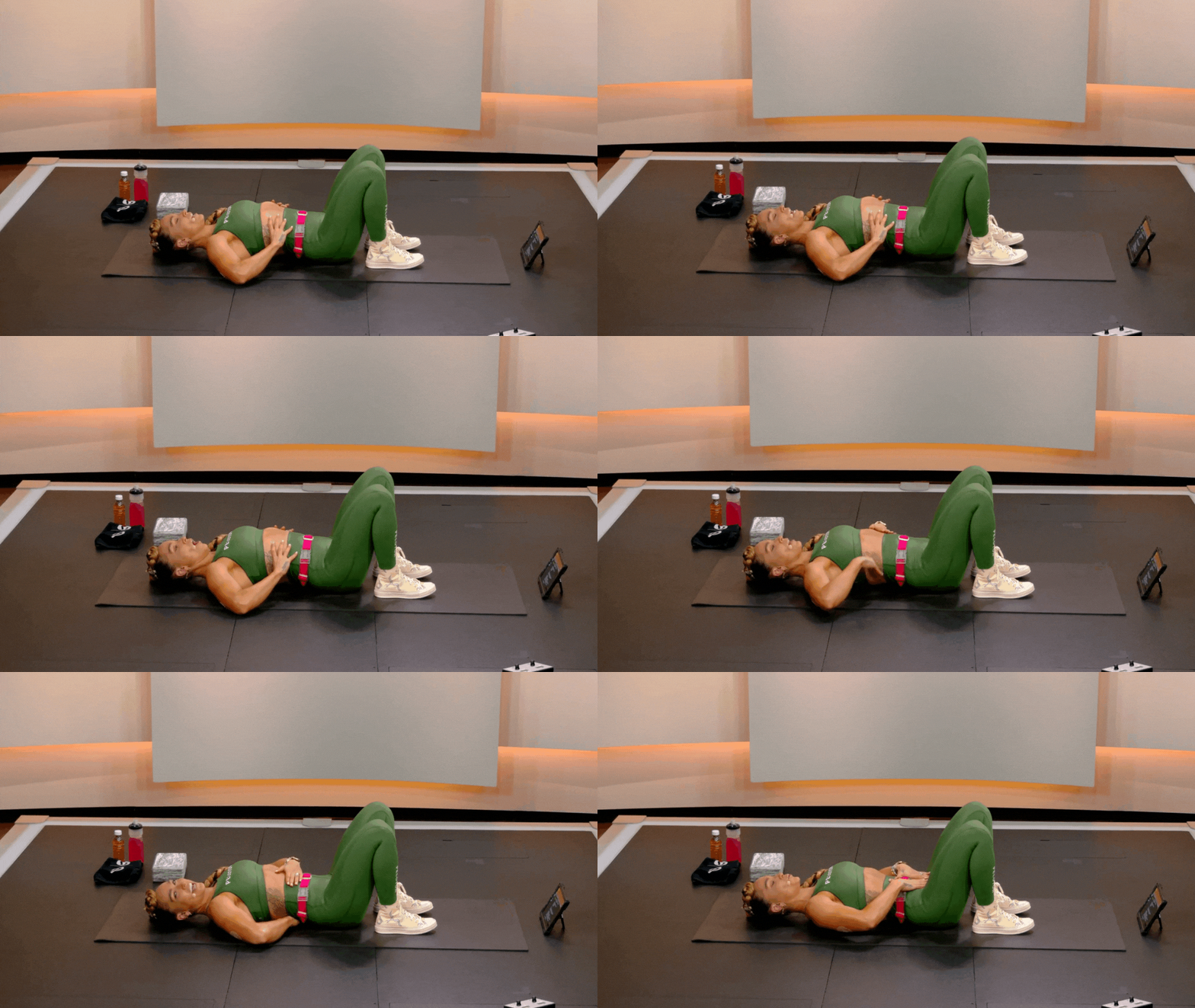
### 360 Diaphragmatic Breathing
Robin always begins her postnatal workouts with 360 diaphragmatic breathing, which is a deep breathing technique where your breath is used to create expansion in your abdomen and rib cage. “This is the same type of deep breathing that would have been recommended throughout pregnancy,” she says. “It is one of the most, if not *the* most, effective ways to re-strengthen the neural pathways of the core and to close diastasis, and it can be done in the early postpartum period after you’ve been cleared for movement.”
1. To perform this type of breathing, start by lying flat on your back (you can also do this move from a seated position) and placing your hands around your lower rib cage, with your fingers in the front and your thumbs in the back.
2. Inhale through your nose to expand your rib cage 360 degrees, pushing it into your hands in all directions.
3. Exhale through your lips—”as if you’re blowing out one thousand birthday candles,” says Robin. “The rib cage contracts, and the front of your body and the back of your body get closer together,” she says. “So it’s not a sucking in of the belly, it’s as if someone is wrapping you in mummy tape.”
4. Repeat for several breaths.
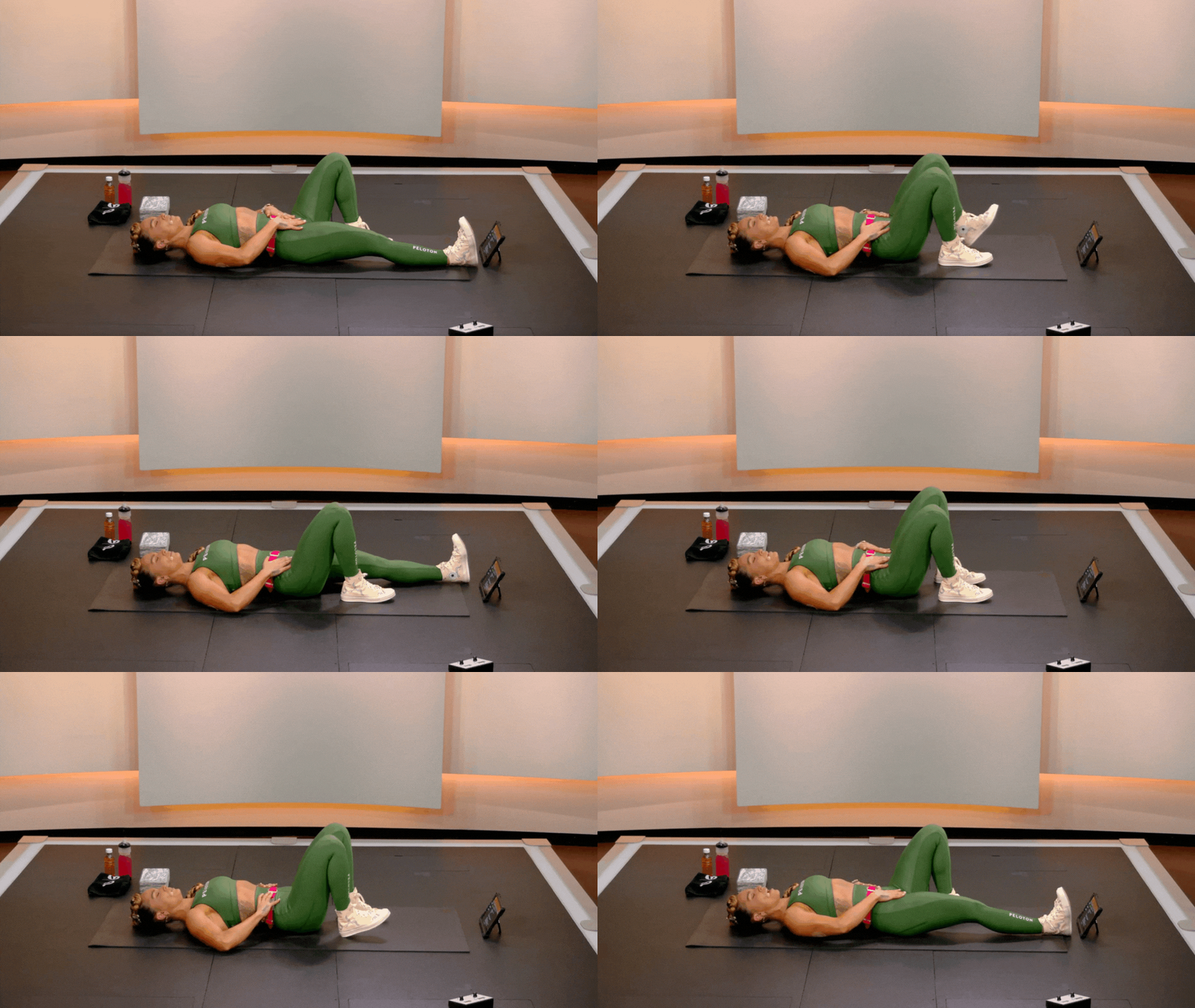
### Heel Slides
1. Lie on your back with your knees bent and feet planted on the ground.
2. Slowly extend one leg all the way flat, leading with the heel, while exhaling.
3. Inhale as you bring the heel slowly back in.
4. Alternate to the other leg, and repeat for several reps.
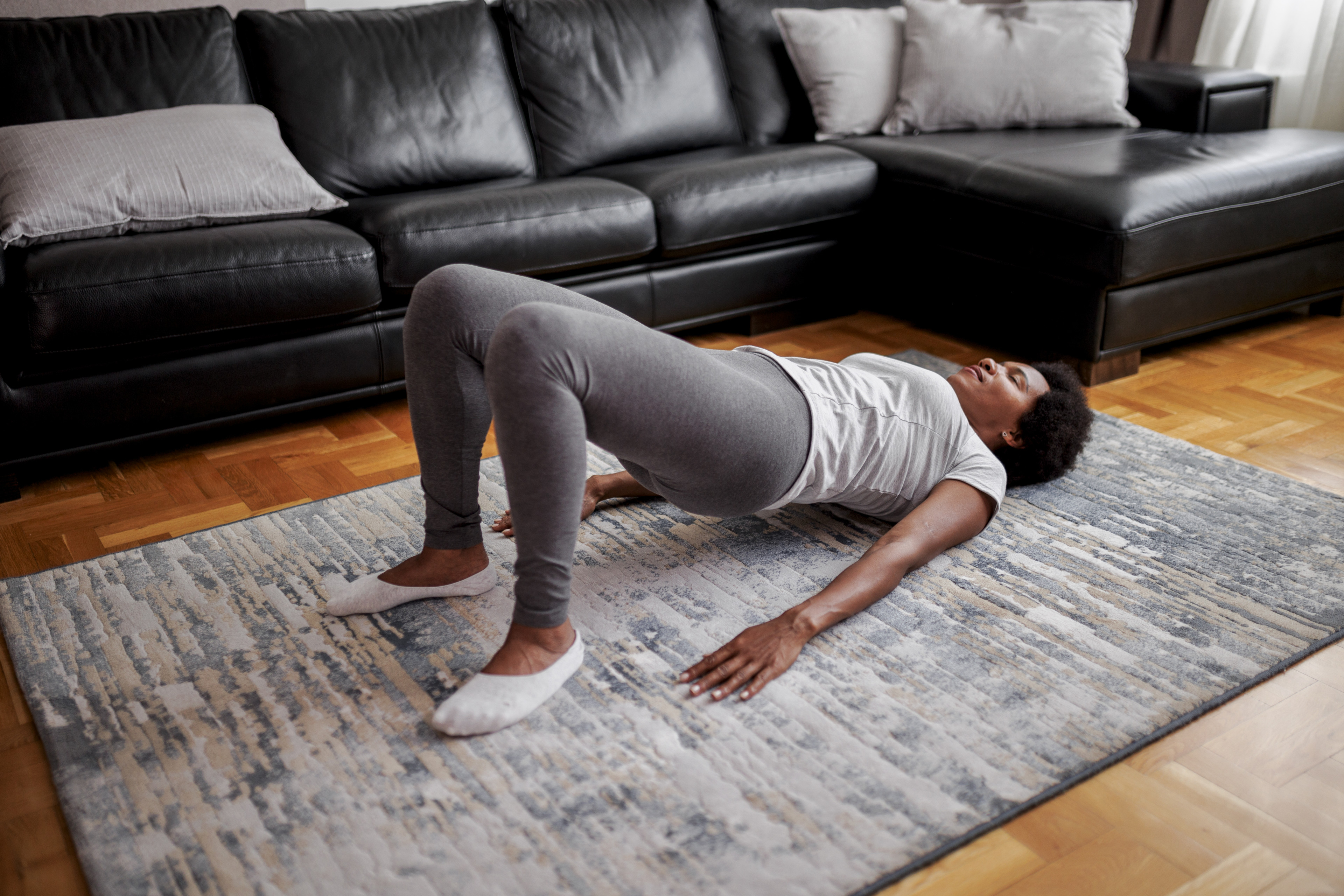
Eleganza/E+ via Getty Images
### [Glute Bridge](https://www.onepeloton.com/blog/glute-bridge)
1. Lie on your back with your knees bent and your feet planted on the ground.
2. Tighten your glute and abdominal muscles by pushing your lower back into the floor.
3. Slowly lift your hips off the ground until you’ve formed a straight diagonal line from your knees to your shoulders.
4. Pull your belly button to your spine and hold for 30 seconds. “Find a diamond position with your hands, place them on the lower abdomen, exhale, and imagine your hips are magnetizing toward each other while your pelvic floor is drawing up,” says Robin.
5. Tuck even more as you lower your hips, pausing halfway down to take another inhale and deep exhale for a total of two breaths as your hips descend.
6. Repeat for several reps.
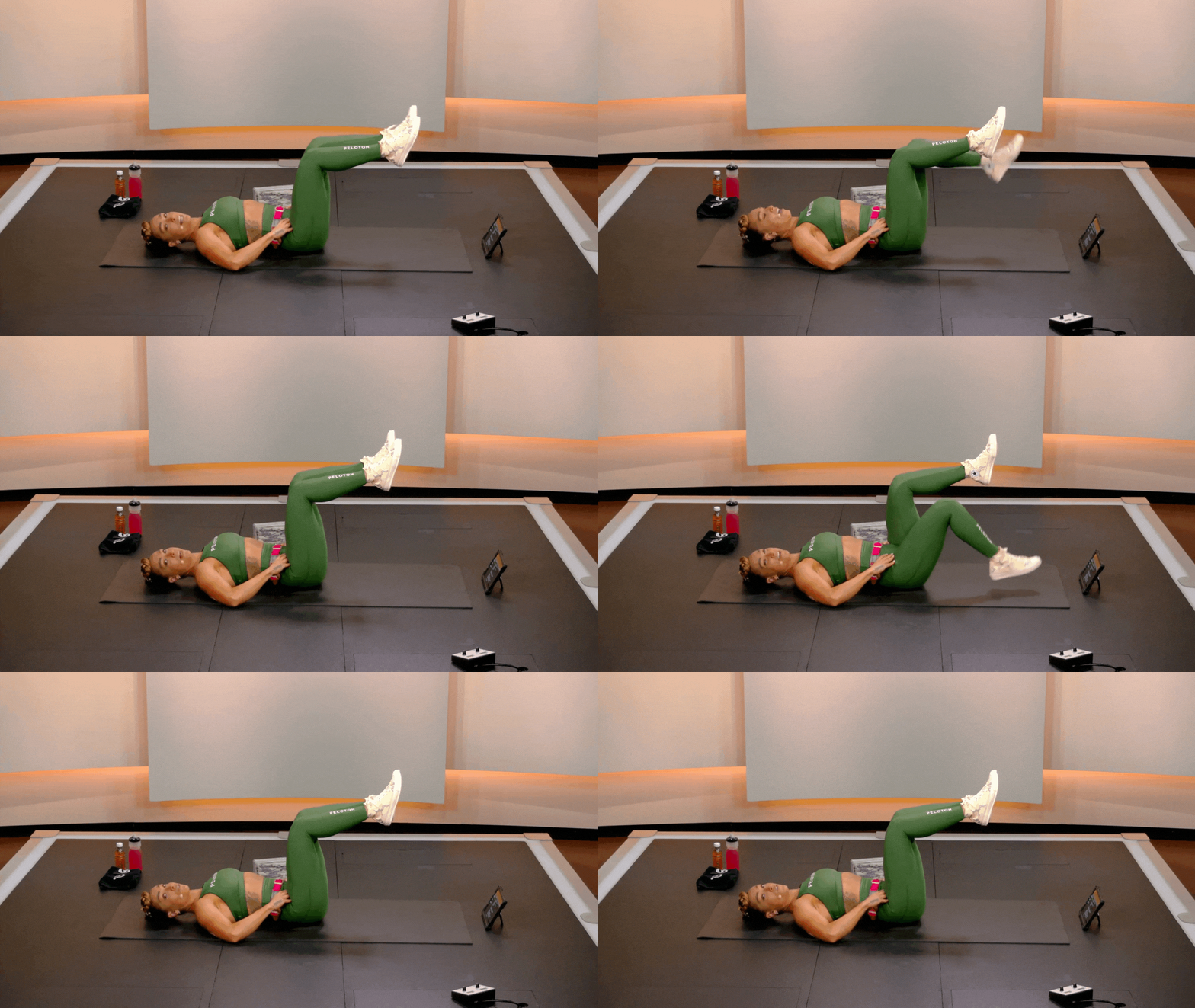
### [Heel Taps](https://www.onepeloton.com/blog/heel-taps)
1. Lie on your back. Beginners can start with both feet planted on the floor.
2. On the inhale, slowly and gently tap your right heel to the mat.
3. On the exhale, use your abdominals to lift your leg back up to tabletop position.
4. Alternate legs and repeat for several reps.
5. To level up, start with both legs in tabletop position and then slowly tap one heel at a time down to the ground, alternating legs. Repeat for several reps.
6. And for even more of a challenge, begin with both legs in tabletop. Then, lower both legs simultaneously to tap both heels to the ground at the same time. Repeat for several reps.

### Modified [Dead Bug](https://www.onepeloton.com/blog/dead-bug-exercise)
1. Lie on your back.
2. Bring your legs to tabletop position and extend your arms so they point straight up to the ceiling.
3. Beginners can start with arm work only. Inhale while extending one arm at a time towards the floor above your head.
4. Exhale as you return your arm to its starting position.
5. Alternate arms and repeat for several reps.
6. If this feels too challenging, you can plant both feet on the floor and lift just one leg into tabletop at a time, moving the same arm as leg (e.g. both on the right or left side). Repeat for several reps.
7. Another modification is to lay on your back with your legs in tabletop and your arms extended out to the ceiling, and only extend the legs out, one leg at a time. The lower the extended leg, the more challenging the work.
8. Once that feels secure—no coning or discomfort—you can move into traditional dead bug. To do so, add alternating arm extensions, extending opposite arm and leg simultaneously, and then switching to the other arm and leg (e.g. left arm, right leg, then switch).
### Leg Extensions
1. Lie on your back and bring your legs into tabletop position.
2. Extend one leg out straight to a 45-degree angle. Beginners can lift the leg higher up to 90-degrees—the lower the leg, the more challenging the exercise. Keep your lower back planted to the ground without arching throughout.
3. Alternate with the other leg.
4. Repeat for several reps.
### Leg Circles
1. Lie on your back and bring your legs into tabletop.
2. Inhale and extend one leg to the ceiling.
3. Exhale and lower the leg out to the side and back up to the starting position in a circling motion, keeping it slow and controlled the entire time. If that feels too challenging, you can do the circles with your knee bent instead. “The goal here is only to take it as wide in the circle as you can while maintaining the stability of the pelvis,” says Robin.
4. Repeat for several reps, and then switch sides.
5. Then, do each leg again, circling the legs in the opposite direction from the direction you did on the first set of reps.
6. Repeat for several reps.

### [Bird-Dog](https://www.onepeloton.com/blog/core-strength-benefits)
7. Begin on all fours in the tabletop position, placing your knees under your hips and your hands under your shoulders.
8. Keep your spine neutral.
9. Extend your right arm forward and left leg backward, keeping your shoulders and hips parallel to the floor.
10. Tuck your chin into your chest so your gaze is at the floor.
11. Hold for a few seconds and then lower back to your starting position.
12. Switch to the left arm and right leg and repeat.
13. Return to the starting position.
### Modified Side Plank
1. Sit on one hip with your legs folded.
2. Prop yourself up to 90 degrees on the arm that’s on the same side as the hip you’re sitting on.
3. Slowly lift up the hips and hold for 30 seconds, inhaling and exhaling slowly.
4. For more of a challenge, extend your top arm overhead. Then, “thread the needle” by moving it into the space between your ribs and your extended arm, finding a twist in the rib cage and shoulders.
5. Alternate to the other side.
### Rolling Plank
1. Begin on all fours in the tabletop position, placing your knees under your hips and your hands under your shoulder.
2. Tuck your toes.
3. Drop one knee down to the ground, and then the other knee.
4. Bring both knees up.
5. Repeat for several reps.
6. Once you’re ready for more of a challenge, you can hold both knees up, or extend both legs into full plank.
## Postpartum Core Strength Phases: 1-4
If you’d prefer to have professional guidance as you return to and transition through postpartum core exercises, Robin’s new Peloton Postnatal Core Strength Series is phased out to help you safely rebuild core strength after pregnancy. “Each phase is going to build on the one prior,” she says. “The idea is that you repeat a class until you feel ready to take the next one.” Some signs you might be ready are if you’re effectively “bracing”—a.k.a. activating the muscles of the core by contracting the deep abdominal muscles—to provide a solid foundation for movement and protect against injury and aren’t feeling any discomfort, coning, or uterine prolapse.
As a reminder, Robin says it’s best to check in with your healthcare provider before beginning any of her classes, and notes that you’re always welcome to modify any move.
**Phase One:** The first phase is the gentlest. It begins with 360 breathing. From there, Robin moves through heel slides, articulated bridge, toe taps, leg extension, and modified dead bug. At this level, she notes, core work will not burn as you may be used to it doing, but it is working nonetheless\!
**Phase Two:** In the second phase, Robin begins to layer in different patterns of movement, but all exercises remain on your back. The workout begins with deep breathing and then moves through single leg stretches, tabletop leg circles, modified dead bug, modified side plank, butterfly exercises with a miniband, wide leg heel taps, and [glute bridge](https://www.onepeloton.com/blog/glute-bridge).
**Phase Three:** By phase three, moves begin to challenge the core more intensely, and some are done off of your back. After deep breathing exercises, Robin moves into bird dog, bear hover, wide leg toe taps, leg scissors, and wide leg circles.
**Phase four:** Phase four, says Robin, serves as a bridge to the rest of Peloton’s regular strength classes and content. As such, it’s the most challenging. It begins with 360 deep breathing and then moves into glute bridge, one-legged glute bridge, alternating crunches, rolling plank, modified plank, and full plank.
## Mistakes to Avoid When Doing Postpartum Core Exercises
Proper form and caution is more important than ever when it comes to postpartum core exercises. Here are two mistakes Robin says it’s crucial to avoid making:
**Rushing it:** One common mistake Robin says she sees women making is returning to crunching and planking too soon. These core exercises should be gradually worked up to, as demonstrated in Robin’s four-phase Peloton Postnatal Core series.
**Not going deep:** “You want to make sure that you're really activating and working on the deep core muscles,” she says. “So that’s not the superficial abs, it’s deeper, and that’s what the 360 breathing really gets at.”
## How to Integrate Postpartum Core Exercises Into Your Workout Routine
Robin believes you should be doing postpartum core exercises or deep breathing every single day. “With postpartum core exercises, little by little will amount to a lot,” she says. “Small moments, even just a few minutes a day, are going to go a long way.”
And if you’re wondering when, exactly, it is safe to resume your pre-pregnancy core workouts, Dr. Sekhon says there is no exact timeline for when someone is no longer considered postpartum as it varies person to person, but that it’s best to ease in that direction over time. “It's essential to listen to your body and gradually reintroduce exercises, taking into account any postpartum considerations or modifications needed.” Robin’s four-phase postnatal core series offers a safe and effective way to do this—by the time you’ve completed phase four comfortably, you should be good to go\!
Recommended

# Peloton App
Access thousands of classes with no equipment needed.
[Learn more](https://www.onepeloton.com/app)[Try 30 days free](https://www.onepeloton.com/app-membership)
*This content is for informational and educational purposes only and does not constitute individualized advice. It is not intended to replace professional medical evaluation, diagnosis, or treatment. Seek the advice of your physician for questions you may have regarding your health or a medical condition. If you are having a medical emergency, call your physician or 911 immediately.*
This content is for informational and educational purposes only and does not constitute individualized advice. It is not intended to replace professional medical evaluation, diagnosis, or treatment. Seek the advice of your physician for questions you may have regarding your health or a medical condition. If you are having a medical emergency, call your physician or 911 immediately.
Share:

Featured Peloton Instructor
#### Robin Arzón
Peloton’s VP of Fitness Programming, Robin believes that sweat transforms lives. Robin is a RRCA-certified running coach, ultramarathoner, and NYT-bestselling author.
Follow:
## Level up your inbox.
Subscribe for a weekly dose of fitness, plus the latest promos, launches, and events.
By providing your email address, you agree to receive marketing communications from Peloton.
For more about how we use your information, see our [Privacy Policy.](https://www.onepeloton.com/privacy-policy)
Shop and Learn
- [Home Trial](https://www.onepeloton.com/home-trial)
- [Membership](https://www.onepeloton.com/membership)
- [Refurbished Bikes](https://www.onepeloton.com/refurbished)
- [Purchasing Used Peloton Bikes](https://www.onepeloton.com/used-bikes)
- [Gift cards](https://www.onepeloton.com/gift-cards)
- [Financing](https://www.onepeloton.com/financing)
- [Instructors](https://www.onepeloton.com/instructors)
- [Peloton for Business](https://business.onepeloton.com/)
- [The Peloton Report](https://downloads.ctfassets.net/6jnflt57iyzx/59EciC2hgJjZ8XoSnbBGbw/e3ee7a80635afee254708c5cc8f2c567/Peloton_Report_Executive_Summary.pdf)
About
- [Our Story](https://www.onepeloton.com/company)
- [Team](https://www.onepeloton.com/company/team)
- [Careers](https://careers.onepeloton.com/)
- [Press](https://www.onepeloton.com/press)
- [Global](https://global.onepeloton.com/)
- [Investors](https://investor.onepeloton.com/)
- [Impact & Inclusion](https://www.onepeloton.com/impact-inclusion)
Visit Us
- [Showrooms](https://www.onepeloton.com/showrooms)
- [Hotel Finder](https://hospitality.onepeloton.com/)
- [Booking a Test Class](https://booking.onepeloton.com/)
- [Studio](https://studio.onepeloton.com/)
Support
- [Contact Peloton](https://support.onepeloton.com/s/contact-us)
- [Member Support Center](https://support.onepeloton.com/)
- [Order Replacement Parts](https://www.onepeloton.com/shop/replacement-parts)
- [Return Policy](https://support.onepeloton.com/s/article/201108256-Peloton-Return-Policy)
- [Warranties & Protection Plans](https://support.onepeloton.com/s/article/4404036415764-Peloton-Warranties-Protection-Plans?language=en_US)
- [Shipping](https://support.onepeloton.com/s/article/203078315-What-To-Expect-From-The-In-Home-Delivery-And-Set-Up-Of-Your-Peloton-Bike?language=en_US)
- [Product Recalls](https://support.onepeloton.com/s/article/Peloton-Recall-Information)
- [Security](https://www.onepeloton.com/security)
- [Consumer Health Data Policy](https://www.onepeloton.com/consumer-health-data-policy)
Sign up to get the latest
1-866-679-9129
Visit Support Center
- [Privacy Policy](https://www.onepeloton.com/privacy-policy)
- [Terms of Service](https://www.onepeloton.com/terms-of-service)
- [Membership Terms](https://www.onepeloton.com/membership-terms)
- [IP Policy](https://www.onepeloton.com/ip-policy)
- Cookie Settings
- [Accessibility](https://www.onepeloton.com/accessibility)
- [California Transparency Act](https://investor.onepeloton.com/static-files/4e447c26-4cf4-49bf-9193-ef66f3db99b2)
- © Peloton 2012-2023, Peloton Interactive, Inc. All rights reserved. |
| Readable Markdown | Pregnancy is not easy on the body generally, but the core is specifically challenged by prenatal changes. After all, there is a *lot* going on around the core muscles during pregnancy as the abdomen makes room for a growing baby. Something’s got to give in the process, and that something is often the strength of the core. These changes matter, which is why you may be considering trying postpartum core exercises.
Discover more ways to reach your goals with Peloton
[Core strength](https://www.onepeloton.com/blog/core-strength-benefits) helps stabilize the lower back and improve [balance](https://www.onepeloton.com/blog/how-to-improve-balance), [posture](https://www.onepeloton.com/blog/posture-exercises), and [flexibility](https://www.onepeloton.com/blog/mobility-vs-flexibility). It also makes everyday tasks easier and lowers the risk of chronic pain and injury.
For these reasons, it’s important to prioritize re-strengthening the core post-pregnancy, but returning to core workouts after having a baby can be daunting. Things do not look or feel as they did before, and the last thing you want to do is injure an already delicate area by making the wrong moves.
Below, experts unpack everything you need to know in order to safely engage in postpartum core exercises.
Here’s Why and How Your Core Changes During Pregnancy
Core changes during pregnancy aren’t just aesthetic. According to [Dr. Lucky Sekhon](https://www.instagram.com/lucky.sekhon), Double Board Certified REI & OBGYN at [RMA of New York](https://www.rmany.com/our-team/physicians/dr-lucky-sekhon)and founding member of [Doctors for Fertility](https://www.linkedin.com/company/doctors-for-fertility), the core muscles undergo significant physical changes to accommodate the growing fetus. “The abdominal muscles, including the rectus abdominis, may stretch and separate to make room for the expanding uterus,” she says. Additionally, hormonal changes loosen ligaments, which can affect stability in the core area, she says. Some women also develop a core-related condition called diastasis recti during pregnancy.
What Is Diastasis Recti?
Diastasis recti is a condition characterized by separation of the abdominal muscles, specifically the rectus abdominis. “It often develops during pregnancy due to the stretching and thinning of the linea alba, the connective tissue that runs down the midline of the abdomen,” says Dr. Sekhon. “This can result in a visible bulge or indentation in the midsection.” While some cases of diastasis recti may improve on their own after birth, others may persist. “To check for diastasis recti, you can lie on your back with knees bent, then lift your head and shoulders off the ground while placing fingers above and below the belly button to feel for any separation,” Dr. Sekhon says.
Can You Do Core Exercises During Pregnancy?
Conventional wisdom holds that it’s safe to continue any workout you were doing prior to pregnancy while pregnant, with appropriate modifications. This includes core work, which Dr. Sekhon says you can and should do (after checking in with your doctor). “Regular core exercise during pregnancy may help maintain strength and stability in the abdominal muscles, potentially aiding in postpartum recovery,” she says.
Core exercises are just going to look a bit different than they did in your pre-pregnancy workouts. “Primarily, the core should be exercised through deep breathwork—360 breathing,” says [Robin Arzón](https://www.onepeloton.com/instructors/robin), Peloton Head Instructor and VP of Fitness Programming. (More on that in a bit.) And while you can still do normal ab exercises in the first trimester in most cases—it’s best to check with your doctor for specific recommendations—by the second and third trimesters, or whenever you have a visible belly, Robin says you’ll generally want to avoid crunching.
You can continue [planks](https://www.onepeloton.com/blog/1-minute-plank-every-day), if you were doing them pre-pregnancy and have no pregnancy complications, but they’ll need to be modified at some point, she says. Typically, that point is in the second trimester, but exact timing will vary according to the individual.
Such modifications generally involve elevating your hands to a higher surface for an incline plank, dropping your knees, or engaging the abs while seated on a large medicine ball. “You just want to make sure that you're not coning, doming, or leaking \[a.ka. experiencing urinary incontinence\] throughout the movement, as that's going to be an indication there's too much intra abdominal pressure,” she says. Coning, or doming, is when the Linea alba pushes out further than the rest of the abdominal wall, resulting in a tent or triangle shape of the abdomen.
Is It Safe to Do Postpartum Core Exercises After Giving Birth?
The postpartum period is one of the most physically delicate periods of a woman’s life—if not *the* most—and the thought of doing any kind of ab work in those early days post-birth can be a scary one. And while you shouldn’t fear [returning to exercise after baby](https://www.onepeloton.com/blog/postpartum-fitness), it’s also incredibly important not to rush the transition. A safe return to core work is possible, but proper consultation and education is critical. Below, Dr. Sekhon explains how and when it’s safe to re-[engage your core](https://www.onepeloton.com/blog/how-to-engage-your-core) in the postpartum period.
How Soon Can You Do Core Exercises Postpartum?
According to Dr. Sekhon, the timing for resuming core exercises postpartum varies depending on individual factors such as delivery type, recovery, and overall fitness level. “Generally, it's recommended to wait until after the postpartum check-up, which typically occurs around six weeks after vaginal delivery and longer after a cesarean section to account for the time needed for the surgical incision to heal,” she says. “Women with diastasis recti, pelvic floor issues, or other postpartum complications should approach core exercises with caution.“ It is crucial for all postpartum women to check in with a healthcare provider before starting any prenatal exercise regimen, she says.
Remember how to check for diastasis recti? Lie on your back with knees bent, then lift your head and shoulders off the ground while placing fingers above and below the belly button to feel for any separation. If the condition persists after childbirth, it may require specific exercises tailored to help strengthen and close the gap in the abdominal muscles. “Traditional core exercises like crunches or planks may need to be modified or avoided until the condition improves,” Dr. Sekhon says. Again, she recommends checking in with a health care provider or physical therapist for professional guidance.
According to Robin, you may also want to see a pelvic floor specialist, no matter what kind of birth you’ve had. “The [pelvic floor](https://www.onepeloton.com/blog/pelvic-floor-explained) is part of the core and can be affected post-pregnancy,” she says.
The Benefits of Strengthening Your Core After Having a Baby
In general, it’s important to resume exercise post-pregnancy when cleared to do so by your doctor. This is due not only to the physical benefits of moving your body but also the mental benefits, which can be hugely important in this emotionally delicate time. “As a new parent, taking time for yourself to remember that you're a whole person is incredibly important, even if it's five or 10 minutes,” says Robin.
It’s specifically “crucial” she says, to train and strengthen your core post-pregnancy because the core stabilizes the entire body. “All functional movements—sitting, standing, squatting, walking, and running—involve core stability,” she says. And yes, that definitely includes lifting and carrying a quickly growing baby (and all the stuff that comes with them!).
The good news is that no matter what shape your core is in post-pregnancy, it can and will bounce back. “Our stabilizer muscles are incredibly resilient,” says Robin.
10 Best Postpartum Core Exercises (And How to Do Them Safely)
One of the best features of postnatal core workouts is that they don’t require equipment, which makes them easier to squeeze in under whatever circumstances you might be able to do so with a new baby forever beckoning. “Postpartum folks should only use bodyweight in their core workouts,” says Robin. “No need to add on weights just yet.”
Below, she shares 10 of her favorite postpartum core exercises that will help you reclaim core strength after baby. “Whether you’re six weeks or six years postpartum, these are great, diastasis-safe exercises,” she says.

360 Diaphragmatic Breathing
Robin always begins her postnatal workouts with 360 diaphragmatic breathing, which is a deep breathing technique where your breath is used to create expansion in your abdomen and rib cage. “This is the same type of deep breathing that would have been recommended throughout pregnancy,” she says. “It is one of the most, if not *the* most, effective ways to re-strengthen the neural pathways of the core and to close diastasis, and it can be done in the early postpartum period after you’ve been cleared for movement.”
1. To perform this type of breathing, start by lying flat on your back (you can also do this move from a seated position) and placing your hands around your lower rib cage, with your fingers in the front and your thumbs in the back.
2. Inhale through your nose to expand your rib cage 360 degrees, pushing it into your hands in all directions.
3. Exhale through your lips—”as if you’re blowing out one thousand birthday candles,” says Robin. “The rib cage contracts, and the front of your body and the back of your body get closer together,” she says. “So it’s not a sucking in of the belly, it’s as if someone is wrapping you in mummy tape.”
4. Repeat for several breaths.

Heel Slides
1. Lie on your back with your knees bent and feet planted on the ground.
2. Slowly extend one leg all the way flat, leading with the heel, while exhaling.
3. Inhale as you bring the heel slowly back in.
4. Alternate to the other leg, and repeat for several reps.

Eleganza/E+ via Getty Images
[Glute Bridge](https://www.onepeloton.com/blog/glute-bridge)
1. Lie on your back with your knees bent and your feet planted on the ground.
2. Tighten your glute and abdominal muscles by pushing your lower back into the floor.
3. Slowly lift your hips off the ground until you’ve formed a straight diagonal line from your knees to your shoulders.
4. Pull your belly button to your spine and hold for 30 seconds. “Find a diamond position with your hands, place them on the lower abdomen, exhale, and imagine your hips are magnetizing toward each other while your pelvic floor is drawing up,” says Robin.
5. Tuck even more as you lower your hips, pausing halfway down to take another inhale and deep exhale for a total of two breaths as your hips descend.
6. Repeat for several reps.

[Heel Taps](https://www.onepeloton.com/blog/heel-taps)
1. Lie on your back. Beginners can start with both feet planted on the floor.
2. On the inhale, slowly and gently tap your right heel to the mat.
3. On the exhale, use your abdominals to lift your leg back up to tabletop position.
4. Alternate legs and repeat for several reps.
5. To level up, start with both legs in tabletop position and then slowly tap one heel at a time down to the ground, alternating legs. Repeat for several reps.
6. And for even more of a challenge, begin with both legs in tabletop. Then, lower both legs simultaneously to tap both heels to the ground at the same time. Repeat for several reps.

Modified [Dead Bug](https://www.onepeloton.com/blog/dead-bug-exercise)
1. Lie on your back.
2. Bring your legs to tabletop position and extend your arms so they point straight up to the ceiling.
3. Beginners can start with arm work only. Inhale while extending one arm at a time towards the floor above your head.
4. Exhale as you return your arm to its starting position.
5. Alternate arms and repeat for several reps.
6. If this feels too challenging, you can plant both feet on the floor and lift just one leg into tabletop at a time, moving the same arm as leg (e.g. both on the right or left side). Repeat for several reps.
7. Another modification is to lay on your back with your legs in tabletop and your arms extended out to the ceiling, and only extend the legs out, one leg at a time. The lower the extended leg, the more challenging the work.
8. Once that feels secure—no coning or discomfort—you can move into traditional dead bug. To do so, add alternating arm extensions, extending opposite arm and leg simultaneously, and then switching to the other arm and leg (e.g. left arm, right leg, then switch).
Leg Extensions
1. Lie on your back and bring your legs into tabletop position.
2. Extend one leg out straight to a 45-degree angle. Beginners can lift the leg higher up to 90-degrees—the lower the leg, the more challenging the exercise. Keep your lower back planted to the ground without arching throughout.
3. Alternate with the other leg.
4. Repeat for several reps.
Leg Circles
1. Lie on your back and bring your legs into tabletop.
2. Inhale and extend one leg to the ceiling.
3. Exhale and lower the leg out to the side and back up to the starting position in a circling motion, keeping it slow and controlled the entire time. If that feels too challenging, you can do the circles with your knee bent instead. “The goal here is only to take it as wide in the circle as you can while maintaining the stability of the pelvis,” says Robin.
4. Repeat for several reps, and then switch sides.
5. Then, do each leg again, circling the legs in the opposite direction from the direction you did on the first set of reps.
6. Repeat for several reps.

[Bird-Dog](https://www.onepeloton.com/blog/core-strength-benefits)
7. Begin on all fours in the tabletop position, placing your knees under your hips and your hands under your shoulders.
8. Keep your spine neutral.
9. Extend your right arm forward and left leg backward, keeping your shoulders and hips parallel to the floor.
10. Tuck your chin into your chest so your gaze is at the floor.
11. Hold for a few seconds and then lower back to your starting position.
12. Switch to the left arm and right leg and repeat.
13. Return to the starting position.
Modified Side Plank
1. Sit on one hip with your legs folded.
2. Prop yourself up to 90 degrees on the arm that’s on the same side as the hip you’re sitting on.
3. Slowly lift up the hips and hold for 30 seconds, inhaling and exhaling slowly.
4. For more of a challenge, extend your top arm overhead. Then, “thread the needle” by moving it into the space between your ribs and your extended arm, finding a twist in the rib cage and shoulders.
5. Alternate to the other side.
Rolling Plank
1. Begin on all fours in the tabletop position, placing your knees under your hips and your hands under your shoulder.
2. Tuck your toes.
3. Drop one knee down to the ground, and then the other knee.
4. Bring both knees up.
5. Repeat for several reps.
6. Once you’re ready for more of a challenge, you can hold both knees up, or extend both legs into full plank.
Postpartum Core Strength Phases: 1-4
If you’d prefer to have professional guidance as you return to and transition through postpartum core exercises, Robin’s new Peloton Postnatal Core Strength Series is phased out to help you safely rebuild core strength after pregnancy. “Each phase is going to build on the one prior,” she says. “The idea is that you repeat a class until you feel ready to take the next one.” Some signs you might be ready are if you’re effectively “bracing”—a.k.a. activating the muscles of the core by contracting the deep abdominal muscles—to provide a solid foundation for movement and protect against injury and aren’t feeling any discomfort, coning, or uterine prolapse.
As a reminder, Robin says it’s best to check in with your healthcare provider before beginning any of her classes, and notes that you’re always welcome to modify any move.
**Phase One:** The first phase is the gentlest. It begins with 360 breathing. From there, Robin moves through heel slides, articulated bridge, toe taps, leg extension, and modified dead bug. At this level, she notes, core work will not burn as you may be used to it doing, but it is working nonetheless\!
**Phase Two:** In the second phase, Robin begins to layer in different patterns of movement, but all exercises remain on your back. The workout begins with deep breathing and then moves through single leg stretches, tabletop leg circles, modified dead bug, modified side plank, butterfly exercises with a miniband, wide leg heel taps, and [glute bridge](https://www.onepeloton.com/blog/glute-bridge).
**Phase Three:** By phase three, moves begin to challenge the core more intensely, and some are done off of your back. After deep breathing exercises, Robin moves into bird dog, bear hover, wide leg toe taps, leg scissors, and wide leg circles.
**Phase four:** Phase four, says Robin, serves as a bridge to the rest of Peloton’s regular strength classes and content. As such, it’s the most challenging. It begins with 360 deep breathing and then moves into glute bridge, one-legged glute bridge, alternating crunches, rolling plank, modified plank, and full plank.
Mistakes to Avoid When Doing Postpartum Core Exercises
Proper form and caution is more important than ever when it comes to postpartum core exercises. Here are two mistakes Robin says it’s crucial to avoid making:
**Rushing it:** One common mistake Robin says she sees women making is returning to crunching and planking too soon. These core exercises should be gradually worked up to, as demonstrated in Robin’s four-phase Peloton Postnatal Core series.
**Not going deep:** “You want to make sure that you're really activating and working on the deep core muscles,” she says. “So that’s not the superficial abs, it’s deeper, and that’s what the 360 breathing really gets at.”
How to Integrate Postpartum Core Exercises Into Your Workout Routine
Robin believes you should be doing postpartum core exercises or deep breathing every single day. “With postpartum core exercises, little by little will amount to a lot,” she says. “Small moments, even just a few minutes a day, are going to go a long way.”
And if you’re wondering when, exactly, it is safe to resume your pre-pregnancy core workouts, Dr. Sekhon says there is no exact timeline for when someone is no longer considered postpartum as it varies person to person, but that it’s best to ease in that direction over time. “It's essential to listen to your body and gradually reintroduce exercises, taking into account any postpartum considerations or modifications needed.” Robin’s four-phase postnatal core series offers a safe and effective way to do this—by the time you’ve completed phase four comfortably, you should be good to go\!
Recommended
## Peloton App
Access thousands of classes with no equipment needed.
*This content is for informational and educational purposes only and does not constitute individualized advice. It is not intended to replace professional medical evaluation, diagnosis, or treatment. Seek the advice of your physician for questions you may have regarding your health or a medical condition. If you are having a medical emergency, call your physician or 911 immediately.*
This content is for informational and educational purposes only and does not constitute individualized advice. It is not intended to replace professional medical evaluation, diagnosis, or treatment. Seek the advice of your physician for questions you may have regarding your health or a medical condition. If you are having a medical emergency, call your physician or 911 immediately. |
| Shard | 137 (laksa) |
| Root Hash | 12150172137472338337 |
| Unparsed URL | com,onepeloton!www,/blog/postpartum-core-exercises s443 |