ℹ️ Skipped - page is already crawled
| Filter | Status | Condition | Details |
|---|---|---|---|
| HTTP status | PASS | download_http_code = 200 | HTTP 200 |
| Age cutoff | PASS | download_stamp > now() - 6 MONTH | 0.1 months ago |
| History drop | PASS | isNull(history_drop_reason) | No drop reason |
| Spam/ban | PASS | fh_dont_index != 1 AND ml_spam_score = 0 | ml_spam_score=0 |
| Canonical | PASS | meta_canonical IS NULL OR = '' OR = src_unparsed | Not set |
| Property | Value | ||||||||||||||||||
|---|---|---|---|---|---|---|---|---|---|---|---|---|---|---|---|---|---|---|---|
| URL | https://www.nrdc.org/bio/zanagee-artis/fourteen-years-after-deepwater-horizon-drilling-still-threat | ||||||||||||||||||
| Last Crawled | 2026-04-21 08:20:39 (2 days ago) | ||||||||||||||||||
| First Indexed | 2024-04-19 19:14:25 (2 years ago) | ||||||||||||||||||
| HTTP Status Code | 200 | ||||||||||||||||||
| Content | |||||||||||||||||||
| Meta Title | Fourteen Years After Deepwater Horizon | ||||||||||||||||||
| Meta Description | Despite the devastation of the BP Deepwater Horizon disaster, offshore drilling remains a threat to communities, our ocean, and the climate.... | ||||||||||||||||||
| Meta Canonical | null | ||||||||||||||||||
| Boilerpipe Text | Credit:
Ray Hennessy
NRDC Logo
2X MATCH FOR EARTH DAY
This Earth Day, everything is on the line.
The Trump administration is stripping protections for the air we breathe, the water we drink, and the lands we love.
Your Earth Day gift will be 2X matched until 4/22 to help NRDC fight back in and out of court.
DOUBLE MY GIFT
See all News & Commentary
Oil supply boats use water cannons to fight fire and smoke rising from BP's mobile offshore drilling unit called Deepwater Horizon following an explosion on the rig in the Gulf of Mexico.
Credit:
U.S. Coast Guard
Fourteen years after the BP Deepwater Horizon oil spill in the Gulf of Mexico, it could happen again. The devastating consequences of our dependence on fossil fuels are especially clear as we look back on one of the greatest environmental disasters in history. On April 20, 2010, barrels upon barrels of oil gushed into the Gulf of Mexico following an explosion on the BP Deepwater Horizon oil rig. The explosion took the lives of 11 workers stationed on the rig and unleashed roughly
3.19 million barrels (134 million gallons)
of oil into the Gulf, which flowed for 87 days. To say that the spill was catastrophic for marine ecosystems, coastal communities, and Gulf South economies would be a grotesque understatement. The impacts of the disaster continue to reverberate throughout the Gulf South today.
Beyond the devastating impacts for marine ecosystems, the BP Deepwater Horizon disaster had a profound human impact. The spill oiled 1,300 miles of shoreline across Alabama, Mississippi, Louisiana, Texas, and Florida. The surface oil slick cumulative extent totaled
43,300 square miles
(approximately equal to the size of Virginia). Fishermen saw their livelihoods erased as
state and federal fisheries were closed in the Gulf of Mexico
. Coastal economies lost hundreds of millions of dollars in commercial fishing and tourism because of the fossil fuel industry’s reckless pursuit of profit. The fossil fuel industry is pushing for even more offshore drilling despite the clear evidence of what happens when they drill and who bears the consequences.
A Rice's Whale in the Gulf of Mexico. Credit: NOAA Fisheries/Laura Dias (Permit #14450)
Of the many species hit by the BP Deepwater Horizon oil spill, one of the most impacted species was the
Gulf of Mexico whale
(also known as Rice’s whale). This whale is endemic to the Gulf of Mexico, and offshore drilling is hurtling the species toward extinction. Although the BP Deepwater Horizon drilling platform was outside the known habitat range of the Gulf whale, the spill
killed roughly 17% of the whales outright
. It caused reproductive failure and other misery in much of the rest of the population. There are fewer than 100 of these critically endangered whales alive today. A unique part of the region’s—and the country’s—natural history, the Gulf whale could be silenced forever if offshore drilling is allowed to continue.
At the same time, the same oil and gas companies polluting our waters are making billions in profits and still expecting taxpayers to foot the bill for cleaning up their messes. A recent report by the U.S. Government Accountability Office (GAO) states that over
2,700 wells and 500 platforms
are actively deteriorating and endangering our oceans, wildlife, and Gulf Coast communities. At the same time, Big Oil recklessly continues to drill in public waters.
Members of Congress agree
, “The oil and gas companies, which are making record-breaking profits using our offshore waters, should be assuming the risks of their operations, not the American people.” Gulf South communities and ecosystems cannot afford another oil spill like Deepwater Horizon.
The Deepwater Horizon disaster was not an isolated incident but a symptom of an economy that functions off of exploitation of people and the environment to further the profits of a few over the prosperity of the many. Since the BP Deepwater Horizon oil spill, millions more gallons of oil have spilled into the Gulf of Mexico. A fossil fuel economy does not have to be our reality or future. The anniversary of the BP Deepwater Horizon disaster is a reminder of the devastation that fossil fuels can have. Still, it is an opportunity to reflect on all we can save by ending our reliance on polluting industries for our energy system. It is time for accountability from the fossil fuel industry, and it is time for a fossil fuel phaseout. It is up to us to protect our coasts, our climate, and our futures because the fossil fuel industry certainly won’t. | ||||||||||||||||||
| Markdown | [Skip to main content](https://www.nrdc.org/bio/zanagee-artis/fourteen-years-after-deepwater-horizon-drilling-still-threat#main)

Credit:
Ray Hennessy
2X MATCH FOR EARTH DAY
This Earth Day, everything is on the line.
The Trump administration is stripping protections for the air we breathe, the water we drink, and the lands we love.
**Your Earth Day gift will be 2X matched until 4/22 to help NRDC fight back in and out of court.**
[DOUBLE MY GIFT](https://action.nrdc.org/donation/4888-earth-month-ngsc-041026?initms=WBSNAAPRDONC30426&ms=WBSNAAPRDONC30426)
[Search](https://www.nrdc.org/bio/zanagee-artis/fourteen-years-after-deepwater-horizon-drilling-still-threat)
## Search
- Learn About the Climate Crisis
- [Climate Crisis 101](https://www.nrdc.org/climate-crisis)
- [What Is Climate Change?](https://www.nrdc.org/stories/what-climate-change)
- [Causes](https://www.nrdc.org/stories/what-are-causes-climate-change)
- [Effects](https://www.nrdc.org/stories/what-are-effects-climate-change)
- [Solutions](https://www.nrdc.org/stories/what-are-solutions-climate-change)
- [Take Action](https://action.nrdc.org/letter/4573-ocs-5-year-plan-112125?initms=WBSNAOCSPETC31125&ms=WBSNAOCSPETC31125)
- About NRDC
- [Our Mission](https://www.nrdc.org/about)
- [History & Victories](https://www.nrdc.org/about#history)
- [Leadership & Board of Trustees](https://www.nrdc.org/leadership)
- [Our Experts](https://www.nrdc.org/experts)
- [How We Work](https://www.nrdc.org/about#how-we-work)
- [Where We Work](https://www.nrdc.org/about#where-we-work)
- [Financials](https://www.nrdc.org/about#financials)
- [Sustainability at NRDC](https://www.nrdc.org/sustainability-nrdc)
- Our Work
- [Climate Change](https://www.nrdc.org/issues/climate-change)
- [Agriculture & Food](https://www.nrdc.org/issues/agriculture-food)
- [Buildings](https://www.nrdc.org/issues/buildings)
- [Climate Adaptation](https://www.nrdc.org/issues/climate-adaptation)
- [Fossil Fuels](https://www.nrdc.org/issues/fossil-fuels)
- [Industrial Production](https://www.nrdc.org/issues/industrial-production)
- [Renewable Energy](https://www.nrdc.org/issues/renewable-energy)
- [Sustainable Cities](https://www.nrdc.org/issues/sustainable-cities)
- [Sustainable Finance](https://www.nrdc.org/issues/sustainable-finance)
- [Transportation](https://www.nrdc.org/issues/transportation)
- [Equity & Justice](https://www.nrdc.org/issues/equity-justice)
- [Human Health](https://www.nrdc.org/issues/human-health)
- [Agriculture & Food](https://www.nrdc.org/issues/agriculture-food)
- [Clean Air](https://www.nrdc.org/issues/clean-air)
- [Drinking Water](https://www.nrdc.org/issues/drinking-water)
- [Toxics](https://www.nrdc.org/issues/toxics)
- [Nature & Wildlife](https://www.nrdc.org/issues/nature-wildlife)
- [Forests & Lands](https://www.nrdc.org/issues/forests-lands)
- [Fresh Water](https://www.nrdc.org/issues/fresh-water)
- [Ocean](https://www.nrdc.org/issues/oceans)
- [Wildlife](https://www.nrdc.org/issues/wildlife)
- Stay Informed
- [News & Commentary](https://www.nrdc.org/news-and-commentary)
- [Data, Reports & Resources](https://www.nrdc.org/data-reports-resources)
- [Court Battles](https://www.nrdc.org/court-battles)
- [Subscribe](https://action.nrdc.org/petition/4273-email-and-text-alerts?initms=WBSNAETASIGC30825SI&ms=WBSNAETASIGC30825SI)
- Take Action
- [Petitions & Letters](https://www.nrdc.org/take-action/add-your-voice)
- [Toolkits & How-Tos](https://www.nrdc.org/take-action/toolkits)
- [Events](https://www.nrdc.org/take-action/events)
- [Ways to Give](https://www.nrdc.org/ways-give)
- [Action Alerts](https://action.nrdc.org/petition/4273-email-and-text-alerts?initms=WBSNAETASIGC30825TA&ms=WBSNAETASIGC30825TA)
- Ways to Give
- [Donate](https://action.nrdc.org/donation/2554-support-nrdc?initms=HOMENV&ms=HOMENV)
- [Give Monthly](https://action.nrdc.org/donation/2554-support-nrdc?initms=HOMENV&ms=HOMENV)
- [Renew Membership](https://action.nrdc.org/donation/1308-renewal-match-010123?initms=HOMENV&ms=HOMENV)
- [Donor-advised Funds](https://nrdc.planmygift.org/donor-advised-funds)
- [Gifts of Stock](https://nrdc.tfaforms.net/wfJ7219)
- [More Ways to Give](https://www.nrdc.org/ways-give?initms=HOMENV&ms=HOMENV)
[Donate](https://action.nrdc.org/donation/2554-support-nrdc?initms=HOMERB&ms=HOMERB)
1. [See all News & Commentary](https://www.nrdc.org/news-and-commentary?f%5B0%5D=news_commentary_language%3Aen#listing-page-content)
[Expert Blog](https://www.nrdc.org/news-and-commentary?f%5B0%5D=news_commentary_language%3Aen&f%5B1%5D=news_commentary_type%3Aexpert_blog#listing-page-content)
# Fourteen Years After Deepwater Horizon, Drilling is Still a Threat
Despite the devastation of the BP Deepwater Horizon disaster, offshore drilling remains a threat to communities, our ocean, and the climate.
April 19, 2024
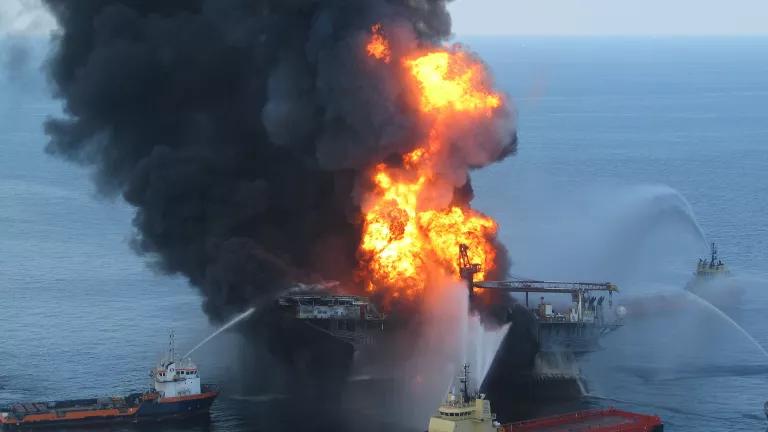
Oil supply boats use water cannons to fight fire and smoke rising from BP's mobile offshore drilling unit called Deepwater Horizon following an explosion on the rig in the Gulf of Mexico.
Credit:
U.S. Coast Guard
[ Zanagee Artis Fossil Fuels Policy Advocate, Nature](https://www.nrdc.org/bio/zanagee-artis)
Share this page
Fourteen years after the BP Deepwater Horizon oil spill in the Gulf of Mexico, it could happen again. The devastating consequences of our dependence on fossil fuels are especially clear as we look back on one of the greatest environmental disasters in history. On April 20, 2010, barrels upon barrels of oil gushed into the Gulf of Mexico following an explosion on the BP Deepwater Horizon oil rig. The explosion took the lives of 11 workers stationed on the rig and unleashed roughly [3\.19 million barrels (134 million gallons)](https://www.fisheries.noaa.gov/news/deepwater-horizon-10-years-later-10-questions) of oil into the Gulf, which flowed for 87 days. To say that the spill was catastrophic for marine ecosystems, coastal communities, and Gulf South economies would be a grotesque understatement. The impacts of the disaster continue to reverberate throughout the Gulf South today.
Beyond the devastating impacts for marine ecosystems, the BP Deepwater Horizon disaster had a profound human impact. The spill oiled 1,300 miles of shoreline across Alabama, Mississippi, Louisiana, Texas, and Florida. The surface oil slick cumulative extent totaled [43,300 square miles](https://www.fisheries.noaa.gov/news/deepwater-horizon-10-years-later-10-questions) (approximately equal to the size of Virginia). Fishermen saw their livelihoods erased as [state and federal fisheries were closed in the Gulf of Mexico](https://www.pnas.org/doi/full/10.1073/pnas.1108886109#:~:text=At%20the%20greatest%20extent%20of,Economic%20Zone%20were%20closed%20\(Fig.). Coastal economies lost hundreds of millions of dollars in commercial fishing and tourism because of the fossil fuel industry’s reckless pursuit of profit. The fossil fuel industry is pushing for even more offshore drilling despite the clear evidence of what happens when they drill and who bears the consequences.
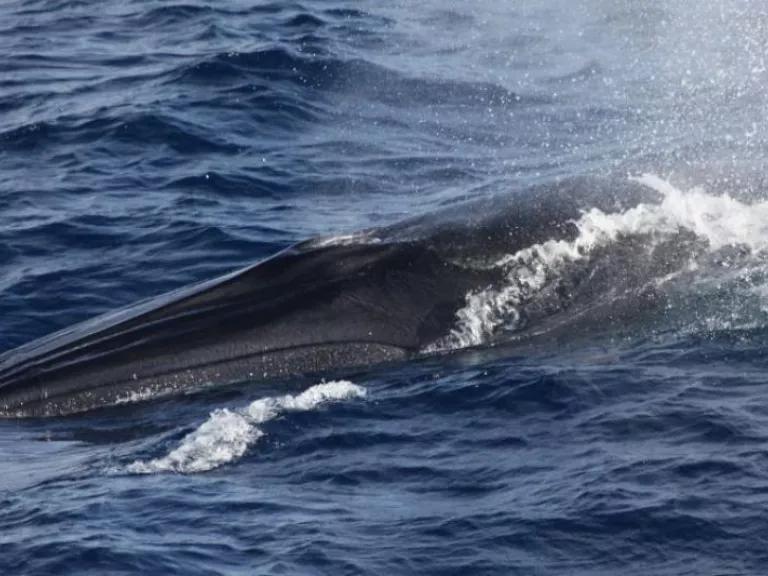
*A Rice's Whale in the Gulf of Mexico. Credit: NOAA Fisheries/Laura Dias (Permit \#14450)*
Of the many species hit by the BP Deepwater Horizon oil spill, one of the most impacted species was the [Gulf of Mexico whale](https://www.nrdc.org/bio/michael-jasny/new-rule-would-let-oil-industry-harm-most-endangered-whale) (also known as Rice’s whale). This whale is endemic to the Gulf of Mexico, and offshore drilling is hurtling the species toward extinction. Although the BP Deepwater Horizon drilling platform was outside the known habitat range of the Gulf whale, the spill [killed roughly 17% of the whales outright](https://www.nrdc.org/bio/zanagee-artis/marine-life-casualties-offshore-drilling). It caused reproductive failure and other misery in much of the rest of the population. There are fewer than 100 of these critically endangered whales alive today. A unique part of the region’s—and the country’s—natural history, the Gulf whale could be silenced forever if offshore drilling is allowed to continue.
At the same time, the same oil and gas companies polluting our waters are making billions in profits and still expecting taxpayers to foot the bill for cleaning up their messes. A recent report by the U.S. Government Accountability Office (GAO) states that over [2,700 wells and 500 platforms](https://www.gao.gov/products/gao-24-106229) are actively deteriorating and endangering our oceans, wildlife, and Gulf Coast communities. At the same time, Big Oil recklessly continues to drill in public waters. [Members of Congress agree](https://thehill.com/opinion/congress-blog/4546330-as-big-oils-mess-in-our-oceans-grows-their-bonding-requirements-should-too/), “The oil and gas companies, which are making record-breaking profits using our offshore waters, should be assuming the risks of their operations, not the American people.” Gulf South communities and ecosystems cannot afford another oil spill like Deepwater Horizon.
The Deepwater Horizon disaster was not an isolated incident but a symptom of an economy that functions off of exploitation of people and the environment to further the profits of a few over the prosperity of the many. Since the BP Deepwater Horizon oil spill, millions more gallons of oil have spilled into the Gulf of Mexico. A fossil fuel economy does not have to be our reality or future. The anniversary of the BP Deepwater Horizon disaster is a reminder of the devastation that fossil fuels can have. Still, it is an opportunity to reflect on all we can save by ending our reliance on polluting industries for our energy system. It is time for accountability from the fossil fuel industry, and it is time for a fossil fuel phaseout. It is up to us to protect our coasts, our climate, and our futures because the fossil fuel industry certainly won’t.
Related Issues
[Ocean](https://www.nrdc.org/issues/oceans) [Fossil Fuels](https://www.nrdc.org/issues/fossil-fuels)
## Related Blogs
[Skip carousel items](https://www.nrdc.org/bio/zanagee-artis/fourteen-years-after-deepwater-horizon-drilling-still-threat#carousel)

[16 Years after Deepwater Horizon, We’re Charging in the Wrong Direction](https://www.nrdc.org/bio/rebecca-loomis/sixteen-years-after-deepwater-horizon-were-charging-wrong-direction)
April 20, 2026
Expert BlogUnited States, LouisianaRebecca Loomis
From aggressively expanding offshore drilling to reversing protections for U.S. coasts, waters, and wildlife, pro-polluters are putting the country at greater risk of the next catastrophic oil spill.

[The God Squad from Hell: Trump Convened Committee to Greenlight Extinction](https://www.nrdc.org/bio/michael-jasny/god-squad-hell-trump-convenes-committee-explore-extinction)
March 31, 2026
Expert BlogUnited States, LouisianaMichael Jasny, Lucas Rhoads
The administration voted in favor of oil and gas interests over the survival of some of America’s most imperiled wildlife.

[\$1 Trillion: The Social Cost of Plastic in the United States](https://www.nrdc.org/bio/renee-sharp/1-trillion-social-cost-plastic-united-states)
November 6, 2025
Expert BlogUnited StatesRenée Sharp, Shannon Goff
A new report shows that the true costs of plastic are far more than what you see on the price tag.
Thanks for signing up. You’ll receive your first NRDC action alert and update email soon\!
## Thank you for subscribing\!
We will be reaching out to you at:
\[Email\]
## Thank you for the information\!
Providing us ways to reach out allows us to work together to solve the issues facing us. You can expect updates at:
\[Email\]
\[Phone number\]
Close
- [About NRDC (Natural Resources Defense Council)](https://www.nrdc.org/about)
- [Resources](https://www.nrdc.org/data-reports-resources)
- [Media Center](https://www.nrdc.org/media)
- [Careers](https://www.nrdc.org/careers)
- [Contact Us](https://www.nrdc.org/contact-us)
- [En Español](https://www.nrdc.org/es/nrdc-espanol)
- [Bluesky](https://bsky.app/profile/nrdc.org)
- [Facebook](https://www.facebook.com/nrdc.org)
- [Instagram](https://www.instagram.com/nrdc_org/)
- [LinkedIn](https://www.linkedin.com/company/natural-resources-defense-council/)
- [RSS](https://www.nrdc.org/rss.xml)
- [TikTok](https://www.tiktok.com/@nrdc.org)
- [X](https://twitter.com/nrdc)
- [YouTube](https://www.youtube.com/user/NRDCflix)
- [Sitemap](https://www.nrdc.org/sitemap)
- [Privacy Policy](https://www.nrdc.org/privacy-policy)
- [State Disclosures](https://www.nrdc.org/state-disclosures)
© 2026 NRDC. All rights reserved. | ||||||||||||||||||
| Readable Markdown | 
Credit:
Ray Hennessy
2X MATCH FOR EARTH DAY
This Earth Day, everything is on the line.
The Trump administration is stripping protections for the air we breathe, the water we drink, and the lands we love.
**Your Earth Day gift will be 2X matched until 4/22 to help NRDC fight back in and out of court.**
[DOUBLE MY GIFT](https://action.nrdc.org/donation/4888-earth-month-ngsc-041026?initms=WBSNAAPRDONC30426&ms=WBSNAAPRDONC30426)
1. [See all News & Commentary](https://www.nrdc.org/news-and-commentary?f%5B0%5D=news_commentary_language%3Aen#listing-page-content)

Oil supply boats use water cannons to fight fire and smoke rising from BP's mobile offshore drilling unit called Deepwater Horizon following an explosion on the rig in the Gulf of Mexico.
Credit:
U.S. Coast Guard
Fourteen years after the BP Deepwater Horizon oil spill in the Gulf of Mexico, it could happen again. The devastating consequences of our dependence on fossil fuels are especially clear as we look back on one of the greatest environmental disasters in history. On April 20, 2010, barrels upon barrels of oil gushed into the Gulf of Mexico following an explosion on the BP Deepwater Horizon oil rig. The explosion took the lives of 11 workers stationed on the rig and unleashed roughly [3\.19 million barrels (134 million gallons)](https://www.fisheries.noaa.gov/news/deepwater-horizon-10-years-later-10-questions) of oil into the Gulf, which flowed for 87 days. To say that the spill was catastrophic for marine ecosystems, coastal communities, and Gulf South economies would be a grotesque understatement. The impacts of the disaster continue to reverberate throughout the Gulf South today.
Beyond the devastating impacts for marine ecosystems, the BP Deepwater Horizon disaster had a profound human impact. The spill oiled 1,300 miles of shoreline across Alabama, Mississippi, Louisiana, Texas, and Florida. The surface oil slick cumulative extent totaled [43,300 square miles](https://www.fisheries.noaa.gov/news/deepwater-horizon-10-years-later-10-questions) (approximately equal to the size of Virginia). Fishermen saw their livelihoods erased as [state and federal fisheries were closed in the Gulf of Mexico](https://www.pnas.org/doi/full/10.1073/pnas.1108886109#:~:text=At%20the%20greatest%20extent%20of,Economic%20Zone%20were%20closed%20\(Fig.). Coastal economies lost hundreds of millions of dollars in commercial fishing and tourism because of the fossil fuel industry’s reckless pursuit of profit. The fossil fuel industry is pushing for even more offshore drilling despite the clear evidence of what happens when they drill and who bears the consequences.

*A Rice's Whale in the Gulf of Mexico. Credit: NOAA Fisheries/Laura Dias (Permit \#14450)*
Of the many species hit by the BP Deepwater Horizon oil spill, one of the most impacted species was the [Gulf of Mexico whale](https://www.nrdc.org/bio/michael-jasny/new-rule-would-let-oil-industry-harm-most-endangered-whale) (also known as Rice’s whale). This whale is endemic to the Gulf of Mexico, and offshore drilling is hurtling the species toward extinction. Although the BP Deepwater Horizon drilling platform was outside the known habitat range of the Gulf whale, the spill [killed roughly 17% of the whales outright](https://www.nrdc.org/bio/zanagee-artis/marine-life-casualties-offshore-drilling). It caused reproductive failure and other misery in much of the rest of the population. There are fewer than 100 of these critically endangered whales alive today. A unique part of the region’s—and the country’s—natural history, the Gulf whale could be silenced forever if offshore drilling is allowed to continue.
At the same time, the same oil and gas companies polluting our waters are making billions in profits and still expecting taxpayers to foot the bill for cleaning up their messes. A recent report by the U.S. Government Accountability Office (GAO) states that over [2,700 wells and 500 platforms](https://www.gao.gov/products/gao-24-106229) are actively deteriorating and endangering our oceans, wildlife, and Gulf Coast communities. At the same time, Big Oil recklessly continues to drill in public waters. [Members of Congress agree](https://thehill.com/opinion/congress-blog/4546330-as-big-oils-mess-in-our-oceans-grows-their-bonding-requirements-should-too/), “The oil and gas companies, which are making record-breaking profits using our offshore waters, should be assuming the risks of their operations, not the American people.” Gulf South communities and ecosystems cannot afford another oil spill like Deepwater Horizon.
The Deepwater Horizon disaster was not an isolated incident but a symptom of an economy that functions off of exploitation of people and the environment to further the profits of a few over the prosperity of the many. Since the BP Deepwater Horizon oil spill, millions more gallons of oil have spilled into the Gulf of Mexico. A fossil fuel economy does not have to be our reality or future. The anniversary of the BP Deepwater Horizon disaster is a reminder of the devastation that fossil fuels can have. Still, it is an opportunity to reflect on all we can save by ending our reliance on polluting industries for our energy system. It is time for accountability from the fossil fuel industry, and it is time for a fossil fuel phaseout. It is up to us to protect our coasts, our climate, and our futures because the fossil fuel industry certainly won’t. | ||||||||||||||||||
| ML Classification | |||||||||||||||||||
| ML Categories |
Raw JSON{
"/Science": 931,
"/Science/Earth_Sciences": 461,
"/Law_and_Government": 299,
"/Science/Earth_Sciences/Geology": 249,
"/Law_and_Government/Legal": 232,
"/Law_and_Government/Legal/Other": 135
} | ||||||||||||||||||
| ML Page Types |
Raw JSON{
"/Article": 996,
"/Article/News_Update": 506
} | ||||||||||||||||||
| ML Intent Types |
Raw JSON{
"Informational": 999
} | ||||||||||||||||||
| Content Metadata | |||||||||||||||||||
| Language | en | ||||||||||||||||||
| Author | null | ||||||||||||||||||
| Publish Time | 2024-04-19 12:00:00 (2 years ago) | ||||||||||||||||||
| Original Publish Time | 2024-04-19 12:00:00 (2 years ago) | ||||||||||||||||||
| Republished | No | ||||||||||||||||||
| Word Count (Total) | 1,364 | ||||||||||||||||||
| Word Count (Content) | 758 | ||||||||||||||||||
| Links | |||||||||||||||||||
| External Links | 22 | ||||||||||||||||||
| Internal Links | 64 | ||||||||||||||||||
| Technical SEO | |||||||||||||||||||
| Meta Nofollow | No | ||||||||||||||||||
| Meta Noarchive | No | ||||||||||||||||||
| JS Rendered | No | ||||||||||||||||||
| Redirect Target | null | ||||||||||||||||||
| Performance | |||||||||||||||||||
| Download Time (ms) | 156 | ||||||||||||||||||
| TTFB (ms) | 83 | ||||||||||||||||||
| Download Size (bytes) | 18,066 | ||||||||||||||||||
| Shard | 179 (laksa) | ||||||||||||||||||
| Root Hash | 6861268066384318379 | ||||||||||||||||||
| Unparsed URL | org,nrdc!www,/bio/zanagee-artis/fourteen-years-after-deepwater-horizon-drilling-still-threat s443 | ||||||||||||||||||