ℹ️ Skipped - page is already crawled
| Filter | Status | Condition | Details |
|---|---|---|---|
| HTTP status | PASS | download_http_code = 200 | HTTP 200 |
| Age cutoff | PASS | download_stamp > now() - 6 MONTH | 0.6 months ago |
| History drop | PASS | isNull(history_drop_reason) | No drop reason |
| Spam/ban | PASS | fh_dont_index != 1 AND ml_spam_score = 0 | ml_spam_score=0 |
| Canonical | PASS | meta_canonical IS NULL OR = '' OR = src_unparsed | Not set |
| Property | Value |
|---|---|
| URL | https://www.nimh.nih.gov/health/publications/so-stressed-out-fact-sheet |
| Last Crawled | 2026-04-01 03:13:13 (18 days ago) |
| First Indexed | 2021-07-05 07:22:05 (4 years ago) |
| HTTP Status Code | 200 |
| Meta Title | I’m So Stressed Out! Fact Sheet - National Institute of Mental Health (NIMH) |
| Meta Description | This fact sheet is intended for teens and young adults and presents information about stress, anxiety, and ways to cope when feeling overwhelmed. |
| Meta Canonical | null |
| Boilerpipe Text | Download PDF
En español
View the related
infographic
to share this information on social media.
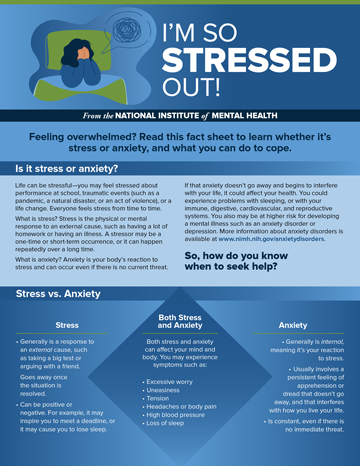
Feeling overwhelmed? Read this fact sheet to learn whether it’s stress or anxiety, and what you can do to cope.
Is it stress or anxiety?
Life can be stressful—you may feel stressed about performance at school, traumatic events (such as a pandemic, a natural disaster, or an act of violence), or a life change. Everyone feels stress from time to time.
What is stress? Stress is the physical or mental response to an external cause, such as having a lot of homework or having an illness. A stressor may be a one-time or short-term occurrence, or it can happen repeatedly over a long time.
What is anxiety? Anxiety is your body's reaction to stress and can occur even if there is no current threat.
If that anxiety doesn’t go away and begins to interfere with your life, it could affect your health. You could experience problems with sleeping, or with your immune, digestive, cardiovascular, and reproductive systems. You also may be at higher risk for developing a mental illness such as an anxiety disorder or depression. Read more about
anxiety disorders
.
So, how do you know when to seek help?
Stress vs. Anxiety
Stress
Both Stress and Anxiety
Anxiety
Generally is a response to an external cause, such as taking a big test or arguing with a friend.
Goes away once the situation is resolved.
Can be positive or negative. For example, it may inspire you to meet a deadline, or it may cause you to lose sleep.
Both stress and anxiety can affect your mind and body. You may experience symptoms such as:
Excessive worry
Uneasiness
Tension
Headaches or body pain
High blood pressure
Loss of sleep
Generally is internal, meaning it's your reaction to stress.
Usually involves a persistent feeling of apprehension or dread that doesn't go away, and that interferes with how you live your life.
Is constant, even if there is no immediate threat.
It’s important to manage your stress.
Everyone experiences stress, and sometimes that stress can feel overwhelming. You may be at risk for an anxiety disorder if it feels like you can’t manage the stress and if the symptoms of your stress:
Interfere with your everyday life.
Cause you to avoid doing things.
Seem to be always present.
Coping With Stress and Anxiety
Learning what causes or triggers your stress and what coping techniques work for you can help reduce your anxiety and improve your daily life. It may take trial and error to discover what works best for you. Here are some activities you can try when you start to feel overwhelmed:
Keep a journal.
Download an app that provides relaxation exercises (such as deep breathing or visualization) or tips for practicing mindfulness, which is a psychological process of actively paying attention to the present moment.
Exercise, and make sure you are eating healthy, regular meals.
Stick to a sleep routine, and make sure you are getting enough sleep.
Avoid drinking excess caffeine such as soft drinks or coffee.
Identify and challenge your negative and unhelpful thoughts.
Reach out to your friends or family members who help you cope in a positive way.
Recognize When You Need More Help
If you are struggling to cope, or the symptoms of your stress or anxiety won’t go away, it may be time to talk to a professional. Psychotherapy (also called talk therapy) and medication are the two main treatments for anxiety, and many people benefit from a combination of the two.
If you or someone you know has a mental illness, is struggling emotionally, or has concerns about their mental health, there are ways to get help. Read more about
getting help
.
More Resources
NIMH:
Anxiety Disorders
NIMH:
Caring for Your Mental Health
NIMH:
Child and Adolescent Mental Health
NIMH:
Tips for Talking With a Health Care Provider About Your Mental Health
Centers for Disease Control and Prevention:
Anxiety and Depression in Children
U.S. DEPARTMENT OF HEALTH AND HUMAN SERVICES
National Institutes of Health
NIH Publication No. 20-MH-8125
Reprints
The information in this publication is in the public domain and may be reused or copied without permission. However, you may not reuse or copy images. Please
cite the National Institute of Mental Health
as the source.
Read our copyright policy
to learn more about our guidelines for reusing NIMH content. |
| Markdown | [Skip to main content](https://www.nimh.nih.gov/health/publications/so-stressed-out-fact-sheet#main-content)

An official website of the United States government
Here’s how you know
Here’s how you know

**Official websites use .gov**
A **.gov** website belongs to an official government organization in the United States.

**Secure .gov websites use HTTPS**
A **lock** ( Locked padlock icon) or **https://** means you’ve safely connected to the .gov website. Share sensitive information only on official, secure websites.
Due to current HHS and NIH restructuring, some content on nimh.nih.gov is not being updated regularly. Please refer to [clinicaltrials.gov](https://clinicaltrials.gov/) and [nih.gov](https://www.nih.gov/about-nih/nih-director/statements/nih-launches-initiative-modernize-strengthen-biosafety-oversight) for up-to-date information on NIH research.
[](https://www.nimh.nih.gov/ "NIMH Home")
[In Crisis? Call or Text 988](https://988lifeline.org/)
Transforming the understanding
and treatment of mental illnesses.
[Home](https://www.nimh.nih.gov/) \| [Help for Mental Illnesses](https://www.nimh.nih.gov/health/find-help)
[Información en español](https://www.nimh.nih.gov/health/topics/espanol)
- [Mental Health Information](https://www.nimh.nih.gov/health)
- [Get Involved](https://www.nimh.nih.gov/get-involved)
- [Research](https://www.nimh.nih.gov/research)
- [Funding](https://www.nimh.nih.gov/funding)
- [News & Events](https://www.nimh.nih.gov/news)
- [About Us](https://www.nimh.nih.gov/about)
[Health Topics NIMH offers expert-reviewed information on mental disorders and a range of topics.](https://www.nimh.nih.gov/health/topics)
[Statistics NIMH statistics pages include statistics on the prevalence, treatment, and costs of mental illness for the population of the United States.](https://www.nimh.nih.gov/health/statistics)
[Brochures and Fact Sheets Download, read, and order free NIMH brochures and fact sheets about mental disorders and related topics.](https://www.nimh.nih.gov/health/publications)
[Help for Mental Illnesses If you or someone you know has a mental illness, there are ways to get help. Use these resources to find help for yourself, a friend, or a family member.](https://www.nimh.nih.gov/health/find-help)
[Clinical Trials If you or a friend or family member are thinking about taking part in clinical research, this page contains basic information about clinical trials.](https://www.nimh.nih.gov/health/trials)
[Stakeholder Engagement Find out how NIMH engages a range of stakeholder organizations as part of its efforts to ensure the greatest public health impact of the research we support.](https://www.nimh.nih.gov/get-involved/public-involvement)
[Connect with NIMH Learn more about NIMH newsletters, public participation in grant reviews, research funding, clinical trials, the NIMH Gift Fund, and connecting with NIMH on social media.](https://www.nimh.nih.gov/get-involved/connect-with-nimh)
[Digital Shareables Use these free education and outreach materials in your community and on social media to spread the word about mental health and related topics.](https://www.nimh.nih.gov/get-involved/digital-shareables)
[Science Education Use these free digital, outreach materials in your community and on social media to spread the word about mental health.](https://www.nimh.nih.gov/get-involved/science-education)
[Research Funded by NIMH NIMH supports research at universities, medical centers, and other institutions via grants, contracts, and cooperative agreements. Learn more about NIMH research areas, policies, resources, and initiatives.](https://www.nimh.nih.gov/research/research-funded-by-nimh)
[Research Conducted at NIMH (Intramural Research Program) The Division of Intramural Research Programs (IRP) is the internal research division of the NIMH. Over 40 research groups conduct basic neuroscience research and clinical investigations of mental illnesses, brain function, and behavior at the NIH campus in Bethesda, Maryland. Learn more about research conducted at NIMH.](https://www.nimh.nih.gov/research/research-conducted-at-nimh)
[Priority Research Areas Learn about NIMH priority areas for research and funding that have the potential to improve mental health care over the short, medium, and long term.](https://www.nimh.nih.gov/research/priority-research-areas)
[Resources for Researchers Information about resources such as data, tissue, model organisms and imaging resources to support the NIMH research community.](https://www.nimh.nih.gov/research/research-funded-by-nimh/research-resources)
[Opportunities & Announcements Find all NIMH and cross-NIH funding opportunities.](https://www.nimh.nih.gov/funding/opportunities-announcements)
[Funding Strategy for Grants Read more about the NIMH Strategic Plan for Research, Strategic Research Priorities, the anatomy of NIMH funding, and our yearly funding strategy for research grants.](https://www.nimh.nih.gov/funding/funding-strategy-for-research-grants)
[Application Process Explore the NIMH grant application process, including how to write your grant, how to submit your grant, and how the review process works.](https://www.nimh.nih.gov/funding/grant-writing-and-application-process)
[Managing Grants Learn about how NIMH manages research grants, including policies and reporting requirements.](https://www.nimh.nih.gov/funding/managing-your-grant)
[Clinical Research Find the latest NIH and NIMH policies, guidance, and resources for clinical research.](https://www.nimh.nih.gov/funding/clinical-research)
[Training Explore NIMH research training and career development opportunities.](https://www.nimh.nih.gov/funding/training)
[Small Business Research Learn about funding opportunities for small businesses.](https://www.nimh.nih.gov/funding/sbir)
### Quick Links
[Funding & Grant News](https://www.nimh.nih.gov/funding/opportunities-announcements/funding-grant-news)
[Support for Clinical Trials at NIMH](https://www.nimh.nih.gov/funding/opportunities-announcements/clinical-trials-foas)
[Science Updates List of NIMH science updates including press releases, research highlights, and institute announcements.](https://www.nimh.nih.gov/news/science-updates)
[Meetings and Events Details about upcoming events—including meetings, conferences, workshops, lectures, webinars, and chats—sponsored by NIMH.](https://www.nimh.nih.gov/news/events)
[Multimedia NIMH videos and podcasts featuring science news, lecture series, meetings, seminars, and special events.](https://www.nimh.nih.gov/news/media)
[Innovation Speaker Series An annual lecture series dedicated to innovation, invention, and scientific discovery.](https://www.nimh.nih.gov/news/innovation-speaker-series)
[About the Acting NIMH Director Learn more about the Acting Director of the NIMH, Shelli Avenevoli, Ph.D.](https://www.nimh.nih.gov/about/director)
[Advisory Boards and Groups Read about the boards and groups that advise and provide guidance to the Institute.](https://www.nimh.nih.gov/about/advisory-boards-and-groups)
[Strategic Plan Learn more about NIMH's roadmap for the Institute’s research priorities over the next five years.](https://www.nimh.nih.gov/about/strategic-planning-reports)
[Offices and Divisions Learn more about the functions of each NIMH office and division.](https://www.nimh.nih.gov/about/organization)
[Budget Read the annual NIMH Congressional Justifications.](https://www.nimh.nih.gov/about/budget)
[Careers at NIMH Search for jobs, including scientific, administrative and executive careers at NIMH.](https://www.nimh.nih.gov/about/careers)
[Staff Directories Find the names, telephone numbers, email addresses, and office locations of NIMH staff.](https://www.nimh.nih.gov/about/staff-directories)
[History Explore key milestones, discoveries, and the impact of NIMH-funded studies on mental health.](https://www.nimh.nih.gov/about/nimh-history)
[Getting to NIMH Find directions, maps, parking information, and other visitor information for NIMH.](https://www.nimh.nih.gov/about/connect-with-nimh)
### Quick Links
**[Contribute to Mental Health Research](https://www.nimh.nih.gov/about/connect-with-nimh/donate-to-mental-health-research "Donate to Mental Health Research")**
- [Mental Health Information](https://www.nimh.nih.gov/health)
- [Mental Health Information Home](https://www.nimh.nih.gov/health)
- [Health Topics](https://www.nimh.nih.gov/health/topics)
- [Statistics](https://www.nimh.nih.gov/health/statistics)
- [Brochures and Fact Sheets](https://www.nimh.nih.gov/health/publications)
- [Help for Mental Illnesses](https://www.nimh.nih.gov/health/find-help)
- [Clinical Trials](https://www.nimh.nih.gov/health/trials)
- [Get Involved](https://www.nimh.nih.gov/get-involved)
- [Get Involved Home](https://www.nimh.nih.gov/get-involved)
- [Stakeholder Engagement](https://www.nimh.nih.gov/get-involved/public-involvement)
- [Connect with NIMH](https://www.nimh.nih.gov/get-involved/connect-with-nimh)
- [Digital Shareables](https://www.nimh.nih.gov/get-involved/digital-shareables)
- [Science Education](https://www.nimh.nih.gov/get-involved/science-education)
- [Research](https://www.nimh.nih.gov/research)
- [Research Home](https://www.nimh.nih.gov/research)
- [Research Funded by NIMH](https://www.nimh.nih.gov/research/research-funded-by-nimh)
- [Research Conducted at NIMH (Intramural Research Program)](https://www.nimh.nih.gov/research/research-conducted-at-nimh)
- [Funding](https://www.nimh.nih.gov/funding)
- [Funding Home](https://www.nimh.nih.gov/funding)
- [Opportunities & Announcements](https://www.nimh.nih.gov/funding/opportunities-announcements)
- [Strategy for Research Grants](https://www.nimh.nih.gov/funding/funding-strategy-for-research-grants/strategy-for-research-grants)
- [Grant Writing & Approval Process](https://www.nimh.nih.gov/funding/grant-writing-and-application-process)
- [Managing Grants](https://www.nimh.nih.gov/funding/managing-your-grant)
- [Clinical Research](https://www.nimh.nih.gov/funding/clinical-research)
- [Research Training and Career Development Opportunities](https://www.nimh.nih.gov/funding/training)
- [Small Business Research](https://www.nimh.nih.gov/funding/sbir)
- [News & Events](https://www.nimh.nih.gov/news)
- [News & Events Home](https://www.nimh.nih.gov/news)
- [Science Updates](https://www.nimh.nih.gov/news/science-updates)
- [Meetings and Events](https://www.nimh.nih.gov/news/events)
- [Multimedia](https://www.nimh.nih.gov/news/media)
- [Social Media](https://www.nimh.nih.gov/news/social-media)
- [Email Updates](https://www.nimh.nih.gov/news/email-updates)
- [Innovation Speaker Series](https://www.nimh.nih.gov/news/innovation-speaker-series)
- [About Us](https://www.nimh.nih.gov/about)
- [About Us Home](https://www.nimh.nih.gov/about)
- [About the Acting NIMH Director](https://www.nimh.nih.gov/about/director)
- [Advisory Boards and Groups](https://www.nimh.nih.gov/about/advisory-boards-and-groups)
- [Strategic Plan](https://www.nimh.nih.gov/about/strategic-planning-reports)
- [Offices and Divisions](https://www.nimh.nih.gov/about/organization)
- [Budget](https://www.nimh.nih.gov/about/budget)
- [Careers at NIMH](https://www.nimh.nih.gov/about/careers)
- [Staff Directories](https://www.nimh.nih.gov/about/staff-directories)
- [History](https://www.nimh.nih.gov/about/nimh-history)
- [Getting to NIMH](https://www.nimh.nih.gov/about/connect-with-nimh)
- [Health Topics](https://www.nimh.nih.gov/health/topics)
- [Statistics](https://www.nimh.nih.gov/health/statistics)
- [Brochures and Fact Sheets](https://www.nimh.nih.gov/health/publications)
- [Help for Mental Illnesses](https://www.nimh.nih.gov/health/find-help)
- [Clinical Trials](https://www.nimh.nih.gov/health/trials)
[Home](https://www.nimh.nih.gov/) \> [Mental Health Information](https://www.nimh.nih.gov/health) \> [Brochures and Fact Sheets](https://www.nimh.nih.gov/health/publications) \> I’m So Stressed Out! Fact Sheet
###### Share Page
Menu
- [Is it stress or anxiety?](https://www.nimh.nih.gov/health/publications/so-stressed-out-fact-sheet#part_6631)
- [Stress vs. Anxiety](https://www.nimh.nih.gov/health/publications/so-stressed-out-fact-sheet#part_6632)
- [It’s important to manage your stress.](https://www.nimh.nih.gov/health/publications/so-stressed-out-fact-sheet#part_6633)
- [Coping With Stress and Anxiety](https://www.nimh.nih.gov/health/publications/so-stressed-out-fact-sheet#part_6634)
- [Recognize When You Need More Help](https://www.nimh.nih.gov/health/publications/so-stressed-out-fact-sheet#part_6635)
- [More Resources](https://www.nimh.nih.gov/health/publications/so-stressed-out-fact-sheet#part_6636)
- [Reprints](https://www.nimh.nih.gov/health/publications/so-stressed-out-fact-sheet#part_11021)
# I’m So Stressed Out! Fact Sheet
- [Download PDF](https://www.nimh.nih.gov/sites/default/files/documents/health/publications/so-stressed-out-fact-sheet/Im-So-Stressed-Out.pdf)
- [En español](https://www.nimh.nih.gov/health/publications/espanol/estoy-tan-estresado)
View the related [infographic](https://www.nimh.nih.gov/health/publications/so-stressed-out-infographic) to share this information on social media.
Feeling overwhelmed? Read this fact sheet to learn whether it’s stress or anxiety, and what you can do to cope.
## Is it stress or anxiety?
Life can be stressful—you may feel stressed about performance at school, traumatic events (such as a pandemic, a natural disaster, or an act of violence), or a life change. Everyone feels stress from time to time.
What is stress? Stress is the physical or mental response to an external cause, such as having a lot of homework or having an illness. A stressor may be a one-time or short-term occurrence, or it can happen repeatedly over a long time.
What is anxiety? Anxiety is your body's reaction to stress and can occur even if there is no current threat.
If that anxiety doesn’t go away and begins to interfere with your life, it could affect your health. You could experience problems with sleeping, or with your immune, digestive, cardiovascular, and reproductive systems. You also may be at higher risk for developing a mental illness such as an anxiety disorder or depression. Read more about [anxiety disorders](https://www.nimh.nih.gov/health/topics/anxiety-disorders).
**So, how do you know when to seek help?**
## Stress vs. Anxiety
| Stress | Both Stress and Anxiety | Anxiety |
|---|---|---|
| Generally is a response to an external cause, such as taking a big test or arguing with a friend. Goes away once the situation is resolved. Can be positive or negative. For example, it may inspire you to meet a deadline, or it may cause you to lose sleep. | Both stress and anxiety can affect your mind and body. You may experience symptoms such as: Excessive worry Uneasiness Tension Headaches or body pain High blood pressure Loss of sleep | Generally is internal, meaning it's your reaction to stress. Usually involves a persistent feeling of apprehension or dread that doesn't go away, and that interferes with how you live your life. Is constant, even if there is no immediate threat. |
## It’s important to manage your stress.
Everyone experiences stress, and sometimes that stress can feel overwhelming. You may be at risk for an anxiety disorder if it feels like you can’t manage the stress and if the symptoms of your stress:
- Interfere with your everyday life.
- Cause you to avoid doing things.
- Seem to be always present.
## Coping With Stress and Anxiety
Learning what causes or triggers your stress and what coping techniques work for you can help reduce your anxiety and improve your daily life. It may take trial and error to discover what works best for you. Here are some activities you can try when you start to feel overwhelmed:
- Keep a journal.
- Download an app that provides relaxation exercises (such as deep breathing or visualization) or tips for practicing mindfulness, which is a psychological process of actively paying attention to the present moment.
- Exercise, and make sure you are eating healthy, regular meals.
- Stick to a sleep routine, and make sure you are getting enough sleep.
- Avoid drinking excess caffeine such as soft drinks or coffee.
- Identify and challenge your negative and unhelpful thoughts.
- Reach out to your friends or family members who help you cope in a positive way.
## Recognize When You Need More Help
If you are struggling to cope, or the symptoms of your stress or anxiety won’t go away, it may be time to talk to a professional. Psychotherapy (also called talk therapy) and medication are the two main treatments for anxiety, and many people benefit from a combination of the two.
If you are in immediate distress or are thinking about hurting yourself, call or text the [988 Suicide & Crisis Lifeline](https://988lifeline.org/) at **988** or chat at [**988lifeline.org**](https://988lifeline.org/) .
If you or someone you know has a mental illness, is struggling emotionally, or has concerns about their mental health, there are ways to get help. Read more about [getting help](https://www.nimh.nih.gov/health/find-help).
## More Resources
- NIMH: [Anxiety Disorders](https://www.nimh.nih.gov/health/topics/anxiety-disorders)
- NIMH: [Caring for Your Mental Health](https://www.nimh.nih.gov/health/topics/caring-for-your-mental-health)
- NIMH: [Child and Adolescent Mental Health](https://www.nimh.nih.gov/health/topics/child-and-adolescent-mental-health)
- NIMH: [Tips for Talking With a Health Care Provider About Your Mental Health](https://www.nimh.nih.gov/health/publications/tips-for-talking-with-your-health-care-provider)
- Centers for Disease Control and Prevention: [Anxiety and Depression in Children](https://www.cdc.gov/children-mental-health/about/about-anxiety-and-depression-in-children.html)
U.S. DEPARTMENT OF HEALTH AND HUMAN SERVICES
National Institutes of Health
NIH Publication No. 20-MH-8125
## Reprints
The information in this publication is in the public domain and may be reused or copied without permission. However, you may not reuse or copy images. Please [cite the National Institute of Mental Health](https://www.nimh.nih.gov/site-info/citing-nimh-publications-and-webpages "Citing NIMH Publications and Webpages") as the source. [Read our copyright policy](https://www.nimh.nih.gov/site-info/policies#part_2718 "Website Policies") to learn more about our guidelines for reusing NIMH content.
## Disclaimer
We link to external websites for informational purposes only, but we do not endorse or guarantee their accuracy. Once you leave our site, you will be subject to the new website’s privacy policy. Read NIMH’s [full external linking policy](https://www.nimh.nih.gov/site-info/policies#part_2717) for more information.
##### NIMH Resources
[Health Topics](https://www.nimh.nih.gov/health/topics)
[Brochures and Fact Sheets](https://www.nimh.nih.gov/health/publications)
[Contact Us](https://www.nimh.nih.gov/site-info/contact-nimh)
[Información en español](https://www.nimh.nih.gov/health/topics/espanol)
##### Policies and Notices
[Privacy Policy](https://www.nimh.nih.gov/site-info/privacy-policy)
[Website Policies](https://www.nimh.nih.gov/site-info/policies)
[FOIA](http://www.nih.gov/icd/od/foia/index.htm)
[Accessibility](https://www.nimh.nih.gov/site-info/accessibility)
[HHS Vulnerability Disclosure](https://www.hhs.gov/vulnerability-disclosure-policy/index.html)
##### Federal Resources
[National Institutes of Health (NIH)](http://www.nih.gov/)
[NIH Virtual Tour](https://www.nih.gov/virtual-tour/)
[U.S. Department of Health and Human Services](https://www.hhs.gov/)
[USA.gov](http://www.usa.gov/)
The National Institute of Mental Health (NIMH) is part of NIH, a component of the U.S. Department of Health and Human Services.
[Top](https://www.nimh.nih.gov/health/publications/so-stressed-out-fact-sheet#skipnav) |
| Readable Markdown | 
- [Download PDF](https://www.nimh.nih.gov/sites/default/files/documents/health/publications/so-stressed-out-fact-sheet/Im-So-Stressed-Out.pdf)
- [En español](https://www.nimh.nih.gov/health/publications/espanol/estoy-tan-estresado)
View the related [infographic](https://www.nimh.nih.gov/health/publications/so-stressed-out-infographic) to share this information on social media.
Feeling overwhelmed? Read this fact sheet to learn whether it’s stress or anxiety, and what you can do to cope.
## Is it stress or anxiety?
Life can be stressful—you may feel stressed about performance at school, traumatic events (such as a pandemic, a natural disaster, or an act of violence), or a life change. Everyone feels stress from time to time.
What is stress? Stress is the physical or mental response to an external cause, such as having a lot of homework or having an illness. A stressor may be a one-time or short-term occurrence, or it can happen repeatedly over a long time.
What is anxiety? Anxiety is your body's reaction to stress and can occur even if there is no current threat.
If that anxiety doesn’t go away and begins to interfere with your life, it could affect your health. You could experience problems with sleeping, or with your immune, digestive, cardiovascular, and reproductive systems. You also may be at higher risk for developing a mental illness such as an anxiety disorder or depression. Read more about [anxiety disorders](https://www.nimh.nih.gov/health/topics/anxiety-disorders).
**So, how do you know when to seek help?**
## Stress vs. Anxiety
| Stress | Both Stress and Anxiety | Anxiety |
|---|---|---|
| Generally is a response to an external cause, such as taking a big test or arguing with a friend. Goes away once the situation is resolved. Can be positive or negative. For example, it may inspire you to meet a deadline, or it may cause you to lose sleep. | Both stress and anxiety can affect your mind and body. You may experience symptoms such as: Excessive worry Uneasiness Tension Headaches or body pain High blood pressure Loss of sleep | Generally is internal, meaning it's your reaction to stress. Usually involves a persistent feeling of apprehension or dread that doesn't go away, and that interferes with how you live your life. Is constant, even if there is no immediate threat. |
## It’s important to manage your stress.
Everyone experiences stress, and sometimes that stress can feel overwhelming. You may be at risk for an anxiety disorder if it feels like you can’t manage the stress and if the symptoms of your stress:
- Interfere with your everyday life.
- Cause you to avoid doing things.
- Seem to be always present.
## Coping With Stress and Anxiety
Learning what causes or triggers your stress and what coping techniques work for you can help reduce your anxiety and improve your daily life. It may take trial and error to discover what works best for you. Here are some activities you can try when you start to feel overwhelmed:
- Keep a journal.
- Download an app that provides relaxation exercises (such as deep breathing or visualization) or tips for practicing mindfulness, which is a psychological process of actively paying attention to the present moment.
- Exercise, and make sure you are eating healthy, regular meals.
- Stick to a sleep routine, and make sure you are getting enough sleep.
- Avoid drinking excess caffeine such as soft drinks or coffee.
- Identify and challenge your negative and unhelpful thoughts.
- Reach out to your friends or family members who help you cope in a positive way.
## Recognize When You Need More Help
If you are struggling to cope, or the symptoms of your stress or anxiety won’t go away, it may be time to talk to a professional. Psychotherapy (also called talk therapy) and medication are the two main treatments for anxiety, and many people benefit from a combination of the two.
If you or someone you know has a mental illness, is struggling emotionally, or has concerns about their mental health, there are ways to get help. Read more about [getting help](https://www.nimh.nih.gov/health/find-help).
## More Resources
- NIMH: [Anxiety Disorders](https://www.nimh.nih.gov/health/topics/anxiety-disorders)
- NIMH: [Caring for Your Mental Health](https://www.nimh.nih.gov/health/topics/caring-for-your-mental-health)
- NIMH: [Child and Adolescent Mental Health](https://www.nimh.nih.gov/health/topics/child-and-adolescent-mental-health)
- NIMH: [Tips for Talking With a Health Care Provider About Your Mental Health](https://www.nimh.nih.gov/health/publications/tips-for-talking-with-your-health-care-provider)
- Centers for Disease Control and Prevention: [Anxiety and Depression in Children](https://www.cdc.gov/children-mental-health/about/about-anxiety-and-depression-in-children.html)
U.S. DEPARTMENT OF HEALTH AND HUMAN SERVICES
National Institutes of Health
NIH Publication No. 20-MH-8125
## Reprints
The information in this publication is in the public domain and may be reused or copied without permission. However, you may not reuse or copy images. Please [cite the National Institute of Mental Health](https://www.nimh.nih.gov/site-info/citing-nimh-publications-and-webpages "Citing NIMH Publications and Webpages") as the source. [Read our copyright policy](https://www.nimh.nih.gov/site-info/policies#part_2718 "Website Policies") to learn more about our guidelines for reusing NIMH content. |
| Shard | 129 (laksa) |
| Root Hash | 7295144728021232729 |
| Unparsed URL | gov,nih!nimh,www,/health/publications/so-stressed-out-fact-sheet s443 |