ℹ️ Skipped - page is already crawled
| Filter | Status | Condition | Details |
|---|---|---|---|
| HTTP status | PASS | download_http_code = 200 | HTTP 200 |
| Age cutoff | PASS | download_stamp > now() - 6 MONTH | 0.7 months ago |
| History drop | PASS | isNull(history_drop_reason) | No drop reason |
| Spam/ban | PASS | fh_dont_index != 1 AND ml_spam_score = 0 | ml_spam_score=0 |
| Canonical | PASS | meta_canonical IS NULL OR = '' OR = src_unparsed | Not set |
| Property | Value | |||||||||
|---|---|---|---|---|---|---|---|---|---|---|
| URL | https://www.nidcd.nih.gov/health/statistics/quick-statistics-taste-smell | |||||||||
| Last Crawled | 2026-04-01 22:51:27 (22 days ago) | |||||||||
| First Indexed | 2016-03-23 16:48:19 (10 years ago) | |||||||||
| HTTP Status Code | 200 | |||||||||
| Content | ||||||||||
| Meta Title | Quick Statistics About Taste and Smell | NIDCD | |||||||||
| Meta Description | Statistics on taste and smell disorders. | |||||||||
| Meta Canonical | null | |||||||||
| Boilerpipe Text | Skip to main content
Taste
Almost 1 in 5 Americans (or 19%) over the age of 40 reports some alteration in their sense of taste.
1
The prevalence of reported alterations in the sense of taste increases with age, and is highest, at 27%, for people ages 80 years and older.
1
Risk factors include dry mouth, nose/facial injury, and cold or flu lasting more than a month in the past year.
1
1 in 20 Americans (or 5%) reports experiencing
dysgeusia
[dis-GYOO-zee-a], a disorder characterized by distorted taste.
1
This disorder is often persistent.
Dysgeusia is more commonly reported in women (64% of reported cases).
1
Based on their genetics, certain people can taste the bitterness of phenylthiocarbamide (PTC) or a related substance called 6-n-propylthiouracil (PROP). In the United States, about 25% are super-tasters who describe PTC as extremely bitter, 50% are medium tasters of PTC, and 25% cannot taste PTC.
2
Medium tasters and especially super-tasters tend to dislike more types of food, particularly if they are strongly flavored.
3
The ability to taste PTC/PROP
varies around the world and among different ethnic and racial groups
.
2
Compared to never smokers, dependent smokers (people who need to smoke within 30 minutes of waking) and chronic smokers (people who have smoked a pack daily for several years) reported lower sensitivity to bitter and salty tastes.
4
Among 138,897 COVID-19-positive patients, 39.2% reported taste dysfunction.
5
Among adults 40 and older, approximately 10% noted a loss in their ability to taste food flavors compared to when they were young adults. 5% reported distortions in their sense of taste, most commonly related to bitter and metallic tastes.
1
Among adults ages 40 or older who reported persistent dry mouth in the past year, approximately 43% experienced changes in their sense of taste.
1
Smell
Nearly 1 in 4 Americans (or 23%) over the age of 40 reports some alteration in their sense of smell.
1
Rates increase in older populations and are highest for those over 80 years old, at 32%.
1
Risk factors include sinonasal symptoms (of the nose and sinuses), heavy drinking, previous loss of consciousness from head injury, poverty, and dry mouth.
1
Approximately
1 in 15 Americans (or 6.5%) over the age of 40 reports sometimes experiencing phantom odor perception
. (The survey asked if participants smelled unpleasant, bad, or burning odors when nothing is there; not all phantom odor perception fits into this category.
6
)
Women are more likely to report phantom odors, particularly if they are between the ages of 40 and 60, compared to above 60 years of age.
7
Those with a history of head injury or poor overall health are more likely to report phantom odors.
6
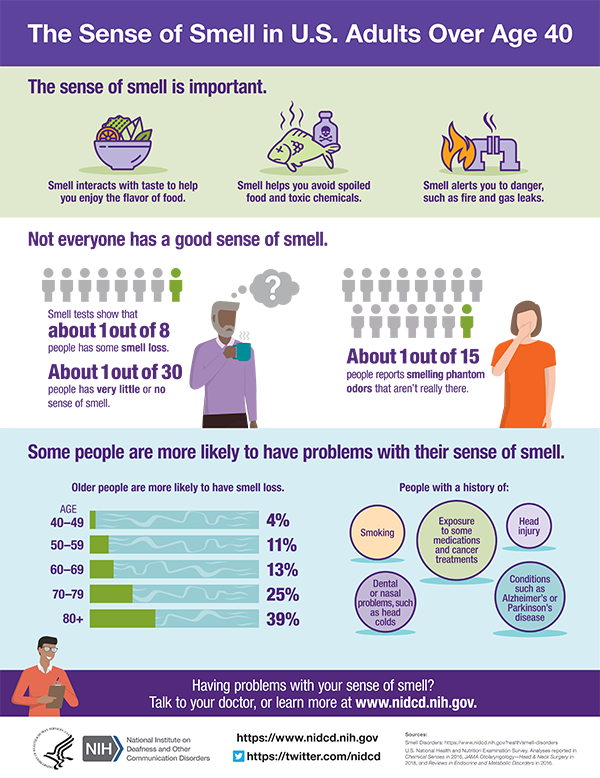
Approximately 1 in 8 Americans over age 40 (up to 13.3 million people, or 12.4% of the population) has measurable smell dysfunction.
7
Approximately 3% of Americans have anosmia (no sense of smell) or severe hyposmia (minimal sense of smell).
7
The prevalence of any type of smell impairment increases with age: 4% in Americans ages 40-49, 11% in Americans ages 50-59, 13% in Americans ages 60-69, 25% in Americans 70-79, and 39% in Americans ages 80 and above.
7
The prevalence of smell impairment is higher in men, ethnic minorities (non-Hispanic Black and Mexican American), and in those with lower educational attainment and/or family income.
7
On average, people with smell dysfunction eat a less healthy diet, with more saturated fats and added sugars.
8
A study of 1,636 people found that individuals with cognitive impairment are 3 times more likely than others to have mild to moderate olfactory impairment. The study also found that people with a diagnosis of Parkinson’s disease are 10 times more likely than others to have mild olfactory impairment, and 16 times more likely to have moderate olfactory impairment.
9
Sources
Rawal, S; Hoffman, HJ; Bainbridge, KE; Huedo-Medina, TB; Duffy, VB (2016):
Prevalence and risk factors of self-reported smell and taste alterations: Results from the 2011–2012 US National Health and Nutrition Examination Survey (NHANES)
.
Chem Senses.
Jan;41(1):69-76. doi: 10.1093/chemse/bjv057.
Guo, SW; Reed, DR (2001):
The genetics of phenylthiocarbamide perception
.
Annals of Human Biology.
Mar-Apr;28(2):111-42. doi: 10.1080/03014460151056310.
Tepper, BJ (1998):
6-n-Propylthiouracil: A genetic marker for taste, with implications for food preference and dietary habits
.
American Journal of Human Genetics
. Nov;63(5):1271-6. doi: 10.1086/302124.
Berube, L; Duffy, VB; Hayes, JE; Hoffman, HJ; Rawal, S (2021):
Associations between chronic cigarette smoking and taste function: Results from the 2013-2014 National Health and Nutrition Examination Survey
.
Physiol Behav
. Oct 15:240:113554. doi: 10.1016/j.physbeh.2021.113554.
Hannum, ME; Koch, RJ; Ramirez, VA; Marks, SS; Toskala, AK; Herriman, RD; Lin, C; Joseph, PV; Reed, DR (2023):
Taste loss as a distinct symptom of COVID-19: a systematic review and meta-analysis
.
Chem Senses.
Jan 1:48:bjad043. doi: 10.1093/chemse/bjad043.
Bainbridge, KE; Byrd-Clark, D; Leopold, D (2018):
Factors associated with phantom odor perception among US adults: Findings from the National Health and Nutrition Examination Survey
.
JAMA Otolaryngol Head Neck Surg
. Sep 1;144(9):807-814. doi: 10.1001/jamaoto.2018.1446.
Hoffman, HJ; Rawal, S; Li, CM; Duffy, VB (2016):
New chemosensory component in the U.S. National Health and Nutrition Examination Survey (NHANES): First year results for measured olfactory dysfunction
.
Rev Endocr Metab Disord
. Jun;17(2):221-40. doi: 10.1007/s11154-016-9364-1.
Rawal, S; Duffy, VB; Berube, L; Hayes, JE; Kant, AK; Li, CM; Graubard, BI; Hoffman, HJ (2021):
Self-reported olfactory dysfunction and diet quality: Findings from the 2011-2014 National Health and Nutrition Examination Survey (NHANES)
.
Nutrients.
Dec 20;13(12):4561. doi: 10.3390/nu13124561.
Karpa, MJ; Gopinath, B; Rochtchina, E; Wang, JJ; Cumming, RG; Sue, CM; Mitchell, P (2010):
Prevalence and neurodegenerative or other associations with olfactory impairment in an older community
.
J Aging Health.
Mar;22(2):154-168. doi:10.1177/0898264309353066.
Last Updated Date:
September 20, 2024 | |||||||||
| Markdown | [Skip to main content](https://www.nidcd.nih.gov/health/statistics/quick-statistics-taste-smell#main-content)

An official website of the United States government
Here's how you know
Here's how you know
[U.S. Department of Health & Human Services](http://www.hhs.gov/) \| [National Institutes of Health](https://www.nih.gov/)

**Official websites use .gov**
A **.gov** website belongs to an official government organization in the United States.

**Secure .gov websites use HTTPS**
A **lock** (A locked padlock) or **https://** means you've safely connected to the .gov website. Share sensitive information only on official, secure websites.
*[](https://www.nidcd.nih.gov/ "Home")*
Menu
[NIDCD Employee Intranet](https://intranet.nidcd.nih.gov/) \| [A–Z Index](https://www.nidcd.nih.gov/a-z-index) \| [En español](https://www.nidcd.nih.gov/es/espanol)

- [Home](https://www.nidcd.nih.gov/)
- Health Info
- [**Health Info**](https://www.nidcd.nih.gov/health)
- [Hearing, Ear Infections, and Deafness](https://www.nidcd.nih.gov/health/hearing-ear-infections-deafness)
- [Balance](https://www.nidcd.nih.gov/health/balance)
- [Taste and Smell](https://www.nidcd.nih.gov/health/taste-smell)
- [Voice, Speech, and Language](https://www.nidcd.nih.gov/health/voice-speech-and-language)
- [Información en español](https://www.nidcd.nih.gov/es/espanol)
- [Statistics](https://www.nidcd.nih.gov/health/statistics)
- [Health Resources](https://www.nidcd.nih.gov/health/resources)
- [Clinical Studies](https://www.nidcd.nih.gov/research/clinical-studies)
- [Adult Hearing Health Care](https://www.nidcd.nih.gov/health/adult-hearing-health-care)
- Research
- [**Research**](https://www.nidcd.nih.gov/research)
- [Extramural Research](https://www.nidcd.nih.gov/research/extramural)
- [Intramural Research](https://www.nidcd.nih.gov/research/labs)
- [Scientific Workshop and Meeting Reports](https://www.nidcd.nih.gov/research/workshops)
- [Clinical Studies](https://www.nidcd.nih.gov/research/clinical-studies)
- [Global Health](https://www.nidcd.nih.gov/research/global-health)
- Grants & Funding
- [**Grants & Funding**](https://www.nidcd.nih.gov/funding)
- [Types of Grants and Funding](https://www.nidcd.nih.gov/funding/types)
- [How to Apply for a Grant](https://www.nidcd.nih.gov/funding/apply)
- [All NIDCD Funding Opportunities](https://www.nidcd.nih.gov/funding/all-nidcd-funding-opportunities)
- [The BRAIN Initiative and the NIDCD](https://www.nidcd.nih.gov/funding/brain-initiative-nidcd)
- Training
- [**Training**](https://www.nidcd.nih.gov/training)
- [About NIDCD's Research Training Program](https://www.nidcd.nih.gov/training/about)
- [Types of Research Training Funding Opportunities](https://www.nidcd.nih.gov/training/awards)
- [Research Training in NIDCD Laboratories (Intramural)](https://www.nidcd.nih.gov/training/intramural-labs)
- [More Training Resources](https://www.nidcd.nih.gov/training/resources)
- News & Events
- [**News & Events**](https://www.nidcd.nih.gov/news)
- [NIDCD News](https://www.nidcd.nih.gov/news/nidcd-news)
- [Grantee News](https://www.nidcd.nih.gov/news/grantee-news)
- [Multimedia](https://www.nidcd.nih.gov/news/multimedia-library?langcode%5Ben%5D=en)
- [Events](https://www.nidcd.nih.gov/news/events)
- About Us
- [**About Us**](https://www.nidcd.nih.gov/about)
- [Messages from the NIDCD Director](https://www.nidcd.nih.gov/about/nidcd-director-message)
- [Mission](https://www.nidcd.nih.gov/about/mission)
- [Strategic Plans](https://www.nidcd.nih.gov/about/strategic-plans)
- [NIDCD History and Milestones](https://www.nidcd.nih.gov/about/history)
- [Organizational Structure and Staff](https://www.nidcd.nih.gov/about/staff-organization)
- [Congressional Testimony and the NIDCD Budget](https://www.nidcd.nih.gov/about/budget-congressional-testimony)
- [Advisory Groups and Review Committees](https://www.nidcd.nih.gov/about/advisory-committees)
- [Contact Us](https://www.nidcd.nih.gov/contact-us)
- [Get Involved](https://www.nidcd.nih.gov/about/get-involved)
## Breadcrumb
1. [Home](https://www.nidcd.nih.gov/)
2. [Health Information](https://www.nidcd.nih.gov/health)
3. [Statistics and Epidemiology](https://www.nidcd.nih.gov/health/statistics)
# Quick Statistics About Taste and Smell
## Taste
- Almost 1 in 5 Americans (or 19%) over the age of 40 reports some alteration in their sense of taste.[1](https://www.nidcd.nih.gov/health/statistics/quick-statistics-taste-smell#1)
- The prevalence of reported alterations in the sense of taste increases with age, and is highest, at 27%, for people ages 80 years and older.[1](https://www.nidcd.nih.gov/health/statistics/quick-statistics-taste-smell#1)
- Risk factors include dry mouth, nose/facial injury, and cold or flu lasting more than a month in the past year.[1](https://www.nidcd.nih.gov/health/statistics/quick-statistics-taste-smell#1)
- 1 in 20 Americans (or 5%) reports experiencing [dysgeusia](https://www.nidcd.nih.gov/health/taste-disorders#3) \[dis-GYOO-zee-a\], a disorder characterized by distorted taste.[1](https://www.nidcd.nih.gov/health/statistics/quick-statistics-taste-smell#1) This disorder is often persistent.
- Dysgeusia is more commonly reported in women (64% of reported cases).[1](https://www.nidcd.nih.gov/health/statistics/quick-statistics-taste-smell#1)
- Based on their genetics, certain people can taste the bitterness of phenylthiocarbamide (PTC) or a related substance called 6-n-propylthiouracil (PROP). In the United States, about 25% are super-tasters who describe PTC as extremely bitter, 50% are medium tasters of PTC, and 25% cannot taste PTC.[2](https://www.nidcd.nih.gov/health/statistics/quick-statistics-taste-smell#2) Medium tasters and especially super-tasters tend to dislike more types of food, particularly if they are strongly flavored.[3](https://www.nidcd.nih.gov/health/statistics/quick-statistics-taste-smell#3)
- The ability to taste PTC/PROP [varies around the world and among different ethnic and racial groups](https://www.nidcd.nih.gov/health/statistics/global-variation-sensitivity-bitter-tasting-substances-ptc-or-prop).[2](https://www.nidcd.nih.gov/health/statistics/quick-statistics-taste-smell#2)
- Compared to never smokers, dependent smokers (people who need to smoke within 30 minutes of waking) and chronic smokers (people who have smoked a pack daily for several years) reported lower sensitivity to bitter and salty tastes.[4](https://www.nidcd.nih.gov/health/statistics/quick-statistics-taste-smell#4)
- Among 138,897 COVID-19-positive patients, 39.2% reported taste dysfunction.[5](https://www.nidcd.nih.gov/health/statistics/quick-statistics-taste-smell#5)
- Among adults 40 and older, approximately 10% noted a loss in their ability to taste food flavors compared to when they were young adults. 5% reported distortions in their sense of taste, most commonly related to bitter and metallic tastes.[1](https://www.nidcd.nih.gov/health/statistics/quick-statistics-taste-smell#1)
- Among adults ages 40 or older who reported persistent dry mouth in the past year, approximately 43% experienced changes in their sense of taste.[1](https://www.nidcd.nih.gov/health/statistics/quick-statistics-taste-smell#1)
## Smell
- Nearly 1 in 4 Americans (or 23%) over the age of 40 reports some alteration in their sense of smell.[1](https://www.nidcd.nih.gov/health/statistics/quick-statistics-taste-smell#1)
- Rates increase in older populations and are highest for those over 80 years old, at 32%.[1](https://www.nidcd.nih.gov/health/statistics/quick-statistics-taste-smell#1)
- Risk factors include sinonasal symptoms (of the nose and sinuses), heavy drinking, previous loss of consciousness from head injury, poverty, and dry mouth.[1](https://www.nidcd.nih.gov/health/statistics/quick-statistics-taste-smell#1)
- Approximately [1 in 15 Americans (or 6.5%) over the age of 40 reports sometimes experiencing phantom odor perception](https://www.nidcd.nih.gov/news/2018/1-american-in-15-smells-odors-that-are-not-there). (The survey asked if participants smelled unpleasant, bad, or burning odors when nothing is there; not all phantom odor perception fits into this category.[6](https://www.nidcd.nih.gov/health/statistics/quick-statistics-taste-smell#6))
- Women are more likely to report phantom odors, particularly if they are between the ages of 40 and 60, compared to above 60 years of age.[7](https://www.nidcd.nih.gov/health/statistics/quick-statistics-taste-smell#7)
- Those with a history of head injury or poor overall health are more likely to report phantom odors.[6](https://www.nidcd.nih.gov/health/statistics/quick-statistics-taste-smell#6)
- Approximately 1 in 8 Americans over age 40 (up to 13.3 million people, or 12.4% of the population) has measurable smell dysfunction.[7](https://www.nidcd.nih.gov/health/statistics/quick-statistics-taste-smell#7)
- Approximately 3% of Americans have anosmia (no sense of smell) or severe hyposmia (minimal sense of smell).[7](https://www.nidcd.nih.gov/health/statistics/quick-statistics-taste-smell#7)
- The prevalence of any type of smell impairment increases with age: 4% in Americans ages 40-49, 11% in Americans ages 50-59, 13% in Americans ages 60-69, 25% in Americans 70-79, and 39% in Americans ages 80 and above.[7](https://www.nidcd.nih.gov/health/statistics/quick-statistics-taste-smell#7)
- The prevalence of smell impairment is higher in men, ethnic minorities (non-Hispanic Black and Mexican American), and in those with lower educational attainment and/or family income.[7](https://www.nidcd.nih.gov/health/statistics/quick-statistics-taste-smell#7)
- On average, people with smell dysfunction eat a less healthy diet, with more saturated fats and added sugars.[8](https://www.nidcd.nih.gov/health/statistics/quick-statistics-taste-smell#8)
- A study of 1,636 people found that individuals with cognitive impairment are 3 times more likely than others to have mild to moderate olfactory impairment. The study also found that people with a diagnosis of Parkinson’s disease are 10 times more likely than others to have mild olfactory impairment, and 16 times more likely to have moderate olfactory impairment.[9](https://www.nidcd.nih.gov/health/statistics/quick-statistics-taste-smell#9)
## Sources
1. Rawal, S; Hoffman, HJ; Bainbridge, KE; Huedo-Medina, TB; Duffy, VB (2016): [Prevalence and risk factors of self-reported smell and taste alterations: Results from the 2011–2012 US National Health and Nutrition Examination Survey (NHANES)](https://pubmed.ncbi.nlm.nih.gov/26487703/). *Chem Senses.* Jan;41(1):69-76. doi: 10.1093/chemse/bjv057.
2. Guo, SW; Reed, DR (2001): [The genetics of phenylthiocarbamide perception](https://pubmed.ncbi.nlm.nih.gov/11293722/). *Annals of Human Biology.* Mar-Apr;28(2):111-42. doi: 10.1080/03014460151056310.
3. Tepper, BJ (1998): [6-n-Propylthiouracil: A genetic marker for taste, with implications for food preference and dietary habits](https://pubmed.ncbi.nlm.nih.gov/9792854/). *American Journal of Human Genetics*. Nov;63(5):1271-6. doi: 10.1086/302124.
4. Berube, L; Duffy, VB; Hayes, JE; Hoffman, HJ; Rawal, S (2021): [Associations between chronic cigarette smoking and taste function: Results from the 2013-2014 National Health and Nutrition Examination Survey](https://pubmed.ncbi.nlm.nih.gov/34375623/). *Physiol Behav*. Oct 15:240:113554. doi: 10.1016/j.physbeh.2021.113554.
5. Hannum, ME; Koch, RJ; Ramirez, VA; Marks, SS; Toskala, AK; Herriman, RD; Lin, C; Joseph, PV; Reed, DR (2023): [Taste loss as a distinct symptom of COVID-19: a systematic review and meta-analysis](https://pubmed.ncbi.nlm.nih.gov/38100383/). *Chem Senses.* Jan 1:48:bjad043. doi: 10.1093/chemse/bjad043.
6. Bainbridge, KE; Byrd-Clark, D; Leopold, D (2018): [Factors associated with phantom odor perception among US adults: Findings from the National Health and Nutrition Examination Survey](https://pubmed.ncbi.nlm.nih.gov/30128498/). *JAMA Otolaryngol Head Neck Surg*. Sep 1;144(9):807-814. doi: 10.1001/jamaoto.2018.1446.
7. Hoffman, HJ; Rawal, S; Li, CM; Duffy, VB (2016): [New chemosensory component in the U.S. National Health and Nutrition Examination Survey (NHANES): First year results for measured olfactory dysfunction](https://pubmed.ncbi.nlm.nih.gov/27287364/). *Rev Endocr Metab Disord*. Jun;17(2):221-40. doi: 10.1007/s11154-016-9364-1.
8. Rawal, S; Duffy, VB; Berube, L; Hayes, JE; Kant, AK; Li, CM; Graubard, BI; Hoffman, HJ (2021): [Self-reported olfactory dysfunction and diet quality: Findings from the 2011-2014 National Health and Nutrition Examination Survey (NHANES)](https://pubmed.ncbi.nlm.nih.gov/34960113/). *Nutrients.* Dec 20;13(12):4561. doi: 10.3390/nu13124561.
9. Karpa, MJ; Gopinath, B; Rochtchina, E; Wang, JJ; Cumming, RG; Sue, CM; Mitchell, P (2010): [Prevalence and neurodegenerative or other associations with olfactory impairment in an older community](https://pubmed.ncbi.nlm.nih.gov/20133956/). *J Aging Health.* Mar;22(2):154-168. doi:10.1177/0898264309353066.
Last Updated Date:
September 20, 2024
[](https://x.com/intent/post?url=https://www.nidcd.nih.gov/health/statistics/quick-statistics-taste-smell&text=Quick%20Statistics%20About%20Taste%20and%20Smell%20https://www.nidcd.nih.gov/health/statistics/quick-statistics-taste-smell%20via%20@nih_nidcd "Tweet this")
[](https://www.facebook.com/sharer.php?u=https://www.nidcd.nih.gov/health/statistics/quick-statistics-taste-smell&t=Quick%20Statistics%20About%20Taste%20and%20Smell "Share on Facebook")
## Have a question?
Information specialists can answer your questions in English or Spanish.
Voice: (800) 241-1044
TTY: (800) 241-1055
[nidcdinfo@nidcd.nih.gov](mailto:nidcdinfo@nidcd.nih.gov)
[More Info](https://www.nidcd.nih.gov/health/clearinghouse)
## The Sense of Smell in U.S. Adults Over Age 40
[](https://www.nidcd.nih.gov/news/multimedia/sense-smell-us-adults-over-age-40)
- [Accessibility](https://www.nidcd.nih.gov/accessibility)
- [Contact Us](https://www.nidcd.nih.gov/contact-us)
- [Free Publications](https://www.nidcd.nih.gov/order)
- [Freedom of Information Act](https://www.nidcd.nih.gov/foia)
- [Privacy](https://www.nidcd.nih.gov/privacy)
- [Site Map](https://www.nidcd.nih.gov/sitemap)
- [Syndication](https://www.nidcd.nih.gov/content-syndication)
- [Vulnerability Disclosure](https://www.hhs.gov/vulnerability-disclosure-policy/index.html)
- [Website Policies](https://www.nidcd.nih.gov/policies)
- [Subscribe to NIDCD Email Updates](https://public.govdelivery.com/accounts/USNIHNIDCD/subscriber/new "(opens in a new window)")
[](https://www.nidcd.nih.gov/)
Follow Us:
[Facebook](https://www.facebook.com/nidcd.nih.gov/%20)
[X](https://x.com/nih_nidcd "(opens in a new window)")
31 Center Drive, MSC 2320, Bethesda, MD USA 20892-2320
[800-241-1044](tel:800-241-1044)
[nidcdinfo@nidcd.nih.gov](mailto:nidcdinfo@nidcd.nih.gov)
[U.S. Department of Health and Human Services](https://www.hhs.gov/)
[National Institutes of Health](https://www.nih.gov/)
[USA.gov—Government Made Easy](https://www.usa.gov/)
BACK TO TOP | |||||||||
| Readable Markdown | [Skip to main content](https://www.nidcd.nih.gov/health/statistics/quick-statistics-taste-smell#main-content)
## Taste
- Almost 1 in 5 Americans (or 19%) over the age of 40 reports some alteration in their sense of taste.[1](https://www.nidcd.nih.gov/health/statistics/quick-statistics-taste-smell#1)
- The prevalence of reported alterations in the sense of taste increases with age, and is highest, at 27%, for people ages 80 years and older.[1](https://www.nidcd.nih.gov/health/statistics/quick-statistics-taste-smell#1)
- Risk factors include dry mouth, nose/facial injury, and cold or flu lasting more than a month in the past year.[1](https://www.nidcd.nih.gov/health/statistics/quick-statistics-taste-smell#1)
- 1 in 20 Americans (or 5%) reports experiencing [dysgeusia](https://www.nidcd.nih.gov/health/taste-disorders#3) \[dis-GYOO-zee-a\], a disorder characterized by distorted taste.[1](https://www.nidcd.nih.gov/health/statistics/quick-statistics-taste-smell#1) This disorder is often persistent.
- Dysgeusia is more commonly reported in women (64% of reported cases).[1](https://www.nidcd.nih.gov/health/statistics/quick-statistics-taste-smell#1)
- Based on their genetics, certain people can taste the bitterness of phenylthiocarbamide (PTC) or a related substance called 6-n-propylthiouracil (PROP). In the United States, about 25% are super-tasters who describe PTC as extremely bitter, 50% are medium tasters of PTC, and 25% cannot taste PTC.[2](https://www.nidcd.nih.gov/health/statistics/quick-statistics-taste-smell#2) Medium tasters and especially super-tasters tend to dislike more types of food, particularly if they are strongly flavored.[3](https://www.nidcd.nih.gov/health/statistics/quick-statistics-taste-smell#3)
- The ability to taste PTC/PROP [varies around the world and among different ethnic and racial groups](https://www.nidcd.nih.gov/health/statistics/global-variation-sensitivity-bitter-tasting-substances-ptc-or-prop).[2](https://www.nidcd.nih.gov/health/statistics/quick-statistics-taste-smell#2)
- Compared to never smokers, dependent smokers (people who need to smoke within 30 minutes of waking) and chronic smokers (people who have smoked a pack daily for several years) reported lower sensitivity to bitter and salty tastes.[4](https://www.nidcd.nih.gov/health/statistics/quick-statistics-taste-smell#4)
- Among 138,897 COVID-19-positive patients, 39.2% reported taste dysfunction.[5](https://www.nidcd.nih.gov/health/statistics/quick-statistics-taste-smell#5)
- Among adults 40 and older, approximately 10% noted a loss in their ability to taste food flavors compared to when they were young adults. 5% reported distortions in their sense of taste, most commonly related to bitter and metallic tastes.[1](https://www.nidcd.nih.gov/health/statistics/quick-statistics-taste-smell#1)
- Among adults ages 40 or older who reported persistent dry mouth in the past year, approximately 43% experienced changes in their sense of taste.[1](https://www.nidcd.nih.gov/health/statistics/quick-statistics-taste-smell#1)
## Smell
- Nearly 1 in 4 Americans (or 23%) over the age of 40 reports some alteration in their sense of smell.[1](https://www.nidcd.nih.gov/health/statistics/quick-statistics-taste-smell#1)
- Rates increase in older populations and are highest for those over 80 years old, at 32%.[1](https://www.nidcd.nih.gov/health/statistics/quick-statistics-taste-smell#1)
- Risk factors include sinonasal symptoms (of the nose and sinuses), heavy drinking, previous loss of consciousness from head injury, poverty, and dry mouth.[1](https://www.nidcd.nih.gov/health/statistics/quick-statistics-taste-smell#1)
- Approximately [1 in 15 Americans (or 6.5%) over the age of 40 reports sometimes experiencing phantom odor perception](https://www.nidcd.nih.gov/news/2018/1-american-in-15-smells-odors-that-are-not-there). (The survey asked if participants smelled unpleasant, bad, or burning odors when nothing is there; not all phantom odor perception fits into this category.[6](https://www.nidcd.nih.gov/health/statistics/quick-statistics-taste-smell#6))
- Women are more likely to report phantom odors, particularly if they are between the ages of 40 and 60, compared to above 60 years of age.[7](https://www.nidcd.nih.gov/health/statistics/quick-statistics-taste-smell#7)
- Those with a history of head injury or poor overall health are more likely to report phantom odors.[6](https://www.nidcd.nih.gov/health/statistics/quick-statistics-taste-smell#6)
- Approximately 1 in 8 Americans over age 40 (up to 13.3 million people, or 12.4% of the population) has measurable smell dysfunction.[7](https://www.nidcd.nih.gov/health/statistics/quick-statistics-taste-smell#7)
- Approximately 3% of Americans have anosmia (no sense of smell) or severe hyposmia (minimal sense of smell).[7](https://www.nidcd.nih.gov/health/statistics/quick-statistics-taste-smell#7)
- The prevalence of any type of smell impairment increases with age: 4% in Americans ages 40-49, 11% in Americans ages 50-59, 13% in Americans ages 60-69, 25% in Americans 70-79, and 39% in Americans ages 80 and above.[7](https://www.nidcd.nih.gov/health/statistics/quick-statistics-taste-smell#7)
- The prevalence of smell impairment is higher in men, ethnic minorities (non-Hispanic Black and Mexican American), and in those with lower educational attainment and/or family income.[7](https://www.nidcd.nih.gov/health/statistics/quick-statistics-taste-smell#7)
- On average, people with smell dysfunction eat a less healthy diet, with more saturated fats and added sugars.[8](https://www.nidcd.nih.gov/health/statistics/quick-statistics-taste-smell#8)
- A study of 1,636 people found that individuals with cognitive impairment are 3 times more likely than others to have mild to moderate olfactory impairment. The study also found that people with a diagnosis of Parkinson’s disease are 10 times more likely than others to have mild olfactory impairment, and 16 times more likely to have moderate olfactory impairment.[9](https://www.nidcd.nih.gov/health/statistics/quick-statistics-taste-smell#9)
## Sources
1. Rawal, S; Hoffman, HJ; Bainbridge, KE; Huedo-Medina, TB; Duffy, VB (2016): [Prevalence and risk factors of self-reported smell and taste alterations: Results from the 2011–2012 US National Health and Nutrition Examination Survey (NHANES)](https://pubmed.ncbi.nlm.nih.gov/26487703/). *Chem Senses.* Jan;41(1):69-76. doi: 10.1093/chemse/bjv057.
2. Guo, SW; Reed, DR (2001): [The genetics of phenylthiocarbamide perception](https://pubmed.ncbi.nlm.nih.gov/11293722/). *Annals of Human Biology.* Mar-Apr;28(2):111-42. doi: 10.1080/03014460151056310.
3. Tepper, BJ (1998): [6-n-Propylthiouracil: A genetic marker for taste, with implications for food preference and dietary habits](https://pubmed.ncbi.nlm.nih.gov/9792854/). *American Journal of Human Genetics*. Nov;63(5):1271-6. doi: 10.1086/302124.
4. Berube, L; Duffy, VB; Hayes, JE; Hoffman, HJ; Rawal, S (2021): [Associations between chronic cigarette smoking and taste function: Results from the 2013-2014 National Health and Nutrition Examination Survey](https://pubmed.ncbi.nlm.nih.gov/34375623/). *Physiol Behav*. Oct 15:240:113554. doi: 10.1016/j.physbeh.2021.113554.
5. Hannum, ME; Koch, RJ; Ramirez, VA; Marks, SS; Toskala, AK; Herriman, RD; Lin, C; Joseph, PV; Reed, DR (2023): [Taste loss as a distinct symptom of COVID-19: a systematic review and meta-analysis](https://pubmed.ncbi.nlm.nih.gov/38100383/). *Chem Senses.* Jan 1:48:bjad043. doi: 10.1093/chemse/bjad043.
6. Bainbridge, KE; Byrd-Clark, D; Leopold, D (2018): [Factors associated with phantom odor perception among US adults: Findings from the National Health and Nutrition Examination Survey](https://pubmed.ncbi.nlm.nih.gov/30128498/). *JAMA Otolaryngol Head Neck Surg*. Sep 1;144(9):807-814. doi: 10.1001/jamaoto.2018.1446.
7. Hoffman, HJ; Rawal, S; Li, CM; Duffy, VB (2016): [New chemosensory component in the U.S. National Health and Nutrition Examination Survey (NHANES): First year results for measured olfactory dysfunction](https://pubmed.ncbi.nlm.nih.gov/27287364/). *Rev Endocr Metab Disord*. Jun;17(2):221-40. doi: 10.1007/s11154-016-9364-1.
8. Rawal, S; Duffy, VB; Berube, L; Hayes, JE; Kant, AK; Li, CM; Graubard, BI; Hoffman, HJ (2021): [Self-reported olfactory dysfunction and diet quality: Findings from the 2011-2014 National Health and Nutrition Examination Survey (NHANES)](https://pubmed.ncbi.nlm.nih.gov/34960113/). *Nutrients.* Dec 20;13(12):4561. doi: 10.3390/nu13124561.
9. Karpa, MJ; Gopinath, B; Rochtchina, E; Wang, JJ; Cumming, RG; Sue, CM; Mitchell, P (2010): [Prevalence and neurodegenerative or other associations with olfactory impairment in an older community](https://pubmed.ncbi.nlm.nih.gov/20133956/). *J Aging Health.* Mar;22(2):154-168. doi:10.1177/0898264309353066.
Last Updated Date:
September 20, 2024 | |||||||||
| ML Classification | ||||||||||
| ML Categories |
Raw JSON{
"/Health": 994,
"/Health/Health_Conditions": 712,
"/Health/Health_Conditions/Neurological_Conditions": 222
} | |||||||||
| ML Page Types |
Raw JSON{
"/Article": 894,
"/Article/Definitions": 634
} | |||||||||
| ML Intent Types |
Raw JSON{
"Informational": 999
} | |||||||||
| Content Metadata | ||||||||||
| Language | en | |||||||||
| Author | null | |||||||||
| Publish Time | 2024-09-20 12:00:00 (1 year ago) | |||||||||
| Original Publish Time | 2016-03-23 16:48:19 (10 years ago) | |||||||||
| Republished | Yes | |||||||||
| Word Count (Total) | 1,306 | |||||||||
| Word Count (Content) | 958 | |||||||||
| Links | ||||||||||
| External Links | 9 | |||||||||
| Internal Links | 67 | |||||||||
| Technical SEO | ||||||||||
| Meta Nofollow | No | |||||||||
| Meta Noarchive | No | |||||||||
| JS Rendered | Yes | |||||||||
| Redirect Target | null | |||||||||
| Performance | ||||||||||
| Download Time (ms) | 64 | |||||||||
| TTFB (ms) | 64 | |||||||||
| Download Size (bytes) | 11,503 | |||||||||
| Shard | 129 (laksa) | |||||||||
| Root Hash | 7295144728021232729 | |||||||||
| Unparsed URL | gov,nih!nidcd,www,/health/statistics/quick-statistics-taste-smell s443 | |||||||||