ℹ️ Skipped - page is already crawled
| Filter | Status | Condition | Details |
|---|---|---|---|
| HTTP status | PASS | download_http_code = 200 | HTTP 200 |
| Age cutoff | PASS | download_stamp > now() - 6 MONTH | 0.2 months ago |
| History drop | PASS | isNull(history_drop_reason) | No drop reason |
| Spam/ban | PASS | fh_dont_index != 1 AND ml_spam_score = 0 | ml_spam_score=0 |
| Canonical | PASS | meta_canonical IS NULL OR = '' OR = src_unparsed | Not set |
| Property | Value |
|---|---|
| URL | https://www.nhs.uk/every-mind-matters/mental-wellbeing-tips/how-to-meditate-for-beginners/ |
| Last Crawled | 2026-04-15 10:51:00 (4 days ago) |
| First Indexed | 2023-04-11 11:44:43 (3 years ago) |
| HTTP Status Code | 200 |
| Meta Title | How to meditate for beginners - Mental wellbeing tips - Every Mind Matters - NHS |
| Meta Description | Use this beginners' guide and video to learn how to meditate and about the benefits of meditation. |
| Meta Canonical | null |
| Boilerpipe Text | Meditation is not mystical – it's simply a way for us to stop for a moment and be calm. In a busy world, it gives us the permission to pause, breathe and reset.
Use this beginners' guide and video to learn how to meditate and about the benefits of meditation.
The benefits of meditation
There are many types of meditation but the thing they all have in common is that, over time, they can help lower stress levels.
By releasing physical tension held in the body, meditation can help us release worries buried in the mind, easing anxiety, stress and low mood, and even helping you get deeper, more restful sleep.
Meditation can also bring a sense of calm that enables us to respond to life events in a measured way, rather than reacting with our emotions.
For the best results, try to build regular meditation into your daily routine.
Video: How to meditate for beginners
In this step-by-step video guide, mindfulness and meditation expert Dr. Becky Spelman explains how you can give meditation a go and the benefits it can bring.
How to meditate in 7 steps
Stopping to consciously be calm does not come easily to everyone, but it can be beneficial to us all.
Here is our 7-step guide to learning how to meditate.
1. Set aside some time
We all know it can be hard to find time, but meditation works best with regular sessions. There's no rule about how long a meditation session should last, but 20 minutes is a good guide.
If possible, it can be useful to meditate at the start of the day to set you up well for what's ahead and in the evening to help you let go of tension before bed.
Don't worry if this is not possible – everyone needs to find a routine that works for them.
2. Find a comfortable place
You do not need any specialist equipment, just somewhere to sit that is comfortable and warm.
You might want to sit cross-legged on the floor, in which case a yoga mat can be useful, but a towel or rug also works fine. Some people sit in a chair or on their bed.
Two things are important: that you are comfortable and can be upright. Sitting with good posture is a more positive position for your body than slumping – some people find a meditation cushion can help with this.
If you are on a chair or bed, make sure it provides support so you do not sink down into it.
3. Bring mindfulness into meditation
You may have already watched
our video on mindfulness
. It can be helpful to bring this into your meditation, as it might help you focus on the present moment.
One way would be to consciously be aware of your senses. Once you're comfortable, close your eyes and then focus on each of your other senses.
Notice what the carpet, mat or duvet feels like beneath you. What can you hear? What you can smell? Is there any particular taste in your mouth?
By doing this, you might feel more connected with your body and less concerned with the thoughts whirring in your head.
4. Start your meditation
When you're comfortable and centred, you can start meditating.
With your eyes closed, simply breathe in while saying "breathe in" in your head as you do. Then breathe out and say "breathe out".
For the next 20 minutes or so, your aim is to focus on this circular breath and the simple words in your head as much as possible.
5. The challenge of focusing the mind
It's important to remember that a wandering mind is a natural part of meditation practice. It's not a failure, just part of learning – and even people with lots of experience of meditating will still have wandering minds sometimes.
The challenge is to notice when we get distracted by a thought and consciously bring our minds back to focus on the breath.
When you first start to meditate and your mind wanders, simply congratulate yourself for noticing.
You then have the opportunity to shift your focus back to your breath.
6. Get the hang of meditation
Mastering meditation takes practice. Here's how to manage some of the difficulties you may face when meditating.
Meditation challenges
Intruding thoughts
A brief thought about paying the electricity bill could spiral into worries about money or work and take your mind off the meditation.
Remember: having a totally blank mind is not the goal of meditation. It's OK if a thought intrudes – just gently try to shift your focus back to your breath.
If your mind wanders off 10 times during a meditation, bring it back to the breath 10 times.
Breathing naturally
It can be difficult to find the balance between focusing on the circular breath and breathing naturally when meditating.
This is just part of learning the technique, so it's important to be aware of this as an issue.
Over time you should find the right balance.
Judging your practice
There is no right or wrong way to meditate – the important thing is that you have taken time to invest in your mental wellbeing.
A meditation filled with rising thoughts and a wandering mind is still a meditation and still beneficial.
7. Bring your meditation to a close
It's important not to finish meditating too suddenly.
When you feel it's time to end, stop repeating the words and focusing on the breath, but stay in the same position with your eyes closed for a couple more minutes.
Once you feel ready, gently open your eyes. Stay seated for a little longer before getting up.
Ending a meditation like this gives you a calm transition into the next part of your day.
Try our guided meditations
To help you get started meditating, we offer 2 types of guided meditation for you to try.
Give them both a go, and come back to repeat them regularly if you find them useful. You will get the most benefit from meditating if you're able to build it into your routine.
Video: Guided body scan meditation (audio-only)
The guided meditation in this audio-only video can help you connect with your body, and identify areas of tension and anxiety. Dr. Becky Spelman takes you through the process.
Video: Guided awareness of breath meditation (audio-only)
Learning to focus on your breathing is an easy way to reduce stress, and relieve tension and anxiety. In this audio-only video, Dr. Becky Spelman guides you through a simple breath meditation.
More self-help ideas
We have loads more tips, guidance and advice to help you be kind to your mind. |
| Markdown | [Skip to main content](https://www.nhs.uk/every-mind-matters/mental-wellbeing-tips/how-to-meditate-for-beginners/#maincontent)
[Every Mind Matters - Home](https://www.nhs.uk/every-mind-matters)
- [Wellbeing tips](https://www.nhs.uk/every-mind-matters/mental-wellbeing-tips/)
- [Mental health issues](https://www.nhs.uk/every-mind-matters/mental-health-issues/)
- [Life's challenges](https://www.nhs.uk/every-mind-matters/lifes-challenges/)
- [Supporting others](https://www.nhs.uk/every-mind-matters/supporting-others/)
- [Urgent support](https://www.nhs.uk/every-mind-matters/urgent-support/)
1. [Home](https://www.nhs.uk/every-mind-matters/)
2. [Mental wellbeing tips](https://www.nhs.uk/every-mind-matters/mental-wellbeing-tips/)
[Back to Mental wellbeing tips](https://www.nhs.uk/every-mind-matters/mental-wellbeing-tips/)
# How to meditate for beginners
Meditation is not mystical – it's simply a way for us to stop for a moment and be calm. In a busy world, it gives us the permission to pause, breathe and reset.
Use this beginners' guide and video to learn how to meditate and about the benefits of meditation.
## On this page
1. [The benefits of meditation](https://www.nhs.uk/every-mind-matters/mental-wellbeing-tips/how-to-meditate-for-beginners/#benefits)
2. [Video: How to meditate for beginners](https://www.nhs.uk/every-mind-matters/mental-wellbeing-tips/how-to-meditate-for-beginners/#video)
3. [How to meditate in 7 steps](https://www.nhs.uk/every-mind-matters/mental-wellbeing-tips/how-to-meditate-for-beginners/#7-steps)
4. [Try our guided meditations](https://www.nhs.uk/every-mind-matters/mental-wellbeing-tips/how-to-meditate-for-beginners/#guided-meditations)
5. [More self-help ideas](https://www.nhs.uk/every-mind-matters/mental-wellbeing-tips/how-to-meditate-for-beginners/#more)
## The benefits of meditation
There are many types of meditation but the thing they all have in common is that, over time, they can help lower stress levels.
By releasing physical tension held in the body, meditation can help us release worries buried in the mind, easing anxiety, stress and low mood, and even helping you get deeper, more restful sleep.
Meditation can also bring a sense of calm that enables us to respond to life events in a measured way, rather than reacting with our emotions.
For the best results, try to build regular meditation into your daily routine.
## Video: How to meditate for beginners
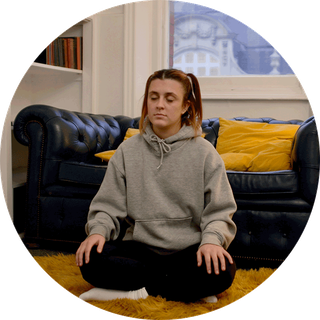
In this step-by-step video guide, mindfulness and meditation expert Dr. Becky Spelman explains how you can give meditation a go and the benefits it can bring.
## How to meditate in 7 steps
Stopping to consciously be calm does not come easily to everyone, but it can be beneficial to us all.
Here is our 7-step guide to learning how to meditate.
### 1\. Set aside some time
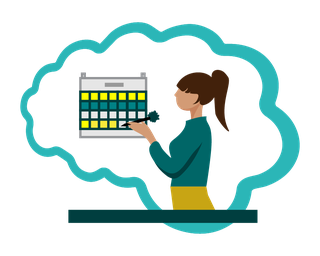
We all know it can be hard to find time, but meditation works best with regular sessions. There's no rule about how long a meditation session should last, but 20 minutes is a good guide.
If possible, it can be useful to meditate at the start of the day to set you up well for what's ahead and in the evening to help you let go of tension before bed.
Don't worry if this is not possible – everyone needs to find a routine that works for them.

### 2\. Find a comfortable place
You do not need any specialist equipment, just somewhere to sit that is comfortable and warm.
You might want to sit cross-legged on the floor, in which case a yoga mat can be useful, but a towel or rug also works fine. Some people sit in a chair or on their bed.
Two things are important: that you are comfortable and can be upright. Sitting with good posture is a more positive position for your body than slumping – some people find a meditation cushion can help with this.
If you are on a chair or bed, make sure it provides support so you do not sink down into it.
### 3\. Bring mindfulness into meditation
You may have already watched [our video on mindfulness](https://www.nhs.uk/every-mind-matters/mental-wellbeing-tips/what-is-mindfulness/). It can be helpful to bring this into your meditation, as it might help you focus on the present moment.
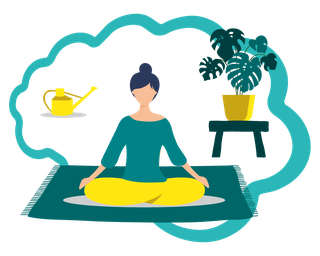
One way would be to consciously be aware of your senses. Once you're comfortable, close your eyes and then focus on each of your other senses.
Notice what the carpet, mat or duvet feels like beneath you. What can you hear? What you can smell? Is there any particular taste in your mouth?
By doing this, you might feel more connected with your body and less concerned with the thoughts whirring in your head.
### 4\. Start your meditation
When you're comfortable and centred, you can start meditating.
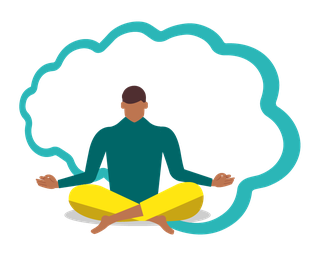
With your eyes closed, simply breathe in while saying "breathe in" in your head as you do. Then breathe out and say "breathe out".
For the next 20 minutes or so, your aim is to focus on this circular breath and the simple words in your head as much as possible.

### 5\. The challenge of focusing the mind
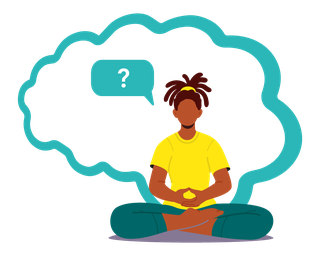
It's important to remember that a wandering mind is a natural part of meditation practice. It's not a failure, just part of learning – and even people with lots of experience of meditating will still have wandering minds sometimes.
The challenge is to notice when we get distracted by a thought and consciously bring our minds back to focus on the breath.
When you first start to meditate and your mind wanders, simply congratulate yourself for noticing.
You then have the opportunity to shift your focus back to your breath.
### 6\. Get the hang of meditation
Mastering meditation takes practice. Here's how to manage some of the difficulties you may face when meditating.
#### Meditation challenges
Intruding thoughts
A brief thought about paying the electricity bill could spiral into worries about money or work and take your mind off the meditation.
Remember: having a totally blank mind is not the goal of meditation. It's OK if a thought intrudes – just gently try to shift your focus back to your breath.
If your mind wanders off 10 times during a meditation, bring it back to the breath 10 times.
Breathing naturally
It can be difficult to find the balance between focusing on the circular breath and breathing naturally when meditating.
This is just part of learning the technique, so it's important to be aware of this as an issue.
Over time you should find the right balance.
Judging your practice
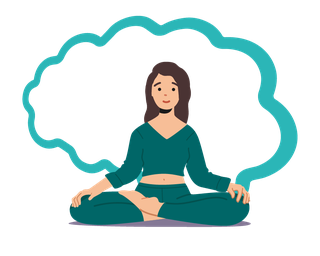
There is no right or wrong way to meditate – the important thing is that you have taken time to invest in your mental wellbeing.
A meditation filled with rising thoughts and a wandering mind is still a meditation and still beneficial.
### 7\. Bring your meditation to a close
It's important not to finish meditating too suddenly.
When you feel it's time to end, stop repeating the words and focusing on the breath, but stay in the same position with your eyes closed for a couple more minutes.
Once you feel ready, gently open your eyes. Stay seated for a little longer before getting up.
Ending a meditation like this gives you a calm transition into the next part of your day.
## Try our guided meditations
To help you get started meditating, we offer 2 types of guided meditation for you to try.
Give them both a go, and come back to repeat them regularly if you find them useful. You will get the most benefit from meditating if you're able to build it into your routine.
### Video: Guided body scan meditation (audio-only)
The guided meditation in this audio-only video can help you connect with your body, and identify areas of tension and anxiety. Dr. Becky Spelman takes you through the process.
### Video: Guided awareness of breath meditation (audio-only)
Learning to focus on your breathing is an easy way to reduce stress, and relieve tension and anxiety. In this audio-only video, Dr. Becky Spelman guides you through a simple breath meditation.
## More self-help ideas
We have loads more tips, guidance and advice to help you be kind to your mind.

### [What is mindfulness?](https://www.nhs.uk/every-mind-matters/mental-wellbeing-tips/what-is-mindfulness/)
Find out more about what mindfulness means and how it could benefit you, as well as expert video guidance and advice for how to start practising mindfulness and living in a mindful way.
[ Sign up for anxiety-easing emails Join our email programme to get expert advice and practical tips to help you deal with anxiety. It will also show you how to make these new steps part of your daily routine.](https://anxiety.ecrm-registration.nhs.uk/)
[ Self-help CBT techniques Find out what CBT is, watch video guides, and try practical tips and strategies to help deal with worries, solve problems and boost your mental wellbeing.](https://www.nhs.uk/every-mind-matters/mental-wellbeing-tips/self-help-cbt-techniques/)
[ Top tips to improve your mental wellbeing Good mental health and wellbeing is essential to living happy and healthy lives. Watch our videos and see 7 areas of life where simple changes can make a big difference.](https://www.nhs.uk/every-mind-matters/mental-wellbeing-tips/top-tips-to-improve-your-mental-wellbeing/)
Find more ideas to try in [mental wellbeing tips](https://www.nhs.uk/every-mind-matters/mental-wellbeing-tips/)
## Support links
- [Accessibility](https://www.nhs.uk/every-mind-matters/accessibility/)
- [Contact us](https://www.nhs.uk/every-mind-matters/contact-us/)
- [Cookies](https://www.nhs.uk/our-policies/cookies-policy/)
- [Privacy policy](https://www.nhs.uk/every-mind-matters/privacy-policy/)
- [Site map](https://www.nhs.uk/every-mind-matters/site-map/)
- [Terms and conditions](https://www.nhs.uk/every-mind-matters/terms-and-conditions/)
© Crown copyright |
| Readable Markdown | Meditation is not mystical – it's simply a way for us to stop for a moment and be calm. In a busy world, it gives us the permission to pause, breathe and reset.
Use this beginners' guide and video to learn how to meditate and about the benefits of meditation.
## The benefits of meditation
There are many types of meditation but the thing they all have in common is that, over time, they can help lower stress levels.
By releasing physical tension held in the body, meditation can help us release worries buried in the mind, easing anxiety, stress and low mood, and even helping you get deeper, more restful sleep.
Meditation can also bring a sense of calm that enables us to respond to life events in a measured way, rather than reacting with our emotions.
For the best results, try to build regular meditation into your daily routine.

## Video: How to meditate for beginners
In this step-by-step video guide, mindfulness and meditation expert Dr. Becky Spelman explains how you can give meditation a go and the benefits it can bring.
## How to meditate in 7 steps
Stopping to consciously be calm does not come easily to everyone, but it can be beneficial to us all.
Here is our 7-step guide to learning how to meditate.

### 1\. Set aside some time
We all know it can be hard to find time, but meditation works best with regular sessions. There's no rule about how long a meditation session should last, but 20 minutes is a good guide.
If possible, it can be useful to meditate at the start of the day to set you up well for what's ahead and in the evening to help you let go of tension before bed.
Don't worry if this is not possible – everyone needs to find a routine that works for them.

### 2\. Find a comfortable place
You do not need any specialist equipment, just somewhere to sit that is comfortable and warm.
You might want to sit cross-legged on the floor, in which case a yoga mat can be useful, but a towel or rug also works fine. Some people sit in a chair or on their bed.
Two things are important: that you are comfortable and can be upright. Sitting with good posture is a more positive position for your body than slumping – some people find a meditation cushion can help with this.
If you are on a chair or bed, make sure it provides support so you do not sink down into it.

### 3\. Bring mindfulness into meditation
You may have already watched [our video on mindfulness](https://www.nhs.uk/every-mind-matters/mental-wellbeing-tips/what-is-mindfulness/). It can be helpful to bring this into your meditation, as it might help you focus on the present moment.
One way would be to consciously be aware of your senses. Once you're comfortable, close your eyes and then focus on each of your other senses.
Notice what the carpet, mat or duvet feels like beneath you. What can you hear? What you can smell? Is there any particular taste in your mouth?
By doing this, you might feel more connected with your body and less concerned with the thoughts whirring in your head.

### 4\. Start your meditation
When you're comfortable and centred, you can start meditating.
With your eyes closed, simply breathe in while saying "breathe in" in your head as you do. Then breathe out and say "breathe out".
For the next 20 minutes or so, your aim is to focus on this circular breath and the simple words in your head as much as possible.

### 5\. The challenge of focusing the mind
It's important to remember that a wandering mind is a natural part of meditation practice. It's not a failure, just part of learning – and even people with lots of experience of meditating will still have wandering minds sometimes.
The challenge is to notice when we get distracted by a thought and consciously bring our minds back to focus on the breath.
When you first start to meditate and your mind wanders, simply congratulate yourself for noticing.
You then have the opportunity to shift your focus back to your breath.

### 6\. Get the hang of meditation
Mastering meditation takes practice. Here's how to manage some of the difficulties you may face when meditating.
Meditation challenges
Intruding thoughts
A brief thought about paying the electricity bill could spiral into worries about money or work and take your mind off the meditation.
Remember: having a totally blank mind is not the goal of meditation. It's OK if a thought intrudes – just gently try to shift your focus back to your breath.
If your mind wanders off 10 times during a meditation, bring it back to the breath 10 times.
Breathing naturally
It can be difficult to find the balance between focusing on the circular breath and breathing naturally when meditating.
This is just part of learning the technique, so it's important to be aware of this as an issue.
Over time you should find the right balance.
Judging your practice
There is no right or wrong way to meditate – the important thing is that you have taken time to invest in your mental wellbeing.
A meditation filled with rising thoughts and a wandering mind is still a meditation and still beneficial.

### 7\. Bring your meditation to a close
It's important not to finish meditating too suddenly.
When you feel it's time to end, stop repeating the words and focusing on the breath, but stay in the same position with your eyes closed for a couple more minutes.
Once you feel ready, gently open your eyes. Stay seated for a little longer before getting up.
Ending a meditation like this gives you a calm transition into the next part of your day.
## Try our guided meditations
To help you get started meditating, we offer 2 types of guided meditation for you to try.
Give them both a go, and come back to repeat them regularly if you find them useful. You will get the most benefit from meditating if you're able to build it into your routine.
### Video: Guided body scan meditation (audio-only)
The guided meditation in this audio-only video can help you connect with your body, and identify areas of tension and anxiety. Dr. Becky Spelman takes you through the process.
### Video: Guided awareness of breath meditation (audio-only)
Learning to focus on your breathing is an easy way to reduce stress, and relieve tension and anxiety. In this audio-only video, Dr. Becky Spelman guides you through a simple breath meditation.
## More self-help ideas
We have loads more tips, guidance and advice to help you be kind to your mind. |
| Shard | 75 (laksa) |
| Root Hash | 11359509702434384875 |
| Unparsed URL | uk,nhs,www!/every-mind-matters/mental-wellbeing-tips/how-to-meditate-for-beginners/ s443 |