ℹ️ Skipped - page is already crawled
| Filter | Status | Condition | Details |
|---|---|---|---|
| HTTP status | PASS | download_http_code = 200 | HTTP 200 |
| Age cutoff | PASS | download_stamp > now() - 6 MONTH | 0 months ago |
| History drop | PASS | isNull(history_drop_reason) | No drop reason |
| Spam/ban | PASS | fh_dont_index != 1 AND ml_spam_score = 0 | ml_spam_score=0 |
| Canonical | PASS | meta_canonical IS NULL OR = '' OR = src_unparsed | Not set |
| Property | Value |
|---|---|
| URL | https://www.ncufc.org/How-to-Plant-a.php |
| Last Crawled | 2026-04-10 17:46:31 (10 hours ago) |
| First Indexed | 2022-02-22 15:09:15 (4 years ago) |
| HTTP Status Code | 200 |
| Meta Title | How to Plant a Tree |
| Meta Description | null |
| Meta Canonical | null |
| Boilerpipe Text | Ready to plant your tree? The first thing you need to do is to determine what you want the tree to do for you.
A large tree to provide shade?
An ornamental tree with beautiful flowers, leaves, or bark?
A tree with dense leaves or needles to act as a windbreak or screen?
A deciduous tree that cools the house in the summer and drops its leaves in the fall so the winter sun can warm the house?
A tree that bears fruit for you or attracts wildlife?
Answering these questions can help determine where to locate a tree and what type of tree you want or need. You also need to determine if the tree needs full sun, partial shade (like dogwood), or a wetter environment (like weeping willow). For help with selecting high-quality nursery stock, refer to our handy
Tree Owner's Manual
.
Selecting the Planting Site
You need to consider several important factors in selecting the best site for your trees. Check for potential obstacles that might cause a problem. You do not want to place a tree that might interfere with buildings, utility lines, pavement like driveways and walks, and intersection sightlines. See some examples in the illustrations below. Also, you should plant your tree:
3 feet from pavement or fencing
15 feet from buildings
25 feet from utility lines if the tree will grow 30 feet or taller at maturity
Other Important Factors to Consider
Check below the ground so as not to sever underground utility lines. Call a locating service (1-888-258-0808).
Check local ordinances. Some communities may have ordinances for planting types of trees and their care. Always get permission if planting on public property like along the right of way.
Make sure you have the tools you need: shovel, sharp knife, pruning shears, water, mulch, and wire cutters if planting a ball and burlap tree
How to Plant a Tree
The illustration below provides the basic steps you should take to plant a tree.
The hole should be 2-3 times the size of the rootball.
Plant it with the root flare at or several inches above ground level.
If it's a ball and burlap tree, remove the pinning nails and pull the burlap and wire cage back as much as possible. Cut away as much wire as possible.
If it's a containerized tree, feather out the roots for better soil contact.
If it's a bare-root tree, create a small mound underneath to support the trunk.
Backfill half way and add water. Then complete the backfill and water again.
When you backfill, DO NOT tamp the soil down with your feet as it compacts the soil and makes it difficult for roots to spread.
Do not pile up mulch around the trunk of the tree (volcano mulching). Make a round berm of mulch around the planting hole to direct water towards the tree roots.
Water the tree very well after planting and then every few days. Water at least once a week if there is no rain.
Right Tree Right Place - Downloadable PDF |
| Markdown | - [About NCUFC](https://www.ncufc.org/About-NCUFC.php)
- [Mission & Goals](https://www.ncufc.org/Mission-Goals.php)
- [Bylaws](https://www.ncufc.org/bylaws.php)
- [Board](https://www.ncufc.org/Board.php)
- [Partners and Supporters](https://www.ncufc.org/partners-supports.php)
- [News & Press](https://www.ncufc.org/news.php)
- [Events](https://www.ncufc.org/Events.php)
- [Additional Resources](https://www.ncufc.org/Additional-Resources.php)
- [Contact Us](https://www.ncufc.org/Contact-Us.php)
[](https://www.ncufc.org/)
- [ABOUT NCUFC](https://www.ncufc.org/about-ncufc.php)
- [Mission & Goals](https://www.ncufc.org/Mission-Goals.php)
- [Bylaws](https://www.ncufc.org/bylaws.php)
- [Board](https://www.ncufc.org/Board.php)
- [Partners and Supporters](https://www.ncufc.org/partners-supports.php)
- [News & Press](https://www.ncufc.org/news.php)
- [PROJECTS & INITIATIVES](https://www.ncufc.org/projects-initiatives.php)
- [Career in Arboriculture](https://www.ncufc.org/Career-in-Arboriculture.php)
- [Careers in Urban Forestry Blog](https://www.ncufc.org/Career-in-Urban-Forestry.php)
- [Green Infrastructure Alliance](https://www.ncufc.org/Green-Infrastructure-Alliance-GIA.php)
- [Legacy Tree Fund](https://www.ncufc.org/Legacy-Tree-Fund.php)
- [NC Community Tree Advocacy Network](https://www.ncufc.org/NC-Community-Tree-Advocacy.php)
- [NC Urban Forestry Awards](https://www.ncufc.org/NC-Urban-Forestry-Awards.php)
- [NC Trees & Storms: Readiness, Response, & Recovery](https://www.ncufc.org/Readiness-Response-Recovery.php)
- [NC Urban Wood Group](https://www.ncufc.org/NC-Urban-Wood-Group.php)
- [Tree Board Webinars](https://www.ncufc.org/Tree-Board-Webinars.php)
- [TREE CARE INFORMATION](https://www.ncufc.org/tree-care-information.php)
- [How to Hire an Arborist](https://www.ncufc.org/How-to-Hire-an.php)
- [How to Plant a Tree](https://www.ncufc.org/How-to-Plant-a.php)
- [Proper Mulching for Trees](https://www.ncufc.org/proper-mulching-for-trees.php)
- [Proper Pruning](https://www.ncufc.org/Proper-Pruning.php)
- [Street Tree Inventories](https://www.ncufc.org/Street-Tree-Inventories.php)
- [Trees & Storms](https://www.ncufc.org/NC-Trees-Storms.php)
- [Trees and Utilities](https://www.ncufc.org/Trees-and-Utilities.php)
- [Tree Protection During Construction](https://www.ncufc.org/Tree-Protection-During-Construction.php)
- [Urban Pests of NC](https://www.ncufc.org/urban-pests-of-nc.php)
- [Urban Site Considerations](https://www.ncufc.org/Urban-Site-Considerations.php)
- [UPCOMING EVENTS](https://www.ncufc.org/events.php)
- [ADDITIONAL RESOURCES](https://www.ncufc.org/additional-resources.php)
- [CONTACT US](https://www.ncufc.org/contact-us.php)
[](https://www.ncufc.org/)
- [Twitter](http://www.twitter.com/ncurbanforests)
- [Instagram](http://www.instagram.com/ncurbanforests)
- [Facebook](http://www.facebook.com/pages/NC-Urban-Forest-Council/244787824452)
- [Youtube](https://www.youtube.com/channel/UC2ddG78pqPqUtLOpXLXphUw)
- [LinkedIn](https://www.linkedin.com/company/north-carolina-urban-forest-council/)
[(252) 653-6277](tel:2526536277) [BECOME A MEMBER](https://www.ncufc.org/Membership.php)
# How to Plant a Tree
Ready to plant your tree? The first thing you need to do is to determine what you want the tree to do for you.
- A large tree to provide shade?
- An ornamental tree with beautiful flowers, leaves, or bark?
- A tree with dense leaves or needles to act as a windbreak or screen?
- A deciduous tree that cools the house in the summer and drops its leaves in the fall so the winter sun can warm the house?
- A tree that bears fruit for you or attracts wildlife?
Answering these questions can help determine where to locate a tree and what type of tree you want or need. You also need to determine if the tree needs full sun, partial shade (like dogwood), or a wetter environment (like weeping willow). For help with selecting high-quality nursery stock, refer to our handy **[Tree Owner's Manual](https://www.ncufc.org/uploads/TreeOwner_proof_final.pdf)**.
**Selecting the Planting Site**
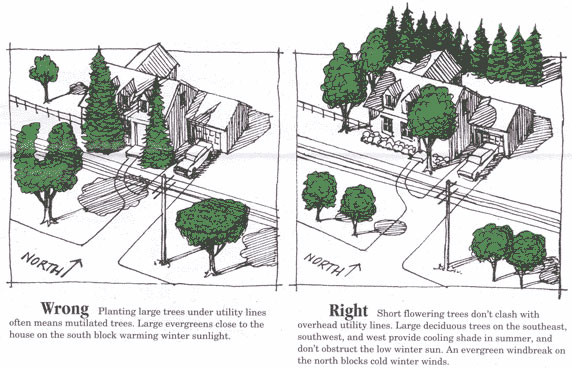
You need to consider several important factors in selecting the best site for your trees. Check for potential obstacles that might cause a problem. You do not want to place a tree that might interfere with buildings, utility lines, pavement like driveways and walks, and intersection sightlines. See some examples in the illustrations below. Also, you should plant your tree:
- 3 feet from pavement or fencing
- 15 feet from buildings
- 25 feet from utility lines if the tree will grow 30 feet or taller at maturity
**Other Important Factors to Consider**
- Check below the ground so as not to sever underground utility lines. Call a locating service (1-888-258-0808).
- Check local ordinances. Some communities may have ordinances for planting types of trees and their care. Always get permission if planting on public property like along the right of way.
- Make sure you have the tools you need: shovel, sharp knife, pruning shears, water, mulch, and wire cutters if planting a ball and burlap tree
**How to Plant a Tree**
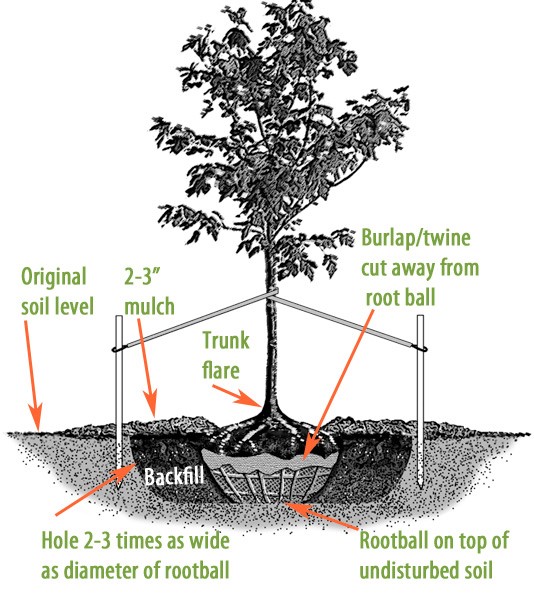
The illustration below provides the basic steps you should take to plant a tree.
- The hole should be 2-3 times the size of the rootball.
- Plant it with the root flare at or several inches above ground level.
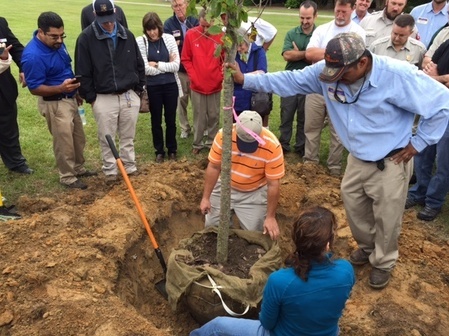
- If it's a ball and burlap tree, remove the pinning nails and pull the burlap and wire cage back as much as possible. Cut away as much wire as possible.
- If it's a containerized tree, feather out the roots for better soil contact.
- If it's a bare-root tree, create a small mound underneath to support the trunk.
- Backfill half way and add water. Then complete the backfill and water again.
- When you backfill, DO NOT tamp the soil down with your feet as it compacts the soil and makes it difficult for roots to spread.
- Do not pile up mulch around the trunk of the tree (volcano mulching). Make a round berm of mulch around the planting hole to direct water towards the tree roots.
- Water the tree very well after planting and then every few days. Water at least once a week if there is no rain.
- **[Right Tree Right Place - Downloadable PDF](http://www.ncufc.org/righttree.pdf)**
| | | | | |
|---|---|---|---|---|
| Our Partners: |  |  |  |  |
[SUPPORT OUR WORK](https://www.ncufc.org/donate.php)
[REQUEST INFORMATION](https://www.ncufc.org/contact-us.php)
[MEMBER LOGIN](https://www.ncufc.org/member-login.php)
[X]()
- [**Projects & Initiatives**](https://www.ncufc.org/projects-initiatives.php)
- [NC Trees & Storms: Readiness, Response, & Recovery](https://www.ncufc.org/Readiness-Response-Recovery.php)
- [Green Infrastructure Alliance](https://www.ncufc.org/Green-Infrastructure-Alliance-GIA.php)
- [Career in Arboriculture](https://www.ncufc.org/Career-in-Arboriculture.php)
- [NC Community Tree Advocacy Network](https://www.ncufc.org/NC-Community-Tree-Advocacy.php)
- [Fundraising](https://www.ncufc.org/fundraising.php)
- [Legacy Tree Fund](https://www.ncufc.org/legacy-tree-fund.php)
- [NC Urban Forestry Awards](https://www.ncufc.org/nc-urban-forestry-awards.php)
- [NC Urban Wood Group](https://www.ncufc.org//nc-wood-group.php)
- [Tree Board Webinars](https://www.ncufc.org/tree-board-webinars.php)
- [**Tree Care Information**](https://www.ncufc.org/tree-care-information.php)
- [NC Trees & Storms](https://www.ncufc.org/NC-Trees-Storms.php)
- [Trees and Utilities](https://www.ncufc.org/Trees-and-Utilities.php)
- [How to Plant a Tree](https://www.ncufc.org/How-to-Plant-a.php)
- [Urban Site Considerations](https://www.ncufc.org/Urban-Site-Considerations.php)
- [Tree Protection During Construction](https://www.ncufc.org//tree-protection-during-construction.php)
- [How to Hire an Arborist](https://www.ncufc.org/how-to-hire-an-arborist.php)
- [Proper Mulching for Trees](https://www.ncufc.org//proper-mulching-for-trees.php)
- [Street Tree Inventories](https://www.ncufc.org/street-tree-initiatives.php)
- [Proper Pruning](https://www.ncufc.org//proper-pruning.php)
- [Urban Pests of NC](https://www.ncufc.org//urban-pests-of-nc.php)
- [**Upcoming Events**](https://www.ncufc.org/events.php)
- [Events](https://www.ncufc.org/events.php)
- [Conference](https://www.ncufc.org/event.php?id=1)
- [**About NCUFC**](https://www.ncufc.org/about-ncufc.php)
- [Board](https://www.ncufc.org/Board.php)
- [Bylaws](https://www.ncufc.org/bylaws.php)
- [Mission & Goals](https://www.ncufc.org/mission-goals.php)
- [Partners](https://www.ncufc.org/partners-supports.php)
- **[Additional Resources](https://www.ncufc.org/additional-resources.php)**
- **[Become a Member](https://www.ncufc.org/Membership.php)**
- **[E-News Sign Up](https://www.ncufc.org/contact-us.php)**
- **[Donate](https://www.ncufc.org/donate.php)**
- **[News & Press](https://www.ncufc.org/news.php)**
**North Carolina Urban Forest Council**
P.O. Box 37416
Raleigh, North Carolina 27627
(252) 653-6277
- [Twitter](http://www.twitter.com/ncurbanforests)
- [Instagram](http://www.instagram.com/ncurbanforests)
- [Facebook](http://www.facebook.com/pages/NC-Urban-Forest-Council/244787824452)
- [Youtube](https://www.youtube.com/channel/UC2ddG78pqPqUtLOpXLXphUw)
- [Youtube](https://www.linkedin.com/company/north-carolina-urban-forest-council/) |
| Readable Markdown | Ready to plant your tree? The first thing you need to do is to determine what you want the tree to do for you.
- A large tree to provide shade?
- An ornamental tree with beautiful flowers, leaves, or bark?
- A tree with dense leaves or needles to act as a windbreak or screen?
- A deciduous tree that cools the house in the summer and drops its leaves in the fall so the winter sun can warm the house?
- A tree that bears fruit for you or attracts wildlife?
Answering these questions can help determine where to locate a tree and what type of tree you want or need. You also need to determine if the tree needs full sun, partial shade (like dogwood), or a wetter environment (like weeping willow). For help with selecting high-quality nursery stock, refer to our handy **[Tree Owner's Manual](https://www.ncufc.org/uploads/TreeOwner_proof_final.pdf)**.
**Selecting the Planting Site**
You need to consider several important factors in selecting the best site for your trees. Check for potential obstacles that might cause a problem. You do not want to place a tree that might interfere with buildings, utility lines, pavement like driveways and walks, and intersection sightlines. See some examples in the illustrations below. Also, you should plant your tree:
- 3 feet from pavement or fencing
- 15 feet from buildings
- 25 feet from utility lines if the tree will grow 30 feet or taller at maturity

**Other Important Factors to Consider**
- Check below the ground so as not to sever underground utility lines. Call a locating service (1-888-258-0808).
- Check local ordinances. Some communities may have ordinances for planting types of trees and their care. Always get permission if planting on public property like along the right of way.
- Make sure you have the tools you need: shovel, sharp knife, pruning shears, water, mulch, and wire cutters if planting a ball and burlap tree
**How to Plant a Tree**
The illustration below provides the basic steps you should take to plant a tree.
- The hole should be 2-3 times the size of the rootball.
- Plant it with the root flare at or several inches above ground level.
- If it's a ball and burlap tree, remove the pinning nails and pull the burlap and wire cage back as much as possible. Cut away as much wire as possible.
- If it's a containerized tree, feather out the roots for better soil contact.
- If it's a bare-root tree, create a small mound underneath to support the trunk.
- Backfill half way and add water. Then complete the backfill and water again.
- When you backfill, DO NOT tamp the soil down with your feet as it compacts the soil and makes it difficult for roots to spread.
- Do not pile up mulch around the trunk of the tree (volcano mulching). Make a round berm of mulch around the planting hole to direct water towards the tree roots.
- Water the tree very well after planting and then every few days. Water at least once a week if there is no rain.

- **[Right Tree Right Place - Downloadable PDF](http://www.ncufc.org/righttree.pdf)** |
| Shard | 135 (laksa) |
| Root Hash | 3839313699825512135 |
| Unparsed URL | org,ncufc!www,/How-to-Plant-a.php s443 |