ℹ️ Skipped - page is already crawled
| Filter | Status | Condition | Details |
|---|---|---|---|
| HTTP status | PASS | download_http_code = 200 | HTTP 200 |
| Age cutoff | PASS | download_stamp > now() - 6 MONTH | 0 months ago |
| History drop | PASS | isNull(history_drop_reason) | No drop reason |
| Spam/ban | PASS | fh_dont_index != 1 AND ml_spam_score = 0 | ml_spam_score=0 |
| Canonical | PASS | meta_canonical IS NULL OR = '' OR = src_unparsed | Not set |
| Property | Value |
|---|---|
| URL | https://www.moneysense.ca/save/investing/bitcoin/should-you-invest-in-cryptocurrency/ |
| Last Crawled | 2026-04-21 01:32:18 (9 hours ago) |
| First Indexed | 2021-01-28 15:06:08 (5 years ago) |
| HTTP Status Code | 200 |
| Meta Title | Should you invest in cryptocurrency? - MoneySense |
| Meta Description | It's no wonder bitcoin and other cryptocurrency have captured the attention of investors around the world: if you invested $1,000 in bitcoin in 2010, it would be worth $287.5 million today. But crypto is frighteningly volatile, and should be approached with clarity and caution. Here's what you need to know. |
| Meta Canonical | null |
| Boilerpipe Text | Photo by Aleksi Räisä on Unsplash
How much is bitcoin worth? Should you invest in it? If so, how do you invest in bitcoin? Great questions. And
since its creation in 2009,
bitcoin investing has intrigued, excited and, often, frightened market-watchers and investors alike. Notoriously volatile, the cryptocurrency traded at 8 cents per coin in 2010, to an all-time high of more than US$23,000 on Dec. 16, 2020. If you were to chart bitcoin’s worth i
n the intervening years, it would look like the profile of a terrifying roller coaster, with a long, slow, initial rise, followed by jagged peaks and valleys from 2017—the first time it crested US$20,000—to today.
There are other
crypto investments, but bitcoin is considered the most widely traded and most successful. It has been mused that if you invested $1,000 in bitcoin at 8 cents per coin in 2010, your cryptocurrency
investment would be worth $287.5 million today. Phew! No wonder bitcoin has captured so much interest.
What is bitcoin?
Bitcoin is a digital currency that many call
the best
cryptocurrency
to buy, dubbing it “the new gold.”
Of course, gold is one of the oldest currencies on earth, and currencies and methods of payment are always evolving.
What does this mean? Arthur Salzer of Northland Wealth Management offers:
“Monetary value usually arises from objects that are scarce, durable and relatively easy to divide. Since the dawn of civilization, societies have used rare seashells, wampum, glass beads, and stones as money or a form of record keeping. Gold is an ideal example since it can be made into jewelry, coins and bars, but bitcoin is unique in today’s digital world since it is scarce, durable, has strong privacy characteristics.”
These days, gold is rarely used as a form of payment; it’s seen more as a store of value, and an investment or portfolio asset that is not highly correlated to stocks and bonds and cash.
Similarly, supporters and owne
rs of cryptocurrency invest in bitcoin because they
see it as a store of value, and a useful portfolio asset. Bitcoin may also work its way into a direct method of payment as well. In other words, you might one day use bitcoin to buy a car or a loaf of bread. It’s a lot quicker and easier to send digital money than to lug around bars of gold.
How to invest in cryptocurrency
Bitcoin isn’t your typical investment. In fact,
as a digital currency, bitcoin is not a physical coin. Rather, a bitcoin is created and then accessed by way of a digital code. This happens over the internet.
The ledger (blockchain) where the transactions are executed and monitored is public and for all to see. That’s referred to as “open source.”
The creator of bitcoin, who goes by the pseudonym
Satoshi Nakamoto
, describes bitcoin as
“a purely peer-to-peer version of electronic cash that allows online payments to be sent directly from one party to another without going through a financial institution.”
In essence, bitcoin is a public ledger shared by a network of computers. To pay with or to exchange bitcoins, you send a signed message transferring ownership to a receiver’s public key. Each bitcoin is locked by a second private key. Think of a private key as a more complicated series of passwords called a “seed.” No one can access any amount of bitcoin without a private key. Obviously, it is crucial that you keep track of both the public and private keys, and do not share those keys except with a person you trust as your backup. If you lose your keys,
you lose your bitcoin
.
Blockchain
is the revolutionary record-keeping technology that is the backbone of bitcoin. No single person or group has control of the currency; all users are in control collectively. The larger the bitcoin network gets, the more secure it gets. The computer hubs (called nodes) all over the world are all continually fact-checking each other’s ledgers. Each translation is scrutinized. When bitcoin is exchanged, it’s as if millions of tellers are simultaneously confirming the validity of the translation.
Watch: How to buy bitcoin in Canada
How much is bitcoin worth?
How much is one bitcoin worth? Well, it depends on the day.
Bitcoin has value because enough people believe bitcoin has value. That may be no different than gold. Gold is really just a shiny rock; but because it was “decided” centuries ago that gold was desirable (and scarce), it is considered a store of value. It became a currency and also a store of wealth, and a portfolio asset in modern times.
While no one knows with any certainty how much gold might be discovered, the algorithm for bitcoin release is capped at 21 million coins. To date, just over 18.5 million bitcoins have been created, and there are almost 2.4 million coins left to be released. Currently, 900 coins are released each day, and the last bitcoins will be released around 2040. Bitcoin “miners” (a.k.a. programmers) are rewarded with the new bitcoins, in payment for their verifications of the transaction on the blockchain.
It is the scarcity of bitcoin, and its finite quantity, that offer the greatest appeal to those who reject or question the value of fiat currencies such as the US dollar, the euro or the Canadian dollar. Certainly, bitcoin, as well as fiat currencies, are created “out of thin air.” But while central banks can create as much new currency as they see fit, there is a hard limit to the amount of bitcoin. That’s why those who favour bitcoin often call it “the hardest currency on earth.”
On the other side of the ledger, critics will offer that bitcoin is worthless
because
it is created out of thin air, and only backed by those who accept and exchange bitcoin, and assign value. In contrast, fiat currencies are backed by the wealth creation and taxing powers of each nation.
How is bitcoin mined, exactly?
Programmers (bitcoin miners) have to locate the new coins and then perform a series of complex mathematical equations in order to unlock the new coins. These miners collectively are also required to confirm ongoing bitcoin transitions verifying the details. As noted above, millions of digital eyeballs are on each transaction. But in the end, only one miner or miner group (called a “node”) will be rewarded with the new issue of bitcoins.
The successful miner “walks away” with the new coins, and the group of confirmed and verified bitcoin transactions (the “block”) is added to the existing record (“chain”) of transitions. That is how we get to the name and technology known as the “blockchain.”
You might think of these miners as paid auditors.
Other desirable attributes of bitcoin investing
Bitcoin is decentralized. It is not regulated by any government or any financial regulator. As you’ve read, bitcoin is operated and ‘policed’ by its own community. This decentralization is one of the greatest appeals for many who have embraced bitcoin.
As you may know, governments around the world have confiscated gold in the past and, during some periods, private ownership of gold
was outlawed
. However, in theory, government agencies will not be able to confiscate your bitcoin.
Bitcoin is portable, and near frictionless to send and receive. It can be sent from anywhere to anywhere in just seconds. It knows no borders.
The potential for bitcoin investors
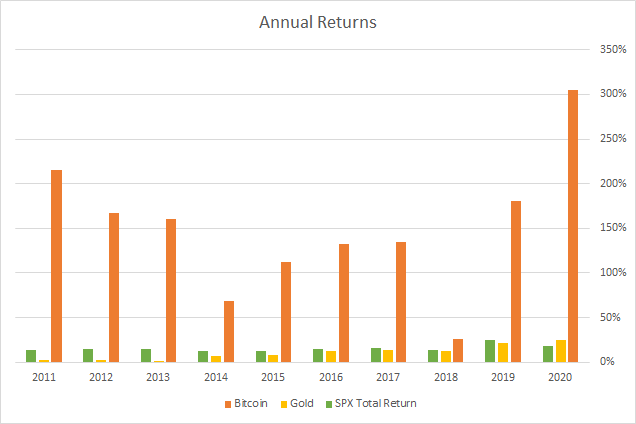
Bitcoin has delivered mind-boggling returns from its inception. If you consider it an asset or an asset class, it has been the best-performing for many periods over the last 10 years. The following table takes us to the end of November 2020. Bitcoin then went on to add another 50% in December of 2020.
Source: Arxnovum Investments Inc., Bloomberg
Despite the jaw-dropping overall gains over time, bitcoin is incredibly explosive and incredibly volatile. To come up a winner, one would have to be prepared for some violent moves to the downside.
And given the volatility and explosive characteristics, bitcoin historically has made a wonderful portfolio asset. How’s that? There is very little (or negative) correlation between bitcoin and other major assets. That’s exactly what we’re looking for when we seek portfolio diversification. We want non-correlated assets that will move in opposite directions.
Keep in mind though, that because bitcoin is still very volatile and explosive at its core, it will increase the overall volatility of a balanced portfolio. But historically it has boosted returns (although it’s important to remember that past performance is not a guarantee of future returns).
As
CoinShares
offers, using a 4% weighting in a balanced portfolio increased returns from 9.3% to 18.8%. The calculation is a 5-year period to the end of October 2020 (although it’s important to remember that past performance does not guarantee future returns).
As well, looking at the period from January of 2014 to the end of October 2020, an
allocation of bitcoin would have contributed positively
to a diversified portfolio’s cumulative and risk-adjusted returns in 74% of one-year periods, 97% of two-year periods, and 100% of three-year periods since 2014, assuming quarterly rebalancing.
How widely accepted is bitcoin today?
In July 2020, Michael Saylor, the billionaire founder of MicroStrategy, an American corporation that offers software-based solutions to client companies, directed his company to hold part of its cash reserves in alternative assets. By September, MicroStrategy’s corporate treasury had purchased bitcoins worth $425 million. Square, the San Francisco-based payments company, bought bitcoins worth $50 million in October 2020. More recently PayPal announced that American users can
buy bitcoins
, as well as hold and sell it in their PayPal wallets. Every week we see more major financial institutions “come on board.”
How do you buy bitcoin and hold cryptocurrency?
Like paper money, you hold bitcoin in a wallet. In this case, it is a digital wallet. And “wallet” is a misnomer; the wallet doesn’t secure your bitcoin, but, rather, storing your keys—digital code that is required to unlock your
bitcoin investment
. No one, not even you, can access your bitcoin without your keys.
You can hold your bitcoin in a “hot wallet” or a “cold wallet.” Hot wallets are digital wallets stored online, whereas cold storage or cold wallets are most often physical hardware devices. As you might guess, cold storage is the gold standard for securing bitcoin keys; money held in a hot wallet might be as secure as a physical leather wallet—it could be stolen.
A
cold wallet
, which costs upwards of $150, offers physical bitcoin storage and is more secure, like a vault at a bank. Technically, your cold storage cannot be hacked as it is not accessible online. Think of it like a vault at the bank. Of course, you would have to take great care to ensure that you understand the technology and processes for storing your personal keys in a cold wallet.
What bitcoin options are available in Canada?
With the following options you will not have to own or create your own wallet, and becoming a bitcoin investor is as easy as opening an account and pressing a few buttons to buy or sell bitcoin. These companies will hold and store your keys on your behalf. As with buying mutual funds or
ETFs
there are fees for these services.
You can
buy bitcoin, as well as sell it,
with
Wealthsimple
; the setup process is very quick and simple.
The same level of ease goes with the all-in-one solution at
Bitbuy
.
You can also purchase closed-end mutual funds from
3iQ
and from
CI Galaxy
. These bitcoin funds are available in U.S. or Canadian dollars. An added bonus with these funds is that you can hold them in registered accounts such as an
RRSP
,
RRIF
or even a
TFSA
. (Given the potential of explosive gains, a tax-free savings account would be a wonderful place to have exposure to bitcoin.)
If you’re wondering
how to invest in bitcoin
outside of your TFSA, you might also consider
Grayscale
, which is a U.S.-dollar fund.
What are the risks of owning bitcoin?
The greatest risk is the hacking of bitcoin exchange platforms and the bitcoin blockchain platform. To date, the bitcoin platform has never suffered a serious hacking event, but certainly many third-party exchanges that hold bitcoin for their clients have been hacked, and bitcoin has been stolen.
In Canada, many were victims of the
QuadrigaCX debacle
. A total of 76,319 unsecured creditors—virtually all of them QuadrigaCX clients—have come forward to claim they are owed $214.6 million collectively. In the case of QuadrigaCX, the founder died and allegedly took the keys to his deathbed.
There are many other risks, including from governments that may attempt to circumvent or regulate this new currency, which is in competition with their own fiat currencies.
The ownership of bitcoin might also be concentrated in too few names, who can then control or manipulate the
bitcoin price.
For a full rundown on the risks. you might check out the prospectus for the
3iQ bitcoin fund
.
Is bitcoin safe, and more final thoughts on bitcoin
Bitcoin is an incredibly volatile but explosive asset. That’s why you might not need an aggressive allocation for bitcoin to have a considerable impact on your portfolio.
And given that bitcoin is (likely) near all-time highs at the time of this post’s initial publication in January 2021, you might simply dollar-cost-average into your position. You might be offered lower prices in the future. But if bitcoin keeps (mostly) rising, then you’re making money on the way up. That’s not a bad deal, either. If you’re interested in going deep into bitcoin, have a read of
The Bitcoin Standard
from Saifedean Ammous.
Given its explosive nature, you might develop an exit or rebalancing plan as well. I invested at a weight of 2% with plans to add more. But the recent surge in bitcoin price quickly took me to over a 6% weighting. I may trim the bitcoin holding when it reaches a 15% weighting, reducing it to 10%. When or if it moves to 15% again, trim back to 10%. Rinse and repeat. My risk is managed, as I am then in a very positive position at the very first trimming—even if I were to lose the remaining position. (Disclosure: I have invested in bitcoin by way of the 3iQ funds.)
For me, it was a no-brainer risk-return proposition, but you will have to decide for yourself.
This post is not a recommendation for
bitcoin or crypto
investment advice. If you decide to invest, please ensure that you understand the risks, and the risk of permanent loss.
Dale Roberts is a proponent of low-fee investing who blogs at
cutthecrapinvesting.com
. Find him on
Twitter @67Dodge
.
Read more about
crypto
:
How to buy ethereum in Canada
How to buy Avalanche (AVAX) in Canada
Is ethereum a good investment in 2022? A guide for Canadian investors
How to gain exposure to crypto without buying it
About Dale Roberts
Dale Roberts is a former investment advisor and proponent of low-fee investing. He created the Cut The Crap Investing blog in 2018. Find him on Twitter for market updates and commentary, every day.
Related Articles
Investing
Wealthsimple-X deal sparks investor risk concerns
Wealthsimple’s new partnership with X lets users jump from posts to trading, but critics warn it could fuel hype-driven...
Wealthsimple-X deal sparks investor risk concerns
Investing
The best GIC rates in Canada for 2026
Find the best GIC rates in Canada. Plus, everything you need to know about how they work.
The best GIC rates in Canada for 2026
ETFS
Best international equity ETFs for Canadian investors 2026
Canadian investors should look beyond the border for diversification, given that Canada represents just a small part of the...
Best international equity ETFs for Canadian investors 2026
ETFs
Best U.S. equity ETFs for Canadian investors 2026
The MoneySense Best ETFs 2026 panel suggests what to look at for the best exchange-traded funds that own companies...
Best U.S. equity ETFs for Canadian investors 2026
ETFs
Best Canadian equity ETFs 2026
The 2026 MoneySense Best ETFs panel’s picks for the best exchange-traded funds focused on Canadian stocks.
Best Canadian equity ETFs 2026
ETFs
Buying ETFs in Canada Tool: The MoneySense ETF Screener
Which ETFs should you invest in? Which ones best suit your risk tolerance? What about personal ethics? Check out...
Buying ETFs in Canada Tool: The MoneySense ETF Screener
Investing
Why emotional biases may be riskier than market swings
Volatile markets can trigger emotional investing driven by biases like overconfidence and herd behaviour. Experts explain how to stay...
Why emotional biases may be riskier than market swings
ETFS
Best ETFs in Canada for 2026
Back for the 14th edition, here are the top exchange-traded funds among Canadian, U.S., international, fixed income, cash alternative,...
Best ETFs in Canada for 2026
Investing
Stock news: Cogeco, Roots, and BlackBerry deliver earnings gains but outlooks remain mixed
Quarterly results show profit gains at Cogeco, Roots and BlackBerry despite ongoing revenue pressure and uneven forward guidance.
Stock news: Cogeco, Roots, and BlackBerry deliver earnings gains but outlooks remain mixed
Investing
Defence stocks attract attention as spending climbs
Experts say rising geopolitical tensions and higher defence budgets are reshaping investing strategies, with opportunities spanning weapons, tech and...
Defence stocks attract attention as spending climbs |
| Markdown | [Go to Main Content](https://www.moneysense.ca/save/investing/bitcoin/should-you-invest-in-cryptocurrency/#maincontent)
- [](https://www.moneysense.ca/)
- [](https://www.ratehub.ca/)
- [](https://www.canwise.com/)
- [](https://www.rhinsurance.ca/)
Menu
Search Site
[Subscribe](https://www.moneysense.ca/newsletter-signup/)
- [Save & Spending]()
- [All Save & Spending](https://www.moneysense.ca/save/)
- [Credit](https://www.moneysense.ca/tag/credit/)
- [Fraud and Scams](https://www.moneysense.ca/save/fraud-and-scams/)
- [Credit cards](https://www.moneysense.ca/spend/credit-cards/)
- [Best credit cards](https://www.moneysense.ca/spend/credit-cards/best-credit-cards-in-canada/)
- [Best rewards cards](https://www.moneysense.ca/spend/best-rewards-credit-cards-in-canada/)
- [Best travel cards](https://www.moneysense.ca/spend/credit-cards/best-travel-credit-cards-in-canada/)
- [Best cash back cards](https://www.moneysense.ca/spend/credit-cards/best-cash-back-credit-cards-in-canada/)
- [Best low interest cards](https://www.moneysense.ca/spend/credit-cards/best-low-interest-credit-cards-in-canada)
- [Best balance transfer cards](https://www.moneysense.ca/spend/best-balance-transfer-credit-cards-in-canada/)
- [Debt](https://www.moneysense.ca/save/debt/)
- [Banking](https://www.moneysense.ca/save/banking/)
- [Travel](https://www.moneysense.ca/spend/shopping/travel/)
- [Auto](https://www.moneysense.ca/spend/shopping/auto/)
- [Loans](https://www.moneysense.ca/save/debt/loans/)
- [Newcomers to Canada](https://www.moneysense.ca/save/financial-planning/newcomers-to-canada/)
- [Students](https://www.moneysense.ca/save/debt/student-debt/)
- [Investing]()
- [All Investing](https://www.moneysense.ca/save/investing/)
- [GICs](https://www.moneysense.ca/save/investing/gic/)
- [GIC rates](https://www.moneysense.ca/save/investing/best-gic-rates/)
- [RRSPs + RRIFs + LIRAs](https://www.moneysense.ca/save/investing/rrsp/)
- [Best RRSPs](https://www.moneysense.ca/save/investing/rrsp/the-best-rrsp-investments/)
- [TFSAs](https://www.moneysense.ca/save/investing/tfsa/)
- [Best TFSAs](https://www.moneysense.ca/save/best-tfsa-rates-canada/)
- [ETFs](https://www.moneysense.ca/save/investing/etfs/)
- [Best ETFs](https://www.moneysense.ca/save/investing/best-etfs-in-canada/)
- [ETF finder tool](https://www.moneysense.ca/save/investing/etfs/the-moneysense-etf-finder-tool/)
- [Crypto](https://www.moneysense.ca/save/investing/crypto/)
- [Best crypto](https://www.moneysense.ca/save/investing/crypto/the-top-crypto-platforms-and-apps-in-canada/)
- [RESPs](https://www.moneysense.ca/save/investing/resp/)
- [REITs](https://www.moneysense.ca/tag/reits/)
- [Markets](https://www.moneysense.ca/save/investing/stocks/)
- [Investing strategies](https://www.moneysense.ca/save/investing/)
- [Couch potato](https://www.moneysense.ca/save/investing/ultimate-couch-potato-portfolio-guide-overview/)
- [Real Estate]()
- [All Real Estate](https://www.moneysense.ca/spend/real-estate/)
- [Fixed rates](https://www.moneysense.ca/spend/real-estate/mortgages/five-year-fixed-mortgage-rates/)
- [Variable rates](https://www.moneysense.ca/spend/real-estate/mortgages/five-year-variable-mortgage-rates/)
- [Mortgage calculator](https://www.moneysense.ca/spend/real-estate/mortgages/mortgage-payment-calculator/)
- [Mortgages](https://www.moneysense.ca/spend/real-estate/mortgages/)
- [Housing]()
- [All Housing](https://www.moneysense.ca/spend/real-estate/)
- [Your home](https://www.moneysense.ca/tag/housing-market/)
- [Income property](https://www.moneysense.ca/spend/real-estate/income-properties/)
- [Renters](https://www.moneysense.ca/spend/real-estate/renting/)
- [Renovations + maintenance](https://www.moneysense.ca/spend/real-estate/renovations/)
- [Insurance]()
- [All Insurance](https://www.moneysense.ca/spend/insurance/)
- [Auto](https://www.moneysense.ca/spend/insurance/auto-insurance/)
- [Home](https://www.moneysense.ca/spend/insurance/home-insurance/)
- [House](https://www.moneysense.ca/spend/insurance/home-insurance/)
- [Condo](https://www.moneysense.ca/tag/condo-insurance/)
- [Renters](https://www.moneysense.ca/tag/renters-insurance/)
- [Life](https://www.moneysense.ca/spend/insurance/life-insurance/)
- [Travel](https://www.moneysense.ca/spend/insurance/travel-insurance/)
- [Pet](https://www.moneysense.ca/spend/pets/)
- [Personal Finance]()
- [All Personal Finance](https://www.moneysense.ca/spend/)
- [Retirement](https://www.moneysense.ca/save/retirement/)
- [Budgeting](https://www.moneysense.ca/save/budgeting/)
- [Finance basics](https://www.moneysense.ca/financial-literacy/)
- [Compound interest calculator](https://www.moneysense.ca/save/investing/compound-interest-calculator/)
- [Work](https://www.moneysense.ca/earn/careers/)
- [Taxes](https://www.moneysense.ca/save/taxes/)
- [Household finances](https://www.moneysense.ca/save/financial-planning/)
- [Resources + Guides]()
- [All Resources + Guides](https://www.moneysense.ca/save/resources/)
- [Find a Qualified Advisor](https://www.moneysense.ca/save/financial-planning/the-moneysense-find-a-qualified-advisor-tool/)
- [Glossary](https://www.moneysense.ca/glossary/)
- [Monthly budget template](https://www.moneysense.ca/save/budgeting/moneysenses-free-excel-template-for-your-monthly-budget/)
- [ETF Finder Tool](https://www.moneysense.ca/save/investing/etfs/the-moneysense-etf-finder-tool/)
- [2024 Taxes](https://www.moneysense.ca/save/taxes/personal-income-taxes/)
- [Student money](https://www.moneysense.ca/save/student-money-guide/)
- [First-time home buyers](https://www.moneysense.ca/spend/real-estate/the-complete-guide-for-first-time-home-buyers/)
- [Guide For New Immigrants](https://www.moneysense.ca/save/financial-planning/finance-guide-for-immigrants-to-canada/)
- [Best dividend stocks](https://www.moneysense.ca/save/investing/stocks/top-100-dividend-stocks/)
- [Best online brokers](https://www.moneysense.ca/save/investing/best-online-brokers-in-canada/)
- [Where to buy real estate](https://www.moneysense.ca/spend/real-estate/where-to-buy-real-estate-in-canada/)
- [Best robo-advisors](https://www.moneysense.ca/save/investing/best-robo-advisors-in-canada/)
- [Columns]()
- [All Columns](https://www.moneysense.ca/columns/)
- [Making sense of the markets](https://www.moneysense.ca/tag/msotm/)
- [Ask a Planner](https://www.moneysense.ca/columns/ask-a-planner/)
- [Ask Iny](https://www.moneysense.ca/tag/ask-iny/)
- [A Rich Life](https://www.moneysense.ca/columns/a-rich-life/)
- [Interviews + profiles](https://www.moneysense.ca/columns/my-moneysense/)
- [MoneyFlex](https://www.moneysense.ca/columns/moneyflex/)
- [Retired Money](https://www.moneysense.ca/columns/retired-money/)
Advertisement
- [Save & Spending]()
- [All Save & Spending](https://www.moneysense.ca/save/)
- [Credit](https://www.moneysense.ca/tag/credit/)
- [Fraud and Scams](https://www.moneysense.ca/save/fraud-and-scams/)
- [Credit cards](https://www.moneysense.ca/spend/credit-cards/)
- [Best credit cards](https://www.moneysense.ca/spend/credit-cards/best-credit-cards-in-canada/)
- [Best rewards cards](https://www.moneysense.ca/spend/best-rewards-credit-cards-in-canada/)
- [Best travel cards](https://www.moneysense.ca/spend/credit-cards/best-travel-credit-cards-in-canada/)
- [Best cash back cards](https://www.moneysense.ca/spend/credit-cards/best-cash-back-credit-cards-in-canada/)
- [Best low interest cards](https://www.moneysense.ca/spend/credit-cards/best-low-interest-credit-cards-in-canada)
- [Best balance transfer cards](https://www.moneysense.ca/spend/best-balance-transfer-credit-cards-in-canada/)
- [Debt](https://www.moneysense.ca/save/debt/)
- [Banking](https://www.moneysense.ca/save/banking/)
- [Travel](https://www.moneysense.ca/spend/shopping/travel/)
- [Auto](https://www.moneysense.ca/spend/shopping/auto/)
- [Loans](https://www.moneysense.ca/save/debt/loans/)
- [Newcomers to Canada](https://www.moneysense.ca/save/financial-planning/newcomers-to-canada/)
- [Students](https://www.moneysense.ca/save/debt/student-debt/)
- [Investing]()
- [All Investing](https://www.moneysense.ca/save/investing/)
- [GICs](https://www.moneysense.ca/save/investing/gic/)
- [GIC rates](https://www.moneysense.ca/save/investing/best-gic-rates/)
- [RRSPs + RRIFs + LIRAs](https://www.moneysense.ca/save/investing/rrsp/)
- [Best RRSPs](https://www.moneysense.ca/save/investing/rrsp/the-best-rrsp-investments/)
- [TFSAs](https://www.moneysense.ca/save/investing/tfsa/)
- [Best TFSAs](https://www.moneysense.ca/save/best-tfsa-rates-canada/)
- [ETFs](https://www.moneysense.ca/save/investing/etfs/)
- [Best ETFs](https://www.moneysense.ca/save/investing/best-etfs-in-canada/)
- [ETF finder tool](https://www.moneysense.ca/save/investing/etfs/the-moneysense-etf-finder-tool/)
- [Crypto](https://www.moneysense.ca/save/investing/crypto/)
- [Best crypto](https://www.moneysense.ca/save/investing/crypto/the-top-crypto-platforms-and-apps-in-canada/)
- [RESPs](https://www.moneysense.ca/save/investing/resp/)
- [REITs](https://www.moneysense.ca/tag/reits/)
- [Markets](https://www.moneysense.ca/save/investing/stocks/)
- [Investing strategies](https://www.moneysense.ca/save/investing/)
- [Couch potato](https://www.moneysense.ca/save/investing/ultimate-couch-potato-portfolio-guide-overview/)
- [Real Estate]()
- [All Real Estate](https://www.moneysense.ca/spend/real-estate/)
- [Fixed rates](https://www.moneysense.ca/spend/real-estate/mortgages/five-year-fixed-mortgage-rates/)
- [Variable rates](https://www.moneysense.ca/spend/real-estate/mortgages/five-year-variable-mortgage-rates/)
- [Mortgage calculator](https://www.moneysense.ca/spend/real-estate/mortgages/mortgage-payment-calculator/)
- [Mortgages](https://www.moneysense.ca/spend/real-estate/mortgages/)
- [Housing]()
- [All Housing](https://www.moneysense.ca/spend/real-estate/)
- [Your home](https://www.moneysense.ca/tag/housing-market/)
- [Income property](https://www.moneysense.ca/spend/real-estate/income-properties/)
- [Renters](https://www.moneysense.ca/spend/real-estate/renting/)
- [Renovations + maintenance](https://www.moneysense.ca/spend/real-estate/renovations/)
- [Insurance]()
- [All Insurance](https://www.moneysense.ca/spend/insurance/)
- [Auto](https://www.moneysense.ca/spend/insurance/auto-insurance/)
- [Home](https://www.moneysense.ca/spend/insurance/home-insurance/)
- [House](https://www.moneysense.ca/spend/insurance/home-insurance/)
- [Condo](https://www.moneysense.ca/tag/condo-insurance/)
- [Renters](https://www.moneysense.ca/tag/renters-insurance/)
- [Life](https://www.moneysense.ca/spend/insurance/life-insurance/)
- [Travel](https://www.moneysense.ca/spend/insurance/travel-insurance/)
- [Pet](https://www.moneysense.ca/spend/pets/)
- [Personal Finance]()
- [All Personal Finance](https://www.moneysense.ca/spend/)
- [Retirement](https://www.moneysense.ca/save/retirement/)
- [Budgeting](https://www.moneysense.ca/save/budgeting/)
- [Finance basics](https://www.moneysense.ca/financial-literacy/)
- [Compound interest calculator](https://www.moneysense.ca/save/investing/compound-interest-calculator/)
- [Work](https://www.moneysense.ca/earn/careers/)
- [Taxes](https://www.moneysense.ca/save/taxes/)
- [Household finances](https://www.moneysense.ca/save/financial-planning/)
- [Resources + Guides]()
- [All Resources + Guides](https://www.moneysense.ca/save/resources/)
- [Find a Qualified Advisor](https://www.moneysense.ca/save/financial-planning/the-moneysense-find-a-qualified-advisor-tool/)
- [Glossary](https://www.moneysense.ca/glossary/)
- [Monthly budget template](https://www.moneysense.ca/save/budgeting/moneysenses-free-excel-template-for-your-monthly-budget/)
- [ETF Finder Tool](https://www.moneysense.ca/save/investing/etfs/the-moneysense-etf-finder-tool/)
- [2024 Taxes](https://www.moneysense.ca/save/taxes/personal-income-taxes/)
- [Student money](https://www.moneysense.ca/save/student-money-guide/)
- [First-time home buyers](https://www.moneysense.ca/spend/real-estate/the-complete-guide-for-first-time-home-buyers/)
- [Guide For New Immigrants](https://www.moneysense.ca/save/financial-planning/finance-guide-for-immigrants-to-canada/)
- [Best dividend stocks](https://www.moneysense.ca/save/investing/stocks/top-100-dividend-stocks/)
- [Best online brokers](https://www.moneysense.ca/save/investing/best-online-brokers-in-canada/)
- [Where to buy real estate](https://www.moneysense.ca/spend/real-estate/where-to-buy-real-estate-in-canada/)
- [Best robo-advisors](https://www.moneysense.ca/save/investing/best-robo-advisors-in-canada/)
- [Columns]()
- [All Columns](https://www.moneysense.ca/columns/)
- [Making sense of the markets](https://www.moneysense.ca/tag/msotm/)
- [Ask a Planner](https://www.moneysense.ca/columns/ask-a-planner/)
- [Ask Iny](https://www.moneysense.ca/tag/ask-iny/)
- [A Rich Life](https://www.moneysense.ca/columns/a-rich-life/)
- [Interviews + profiles](https://www.moneysense.ca/columns/my-moneysense/)
- [MoneyFlex](https://www.moneysense.ca/columns/moneyflex/)
- [Retired Money](https://www.moneysense.ca/columns/retired-money/)
[Subscribe](https://www.moneysense.ca/newsletter-signup/)
Advertisement
[Bitcoin](https://www.moneysense.ca/save/investing/bitcoin/)
By [Dale Roberts](https://www.moneysense.ca/author/dale-roberts/ "Posts by Dale Roberts") on January 28, 2021
Estimated reading time: 12 minutes
# Should you invest in cryptocurrency?
[ Sponsored By CoinSmart](https://imp.i246982.net/c/2740856/794942/11346?trafsrc=Impact&u=https%3A%2F%2Fwww.coinsmart.com%2Fget30%2F)
By [Dale Roberts](https://www.moneysense.ca/author/dale-roberts/ "Posts by Dale Roberts") on January 28, 2021
Estimated reading time: 12 minutes
It's no wonder bitcoin and other cryptocurrency have captured the attention of investors around the world: if you invested \$1,000 in bitcoin in 2010, it would be worth \$287.5 million today. But crypto is frighteningly volatile, and should be approached with clarity and caution. Here's what you need to know.
This article is 3 years old. Some details may be outdated.
Advertisement
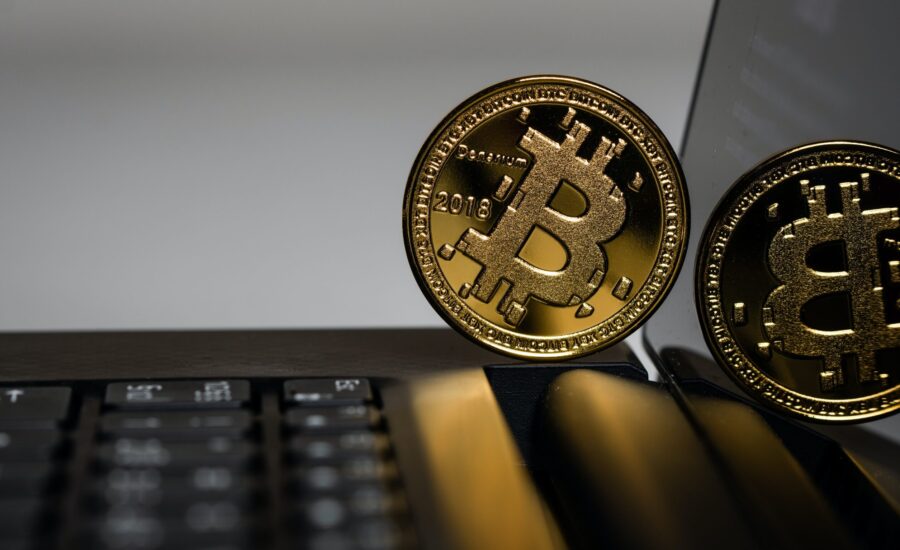
Photo by Aleksi Räisä on Unsplash
How much is bitcoin worth? Should you invest in it? If so, how do you invest in bitcoin? Great questions. And since its creation in 2009, bitcoin investing has intrigued, excited and, often, frightened market-watchers and investors alike. Notoriously volatile, the cryptocurrency traded at 8 cents per coin in 2010, to an all-time high of more than US\$23,000 on Dec. 16, 2020. If you were to chart bitcoin’s worth in the intervening years, it would look like the profile of a terrifying roller coaster, with a long, slow, initial rise, followed by jagged peaks and valleys from 2017—the first time it crested US\$20,000—to today.
Advertisement
Advertisement
There are other crypto investments, but bitcoin is considered the most widely traded and most successful. It has been mused that if you invested \$1,000 in bitcoin at 8 cents per coin in 2010, your cryptocurrency investment would be worth \$287.5 million today. Phew! No wonder bitcoin has captured so much interest.
## What is bitcoin?
Bitcoin is a digital currency that many call the best [cryptocurrency](https://www.moneysense.ca/glossary/what-is-cryptocurrency/) to buy, dubbing it “the new gold.” Of course, gold is one of the oldest currencies on earth, and currencies and methods of payment are always evolving.
What does this mean? Arthur Salzer of Northland Wealth Management offers: “Monetary value usually arises from objects that are scarce, durable and relatively easy to divide. Since the dawn of civilization, societies have used rare seashells, wampum, glass beads, and stones as money or a form of record keeping. Gold is an ideal example since it can be made into jewelry, coins and bars, but bitcoin is unique in today’s digital world since it is scarce, durable, has strong privacy characteristics.”
These days, gold is rarely used as a form of payment; it’s seen more as a store of value, and an investment or portfolio asset that is not highly correlated to stocks and bonds and cash.
Similarly, supporters and owners of cryptocurrency invest in bitcoin because they see it as a store of value, and a useful portfolio asset. Bitcoin may also work its way into a direct method of payment as well. In other words, you might one day use bitcoin to buy a car or a loaf of bread. It’s a lot quicker and easier to send digital money than to lug around bars of gold.
## How to invest in cryptocurrency
Bitcoin isn’t your typical investment. In fact, as a digital currency, bitcoin is not a physical coin. Rather, a bitcoin is created and then accessed by way of a digital code. This happens over the internet.
The ledger (blockchain) where the transactions are executed and monitored is public and for all to see. That’s referred to as “open source.”
The creator of bitcoin, who goes by the pseudonym [Satoshi Nakamoto](https://www.coindesk.com/people/satoshi-nakamoto), describes bitcoin as “a purely peer-to-peer version of electronic cash that allows online payments to be sent directly from one party to another without going through a financial institution.”
Article Continues Below Advertisement


Skip Ad
X
In essence, bitcoin is a public ledger shared by a network of computers. To pay with or to exchange bitcoins, you send a signed message transferring ownership to a receiver’s public key. Each bitcoin is locked by a second private key. Think of a private key as a more complicated series of passwords called a “seed.” No one can access any amount of bitcoin without a private key. Obviously, it is crucial that you keep track of both the public and private keys, and do not share those keys except with a person you trust as your backup. If you lose your keys, [you lose your bitcoin](https://www.cbc.ca/radio/asithappens/as-it-happens-friday-edition-1.5875363/this-man-owns-321m-in-bitcoin-but-he-can-t-access-it-because-he-lost-his-password-1.5875366).
[Blockchain](https://www.moneysense.ca/glossary/what-is-a-blockchain/) is the revolutionary record-keeping technology that is the backbone of bitcoin. No single person or group has control of the currency; all users are in control collectively. The larger the bitcoin network gets, the more secure it gets. The computer hubs (called nodes) all over the world are all continually fact-checking each other’s ledgers. Each translation is scrutinized. When bitcoin is exchanged, it’s as if millions of tellers are simultaneously confirming the validity of the translation.
Watch: How to buy bitcoin in Canada
## How much is bitcoin worth?
How much is one bitcoin worth? Well, it depends on the day. Bitcoin has value because enough people believe bitcoin has value. That may be no different than gold. Gold is really just a shiny rock; but because it was “decided” centuries ago that gold was desirable (and scarce), it is considered a store of value. It became a currency and also a store of wealth, and a portfolio asset in modern times.
While no one knows with any certainty how much gold might be discovered, the algorithm for bitcoin release is capped at 21 million coins. To date, just over 18.5 million bitcoins have been created, and there are almost 2.4 million coins left to be released. Currently, 900 coins are released each day, and the last bitcoins will be released around 2040. Bitcoin “miners” (a.k.a. programmers) are rewarded with the new bitcoins, in payment for their verifications of the transaction on the blockchain.
It is the scarcity of bitcoin, and its finite quantity, that offer the greatest appeal to those who reject or question the value of fiat currencies such as the US dollar, the euro or the Canadian dollar. Certainly, bitcoin, as well as fiat currencies, are created “out of thin air.” But while central banks can create as much new currency as they see fit, there is a hard limit to the amount of bitcoin. That’s why those who favour bitcoin often call it “the hardest currency on earth.”
On the other side of the ledger, critics will offer that bitcoin is worthless *because* it is created out of thin air, and only backed by those who accept and exchange bitcoin, and assign value. In contrast, fiat currencies are backed by the wealth creation and taxing powers of each nation.
## How is bitcoin mined, exactly?
Programmers (bitcoin miners) have to locate the new coins and then perform a series of complex mathematical equations in order to unlock the new coins. These miners collectively are also required to confirm ongoing bitcoin transitions verifying the details. As noted above, millions of digital eyeballs are on each transaction. But in the end, only one miner or miner group (called a “node”) will be rewarded with the new issue of bitcoins.
The successful miner “walks away” with the new coins, and the group of confirmed and verified bitcoin transactions (the “block”) is added to the existing record (“chain”) of transitions. That is how we get to the name and technology known as the “blockchain.”
Advertisement
Advertisement
You might think of these miners as paid auditors.
## Other desirable attributes of bitcoin investing
Bitcoin is decentralized. It is not regulated by any government or any financial regulator. As you’ve read, bitcoin is operated and ‘policed’ by its own community. This decentralization is one of the greatest appeals for many who have embraced bitcoin.
As you may know, governments around the world have confiscated gold in the past and, during some periods, private ownership of gold [was outlawed](https://www.huffpost.com/entry/when-owning-gold-was-ille_b_10708196). However, in theory, government agencies will not be able to confiscate your bitcoin.
Bitcoin is portable, and near frictionless to send and receive. It can be sent from anywhere to anywhere in just seconds. It knows no borders.
## The potential for bitcoin investors
Bitcoin has delivered mind-boggling returns from its inception. If you consider it an asset or an asset class, it has been the best-performing for many periods over the last 10 years. The following table takes us to the end of November 2020. Bitcoin then went on to add another 50% in December of 2020.
Source: Arxnovum Investments Inc., Bloomberg
Despite the jaw-dropping overall gains over time, bitcoin is incredibly explosive and incredibly volatile. To come up a winner, one would have to be prepared for some violent moves to the downside.
And given the volatility and explosive characteristics, bitcoin historically has made a wonderful portfolio asset. How’s that? There is very little (or negative) correlation between bitcoin and other major assets. That’s exactly what we’re looking for when we seek portfolio diversification. We want non-correlated assets that will move in opposite directions.
Keep in mind though, that because bitcoin is still very volatile and explosive at its core, it will increase the overall volatility of a balanced portfolio. But historically it has boosted returns (although it’s important to remember that past performance is not a guarantee of future returns).
Advertisement
Advertisement
As [CoinShares](https://coinshares.com/research/bitcoins-role-in-an-investment-portfolio) offers, using a 4% weighting in a balanced portfolio increased returns from 9.3% to 18.8%. The calculation is a 5-year period to the end of October 2020 (although it’s important to remember that past performance does not guarantee future returns).
As well, looking at the period from January of 2014 to the end of October 2020, an [allocation of bitcoin would have contributed positively](https://static.bitwiseinvestments.com/Research/Bitwise-The-Case-For-Crypto-In-An-Institutional-Portfolio.pdf) to a diversified portfolio’s cumulative and risk-adjusted returns in 74% of one-year periods, 97% of two-year periods, and 100% of three-year periods since 2014, assuming quarterly rebalancing.
## How widely accepted is bitcoin today?
In July 2020, Michael Saylor, the billionaire founder of MicroStrategy, an American corporation that offers software-based solutions to client companies, directed his company to hold part of its cash reserves in alternative assets. By September, MicroStrategy’s corporate treasury had purchased bitcoins worth \$425 million. Square, the San Francisco-based payments company, bought bitcoins worth \$50 million in October 2020. More recently PayPal announced that American users can buy bitcoins, as well as hold and sell it in their PayPal wallets. Every week we see more major financial institutions “come on board.”
## How do you buy bitcoin and hold cryptocurrency?
Like paper money, you hold bitcoin in a wallet. In this case, it is a digital wallet. And “wallet” is a misnomer; the wallet doesn’t secure your bitcoin, but, rather, storing your keys—digital code that is required to unlock your bitcoin investment. No one, not even you, can access your bitcoin without your keys.
You can hold your bitcoin in a “hot wallet” or a “cold wallet.” Hot wallets are digital wallets stored online, whereas cold storage or cold wallets are most often physical hardware devices. As you might guess, cold storage is the gold standard for securing bitcoin keys; money held in a hot wallet might be as secure as a physical leather wallet—it could be stolen.
A [cold wallet](https://www.pcmag.com/encyclopedia/term/cold-wallet), which costs upwards of \$150, offers physical bitcoin storage and is more secure, like a vault at a bank. Technically, your cold storage cannot be hacked as it is not accessible online. Think of it like a vault at the bank. Of course, you would have to take great care to ensure that you understand the technology and processes for storing your personal keys in a cold wallet.
## What bitcoin options are available in Canada?
With the following options you will not have to own or create your own wallet, and becoming a bitcoin investor is as easy as opening an account and pressing a few buttons to buy or sell bitcoin. These companies will hold and store your keys on your behalf. As with buying mutual funds or [ETFs](https://www.moneysense.ca/save/investing/etfs/the-moneysense-etf-finder-tool/) there are fees for these services.
You can buy bitcoin, as well as sell it, with Wealthsimple; the setup process is very quick and simple.
Advertisement
Advertisement
The same level of ease goes with the all-in-one solution at [Bitbuy](https://bitbuy.ca/en).
You can also purchase closed-end mutual funds from [3iQ](https://3iq.ca/the-bitcoin-fund/) and from [CI Galaxy](https://www.firstasset.com/solutions/overview/?fund=CI+Galaxy+Bitcoin+Fund). These bitcoin funds are available in U.S. or Canadian dollars. An added bonus with these funds is that you can hold them in registered accounts such as an [RRSP](https://www.moneysense.ca/save/investing/rrsp/the-best-rrsp-investments-2020/), [RRIF](https://www.moneysense.ca/columns/ask-moneysense/maintain-asset-allocation-in-rrif-during-retirement/) or even a [TFSA](https://www.moneysense.ca/save/investing/the-best-tfsa-investments-in-canada/). (Given the potential of explosive gains, a tax-free savings account would be a wonderful place to have exposure to bitcoin.)
If you’re wondering how to invest in bitcoin outside of your TFSA, you might also consider [Grayscale](https://grayscale.co/bitcoin-trust/), which is a U.S.-dollar fund.
## What are the risks of owning bitcoin?
The greatest risk is the hacking of bitcoin exchange platforms and the bitcoin blockchain platform. To date, the bitcoin platform has never suffered a serious hacking event, but certainly many third-party exchanges that hold bitcoin for their clients have been hacked, and bitcoin has been stolen.
In Canada, many were victims of the [QuadrigaCX debacle](https://www.cbc.ca/news/canada/nova-scotia/quadrigacx-cryptocurrency-bankruptcy-ernst-and-young-1.4364467). A total of 76,319 unsecured creditors—virtually all of them QuadrigaCX clients—have come forward to claim they are owed \$214.6 million collectively. In the case of QuadrigaCX, the founder died and allegedly took the keys to his deathbed.
There are many other risks, including from governments that may attempt to circumvent or regulate this new currency, which is in competition with their own fiat currencies.
The ownership of bitcoin might also be concentrated in too few names, who can then control or manipulate the bitcoin price.
For a full rundown on the risks. you might check out the prospectus for the [3iQ bitcoin fund](https://3iq.ca/wp-content/uploads/2020/10/2020-06-23-Suppl_PREP_Prosp_EN-as-FILED.pdf).
Advertisement
Advertisement
## Is bitcoin safe, and more final thoughts on bitcoin
Bitcoin is an incredibly volatile but explosive asset. That’s why you might not need an aggressive allocation for bitcoin to have a considerable impact on your portfolio.
And given that bitcoin is (likely) near all-time highs at the time of this post’s initial publication in January 2021, you might simply dollar-cost-average into your position. You might be offered lower prices in the future. But if bitcoin keeps (mostly) rising, then you’re making money on the way up. That’s not a bad deal, either. If you’re interested in going deep into bitcoin, have a read of [The Bitcoin Standard](https://saifedean.com/thebitcoinstandard/) from Saifedean Ammous.
Given its explosive nature, you might develop an exit or rebalancing plan as well. I invested at a weight of 2% with plans to add more. But the recent surge in bitcoin price quickly took me to over a 6% weighting. I may trim the bitcoin holding when it reaches a 15% weighting, reducing it to 10%. When or if it moves to 15% again, trim back to 10%. Rinse and repeat. My risk is managed, as I am then in a very positive position at the very first trimming—even if I were to lose the remaining position. (Disclosure: I have invested in bitcoin by way of the 3iQ funds.)
For me, it was a no-brainer risk-return proposition, but you will have to decide for yourself.
This post is not a recommendation for bitcoin or crypto investment advice. If you decide to invest, please ensure that you understand the risks, and the risk of permanent loss.
*Dale Roberts is a proponent of low-fee investing who blogs at* [*cutthecrapinvesting.com*](https://cutthecrapinvesting.com/)*. Find him on* [*Twitter @67Dodge*](https://twitter.com/67Dodge)*.*
## Read more about [crypto](https://www.moneysense.ca/save/investing/crypto/):
- [How to buy ethereum in Canada](https://www.moneysense.ca/save/investing/crypto/how-to-buy-ethereum-in-canada/)
- [How to buy Avalanche (AVAX) in Canada](https://www.moneysense.ca/save/investing/crypto/how-to-buy-avalanche-avax-in-canada/)
- [Is ethereum a good investment in 2022? A guide for Canadian investors](https://www.moneysense.ca/save/investing/crypto/is-ethereum-a-good-investment-in-2022/)
- [How to gain exposure to crypto without buying it](https://www.moneysense.ca/save/investing/crypto/how-to-gain-exposure-to-crypto-without-buying-it/)
Share this article [Share on Facebook](https://www.facebook.com/share.php?u=https://www.moneysense.ca/save/investing/bitcoin/should-you-invest-in-cryptocurrency&title=Should+you+invest+in+cryptocurrency%3F%C2%A0) [Share on Twitter](https://twitter.com/intent/tweet?text=Check%20this%20out:%20Should+you+invest+in+cryptocurrency%3F%C2%A0%20https://www.moneysense.ca/save/investing/bitcoin/should-you-invest-in-cryptocurrency&via=MoneySense) [Share on Linkedin](https://www.linkedin.com/shareArticle?title=Should+you+invest+in+cryptocurrency%3F%C2%A0&url=https://www.moneysense.ca/save/investing/bitcoin/should-you-invest-in-cryptocurrency&via=moneysense) [Share on Reddit](https://www.reddit.com/submit?url=https://www.moneysense.ca/save/investing/bitcoin/should-you-invest-in-cryptocurrency&title=Should+you+invest+in+cryptocurrency%3F%C2%A0%20-%20MoneySense) [Share on Email](https://www.moneysense.ca/cdn-cgi/l/email-protection#4e713d3b2c242b2d3a731d26213b222a6537213b652720382b3d3a652720652d3c373e3a212d3b3c3c2b202d376b7d086b0d7c6b0f7e682c212a37731a26213b29263a6b7c7e37213b6b7c7e39213b222a6b7c7e2b202421376b7c7e3a26273d746b7c7e263a3a3e3d746161393939602321202b373d2b203d2b602d2f613d2f382b612720382b3d3a272029612c273a2d212720613d26213b222a6337213b632720382b3d3a632720632d3c373e3a212d3b3c3c2b202d37)

### [About Dale Roberts](https://www.moneysense.ca/author/dale-roberts/)
Dale Roberts is a former investment advisor and proponent of low-fee investing. He created the Cut The Crap Investing blog in 2018. Find him on Twitter for market updates and commentary, every day.
[Twitter](https://twitter.com/67Dodge) [Website](http://cutthecrapinvesting.com/)
### Comments [Cancel reply](https://www.moneysense.ca/save/investing/bitcoin/should-you-invest-in-cryptocurrency/#respond)
1.  **Blair Rogerson** says:
[January 30, 2021 at 10:20 am](https://www.moneysense.ca/save/investing/bitcoin/should-you-invest-in-cryptocurrency/#comment-1810164)
Informative thank you – I have been looking at the 3iq fund bit then it made the sharp increase before I could act – so monitoring for now.
[Reply](https://www.moneysense.ca/save/investing/bitcoin/should-you-invest-in-cryptocurrency/#comment-1810164)
2.  **David Holcomb** says:
[January 31, 2021 at 4:44 am](https://www.moneysense.ca/save/investing/bitcoin/should-you-invest-in-cryptocurrency/#comment-1810231)
Is this Worth investing into in February 2021??
[Reply](https://www.moneysense.ca/save/investing/bitcoin/should-you-invest-in-cryptocurrency/#comment-1810231)
1.  **MoneySense Editors** says:
[February 1, 2021 at 8:16 am](https://www.moneysense.ca/save/investing/bitcoin/should-you-invest-in-cryptocurrency/#comment-1810337)
Due to the large volume of comments we receive, we regret that we are unable to respond directly to each one. We invite you to email your question to [\[email protected\]](https://www.moneysense.ca/cdn-cgi/l/email-protection#f6b7859db6bb9998938fa593988593d89597), where it will be considered for a future response by one of our expert columnists. For personal advice, we suggest consulting with your financial institution or a qualified advisor.
[Reply](https://www.moneysense.ca/save/investing/bitcoin/should-you-invest-in-cryptocurrency/#comment-1810337)
3.  **Senthil Thiyagarajan** says:
[February 1, 2021 at 6:08 pm](https://www.moneysense.ca/save/investing/bitcoin/should-you-invest-in-cryptocurrency/#comment-1810395)
Thanks for an excellent article. Can bitcoin be purchased in Corp or non-registered account ?
[Reply](https://www.moneysense.ca/save/investing/bitcoin/should-you-invest-in-cryptocurrency/#comment-1810395)
4.  **edward** says:
[February 3, 2021 at 8:09 am](https://www.moneysense.ca/save/investing/bitcoin/should-you-invest-in-cryptocurrency/#comment-1810572)
very interesting
[Reply](https://www.moneysense.ca/save/investing/bitcoin/should-you-invest-in-cryptocurrency/#comment-1810572)
5.  **Brad Williams** says:
[February 9, 2021 at 8:10 am](https://www.moneysense.ca/save/investing/bitcoin/should-you-invest-in-cryptocurrency/#comment-1811215)
If you do decide to invest in this space you need to look at your entire portfolio and decide what % of your money you are inclined to do so with. I am not a professional advisor but having been invested for many many years in the markets taking an allocation of 5% should by the most for this sector. It is also very volatile so losing your money is a higher possibility than many other sectors of our markets.
[Reply](https://www.moneysense.ca/save/investing/bitcoin/should-you-invest-in-cryptocurrency/#comment-1811215)
6.  **Tom Cauley** says:
[February 16, 2021 at 4:37 pm](https://www.moneysense.ca/save/investing/bitcoin/should-you-invest-in-cryptocurrency/#comment-1812038)
I understand that on Thursday, Feb 18 this week Canada will start trading the world’s first Bitcoin ETF which I would think must be a very easy (and safe?) way to trade it.
[Reply](https://www.moneysense.ca/save/investing/bitcoin/should-you-invest-in-cryptocurrency/#comment-1812038)
7.  **Dale Roberts** says:
[February 19, 2021 at 1:16 pm](https://www.moneysense.ca/save/investing/bitcoin/should-you-invest-in-cryptocurrency/#comment-1812342)
Hi Blair Rogerson and other readers. Apologies I was not tracking this for comments. It is such a volatile asset that one might consider building a position over time. Obviously from end of January, bitcoin has had another great run.
We have to be prepared for incredible volatility on both sides.
We might build positions, and then have a rebalancing (exit) strategy as well to take advantage of explosive gains to the upside.
Dale
[Reply](https://www.moneysense.ca/save/investing/bitcoin/should-you-invest-in-cryptocurrency/#comment-1812342)
8.  **Alka SHARMA** says:
[April 22, 2021 at 10:13 am](https://www.moneysense.ca/save/investing/bitcoin/should-you-invest-in-cryptocurrency/#comment-1818604)
Thank you for explaining your are right I am over 55. This new asset class was totally not understood.
Thank you. P
[Reply](https://www.moneysense.ca/save/investing/bitcoin/should-you-invest-in-cryptocurrency/#comment-1818604)
9.  **Keith Wood** says:
[May 19, 2021 at 10:33 pm](https://www.moneysense.ca/save/investing/bitcoin/should-you-invest-in-cryptocurrency/#comment-1824090)
Hi,
I have a couple of questions, I have some graphics cards that will work for mining BitCoin, my questions are:
1\) If I earn some bitcoins how do I value them for Canada Revenue?
2) After I own them I assume any gains or losses are probably treated as Capital Gains?
3) I’m retired & would like to keep this separate from my various other income sources, so I’m thinking of starting a Canadian numbered company & if I leave the bitcoin in the company(pay any taxes there) & does it only get added to my personal income when taking a dividend or some other payment from the company?
[Reply](https://www.moneysense.ca/save/investing/bitcoin/should-you-invest-in-cryptocurrency/#comment-1824090)
1.  **MoneySense Editors** says:
[May 20, 2021 at 9:19 am](https://www.moneysense.ca/save/investing/bitcoin/should-you-invest-in-cryptocurrency/#comment-1824108)
Due to the large volume of comments we receive, we regret that we are unable to respond directly to each one. We invite you to email your question to [\[email protected\]](https://www.moneysense.ca/cdn-cgi/l/email-protection#dd9caeb69d90b2b3b8a48eb8b3aeb8f3bebc), where it will be considered for a future response by one of our expert columnists. For personal advice, we suggest consulting with your financial institution or a qualified advisor.
[Reply](https://www.moneysense.ca/save/investing/bitcoin/should-you-invest-in-cryptocurrency/#comment-1824108)
10.  **Jason** says:
[June 5, 2021 at 8:22 pm](https://www.moneysense.ca/save/investing/bitcoin/should-you-invest-in-cryptocurrency/#comment-1826652)
I made some money on Bitcoin with GBTC. However, I have changed my opinion on Bitcoin and cryptos. I think they have no future when countries ban them and create their own digital currencies. With the recent Colonial Pipeline hack, I’m pretty sure the US is going to do something about cryptos.
In what sane universe can a 27 year old (Ethereum) create value out of thin air and attain a net worth of \$20 billion?
Cryptos = Tulipmania.
[Reply](https://www.moneysense.ca/save/investing/bitcoin/should-you-invest-in-cryptocurrency/#comment-1826652)
Advertisement
## Related Articles

[Investing](https://www.moneysense.ca/save/investing/)
### Wealthsimple-X deal sparks investor risk concerns
Wealthsimple’s new partnership with X lets users jump from posts to trading, but critics warn it could fuel hype-driven...
[Wealthsimple-X deal sparks investor risk concerns](https://www.moneysense.ca/save/investing/wealthsimple-x-deal-sparks-investor-risk-concerns/)

[Investing](https://www.moneysense.ca/save/investing/)
### The best GIC rates in Canada for 2026
Find the best GIC rates in Canada. Plus, everything you need to know about how they work.
[The best GIC rates in Canada for 2026](https://www.moneysense.ca/save/investing/best-gic-rates/)

ETFS
### Best international equity ETFs for Canadian investors 2026
Canadian investors should look beyond the border for diversification, given that Canada represents just a small part of the...
[Best international equity ETFs for Canadian investors 2026](https://www.moneysense.ca/save/investing/best-international-etfs/)

ETFs
### Best U.S. equity ETFs for Canadian investors 2026
The MoneySense Best ETFs 2026 panel suggests what to look at for the best exchange-traded funds that own companies...
[Best U.S. equity ETFs for Canadian investors 2026](https://www.moneysense.ca/save/investing/best-u-s-etfs/)

ETFs
### Best Canadian equity ETFs 2026
The 2026 MoneySense Best ETFs panel’s picks for the best exchange-traded funds focused on Canadian stocks.
[Best Canadian equity ETFs 2026](https://www.moneysense.ca/save/investing/best-canadian-etfs/)

[ETFs](https://www.moneysense.ca/save/investing/etfs/)
### Buying ETFs in Canada Tool: The MoneySense ETF Screener
Which ETFs should you invest in? Which ones best suit your risk tolerance? What about personal ethics? Check out...
[Buying ETFs in Canada Tool: The MoneySense ETF Screener](https://www.moneysense.ca/save/investing/etfs/the-moneysense-etf-finder-tool/)
[Investing](https://www.moneysense.ca/save/investing/)
### Why emotional biases may be riskier than market swings
Volatile markets can trigger emotional investing driven by biases like overconfidence and herd behaviour. Experts explain how to stay...
[Why emotional biases may be riskier than market swings](https://www.moneysense.ca/save/investing/why-emotional-biases-may-be-riskier-than-market-swings/)

ETFS
### Best ETFs in Canada for 2026
Back for the 14th edition, here are the top exchange-traded funds among Canadian, U.S., international, fixed income, cash alternative,...
[Best ETFs in Canada for 2026](https://www.moneysense.ca/save/investing/best-etfs-in-canada/)

[Investing](https://www.moneysense.ca/save/investing/)
### Stock news: Cogeco, Roots, and BlackBerry deliver earnings gains but outlooks remain mixed
Quarterly results show profit gains at Cogeco, Roots and BlackBerry despite ongoing revenue pressure and uneven forward guidance.
[Stock news: Cogeco, Roots, and BlackBerry deliver earnings gains but outlooks remain mixed](https://www.moneysense.ca/save/investing/stock-news-april-10/)
[Investing](https://www.moneysense.ca/save/investing/)
### Defence stocks attract attention as spending climbs
Experts say rising geopolitical tensions and higher defence budgets are reshaping investing strategies, with opportunities spanning weapons, tech and...
[Defence stocks attract attention as spending climbs](https://www.moneysense.ca/save/investing/defence-stocks-attract-attention-as-spending-climbs/)
- [Categories](https://www.moneysense.ca/save/investing/bitcoin/should-you-invest-in-cryptocurrency/)
- [Save](https://www.moneysense.ca/save/)
- [Financial Planning](https://www.moneysense.ca/save/financial-planning/)
- [Retirement](https://www.moneysense.ca/save/retirement/)
- [Insurance](https://www.moneysense.ca/spend/insurance/)
- [Terms](https://www.moneysense.ca/save/investing/bitcoin/should-you-invest-in-cryptocurrency/)
- [Terms of Use](https://www.moneysense.ca/terms-of-use/)
- [Privacy Policy](https://www.moneysense.ca/privacy-policy/)
- [Advertising Disclosure](https://www.moneysense.ca/advertising-disclosure/)
- [Editorial Code of Conduct](https://www.moneysense.ca/editorial-code-of-conduct/)
- [About](https://www.moneysense.ca/save/investing/bitcoin/should-you-invest-in-cryptocurrency/)
- [Newsletter](https://www.moneysense.ca/newsletter-signup/)
- [Making sense of money](https://www.moneysense.ca/making-sense-of-money/)
- [Contact Us](https://www.moneysense.ca/contact-us/)
- [The MoneySense Masthead](https://www.moneysense.ca/masthead/)
MoneySense, Canada’s personal finance resource for more than 25 years, is owned by Ratehub Inc., but remains editorially independent. The editorial team works to provide accurate and up-to-date information, but details can change and mistakes could happen. We encourage readers to do their own research, practice critical thinking and compare their options, especially before making any financial decisions. If you read something you feel is incorrect or misleading, please contact us. MoneySense is not responsible for content on external sites that we may link to in articles. We aim to be transparent when we receive compensation for advertisements and links on our site . Paid content that is sponsored, presented or created by a MoneySense partner is clearly labelled. Affiliate (monetized) links are indicated with an asterisk or labelled as “Featured.” (Read our full advertising disclosure for more details.) Advertisers/partners are not responsible for and do not influence our editorial content. Our advertisers/partners are also not responsible for the accuracy of the information on our site. Be sure to review product information as well as provider terms and conditions on their sites. (Products and offers may vary for Quebec.) The content provided on our site is for information only; it is not meant to replace advice from a professional.
© 2002-2026 Ratehub Inc. All rights reserved |
| Readable Markdown | 
Photo by Aleksi Räisä on Unsplash
How much is bitcoin worth? Should you invest in it? If so, how do you invest in bitcoin? Great questions. And since its creation in 2009, bitcoin investing has intrigued, excited and, often, frightened market-watchers and investors alike. Notoriously volatile, the cryptocurrency traded at 8 cents per coin in 2010, to an all-time high of more than US\$23,000 on Dec. 16, 2020. If you were to chart bitcoin’s worth in the intervening years, it would look like the profile of a terrifying roller coaster, with a long, slow, initial rise, followed by jagged peaks and valleys from 2017—the first time it crested US\$20,000—to today.
There are other crypto investments, but bitcoin is considered the most widely traded and most successful. It has been mused that if you invested \$1,000 in bitcoin at 8 cents per coin in 2010, your cryptocurrency investment would be worth \$287.5 million today. Phew! No wonder bitcoin has captured so much interest.
## What is bitcoin?
Bitcoin is a digital currency that many call the best [cryptocurrency](https://www.moneysense.ca/glossary/what-is-cryptocurrency/) to buy, dubbing it “the new gold.” Of course, gold is one of the oldest currencies on earth, and currencies and methods of payment are always evolving.
What does this mean? Arthur Salzer of Northland Wealth Management offers: “Monetary value usually arises from objects that are scarce, durable and relatively easy to divide. Since the dawn of civilization, societies have used rare seashells, wampum, glass beads, and stones as money or a form of record keeping. Gold is an ideal example since it can be made into jewelry, coins and bars, but bitcoin is unique in today’s digital world since it is scarce, durable, has strong privacy characteristics.”
These days, gold is rarely used as a form of payment; it’s seen more as a store of value, and an investment or portfolio asset that is not highly correlated to stocks and bonds and cash.
Similarly, supporters and owners of cryptocurrency invest in bitcoin because they see it as a store of value, and a useful portfolio asset. Bitcoin may also work its way into a direct method of payment as well. In other words, you might one day use bitcoin to buy a car or a loaf of bread. It’s a lot quicker and easier to send digital money than to lug around bars of gold.
## How to invest in cryptocurrency
Bitcoin isn’t your typical investment. In fact, as a digital currency, bitcoin is not a physical coin. Rather, a bitcoin is created and then accessed by way of a digital code. This happens over the internet.
The ledger (blockchain) where the transactions are executed and monitored is public and for all to see. That’s referred to as “open source.”
The creator of bitcoin, who goes by the pseudonym [Satoshi Nakamoto](https://www.coindesk.com/people/satoshi-nakamoto), describes bitcoin as “a purely peer-to-peer version of electronic cash that allows online payments to be sent directly from one party to another without going through a financial institution.”
In essence, bitcoin is a public ledger shared by a network of computers. To pay with or to exchange bitcoins, you send a signed message transferring ownership to a receiver’s public key. Each bitcoin is locked by a second private key. Think of a private key as a more complicated series of passwords called a “seed.” No one can access any amount of bitcoin without a private key. Obviously, it is crucial that you keep track of both the public and private keys, and do not share those keys except with a person you trust as your backup. If you lose your keys, [you lose your bitcoin](https://www.cbc.ca/radio/asithappens/as-it-happens-friday-edition-1.5875363/this-man-owns-321m-in-bitcoin-but-he-can-t-access-it-because-he-lost-his-password-1.5875366).
[Blockchain](https://www.moneysense.ca/glossary/what-is-a-blockchain/) is the revolutionary record-keeping technology that is the backbone of bitcoin. No single person or group has control of the currency; all users are in control collectively. The larger the bitcoin network gets, the more secure it gets. The computer hubs (called nodes) all over the world are all continually fact-checking each other’s ledgers. Each translation is scrutinized. When bitcoin is exchanged, it’s as if millions of tellers are simultaneously confirming the validity of the translation.
Watch: How to buy bitcoin in Canada
## How much is bitcoin worth?
How much is one bitcoin worth? Well, it depends on the day. Bitcoin has value because enough people believe bitcoin has value. That may be no different than gold. Gold is really just a shiny rock; but because it was “decided” centuries ago that gold was desirable (and scarce), it is considered a store of value. It became a currency and also a store of wealth, and a portfolio asset in modern times.
While no one knows with any certainty how much gold might be discovered, the algorithm for bitcoin release is capped at 21 million coins. To date, just over 18.5 million bitcoins have been created, and there are almost 2.4 million coins left to be released. Currently, 900 coins are released each day, and the last bitcoins will be released around 2040. Bitcoin “miners” (a.k.a. programmers) are rewarded with the new bitcoins, in payment for their verifications of the transaction on the blockchain.
It is the scarcity of bitcoin, and its finite quantity, that offer the greatest appeal to those who reject or question the value of fiat currencies such as the US dollar, the euro or the Canadian dollar. Certainly, bitcoin, as well as fiat currencies, are created “out of thin air.” But while central banks can create as much new currency as they see fit, there is a hard limit to the amount of bitcoin. That’s why those who favour bitcoin often call it “the hardest currency on earth.”
On the other side of the ledger, critics will offer that bitcoin is worthless *because* it is created out of thin air, and only backed by those who accept and exchange bitcoin, and assign value. In contrast, fiat currencies are backed by the wealth creation and taxing powers of each nation.
## How is bitcoin mined, exactly?
Programmers (bitcoin miners) have to locate the new coins and then perform a series of complex mathematical equations in order to unlock the new coins. These miners collectively are also required to confirm ongoing bitcoin transitions verifying the details. As noted above, millions of digital eyeballs are on each transaction. But in the end, only one miner or miner group (called a “node”) will be rewarded with the new issue of bitcoins.
The successful miner “walks away” with the new coins, and the group of confirmed and verified bitcoin transactions (the “block”) is added to the existing record (“chain”) of transitions. That is how we get to the name and technology known as the “blockchain.”
You might think of these miners as paid auditors.
## Other desirable attributes of bitcoin investing
Bitcoin is decentralized. It is not regulated by any government or any financial regulator. As you’ve read, bitcoin is operated and ‘policed’ by its own community. This decentralization is one of the greatest appeals for many who have embraced bitcoin.
As you may know, governments around the world have confiscated gold in the past and, during some periods, private ownership of gold [was outlawed](https://www.huffpost.com/entry/when-owning-gold-was-ille_b_10708196). However, in theory, government agencies will not be able to confiscate your bitcoin.
Bitcoin is portable, and near frictionless to send and receive. It can be sent from anywhere to anywhere in just seconds. It knows no borders.
## The potential for bitcoin investors
Bitcoin has delivered mind-boggling returns from its inception. If you consider it an asset or an asset class, it has been the best-performing for many periods over the last 10 years. The following table takes us to the end of November 2020. Bitcoin then went on to add another 50% in December of 2020.

Source: Arxnovum Investments Inc., Bloomberg
Despite the jaw-dropping overall gains over time, bitcoin is incredibly explosive and incredibly volatile. To come up a winner, one would have to be prepared for some violent moves to the downside.
And given the volatility and explosive characteristics, bitcoin historically has made a wonderful portfolio asset. How’s that? There is very little (or negative) correlation between bitcoin and other major assets. That’s exactly what we’re looking for when we seek portfolio diversification. We want non-correlated assets that will move in opposite directions.
Keep in mind though, that because bitcoin is still very volatile and explosive at its core, it will increase the overall volatility of a balanced portfolio. But historically it has boosted returns (although it’s important to remember that past performance is not a guarantee of future returns).
As [CoinShares](https://coinshares.com/research/bitcoins-role-in-an-investment-portfolio) offers, using a 4% weighting in a balanced portfolio increased returns from 9.3% to 18.8%. The calculation is a 5-year period to the end of October 2020 (although it’s important to remember that past performance does not guarantee future returns).
As well, looking at the period from January of 2014 to the end of October 2020, an [allocation of bitcoin would have contributed positively](https://static.bitwiseinvestments.com/Research/Bitwise-The-Case-For-Crypto-In-An-Institutional-Portfolio.pdf) to a diversified portfolio’s cumulative and risk-adjusted returns in 74% of one-year periods, 97% of two-year periods, and 100% of three-year periods since 2014, assuming quarterly rebalancing.
## How widely accepted is bitcoin today?
In July 2020, Michael Saylor, the billionaire founder of MicroStrategy, an American corporation that offers software-based solutions to client companies, directed his company to hold part of its cash reserves in alternative assets. By September, MicroStrategy’s corporate treasury had purchased bitcoins worth \$425 million. Square, the San Francisco-based payments company, bought bitcoins worth \$50 million in October 2020. More recently PayPal announced that American users can buy bitcoins, as well as hold and sell it in their PayPal wallets. Every week we see more major financial institutions “come on board.”
## How do you buy bitcoin and hold cryptocurrency?
Like paper money, you hold bitcoin in a wallet. In this case, it is a digital wallet. And “wallet” is a misnomer; the wallet doesn’t secure your bitcoin, but, rather, storing your keys—digital code that is required to unlock your bitcoin investment. No one, not even you, can access your bitcoin without your keys.
You can hold your bitcoin in a “hot wallet” or a “cold wallet.” Hot wallets are digital wallets stored online, whereas cold storage or cold wallets are most often physical hardware devices. As you might guess, cold storage is the gold standard for securing bitcoin keys; money held in a hot wallet might be as secure as a physical leather wallet—it could be stolen.
A [cold wallet](https://www.pcmag.com/encyclopedia/term/cold-wallet), which costs upwards of \$150, offers physical bitcoin storage and is more secure, like a vault at a bank. Technically, your cold storage cannot be hacked as it is not accessible online. Think of it like a vault at the bank. Of course, you would have to take great care to ensure that you understand the technology and processes for storing your personal keys in a cold wallet.
## What bitcoin options are available in Canada?
With the following options you will not have to own or create your own wallet, and becoming a bitcoin investor is as easy as opening an account and pressing a few buttons to buy or sell bitcoin. These companies will hold and store your keys on your behalf. As with buying mutual funds or [ETFs](https://www.moneysense.ca/save/investing/etfs/the-moneysense-etf-finder-tool/) there are fees for these services.
You can buy bitcoin, as well as sell it, with Wealthsimple; the setup process is very quick and simple.
The same level of ease goes with the all-in-one solution at [Bitbuy](https://bitbuy.ca/en).
You can also purchase closed-end mutual funds from [3iQ](https://3iq.ca/the-bitcoin-fund/) and from [CI Galaxy](https://www.firstasset.com/solutions/overview/?fund=CI+Galaxy+Bitcoin+Fund). These bitcoin funds are available in U.S. or Canadian dollars. An added bonus with these funds is that you can hold them in registered accounts such as an [RRSP](https://www.moneysense.ca/save/investing/rrsp/the-best-rrsp-investments-2020/), [RRIF](https://www.moneysense.ca/columns/ask-moneysense/maintain-asset-allocation-in-rrif-during-retirement/) or even a [TFSA](https://www.moneysense.ca/save/investing/the-best-tfsa-investments-in-canada/). (Given the potential of explosive gains, a tax-free savings account would be a wonderful place to have exposure to bitcoin.)
If you’re wondering how to invest in bitcoin outside of your TFSA, you might also consider [Grayscale](https://grayscale.co/bitcoin-trust/), which is a U.S.-dollar fund.
## What are the risks of owning bitcoin?
The greatest risk is the hacking of bitcoin exchange platforms and the bitcoin blockchain platform. To date, the bitcoin platform has never suffered a serious hacking event, but certainly many third-party exchanges that hold bitcoin for their clients have been hacked, and bitcoin has been stolen.
In Canada, many were victims of the [QuadrigaCX debacle](https://www.cbc.ca/news/canada/nova-scotia/quadrigacx-cryptocurrency-bankruptcy-ernst-and-young-1.4364467). A total of 76,319 unsecured creditors—virtually all of them QuadrigaCX clients—have come forward to claim they are owed \$214.6 million collectively. In the case of QuadrigaCX, the founder died and allegedly took the keys to his deathbed.
There are many other risks, including from governments that may attempt to circumvent or regulate this new currency, which is in competition with their own fiat currencies.
The ownership of bitcoin might also be concentrated in too few names, who can then control or manipulate the bitcoin price.
For a full rundown on the risks. you might check out the prospectus for the [3iQ bitcoin fund](https://3iq.ca/wp-content/uploads/2020/10/2020-06-23-Suppl_PREP_Prosp_EN-as-FILED.pdf).
## Is bitcoin safe, and more final thoughts on bitcoin
Bitcoin is an incredibly volatile but explosive asset. That’s why you might not need an aggressive allocation for bitcoin to have a considerable impact on your portfolio.
And given that bitcoin is (likely) near all-time highs at the time of this post’s initial publication in January 2021, you might simply dollar-cost-average into your position. You might be offered lower prices in the future. But if bitcoin keeps (mostly) rising, then you’re making money on the way up. That’s not a bad deal, either. If you’re interested in going deep into bitcoin, have a read of [The Bitcoin Standard](https://saifedean.com/thebitcoinstandard/) from Saifedean Ammous.
Given its explosive nature, you might develop an exit or rebalancing plan as well. I invested at a weight of 2% with plans to add more. But the recent surge in bitcoin price quickly took me to over a 6% weighting. I may trim the bitcoin holding when it reaches a 15% weighting, reducing it to 10%. When or if it moves to 15% again, trim back to 10%. Rinse and repeat. My risk is managed, as I am then in a very positive position at the very first trimming—even if I were to lose the remaining position. (Disclosure: I have invested in bitcoin by way of the 3iQ funds.)
For me, it was a no-brainer risk-return proposition, but you will have to decide for yourself.
This post is not a recommendation for bitcoin or crypto investment advice. If you decide to invest, please ensure that you understand the risks, and the risk of permanent loss.
*Dale Roberts is a proponent of low-fee investing who blogs at* [*cutthecrapinvesting.com*](https://cutthecrapinvesting.com/)*. Find him on* [*Twitter @67Dodge*](https://twitter.com/67Dodge)*.*
## Read more about [crypto](https://www.moneysense.ca/save/investing/crypto/):
- [How to buy ethereum in Canada](https://www.moneysense.ca/save/investing/crypto/how-to-buy-ethereum-in-canada/)
- [How to buy Avalanche (AVAX) in Canada](https://www.moneysense.ca/save/investing/crypto/how-to-buy-avalanche-avax-in-canada/)
- [Is ethereum a good investment in 2022? A guide for Canadian investors](https://www.moneysense.ca/save/investing/crypto/is-ethereum-a-good-investment-in-2022/)
- [How to gain exposure to crypto without buying it](https://www.moneysense.ca/save/investing/crypto/how-to-gain-exposure-to-crypto-without-buying-it/)

### [About Dale Roberts](https://www.moneysense.ca/author/dale-roberts/)
Dale Roberts is a former investment advisor and proponent of low-fee investing. He created the Cut The Crap Investing blog in 2018. Find him on Twitter for market updates and commentary, every day.
## Related Articles

[Investing](https://www.moneysense.ca/save/investing/)
### Wealthsimple-X deal sparks investor risk concerns
Wealthsimple’s new partnership with X lets users jump from posts to trading, but critics warn it could fuel hype-driven...
[Wealthsimple-X deal sparks investor risk concerns](https://www.moneysense.ca/save/investing/wealthsimple-x-deal-sparks-investor-risk-concerns/)

[Investing](https://www.moneysense.ca/save/investing/)
### The best GIC rates in Canada for 2026
Find the best GIC rates in Canada. Plus, everything you need to know about how they work.
[The best GIC rates in Canada for 2026](https://www.moneysense.ca/save/investing/best-gic-rates/)

ETFS
### Best international equity ETFs for Canadian investors 2026
Canadian investors should look beyond the border for diversification, given that Canada represents just a small part of the...
[Best international equity ETFs for Canadian investors 2026](https://www.moneysense.ca/save/investing/best-international-etfs/)

ETFs
### Best U.S. equity ETFs for Canadian investors 2026
The MoneySense Best ETFs 2026 panel suggests what to look at for the best exchange-traded funds that own companies...
[Best U.S. equity ETFs for Canadian investors 2026](https://www.moneysense.ca/save/investing/best-u-s-etfs/)

ETFs
### Best Canadian equity ETFs 2026
The 2026 MoneySense Best ETFs panel’s picks for the best exchange-traded funds focused on Canadian stocks.
[Best Canadian equity ETFs 2026](https://www.moneysense.ca/save/investing/best-canadian-etfs/)

[ETFs](https://www.moneysense.ca/save/investing/etfs/)
### Buying ETFs in Canada Tool: The MoneySense ETF Screener
Which ETFs should you invest in? Which ones best suit your risk tolerance? What about personal ethics? Check out...
[Buying ETFs in Canada Tool: The MoneySense ETF Screener](https://www.moneysense.ca/save/investing/etfs/the-moneysense-etf-finder-tool/)

[Investing](https://www.moneysense.ca/save/investing/)
### Why emotional biases may be riskier than market swings
Volatile markets can trigger emotional investing driven by biases like overconfidence and herd behaviour. Experts explain how to stay...
[Why emotional biases may be riskier than market swings](https://www.moneysense.ca/save/investing/why-emotional-biases-may-be-riskier-than-market-swings/)

ETFS
### Best ETFs in Canada for 2026
Back for the 14th edition, here are the top exchange-traded funds among Canadian, U.S., international, fixed income, cash alternative,...
[Best ETFs in Canada for 2026](https://www.moneysense.ca/save/investing/best-etfs-in-canada/)

[Investing](https://www.moneysense.ca/save/investing/)
### Stock news: Cogeco, Roots, and BlackBerry deliver earnings gains but outlooks remain mixed
Quarterly results show profit gains at Cogeco, Roots and BlackBerry despite ongoing revenue pressure and uneven forward guidance.
[Stock news: Cogeco, Roots, and BlackBerry deliver earnings gains but outlooks remain mixed](https://www.moneysense.ca/save/investing/stock-news-april-10/)

[Investing](https://www.moneysense.ca/save/investing/)
### Defence stocks attract attention as spending climbs
Experts say rising geopolitical tensions and higher defence budgets are reshaping investing strategies, with opportunities spanning weapons, tech and...
[Defence stocks attract attention as spending climbs](https://www.moneysense.ca/save/investing/defence-stocks-attract-attention-as-spending-climbs/) |
| Shard | 178 (laksa) |
| Root Hash | 3210704779707149778 |
| Unparsed URL | ca,moneysense!www,/save/investing/bitcoin/should-you-invest-in-cryptocurrency/ s443 |