ℹ️ Skipped - page is already crawled
| Filter | Status | Condition | Details |
|---|---|---|---|
| HTTP status | PASS | download_http_code = 200 | HTTP 200 |
| Age cutoff | PASS | download_stamp > now() - 6 MONTH | 1.2 months ago |
| History drop | PASS | isNull(history_drop_reason) | No drop reason |
| Spam/ban | PASS | fh_dont_index != 1 AND ml_spam_score = 0 | ml_spam_score=0 |
| Canonical | PASS | meta_canonical IS NULL OR = '' OR = src_unparsed | Not set |
| Property | Value |
|---|---|
| URL | https://www.mdpi.com/2313-0105/12/3/84 |
| Last Crawled | 2026-03-02 02:32:08 (1 month ago) |
| First Indexed | not set |
| HTTP Status Code | 200 |
| Meta Title | State of Charge Estimation Method for Lithium-Ion Batteries Based on Online Parameter Identification and QPSO-AUKF |
| Meta Description | Accurate estimation of the state of charge (SOC) is essential for the safe and efficient operation of lithium-ion batteries. Conventional Adaptive Unscented Kalman Filter (AUKF) methods often exhibit limited accuracy, primarily due to the empirical selection of process and measurement noise covariance matrices. To overcome this limitation, this study proposes a QPSO-AUKF algorithm based on a second-order RC equivalent circuit model, which integrates Quantum-behaved Particle Swarm Optimization (QPSO) with online parameter identification. In this approach, the QPSO algorithm optimizes the noise covariance matrices, which are subsequently used within the AUKF framework for SOC estimation. MATLAB R2020a simulations conducted on the Maryland and Wisconsin datasets demonstrate that the QPSO-AUKF reduces the root mean square error (RMSE) by more than 60% compared with the conventional AUKF, indicating a significant improvement in SOC estimation accuracy. |
| Meta Canonical | null |
| Boilerpipe Text | 1. Introduction
In the context of advancing the “Dual Carbon” goals and promoting the development of the new energy vehicle industry, lithium-ion batteries are being increasingly recognized as the ideal power source for electric vehicles due to their high energy density, low environmental impact, and long cycle life [
1
]. The Battery Management System (BMS) plays a vital role in monitoring and safeguarding batteries, thereby improving their performance and extending their service life [
2
]. Among various state variables monitored by the BMS, the state of charge (SOC) serves as a fundamental indicator reflecting the available energy of the battery. Accurate SOC estimation is not only essential for driving range prediction, but also acts as a key feedback variable for power allocation, thermal and energy management coordination, and battery protection strategies. Inaccurate SOC information may lead to overly conservative power limitation, inefficient thermal control, or even safety risks under extreme operating conditions. Therefore, high-precision and robust SOC estimation is widely recognized as a core requirement for advanced BMS, particularly in electric vehicles and connected automated driving scenarios [
3
]. During operation, the battery temperature fluctuates with changes in ambient conditions, which complicates the accurate estimation of the State of Charge (SOC) [
4
]. Accurate State of Charge (SOC) estimation is crucial as it determines the remaining battery capacity, optimizes energy management, and enhances system safety and reliability [
5
]. Therefore, accurate SOC estimation is essential for managing and controlling lithium-ion batteries [
6
]. Developing an accurate equivalent circuit model is fundamental for reliably estimating battery SOC with efficiency. Model accuracy directly influences the precision and stability of subsequent SOC estimations. Current battery models used in research include neural network models [
7
], electrochemical models [
8
], and equivalent circuit models [
9
], among others. Data-driven SOC estimation methods based on deep learning have attracted increasing attention due to their strong capability in capturing the nonlinear dynamic characteristics of batteries. For instance, Li et al. [
10
]. proposed a method combining a weight-clustering convolutional neural network and a long short-term memory network (WC-CNN-LSTM) to improve SOC estimation accuracy under varying temperature conditions. In addition, advanced Bayesian filtering strategies have been extensively investigated. For example, Tan et al. [
11
] developed an unscented Kalman filter based on variational Bayesian multi-kernel correntropy, which significantly enhances robustness in complex noise environments. However, the accuracy of neural network models heavily depends on the quality and coverage of the training data. Insufficient data or incomplete operating conditions can substantially reduce their generalization capability. Furthermore, as “black-box” models, neural networks lack interpretability, which hinders fault diagnosis and mechanistic analysis. In contrast, electrochemical models typically involve numerous partial differential equations, whose numerical solutions are time-consuming and computationally intensive, making them challenging to apply in real-time scenarios. Conversely, the equivalent circuit model (ECM) is commonly used in model-based techniques due to its ease of implementation and computational efficiency, which facilitates the formulation of state-space equations [
12
]. This model offers straightforward parameter identification, high computational efficiency, and excellent real-time performance. Recently, Liang et al. modeled the hysteresis characteristics of LiFePO
4
batteries and integrated this with an ECM for SOC estimation, further validating the effectiveness of ECMs under complex operating conditions [
13
].
Currently, the estimation of the state of charge (SOC) of lithium-ion batteries primarily relies on the open-circuit voltage (OCV) method and the ampere-hour (Ah) integration method [
14
]. The OCV method can accurately estimate SOC under non-operating conditions; however, it requires a prolonged resting period to obtain a stable OCV value, which is subsequently used to determine the corresponding SOC [
15
]. The ampere-hour integration method can effectively meet the real-time requirements of battery management systems; however, its estimation accuracy is susceptible to initial SOC errors and current measurement drift. As both of these open-loop estimation methods lack a measurement feedback mechanism, they are unable to perform online correction of the estimation results. Consequently, achieving precise SOC estimation in real-time applications remains challenging with these approaches. The traditional extended Kalman filter (EKF) can address nonlinear system problems by employing a first-order Taylor series expansion [
16
]. Although the EKF can achieve relatively high accuracy in lithium-ion battery SOC estimation, the first-order Taylor linearization of nonlinear models inevitably neglects second-order and higher-order terms, resulting in unavoidable linearization errors. The unscented Kalman filter (UKF) employs a recursive unscented transform (UT) technique to approximate the target state without requiring linearization of the system [
17
]. For strongly nonlinear systems, the UKF demonstrates higher estimation accuracy and better robustness than the EKF [
18
]. The adaptive performance of the AUKF algorithm is highly dependent on the empirical presetting and initialization of the noise covariance matrices. Its noise estimation process relies heavily on ideal assumptions. In particular, when model parameters are inaccurate, the adaptive adjustment of the process noise covariance matrix Q and the measurement noise covariance matrix R is often based on distorted error distributions, making convergence to a globally optimal solution difficult. This inherent limitation fundamentally restricts the achievable accuracy and robustness of SOC estimation.
Based on the foregoing analysis, to address the time-varying nature of lithium-ion battery parameters and the reliance on empirically determined noise covariance matrices in the AUKF estimation process—both of which result in inaccurate SOC estimation—this paper proposes a novel joint estimation framework. The proposed framework integrates online parameter identification using the forgetting factor recursive least squares (FFRLS) algorithm to update model parameters in real time and introduces the quantum-behaved particle swarm optimization (QPSO) algorithm to dynamically optimize the noise covariance matrices of the AUKF. This integrated approach, referred to as the QPSO-AUKF method, is designed to significantly enhance the accuracy and robustness of SOC estimation.
2. Equivalent Circuit Modeling and Parameter Dynamics
2.1. Battery Equivalent Circuit Model Construction
The equivalent circuit model can accurately describe the dynamic characteristics of batteries [
19
]. In this study, the battery is modeled using a second-order RC equivalent circuit [
20
], as illustrated in
Figure 1
. In the model,
U
o
c
represents the open-circuit voltage (OCV) of the battery under no-load conditions;
R
0
corresponds to the ohmic internal resistance;
R
1
denotes the polarization resistance associated with the electrode reaction process;
C
1
represents the capacitive characteristics associated with the polarization effect;
R
2
denotes the mass transfer resistance caused by concentration gradients, commonly referred to as the concentration polarization resistance;
C
2
characterizes the dynamic buffering effect associated with concentration polarization; and
U
t
represents the terminal voltage measured across the battery under an external load.
Based on Kirchhoff’s laws, the mathematical expressions of the equivalent circuit model are derived as follows:
d
U
1
d
t
=
−
1
R
1
C
1
U
1
+
1
C
1
I
d
U
2
d
t
=
−
1
R
2
C
2
U
2
+
1
C
2
I
U
t
=
U
o
c
v
−
U
1
−
U
2
−
R
0
I
(1)
Through linear discretization, the state-space representation of the model at time step
k
is obtained, as shown in Equation (2).
S
O
C
(
k
+
1
)
U
1
(
k
+
1
)
U
2
(
k
+
1
)
=
1
0
0
0
e
−
T
/
τ
1
0
0
0
e
−
T
/
τ
2
S
O
C
(
k
)
U
1
(
k
)
U
2
(
k
)
+
−
T
Q
n
R
1
(
1
−
e
−
T
/
τ
1
)
R
2
(
1
−
e
−
T
/
τ
2
)
I
(
k
)
(2)
where
T
denotes the sampling period,
τ
1
=
R
1
C
1
;
τ
2
=
R
2
C
2
.
2.2. OCV-SOC Relationship Fitting
In lithium-ion battery modeling, the open-circuit voltage (OCV) typically exhibits a stable one-to-one relationship with the state of charge (SOC). Therefore, this relationship can be identified and fitted using experimental data. First, based on the discharge test data obtained under the Hybrid Pulse Power Characterization (HPPC) profile, the ampere-hour (Ah) integration method is employed to calculate the variation in battery capacity during the discharge process, thereby deriving the corresponding SOC curve. Then, following the sequence of SOC decreasing from 100% to the lower SOC range, the corresponding steady-state open-circuit voltage values are extracted point by point to form a set of OCV–SOC data samples. An eighth-order polynomial is adopted to fit the experimental OCV-SOC data. The resulting relationship is expressed in Equation (3), and the corresponding fitting curve is shown in
Figure 2
.
U
o
c
v
=
−
0.372
S
O
C
8
−
88.635
S
O
C
7
+
352.2518
S
O
C
6
−
557.6238
S
O
C
5
+
448.3702
S
O
C
4
−
190.9562
S
O
C
3
+
40.8201
S
O
C
2
−
3.2112
S
O
C
+
3.5320
(3)
2.3. Parameter Identification
The parameters of the lithium-ion battery model are time-varying rather than fixed. Variations in key factors such as ambient temperature, cycling aging level, and state of charge (SOC) can induce complex nonlinear changes in these parameters. Therefore, during battery SOC estimation, it is necessary to perform parameter identification for the five model parameters:
R
0
,
R
1
,
R
2
,
C
1
,
C
2
. Parameter identification methods can generally be categorized into online and offline approaches. Offline parameter identification assumes fixed system parameters; however, in practice, system parameters are time-varying. This discrepancy causes offline identification results to gradually lose validity and fail to reflect the real-time battery state. In contrast, online parameter identification can promptly capture the dynamic changes in system parameters. It continuously optimizes parameter estimates concurrently with data acquisition, without the need to accumulate large volumes of historical data. Consequently, it can adapt efficiently to variations in operating conditions and provide continuously updated parameter information for real-time control systems. Accordingly, this study employs the forgetting factor recursive least squares (FFRLS) algorithm for online parameter identification. Compared with the traditional recursive least squares (RLS) algorithm, the primary enhancement of the FFRLS lies in the introduction of a forgetting factor mechanism. This mechanism enables the algorithm to place greater emphasis on recent measurement data during parameter updates while gradually diminishing the influence of historical data. Through appropriate configuration of the forgetting factor, the contribution of historical information in the estimation process can be regulated, enabling the model to rapidly adapt to changes in system parameters. The FFRLS algorithm demonstrates superior performance compared with the traditional RLS algorithm in terms of real-time capability, estimation accuracy, and robustness. The FFRLS-based model parameter identification procedure proceeds as follows:
Taking the Laplace transform of Equation (1) and rearranging it yields the expression for the polarization voltage in the complex frequency domain. Let
τ
1
=
R
1
C
1
;
τ
2
=
R
2
C
2
. Substituting this expression into the terminal voltage equation yields the system transfer function, as shown in Equation (4).
U
o
c
v
(
s
)
−
U
t
(
s
)
I
(
s
)
=
R
0
+
R
1
R
1
C
1
s
+
1
+
R
2
R
2
C
2
s
+
1
(4)
The bilinear transform is applied to discretize the system model.
s
=
2
T
⋅
1
−
z
−
1
1
+
z
−
1
, the discretization is performed, yielding a discrete-time difference equation, as shown in Equation (5).
U
t
(
k
)
=
c
0
+
c
1
U
t
(
k
−
1
)
+
c
2
U
t
(
k
−
2
)
+
d
0
I
(
k
)
+
d
1
I
(
k
−
1
)
+
d
2
I
(
k
−
2
)
(5)
where
c
0
,
c
1
,
c
2
,
d
0
,
d
1
, and
d
2
are the coefficients of the difference equation. Their mapping to the model parameters is illustrated in Equation (6).
c
1
=
2
1
+
τ
1
T
1
+
τ
2
T
−
2
1
+
τ
1
T
+
1
+
τ
2
T
1
+
τ
1
T
1
+
τ
2
T
c
2
=
1
+
τ
1
T
1
+
τ
2
T
−
2
1
+
τ
1
T
+
1
+
τ
2
T
1
+
τ
1
T
1
+
τ
2
T
d
0
=
R
0
1
+
τ
1
T
1
+
τ
2
T
+
R
1
1
+
τ
2
T
+
R
2
1
+
τ
1
T
1
+
τ
1
T
1
+
τ
2
T
d
1
=
−
2
[
R
0
1
+
τ
1
T
1
+
τ
2
T
+
R
1
+
R
2
]
1
+
τ
1
T
1
+
τ
2
T
d
2
=
R
0
1
+
τ
1
T
1
+
τ
2
T
+
R
1
1
−
τ
2
T
+
R
2
1
−
τ
1
T
1
+
τ
1
T
1
+
τ
2
T
(6)
The regression vector and the parameter vector are defined as shown in Equation (7).
φ
(
k
)
=
[
1
,
U
t
(
k
−
1
)
,
U
t
(
k
−
2
)
,
I
(
k
)
,
I
(
k
−
1
)
,
I
(
k
−
2
)
]
T
θ
^
(
k
)
=
[
c
0
,
c
1
,
c
2
,
d
0
,
d
1
,
d
2
]
T
(7)
The established difference equation is reformulated into a linear observation form
U
t
(
k
)
=
φ
T
(
k
)
θ
^
(
k
)
+
v
(
k
)
, where
v
(
k
)
represents the measurement noise.
Based on the recursive least squares (RLS) algorithm, a forgetting factor
λ
(ranging between 0 and 1) is introduced. The forgetting factor exponentially reduces the influence of older data while assigning greater weight to newer data, enabling the algorithm to track the most recent characteristics of time-varying systems. Consequently, more accurate real-time estimation can be achieved in environments with time-varying parameters. In this study, the forgetting factor
λ
is set to 0.98. The FFRLS algorithm is formulated as shown in Equation (8).
e
(
k
)
=
U
t
(
k
)
−
φ
T
(
k
)
θ
^
(
k
−
1
)
θ
^
(
k
)
=
θ
^
(
k
−
1
)
+
K
(
k
)
e
(
k
)
K
(
k
)
=
P
(
k
−
1
)
φ
(
k
)
φ
T
(
k
)
P
(
k
−
1
)
φ
(
k
)
+
λ
P
(
k
)
=
1
λ
[
I
−
K
(
k
)
φ
T
(
k
)
]
P
(
k
−
1
)
(8)
e
(
k
)
is the residual between the measured terminal voltage and the model-predicted value at time step
k
;
θ
^
(
k
)
is the estimated parameter vector to be identified;
K
(
k
)
is the gain matrix;
P
(
k
)
is the covariance matrix of the parameter estimation error; and
φ
(
k
)
is the regression vector.
After
θ
^
(
k
)
is identified using the FFRLS algorithm, the model parameters can be obtained by mapping them through the coefficient equations, as shown in Equation (9).
τ
1
=
T
(
1
−
c
2
)
1
+
c
1
+
c
2
τ
2
=
T
(
1
+
c
1
+
c
2
)
1
−
c
1
+
c
2
R
0
=
d
0
+
d
2
2
+
c
1
R
1
=
(
d
0
−
R
0
)
(
1
+
τ
2
/
T
)
1
+
τ
1
/
T
R
2
=
(
d
0
−
R
0
)
(
1
+
τ
1
/
T
)
1
+
τ
2
/
T
C
1
=
τ
1
R
1
C
2
=
τ
2
R
2
(9)
3. SOC Estimation
3.1. Quantum-Behaved Particle Swarm Optimization Algorithm
The Quantum-behaved Particle Swarm Optimization (QPSO) algorithm is an intelligent optimization method based on quantum-behavioral characteristics. Unlike the traditional particle swarm optimization (PSO), QPSO models the distribution of particle positions using a probability density function, which provides stronger global search capability and reduces the risk of being trapped in local optima. When the adaptive unscented Kalman filter (AUKF) estimates the state of charge (SOC) of lithium-ion batteries, the process noise covariance matrix (
Q
) and the observation noise covariance matrix (
R
) rely on empirically preset values. If the initial values deviate significantly from the actual operating conditions, this may result in a decrease in filtering accuracy or even filter divergence. The introduced QPSO algorithm models particle positions using a probability density function, eliminating the need to specify an inertia weight. It efficiently searches for the optimal values of the process noise covariance matrix
Q
and the observation noise covariance matrix
R
within the solution space, thereby improving the filter’s adaptability and estimation accuracy under varying operating conditions. The basic position update equation for QPSO is presented in Equation (10).
x
i
(
t
+
1
)
=
p
i
(
t
)
±
β
m
(
t
)
−
x
i
(
t
)
ln
1
u
(10)
where
x
i
(
t
)
is the position of the
i
-th particle at the
t
-th iteration,
p
i
(
t
)
is the historical best position of the particle,
β
is the contraction-expansion coefficient used to balance global search and local convergence,
u
is a random number in the interval (0, 1), the symbol “±” depends on the randomly selected direction, and
m
(
t
)
=
1
N
∑
i
=
1
N
p
i
(
t
)
is the global attraction center.
3.2. QPSO-Optimized AUKF Algorithm
3.2.1. Fundamentals of the Adaptive Unscented Kalman Filter
The Adaptive Unscented Kalman Filter (AUKF) is a recursive state estimation algorithm developed for nonlinear systems. The core concept involves introducing an adaptive update mechanism for the noise covariance matrices based on the standard Unscented Kalman Filter (UKF), thereby enhancing the algorithm’s adaptability to modeling uncertainties and variations in measurement noise. The AUKF procedure is summarized as follows:
Initialization
The initial values for the subsequent filtering process are obtained by initializing the system state estimate and the associated covariance matrix. The system model is given in Equation (11).
x
k
=
f
(
x
k
−
1
,
u
k
−
1
)
+
w
k
−
1
y
k
=
h
(
x
k
,
u
k
)
+
v
k
(11)
where
x
k
is the system state vector,
y
k
is the observation vector,
u
k
is the control input,
f
(
⋅
)
is the state transition function,
h
(
⋅
)
is the observation function,
w
k
~
N
(
0
,
Q
k
)
is the process noise, and
v
k
~
N
(
0
,
R
k
)
is the observation noise. The initial state estimate and its covariance matrix are given in Equation (12).
x
^
0
=
E
[
x
0
]
P
0
=
E
(
x
0
−
x
^
0
)
(
x
0
−
x
^
0
)
T
(12)
where
x
^
0
is the initial state estimate and
P
0
is the initial covariance matrix.
2.
Calculation of Unscented Transform Parameters
In the Unscented Kalman Filter (UKF), a set of scaling parameters
λ
and corresponding weights are calculated to generate the sigma points. These parameters are subsequently used to propagate the sigma points through the state space. The scaling parameter
λ
and the sigma-point weights are computed as follows:
λ
=
α
2
(
L
+
κ
)
−
L
, where α is the scaling factor,
L
is the state dimension,
κ
is the secondary scaling parameter, and
λ
is the parameter that adjusts the distribution range of the sigma points.
W
m
(
0
)
=
λ
L
+
λ
W
c
(
0
)
=
λ
L
+
λ
+
(
1
−
α
2
+
β
)
W
m
(
i
)
=
W
c
(
i
)
=
1
2
(
L
+
λ
)
,
i
=
1
,
2
,
…
,
2
L
(13)
where
W
m
(
i
)
is the mean weight of the
i
-th Sigma point,
W
c
(
i
)
is the mean square error weight of the
i
-th Sigma point, and β is the parameter used to adjust the weight calculation formula.
3.
Generation of Sigma Points
Sigma points are employed to represent the state distribution and to propagate it through the state space. Through these sigma points, the uncertainty of the system state can be effectively captured. The sigma points are generated according to Equation (14).
X
k
−
1
(
i
)
=
x
^
k
−
1
±
(
L
+
λ
)
P
k
−
1
,
i
=
1
,
2
,
…
,
2
L
(14)
where
X
k
−
1
(
i
)
is the
i
-th generated Sigma point,
x
^
k
−
1
is the mean state estimate at the previous time step,
P
k
−
1
is the state estimation covariance matrix at the previous time step, and
(
L
+
λ
)
P
k
−
1
is the square root of the covariance matrix.
4.
Time Update
During the state transition, the predicted state estimate is obtained by propagating the sigma points. The sigma points are propagated according to Equation (15), which represents the state transition function.
X
˜
k
|
k
−
1
(
i
)
X
k
|
k
−
1
(
i
)
=
f
(
X
k
−
1
(
i
)
,
u
k
−
1
)
,
i
=
0
,
1
,
…
,
2
L
(15)
where
X
˜
k
|
k
−
1
(
i
)
is the
i
-th predicted Sigma point, and
f
(
⋅
)
is the state transition function. The predicted state and its covariance matrix are given in Equation (16).
x
^
k
|
k
−
1
=
∑
i
=
0
2
L
W
m
(
i
)
X
˜
k
|
k
−
1
(
i
)
P
k
|
k
−
1
=
∑
i
=
0
2
L
W
c
(
i
)
X
˜
k
|
k
−
1
(
i
)
−
x
^
k
|
k
−
1
X
˜
k
|
k
−
1
(
i
)
−
x
^
k
|
k
−
1
T
+
Q
k
(16)
where
x
^
k
|
k
−
1
is the predicted state mean,
P
k
|
k
−
1
is the predicted covariance matrix, and
Q
k
is the process noise covariance matrix.
5.
Measurement Prediction
Measurement prediction is employed to transform the predicted state into the corresponding observation prediction. The sigma points are propagated through the observation model, as given in Equation (17).
Y
k
|
k
−
1
(
i
)
=
h
(
X
˜
k
|
k
−
1
(
i
)
,
u
k
−
1
)
,
i
=
0
,
1
,
…
,
2
L
y
^
k
|
k
−
1
=
∑
i
=
0
2
L
W
m
(
i
)
Y
k
|
k
−
1
(
i
)
P
y
y
,
k
=
∑
i
=
0
2
L
W
c
(
i
)
Y
k
|
k
−
1
(
i
)
−
y
^
k
|
k
−
1
Y
k
|
k
−
1
(
i
)
−
y
^
k
|
k
−
1
T
+
R
k
P
x
y
,
k
=
∑
i
=
0
2
L
W
c
(
i
)
X
˜
k
|
k
−
1
(
i
)
−
x
^
k
|
k
−
1
Y
k
|
k
−
1
(
i
)
−
y
^
k
|
k
−
1
T
(17)
where
Y
k
|
k
−
1
(
i
)
is the
i
-th predicted observation Sigma point,
y
^
k
|
k
−
1
is the predicted observation mean,
P
y
y
,
k
is the observation prediction covariance matrix,
P
x
y
,
k
is the cross-covariance between the state and observation, and
R
k
is the observation noise covariance.
6.
Measurement Update
Following the prediction step, the state is corrected using the actual measurements. During the measurement update, the state estimate is refined by combining the innovation (observation residual) with the Kalman gain, as shown in Equation (18).
K
k
=
P
x
y
,
k
P
y
y
,
k
−
1
e
k
=
y
k
−
y
^
k
|
k
−
1
x
^
k
=
x
^
k
|
k
−
1
+
K
k
e
k
P
k
=
P
k
|
k
−
1
−
K
k
P
y
y
,
k
K
k
T
(18)
where
K
k
is the Kalman gain matrix,
e
k
is the innovation (observation residual),
x
^
k
is the updated state estimate, and
P
k
is the updated covariance matrix.
7.
Adaptive Noise Covariance Update
Through the innovation-based adaptive noise update, the covariances of the process noise (
Q
) and observation noise (
R
) are adaptively adjusted, as given in Equation (19).
R
k
=
α
R
R
k
−
1
+
(
1
−
α
R
)
e
k
e
k
T
Q
k
=
α
Q
Q
k
−
1
+
(
1
−
α
Q
)
K
k
e
k
e
k
T
K
k
T
(19)
where
α
Q
and
α
R
are forgetting factors that control the smoothness of the noise update,
Q
k
is the adaptive estimate of the process noise covariance,
R
k
is the adaptive estimate of the observation noise covariance, and
e
k
is the observation residual (innovation).
The filtering process is carried out by iteratively repeating Steps 3–7. Based on the standard UKF, the AUKF incorporates an adaptive noise update mechanism that dynamically adjusts the process and measurement noise according to real-time observation errors. This mechanism enables the filter to better accommodate variations in system noise and modeling uncertainties. Furthermore, it enhances the stability and robustness of the algorithm under complex system conditions.
3.2.2. QPSO-Based Noise Optimization Mechanism for AUKF
The performance of the AUKF strongly depends on the accuracy of the noise covariance matrices
Q
and
R
. Traditional methods typically rely on empirical settings, which makes it challenging to adapt to dynamic variations in operating conditions. To address this issue, the study introduces the Quantum-behaved Particle Swarm Optimization (QPSO) algorithm as an outer-layer optimizer to perform a global search for the optimal
Q
and
R
. Given a set of noise parameters (
Q
,
R
), the objective function of the AUKF is defined as the root mean square error (RMSE) of the residuals between the measured terminal voltage
U
k
m
e
a
s
and the estimated terminal voltage
U
k
e
s
t
(
Q
,
R
)
, as expressed in Equation (20). The objective function of the QPSO algorithm is based on the root mean square error (RMSE) of the terminal voltage rather than the SOC estimation error. The terminal voltage is directly measurable with high reliability, whereas the SOC reference value (typically derived from the ampere-hour (Ah) integration method) may accumulate drift during prolonged operation. Within the framework of the equivalent circuit model and Kalman filter, a strong coupling exists among the terminal voltage, SOC, and polarization states. Therefore, minimizing the RMSE of the terminal voltage residuals can effectively constrain SOC estimation accuracy while avoiding the introduction of potentially noisy or drifting SOC reference values into the optimization process. In this study, the QPSO algorithm is employed for global offline statistical calibration of the noise covariance matrices. The online correction of these matrices is achieved through the innovation sequence adaptation mechanism within the AUKF.
J
(
Q
,
R
)
=
1
N
∑
k
=
1
N
U
k
m
e
a
s
−
U
k
e
s
t
(
Q
,
R
)
2
(20)
where
U
k
m
e
a
s
is the measured terminal voltage,
U
k
e
s
t
(
Q
,
R
)
is the estimated voltage calculated by the AUKF, and
N
is the sampling length. The optimization objective is shown in Equation (21).
(
Q
*
,
R
*
)
=
arg
min
Q
,
R
J
(
Q
,
R
)
(21)
Each particle in the QPSO represents a set of candidate parameters
(
Q
i
,
R
i
)
, The outer-layer QPSO evaluates the performance of the particle swarm using the fitness function
J
(
Q
i
,
R
i
)
, and updates the particle positions according to Equation (10). As the iterations proceed, the
Q
*
and
R
*
corresponding to the global best particle
g
t
converge to the optimal noise matrices.
3.2.3. Dynamic Adjustment of Noise Matrices
After obtaining the initial optimal noise matrices via QPSO, and to balance global optimization with real-time adaptability, an online fine-tuning mechanism for the process noise matrix
Q
and measurement noise matrix
R
is incorporated within the inner layer of the AUKF. The noise matrices are adaptively updated using an exponential weighting method, as given in Equation (22).
Q
k
=
γ
Q
k
−
1
+
(
1
−
γ
)
(
ϵ
k
ϵ
k
T
)
R
k
=
δ
R
k
−
1
+
(
1
−
δ
)
(
ν
k
ν
k
T
)
(22)
where
Q
k
is the current process noise covariance matrix,
R
k
is the current measurement noise covariance matrix,
ϵ
k
=
x
^
k
−
x
^
k
|
k
−
1
is the state prediction error (state innovation),
ν
k
=
y
k
−
y
^
k
|
k
−
1
is the observation residual (measurement innovation), and
γ
,
δ
∈
(
0
,
1
)
are smoothing factors that control the update rate. The adaptive factors
γ
and
δ
are dynamically adjusted based on the system innovation. During phases of drastic changes in operating conditions, their values are adaptively decreased to enhance the filter’s ability to track state mutations; when the system tends towards a steady state, their values are correspondingly increased to effectively suppress measurement noise and improve estimation smoothness.
3.3. Online Parameter Identification and Joint Estimation
In the proposed QPSO-AUKF algorithm, the Forgetting Factor Recursive Least Squares (FFRLS) method is employed for online identification of the battery equivalent model parameters, aiming to enhance the filter model’s accuracy and the system’s robustness. Using the FFRLS algorithm, parameters such as resistances and capacitances in the battery’s second-order RC equivalent circuit model can be identified in real time, allowing the model to dynamically reflect the battery’s response under varying operating conditions. After initializing the second-order RC battery model, the FFRLS algorithm recursively updates the model parameters based on collected terminal voltage and current data, producing an optimal parameter vector that evolves over time. The updated parameters are then fed into the QPSO-AUKF algorithm in real time to correct the model-related terms in the state and observation equations, thereby enabling dynamic tracking of the battery state during filtering. To ensure filtering precision, QPSO is employed for global optimization of the noise covariance matrices Q and R, providing stable initial values. Once the initial parameters are determined, the AUKF performs online state estimation using real-time data and dynamically adjusts the noise covariance matrices to adapt to variations under different operating conditions. Simultaneously, FFRLS continuously updates the battery model parameters to maintain consistency between the model and actual operating conditions. This integrated strategy of “online parameter identification, real-time state estimation, and adaptive noise optimization” forms a closed-loop correction structure: QPSO performs global optimization of the noise covariance matrices in the outer layer; AUKF conducts SOC state estimation in the inner layer using the latest parameters; and FFRLS continuously adjusts the battery model parameters to match actual operating conditions. QPSO serves only as a one-time offline tuning step to provide robust initial values, while AUKF is responsible for online adaptive adjustment of the noise covariance matrices to accommodate changes in dynamic operating conditions. The flowchart of the algorithm is presented in
Figure 3
.
4. Experimental Verification and Analysis
4.1. Experimental Setup and Parameter Settings
This study employs the dataset published by the CALCE Battery Research Group to validate the accuracy of the proposed parameter identification method. The INR 18650-20R lithium-ion battery (Samsung SDI in Seoul, Republic of Korea) was selected as the test object, featuring a nominal voltage of 3.6 V, an operating voltage range of 2.5–4.2 V, and a rated capacity of 2000 mAh. The sampling interval for all experiments was set to 1 s. In this study, a second-order RC equivalent circuit model was adopted to characterize the dynamic behavior of the battery, with the state vector defined as
x
=
U
1
,
U
2
,
S
O
C
T
. To account for the time-varying characteristics of the battery, the Forgetting Factor Recursive Least Squares (FFRLS) algorithm is employed for online identification of the model parameters
R
0
,
R
1
,
R
2
,
C
1
,
C
2
. The forgetting factor is set to λ = 0.98. To prevent numerical instability caused by zero initial values, the parameters identified during the first three sampling instants are replaced with the values at the third instant. All resistance and capacitance parameters are expressed in ohms (Ω) and farads (F), respectively. The Quantum-behaved Particle Swarm Optimization (QPSO) algorithm is executed offline to determine the initial values of the process noise covariance matrix Q and the measurement noise covariance matrix R for the Adaptive Unscented Kalman Filter (AUKF). The optimization vector is defined as
θ
=
q
1
,
q
2
,
q
3
,
r
. Where
Q
=
diag
(
q
1
,
q
2
,
q
3
)
, The search ranges of all variables are set to
[
10
−
12
,
10
−
1
]
. The QPSO population size is set to 30, and the maximum number of iterations is set to 50. The contraction–expansion coefficient decreases linearly with the iteration index. The optimization process terminates when the maximum number of iterations is reached. QPSO is executed offline to obtain the initial configuration of the noise covariance matrices, while SOC is estimated online using the AUKF. The AUKF is initialized with
x
0
=
0
,
0
,
0.6
T
,
P
0
=
diag
(
10
−
6
,
10
−
6
,
10
−
2
)
. The UKF scaling parameters are selected as L = 3, α = 0.2, κ = 0, and β = 2. An innovation-based adaptive mechanism is incorporated, in which the innovation covariance is estimated using a sliding window of five samples, and the adaptive update is activated from the sixth sampling instant onward. To ensure a fair comparison, all algorithms were initialized with the same noise covariance matrices (Q and R) and parameter tuning ranges across all datasets.
4.2. Parameter Identification Results Under Different Operating Conditions
Experiments were conducted under constant-current pulse discharge, dynamic stress test (DST), and federal urban driving schedule (FUDS) conditions at three different temperatures (0 °C, 25 °C, and 45 °C) to obtain online parameter identification results. The identified parameters were substituted into the state-space equations, and the simulated terminal voltage was compared with the experimentally measured data, producing terminal voltage comparison results and the corresponding error curves.
Figure 4
,
Figure 5
, and
Figure 6
illustrate the battery parameter identification results under constant-current pulse discharge, DST, and FUDS conditions, respectively, at the three tested temperatures.
Simulation results show that across three temperatures (0 °C, 25 °C, and 45 °C), the simulated terminal voltage closely matches the measured terminal voltage under constant-current pulse discharge, DST, and FUDS conditions, indicating high overall accuracy of the online-identified second-order RC equivalent circuit model. Among the three profiles, DST generally exhibits the largest voltage deviation due to its more aggressive dynamic excitation, while the pulse discharge and FUDS profiles maintain satisfactory accuracy. These results demonstrate that the proposed online parameter identification strategy can robustly support SOC estimation across a wide temperature range. In particular, by introducing a forgetting factor and exponential weighting to gradually reduce the influence of historical data, the FFRLS algorithm can dynamically track temperature- and condition-dependent parameter variations, thereby providing a reliable foundation for subsequent high-accuracy SOC estimation.
4.3. Comparison of SOC Estimation Results Under Multiple Operating Conditions
To verify the accuracy and reliability of the QPSO-AUKF algorithm for battery SOC estimation, real-time SOC estimation is conducted under pulse discharge, DST, and FUDS operating conditions. The actual SOC value, calculated using the ampere-hour integration method, is used as the reference standard. Meanwhile, the SOC estimation results obtained using the QPSO-AUKF algorithm are compared with those of the UKF, AUKF, and PSO-AUKF algorithms to comprehensively evaluate the performance differences and applicability of each algorithm under different operating conditions.
First, the simulation results under the HPPC operating condition at 0 °C, 25 °C, and 45 °C are presented in
Figure 7
. As shown in
Figure 7
, the UKF, AUKF, PSO-AUKF, and QPSO-AUKF algorithms are all capable of estimating the battery SOC with reasonable accuracy. However, the SOC estimation obtained using QPSO-AUKF is the closest to the reference value across all three temperatures. This performance can be attributed to several factors. The UKF is highly dependent on the initialization of parameters and noise covariance matrices. Although the adaptive mechanism of the AUKF improves performance, its response may still lag under highly nonlinear or rapidly varying conditions in the HPPC test. Moreover, the PSO-AUKF algorithm exhibits slow convergence and a tendency to become trapped in local optima during the optimization process, particularly under temperature variations. In contrast, the QPSO-AUKF algorithm employs QPSO for global parameter optimization, providing a broader search range, faster convergence, and reduced susceptibility to local optima. These results indicate that incorporating QPSO significantly enhances the accuracy and robustness of SOC estimation under HPPC conditions across different temperatures.
Second, the simulation results under DST conditions at 0 °C, 25 °C, and 45 °C are presented in
Figure 8
. Compared with the HPPC condition, differences in the responses of the various algorithms to frequent and severe current disturbances are more pronounced under DST conditions. Although all methods capture the overall SOC variation trend, the QPSO-AUKF algorithm exhibits smaller fluctuations and more stable tracking performance throughout the dynamic process across all three temperatures. This phenomenon primarily results from the higher demands imposed by DST conditions on the adaptive capability of model parameters and noise estimation. The conventional UKF, due to its reliance on fixed noise statistics, is prone to significant overshoot during large current step changes, particularly under temperature variations. Although the AUKF mitigates part of the overshoot through online adjustment, its adaptive response still lags under continuous and strong dynamic disturbances. The PSO-AUKF demonstrates improved parameter optimization performance; however, particle swarm optimization may become trapped in local optima, resulting in intermittent error increases during complex dynamic processes across different temperatures. The results demonstrate that the QPSO-AUKF, benefiting from its stronger global search capability, provides more robust parameter configurations for the filter. Consequently, it maintains superior estimation accuracy and stability under demanding DST operating conditions across different temperatures.
Finally, under FUDS conditions at 0 °C, 25 °C, and 45 °C, the SOC estimation comparison and error distribution are presented in
Figure 9
. FUDS conditions simulate continuous and slowly varying current loads typical of urban traffic, providing a persistent test of the algorithm’s long-term tracking accuracy and cumulative error control capability. Under these operating conditions, the advantage of QPSO-AUKF is demonstrated by its extremely low steady-state error and non-divergent trend tracking behavior across all three temperatures. The analysis suggests that the UKF exhibits a cumulative error trend during long-term operation. The AUKF improves long-term performance but shows limited adaptability to the slowly time-varying characteristics of model parameters, particularly under temperature variations. Moreover, the statically optimized parameters of PSO-AUKF may lead to performance degradation toward the end of long-duration operating conditions across different temperatures. In contrast, QPSO-AUKF, through its quantum-behavior mechanism, ensures that the optimized parameter set not only achieves excellent initial performance but also effectively adapts to changes in system characteristics throughout the entire operating process, thereby guaranteeing high-precision estimation from start to finish across different temperature conditions.
This study employs the mean absolute error (MAE) and root mean square error (RMSE) as evaluation metrics for SOC estimation performance. Lower values of these metrics indicate higher estimation accuracy. A quantitative comparison of SOC estimation performance among the UKF, AUKF, PSO-AUKF, and QPSO-AUKF algorithms is presented in
Table 1
,
Table 2
, and
Table 3
for different temperatures, respectively.
As shown in
Table 1
,
Table 2
and
Table 3
, the QPSO-AUKF algorithm achieves the lowest values for both MAE and RMSE metrics. Its MAE and RMSE are not only significantly lower than those of the UKF and AUKF algorithms but also outperform those of the PSO-AUKF algorithm. These results indicate that, among the evaluated algorithms, QPSO-AUKF demonstrates superior estimation accuracy and stability, thereby enhancing the reliability of battery SOC estimation.
4.4. Validation on an Independent Wisconsin Dataset
To further assess the effectiveness and robustness of the proposed QPSO-AUKF algorithm, an additional experiment was conducted using the independent Wisconsin dataset, which provides a diverse set of test cycles under varying operational conditions. The dataset contains data collected from the Panasonic 18650PF Li-ion battery (Panasonic Corporation, Osaka, Japan), which has a nominal voltage of 3.6 V, an operating voltage range of 2.5–4.2 V, and a rated capacity of 2.9 Ah. This experiment was conducted under the standard temperature condition of 25 °C to evaluate the algorithm’s performance in a real-world scenario. The SOC estimation results under HWFET, LA92, and UDDS conditions are presented in
Figure 10
,
Figure 11
and
Figure 12
, respectively, and the corresponding error metrics, including MAE and RMSE, are summarized in
Table 4
.
The experimental results demonstrate that the QPSO-AUKF algorithm consistently outperforms the UKF, AUKF, and PSO-AUKF algorithms across all three test cycles (HWFET, UDDS, and LA92). The algorithm maintains superior accuracy and stability in SOC estimation, even when applied to the independent Wisconsin dataset at 25 °C. These results further confirm the robustness and reliability of the QPSO-AUKF method, demonstrating its strong potential for real-world applications in battery management systems.
5. Conclusions and Outlook
In battery management systems (BMSs), accurate state-of-charge (SOC) estimation for lithium-ion batteries is essential for ensuring system safety and optimizing energy utilization. To enhance SOC estimation performance, this study employs the FFRLS algorithm for online identification of model parameters and adopts a second-order RC equivalent circuit model to characterize the battery’s dynamic behavior, thereby improving the model’s representational accuracy under various dynamic operating conditions. Furthermore, to address the dependence on empirical settings of the noise covariance matrices Q and R in the AUKF algorithm, as well as potential numerical instability during iterations, a fused estimation algorithm integrating QPSO and AUKF is proposed. Comparative validation was conducted against traditional UKF, AUKF, and PSO-AUKF algorithms under various operating conditions, including HPPC, DST, and FUDS. Simulation results demonstrate that introducing the quantum-behaved particle swarm optimization (QPSO) algorithm for global optimization of the noise covariance matrices significantly enhances both SOC estimation accuracy and algorithm robustness.
In summary, future work could incorporate additional practical factors, such as battery aging and temperature, into SOC estimation to further enhance the algorithm’s adaptability over the entire battery lifecycle. Simultaneously, exploring the integration of advanced optimization strategies could further improve estimation accuracy and computational efficiency, thereby enhancing algorithm stability under complex load conditions. Extending such methods to embedded battery management systems would enable real-time SOC monitoring and joint optimization with battery health management, providing reliable support for electric vehicles and energy storage systems. Achieving synergistic integration with functions such as battery fault monitoring, state-of-health assessment, and online SOC calibration could further enhance the practical engineering utility of these systems.
6. Patents
The authors plan to file a patent application based on the work described in this manuscript.
Author Contributions
Conceptualization, H.G. and Z.L.; methodology, Z.L.; software, H.G.; validation, H.G. and J.L.; formal analysis, H.G.; investigation, H.G.; resources, Z.L.; data curation, H.G.; writing—original draft preparation, H.G.; writing—review and editing, H.G.; visualization, Z.L.; supervision, Z.L.; project administration, H.X.; funding acquisition, Z.L. All authors have read and agreed to the published version of the manuscript.
Funding
This research was funded by the Hunan Provincial Natural Science Foundation of China (grant number 2024JJ7135).
Data Availability Statement
The original contributions presented in the study are included in the article. Further inquiries can be directed to the corresponding author.
Conflicts of Interest
The authors declare no conflicts of interest.
References
Chen, L.; Lu, Y.; Lin, Z. State-of-Charge Estimation for Lithium-Ion Batteries Based on an Improved AFFRLS-AUKF Method.
Dianyuan Jishu
2024
,
48
, 1109–1115. [
Google Scholar
]
Wang, Y.J.; Zhang, X.C.; Li, K.Q.; Zhao, G.; Chen, Z. Perspectives and challenges for future lithium-ion battery control and management.
eTransportation
2023
,
18
, 100261. [
Google Scholar
] [
CrossRef
]
Dong, H.; Hu, Q.; Li, D.; Li, Z.; Song, Z. Predictive Battery Thermal and Energy Management for Connected and Automated Electric Vehicles.
IEEE Trans. Intell. Transp. Syst.
2025
,
26
, 2144–2156. [
Google Scholar
] [
CrossRef
]
Xiao, Z.; Zheng, Y.; Li, X.; Jin, W.; Wang, X. State-of-Charge Estimation Methods for Lithium Iron Phosphate Batteries under Variable Temperature Conditions.
Dianyuan Xuebao
2024
,
22
, 199–206. [
Google Scholar
]
Rajakumar, S.; Kumar, U.S. Estimation of lithium-ion battery state of charge for electric vehicles using an adaptive joint algorithm.
Adv. Theory Simul.
2022
,
5
, 2100217. [
Google Scholar
]
Garg, A.; Suhagan, S. Charging station control strategy considering dynamic behaviour of electric vehicles with variable state of charge regulation for energy management of autonomous micro-grid.
J. Energy Storage
2023
,
59
, 106518. [
Google Scholar
]
Han, Y.; Xie, J.; Cai, T.; Duan, S.; Cheng, S. State Assessment Method for Lithium-Ion Batteries Based on Autoencoders.
Dianli Xitong Zidonghua
2021
,
45
, 41–48. [
Google Scholar
]
Wong, D.; Cui, M.; Kurtoglu, B.; Job, N.; Kinnaert, M. Lithium-ion battery design optimization based on a dimensionless reduced-order electrochemical model.
Energy
2023
,
263
, 125758. [
Google Scholar
]
Frotte, A.; Deguilhem, N. Coupling electrical parameters of a battery equivalent circuit model to electrodes dimensions.
J. Power Sources
2023
,
561
, 232731. [
Google Scholar
] [
CrossRef
]
Li, C.; Zhu, S.; Zhang, L.; Liu, X.; Li, M.; Zhou, H.; Zhang, Q.; Rao, Z. State of charge estimation of lithium-ion battery based on state of temperature estimation using weight clustered-convolutional neural network-long short-term memory.
Green Energy Intell. Transp.
2025
,
4
, 100226. [
Google Scholar
] [
CrossRef
]
Tan, Y.; Dang, L.; Dou, H.; Liu, M.; Chen, B. Variational Bayesian and MultiKernel Correntropy-Based Unscented Kalman Filter for Battery SOC Estimation.
IEEE Trans. Transp. Electrif.
2025
,
11
, 12743–12757. [
Google Scholar
] [
CrossRef
]
Sun, B.X.; He, X.T.; Zhang, W.G.; Ruan, H.; Su, X.; Jiang, J. Study of parameters identification method of Li-ion battery model for EV power profile based on transient characteristics data.
IEEE Trans. Intell. Transp. Syst.
2021
,
22
, 661–672. [
Google Scholar
] [
CrossRef
]
Liang, Y.; Sun, T.; Zheng, Y. Hysteresis Modeling and State-of-Charge Estimation of LiFePO4 Batteries under Charge–Discharge Conditions.
Dianyuan Xuebao
2024
,
22
, 207–216. [
Google Scholar
]
Wang, S.K.; Lu, S.; Chen, Z.H.; Liu, D.; Yue, W. SOC estimation ofsix-wheeled-legged robot battery basedon FFRLS-AEKF.
Trans. Beijing Inst. Technol.
2022
,
42
, 271–278. [
Google Scholar
]
Du, H.; Ma, Y.; Wang, F.; Zhou, Y.; Xin, Y. State-of-Charge Estimation of Lithium-Ion Batteries Based on the AUKF Algorithm.
Dianchi
2024
,
54
, 810–814. [
Google Scholar
]
Al-Gabalawy, M.; Hosny, N.S.; Dawson, J.A.; Omar, A.I. State of charge estimation of a Li-ion battery based on extended Kalman filtering and sensor bias.
Int. J. Energy Res.
2021
,
45
, 6708–6726. [
Google Scholar
] [
CrossRef
]
Peng, S.M.; Zhang, A.; Liu, D.D.; Cheng, M.; Kan, J.; Pecht, M. State-of-charge estimation of lithium-ion batteries based on dual-coefficient tracking improved square-root unscented Kalman filter.
Batteries
2023
,
9
, 392. [
Google Scholar
] [
CrossRef
]
Alkaya, A. Unscented Kalman filter performance for closed-loop nonlinear state estimation: A simulation case study.
Electr. Eng.
2014
,
96
, 299–308. [
Google Scholar
] [
CrossRef
]
Li, Q.; Zhang, M.; Luo, Y.; Lu, T.; Xie, J. State-of-Charge Estimation of Lithium-Ion Batteries Based on an Equivalent Circuit Model Integrated with Electrochemical Principles.
Chuneng Kexue Yu Jishu
2024
,
13
, 3072–3083. [
Google Scholar
]
Zhou, H.; He, Q.; Li, Y.; Wang, Y.; Wang, D.; Xie, Y. Enhanced Second-Order RC Equivalent Circuit Model with Hybrid Offline–Online Parameter Identification for Accurate SOC Estimation in Electric Vehicles under Varying Temperature Conditions.
Energies
2024
,
17
, 4397. [
Google Scholar
] [
CrossRef
]
Figure 1.
Dual-polarization circuit model.
Figure 1.
Dual-polarization circuit model.
Figure 2.
OCV-SOC fitting curve.
Figure 2.
OCV-SOC fitting curve.
Figure 3.
Online Identification and QPSO-AUKF for Battery SOC Estimation.
Figure 3.
Online Identification and QPSO-AUKF for Battery SOC Estimation.
Figure 4.
Comparison of identified parameters and voltage errors at 0 °C.
Figure 4.
Comparison of identified parameters and voltage errors at 0 °C.
Figure 5.
Comparison of identified parameters and voltage errors at 25 °C.
Figure 5.
Comparison of identified parameters and voltage errors at 25 °C.
Figure 6.
Comparison of identified parameters and voltage errors at 45 °C.
Figure 6.
Comparison of identified parameters and voltage errors at 45 °C.
Figure 7.
SOC estimation comparison under HPPC conditions.
Figure 7.
SOC estimation comparison under HPPC conditions.
Figure 8.
SOC estimation comparison under DST conditions.
Figure 8.
SOC estimation comparison under DST conditions.
Figure 9.
SOC estimation comparison under FUDS conditions.
Figure 9.
SOC estimation comparison under FUDS conditions.
Figure 10.
SOC Estimation and Error Curves under HWFET Condition.
Figure 10.
SOC Estimation and Error Curves under HWFET Condition.
Figure 11.
SOC Estimation and Error Curves under LA92 Condition.
Figure 11.
SOC Estimation and Error Curves under LA92 Condition.
Figure 12.
SOC Estimation and Error Curves under UDDS Condition.
Figure 12.
SOC Estimation and Error Curves under UDDS Condition.
Table 1.
MAE and RMSE of SOC Estimation by Different Algorithms and Test Cycles at 0 °C.
Table 1.
MAE and RMSE of SOC Estimation by Different Algorithms and Test Cycles at 0 °C.
Test Cycle
Estimation Method
MAE
RMSE
HPPC
UKF
0.73%
1.41%
AUKF
0.088%
0.84%
PSO-AUKF
0.093%
0.21%
QPSO-AUKF
0.089%
0.19%
DST
UKF
1.40%
2.09%
AUKF
0.38%
0.84%
PSO-AUKF
0.65%
0.72%
QPSO-AUKF
0.41%
0.60%
FUDS
UKF
1.45%
2.17%
AUKF
0.22%
0.76%
PSO-AUKF
0.20%
0.41%
QPSO-AUKF
0.19%
0.35%
Table 2.
MAE and RMSE of SOC Estimation by Different Algorithms and Test Cycles at 25 °C.
Table 2.
MAE and RMSE of SOC Estimation by Different Algorithms and Test Cycles at 25 °C.
Test Cycle
Estimation Method
MAE
RMSE
HPPC
UKF
0.5%
1.37%
AUKF
0.42%
0.92%
PSO-AUKF
0.4%
0.47%
QPSO-AUKF
0.32%
0.36%
DST
UKF
1.56%
2.3%
AUKF
0.47%
0.84%
PSO-AUKF
0.15%
0.28%
QPSO-AUKF
0.09%
0.22%
FUDS
UKF
1.37%
2.17%
AUKF
0.2%
0.71%
PSO-AUKF
0.10%
0.31%
QPSO-AUKF
0.097%
0.24%
Table 3.
MAE and RMSE of SOC Estimation by Different Algorithms and Test Cycles at 45 °C.
Table 3.
MAE and RMSE of SOC Estimation by Different Algorithms and Test Cycles at 45 °C.
Test Cycle
Estimation Method
MAE
RMSE
HPPC
UKF
0.36%
1.34%
AUKF
0.32%
0.89%
PSO-AUKF
0.25%
0.36%
QPSO-AUKF
0.24%
0.29%
DST
UKF
0.81%
1.86%
AUKF
0.67%
0.97%
PSO-AUKF
0.66%
0.81%
QPSO-AUKF
0.58%
0.68%
FUDS
UKF
0.91%
1.92%
AUKF
0.46%
0.83%
PSO-AUKF
0.41%
0.54%
QPSO-AUKF
0.39%
0.45%
Table 4.
MAE and RMSE of SOC Estimation by Different Algorithms and Test Cycles.
Table 4.
MAE and RMSE of SOC Estimation by Different Algorithms and Test Cycles.
Test Cycle
Estimation Method
MAE
RMSE
HWFET
UKF
1.54%
2.08%
AUKF
0.52%
1.05%
PSO-AUKF
0.52%
0.83%
QPSO-AUKF
0.35%
0.61%
LA92
UKF
2.16%
2.46%
AUKF
0.70%
0.92%
PSO-AUKF
0.69%
0.81%
QPSO-AUKF
0.19%
0.29%
UDDS
UKF
1.79%
2.11%
AUKF
0.11%
0.53%
PSO-AUKF
0.099%
0.41%
QPSO-AUKF
0.075%
0.18%
Disclaimer/Publisher’s Note:
The statements, opinions and data contained in all publications are solely those of the individual author(s) and contributor(s) and not of MDPI and/or the editor(s). MDPI and/or the editor(s) disclaim responsibility for any injury to people or property resulting from any ideas, methods, instructions or products referred to in the content.
© 2026 by the authors. Licensee MDPI, Basel, Switzerland. This article is an open access article distributed under the terms and conditions of the
Creative Commons Attribution (CC BY) license
. |
| Markdown | Previous Article in Journal
[State of Health Estimation of Lithium-Ion Batteries Based on Voltage Data Segment Hybrid Model](https://www.mdpi.com/2313-0105/12/3/83)
## Journals
[Active Journals](https://www.mdpi.com/about/journals) [Find a Journal](https://www.mdpi.com/about/journalfinder) [Journal Proposal](https://www.mdpi.com/about/journals/proposal) [Proceedings Series](https://www.mdpi.com/about/proceedings)
[Topics](https://www.mdpi.com/topics)
## Information
[For Authors](https://www.mdpi.com/authors) [For Reviewers](https://www.mdpi.com/reviewers) [For Editors](https://www.mdpi.com/editors) [For Librarians](https://www.mdpi.com/librarians) [For Publishers](https://www.mdpi.com/publishing_services) [For Societies](https://www.mdpi.com/societies) [For Conference Organizers](https://www.mdpi.com/conference_organizers)
[Open Access Policy](https://www.mdpi.com/openaccess) [Institutional Open Access Program](https://www.mdpi.com/ioap) [Special Issues Guidelines](https://www.mdpi.com/special_issues_guidelines) [Editorial Process](https://www.mdpi.com/editorial_process) [Research and Publication Ethics](https://www.mdpi.com/ethics) [Article Processing Charges](https://www.mdpi.com/apc) [Awards](https://www.mdpi.com/awards) [Testimonials](https://www.mdpi.com/testimonials)
[Author Services](https://www.mdpi.com/authors/english)
## Initiatives
[Sciforum](https://sciforum.net/) [MDPI Books](https://www.mdpi.com/books) [Preprints.org](https://www.preprints.org/) [Scilit](https://www.scilit.com/) [SciProfiles](https://sciprofiles.com/) [Encyclopedia](https://encyclopedia.pub/) [JAMS](https://jams.pub/) [Proceedings Series](https://www.mdpi.com/about/proceedings)
## About
[Overview](https://www.mdpi.com/about) [Contact](https://www.mdpi.com/about/contact) [Careers](https://careers.mdpi.com/) [News](https://www.mdpi.com/about/announcements) [Press](https://www.mdpi.com/about/press) [Blog](http://blog.mdpi.com/)
[Sign In / Sign Up](https://www.mdpi.com/user/login)
## Notice
[*clear*]()
## Notice
You are accessing a machine-readable page. In order to be human-readable, please install an RSS reader.
[Continue]() [Cancel]()
[*clear*]()
All articles published by MDPI are made immediately available worldwide under an open access license. No special permission is required to reuse all or part of the article published by MDPI, including figures and tables. For articles published under an open access Creative Common CC BY license, any part of the article may be reused without permission provided that the original article is clearly cited. For more information, please refer to <https://www.mdpi.com/openaccess>.
Feature papers represent the most advanced research with significant potential for high impact in the field. A Feature Paper should be a substantial original Article that involves several techniques or approaches, provides an outlook for future research directions and describes possible research applications.
Feature papers are submitted upon individual invitation or recommendation by the scientific editors and must receive positive feedback from the reviewers.
Editor’s Choice articles are based on recommendations by the scientific editors of MDPI journals from around the world. Editors select a small number of articles recently published in the journal that they believe will be particularly interesting to readers, or important in the respective research area. The aim is to provide a snapshot of some of the most exciting work published in the various research areas of the journal.
Original Submission Date Received: .
You seem to have javascript disabled. Please note that many of the page functionalities won't work as expected without javascript enabled.
[](https://www.mdpi.com/)
[*clear*](https://www.mdpi.com/2313-0105/12/3/84) [*zoom\_out\_map*](https://www.mdpi.com/toggle_desktop_layout_cookie "Toggle desktop layout") [*search*](https://www.mdpi.com/2313-0105/12/3/84) [*menu*](https://www.mdpi.com/2313-0105/12/3/84 "MDPI main page")
[](https://www.mdpi.com/)
- [Journals](https://www.mdpi.com/about/journals)
- - [Active Journals](https://www.mdpi.com/about/journals)
- [Find a Journal](https://www.mdpi.com/about/journalfinder)
- [Journal Proposal](https://www.mdpi.com/about/journals/proposal)
- [Proceedings Series](https://www.mdpi.com/about/proceedings)
- [Topics](https://www.mdpi.com/topics)
- [Information](https://www.mdpi.com/authors)
- - [For Authors](https://www.mdpi.com/authors)
- [For Reviewers](https://www.mdpi.com/reviewers)
- [For Editors](https://www.mdpi.com/editors)
- [For Librarians](https://www.mdpi.com/librarians)
- [For Publishers](https://www.mdpi.com/publishing_services)
- [For Societies](https://www.mdpi.com/societies)
- [For Conference Organizers](https://www.mdpi.com/conference_organizers)
- [Open Access Policy](https://www.mdpi.com/openaccess)
- [Institutional Open Access Program](https://www.mdpi.com/ioap)
- [Special Issues Guidelines](https://www.mdpi.com/special_issues_guidelines)
- [Editorial Process](https://www.mdpi.com/editorial_process)
- [Research and Publication Ethics](https://www.mdpi.com/ethics)
- [Article Processing Charges](https://www.mdpi.com/apc)
- [Awards](https://www.mdpi.com/awards)
- [Testimonials](https://www.mdpi.com/testimonials)
- [Author Services](https://www.mdpi.com/authors/english)
- [Initiatives](https://www.mdpi.com/about/initiatives)
- - [Sciforum](https://sciforum.net/)
- [MDPI Books](https://www.mdpi.com/books)
- [Preprints.org](https://www.preprints.org/)
- [Scilit](https://www.scilit.com/)
- [SciProfiles](https://sciprofiles.com/)
- [Encyclopedia](https://encyclopedia.pub/)
- [JAMS](https://jams.pub/)
- [Proceedings Series](https://www.mdpi.com/about/proceedings)
- [About](https://www.mdpi.com/about)
- - [Overview](https://www.mdpi.com/about)
- [Contact](https://www.mdpi.com/about/contact)
- [Careers](https://careers.mdpi.com/)
- [News](https://www.mdpi.com/about/announcements)
- [Press](https://www.mdpi.com/about/press)
- [Blog](http://blog.mdpi.com/)
[Sign In / Sign Up](https://www.mdpi.com/user/login) [Submit](https://www.mdpi.com/2313-0105/12/3/%20%20%20%20%20%20%20%20%20%20%20%20https://susy.mdpi.com/user/manuscripts/upload?journal=batteries%0A%20%20%20%20)
*error\_outline* You can access [the new MDPI.com website here](https://www.mdpi.com/redirect/new_site?return=/2313-0105/12/3/84). Explore and share your feedback with us. [*close*](https://www.mdpi.com/2313-0105/12/3/84)
[Journals](https://www.mdpi.com/about/journals)
[Batteries](https://www.mdpi.com/journal/batteries)
[Volume 12](https://www.mdpi.com/2313-0105/12)
[Issue 3](https://www.mdpi.com/2313-0105/12/3)
[10\.3390/batteries12030084](https://www.mdpi.com/2313-0105/12/3/84)
[](https://www.mdpi.com/journal/batteries)
[Submit to this Journal](https://susy.mdpi.com/user/manuscripts/upload?form%5Bjournal_id%5D%3D201) [Review for this Journal](https://susy.mdpi.com/volunteer/journals/review) [Propose a Special Issue](https://www.mdpi.com/journalproposal/sendproposalspecialissue/batteries)
[► ▼ Article Menu](https://www.mdpi.com/2313-0105/12/3/84)
## Article Menu
- [Academic Editor](https://www.mdpi.com/2313-0105/12/3/84#academic_editors)
[Federico Baronti](https://sciprofiles.com/profile/808709?utm_source=mdpi.com&utm_medium=website&utm_campaign=avatar_name)
- [Recommended Articles](https://www.mdpi.com/2313-0105/12/3/84)
- [Related Info Link](https://www.mdpi.com/2313-0105/12/3/84#related)
- [Google Scholar](http://scholar.google.com/scholar?q=State%20of%20Charge%20Estimation%20Method%20for%20Lithium-Ion%20Batteries%20Based%20on%20Online%20Parameter%20Identification%20and%20QPSO-AUKF)
- [More by Authors Links](https://www.mdpi.com/2313-0105/12/3/84#authors)
- [on DOAJ]()
- [Guo, H.](http://doaj.org/search/articles?source=%7B%22query%22%3A%7B%22query_string%22%3A%7B%22query%22%3A%22%5C%22Hai%20Guo%5C%22%22%2C%22default_operator%22%3A%22AND%22%2C%22default_field%22%3A%22bibjson.author.name%22%7D%7D%7D)
- [Li, Z.](http://doaj.org/search/articles?source=%7B%22query%22%3A%7B%22query_string%22%3A%7B%22query%22%3A%22%5C%22Zhaohui%20Li%5C%22%22%2C%22default_operator%22%3A%22AND%22%2C%22default_field%22%3A%22bibjson.author.name%22%7D%7D%7D)
- [Xue, H.](http://doaj.org/search/articles?source=%7B%22query%22%3A%7B%22query_string%22%3A%7B%22query%22%3A%22%5C%22Haoze%20Xue%5C%22%22%2C%22default_operator%22%3A%22AND%22%2C%22default_field%22%3A%22bibjson.author.name%22%7D%7D%7D)
- [Luo, J.](http://doaj.org/search/articles?source=%7B%22query%22%3A%7B%22query_string%22%3A%7B%22query%22%3A%22%5C%22Jing%20Luo%5C%22%22%2C%22default_operator%22%3A%22AND%22%2C%22default_field%22%3A%22bibjson.author.name%22%7D%7D%7D)
- [on Google Scholar]()
- [Guo, H.](http://scholar.google.com/scholar?q=Hai%20Guo)
- [Li, Z.](http://scholar.google.com/scholar?q=Zhaohui%20Li)
- [Xue, H.](http://scholar.google.com/scholar?q=Haoze%20Xue)
- [Luo, J.](http://scholar.google.com/scholar?q=Jing%20Luo)
- [on PubMed]()
- [Guo, H.](http://www.pubmed.gov/?cmd=Search&term=Hai%20Guo)
- [Li, Z.](http://www.pubmed.gov/?cmd=Search&term=Zhaohui%20Li)
- [Xue, H.](http://www.pubmed.gov/?cmd=Search&term=Haoze%20Xue)
- [Luo, J.](http://www.pubmed.gov/?cmd=Search&term=Jing%20Luo)
[Article Views](https://www.mdpi.com/2313-0105/12/3/84#metrics)
[Citations \-](https://www.mdpi.com/2313-0105/12/3/84#metrics)
- [Table of Contents](https://www.mdpi.com/2313-0105/12/3/84#table_of_contents)
Altmetric [*share* Share](https://www.mdpi.com/2313-0105/12/3/84 "Share") [*announcement* Help](https://www.mdpi.com/2313-0105/12/3/84 "Help") [*format\_quote* Cite]()
## Need Help?
### Support
Find support for a specific problem in the support section of our website.
[Get Support](https://www.mdpi.com/about/contactform)
### Feedback
Please let us know what you think of our products and services.
[Give Feedback](https://www.mdpi.com/feedback/send)
### Information
Visit our dedicated information section to learn more about MDPI.
[Get Information](https://www.mdpi.com/authors)
[*clear*]()
## JSmol Viewer
[*clear*]()
*first\_page*
[Download PDF](https://www.mdpi.com/2313-0105/12/3/84/pdf?version=1772353251)
*settings*
[Order Article Reprints](https://www.mdpi.com/2313-0105/12/3/84/reprints)
Font Type:
*Arial* *Georgia* *Verdana*
Font Size:
Aa Aa Aa
Line Spacing:
** ** **
Column Width:
** ** **
Background:
Open AccessArticle
# State of Charge Estimation Method for Lithium-Ion Batteries Based on Online Parameter Identification and QPSO-AUKF
by
Hai Guo
Hai Guo
[SciProfiles](https://sciprofiles.com/profile/5027973?utm_source=mdpi.com&utm_medium=website&utm_campaign=avatar_name) [Scilit](https://scilit.com/scholars?q=Hai%20Guo) [Preprints.org](https://www.preprints.org/search?condition_blocks=[{%22value%22:%22Hai+Guo%22,%22type%22:%22author%22,%22operator%22:null}]&sort_field=relevance&sort_dir=desc&page=1&exact_match=true) [Google Scholar](https://scholar.google.com/scholar?q=Hai+Guo)
1,
Zhaohui Li
Zhaohui Li
[SciProfiles](https://sciprofiles.com/profile/4371115?utm_source=mdpi.com&utm_medium=website&utm_campaign=avatar_name) [Scilit](https://scilit.com/scholars?q=Zhaohui%20Li) [Preprints.org](https://www.preprints.org/search?condition_blocks=[{%22value%22:%22Zhaohui+Li%22,%22type%22:%22author%22,%22operator%22:null}]&sort_field=relevance&sort_dir=desc&page=1&exact_match=true) [Google Scholar](https://scholar.google.com/scholar?q=Zhaohui+Li)
1,\*,
Haoze Xue
Haoze Xue
[SciProfiles](https://sciprofiles.com/profile/5031585?utm_source=mdpi.com&utm_medium=website&utm_campaign=avatar_name) [Scilit](https://scilit.com/scholars?q=Haoze%20Xue) [Preprints.org](https://www.preprints.org/search?condition_blocks=[{%22value%22:%22Haoze+Xue%22,%22type%22:%22author%22,%22operator%22:null}]&sort_field=relevance&sort_dir=desc&page=1&exact_match=true) [Google Scholar](https://scholar.google.com/scholar?q=Haoze+Xue)
2 and
Jing Luo
Jing Luo
[SciProfiles](https://sciprofiles.com/profile/author/MmFtY0YzUGFrU09aamNJQ2l0dGdRVWRSSGdkVlFheVo1T04rcFdpZ1ZiND0=?utm_source=mdpi.com&utm_medium=website&utm_campaign=avatar_name) [Scilit](https://scilit.com/scholars?q=Jing%20Luo) [Preprints.org](https://www.preprints.org/search?condition_blocks=[{%22value%22:%22Jing+Luo%22,%22type%22:%22author%22,%22operator%22:null}]&sort_field=relevance&sort_dir=desc&page=1&exact_match=true) [Google Scholar](https://scholar.google.com/scholar?q=Jing+Luo)
1
1
School of Transportation and Electrical Engineering, Hunan University of Technology, Zhuzhou 412007, China
2
School of Materials Science and Engineering, Hunan University of Technology, Zhuzhou 412007, China
\*
Author to whom correspondence should be addressed.
*Batteries* **2026**, *12*(3), 84; https://doi.org/10.3390/batteries12030084 (registering DOI)
Submission received: 12 January 2026 / Revised: 14 February 2026 / Accepted: 21 February 2026 / Published: 1 March 2026
[Download *keyboard\_arrow\_down*]()
[Download PDF](https://www.mdpi.com/2313-0105/12/3/84/pdf?version=1772353251)
[Download XML](https://www.mdpi.com/2313-0105/12/3/84)
[Download Epub](https://www.mdpi.com/2313-0105/12/3/84/epub)
[Browse Figures](https://www.mdpi.com/2313-0105/12/3/84)
[Versions Notes](https://www.mdpi.com/2313-0105/12/3/84/notes)
## Abstract
Accurate estimation of the state of charge (SOC) is essential for the safe and efficient operation of lithium-ion batteries. Conventional Adaptive Unscented Kalman Filter (AUKF) methods often exhibit limited accuracy, primarily due to the empirical selection of process and measurement noise covariance matrices. To overcome this limitation, this study proposes a QPSO-AUKF algorithm based on a second-order RC equivalent circuit model, which integrates Quantum-behaved Particle Swarm Optimization (QPSO) with online parameter identification. In this approach, the QPSO algorithm optimizes the noise covariance matrices, which are subsequently used within the AUKF framework for SOC estimation. MATLAB R2020a simulations conducted on the Maryland and Wisconsin datasets demonstrate that the QPSO-AUKF reduces the root mean square error (RMSE) by more than 60% compared with the conventional AUKF, indicating a significant improvement in SOC estimation accuracy.
Keywords:
[lithium-ion batteries](https://www.mdpi.com/search?q=lithium-ion+batteries); [state of charge](https://www.mdpi.com/search?q=state+of+charge); [parameter identification](https://www.mdpi.com/search?q=parameter+identification); [quantum-behaved particle swarm optimization](https://www.mdpi.com/search?q=quantum-behaved+particle+swarm+optimization); [adaptive unscented Kalman filter](https://www.mdpi.com/search?q=adaptive+unscented+Kalman+filter)
## 1\. Introduction
In the context of advancing the “Dual Carbon” goals and promoting the development of the new energy vehicle industry, lithium-ion batteries are being increasingly recognized as the ideal power source for electric vehicles due to their high energy density, low environmental impact, and long cycle life \[[1](https://www.mdpi.com/2313-0105/12/3/84#B1-batteries-12-00084)\]. The Battery Management System (BMS) plays a vital role in monitoring and safeguarding batteries, thereby improving their performance and extending their service life \[[2](https://www.mdpi.com/2313-0105/12/3/84#B2-batteries-12-00084)\]. Among various state variables monitored by the BMS, the state of charge (SOC) serves as a fundamental indicator reflecting the available energy of the battery. Accurate SOC estimation is not only essential for driving range prediction, but also acts as a key feedback variable for power allocation, thermal and energy management coordination, and battery protection strategies. Inaccurate SOC information may lead to overly conservative power limitation, inefficient thermal control, or even safety risks under extreme operating conditions. Therefore, high-precision and robust SOC estimation is widely recognized as a core requirement for advanced BMS, particularly in electric vehicles and connected automated driving scenarios \[[3](https://www.mdpi.com/2313-0105/12/3/84#B3-batteries-12-00084)\]. During operation, the battery temperature fluctuates with changes in ambient conditions, which complicates the accurate estimation of the State of Charge (SOC) \[[4](https://www.mdpi.com/2313-0105/12/3/84#B4-batteries-12-00084)\]. Accurate State of Charge (SOC) estimation is crucial as it determines the remaining battery capacity, optimizes energy management, and enhances system safety and reliability \[[5](https://www.mdpi.com/2313-0105/12/3/84#B5-batteries-12-00084)\]. Therefore, accurate SOC estimation is essential for managing and controlling lithium-ion batteries \[[6](https://www.mdpi.com/2313-0105/12/3/84#B6-batteries-12-00084)\]. Developing an accurate equivalent circuit model is fundamental for reliably estimating battery SOC with efficiency. Model accuracy directly influences the precision and stability of subsequent SOC estimations. Current battery models used in research include neural network models \[[7](https://www.mdpi.com/2313-0105/12/3/84#B7-batteries-12-00084)\], electrochemical models \[[8](https://www.mdpi.com/2313-0105/12/3/84#B8-batteries-12-00084)\], and equivalent circuit models \[[9](https://www.mdpi.com/2313-0105/12/3/84#B9-batteries-12-00084)\], among others. Data-driven SOC estimation methods based on deep learning have attracted increasing attention due to their strong capability in capturing the nonlinear dynamic characteristics of batteries. For instance, Li et al. \[[10](https://www.mdpi.com/2313-0105/12/3/84#B10-batteries-12-00084)\]. proposed a method combining a weight-clustering convolutional neural network and a long short-term memory network (WC-CNN-LSTM) to improve SOC estimation accuracy under varying temperature conditions. In addition, advanced Bayesian filtering strategies have been extensively investigated. For example, Tan et al. \[[11](https://www.mdpi.com/2313-0105/12/3/84#B11-batteries-12-00084)\] developed an unscented Kalman filter based on variational Bayesian multi-kernel correntropy, which significantly enhances robustness in complex noise environments. However, the accuracy of neural network models heavily depends on the quality and coverage of the training data. Insufficient data or incomplete operating conditions can substantially reduce their generalization capability. Furthermore, as “black-box” models, neural networks lack interpretability, which hinders fault diagnosis and mechanistic analysis. In contrast, electrochemical models typically involve numerous partial differential equations, whose numerical solutions are time-consuming and computationally intensive, making them challenging to apply in real-time scenarios. Conversely, the equivalent circuit model (ECM) is commonly used in model-based techniques due to its ease of implementation and computational efficiency, which facilitates the formulation of state-space equations \[[12](https://www.mdpi.com/2313-0105/12/3/84#B12-batteries-12-00084)\]. This model offers straightforward parameter identification, high computational efficiency, and excellent real-time performance. Recently, Liang et al. modeled the hysteresis characteristics of LiFePO4 batteries and integrated this with an ECM for SOC estimation, further validating the effectiveness of ECMs under complex operating conditions \[[13](https://www.mdpi.com/2313-0105/12/3/84#B13-batteries-12-00084)\].
Currently, the estimation of the state of charge (SOC) of lithium-ion batteries primarily relies on the open-circuit voltage (OCV) method and the ampere-hour (Ah) integration method \[[14](https://www.mdpi.com/2313-0105/12/3/84#B14-batteries-12-00084)\]. The OCV method can accurately estimate SOC under non-operating conditions; however, it requires a prolonged resting period to obtain a stable OCV value, which is subsequently used to determine the corresponding SOC \[[15](https://www.mdpi.com/2313-0105/12/3/84#B15-batteries-12-00084)\]. The ampere-hour integration method can effectively meet the real-time requirements of battery management systems; however, its estimation accuracy is susceptible to initial SOC errors and current measurement drift. As both of these open-loop estimation methods lack a measurement feedback mechanism, they are unable to perform online correction of the estimation results. Consequently, achieving precise SOC estimation in real-time applications remains challenging with these approaches. The traditional extended Kalman filter (EKF) can address nonlinear system problems by employing a first-order Taylor series expansion \[[16](https://www.mdpi.com/2313-0105/12/3/84#B16-batteries-12-00084)\]. Although the EKF can achieve relatively high accuracy in lithium-ion battery SOC estimation, the first-order Taylor linearization of nonlinear models inevitably neglects second-order and higher-order terms, resulting in unavoidable linearization errors. The unscented Kalman filter (UKF) employs a recursive unscented transform (UT) technique to approximate the target state without requiring linearization of the system \[[17](https://www.mdpi.com/2313-0105/12/3/84#B17-batteries-12-00084)\]. For strongly nonlinear systems, the UKF demonstrates higher estimation accuracy and better robustness than the EKF \[[18](https://www.mdpi.com/2313-0105/12/3/84#B18-batteries-12-00084)\]. The adaptive performance of the AUKF algorithm is highly dependent on the empirical presetting and initialization of the noise covariance matrices. Its noise estimation process relies heavily on ideal assumptions. In particular, when model parameters are inaccurate, the adaptive adjustment of the process noise covariance matrix Q and the measurement noise covariance matrix R is often based on distorted error distributions, making convergence to a globally optimal solution difficult. This inherent limitation fundamentally restricts the achievable accuracy and robustness of SOC estimation.
Based on the foregoing analysis, to address the time-varying nature of lithium-ion battery parameters and the reliance on empirically determined noise covariance matrices in the AUKF estimation process—both of which result in inaccurate SOC estimation—this paper proposes a novel joint estimation framework. The proposed framework integrates online parameter identification using the forgetting factor recursive least squares (FFRLS) algorithm to update model parameters in real time and introduces the quantum-behaved particle swarm optimization (QPSO) algorithm to dynamically optimize the noise covariance matrices of the AUKF. This integrated approach, referred to as the QPSO-AUKF method, is designed to significantly enhance the accuracy and robustness of SOC estimation.
## 2\. Equivalent Circuit Modeling and Parameter Dynamics
### 2\.1. Battery Equivalent Circuit Model Construction
The equivalent circuit model can accurately describe the dynamic characteristics of batteries \[[19](https://www.mdpi.com/2313-0105/12/3/84#B19-batteries-12-00084)\]. In this study, the battery is modeled using a second-order RC equivalent circuit \[[20](https://www.mdpi.com/2313-0105/12/3/84#B20-batteries-12-00084)\], as illustrated in [Figure 1](https://www.mdpi.com/2313-0105/12/3/84#batteries-12-00084-f001). In the model,
U
o
c
represents the open-circuit voltage (OCV) of the battery under no-load conditions;
R
0
corresponds to the ohmic internal resistance;
R
1
denotes the polarization resistance associated with the electrode reaction process;
C
1
represents the capacitive characteristics associated with the polarization effect;
R
2
denotes the mass transfer resistance caused by concentration gradients, commonly referred to as the concentration polarization resistance;
C
2
characterizes the dynamic buffering effect associated with concentration polarization; and
U
t
represents the terminal voltage measured across the battery under an external load.
Based on Kirchhoff’s laws, the mathematical expressions of the equivalent circuit model are derived as follows:
d
U
1
d
t
\=
−
1
R
1
C
1
U
1
\+
1
C
1
I
d
U
2
d
t
\=
−
1
R
2
C
2
U
2
\+
1
C
2
I
U
t
\=
U
o
c
v
−
U
1
−
U
2
−
R
0
I
(1)
Through linear discretization, the state-space representation of the model at time step k is obtained, as shown in Equation (2).
S
O
C
(
k
\+
1
)
U
1
(
k
\+
1
)
U
2
(
k
\+
1
)
\=
1
0
0
0
e
−
T
/
τ
1
0
0
0
e
−
T
/
τ
2
S
O
C
(
k
)
U
1
(
k
)
U
2
(
k
)
\+
−
T
Q
n
R
1
(
1
−
e
−
T
/
τ
1
)
R
2
(
1
−
e
−
T
/
τ
2
)
I
(
k
)
(2)
where T denotes the sampling period,
τ
1
\=
R
1
C
1
;
τ
2
\=
R
2
C
2
.
### 2\.2. OCV-SOC Relationship Fitting
In lithium-ion battery modeling, the open-circuit voltage (OCV) typically exhibits a stable one-to-one relationship with the state of charge (SOC). Therefore, this relationship can be identified and fitted using experimental data. First, based on the discharge test data obtained under the Hybrid Pulse Power Characterization (HPPC) profile, the ampere-hour (Ah) integration method is employed to calculate the variation in battery capacity during the discharge process, thereby deriving the corresponding SOC curve. Then, following the sequence of SOC decreasing from 100% to the lower SOC range, the corresponding steady-state open-circuit voltage values are extracted point by point to form a set of OCV–SOC data samples. An eighth-order polynomial is adopted to fit the experimental OCV-SOC data. The resulting relationship is expressed in Equation (3), and the corresponding fitting curve is shown in [Figure 2](https://www.mdpi.com/2313-0105/12/3/84#batteries-12-00084-f002).
U
o
c
v
\=
−
0\.372
S
O
C
8
−
88\.635
S
O
C
7
\+
352\.2518
S
O
C
6
−
557\.6238
S
O
C
5
\+
448\.3702
S
O
C
4
−
190\.9562
S
O
C
3
\+
40\.8201
S
O
C
2
−
3\.2112
S
O
C
\+
3\.5320
(3)
### 2\.3. Parameter Identification
The parameters of the lithium-ion battery model are time-varying rather than fixed. Variations in key factors such as ambient temperature, cycling aging level, and state of charge (SOC) can induce complex nonlinear changes in these parameters. Therefore, during battery SOC estimation, it is necessary to perform parameter identification for the five model parameters:
R
0
,
R
1
,
R
2
,
C
1
,
C
2
. Parameter identification methods can generally be categorized into online and offline approaches. Offline parameter identification assumes fixed system parameters; however, in practice, system parameters are time-varying. This discrepancy causes offline identification results to gradually lose validity and fail to reflect the real-time battery state. In contrast, online parameter identification can promptly capture the dynamic changes in system parameters. It continuously optimizes parameter estimates concurrently with data acquisition, without the need to accumulate large volumes of historical data. Consequently, it can adapt efficiently to variations in operating conditions and provide continuously updated parameter information for real-time control systems. Accordingly, this study employs the forgetting factor recursive least squares (FFRLS) algorithm for online parameter identification. Compared with the traditional recursive least squares (RLS) algorithm, the primary enhancement of the FFRLS lies in the introduction of a forgetting factor mechanism. This mechanism enables the algorithm to place greater emphasis on recent measurement data during parameter updates while gradually diminishing the influence of historical data. Through appropriate configuration of the forgetting factor, the contribution of historical information in the estimation process can be regulated, enabling the model to rapidly adapt to changes in system parameters. The FFRLS algorithm demonstrates superior performance compared with the traditional RLS algorithm in terms of real-time capability, estimation accuracy, and robustness. The FFRLS-based model parameter identification procedure proceeds as follows:
Taking the Laplace transform of Equation (1) and rearranging it yields the expression for the polarization voltage in the complex frequency domain. Let
τ
1
\=
R
1
C
1
;
τ
2
\=
R
2
C
2
. Substituting this expression into the terminal voltage equation yields the system transfer function, as shown in Equation (4).
U
o
c
v
(
s
)
−
U
t
(
s
)
I
(
s
)
\=
R
0
\+
R
1
R
1
C
1
s
\+
1
\+
R
2
R
2
C
2
s
\+
1
(4)
The bilinear transform is applied to discretize the system model.
s
\=
2
T
⋅
1
−
z
−
1
1
\+
z
−
1
, the discretization is performed, yielding a discrete-time difference equation, as shown in Equation (5).
U
t
(
k
)
\=
c
0
\+
c
1
U
t
(
k
−
1
)
\+
c
2
U
t
(
k
−
2
)
\+
d
0
I
(
k
)
\+
d
1
I
(
k
−
1
)
\+
d
2
I
(
k
−
2
)
(5)
where
c
0
,
c
1
,
c
2
,
d
0
,
d
1
, and
d
2
are the coefficients of the difference equation. Their mapping to the model parameters is illustrated in Equation (6).
c
1
\=
2
1
\+
τ
1
T
1
\+
τ
2
T
−
2
1
\+
τ
1
T
\+
1
\+
τ
2
T
1
\+
τ
1
T
1
\+
τ
2
T
c
2
\=
1
\+
τ
1
T
1
\+
τ
2
T
−
2
1
\+
τ
1
T
\+
1
\+
τ
2
T
1
\+
τ
1
T
1
\+
τ
2
T
d
0
\=
R
0
1
\+
τ
1
T
1
\+
τ
2
T
\+
R
1
1
\+
τ
2
T
\+
R
2
1
\+
τ
1
T
1
\+
τ
1
T
1
\+
τ
2
T
d
1
\=
−
2
\[
R
0
1
\+
τ
1
T
1
\+
τ
2
T
\+
R
1
\+
R
2
\]
1
\+
τ
1
T
1
\+
τ
2
T
d
2
\=
R
0
1
\+
τ
1
T
1
\+
τ
2
T
\+
R
1
1
−
τ
2
T
\+
R
2
1
−
τ
1
T
1
\+
τ
1
T
1
\+
τ
2
T
(6)
The regression vector and the parameter vector are defined as shown in Equation (7).
φ
(
k
)
\=
\[
1
,
U
t
(
k
−
1
)
,
U
t
(
k
−
2
)
,
I
(
k
)
,
I
(
k
−
1
)
,
I
(
k
−
2
)
\]
T
θ
^
(
k
)
\=
\[
c
0
,
c
1
,
c
2
,
d
0
,
d
1
,
d
2
\]
T
(7)
The established difference equation is reformulated into a linear observation form
U
t
(
k
)
\=
φ
T
(
k
)
θ
^
(
k
)
\+
v
(
k
)
, where
v
(
k
)
represents the measurement noise.
Based on the recursive least squares (RLS) algorithm, a forgetting factor λ (ranging between 0 and 1) is introduced. The forgetting factor exponentially reduces the influence of older data while assigning greater weight to newer data, enabling the algorithm to track the most recent characteristics of time-varying systems. Consequently, more accurate real-time estimation can be achieved in environments with time-varying parameters. In this study, the forgetting factor λ is set to 0.98. The FFRLS algorithm is formulated as shown in Equation (8).
e
(
k
)
\=
U
t
(
k
)
−
φ
T
(
k
)
θ
^
(
k
−
1
)
θ
^
(
k
)
\=
θ
^
(
k
−
1
)
\+
K
(
k
)
e
(
k
)
K
(
k
)
\=
P
(
k
−
1
)
φ
(
k
)
φ
T
(
k
)
P
(
k
−
1
)
φ
(
k
)
\+
λ
P
(
k
)
\=
1
λ
\[
I
−
K
(
k
)
φ
T
(
k
)
\]
P
(
k
−
1
)
(8)
e
(
k
)
is the residual between the measured terminal voltage and the model-predicted value at time step k;
θ
^
(
k
)
is the estimated parameter vector to be identified;
K
(
k
)
is the gain matrix;
P
(
k
)
is the covariance matrix of the parameter estimation error; and
φ
(
k
)
is the regression vector.
After
θ
^
(
k
)
is identified using the FFRLS algorithm, the model parameters can be obtained by mapping them through the coefficient equations, as shown in Equation (9).
τ
1
\=
T
(
1
−
c
2
)
1
\+
c
1
\+
c
2
τ
2
\=
T
(
1
\+
c
1
\+
c
2
)
1
−
c
1
\+
c
2
R
0
\=
d
0
\+
d
2
2
\+
c
1
R
1
\=
(
d
0
−
R
0
)
(
1
\+
τ
2
/
T
)
1
\+
τ
1
/
T
R
2
\=
(
d
0
−
R
0
)
(
1
\+
τ
1
/
T
)
1
\+
τ
2
/
T
C
1
\=
τ
1
R
1
C
2
\=
τ
2
R
2
(9)
## 3\. SOC Estimation
### 3\.1. Quantum-Behaved Particle Swarm Optimization Algorithm
The Quantum-behaved Particle Swarm Optimization (QPSO) algorithm is an intelligent optimization method based on quantum-behavioral characteristics. Unlike the traditional particle swarm optimization (PSO), QPSO models the distribution of particle positions using a probability density function, which provides stronger global search capability and reduces the risk of being trapped in local optima. When the adaptive unscented Kalman filter (AUKF) estimates the state of charge (SOC) of lithium-ion batteries, the process noise covariance matrix (Q) and the observation noise covariance matrix (R) rely on empirically preset values. If the initial values deviate significantly from the actual operating conditions, this may result in a decrease in filtering accuracy or even filter divergence. The introduced QPSO algorithm models particle positions using a probability density function, eliminating the need to specify an inertia weight. It efficiently searches for the optimal values of the process noise covariance matrix Q and the observation noise covariance matrix R within the solution space, thereby improving the filter’s adaptability and estimation accuracy under varying operating conditions. The basic position update equation for QPSO is presented in Equation (10).
x
i
(
t
\+
1
)
\=
p
i
(
t
)
±
β
m
(
t
)
−
x
i
(
t
)
ln
1
u
(10)
where
x
i
(
t
)
is the position of the
i
\-th particle at the
t
\-th iteration,
p
i
(
t
)
is the historical best position of the particle,
β
is the contraction-expansion coefficient used to balance global search and local convergence,
u
is a random number in the interval (0, 1), the symbol “±” depends on the randomly selected direction, and
m
(
t
)
\=
1
N
∑
i
\=
1
N
p
i
(
t
)
is the global attraction center.
### 3\.2. QPSO-Optimized AUKF Algorithm
#### 3\.2.1. Fundamentals of the Adaptive Unscented Kalman Filter
The Adaptive Unscented Kalman Filter (AUKF) is a recursive state estimation algorithm developed for nonlinear systems. The core concept involves introducing an adaptive update mechanism for the noise covariance matrices based on the standard Unscented Kalman Filter (UKF), thereby enhancing the algorithm’s adaptability to modeling uncertainties and variations in measurement noise. The AUKF procedure is summarized as follows:
- Initialization
The initial values for the subsequent filtering process are obtained by initializing the system state estimate and the associated covariance matrix. The system model is given in Equation (11).
x
k
\=
f
(
x
k
−
1
,
u
k
−
1
)
\+
w
k
−
1
y
k
\=
h
(
x
k
,
u
k
)
\+
v
k
(11)
where
x
k
is the system state vector,
y
k
is the observation vector,
u
k
is the control input,
f
(
⋅
)
is the state transition function,
h
(
⋅
)
is the observation function,
w
k
~
N
(
0
,
Q
k
)
is the process noise, and
v
k
~
N
(
0
,
R
k
)
is the observation noise. The initial state estimate and its covariance matrix are given in Equation (12).
x
^
0
\=
E
\[
x
0
\]
P
0
\=
E
(
x
0
−
x
^
0
)
(
x
0
−
x
^
0
)
T
(12)
where
x
^
0
is the initial state estimate and
P
0
is the initial covariance matrix.
2\.
Calculation of Unscented Transform Parameters
In the Unscented Kalman Filter (UKF), a set of scaling parameters λ and corresponding weights are calculated to generate the sigma points. These parameters are subsequently used to propagate the sigma points through the state space. The scaling parameter λ and the sigma-point weights are computed as follows:
λ
\=
α
2
(
L
\+
κ
)
−
L
, where α is the scaling factor,
L
is the state dimension, κ is the secondary scaling parameter, and λ is the parameter that adjusts the distribution range of the sigma points.
W
m
(
0
)
\=
λ
L
\+
λ
W
c
(
0
)
\=
λ
L
\+
λ
\+
(
1
−
α
2
\+
β
)
W
m
(
i
)
\=
W
c
(
i
)
\=
1
2
(
L
\+
λ
)
,
i
\=
1
,
2
,
…
,
2
L
(13)
where
W
m
(
i
)
is the mean weight of the
i
\-th Sigma point,
W
c
(
i
)
is the mean square error weight of the
i
\-th Sigma point, and β is the parameter used to adjust the weight calculation formula.
3\.
Generation of Sigma Points
Sigma points are employed to represent the state distribution and to propagate it through the state space. Through these sigma points, the uncertainty of the system state can be effectively captured. The sigma points are generated according to Equation (14).
X
k
−
1
(
i
)
\=
x
^
k
−
1
±
(
L
\+
λ
)
P
k
−
1
,
i
\=
1
,
2
,
…
,
2
L
(14)
where
X
k
−
1
(
i
)
is the
i
\-th generated Sigma point,
x
^
k
−
1
is the mean state estimate at the previous time step,
P
k
−
1
is the state estimation covariance matrix at the previous time step, and
(
L
\+
λ
)
P
k
−
1
is the square root of the covariance matrix.
4\.
Time Update
During the state transition, the predicted state estimate is obtained by propagating the sigma points. The sigma points are propagated according to Equation (15), which represents the state transition function.
X
˜
k
\|
k
−
1
(
i
)
X
k
\|
k
−
1
(
i
)
\=
f
(
X
k
−
1
(
i
)
,
u
k
−
1
)
,
i
\=
0
,
1
,
…
,
2
L
(15)
where
X
˜
k
\|
k
−
1
(
i
)
is the
i
\-th predicted Sigma point, and
f
(
⋅
)
is the state transition function. The predicted state and its covariance matrix are given in Equation (16).
x
^
k
\|
k
−
1
\=
∑
i
\=
0
2
L
W
m
(
i
)
X
˜
k
\|
k
−
1
(
i
)
P
k
\|
k
−
1
\=
∑
i
\=
0
2
L
W
c
(
i
)
X
˜
k
\|
k
−
1
(
i
)
−
x
^
k
\|
k
−
1
X
˜
k
\|
k
−
1
(
i
)
−
x
^
k
\|
k
−
1
T
\+
Q
k
(16)
where
x
^
k
\|
k
−
1
is the predicted state mean,
P
k
\|
k
−
1
is the predicted covariance matrix, and
Q
k
is the process noise covariance matrix.
5\.
Measurement Prediction
Measurement prediction is employed to transform the predicted state into the corresponding observation prediction. The sigma points are propagated through the observation model, as given in Equation (17).
Y
k
\|
k
−
1
(
i
)
\=
h
(
X
˜
k
\|
k
−
1
(
i
)
,
u
k
−
1
)
,
i
\=
0
,
1
,
…
,
2
L
y
^
k
\|
k
−
1
\=
∑
i
\=
0
2
L
W
m
(
i
)
Y
k
\|
k
−
1
(
i
)
P
y
y
,
k
\=
∑
i
\=
0
2
L
W
c
(
i
)
Y
k
\|
k
−
1
(
i
)
−
y
^
k
\|
k
−
1
Y
k
\|
k
−
1
(
i
)
−
y
^
k
\|
k
−
1
T
\+
R
k
P
x
y
,
k
\=
∑
i
\=
0
2
L
W
c
(
i
)
X
˜
k
\|
k
−
1
(
i
)
−
x
^
k
\|
k
−
1
Y
k
\|
k
−
1
(
i
)
−
y
^
k
\|
k
−
1
T
(17)
where
Y
k
\|
k
−
1
(
i
)
is the
i
\-th predicted observation Sigma point,
y
^
k
\|
k
−
1
is the predicted observation mean,
P
y
y
,
k
is the observation prediction covariance matrix,
P
x
y
,
k
is the cross-covariance between the state and observation, and
R
k
is the observation noise covariance.
6\.
Measurement Update
Following the prediction step, the state is corrected using the actual measurements. During the measurement update, the state estimate is refined by combining the innovation (observation residual) with the Kalman gain, as shown in Equation (18).
K
k
\=
P
x
y
,
k
P
y
y
,
k
−
1
e
k
\=
y
k
−
y
^
k
\|
k
−
1
x
^
k
\=
x
^
k
\|
k
−
1
\+
K
k
e
k
P
k
\=
P
k
\|
k
−
1
−
K
k
P
y
y
,
k
K
k
T
(18)
where
K
k
is the Kalman gain matrix,
e
k
is the innovation (observation residual),
x
^
k
is the updated state estimate, and
P
k
is the updated covariance matrix.
7\.
Adaptive Noise Covariance Update
Through the innovation-based adaptive noise update, the covariances of the process noise (Q) and observation noise (R) are adaptively adjusted, as given in Equation (19).
R
k
\=
α
R
R
k
−
1
\+
(
1
−
α
R
)
e
k
e
k
T
Q
k
\=
α
Q
Q
k
−
1
\+
(
1
−
α
Q
)
K
k
e
k
e
k
T
K
k
T
(19)
where
α
Q
and
α
R
are forgetting factors that control the smoothness of the noise update,
Q
k
is the adaptive estimate of the process noise covariance,
R
k
is the adaptive estimate of the observation noise covariance, and
e
k
is the observation residual (innovation).
The filtering process is carried out by iteratively repeating Steps 3–7. Based on the standard UKF, the AUKF incorporates an adaptive noise update mechanism that dynamically adjusts the process and measurement noise according to real-time observation errors. This mechanism enables the filter to better accommodate variations in system noise and modeling uncertainties. Furthermore, it enhances the stability and robustness of the algorithm under complex system conditions.
#### 3\.2.2. QPSO-Based Noise Optimization Mechanism for AUKF
The performance of the AUKF strongly depends on the accuracy of the noise covariance matrices Q and R. Traditional methods typically rely on empirical settings, which makes it challenging to adapt to dynamic variations in operating conditions. To address this issue, the study introduces the Quantum-behaved Particle Swarm Optimization (QPSO) algorithm as an outer-layer optimizer to perform a global search for the optimal Q and R. Given a set of noise parameters (Q, R), the objective function of the AUKF is defined as the root mean square error (RMSE) of the residuals between the measured terminal voltage
U
k
m
e
a
s
and the estimated terminal voltage
U
k
e
s
t
(
Q
,
R
)
, as expressed in Equation (20). The objective function of the QPSO algorithm is based on the root mean square error (RMSE) of the terminal voltage rather than the SOC estimation error. The terminal voltage is directly measurable with high reliability, whereas the SOC reference value (typically derived from the ampere-hour (Ah) integration method) may accumulate drift during prolonged operation. Within the framework of the equivalent circuit model and Kalman filter, a strong coupling exists among the terminal voltage, SOC, and polarization states. Therefore, minimizing the RMSE of the terminal voltage residuals can effectively constrain SOC estimation accuracy while avoiding the introduction of potentially noisy or drifting SOC reference values into the optimization process. In this study, the QPSO algorithm is employed for global offline statistical calibration of the noise covariance matrices. The online correction of these matrices is achieved through the innovation sequence adaptation mechanism within the AUKF.
J
(
Q
,
R
)
\=
1
N
∑
k
\=
1
N
U
k
m
e
a
s
−
U
k
e
s
t
(
Q
,
R
)
2
(20)
where
U
k
m
e
a
s
is the measured terminal voltage,
U
k
e
s
t
(
Q
,
R
)
is the estimated voltage calculated by the AUKF, and
N
is the sampling length. The optimization objective is shown in Equation (21).
(
Q
\*
,
R
\*
)
\=
arg
min
Q
,
R
J
(
Q
,
R
)
(21)
Each particle in the QPSO represents a set of candidate parameters
(
Q
i
,
R
i
)
, The outer-layer QPSO evaluates the performance of the particle swarm using the fitness function
J
(
Q
i
,
R
i
)
, and updates the particle positions according to Equation (10). As the iterations proceed, the
Q
\*
and
R
\*
corresponding to the global best particle
g
t
converge to the optimal noise matrices.
#### 3\.2.3. Dynamic Adjustment of Noise Matrices
After obtaining the initial optimal noise matrices via QPSO, and to balance global optimization with real-time adaptability, an online fine-tuning mechanism for the process noise matrix Q and measurement noise matrix R is incorporated within the inner layer of the AUKF. The noise matrices are adaptively updated using an exponential weighting method, as given in Equation (22).
Q
k
\=
γ
Q
k
−
1
\+
(
1
−
γ
)
(
ϵ
k
ϵ
k
T
)
R
k
\=
δ
R
k
−
1
\+
(
1
−
δ
)
(
ν
k
ν
k
T
)
(22)
where
Q
k
is the current process noise covariance matrix,
R
k
is the current measurement noise covariance matrix,
ϵ
k
\=
x
^
k
−
x
^
k
\|
k
−
1
is the state prediction error (state innovation),
ν
k
\=
y
k
−
y
^
k
\|
k
−
1
is the observation residual (measurement innovation), and
γ
,
δ
∈
(
0
,
1
)
are smoothing factors that control the update rate. The adaptive factors
γ
and
δ
are dynamically adjusted based on the system innovation. During phases of drastic changes in operating conditions, their values are adaptively decreased to enhance the filter’s ability to track state mutations; when the system tends towards a steady state, their values are correspondingly increased to effectively suppress measurement noise and improve estimation smoothness.
### 3\.3. Online Parameter Identification and Joint Estimation
In the proposed QPSO-AUKF algorithm, the Forgetting Factor Recursive Least Squares (FFRLS) method is employed for online identification of the battery equivalent model parameters, aiming to enhance the filter model’s accuracy and the system’s robustness. Using the FFRLS algorithm, parameters such as resistances and capacitances in the battery’s second-order RC equivalent circuit model can be identified in real time, allowing the model to dynamically reflect the battery’s response under varying operating conditions. After initializing the second-order RC battery model, the FFRLS algorithm recursively updates the model parameters based on collected terminal voltage and current data, producing an optimal parameter vector that evolves over time. The updated parameters are then fed into the QPSO-AUKF algorithm in real time to correct the model-related terms in the state and observation equations, thereby enabling dynamic tracking of the battery state during filtering. To ensure filtering precision, QPSO is employed for global optimization of the noise covariance matrices Q and R, providing stable initial values. Once the initial parameters are determined, the AUKF performs online state estimation using real-time data and dynamically adjusts the noise covariance matrices to adapt to variations under different operating conditions. Simultaneously, FFRLS continuously updates the battery model parameters to maintain consistency between the model and actual operating conditions. This integrated strategy of “online parameter identification, real-time state estimation, and adaptive noise optimization” forms a closed-loop correction structure: QPSO performs global optimization of the noise covariance matrices in the outer layer; AUKF conducts SOC state estimation in the inner layer using the latest parameters; and FFRLS continuously adjusts the battery model parameters to match actual operating conditions. QPSO serves only as a one-time offline tuning step to provide robust initial values, while AUKF is responsible for online adaptive adjustment of the noise covariance matrices to accommodate changes in dynamic operating conditions. The flowchart of the algorithm is presented in [Figure 3](https://www.mdpi.com/2313-0105/12/3/84#batteries-12-00084-f003).
## 4\. Experimental Verification and Analysis
### 4\.1. Experimental Setup and Parameter Settings
This study employs the dataset published by the CALCE Battery Research Group to validate the accuracy of the proposed parameter identification method. The INR 18650-20R lithium-ion battery (Samsung SDI in Seoul, Republic of Korea) was selected as the test object, featuring a nominal voltage of 3.6 V, an operating voltage range of 2.5–4.2 V, and a rated capacity of 2000 mAh. The sampling interval for all experiments was set to 1 s. In this study, a second-order RC equivalent circuit model was adopted to characterize the dynamic behavior of the battery, with the state vector defined as
x
\=
U
1
,
U
2
,
S
O
C
T
. To account for the time-varying characteristics of the battery, the Forgetting Factor Recursive Least Squares (FFRLS) algorithm is employed for online identification of the model parameters
R
0
,
R
1
,
R
2
,
C
1
,
C
2
. The forgetting factor is set to λ = 0.98. To prevent numerical instability caused by zero initial values, the parameters identified during the first three sampling instants are replaced with the values at the third instant. All resistance and capacitance parameters are expressed in ohms (Ω) and farads (F), respectively. The Quantum-behaved Particle Swarm Optimization (QPSO) algorithm is executed offline to determine the initial values of the process noise covariance matrix Q and the measurement noise covariance matrix R for the Adaptive Unscented Kalman Filter (AUKF). The optimization vector is defined as
θ
\=
q
1
,
q
2
,
q
3
,
r
. Where
Q
\=
diag
(
q
1
,
q
2
,
q
3
)
, The search ranges of all variables are set to
\[
10
−
12
,
10
−
1
\]
. The QPSO population size is set to 30, and the maximum number of iterations is set to 50. The contraction–expansion coefficient decreases linearly with the iteration index. The optimization process terminates when the maximum number of iterations is reached. QPSO is executed offline to obtain the initial configuration of the noise covariance matrices, while SOC is estimated online using the AUKF. The AUKF is initialized with
x
0
\=
0
,
0
,
0\.6
T
,
P
0
\=
diag
(
10
−
6
,
10
−
6
,
10
−
2
)
. The UKF scaling parameters are selected as L = 3, α = 0.2, κ = 0, and β = 2. An innovation-based adaptive mechanism is incorporated, in which the innovation covariance is estimated using a sliding window of five samples, and the adaptive update is activated from the sixth sampling instant onward. To ensure a fair comparison, all algorithms were initialized with the same noise covariance matrices (Q and R) and parameter tuning ranges across all datasets.
### 4\.2. Parameter Identification Results Under Different Operating Conditions
Experiments were conducted under constant-current pulse discharge, dynamic stress test (DST), and federal urban driving schedule (FUDS) conditions at three different temperatures (0 °C, 25 °C, and 45 °C) to obtain online parameter identification results. The identified parameters were substituted into the state-space equations, and the simulated terminal voltage was compared with the experimentally measured data, producing terminal voltage comparison results and the corresponding error curves. [Figure 4](https://www.mdpi.com/2313-0105/12/3/84#batteries-12-00084-f004), [Figure 5](https://www.mdpi.com/2313-0105/12/3/84#batteries-12-00084-f005), and [Figure 6](https://www.mdpi.com/2313-0105/12/3/84#batteries-12-00084-f006) illustrate the battery parameter identification results under constant-current pulse discharge, DST, and FUDS conditions, respectively, at the three tested temperatures.
Simulation results show that across three temperatures (0 °C, 25 °C, and 45 °C), the simulated terminal voltage closely matches the measured terminal voltage under constant-current pulse discharge, DST, and FUDS conditions, indicating high overall accuracy of the online-identified second-order RC equivalent circuit model. Among the three profiles, DST generally exhibits the largest voltage deviation due to its more aggressive dynamic excitation, while the pulse discharge and FUDS profiles maintain satisfactory accuracy. These results demonstrate that the proposed online parameter identification strategy can robustly support SOC estimation across a wide temperature range. In particular, by introducing a forgetting factor and exponential weighting to gradually reduce the influence of historical data, the FFRLS algorithm can dynamically track temperature- and condition-dependent parameter variations, thereby providing a reliable foundation for subsequent high-accuracy SOC estimation.
### 4\.3. Comparison of SOC Estimation Results Under Multiple Operating Conditions
To verify the accuracy and reliability of the QPSO-AUKF algorithm for battery SOC estimation, real-time SOC estimation is conducted under pulse discharge, DST, and FUDS operating conditions. The actual SOC value, calculated using the ampere-hour integration method, is used as the reference standard. Meanwhile, the SOC estimation results obtained using the QPSO-AUKF algorithm are compared with those of the UKF, AUKF, and PSO-AUKF algorithms to comprehensively evaluate the performance differences and applicability of each algorithm under different operating conditions.
First, the simulation results under the HPPC operating condition at 0 °C, 25 °C, and 45 °C are presented in [Figure 7](https://www.mdpi.com/2313-0105/12/3/84#batteries-12-00084-f007). As shown in [Figure 7](https://www.mdpi.com/2313-0105/12/3/84#batteries-12-00084-f007), the UKF, AUKF, PSO-AUKF, and QPSO-AUKF algorithms are all capable of estimating the battery SOC with reasonable accuracy. However, the SOC estimation obtained using QPSO-AUKF is the closest to the reference value across all three temperatures. This performance can be attributed to several factors. The UKF is highly dependent on the initialization of parameters and noise covariance matrices. Although the adaptive mechanism of the AUKF improves performance, its response may still lag under highly nonlinear or rapidly varying conditions in the HPPC test. Moreover, the PSO-AUKF algorithm exhibits slow convergence and a tendency to become trapped in local optima during the optimization process, particularly under temperature variations. In contrast, the QPSO-AUKF algorithm employs QPSO for global parameter optimization, providing a broader search range, faster convergence, and reduced susceptibility to local optima. These results indicate that incorporating QPSO significantly enhances the accuracy and robustness of SOC estimation under HPPC conditions across different temperatures.
Second, the simulation results under DST conditions at 0 °C, 25 °C, and 45 °C are presented in [Figure 8](https://www.mdpi.com/2313-0105/12/3/84#batteries-12-00084-f008). Compared with the HPPC condition, differences in the responses of the various algorithms to frequent and severe current disturbances are more pronounced under DST conditions. Although all methods capture the overall SOC variation trend, the QPSO-AUKF algorithm exhibits smaller fluctuations and more stable tracking performance throughout the dynamic process across all three temperatures. This phenomenon primarily results from the higher demands imposed by DST conditions on the adaptive capability of model parameters and noise estimation. The conventional UKF, due to its reliance on fixed noise statistics, is prone to significant overshoot during large current step changes, particularly under temperature variations. Although the AUKF mitigates part of the overshoot through online adjustment, its adaptive response still lags under continuous and strong dynamic disturbances. The PSO-AUKF demonstrates improved parameter optimization performance; however, particle swarm optimization may become trapped in local optima, resulting in intermittent error increases during complex dynamic processes across different temperatures. The results demonstrate that the QPSO-AUKF, benefiting from its stronger global search capability, provides more robust parameter configurations for the filter. Consequently, it maintains superior estimation accuracy and stability under demanding DST operating conditions across different temperatures.
Finally, under FUDS conditions at 0 °C, 25 °C, and 45 °C, the SOC estimation comparison and error distribution are presented in [Figure 9](https://www.mdpi.com/2313-0105/12/3/84#batteries-12-00084-f009). FUDS conditions simulate continuous and slowly varying current loads typical of urban traffic, providing a persistent test of the algorithm’s long-term tracking accuracy and cumulative error control capability. Under these operating conditions, the advantage of QPSO-AUKF is demonstrated by its extremely low steady-state error and non-divergent trend tracking behavior across all three temperatures. The analysis suggests that the UKF exhibits a cumulative error trend during long-term operation. The AUKF improves long-term performance but shows limited adaptability to the slowly time-varying characteristics of model parameters, particularly under temperature variations. Moreover, the statically optimized parameters of PSO-AUKF may lead to performance degradation toward the end of long-duration operating conditions across different temperatures. In contrast, QPSO-AUKF, through its quantum-behavior mechanism, ensures that the optimized parameter set not only achieves excellent initial performance but also effectively adapts to changes in system characteristics throughout the entire operating process, thereby guaranteeing high-precision estimation from start to finish across different temperature conditions.
This study employs the mean absolute error (MAE) and root mean square error (RMSE) as evaluation metrics for SOC estimation performance. Lower values of these metrics indicate higher estimation accuracy. A quantitative comparison of SOC estimation performance among the UKF, AUKF, PSO-AUKF, and QPSO-AUKF algorithms is presented in [Table 1](https://www.mdpi.com/2313-0105/12/3/84#batteries-12-00084-t001), [Table 2](https://www.mdpi.com/2313-0105/12/3/84#batteries-12-00084-t002), and [Table 3](https://www.mdpi.com/2313-0105/12/3/84#batteries-12-00084-t003) for different temperatures, respectively.
As shown in [Table 1](https://www.mdpi.com/2313-0105/12/3/84#batteries-12-00084-t001), [Table 2](https://www.mdpi.com/2313-0105/12/3/84#batteries-12-00084-t002) and [Table 3](https://www.mdpi.com/2313-0105/12/3/84#batteries-12-00084-t003), the QPSO-AUKF algorithm achieves the lowest values for both MAE and RMSE metrics. Its MAE and RMSE are not only significantly lower than those of the UKF and AUKF algorithms but also outperform those of the PSO-AUKF algorithm. These results indicate that, among the evaluated algorithms, QPSO-AUKF demonstrates superior estimation accuracy and stability, thereby enhancing the reliability of battery SOC estimation.
### 4\.4. Validation on an Independent Wisconsin Dataset
To further assess the effectiveness and robustness of the proposed QPSO-AUKF algorithm, an additional experiment was conducted using the independent Wisconsin dataset, which provides a diverse set of test cycles under varying operational conditions. The dataset contains data collected from the Panasonic 18650PF Li-ion battery (Panasonic Corporation, Osaka, Japan), which has a nominal voltage of 3.6 V, an operating voltage range of 2.5–4.2 V, and a rated capacity of 2.9 Ah. This experiment was conducted under the standard temperature condition of 25 °C to evaluate the algorithm’s performance in a real-world scenario. The SOC estimation results under HWFET, LA92, and UDDS conditions are presented in [Figure 10](https://www.mdpi.com/2313-0105/12/3/84#batteries-12-00084-f010), [Figure 11](https://www.mdpi.com/2313-0105/12/3/84#batteries-12-00084-f011) and [Figure 12](https://www.mdpi.com/2313-0105/12/3/84#batteries-12-00084-f012), respectively, and the corresponding error metrics, including MAE and RMSE, are summarized in [Table 4](https://www.mdpi.com/2313-0105/12/3/84#batteries-12-00084-t004).
The experimental results demonstrate that the QPSO-AUKF algorithm consistently outperforms the UKF, AUKF, and PSO-AUKF algorithms across all three test cycles (HWFET, UDDS, and LA92). The algorithm maintains superior accuracy and stability in SOC estimation, even when applied to the independent Wisconsin dataset at 25 °C. These results further confirm the robustness and reliability of the QPSO-AUKF method, demonstrating its strong potential for real-world applications in battery management systems.
## 5\. Conclusions and Outlook
In battery management systems (BMSs), accurate state-of-charge (SOC) estimation for lithium-ion batteries is essential for ensuring system safety and optimizing energy utilization. To enhance SOC estimation performance, this study employs the FFRLS algorithm for online identification of model parameters and adopts a second-order RC equivalent circuit model to characterize the battery’s dynamic behavior, thereby improving the model’s representational accuracy under various dynamic operating conditions. Furthermore, to address the dependence on empirical settings of the noise covariance matrices Q and R in the AUKF algorithm, as well as potential numerical instability during iterations, a fused estimation algorithm integrating QPSO and AUKF is proposed. Comparative validation was conducted against traditional UKF, AUKF, and PSO-AUKF algorithms under various operating conditions, including HPPC, DST, and FUDS. Simulation results demonstrate that introducing the quantum-behaved particle swarm optimization (QPSO) algorithm for global optimization of the noise covariance matrices significantly enhances both SOC estimation accuracy and algorithm robustness.
In summary, future work could incorporate additional practical factors, such as battery aging and temperature, into SOC estimation to further enhance the algorithm’s adaptability over the entire battery lifecycle. Simultaneously, exploring the integration of advanced optimization strategies could further improve estimation accuracy and computational efficiency, thereby enhancing algorithm stability under complex load conditions. Extending such methods to embedded battery management systems would enable real-time SOC monitoring and joint optimization with battery health management, providing reliable support for electric vehicles and energy storage systems. Achieving synergistic integration with functions such as battery fault monitoring, state-of-health assessment, and online SOC calibration could further enhance the practical engineering utility of these systems.
## 6\. Patents
The authors plan to file a patent application based on the work described in this manuscript.
## Author Contributions
Conceptualization, H.G. and Z.L.; methodology, Z.L.; software, H.G.; validation, H.G. and J.L.; formal analysis, H.G.; investigation, H.G.; resources, Z.L.; data curation, H.G.; writing—original draft preparation, H.G.; writing—review and editing, H.G.; visualization, Z.L.; supervision, Z.L.; project administration, H.X.; funding acquisition, Z.L. All authors have read and agreed to the published version of the manuscript.
## Funding
This research was funded by the Hunan Provincial Natural Science Foundation of China (grant number 2024JJ7135).
## Data Availability Statement
The original contributions presented in the study are included in the article. Further inquiries can be directed to the corresponding author.
## Conflicts of Interest
The authors declare no conflicts of interest.
## References
1. Chen, L.; Lu, Y.; Lin, Z. State-of-Charge Estimation for Lithium-Ion Batteries Based on an Improved AFFRLS-AUKF Method. Dianyuan Jishu **2024**, 48, 1109–1115. \[[Google Scholar](https://scholar.google.com/scholar_lookup?title=State-of-Charge+Estimation+for+Lithium-Ion+Batteries+Based+on+an+Improved+AFFRLS-AUKF+Method&author=Chen,+L.&author=Lu,+Y.&author=Lin,+Z.&publication_year=2024&journal=Dianyuan+Jishu&volume=48&pages=1109%E2%80%931115)\]
2. Wang, Y.J.; Zhang, X.C.; Li, K.Q.; Zhao, G.; Chen, Z. Perspectives and challenges for future lithium-ion battery control and management. eTransportation **2023**, 18, 100261. \[[Google Scholar](https://scholar.google.com/scholar_lookup?title=Perspectives+and+challenges+for+future+lithium-ion+battery+control+and+management&author=Wang,+Y.J.&author=Zhang,+X.C.&author=Li,+K.Q.&author=Zhao,+G.&author=Chen,+Z.&publication_year=2023&journal=eTransportation&volume=18&pages=100261&doi=10.1016/j.etran.2023.100260)\] \[[CrossRef](https://doi.org/10.1016/j.etran.2023.100260)\]
3. Dong, H.; Hu, Q.; Li, D.; Li, Z.; Song, Z. Predictive Battery Thermal and Energy Management for Connected and Automated Electric Vehicles. IEEE Trans. Intell. Transp. Syst. **2025**, 26, 2144–2156. \[[Google Scholar](https://scholar.google.com/scholar_lookup?title=Predictive+Battery+Thermal+and+Energy+Management+for+Connected+and+Automated+Electric+Vehicles&author=Dong,+H.&author=Hu,+Q.&author=Li,+D.&author=Li,+Z.&author=Song,+Z.&publication_year=2025&journal=IEEE+Trans.+Intell.+Transp.+Syst.&volume=26&pages=2144%E2%80%932156&doi=10.1109/TITS.2024.3494734)\] \[[CrossRef](https://doi.org/10.1109/TITS.2024.3494734)\]
4. Xiao, Z.; Zheng, Y.; Li, X.; Jin, W.; Wang, X. State-of-Charge Estimation Methods for Lithium Iron Phosphate Batteries under Variable Temperature Conditions. Dianyuan Xuebao **2024**, 22, 199–206. \[[Google Scholar](https://scholar.google.com/scholar_lookup?title=State-of-Charge+Estimation+Methods+for+Lithium+Iron+Phosphate+Batteries+under+Variable+Temperature+Conditions&author=Xiao,+Z.&author=Zheng,+Y.&author=Li,+X.&author=Jin,+W.&author=Wang,+X.&publication_year=2024&journal=Dianyuan+Xuebao&volume=22&pages=199%E2%80%93206)\]
5. Rajakumar, S.; Kumar, U.S. Estimation of lithium-ion battery state of charge for electric vehicles using an adaptive joint algorithm. Adv. Theory Simul. **2022**, 5, 2100217. \[[Google Scholar](https://scholar.google.com/scholar_lookup?title=Estimation+of+lithium-ion+battery+state+of+charge+for+electric+vehicles+using+an+adaptive+joint+algorithm&author=Rajakumar,+S.&author=Kumar,+U.S.&publication_year=2022&journal=Adv.+Theory+Simul.&volume=5&pages=2100217)\]
6. Garg, A.; Suhagan, S. Charging station control strategy considering dynamic behaviour of electric vehicles with variable state of charge regulation for energy management of autonomous micro-grid. J. Energy Storage **2023**, 59, 106518. \[[Google Scholar](https://scholar.google.com/scholar_lookup?title=Charging+station+control+strategy+considering+dynamic+behaviour+of+electric+vehicles+with+variable+state+of+charge+regulation+for+energy+management+of+autonomous+micro-grid&author=Garg,+A.&author=Suhagan,+S.&publication_year=2023&journal=J.+Energy+Storage&volume=59&pages=106518)\]
7. Han, Y.; Xie, J.; Cai, T.; Duan, S.; Cheng, S. State Assessment Method for Lithium-Ion Batteries Based on Autoencoders. Dianli Xitong Zidonghua **2021**, 45, 41–48. \[[Google Scholar](https://scholar.google.com/scholar_lookup?title=State+Assessment+Method+for+Lithium-Ion+Batteries+Based+on+Autoencoders&author=Han,+Y.&author=Xie,+J.&author=Cai,+T.&author=Duan,+S.&author=Cheng,+S.&publication_year=2021&journal=Dianli+Xitong+Zidonghua&volume=45&pages=41%E2%80%9348)\]
8. Wong, D.; Cui, M.; Kurtoglu, B.; Job, N.; Kinnaert, M. Lithium-ion battery design optimization based on a dimensionless reduced-order electrochemical model. Energy **2023**, 263, 125758. \[[Google Scholar](https://scholar.google.com/scholar_lookup?title=Lithium-ion+battery+design+optimization+based+on+a+dimensionless+reduced-order+electrochemical+model&author=Wong,+D.&author=Cui,+M.&author=Kurtoglu,+B.&author=Job,+N.&author=Kinnaert,+M.&publication_year=2023&journal=Energy&volume=263&pages=125758)\]
9. Frotte, A.; Deguilhem, N. Coupling electrical parameters of a battery equivalent circuit model to electrodes dimensions. J. Power Sources **2023**, 561, 232731. \[[Google Scholar](https://scholar.google.com/scholar_lookup?title=Coupling+electrical+parameters+of+a+battery+equivalent+circuit+model+to+electrodes+dimensions&author=Frotte,+A.&author=Deguilhem,+N.&publication_year=2023&journal=J.+Power+Sources&volume=561&pages=232731&doi=10.1016/j.jpowsour.2023.232690)\] \[[CrossRef](https://doi.org/10.1016/j.jpowsour.2023.232690)\]
10. Li, C.; Zhu, S.; Zhang, L.; Liu, X.; Li, M.; Zhou, H.; Zhang, Q.; Rao, Z. State of charge estimation of lithium-ion battery based on state of temperature estimation using weight clustered-convolutional neural network-long short-term memory. Green Energy Intell. Transp. **2025**, 4, 100226. \[[Google Scholar](https://scholar.google.com/scholar_lookup?title=State+of+charge+estimation+of+lithium-ion+battery+based+on+state+of+temperature+estimation+using+weight+clustered-convolutional+neural+network-long+short-term+memory&author=Li,+C.&author=Zhu,+S.&author=Zhang,+L.&author=Liu,+X.&author=Li,+M.&author=Zhou,+H.&author=Zhang,+Q.&author=Rao,+Z.&publication_year=2025&journal=Green+Energy+Intell.+Transp.&volume=4&pages=100226&doi=10.1016/j.geits.2024.100226)\] \[[CrossRef](https://doi.org/10.1016/j.geits.2024.100226)\]
11. Tan, Y.; Dang, L.; Dou, H.; Liu, M.; Chen, B. Variational Bayesian and MultiKernel Correntropy-Based Unscented Kalman Filter for Battery SOC Estimation. IEEE Trans. Transp. Electrif. **2025**, 11, 12743–12757. \[[Google Scholar](https://scholar.google.com/scholar_lookup?title=Variational+Bayesian+and+MultiKernel+Correntropy-Based+Unscented+Kalman+Filter+for+Battery+SOC+Estimation&author=Tan,+Y.&author=Dang,+L.&author=Dou,+H.&author=Liu,+M.&author=Chen,+B.&publication_year=2025&journal=IEEE+Trans.+Transp.+Electrif.&volume=11&pages=12743%E2%80%9312757&doi=10.1109/TTE.2025.3605227)\] \[[CrossRef](https://doi.org/10.1109/TTE.2025.3605227)\]
12. Sun, B.X.; He, X.T.; Zhang, W.G.; Ruan, H.; Su, X.; Jiang, J. Study of parameters identification method of Li-ion battery model for EV power profile based on transient characteristics data. IEEE Trans. Intell. Transp. Syst. **2021**, 22, 661–672. \[[Google Scholar](https://scholar.google.com/scholar_lookup?title=Study+of+parameters+identification+method+of+Li-ion+battery+model+for+EV+power+profile+based+on+transient+characteristics+data&author=Sun,+B.X.&author=He,+X.T.&author=Zhang,+W.G.&author=Ruan,+H.&author=Su,+X.&author=Jiang,+J.&publication_year=2021&journal=IEEE+Trans.+Intell.+Transp.+Syst.&volume=22&pages=661%E2%80%93672&doi=10.1109/TITS.2020.3032447)\] \[[CrossRef](https://doi.org/10.1109/TITS.2020.3032447)\]
13. Liang, Y.; Sun, T.; Zheng, Y. Hysteresis Modeling and State-of-Charge Estimation of LiFePO4 Batteries under Charge–Discharge Conditions. Dianyuan Xuebao **2024**, 22, 207–216. \[[Google Scholar](https://scholar.google.com/scholar_lookup?title=Hysteresis+Modeling+and+State-of-Charge+Estimation+of+LiFePO4+Batteries+under+Charge%E2%80%93Discharge+Conditions&author=Liang,+Y.&author=Sun,+T.&author=Zheng,+Y.&publication_year=2024&journal=Dianyuan+Xuebao&volume=22&pages=207%E2%80%93216)\]
14. Wang, S.K.; Lu, S.; Chen, Z.H.; Liu, D.; Yue, W. SOC estimation ofsix-wheeled-legged robot battery basedon FFRLS-AEKF. Trans. Beijing Inst. Technol. **2022**, 42, 271–278. \[[Google Scholar](https://scholar.google.com/scholar_lookup?title=SOC+estimation+ofsix-wheeled-legged+robot+battery+basedon+FFRLS-AEKF&author=Wang,+S.K.&author=Lu,+S.&author=Chen,+Z.H.&author=Liu,+D.&author=Yue,+W.&publication_year=2022&journal=Trans.+Beijing+Inst.+Technol.&volume=42&pages=271%E2%80%93278)\]
15. Du, H.; Ma, Y.; Wang, F.; Zhou, Y.; Xin, Y. State-of-Charge Estimation of Lithium-Ion Batteries Based on the AUKF Algorithm. Dianchi **2024**, 54, 810–814. \[[Google Scholar](https://scholar.google.com/scholar_lookup?title=State-of-Charge+Estimation+of+Lithium-Ion+Batteries+Based+on+the+AUKF+Algorithm&author=Du,+H.&author=Ma,+Y.&author=Wang,+F.&author=Zhou,+Y.&author=Xin,+Y.&publication_year=2024&journal=Dianchi&volume=54&pages=810%E2%80%93814)\]
16. Al-Gabalawy, M.; Hosny, N.S.; Dawson, J.A.; Omar, A.I. State of charge estimation of a Li-ion battery based on extended Kalman filtering and sensor bias. Int. J. Energy Res. **2021**, 45, 6708–6726. \[[Google Scholar](https://scholar.google.com/scholar_lookup?title=State+of+charge+estimation+of+a+Li-ion+battery+based+on+extended+Kalman+filtering+and+sensor+bias&author=Al-Gabalawy,+M.&author=Hosny,+N.S.&author=Dawson,+J.A.&author=Omar,+A.I.&publication_year=2021&journal=Int.+J.+Energy+Res.&volume=45&pages=6708%E2%80%936726&doi=10.1002/er.6265)\] \[[CrossRef](https://doi.org/10.1002/er.6265)\]
17. Peng, S.M.; Zhang, A.; Liu, D.D.; Cheng, M.; Kan, J.; Pecht, M. State-of-charge estimation of lithium-ion batteries based on dual-coefficient tracking improved square-root unscented Kalman filter. Batteries **2023**, 9, 392. \[[Google Scholar](https://scholar.google.com/scholar_lookup?title=State-of-charge+estimation+of+lithium-ion+batteries+based+on+dual-coefficient+tracking+improved+square-root+unscented+Kalman+filter&author=Peng,+S.M.&author=Zhang,+A.&author=Liu,+D.D.&author=Cheng,+M.&author=Kan,+J.&author=Pecht,+M.&publication_year=2023&journal=Batteries&volume=9&pages=392&doi=10.3390/batteries9080392)\] \[[CrossRef](https://doi.org/10.3390/batteries9080392)\]
18. Alkaya, A. Unscented Kalman filter performance for closed-loop nonlinear state estimation: A simulation case study. Electr. Eng. **2014**, 96, 299–308. \[[Google Scholar](https://scholar.google.com/scholar_lookup?title=Unscented+Kalman+filter+performance+for+closed-loop+nonlinear+state+estimation:+A+simulation+case+study&author=Alkaya,+A.&publication_year=2014&journal=Electr.+Eng.&volume=96&pages=299%E2%80%93308&doi=10.1007/s00202-014-0298-x)\] \[[CrossRef](https://doi.org/10.1007/s00202-014-0298-x)\]
19. Li, Q.; Zhang, M.; Luo, Y.; Lu, T.; Xie, J. State-of-Charge Estimation of Lithium-Ion Batteries Based on an Equivalent Circuit Model Integrated with Electrochemical Principles. Chuneng Kexue Yu Jishu **2024**, 13, 3072–3083. \[[Google Scholar](https://scholar.google.com/scholar_lookup?title=State-of-Charge+Estimation+of+Lithium-Ion+Batteries+Based+on+an+Equivalent+Circuit+Model+Integrated+with+Electrochemical+Principles&author=Li,+Q.&author=Zhang,+M.&author=Luo,+Y.&author=Lu,+T.&author=Xie,+J.&publication_year=2024&journal=Chuneng+Kexue+Yu+Jishu&volume=13&pages=3072%E2%80%933083)\]
20. Zhou, H.; He, Q.; Li, Y.; Wang, Y.; Wang, D.; Xie, Y. Enhanced Second-Order RC Equivalent Circuit Model with Hybrid Offline–Online Parameter Identification for Accurate SOC Estimation in Electric Vehicles under Varying Temperature Conditions. Energies **2024**, 17, 4397. \[[Google Scholar](https://scholar.google.com/scholar_lookup?title=Enhanced+Second-Order+RC+Equivalent+Circuit+Model+with+Hybrid+Offline%E2%80%93Online+Parameter+Identification+for+Accurate+SOC+Estimation+in+Electric+Vehicles+under+Varying+Temperature+Conditions&author=Zhou,+H.&author=He,+Q.&author=Li,+Y.&author=Wang,+Y.&author=Wang,+D.&author=Xie,+Y.&publication_year=2024&journal=Energies&volume=17&pages=4397&doi=10.3390/en17174397)\] \[[CrossRef](https://doi.org/10.3390/en17174397)\]
![Batteries 12 00084 g001]()
**Figure 1.** Dual-polarization circuit model.
**Figure 1.** Dual-polarization circuit model.
![Batteries 12 00084 g001]()
![Batteries 12 00084 g002]()
**Figure 2.** OCV-SOC fitting curve.
**Figure 2.** OCV-SOC fitting curve.
![Batteries 12 00084 g002]()
![Batteries 12 00084 g003]()
**Figure 3.** Online Identification and QPSO-AUKF for Battery SOC Estimation.
**Figure 3.** Online Identification and QPSO-AUKF for Battery SOC Estimation.
![Batteries 12 00084 g003]()
![Batteries 12 00084 g004a]()![Batteries 12 00084 g004b]()
**Figure 4.** Comparison of identified parameters and voltage errors at 0 °C.
**Figure 4.** Comparison of identified parameters and voltage errors at 0 °C.
![Batteries 12 00084 g004a]()![Batteries 12 00084 g004b]()
![Batteries 12 00084 g005a]()![Batteries 12 00084 g005b]()
**Figure 5.** Comparison of identified parameters and voltage errors at 25 °C.
**Figure 5.** Comparison of identified parameters and voltage errors at 25 °C.
![Batteries 12 00084 g005a]()![Batteries 12 00084 g005b]()
![Batteries 12 00084 g006a]()![Batteries 12 00084 g006b]()
**Figure 6.** Comparison of identified parameters and voltage errors at 45 °C.
**Figure 6.** Comparison of identified parameters and voltage errors at 45 °C.
![Batteries 12 00084 g006a]()![Batteries 12 00084 g006b]()
![Batteries 12 00084 g007a]()![Batteries 12 00084 g007b]()
**Figure 7.** SOC estimation comparison under HPPC conditions.
**Figure 7.** SOC estimation comparison under HPPC conditions.
![Batteries 12 00084 g007a]()![Batteries 12 00084 g007b]()
![Batteries 12 00084 g008a]()![Batteries 12 00084 g008b]()
**Figure 8.** SOC estimation comparison under DST conditions.
**Figure 8.** SOC estimation comparison under DST conditions.
![Batteries 12 00084 g008a]()![Batteries 12 00084 g008b]()
![Batteries 12 00084 g009]()
**Figure 9.** SOC estimation comparison under FUDS conditions.
**Figure 9.** SOC estimation comparison under FUDS conditions.
![Batteries 12 00084 g009]()
![Batteries 12 00084 g010]()
**Figure 10.** SOC Estimation and Error Curves under HWFET Condition.
**Figure 10.** SOC Estimation and Error Curves under HWFET Condition.
![Batteries 12 00084 g010]()
![Batteries 12 00084 g011]()
**Figure 11.** SOC Estimation and Error Curves under LA92 Condition.
**Figure 11.** SOC Estimation and Error Curves under LA92 Condition.
![Batteries 12 00084 g011]()
![Batteries 12 00084 g012]()
**Figure 12.** SOC Estimation and Error Curves under UDDS Condition.
**Figure 12.** SOC Estimation and Error Curves under UDDS Condition.
![Batteries 12 00084 g012]()
![]()
**Table 1.** MAE and RMSE of SOC Estimation by Different Algorithms and Test Cycles at 0 °C.
**Table 1.** MAE and RMSE of SOC Estimation by Different Algorithms and Test Cycles at 0 °C.
| Test Cycle | Estimation Method | MAE | RMSE |
|---|---|---|---|
| HPPC | UKF | 0\.73% | 1\.41% |
| AUKF | 0\.088% | 0\.84% | |
| PSO-AUKF | 0\.093% | 0\.21% | |
| QPSO-AUKF | 0\.089% | 0\.19% | |
| DST | UKF | 1\.40% | 2\.09% |
| AUKF | 0\.38% | 0\.84% | |
| PSO-AUKF | 0\.65% | 0\.72% | |
| QPSO-AUKF | 0\.41% | 0\.60% | |
| FUDS | UKF | 1\.45% | 2\.17% |
| AUKF | 0\.22% | 0\.76% | |
| PSO-AUKF | 0\.20% | 0\.41% | |
| QPSO-AUKF | 0\.19% | 0\.35% | |
![]()
**Table 2.** MAE and RMSE of SOC Estimation by Different Algorithms and Test Cycles at 25 °C.
**Table 2.** MAE and RMSE of SOC Estimation by Different Algorithms and Test Cycles at 25 °C.
| Test Cycle | Estimation Method | MAE | RMSE |
|---|---|---|---|
| HPPC | UKF | 0\.5% | 1\.37% |
| AUKF | 0\.42% | 0\.92% | |
| PSO-AUKF | 0\.4% | 0\.47% | |
| QPSO-AUKF | 0\.32% | 0\.36% | |
| DST | UKF | 1\.56% | 2\.3% |
| AUKF | 0\.47% | 0\.84% | |
| PSO-AUKF | 0\.15% | 0\.28% | |
| QPSO-AUKF | 0\.09% | 0\.22% | |
| FUDS | UKF | 1\.37% | 2\.17% |
| AUKF | 0\.2% | 0\.71% | |
| PSO-AUKF | 0\.10% | 0\.31% | |
| QPSO-AUKF | 0\.097% | 0\.24% | |
![]()
**Table 3.** MAE and RMSE of SOC Estimation by Different Algorithms and Test Cycles at 45 °C.
**Table 3.** MAE and RMSE of SOC Estimation by Different Algorithms and Test Cycles at 45 °C.
| Test Cycle | Estimation Method | MAE | RMSE |
|---|---|---|---|
| HPPC | UKF | 0\.36% | 1\.34% |
| AUKF | 0\.32% | 0\.89% | |
| PSO-AUKF | 0\.25% | 0\.36% | |
| QPSO-AUKF | 0\.24% | 0\.29% | |
| DST | UKF | 0\.81% | 1\.86% |
| AUKF | 0\.67% | 0\.97% | |
| PSO-AUKF | 0\.66% | 0\.81% | |
| QPSO-AUKF | 0\.58% | 0\.68% | |
| FUDS | UKF | 0\.91% | 1\.92% |
| AUKF | 0\.46% | 0\.83% | |
| PSO-AUKF | 0\.41% | 0\.54% | |
| QPSO-AUKF | 0\.39% | 0\.45% | |
![]()
**Table 4.** MAE and RMSE of SOC Estimation by Different Algorithms and Test Cycles.
**Table 4.** MAE and RMSE of SOC Estimation by Different Algorithms and Test Cycles.
| Test Cycle | Estimation Method | MAE | RMSE |
|---|---|---|---|
| HWFET | UKF | 1\.54% | 2\.08% |
| AUKF | 0\.52% | 1\.05% | |
| PSO-AUKF | 0\.52% | 0\.83% | |
| QPSO-AUKF | 0\.35% | 0\.61% | |
| LA92 | UKF | 2\.16% | 2\.46% |
| AUKF | 0\.70% | 0\.92% | |
| PSO-AUKF | 0\.69% | 0\.81% | |
| QPSO-AUKF | 0\.19% | 0\.29% | |
| UDDS | UKF | 1\.79% | 2\.11% |
| AUKF | 0\.11% | 0\.53% | |
| PSO-AUKF | 0\.099% | 0\.41% | |
| QPSO-AUKF | 0\.075% | 0\.18% | |
| | |
|---|---|
| | **Disclaimer/Publisher’s Note:** The statements, opinions and data contained in all publications are solely those of the individual author(s) and contributor(s) and not of MDPI and/or the editor(s). MDPI and/or the editor(s) disclaim responsibility for any injury to people or property resulting from any ideas, methods, instructions or products referred to in the content. |
© 2026 by the authors. Licensee MDPI, Basel, Switzerland. This article is an open access article distributed under the terms and conditions of the [Creative Commons Attribution (CC BY) license](https://creativecommons.org/licenses/by/4.0/).
## Share and Cite
**MDPI and ACS Style**
Guo, H.; Li, Z.; Xue, H.; Luo, J. State of Charge Estimation Method for Lithium-Ion Batteries Based on Online Parameter Identification and QPSO-AUKF. *Batteries* **2026**, *12*, 84. https://doi.org/10.3390/batteries12030084
**AMA Style**
Guo H, Li Z, Xue H, Luo J. State of Charge Estimation Method for Lithium-Ion Batteries Based on Online Parameter Identification and QPSO-AUKF. *Batteries*. 2026; 12(3):84. https://doi.org/10.3390/batteries12030084
**Chicago/Turabian Style**
Guo, Hai, Zhaohui Li, Haoze Xue, and Jing Luo. 2026. "State of Charge Estimation Method for Lithium-Ion Batteries Based on Online Parameter Identification and QPSO-AUKF" *Batteries* 12, no. 3: 84. https://doi.org/10.3390/batteries12030084
**APA Style**
Guo, H., Li, Z., Xue, H., & Luo, J. (2026). State of Charge Estimation Method for Lithium-Ion Batteries Based on Online Parameter Identification and QPSO-AUKF. *Batteries*, *12*(3), 84. https://doi.org/10.3390/batteries12030084
Note that from the first issue of 2016, this journal uses article numbers instead of page numbers. See further details [here](https://www.mdpi.com/about/announcements/784).
## Article Metrics
No
No
### Article Access Statistics
For more information on the journal statistics, click [here](https://www.mdpi.com/journal/batteries/stats).
Multiple requests from the same IP address are counted as one view.
[Zoom]() \| [Orient]() \| [As Lines]() \| [As Sticks]() \| [As Cartoon]() \| [As Surface]() \| [Previous Scene]() \| [Next Scene]()
## Cite
Export citation file: [BibTeX]() \| [EndNote]() \| [RIS]()
**MDPI and ACS Style**
Guo, H.; Li, Z.; Xue, H.; Luo, J. State of Charge Estimation Method for Lithium-Ion Batteries Based on Online Parameter Identification and QPSO-AUKF. *Batteries* **2026**, *12*, 84. https://doi.org/10.3390/batteries12030084
**AMA Style**
Guo H, Li Z, Xue H, Luo J. State of Charge Estimation Method for Lithium-Ion Batteries Based on Online Parameter Identification and QPSO-AUKF. *Batteries*. 2026; 12(3):84. https://doi.org/10.3390/batteries12030084
**Chicago/Turabian Style**
Guo, Hai, Zhaohui Li, Haoze Xue, and Jing Luo. 2026. "State of Charge Estimation Method for Lithium-Ion Batteries Based on Online Parameter Identification and QPSO-AUKF" *Batteries* 12, no. 3: 84. https://doi.org/10.3390/batteries12030084
**APA Style**
Guo, H., Li, Z., Xue, H., & Luo, J. (2026). State of Charge Estimation Method for Lithium-Ion Batteries Based on Online Parameter Identification and QPSO-AUKF. *Batteries*, *12*(3), 84. https://doi.org/10.3390/batteries12030084
Note that from the first issue of 2016, this journal uses article numbers instead of page numbers. See further details [here](https://www.mdpi.com/about/announcements/784).
[*clear*]()
*[Batteries](https://www.mdpi.com/journal/batteries)*, EISSN 2313-0105, Published by MDPI
[RSS](https://www.mdpi.com/rss/journal/batteries) [Content Alert](https://www.mdpi.com/journal/batteries/toc-alert)
### Further Information
[Article Processing Charges](https://www.mdpi.com/apc) [Pay an Invoice](https://www.mdpi.com/about/payment) [Open Access Policy](https://www.mdpi.com/openaccess) [Contact MDPI](https://www.mdpi.com/about/contact) [Jobs at MDPI](https://careers.mdpi.com/)
### Guidelines
[For Authors](https://www.mdpi.com/authors) [For Reviewers](https://www.mdpi.com/reviewers) [For Editors](https://www.mdpi.com/editors) [For Librarians](https://www.mdpi.com/librarians) [For Publishers](https://www.mdpi.com/publishing_services) [For Societies](https://www.mdpi.com/societies) [For Conference Organizers](https://www.mdpi.com/conference_organizers)
### MDPI Initiatives
[Sciforum](https://sciforum.net/) [MDPI Books](https://www.mdpi.com/books) [Preprints.org](https://www.preprints.org/) [Scilit](https://www.scilit.com/) [SciProfiles](https://sciprofiles.com/?utm_source=mpdi.com&utm_medium=bottom_menu&utm_campaign=initiative) [Encyclopedia](https://encyclopedia.pub/) [JAMS](https://jams.pub/) [Proceedings Series](https://www.mdpi.com/about/proceedings)
### Follow MDPI
[LinkedIn](https://www.linkedin.com/company/mdpi) [Facebook](https://www.facebook.com/MDPIOpenAccessPublishing) [X](https://x.com/MDPIOpenAccess)

© 1996-2026 MDPI (Basel, Switzerland) unless otherwise stated
[Disclaimer]()
Disclaimer/Publisher’s Note: The statements, opinions and data contained in all publications are solely those of the individual author(s) and contributor(s) and not of MDPI and/or the editor(s). MDPI and/or the editor(s) disclaim responsibility for any injury to people or property resulting from any ideas, methods, instructions or products referred to in the content.
[Terms and Conditions](https://www.mdpi.com/about/terms-and-conditions) [Privacy Policy](https://www.mdpi.com/about/privacy)
We use cookies on our website to ensure you get the best experience.
Read more about our cookies [here](https://www.mdpi.com/about/privacy).
[Accept](https://www.mdpi.com/accept_cookies)
## Share Link
[Copy]()
[*clear*]()
## Share
https://www.mdpi.com/3750774
[*clear*]()
[Back to TopTop](https://www.mdpi.com/2313-0105/12/3/84) |
| Readable Markdown | ## 1\. Introduction
In the context of advancing the “Dual Carbon” goals and promoting the development of the new energy vehicle industry, lithium-ion batteries are being increasingly recognized as the ideal power source for electric vehicles due to their high energy density, low environmental impact, and long cycle life \[[1](https://www.mdpi.com/2313-0105/12/3/84#B1-batteries-12-00084)\]. The Battery Management System (BMS) plays a vital role in monitoring and safeguarding batteries, thereby improving their performance and extending their service life \[[2](https://www.mdpi.com/2313-0105/12/3/84#B2-batteries-12-00084)\]. Among various state variables monitored by the BMS, the state of charge (SOC) serves as a fundamental indicator reflecting the available energy of the battery. Accurate SOC estimation is not only essential for driving range prediction, but also acts as a key feedback variable for power allocation, thermal and energy management coordination, and battery protection strategies. Inaccurate SOC information may lead to overly conservative power limitation, inefficient thermal control, or even safety risks under extreme operating conditions. Therefore, high-precision and robust SOC estimation is widely recognized as a core requirement for advanced BMS, particularly in electric vehicles and connected automated driving scenarios \[[3](https://www.mdpi.com/2313-0105/12/3/84#B3-batteries-12-00084)\]. During operation, the battery temperature fluctuates with changes in ambient conditions, which complicates the accurate estimation of the State of Charge (SOC) \[[4](https://www.mdpi.com/2313-0105/12/3/84#B4-batteries-12-00084)\]. Accurate State of Charge (SOC) estimation is crucial as it determines the remaining battery capacity, optimizes energy management, and enhances system safety and reliability \[[5](https://www.mdpi.com/2313-0105/12/3/84#B5-batteries-12-00084)\]. Therefore, accurate SOC estimation is essential for managing and controlling lithium-ion batteries \[[6](https://www.mdpi.com/2313-0105/12/3/84#B6-batteries-12-00084)\]. Developing an accurate equivalent circuit model is fundamental for reliably estimating battery SOC with efficiency. Model accuracy directly influences the precision and stability of subsequent SOC estimations. Current battery models used in research include neural network models \[[7](https://www.mdpi.com/2313-0105/12/3/84#B7-batteries-12-00084)\], electrochemical models \[[8](https://www.mdpi.com/2313-0105/12/3/84#B8-batteries-12-00084)\], and equivalent circuit models \[[9](https://www.mdpi.com/2313-0105/12/3/84#B9-batteries-12-00084)\], among others. Data-driven SOC estimation methods based on deep learning have attracted increasing attention due to their strong capability in capturing the nonlinear dynamic characteristics of batteries. For instance, Li et al. \[[10](https://www.mdpi.com/2313-0105/12/3/84#B10-batteries-12-00084)\]. proposed a method combining a weight-clustering convolutional neural network and a long short-term memory network (WC-CNN-LSTM) to improve SOC estimation accuracy under varying temperature conditions. In addition, advanced Bayesian filtering strategies have been extensively investigated. For example, Tan et al. \[[11](https://www.mdpi.com/2313-0105/12/3/84#B11-batteries-12-00084)\] developed an unscented Kalman filter based on variational Bayesian multi-kernel correntropy, which significantly enhances robustness in complex noise environments. However, the accuracy of neural network models heavily depends on the quality and coverage of the training data. Insufficient data or incomplete operating conditions can substantially reduce their generalization capability. Furthermore, as “black-box” models, neural networks lack interpretability, which hinders fault diagnosis and mechanistic analysis. In contrast, electrochemical models typically involve numerous partial differential equations, whose numerical solutions are time-consuming and computationally intensive, making them challenging to apply in real-time scenarios. Conversely, the equivalent circuit model (ECM) is commonly used in model-based techniques due to its ease of implementation and computational efficiency, which facilitates the formulation of state-space equations \[[12](https://www.mdpi.com/2313-0105/12/3/84#B12-batteries-12-00084)\]. This model offers straightforward parameter identification, high computational efficiency, and excellent real-time performance. Recently, Liang et al. modeled the hysteresis characteristics of LiFePO4 batteries and integrated this with an ECM for SOC estimation, further validating the effectiveness of ECMs under complex operating conditions \[[13](https://www.mdpi.com/2313-0105/12/3/84#B13-batteries-12-00084)\].
Currently, the estimation of the state of charge (SOC) of lithium-ion batteries primarily relies on the open-circuit voltage (OCV) method and the ampere-hour (Ah) integration method \[[14](https://www.mdpi.com/2313-0105/12/3/84#B14-batteries-12-00084)\]. The OCV method can accurately estimate SOC under non-operating conditions; however, it requires a prolonged resting period to obtain a stable OCV value, which is subsequently used to determine the corresponding SOC \[[15](https://www.mdpi.com/2313-0105/12/3/84#B15-batteries-12-00084)\]. The ampere-hour integration method can effectively meet the real-time requirements of battery management systems; however, its estimation accuracy is susceptible to initial SOC errors and current measurement drift. As both of these open-loop estimation methods lack a measurement feedback mechanism, they are unable to perform online correction of the estimation results. Consequently, achieving precise SOC estimation in real-time applications remains challenging with these approaches. The traditional extended Kalman filter (EKF) can address nonlinear system problems by employing a first-order Taylor series expansion \[[16](https://www.mdpi.com/2313-0105/12/3/84#B16-batteries-12-00084)\]. Although the EKF can achieve relatively high accuracy in lithium-ion battery SOC estimation, the first-order Taylor linearization of nonlinear models inevitably neglects second-order and higher-order terms, resulting in unavoidable linearization errors. The unscented Kalman filter (UKF) employs a recursive unscented transform (UT) technique to approximate the target state without requiring linearization of the system \[[17](https://www.mdpi.com/2313-0105/12/3/84#B17-batteries-12-00084)\]. For strongly nonlinear systems, the UKF demonstrates higher estimation accuracy and better robustness than the EKF \[[18](https://www.mdpi.com/2313-0105/12/3/84#B18-batteries-12-00084)\]. The adaptive performance of the AUKF algorithm is highly dependent on the empirical presetting and initialization of the noise covariance matrices. Its noise estimation process relies heavily on ideal assumptions. In particular, when model parameters are inaccurate, the adaptive adjustment of the process noise covariance matrix Q and the measurement noise covariance matrix R is often based on distorted error distributions, making convergence to a globally optimal solution difficult. This inherent limitation fundamentally restricts the achievable accuracy and robustness of SOC estimation.
Based on the foregoing analysis, to address the time-varying nature of lithium-ion battery parameters and the reliance on empirically determined noise covariance matrices in the AUKF estimation process—both of which result in inaccurate SOC estimation—this paper proposes a novel joint estimation framework. The proposed framework integrates online parameter identification using the forgetting factor recursive least squares (FFRLS) algorithm to update model parameters in real time and introduces the quantum-behaved particle swarm optimization (QPSO) algorithm to dynamically optimize the noise covariance matrices of the AUKF. This integrated approach, referred to as the QPSO-AUKF method, is designed to significantly enhance the accuracy and robustness of SOC estimation.
## 2\. Equivalent Circuit Modeling and Parameter Dynamics
### 2\.1. Battery Equivalent Circuit Model Construction
The equivalent circuit model can accurately describe the dynamic characteristics of batteries \[[19](https://www.mdpi.com/2313-0105/12/3/84#B19-batteries-12-00084)\]. In this study, the battery is modeled using a second-order RC equivalent circuit \[[20](https://www.mdpi.com/2313-0105/12/3/84#B20-batteries-12-00084)\], as illustrated in [Figure 1](https://www.mdpi.com/2313-0105/12/3/84#batteries-12-00084-f001). In the model, U o c represents the open-circuit voltage (OCV) of the battery under no-load conditions; R 0 corresponds to the ohmic internal resistance; R 1 denotes the polarization resistance associated with the electrode reaction process; C 1 represents the capacitive characteristics associated with the polarization effect; R 2 denotes the mass transfer resistance caused by concentration gradients, commonly referred to as the concentration polarization resistance; C 2 characterizes the dynamic buffering effect associated with concentration polarization; and U t represents the terminal voltage measured across the battery under an external load.
Based on Kirchhoff’s laws, the mathematical expressions of the equivalent circuit model are derived as follows:
d U 1 d t \= − 1 R 1 C 1 U 1 \+ 1 C 1 I d U 2 d t \= − 1 R 2 C 2 U 2 \+ 1 C 2 I U t \= U o c v − U 1 − U 2 − R 0 I
(1)
Through linear discretization, the state-space representation of the model at time step k is obtained, as shown in Equation (2).
S O C ( k \+ 1 ) U 1 ( k \+ 1 ) U 2 ( k \+ 1 ) \= 1 0 0 0 e − T / τ 1 0 0 0 e − T / τ 2 S O C ( k ) U 1 ( k ) U 2 ( k ) \+ − T Q n R 1 ( 1 − e − T / τ 1 ) R 2 ( 1 − e − T / τ 2 ) I ( k )
(2)
where T denotes the sampling period, τ 1 \= R 1 C 1 ; τ 2 \= R 2 C 2.
### 2\.2. OCV-SOC Relationship Fitting
In lithium-ion battery modeling, the open-circuit voltage (OCV) typically exhibits a stable one-to-one relationship with the state of charge (SOC). Therefore, this relationship can be identified and fitted using experimental data. First, based on the discharge test data obtained under the Hybrid Pulse Power Characterization (HPPC) profile, the ampere-hour (Ah) integration method is employed to calculate the variation in battery capacity during the discharge process, thereby deriving the corresponding SOC curve. Then, following the sequence of SOC decreasing from 100% to the lower SOC range, the corresponding steady-state open-circuit voltage values are extracted point by point to form a set of OCV–SOC data samples. An eighth-order polynomial is adopted to fit the experimental OCV-SOC data. The resulting relationship is expressed in Equation (3), and the corresponding fitting curve is shown in [Figure 2](https://www.mdpi.com/2313-0105/12/3/84#batteries-12-00084-f002).
U o c v \= − 0\.372 S O C 8 − 88\.635 S O C 7 \+ 352\.2518 S O C 6 − 557\.6238 S O C 5 \+ 448\.3702 S O C 4 − 190\.9562 S O C 3 \+ 40\.8201 S O C 2 − 3\.2112 S O C \+ 3\.5320
(3)
### 2\.3. Parameter Identification
The parameters of the lithium-ion battery model are time-varying rather than fixed. Variations in key factors such as ambient temperature, cycling aging level, and state of charge (SOC) can induce complex nonlinear changes in these parameters. Therefore, during battery SOC estimation, it is necessary to perform parameter identification for the five model parameters: R 0 , R 1 , R 2 , C 1 , C 2. Parameter identification methods can generally be categorized into online and offline approaches. Offline parameter identification assumes fixed system parameters; however, in practice, system parameters are time-varying. This discrepancy causes offline identification results to gradually lose validity and fail to reflect the real-time battery state. In contrast, online parameter identification can promptly capture the dynamic changes in system parameters. It continuously optimizes parameter estimates concurrently with data acquisition, without the need to accumulate large volumes of historical data. Consequently, it can adapt efficiently to variations in operating conditions and provide continuously updated parameter information for real-time control systems. Accordingly, this study employs the forgetting factor recursive least squares (FFRLS) algorithm for online parameter identification. Compared with the traditional recursive least squares (RLS) algorithm, the primary enhancement of the FFRLS lies in the introduction of a forgetting factor mechanism. This mechanism enables the algorithm to place greater emphasis on recent measurement data during parameter updates while gradually diminishing the influence of historical data. Through appropriate configuration of the forgetting factor, the contribution of historical information in the estimation process can be regulated, enabling the model to rapidly adapt to changes in system parameters. The FFRLS algorithm demonstrates superior performance compared with the traditional RLS algorithm in terms of real-time capability, estimation accuracy, and robustness. The FFRLS-based model parameter identification procedure proceeds as follows:
Taking the Laplace transform of Equation (1) and rearranging it yields the expression for the polarization voltage in the complex frequency domain. Let τ 1 \= R 1 C 1 ; τ 2 \= R 2 C 2. Substituting this expression into the terminal voltage equation yields the system transfer function, as shown in Equation (4).
U o c v ( s ) − U t ( s ) I ( s ) \= R 0 \+ R 1 R 1 C 1 s \+ 1 \+ R 2 R 2 C 2 s \+ 1
(4)
The bilinear transform is applied to discretize the system model. s \= 2 T ⋅ 1 − z − 1 1 \+ z − 1, the discretization is performed, yielding a discrete-time difference equation, as shown in Equation (5).
U t ( k ) \= c 0 \+ c 1 U t ( k − 1 ) \+ c 2 U t ( k − 2 ) \+ d 0 I ( k ) \+ d 1 I ( k − 1 ) \+ d 2 I ( k − 2 )
(5)
where c 0 , c 1 , c 2 , d 0 , d 1, and d 2 are the coefficients of the difference equation. Their mapping to the model parameters is illustrated in Equation (6).
c 1 \= 2 1 \+ τ 1 T 1 \+ τ 2 T − 2 1 \+ τ 1 T \+ 1 \+ τ 2 T 1 \+ τ 1 T 1 \+ τ 2 T c 2 \= 1 \+ τ 1 T 1 \+ τ 2 T − 2 1 \+ τ 1 T \+ 1 \+ τ 2 T 1 \+ τ 1 T 1 \+ τ 2 T d 0 \= R 0 1 \+ τ 1 T 1 \+ τ 2 T \+ R 1 1 \+ τ 2 T \+ R 2 1 \+ τ 1 T 1 \+ τ 1 T 1 \+ τ 2 T d 1 \= − 2 \[ R 0 1 \+ τ 1 T 1 \+ τ 2 T \+ R 1 \+ R 2 \] 1 \+ τ 1 T 1 \+ τ 2 T d 2 \= R 0 1 \+ τ 1 T 1 \+ τ 2 T \+ R 1 1 − τ 2 T \+ R 2 1 − τ 1 T 1 \+ τ 1 T 1 \+ τ 2 T
(6)
The regression vector and the parameter vector are defined as shown in Equation (7).
φ ( k ) \= \[ 1 , U t ( k − 1 ) , U t ( k − 2 ) , I ( k ) , I ( k − 1 ) , I ( k − 2 ) \] T θ ^ ( k ) \= \[ c 0 , c 1 , c 2 , d 0 , d 1 , d 2 \] T
(7)
The established difference equation is reformulated into a linear observation form U t ( k ) \= φ T ( k ) θ ^ ( k ) \+ v ( k ), where v ( k ) represents the measurement noise.
Based on the recursive least squares (RLS) algorithm, a forgetting factor λ (ranging between 0 and 1) is introduced. The forgetting factor exponentially reduces the influence of older data while assigning greater weight to newer data, enabling the algorithm to track the most recent characteristics of time-varying systems. Consequently, more accurate real-time estimation can be achieved in environments with time-varying parameters. In this study, the forgetting factor λ is set to 0.98. The FFRLS algorithm is formulated as shown in Equation (8).
e ( k ) \= U t ( k ) − φ T ( k ) θ ^ ( k − 1 ) θ ^ ( k ) \= θ ^ ( k − 1 ) \+ K ( k ) e ( k ) K ( k ) \= P ( k − 1 ) φ ( k ) φ T ( k ) P ( k − 1 ) φ ( k ) \+ λ P ( k ) \= 1 λ \[ I − K ( k ) φ T ( k ) \] P ( k − 1 )
(8)
e ( k ) is the residual between the measured terminal voltage and the model-predicted value at time step k; θ ^ ( k ) is the estimated parameter vector to be identified; K ( k ) is the gain matrix; P ( k ) is the covariance matrix of the parameter estimation error; and φ ( k ) is the regression vector.
After θ ^ ( k ) is identified using the FFRLS algorithm, the model parameters can be obtained by mapping them through the coefficient equations, as shown in Equation (9).
τ 1 \= T ( 1 − c 2 ) 1 \+ c 1 \+ c 2 τ 2 \= T ( 1 \+ c 1 \+ c 2 ) 1 − c 1 \+ c 2 R 0 \= d 0 \+ d 2 2 \+ c 1 R 1 \= ( d 0 − R 0 ) ( 1 \+ τ 2 / T ) 1 \+ τ 1 / T R 2 \= ( d 0 − R 0 ) ( 1 \+ τ 1 / T ) 1 \+ τ 2 / T C 1 \= τ 1 R 1 C 2 \= τ 2 R 2
(9)
## 3\. SOC Estimation
### 3\.1. Quantum-Behaved Particle Swarm Optimization Algorithm
The Quantum-behaved Particle Swarm Optimization (QPSO) algorithm is an intelligent optimization method based on quantum-behavioral characteristics. Unlike the traditional particle swarm optimization (PSO), QPSO models the distribution of particle positions using a probability density function, which provides stronger global search capability and reduces the risk of being trapped in local optima. When the adaptive unscented Kalman filter (AUKF) estimates the state of charge (SOC) of lithium-ion batteries, the process noise covariance matrix (Q) and the observation noise covariance matrix (R) rely on empirically preset values. If the initial values deviate significantly from the actual operating conditions, this may result in a decrease in filtering accuracy or even filter divergence. The introduced QPSO algorithm models particle positions using a probability density function, eliminating the need to specify an inertia weight. It efficiently searches for the optimal values of the process noise covariance matrix Q and the observation noise covariance matrix R within the solution space, thereby improving the filter’s adaptability and estimation accuracy under varying operating conditions. The basic position update equation for QPSO is presented in Equation (10).
x i ( t \+ 1 ) \= p i ( t ) ± β m ( t ) − x i ( t ) ln 1 u
(10)
where x i ( t ) is the position of the i\-th particle at the t\-th iteration, p i ( t ) is the historical best position of the particle, β is the contraction-expansion coefficient used to balance global search and local convergence, u is a random number in the interval (0, 1), the symbol “±” depends on the randomly selected direction, and m ( t ) \= 1 N ∑ i \= 1 N p i ( t ) is the global attraction center.
### 3\.2. QPSO-Optimized AUKF Algorithm
#### 3\.2.1. Fundamentals of the Adaptive Unscented Kalman Filter
The Adaptive Unscented Kalman Filter (AUKF) is a recursive state estimation algorithm developed for nonlinear systems. The core concept involves introducing an adaptive update mechanism for the noise covariance matrices based on the standard Unscented Kalman Filter (UKF), thereby enhancing the algorithm’s adaptability to modeling uncertainties and variations in measurement noise. The AUKF procedure is summarized as follows:
- Initialization
The initial values for the subsequent filtering process are obtained by initializing the system state estimate and the associated covariance matrix. The system model is given in Equation (11).
x k \= f ( x k − 1 , u k − 1 ) \+ w k − 1 y k \= h ( x k , u k ) \+ v k
(11)
where x k is the system state vector, y k is the observation vector, u k is the control input, f ( ⋅ ) is the state transition function, h ( ⋅ ) is the observation function, w k ~ N ( 0 , Q k ) is the process noise, and v k ~ N ( 0 , R k ) is the observation noise. The initial state estimate and its covariance matrix are given in Equation (12).
x ^ 0 \= E \[ x 0 \] P 0 \= E ( x 0 − x ^ 0 ) ( x 0 − x ^ 0 ) T
(12)
where x ^ 0 is the initial state estimate and P 0 is the initial covariance matrix.
2\.
Calculation of Unscented Transform Parameters
In the Unscented Kalman Filter (UKF), a set of scaling parameters λ and corresponding weights are calculated to generate the sigma points. These parameters are subsequently used to propagate the sigma points through the state space. The scaling parameter λ and the sigma-point weights are computed as follows: λ \= α 2 ( L \+ κ ) − L, where α is the scaling factor, L is the state dimension, κ is the secondary scaling parameter, and λ is the parameter that adjusts the distribution range of the sigma points.
W m ( 0 ) \= λ L \+ λ W c ( 0 ) \= λ L \+ λ \+ ( 1 − α 2 \+ β ) W m ( i ) \= W c ( i ) \= 1 2 ( L \+ λ ) , i \= 1 , 2 , … , 2 L
(13)
where W m ( i ) is the mean weight of the i\-th Sigma point, W c ( i ) is the mean square error weight of the i\-th Sigma point, and β is the parameter used to adjust the weight calculation formula.
3\.
Generation of Sigma Points
Sigma points are employed to represent the state distribution and to propagate it through the state space. Through these sigma points, the uncertainty of the system state can be effectively captured. The sigma points are generated according to Equation (14).
X k − 1 ( i ) \= x ^ k − 1 ± ( L \+ λ ) P k − 1 , i \= 1 , 2 , … , 2 L
(14)
where X k − 1 ( i ) is the i\-th generated Sigma point, x ^ k − 1 is the mean state estimate at the previous time step, P k − 1 is the state estimation covariance matrix at the previous time step, and ( L \+ λ ) P k − 1 is the square root of the covariance matrix.
4\.
Time Update
During the state transition, the predicted state estimate is obtained by propagating the sigma points. The sigma points are propagated according to Equation (15), which represents the state transition function.
X ˜ k \| k − 1 ( i ) X k \| k − 1 ( i ) \= f ( X k − 1 ( i ) , u k − 1 ) , i \= 0 , 1 , … , 2 L
(15)
where X ˜ k \| k − 1 ( i ) is the i\-th predicted Sigma point, and f ( ⋅ ) is the state transition function. The predicted state and its covariance matrix are given in Equation (16).
x ^ k \| k − 1 \= ∑ i \= 0 2 L W m ( i ) X ˜ k \| k − 1 ( i ) P k \| k − 1 \= ∑ i \= 0 2 L W c ( i ) X ˜ k \| k − 1 ( i ) − x ^ k \| k − 1 X ˜ k \| k − 1 ( i ) − x ^ k \| k − 1 T \+ Q k
(16)
where x ^ k \| k − 1 is the predicted state mean, P k \| k − 1 is the predicted covariance matrix, and Q k is the process noise covariance matrix.
5\.
Measurement Prediction
Measurement prediction is employed to transform the predicted state into the corresponding observation prediction. The sigma points are propagated through the observation model, as given in Equation (17).
Y k \| k − 1 ( i ) \= h ( X ˜ k \| k − 1 ( i ) , u k − 1 ) , i \= 0 , 1 , … , 2 L y ^ k \| k − 1 \= ∑ i \= 0 2 L W m ( i ) Y k \| k − 1 ( i ) P y y , k \= ∑ i \= 0 2 L W c ( i ) Y k \| k − 1 ( i ) − y ^ k \| k − 1 Y k \| k − 1 ( i ) − y ^ k \| k − 1 T \+ R k P x y , k \= ∑ i \= 0 2 L W c ( i ) X ˜ k \| k − 1 ( i ) − x ^ k \| k − 1 Y k \| k − 1 ( i ) − y ^ k \| k − 1 T
(17)
where Y k \| k − 1 ( i ) is the i\-th predicted observation Sigma point, y ^ k \| k − 1 is the predicted observation mean, P y y , k is the observation prediction covariance matrix, P x y , k is the cross-covariance between the state and observation, and R k is the observation noise covariance.
6\.
Measurement Update
Following the prediction step, the state is corrected using the actual measurements. During the measurement update, the state estimate is refined by combining the innovation (observation residual) with the Kalman gain, as shown in Equation (18).
K k \= P x y , k P y y , k − 1 e k \= y k − y ^ k \| k − 1 x ^ k \= x ^ k \| k − 1 \+ K k e k P k \= P k \| k − 1 − K k P y y , k K k T
(18)
where K k is the Kalman gain matrix, e k is the innovation (observation residual), x ^ k is the updated state estimate, and P k is the updated covariance matrix.
7\.
Adaptive Noise Covariance Update
Through the innovation-based adaptive noise update, the covariances of the process noise (Q) and observation noise (R) are adaptively adjusted, as given in Equation (19).
R k \= α R R k − 1 \+ ( 1 − α R ) e k e k T Q k \= α Q Q k − 1 \+ ( 1 − α Q ) K k e k e k T K k T
(19)
where α Q and α R are forgetting factors that control the smoothness of the noise update, Q k is the adaptive estimate of the process noise covariance, R k is the adaptive estimate of the observation noise covariance, and e k is the observation residual (innovation).
The filtering process is carried out by iteratively repeating Steps 3–7. Based on the standard UKF, the AUKF incorporates an adaptive noise update mechanism that dynamically adjusts the process and measurement noise according to real-time observation errors. This mechanism enables the filter to better accommodate variations in system noise and modeling uncertainties. Furthermore, it enhances the stability and robustness of the algorithm under complex system conditions.
#### 3\.2.2. QPSO-Based Noise Optimization Mechanism for AUKF
The performance of the AUKF strongly depends on the accuracy of the noise covariance matrices Q and R. Traditional methods typically rely on empirical settings, which makes it challenging to adapt to dynamic variations in operating conditions. To address this issue, the study introduces the Quantum-behaved Particle Swarm Optimization (QPSO) algorithm as an outer-layer optimizer to perform a global search for the optimal Q and R. Given a set of noise parameters (Q, R), the objective function of the AUKF is defined as the root mean square error (RMSE) of the residuals between the measured terminal voltage U k m e a s and the estimated terminal voltage U k e s t ( Q , R ), as expressed in Equation (20). The objective function of the QPSO algorithm is based on the root mean square error (RMSE) of the terminal voltage rather than the SOC estimation error. The terminal voltage is directly measurable with high reliability, whereas the SOC reference value (typically derived from the ampere-hour (Ah) integration method) may accumulate drift during prolonged operation. Within the framework of the equivalent circuit model and Kalman filter, a strong coupling exists among the terminal voltage, SOC, and polarization states. Therefore, minimizing the RMSE of the terminal voltage residuals can effectively constrain SOC estimation accuracy while avoiding the introduction of potentially noisy or drifting SOC reference values into the optimization process. In this study, the QPSO algorithm is employed for global offline statistical calibration of the noise covariance matrices. The online correction of these matrices is achieved through the innovation sequence adaptation mechanism within the AUKF.
J ( Q , R ) \= 1 N ∑ k \= 1 N U k m e a s − U k e s t ( Q , R ) 2
(20)
where U k m e a s is the measured terminal voltage, U k e s t ( Q , R ) is the estimated voltage calculated by the AUKF, and N is the sampling length. The optimization objective is shown in Equation (21).
( Q \* , R \* ) \= arg min Q , R J ( Q , R )
(21)
Each particle in the QPSO represents a set of candidate parameters ( Q i , R i ), The outer-layer QPSO evaluates the performance of the particle swarm using the fitness function J ( Q i , R i ), and updates the particle positions according to Equation (10). As the iterations proceed, the Q \* and R \* corresponding to the global best particle g t converge to the optimal noise matrices.
#### 3\.2.3. Dynamic Adjustment of Noise Matrices
After obtaining the initial optimal noise matrices via QPSO, and to balance global optimization with real-time adaptability, an online fine-tuning mechanism for the process noise matrix Q and measurement noise matrix R is incorporated within the inner layer of the AUKF. The noise matrices are adaptively updated using an exponential weighting method, as given in Equation (22).
Q k \= γ Q k − 1 \+ ( 1 − γ ) ( ϵ k ϵ k T ) R k \= δ R k − 1 \+ ( 1 − δ ) ( ν k ν k T )
(22)
where Q k is the current process noise covariance matrix, R k is the current measurement noise covariance matrix, ϵ k \= x ^ k − x ^ k \| k − 1 is the state prediction error (state innovation), ν k \= y k − y ^ k \| k − 1 is the observation residual (measurement innovation), and γ , δ ∈ ( 0 , 1 ) are smoothing factors that control the update rate. The adaptive factors γ and δ are dynamically adjusted based on the system innovation. During phases of drastic changes in operating conditions, their values are adaptively decreased to enhance the filter’s ability to track state mutations; when the system tends towards a steady state, their values are correspondingly increased to effectively suppress measurement noise and improve estimation smoothness.
### 3\.3. Online Parameter Identification and Joint Estimation
In the proposed QPSO-AUKF algorithm, the Forgetting Factor Recursive Least Squares (FFRLS) method is employed for online identification of the battery equivalent model parameters, aiming to enhance the filter model’s accuracy and the system’s robustness. Using the FFRLS algorithm, parameters such as resistances and capacitances in the battery’s second-order RC equivalent circuit model can be identified in real time, allowing the model to dynamically reflect the battery’s response under varying operating conditions. After initializing the second-order RC battery model, the FFRLS algorithm recursively updates the model parameters based on collected terminal voltage and current data, producing an optimal parameter vector that evolves over time. The updated parameters are then fed into the QPSO-AUKF algorithm in real time to correct the model-related terms in the state and observation equations, thereby enabling dynamic tracking of the battery state during filtering. To ensure filtering precision, QPSO is employed for global optimization of the noise covariance matrices Q and R, providing stable initial values. Once the initial parameters are determined, the AUKF performs online state estimation using real-time data and dynamically adjusts the noise covariance matrices to adapt to variations under different operating conditions. Simultaneously, FFRLS continuously updates the battery model parameters to maintain consistency between the model and actual operating conditions. This integrated strategy of “online parameter identification, real-time state estimation, and adaptive noise optimization” forms a closed-loop correction structure: QPSO performs global optimization of the noise covariance matrices in the outer layer; AUKF conducts SOC state estimation in the inner layer using the latest parameters; and FFRLS continuously adjusts the battery model parameters to match actual operating conditions. QPSO serves only as a one-time offline tuning step to provide robust initial values, while AUKF is responsible for online adaptive adjustment of the noise covariance matrices to accommodate changes in dynamic operating conditions. The flowchart of the algorithm is presented in [Figure 3](https://www.mdpi.com/2313-0105/12/3/84#batteries-12-00084-f003).
## 4\. Experimental Verification and Analysis
### 4\.1. Experimental Setup and Parameter Settings
This study employs the dataset published by the CALCE Battery Research Group to validate the accuracy of the proposed parameter identification method. The INR 18650-20R lithium-ion battery (Samsung SDI in Seoul, Republic of Korea) was selected as the test object, featuring a nominal voltage of 3.6 V, an operating voltage range of 2.5–4.2 V, and a rated capacity of 2000 mAh. The sampling interval for all experiments was set to 1 s. In this study, a second-order RC equivalent circuit model was adopted to characterize the dynamic behavior of the battery, with the state vector defined as x \= U 1 , U 2 , S O C T. To account for the time-varying characteristics of the battery, the Forgetting Factor Recursive Least Squares (FFRLS) algorithm is employed for online identification of the model parameters R 0 , R 1 , R 2 , C 1 , C 2. The forgetting factor is set to λ = 0.98. To prevent numerical instability caused by zero initial values, the parameters identified during the first three sampling instants are replaced with the values at the third instant. All resistance and capacitance parameters are expressed in ohms (Ω) and farads (F), respectively. The Quantum-behaved Particle Swarm Optimization (QPSO) algorithm is executed offline to determine the initial values of the process noise covariance matrix Q and the measurement noise covariance matrix R for the Adaptive Unscented Kalman Filter (AUKF). The optimization vector is defined as θ \= q 1 , q 2 , q 3 , r. Where Q \= diag ( q 1 , q 2 , q 3 ), The search ranges of all variables are set to \[ 10 − 12 , 10 − 1 \]. The QPSO population size is set to 30, and the maximum number of iterations is set to 50. The contraction–expansion coefficient decreases linearly with the iteration index. The optimization process terminates when the maximum number of iterations is reached. QPSO is executed offline to obtain the initial configuration of the noise covariance matrices, while SOC is estimated online using the AUKF. The AUKF is initialized with x 0 \= 0 , 0 , 0\.6 T , P 0 \= diag ( 10 − 6 , 10 − 6 , 10 − 2 ). The UKF scaling parameters are selected as L = 3, α = 0.2, κ = 0, and β = 2. An innovation-based adaptive mechanism is incorporated, in which the innovation covariance is estimated using a sliding window of five samples, and the adaptive update is activated from the sixth sampling instant onward. To ensure a fair comparison, all algorithms were initialized with the same noise covariance matrices (Q and R) and parameter tuning ranges across all datasets.
### 4\.2. Parameter Identification Results Under Different Operating Conditions
Experiments were conducted under constant-current pulse discharge, dynamic stress test (DST), and federal urban driving schedule (FUDS) conditions at three different temperatures (0 °C, 25 °C, and 45 °C) to obtain online parameter identification results. The identified parameters were substituted into the state-space equations, and the simulated terminal voltage was compared with the experimentally measured data, producing terminal voltage comparison results and the corresponding error curves. [Figure 4](https://www.mdpi.com/2313-0105/12/3/84#batteries-12-00084-f004), [Figure 5](https://www.mdpi.com/2313-0105/12/3/84#batteries-12-00084-f005), and [Figure 6](https://www.mdpi.com/2313-0105/12/3/84#batteries-12-00084-f006) illustrate the battery parameter identification results under constant-current pulse discharge, DST, and FUDS conditions, respectively, at the three tested temperatures.
Simulation results show that across three temperatures (0 °C, 25 °C, and 45 °C), the simulated terminal voltage closely matches the measured terminal voltage under constant-current pulse discharge, DST, and FUDS conditions, indicating high overall accuracy of the online-identified second-order RC equivalent circuit model. Among the three profiles, DST generally exhibits the largest voltage deviation due to its more aggressive dynamic excitation, while the pulse discharge and FUDS profiles maintain satisfactory accuracy. These results demonstrate that the proposed online parameter identification strategy can robustly support SOC estimation across a wide temperature range. In particular, by introducing a forgetting factor and exponential weighting to gradually reduce the influence of historical data, the FFRLS algorithm can dynamically track temperature- and condition-dependent parameter variations, thereby providing a reliable foundation for subsequent high-accuracy SOC estimation.
### 4\.3. Comparison of SOC Estimation Results Under Multiple Operating Conditions
To verify the accuracy and reliability of the QPSO-AUKF algorithm for battery SOC estimation, real-time SOC estimation is conducted under pulse discharge, DST, and FUDS operating conditions. The actual SOC value, calculated using the ampere-hour integration method, is used as the reference standard. Meanwhile, the SOC estimation results obtained using the QPSO-AUKF algorithm are compared with those of the UKF, AUKF, and PSO-AUKF algorithms to comprehensively evaluate the performance differences and applicability of each algorithm under different operating conditions.
First, the simulation results under the HPPC operating condition at 0 °C, 25 °C, and 45 °C are presented in [Figure 7](https://www.mdpi.com/2313-0105/12/3/84#batteries-12-00084-f007). As shown in [Figure 7](https://www.mdpi.com/2313-0105/12/3/84#batteries-12-00084-f007), the UKF, AUKF, PSO-AUKF, and QPSO-AUKF algorithms are all capable of estimating the battery SOC with reasonable accuracy. However, the SOC estimation obtained using QPSO-AUKF is the closest to the reference value across all three temperatures. This performance can be attributed to several factors. The UKF is highly dependent on the initialization of parameters and noise covariance matrices. Although the adaptive mechanism of the AUKF improves performance, its response may still lag under highly nonlinear or rapidly varying conditions in the HPPC test. Moreover, the PSO-AUKF algorithm exhibits slow convergence and a tendency to become trapped in local optima during the optimization process, particularly under temperature variations. In contrast, the QPSO-AUKF algorithm employs QPSO for global parameter optimization, providing a broader search range, faster convergence, and reduced susceptibility to local optima. These results indicate that incorporating QPSO significantly enhances the accuracy and robustness of SOC estimation under HPPC conditions across different temperatures.
Second, the simulation results under DST conditions at 0 °C, 25 °C, and 45 °C are presented in [Figure 8](https://www.mdpi.com/2313-0105/12/3/84#batteries-12-00084-f008). Compared with the HPPC condition, differences in the responses of the various algorithms to frequent and severe current disturbances are more pronounced under DST conditions. Although all methods capture the overall SOC variation trend, the QPSO-AUKF algorithm exhibits smaller fluctuations and more stable tracking performance throughout the dynamic process across all three temperatures. This phenomenon primarily results from the higher demands imposed by DST conditions on the adaptive capability of model parameters and noise estimation. The conventional UKF, due to its reliance on fixed noise statistics, is prone to significant overshoot during large current step changes, particularly under temperature variations. Although the AUKF mitigates part of the overshoot through online adjustment, its adaptive response still lags under continuous and strong dynamic disturbances. The PSO-AUKF demonstrates improved parameter optimization performance; however, particle swarm optimization may become trapped in local optima, resulting in intermittent error increases during complex dynamic processes across different temperatures. The results demonstrate that the QPSO-AUKF, benefiting from its stronger global search capability, provides more robust parameter configurations for the filter. Consequently, it maintains superior estimation accuracy and stability under demanding DST operating conditions across different temperatures.
Finally, under FUDS conditions at 0 °C, 25 °C, and 45 °C, the SOC estimation comparison and error distribution are presented in [Figure 9](https://www.mdpi.com/2313-0105/12/3/84#batteries-12-00084-f009). FUDS conditions simulate continuous and slowly varying current loads typical of urban traffic, providing a persistent test of the algorithm’s long-term tracking accuracy and cumulative error control capability. Under these operating conditions, the advantage of QPSO-AUKF is demonstrated by its extremely low steady-state error and non-divergent trend tracking behavior across all three temperatures. The analysis suggests that the UKF exhibits a cumulative error trend during long-term operation. The AUKF improves long-term performance but shows limited adaptability to the slowly time-varying characteristics of model parameters, particularly under temperature variations. Moreover, the statically optimized parameters of PSO-AUKF may lead to performance degradation toward the end of long-duration operating conditions across different temperatures. In contrast, QPSO-AUKF, through its quantum-behavior mechanism, ensures that the optimized parameter set not only achieves excellent initial performance but also effectively adapts to changes in system characteristics throughout the entire operating process, thereby guaranteeing high-precision estimation from start to finish across different temperature conditions.
This study employs the mean absolute error (MAE) and root mean square error (RMSE) as evaluation metrics for SOC estimation performance. Lower values of these metrics indicate higher estimation accuracy. A quantitative comparison of SOC estimation performance among the UKF, AUKF, PSO-AUKF, and QPSO-AUKF algorithms is presented in [Table 1](https://www.mdpi.com/2313-0105/12/3/84#batteries-12-00084-t001), [Table 2](https://www.mdpi.com/2313-0105/12/3/84#batteries-12-00084-t002), and [Table 3](https://www.mdpi.com/2313-0105/12/3/84#batteries-12-00084-t003) for different temperatures, respectively.
As shown in [Table 1](https://www.mdpi.com/2313-0105/12/3/84#batteries-12-00084-t001), [Table 2](https://www.mdpi.com/2313-0105/12/3/84#batteries-12-00084-t002) and [Table 3](https://www.mdpi.com/2313-0105/12/3/84#batteries-12-00084-t003), the QPSO-AUKF algorithm achieves the lowest values for both MAE and RMSE metrics. Its MAE and RMSE are not only significantly lower than those of the UKF and AUKF algorithms but also outperform those of the PSO-AUKF algorithm. These results indicate that, among the evaluated algorithms, QPSO-AUKF demonstrates superior estimation accuracy and stability, thereby enhancing the reliability of battery SOC estimation.
### 4\.4. Validation on an Independent Wisconsin Dataset
To further assess the effectiveness and robustness of the proposed QPSO-AUKF algorithm, an additional experiment was conducted using the independent Wisconsin dataset, which provides a diverse set of test cycles under varying operational conditions. The dataset contains data collected from the Panasonic 18650PF Li-ion battery (Panasonic Corporation, Osaka, Japan), which has a nominal voltage of 3.6 V, an operating voltage range of 2.5–4.2 V, and a rated capacity of 2.9 Ah. This experiment was conducted under the standard temperature condition of 25 °C to evaluate the algorithm’s performance in a real-world scenario. The SOC estimation results under HWFET, LA92, and UDDS conditions are presented in [Figure 10](https://www.mdpi.com/2313-0105/12/3/84#batteries-12-00084-f010), [Figure 11](https://www.mdpi.com/2313-0105/12/3/84#batteries-12-00084-f011) and [Figure 12](https://www.mdpi.com/2313-0105/12/3/84#batteries-12-00084-f012), respectively, and the corresponding error metrics, including MAE and RMSE, are summarized in [Table 4](https://www.mdpi.com/2313-0105/12/3/84#batteries-12-00084-t004).
The experimental results demonstrate that the QPSO-AUKF algorithm consistently outperforms the UKF, AUKF, and PSO-AUKF algorithms across all three test cycles (HWFET, UDDS, and LA92). The algorithm maintains superior accuracy and stability in SOC estimation, even when applied to the independent Wisconsin dataset at 25 °C. These results further confirm the robustness and reliability of the QPSO-AUKF method, demonstrating its strong potential for real-world applications in battery management systems.
## 5\. Conclusions and Outlook
In battery management systems (BMSs), accurate state-of-charge (SOC) estimation for lithium-ion batteries is essential for ensuring system safety and optimizing energy utilization. To enhance SOC estimation performance, this study employs the FFRLS algorithm for online identification of model parameters and adopts a second-order RC equivalent circuit model to characterize the battery’s dynamic behavior, thereby improving the model’s representational accuracy under various dynamic operating conditions. Furthermore, to address the dependence on empirical settings of the noise covariance matrices Q and R in the AUKF algorithm, as well as potential numerical instability during iterations, a fused estimation algorithm integrating QPSO and AUKF is proposed. Comparative validation was conducted against traditional UKF, AUKF, and PSO-AUKF algorithms under various operating conditions, including HPPC, DST, and FUDS. Simulation results demonstrate that introducing the quantum-behaved particle swarm optimization (QPSO) algorithm for global optimization of the noise covariance matrices significantly enhances both SOC estimation accuracy and algorithm robustness.
In summary, future work could incorporate additional practical factors, such as battery aging and temperature, into SOC estimation to further enhance the algorithm’s adaptability over the entire battery lifecycle. Simultaneously, exploring the integration of advanced optimization strategies could further improve estimation accuracy and computational efficiency, thereby enhancing algorithm stability under complex load conditions. Extending such methods to embedded battery management systems would enable real-time SOC monitoring and joint optimization with battery health management, providing reliable support for electric vehicles and energy storage systems. Achieving synergistic integration with functions such as battery fault monitoring, state-of-health assessment, and online SOC calibration could further enhance the practical engineering utility of these systems.
## 6\. Patents
The authors plan to file a patent application based on the work described in this manuscript.
## Author Contributions
Conceptualization, H.G. and Z.L.; methodology, Z.L.; software, H.G.; validation, H.G. and J.L.; formal analysis, H.G.; investigation, H.G.; resources, Z.L.; data curation, H.G.; writing—original draft preparation, H.G.; writing—review and editing, H.G.; visualization, Z.L.; supervision, Z.L.; project administration, H.X.; funding acquisition, Z.L. All authors have read and agreed to the published version of the manuscript.
## Funding
This research was funded by the Hunan Provincial Natural Science Foundation of China (grant number 2024JJ7135).
## Data Availability Statement
The original contributions presented in the study are included in the article. Further inquiries can be directed to the corresponding author.
## Conflicts of Interest
The authors declare no conflicts of interest.
## References
1. Chen, L.; Lu, Y.; Lin, Z. State-of-Charge Estimation for Lithium-Ion Batteries Based on an Improved AFFRLS-AUKF Method. Dianyuan Jishu **2024**, 48, 1109–1115. \[[Google Scholar](https://scholar.google.com/scholar_lookup?title=State-of-Charge+Estimation+for+Lithium-Ion+Batteries+Based+on+an+Improved+AFFRLS-AUKF+Method&author=Chen,+L.&author=Lu,+Y.&author=Lin,+Z.&publication_year=2024&journal=Dianyuan+Jishu&volume=48&pages=1109%E2%80%931115)\]
2. Wang, Y.J.; Zhang, X.C.; Li, K.Q.; Zhao, G.; Chen, Z. Perspectives and challenges for future lithium-ion battery control and management. eTransportation **2023**, 18, 100261. \[[Google Scholar](https://scholar.google.com/scholar_lookup?title=Perspectives+and+challenges+for+future+lithium-ion+battery+control+and+management&author=Wang,+Y.J.&author=Zhang,+X.C.&author=Li,+K.Q.&author=Zhao,+G.&author=Chen,+Z.&publication_year=2023&journal=eTransportation&volume=18&pages=100261&doi=10.1016/j.etran.2023.100260)\] \[[CrossRef](https://doi.org/10.1016/j.etran.2023.100260)\]
3. Dong, H.; Hu, Q.; Li, D.; Li, Z.; Song, Z. Predictive Battery Thermal and Energy Management for Connected and Automated Electric Vehicles. IEEE Trans. Intell. Transp. Syst. **2025**, 26, 2144–2156. \[[Google Scholar](https://scholar.google.com/scholar_lookup?title=Predictive+Battery+Thermal+and+Energy+Management+for+Connected+and+Automated+Electric+Vehicles&author=Dong,+H.&author=Hu,+Q.&author=Li,+D.&author=Li,+Z.&author=Song,+Z.&publication_year=2025&journal=IEEE+Trans.+Intell.+Transp.+Syst.&volume=26&pages=2144%E2%80%932156&doi=10.1109/TITS.2024.3494734)\] \[[CrossRef](https://doi.org/10.1109/TITS.2024.3494734)\]
4. Xiao, Z.; Zheng, Y.; Li, X.; Jin, W.; Wang, X. State-of-Charge Estimation Methods for Lithium Iron Phosphate Batteries under Variable Temperature Conditions. Dianyuan Xuebao **2024**, 22, 199–206. \[[Google Scholar](https://scholar.google.com/scholar_lookup?title=State-of-Charge+Estimation+Methods+for+Lithium+Iron+Phosphate+Batteries+under+Variable+Temperature+Conditions&author=Xiao,+Z.&author=Zheng,+Y.&author=Li,+X.&author=Jin,+W.&author=Wang,+X.&publication_year=2024&journal=Dianyuan+Xuebao&volume=22&pages=199%E2%80%93206)\]
5. Rajakumar, S.; Kumar, U.S. Estimation of lithium-ion battery state of charge for electric vehicles using an adaptive joint algorithm. Adv. Theory Simul. **2022**, 5, 2100217. \[[Google Scholar](https://scholar.google.com/scholar_lookup?title=Estimation+of+lithium-ion+battery+state+of+charge+for+electric+vehicles+using+an+adaptive+joint+algorithm&author=Rajakumar,+S.&author=Kumar,+U.S.&publication_year=2022&journal=Adv.+Theory+Simul.&volume=5&pages=2100217)\]
6. Garg, A.; Suhagan, S. Charging station control strategy considering dynamic behaviour of electric vehicles with variable state of charge regulation for energy management of autonomous micro-grid. J. Energy Storage **2023**, 59, 106518. \[[Google Scholar](https://scholar.google.com/scholar_lookup?title=Charging+station+control+strategy+considering+dynamic+behaviour+of+electric+vehicles+with+variable+state+of+charge+regulation+for+energy+management+of+autonomous+micro-grid&author=Garg,+A.&author=Suhagan,+S.&publication_year=2023&journal=J.+Energy+Storage&volume=59&pages=106518)\]
7. Han, Y.; Xie, J.; Cai, T.; Duan, S.; Cheng, S. State Assessment Method for Lithium-Ion Batteries Based on Autoencoders. Dianli Xitong Zidonghua **2021**, 45, 41–48. \[[Google Scholar](https://scholar.google.com/scholar_lookup?title=State+Assessment+Method+for+Lithium-Ion+Batteries+Based+on+Autoencoders&author=Han,+Y.&author=Xie,+J.&author=Cai,+T.&author=Duan,+S.&author=Cheng,+S.&publication_year=2021&journal=Dianli+Xitong+Zidonghua&volume=45&pages=41%E2%80%9348)\]
8. Wong, D.; Cui, M.; Kurtoglu, B.; Job, N.; Kinnaert, M. Lithium-ion battery design optimization based on a dimensionless reduced-order electrochemical model. Energy **2023**, 263, 125758. \[[Google Scholar](https://scholar.google.com/scholar_lookup?title=Lithium-ion+battery+design+optimization+based+on+a+dimensionless+reduced-order+electrochemical+model&author=Wong,+D.&author=Cui,+M.&author=Kurtoglu,+B.&author=Job,+N.&author=Kinnaert,+M.&publication_year=2023&journal=Energy&volume=263&pages=125758)\]
9. Frotte, A.; Deguilhem, N. Coupling electrical parameters of a battery equivalent circuit model to electrodes dimensions. J. Power Sources **2023**, 561, 232731. \[[Google Scholar](https://scholar.google.com/scholar_lookup?title=Coupling+electrical+parameters+of+a+battery+equivalent+circuit+model+to+electrodes+dimensions&author=Frotte,+A.&author=Deguilhem,+N.&publication_year=2023&journal=J.+Power+Sources&volume=561&pages=232731&doi=10.1016/j.jpowsour.2023.232690)\] \[[CrossRef](https://doi.org/10.1016/j.jpowsour.2023.232690)\]
10. Li, C.; Zhu, S.; Zhang, L.; Liu, X.; Li, M.; Zhou, H.; Zhang, Q.; Rao, Z. State of charge estimation of lithium-ion battery based on state of temperature estimation using weight clustered-convolutional neural network-long short-term memory. Green Energy Intell. Transp. **2025**, 4, 100226. \[[Google Scholar](https://scholar.google.com/scholar_lookup?title=State+of+charge+estimation+of+lithium-ion+battery+based+on+state+of+temperature+estimation+using+weight+clustered-convolutional+neural+network-long+short-term+memory&author=Li,+C.&author=Zhu,+S.&author=Zhang,+L.&author=Liu,+X.&author=Li,+M.&author=Zhou,+H.&author=Zhang,+Q.&author=Rao,+Z.&publication_year=2025&journal=Green+Energy+Intell.+Transp.&volume=4&pages=100226&doi=10.1016/j.geits.2024.100226)\] \[[CrossRef](https://doi.org/10.1016/j.geits.2024.100226)\]
11. Tan, Y.; Dang, L.; Dou, H.; Liu, M.; Chen, B. Variational Bayesian and MultiKernel Correntropy-Based Unscented Kalman Filter for Battery SOC Estimation. IEEE Trans. Transp. Electrif. **2025**, 11, 12743–12757. \[[Google Scholar](https://scholar.google.com/scholar_lookup?title=Variational+Bayesian+and+MultiKernel+Correntropy-Based+Unscented+Kalman+Filter+for+Battery+SOC+Estimation&author=Tan,+Y.&author=Dang,+L.&author=Dou,+H.&author=Liu,+M.&author=Chen,+B.&publication_year=2025&journal=IEEE+Trans.+Transp.+Electrif.&volume=11&pages=12743%E2%80%9312757&doi=10.1109/TTE.2025.3605227)\] \[[CrossRef](https://doi.org/10.1109/TTE.2025.3605227)\]
12. Sun, B.X.; He, X.T.; Zhang, W.G.; Ruan, H.; Su, X.; Jiang, J. Study of parameters identification method of Li-ion battery model for EV power profile based on transient characteristics data. IEEE Trans. Intell. Transp. Syst. **2021**, 22, 661–672. \[[Google Scholar](https://scholar.google.com/scholar_lookup?title=Study+of+parameters+identification+method+of+Li-ion+battery+model+for+EV+power+profile+based+on+transient+characteristics+data&author=Sun,+B.X.&author=He,+X.T.&author=Zhang,+W.G.&author=Ruan,+H.&author=Su,+X.&author=Jiang,+J.&publication_year=2021&journal=IEEE+Trans.+Intell.+Transp.+Syst.&volume=22&pages=661%E2%80%93672&doi=10.1109/TITS.2020.3032447)\] \[[CrossRef](https://doi.org/10.1109/TITS.2020.3032447)\]
13. Liang, Y.; Sun, T.; Zheng, Y. Hysteresis Modeling and State-of-Charge Estimation of LiFePO4 Batteries under Charge–Discharge Conditions. Dianyuan Xuebao **2024**, 22, 207–216. \[[Google Scholar](https://scholar.google.com/scholar_lookup?title=Hysteresis+Modeling+and+State-of-Charge+Estimation+of+LiFePO4+Batteries+under+Charge%E2%80%93Discharge+Conditions&author=Liang,+Y.&author=Sun,+T.&author=Zheng,+Y.&publication_year=2024&journal=Dianyuan+Xuebao&volume=22&pages=207%E2%80%93216)\]
14. Wang, S.K.; Lu, S.; Chen, Z.H.; Liu, D.; Yue, W. SOC estimation ofsix-wheeled-legged robot battery basedon FFRLS-AEKF. Trans. Beijing Inst. Technol. **2022**, 42, 271–278. \[[Google Scholar](https://scholar.google.com/scholar_lookup?title=SOC+estimation+ofsix-wheeled-legged+robot+battery+basedon+FFRLS-AEKF&author=Wang,+S.K.&author=Lu,+S.&author=Chen,+Z.H.&author=Liu,+D.&author=Yue,+W.&publication_year=2022&journal=Trans.+Beijing+Inst.+Technol.&volume=42&pages=271%E2%80%93278)\]
15. Du, H.; Ma, Y.; Wang, F.; Zhou, Y.; Xin, Y. State-of-Charge Estimation of Lithium-Ion Batteries Based on the AUKF Algorithm. Dianchi **2024**, 54, 810–814. \[[Google Scholar](https://scholar.google.com/scholar_lookup?title=State-of-Charge+Estimation+of+Lithium-Ion+Batteries+Based+on+the+AUKF+Algorithm&author=Du,+H.&author=Ma,+Y.&author=Wang,+F.&author=Zhou,+Y.&author=Xin,+Y.&publication_year=2024&journal=Dianchi&volume=54&pages=810%E2%80%93814)\]
16. Al-Gabalawy, M.; Hosny, N.S.; Dawson, J.A.; Omar, A.I. State of charge estimation of a Li-ion battery based on extended Kalman filtering and sensor bias. Int. J. Energy Res. **2021**, 45, 6708–6726. \[[Google Scholar](https://scholar.google.com/scholar_lookup?title=State+of+charge+estimation+of+a+Li-ion+battery+based+on+extended+Kalman+filtering+and+sensor+bias&author=Al-Gabalawy,+M.&author=Hosny,+N.S.&author=Dawson,+J.A.&author=Omar,+A.I.&publication_year=2021&journal=Int.+J.+Energy+Res.&volume=45&pages=6708%E2%80%936726&doi=10.1002/er.6265)\] \[[CrossRef](https://doi.org/10.1002/er.6265)\]
17. Peng, S.M.; Zhang, A.; Liu, D.D.; Cheng, M.; Kan, J.; Pecht, M. State-of-charge estimation of lithium-ion batteries based on dual-coefficient tracking improved square-root unscented Kalman filter. Batteries **2023**, 9, 392. \[[Google Scholar](https://scholar.google.com/scholar_lookup?title=State-of-charge+estimation+of+lithium-ion+batteries+based+on+dual-coefficient+tracking+improved+square-root+unscented+Kalman+filter&author=Peng,+S.M.&author=Zhang,+A.&author=Liu,+D.D.&author=Cheng,+M.&author=Kan,+J.&author=Pecht,+M.&publication_year=2023&journal=Batteries&volume=9&pages=392&doi=10.3390/batteries9080392)\] \[[CrossRef](https://doi.org/10.3390/batteries9080392)\]
18. Alkaya, A. Unscented Kalman filter performance for closed-loop nonlinear state estimation: A simulation case study. Electr. Eng. **2014**, 96, 299–308. \[[Google Scholar](https://scholar.google.com/scholar_lookup?title=Unscented+Kalman+filter+performance+for+closed-loop+nonlinear+state+estimation:+A+simulation+case+study&author=Alkaya,+A.&publication_year=2014&journal=Electr.+Eng.&volume=96&pages=299%E2%80%93308&doi=10.1007/s00202-014-0298-x)\] \[[CrossRef](https://doi.org/10.1007/s00202-014-0298-x)\]
19. Li, Q.; Zhang, M.; Luo, Y.; Lu, T.; Xie, J. State-of-Charge Estimation of Lithium-Ion Batteries Based on an Equivalent Circuit Model Integrated with Electrochemical Principles. Chuneng Kexue Yu Jishu **2024**, 13, 3072–3083. \[[Google Scholar](https://scholar.google.com/scholar_lookup?title=State-of-Charge+Estimation+of+Lithium-Ion+Batteries+Based+on+an+Equivalent+Circuit+Model+Integrated+with+Electrochemical+Principles&author=Li,+Q.&author=Zhang,+M.&author=Luo,+Y.&author=Lu,+T.&author=Xie,+J.&publication_year=2024&journal=Chuneng+Kexue+Yu+Jishu&volume=13&pages=3072%E2%80%933083)\]
20. Zhou, H.; He, Q.; Li, Y.; Wang, Y.; Wang, D.; Xie, Y. Enhanced Second-Order RC Equivalent Circuit Model with Hybrid Offline–Online Parameter Identification for Accurate SOC Estimation in Electric Vehicles under Varying Temperature Conditions. Energies **2024**, 17, 4397. \[[Google Scholar](https://scholar.google.com/scholar_lookup?title=Enhanced+Second-Order+RC+Equivalent+Circuit+Model+with+Hybrid+Offline%E2%80%93Online+Parameter+Identification+for+Accurate+SOC+Estimation+in+Electric+Vehicles+under+Varying+Temperature+Conditions&author=Zhou,+H.&author=He,+Q.&author=Li,+Y.&author=Wang,+Y.&author=Wang,+D.&author=Xie,+Y.&publication_year=2024&journal=Energies&volume=17&pages=4397&doi=10.3390/en17174397)\] \[[CrossRef](https://doi.org/10.3390/en17174397)\]
**Figure 1.** Dual-polarization circuit model.
**Figure 1.** Dual-polarization circuit model.

**Figure 2.** OCV-SOC fitting curve.
**Figure 2.** OCV-SOC fitting curve.
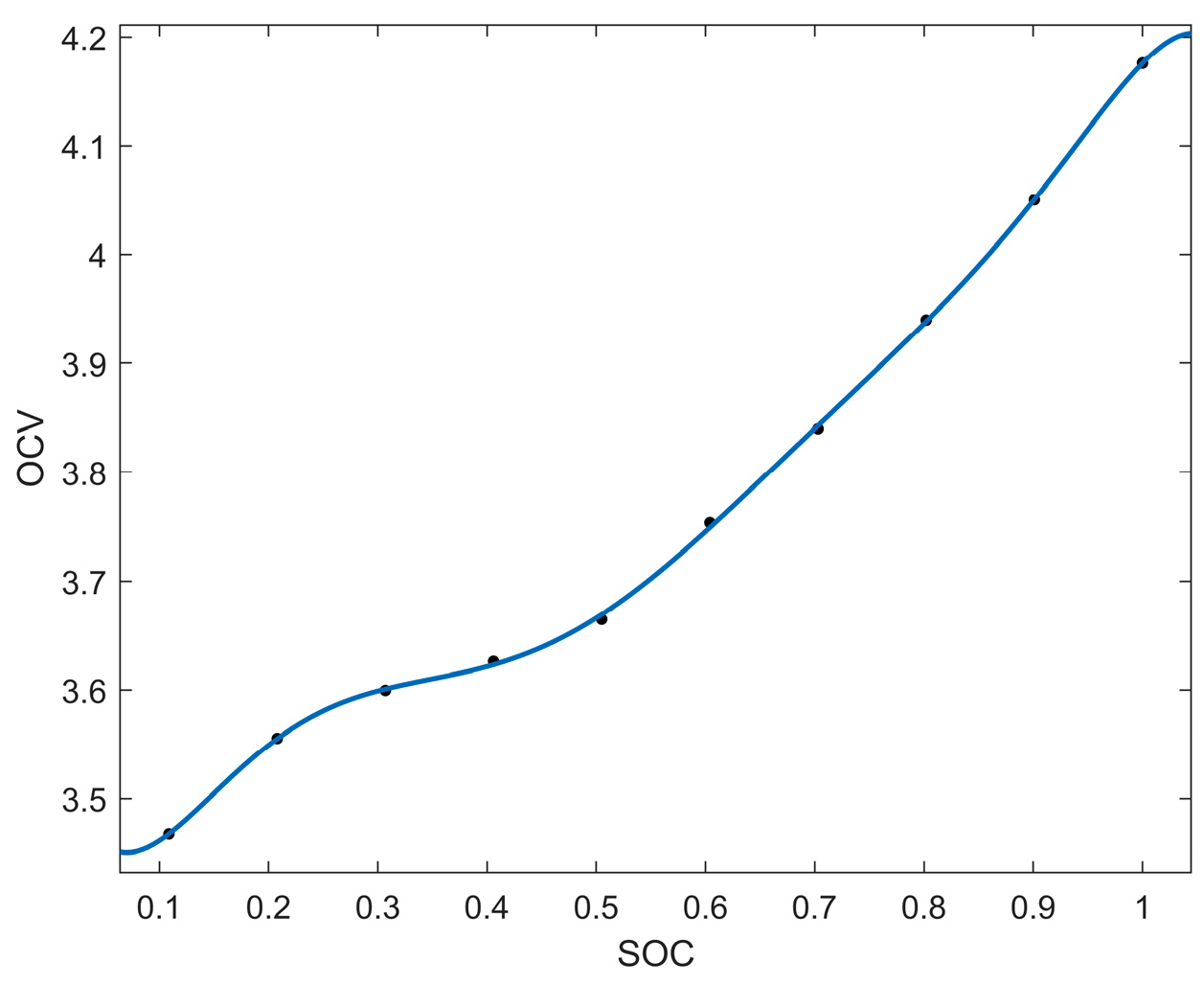
**Figure 3.** Online Identification and QPSO-AUKF for Battery SOC Estimation.
**Figure 3.** Online Identification and QPSO-AUKF for Battery SOC Estimation.

**Figure 4.** Comparison of identified parameters and voltage errors at 0 °C.
**Figure 4.** Comparison of identified parameters and voltage errors at 0 °C.
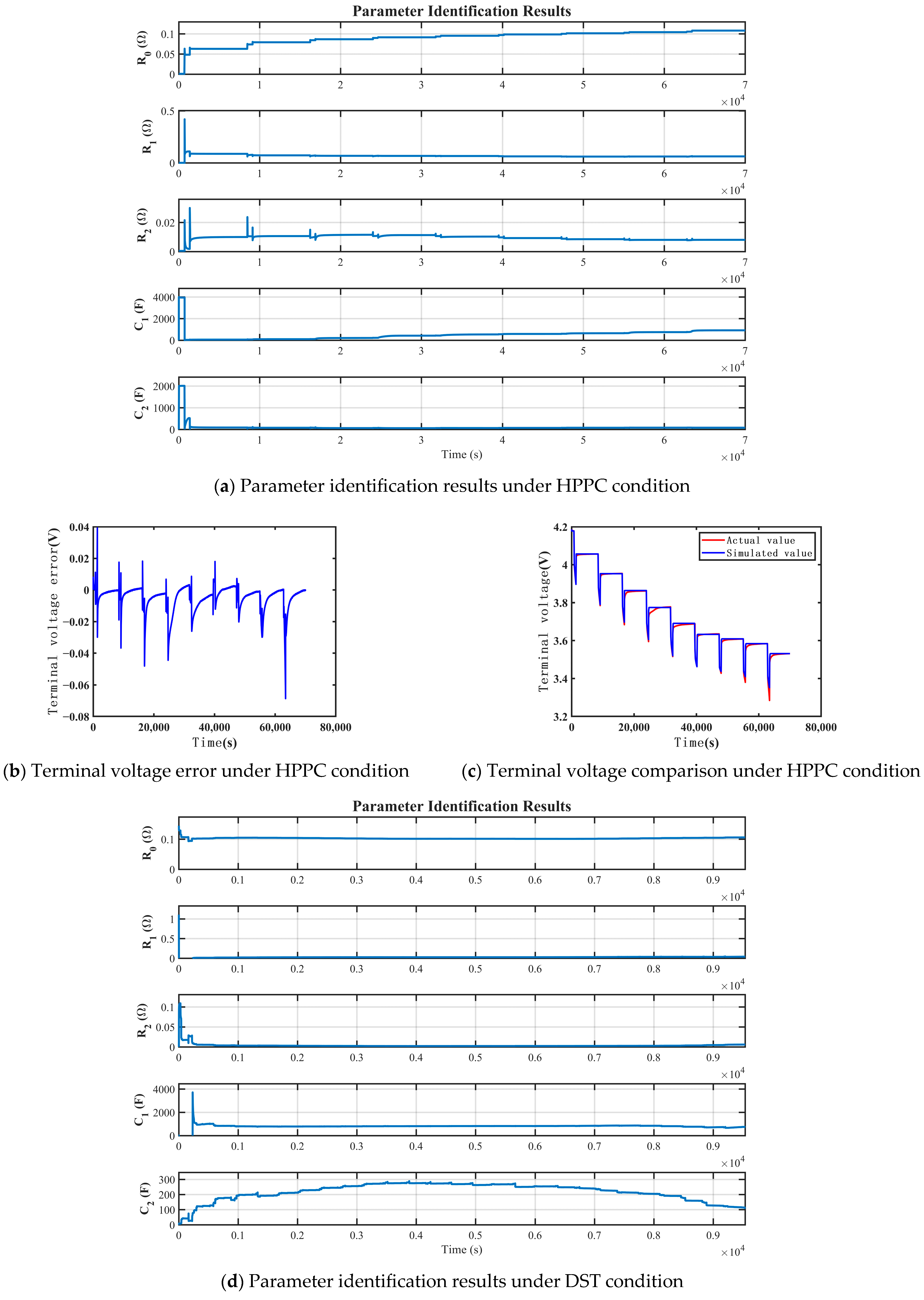
**Figure 5.** Comparison of identified parameters and voltage errors at 25 °C.
**Figure 5.** Comparison of identified parameters and voltage errors at 25 °C.
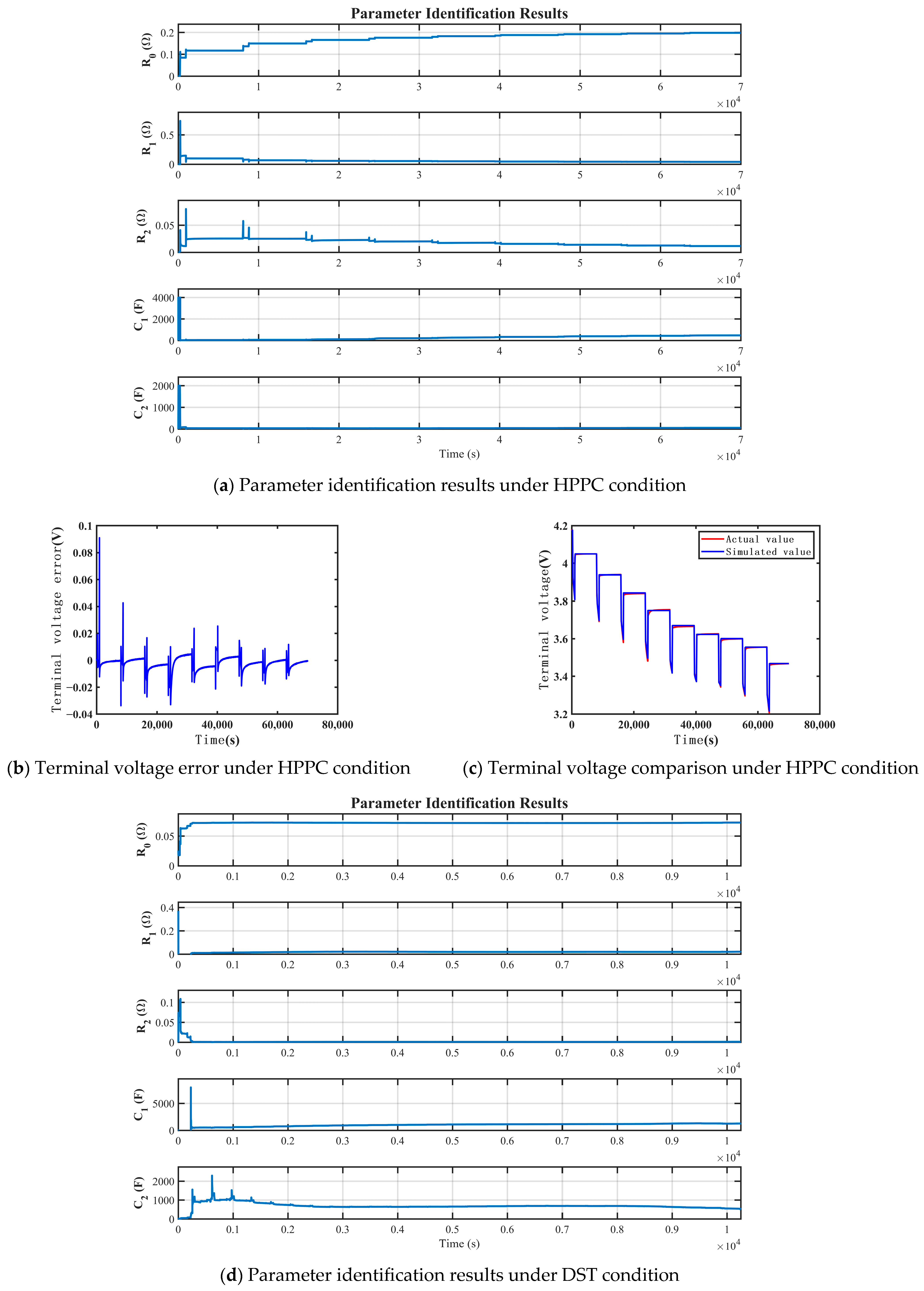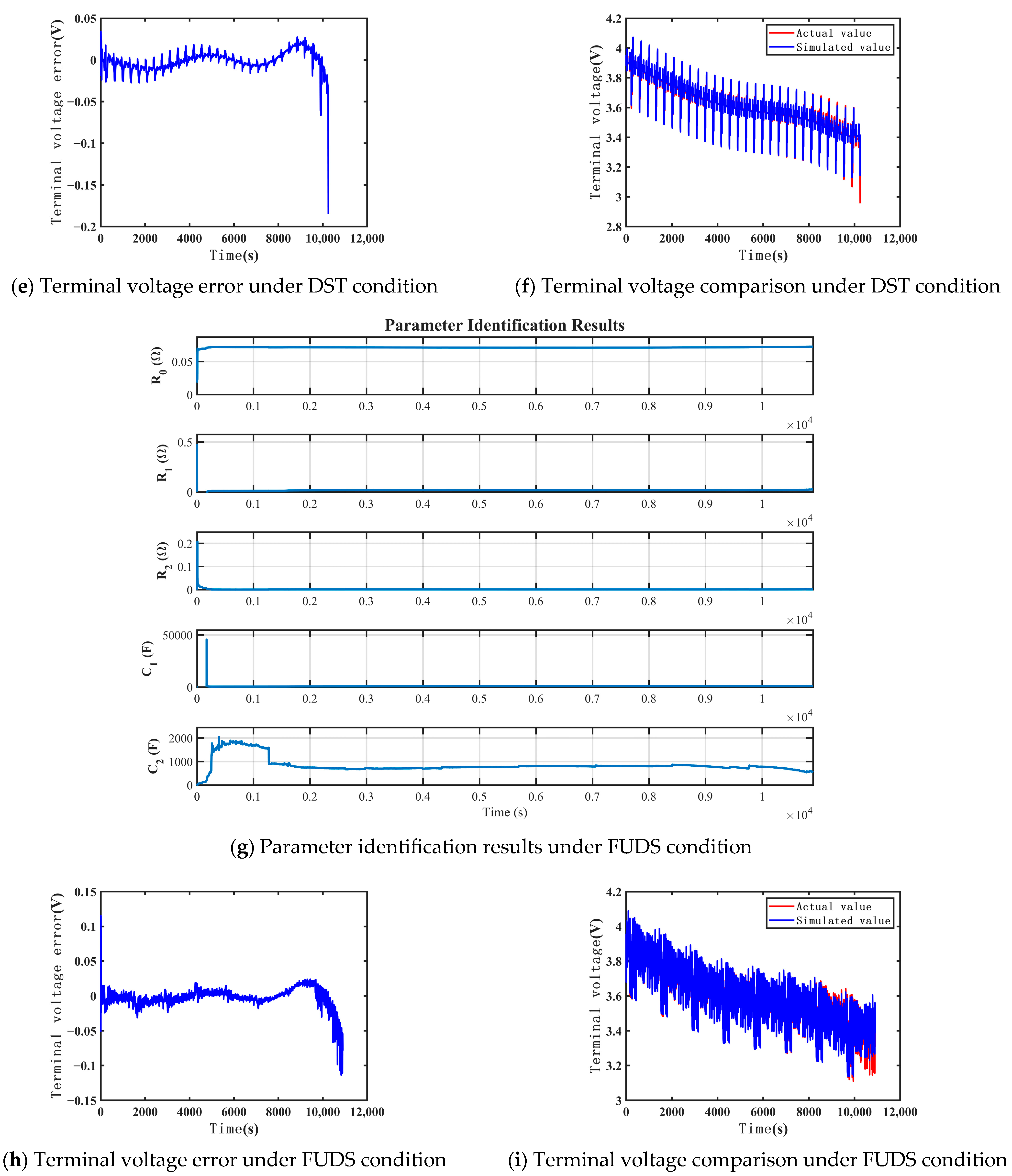
**Figure 6.** Comparison of identified parameters and voltage errors at 45 °C.
**Figure 6.** Comparison of identified parameters and voltage errors at 45 °C.

**Figure 7.** SOC estimation comparison under HPPC conditions.
**Figure 7.** SOC estimation comparison under HPPC conditions.

**Figure 8.** SOC estimation comparison under DST conditions.
**Figure 8.** SOC estimation comparison under DST conditions.
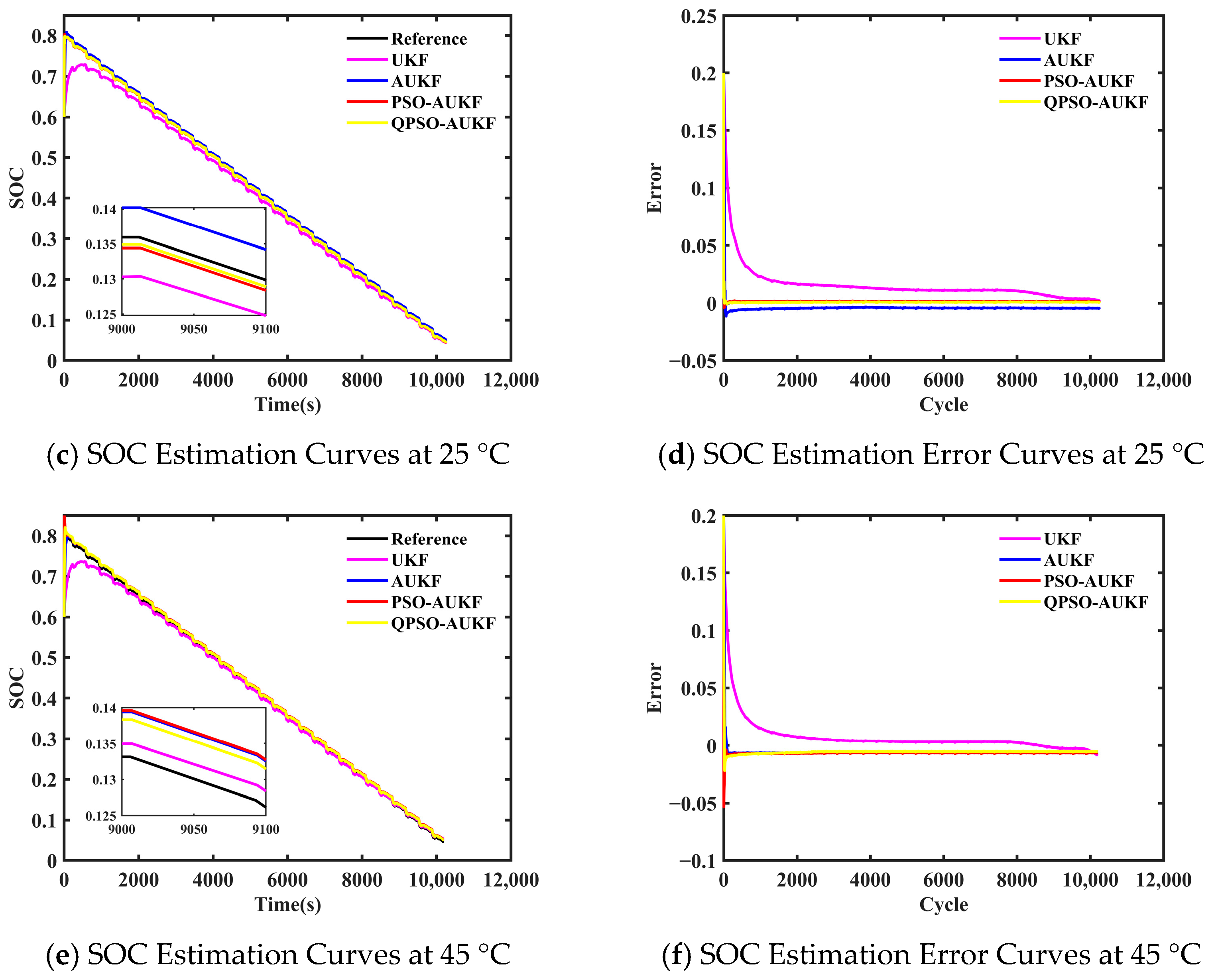
**Figure 9.** SOC estimation comparison under FUDS conditions.
**Figure 9.** SOC estimation comparison under FUDS conditions.

**Figure 10.** SOC Estimation and Error Curves under HWFET Condition.
**Figure 10.** SOC Estimation and Error Curves under HWFET Condition.

**Figure 11.** SOC Estimation and Error Curves under LA92 Condition.
**Figure 11.** SOC Estimation and Error Curves under LA92 Condition.

**Figure 12.** SOC Estimation and Error Curves under UDDS Condition.
**Figure 12.** SOC Estimation and Error Curves under UDDS Condition.

**Table 1.** MAE and RMSE of SOC Estimation by Different Algorithms and Test Cycles at 0 °C.
**Table 1.** MAE and RMSE of SOC Estimation by Different Algorithms and Test Cycles at 0 °C.
| Test Cycle | Estimation Method | MAE | RMSE |
|---|---|---|---|
| HPPC | UKF | 0\.73% | 1\.41% |
| AUKF | 0\.088% | 0\.84% | |
| PSO-AUKF | 0\.093% | 0\.21% | |
| QPSO-AUKF | 0\.089% | 0\.19% | |
| DST | UKF | 1\.40% | 2\.09% |
| AUKF | 0\.38% | 0\.84% | |
| PSO-AUKF | 0\.65% | 0\.72% | |
| QPSO-AUKF | 0\.41% | 0\.60% | |
| FUDS | UKF | 1\.45% | 2\.17% |
| AUKF | 0\.22% | 0\.76% | |
| PSO-AUKF | 0\.20% | 0\.41% | |
| QPSO-AUKF | 0\.19% | 0\.35% | |
**Table 2.** MAE and RMSE of SOC Estimation by Different Algorithms and Test Cycles at 25 °C.
**Table 2.** MAE and RMSE of SOC Estimation by Different Algorithms and Test Cycles at 25 °C.
| Test Cycle | Estimation Method | MAE | RMSE |
|---|---|---|---|
| HPPC | UKF | 0\.5% | 1\.37% |
| AUKF | 0\.42% | 0\.92% | |
| PSO-AUKF | 0\.4% | 0\.47% | |
| QPSO-AUKF | 0\.32% | 0\.36% | |
| DST | UKF | 1\.56% | 2\.3% |
| AUKF | 0\.47% | 0\.84% | |
| PSO-AUKF | 0\.15% | 0\.28% | |
| QPSO-AUKF | 0\.09% | 0\.22% | |
| FUDS | UKF | 1\.37% | 2\.17% |
| AUKF | 0\.2% | 0\.71% | |
| PSO-AUKF | 0\.10% | 0\.31% | |
| QPSO-AUKF | 0\.097% | 0\.24% | |
**Table 3.** MAE and RMSE of SOC Estimation by Different Algorithms and Test Cycles at 45 °C.
**Table 3.** MAE and RMSE of SOC Estimation by Different Algorithms and Test Cycles at 45 °C.
| Test Cycle | Estimation Method | MAE | RMSE |
|---|---|---|---|
| HPPC | UKF | 0\.36% | 1\.34% |
| AUKF | 0\.32% | 0\.89% | |
| PSO-AUKF | 0\.25% | 0\.36% | |
| QPSO-AUKF | 0\.24% | 0\.29% | |
| DST | UKF | 0\.81% | 1\.86% |
| AUKF | 0\.67% | 0\.97% | |
| PSO-AUKF | 0\.66% | 0\.81% | |
| QPSO-AUKF | 0\.58% | 0\.68% | |
| FUDS | UKF | 0\.91% | 1\.92% |
| AUKF | 0\.46% | 0\.83% | |
| PSO-AUKF | 0\.41% | 0\.54% | |
| QPSO-AUKF | 0\.39% | 0\.45% | |
**Table 4.** MAE and RMSE of SOC Estimation by Different Algorithms and Test Cycles.
**Table 4.** MAE and RMSE of SOC Estimation by Different Algorithms and Test Cycles.
| Test Cycle | Estimation Method | MAE | RMSE |
|---|---|---|---|
| HWFET | UKF | 1\.54% | 2\.08% |
| AUKF | 0\.52% | 1\.05% | |
| PSO-AUKF | 0\.52% | 0\.83% | |
| QPSO-AUKF | 0\.35% | 0\.61% | |
| LA92 | UKF | 2\.16% | 2\.46% |
| AUKF | 0\.70% | 0\.92% | |
| PSO-AUKF | 0\.69% | 0\.81% | |
| QPSO-AUKF | 0\.19% | 0\.29% | |
| UDDS | UKF | 1\.79% | 2\.11% |
| AUKF | 0\.11% | 0\.53% | |
| PSO-AUKF | 0\.099% | 0\.41% | |
| QPSO-AUKF | 0\.075% | 0\.18% | |
| | |
|---|---|
| | **Disclaimer/Publisher’s Note:** The statements, opinions and data contained in all publications are solely those of the individual author(s) and contributor(s) and not of MDPI and/or the editor(s). MDPI and/or the editor(s) disclaim responsibility for any injury to people or property resulting from any ideas, methods, instructions or products referred to in the content. |
© 2026 by the authors. Licensee MDPI, Basel, Switzerland. This article is an open access article distributed under the terms and conditions of the [Creative Commons Attribution (CC BY) license](https://creativecommons.org/licenses/by/4.0/). |
| Shard | 31 (laksa) |
| Root Hash | 11974975279136771031 |
| Unparsed URL | com,mdpi!www,/2313-0105/12/3/84 s443 |