ℹ️ Skipped - page is already crawled
| Filter | Status | Condition | Details |
|---|---|---|---|
| HTTP status | PASS | download_http_code = 200 | HTTP 200 |
| Age cutoff | PASS | download_stamp > now() - 6 MONTH | 0.2 months ago |
| History drop | PASS | isNull(history_drop_reason) | No drop reason |
| Spam/ban | PASS | fh_dont_index != 1 AND ml_spam_score = 0 | ml_spam_score=0 |
| Canonical | PASS | meta_canonical IS NULL OR = '' OR = src_unparsed | Not set |
| Property | Value |
|---|---|
| URL | https://www.math.net/laplace-transform |
| Last Crawled | 2026-04-06 16:25:39 (5 days ago) |
| First Indexed | 2022-10-25 02:51:39 (3 years ago) |
| HTTP Status Code | 200 |
| Meta Title | Laplace transform |
| Meta Description | null |
| Meta Canonical | null |
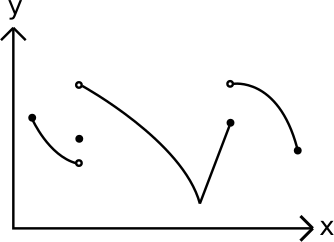
| Boilerpipe Text | A Laplace transform is a method used to solve ordinary differential equations (ODEs). It is an integral transformation that transforms a continuous piecewise function into a simpler form that allows us to solve complicated differential equations using algebra. Recall that a piecewise continuous function is a function that has a finite number of breaks over a given interval such that each subinterval is continuous and the endpoints of each subinterval are finite. The figure below depicts a piecewise continuous function:
Laplace transform definition
The Laplace transform of a function f(t), denoted
is
where t is a real number such that t ≥ 0, and s is a complex number. Below are some examples of finding Laplace transforms.
Examples
Find the following:
i
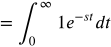
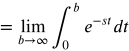
. Substitute f(t) = 1 into the Laplace transform formula:
Thus,
if s > 0. If s ≤ 0, the improper integral diverges since
.
ii
. Substitute f(t) = t into the Laplace transform formula:
Next, use integration by parts with
,
,
, and
:
Like the first example, the solution holds only if s > 0.
iii
. Substitute f(t) = e
at
into the Laplace transform formula:
For the solution to hold, s > a > 0. Otherwise, the improper integral diverges.
iv
. Substitute f(t) =sin(at) into the Laplace transform formula:
Next, use integration by parts with
,
,
, and
:
Use integration by parts again, with
,
,
, and
:
Thus,
. Notice that the improper integral is our initial problem:
. Substituting this into the value of the last equation above,
,
given that s > 0.
As you can see from the above examples, finding the Laplace transform for a given function can be quite tedious. For this reason, the Laplace transforms of commonly used functions is typically compiled in the form of a table for ease of use:
The above is not a comprehensive table, just an example of some the Laplace transforms of some functions that one might encounter. As an example of using the table, we can find the Laplace transform for f(t) = t
3
by substituting n = 3 into
to get
. If instead we had to find the Laplace transform without the use of a table, it would require integration by parts multiple times.
Property of linearity of the Laplace transform
When computing Laplace transforms, it is not necessary to pay attention to constants or the sums or differences of functions due to the following property:
where f(t) and g(t) are functions with Laplace transforms, and a and b are constants. In other words, we can compute the Laplace transforms of the functions, ignoring constants and sums/differences of functions, then add them back in after computing the transform.
Example
Find the Laplace transform of
Using the property of linearity,
Using the table of Laplace transforms above,
Thus, the solution is: |
| Markdown | 
[](https://www.math.net/)
[home](https://www.math.net/)
/
[calculus](https://www.math.net/calculus)
/
[differential equations](https://www.math.net/differential-equations)
/
laplace transform
# Laplace transform
A Laplace transform is a method used to solve ordinary differential equations (ODEs). It is an integral transformation that transforms a continuous piecewise function into a simpler form that allows us to solve complicated differential equations using algebra. Recall that a piecewise continuous function is a function that has a finite number of breaks over a given interval such that each subinterval is continuous and the endpoints of each subinterval are finite. The figure below depicts a piecewise continuous function:
## Laplace transform definition
The Laplace transform of a function f(t), denoted  is
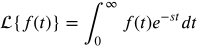
where t is a real number such that t ≥ 0, and s is a complex number. Below are some examples of finding Laplace transforms.
Examples
Find the following:
1. 
2. 
3. 
4. 
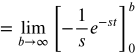
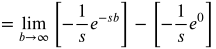
i. Substitute f(t) = 1 into the Laplace transform formula:
| | |
|---|---|
|  |  |
| |  |
| |  |
| |  |
| |  |
| |  |
Thus,  if s \> 0. If s ≤ 0, the improper integral diverges since 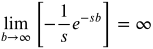.
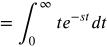
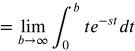
ii. Substitute f(t) = t into the Laplace transform formula:
| | |
|---|---|
|  |  |
| |  |
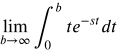
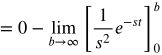
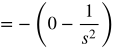
Next, use integration by parts with , , , and :
| | |
|---|---|
|  |  |
| |  |
| |  |
| |  |
| |  |
Like the first example, the solution holds only if s \> 0.
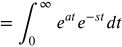
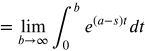
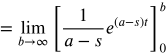
iii. Substitute f(t) = eat into the Laplace transform formula:
| | |
|---|---|
|  |  |
| |  |
| |  |
| |  |
| |  |
| | 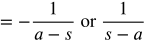 |
For the solution to hold, s \> a \> 0. Otherwise, the improper integral diverges.
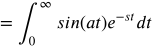
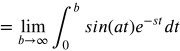
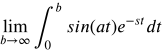
iv. Substitute f(t) =sin(at) into the Laplace transform formula:
| | |
|---|---|
|  |  |
| |  |
Next, use integration by parts with , , , and 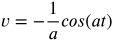:
| | |
|---|---|
|  |  |
| |  |
| |  |
Use integration by parts again, with , , , and :
| | |
|---|---|
|  |  |
| |  |
| |  |
| | 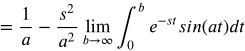 |
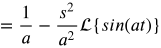
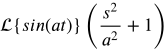
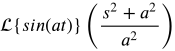
Thus, . Notice that the improper integral is our initial problem: . Substituting this into the value of the last equation above,
| | |
|---|---|
|  |  |
|  |  |
|  |  |
|  | , |
given that s \> 0.
As you can see from the above examples, finding the Laplace transform for a given function can be quite tedious. For this reason, the Laplace transforms of commonly used functions is typically compiled in the form of a table for ease of use:
|  |  |
|---|---|
|  |  |
|  |  |
|  |  |
|  |  |
|  |  |
|  |  |
|  |  |
|  |  |
|  |  |
|  |  |
|  |  |
|  |  |
The above is not a comprehensive table, just an example of some the Laplace transforms of some functions that one might encounter. As an example of using the table, we can find the Laplace transform for f(t) = t3 by substituting n = 3 into  to get . If instead we had to find the Laplace transform without the use of a table, it would require integration by parts multiple times.
## Property of linearity of the Laplace transform
When computing Laplace transforms, it is not necessary to pay attention to constants or the sums or differences of functions due to the following property:

where f(t) and g(t) are functions with Laplace transforms, and a and b are constants. In other words, we can compute the Laplace transforms of the functions, ignoring constants and sums/differences of functions, then add them back in after computing the transform.
Example
Find the Laplace transform of 
Using the property of linearity,

Using the table of Laplace transforms above,

Thus, the solution is:

Differential equations
[Laplace transform](https://www.math.net/laplace-transform)
[about us](https://www.math.net/site/about-us) \| [sitemap](https://www.math.net/site/sitemap) \| [terms](https://www.math.net/site/about-us#terms) \| [privacy](https://www.math.net/site/about-us#privacy) © 2026 math.net |
| Readable Markdown | A Laplace transform is a method used to solve ordinary differential equations (ODEs). It is an integral transformation that transforms a continuous piecewise function into a simpler form that allows us to solve complicated differential equations using algebra. Recall that a piecewise continuous function is a function that has a finite number of breaks over a given interval such that each subinterval is continuous and the endpoints of each subinterval are finite. The figure below depicts a piecewise continuous function:

## Laplace transform definition
The Laplace transform of a function f(t), denoted  is

where t is a real number such that t ≥ 0, and s is a complex number. Below are some examples of finding Laplace transforms.
Examples
Find the following:
1. 
2. 
3. 
4. 
i. Substitute f(t) = 1 into the Laplace transform formula:
| | |
|---|---|
|  |  |
| |  |
| |  |
| |  |
| |  |
| |  |
Thus,  if s \> 0. If s ≤ 0, the improper integral diverges since .
ii. Substitute f(t) = t into the Laplace transform formula:
Next, use integration by parts with , , , and :
| | |
|---|---|
|  |  |
| |  |
| |  |
| |  |
| |  |
Like the first example, the solution holds only if s \> 0.
iii. Substitute f(t) = eat into the Laplace transform formula:
| | |
|---|---|
|  |  |
| |  |
| |  |
| |  |
| |  |
| |  |
For the solution to hold, s \> a \> 0. Otherwise, the improper integral diverges.
iv. Substitute f(t) =sin(at) into the Laplace transform formula:
Next, use integration by parts with , , , and :
Use integration by parts again, with , , , and :
| | |
|---|---|
|  |  |
| |  |
| |  |
| |  |
Thus, . Notice that the improper integral is our initial problem: . Substituting this into the value of the last equation above,
| | |
|---|---|
|  |  |
|  |  |
|  |  |
|  | , |
given that s \> 0.
As you can see from the above examples, finding the Laplace transform for a given function can be quite tedious. For this reason, the Laplace transforms of commonly used functions is typically compiled in the form of a table for ease of use:
|  |  |
|---|---|
|  |  |
|  |  |
|  |  |
|  |  |
|  |  |
|  |  |
|  |  |
|  |  |
|  |  |
|  |  |
|  |  |
|  |  |
The above is not a comprehensive table, just an example of some the Laplace transforms of some functions that one might encounter. As an example of using the table, we can find the Laplace transform for f(t) = t3 by substituting n = 3 into  to get . If instead we had to find the Laplace transform without the use of a table, it would require integration by parts multiple times.
## Property of linearity of the Laplace transform
When computing Laplace transforms, it is not necessary to pay attention to constants or the sums or differences of functions due to the following property:

where f(t) and g(t) are functions with Laplace transforms, and a and b are constants. In other words, we can compute the Laplace transforms of the functions, ignoring constants and sums/differences of functions, then add them back in after computing the transform.
Example
Find the Laplace transform of 
Using the property of linearity,

Using the table of Laplace transforms above,

Thus, the solution is:
 |
| Shard | 120 (laksa) |
| Root Hash | 4471694184961019120 |
| Unparsed URL | net,math!www,/laplace-transform s443 |