ℹ️ Skipped - page is already crawled
| Filter | Status | Condition | Details |
|---|---|---|---|
| HTTP status | PASS | download_http_code = 200 | HTTP 200 |
| Age cutoff | PASS | download_stamp > now() - 6 MONTH | 0.1 months ago |
| History drop | PASS | isNull(history_drop_reason) | No drop reason |
| Spam/ban | PASS | fh_dont_index != 1 AND ml_spam_score = 0 | ml_spam_score=0 |
| Canonical | PASS | meta_canonical IS NULL OR = '' OR = src_unparsed | Not set |
| Property | Value | |||||||||
|---|---|---|---|---|---|---|---|---|---|---|
| URL | https://www.massgeneralbrigham.org/en/about/newsroom/articles/why-do-people-sleep-talk | |||||||||
| Last Crawled | 2026-04-27 00:07:05 (1 day ago) | |||||||||
| First Indexed | 2024-02-09 00:08:06 (2 years ago) | |||||||||
| HTTP Status Code | 200 | |||||||||
| Content | ||||||||||
| Meta Title | Sleep Talking | Mass General Brigham | |||||||||
| Meta Description | Why do people sleep talk? Learn what causes sleep talking and how to stop talking in your sleep. | |||||||||
| Meta Canonical | null | |||||||||
| Boilerpipe Text | Many people talk in their sleep at some point in their life—whether they know it or not. In fact, studies suggest 2 in 3 people experience the behavior.
According to
Milena Pavlova, MD
, a Mass General Brigham neurologist, sleep talking begins inside the brain.
“You’re asleep, but part of your brain hasn’t quite transitioned to sleep mode,” says Dr. Pavlova. “So, you keep doing things in your sleep that normally happen during wakefulness.”
Dr. Pavlova serves as medical director of the
Clinical Sleep Laboratory
at Brigham and Women’s Faulkner Hospital. She explains why sleep talking occurs, what sleep talking means, and how to manage the nighttime behavior.
Why do people talk in their sleep?
Sleep is delicate. When you fall asleep, your brain cycles through 4 different sleep stages. How long the brain stays in one stage, and their order through the night, can determine how refreshed you feel when you wake up and how well you perform during the day.
Disruptions to when, how, or for how long you sleep can alter brain activity at each stage. Abnormal behavior in your sleep, or parasomnias, usually occur from these disruptions.
Pop culture often embellishes these behaviors. A few of the most well-known include:
Sleep walking:
Stumbling, or completely walking, in one’s sleep. Typically, someone who sleepwalks does not leave their room. They may just fall out of bed.
Sleep paralysis:
Losing muscle control before waking up or just after falling asleep. Some people may hallucinate and feel a sense of panic. People may feel the panic in their chest.
Night terrors:
Different from a nightmare, night terrors occur when someone acts panicked or terrified in their sleep. They may abruptly sit, kick, and scream, or briefly flail without any memory of the incident.
While some parasomnias, like sleep walking, may put you in danger, sleep talking presents little risk at all—except for the possible embarrassment of a sleep partner overhearing your banter.
What causes sleep talking in adults?
The two main triggers of sleep talking in adults are:
Jet lag:
Switching between time zones disrupts how long someone stays awake during a full 24-hour day. Time shifts from
daylight savings
cause a similar effect.
Sleep deprivation:
A general lack of sleep from work, family, or social obligations creates a biological tension between wanting to stay awake during the day and falling asleep later that night.
Several other factors increase the likelihood of sleep talking. These include:
Sleep apnea:
People with
sleep apnea
can wake up gasping for air from a lack of oxygen. Typically, a patient comes to the doctor because of sleepiness and fatigue during the day or because a bed partner complains of the patient’s snoring. Notably, a patient with sleep apnea may be unaware of their symptoms.
Family health history
:
Genetics can play a strong role in how people behave in their sleep. They can increase the likelihood of certain parasomnias, including sleep talking.
Anxiety and stress:
When carrying too much
stress
and
anxiety
, the brain can struggle to transition into its sleep stages.
Meditation
can help lighten the load.
What causes sleep talking in children?
Sleep talking happens more frequently in children than adults. Half of young children experience the behavior compared to 5% of adults.
Dr. Pavlova believes the development of a child’s brain helps explain why. She lists several possible factors:
Maturity:
The brain of a child, Dr. Pavlova says, is not mature enough to transition between wakefulness and sleep as smoothly as an adult’s brain. As they grow older, children talk in their sleep less frequently.
Longer sleep times:
Children require more sleep than adults.
Continuous sleep:
For their own growth and development, children need as few interruptions to their sleep as possible.
What does it mean when you talk in your sleep?
The short answer: nothing. The myth of people confessing their deepest, darkest secrets in their sleep occurs only in Hollywood films, not in real-life bedrooms, Dr. Pavlova says.
Most times, sleep talking sounds more like babbling than intelligible sentences.
“If you’re looking for an elixir of truth, sleep talking isn’t it,” she adds. “That’s a myth that’s persisted for decades.”
Can sleep talking be a sign of something worse?
Sleep talking, while largely harmless, sometimes signals a more serious condition in adults.
The stages of sleep are characterized as either rapid eye movement (REM) or non-rapid eye movement (non-REM). During REM sleep, the brain paralyzes the entire body, except for those muscles controlling the eyes and organs essential for breathing. Dreaming occurs during this type of sleep, too.
When someone acts out purposeful movements, such as talking or walking, during REM sleep, the part of their brain responsible for restraining muscle movement has malfunctioned. This condition, called a REM behavior disorder (RBD), allows people to act out dreams. These individuals put themselves, or others, in danger, especially if they act out violent behaviors.
“RBD can start with benign talking but transition into shouting and gradually turn into violent actions,” says Dr. Pavlova. “They might try kicking or punching air. Some may fall right out of bed.”
How common is RBD?
Only 1% of people develop RBD. However, those who do often develop
Parkinson’s disease
, leading many to wonder whether a link exists between the two.
RBD is associated with:
People age 50 and older
Males
Narcolepsy, or excessive daytime sleepiness combined with sudden muscle weakness
Medications, including antidepressants
Substance use
, like
alcohol use
or
opioid use
Nighttime
seizures
Diagnosing RBD
People often talk in their sleep without realizing it. Sometimes, only a sleep partner makes them aware of the behavior.
Those same sleep partners can help recognize the early signs of RBD. People with RBD often wake up remembering elaborate dreams. Their sleep partners may recall whether they spoke out specific parts of that dream in their sleep.
Only a doctor can diagnose RBD using a sleep study. The study determines which stage of sleep their talking occurs. Individuals must undergo testing in a laboratory, as opposed to an at-home sleep test, to measure brain wave activity from electroencephalogram (EEG). | |||||||||
| Markdown | [Skip to cookie consent](https://www.massgeneralbrigham.org/en/about/newsroom/articles/why-do-people-sleep-talk#cookieNotice) [Skip to main content](https://www.massgeneralbrigham.org/en/about/newsroom/articles/why-do-people-sleep-talk#main-content) [Skip to pause video preview](https://www.massgeneralbrigham.org/en/about/newsroom/articles/why-do-people-sleep-talk) [Skip to alerts](https://www.massgeneralbrigham.org/en/about/newsroom/articles/why-do-people-sleep-talk) [Skip to pause carousel](https://www.massgeneralbrigham.org/en/about/newsroom/articles/why-do-people-sleep-talk)
Site Selection
Changing the site selection will update the primary navigation on the page
- [Patient Care](https://www.massgeneralbrigham.org/en/patient-care)
- [Research & Innovation](https://www.massgeneralbrigham.org/en/research-and-innovation)
- [Education & Training](https://www.massgeneralbrigham.org/en/education-and-training)
- [About](https://www.massgeneralbrigham.org/en/about)
Featured Links
- [Giving to Mass General Brigham](https://www.massgeneralbrigham.org/en/about/giving)
Featured Links
- [Giving to Mass General Brigham](https://www.massgeneralbrigham.org/en/about/giving)
Featured Links
- [Giving to Mass General Brigham](https://www.massgeneralbrigham.org/en/about/giving)
Featured Links
- [Giving to Mass General Brigham](https://www.massgeneralbrigham.org/en/about/giving)
[](https://www.massgeneralbrigham.org/en)
Utility Links
- [Request an appointment](https://www.massgeneralbrigham.org/en/patient-care/patient-visitor-information/appointments)
- [Log in to Patient Gateway](https://patientgateway.massgeneralbrigham.org/)
- [Find a doctor](https://doctors.massgeneralbrigham.org/search)
- [Find a location](https://www.massgeneralbrigham.org/en/patient-care/services-and-specialties/find-a-location)
- Choose Language
- [Home](https://www.massgeneralbrigham.org/en/about/newsroom/articles/why-do-people-sleep-talk)
- [العربية](https://www.massgeneralbrigham.org/ar)
- [中文](https://www.massgeneralbrigham.org/zh)
- [Kreyòl Ayisyen](https://www.massgeneralbrigham.org/ht)
- [Português](https://www.massgeneralbrigham.org/pt-br)
- [Pусский](https://www.massgeneralbrigham.org/ru)
- [Español](https://www.massgeneralbrigham.org/es)
- [中文](https://www.massgeneralbrigham.org/zh_cn)
- Search the Site
Close Search
Primary
[](https://www.massgeneralbrigham.org/en)
- Patient & Visitor Information
- [Patient & Visitor Information](https://www.massgeneralbrigham.org/en/patient-care/patient-visitor-information)
[Find Care](https://www.massgeneralbrigham.org/en/patient-care/get-care)
- - Getting Started
- [New to Mass General Brigham](https://www.massgeneralbrigham.org/en/patient-care/patient-visitor-information/new-to-mass-general-brigham)
- [International Patient Services](https://www.massgeneralbrigham.org/en/patient-care/international)
- [What Is Patient Gateway?](https://www.massgeneralbrigham.org/en/patient-care/patient-visitor-information/patient-gateway)
- [Planning Your Visit](https://www.massgeneralbrigham.org/en/patient-care/patient-visitor-information/planning-your-visit)
- [Find a Doctor (opens link in new tab)](https://doctors.massgeneralbrigham.org/search?sort=relevance%2Cnetworks%2Cavailability_density_best)
- [Appointments](https://www.massgeneralbrigham.org/en/patient-care/patient-visitor-information/appointments)
- - Patient Resources
- [Health & Wellness](https://www.massgeneralbrigham.org/en/patient-care/patient-visitor-information/health-information)
- [Flu, COVID-19, & RSV](https://www.massgeneralbrigham.org/en/patient-care/patient-visitor-information/respiratory-illnesses)
- [Billing & Insurance](https://www.massgeneralbrigham.org/en/patient-care/patient-visitor-information/billing)
- [Financial Assistance](https://www.massgeneralbrigham.org/en/patient-care/patient-visitor-information/financial-assistance)
- [Medicare and MassHealth ACOs](https://www.massgeneralbrigham.org/en/patient-care/patient-visitor-information/medicare-and-masshealth-acos)
- [Participate in Research](https://www.massgeneralbrigham.org/en/research-and-innovation/participate-in-research)
- [Educational Resources](https://www.massgeneralbrigham.org/en/patient-care/patient-visitor-information/videos)
- - Visitor Information
- [Find a Location](https://www.massgeneralbrigham.org/en/patient-care/services-and-specialties/find-a-location)
- [Shuttles](https://www.massgeneralbrigham.org/en/patient-care/patient-visitor-information/planning-your-visit/shuttles)
- [Visitor Policies](https://www.massgeneralbrigham.org/en/patient-care/patient-visitor-information/planning-your-visit/visitor-policy)
- Hospitals, Services & Specialties
- [Hospitals, Services & Specialties](https://www.massgeneralbrigham.org/en/patient-care/services-and-specialties)
- - Services & Specialties
- [Cancer Institute](https://www.massgeneralbrigham.org/en/patient-care/services-and-specialties/cancer)
- [Primary Care](https://www.massgeneralbrigham.org/en/patient-care/services-and-specialties/primary-care)
- [Emergency Care](https://www.massgeneralbrigham.org/en/patient-care/services-and-specialties/emergency)
- [Urgent Care](https://www.massgeneralbrigham.org/en/patient-care/services-and-specialties/urgent-care)
- [24/7 Virtual Care](https://www.massgeneralbrigham.org/en/patient-care/virtual-care/virtual-urgent-care)
- [Healthcare at Home](https://www.massgeneralbrigham.org/en/patient-care/services-and-specialties/healthcare-at-home)
- [Heart & Vascular Institute](https://www.massgeneralbrigham.org/en/patient-care/services-and-specialties/heart)
- [Orthopedics](https://www.massgeneralbrigham.org/en/patient-care/services-and-specialties/orthopedics)
- [Rehabilitation](https://www.massgeneralbrigham.org/en/patient-care/services-and-specialties/rehabilitation)
- [Sports Medicine](https://www.massgeneralbrigham.org/en/patient-care/services-and-specialties/sports-medicine)
- - Hospitals
- [Hospital Locations](https://www.massgeneralbrigham.org/en/patient-care/services-and-specialties/locations.location=Hospital)
- [Information About Our Hospitals](https://www.massgeneralbrigham.org/en/patient-care/services-and-specialties/find-a-location/our-hospitals)
- Virtual Care
- [Virtual Care](https://www.massgeneralbrigham.org/en/patient-care/virtual-care)
- - Our Virtual Care Options
- [24/7 Virtual Care](https://www.massgeneralbrigham.org/en/patient-care/virtual-care/virtual-urgent-care)
- [Virtual Visits for Primary & Specialty Care](https://www.massgeneralbrigham.org/en/patient-care/virtual-care/virtual-visits)
- [Online Second Opinions](https://www.massgeneralbrigham.org/en/patient-care/virtual-care/online-second-opinions)
- [Participate in Research](https://www.massgeneralbrigham.org/en/research-and-innovation/participate-in-research)
- Centers & Programs
- [Research Centers & Programs](https://www.massgeneralbrigham.org/en/research-and-innovation/centers-and-programs)
- - [Hospital Research Institutes](https://www.massgeneralbrigham.org/en/research-and-innovation/centers-and-programs/hospital-research-institutes)
- [Artificial Intelligence](https://www.massgeneralbrigham.org/en/research-and-innovation/centers-and-programs/artificial-intelligence)
- [Gene and Cell Therapy Institute](https://www.massgeneralbrigham.org/en/research-and-innovation/centers-and-programs/gene-cell-therapy)
- [Personalized Medicine](https://www.massgeneralbrigham.org/en/research-and-innovation/centers-and-programs/personalized-medicine)
- [Population Health](https://www.massgeneralbrigham.org/en/research-and-innovation/centers-and-programs/population-health)
- Innovation
- [Mass General Brigham Innovation](https://www.massgeneralbrigham.org/en/research-and-innovation/innovation)
[Contact us](https://www.massgeneralbrigham.org/en/research-and-innovation/innovation/contact)
- - About Innovation
- [About](https://www.massgeneralbrigham.org/en/research-and-innovation/innovation/about)
- [Team](https://www.massgeneralbrigham.org/en/research-and-innovation/innovation/about/team)
- [News](https://www.massgeneralbrigham.org/en/research-and-innovation/innovation/news)
- - For Industry
- [Venture Capital and Investments](https://www.massgeneralbrigham.org/en/research-and-innovation/innovation/venture-capital-and-investments)
- [World Medical Innovation Forum (opens link in new tab)](https://worldmedicalinnovation.org/)
- [Featured Licensing Opportunities](https://www.massgeneralbrigham.org/en/research-and-innovation/innovation/for-industry/featured-licensing)
- - For Innovators
- [Commercialization Guide for Innovators](https://www.massgeneralbrigham.org/en/research-and-innovation/innovation/for-innovators/commercialization)
- Researchers & Collaborators
- [For Researchers & Collaborators](https://www.massgeneralbrigham.org/en/research-and-innovation/for-researchers-and-collaborators)
- - [Information for Researchers](https://www.massgeneralbrigham.org/en/research-and-innovation/for-researchers-and-collaborators/information-for-researchers)
- [Compliance Office](https://www.massgeneralbrigham.org/en/research-and-innovation/for-researchers-and-collaborators/compliance-office)
- [Research Cores](https://www.massgeneralbrigham.org/en/research-and-innovation/for-researchers-and-collaborators/research-cores)
- [Clinical Trials](https://www.massgeneralbrigham.org/en/research-and-innovation/centers-and-programs/clinical-trials-office)
- [Advisory Services](https://www.massgeneralbrigham.org/en/research-and-innovation/for-researchers-and-collaborators/advisory-services)
- - Featured Research
- [Two Centuries of Breakthroughs](https://www.massgeneralbrigham.org/en/research-and-innovation/breakthroughs)
- [Advances in Motion (opens link in new tab)](https://advances.massgeneral.org/)
- [Brigham on a Mission (opens link in new tab)](https://www.brighamhealthonamission.org/)
- [Gene and Cell Therapy Institute](https://www.massgeneralbrigham.org/en/research-and-innovation/centers-and-programs/gene-cell-therapy)
- - Research News
- [Alzheimer's Disease](https://www.massgeneralbrigham.org/en/research-and-innovation/for-researchers-and-collaborators/alzheimers)
- [Artificial Intelligence](https://www.massgeneralbrigham.org/en/research-and-innovation/for-researchers-and-collaborators/artificial-intelligence)
- Graduate Medical Education
- [Graduate Medical Education](https://www.massgeneralbrigham.org/en/education-and-training/graduate-medical-education)
- - Residency & fellowship programs
- [Brigham and Women's Hospital](https://www.massgeneralbrigham.org/en/education-and-training/graduate-medical-education/residencies-and-fellowships/brigham-and-womens-hospital)
- [Massachusetts General Hospital](https://www.massgeneralbrigham.org/en/education-and-training/graduate-medical-education/residencies-and-fellowships/massachusetts-general-hospital)
- [Mass Eye and Ear](https://www.massgeneralbrigham.org/en/education-and-training/graduate-medical-education/residencies-and-fellowships/mass-eye-and-ear)
- [Newton-Wellesley Hospital](https://www.massgeneralbrigham.org/en/education-and-training/graduate-medical-education/residencies-and-fellowships/newton-wellesley-hospital)
- [Salem Hospital](https://www.massgeneralbrigham.org/en/education-and-training/graduate-medical-education/residencies-and-fellowships/salem-hospital)
- [Integrated Mass General Brigham Programs](https://www.massgeneralbrigham.org/en/education-and-training/graduate-medical-education/residencies-and-fellowships/integrated-programs)
- - Centers of Expertise
- [Global & Community Health](https://www.massgeneralbrigham.org/en/education-and-training/graduate-medical-education/centers-of-expertise/global-community-health)
- [Health Policy & Management](https://www.massgeneralbrigham.org/en/education-and-training/graduate-medical-education/centers-of-expertise/health-policy-and-management)
- [Healthcare Quality & Patient Safey](https://www.massgeneralbrigham.org/en/education-and-training/graduate-medical-education/centers-of-expertise/healthcare-quality-patient-safety)
- [Medical Education](https://www.massgeneralbrigham.org/en/education-and-training/graduate-medical-education/centers-of-expertise/medical-education)
- - For trainees
- [Prospective trainees](https://www.massgeneralbrigham.org/en/education-and-training/graduate-medical-education/for-trainees/prospective)
- [Incoming trainees](https://www.massgeneralbrigham.org/en/education-and-training/graduate-medical-education/for-trainees/incoming)
- [Current trainees](https://www.massgeneralbrigham.org/en/education-and-training/graduate-medical-education/for-trainees/current)
- [Continuing Professional Development](https://www.massgeneralbrigham.org/en/education-and-training/continuing-professional-development)
- Other Learning Opportunities
- [Other Learning Opportunities](https://www.massgeneralbrigham.org/en/education-and-training/learning-opportunities)
- - [MGH Institute of Health Professions](https://www.massgeneralbrigham.org/en/education-and-training/mgh-institute-of-health-professions)
- [Internships](https://www.massgeneralbrigham.org/en/education-and-training/learning-opportunities/internships)
- [Medical Lab Science Training Program](https://www.massgeneralbrigham.org/en/education-and-training/learning-opportunities/medical-laboratory-science-training-program)
- [Mass General Brigham Workforce Development](https://www.massgeneralbrigham.org/en/education-and-training/learning-opportunities/workforce-development)
- [Center for Academic Development and Enrichment](https://www.massgeneralbrigham.org/en/education-and-training/academic-development-and-enrichment)
- Our Educational Commitment
- [Our Commitment to Education](https://www.massgeneralbrigham.org/en/education-and-training/our-educational-commitment)
- - [Alumni Association](https://www.massgeneralbrigham.org/en/education-and-training/alumni-association)
- Advancing Care
- [Advancing Care](https://www.massgeneralbrigham.org/en/about/advancing-care)
- - [Integrated Healthcare System](https://www.massgeneralbrigham.org/en/about/advancing-care/integrated-healthcare-system)
- [Quality of Care](https://www.massgeneralbrigham.org/en/patient-care/patient-visitor-information/quality-of-care)
- [Health Equity & Community Health](https://www.massgeneralbrigham.org/en/about/advancing-care/health-equity-community-health)
- [Members and Affiliates](https://www.massgeneralbrigham.org/en/about/members-affiliations)
- [History](https://www.massgeneralbrigham.org/en/about/advancing-care/history)
- [Leadership](https://www.massgeneralbrigham.org/en/about/leadership-and-governance)
- [Accessibility](https://www.massgeneralbrigham.org/en/about/accessibility)
- [United Against Racism](https://www.massgeneralbrigham.org/en/about/united-against-racism)
- - Institutes
- [Cancer Institute](https://www.massgeneralbrigham.org/en/patient-care/services-and-specialties/cancer)
- [Heart and Vascular Institute](https://www.massgeneralbrigham.org/en/about/heart-and-vascular-institute)
- [Neuroscience Institute](https://www.massgeneralbrigham.org/en/about/neuroscience-institute)
- [Workforce Enrichment and Engagement](https://www.massgeneralbrigham.org/en/about/workforce-enrichment-and-engagement)
- [Newsroom](https://www.massgeneralbrigham.org/en/about/newsroom)
- Careers
- [Careers](https://www.massgeneralbrigham.org/en/about/careers)
[Search Mass General Brigham Careers (opens external link in new tab)](https://massgeneralbrigham.wd1.myworkdayjobs.com/MGBExternal)
- - [Benefits](https://www.massgeneralbrigham.org/en/about/careers/benefits)
- [Careers at our Member Institutions](https://www.massgeneralbrigham.org/en/about/careers/at-our-member-institutions)
- [Join our Talent Community](https://www.massgeneralbrigham.org/en/about/careers/talent-community)
- [Employment Conditions](https://www.massgeneralbrigham.org/en/about/careers/employment-conditions)
- - Featured Jobs
- [Development](https://www.massgeneralbrigham.org/en/about/careers/system/development)
- [Healthcare at Home](https://www.massgeneralbrigham.org/en/about/careers/system/healthcare-at-home)
[](https://www.massgeneralbrigham.org/en)
Open Menu
Site Selection
- Patient Care
- [Overview](https://www.massgeneralbrigham.org/en/patient-care)
- Patient & Visitor Information
- [Overview](https://www.massgeneralbrigham.org/en/patient-care/patient-visitor-information)
- Getting Started
- [New to Mass General Brigham](https://www.massgeneralbrigham.org/en/patient-care/patient-visitor-information/new-to-mass-general-brigham)
- [International Patient Services](https://www.massgeneralbrigham.org/en/patient-care/international)
- [What Is Patient Gateway?](https://www.massgeneralbrigham.org/en/patient-care/patient-visitor-information/patient-gateway)
- [Planning Your Visit](https://www.massgeneralbrigham.org/en/patient-care/patient-visitor-information/planning-your-visit)
- [Find a Doctor (opens link in new tab)](https://doctors.massgeneralbrigham.org/search?sort=relevance%2Cnetworks%2Cavailability_density_best)
- [Appointments](https://www.massgeneralbrigham.org/en/patient-care/patient-visitor-information/appointments)
- Patient Resources
- [Health & Wellness](https://www.massgeneralbrigham.org/en/patient-care/patient-visitor-information/health-information)
- [Flu, COVID-19, & RSV](https://www.massgeneralbrigham.org/en/patient-care/patient-visitor-information/respiratory-illnesses)
- [Billing & Insurance](https://www.massgeneralbrigham.org/en/patient-care/patient-visitor-information/billing)
- [Financial Assistance](https://www.massgeneralbrigham.org/en/patient-care/patient-visitor-information/financial-assistance)
- [Medicare and MassHealth ACOs](https://www.massgeneralbrigham.org/en/patient-care/patient-visitor-information/medicare-and-masshealth-acos)
- [Participate in Research](https://www.massgeneralbrigham.org/en/research-and-innovation/participate-in-research)
- [Educational Resources](https://www.massgeneralbrigham.org/en/patient-care/patient-visitor-information/videos)
- Visitor Information
- [Find a Location](https://www.massgeneralbrigham.org/en/patient-care/services-and-specialties/find-a-location)
- [Shuttles](https://www.massgeneralbrigham.org/en/patient-care/patient-visitor-information/planning-your-visit/shuttles)
- [Visitor Policies](https://www.massgeneralbrigham.org/en/patient-care/patient-visitor-information/planning-your-visit/visitor-policy)
- [Find Care](https://www.massgeneralbrigham.org/en/patient-care/get-care)
- Hospitals, Services & Specialties
- [Overview](https://www.massgeneralbrigham.org/en/patient-care/services-and-specialties)
- Services & Specialties
- [Cancer Institute](https://www.massgeneralbrigham.org/en/patient-care/services-and-specialties/cancer)
- [Primary Care](https://www.massgeneralbrigham.org/en/patient-care/services-and-specialties/primary-care)
- [Emergency Care](https://www.massgeneralbrigham.org/en/patient-care/services-and-specialties/emergency)
- [Urgent Care](https://www.massgeneralbrigham.org/en/patient-care/services-and-specialties/urgent-care)
- [24/7 Virtual Care](https://www.massgeneralbrigham.org/en/patient-care/virtual-care/virtual-urgent-care)
- [Healthcare at Home](https://www.massgeneralbrigham.org/en/patient-care/services-and-specialties/healthcare-at-home)
- [Heart & Vascular Institute](https://www.massgeneralbrigham.org/en/patient-care/services-and-specialties/heart)
- [Orthopedics](https://www.massgeneralbrigham.org/en/patient-care/services-and-specialties/orthopedics)
- [Rehabilitation](https://www.massgeneralbrigham.org/en/patient-care/services-and-specialties/rehabilitation)
- [Sports Medicine](https://www.massgeneralbrigham.org/en/patient-care/services-and-specialties/sports-medicine)
- Hospitals
- [Hospital Locations](https://www.massgeneralbrigham.org/en/patient-care/services-and-specialties/locations.location=Hospital)
- [Information About Our Hospitals](https://www.massgeneralbrigham.org/en/patient-care/services-and-specialties/find-a-location/our-hospitals)
- Virtual Care
- [Overview](https://www.massgeneralbrigham.org/en/patient-care/virtual-care)
- Our Virtual Care Options
- [24/7 Virtual Care](https://www.massgeneralbrigham.org/en/patient-care/virtual-care/virtual-urgent-care)
- [Virtual Visits for Primary & Specialty Care](https://www.massgeneralbrigham.org/en/patient-care/virtual-care/virtual-visits)
- [Online Second Opinions](https://www.massgeneralbrigham.org/en/patient-care/virtual-care/online-second-opinions)
- Research & Innovation
- [Overview](https://www.massgeneralbrigham.org/en/research-and-innovation)
- [Participate in Research](https://www.massgeneralbrigham.org/en/research-and-innovation/participate-in-research)
- Centers & Programs
- [Overview](https://www.massgeneralbrigham.org/en/research-and-innovation/centers-and-programs)
- [Hospital Research Institutes](https://www.massgeneralbrigham.org/en/research-and-innovation/centers-and-programs/hospital-research-institutes)
- [Artificial Intelligence](https://www.massgeneralbrigham.org/en/research-and-innovation/centers-and-programs/artificial-intelligence)
- [Gene and Cell Therapy Institute](https://www.massgeneralbrigham.org/en/research-and-innovation/centers-and-programs/gene-cell-therapy)
- [Personalized Medicine](https://www.massgeneralbrigham.org/en/research-and-innovation/centers-and-programs/personalized-medicine)
- [Population Health](https://www.massgeneralbrigham.org/en/research-and-innovation/centers-and-programs/population-health)
- Innovation
- [Overview](https://www.massgeneralbrigham.org/en/research-and-innovation/innovation)
- About Innovation
- [About](https://www.massgeneralbrigham.org/en/research-and-innovation/innovation/about)
- [Team](https://www.massgeneralbrigham.org/en/research-and-innovation/innovation/about/team)
- [News](https://www.massgeneralbrigham.org/en/research-and-innovation/innovation/news)
- For Industry
- [Venture Capital and Investments](https://www.massgeneralbrigham.org/en/research-and-innovation/innovation/venture-capital-and-investments)
- [World Medical Innovation Forum (opens link in new tab)](https://worldmedicalinnovation.org/)
- [Featured Licensing Opportunities](https://www.massgeneralbrigham.org/en/research-and-innovation/innovation/for-industry/featured-licensing)
- For Innovators
- [Commercialization Guide for Innovators](https://www.massgeneralbrigham.org/en/research-and-innovation/innovation/for-innovators/commercialization)
- [Contact us](https://www.massgeneralbrigham.org/en/research-and-innovation/innovation/contact)
- Researchers & Collaborators
- [Overview](https://www.massgeneralbrigham.org/en/research-and-innovation/for-researchers-and-collaborators)
- [Information for Researchers](https://www.massgeneralbrigham.org/en/research-and-innovation/for-researchers-and-collaborators/information-for-researchers)
- [Compliance Office](https://www.massgeneralbrigham.org/en/research-and-innovation/for-researchers-and-collaborators/compliance-office)
- [Research Cores](https://www.massgeneralbrigham.org/en/research-and-innovation/for-researchers-and-collaborators/research-cores)
- [Clinical Trials](https://www.massgeneralbrigham.org/en/research-and-innovation/centers-and-programs/clinical-trials-office)
- [Advisory Services](https://www.massgeneralbrigham.org/en/research-and-innovation/for-researchers-and-collaborators/advisory-services)
- Featured Research
- [Two Centuries of Breakthroughs](https://www.massgeneralbrigham.org/en/research-and-innovation/breakthroughs)
- [Advances in Motion (opens link in new tab)](https://advances.massgeneral.org/)
- [Brigham on a Mission (opens link in new tab)](https://www.brighamhealthonamission.org/)
- [Gene and Cell Therapy Institute](https://www.massgeneralbrigham.org/en/research-and-innovation/centers-and-programs/gene-cell-therapy)
- Research News
- [Alzheimer's Disease](https://www.massgeneralbrigham.org/en/research-and-innovation/for-researchers-and-collaborators/alzheimers)
- [Artificial Intelligence](https://www.massgeneralbrigham.org/en/research-and-innovation/for-researchers-and-collaborators/artificial-intelligence)
- Education & Training
- [Overview](https://www.massgeneralbrigham.org/en/education-and-training)
- Graduate Medical Education
- [Overview](https://www.massgeneralbrigham.org/en/education-and-training/graduate-medical-education)
- Residency & fellowship programs
- [Brigham and Women's Hospital](https://www.massgeneralbrigham.org/en/education-and-training/graduate-medical-education/residencies-and-fellowships/brigham-and-womens-hospital)
- [Massachusetts General Hospital](https://www.massgeneralbrigham.org/en/education-and-training/graduate-medical-education/residencies-and-fellowships/massachusetts-general-hospital)
- [Mass Eye and Ear](https://www.massgeneralbrigham.org/en/education-and-training/graduate-medical-education/residencies-and-fellowships/mass-eye-and-ear)
- [Newton-Wellesley Hospital](https://www.massgeneralbrigham.org/en/education-and-training/graduate-medical-education/residencies-and-fellowships/newton-wellesley-hospital)
- [Salem Hospital](https://www.massgeneralbrigham.org/en/education-and-training/graduate-medical-education/residencies-and-fellowships/salem-hospital)
- [Integrated Mass General Brigham Programs](https://www.massgeneralbrigham.org/en/education-and-training/graduate-medical-education/residencies-and-fellowships/integrated-programs)
- Centers of Expertise
- [Global & Community Health](https://www.massgeneralbrigham.org/en/education-and-training/graduate-medical-education/centers-of-expertise/global-community-health)
- [Health Policy & Management](https://www.massgeneralbrigham.org/en/education-and-training/graduate-medical-education/centers-of-expertise/health-policy-and-management)
- [Healthcare Quality & Patient Safey](https://www.massgeneralbrigham.org/en/education-and-training/graduate-medical-education/centers-of-expertise/healthcare-quality-patient-safety)
- [Medical Education](https://www.massgeneralbrigham.org/en/education-and-training/graduate-medical-education/centers-of-expertise/medical-education)
- For trainees
- [Prospective trainees](https://www.massgeneralbrigham.org/en/education-and-training/graduate-medical-education/for-trainees/prospective)
- [Incoming trainees](https://www.massgeneralbrigham.org/en/education-and-training/graduate-medical-education/for-trainees/incoming)
- [Current trainees](https://www.massgeneralbrigham.org/en/education-and-training/graduate-medical-education/for-trainees/current)
- [Continuing Professional Development](https://www.massgeneralbrigham.org/en/education-and-training/continuing-professional-development)
- Other Learning Opportunities
- [Overview](https://www.massgeneralbrigham.org/en/education-and-training/learning-opportunities)
- [MGH Institute of Health Professions](https://www.massgeneralbrigham.org/en/education-and-training/mgh-institute-of-health-professions)
- [Internships](https://www.massgeneralbrigham.org/en/education-and-training/learning-opportunities/internships)
- [Medical Lab Science Training Program](https://www.massgeneralbrigham.org/en/education-and-training/learning-opportunities/medical-laboratory-science-training-program)
- [Mass General Brigham Workforce Development](https://www.massgeneralbrigham.org/en/education-and-training/learning-opportunities/workforce-development)
- [Center for Academic Development and Enrichment](https://www.massgeneralbrigham.org/en/education-and-training/academic-development-and-enrichment)
- Our Educational Commitment
- [Overview](https://www.massgeneralbrigham.org/en/education-and-training/our-educational-commitment)
- [Alumni Association](https://www.massgeneralbrigham.org/en/education-and-training/alumni-association)
- About
- [Overview](https://www.massgeneralbrigham.org/en/about)
- Advancing Care
- [Overview](https://www.massgeneralbrigham.org/en/about/advancing-care)
- [Integrated Healthcare System](https://www.massgeneralbrigham.org/en/about/advancing-care/integrated-healthcare-system)
- [Quality of Care](https://www.massgeneralbrigham.org/en/patient-care/patient-visitor-information/quality-of-care)
- [Health Equity & Community Health](https://www.massgeneralbrigham.org/en/about/advancing-care/health-equity-community-health)
- [Members and Affiliates](https://www.massgeneralbrigham.org/en/about/members-affiliations)
- [History](https://www.massgeneralbrigham.org/en/about/advancing-care/history)
- [Leadership](https://www.massgeneralbrigham.org/en/about/leadership-and-governance)
- [Accessibility](https://www.massgeneralbrigham.org/en/about/accessibility)
- [United Against Racism](https://www.massgeneralbrigham.org/en/about/united-against-racism)
- Institutes
- [Cancer Institute](https://www.massgeneralbrigham.org/en/patient-care/services-and-specialties/cancer)
- [Heart and Vascular Institute](https://www.massgeneralbrigham.org/en/about/heart-and-vascular-institute)
- [Neuroscience Institute](https://www.massgeneralbrigham.org/en/about/neuroscience-institute)
- [Workforce Enrichment and Engagement](https://www.massgeneralbrigham.org/en/about/workforce-enrichment-and-engagement)
- [Newsroom](https://www.massgeneralbrigham.org/en/about/newsroom)
- Careers
- [Overview](https://www.massgeneralbrigham.org/en/about/careers)
- [Benefits](https://www.massgeneralbrigham.org/en/about/careers/benefits)
- [Careers at our Member Institutions](https://www.massgeneralbrigham.org/en/about/careers/at-our-member-institutions)
- [Join our Talent Community](https://www.massgeneralbrigham.org/en/about/careers/talent-community)
- [Employment Conditions](https://www.massgeneralbrigham.org/en/about/careers/employment-conditions)
- Featured Jobs
- [Development](https://www.massgeneralbrigham.org/en/about/careers/system/development)
- [Healthcare at Home](https://www.massgeneralbrigham.org/en/about/careers/system/healthcare-at-home)
- [Search Mass General Brigham Careers (opens external link in new tab)](https://massgeneralbrigham.wd1.myworkdayjobs.com/MGBExternal)
- Select Language
- [Home](https://www.massgeneralbrigham.org/en/about/newsroom/articles/why-do-people-sleep-talk)
- [العربية](https://www.massgeneralbrigham.org/ar)
- [中文](https://www.massgeneralbrigham.org/zh)
- [Kreyòl Ayisyen](https://www.massgeneralbrigham.org/ht)
- [Português](https://www.massgeneralbrigham.org/pt-br)
- [Pусский](https://www.massgeneralbrigham.org/ru)
- [Español](https://www.massgeneralbrigham.org/es)
- [中文](https://www.massgeneralbrigham.org/zh_cn)
Language selector navigation menu.
[Giving to Mass General Brigham](https://www.massgeneralbrigham.org/en/about/giving)
[Giving to Mass General Brigham](https://www.massgeneralbrigham.org/en/about/giving)
[Giving to Mass General Brigham](https://www.massgeneralbrigham.org/en/about/giving)
[Giving to Mass General Brigham](https://www.massgeneralbrigham.org/en/about/giving)
Main Navigation Links
- [Request an appointment](https://www.massgeneralbrigham.org/en/patient-care/patient-visitor-information/appointments)
- [Log in to Patient Gateway](https://patientgateway.massgeneralbrigham.org/)
- [Find a doctor](https://doctors.massgeneralbrigham.org/search)
- [Find a location](https://www.massgeneralbrigham.org/en/patient-care/services-and-specialties/find-a-location)
Utility Links
1. [About Us](https://www.massgeneralbrigham.org/en/about)
2. [Newsroom](https://www.massgeneralbrigham.org/en/about/newsroom)
3. Why Do I Talk in My Sleep?
##
More alert details
# Why Do I Talk in My Sleep?
Contributor: Milena Pavlova, MD
Feb 8, 2024
8 minute read
- [Patient Care](https://www.massgeneralbrigham.org/en/about/newsroom.topic=Patient%20Care)
- [Sleep Health](https://www.massgeneralbrigham.org/en/about/newsroom.topic=Sleep%20Health)
- [Brain & Nervous System Conditions](https://www.massgeneralbrigham.org/en/about/newsroom.topic=Brain%20&%20Nervous%20System%20Conditions)
- [Health & Wellness](https://www.massgeneralbrigham.org/en/about/newsroom.topic=Health%20&%20Wellness)
- [share on facebook](https://www.massgeneralbrigham.org/en/about/newsroom/articles/why-do-people-sleep-talk)
- [share on linkedIn](https://www.massgeneralbrigham.org/en/about/newsroom/articles/why-do-people-sleep-talk)
- [share on X, formerly known as Twitter](https://www.massgeneralbrigham.org/en/about/newsroom/articles/why-do-people-sleep-talk)
- [share by email](https://www.massgeneralbrigham.org/en/about/newsroom/articles/why-do-people-sleep-talk)
- print article

Many people talk in their sleep at some point in their life—whether they know it or not. In fact, studies suggest 2 in 3 people experience the behavior.
According to [Milena Pavlova, MD](https://doctors.massgeneralbrigham.org/provider/Milena+Pavlova/256826), a Mass General Brigham neurologist, sleep talking begins inside the brain.
“You’re asleep, but part of your brain hasn’t quite transitioned to sleep mode,” says Dr. Pavlova. “So, you keep doing things in your sleep that normally happen during wakefulness.”
Dr. Pavlova serves as medical director of the [Clinical Sleep Laboratory](https://www.brighamandwomensfaulkner.org/programs-and-services/sleep-testing/default) at Brigham and Women’s Faulkner Hospital. She explains why sleep talking occurs, what sleep talking means, and how to manage the nighttime behavior.
## Why do people talk in their sleep?
Sleep is delicate. When you fall asleep, your brain cycles through 4 different sleep stages. How long the brain stays in one stage, and their order through the night, can determine how refreshed you feel when you wake up and how well you perform during the day.
Disruptions to when, how, or for how long you sleep can alter brain activity at each stage. Abnormal behavior in your sleep, or parasomnias, usually occur from these disruptions.
Pop culture often embellishes these behaviors. A few of the most well-known include:
- **Sleep walking:** Stumbling, or completely walking, in one’s sleep. Typically, someone who sleepwalks does not leave their room. They may just fall out of bed.
- **Sleep paralysis:** Losing muscle control before waking up or just after falling asleep. Some people may hallucinate and feel a sense of panic. People may feel the panic in their chest.
- **Night terrors:** Different from a nightmare, night terrors occur when someone acts panicked or terrified in their sleep. They may abruptly sit, kick, and scream, or briefly flail without any memory of the incident.
While some parasomnias, like sleep walking, may put you in danger, sleep talking presents little risk at all—except for the possible embarrassment of a sleep partner overhearing your banter.
> If you’re looking for an elixir of truth, sleep talking isn’t it. That’s a myth that’s persisted for decades.
Milena Pavlova, MD
Neurologist
Mass General Brigham
### What causes sleep talking in adults?
The two main triggers of sleep talking in adults are:
1. **Jet lag:** Switching between time zones disrupts how long someone stays awake during a full 24-hour day. Time shifts from [daylight savings](https://www.massgeneralbrigham.org/en/about/newsroom/articles/daylight-savings-impact-teens-sleep-schedule) cause a similar effect.
2. **Sleep deprivation:** A general lack of sleep from work, family, or social obligations creates a biological tension between wanting to stay awake during the day and falling asleep later that night.
Several other factors increase the likelihood of sleep talking. These include:
- **Sleep apnea:** People with [sleep apnea](https://www.massgeneralbrigham.org/en/about/newsroom/articles/sleep-apnea-symptoms) can wake up gasping for air from a lack of oxygen. Typically, a patient comes to the doctor because of sleepiness and fatigue during the day or because a bed partner complains of the patient’s snoring. Notably, a patient with sleep apnea may be unaware of their symptoms.
- [**Family health history**](https://www.massgeneralbrigham.org/en/about/newsroom/articles/family-health-history)**:** Genetics can play a strong role in how people behave in their sleep. They can increase the likelihood of certain parasomnias, including sleep talking.
- **Anxiety and stress:** When carrying too much [stress](https://www.massgeneralbrigham.org/en/about/newsroom/articles/stress-in-teenagers) and [anxiety](https://www.massgeneralbrigham.org/en/about/newsroom/articles/anxiety-disorder-history-treatment), the brain can struggle to transition into its sleep stages. [Meditation](https://www.massgeneralbrigham.org/en/about/newsroom/articles/meditation-for-anxiety-and-stress) can help lighten the load.
### What causes sleep talking in children?
Sleep talking happens more frequently in children than adults. Half of young children experience the behavior compared to 5% of adults.
Dr. Pavlova believes the development of a child’s brain helps explain why. She lists several possible factors:
- **Maturity:** The brain of a child, Dr. Pavlova says, is not mature enough to transition between wakefulness and sleep as smoothly as an adult’s brain. As they grow older, children talk in their sleep less frequently.
- **Longer sleep times:** Children require more sleep than adults.
- **Continuous sleep:** For their own growth and development, children need as few interruptions to their sleep as possible.
## What does it mean when you talk in your sleep?
The short answer: nothing. The myth of people confessing their deepest, darkest secrets in their sleep occurs only in Hollywood films, not in real-life bedrooms, Dr. Pavlova says.
Most times, sleep talking sounds more like babbling than intelligible sentences.
“If you’re looking for an elixir of truth, sleep talking isn’t it,” she adds. “That’s a myth that’s persisted for decades.”
## Can sleep talking be a sign of something worse?
Sleep talking, while largely harmless, sometimes signals a more serious condition in adults.
The stages of sleep are characterized as either rapid eye movement (REM) or non-rapid eye movement (non-REM). During REM sleep, the brain paralyzes the entire body, except for those muscles controlling the eyes and organs essential for breathing. Dreaming occurs during this type of sleep, too.
When someone acts out purposeful movements, such as talking or walking, during REM sleep, the part of their brain responsible for restraining muscle movement has malfunctioned. This condition, called a REM behavior disorder (RBD), allows people to act out dreams. These individuals put themselves, or others, in danger, especially if they act out violent behaviors.
“RBD can start with benign talking but transition into shouting and gradually turn into violent actions,” says Dr. Pavlova. “They might try kicking or punching air. Some may fall right out of bed.”
### How common is RBD?
Only 1% of people develop RBD. However, those who do often develop [Parkinson’s disease](https://www.massgeneralbrigham.org/en/about/newsroom/articles/parkinsons-exercises), leading many to wonder whether a link exists between the two.
RBD is associated with:
- People age 50 and older
- Males
- Narcolepsy, or excessive daytime sleepiness combined with sudden muscle weakness
- Medications, including antidepressants
- [Substance use](https://www.massgeneralbrigham.org/en/about/newsroom/articles/substance-use-disorders), like [alcohol use](https://www.massgeneralbrigham.org/en/about/newsroom/articles/alcohol-use-disorder-treatment-in-women) or [opioid use](https://www.massgeneralbrigham.org/en/about/newsroom/articles/opioid-addiction-fentanyl)
- Nighttime [seizures](https://www.massgeneralbrigham.org/en/about/newsroom/articles/seizure-signs-and-causes)
### Diagnosing RBD
People often talk in their sleep without realizing it. Sometimes, only a sleep partner makes them aware of the behavior.
Those same sleep partners can help recognize the early signs of RBD. People with RBD often wake up remembering elaborate dreams. Their sleep partners may recall whether they spoke out specific parts of that dream in their sleep.
Only a doctor can diagnose RBD using a sleep study. The study determines which stage of sleep their talking occurs. Individuals must undergo testing in a laboratory, as opposed to an at-home sleep test, to measure brain wave activity from electroencephalogram (EEG).
## How to stop talking in your sleep
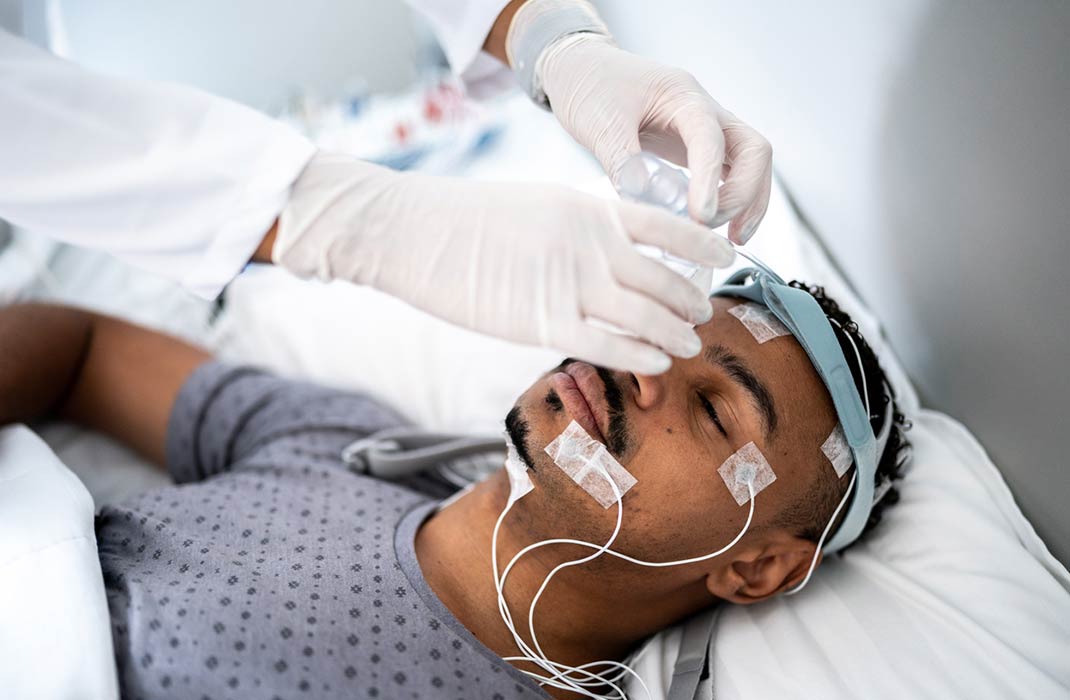
A patient undergoing a laboratory sleep test.
Dr. Pavlova says patients hardly ever seek treatment for sleep talking. She usually treats the condition in the context of another sleep-related disorder. She never prescribes medication to treat sleep talking alone.
That said, maintaining proper sleep hygiene — or the quality of one’s sleep — can help minimize sleep talking. Dr. Pavlova encourages patients to avoid activities that disrupt sleep, especially drinking coffee. Drinking coffee past noon, she says, can make it more difficult for those in bed at 10 or 11 p.m. to fall, and stay, asleep.
To [sleep better](https://www.massgeneralbrigham.org/en/about/newsroom/articles/how-to-sleep-better):
- **Avoid alcohol and caffeine before bed:** Alcohol can suppress REM sleep, limiting the benefit of a full night’s rest. It may also cause early awakening. Late or afternoon caffeine can disrupt sleep directly.
- **Exercise regularly:** The body, she says, must feel ready to rest and recharge to fall asleep.
- **Avoid bright-light devices before bed:** Excessive light exposure from televisions or other electronics before bed can keep the brain from transitioning to sleep. Bright light during the day is good — it helps the body maintain and stabilize natural body clock rhythms.
- **Maintain a consistent sleep schedule**: Falling asleep and waking up at roughly the same time every day maintains the brain’s inner clock, or [circadian rhythms](https://www.massgeneralbrigham.org/en/about/newsroom/articles/adjust-sleep-for-daylight-savings), for sleep.
- **Find comfort in your bedroom environment**: Adequate relaxation and a peaceful nighttime routine are also helpful.
“We want our bodies to feel as ready as possible to go to sleep,” says Dr. Pavlova. “Disruptors do the opposite.”
## Sleep talking research
Dr. Pavlova dedicates much of her research to understanding treatment options for parasomnias. Her work examines medications most frequently prescribed to patients for non-REM parasomnias at Brigham and Women’s Hospital and Brigham and Women’s Faulkner Hospital clinics.
According to her findings, medications such as benzodiazepine and melatonin can significantly improve certain parasomnias, including sleep walking and night terrors.
Beyond her research, Dr. Pavlova teaches a course on sleep disorders, which draws the attention of not only medical professionals, but business managers who want to see their employees thrive.
“Sleep touches everybody,” says Dr. Pavlova. “When you’re not sleeping the way you should, it’s going to affect every facet of your life: how you interact with your family, how you perform at work, and how late or early you return to bed that night.”
[Explore sleep medicine services at Brigham and Women’s Faulkner Hospital (opens external link in new tab)](https://www.brighamandwomensfaulkner.org/programs-and-services/sleep-medicine-and-endocrinology/sleep-medicine)

## Contributor
[Milena Pavlova, MD](https://doctors.massgeneralbrigham.org/provider/Milena+Pavlova/256826)
Neurologist

[Patient Care](https://www.massgeneralbrigham.org/en/patient-care)
[Research & Innovation](https://www.massgeneralbrigham.org/en/research-and-innovation)
[Education & Training](https://www.massgeneralbrigham.org/en/education-and-training)
[About](https://www.massgeneralbrigham.org/en/about)
[Careers](https://www.massgeneralbrigham.org/en/about/careers)
[For Medical Professionals](https://www.massgeneralbrigham.org/en/medical-professionals)
[For Employees](https://www.massgeneralbrigham.org/en/about/for-employees)
[Log in to Patient Gateway](https://patientgateway.massgeneralbrigham.org/)
[Find a Doctor](https://doctors.massgeneralbrigham.org/search?sort=relevance%2Cnetworks%2Cavailability_density_best)
[Find a Location](https://www.massgeneralbrigham.org/en/patient-care/services-and-specialties/find-a-location)
[Contact Us](https://www.massgeneralbrigham.org/en/contact-us)
[Mass General Brigham Health Plan](https://massgeneralbrighamhealthplan.org/)
[Facebook](https://www.facebook.com/MassGeneralBrigham)
[X, formerly known as Twitter](https://twitter.com/MassGenBrigham)
[Instagram](https://www.instagram.com/massgeneralbrigham/)
[YouTube](https://www.youtube.com/massgeneralbrigham)
[LinkedIn](https://www.linkedin.com/company/mass-general-brigham)
© 2026 Mass General Brigham Incorporated. All Rights Reserved.
[Sitemap](https://www.massgeneralbrigham.org/en/sitemap)
[Web Accessibility Statement](https://www.massgeneralbrigham.org/en/notices/web-accessibility)
[Privacy Notices and Terms of Use](https://www.massgeneralbrigham.org/en/notices)
[Price Transparency](https://www.massgeneralbrigham.org/en/patient-care/patient-visitor-information/billing/cms-required-hospital-charge-data)
[Supplier / Vendor Information](https://www.massgeneralbrigham.org/en/supplier-vendor-information)
[Ethics](https://www.massgeneralbrigham.org/en/about/ethics)
***
[Back to top](https://www.massgeneralbrigham.org/en/about/newsroom/articles/why-do-people-sleep-talk#backTop)
| | |
|---|---|
| We use cookies and other tools to enhance your experience on our website and to analyze our web traffic. For more information about these cookies and the data collected, please refer to our [Privacy Policy](https://www.massgeneralbrigham.org/en/notices/web-privacy-policy). | [×](https://www.massgeneralbrigham.org/en/about/newsroom/articles/why-do-people-sleep-talk#cookieNoticeClose) | | |||||||||
| Readable Markdown | Many people talk in their sleep at some point in their life—whether they know it or not. In fact, studies suggest 2 in 3 people experience the behavior.
According to [Milena Pavlova, MD](https://doctors.massgeneralbrigham.org/provider/Milena+Pavlova/256826), a Mass General Brigham neurologist, sleep talking begins inside the brain.
“You’re asleep, but part of your brain hasn’t quite transitioned to sleep mode,” says Dr. Pavlova. “So, you keep doing things in your sleep that normally happen during wakefulness.”
Dr. Pavlova serves as medical director of the [Clinical Sleep Laboratory](https://www.brighamandwomensfaulkner.org/programs-and-services/sleep-testing/default) at Brigham and Women’s Faulkner Hospital. She explains why sleep talking occurs, what sleep talking means, and how to manage the nighttime behavior.
## Why do people talk in their sleep?
Sleep is delicate. When you fall asleep, your brain cycles through 4 different sleep stages. How long the brain stays in one stage, and their order through the night, can determine how refreshed you feel when you wake up and how well you perform during the day.
Disruptions to when, how, or for how long you sleep can alter brain activity at each stage. Abnormal behavior in your sleep, or parasomnias, usually occur from these disruptions.
Pop culture often embellishes these behaviors. A few of the most well-known include:
- **Sleep walking:** Stumbling, or completely walking, in one’s sleep. Typically, someone who sleepwalks does not leave their room. They may just fall out of bed.
- **Sleep paralysis:** Losing muscle control before waking up or just after falling asleep. Some people may hallucinate and feel a sense of panic. People may feel the panic in their chest.
- **Night terrors:** Different from a nightmare, night terrors occur when someone acts panicked or terrified in their sleep. They may abruptly sit, kick, and scream, or briefly flail without any memory of the incident.
While some parasomnias, like sleep walking, may put you in danger, sleep talking presents little risk at all—except for the possible embarrassment of a sleep partner overhearing your banter.
### What causes sleep talking in adults?
The two main triggers of sleep talking in adults are:
1. **Jet lag:** Switching between time zones disrupts how long someone stays awake during a full 24-hour day. Time shifts from [daylight savings](https://www.massgeneralbrigham.org/en/about/newsroom/articles/daylight-savings-impact-teens-sleep-schedule) cause a similar effect.
2. **Sleep deprivation:** A general lack of sleep from work, family, or social obligations creates a biological tension between wanting to stay awake during the day and falling asleep later that night.
Several other factors increase the likelihood of sleep talking. These include:
- **Sleep apnea:** People with [sleep apnea](https://www.massgeneralbrigham.org/en/about/newsroom/articles/sleep-apnea-symptoms) can wake up gasping for air from a lack of oxygen. Typically, a patient comes to the doctor because of sleepiness and fatigue during the day or because a bed partner complains of the patient’s snoring. Notably, a patient with sleep apnea may be unaware of their symptoms.
- [**Family health history**](https://www.massgeneralbrigham.org/en/about/newsroom/articles/family-health-history)**:** Genetics can play a strong role in how people behave in their sleep. They can increase the likelihood of certain parasomnias, including sleep talking.
- **Anxiety and stress:** When carrying too much [stress](https://www.massgeneralbrigham.org/en/about/newsroom/articles/stress-in-teenagers) and [anxiety](https://www.massgeneralbrigham.org/en/about/newsroom/articles/anxiety-disorder-history-treatment), the brain can struggle to transition into its sleep stages. [Meditation](https://www.massgeneralbrigham.org/en/about/newsroom/articles/meditation-for-anxiety-and-stress) can help lighten the load.
### What causes sleep talking in children?
Sleep talking happens more frequently in children than adults. Half of young children experience the behavior compared to 5% of adults.
Dr. Pavlova believes the development of a child’s brain helps explain why. She lists several possible factors:
- **Maturity:** The brain of a child, Dr. Pavlova says, is not mature enough to transition between wakefulness and sleep as smoothly as an adult’s brain. As they grow older, children talk in their sleep less frequently.
- **Longer sleep times:** Children require more sleep than adults.
- **Continuous sleep:** For their own growth and development, children need as few interruptions to their sleep as possible.
## What does it mean when you talk in your sleep?
The short answer: nothing. The myth of people confessing their deepest, darkest secrets in their sleep occurs only in Hollywood films, not in real-life bedrooms, Dr. Pavlova says.
Most times, sleep talking sounds more like babbling than intelligible sentences.
“If you’re looking for an elixir of truth, sleep talking isn’t it,” she adds. “That’s a myth that’s persisted for decades.”
## Can sleep talking be a sign of something worse?
Sleep talking, while largely harmless, sometimes signals a more serious condition in adults.
The stages of sleep are characterized as either rapid eye movement (REM) or non-rapid eye movement (non-REM). During REM sleep, the brain paralyzes the entire body, except for those muscles controlling the eyes and organs essential for breathing. Dreaming occurs during this type of sleep, too.
When someone acts out purposeful movements, such as talking or walking, during REM sleep, the part of their brain responsible for restraining muscle movement has malfunctioned. This condition, called a REM behavior disorder (RBD), allows people to act out dreams. These individuals put themselves, or others, in danger, especially if they act out violent behaviors.
“RBD can start with benign talking but transition into shouting and gradually turn into violent actions,” says Dr. Pavlova. “They might try kicking or punching air. Some may fall right out of bed.”
### How common is RBD?
Only 1% of people develop RBD. However, those who do often develop [Parkinson’s disease](https://www.massgeneralbrigham.org/en/about/newsroom/articles/parkinsons-exercises), leading many to wonder whether a link exists between the two.
RBD is associated with:
- People age 50 and older
- Males
- Narcolepsy, or excessive daytime sleepiness combined with sudden muscle weakness
- Medications, including antidepressants
- [Substance use](https://www.massgeneralbrigham.org/en/about/newsroom/articles/substance-use-disorders), like [alcohol use](https://www.massgeneralbrigham.org/en/about/newsroom/articles/alcohol-use-disorder-treatment-in-women) or [opioid use](https://www.massgeneralbrigham.org/en/about/newsroom/articles/opioid-addiction-fentanyl)
- Nighttime [seizures](https://www.massgeneralbrigham.org/en/about/newsroom/articles/seizure-signs-and-causes)
### Diagnosing RBD
People often talk in their sleep without realizing it. Sometimes, only a sleep partner makes them aware of the behavior.
Those same sleep partners can help recognize the early signs of RBD. People with RBD often wake up remembering elaborate dreams. Their sleep partners may recall whether they spoke out specific parts of that dream in their sleep.
Only a doctor can diagnose RBD using a sleep study. The study determines which stage of sleep their talking occurs. Individuals must undergo testing in a laboratory, as opposed to an at-home sleep test, to measure brain wave activity from electroencephalogram (EEG). | |||||||||
| ML Classification | ||||||||||
| ML Categories |
Raw JSON{
"/Health": 990,
"/Health/Mental_Health": 863,
"/Health/Mental_Health/Anxiety_and_Stress": 603
} | |||||||||
| ML Page Types |
Raw JSON{
"/Article": 988,
"/Article/Tutorial_or_Guide": 369
} | |||||||||
| ML Intent Types |
Raw JSON{
"Informational": 999
} | |||||||||
| Content Metadata | ||||||||||
| Language | en | |||||||||
| Author | null | |||||||||
| Publish Time | 2024-02-08 00:00:00 (2 years ago) | |||||||||
| Original Publish Time | 2024-02-08 00:00:00 (2 years ago) | |||||||||
| Republished | No | |||||||||
| Word Count (Total) | 2,618 | |||||||||
| Word Count (Content) | 1,015 | |||||||||
| Links | ||||||||||
| External Links | 13 | |||||||||
| Internal Links | 145 | |||||||||
| Technical SEO | ||||||||||
| Meta Nofollow | No | |||||||||
| Meta Noarchive | No | |||||||||
| JS Rendered | No | |||||||||
| Redirect Target | null | |||||||||
| Performance | ||||||||||
| Download Time (ms) | 181 | |||||||||
| TTFB (ms) | 179 | |||||||||
| Download Size (bytes) | 30,072 | |||||||||
| Shard | 161 (laksa) | |||||||||
| Root Hash | 9324133305715668761 | |||||||||
| Unparsed URL | org,massgeneralbrigham!www,/en/about/newsroom/articles/why-do-people-sleep-talk s443 | |||||||||