ℹ️ Skipped - page is already crawled
| Filter | Status | Condition | Details |
|---|---|---|---|
| HTTP status | PASS | download_http_code = 200 | HTTP 200 |
| Age cutoff | PASS | download_stamp > now() - 6 MONTH | 0.4 months ago |
| History drop | PASS | isNull(history_drop_reason) | No drop reason |
| Spam/ban | PASS | fh_dont_index != 1 AND ml_spam_score = 0 | ml_spam_score=0 |
| Canonical | PASS | meta_canonical IS NULL OR = '' OR = src_unparsed | Not set |
| Property | Value | ||||||
|---|---|---|---|---|---|---|---|
| URL | https://www.livescience.com/space/extraterrestrial-life/what-could-aliens-look-like | ||||||
| Last Crawled | 2026-04-13 23:07:24 (10 days ago) | ||||||
| First Indexed | 2024-06-08 10:11:46 (1 year ago) | ||||||
| HTTP Status Code | 200 | ||||||
| Content | |||||||
| Meta Title | What could aliens look like? | Live Science | ||||||
| Meta Description | The search for alien life is one of humanity's greatest missions, but it may look nothing like anything we've seen on Earth. | ||||||
| Meta Canonical | null | ||||||
| Boilerpipe Text | Contrary to depictions on the silver screen, aliens probably don't look anything like humans do.
(Image credit: David Wall via Getty Images)
Are we alone in the universe? It's one of life's biggest mysteries and one that is explored by science fiction and scientists alike. But if there is
alien life
on other planets, what might it look like?
While
little green men
or towering predators are the stereotypical depictions of extraterrestrials in film, any aliens that might be out there are unlikely to resemble those characters, experts told Live Science. Instead, the unique environment of the moons or exoplanets that these aliens call home could make their physiology completely different from anything found on Earth.
Some aliens might evolve to only fly through their planet's sky as a result of a dense planetary atmosphere,
Adam Frank
, a professor of astrophysics at the University of Rochester, told Live Science. Or, in cases of planets with high
gravity
, he said that aliens might develop to be sturdier "more like elephants."
Or perhaps life would evolve to live underground,
Valentina Erastova
, a chancellor's fellow of chemistry at the University of Edinburgh, told Live Science. If a planet has high levels of radiation not absorbed by an ozone, that might result in subterranean life that uses soil as protection. In this case, Erastova suggests that simple multicellular life might look similar to fungi. While we usually see the fruiting body of a fungus above ground, most of its life actually happens underground in a vast network of roots called mycorrhiza.
"Even on Earth, there are more life-form varieties inside [the Earth] than walking on top of it," Erastova said.
Related:
Are aliens real?
In cases of extreme ultraviolet (UV) radiation, work published in the journal
Monthly Notices of the Royal Astronomical Society
in 2019 suggests that
aliens might actually glow
red, blue or green as a way to protect themselves. Like some corals, these organisms might have proteins or pigments that can absorb some of the UV light's energy, which would then make them glow in a safer wavelength on the visible spectrum, according to the study.
Get the world’s most fascinating discoveries delivered straight to your inbox.
Another potential adaptation, said Frank, would be aliens with very slow metabolism as a result of the frigid temperature of their home world.
Titan, Saturn's largest moon, is a nice example of a very cold world that scientists speculate could possibly be home to extreme life living in methane seas, Frank said.
Sloths on Earth
are an example of animals with extremely slow metabolisms — their
metabolism is only 40 to 45%
that of other animals their size — which move very slowly as a result.
Would aliens look like humans?
Yet, while these wild looking aliens would be amazing to discover, any extraterrestrial life out there would probably be much simpler than flying, sturdy, fungus-like or glowing organisms.
"It is far more likely that life would be single cellular,"
Sarah Rugheimer
, an associate professor of astronomy and astrophysics at York University in Toronto, told Live Science in an email. "The majority of time on Earth, the only life that existed was microbial. Even today, most of the biosphere is microbial."
Spotting single cell life all the way from Earth might prove to be a difficult task, but one way scientists suggest solving this problem is by looking for evidence of life that microbes might have left behind. In a 2019 study published in the journal
Astrobiology
, scientists reported that calcium carbonate formations left behind in dried up hot-springs might be formed by the
hot, pasta-like
mats of extraterrestrial microbes. Finding such formations on other planets could point toward a promising source of fossilized microbes, scientists suggested.
That said, if alien life has evolved into multicellular life, Rugheimer said it is still "very unlikely" that it would look exactly like humans. Our unique physiology is both a result of evolution in a unique Earth environment, as well as a good dash of luck, Frank said.
However, alien life may still have some animal-like traits as a result of
convergent evolution
, Rugheimer said — for example, eyes to see the environment and limbs or wings to traverse it. But that could be where the similarities end.
Of course, all these ideas are based on the assumption that extraterrestrial life would need similar necessities to Earth-life — like water, sunlight, and oxygen — in order to survive. It's also possible that life on other planets could evolve in a completely different way, or even with a completely different elemental structure.
RELATED MYSTERIES
For example, many aliens from science fiction are composed of silicon instead of Earth life's carbon. In an area of study with so many unknowns, Rugheimer is at least confident that this idea seems unlikely.
"Carbon is more abundant than silicon and forms more complex chemistry," she said. "[But] the one thing I think is true is that we have no idea what they would look like."
Sarah is a D.C.-based independent science journalist interested in the philosophical questions of science and technology and how research intersects with our daily lives. Her work has appeared in Popular Mechanics, IEEE Spectrum, Inverse, and Nature, among other outlets, and covers topics ranging from AI to particle physics and space travel. She has a master's degree in science journalism from Boston University. | ||||||
| Markdown | 
[Skip to main content](https://www.livescience.com/space/extraterrestrial-life/what-could-aliens-look-like#main)
Live Science Plus
\- Join our community
JOIN NOW
10
Member Features
24/7
Access Available
25K+
Active Members

Exclusive Newsletters
Science news direct to your inbox

Member Competitions
Win exclusive prizes

Exclusive Content
Premium articles & videos

Early Access
First to see new features

Private Forums
Connect with members

Monthly Rewards
Surprise gifts & perks
GET LIVE SCIENCE PLUS
It's quick and easy to access Live Science Plus, simply enter your email below. We'll send you a confirmation and sign you up for our daily newsletter, keeping you up to date with the latest science news.
By submitting your information you agree to the [Terms & Conditions](https://futureplc.com/future-member-terms-and-conditions/) and [Privacy Policy](https://futureplc.com/privacy-policy/) and are aged 16 or over.
FIND OUT ABOUT OUR MAGAZINE
Want to subscribe to the magazine? Click the button below to find out more information.
[Find out more](https://www.livescience.com/space/extraterrestrial-life/what-could-aliens-look-like)

Welcome to Live Science Plus \!
Hi ,
Your membership journey starts here.
Keep exploring and earning more as a member.
[MY ACCOUNT](https://www.livescience.com/my-account)
***

Earn your first badge
Complete 1 quiz to unlock your first badge.
Keep earning badges
Explore ways to get more involved as a member.

Live Science Quizzes
Quick, fun science challenges.
[Play Now](https://www.livescience.com/quizzes)

Science Crosswords
Short, brain-teasing puzzles.
[Play Now](https://www.livescience.com/tag/science-crossword)
***
See what you’ve unlocked.
Explore your membership benefits.
[Explore](https://www.livescience.com/membership)
Member Exclusives
Science Newsletters
Select the newsletters you'd like to receive and enter your email below.
[View all](https://www.livescience.com/newsletter)
***
[Sign Out]()
Open menu
Close main menu
[ Live Science](https://www.livescience.com/)
[Sign up to our newsletter Newsletter](https://www.livescience.com/newsletter)
[RSS](https://www.livescience.com/feeds.xml)
Sign in
- View Profile
- Sign out
Search
- [Space](https://www.livescience.com/space)
- [Health](https://www.livescience.com/health)
- [Planet Earth](https://www.livescience.com/planet-earth)
- [Animals](https://www.livescience.com/animals)
- [Archaeology](https://www.livescience.com/archaeology)
- [Physics & Math](https://www.livescience.com/physics-mathematics)
- [Technology](https://www.livescience.com/technology)
- More
- [Human Behavior](https://www.livescience.com/human-behavior)
- [Chemistry](https://www.livescience.com/chemistry)
- [Science news](https://www.livescience.com/news)
- [Opinion](https://www.livescience.com/opinion)
- [Life's Little Mysteries](https://www.livescience.com/tag/lifes-little-mysteries)
- [Science quizzes](https://www.livescience.com/quizzes)
- [Crossword](https://www.livescience.com/human-behavior/arts-entertainment/live-science-crossword-puzzle)
- [About us](https://www.livescience.com/about-live-science)
- [Newsletters](https://www.livescience.com/newsletter)
- [Follow us](https://www.livescience.com/technology/internet/follow-live-science-on-social-media)
- [Story archive](https://www.livescience.com/archive)
Don't miss these
[ The Moon The moon is green and brown? Why scientists are already excited about Artemis II's historic lunar photos](https://www.livescience.com/space/the-moon/the-moon-is-green-and-brown-why-scientists-are-already-excited-about-artemis-iis-historic-lunar-photos "The moon is green and brown? Why scientists are already excited about Artemis II's historic lunar photos")
[ The Moon 'This generation's moment': How the Artemis missions will reframe humanity's relationship with the moon](https://www.livescience.com/space/the-moon/this-generations-moment-how-the-artemis-missions-will-reframe-humanitys-relationship-with-the-moon "'This generation's moment': How the Artemis missions will reframe humanity's relationship with the moon")
[ Archaeology Did modern humans wipe out the Neanderthals? New evidence may finally provide answers.](https://www.livescience.com/archaeology/did-modern-humans-wipe-out-the-neanderthals-new-evidence-may-finally-provide-answers "Did modern humans wipe out the Neanderthals? New evidence may finally provide answers.")
[ Animals 60 mind-blowing science facts about our incredible world](https://www.livescience.com/science-facts "60 mind-blowing science facts about our incredible world")
[ Human Evolution 'That's why there's 9 billion of us and not 9 billion of some other primate': Why our ability to adapt is humanity's 'superpower'](https://www.livescience.com/archaeology/human-evolution/thats-why-theres-9-billion-of-us-and-not-9-billion-of-some-other-primate-why-our-ability-to-adapt-is-humanitys-superpower "'That's why there's 9 billion of us and not 9 billion of some other primate': Why our ability to adapt is humanity's 'superpower'")
[ Animals 'It's nature calling to humans, and humans deciding whether or not to reply': Why we need to start paying attention to our mutually beneficial relationships with other species](https://www.livescience.com/animals/its-nature-calling-to-humans-and-humans-deciding-whether-or-not-to-reply-why-we-need-to-start-paying-attention-to-our-mutually-beneficial-relationships-with-other-species "'It's nature calling to humans, and humans deciding whether or not to reply': Why we need to start paying attention to our mutually beneficial relationships with other species")
[ Planet Earth DNA shed by every living thing is lurking in the environment — and it could tell us how Earth is changing in real time](https://www.livescience.com/planet-earth/dna-shed-by-every-living-thing-is-lurking-in-the-environment-and-it-could-tell-us-how-earth-is-changing-in-real-time "DNA shed by every living thing is lurking in the environment — and it could tell us how Earth is changing in real time")
[ Animals Cannibal orcas identified near Russia, two 'extinct' marsupials found, humans do cranial modification, China's oracle bones reveal climate disaster, and a barefoot volcanologist](https://www.livescience.com/animals/science-news-this-week-cannibal-orcas-in-russia-oracle-bones-that-reveal-climate-disaster-in-ancient-china-humming-black-holes-and-a-barefoot-volcanologist "Cannibal orcas identified near Russia, two 'extinct' marsupials found, humans do cranial modification, China's oracle bones reveal climate disaster, and a barefoot volcanologist")
[ Animals 'They are life, but not as we now know it': 26-foot organism that lived 420 million years ago is completely unknown branch of animal kingdom](https://www.livescience.com/animals/giant-fungus-like-organism-may-be-a-completely-unknown-branch-of-life "'They are life, but not as we now know it': 26-foot organism that lived 420 million years ago is completely unknown branch of animal kingdom")
[ Planet Earth What would happen to Earth if the sun suddenly vanished?](https://www.livescience.com/planet-earth/what-would-happen-to-earth-if-the-sun-suddenly-vanished "What would happen to Earth if the sun suddenly vanished?")
[ Cosmology James Webb telescope saw black holes emerging from 'cocoons' near the dawn of time](https://www.livescience.com/space/cosmology/james-webb-telescope-saw-black-holes-emerging-from-cocoons-near-the-dawn-of-time-new-study-hints "James Webb telescope saw black holes emerging from 'cocoons' near the dawn of time")
[ Astronomy Mysterious 'dots' discovered by Webb telescope may be the first stars in the universe on the verge of collapse](https://www.livescience.com/space/astronomy/mysterious-little-red-dots-discovered-by-james-webb-telescope-may-be-the-first-stars-in-the-universe-on-the-verge-of-collapse "Mysterious 'dots' discovered by Webb telescope may be the first stars in the universe on the verge of collapse")
[ Space Astronauts may struggle to reproduce in outer space, study suggests — what does that mean for the future of space colonization?](https://www.livescience.com/space/astronauts-may-struggle-to-reproduce-in-outer-space-study-suggests-what-does-that-mean-for-the-future-of-space-colonization "Astronauts may struggle to reproduce in outer space, study suggests — what does that mean for the future of space colonization?")
[ Mars Giant 'spiderwebs' on Mars contain tiny egg-like structures that scientists 'can't quite explain,' NASA rover reveals](https://www.livescience.com/space/mars/giant-spiderwebs-on-mars-contain-tiny-egg-like-structures-that-scientists-cant-quite-explain-nasa-rover-reveals "Giant 'spiderwebs' on Mars contain tiny egg-like structures that scientists 'can't quite explain,' NASA rover reveals")
[ Animals Why aren't mammals as colorful as reptiles, birds or fish?](https://www.livescience.com/animals/why-arent-mammals-as-colorful-as-reptiles-birds-or-fish "Why aren't mammals as colorful as reptiles, birds or fish? ")
Trending
- [Artemis II](https://www.livescience.com/tag/artemis-2)
- [Coin belongs to doomed settlement](https://www.livescience.com/archaeology/americas/16th-century-silver-coin-discovered-near-strait-of-magellan-marks-the-spot-of-a-doomed-spanish-colony)
- [Scientists map all clitoris nerves first time](https://www.livescience.com/health/anatomy/scientists-mapped-all-the-nerves-of-the-clitoris-for-the-first-time)
- [How humans adapted to survive everywhere](https://www.livescience.com/archaeology/human-evolution/they-could-spend-4-or-5-hours-per-day-underwater-how-humans-adapted-to-the-most-challenging-environments)
- [Woman sneezes worms](https://www.livescience.com/health/viruses-infections-disease/diagnostic-dilemma-womans-biologically-implausible-infection-led-her-to-sneeze-worms-out-of-her-nose)
1. [Space](https://www.livescience.com/space)
2. [Extraterrestrial Life](https://www.livescience.com/space/extraterrestrial-life)
[](https://www.livescience.com/tag/lifes-little-mysteries)
# What could aliens look like?
[News](https://www.livescience.com/news)
By [Sarah Wells](https://www.livescience.com/author/sarah-wells)
published
June 8, 2024
The search for alien life is one of humanity's greatest missions, but it may look nothing like anything we've seen on Earth.
When you purchase through links on our site, we may earn an affiliate commission. [Here’s how it works](https://www.livescience.com/about-live-science#section-affiliate-advertising-disclosure).
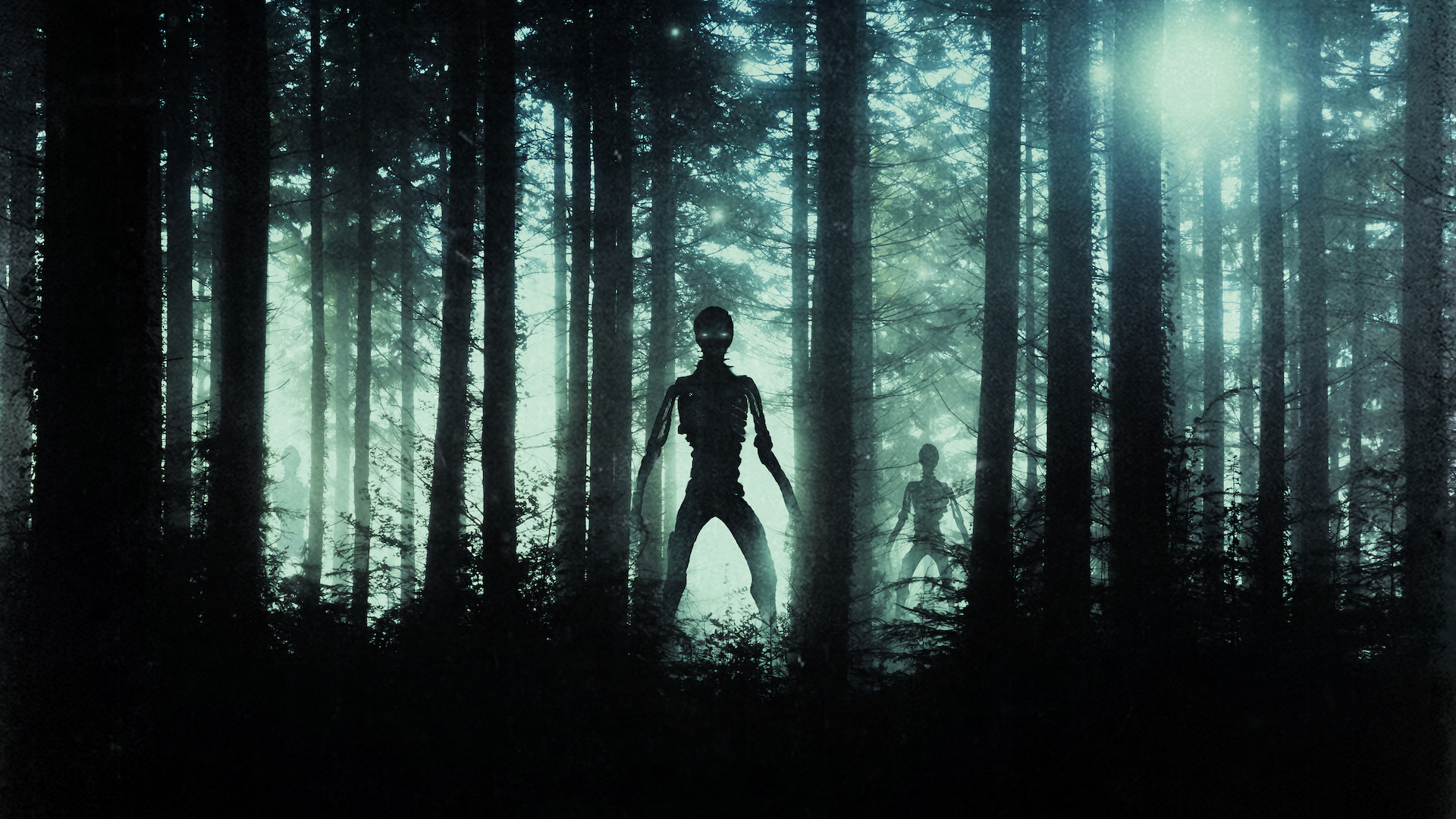
Contrary to depictions on the silver screen, aliens probably don't look anything like humans do. (Image credit: David Wall via Getty Images)
Share
- Copy link
- [Facebook](https://www.facebook.com/sharer/sharer.php?u=https%3A%2F%2Fwww.livescience.com%2Fspace%2Fextraterrestrial-life%2Fwhat-could-aliens-look-like)
- [X](https://twitter.com/intent/tweet?text=What+could+aliens+look+like%3F&url=https%3A%2F%2Fwww.livescience.com%2Fspace%2Fextraterrestrial-life%2Fwhat-could-aliens-look-like)
- [Whatsapp](whatsapp://send?text=What+could+aliens+look+like%3F+https%3A%2F%2Fwww.livescience.com%2Fspace%2Fextraterrestrial-life%2Fwhat-could-aliens-look-like?fwa)
- [Reddit](https://www.reddit.com/submit?url=https%3A%2F%2Fwww.livescience.com%2Fspace%2Fextraterrestrial-life%2Fwhat-could-aliens-look-like&title=What+could+aliens+look+like%3F)
- [Pinterest](https://pinterest.com/pin/create/button/?url=https%3A%2F%2Fwww.livescience.com%2Fspace%2Fextraterrestrial-life%2Fwhat-could-aliens-look-like&media=https%3A%2F%2Fcdn.mos.cms.futurecdn.net%2FiAyRYAfv9RPmAkpdrGHTdF.jpg)
- [Flipboard](https://share.flipboard.com/bookmarklet/popout?title=What+could+aliens+look+like%3F&url=https%3A%2F%2Fwww.livescience.com%2Fspace%2Fextraterrestrial-life%2Fwhat-could-aliens-look-like)
- [Email](mailto:?subject=I%20found%20this%20webpage&body=Hi,%20I%20found%20this%20webpage%20and%20thought%20you%20might%20like%20it%20https://www.livescience.com/space/extraterrestrial-life/what-could-aliens-look-like)
Share this article
Join the conversation
[Follow us](https://google.com/preferences/source?q=livescience.com)
Add us as a preferred source on Google
Newsletter
Sign up for the Live Science daily newsletter now
Get the world’s most fascinating discoveries delivered straight to your inbox.
***
By signing up, you agree to our [Terms of services](https:\/\/futureplc.com\/terms-conditions\/) and acknowledge that you have read our [Privacy Notice](https:\/\/futureplc.com\/privacy-policy\/). You also agree to receive marketing emails from us that may include promotions from our trusted partners and sponsors, which you can unsubscribe from at any time.
You are now subscribed
Your newsletter sign-up was successful
***
Want to add more newsletters?

Delivered Daily
Daily Newsletter
Sign up for the latest discoveries, groundbreaking research and fascinating breakthroughs that impact you and the wider world direct to your inbox.
Subscribe +

Once a week
Life's Little Mysteries
Feed your curiosity with an exclusive mystery every week, solved with science and delivered direct to your inbox before it's seen anywhere else.
Subscribe +

Once a week
How It Works
Sign up to our free science & technology newsletter for your weekly fix of fascinating articles, quick quizzes, amazing images, and more
Subscribe +

Delivered daily
Space.com Newsletter
Breaking space news, the latest updates on rocket launches, skywatching events and more\!
Subscribe +
Once a month
Watch This Space
Sign up to our monthly entertainment newsletter to keep up with all our coverage of the latest sci-fi and space movies, tv shows, games and books.
Subscribe +
Once a week
Night Sky This Week
Discover this week's must-see night sky events, moon phases, and stunning astrophotos. Sign up for our skywatching newsletter and explore the universe with us\!
Subscribe +
***
Join the club
Get full access to premium articles, exclusive features and a growing list of member rewards.
[Explore](https://www.livescience.com/membership)
***
An account already exists for this email address, please log in.
Subscribe to our newsletter
Are we alone in the universe? It's one of life's biggest mysteries and one that is explored by science fiction and scientists alike. But if there is [alien life](https://www.livescience.com/space/extraterrestrial-life) on other planets, what might it look like?
While [little green men](https://www.livescience.com/55370-why-are-aliens-little-green-men.html) or towering predators are the stereotypical depictions of extraterrestrials in film, any aliens that might be out there are unlikely to resemble those characters, experts told Live Science. Instead, the unique environment of the moons or exoplanets that these aliens call home could make their physiology completely different from anything found on Earth.
Some aliens might evolve to only fly through their planet's sky as a result of a dense planetary atmosphere, [Adam Frank](https://www.rochester.edu/news/adam-frank/), a professor of astrophysics at the University of Rochester, told Live Science. Or, in cases of planets with high [gravity](https://www.livescience.com/37115-what-is-gravity.html), he said that aliens might develop to be sturdier "more like elephants."
You may like
- [ 'Maybe they're waiting for something that only happens thousands of years later': The hidden life 'sleeping' deep beneath Earth for millions of years](https://www.livescience.com/planet-earth/evolution/maybe-theyre-waiting-for-something-that-only-happens-thousands-of-years-later-the-hidden-life-sleeping-deep-beneath-earth-for-millions-of-years)
- [ Life-friendly molecules are leaking out of Jupiter's giant moon Europa](https://www.livescience.com/space/planets/life-friendly-molecules-are-leaking-out-of-jupiters-giant-moon-europa-galileo-images-hint)
- [ Giant string of organic molecules on Mars may be one of the best signs of life yet](https://www.livescience.com/space/mars/giant-string-of-organic-molecules-on-mars-may-be-one-of-the-best-signs-of-life-yet)
Or perhaps life would evolve to live underground, [Valentina Erastova](https://www.erastova.xyz/group/valentina/), a chancellor's fellow of chemistry at the University of Edinburgh, told Live Science. If a planet has high levels of radiation not absorbed by an ozone, that might result in subterranean life that uses soil as protection. In this case, Erastova suggests that simple multicellular life might look similar to fungi. While we usually see the fruiting body of a fungus above ground, most of its life actually happens underground in a vast network of roots called mycorrhiza.
"Even on Earth, there are more life-form varieties inside \[the Earth\] than walking on top of it," Erastova said.
**Related:** [**Are aliens real?**](https://www.livescience.com/are-aliens-real)
In cases of extreme ultraviolet (UV) radiation, work published in the journal [Monthly Notices of the Royal Astronomical Society](https://academic.oup.com/mnras/article/488/4/4530/5545464?login=false) in 2019 suggests that [aliens might actually glow](https://www.livescience.com/biofluorescent-worlds-extraterrestrial-life.html) red, blue or green as a way to protect themselves. Like some corals, these organisms might have proteins or pigments that can absorb some of the UV light's energy, which would then make them glow in a safer wavelength on the visible spectrum, according to the study.
Sign up for the Live Science daily newsletter now
Get the world’s most fascinating discoveries delivered straight to your inbox.
By signing up, you agree to our [Terms of services](https:\/\/futureplc.com\/terms-conditions\/) and acknowledge that you have read our [Privacy Notice](https:\/\/futureplc.com\/privacy-policy\/). You also agree to receive marketing emails from us that may include promotions from our trusted partners and sponsors, which you can unsubscribe from at any time.
Another potential adaptation, said Frank, would be aliens with very slow metabolism as a result of the frigid temperature of their home world.
Titan, Saturn's largest moon, is a nice example of a very cold world that scientists speculate could possibly be home to extreme life living in methane seas, Frank said. [Sloths on Earth](https://www.livescience.com/27612-sloths.html) are an example of animals with extremely slow metabolisms — their [metabolism is only 40 to 45%](https://nationalzoo.si.edu/animals/news/why-are-sloths-so-slow-and-other-sloth-facts#:~:text=Their%20metabolic%20rate%20is%20only,from%20their%20small%20home%20ranges) that of other animals their size — which move very slowly as a result.
## Would aliens look like humans?
Yet, while these wild looking aliens would be amazing to discover, any extraterrestrial life out there would probably be much simpler than flying, sturdy, fungus-like or glowing organisms.
What to read next
- [ Some objects we thought were planets may actually be tiny black holes from the dawn of time](https://www.livescience.com/space/black-holes/some-objects-we-thought-were-planets-may-actually-be-tiny-black-holes-from-the-dawn-of-time)
- [ Scientists squished microbes into a steel 'sandwich' — and made a profound discovery about life in space](https://www.livescience.com/space/extraterrestrial-life/scientists-squished-microbes-into-a-steel-sandwich-and-made-a-profound-discovery-about-life-in-space)
- [ Giant 'metal cloud' in nearby star system could be hiding an undiscovered sun](https://www.livescience.com/space/astronomy/giant-metal-cloud-spotted-in-nearby-star-system-could-be-hiding-a-second-alien-sun)
"It is far more likely that life would be single cellular," [Sarah Rugheimer](https://www.yorku.ca/science/profiles/faculty/sarah-rugheimer/), an associate professor of astronomy and astrophysics at York University in Toronto, told Live Science in an email. "The majority of time on Earth, the only life that existed was microbial. Even today, most of the biosphere is microbial."
Spotting single cell life all the way from Earth might prove to be a difficult task, but one way scientists suggest solving this problem is by looking for evidence of life that microbes might have left behind. In a 2019 study published in the journal [Astrobiology](https://www.liebertpub.com/doi/10.1089/ast.2018.1965), scientists reported that calcium carbonate formations left behind in dried up hot-springs might be formed by the [hot, pasta-like](https://www.livescience.com/65607-does-extraterrestrial-life-resemble-pasta.html) mats of extraterrestrial microbes. Finding such formations on other planets could point toward a promising source of fossilized microbes, scientists suggested.
That said, if alien life has evolved into multicellular life, Rugheimer said it is still "very unlikely" that it would look exactly like humans. Our unique physiology is both a result of evolution in a unique Earth environment, as well as a good dash of luck, Frank said.
However, alien life may still have some animal-like traits as a result of [convergent evolution](https://www.livescience.com/convergent-evolution.html), Rugheimer said — for example, eyes to see the environment and limbs or wings to traverse it. But that could be where the similarities end.
Of course, all these ideas are based on the assumption that extraterrestrial life would need similar necessities to Earth-life — like water, sunlight, and oxygen — in order to survive. It's also possible that life on other planets could evolve in a completely different way, or even with a completely different elemental structure.
RELATED MYSTERIES
—[What's the best evidence we've found for alien life?](https://www.livescience.com/space/extraterrestrial-life/whats-the-best-evidence-weve-found-for-alien-life)
—[What messages have we sent to aliens?](https://www.livescience.com/messages-sent-to-aliens.html)
—[How would we give aliens directions to Earth?](https://www.livescience.com/earth-directions-for-aliens)
For example, many aliens from science fiction are composed of silicon instead of Earth life's carbon. In an area of study with so many unknowns, Rugheimer is at least confident that this idea seems unlikely.
"Carbon is more abundant than silicon and forms more complex chemistry," she said. "\[But\] the one thing I think is true is that we have no idea what they would look like."
TOPICS
[Life's Little Mysteries](https://www.livescience.com/tag/lifes-little-mysteries)

[Sarah Wells](https://www.livescience.com/author/sarah-wells)
Live Science Contributor
Sarah is a D.C.-based independent science journalist interested in the philosophical questions of science and technology and how research intersects with our daily lives. Her work has appeared in Popular Mechanics, IEEE Spectrum, Inverse, and Nature, among other outlets, and covers topics ranging from AI to particle physics and space travel. She has a master's degree in science journalism from Boston University.
Read more
[ Evolution 'Maybe they're waiting for something that only happens thousands of years later': The hidden life 'sleeping' deep beneath Earth for millions of years](https://www.livescience.com/planet-earth/evolution/maybe-theyre-waiting-for-something-that-only-happens-thousands-of-years-later-the-hidden-life-sleeping-deep-beneath-earth-for-millions-of-years "'Maybe they're waiting for something that only happens thousands of years later': The hidden life 'sleeping' deep beneath Earth for millions of years ")
[ Planets Life-friendly molecules are leaking out of Jupiter's giant moon Europa](https://www.livescience.com/space/planets/life-friendly-molecules-are-leaking-out-of-jupiters-giant-moon-europa-galileo-images-hint "Life-friendly molecules are leaking out of Jupiter's giant moon Europa")
[ Mars Giant string of organic molecules on Mars may be one of the best signs of life yet](https://www.livescience.com/space/mars/giant-string-of-organic-molecules-on-mars-may-be-one-of-the-best-signs-of-life-yet "Giant string of organic molecules on Mars may be one of the best signs of life yet")
[ Black Holes Some objects we thought were planets may actually be tiny black holes from the dawn of time](https://www.livescience.com/space/black-holes/some-objects-we-thought-were-planets-may-actually-be-tiny-black-holes-from-the-dawn-of-time "Some objects we thought were planets may actually be tiny black holes from the dawn of time")
[ Extraterrestrial Life Scientists squished microbes into a steel 'sandwich' — and made a profound discovery about life in space](https://www.livescience.com/space/extraterrestrial-life/scientists-squished-microbes-into-a-steel-sandwich-and-made-a-profound-discovery-about-life-in-space "Scientists squished microbes into a steel 'sandwich' — and made a profound discovery about life in space")
[ Astronomy Giant 'metal cloud' in nearby star system could be hiding an undiscovered sun](https://www.livescience.com/space/astronomy/giant-metal-cloud-spotted-in-nearby-star-system-could-be-hiding-a-second-alien-sun "Giant 'metal cloud' in nearby star system could be hiding an undiscovered sun")
Latest in Extraterrestrial Life
[ Extraterrestrial Life The government is very serious about UFOs. So why are researchers being stymied?](https://www.livescience.com/space/extraterrestrial-life/the-government-is-very-serious-about-ufos-so-why-are-researchers-being-stymied "The government is very serious about UFOs. So why are researchers being stymied?")
[ Extraterrestrial Life Scientists squished microbes into a steel 'sandwich' — and made a profound discovery about life in space](https://www.livescience.com/space/extraterrestrial-life/scientists-squished-microbes-into-a-steel-sandwich-and-made-a-profound-discovery-about-life-in-space "Scientists squished microbes into a steel 'sandwich' — and made a profound discovery about life in space")
[ Extraterrestrial Life SETI scientists reveal 100 'signals of interest' from collapsed Arecibo Observatory](https://www.livescience.com/space/extraterrestrial-life/scientists-study-100-possible-alien-radio-signals-from-collapsed-arecibo-observatory-ending-groundbreaking-21-year-search "SETI scientists reveal 100 'signals of interest' from collapsed Arecibo Observatory")
[ Extraterrestrial Life Advanced alien civilizations could be communicating 'like fireflies' in plain sight, researchers suggest](https://www.livescience.com/space/extraterrestrial-life/advanced-alien-civilizations-could-be-communicating-like-fireflies-in-plain-sight-researchers-suggest "Advanced alien civilizations could be communicating 'like fireflies' in plain sight, researchers suggest")
[ Extraterrestrial Life Scientists are debating a 70-year-old UFO mystery as new images come to light](https://www.livescience.com/space/extraterrestrial-life/no-easy-explanation-scientists-are-debating-a-70-year-old-ufo-mystery-as-new-images-come-to-light "Scientists are debating a 70-year-old UFO mystery as new images come to light")
[ Extraterrestrial Life Is it aliens? Here's why that's the least important question about 3I/ATLAS.](https://www.livescience.com/space/extraterrestrial-life/is-it-aliens-heres-why-thats-the-least-important-question-about-3i-atlas "Is it aliens? Here's why that's the least important question about 3I/ATLAS.")
Latest in News
[ Space Exploration 'I'm at a loss for words': Artemis II mission comes home to joy and cheers after historic 10-day mission](https://www.livescience.com/space/space-exploration/im-at-a-loss-for-words-artemis-ii-mission-comes-home-to-joy-and-cheers-after-historic-10-day-mission "'I'm at a loss for words': Artemis II mission comes home to joy and cheers after historic 10-day mission")
[ Ancient Egyptians Ancient Egyptian stone monument depicting a Roman emperor as a pharaoh discovered in Luxor](https://www.livescience.com/archaeology/ancient-egyptians/ancient-egyptian-stone-monument-depicting-a-roman-emperor-as-a-pharaoh-discovered-in-luxor "Ancient Egyptian stone monument depicting a Roman emperor as a pharaoh discovered in Luxor")
[ The Moon The moon is green and brown? Why scientists are already excited about Artemis II's historic lunar photos](https://www.livescience.com/space/the-moon/the-moon-is-green-and-brown-why-scientists-are-already-excited-about-artemis-iis-historic-lunar-photos "The moon is green and brown? Why scientists are already excited about Artemis II's historic lunar photos")
[ Space Exploration There are 'reasons to be confident' about faulty Artemis II heat shield ahead of 25,000 mph reentry, space expert Ed Macaulay says](https://www.livescience.com/space/space-exploration/there-are-reasons-to-be-confident-about-faulty-artemis-ii-heat-shield-ahead-of-25-000-mph-reentry-space-expert-ed-macauley-says "There are 'reasons to be confident' about faulty Artemis II heat shield ahead of 25,000 mph reentry, space expert Ed Macaulay says")
[ Orcas 'More questions than answers': Experts baffled by Alaskan mammal-eating orcas spotted near Seattle](https://www.livescience.com/animals/orcas/more-questions-than-answers-experts-baffled-by-alaskan-mammal-eating-orcas-spotted-near-seattle "'More questions than answers': Experts baffled by Alaskan mammal-eating orcas spotted near Seattle")
[ Genetics Changing 'just one DNA letter' in female mice triggers growth of male genitalia](https://www.livescience.com/health/genetics/changing-just-one-dna-letter-in-female-mice-triggers-growth-of-male-genitalia "Changing 'just one DNA letter' in female mice triggers growth of male genitalia")
LATEST ARTICLES
1. [](https://www.livescience.com/archaeology/human-evolution/human-ancestors-butchered-and-ate-elephants-18-million-years-ago-helping-to-fuel-their-large-brains "Human ancestors butchered and ate elephants 1.8 million years ago, helping to fuel their large brains")
1
[Human ancestors butchered and ate elephants 1.8 million years ago, helping to fuel their large brains](https://www.livescience.com/archaeology/human-evolution/human-ancestors-butchered-and-ate-elephants-18-million-years-ago-helping-to-fuel-their-large-brains)
2. 2
[Ancient Egyptian stone monument depicting a Roman emperor as a pharaoh discovered in Luxor](https://www.livescience.com/archaeology/ancient-egyptians/ancient-egyptian-stone-monument-depicting-a-roman-emperor-as-a-pharaoh-discovered-in-luxor)
3. 3
['Human minds shouldn't have to go through' this: Artemis II crew recalls unreal moment when Earth disappeared — Space photo of the week](https://www.livescience.com/space/human-minds-shouldnt-have-to-go-through-this-artemis-ii-crew-recalls-unreal-moment-when-earth-disappeared-space-photo-of-the-week)
4. 4
[Does the moon look the same from everywhere on Earth?](https://www.livescience.com/space/the-moon/does-the-moon-look-the-same-from-everywhere-on-earth)
5. 5
[I found a new meteor shower — and it comes from an asteroid getting baked to bits by the sun](https://www.livescience.com/space/meteoroids/i-found-a-new-meteor-shower-and-it-comes-from-an-asteroid-getting-baked-to-bits-by-the-sun)
Live Science is part of Future US Inc, an international media group and leading digital publisher. [Visit our corporate site](https://futureplc.com/).
[ Add as a preferred source on Google](https://google.com/preferences/source?q=livescience.com)
- [About Us](https://www.livescience.com/about-live-science)
- [Contact Future's experts](https://futureplc.com/contact/)
- [Terms and conditions](https://futureplc.com/terms-conditions/)
- [Privacy policy](https://futureplc.com/privacy-policy/)
- [Cookies policy](https://futureplc.com/cookies-policy/)
- [Accessibility Statement](https://futureplc.com/accessibility-statement/)
- [Advertise with us](https://go.future-advertising.com/Live-Science-Media-Kit.html)
- [Web notifications](https://www.livescience.com/how-to-turn-off-web-notifications-for-chrome-macos.html)
- [Careers](https://futureplc.com/careers/)
- [Editorial standards](https://www.livescience.com/editorial-standards)
- [How to pitch a story to us](https://www.livescience.com/how-to-pitch-live-science)
- [Do not sell or share my personal information](https://www.livescience.com/privacy-portal)
© Future US, Inc. Full 7th Floor, 130 West 42nd Street, New York, NY 10036.
Close
Please login or signup to comment
Please wait...
Login
Sign Up | ||||||
| Readable Markdown | 
Contrary to depictions on the silver screen, aliens probably don't look anything like humans do. (Image credit: David Wall via Getty Images)
Are we alone in the universe? It's one of life's biggest mysteries and one that is explored by science fiction and scientists alike. But if there is [alien life](https://www.livescience.com/space/extraterrestrial-life) on other planets, what might it look like?
While [little green men](https://www.livescience.com/55370-why-are-aliens-little-green-men.html) or towering predators are the stereotypical depictions of extraterrestrials in film, any aliens that might be out there are unlikely to resemble those characters, experts told Live Science. Instead, the unique environment of the moons or exoplanets that these aliens call home could make their physiology completely different from anything found on Earth.
Some aliens might evolve to only fly through their planet's sky as a result of a dense planetary atmosphere, [Adam Frank](https://www.rochester.edu/news/adam-frank/), a professor of astrophysics at the University of Rochester, told Live Science. Or, in cases of planets with high [gravity](https://www.livescience.com/37115-what-is-gravity.html), he said that aliens might develop to be sturdier "more like elephants."
Or perhaps life would evolve to live underground, [Valentina Erastova](https://www.erastova.xyz/group/valentina/), a chancellor's fellow of chemistry at the University of Edinburgh, told Live Science. If a planet has high levels of radiation not absorbed by an ozone, that might result in subterranean life that uses soil as protection. In this case, Erastova suggests that simple multicellular life might look similar to fungi. While we usually see the fruiting body of a fungus above ground, most of its life actually happens underground in a vast network of roots called mycorrhiza.
"Even on Earth, there are more life-form varieties inside \[the Earth\] than walking on top of it," Erastova said.
**Related:** [**Are aliens real?**](https://www.livescience.com/are-aliens-real)
In cases of extreme ultraviolet (UV) radiation, work published in the journal [Monthly Notices of the Royal Astronomical Society](https://academic.oup.com/mnras/article/488/4/4530/5545464?login=false) in 2019 suggests that [aliens might actually glow](https://www.livescience.com/biofluorescent-worlds-extraterrestrial-life.html) red, blue or green as a way to protect themselves. Like some corals, these organisms might have proteins or pigments that can absorb some of the UV light's energy, which would then make them glow in a safer wavelength on the visible spectrum, according to the study.
Get the world’s most fascinating discoveries delivered straight to your inbox.
Another potential adaptation, said Frank, would be aliens with very slow metabolism as a result of the frigid temperature of their home world.
Titan, Saturn's largest moon, is a nice example of a very cold world that scientists speculate could possibly be home to extreme life living in methane seas, Frank said. [Sloths on Earth](https://www.livescience.com/27612-sloths.html) are an example of animals with extremely slow metabolisms — their [metabolism is only 40 to 45%](https://nationalzoo.si.edu/animals/news/why-are-sloths-so-slow-and-other-sloth-facts#:~:text=Their%20metabolic%20rate%20is%20only,from%20their%20small%20home%20ranges) that of other animals their size — which move very slowly as a result.
## Would aliens look like humans?
Yet, while these wild looking aliens would be amazing to discover, any extraterrestrial life out there would probably be much simpler than flying, sturdy, fungus-like or glowing organisms.
"It is far more likely that life would be single cellular," [Sarah Rugheimer](https://www.yorku.ca/science/profiles/faculty/sarah-rugheimer/), an associate professor of astronomy and astrophysics at York University in Toronto, told Live Science in an email. "The majority of time on Earth, the only life that existed was microbial. Even today, most of the biosphere is microbial."
Spotting single cell life all the way from Earth might prove to be a difficult task, but one way scientists suggest solving this problem is by looking for evidence of life that microbes might have left behind. In a 2019 study published in the journal [Astrobiology](https://www.liebertpub.com/doi/10.1089/ast.2018.1965), scientists reported that calcium carbonate formations left behind in dried up hot-springs might be formed by the [hot, pasta-like](https://www.livescience.com/65607-does-extraterrestrial-life-resemble-pasta.html) mats of extraterrestrial microbes. Finding such formations on other planets could point toward a promising source of fossilized microbes, scientists suggested.
That said, if alien life has evolved into multicellular life, Rugheimer said it is still "very unlikely" that it would look exactly like humans. Our unique physiology is both a result of evolution in a unique Earth environment, as well as a good dash of luck, Frank said.
However, alien life may still have some animal-like traits as a result of [convergent evolution](https://www.livescience.com/convergent-evolution.html), Rugheimer said — for example, eyes to see the environment and limbs or wings to traverse it. But that could be where the similarities end.
Of course, all these ideas are based on the assumption that extraterrestrial life would need similar necessities to Earth-life — like water, sunlight, and oxygen — in order to survive. It's also possible that life on other planets could evolve in a completely different way, or even with a completely different elemental structure.
RELATED MYSTERIES
For example, many aliens from science fiction are composed of silicon instead of Earth life's carbon. In an area of study with so many unknowns, Rugheimer is at least confident that this idea seems unlikely.
"Carbon is more abundant than silicon and forms more complex chemistry," she said. "\[But\] the one thing I think is true is that we have no idea what they would look like."
Sarah is a D.C.-based independent science journalist interested in the philosophical questions of science and technology and how research intersects with our daily lives. Her work has appeared in Popular Mechanics, IEEE Spectrum, Inverse, and Nature, among other outlets, and covers topics ranging from AI to particle physics and space travel. She has a master's degree in science journalism from Boston University. | ||||||
| ML Classification | |||||||
| ML Categories |
Raw JSON{
"/Science": 993,
"/Science/Astronomy": 736
} | ||||||
| ML Page Types |
Raw JSON{
"/Article": 992,
"/Article/Study_or_Research_Findings": 394
} | ||||||
| ML Intent Types |
Raw JSON{
"Informational": 999
} | ||||||
| Content Metadata | |||||||
| Language | en | ||||||
| Author | Sarah Wells | ||||||
| Publish Time | 2024-06-08 09:00:00 (1 year ago) | ||||||
| Original Publish Time | 2024-06-08 09:00:00 (1 year ago) | ||||||
| Republished | No | ||||||
| Word Count (Total) | 2,668 | ||||||
| Word Count (Content) | 900 | ||||||
| Links | |||||||
| External Links | 26 | ||||||
| Internal Links | 82 | ||||||
| Technical SEO | |||||||
| Meta Nofollow | No | ||||||
| Meta Noarchive | No | ||||||
| JS Rendered | Yes | ||||||
| Redirect Target | null | ||||||
| Performance | |||||||
| Download Time (ms) | 173 | ||||||
| TTFB (ms) | 75 | ||||||
| Download Size (bytes) | 295,030 | ||||||
| Shard | 78 (laksa) | ||||||
| Root Hash | 4110033003681956278 | ||||||
| Unparsed URL | com,livescience!www,/space/extraterrestrial-life/what-could-aliens-look-like s443 | ||||||