ℹ️ Skipped - page is already crawled
| Filter | Status | Condition | Details |
|---|---|---|---|
| HTTP status | PASS | download_http_code = 200 | HTTP 200 |
| Age cutoff | PASS | download_stamp > now() - 6 MONTH | 0.1 months ago |
| History drop | PASS | isNull(history_drop_reason) | No drop reason |
| Spam/ban | PASS | fh_dont_index != 1 AND ml_spam_score = 0 | ml_spam_score=0 |
| Canonical | PASS | meta_canonical IS NULL OR = '' OR = src_unparsed | Not set |
| Property | Value |
|---|---|
| URL | https://www.livescience.com/65196-black-hole-event-horizon-image.html |
| Last Crawled | 2026-04-06 02:03:15 (1 day ago) |
| First Indexed | 2019-04-10 13:48:36 (6 years ago) |
| HTTP Status Code | 200 |
| Meta Title | IT'S HERE: The First-Ever Close-Up of a Black Hole | Live Science |
| Meta Description | The Event Horizons Telescope has produced its first image, and it's a stunner |
| Meta Canonical | null |
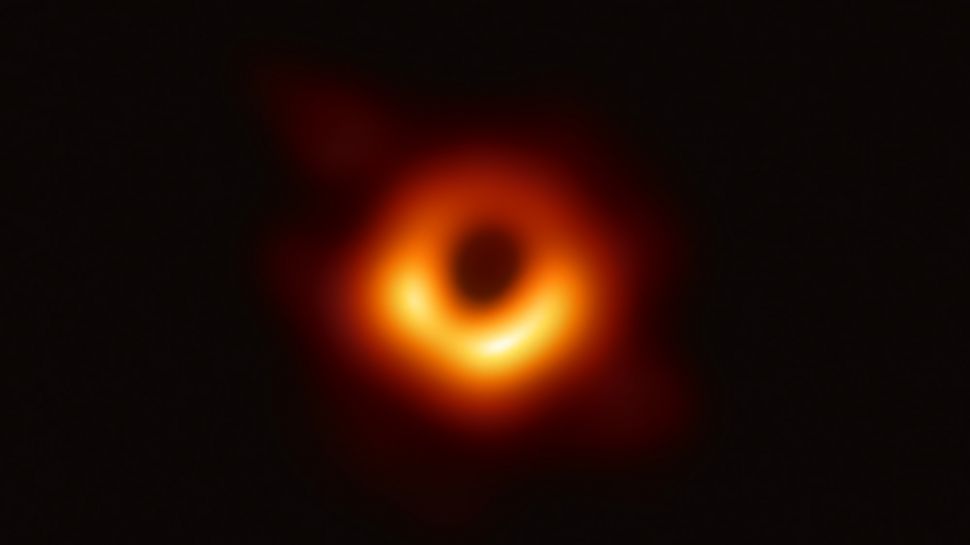
| Boilerpipe Text | This image by the Event Horizon Telescope project shows the event horizon of the supermassive black hole at the heart of the M87 galaxy.
(Image credit: EHT Collaboration)
You're looking at the brand-new, first-ever close-up picture of a black hole. This image of the black hole M87 at the center of the Virgo A galaxy is the result of an international, 2-year-long effort to zoom in on the singularity. It reveals, for the first time, the contours of a black hole's
event horizon
, the point beyond which no light or matter escapes.
M87 is 53 million light-years away, deep in the center of a distant galaxy, surrounded by clouds of dust and gas and other matter, so no visible light telescope could see the
black hole
through all that gunk. It's not the nearest black hole, or even the nearest supermassive black hole. But it's so huge (as wide as our entire
solar system
, and 6.5 billion times the mass of the sun) that it's one of the two biggest-appearing in Earth's sky. (The other is Sagittarius A* at the center of the
Milky Way
.) To make this image, astronomers networked radio telescopes all over the world to magnify M87 to unprecedented resolution. They called the combined network the Event Horizon Telescope.
That name is appropriate because this image isn't the black hole itself. Black holes emit no radiation, or at least
nowhere near enough
to be detected using existing telescopes. But at their edges, just before the singularity's gravity becomes too intense for even light to escape, black holes accelerate matter to extreme speeds. That matter, just before falling past the horizon, rubs against itself at high speed, generating energy and glowing. The radio waves that the Event Horizon Telescope detected were part of that process. [
9 Facts About Black Holes That Will Blow Your Mind
]
Article continues below
Latest Videos From Live Science
"This image forms a clear link now between supermassive black holes and bright galaxies," said Sheperd Doeleman, a Harvard astrophysicist and director of the Event Horizon Telescope at a National Science Foundation press conference.
It confirms that large galaxies like Virgo A (and the Milky Way) are held together by supermassive black holes, Doeleman said.
Astronomers knew that black holes were surrounded by glowing matter. But this image still answers a key question about black holes, and about the structure of our universe. We now know for certain that
Einstein's theory of relativity
holds up even at the edge of a black hole, where some researchers suspected it would break down. The shape of the visible event horizon in the image is a circle, as predicted by relativity, so it confirms relativity still holds sway even in one of the most extreme environments in the universe.
"You could have a seen a blob, and we have seen blobs. We could have seen something unexpected, but we didn’t see something unexpected," Doeleman said."
Get the world’s most fascinating discoveries delivered straight to your inbox.
What the project revealed instead was about as pure and "true" to Eintein's theory, he said.
This is good news and bad news for physics. It's good news, because it means researchers don't have to rewrite their textbooks. But it leaves a key question unresolved:
General relativity
(which governs very big things, like stars and gravity) works up to the edge of a black hole. Quantum mechanics (which describes very small things) is incompatible with general relativity in several key respects. But nothing in this image yet answers any questions about how the two intersect. If general relativity had broken down in this extreme place, scientists might have found some unifying answers.
Data will likely continue to roll in from the telescope network, which is also observing the much nearer (but smaller) supermassive black hole at the center of the Milky Way.
Sera Markoff, an astrophysicist from the University of Amsterdam, said that while the collaboration hasn't yet offered specific details on how black holes produce their giant jets. But she said that further observations of the M87 black hole, which produces dramatic jets, should help to answer those questions. The Event Horizons Telescope project will continue to add telescopes over time and improve its resolution over time, enabling it to answer more questions, she said. Specifically, she said, she's hopeful that imaging black holes could eventually link up quantum physics and gravity.
That linking up, said Avery Broderick, a physicist at the University of Waterloo and collaborator on the project, might eventually allow physicists to "supplant" Einstein.
But for now, just enjoy this first glimpse of the edge of a totally unknowable region of space.
The Biggest Unsolved Mysteries in Physics
The 12 Strangest Objects in the Universe
Stephen Hawking's Most Far-Out Ideas About Black Holes
Originally published on
Live Science
.
Rafi joined Live Science in 2017. He has a bachelor's degree in journalism from Northwestern University’s Medill School of journalism. You can find his past science reporting at Inverse, Business Insider and Popular Science, and his past photojournalism on the Flash90 wire service and in the pages of The Courier Post of southern New Jersey. |
| Markdown | 
[Skip to main content](https://www.livescience.com/65196-black-hole-event-horizon-image.html#main)
Live Science Plus
\- Join our community
JOIN NOW
10
Member Features
24/7
Access Available
25K+
Active Members

Exclusive Newsletters
Science news direct to your inbox

Member Competitions
Win exclusive prizes

Exclusive Content
Premium articles & videos

Early Access
First to see new features

Private Forums
Connect with members

Monthly Rewards
Surprise gifts & perks
GET LIVE SCIENCE PLUS
It's quick and easy to access Live Science Plus, simply enter your email below. We'll send you a confirmation and sign you up for our daily newsletter, keeping you up to date with the latest science news.
By submitting your information you agree to the [Terms & Conditions](https://futureplc.com/future-member-terms-and-conditions/) and [Privacy Policy](https://futureplc.com/privacy-policy/) and are aged 16 or over.
FIND OUT ABOUT OUR MAGAZINE
Want to subscribe to the magazine? Click the button below to find out more information.
[Find out more](https://www.livescience.com/65196-black-hole-event-horizon-image.html)

Welcome to Live Science Plus \!
Hi ,
Your membership journey starts here.
Keep exploring and earning more as a member.
[MY ACCOUNT](https://www.livescience.com/my-account)
***

Earn your first badge
Complete 1 quiz to unlock your first badge.
Keep earning badges
Explore ways to get more involved as a member.

Live Science Quizzes
Quick, fun science challenges.
[Play Now](https://www.livescience.com/quizzes)

Science Crosswords
Short, brain-teasing puzzles.
[Play Now](https://www.livescience.com/tag/science-crossword)
***
See what you’ve unlocked.
Explore your membership benefits.
[Explore](https://www.livescience.com/membership)
Member Exclusives
Science Newsletters
Select the newsletters you'd like to receive and enter your email below.
[View all](https://www.livescience.com/newsletter)
***
[Sign Out]()
Open menu
Close main menu
[ Live Science](https://www.livescience.com/)
[Sign up to our newsletter Newsletter](https://www.livescience.com/newsletter)
[RSS](https://www.livescience.com/feeds.xml)
Sign in
- View Profile
- Sign out
Search
- [Space](https://www.livescience.com/space)
- [Health](https://www.livescience.com/health)
- [Planet Earth](https://www.livescience.com/planet-earth)
- [Animals](https://www.livescience.com/animals)
- [Archaeology](https://www.livescience.com/archaeology)
- [Physics & Math](https://www.livescience.com/physics-mathematics)
- [Technology](https://www.livescience.com/technology)
- More
- [Human Behavior](https://www.livescience.com/human-behavior)
- [Chemistry](https://www.livescience.com/chemistry)
- [Science news](https://www.livescience.com/news)
- [Opinion](https://www.livescience.com/opinion)
- [Life's Little Mysteries](https://www.livescience.com/tag/lifes-little-mysteries)
- [Science quizzes](https://www.livescience.com/quizzes)
- [Crossword](https://www.livescience.com/human-behavior/arts-entertainment/live-science-crossword-puzzle)
- [About us](https://www.livescience.com/about-live-science)
- [Newsletters](https://www.livescience.com/newsletter)
- [Follow us](https://www.livescience.com/technology/internet/follow-live-science-on-social-media)
- [Story archive](https://www.livescience.com/archive)
Don't miss these
[ Space Rare star spotted in its original galaxy could answer a key question about the ingredients of life: Space photo of the week](https://www.livescience.com/space/rare-star-spotted-in-its-original-galaxy-could-answer-a-key-question-about-the-ingredients-of-life-space-photo-of-the-week "Rare star spotted in its original galaxy could answer a key question about the ingredients of life: Space photo of the week ")
[ Astronomy Scientists witness birth of one of the universe's strongest magnets for the first time, thanks to a general relativity 'magic trick'](https://www.livescience.com/space/astronomy/scientists-witness-birth-of-one-of-the-universes-strongest-magnets-for-the-first-time-thanks-to-a-general-relativity-magic-trick "Scientists witness birth of one of the universe's strongest magnets for the first time, thanks to a general relativity 'magic trick'")
[ Space Hubble images taken 25 years apart show big changes in the iconic Crab Nebula — Space photo of the week](https://www.livescience.com/space/hubble-images-taken-25-years-apart-show-big-changes-in-the-iconic-crab-nebula-space-photo-of-the-week "Hubble images taken 25 years apart show big changes in the iconic Crab Nebula — Space photo of the week")
[ Space Hubble and Euclid capture the final act of a dying star — and it's glorious: Space photo of the week](https://www.livescience.com/space/hubble-and-euclid-capture-the-final-act-of-a-dying-star-and-its-glorious-space-photo-of-the-week "Hubble and Euclid capture the final act of a dying star — and it's glorious: Space photo of the week")
[ Archaeology World's oldest rock art, giant reservoir found beneath the East Coast seafloor, black hole revelations, and a record solar radiation storm](https://www.livescience.com/archaeology/science-news-this-week-the-worlds-oldest-rock-art-giant-freshwater-reservoir-found-off-the-east-coast-and-the-biggest-solar-radiation-storm-in-decades "World's oldest rock art, giant reservoir found beneath the East Coast seafloor, black hole revelations, and a record solar radiation storm")
[ Space Can you see Earth's shadow?](https://www.livescience.com/space/can-you-see-earths-shadow "Can you see Earth's shadow?")
[ Astronomy James Webb telescope peers into 'Eye of God' and finds clues to life's origins — Space photo of the week](https://www.livescience.com/space/astronomy/james-webb-telescope-peers-into-eye-of-god-and-finds-clues-to-lifes-origins-space-photo-of-the-week "James Webb telescope peers into 'Eye of God' and finds clues to life's origins — Space photo of the week")
[ Black Holes Exotic prime numbers could be hiding inside black holes](https://www.livescience.com/space/black-holes/exotic-prime-numbers-could-be-hiding-inside-black-holes "Exotic prime numbers could be hiding inside black holes")
[ Space Exceptionally rare sighting of planets colliding may shed light on the crash that formed the moon](https://www.livescience.com/space/exceptionally-rare-sighting-of-planets-colliding-may-shed-light-on-the-crash-that-formed-the-moon "Exceptionally rare sighting of planets colliding may shed light on the crash that formed the moon")
[ Comets Newly visible, city-size 'green comet' will soon be ejected into interstellar space — just like 3I/ATLAS](https://www.livescience.com/space/comets/newly-visible-city-size-green-comet-will-soon-be-ejected-into-interstellar-space-just-like-3i-atlas "Newly visible, city-size 'green comet' will soon be ejected into interstellar space — just like 3I/ATLAS")
[ Astronomy James Webb telescope breaks own record, discovering farthest known galaxy in the universe](https://www.livescience.com/space/astronomy/previously-unimaginable-james-webb-telescope-breaks-own-record-again-discovering-farthest-known-galaxy-in-the-universe "James Webb telescope breaks own record, discovering farthest known galaxy in the universe")
[ Space Deepest views from James Webb and Chandra reveal monster object that defies theory — Space photo of the week](https://www.livescience.com/space/deepest-views-from-james-webb-and-chandra-telescopes-reveal-a-monster-object-that-defies-theory-space-photo-of-the-week "Deepest views from James Webb and Chandra reveal monster object that defies theory — Space photo of the week")
[ Astronomy Closest baby nebula to Earth 'hatches' in strange new Hubble image – Space photo of the week](https://www.livescience.com/space/astronomy/closest-baby-nebula-to-earth-hatches-in-strange-new-hubble-image-space-photo-of-the-week "Closest baby nebula to Earth 'hatches' in strange new Hubble image – Space photo of the week")
[ Astronomy NASA telescope spots first alien 'astrosphere' around a sun-like star: Space photo of the week](https://www.livescience.com/space/astronomy/nasa-telescope-spots-first-alien-astrosphere-around-a-sun-like-star-space-photo-of-the-week "NASA telescope spots first alien 'astrosphere' around a sun-like star: Space photo of the week")
[ Black Holes Universe-shaking collision of black hole and neutron star could upend our understanding of monster cosmic mergers](https://www.livescience.com/space/black-holes/universe-shaking-collision-of-black-hole-and-neutron-star-could-upend-our-understanding-of-monster-cosmic-mergers "Universe-shaking collision of black hole and neutron star could upend our understanding of monster cosmic mergers")
Trending
- [Astronauts struggle to reproduce in space](https://www.livescience.com/space/astronauts-may-struggle-to-reproduce-in-outer-space-study-suggests-what-does-that-mean-for-the-future-of-space-colonization)
- [Fossil ape found in Egypt](https://www.livescience.com/archaeology/human-evolution/18-million-year-old-fossils-of-ape-found-in-africa-but-in-an-unexpected-place)
- [Meteorite crashes through roof](https://www.livescience.com/space/meteoroids/cannonball-size-meteorite-crashes-through-roof-of-texas-home-as-multiple-fireballs-rain-down-on-the-us)
- [Amazon stargazing equipment deals](https://www.livescience.com/products/optics/amazon-spring-sale-2026-stargazing-deals-on-telescopes-cameras-and-binoculars)
1. [Space](https://www.livescience.com/space)
2. [Astronomy](https://www.livescience.com/space/astronomy)
3. [Black Holes](https://www.livescience.com/space/astronomy/black-holes)
# IT'S HERE: The First-Ever Close-Up of a Black Hole
[News](https://www.livescience.com/news)
By [Rafi Letzter](https://www.livescience.com/author/rafi-letzter)
published
April 10, 2019
When you purchase through links on our site, we may earn an affiliate commission. [Here’s how it works](https://www.livescience.com/about-live-science#section-affiliate-advertising-disclosure).
This image by the Event Horizon Telescope project shows the event horizon of the supermassive black hole at the heart of the M87 galaxy. (Image credit: EHT Collaboration)
Share
- Copy link
- [Facebook](https://www.facebook.com/sharer/sharer.php?u=https%3A%2F%2Fwww.livescience.com%2F65196-black-hole-event-horizon-image.html)
- [X](https://twitter.com/intent/tweet?text=IT%27S+HERE%3A+The+First-Ever+Close-Up+of+a+Black+Hole&url=https%3A%2F%2Fwww.livescience.com%2F65196-black-hole-event-horizon-image.html)
- [Whatsapp](whatsapp://send?text=IT%27S+HERE%3A+The+First-Ever+Close-Up+of+a+Black+Hole+https%3A%2F%2Fwww.livescience.com%2F65196-black-hole-event-horizon-image.html?fwa)
- [Reddit](https://www.reddit.com/submit?url=https%3A%2F%2Fwww.livescience.com%2F65196-black-hole-event-horizon-image.html&title=IT%27S+HERE%3A+The+First-Ever+Close-Up+of+a+Black+Hole)
- [Pinterest](https://pinterest.com/pin/create/button/?url=https%3A%2F%2Fwww.livescience.com%2F65196-black-hole-event-horizon-image.html&media=https%3A%2F%2Fcdn.mos.cms.futurecdn.net%2FNETHv2F9UZUe7xabGjpw3N.jpg)
- [Flipboard](https://share.flipboard.com/bookmarklet/popout?title=IT%27S+HERE%3A+The+First-Ever+Close-Up+of+a+Black+Hole&url=https%3A%2F%2Fwww.livescience.com%2F65196-black-hole-event-horizon-image.html)
- [Email](mailto:?subject=I%20found%20this%20webpage&body=Hi,%20I%20found%20this%20webpage%20and%20thought%20you%20might%20like%20it%20https://www.livescience.com/65196-black-hole-event-horizon-image.html)
Share this article
Join the conversation
[Follow us](https://google.com/preferences/source?q=livescience.com)
Add us as a preferred source on Google
Newsletter
Sign up for the Live Science daily newsletter now
Get the world’s most fascinating discoveries delivered straight to your inbox.
***
By signing up, you agree to our [Terms of services](https:\/\/futureplc.com\/terms-conditions\/) and acknowledge that you have read our [Privacy Notice](https:\/\/futureplc.com\/privacy-policy\/). You also agree to receive marketing emails from us that may include promotions from our trusted partners and sponsors, which you can unsubscribe from at any time.
You are now subscribed
Your newsletter sign-up was successful
***
Want to add more newsletters?
Delivered Daily
Daily Newsletter
Sign up for the latest discoveries, groundbreaking research and fascinating breakthroughs that impact you and the wider world direct to your inbox.
Subscribe +

Once a week
Life's Little Mysteries
Feed your curiosity with an exclusive mystery every week, solved with science and delivered direct to your inbox before it's seen anywhere else.
Subscribe +

Once a week
How It Works
Sign up to our free science & technology newsletter for your weekly fix of fascinating articles, quick quizzes, amazing images, and more
Subscribe +
Delivered daily
Space.com Newsletter
Breaking space news, the latest updates on rocket launches, skywatching events and more\!
Subscribe +
Once a month
Watch This Space
Sign up to our monthly entertainment newsletter to keep up with all our coverage of the latest sci-fi and space movies, tv shows, games and books.
Subscribe +
Once a week
Night Sky This Week
Discover this week's must-see night sky events, moon phases, and stunning astrophotos. Sign up for our skywatching newsletter and explore the universe with us\!
Subscribe +
***
Join the club
Get full access to premium articles, exclusive features and a growing list of member rewards.
[Explore](https://www.livescience.com/membership)
***
An account already exists for this email address, please log in.
Subscribe to our newsletter
You're looking at the brand-new, first-ever close-up picture of a black hole. This image of the black hole M87 at the center of the Virgo A galaxy is the result of an international, 2-year-long effort to zoom in on the singularity. It reveals, for the first time, the contours of a black hole's [event horizon](https://www.livescience.com/61870-entering-black-holes-alive.html), the point beyond which no light or matter escapes.
M87 is 53 million light-years away, deep in the center of a distant galaxy, surrounded by clouds of dust and gas and other matter, so no visible light telescope could see the [black hole](https://www.livescience.com/63436-llm-how-black-holes-form.html) through all that gunk. It's not the nearest black hole, or even the nearest supermassive black hole. But it's so huge (as wide as our entire [solar system](https://www.livescience.com/tag/solar-system), and 6.5 billion times the mass of the sun) that it's one of the two biggest-appearing in Earth's sky. (The other is Sagittarius A\* at the center of the [Milky Way](https://www.livescience.com/tag/milky-way).) To make this image, astronomers networked radio telescopes all over the world to magnify M87 to unprecedented resolution. They called the combined network the Event Horizon Telescope.
That name is appropriate because this image isn't the black hole itself. Black holes emit no radiation, or at least [nowhere near enough](https://www.livescience.com/64981-stephen-hawking-black-hole-coin.html) to be detected using existing telescopes. But at their edges, just before the singularity's gravity becomes too intense for even light to escape, black holes accelerate matter to extreme speeds. That matter, just before falling past the horizon, rubs against itself at high speed, generating energy and glowing. The radio waves that the Event Horizon Telescope detected were part of that process. \[[9 Facts About Black Holes That Will Blow Your Mind](https://www.livescience.com/65170-9-weird-facts-black-holes.html)\]
Article continues below
Latest Videos From Live Science
You may like
- [ James Webb telescope reveals sharpest-ever look at the edge of a supermassive black hole](https://www.livescience.com/space/astronomy/james-webb-telescope-reveals-sharpest-ever-look-at-the-edge-of-a-black-hole-and-it-could-solve-a-major-galactic-mystery)
- [ Scientists may have seen a star collapse directly into a black hole without exploding first](https://www.livescience.com/space/black-holes/scientists-may-have-seen-a-star-collapse-directly-into-a-black-hole-without-exploding-first)
- [ 'A real revolution': The James Webb telescope is upending our understanding of the biggest, oldest black holes in the universe](https://www.livescience.com/space/black-holes/a-real-revolution-the-james-webb-telescope-is-upending-our-understanding-of-the-biggest-oldest-black-holes-in-the-universe)
"This image forms a clear link now between supermassive black holes and bright galaxies," said Sheperd Doeleman, a Harvard astrophysicist and director of the Event Horizon Telescope at a National Science Foundation press conference.
It confirms that large galaxies like Virgo A (and the Milky Way) are held together by supermassive black holes, Doeleman said.
Astronomers knew that black holes were surrounded by glowing matter. But this image still answers a key question about black holes, and about the structure of our universe. We now know for certain that [Einstein's theory of relativity](https://www.livescience.com/58245-theory-of-relativity-in-real-life.html) holds up even at the edge of a black hole, where some researchers suspected it would break down. The shape of the visible event horizon in the image is a circle, as predicted by relativity, so it confirms relativity still holds sway even in one of the most extreme environments in the universe.
"You could have a seen a blob, and we have seen blobs. We could have seen something unexpected, but we didn’t see something unexpected," Doeleman said."
Sign up for the Live Science daily newsletter now
Get the world’s most fascinating discoveries delivered straight to your inbox.
By signing up, you agree to our [Terms of services](https:\/\/futureplc.com\/terms-conditions\/) and acknowledge that you have read our [Privacy Notice](https:\/\/futureplc.com\/privacy-policy\/). You also agree to receive marketing emails from us that may include promotions from our trusted partners and sponsors, which you can unsubscribe from at any time.
What the project revealed instead was about as pure and "true" to Eintein's theory, he said.
This is good news and bad news for physics. It's good news, because it means researchers don't have to rewrite their textbooks. But it leaves a key question unresolved: [General relativity](https://www.livescience.com/58245-theory-of-relativity-in-real-life.html) (which governs very big things, like stars and gravity) works up to the edge of a black hole. Quantum mechanics (which describes very small things) is incompatible with general relativity in several key respects. But nothing in this image yet answers any questions about how the two intersect. If general relativity had broken down in this extreme place, scientists might have found some unifying answers.
Data will likely continue to roll in from the telescope network, which is also observing the much nearer (but smaller) supermassive black hole at the center of the Milky Way.
What to read next
- [ Astronomers discover a gigantic, wobbling black hole jet that 'changes the way we think about the galaxy'](https://www.livescience.com/space/black-holes/astronomers-discover-a-gigantic-wobbling-black-hole-jet-that-changes-the-way-we-think-about-the-galaxy)
- [ 'Rare and enigmatic' structures found at the Milky Way's center in largest-ever map of its kind](https://www.livescience.com/space/astronomy/a-place-of-extremes-scientists-unveil-the-largest-ever-map-of-the-galaxys-chaotic-center)
- [ Scientists see monster black hole 'reborn' after 100 million years of rest](https://www.livescience.com/space/black-holes/like-watching-a-cosmic-volcano-erupt-scientists-see-monster-black-hole-reborn-after-100-million-years)
Sera Markoff, an astrophysicist from the University of Amsterdam, said that while the collaboration hasn't yet offered specific details on how black holes produce their giant jets. But she said that further observations of the M87 black hole, which produces dramatic jets, should help to answer those questions. The Event Horizons Telescope project will continue to add telescopes over time and improve its resolution over time, enabling it to answer more questions, she said. Specifically, she said, she's hopeful that imaging black holes could eventually link up quantum physics and gravity.
That linking up, said Avery Broderick, a physicist at the University of Waterloo and collaborator on the project, might eventually allow physicists to "supplant" Einstein.
But for now, just enjoy this first glimpse of the edge of a totally unknowable region of space.
- [The Biggest Unsolved Mysteries in Physics](https://www.livescience.com/34052-unsolved-mysteries-physics.html)
- [The 12 Strangest Objects in the Universe](https://www.livescience.com/64993-weirdest-celestial-objects.html)
- [Stephen Hawking's Most Far-Out Ideas About Black Holes](https://www.livescience.com/62016-stephen-hawking-black-holes.html)
*Originally published on* *[Live Science](https://www.livescience.com/)**.*

[Rafi Letzter](https://www.livescience.com/author/rafi-letzter)
Staff Writer
Rafi joined Live Science in 2017. He has a bachelor's degree in journalism from Northwestern University’s Medill School of journalism. You can find his past science reporting at Inverse, Business Insider and Popular Science, and his past photojournalism on the Flash90 wire service and in the pages of The Courier Post of southern New Jersey.
Read more
[ Astronomy James Webb telescope reveals sharpest-ever look at the edge of a supermassive black hole](https://www.livescience.com/space/astronomy/james-webb-telescope-reveals-sharpest-ever-look-at-the-edge-of-a-black-hole-and-it-could-solve-a-major-galactic-mystery "James Webb telescope reveals sharpest-ever look at the edge of a supermassive black hole")
[ Black Holes Scientists may have seen a star collapse directly into a black hole without exploding first](https://www.livescience.com/space/black-holes/scientists-may-have-seen-a-star-collapse-directly-into-a-black-hole-without-exploding-first "Scientists may have seen a star collapse directly into a black hole without exploding first")
[ Black Holes 'A real revolution': The James Webb telescope is upending our understanding of the biggest, oldest black holes in the universe](https://www.livescience.com/space/black-holes/a-real-revolution-the-james-webb-telescope-is-upending-our-understanding-of-the-biggest-oldest-black-holes-in-the-universe "'A real revolution': The James Webb telescope is upending our understanding of the biggest, oldest black holes in the universe")
[ Black Holes Astronomers discover a gigantic, wobbling black hole jet that 'changes the way we think about the galaxy'](https://www.livescience.com/space/black-holes/astronomers-discover-a-gigantic-wobbling-black-hole-jet-that-changes-the-way-we-think-about-the-galaxy "Astronomers discover a gigantic, wobbling black hole jet that 'changes the way we think about the galaxy'")
[ Astronomy 'Rare and enigmatic' structures found at the Milky Way's center in largest-ever map of its kind](https://www.livescience.com/space/astronomy/a-place-of-extremes-scientists-unveil-the-largest-ever-map-of-the-galaxys-chaotic-center "'Rare and enigmatic' structures found at the Milky Way's center in largest-ever map of its kind")
[ Black Holes Scientists see monster black hole 'reborn' after 100 million years of rest](https://www.livescience.com/space/black-holes/like-watching-a-cosmic-volcano-erupt-scientists-see-monster-black-hole-reborn-after-100-million-years "Scientists see monster black hole 'reborn' after 100 million years of rest")
Latest in Black Holes
[ Black Holes Universe-shaking collision of black hole and neutron star could upend our understanding of monster cosmic mergers](https://www.livescience.com/space/black-holes/universe-shaking-collision-of-black-hole-and-neutron-star-could-upend-our-understanding-of-monster-cosmic-mergers "Universe-shaking collision of black hole and neutron star could upend our understanding of monster cosmic mergers")
[ Black Holes Exotic prime numbers could be hiding inside black holes](https://www.livescience.com/space/black-holes/exotic-prime-numbers-could-be-hiding-inside-black-holes "Exotic prime numbers could be hiding inside black holes")
[ Black Holes Science history: Stephen Hawking writes a tiny paper — and turns our understanding of black holes inside out — March 1, 1974](https://www.livescience.com/space/black-holes/science-history-stephen-hawking-writes-a-tiny-paper-and-turns-our-understanding-of-black-holes-inside-out-march-1-1974 "Science history: Stephen Hawking writes a tiny paper — and turns our understanding of black holes inside out — March 1, 1974")
[ Black Holes Scientists may have seen a star collapse directly into a black hole without exploding first](https://www.livescience.com/space/black-holes/scientists-may-have-seen-a-star-collapse-directly-into-a-black-hole-without-exploding-first "Scientists may have seen a star collapse directly into a black hole without exploding first")
[ Black Holes Scientists spot 'rule-breaking' black hole growing 13 times faster than should be possible](https://www.livescience.com/space/black-holes/rule-breaking-black-hole-found-growing-at-13-times-the-cosmic-speed-limit-challenging-theories "Scientists spot 'rule-breaking' black hole growing 13 times faster than should be possible")
[ Black Holes The earliest black holes in the universe may still be with us, surprising study claims](https://www.livescience.com/space/black-holes/the-earliest-black-holes-in-the-universe-may-still-be-with-us-surprising-study-claims "The earliest black holes in the universe may still be with us, surprising study claims")
Latest in News
[ Space Exploration Mystery medical episode that left astronaut unable to speak shows one of NASA's biggest risks as moon missions ramp up](https://www.livescience.com/space/space-exploration/mystery-medical-episode-that-left-astronaut-unable-to-speak-shows-one-of-nasas-biggest-risks-as-moon-missions-ramp-up "Mystery medical episode that left astronaut unable to speak shows one of NASA's biggest risks as moon missions ramp up")
[ Food & Drink A gut microbe linked to the Mediterranean diet boosts muscle strength in mice](https://www.livescience.com/health/food-drink/a-gut-microbe-linked-to-the-mediterranean-diet-boosts-muscle-strength-in-mice "A gut microbe linked to the Mediterranean diet boosts muscle strength in mice")
[ Saturn Saturn's chaotic atmosphere revealed in most comprehensive view yet by James Webb and Hubble telescopes](https://www.livescience.com/space/saturn/saturns-chaotic-atmosphere-revealed-in-most-comprehensive-view-yet-by-james-webb-and-hubble-telescopes "Saturn's chaotic atmosphere revealed in most comprehensive view yet by James Webb and Hubble telescopes")
[ Space NASA announces moon base, Iran war releases staggering carbon, why weed gives people munchies, and Artemis II preps for liftoff.](https://www.livescience.com/science-news-this-week-nasa-announces-nuclear-rocket-space-reproduction-proves-difficult-and-why-weed-gives-you-the-munchies "NASA announces moon base, Iran war releases staggering carbon, why weed gives people munchies, and Artemis II preps for liftoff.")
[ Animals Live Science Today: Jaw-dropping first glimpse of sperm whale birth and how NASA is turning astronauts into test subjects](https://www.livescience.com/live-science-today-jaw-dropping-first-glimpse-of-sperm-whale-birth-and-how-nasa-is-turning-astronauts-into-test-subjects "Live Science Today: Jaw-dropping first glimpse of sperm whale birth and how NASA is turning astronauts into test subjects")
[ Neanderthals 'Major disruption in Neanderthal history': 65,000 years ago, all Neanderthals in Europe died out except for one lineage](https://www.livescience.com/archaeology/neanderthals/major-disruption-in-neanderthal-history-65-000-years-ago-all-neanderthals-in-europe-died-out-except-for-one-lineage "'Major disruption in Neanderthal history': 65,000 years ago, all Neanderthals in Europe died out except for one lineage")
LATEST ARTICLES
1. [](https://www.livescience.com/technology/artificial-intelligence/cameras-have-quietly-appeared-in-thousands-of-us-cities-now-their-integration-with-ai-is-sounding-alarms-opinion "AI systems are enabling mass surveillance in the US, and there is no national law that 'meaningfully limits' the use of this data")
1
[AI systems are enabling mass surveillance in the US, and there is no national law that 'meaningfully limits' the use of this data](https://www.livescience.com/technology/artificial-intelligence/cameras-have-quietly-appeared-in-thousands-of-us-cities-now-their-integration-with-ai-is-sounding-alarms-opinion)
2. 2
[Endometriosis messes with the immune system and causes 'ripple effects across the body'](https://www.livescience.com/health/reproductive-health/endometriosis-messes-with-the-immune-system-and-causes-ripple-effects-across-the-body)
3. 3
[Hubble images taken 25 years apart show big changes in the iconic Crab Nebula — Space photo of the week](https://www.livescience.com/space/hubble-images-taken-25-years-apart-show-big-changes-in-the-iconic-crab-nebula-space-photo-of-the-week)
4. 4
[What would happen to Earth if the sun suddenly vanished?](https://www.livescience.com/planet-earth/what-would-happen-to-earth-if-the-sun-suddenly-vanished)
5. 5
[Top 5 health and fitness products to buy during spring sales (and 2 to skip)](https://www.livescience.com/products/health-fitness/top-5-health-and-fitness-products-to-buy-during-spring-sales)
Live Science is part of Future US Inc, an international media group and leading digital publisher. [Visit our corporate site](https://futureplc.com/).
[ Add as a preferred source on Google](https://google.com/preferences/source?q=livescience.com)
- [About Us](https://www.livescience.com/about-live-science)
- [Contact Future's experts](https://futureplc.com/contact/)
- [Terms and conditions](https://futureplc.com/terms-conditions/)
- [Privacy policy](https://futureplc.com/privacy-policy/)
- [Cookies policy](https://futureplc.com/cookies-policy/)
- [Accessibility Statement](https://futureplc.com/accessibility-statement/)
- [Advertise with us](https://go.future-advertising.com/Live-Science-Media-Kit.html)
- [Web notifications](https://www.livescience.com/how-to-turn-off-web-notifications-for-chrome-macos.html)
- [Careers](https://futureplc.com/careers/)
- [Editorial standards](https://www.livescience.com/editorial-standards)
- [How to pitch a story to us](https://www.livescience.com/how-to-pitch-live-science)
- [Do not sell or share my personal information](https://www.livescience.com/privacy-portal)
© Future US, Inc. Full 7th Floor, 130 West 42nd Street, New York, NY 10036.
Close
Please login or signup to comment
Please wait...
Login
Sign Up |
| Readable Markdown | 
This image by the Event Horizon Telescope project shows the event horizon of the supermassive black hole at the heart of the M87 galaxy. (Image credit: EHT Collaboration)
You're looking at the brand-new, first-ever close-up picture of a black hole. This image of the black hole M87 at the center of the Virgo A galaxy is the result of an international, 2-year-long effort to zoom in on the singularity. It reveals, for the first time, the contours of a black hole's [event horizon](https://www.livescience.com/61870-entering-black-holes-alive.html), the point beyond which no light or matter escapes.
M87 is 53 million light-years away, deep in the center of a distant galaxy, surrounded by clouds of dust and gas and other matter, so no visible light telescope could see the [black hole](https://www.livescience.com/63436-llm-how-black-holes-form.html) through all that gunk. It's not the nearest black hole, or even the nearest supermassive black hole. But it's so huge (as wide as our entire [solar system](https://www.livescience.com/tag/solar-system), and 6.5 billion times the mass of the sun) that it's one of the two biggest-appearing in Earth's sky. (The other is Sagittarius A\* at the center of the [Milky Way](https://www.livescience.com/tag/milky-way).) To make this image, astronomers networked radio telescopes all over the world to magnify M87 to unprecedented resolution. They called the combined network the Event Horizon Telescope.
That name is appropriate because this image isn't the black hole itself. Black holes emit no radiation, or at least [nowhere near enough](https://www.livescience.com/64981-stephen-hawking-black-hole-coin.html) to be detected using existing telescopes. But at their edges, just before the singularity's gravity becomes too intense for even light to escape, black holes accelerate matter to extreme speeds. That matter, just before falling past the horizon, rubs against itself at high speed, generating energy and glowing. The radio waves that the Event Horizon Telescope detected were part of that process. \[[9 Facts About Black Holes That Will Blow Your Mind](https://www.livescience.com/65170-9-weird-facts-black-holes.html)\]
Article continues below
Latest Videos From Live Science
"This image forms a clear link now between supermassive black holes and bright galaxies," said Sheperd Doeleman, a Harvard astrophysicist and director of the Event Horizon Telescope at a National Science Foundation press conference.
It confirms that large galaxies like Virgo A (and the Milky Way) are held together by supermassive black holes, Doeleman said.
Astronomers knew that black holes were surrounded by glowing matter. But this image still answers a key question about black holes, and about the structure of our universe. We now know for certain that [Einstein's theory of relativity](https://www.livescience.com/58245-theory-of-relativity-in-real-life.html) holds up even at the edge of a black hole, where some researchers suspected it would break down. The shape of the visible event horizon in the image is a circle, as predicted by relativity, so it confirms relativity still holds sway even in one of the most extreme environments in the universe.
"You could have a seen a blob, and we have seen blobs. We could have seen something unexpected, but we didn’t see something unexpected," Doeleman said."
Get the world’s most fascinating discoveries delivered straight to your inbox.
What the project revealed instead was about as pure and "true" to Eintein's theory, he said.
This is good news and bad news for physics. It's good news, because it means researchers don't have to rewrite their textbooks. But it leaves a key question unresolved: [General relativity](https://www.livescience.com/58245-theory-of-relativity-in-real-life.html) (which governs very big things, like stars and gravity) works up to the edge of a black hole. Quantum mechanics (which describes very small things) is incompatible with general relativity in several key respects. But nothing in this image yet answers any questions about how the two intersect. If general relativity had broken down in this extreme place, scientists might have found some unifying answers.
Data will likely continue to roll in from the telescope network, which is also observing the much nearer (but smaller) supermassive black hole at the center of the Milky Way.
Sera Markoff, an astrophysicist from the University of Amsterdam, said that while the collaboration hasn't yet offered specific details on how black holes produce their giant jets. But she said that further observations of the M87 black hole, which produces dramatic jets, should help to answer those questions. The Event Horizons Telescope project will continue to add telescopes over time and improve its resolution over time, enabling it to answer more questions, she said. Specifically, she said, she's hopeful that imaging black holes could eventually link up quantum physics and gravity.
That linking up, said Avery Broderick, a physicist at the University of Waterloo and collaborator on the project, might eventually allow physicists to "supplant" Einstein.
But for now, just enjoy this first glimpse of the edge of a totally unknowable region of space.
- [The Biggest Unsolved Mysteries in Physics](https://www.livescience.com/34052-unsolved-mysteries-physics.html)
- [The 12 Strangest Objects in the Universe](https://www.livescience.com/64993-weirdest-celestial-objects.html)
- [Stephen Hawking's Most Far-Out Ideas About Black Holes](https://www.livescience.com/62016-stephen-hawking-black-holes.html)
*Originally published on* *[Live Science](https://www.livescience.com/)**.*
Rafi joined Live Science in 2017. He has a bachelor's degree in journalism from Northwestern University’s Medill School of journalism. You can find his past science reporting at Inverse, Business Insider and Popular Science, and his past photojournalism on the Flash90 wire service and in the pages of The Courier Post of southern New Jersey. |
| Shard | 78 (laksa) |
| Root Hash | 4110033003681956278 |
| Unparsed URL | com,livescience!www,/65196-black-hole-event-horizon-image.html s443 |