ℹ️ Skipped - page is already crawled
| Filter | Status | Condition | Details |
|---|---|---|---|
| HTTP status | PASS | download_http_code = 200 | HTTP 200 |
| Age cutoff | PASS | download_stamp > now() - 6 MONTH | 0.2 months ago |
| History drop | PASS | isNull(history_drop_reason) | No drop reason |
| Spam/ban | PASS | fh_dont_index != 1 AND ml_spam_score = 0 | ml_spam_score=0 |
| Canonical | PASS | meta_canonical IS NULL OR = '' OR = src_unparsed | Not set |
| Property | Value | |||||||||
|---|---|---|---|---|---|---|---|---|---|---|
| URL | https://www.livescience.com/51399-eulers-identity.html | |||||||||
| Last Crawled | 2026-04-15 19:53:14 (6 days ago) | |||||||||
| First Indexed | 2017-06-13 18:42:48 (8 years ago) | |||||||||
| HTTP Status Code | 200 | |||||||||
| Content | ||||||||||
| Meta Title | Euler’s Identity: 'The Most Beautiful Equation' | Live Science | |||||||||
| Meta Description | Euler's Identity is a remarkable equation that comprises the five most important mathematical constants. | |||||||||
| Meta Canonical | null | |||||||||
| Boilerpipe Text | Euler's Equation
(Image credit: public domain)
Euler’s identity is an equality found in mathematics that has been compared to a Shakespearean sonnet and described as "
the most beautiful equation
." It is a special case of a foundational equation in complex arithmetic called Euler’s Formula, which the late great physicist Richard Feynman called
in his lectures
"our jewel" and "the most remarkable formula in mathematics."
In an
interview with the BBC
, Prof David Percy of the Institute of Mathematics and its Applications said Euler's Identity was “a real classic and you can do no better than that … It is simple to look at and yet incredibly profound, it comprises the five most important mathematical constants.”
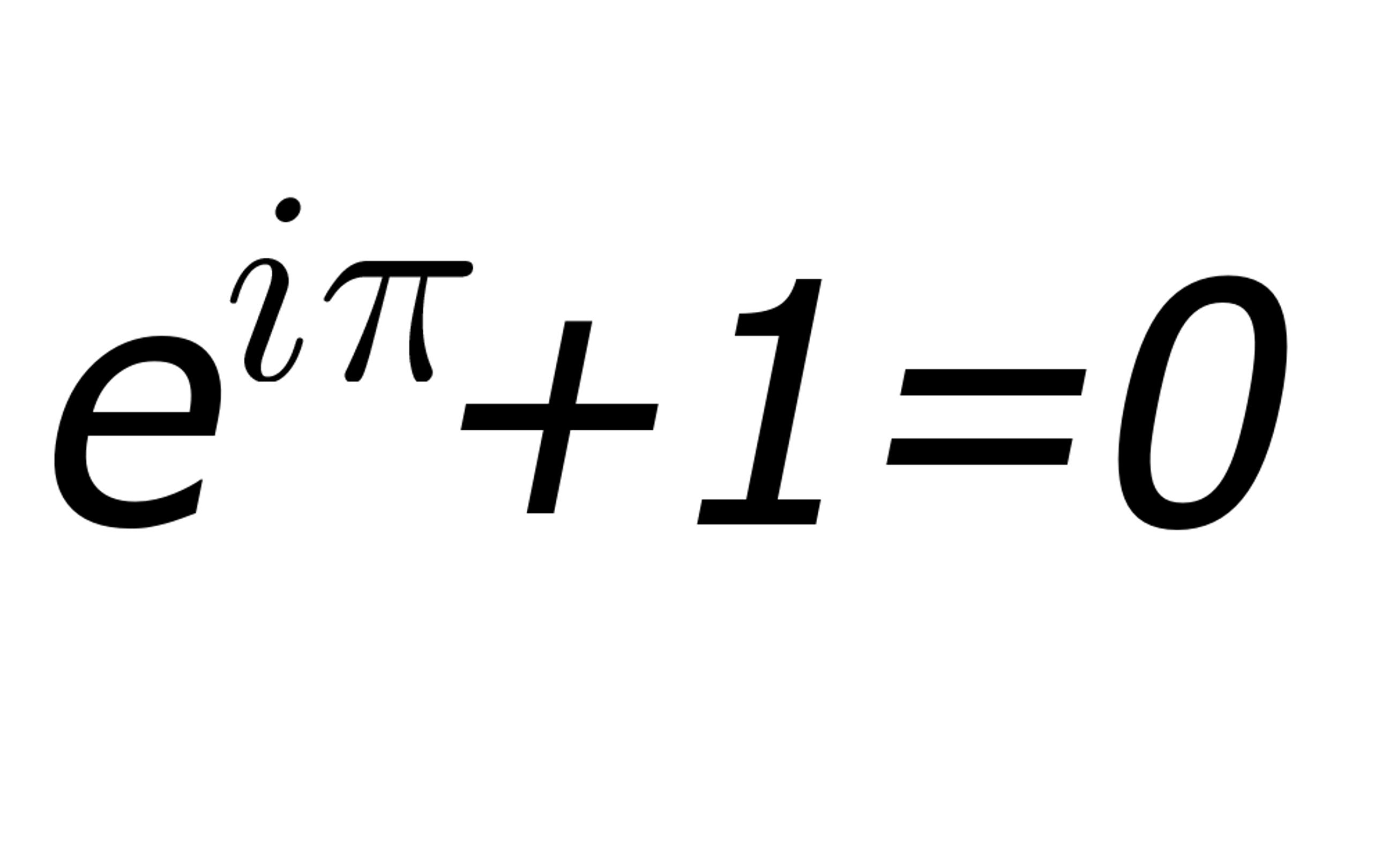
Euler's Identity is written simply as:
e
iπ
+ 1 = 0
Article continues below
Latest Videos From Live Science
The five constants are:
The
number 0
.
The number 1.
The
number
π
, an irrational number (with unending digits) that is the ratio of the circumference of a circle to its diameter. It is approximately 3.14159…
The number
e
, also an irrational number. It is the base of
natural logarithms
that arises naturally through study of compound interest and
calculus
. The number
e
pervades math, appearing seemingly from nowhere in a vast number of important equations. It is approximately 2.71828….
The
number
i
, defined as the square root of negative one: √(-1). The most fundamental of the imaginary numbers, so called because, in reality, no number can be multiplied by itself to produce a negative number (and, therefore, negative numbers have no real square roots). But in math, there are many situations where one is forced to take the square root of a negative. The letter
i
is therefore used as a sort of stand-in to mark places where this was done.
Prolific mathematician
Leonhard Euler was an 18th-century Swiss-born mathematician who developed many concepts that are integral to modern mathematics. He spent most of his career in St. Petersburg, Russia. He was one of the most prolific mathematicians of all time, according to the
U.S. Naval Academy
(USNA), with 886 papers and books published. Much of his output came during the last two decades of his life, when he was totally blind. There was so much work that the St. Petersburg Academy continued publishing his work posthumously for more than 30 years.
Euler's important contributions include Euler's Formula and Euler's Theorem, both of which can mean different things depending on the context. According to the USNA, in mechanics, there are "Euler angles (to specify the orientation of a rigid body), Euler's theorem (that every rotation has an axis), Euler's equations for motion of fluids, and the Euler-Lagrange equation (that comes from calculus of variations)."
Multiplying complex numbers
Euler’s Identity stems naturally from interactions of
complex numbers
which are numbers composed of two pieces: a
real number
and an
imaginary number
; an example is 4+3
i
. Complex numbers appear in a multitude of applications such as wave mechanics (a study within
quantum mechanics
) and design of circuits that use alternating current (a common practice in
electrical engineering
). Additionally, complex numbers (and their cousins, the
hyper complex numbers
) have a property that makes them especially useful for studying computer graphics, robotics, navigation, flight dynamics, and orbital mechanics: multiplying them together causes them to rotate. This property will help us understand the reasoning behind Euler’s Identity.
Get the world’s most fascinating discoveries delivered straight to your inbox.
In the example below, five complex numbers are plotted on the
complex plane
and together form a “house shape.” The complex plane is similar to a number line, except that it’s two-dimensional. The horizontal direction represents the real numbers and the vertical axis represents imaginary numbers. Each house-shape complex number is multiplied by the complex number 4+3
i
and re-plotted (green arrow). [
Related: What Are Complex Numbers?
]
As can be seen, multiplying by 4+3
i
results in the house shape
dilating
(increasing in area and moving away from the origin 0+0
i
by the same amount) and
rotating
(becoming tilted by some angle). To show this is precisely the effect of multiplying by 4+3i, the effect of zooming in on the house five times and rotating by 36.9 degrees is also shown (red arrow). The exact same effect is produced.
The same effect is produced from multiplying the vertices of a figure by 4+3i and rotating the figure by 36.9 degrees and dilating it by a factor of five.
(Image credit: Robert J. Coolman)
Different amounts of dilation and rotation can produce the effects of multiplying by any number on the complex plane.
Polar form of complex numbers
The amount of rotation and dilation is determined by properties intrinsic to the number 4+3
i,
which, as seen in the figure below, is five units from the origin (
r
= 5) and forms an angle of 36.9 degrees with the horizontal axis (
φ
= 36.9°). These measurements are used in what is known as the
polar form
of a complex number (
re
iφ
) as opposed to the normal
rectangular form
(
a
+
bi
).
The number 4+3i is five units from the origin and forms an angle of 36.9 degrees with the horizontal axis.
(Image credit: Robert J. Coolman)
The polar form requires that
φ
be measured in
radians
. One radian (1
rad
) is approximately 57.3 degrees; it’s the measure of angle made when a circle’s radius is wrapped against that circle’s circumference. A measure of
π
radians
wraps half way around a circle; a measure of 2
π
radians wraps a full circle.
An angle measure of one radian is formed when a circle’s radius is wrapped against its circumference. A half-circle is π radians and a full circle is 2π radians.
(Image credit: Robert J. Coolman)
The angle measure for 4+3
i
is 0.644 radians (36.9° = 0.644
rad
) meaning the polar form of 4+3
i
is 5
e
i
0.644
. Measures for
r
and
φ
can also be determined for each of the house-shape points, and yet another way of achieving the dilating/rotating effect of multiplying by 4+3
i
is to multiply each
r
by five, and add 36.9 degrees (or 0.644
rad
) to each
φ
. From this demonstration, we see that when complex numbers are multiplied together, distances multiply and angles add. This is due to a property intrinsic to exponents, which can be shown algebraically.
Using the polar form of complex numbers to show why distances multiply and angles add.
(Image credit: Robert J. Coolman)
With the polar form of complex numbers established, the matter of Euler’s Identity is merely a special case of
a
+
bi
for
a
= -1 and
b
= 0. Consequently for the polar form
re
iφ
, this makes
r
= 1 and
φ
=
π
(since
π
rad
= 180°).
Euler’s Identity is a special case of a+bi for a = -1 and b = 0 and reiφ for r = 1 and φ = π.
(Image credit: Robert J. Coolman)
Derivation of polar form
Though Euler’s Identity follows from the polar form of complex numbers, it is impossible to derive the polar form (in particular the spontaneous appearance of the number
e
) without
calculus
.
A general case of a complex number in both rectangular (a+bi) and polar (reiφ) forms.
(Image credit: Robert J. Coolman)
We start with the rectangular form of a complex number:
a
+
bi
From the diagram and
trigonometry
, we can make the following substitutions:
(
r
·cos
φ
) + (
r
·sin
φ
)
i
From here we can factor out
r
:
r
·(cos
φ
+
i
·sin
φ
)
Sometimes “cos
φ
+
i
·sin
φ
” is named cis
φ
, which is shorthand for “
c
osine plus
i
maginary
s
ine
.”
r
·cis
φ
The function cis
φ
turns out to be equal to
e
iφ
. This is the part that’s impossible to show without calculus. Two derivations are shown below:
Two derivations for of cisφ = eiφ. Both use some form of calculus.
(Image credit: Robert J. Coolman)
Thus, the equation
r
·cis
φ
is written in standard polar form
r
·e
iφ
.
Additional resources
ResearchGate: What is Special in Euler's Identity?
Academia.edu: Euler's Identity — A Mathematical Proof for the Existence of God
, by Robin Robertson
Science4All: The Most Beautiful Equation of Math: Euler's Identity
Robert Coolman, PhD, is a teacher and a freelance science writer and is based in Madison, Wisconsin. He has written for Vice, Discover, Nautilus, Live Science and The Daily Beast. Robert spent his doctorate turning sawdust into gasoline-range fuels and chemicals for materials, medicine, electronics and agriculture. He is made of chemicals. | |||||||||
| Markdown | 
[Skip to main content](https://www.livescience.com/51399-eulers-identity.html#main)
Live Science Plus
\- Join our community
JOIN NOW
10
Member Features
24/7
Access Available
25K+
Active Members

Exclusive Newsletters
Science news direct to your inbox

Member Competitions
Win exclusive prizes

Exclusive Content
Premium articles & videos

Early Access
First to see new features

Private Forums
Connect with members

Monthly Rewards
Surprise gifts & perks
GET LIVE SCIENCE PLUS
It's quick and easy to access Live Science Plus, simply enter your email below. We'll send you a confirmation and sign you up for our daily newsletter, keeping you up to date with the latest science news.
By submitting your information you agree to the [Terms & Conditions](https://futureplc.com/future-member-terms-and-conditions/) and [Privacy Policy](https://futureplc.com/privacy-policy/) and are aged 16 or over.
FIND OUT ABOUT OUR MAGAZINE
Want to subscribe to the magazine? Click the button below to find out more information.
[Find out more](https://www.livescience.com/51399-eulers-identity.html)

Welcome to Live Science Plus \!
Hi ,
Your membership journey starts here.
Keep exploring and earning more as a member.
[MY ACCOUNT](https://www.livescience.com/my-account)
***

Earn your first badge
Complete 1 quiz to unlock your first badge.
Keep earning badges
Explore ways to get more involved as a member.

Live Science Quizzes
Quick, fun science challenges.
[Play Now](https://www.livescience.com/quizzes)

Science Crosswords
Short, brain-teasing puzzles.
[Play Now](https://www.livescience.com/tag/science-crossword)
***
See what you’ve unlocked.
Explore your membership benefits.
[Explore](https://www.livescience.com/membership)
Member Exclusives
Science Newsletters
Select the newsletters you'd like to receive and enter your email below.
[View all](https://www.livescience.com/newsletter)
***
[Sign Out]()
Open menu
Close main menu
[ Live Science](https://www.livescience.com/)
[Sign up to our newsletter Newsletter](https://www.livescience.com/newsletter)
[RSS](https://www.livescience.com/feeds.xml)
Sign in
- View Profile
- Sign out
Search
- [Space](https://www.livescience.com/space)
- [Health](https://www.livescience.com/health)
- [Planet Earth](https://www.livescience.com/planet-earth)
- [Animals](https://www.livescience.com/animals)
- [Archaeology](https://www.livescience.com/archaeology)
- [Physics & Math](https://www.livescience.com/physics-mathematics)
- [Technology](https://www.livescience.com/technology)
- More
- [Human Behavior](https://www.livescience.com/human-behavior)
- [Chemistry](https://www.livescience.com/chemistry)
- [Science news](https://www.livescience.com/news)
- [Opinion](https://www.livescience.com/opinion)
- [Life's Little Mysteries](https://www.livescience.com/tag/lifes-little-mysteries)
- [Science quizzes](https://www.livescience.com/quizzes)
- [Crossword](https://www.livescience.com/human-behavior/arts-entertainment/live-science-crossword-puzzle)
- [About us](https://www.livescience.com/about-live-science)
- [Newsletters](https://www.livescience.com/newsletter)
- [Follow us](https://www.livescience.com/technology/internet/follow-live-science-on-social-media)
- [Story archive](https://www.livescience.com/archive)
Don't miss these
[ The Moon Does the moon look the same from everywhere on Earth?](https://www.livescience.com/space/the-moon/does-the-moon-look-the-same-from-everywhere-on-earth "Does the moon look the same from everywhere on Earth?")
[ Quantum Computing IBM quantum processor achieves highest fidelity calculations for the longest period of time on record](https://www.livescience.com/technology/quantum/ibm-quantum-processor-achieves-highest-fidelity-calculations-for-the-longest-period-of-time-on-record "IBM quantum processor achieves highest fidelity calculations for the longest period of time on record")
[ Physics & Mathematics New tweak to Einstein's relativity could transform our understanding of the Big Bang](https://www.livescience.com/physics-mathematics/a-new-tweak-to-einsteins-relativity-could-transform-our-understanding-of-the-big-bang "New tweak to Einstein's relativity could transform our understanding of the Big Bang")
[ Animals 60 mind-blowing science facts about our incredible world](https://www.livescience.com/science-facts "60 mind-blowing science facts about our incredible world")
[ Quantum Computing Quantum computers need just 10,000 qubits — not the millions we assumed — to break the world's most secure encryption algorithms](https://www.livescience.com/technology/quantum/quantum-computers-need-just-10-000-qubits-not-the-millions-we-assumed-to-break-the-worlds-most-secure-encryption-algorithms "Quantum computers need just 10,000 qubits — not the millions we assumed — to break the world's most secure encryption algorithms")
[ Climate change Human-driven climate change is slowing Earth's rotation at a rate not seen in 3.6 million years](https://www.livescience.com/planet-earth/climate-change/human-driven-climate-change-is-slowing-earths-rotation-at-a-rate-not-seen-in-3-6-million-years "Human-driven climate change is slowing Earth's rotation at a rate not seen in 3.6 million years")
[ Comets 'Farting' comet seen reversing its spin for the first time ever](https://www.livescience.com/space/comets/farting-comet-seen-reversing-its-spin-for-the-first-time-ever-and-it-may-soon-self-destruct "'Farting' comet seen reversing its spin for the first time ever ")
[ The Moon Why does the moon look larger when it's on the horizon?](https://www.livescience.com/space/the-moon/why-does-the-moon-look-larger-when-its-on-the-horizon "Why does the moon look larger when it's on the horizon?")
[ Archaeology Why do some people still believe that aliens shaped ancient civilizations?](https://www.livescience.com/archaeology/why-do-some-people-still-believe-that-aliens-shaped-ancient-civilizations "Why do some people still believe that aliens shaped ancient civilizations?")
[ Astronomy 'Truly extraordinary': Mega-laser shooting at us from halfway across the universe is the brightest 'cosmic beacon' we've ever seen](https://www.livescience.com/space/astronomy/truly-extraordinary-mega-laser-shooting-at-us-from-halfway-across-the-universe-is-the-brightest-cosmic-beacon-weve-ever-seen "'Truly extraordinary': Mega-laser shooting at us from halfway across the universe is the brightest 'cosmic beacon' we've ever seen")
[ Astronomy James Webb telescope peers into 'Eye of God' and finds clues to life's origins — Space photo of the week](https://www.livescience.com/space/astronomy/james-webb-telescope-peers-into-eye-of-god-and-finds-clues-to-lifes-origins-space-photo-of-the-week "James Webb telescope peers into 'Eye of God' and finds clues to life's origins — Space photo of the week")
[ Cosmology Standard model of cosmology holds up in massive 6-year study of the universe](https://www.livescience.com/physics-mathematics/dark-energy/the-dream-has-come-true-standard-model-of-cosmology-holds-up-in-massive-6-year-study-of-the-universe-with-one-big-caveat "Standard model of cosmology holds up in massive 6-year study of the universe")
[ Saturn Saturn's chaotic atmosphere revealed in most comprehensive view yet by James Webb and Hubble telescopes](https://www.livescience.com/space/saturn/saturns-chaotic-atmosphere-revealed-in-most-comprehensive-view-yet-by-james-webb-and-hubble-telescopes "Saturn's chaotic atmosphere revealed in most comprehensive view yet by James Webb and Hubble telescopes")
[ Mathematics Pi has been calculated to trillions of digits — is that completely irrational?](https://www.livescience.com/physics-mathematics/mathematics/pi-has-been-calculated-to-trillions-of-digits-is-that-completely-irrational "Pi has been calculated to trillions of digits — is that completely irrational?")
[ Black Holes Exotic prime numbers could be hiding inside black holes](https://www.livescience.com/space/black-holes/exotic-prime-numbers-could-be-hiding-inside-black-holes "Exotic prime numbers could be hiding inside black holes")
Trending
- [Artemis II](https://www.livescience.com/tag/artemis-2)
- [Coin belongs to doomed settlement](https://www.livescience.com/archaeology/americas/16th-century-silver-coin-discovered-near-strait-of-magellan-marks-the-spot-of-a-doomed-spanish-colony)
- [Scientists map all clitoris nerves first time](https://www.livescience.com/health/anatomy/scientists-mapped-all-the-nerves-of-the-clitoris-for-the-first-time)
- [How humans adapted to survive everywhere](https://www.livescience.com/archaeology/human-evolution/they-could-spend-4-or-5-hours-per-day-underwater-how-humans-adapted-to-the-most-challenging-environments)
- [Woman sneezes worms](https://www.livescience.com/health/viruses-infections-disease/diagnostic-dilemma-womans-biologically-implausible-infection-led-her-to-sneeze-worms-out-of-her-nose)
1. [Physics & Mathematics](https://www.livescience.com/physics-mathematics)
2. [Mathematics](https://www.livescience.com/physics-mathematics/mathematics)
# Euler’s Identity: 'The Most Beautiful Equation'
[References](https://www.livescience.com/references)
By [Robert Coolman](https://www.livescience.com/author/robert-coolman)
published
July 1, 2015
When you purchase through links on our site, we may earn an affiliate commission. [Here’s how it works](https://www.livescience.com/about-live-science#section-affiliate-advertising-disclosure).
Euler's Equation (Image credit: public domain)
Share
- Copy link
- [Facebook](https://www.facebook.com/sharer/sharer.php?u=https%3A%2F%2Fwww.livescience.com%2F51399-eulers-identity.html)
- [X](https://twitter.com/intent/tweet?text=Euler%E2%80%99s+Identity%3A+%27The+Most+Beautiful+Equation%27&url=https%3A%2F%2Fwww.livescience.com%2F51399-eulers-identity.html)
- [Whatsapp](whatsapp://send?text=Euler%E2%80%99s+Identity%3A+%27The+Most+Beautiful+Equation%27+https%3A%2F%2Fwww.livescience.com%2F51399-eulers-identity.html?fwa)
- [Reddit](https://www.reddit.com/submit?url=https%3A%2F%2Fwww.livescience.com%2F51399-eulers-identity.html&title=Euler%E2%80%99s+Identity%3A+%27The+Most+Beautiful+Equation%27)
- [Pinterest](https://pinterest.com/pin/create/button/?url=https%3A%2F%2Fwww.livescience.com%2F51399-eulers-identity.html&media=https%3A%2F%2Fcdn.mos.cms.futurecdn.net%2FBT4GR5JKJJTudF6kUGEqg7.jpg)
- [Flipboard](https://share.flipboard.com/bookmarklet/popout?title=Euler%E2%80%99s+Identity%3A+%27The+Most+Beautiful+Equation%27&url=https%3A%2F%2Fwww.livescience.com%2F51399-eulers-identity.html)
- [Email](mailto:?subject=I%20found%20this%20webpage&body=Hi,%20I%20found%20this%20webpage%20and%20thought%20you%20might%20like%20it%20https://www.livescience.com/51399-eulers-identity.html)
Share this article
Join the conversation
[Follow us](https://google.com/preferences/source?q=livescience.com)
Add us as a preferred source on Google
Newsletter
Sign up for the Live Science daily newsletter now
Get the world’s most fascinating discoveries delivered straight to your inbox.
***
By signing up, you agree to our [Terms of services](https:\/\/futureplc.com\/terms-conditions\/) and acknowledge that you have read our [Privacy Notice](https:\/\/futureplc.com\/privacy-policy\/). You also agree to receive marketing emails from us that may include promotions from our trusted partners and sponsors, which you can unsubscribe from at any time.
You are now subscribed
Your newsletter sign-up was successful
***
Want to add more newsletters?

Delivered Daily
Daily Newsletter
Sign up for the latest discoveries, groundbreaking research and fascinating breakthroughs that impact you and the wider world direct to your inbox.
Subscribe +
Once a week
Life's Little Mysteries
Feed your curiosity with an exclusive mystery every week, solved with science and delivered direct to your inbox before it's seen anywhere else.
Subscribe +

Once a week
How It Works
Sign up to our free science & technology newsletter for your weekly fix of fascinating articles, quick quizzes, amazing images, and more
Subscribe +

Delivered daily
Space.com Newsletter
Breaking space news, the latest updates on rocket launches, skywatching events and more\!
Subscribe +
Once a month
Watch This Space
Sign up to our monthly entertainment newsletter to keep up with all our coverage of the latest sci-fi and space movies, tv shows, games and books.
Subscribe +
Once a week
Night Sky This Week
Discover this week's must-see night sky events, moon phases, and stunning astrophotos. Sign up for our skywatching newsletter and explore the universe with us\!
Subscribe +
***
Join the club
Get full access to premium articles, exclusive features and a growing list of member rewards.
[Explore](https://www.livescience.com/membership)
***
An account already exists for this email address, please log in.
Subscribe to our newsletter
Euler’s identity is an equality found in mathematics that has been compared to a Shakespearean sonnet and described as "[the most beautiful equation](https://www.livescience.com/26584-5-mind-boggling-math-facts.html)." It is a special case of a foundational equation in complex arithmetic called Euler’s Formula, which the late great physicist Richard Feynman called [in his lectures](https://target.georiot.com/Proxy.ashx?tsid=74387&GR_URL=http%3A%2F%2Famazon.com%2FFeynman-Lectures-Physics-Vol-Millennium%2Fdp%2F0465024939%3Ftag%3Dhawk-future-20%26ascsubtag%3Dlivescience-us-5530728407723048703-20) "our jewel" and "the most remarkable formula in mathematics."
In an [interview with the BBC](http://www.bbc.com/news/science-environment-26151062), Prof David Percy of the Institute of Mathematics and its Applications said Euler's Identity was “a real classic and you can do no better than that … It is simple to look at and yet incredibly profound, it comprises the five most important mathematical constants.”
Euler's Identity is written simply as: *e**iπ* + 1 = 0
Article continues below
Latest Videos From Live Science
You may like
- [ Exotic prime numbers could be hiding inside black holes](https://www.livescience.com/space/black-holes/exotic-prime-numbers-could-be-hiding-inside-black-holes)
- [ AI just verified a proof that earned one of math's most prestigious prizes. Math will never be the same](https://www.livescience.com/physics-mathematics/mathematics/ai-just-verified-a-proof-that-earned-one-of-maths-most-prestigious-prizes-math-will-never-be-the-same-opinion)
- [ Pi has been calculated to trillions of digits — is that completely irrational?](https://www.livescience.com/physics-mathematics/mathematics/pi-has-been-calculated-to-trillions-of-digits-is-that-completely-irrational)
The five constants are:
- The [number 0](https://www.livescience.com/27853-who-invented-zero.html).
- The number 1.
- The [number *π*](https://www.livescience.com/29197-what-is-pi.html), an irrational number (with unending digits) that is the ratio of the circumference of a circle to its diameter. It is approximately 3.14159…
- The number *e*, also an irrational number. It is the base of [natural logarithms](https://www.livescience.com/50940-logarithms.html) that arises naturally through study of compound interest and [calculus](https://www.livescience.com/50777-calculus.html). The number *e* pervades math, appearing seemingly from nowhere in a vast number of important equations. It is approximately 2.71828….
- The [number *i*](https://www.livescience.com/42748-imaginary-numbers.html), defined as the square root of negative one: √(-1). The most fundamental of the imaginary numbers, so called because, in reality, no number can be multiplied by itself to produce a negative number (and, therefore, negative numbers have no real square roots). But in math, there are many situations where one is forced to take the square root of a negative. The letter *i* is therefore used as a sort of stand-in to mark places where this was done.
## Prolific mathematician
Leonhard Euler was an 18th-century Swiss-born mathematician who developed many concepts that are integral to modern mathematics. He spent most of his career in St. Petersburg, Russia. He was one of the most prolific mathematicians of all time, according to the [U.S. Naval Academy](http://www.usna.edu/Users/math/meh/euler.html) (USNA), with 886 papers and books published. Much of his output came during the last two decades of his life, when he was totally blind. There was so much work that the St. Petersburg Academy continued publishing his work posthumously for more than 30 years.
Euler's important contributions include Euler's Formula and Euler's Theorem, both of which can mean different things depending on the context. According to the USNA, in mechanics, there are "Euler angles (to specify the orientation of a rigid body), Euler's theorem (that every rotation has an axis), Euler's equations for motion of fluids, and the Euler-Lagrange equation (that comes from calculus of variations)."
## Multiplying complex numbers
Euler’s Identity stems naturally from interactions of [complex numbers](https://www.livescience.com/42966-complex-numbers.html) which are numbers composed of two pieces: a [real number](https://www.livescience.com/42619-real-numbers.html) and an [imaginary number](https://www.livescience.com/42748-imaginary-numbers.html); an example is 4+3*i*. Complex numbers appear in a multitude of applications such as wave mechanics (a study within [quantum mechanics](https://www.livescience.com/33816-quantum-mechanics-explanation.html)) and design of circuits that use alternating current (a common practice in [electrical engineering](https://www.livescience.com/47571-electrical-engineering.html)). Additionally, complex numbers (and their cousins, the [hyper complex numbers](http://mathworld.wolfram.com/HypercomplexNumber.html)) have a property that makes them especially useful for studying computer graphics, robotics, navigation, flight dynamics, and orbital mechanics: multiplying them together causes them to rotate. This property will help us understand the reasoning behind Euler’s Identity.
Sign up for the Live Science daily newsletter now
Get the world’s most fascinating discoveries delivered straight to your inbox.
By signing up, you agree to our [Terms of services](https:\/\/futureplc.com\/terms-conditions\/) and acknowledge that you have read our [Privacy Notice](https:\/\/futureplc.com\/privacy-policy\/). You also agree to receive marketing emails from us that may include promotions from our trusted partners and sponsors, which you can unsubscribe from at any time.
In the example below, five complex numbers are plotted on the **complex plane** and together form a “house shape.” The complex plane is similar to a number line, except that it’s two-dimensional. The horizontal direction represents the real numbers and the vertical axis represents imaginary numbers. Each house-shape complex number is multiplied by the complex number 4+3*i* and re-plotted (green arrow). \[[Related: What Are Complex Numbers?](https://www.livescience.com/42966-complex-numbers.html)\]
As can be seen, multiplying by 4+3*i* results in the house shape **dilating** (increasing in area and moving away from the origin 0+0*i* by the same amount) and **rotating** (becoming tilted by some angle). To show this is precisely the effect of multiplying by 4+3i, the effect of zooming in on the house five times and rotating by 36.9 degrees is also shown (red arrow). The exact same effect is produced.

The same effect is produced from multiplying the vertices of a figure by 4+3i and rotating the figure by 36.9 degrees and dilating it by a factor of five. (Image credit: Robert J. Coolman)
Different amounts of dilation and rotation can produce the effects of multiplying by any number on the complex plane.
What to read next
- [ New tweak to Einstein's relativity could transform our understanding of the Big Bang](https://www.livescience.com/physics-mathematics/a-new-tweak-to-einsteins-relativity-could-transform-our-understanding-of-the-big-bang)
- [ Can you tie a knot in four dimensions? A mathematician explains](https://www.livescience.com/physics-mathematics/can-you-tie-a-knot-in-four-dimensions-a-mathematician-explains)
- [ 'Proof by intimidation': AI is confidently solving 'impossible' math problems. But can it convince the world's top mathematicians?](https://www.livescience.com/physics-mathematics/mathematics/proof-by-intimidation-ai-is-confidently-solving-impossible-math-problems-but-can-it-convince-the-worlds-top-mathematicians)
## Polar form of complex numbers
The amount of rotation and dilation is determined by properties intrinsic to the number 4+3*i,* which, as seen in the figure below, is five units from the origin (*r* = 5) and forms an angle of 36.9 degrees with the horizontal axis (*φ* = 36.9°). These measurements are used in what is known as the [**polar form**](http://mathworld.wolfram.com/PolarCoordinates.html) of a complex number (*re**iφ*) as opposed to the normal **rectangular form** (*a*\+*bi*).
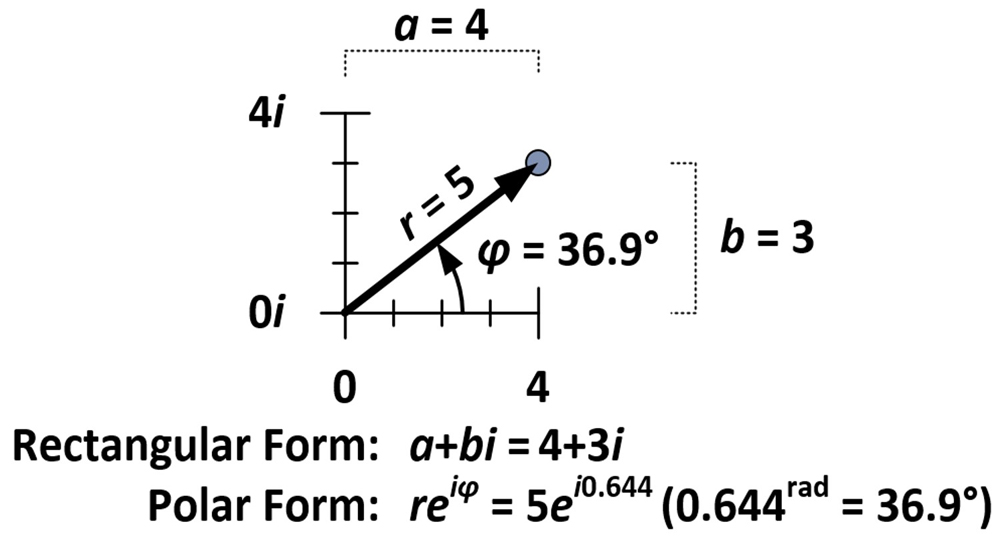
The number 4+3i is five units from the origin and forms an angle of 36.9 degrees with the horizontal axis. (Image credit: Robert J. Coolman)
The polar form requires that *φ* be measured in **radians**. One radian (1rad) is approximately 57.3 degrees; it’s the measure of angle made when a circle’s radius is wrapped against that circle’s circumference. A measure of [*π* radians](https://www.livescience.com/29197-what-is-pi.html) wraps half way around a circle; a measure of 2*π* radians wraps a full circle.
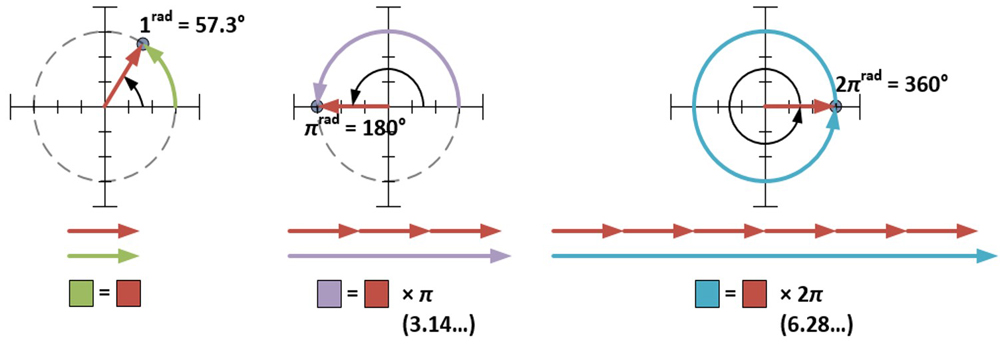
An angle measure of one radian is formed when a circle’s radius is wrapped against its circumference. A half-circle is π radians and a full circle is 2π radians. (Image credit: Robert J. Coolman)
The angle measure for 4+3*i* is 0.644 radians (36.9° = 0.644rad) meaning the polar form of 4+3*i* is 5*e**i*0\.644. Measures for *r* and *φ* can also be determined for each of the house-shape points, and yet another way of achieving the dilating/rotating effect of multiplying by 4+3*i* is to multiply each *r* by five, and add 36.9 degrees (or 0.644rad) to each *φ*. From this demonstration, we see that when complex numbers are multiplied together, distances multiply and angles add. This is due to a property intrinsic to exponents, which can be shown algebraically.
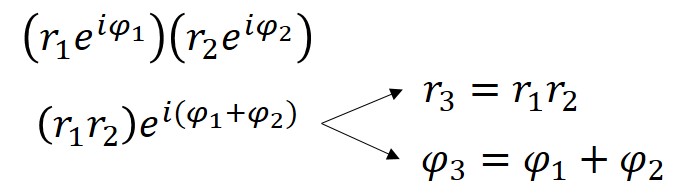
Using the polar form of complex numbers to show why distances multiply and angles add. (Image credit: Robert J. Coolman)
With the polar form of complex numbers established, the matter of Euler’s Identity is merely a special case of *a*\+*bi* for *a* \= -1 and *b* \= 0. Consequently for the polar form *re**iφ*, this makes *r*\= 1 and *φ* = *π* (since *π*rad = 180°).
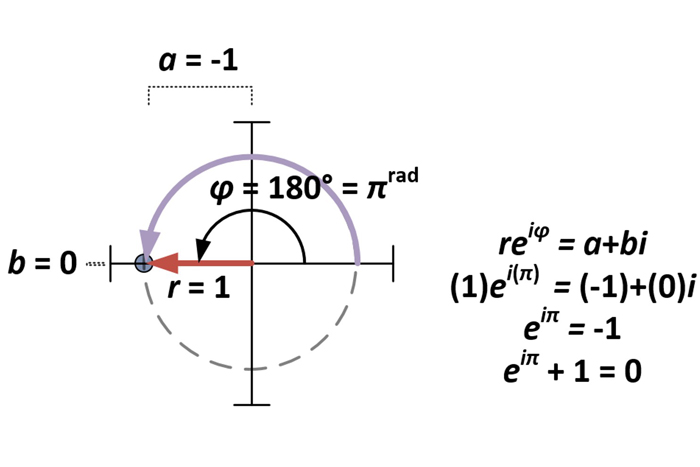
Euler’s Identity is a special case of a+bi for a = -1 and b = 0 and reiφ for r = 1 and φ = π. (Image credit: Robert J. Coolman)
## Derivation of polar form
Though Euler’s Identity follows from the polar form of complex numbers, it is impossible to derive the polar form (in particular the spontaneous appearance of the number *e*) without [calculus](https://www.livescience.com/50777-calculus.html).
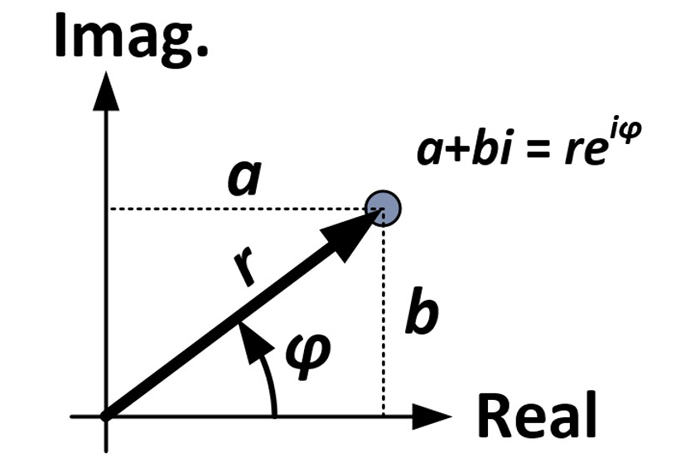
A general case of a complex number in both rectangular (a+bi) and polar (reiφ) forms. (Image credit: Robert J. Coolman)
We start with the rectangular form of a complex number:
*a* \+ *bi*
From the diagram and [trigonometry](https://www.livescience.com/51026-what-is-trigonometry.html), we can make the following substitutions:
(*r*·cos*φ*) + (*r*·sin*φ*)*i*
From here we can factor out *r*:
*r*·(cos*φ* + *i*·sin*φ*)
Sometimes “cos*φ* + *i*·sin*φ*” is named cis*φ*, which is shorthand for “[**c**osine plus **i**maginary **s**ine](http://mathworld.wolfram.com/Cis.html).”
*r*·cis*φ*
The function cis*φ* turns out to be equal to *e**iφ*. This is the part that’s impossible to show without calculus. Two derivations are shown below:

Two derivations for of cisφ = eiφ. Both use some form of calculus. (Image credit: Robert J. Coolman)
Thus, the equation *r*·cis*φ* is written in standard polar form *r*·e*iφ**.*
Additional resources
- [ResearchGate: What is Special in Euler's Identity?](http://www.researchgate.net/post/What_is_Special_in_Eulers_identity_e_ipi_102)
- [Academia.edu: Euler's Identity — A Mathematical Proof for the Existence of God](http://www.academia.edu/217151/Eulers_Identity), by Robin Robertson
- [Science4All: The Most Beautiful Equation of Math: Euler's Identity](http://www.science4all.org/le-nguyen-hoang/eulers-identity)
[Robert Coolman](https://www.livescience.com/author/robert-coolman)
Social Links Navigation
Live Science Contributor
Robert Coolman, PhD, is a teacher and a freelance science writer and is based in Madison, Wisconsin. He has written for Vice, Discover, Nautilus, Live Science and The Daily Beast. Robert spent his doctorate turning sawdust into gasoline-range fuels and chemicals for materials, medicine, electronics and agriculture. He is made of chemicals.
Read more
[ Black Holes Exotic prime numbers could be hiding inside black holes](https://www.livescience.com/space/black-holes/exotic-prime-numbers-could-be-hiding-inside-black-holes "Exotic prime numbers could be hiding inside black holes")
[ Mathematics AI just verified a proof that earned one of math's most prestigious prizes. Math will never be the same](https://www.livescience.com/physics-mathematics/mathematics/ai-just-verified-a-proof-that-earned-one-of-maths-most-prestigious-prizes-math-will-never-be-the-same-opinion "AI just verified a proof that earned one of math's most prestigious prizes. Math will never be the same")
[ Mathematics Pi has been calculated to trillions of digits — is that completely irrational?](https://www.livescience.com/physics-mathematics/mathematics/pi-has-been-calculated-to-trillions-of-digits-is-that-completely-irrational "Pi has been calculated to trillions of digits — is that completely irrational?")
[ Physics & Mathematics New tweak to Einstein's relativity could transform our understanding of the Big Bang](https://www.livescience.com/physics-mathematics/a-new-tweak-to-einsteins-relativity-could-transform-our-understanding-of-the-big-bang "New tweak to Einstein's relativity could transform our understanding of the Big Bang")
[ Physics & Mathematics Can you tie a knot in four dimensions? A mathematician explains](https://www.livescience.com/physics-mathematics/can-you-tie-a-knot-in-four-dimensions-a-mathematician-explains "Can you tie a knot in four dimensions? A mathematician explains")
[ Mathematics 'Proof by intimidation': AI is confidently solving 'impossible' math problems. But can it convince the world's top mathematicians?](https://www.livescience.com/physics-mathematics/mathematics/proof-by-intimidation-ai-is-confidently-solving-impossible-math-problems-but-can-it-convince-the-worlds-top-mathematicians "'Proof by intimidation': AI is confidently solving 'impossible' math problems. But can it convince the world's top mathematicians?")
Latest in Mathematics
[ Mathematics Pi has been calculated to trillions of digits — is that completely irrational?](https://www.livescience.com/physics-mathematics/mathematics/pi-has-been-calculated-to-trillions-of-digits-is-that-completely-irrational "Pi has been calculated to trillions of digits — is that completely irrational?")
[ Mathematics AI just verified a proof that earned one of math's most prestigious prizes. Math will never be the same](https://www.livescience.com/physics-mathematics/mathematics/ai-just-verified-a-proof-that-earned-one-of-maths-most-prestigious-prizes-math-will-never-be-the-same-opinion "AI just verified a proof that earned one of math's most prestigious prizes. Math will never be the same")
[ Mathematics 'Proof by intimidation': AI is confidently solving 'impossible' math problems. But can it convince the world's top mathematicians?](https://www.livescience.com/physics-mathematics/mathematics/proof-by-intimidation-ai-is-confidently-solving-impossible-math-problems-but-can-it-convince-the-worlds-top-mathematicians "'Proof by intimidation': AI is confidently solving 'impossible' math problems. But can it convince the world's top mathematicians?")
[ Mathematics Science history: Sophie Germain, first woman to win France's prestigious 'Grand Mathematics Prize' is snubbed when tickets to award ceremony are 'lost in the mail' — Jan. 9, 1816](https://www.livescience.com/physics-mathematics/mathematics/science-history-sophie-germain-first-woman-to-win-frances-prestigious-grand-mathematics-prize-is-snubbed-when-tickets-to-award-ceremony-are-lost-in-the-mail-jan-9-1816 "Science history: Sophie Germain, first woman to win France's prestigious 'Grand Mathematics Prize' is snubbed when tickets to award ceremony are 'lost in the mail' — Jan. 9, 1816")
[ Mathematics How many holes does the human body have?](https://www.livescience.com/physics-mathematics/mathematics/how-many-holes-does-the-human-body-have "How many holes does the human body have?")
[ Mathematics Law of 'maximal randomness' explains how broken objects shatter in the most annoying way possible](https://www.livescience.com/physics-mathematics/mathematics/law-of-maximal-randomness-explains-how-broken-objects-shatter-in-the-most-annoying-way-possible "Law of 'maximal randomness' explains how broken objects shatter in the most annoying way possible")
Latest in References
[ Allergies Top 5 mistakes when using air purifiers during hay fever season](https://www.livescience.com/health/allergies/top-5-mistakes-when-using-air-purifiers-during-hay-fever-season "Top 5 mistakes when using air purifiers during hay fever season")
[ Allergies Top 5 tips for surviving hay fever season](https://www.livescience.com/health/allergies/top-5-tips-for-surviving-hay-fever-season "Top 5 tips for surviving hay fever season")
[ Health The self-gifter's Christmas: Treat yourself to gear you'll actually want this Christmas](https://www.livescience.com/health/the-self-gifters-christmas-treat-yourself-to-gear-youll-actually-want-this-christmas "The self-gifter's Christmas: Treat yourself to gear you'll actually want this Christmas")
[ Health How to survive training for a marathon through winter (and what to buy)](https://www.livescience.com/health/how-to-survive-training-for-a-marathon-through-winter "How to survive training for a marathon through winter (and what to buy)")
[ Genetics Genetics: How do we inherit traits from our ancestors?](https://www.livescience.com/health/genetics/genetics-how-do-we-inherit-traits-from-our-ancestors "Genetics: How do we inherit traits from our ancestors?")
[ Aging Aging: What happens to the body as it gets older?](https://www.livescience.com/health/ageing/aging-what-happens-to-the-body-as-it-gets-older "Aging: What happens to the body as it gets older?")
LATEST ARTICLES
1. [](https://www.livescience.com/archaeology/human-evolution/human-ancestors-butchered-and-ate-elephants-18-million-years-ago-helping-to-fuel-their-large-brains "Human ancestors butchered and ate elephants 1.8 million years ago, helping to fuel their large brains")
1
[Human ancestors butchered and ate elephants 1.8 million years ago, helping to fuel their large brains](https://www.livescience.com/archaeology/human-evolution/human-ancestors-butchered-and-ate-elephants-18-million-years-ago-helping-to-fuel-their-large-brains)
2. 2
[Ancient Egyptian stone monument depicting a Roman emperor as a pharaoh discovered in Luxor](https://www.livescience.com/archaeology/ancient-egyptians/ancient-egyptian-stone-monument-depicting-a-roman-emperor-as-a-pharaoh-discovered-in-luxor)
3. 3
['Human minds shouldn't have to go through' this: Artemis II crew recalls unreal moment when Earth disappeared — Space photo of the week](https://www.livescience.com/space/human-minds-shouldnt-have-to-go-through-this-artemis-ii-crew-recalls-unreal-moment-when-earth-disappeared-space-photo-of-the-week)
4. 4
[Does the moon look the same from everywhere on Earth?](https://www.livescience.com/space/the-moon/does-the-moon-look-the-same-from-everywhere-on-earth)
5. 5
[I found a new meteor shower — and it comes from an asteroid getting baked to bits by the sun](https://www.livescience.com/space/meteoroids/i-found-a-new-meteor-shower-and-it-comes-from-an-asteroid-getting-baked-to-bits-by-the-sun)
Live Science is part of Future US Inc, an international media group and leading digital publisher. [Visit our corporate site](https://futureplc.com/).
[ Add as a preferred source on Google](https://google.com/preferences/source?q=livescience.com)
- [About Us](https://www.livescience.com/about-live-science)
- [Contact Future's experts](https://futureplc.com/contact/)
- [Terms and conditions](https://futureplc.com/terms-conditions/)
- [Privacy policy](https://futureplc.com/privacy-policy/)
- [Cookies policy](https://futureplc.com/cookies-policy/)
- [Accessibility Statement](https://futureplc.com/accessibility-statement/)
- [Advertise with us](https://go.future-advertising.com/Live-Science-Media-Kit.html)
- [Web notifications](https://www.livescience.com/how-to-turn-off-web-notifications-for-chrome-macos.html)
- [Careers](https://futureplc.com/careers/)
- [Editorial standards](https://www.livescience.com/editorial-standards)
- [How to pitch a story to us](https://www.livescience.com/how-to-pitch-live-science)
- [Do not sell or share my personal information](https://www.livescience.com/privacy-portal)
© Future US, Inc. Full 7th Floor, 130 West 42nd Street, New York, NY 10036.
Close
Please login or signup to comment
Please wait...
Login
Sign Up | |||||||||
| Readable Markdown | 
Euler's Equation (Image credit: public domain)
Euler’s identity is an equality found in mathematics that has been compared to a Shakespearean sonnet and described as "[the most beautiful equation](https://www.livescience.com/26584-5-mind-boggling-math-facts.html)." It is a special case of a foundational equation in complex arithmetic called Euler’s Formula, which the late great physicist Richard Feynman called [in his lectures](https://target.georiot.com/Proxy.ashx?tsid=74387&GR_URL=http%3A%2F%2Famazon.com%2FFeynman-Lectures-Physics-Vol-Millennium%2Fdp%2F0465024939%3Ftag%3Dhawk-future-20%26ascsubtag%3Dlivescience-us-5530728407723048703-20) "our jewel" and "the most remarkable formula in mathematics."
In an [interview with the BBC](http://www.bbc.com/news/science-environment-26151062), Prof David Percy of the Institute of Mathematics and its Applications said Euler's Identity was “a real classic and you can do no better than that … It is simple to look at and yet incredibly profound, it comprises the five most important mathematical constants.”
Euler's Identity is written simply as: *e**iπ* + 1 = 0
Article continues below
Latest Videos From Live Science
The five constants are:
- The [number 0](https://www.livescience.com/27853-who-invented-zero.html).
- The number 1.
- The [number *π*](https://www.livescience.com/29197-what-is-pi.html), an irrational number (with unending digits) that is the ratio of the circumference of a circle to its diameter. It is approximately 3.14159…
- The number *e*, also an irrational number. It is the base of [natural logarithms](https://www.livescience.com/50940-logarithms.html) that arises naturally through study of compound interest and [calculus](https://www.livescience.com/50777-calculus.html). The number *e* pervades math, appearing seemingly from nowhere in a vast number of important equations. It is approximately 2.71828….
- The [number *i*](https://www.livescience.com/42748-imaginary-numbers.html), defined as the square root of negative one: √(-1). The most fundamental of the imaginary numbers, so called because, in reality, no number can be multiplied by itself to produce a negative number (and, therefore, negative numbers have no real square roots). But in math, there are many situations where one is forced to take the square root of a negative. The letter *i* is therefore used as a sort of stand-in to mark places where this was done.
## Prolific mathematician
Leonhard Euler was an 18th-century Swiss-born mathematician who developed many concepts that are integral to modern mathematics. He spent most of his career in St. Petersburg, Russia. He was one of the most prolific mathematicians of all time, according to the [U.S. Naval Academy](http://www.usna.edu/Users/math/meh/euler.html) (USNA), with 886 papers and books published. Much of his output came during the last two decades of his life, when he was totally blind. There was so much work that the St. Petersburg Academy continued publishing his work posthumously for more than 30 years.
Euler's important contributions include Euler's Formula and Euler's Theorem, both of which can mean different things depending on the context. According to the USNA, in mechanics, there are "Euler angles (to specify the orientation of a rigid body), Euler's theorem (that every rotation has an axis), Euler's equations for motion of fluids, and the Euler-Lagrange equation (that comes from calculus of variations)."
## Multiplying complex numbers
Euler’s Identity stems naturally from interactions of [complex numbers](https://www.livescience.com/42966-complex-numbers.html) which are numbers composed of two pieces: a [real number](https://www.livescience.com/42619-real-numbers.html) and an [imaginary number](https://www.livescience.com/42748-imaginary-numbers.html); an example is 4+3*i*. Complex numbers appear in a multitude of applications such as wave mechanics (a study within [quantum mechanics](https://www.livescience.com/33816-quantum-mechanics-explanation.html)) and design of circuits that use alternating current (a common practice in [electrical engineering](https://www.livescience.com/47571-electrical-engineering.html)). Additionally, complex numbers (and their cousins, the [hyper complex numbers](http://mathworld.wolfram.com/HypercomplexNumber.html)) have a property that makes them especially useful for studying computer graphics, robotics, navigation, flight dynamics, and orbital mechanics: multiplying them together causes them to rotate. This property will help us understand the reasoning behind Euler’s Identity.
Get the world’s most fascinating discoveries delivered straight to your inbox.
In the example below, five complex numbers are plotted on the **complex plane** and together form a “house shape.” The complex plane is similar to a number line, except that it’s two-dimensional. The horizontal direction represents the real numbers and the vertical axis represents imaginary numbers. Each house-shape complex number is multiplied by the complex number 4+3*i* and re-plotted (green arrow). \[[Related: What Are Complex Numbers?](https://www.livescience.com/42966-complex-numbers.html)\]
As can be seen, multiplying by 4+3*i* results in the house shape **dilating** (increasing in area and moving away from the origin 0+0*i* by the same amount) and **rotating** (becoming tilted by some angle). To show this is precisely the effect of multiplying by 4+3i, the effect of zooming in on the house five times and rotating by 36.9 degrees is also shown (red arrow). The exact same effect is produced.

The same effect is produced from multiplying the vertices of a figure by 4+3i and rotating the figure by 36.9 degrees and dilating it by a factor of five. (Image credit: Robert J. Coolman)
Different amounts of dilation and rotation can produce the effects of multiplying by any number on the complex plane.
## Polar form of complex numbers
The amount of rotation and dilation is determined by properties intrinsic to the number 4+3*i,* which, as seen in the figure below, is five units from the origin (*r* = 5) and forms an angle of 36.9 degrees with the horizontal axis (*φ* = 36.9°). These measurements are used in what is known as the [**polar form**](http://mathworld.wolfram.com/PolarCoordinates.html) of a complex number (*re**iφ*) as opposed to the normal **rectangular form** (*a*\+*bi*).

The number 4+3i is five units from the origin and forms an angle of 36.9 degrees with the horizontal axis. (Image credit: Robert J. Coolman)
The polar form requires that *φ* be measured in **radians**. One radian (1rad) is approximately 57.3 degrees; it’s the measure of angle made when a circle’s radius is wrapped against that circle’s circumference. A measure of [*π* radians](https://www.livescience.com/29197-what-is-pi.html) wraps half way around a circle; a measure of 2*π* radians wraps a full circle.

An angle measure of one radian is formed when a circle’s radius is wrapped against its circumference. A half-circle is π radians and a full circle is 2π radians. (Image credit: Robert J. Coolman)
The angle measure for 4+3*i* is 0.644 radians (36.9° = 0.644rad) meaning the polar form of 4+3*i* is 5*e**i*0\.644. Measures for *r* and *φ* can also be determined for each of the house-shape points, and yet another way of achieving the dilating/rotating effect of multiplying by 4+3*i* is to multiply each *r* by five, and add 36.9 degrees (or 0.644rad) to each *φ*. From this demonstration, we see that when complex numbers are multiplied together, distances multiply and angles add. This is due to a property intrinsic to exponents, which can be shown algebraically.

Using the polar form of complex numbers to show why distances multiply and angles add. (Image credit: Robert J. Coolman)
With the polar form of complex numbers established, the matter of Euler’s Identity is merely a special case of *a*\+*bi* for *a* \= -1 and *b* \= 0. Consequently for the polar form *re**iφ*, this makes *r*\= 1 and *φ* = *π* (since *π*rad = 180°).

Euler’s Identity is a special case of a+bi for a = -1 and b = 0 and reiφ for r = 1 and φ = π. (Image credit: Robert J. Coolman)
## Derivation of polar form
Though Euler’s Identity follows from the polar form of complex numbers, it is impossible to derive the polar form (in particular the spontaneous appearance of the number *e*) without [calculus](https://www.livescience.com/50777-calculus.html).

A general case of a complex number in both rectangular (a+bi) and polar (reiφ) forms. (Image credit: Robert J. Coolman)
We start with the rectangular form of a complex number:
*a* \+ *bi*
From the diagram and [trigonometry](https://www.livescience.com/51026-what-is-trigonometry.html), we can make the following substitutions:
(*r*·cos*φ*) + (*r*·sin*φ*)*i*
From here we can factor out *r*:
*r*·(cos*φ* + *i*·sin*φ*)
Sometimes “cos*φ* + *i*·sin*φ*” is named cis*φ*, which is shorthand for “[**c**osine plus **i**maginary **s**ine](http://mathworld.wolfram.com/Cis.html).”
*r*·cis*φ*
The function cis*φ* turns out to be equal to *e**iφ*. This is the part that’s impossible to show without calculus. Two derivations are shown below:

Two derivations for of cisφ = eiφ. Both use some form of calculus. (Image credit: Robert J. Coolman)
Thus, the equation *r*·cis*φ* is written in standard polar form *r*·e*iφ**.*
Additional resources
- [ResearchGate: What is Special in Euler's Identity?](http://www.researchgate.net/post/What_is_Special_in_Eulers_identity_e_ipi_102)
- [Academia.edu: Euler's Identity — A Mathematical Proof for the Existence of God](http://www.academia.edu/217151/Eulers_Identity), by Robin Robertson
- [Science4All: The Most Beautiful Equation of Math: Euler's Identity](http://www.science4all.org/le-nguyen-hoang/eulers-identity)
Robert Coolman, PhD, is a teacher and a freelance science writer and is based in Madison, Wisconsin. He has written for Vice, Discover, Nautilus, Live Science and The Daily Beast. Robert spent his doctorate turning sawdust into gasoline-range fuels and chemicals for materials, medicine, electronics and agriculture. He is made of chemicals. | |||||||||
| ML Classification | ||||||||||
| ML Categories |
Raw JSON{
"/Science": 949,
"/Science/Mathematics": 948,
"/Science/Mathematics/Other": 934
} | |||||||||
| ML Page Types |
Raw JSON{
"/Article": 997,
"/Article/Tutorial_or_Guide": 570
} | |||||||||
| ML Intent Types |
Raw JSON{
"Informational": 999
} | |||||||||
| Content Metadata | ||||||||||
| Language | en | |||||||||
| Author | Robert Coolman | |||||||||
| Publish Time | 2015-07-01 08:40:28 (10 years ago) | |||||||||
| Original Publish Time | 2015-07-01 08:40:28 (10 years ago) | |||||||||
| Republished | No | |||||||||
| Word Count (Total) | 3,092 | |||||||||
| Word Count (Content) | 1,477 | |||||||||
| Links | ||||||||||
| External Links | 41 | |||||||||
| Internal Links | 80 | |||||||||
| Technical SEO | ||||||||||
| Meta Nofollow | No | |||||||||
| Meta Noarchive | No | |||||||||
| JS Rendered | Yes | |||||||||
| Redirect Target | null | |||||||||
| Performance | ||||||||||
| Download Time (ms) | 735 | |||||||||
| TTFB (ms) | 558 | |||||||||
| Download Size (bytes) | 256,043 | |||||||||
| Shard | 78 (laksa) | |||||||||
| Root Hash | 4110033003681956278 | |||||||||
| Unparsed URL | com,livescience!www,/51399-eulers-identity.html s443 | |||||||||