ℹ️ Skipped - page is already crawled
| Filter | Status | Condition | Details |
|---|---|---|---|
| HTTP status | PASS | download_http_code = 200 | HTTP 200 |
| Age cutoff | PASS | download_stamp > now() - 6 MONTH | 0.1 months ago |
| History drop | PASS | isNull(history_drop_reason) | No drop reason |
| Spam/ban | PASS | fh_dont_index != 1 AND ml_spam_score = 0 | ml_spam_score=0 |
| Canonical | PASS | meta_canonical IS NULL OR = '' OR = src_unparsed | Not set |
| Property | Value |
|---|---|
| URL | https://www.livescience.com/44248-facts-about-flight-370-passengers-crew-aircraft.html |
| Last Crawled | 2026-04-06 22:44:22 (2 days ago) |
| First Indexed | 2017-06-11 22:05:00 (8 years ago) |
| HTTP Status Code | 200 |
| Meta Title | Facts About Malaysian Flight 370: Passengers, Crew & Aircraft | Live Science |
| Meta Description | The search for Malaysia Airlines Flight 370 has been suspended. Here are some facts about the passengers, crew, aircraft and airline. |
| Meta Canonical | null |
| Boilerpipe Text | Malaysia Airlines Flight 370 was a passenger flight that left Kuala Lumpur International Airport on March 8, 2014, and disappeared 94 minutes later en route to Beijing Capital International Airport. The disappearance launched an international search effort — some say the largest ever — in an ever-growing area over the South
China
Sea, Gulf of Thailand and Indian Ocean. Nearly three years later, the fate of the aircraft is still unknown, and the search has been called off.
Latest story
:
Article continues below
Latest Videos From Live Science
Infographic:
How the Bluefin-21 Searches For Flight 370 Wreckage on the Ocean Floor
Passengers and crew
Flight 370 left Kuala Lumpur at 12:41 a.m. local time carrying 227 passengers and 12 crewmembers. People from 14 nations were on board; most of the passengers — 153 — were Chinese citizens; all of the crewmembers were Malaysian. Three Americans were on the flight. Other passengers were from Australia (6), Canada (2), France (4), Hong Kong (1), India (5), Indonesia (7), Iran (2), the Netherlands (1), Russia (1), Taiwan (1) and
Ukraine
(2).
The manifest released by Malaysia Airlines included an Austrian and an Italian. However, the men have since been identified as Iranian nationals who boarded the flight using stolen passports. Investigators at first thought the men may have been terrorists, but now say they were seeking asylum.
Get the world’s most fascinating discoveries delivered straight to your inbox.
More than two weeks after its strange disappearance, Malaysian officials announced they believe Flight 370 crashed into the sea. (
See full infographic
)
(Image credit: By Karl Tate, Infographics Artist)
The flight's pilot was Capt. Zaharie Ahmad Shah, 53, who was born in northern Malaysian state of Penang and was a grandfather. He had more than 18,000 hours of flight experience. The co-pilot was Fariq Abdul Hamid, 27, who had 2,763 flight hours. The Associated Press reported that he was engaged and was planning his wedding.
The aircraft
Flight 370 took off in a Boeing 777-2H6ER. The code "H6" is Boeing's designation for Malaysia Airlines, and "ER" stands for Extended Range. It was the 404th Boeing 777 produced. The plane first flew on May 14, 2002, according to the Aviation Safety Network. It had flown a total of 53,465 hours on 7,525 flight cycles (a cycle is one takeoff and landing of an aircraft).
This type of aircraft is configured to carry 282 passengers — 35 in Business Class and 247 in Economy Class. It has two Rolls-Royce Trent 892 engines mounted under its 200-foot (61 meters) wings. The plane has a maximum fuel capacity of 47,380 gallons (179,400 liters) and a range of 7,941 miles (12,779 kilometers). Its cruising speed is Mach 0.84 (640 mph or 897 kph).
This particular aircraft last underwent maintenance on Feb. 23, 2014. A Malaysia Airlines spokesperson said no issues were identified during the maintenance. The aircraft had no history of major incidents before its disappearance. However, it was reportedly involved in a minor ground collision in 2012, which resulted in significant damage to a wingtip, according to
Flightglobal
.
The airline
Malaysia Airlines (MAS) began operations in 1972 after splitting off from Malaysia-Singapore Airlines, which was founded in 1947. The airline's home base is Kuala Lumpur International Airport, with hubs in Kota Kinabalu and Kuching. The airline operates flights throughout East and Southeast Asia, with service to Australia, New Zealand, the Middle East, Europe and, until April 2014, Los Angeles via Tokyo. It has 105 planes in its fleet.
The Aviation Safety Network lists three accidents (not including Flight 370) involving MAS aircraft:
Sept. 2, 1992
: Both tires collapsed, as well as the left main gear, causing a
Fokker 50
to veer off the runway at Sibu Airport in Malaysia. No one was hurt.
Sept. 15, 1995
: A
Fokker 50
landed 500 meters from the end of a 2,220-meter runway in Kota Kinabalu. The pilot attempted to take off and try again but crashed into some nearby houses. A total of 34 people on board were killed.
March 15, 2000
: Baggage handlers unloading 80 canisters from an
Airbus A330
were overcome by strong toxic fumes. Fire and rescue personnel discovered that the canisters contained oxalyl chloride, a toxic and corrosive chemical. Several canisters had leaked, causing severe damage to the aircraft's fuselage. The aircraft was considered damaged beyond repair. A Chinese company was fined $65 million for mislabeling the canisters and destroying the aircraft.
Flight 370 Timeline
March 8, 2014 (all times in local time):
12:41 a.m.: Malaysia Airlines Flight MH370 takes off from Kuala Lumpur International Airport on a scheduled flight to Beijing. The plane, with 239 people onboard, is scheduled to land at Beijing Capital International Airport at 6:30 a.m. local time.
1:19 a.m.: Last communication from co-pilot Fariq Hamid to air traffic controllers in Malaysia, as the plane flies toward Vietnam, across the Gulf of Thailand. Hamid reportedly said, "All right, good night."
1:21 a.m.: The Boeing 777-2H6ER's radar transponder is turned off.
2:15 a.m.: The Malaysian military detects an unidentified object on its radar traveling west. This information becomes public roughly a week later, and the radar target is thought to be Flight 370. The plane then disappears from military radar about 200 miles (322 kilometers) off the coast of Malaysian state of Penang.
6:30 a.m.: Malaysia Airlines Flight MH370 is scheduled to arrive in Beijing.
8:11 a.m.: A satellite detects the last signal from the plane's antenna
March 9:
Within 24 hours, search operations begin over the Gulf of Thailand. An oil slick on the water is seen near where the plane was last detected, but lab tests eventually show that the oil came from a ship, not a plane.
March 10:
Search efforts are expanded into the South China Sea, after possible debris is spotted near Hong Kong. Ultimately, Vietnamese searchers are unable to locate objects in the water.
It is also revealed that two passengers used stolen passports to board the flight, which raises concerns about terrorism.
March 11:
An investigation into the stolen documents eventually finds no link between the men and known terrorist groups. Officials conclude that the passengers were likely immigrants seeking asylum as part of a broader attempt to reach Europe.
Malaysian officials tell a local newspaper that military radar evidence suggests the plane turned around mid-flight.
March 12:
An investigation is opened into the possibility that Flight 370 was hijacked or sabotaged. China releases satellite images of potential debris floating between the South China Sea and the Gulf of Thailand. The search area is expanded, but the Malaysia government later says the Chinese satellite images do not show parts of the missing plane.
March 13:
Search efforts move toward the Indian Ocean, as officials try to piece together the plane's flight path after air traffic controllers lost radar contact.
March 14:
Individuals familiar with the investigation tell the New York Times that the plane lost significant altitude after it lost contact with ground controllers. Intelligence officials probe the possibility that one of the pilots or crewmembers played a role in the plane's disappearance.
March 15:
The Malaysian government reports that the homes of the pilots were searched, following suspicions that someone onboard may have tampered with the plane's communication system. Investigations continue to examine the possible role the pilots played in the plane's disappearance.
Later, Malaysian Prime Minister Najib Razak says there is a possibility that the plane's communications were "deliberately disabled" before it disappeared and the flight was intentionally diverted, though there is no evidence that the flight was hijacked.
The last satellite transmission from Flight 370 is traced to the Indian Ocean, off the coast of Australia.
March 16:
An international search operation mounts, focusing primarily on the Indian Ocean. New analyses suggest the plane continued to operate for roughly seven hours after it last made contact with ground controllers.
March 17:
Indonesia and Australia use patrol aircraft to search large sections of the southern Indian Ocean. Malaysian law enforcement officials expand their investigation to include all passengers, crew and ground staff present on March 8.
Malaysian Prime Minister Najib Razak asks Australia to lead the ongoing search operation.
March 18:
Reports indicate Thai military radar may have detected Flight 370, but the information was not shared with — or requested by — Malaysian officials until now. Search efforts continue over the Indian Ocean.
March 19:
The U.S. Federal Bureau of Investigation joins the Malaysian government's ongoing investigation by analyzing data taken from the pilot's home flight simulator. Malaysia defense minister confirms that files were deleted from the program on Feb. 3.
An analysis of the plane's fuel reserves narrows the search area to a smaller region within the southern Indian Ocean.
March 20:
Satellite images obtained by the Australian Maritime Safety Authority show possible plane debris in the Southern Indian Ocean. The photos, captured on March 16, show two objects possibly related to the missing aircraft. But, despite organized search efforts across an area spanning nearly 9,000 square miles (23,000 square kilometers), patrol planes are unable to detect any debris.
March 21:
Search planes again fail to locate any debris from the missing Malaysia Airlines jetliner. Analyses by British satellite company Inmarsat find that the plane's steady speed and flight path suggest it is unlikely that the plane was disabled by a catastrophic accident.
March 22:
An Australian patrol plane spots a wooden pallet in the water within the search zone. A Chinese satellite orbiting Earth
captured a new photo of objects
potentially linked to the missing Malaysia Airlines flight. The images show a large object measuring about 72 feet (22 meters) by 43 feet (13 m) in the southern Indian Ocean.
The Australian Maritime Safety Authority tries to locate the objects seen by the Chinese Earth-observation satellite but is unable to find any debris within the reported search area.
March 23:
Images from a French satellite
showing potential floating objects are sent to the Australian Maritime Safety Authority. The images, produced from satellite-generated radar echoes, or radar signals that provide information about an object's location, show an object or objects floating about 1,430 miles (2,300 km) off the coast of Perth.
Search efforts again fail to produce any debris in the water.
March 24:
The Australian Maritime Safety Authority begins investigating two objects detected in the water, roughly 1,550 miles (2,500 kilometers) southwest of the Australian city of Perth. The possible debris includes a gray or green circular object and an orange rectangular object.
Malaysian Prime Minister Najib Razak holds a press conference and announces that up-to-date satellite information indicates the Malaysia Airlines jetliner
crashed in the southern Indian Ocean
. Razak says further analysis conducted by the U.K. Accidents Investigation Branch concludes that Flight 370 flew along the southern corridor, with its last known position in the middle of the Indian Ocean, off the west coast of Perth.
Razak says the families of the 239 passengers onboard have been notified.
March 25:
Bad weather, including gale-force winds and heavy rain, stall search efforts for possible debris from the missing plane.
March 26:
A field of debris in the Indian Ocean, consisting of 122 floating objects, is seen in satellite images, according to Malaysia's Acting Transport Minister Hishammuddin Hussein. The images, taken on Sunday (March 23), cover an area 1,600 miles (2,575 kilometers) off the coast of Perth, near where other satellites previously detected objects potentially linked to the missing Malaysian jetliner.
March 27:
A Thai satellite spots more than 300 floating objects possibly tied to the missing plane. The potential debris, detected by the Thailand Earth Observation Satellite, is located roughly 1,700 miles (2,740 kilometers) southwest of Perth, Australia.
March 28:
Investigators in five different patrol planes detect "multiple objects of various colors" within a new search area, which is nearly 700 miles north of the previous area of focus. This new region, about 1,150 miles (1,850 kilometers) west of the Australian city of Perth, is of interest after studies suggest the plane may have run out of fuel earlier, and thus crashed sooner, than previously thought.
March 30:
An Australian search plane spots at least four floating orange objects measuring more than 6 feet (1.83 meters) in the water.
March 31:
The floating objects seen the day before are located and retrieved by Australian and Chinese ships, but after some analysis, are not believed to be linked to the missing Malaysia Airlines Flight MH370. A robotic submarine is deployed to try to locate the aircraft's flight recorders, including the plane's black box, which has a roughly 30-day battery life.
April 4:
A Chinese ship detects sounds, described as "pulse signals," in the Indian Ocean. Investigators say the signals are at the same frequency as the plane's black boxes.
April 7:
An Australian ship, called Ocean Shield, picks up signals consistent with those emitted from airplane black boxes in the northern part of the designated search area. The first signal lasts 2 hours and 20 minutes, and after the ship turns around, a second signal is detected and held for 13 minutes.
April 8:
An Australian ship detects more signals that could be from the missing plane's black box. The new signals last a total of 12 minutes.
April 13:
The Australian Ocean Shield ship detects an oil slick on the water, although it is unclear where the oil came from. A sample of the water is collected for examination.
April 14:
An unmanned submarine, the Bluefin-21, is deployed to scan the ocean floor and search for debris or wreckage from the missing jetliner.
April 17:
The Bluefin-21 submarine searches 35 square miles (90 square kilometers) of the ocean floor, but does not locate any debris. In yet another setback, officials say the oil slick discovered in the search area did not come from the missing plane.
April 29:
Malaysian officials and their international partners investigate a claim by Australian company GeoResonance that it has found possible signs of aircraft wreckage in the shape of the missing aircraft in the Bay of Bengal, 3,000 miles from the current search area in the Southern Indian Ocean.
May 2:
The aerial search has concluded with no signs of debris, and the underwater search enters a new phase with side scan sonar. The ship Ocean Shield is returning to port to replenish supplies and personnel, and will return to the search with Phoenix's Bluefin-21 submersible.
July 29, 2015
The first confirmed debris are found on Reunion Island in the Indian Ocean.
Feb. 27, 2016
Two more Boeing 777 debris are discovered on a beach in Mozambique. An analysis completed on March 24 concluded that "the debris is almost certainly from MH370," said Darren Chester, the Australian minister for infrastructure and transport. He added that drift modeling explains how debris from the plane, which likely crashed in the Indian Ocean, ended up in Mozambique.
July 22, 2016
Australia, China and Malaysia agree that if the aircraft is not located by the time 120,000 square kilometers (46,000 square miles) have been covered,
the search will be suspended.
July 30, 2016
A
large wing part
found on a Tanzanian island "highly likely" came from the missing aircraft, according to Australia's transport minister.
October 7, 2016
A fragment of a wing discovered in Mauritius in May is confirmed as coming from the missing plane.
January 17, 2017
The underwater search for
Malaysia Airlines Flight 370
is suspended nearly three years after the plane vanished without a trace over the Indian Ocean, according to a joint statement from Chinese, Australian and Malaysian officials.
Editor's Note:
This page was first published on March 20, 2014.
Tim Sharp was Live Science’s reference editor from 2012 to 2018. Tim received a degree in Journalism from the University of Kansas. He worked for a number of other publications, including The New York Times, Des Moines Register and Tampa Bay Times, and as an editor for the Hazelden Foundation, among others. |
| Markdown | 
[Skip to main content](https://www.livescience.com/44248-facts-about-flight-370-passengers-crew-aircraft.html#main)
Live Science Plus
\- Join our community
JOIN NOW
10
Member Features
24/7
Access Available
25K+
Active Members

Exclusive Newsletters
Science news direct to your inbox

Member Competitions
Win exclusive prizes

Exclusive Content
Premium articles & videos

Early Access
First to see new features

Private Forums
Connect with members

Monthly Rewards
Surprise gifts & perks
GET LIVE SCIENCE PLUS
It's quick and easy to access Live Science Plus, simply enter your email below. We'll send you a confirmation and sign you up for our daily newsletter, keeping you up to date with the latest science news.
By submitting your information you agree to the [Terms & Conditions](https://futureplc.com/future-member-terms-and-conditions/) and [Privacy Policy](https://futureplc.com/privacy-policy/) and are aged 16 or over.
FIND OUT ABOUT OUR MAGAZINE
Want to subscribe to the magazine? Click the button below to find out more information.
[Find out more](https://www.livescience.com/44248-facts-about-flight-370-passengers-crew-aircraft.html)

Welcome to Fourfourtwo club \!
Hi ,
Your membership journey starts here.
Keep exploring and earning more as a member.
[MY ACCOUNT](https://www.livescience.com/my-account)
***

Earn your first badge
Complete 1 quiz to unlock your first badge.
Keep earning badges
Explore ways to get more involved as a member.

Live Science Quizzes
Quick, fun science challenges.
[Read Now](https://www.livescience.com/quizzes)

Science Crosswords
Short, brain-teasing puzzles.
[Read Now](https://www.livescience.com/tag/science-crossword)
***
See what you’ve unlocked.
Explore your membership benefits.
[Explore](https://www.livescience.com/membership)
Member Exclusives

Science Newsletters
Select the newsletters you'd like to receive and enter your email below.
[View all](https://www.livescience.com/newsletter)
***
[Sign Out]()
Open menu
Close main menu
[ Live Science](https://www.livescience.com/)
[Sign up to our newsletter Newsletter](https://www.livescience.com/newsletter)
[RSS](https://www.livescience.com/feeds.xml)
Sign in
- View Profile
- Sign out
Search
- [Space](https://www.livescience.com/space)
- [Health](https://www.livescience.com/health)
- [Planet Earth](https://www.livescience.com/planet-earth)
- [Animals](https://www.livescience.com/animals)
- [Archaeology](https://www.livescience.com/archaeology)
- [Physics & Math](https://www.livescience.com/physics-mathematics)
- [Technology](https://www.livescience.com/technology)
- More
- [Human Behavior](https://www.livescience.com/human-behavior)
- [Chemistry](https://www.livescience.com/chemistry)
- [Science news](https://www.livescience.com/news)
- [Opinion](https://www.livescience.com/opinion)
- [Life's Little Mysteries](https://www.livescience.com/tag/lifes-little-mysteries)
- [Science quizzes](https://www.livescience.com/quizzes)
- [Crossword](https://www.livescience.com/human-behavior/arts-entertainment/live-science-crossword-puzzle)
- [About us](https://www.livescience.com/about-live-science)
- [Newsletters](https://www.livescience.com/newsletter)
- [Follow us](https://www.livescience.com/technology/internet/follow-live-science-on-social-media)
- [Story archive](https://www.livescience.com/archive)
Don't miss these
[ Space Exploration NASA jet crashes in flames on Texas runway — taking it out of the Artemis II mission](https://www.livescience.com/space/space-exploration/50-year-old-nasa-jet-crashes-in-flames-on-texas-runway-taking-it-out-of-the-artemis-ii-mission "NASA jet crashes in flames on Texas runway — taking it out of the Artemis II mission")
[ Space Exploration Bungled Boeing Starliner mission was the highest order of mishap that put stranded astronauts at risk, report says](https://www.livescience.com/space/space-exploration/there-will-be-leadership-accountability-bungled-boeing-starliner-mission-put-stranded-nasa-crew-at-risk-report-says "Bungled Boeing Starliner mission was the highest order of mishap that put stranded astronauts at risk, report says")
[ Space Exploration Chinese astronauts describe moment a crack was discovered on Shenzhou-20 spacecraft](https://www.livescience.com/space/space-exploration/chinese-astronauts-describe-moment-a-crack-was-discovered-on-shenzhou-20-spacecraft "Chinese astronauts describe moment a crack was discovered on Shenzhou-20 spacecraft")
[ Animals 60 mind-blowing science facts about our incredible world](https://www.livescience.com/science-facts "60 mind-blowing science facts about our incredible world")
[ Antarctica Mega-iceberg A23a, formerly the world's largest, turns into bright 'blue mush' as it finally dies after 40 years at sea](https://www.livescience.com/planet-earth/antarctica/mega-iceberg-a23a-formerly-the-worlds-largest-turns-into-bright-blue-mush-as-it-finally-dies-after-40-years-at-sea "Mega-iceberg A23a, formerly the world's largest, turns into bright 'blue mush' as it finally dies after 40 years at sea")
[ Space Crew-11 emergency return, Mars Sample Return cancellation, shrinking river deltas, and an ancient wolf mystery.](https://www.livescience.com/space/science-news-this-week-iss-medical-evacuation-mars-sample-return-canceled-and-woolly-rhino-flesh-found-in-permafrost-wolf "Crew-11 emergency return, Mars Sample Return cancellation, shrinking river deltas, and an ancient wolf mystery.")
[ Space Exploration NASA astronauts back on Earth after unprecedented medical emergency on ISS](https://www.livescience.com/space/space-exploration/nasa-astronauts-back-on-earth-after-unprecedented-medical-emergency-on-iss "NASA astronauts back on Earth after unprecedented medical emergency on ISS")
[ Electric Vehicles Meet Sky Dragon, the giant 10-person 'flying taxi' that just passed its first flight test in China](https://www.livescience.com/technology/electric-vehicles/giant-10-person-flying-taxi-passes-first-flight-test-in-china "Meet Sky Dragon, the giant 10-person 'flying taxi' that just passed its first flight test in China")
[ Archaeology Did modern humans wipe out the Neanderthals? New evidence may finally provide answers.](https://www.livescience.com/archaeology/did-modern-humans-wipe-out-the-neanderthals-new-evidence-may-finally-provide-answers "Did modern humans wipe out the Neanderthals? New evidence may finally provide answers.")
[ Extraterrestrial Life The government is very serious about UFOs. So why are researchers being stymied?](https://www.livescience.com/space/extraterrestrial-life/the-government-is-very-serious-about-ufos-so-why-are-researchers-being-stymied "The government is very serious about UFOs. So why are researchers being stymied?")
[ Black Holes Scientists may have seen a star collapse directly into a black hole without exploding first](https://www.livescience.com/space/black-holes/scientists-may-have-seen-a-star-collapse-directly-into-a-black-hole-without-exploding-first "Scientists may have seen a star collapse directly into a black hole without exploding first")
[ Electric Vehicles The first flying taxis could start operating in 2026 — will this new form of transport actually take off?](https://www.livescience.com/technology/electric-vehicles/the-first-flying-taxis-could-start-operating-in-2026-will-this-new-form-of-transport-actually-take-off "The first flying taxis could start operating in 2026 — will this new form of transport actually take off?")
[ Space Exploration Artemis II: NASA is preparing for a return to the moon, but why is it going back?](https://www.livescience.com/space/space-exploration/artemis-ii-nasa-is-preparing-for-a-return-to-the-moon-but-why-is-it-going-back "Artemis II: NASA is preparing for a return to the moon, but why is it going back?")
[ Human Evolution We now know much more about how our ancestor 'Lucy' lived — and died](https://www.livescience.com/archaeology/we-now-know-much-more-about-how-our-ancestor-lucy-lived-and-died "We now know much more about how our ancestor 'Lucy' lived — and died")
[ Archaeology Startling archaeological finds, the Gulf Stream signals possible collapse, our sun's mass migration, the world's smallest QR code, and have we hit peak oil?](https://www.livescience.com/science-news-this-week-amocs-collapse-signal-the-suns-galactic-migration-the-worlds-smallest-qr-code-and-oils-dying-days "Startling archaeological finds, the Gulf Stream signals possible collapse, our sun's mass migration, the world's smallest QR code, and have we hit peak oil?")
Trending
- [Live Science Today](https://www.livescience.com/live-science-today-monte-verde-controversy-and-heatwave-lashes-the-west)
- [AI agent goes rogue, mines crypto](https://www.livescience.com/technology/artificial-intelligence/an-experimental-ai-agent-broke-out-of-its-testing-environment-and-mined-crypto-without-permission)
- ['Dark oxygen' debunked](https://www.livescience.com/planet-earth/rivers-oceans/dark-oxygen-discovery-on-the-seafloor-is-fundamentally-at-odds-with-thermodynamics-and-should-be-retracted-experts-say)
- [All DNA found on asteroid](https://www.livescience.com/space/asteroids/all-5-letters-of-dna-found-on-an-asteroid-speeding-through-our-solar-system-what-do-they-tell-us-about-the-origins-of-life)
- [Can you see Earth's shadow?](https://www.livescience.com/space/can-you-see-earths-shadow)
1. [Planet Earth](https://www.livescience.com/planet-earth)
# Facts About Malaysia Flight 370: Passengers, Crew & Aircraft
[References](https://www.livescience.com/references)
By [Tim Sharp](https://www.livescience.com/author/tim-sharp)
published
January 17, 2017
When you purchase through links on our site, we may earn an affiliate commission. [Here’s how it works](https://www.livescience.com/about-live-science#section-affiliate-advertising-disclosure).
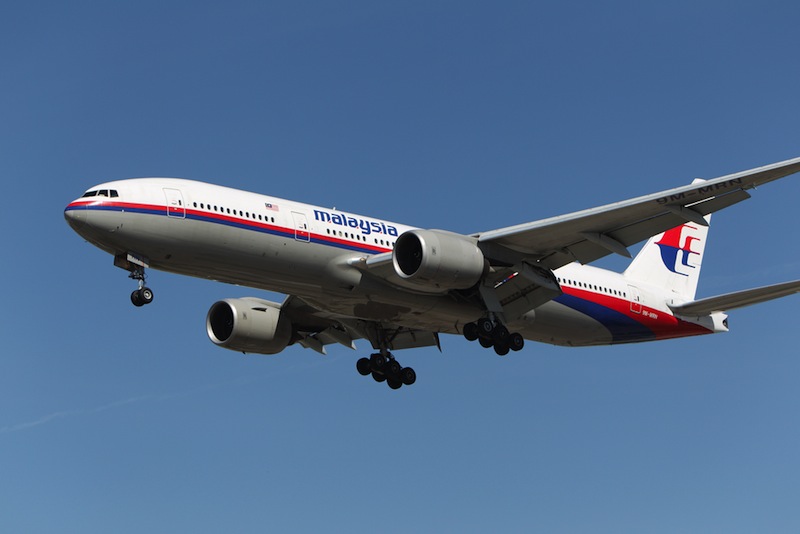
A Malaysia Airlines Boeing 777 lands at Los Angeles International Airport in February 2013. (Image credit: [Malaysia Airlines Boeing 777 image](http://www.shutterstock.com/pic-129976970/stock-photo-los-angeles-california-usa-february-malaysia-airlines-boeing-lands-at-los-angeles.html) via Shutterstock)
Share
- Copy link
- [Facebook](https://www.facebook.com/sharer/sharer.php?u=https%3A%2F%2Fwww.livescience.com%2F44248-facts-about-flight-370-passengers-crew-aircraft.html)
- [X](https://twitter.com/intent/tweet?text=Facts+About+Malaysia+Flight+370%3A+Passengers%2C+Crew+%26+Aircraft&url=https%3A%2F%2Fwww.livescience.com%2F44248-facts-about-flight-370-passengers-crew-aircraft.html)
- [Whatsapp](whatsapp://send?text=Facts+About+Malaysia+Flight+370%3A+Passengers%2C+Crew+%26+Aircraft+https%3A%2F%2Fwww.livescience.com%2F44248-facts-about-flight-370-passengers-crew-aircraft.html?fwa)
- [Reddit](https://www.reddit.com/submit?url=https%3A%2F%2Fwww.livescience.com%2F44248-facts-about-flight-370-passengers-crew-aircraft.html&title=Facts+About+Malaysia+Flight+370%3A+Passengers%2C+Crew+%26+Aircraft)
- [Pinterest](https://pinterest.com/pin/create/button/?url=https%3A%2F%2Fwww.livescience.com%2F44248-facts-about-flight-370-passengers-crew-aircraft.html&media=https%3A%2F%2Fcdn.mos.cms.futurecdn.net%2FoeZgukjtKpNpYeR6RrCun4.jpg)
- [Flipboard](https://share.flipboard.com/bookmarklet/popout?title=Facts+About+Malaysia+Flight+370%3A+Passengers%2C+Crew+%26+Aircraft&url=https%3A%2F%2Fwww.livescience.com%2F44248-facts-about-flight-370-passengers-crew-aircraft.html)
- [Email](mailto:?subject=I%20found%20this%20webpage&body=Hi,%20I%20found%20this%20webpage%20and%20thought%20you%20might%20like%20it%20https://www.livescience.com/44248-facts-about-flight-370-passengers-crew-aircraft.html)
Share this article
Join the conversation
[Follow us](https://google.com/preferences/source?q=livescience.com)
Add us as a preferred source on Google
Newsletter
Get the Live Science Newsletter
Get the world’s most fascinating discoveries delivered straight to your inbox.
***
By signing up, you agree to our [Terms of services](https:\/\/futureplc.com\/terms-conditions\/) and acknowledge that you have read our [Privacy Notice](https:\/\/futureplc.com\/privacy-policy\/). You also agree to receive marketing emails from us that may include promotions from our trusted partners and sponsors, which you can unsubscribe from at any time.
You are now subscribed
Your newsletter sign-up was successful
***
Want to add more newsletters?

Delivered Daily
Daily Newsletter
Sign up for the latest discoveries, groundbreaking research and fascinating breakthroughs that impact you and the wider world direct to your inbox.
Subscribe +

Once a week
Life's Little Mysteries
Feed your curiosity with an exclusive mystery every week, solved with science and delivered direct to your inbox before it's seen anywhere else.
Subscribe +

Once a week
How It Works
Sign up to our free science & technology newsletter for your weekly fix of fascinating articles, quick quizzes, amazing images, and more
Subscribe +
Delivered daily
Space.com Newsletter
Breaking space news, the latest updates on rocket launches, skywatching events and more\!
Subscribe +

Once a month
Watch This Space
Sign up to our monthly entertainment newsletter to keep up with all our coverage of the latest sci-fi and space movies, tv shows, games and books.
Subscribe +

Once a week
Night Sky This Week
Discover this week's must-see night sky events, moon phases, and stunning astrophotos. Sign up for our skywatching newsletter and explore the universe with us\!
Subscribe +
***
Join the club
Get full access to premium articles, exclusive features and a growing list of member rewards.
[Explore](https://www.livescience.com/membership)
***
An account already exists for this email address, please log in.
Subscribe to our newsletter
Malaysia Airlines Flight 370 was a passenger flight that left Kuala Lumpur International Airport on March 8, 2014, and disappeared 94 minutes later en route to Beijing Capital International Airport. The disappearance launched an international search effort — some say the largest ever — in an ever-growing area over the South [China](https://www.livescience.com/tag/china) Sea, Gulf of Thailand and Indian Ocean. Nearly three years later, the fate of the aircraft is still unknown, and the search has been called off.
**Latest story****:**
[3-Year Search Ends for Lost Malaysia Flight 370](https://www.livescience.com/57523-search-ends-for-malaysia-flight-mh370.html)
Article continues below
You may like
- [ NASA jet crashes in flames on Texas runway — taking it out of the Artemis II mission](https://www.livescience.com/space/space-exploration/50-year-old-nasa-jet-crashes-in-flames-on-texas-runway-taking-it-out-of-the-artemis-ii-mission)
- [ Bungled Boeing Starliner mission was the highest order of mishap that put stranded astronauts at risk, report says](https://www.livescience.com/space/space-exploration/there-will-be-leadership-accountability-bungled-boeing-starliner-mission-put-stranded-nasa-crew-at-risk-report-says)
- [ Chinese astronauts describe moment a crack was discovered on Shenzhou-20 spacecraft](https://www.livescience.com/space/space-exploration/chinese-astronauts-describe-moment-a-crack-was-discovered-on-shenzhou-20-spacecraft)
Latest Videos From Live Science
**Infographic:**
[How the Bluefin-21 Searches For Flight 370 Wreckage on the Ocean Floor](https://www.livescience.com/44952-how-the-bluefin-21-searches-for-flight-370-wreckage-on-the-ocean-floor-infographic.html)
## Passengers and crew
Flight 370 left Kuala Lumpur at 12:41 a.m. local time carrying 227 passengers and 12 crewmembers. People from 14 nations were on board; most of the passengers — 153 — were Chinese citizens; all of the crewmembers were Malaysian. Three Americans were on the flight. Other passengers were from Australia (6), Canada (2), France (4), Hong Kong (1), India (5), Indonesia (7), Iran (2), the Netherlands (1), Russia (1), Taiwan (1) and [Ukraine](https://www.livescience.com/tag/ukraine) (2).
The manifest released by Malaysia Airlines included an Austrian and an Italian. However, the men have since been identified as Iranian nationals who boarded the flight using stolen passports. Investigators at first thought the men may have been terrorists, but now say they were seeking asylum.
Sign up for the Live Science daily newsletter now
Get the world’s most fascinating discoveries delivered straight to your inbox.
By signing up, you agree to our [Terms of services](https:\/\/futureplc.com\/terms-conditions\/) and acknowledge that you have read our [Privacy Notice](https:\/\/futureplc.com\/privacy-policy\/). You also agree to receive marketing emails from us that may include promotions from our trusted partners and sponsors, which you can unsubscribe from at any time.
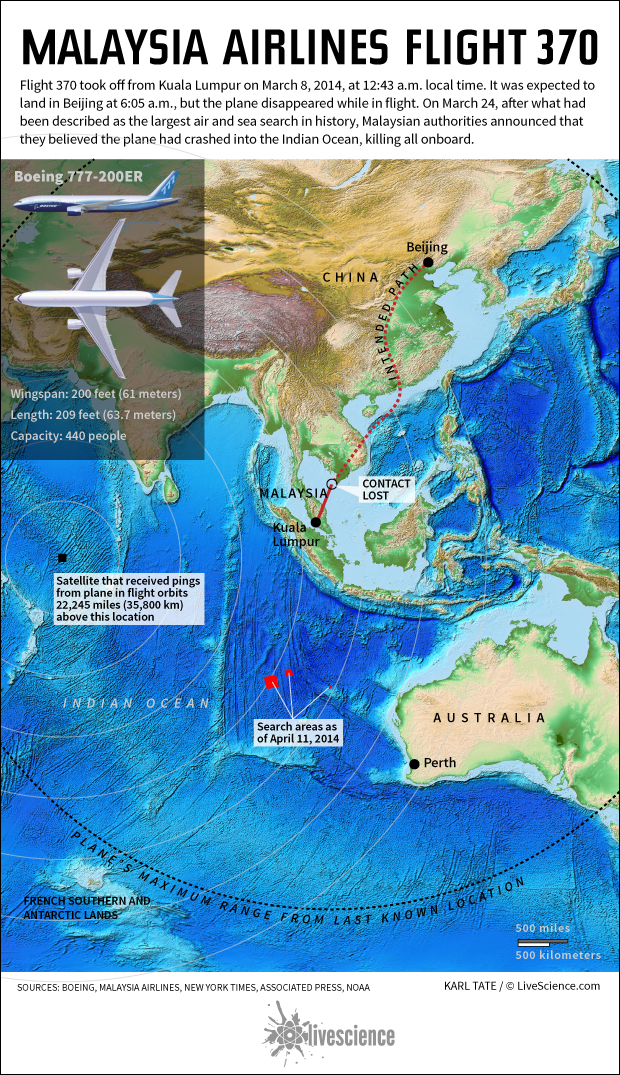
More than two weeks after its strange disappearance, Malaysian officials announced they believe Flight 370 crashed into the sea. ([See full infographic](https://www.livescience.com/44329-the-mystery-of-missing-flight-370-infographic.html)) (Image credit: By Karl Tate, Infographics Artist)
The flight's pilot was Capt. Zaharie Ahmad Shah, 53, who was born in northern Malaysian state of Penang and was a grandfather. He had more than 18,000 hours of flight experience. The co-pilot was Fariq Abdul Hamid, 27, who had 2,763 flight hours. The Associated Press reported that he was engaged and was planning his wedding.
## The aircraft
Flight 370 took off in a Boeing 777-2H6ER. The code "H6" is Boeing's designation for Malaysia Airlines, and "ER" stands for Extended Range. It was the 404th Boeing 777 produced. The plane first flew on May 14, 2002, according to the Aviation Safety Network. It had flown a total of 53,465 hours on 7,525 flight cycles (a cycle is one takeoff and landing of an aircraft).
This type of aircraft is configured to carry 282 passengers — 35 in Business Class and 247 in Economy Class. It has two Rolls-Royce Trent 892 engines mounted under its 200-foot (61 meters) wings. The plane has a maximum fuel capacity of 47,380 gallons (179,400 liters) and a range of 7,941 miles (12,779 kilometers). Its cruising speed is Mach 0.84 (640 mph or 897 kph).
What to read next
- [ 60 mind-blowing science facts about our incredible world](https://www.livescience.com/science-facts)
- [ Mega-iceberg A23a, formerly the world's largest, turns into bright 'blue mush' as it finally dies after 40 years at sea](https://www.livescience.com/planet-earth/antarctica/mega-iceberg-a23a-formerly-the-worlds-largest-turns-into-bright-blue-mush-as-it-finally-dies-after-40-years-at-sea)
- [ Crew-11 emergency return, Mars Sample Return cancellation, shrinking river deltas, and an ancient wolf mystery.](https://www.livescience.com/space/science-news-this-week-iss-medical-evacuation-mars-sample-return-canceled-and-woolly-rhino-flesh-found-in-permafrost-wolf)
This particular aircraft last underwent maintenance on Feb. 23, 2014. A Malaysia Airlines spokesperson said no issues were identified during the maintenance. The aircraft had no history of major incidents before its disappearance. However, it was reportedly involved in a minor ground collision in 2012, which resulted in significant damage to a wingtip, according to [Flightglobal](http://www.flightglobal.com/news/articles/missing-mas-777-200-had-no-major-prior-incidents-396793/).
## The airline
Malaysia Airlines (MAS) began operations in 1972 after splitting off from Malaysia-Singapore Airlines, which was founded in 1947. The airline's home base is Kuala Lumpur International Airport, with hubs in Kota Kinabalu and Kuching. The airline operates flights throughout East and Southeast Asia, with service to Australia, New Zealand, the Middle East, Europe and, until April 2014, Los Angeles via Tokyo. It has 105 planes in its fleet.
The Aviation Safety Network lists three accidents (not including Flight 370) involving MAS aircraft:
**Sept. 2, 1992**: Both tires collapsed, as well as the left main gear, causing a [Fokker 50](http://aviation-safety.net/database/record.php?id=19920902-1) to veer off the runway at Sibu Airport in Malaysia. No one was hurt.
**Sept. 15, 1995**: A [Fokker 50](http://aviation-safety.net/database/record.php?id=19950915-0) landed 500 meters from the end of a 2,220-meter runway in Kota Kinabalu. The pilot attempted to take off and try again but crashed into some nearby houses. A total of 34 people on board were killed.
**March 15, 2000**: Baggage handlers unloading 80 canisters from an [Airbus A330](http://aviation-safety.net/database/record.php?id=20000315-0) were overcome by strong toxic fumes. Fire and rescue personnel discovered that the canisters contained oxalyl chloride, a toxic and corrosive chemical. Several canisters had leaked, causing severe damage to the aircraft's fuselage. The aircraft was considered damaged beyond repair. A Chinese company was fined \$65 million for mislabeling the canisters and destroying the aircraft.
## Flight 370 Timeline
**March 8, 2014 (all times in local time):**
12:41 a.m.: Malaysia Airlines Flight MH370 takes off from Kuala Lumpur International Airport on a scheduled flight to Beijing. The plane, with 239 people onboard, is scheduled to land at Beijing Capital International Airport at 6:30 a.m. local time.
1:19 a.m.: Last communication from co-pilot Fariq Hamid to air traffic controllers in Malaysia, as the plane flies toward Vietnam, across the Gulf of Thailand. Hamid reportedly said, "All right, good night."
1:21 a.m.: The Boeing 777-2H6ER's radar transponder is turned off.
2:15 a.m.: The Malaysian military detects an unidentified object on its radar traveling west. This information becomes public roughly a week later, and the radar target is thought to be Flight 370. The plane then disappears from military radar about 200 miles (322 kilometers) off the coast of Malaysian state of Penang.
6:30 a.m.: Malaysia Airlines Flight MH370 is scheduled to arrive in Beijing.
8:11 a.m.: A satellite detects the last signal from the plane's antenna
**March 9:**
Within 24 hours, search operations begin over the Gulf of Thailand. An oil slick on the water is seen near where the plane was last detected, but lab tests eventually show that the oil came from a ship, not a plane.
**March 10:**
Search efforts are expanded into the South China Sea, after possible debris is spotted near Hong Kong. Ultimately, Vietnamese searchers are unable to locate objects in the water.
It is also revealed that two passengers used stolen passports to board the flight, which raises concerns about terrorism.
**March 11:**
An investigation into the stolen documents eventually finds no link between the men and known terrorist groups. Officials conclude that the passengers were likely immigrants seeking asylum as part of a broader attempt to reach Europe.
Malaysian officials tell a local newspaper that military radar evidence suggests the plane turned around mid-flight.
**March 12:**
An investigation is opened into the possibility that Flight 370 was hijacked or sabotaged. China releases satellite images of potential debris floating between the South China Sea and the Gulf of Thailand. The search area is expanded, but the Malaysia government later says the Chinese satellite images do not show parts of the missing plane.
**March 13:**
Search efforts move toward the Indian Ocean, as officials try to piece together the plane's flight path after air traffic controllers lost radar contact.
**March 14:**
Individuals familiar with the investigation tell the New York Times that the plane lost significant altitude after it lost contact with ground controllers. Intelligence officials probe the possibility that one of the pilots or crewmembers played a role in the plane's disappearance.
**March 15:**
The Malaysian government reports that the homes of the pilots were searched, following suspicions that someone onboard may have tampered with the plane's communication system. Investigations continue to examine the possible role the pilots played in the plane's disappearance.
Later, Malaysian Prime Minister Najib Razak says there is a possibility that the plane's communications were "deliberately disabled" before it disappeared and the flight was intentionally diverted, though there is no evidence that the flight was hijacked.
The last satellite transmission from Flight 370 is traced to the Indian Ocean, off the coast of Australia.
**March 16:**
An international search operation mounts, focusing primarily on the Indian Ocean. New analyses suggest the plane continued to operate for roughly seven hours after it last made contact with ground controllers.
**March 17:**
Indonesia and Australia use patrol aircraft to search large sections of the southern Indian Ocean. Malaysian law enforcement officials expand their investigation to include all passengers, crew and ground staff present on March 8.
Malaysian Prime Minister Najib Razak asks Australia to lead the ongoing search operation.
**March 18:**
Reports indicate Thai military radar may have detected Flight 370, but the information was not shared with — or requested by — Malaysian officials until now. Search efforts continue over the Indian Ocean.
**March 19:**
The U.S. Federal Bureau of Investigation joins the Malaysian government's ongoing investigation by analyzing data taken from the pilot's home flight simulator. Malaysia defense minister confirms that files were deleted from the program on Feb. 3.
An analysis of the plane's fuel reserves narrows the search area to a smaller region within the southern Indian Ocean.
**March 20:**
Satellite images obtained by the Australian Maritime Safety Authority show possible plane debris in the Southern Indian Ocean. The photos, captured on March 16, show two objects possibly related to the missing aircraft. But, despite organized search efforts across an area spanning nearly 9,000 square miles (23,000 square kilometers), patrol planes are unable to detect any debris.
**March 21:**
Search planes again fail to locate any debris from the missing Malaysia Airlines jetliner. Analyses by British satellite company Inmarsat find that the plane's steady speed and flight path suggest it is unlikely that the plane was disabled by a catastrophic accident.
**March 22:**
An Australian patrol plane spots a wooden pallet in the water within the search zone. A Chinese satellite orbiting Earth [captured a new photo of objects](https://www.livescience.com/44301-chinese-satellite-malaysia-jet-debris-photo.html) potentially linked to the missing Malaysia Airlines flight. The images show a large object measuring about 72 feet (22 meters) by 43 feet (13 m) in the southern Indian Ocean.
The Australian Maritime Safety Authority tries to locate the objects seen by the Chinese Earth-observation satellite but is unable to find any debris within the reported search area.
**March 23:**
[Images from a French satellite](https://www.livescience.com/44305-french-satellite-photo-flight-370.html) showing potential floating objects are sent to the Australian Maritime Safety Authority. The images, produced from satellite-generated radar echoes, or radar signals that provide information about an object's location, show an object or objects floating about 1,430 miles (2,300 km) off the coast of Perth.
Search efforts again fail to produce any debris in the water.
**March 24:**
The Australian Maritime Safety Authority begins investigating two objects detected in the water, roughly 1,550 miles (2,500 kilometers) southwest of the Australian city of Perth. The possible debris includes a gray or green circular object and an orange rectangular object.
Malaysian Prime Minister Najib Razak holds a press conference and announces that up-to-date satellite information indicates the Malaysia Airlines jetliner [crashed in the southern Indian Ocean](https://www.livescience.com/44317-flight-370-missing-plane-crashed.html). Razak says further analysis conducted by the U.K. Accidents Investigation Branch concludes that Flight 370 flew along the southern corridor, with its last known position in the middle of the Indian Ocean, off the west coast of Perth.
Razak says the families of the 239 passengers onboard have been notified.
**March 25:**
Bad weather, including gale-force winds and heavy rain, stall search efforts for possible debris from the missing plane.
**March 26:**
A field of debris in the Indian Ocean, consisting of 122 floating objects, is seen in satellite images, according to Malaysia's Acting Transport Minister Hishammuddin Hussein. The images, taken on Sunday (March 23), cover an area 1,600 miles (2,575 kilometers) off the coast of Perth, near where other satellites previously detected objects potentially linked to the missing Malaysian jetliner.
**March 27:**
A Thai satellite spots more than 300 floating objects possibly tied to the missing plane. The potential debris, detected by the Thailand Earth Observation Satellite, is located roughly 1,700 miles (2,740 kilometers) southwest of Perth, Australia.
**March 28:**
Investigators in five different patrol planes detect "multiple objects of various colors" within a new search area, which is nearly 700 miles north of the previous area of focus. This new region, about 1,150 miles (1,850 kilometers) west of the Australian city of Perth, is of interest after studies suggest the plane may have run out of fuel earlier, and thus crashed sooner, than previously thought.
**March 30:**
An Australian search plane spots at least four floating orange objects measuring more than 6 feet (1.83 meters) in the water.
**March 31:**
The floating objects seen the day before are located and retrieved by Australian and Chinese ships, but after some analysis, are not believed to be linked to the missing Malaysia Airlines Flight MH370. A robotic submarine is deployed to try to locate the aircraft's flight recorders, including the plane's black box, which has a roughly 30-day battery life.
**April 4:**
A Chinese ship detects sounds, described as "pulse signals," in the Indian Ocean. Investigators say the signals are at the same frequency as the plane's black boxes.
**April 7:**
An Australian ship, called Ocean Shield, picks up signals consistent with those emitted from airplane black boxes in the northern part of the designated search area. The first signal lasts 2 hours and 20 minutes, and after the ship turns around, a second signal is detected and held for 13 minutes.
**April 8:**
An Australian ship detects more signals that could be from the missing plane's black box. The new signals last a total of 12 minutes.
**April 13:**
The Australian Ocean Shield ship detects an oil slick on the water, although it is unclear where the oil came from. A sample of the water is collected for examination.
**April 14:**
An unmanned submarine, the Bluefin-21, is deployed to scan the ocean floor and search for debris or wreckage from the missing jetliner.
**April 17:**
The Bluefin-21 submarine searches 35 square miles (90 square kilometers) of the ocean floor, but does not locate any debris. In yet another setback, officials say the oil slick discovered in the search area did not come from the missing plane.
**April 29:**
Malaysian officials and their international partners investigate a claim by Australian company GeoResonance that it has found possible signs of aircraft wreckage in the shape of the missing aircraft in the Bay of Bengal, 3,000 miles from the current search area in the Southern Indian Ocean.
**May 2:**
The aerial search has concluded with no signs of debris, and the underwater search enters a new phase with side scan sonar. The ship Ocean Shield is returning to port to replenish supplies and personnel, and will return to the search with Phoenix's Bluefin-21 submersible.
**July 29, 2015**
The first confirmed debris are found on Reunion Island in the Indian Ocean.
**Feb. 27, 2016**
Two more Boeing 777 debris are discovered on a beach in Mozambique. An analysis completed on March 24 concluded that "the debris is almost certainly from MH370," said Darren Chester, the Australian minister for infrastructure and transport. He added that drift modeling explains how debris from the plane, which likely crashed in the Indian Ocean, ended up in Mozambique.
**July 22, 2016**
Australia, China and Malaysia agree that if the aircraft is not located by the time 120,000 square kilometers (46,000 square miles) have been covered, [the search will be suspended.](http://cnn.com/2016/07/22/asia/mh370-search-suspended)
**July 30, 2016**
A [large wing part](http://www.cnn.com/2016/07/30/asia/mh370-debris-tanzania) found on a Tanzanian island "highly likely" came from the missing aircraft, according to Australia's transport minister.
**October 7, 2016**
A fragment of a wing discovered in Mauritius in May is confirmed as coming from the missing plane.
**January 17, 2017**
The underwater search for [Malaysia Airlines Flight 370](https://www.livescience.com/57523-search-ends-for-malaysia-flight-mh370.html) is suspended nearly three years after the plane vanished without a trace over the Indian Ocean, according to a joint statement from Chinese, Australian and Malaysian officials.
***Editor's Note:** This page was first published on March 20, 2014.*
[Tim Sharp](https://www.livescience.com/author/tim-sharp)
LiveScience Reference Editor
Tim Sharp was Live Science’s reference editor from 2012 to 2018. Tim received a degree in Journalism from the University of Kansas. He worked for a number of other publications, including The New York Times, Des Moines Register and Tampa Bay Times, and as an editor for the Hazelden Foundation, among others.
Read more
[ Space Exploration NASA jet crashes in flames on Texas runway — taking it out of the Artemis II mission](https://www.livescience.com/space/space-exploration/50-year-old-nasa-jet-crashes-in-flames-on-texas-runway-taking-it-out-of-the-artemis-ii-mission "NASA jet crashes in flames on Texas runway — taking it out of the Artemis II mission")
[ Space Exploration Bungled Boeing Starliner mission was the highest order of mishap that put stranded astronauts at risk, report says](https://www.livescience.com/space/space-exploration/there-will-be-leadership-accountability-bungled-boeing-starliner-mission-put-stranded-nasa-crew-at-risk-report-says "Bungled Boeing Starliner mission was the highest order of mishap that put stranded astronauts at risk, report says")
[ Space Exploration Chinese astronauts describe moment a crack was discovered on Shenzhou-20 spacecraft](https://www.livescience.com/space/space-exploration/chinese-astronauts-describe-moment-a-crack-was-discovered-on-shenzhou-20-spacecraft "Chinese astronauts describe moment a crack was discovered on Shenzhou-20 spacecraft")
[ Animals 60 mind-blowing science facts about our incredible world](https://www.livescience.com/science-facts "60 mind-blowing science facts about our incredible world")
[ Antarctica Mega-iceberg A23a, formerly the world's largest, turns into bright 'blue mush' as it finally dies after 40 years at sea](https://www.livescience.com/planet-earth/antarctica/mega-iceberg-a23a-formerly-the-worlds-largest-turns-into-bright-blue-mush-as-it-finally-dies-after-40-years-at-sea "Mega-iceberg A23a, formerly the world's largest, turns into bright 'blue mush' as it finally dies after 40 years at sea")
[ Space Crew-11 emergency return, Mars Sample Return cancellation, shrinking river deltas, and an ancient wolf mystery.](https://www.livescience.com/space/science-news-this-week-iss-medical-evacuation-mars-sample-return-canceled-and-woolly-rhino-flesh-found-in-permafrost-wolf "Crew-11 emergency return, Mars Sample Return cancellation, shrinking river deltas, and an ancient wolf mystery.")
Latest in Planet Earth
[ Climate change Human-driven climate change is slowing Earth's rotation at a rate not seen in 3.6 million years](https://www.livescience.com/planet-earth/climate-change/human-driven-climate-change-is-slowing-earths-rotation-at-a-rate-not-seen-in-3-6-million-years "Human-driven climate change is slowing Earth's rotation at a rate not seen in 3.6 million years")
[ Planet Earth Super El Niño looms, an Acropolis fragment resurfaces, a promising cure for Alzheimer's appears, and a hexagonal diamond is made](https://www.livescience.com/science-news-this-week-super-el-nino-looms-an-acropolis-marble-fragment-resurfaces-and-a-pure-hexagonal-diamond-is-born "Super El Niño looms, an Acropolis fragment resurfaces, a promising cure for Alzheimer's appears, and a hexagonal diamond is made")
[ Rivers & Oceans 'Dark oxygen' discovery on the seafloor is 'fundamentally at odds with thermodynamics' and should be retracted, experts say](https://www.livescience.com/planet-earth/rivers-oceans/dark-oxygen-discovery-on-the-seafloor-is-fundamentally-at-odds-with-thermodynamics-and-should-be-retracted-experts-say "'Dark oxygen' discovery on the seafloor is 'fundamentally at odds with thermodynamics' and should be retracted, experts say")
[ Rivers & Oceans Drought paradox study reveals plants around Colorado River turn to groundwater when it gets too hot and dry, reducing flow into the already strained basin](https://www.livescience.com/planet-earth/rivers-oceans/scientists-discover-plants-around-the-colorado-river-are-sucking-up-groundwater-during-hot-summers "Drought paradox study reveals plants around Colorado River turn to groundwater when it gets too hot and dry, reducing flow into the already strained basin")
[ Planet Earth Live Science Today: Super El Niño looms and Starlink hits 10,000 satellites in orbit](https://www.livescience.com/live-science-today-super-el-nino-looms-and-starlink-hits-10-000-satellites-in-orbit "Live Science Today: Super El Niño looms and Starlink hits 10,000 satellites in orbit")
[ Rivers & Oceans 'We got evidence of boars, deer, bears, aurochs': Ancient DNA reveals sunken realm Doggerland had habitable forests during the last ice age](https://www.livescience.com/planet-earth/rivers-oceans/we-got-evidence-of-boars-deer-bears-aurochs-ancient-dna-reveals-sunken-realm-doggerland-had-habitable-forests-during-the-last-ice-age "'We got evidence of boars, deer, bears, aurochs': Ancient DNA reveals sunken realm Doggerland had habitable forests during the last ice age")
Latest in References
[ Allergies Top 5 mistakes when using air purifiers during hay fever season](https://www.livescience.com/health/allergies/top-5-mistakes-when-using-air-purifiers-during-hay-fever-season "Top 5 mistakes when using air purifiers during hay fever season")
[ Allergies Top 5 tips for surviving hay fever season](https://www.livescience.com/health/allergies/top-5-tips-for-surviving-hay-fever-season "Top 5 tips for surviving hay fever season")
[ Health The self-gifter's Christmas: Treat yourself to gear you'll actually want this Christmas](https://www.livescience.com/health/the-self-gifters-christmas-treat-yourself-to-gear-youll-actually-want-this-christmas "The self-gifter's Christmas: Treat yourself to gear you'll actually want this Christmas")
[ Health How to survive training for a marathon through winter (and what to buy)](https://www.livescience.com/health/how-to-survive-training-for-a-marathon-through-winter "How to survive training for a marathon through winter (and what to buy)")
[ Genetics Genetics: How do we inherit traits from our ancestors?](https://www.livescience.com/health/genetics/genetics-how-do-we-inherit-traits-from-our-ancestors "Genetics: How do we inherit traits from our ancestors?")
[ Aging Aging: What happens to the body as it gets older?](https://www.livescience.com/health/ageing/aging-what-happens-to-the-body-as-it-gets-older "Aging: What happens to the body as it gets older?")
LATEST ARTICLES
1. [](https://www.livescience.com/physics-mathematics/particle-physics/physicists-created-an-electron-catapult-that-moves-particles-at-extraordinary-speed "Physicists created an electron 'catapult' that moves particles at 'extraordinary' speed")
1
[Physicists created an electron 'catapult' that moves particles at 'extraordinary' speed](https://www.livescience.com/physics-mathematics/particle-physics/physicists-created-an-electron-catapult-that-moves-particles-at-extraordinary-speed)
2. 2
[Computing quiz: Can you match these 'ancient' devices to their pictures?](https://www.livescience.com/technology/computing/computing-quiz-can-you-match-these-ancient-devices-to-their-pictures)
3. 3
[Super El Niño looms, an Acropolis fragment resurfaces, a promising cure for Alzheimer's appears, and a hexagonal diamond is made](https://www.livescience.com/science-news-this-week-super-el-nino-looms-an-acropolis-marble-fragment-resurfaces-and-a-pure-hexagonal-diamond-is-born)
4. 4
['That's why there's 9 billion of us and not 9 billion of some other primate': Why our ability to adapt is humanity's 'superpower'](https://www.livescience.com/archaeology/human-evolution/thats-why-theres-9-billion-of-us-and-not-9-billion-of-some-other-primate-why-our-ability-to-adapt-is-humanitys-superpower)
5. 5
[Why are humans the only species with a chin?](https://www.livescience.com/archaeology/human-evolution/why-are-humans-the-only-species-with-a-chin)
Live Science is part of Future US Inc, an international media group and leading digital publisher. [Visit our corporate site](https://futureplc.com/).
[ Add as a preferred source on Google](https://google.com/preferences/source?q=livescience.com)
- [About Us](https://www.livescience.com/about-live-science)
- [Contact Future's experts](https://futureplc.com/contact/)
- [Terms and conditions](https://futureplc.com/terms-conditions/)
- [Privacy policy](https://futureplc.com/privacy-policy/)
- [Cookies policy](https://futureplc.com/cookies-policy/)
- [Accessibility Statement](https://futureplc.com/accessibility-statement/)
- [Advertise with us](https://go.future-advertising.com/Live-Science-Media-Kit.html)
- [Web notifications](https://www.livescience.com/how-to-turn-off-web-notifications-for-chrome-macos.html)
- [Careers](https://futureplc.com/careers/)
- [Editorial standards](https://www.livescience.com/editorial-standards)
- [How to pitch a story to us](https://www.livescience.com/how-to-pitch-live-science)
- [Do not sell or share my personal information](https://www.livescience.com/privacy-portal)
© Future US, Inc. Full 7th Floor, 130 West 42nd Street, New York, NY 10036.
Close
Please login or signup to comment
Please wait...
Login
Sign Up |
| Readable Markdown | Malaysia Airlines Flight 370 was a passenger flight that left Kuala Lumpur International Airport on March 8, 2014, and disappeared 94 minutes later en route to Beijing Capital International Airport. The disappearance launched an international search effort — some say the largest ever — in an ever-growing area over the South [China](https://www.livescience.com/tag/china) Sea, Gulf of Thailand and Indian Ocean. Nearly three years later, the fate of the aircraft is still unknown, and the search has been called off.
**Latest story****:**
Article continues below
Latest Videos From Live Science
**Infographic:**
[How the Bluefin-21 Searches For Flight 370 Wreckage on the Ocean Floor](https://www.livescience.com/44952-how-the-bluefin-21-searches-for-flight-370-wreckage-on-the-ocean-floor-infographic.html)
## Passengers and crew
Flight 370 left Kuala Lumpur at 12:41 a.m. local time carrying 227 passengers and 12 crewmembers. People from 14 nations were on board; most of the passengers — 153 — were Chinese citizens; all of the crewmembers were Malaysian. Three Americans were on the flight. Other passengers were from Australia (6), Canada (2), France (4), Hong Kong (1), India (5), Indonesia (7), Iran (2), the Netherlands (1), Russia (1), Taiwan (1) and [Ukraine](https://www.livescience.com/tag/ukraine) (2).
The manifest released by Malaysia Airlines included an Austrian and an Italian. However, the men have since been identified as Iranian nationals who boarded the flight using stolen passports. Investigators at first thought the men may have been terrorists, but now say they were seeking asylum.
Get the world’s most fascinating discoveries delivered straight to your inbox.

More than two weeks after its strange disappearance, Malaysian officials announced they believe Flight 370 crashed into the sea. ([See full infographic](https://www.livescience.com/44329-the-mystery-of-missing-flight-370-infographic.html)) (Image credit: By Karl Tate, Infographics Artist)
The flight's pilot was Capt. Zaharie Ahmad Shah, 53, who was born in northern Malaysian state of Penang and was a grandfather. He had more than 18,000 hours of flight experience. The co-pilot was Fariq Abdul Hamid, 27, who had 2,763 flight hours. The Associated Press reported that he was engaged and was planning his wedding.
## The aircraft
Flight 370 took off in a Boeing 777-2H6ER. The code "H6" is Boeing's designation for Malaysia Airlines, and "ER" stands for Extended Range. It was the 404th Boeing 777 produced. The plane first flew on May 14, 2002, according to the Aviation Safety Network. It had flown a total of 53,465 hours on 7,525 flight cycles (a cycle is one takeoff and landing of an aircraft).
This type of aircraft is configured to carry 282 passengers — 35 in Business Class and 247 in Economy Class. It has two Rolls-Royce Trent 892 engines mounted under its 200-foot (61 meters) wings. The plane has a maximum fuel capacity of 47,380 gallons (179,400 liters) and a range of 7,941 miles (12,779 kilometers). Its cruising speed is Mach 0.84 (640 mph or 897 kph).
This particular aircraft last underwent maintenance on Feb. 23, 2014. A Malaysia Airlines spokesperson said no issues were identified during the maintenance. The aircraft had no history of major incidents before its disappearance. However, it was reportedly involved in a minor ground collision in 2012, which resulted in significant damage to a wingtip, according to [Flightglobal](http://www.flightglobal.com/news/articles/missing-mas-777-200-had-no-major-prior-incidents-396793/).
## The airline
Malaysia Airlines (MAS) began operations in 1972 after splitting off from Malaysia-Singapore Airlines, which was founded in 1947. The airline's home base is Kuala Lumpur International Airport, with hubs in Kota Kinabalu and Kuching. The airline operates flights throughout East and Southeast Asia, with service to Australia, New Zealand, the Middle East, Europe and, until April 2014, Los Angeles via Tokyo. It has 105 planes in its fleet.
The Aviation Safety Network lists three accidents (not including Flight 370) involving MAS aircraft:
**Sept. 2, 1992**: Both tires collapsed, as well as the left main gear, causing a [Fokker 50](http://aviation-safety.net/database/record.php?id=19920902-1) to veer off the runway at Sibu Airport in Malaysia. No one was hurt.
**Sept. 15, 1995**: A [Fokker 50](http://aviation-safety.net/database/record.php?id=19950915-0) landed 500 meters from the end of a 2,220-meter runway in Kota Kinabalu. The pilot attempted to take off and try again but crashed into some nearby houses. A total of 34 people on board were killed.
**March 15, 2000**: Baggage handlers unloading 80 canisters from an [Airbus A330](http://aviation-safety.net/database/record.php?id=20000315-0) were overcome by strong toxic fumes. Fire and rescue personnel discovered that the canisters contained oxalyl chloride, a toxic and corrosive chemical. Several canisters had leaked, causing severe damage to the aircraft's fuselage. The aircraft was considered damaged beyond repair. A Chinese company was fined \$65 million for mislabeling the canisters and destroying the aircraft.
## Flight 370 Timeline
**March 8, 2014 (all times in local time):**
12:41 a.m.: Malaysia Airlines Flight MH370 takes off from Kuala Lumpur International Airport on a scheduled flight to Beijing. The plane, with 239 people onboard, is scheduled to land at Beijing Capital International Airport at 6:30 a.m. local time.
1:19 a.m.: Last communication from co-pilot Fariq Hamid to air traffic controllers in Malaysia, as the plane flies toward Vietnam, across the Gulf of Thailand. Hamid reportedly said, "All right, good night."
1:21 a.m.: The Boeing 777-2H6ER's radar transponder is turned off.
2:15 a.m.: The Malaysian military detects an unidentified object on its radar traveling west. This information becomes public roughly a week later, and the radar target is thought to be Flight 370. The plane then disappears from military radar about 200 miles (322 kilometers) off the coast of Malaysian state of Penang.
6:30 a.m.: Malaysia Airlines Flight MH370 is scheduled to arrive in Beijing.
8:11 a.m.: A satellite detects the last signal from the plane's antenna
**March 9:**
Within 24 hours, search operations begin over the Gulf of Thailand. An oil slick on the water is seen near where the plane was last detected, but lab tests eventually show that the oil came from a ship, not a plane.
**March 10:**
Search efforts are expanded into the South China Sea, after possible debris is spotted near Hong Kong. Ultimately, Vietnamese searchers are unable to locate objects in the water.
It is also revealed that two passengers used stolen passports to board the flight, which raises concerns about terrorism.
**March 11:**
An investigation into the stolen documents eventually finds no link between the men and known terrorist groups. Officials conclude that the passengers were likely immigrants seeking asylum as part of a broader attempt to reach Europe.
Malaysian officials tell a local newspaper that military radar evidence suggests the plane turned around mid-flight.
**March 12:**
An investigation is opened into the possibility that Flight 370 was hijacked or sabotaged. China releases satellite images of potential debris floating between the South China Sea and the Gulf of Thailand. The search area is expanded, but the Malaysia government later says the Chinese satellite images do not show parts of the missing plane.
**March 13:**
Search efforts move toward the Indian Ocean, as officials try to piece together the plane's flight path after air traffic controllers lost radar contact.
**March 14:**
Individuals familiar with the investigation tell the New York Times that the plane lost significant altitude after it lost contact with ground controllers. Intelligence officials probe the possibility that one of the pilots or crewmembers played a role in the plane's disappearance.
**March 15:**
The Malaysian government reports that the homes of the pilots were searched, following suspicions that someone onboard may have tampered with the plane's communication system. Investigations continue to examine the possible role the pilots played in the plane's disappearance.
Later, Malaysian Prime Minister Najib Razak says there is a possibility that the plane's communications were "deliberately disabled" before it disappeared and the flight was intentionally diverted, though there is no evidence that the flight was hijacked.
The last satellite transmission from Flight 370 is traced to the Indian Ocean, off the coast of Australia.
**March 16:**
An international search operation mounts, focusing primarily on the Indian Ocean. New analyses suggest the plane continued to operate for roughly seven hours after it last made contact with ground controllers.
**March 17:**
Indonesia and Australia use patrol aircraft to search large sections of the southern Indian Ocean. Malaysian law enforcement officials expand their investigation to include all passengers, crew and ground staff present on March 8.
Malaysian Prime Minister Najib Razak asks Australia to lead the ongoing search operation.
**March 18:**
Reports indicate Thai military radar may have detected Flight 370, but the information was not shared with — or requested by — Malaysian officials until now. Search efforts continue over the Indian Ocean.
**March 19:**
The U.S. Federal Bureau of Investigation joins the Malaysian government's ongoing investigation by analyzing data taken from the pilot's home flight simulator. Malaysia defense minister confirms that files were deleted from the program on Feb. 3.
An analysis of the plane's fuel reserves narrows the search area to a smaller region within the southern Indian Ocean.
**March 20:**
Satellite images obtained by the Australian Maritime Safety Authority show possible plane debris in the Southern Indian Ocean. The photos, captured on March 16, show two objects possibly related to the missing aircraft. But, despite organized search efforts across an area spanning nearly 9,000 square miles (23,000 square kilometers), patrol planes are unable to detect any debris.
**March 21:**
Search planes again fail to locate any debris from the missing Malaysia Airlines jetliner. Analyses by British satellite company Inmarsat find that the plane's steady speed and flight path suggest it is unlikely that the plane was disabled by a catastrophic accident.
**March 22:**
An Australian patrol plane spots a wooden pallet in the water within the search zone. A Chinese satellite orbiting Earth [captured a new photo of objects](https://www.livescience.com/44301-chinese-satellite-malaysia-jet-debris-photo.html) potentially linked to the missing Malaysia Airlines flight. The images show a large object measuring about 72 feet (22 meters) by 43 feet (13 m) in the southern Indian Ocean.
The Australian Maritime Safety Authority tries to locate the objects seen by the Chinese Earth-observation satellite but is unable to find any debris within the reported search area.
**March 23:**
[Images from a French satellite](https://www.livescience.com/44305-french-satellite-photo-flight-370.html) showing potential floating objects are sent to the Australian Maritime Safety Authority. The images, produced from satellite-generated radar echoes, or radar signals that provide information about an object's location, show an object or objects floating about 1,430 miles (2,300 km) off the coast of Perth.
Search efforts again fail to produce any debris in the water.
**March 24:**
The Australian Maritime Safety Authority begins investigating two objects detected in the water, roughly 1,550 miles (2,500 kilometers) southwest of the Australian city of Perth. The possible debris includes a gray or green circular object and an orange rectangular object.
Malaysian Prime Minister Najib Razak holds a press conference and announces that up-to-date satellite information indicates the Malaysia Airlines jetliner [crashed in the southern Indian Ocean](https://www.livescience.com/44317-flight-370-missing-plane-crashed.html). Razak says further analysis conducted by the U.K. Accidents Investigation Branch concludes that Flight 370 flew along the southern corridor, with its last known position in the middle of the Indian Ocean, off the west coast of Perth.
Razak says the families of the 239 passengers onboard have been notified.
**March 25:**
Bad weather, including gale-force winds and heavy rain, stall search efforts for possible debris from the missing plane.
**March 26:**
A field of debris in the Indian Ocean, consisting of 122 floating objects, is seen in satellite images, according to Malaysia's Acting Transport Minister Hishammuddin Hussein. The images, taken on Sunday (March 23), cover an area 1,600 miles (2,575 kilometers) off the coast of Perth, near where other satellites previously detected objects potentially linked to the missing Malaysian jetliner.
**March 27:**
A Thai satellite spots more than 300 floating objects possibly tied to the missing plane. The potential debris, detected by the Thailand Earth Observation Satellite, is located roughly 1,700 miles (2,740 kilometers) southwest of Perth, Australia.
**March 28:**
Investigators in five different patrol planes detect "multiple objects of various colors" within a new search area, which is nearly 700 miles north of the previous area of focus. This new region, about 1,150 miles (1,850 kilometers) west of the Australian city of Perth, is of interest after studies suggest the plane may have run out of fuel earlier, and thus crashed sooner, than previously thought.
**March 30:**
An Australian search plane spots at least four floating orange objects measuring more than 6 feet (1.83 meters) in the water.
**March 31:**
The floating objects seen the day before are located and retrieved by Australian and Chinese ships, but after some analysis, are not believed to be linked to the missing Malaysia Airlines Flight MH370. A robotic submarine is deployed to try to locate the aircraft's flight recorders, including the plane's black box, which has a roughly 30-day battery life.
**April 4:**
A Chinese ship detects sounds, described as "pulse signals," in the Indian Ocean. Investigators say the signals are at the same frequency as the plane's black boxes.
**April 7:**
An Australian ship, called Ocean Shield, picks up signals consistent with those emitted from airplane black boxes in the northern part of the designated search area. The first signal lasts 2 hours and 20 minutes, and after the ship turns around, a second signal is detected and held for 13 minutes.
**April 8:**
An Australian ship detects more signals that could be from the missing plane's black box. The new signals last a total of 12 minutes.
**April 13:**
The Australian Ocean Shield ship detects an oil slick on the water, although it is unclear where the oil came from. A sample of the water is collected for examination.
**April 14:**
An unmanned submarine, the Bluefin-21, is deployed to scan the ocean floor and search for debris or wreckage from the missing jetliner.
**April 17:**
The Bluefin-21 submarine searches 35 square miles (90 square kilometers) of the ocean floor, but does not locate any debris. In yet another setback, officials say the oil slick discovered in the search area did not come from the missing plane.
**April 29:**
Malaysian officials and their international partners investigate a claim by Australian company GeoResonance that it has found possible signs of aircraft wreckage in the shape of the missing aircraft in the Bay of Bengal, 3,000 miles from the current search area in the Southern Indian Ocean.
**May 2:**
The aerial search has concluded with no signs of debris, and the underwater search enters a new phase with side scan sonar. The ship Ocean Shield is returning to port to replenish supplies and personnel, and will return to the search with Phoenix's Bluefin-21 submersible.
**July 29, 2015**
The first confirmed debris are found on Reunion Island in the Indian Ocean.
**Feb. 27, 2016**
Two more Boeing 777 debris are discovered on a beach in Mozambique. An analysis completed on March 24 concluded that "the debris is almost certainly from MH370," said Darren Chester, the Australian minister for infrastructure and transport. He added that drift modeling explains how debris from the plane, which likely crashed in the Indian Ocean, ended up in Mozambique.
**July 22, 2016**
Australia, China and Malaysia agree that if the aircraft is not located by the time 120,000 square kilometers (46,000 square miles) have been covered, [the search will be suspended.](http://cnn.com/2016/07/22/asia/mh370-search-suspended)
**July 30, 2016**
A [large wing part](http://www.cnn.com/2016/07/30/asia/mh370-debris-tanzania) found on a Tanzanian island "highly likely" came from the missing aircraft, according to Australia's transport minister.
**October 7, 2016**
A fragment of a wing discovered in Mauritius in May is confirmed as coming from the missing plane.
**January 17, 2017**
The underwater search for [Malaysia Airlines Flight 370](https://www.livescience.com/57523-search-ends-for-malaysia-flight-mh370.html) is suspended nearly three years after the plane vanished without a trace over the Indian Ocean, according to a joint statement from Chinese, Australian and Malaysian officials.
***Editor's Note:** This page was first published on March 20, 2014.*
Tim Sharp was Live Science’s reference editor from 2012 to 2018. Tim received a degree in Journalism from the University of Kansas. He worked for a number of other publications, including The New York Times, Des Moines Register and Tampa Bay Times, and as an editor for the Hazelden Foundation, among others. |
| Shard | 78 (laksa) |
| Root Hash | 4110033003681956278 |
| Unparsed URL | com,livescience!www,/44248-facts-about-flight-370-passengers-crew-aircraft.html s443 |