ℹ️ Skipped - page is already crawled
| Filter | Status | Condition | Details |
|---|---|---|---|
| HTTP status | PASS | download_http_code = 200 | HTTP 200 |
| Age cutoff | PASS | download_stamp > now() - 6 MONTH | 0.1 months ago |
| History drop | PASS | isNull(history_drop_reason) | No drop reason |
| Spam/ban | PASS | fh_dont_index != 1 AND ml_spam_score = 0 | ml_spam_score=0 |
| Canonical | PASS | meta_canonical IS NULL OR = '' OR = src_unparsed | Not set |
| Property | Value |
|---|---|
| URL | https://www.kwglobal.com/blog/tactics-for-increasing-the-speed-of-journal-publication/ |
| Last Crawled | 2026-04-18 15:28:10 (3 days ago) |
| First Indexed | 2024-04-06 08:48:39 (2 years ago) |
| HTTP Status Code | 200 |
| Meta Title | Tactics for Increasing the Speed of Journal Publication - KnowledgeWorks Global Ltd |
| Meta Description | Setting Reminders, In this blog, we have listed several tactics for how to increase the speed of journal publication from clear |
| Meta Canonical | null |
| Boilerpipe Text | Skip to content
Peer Review
Setting Reminders
Starting at the beginning, let’s look at the peer-review process. No matter the platform, you need to use your peer review functions to the best of their ability, right? If you haven’t installed auto reminders for punctuality, now is the time to start. However, it’s important not to leave out an entire group of people; when there are sets of reminders for reviewers, be sure you include auto reminders for editors and authors as well.
People get busy, and we certainly need reminding. Remember that we’re not trying to nag, but phrases such as, “Just a friendly reminder” or, “At your earliest convenience” can go quite far with the recipient. Keep in mind, only you know your group, and what they will respond to. At times, a bit more aggressive text can be necessary, e.g., “Within two business days” or “Time is running out!” It’s important to remember that although some groups are cautious about filling up inboxes, you are providing the service of follow through which benefits both parties in the end.
Here at KGL we can certainly attest to reminders being helpful, and the disarray that ensues when, for one reason or another, a series of reminders don’t go out. After touching base with the authors we can expect their response to be, “I’m used to getting reminders from peer review sites, so when I didn’t get one I assumed my review was unnecessary and moved on.” Again, the point here is to remember that you are being helpful rather than annoying. In order to avoid situations like this, you need to know your site, your links, and your folders extremely well; we all know automation can fail. Remember to go in daily to ensure functionality, and if there is a breakdown in communication, make it a priority.
Reviewer and Editor Education
Clear Expectations
Papers in peer review should never sit any longer than they have to. Of course, your reviewers and editors know this too, but at times expectations can be mistaken for demands. By being clear and direct with your reviewers and editors, making them aware of what is expected of them, and understanding that they are in fact volunteers, you will obtain better results and a smoother review process. Progression in turnaround times, thoughtful reviews, and appropriate decisions can be anticipated.
In order to do so, your notifications must be concise and informative. When you review these notices, ask yourself the following: Am I presenting all of the important steps? Have I provided all of the necessary instructions for all working steps of the peer review process? Is the deadline clear enough?
Email Notifications
If this is the case, but your expectations still aren’t being met, you may consider sending out an email blast to ensure all of your colleagues are on the same page. This can be as simple as a short note that includes, “While we know things are busy, we hope that everyone can take a few minutes to read through our updated expectations for their respective roles in our site”. Bulleted lists and other organizational tools can be helpful to provide information at-a-glance as well.
Educational Programs
Another great tool for increasing efficiency and reducing time waste are educational programs. In May of 2017, the
Council of Science Editors (CSE)
held their annual meeting over the future of science publishing. Of the topics presented were new initiatives for training editors and reviewers. Though there was plenty of great information, the presentation spoke more specifically to educational programs for reviewers than others.
At
PLoS One
, a reviewer programming project was initiated and, while keeping in mind that these are still volunteers, most of the reviewers who took advantage of the short educational program found it helpful, not daunting. From the journal’s perspective, they started to see more consistent styles of feedback from their reviewers. Not only did it help set the bar (clear expectations, remember?), it aided in obtaining high level peer reviews. They also spoke to the importance of providing a “Review of the review”. Though this sounds redundant, it can be extremely beneficial to use a scoring system or gradient scale, designate someone to look over the review, and provide feedback to the reviewers themselves.
At this point you may be thinking, “Wasn’t this supposed to tell me how to decrease time? An educational program sounds like a lot of work just to get started.” Yes, the initial training does take time. However, by reallocating some of that time into training at the beginning of the process, it allows for increased efficiency elsewhere. For example, by training the reviewers you can expect more thorough reviews, which in turn means the author knows exactly what to do, and can send a clean draft back to peer review which eliminates the need for second and third revisions. If efficiency and time reduction are a priority for you, educational training models are something you should consider.
Also during the CSE presentation, it was said that reviewers have the mentality to give back to their community of work. Because of this, it is important to remember what benefits they can bring, and ensure you’re not wasting their time or anyone else’s.
Initiate a Quality Checklist
Remove Distracting Elements
Quality checks, technical checks, and other tools used on nearly any peer review site are part of the initial design. But, it’s equally important to weed out any disruptive or redundant elements too. Things like word limit, article type, layout, table callouts, should all be checked upfront. Be sure not to get too involved with this, but understand that there are basic level elements that can be scrutinized and fixed, or sent back to the author to fix, before the paper begins peer review.
Keep the Checklist Concise
Speaking of the author, the flip side here is that you want to avoid an enormous list of check points. Again, you want the submissions moving along as efficiently as possible and it starts with this step. As soon as the paper enters the site, run a quality check and keep it moving. Like a car driving off the lot, authors tend to think that if their paper is sitting, it’s losing value.
Revise Quality Checklist at Revision Stage
This perspective can often be used to your advantage. Consider checking a few more items at the revision stage to avoid author queries down the line. Are references in the correct order per journal style? Can we check resolution of figures now? Again, addressing just a few more elements to the paper upfront saves time once it does get accepted, and the author can see progress. Not only this, but for our two specific examples, renumbering entire reference lists and low resolution figures, it prevents a huge delay during the production stage.
Author Instructions
Set Expectations
Naturally, this leads us to author instructions. It is of the utmost importance that your author instructions are accessible, concise, and doing the most work for you that they can. First, review them to make sure that you have been thorough, but avoided redundancy, and clearly set the expectations for your authors. Then, consider what additions may be beneficial, e.g. instructions on how to order references, or figure resolution requirements.
Hyperlink When Possible
For accessibility, post your author instructions wherever possible. Link them on your society page or peer-review site, and if at all possible use hyperlinked instructions as well. From past experience, we can say that hyperlinked instructions are extremely helpful. A lot of time can be wasted scrolling through a site to find what we’re looking for. With hyperlinked instructions an author can skip around as necessary, once again saving time. After all, that is what we want to do here, and we want to do that for your authors too.
Again, your author instructions should be as visible and available as possible. What you don’t want is for an author to have to go from one site to another unless absolutely necessary.
So, ask yourself, “How am I ensuring all time is accounted for?”
Editorial Turnaround
Is There Enough Time?
When adjusting schedules it is difficult not to look toward chopping turnaround times. Say our reviewers allow too much time for review. Do editors need shortened schedules to submit their decisions? This can be a difficult decision in what we would consider the heart of peer review, particularly when considering an education program and setting higher expectations. We certainly don’t want to take away from quality.
Do Reviewers Need More Time?
For a short duration, after implementing these new practices, it is possible that reviewers will need more time to complete a thorough review. Turnaround times are require a delicate balance for successful production. If a reviewer is given only five days to review, can they effectively do so while still covering all expectations? Alternatively, if they are given 12 days for the same paper, does it increase the likelihood of a thorough review or of wasted time? The same consideration goes toward editorial deadlines. Do the editors need five days for recommendation, or could it be shortened to four? Are the editors feeling pressured and requesting seven? If the reviews have become more thorough, will the editors need more time to go through them? The answer to these questions is individual to your society. However, the importance to review these times for efficiency is not.
Review Turnaround Times
Once a year, take the opportunity to review turnaround times versus expectations, and make sure that you’ve reached an effective balance in both the quality and speed of your peer review process. If slight changes can be made, do so, but only if they help ensure your timelines are strategic, not arbitrary.
Production
Now let’s discuss a few ways to speed up the production side of your publication. Every vendor or contractor you use should be able to provide you with a standard schedule for how long their processes are expected to take – from the submission of materials to final delivery of the completed files.
Annually
For journals who publish on a regular basis, a production schedule is likely to cover an entire year of issues. The next year’s schedule should then be provided to you before any materials are due. For many journals this would fall sometime in September or October.
Issue-by-Issue
If the publication of your journal varies from one issue to another, and there is no set publishing schedule from one volume to the next, request a schedule from your vendor prior to submission of materials for each issue. Be sure to review this schedule very carefully. It should contain not only dates for each stage of production, but also the number of days that each stage needs. You’ll need to know if your vendor includes weekends or just business days, and what holidays they take. Make sure that what you are agreeing to meets your expectations and work with your account representative if it does not.
Keep to the Schedule
It’s important to hold up your end of the bargain, so once you have reviewed the schedule, keep to your dates. While some vendors can rush production to make up lost days, it is not guaranteed. Depending on the way that staff and equipment is scheduled, your work may fall to the bottom of a queue when materials are submitted past their due date.
Connect with Account Representative
Sending your work to a vendor can often seem like dropping it into a black hole and then waiting for the files to reappear, so do your best to make deadlines and make sure you know what their policies and processes are, in case you miss a date for unforeseen reasons.
Remember, your account representative is your connection to your publication as it travels through the production processes.
Make sure you keep in contact with your representative, or the contractor if you’re using one, for updates on progress. Asking for regular updates can alert you to potential issues, and give you the opportunity to resolve them before they result in production delays.
For example, let’s say you have a special issue coming up, and the printed books need to be finished in time to arrive at your annual meeting. Tell your vendor as soon as you know that you have this special situation coming up. If necessary, ask for shorter turnaround times. The vendor may not be able to accommodate the request, but it’s best to find out early. Things change, technology improves, it’s a good idea to review your production processes every couple of years to keep up.
Production Process Review
Stop sweating the small stuff. As editors, we’re always trying to find mistakes. There’s always one more thing that can be tweaked, but just by letting go you can save yourself time in your production schedule and eliminate a great deal of stress. How do you let go? First, review your internal processes, then have a discussion with your account representative about the technology your vendor uses to produce your work.
Copyediting Rounds
When we talk about internal processes, think of things like copy editing, proofreading, and author changes. If you find that you are editing articles after acceptance, before final decision, and after getting them back from your copy editor, you’re likely spending more time than is necessary to edit the articles. Review the quality of work coming from your copy editor, and then pare down your editing to one copy editing pass. Multiple rounds can add days or even weeks to your production schedule.
Proof Revisions
Likewise, if you are reviewing proofs three to four times, it may be time to reduce that number. The more time you spend reviewing proofs, the longer it takes for your content to reach publication.
Review Your Team
Evaluate Your Staff Size
As part of your internal review, regardless of your editorial office size, it’s also a good idea to think about the ratio of staff to the day-to-day tasks that keep your journal running. Is it possible that you need additional staff to help? Evaluate the time that current staff members spend on each task, and if they are unsure of what duties they have that take the most time, implement a task tracker for a few days to be sure.
This involves having the employees stop and record their tasks approximately every 15 minutes, and can be quite enlightening in regards to what tasks take the most time to complete. Also, it can help inform you of any instances where papers are sitting and waiting for action due to a lack of staff coverage.
Consider Hiring Part-Time or Contract Staff
As a journal grows, the staff should grow with it, so consider hiring a full time, or possibly a part time staff person where needed. If you’re located on a university campus, find out if you can obtain student help. Or, outsource eligible tasks to a contractor.
External Review
Now that you’ve reviewed your internal processes, you can be comfortable with your production and confident that your content is scientifically accurate, readable, and pleasing to the eye. It’s time to move onto the external review.
Consult your Account Representative
Talk to your account representative. Their company may have new offerings that can help speed up production times. It’s also a good idea to keep abreast of advances in technology and scholarly publishing, so if you read about something that piques your interest bring it up. Ask how they can help you with any new publishing initiatives that you have, or wish to, implement.
Delegate Tasks to a Vendor
Finally, another option to consider is whether a vendor can help with the daily tasks of running your journal. Every bit of extra capacity helps in keeping the peer review and production processes running smoothly, and on time. Having an
editorial assistant, production editor or managing editor
to rely on can free up time for the in-house staff and can help push your journal toward publishing on time or ahead of schedule.
Publication Ahead of Print
Still concerned about the time it takes distribute your content? Let’s take a look at how publishing articles ahead of print can further increase your speed of publication.
Faster Publication
According to
an article in the journal
Nature
from February 2016
, review time for their articles over a 10-year span has risen from 85 days to 150 days. In
PLoS One
it has risen from 37 days to 125 in the same time period. The length of time spent on review can mean that a researcher’s paper could be in review for close to a year, especially if that author shops around for high-impact journals.
Publishing an article ahead of print can mean that an author doesn’t have to wait even longer for their research to be published, once the paper is accepted.
Here, we have a graph illustrating publication times for the
Journal of Oral Implantology
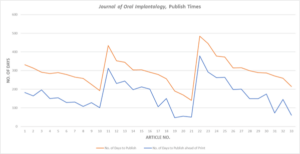
. In the first three issues of 2017, 33 articles were published. The orange line represents the number of days between submission and print publication for all 33 articles. The blue line represents the number of days between submission and online publication of the accepted (raw) manuscript. The difference between the two lines represents an average 58 percent decrease in the number of days to publication. As you can see, there’s quite a savings in time.
Why Bother?
Now, let’s look at who benefits from faster publication. In
an article published in
Science
in 2013
, Daniele Fanelli, evolutionary biologist at the University of Montreal, is quoted as saying, “At the moment, the way a career in science works is that you have to get lots of publication. The better the journals you publish in, the more grants and so on. That’s how you make it in science. Researchers working under the ‘publish or perish’ mentality have to publish often and quickly in order to win additional research dollars for their institutions.”
Often, personal advancement at a researcher’s institution hinges on frequent publishing. This means that their ability to obtain tenure is tied to the number of articles they have published, thus, it is to the benefit of publishers to increase the speed of publication. Being known as a journal that publishes original research quickly, means a journal could start to be seen as the best resource for innovation. This reputation can then cause submissions to increase, as authors will be drawn to a journal that publishes content quickly. And, of course, readers benefit from faster publication as access to the latest research developments, which can potentially change the direction of other scientists’ research.
Publishing Options
Directly from the Peer Review System
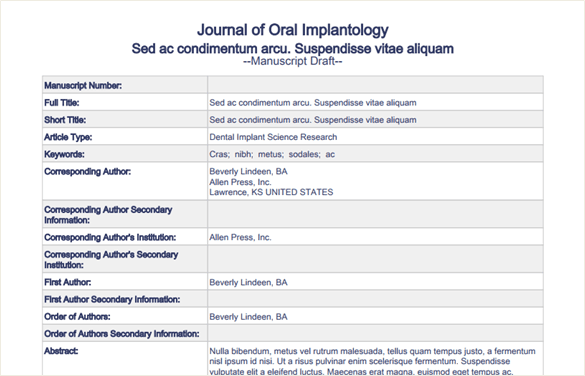
The first of many options for posting an article online is called the ‘raw manuscript’, i.e. the article is posted in its accepted form, directly from the peer review system, previous to any copy editing or paging.
Some peer review systems can automatically export the metadata and PDF of an article upon acceptance, or upon setting a final disposition. This information is then ingested by an online publishing platform and indexed in PubMed or a number of other indexers that allow entries for publish ahead of print articles.
Copyedited Article
Now, what if you’re not comfortable posting an article online that has not been through copy editing? This could be the case if you have a lot of English as a Second Language (ESL) authors who submit articles that could benefit from a thorough copyedit, or if you’ve shortened review times and eased the reviewer’s burden by asking them to concentrate on science alone, leaving grammar or language issues for down the line. In either of these cases, rest easy, copy editing the article prior to online posting is certainly an option.
If your peer review system presents ‘final decision’ and ‘final disposition’ as two separate tasks, the copy editing can be completed between these two stages. Copy-edited files can be uploaded into the system after ‘final decision’. ‘Final disposition’ can then be set and the metadata and PDF export (of the copyedited file) can be completed. Alternatively, you can provide the copy-edited file to your online vendor who then handles posting to the online publishing platform.
Paged Article
Still, maybe you want the publish-ahead-of-print version of an article to be formatted the same as it will when it’s published in the print journal. This brings us to our third option, posting the paged proofs in PDF form.
Within this option, there are two different paged versions you can choose from. The first version is called the ‘first proof’. The first proof is usually the version that is sent to the author and editors for review. Copy editing has been completed; figures and tables are in place on the page. With the exception of any minor corrections requested by the author or editors, the article PDF is nearly identical to its’ printed form.
The second version of our paged proof option is the ‘revised proof’. If you would like the authors and editor feedback to be incorporated into the online version, this is the option you would choose. Whether changes are minor or major they will be incorporated before the article PDF is posted online.
Continuous Publication
Our fourth, and final, publish-ahead-of-print option is referred to as ‘continuous publication’.
Because of the extensive processes a paper goes through, it’s easy (especially for authors) to see your production schedule as a game of red light, green light. First comes acceptance (great news!) then copyediting, typesetting, revision, and the cycle continues. It can seem as though you’re stopped in traffic, and the published result is nowhere in sight, especially for quarterly or bimonthly publications. However, by instituting a continuous publication model, your content can constantly be in motion on its way to final publication.
In a continuous publication cycle, articles are assigned a volume and issue, including page numbers, and posted as soon as they are ready.
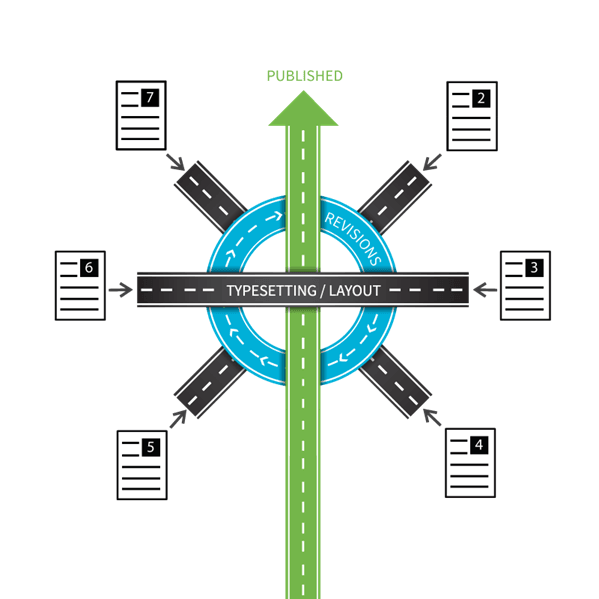
The following model represents multiple articles during a continuous publication cycle. You’ll notice, all of these articles have been numbered, and are at their own stage in production.
Articles three and six are making their way through typesetting and layout, while two, four, five, and seven are conducting revision stages. The blue circle with arrows indicates the possibility of multiple revision cycles during this stage, without causing a delay for other articles. Article one for this issue isn’t pictured, because it’s already exited production via the green arrow ‘road’, and has been published.
Content is Continually Posting Online
Because this is a continuous publication cycle, article one is not an example of the preprints we discussed earlier – it is a complete and final edited page in all its glory. What can this mean for your journal? You have content moving continuously through production and no delay once an article is ready to publish. For journals that don’t print, it may be time to reconsider why you’re holding up publication for an entire issue, and if it’s really necessary.
Table of Contents
When using continuous publication, especially for journals that print, it’s important to be careful when designing your table of contents. Ideally, you may want all page numbering to be consecutive, which can be difficult if your table of contents is organized by article type.
One option to consider, if you wish to retain categories in your table of contents, is to retain article type categories.
Source:
Journal of Food Protection
Here, under each category, the articles can be listed in numerical order within each category. Notice that the research note listed isn’t the entire table of contents, but you’ll see the article types, research papers, research notes and reviews. Notice that the single Research Note is on page 1489; however, the page numbers listed for our Research Papers surround that range. This is a simple way of retaining continuous page numbers and publication, while still organizing your articles by type.
By using this model, it’s possible to have article postings every week. This schedule depends on the quantity of content cycling through production, but it’s certainly an improvement for your authors (and readers) who may be used to waiting months for new content to publish. Not only can this bring more traffic to your online platform, it keeps author queries off your desk.
From smaller publications (10 to 15 articles per year) to journals that publish new content once a week, 52 weeks a year, this process saves grief and avoids some of the potential complications of a preprint workflow.
Testimonials
One specific journal that switched to continuous publication in December 2016, the
Journal of Food Protection
has already seen a reduction in publication length by as much as four weeks. The authors of this journal, as well as the Executive Board and journal management committee, all played a significant role in moving to this option, and are happy to see the platform continue to positively affect their publication in many ways, including impact factor. Remember, from preprints to continuous publication, the sooner an article can be cited, the more advantage it has for distribution in the scientific and scholarly community.
While the goal of publishing ahead of print is to speed up publication, there are some challenges, and drawbacks, to consider.
Challenges and Drawbacks
Grammar/Language Errors
One of the drawbacks of posting an article directly from the peer review system (the raw manuscript) is that the goal of peer review is to evaluate the science presented, so grammar is often pushed to the backburner. Also, typos are likely.
Reviewers volunteer their time to provide a thorough review of the scientific and/or statistical elements of the paper, and the assumption is that the paper will be submitted to the journal as a readily understandable narrative, while any grammar or language mistakes will be taken care of during the production process. This means that publishing raw manuscripts ahead of print will result in publishing these mistakes.
Also, please note that the information that appears in the online table of contents for these articles is often derived from the metadata of the article, which comes from the submission form the author used. If the author has made any typos while filling out the submission form, these errors will be present in the table of contents listing for the publish-ahead-of-print versions. This is the case for raw manuscripts, copy edited proofs, and paged proofs.
Peer Review Formatted Document
Another possible drawback to raw manuscripts, is that the article posted online has been formatted for peer review, which can differ greatly from the paged article. For instance, tables and figures may follow the references for peer review but will follow the in-text citations once the article has been paged.
Additionally, some peer review systems will automatically insert a title page into the PDF that contains information extracted from the submission form, e.g. the article title, author names, article type, abstract and keywords.
1st Proof Stage
Should you choose to post your articles ahead of print at the first proof stage, it’s possible you’ll run into some challenges of your own.
The first challenge is that the version of the article posted online will not have any author corrections incorporated. You may find that the authors are unhappy with the article being posted prior to their corrections being incorporated, especially if those corrections are numerous. In this case, you can remind the authors that the publish-ahead-of-print version will be replaced with the final version of their article once it’s gone to print.
Another challenge is facing potential paging errors, such as incorrect figure sizes, wrong internal heading styles, or tables that are not formatted correctly. It is also possible that the copy editor missed a thing or two at this point, so be aware that minor grammar or language errors may be present in the first proof, even though it is no longer a raw manuscript. Again, these errors will be replaced once the article makes it to print.
Corrections After Online Posting
Policy Regarding Corrections
Often, a near-majority of the errors present themselves in the online table of contents, which, as mentioned earlier, comes directly from the article metadata. Whether it be a typo from the submission form or errors in the article itself, it is best to create a correction policy in accordance with your publish-ahead-of-print processes. Do you want to allow authors to make corrections? Or is the version that is posted static until it’s replaced with the final published version? Authors may be insistent on making corrections, especially since the published ahead of print version is indexed, so having a firm policy can help when confronted by an unhappy author.
Online Platform Vendor
When creating a policy, be sure you are aware of your online vendor’s existing policies. Do they allow multiple postings of an article? Do they allow changes but not multiple alterations per posting? Contact your account representative and find these things out first. Even if your online vendor allows corrections it’s possible that there will be a fee associated with re-posting the article afterward. At this time, you can decide whether the significance of the changes are worth the charge, and whether you will pay or choose to bill the author.
Preprint Repositories
Now that you have an idea about the pros and cons of publishing ahead of print, we’ll move on to preprint repositories. One way that authors can immediately disseminate their research is by depositing the paper on a preprint server. The idea behind this concept is that authors submit their completed papers to the preprint repository, prior to submission to a peer-reviewed journal. The paper is then assigned a perpetual DOI, and is registered in Crossref. From there, readers can make comments on the paper, and authors have the ability to revise submissions when needed, while also submitting their paper to any journal for review. If the paper is then accepted for publication, the final print version is linked on the papers’ original preprint page.
A few examples of preprint repository options are
arXiv
,
BioRxiv,
PeerJ preprints
, and
preprints.org
.
ArXiv
was launched in 1991 for papers in the fields of physics, mathematics, computer science, quantitative biology, quantitative finance, and statistics.
BioRxiv
was launched in 2013 for biology papers.
PeerJ preprints
was also launched in 2013, for papers in the biological and medical sciences.
Preprints.org
is a multi-disciplinary repository launched just last year (2016).
At this time, numerous journals have a strict policy that an article submitted for review must not have been published elsewhere or posted online previously. However, as acceptance of preprint servers grows, more journals are allowing authors to submit articles that are posted on preprint repositories, as long as they aren’t printed elsewhere. If your journal does not already have a policy regarding preprints, it’s a good idea to consider your stance moving forward. Now that you’re aware of the pros and cons of preprints online, decide what’s best for your journal and be sure to make it a clear part of your journal’s general policies.
Conclusion
So, remember, it’s crucial to conduct a thorough review of your editorial, external, and production processes regularly, as well as the services your account representative can provide. Define your expectations moving forward and find out which formula works best for your journal!
Questions and Answers
“What policy guidelines or recommendations do you have for preprint repositories?”
This depends on the type of science that you’re publishing. If it’s something that is time-sensitive and your authors are concerned about publishing their research as quickly as possible after completing their study, you might consider allowing articles currently submitted to your journal for peer review be posted as preprints. You might find that you’re pushed in that direction by your author base already. If you find that this is the case, or that you’re turning authors away because they’ve posted their articles to a preprint server, it may be time to reconsider whether you want to allow authors to do so going forward.
“My peer review workflow is slowed down by our busy volunteer editors and reviewers. How do I ask them to speed up the pace?”
Often it can be as simple as asking reviewers to note their availability from the start. Most peer review sites have a space in their profile where it can be recorded, and used for reference when you’re looking to invite a reviewer. Otherwise, friendly reminders regarding your expectations to your staff are an option, and you might be surprised at what they say in response. You may find out that there’s underlying issue going on, either about the site itself or even the people involved. In thinking of time, it could also be that the actual review form needs some updates
.
Another option is to send all of your reviewers (those that have completed reviews already) a survey to see whether they think the current time table is too long/too short, etc. Though it’s not likely you’ll get a response that the time frame is too long, you can ask simple questions like, “does the proposed review time sound logical to you” or, “Would (X) be too little time to complete the review?”
“Can preprints be cited?”
Absolutely. The fact that they’re indexed, particularly in Pubmed, means that they can be cited, though some journals have individualized style preference when it comes to citing preprints, or more specifically for when they are personal communications or personal observations. Generally speaking, if they have a DOI, are indexed, have been registered in Crossref, yes they are citable.
“Where can I find good freelancers or contractors within scholarly publishing?”
There are a few options. For freelance copy editing you can use websites for the Editorial Freelancers Association. A lot of freelancers will post their resumes there, and you may even be able to pick a person and send in a bid for work, communicating through the system there. There’s also the European Association of Science Editors and the Board of Editors in the Life Sciences, both of which have job boards that you can use to search for freelancers. And as you know, KGL provides a full range of
editorial and publishing services
should you need a more robust service offering.
KnowledgeWorks Global Ltd. (KGL) is the industry leader in editorial, production, online hosting, and transformative services for every stage of the content lifecycle. We are your source for
editorial solutions
,
peer review services
,
intelligent automation
,
digital delivery
,
and more. Email us at
info@kwglobal.com
.
Page load link
Go to Top |
| Markdown | [Skip to content](https://www.kwglobal.com/blog/tactics-for-increasing-the-speed-of-journal-publication/#content)
[](https://www.kwglobal.com/)
[](https://www.kwglobal.com/)
Toggle Navigation
- [Solutions](https://www.kwglobal.com/blog/tactics-for-increasing-the-speed-of-journal-publication/)
- [Scholarly Associations](https://www.kwglobal.com/society-services/)
- [Peer Review Workflows](https://www.kwglobal.com/peer-review/)
- [Consulting Services](https://www.kwglobal.com/consulting/)
- [Research Integrity and Image Forensics](https://www.kwglobal.com/research-integrity/)
- [Association and Meeting Management](https://www.kwglobal.com/association-management/)
- [See All](https://www.kwglobal.com/society-services/)
- [Commercial STM Publishers](https://www.kwglobal.com/commercial-stm-publishers/)
- [Smart Review](https://www.kwglobal.com/smart-suite-3/#smart-review)
- [High-Speed Copyediting](https://www.kwglobal.com/smart-suite-3/#smart-edit)
- [Production](https://www.kwglobal.com/production-management/)
- [See All](https://www.kwglobal.com/commercial-stm-publishers/)
- [Educational Publishers](https://www.kwglobal.com/ed-publishers/)
- [K-12](https://www.kwglobal.com/prek-12/)
- [Higher Education](https://www.kwglobal.com/higher-education/)
- [Accessibility](https://www.kwglobal.com/accessibility/)
- [Education Bridge](https://www.kwglobal.com/education-bridge/)
- [See All](https://www.kwglobal.com/ed-publishers/)
- [Content Providers of All Types](https://www.kwglobal.com/trade-magazines-catalogs-directories/)
- [Book Solutions](https://www.kwglobal.com/book-solutions/)
- [Magazines](https://www.kwglobal.com/magazines/)
- [Design & Media](https://www.kwglobal.com/the-design-studio-books/)
- [See All](https://www.kwglobal.com/trade-magazines-catalogs-directories/)
- [Workforce Learning](https://www.kwglobal.com/workforce-learning/)
- [Digital Transformation](https://www.kwglobal.com/digital-transformation/)
- [Skill Enhancement](https://www.kwglobal.com/skill-enhancement/)
- [Learning Immersion](https://www.kwglobal.com/learning-immersion/)
- [See All](https://www.kwglobal.com/workforce-learning/)
[ Safeguard Research Integrity](https://www.kwglobal.com/research-integrity/)
[Learn More](https://www.kwglobal.com/research-integrity/)
[ Smart Publish with KGL](https://www.kwglobal.com/smart-suite-3/)
[Learn More](https://www.kwglobal.com/smart-suite-3/)
[ Meet Your DEI Goals](https://www.kwglobal.com/dei-support/)
[Learn More](https://www.kwglobal.com/dei-support/)
[ Create Born-Accessible Content](https://www.kwglobal.com/accessibility/)
[Learn More](https://www.kwglobal.com/accessibility/)
[ Engage Learners with Immersive Experiences](https://www.kwglobal.com/learning-immersion/)
[Learn More](https://www.kwglobal.com/learning-immersion/)
- [Scholarly Associations](https://www.kwglobal.com/society-services/)
- [Commercial STM Publishers](https://www.kwglobal.com/commercial-stm-publishers/)
- [Educational Publishers](https://www.kwglobal.com/ed-publishers/)
- [Content Providers of All Types](https://www.kwglobal.com/trade-magazines-catalogs-directories/)
- [Technology](https://www.kwglobal.com/blog/tactics-for-increasing-the-speed-of-journal-publication/)
- [Smart Publish](https://www.kwglobal.com/smart-publish/)
- [Smart Review™](https://www.kwglobal.com/smart-review/)
- [PubFactory](https://pubfactory.com/)
- [Artificial Intelligence](https://www.kwglobal.com/artificial-intelligence/)
- [Accessibility](https://www.kwglobal.com/accessibility/)
- [Image Forensics](https://www.kwglobal.com/research-integrity/#image-forensics)
- [Author Billing](https://www.kwglobal.com/author-billing/)
- [eLearning](https://www.kwglobal.com/elearning-services/)
- [Resources](https://www.kwglobal.com/resources/)
**Resources**
- [Blogs](https://www.kwglobal.com/blog/)
- [Case Studies](https://www.kwglobal.com/case-studies/)
- [Events](https://www.kwglobal.com/events/)
- [In the News](https://www.kwglobal.com/news/)
- [Reports & Sheets](https://www.kwglobal.com/reports/)
- [Customer Support](https://www.kwglobal.com/support/)
- [View All Resources](https://www.kwglobal.com/resources/)
[ Latest in Our Blog](https://www.kwglobal.com/blog/succession-by-design-using-mentorship-to-strengthen-both-reviewer-capacity-and-board-engagement/)
Succession by Design: Using Mentorship to Strengthen Both Reviewer Capacity and Board Engagement
[Read More](https://www.kwglobal.com/blog/succession-by-design-using-mentorship-to-strengthen-both-reviewer-capacity-and-board-engagement/)
[ ](https://www.kwglobal.com/case-study/expanding-journal-reach-with-social-media-email-and-webinars/)
Expanding Journal Reach with Social Media, Email and Webinars
[Learn More](https://www.kwglobal.com/case-study/expanding-journal-reach-with-social-media-email-and-webinars/)
[ NSTA National Spring Conference](https://www.kwglobal.com/event/nsta2026/)
**April 15–18, 2026**
Anaheim, CA
[Meet Us](https://www.kwglobal.com/event/nsta2026/)
[ Latest News](https://www.kwglobal.com/news/cashmere-and-kgl-partner-to-power-the-commercial-and-technical-rails-for-premium-content-in-ai/)
Cashmere and KGL Partner to Power the Commercial and Technical Rails for Premium Content in AI
[Learn More](https://www.kwglobal.com/news/cashmere-and-kgl-partner-to-power-the-commercial-and-technical-rails-for-premium-content-in-ai/)
[ Editorial Management Systems](https://www.kwglobal.com/report/editorial-management-systems/)
Benefits of performing focused editorial audits to ensure optimized workflows, system configurations, and system evaluation and selection
[Download Report](https://www.kwglobal.com/report/editorial-management-systems/)
[ ](https://www.kwglobal.com/support/digital-art-support/)
Digital Art Support
[Learn More](https://www.kwglobal.com/support/digital-art-support/)
[ Latest in Our Blog](https://www.kwglobal.com/blog/evaluating-peer-review-systems-5-lessons-for-a-successful-rfp-and-platform-transition/)
Evaluating Peer Review Systems: 5 Lessons for a Successful RFP and Platform Transition
[Read More](https://www.kwglobal.com/blog/evaluating-peer-review-systems-5-lessons-for-a-successful-rfp-and-platform-transition/)
[ ](https://www.kwglobal.com/case-study/ebook-collection-sales-through-targeted-telemarketing/)
How We Helped AMS Drive eBook Collection Sales Through Targeted Telemarketing
[Learn More](https://www.kwglobal.com/case-study/ebook-collection-sales-through-targeted-telemarketing/)
[ STM Annual US Conference](https://www.kwglobal.com/event/stmus2026/)
**April 22–23, 2026**
Washington, DC
[Meet Us](https://www.kwglobal.com/event/stmus2026/)
[ Latest News](https://www.kwglobal.com/news/kgl-unveils-ai-powered-infrastructure/)
KGL Unveils AI-Powered Infrastructure to Strengthen Trust, Expand Access, and Future-Proof Scholarly Publishing
[Learn More](https://www.kwglobal.com/news/kgl-unveils-ai-powered-infrastructure/)
[ Librarian Survey Report 2025](https://www.kwglobal.com/report/kgl-accucoms-librarian-survey-report-2025/)
Insights on how librarians are negotiating agreements, advising researchers, and managing budgets that now increasingly include OA options.
[Learn More](https://www.kwglobal.com/report/kgl-accucoms-librarian-survey-report-2025/)
[ ](https://www.kwglobal.com/support/meridian-online-support/)
Meridian Online Support
[Learn More](https://www.kwglobal.com/support/meridian-online-support/)
- [Blogs](https://www.kwglobal.com/blog/)
- [Case Studies](https://www.kwglobal.com/case-studies/)
- [Events](https://www.kwglobal.com/events/)
- [In the News](https://www.kwglobal.com/news/)
- [Reports & Sheets](https://www.kwglobal.com/reports/)
- [Customer Support](https://www.kwglobal.com/support/)
- [About](https://www.kwglobal.com/blog/tactics-for-increasing-the-speed-of-journal-publication/)
- [About KGL](https://www.kwglobal.com/about-kgl/)
- [Careers](https://www.kwglobal.com/careers/)
- [Sheridan Print](https://www.sheridan.com/)
- [Contact Us](https://www.kwglobal.com/contact/)
- [Contact Us](https://www.kwglobal.com/support/meridian-online-support/#form)
Blog post
# Tactics for Increasing the Speed of Journal Publication
21 Jul 2020
In this blog, we have listed several tactics for how to increase the speed of journal publication from clear author instructions, efficient peer-review, effective staffing and more. Though some of the concepts presented here may be familiar, there are intricate layers to publication that are often missed, and result in journal backlog, slow processing, and unhappy authors. We will discuss tactics for increasing the speed of publication, beginning with peer-review, then moving all the way through to journal production.
#### **Peer Review**
***Setting Reminders***


Starting at the beginning, let’s look at the peer-review process. No matter the platform, you need to use your peer review functions to the best of their ability, right? If you haven’t installed auto reminders for punctuality, now is the time to start. However, it’s important not to leave out an entire group of people; when there are sets of reminders for reviewers, be sure you include auto reminders for editors and authors as well.
People get busy, and we certainly need reminding. Remember that we’re not trying to nag, but phrases such as, “Just a friendly reminder” or, “At your earliest convenience” can go quite far with the recipient. Keep in mind, only you know your group, and what they will respond to. At times, a bit more aggressive text can be necessary, e.g., “Within two business days” or “Time is running out!” It’s important to remember that although some groups are cautious about filling up inboxes, you are providing the service of follow through which benefits both parties in the end.
Here at KGL we can certainly attest to reminders being helpful, and the disarray that ensues when, for one reason or another, a series of reminders don’t go out. After touching base with the authors we can expect their response to be, “I’m used to getting reminders from peer review sites, so when I didn’t get one I assumed my review was unnecessary and moved on.” Again, the point here is to remember that you are being helpful rather than annoying. In order to avoid situations like this, you need to know your site, your links, and your folders extremely well; we all know automation can fail. Remember to go in daily to ensure functionality, and if there is a breakdown in communication, make it a priority.
#### **Reviewer and Editor Education**
***Clear Expectations***
Papers in peer review should never sit any longer than they have to. Of course, your reviewers and editors know this too, but at times expectations can be mistaken for demands. By being clear and direct with your reviewers and editors, making them aware of what is expected of them, and understanding that they are in fact volunteers, you will obtain better results and a smoother review process. Progression in turnaround times, thoughtful reviews, and appropriate decisions can be anticipated.
In order to do so, your notifications must be concise and informative. When you review these notices, ask yourself the following: Am I presenting all of the important steps? Have I provided all of the necessary instructions for all working steps of the peer review process? Is the deadline clear enough?
***Email Notifications***
If this is the case, but your expectations still aren’t being met, you may consider sending out an email blast to ensure all of your colleagues are on the same page. This can be as simple as a short note that includes, “While we know things are busy, we hope that everyone can take a few minutes to read through our updated expectations for their respective roles in our site”. Bulleted lists and other organizational tools can be helpful to provide information at-a-glance as well.
***Educational Programs***
Another great tool for increasing efficiency and reducing time waste are educational programs. In May of 2017, the [Council of Science Editors (CSE)](https://www.councilscienceeditors.org/) held their annual meeting over the future of science publishing. Of the topics presented were new initiatives for training editors and reviewers. Though there was plenty of great information, the presentation spoke more specifically to educational programs for reviewers than others.
At [PLoS One](https://journals.plos.org/plosone/), a reviewer programming project was initiated and, while keeping in mind that these are still volunteers, most of the reviewers who took advantage of the short educational program found it helpful, not daunting. From the journal’s perspective, they started to see more consistent styles of feedback from their reviewers. Not only did it help set the bar (clear expectations, remember?), it aided in obtaining high level peer reviews. They also spoke to the importance of providing a “Review of the review”. Though this sounds redundant, it can be extremely beneficial to use a scoring system or gradient scale, designate someone to look over the review, and provide feedback to the reviewers themselves.
At this point you may be thinking, “Wasn’t this supposed to tell me how to decrease time? An educational program sounds like a lot of work just to get started.” Yes, the initial training does take time. However, by reallocating some of that time into training at the beginning of the process, it allows for increased efficiency elsewhere. For example, by training the reviewers you can expect more thorough reviews, which in turn means the author knows exactly what to do, and can send a clean draft back to peer review which eliminates the need for second and third revisions. If efficiency and time reduction are a priority for you, educational training models are something you should consider.
Also during the CSE presentation, it was said that reviewers have the mentality to give back to their community of work. Because of this, it is important to remember what benefits they can bring, and ensure you’re not wasting their time or anyone else’s.
#### **Initiate a Quality Checklist**

***Remove Distracting Elements***
Quality checks, technical checks, and other tools used on nearly any peer review site are part of the initial design. But, it’s equally important to weed out any disruptive or redundant elements too. Things like word limit, article type, layout, table callouts, should all be checked upfront. Be sure not to get too involved with this, but understand that there are basic level elements that can be scrutinized and fixed, or sent back to the author to fix, before the paper begins peer review.
***Keep the Checklist Concise***
Speaking of the author, the flip side here is that you want to avoid an enormous list of check points. Again, you want the submissions moving along as efficiently as possible and it starts with this step. As soon as the paper enters the site, run a quality check and keep it moving. Like a car driving off the lot, authors tend to think that if their paper is sitting, it’s losing value.
***Revise Quality Checklist at Revision Stage***
This perspective can often be used to your advantage. Consider checking a few more items at the revision stage to avoid author queries down the line. Are references in the correct order per journal style? Can we check resolution of figures now? Again, addressing just a few more elements to the paper upfront saves time once it does get accepted, and the author can see progress. Not only this, but for our two specific examples, renumbering entire reference lists and low resolution figures, it prevents a huge delay during the production stage.
#### **Author Instructions**
***Set Expectations***
Naturally, this leads us to author instructions. It is of the utmost importance that your author instructions are accessible, concise, and doing the most work for you that they can. First, review them to make sure that you have been thorough, but avoided redundancy, and clearly set the expectations for your authors. Then, consider what additions may be beneficial, e.g. instructions on how to order references, or figure resolution requirements.
***Hyperlink When Possible***
For accessibility, post your author instructions wherever possible. Link them on your society page or peer-review site, and if at all possible use hyperlinked instructions as well. From past experience, we can say that hyperlinked instructions are extremely helpful. A lot of time can be wasted scrolling through a site to find what we’re looking for. With hyperlinked instructions an author can skip around as necessary, once again saving time. After all, that is what we want to do here, and we want to do that for your authors too.
Again, your author instructions should be as visible and available as possible. What you don’t want is for an author to have to go from one site to another unless absolutely necessary.
So, ask yourself, “How am I ensuring all time is accounted for?”
#### **Editorial Turnaround**
***Is There Enough Time?***
When adjusting schedules it is difficult not to look toward chopping turnaround times. Say our reviewers allow too much time for review. Do editors need shortened schedules to submit their decisions? This can be a difficult decision in what we would consider the heart of peer review, particularly when considering an education program and setting higher expectations. We certainly don’t want to take away from quality.
***Do Reviewers Need More Time?***
For a short duration, after implementing these new practices, it is possible that reviewers will need more time to complete a thorough review. Turnaround times are require a delicate balance for successful production. If a reviewer is given only five days to review, can they effectively do so while still covering all expectations? Alternatively, if they are given 12 days for the same paper, does it increase the likelihood of a thorough review or of wasted time? The same consideration goes toward editorial deadlines. Do the editors need five days for recommendation, or could it be shortened to four? Are the editors feeling pressured and requesting seven? If the reviews have become more thorough, will the editors need more time to go through them? The answer to these questions is individual to your society. However, the importance to review these times for efficiency is not.
***Review Turnaround Times***
Once a year, take the opportunity to review turnaround times versus expectations, and make sure that you’ve reached an effective balance in both the quality and speed of your peer review process. If slight changes can be made, do so, but only if they help ensure your timelines are strategic, not arbitrary.
#### **Production**
Now let’s discuss a few ways to speed up the production side of your publication. Every vendor or contractor you use should be able to provide you with a standard schedule for how long their processes are expected to take – from the submission of materials to final delivery of the completed files.
***Annually***
For journals who publish on a regular basis, a production schedule is likely to cover an entire year of issues. The next year’s schedule should then be provided to you before any materials are due. For many journals this would fall sometime in September or October.
***Issue-by-Issue***
If the publication of your journal varies from one issue to another, and there is no set publishing schedule from one volume to the next, request a schedule from your vendor prior to submission of materials for each issue. Be sure to review this schedule very carefully. It should contain not only dates for each stage of production, but also the number of days that each stage needs. You’ll need to know if your vendor includes weekends or just business days, and what holidays they take. Make sure that what you are agreeing to meets your expectations and work with your account representative if it does not.
***Keep to the Schedule***
It’s important to hold up your end of the bargain, so once you have reviewed the schedule, keep to your dates. While some vendors can rush production to make up lost days, it is not guaranteed. Depending on the way that staff and equipment is scheduled, your work may fall to the bottom of a queue when materials are submitted past their due date.
***Connect with Account Representative***
Sending your work to a vendor can often seem like dropping it into a black hole and then waiting for the files to reappear, so do your best to make deadlines and make sure you know what their policies and processes are, in case you miss a date for unforeseen reasons.
Remember, your account representative is your connection to your publication as it travels through the production processes.
Make sure you keep in contact with your representative, or the contractor if you’re using one, for updates on progress. Asking for regular updates can alert you to potential issues, and give you the opportunity to resolve them before they result in production delays.
For example, let’s say you have a special issue coming up, and the printed books need to be finished in time to arrive at your annual meeting. Tell your vendor as soon as you know that you have this special situation coming up. If necessary, ask for shorter turnaround times. The vendor may not be able to accommodate the request, but it’s best to find out early. Things change, technology improves, it’s a good idea to review your production processes every couple of years to keep up.
#### **Production Process Review**
Stop sweating the small stuff. As editors, we’re always trying to find mistakes. There’s always one more thing that can be tweaked, but just by letting go you can save yourself time in your production schedule and eliminate a great deal of stress. How do you let go? First, review your internal processes, then have a discussion with your account representative about the technology your vendor uses to produce your work.
***Copyediting Rounds***
When we talk about internal processes, think of things like copy editing, proofreading, and author changes. If you find that you are editing articles after acceptance, before final decision, and after getting them back from your copy editor, you’re likely spending more time than is necessary to edit the articles. Review the quality of work coming from your copy editor, and then pare down your editing to one copy editing pass. Multiple rounds can add days or even weeks to your production schedule.
***Proof Revisions***
Likewise, if you are reviewing proofs three to four times, it may be time to reduce that number. The more time you spend reviewing proofs, the longer it takes for your content to reach publication.
#### **Review Your Team**
***Evaluate Your Staff Size***


As part of your internal review, regardless of your editorial office size, it’s also a good idea to think about the ratio of staff to the day-to-day tasks that keep your journal running. Is it possible that you need additional staff to help? Evaluate the time that current staff members spend on each task, and if they are unsure of what duties they have that take the most time, implement a task tracker for a few days to be sure.
This involves having the employees stop and record their tasks approximately every 15 minutes, and can be quite enlightening in regards to what tasks take the most time to complete. Also, it can help inform you of any instances where papers are sitting and waiting for action due to a lack of staff coverage.
***Consider Hiring Part-Time or Contract Staff***
As a journal grows, the staff should grow with it, so consider hiring a full time, or possibly a part time staff person where needed. If you’re located on a university campus, find out if you can obtain student help. Or, outsource eligible tasks to a contractor.
#### **External Review**
Now that you’ve reviewed your internal processes, you can be comfortable with your production and confident that your content is scientifically accurate, readable, and pleasing to the eye. It’s time to move onto the external review.
***Consult your Account Representative***
Talk to your account representative. Their company may have new offerings that can help speed up production times. It’s also a good idea to keep abreast of advances in technology and scholarly publishing, so if you read about something that piques your interest bring it up. Ask how they can help you with any new publishing initiatives that you have, or wish to, implement.
***Delegate Tasks to a Vendor***
Finally, another option to consider is whether a vendor can help with the daily tasks of running your journal. Every bit of extra capacity helps in keeping the peer review and production processes running smoothly, and on time. Having an [editorial assistant, production editor or managing editor](https://www.kwglobal.com/peer-review) to rely on can free up time for the in-house staff and can help push your journal toward publishing on time or ahead of schedule.
#### **Publication Ahead of Print**
Still concerned about the time it takes distribute your content? Let’s take a look at how publishing articles ahead of print can further increase your speed of publication.
***Faster Publication***
According to [an article in the journal *Nature* from February 2016](https://www.nature.com/news/does-it-take-too-long-to-publish-research-1.19320), review time for their articles over a 10-year span has risen from 85 days to 150 days. In [*PLoS One*](https://journals.plos.org/plosone/) it has risen from 37 days to 125 in the same time period. The length of time spent on review can mean that a researcher’s paper could be in review for close to a year, especially if that author shops around for high-impact journals.
Publishing an article ahead of print can mean that an author doesn’t have to wait even longer for their research to be published, once the paper is accepted.

Here, we have a graph illustrating publication times for the [*Journal of Oral Implantology*](https://www.joionline.org/). In the first three issues of 2017, 33 articles were published. The orange line represents the number of days between submission and print publication for all 33 articles. The blue line represents the number of days between submission and online publication of the accepted (raw) manuscript. The difference between the two lines represents an average 58 percent decrease in the number of days to publication. As you can see, there’s quite a savings in time.
***Why Bother?***
Now, let’s look at who benefits from faster publication. In [an article published in *Science* in 2013](https://www.sciencemag.org/careers/2013/10/your-data-warts-and-all), Daniele Fanelli, evolutionary biologist at the University of Montreal, is quoted as saying, “At the moment, the way a career in science works is that you have to get lots of publication. The better the journals you publish in, the more grants and so on. That’s how you make it in science. Researchers working under the ‘publish or perish’ mentality have to publish often and quickly in order to win additional research dollars for their institutions.”
Often, personal advancement at a researcher’s institution hinges on frequent publishing. This means that their ability to obtain tenure is tied to the number of articles they have published, thus, it is to the benefit of publishers to increase the speed of publication. Being known as a journal that publishes original research quickly, means a journal could start to be seen as the best resource for innovation. This reputation can then cause submissions to increase, as authors will be drawn to a journal that publishes content quickly. And, of course, readers benefit from faster publication as access to the latest research developments, which can potentially change the direction of other scientists’ research.
#### **Publishing Options**
***Directly from the Peer Review System***

The first of many options for posting an article online is called the ‘raw manuscript’, i.e. the article is posted in its accepted form, directly from the peer review system, previous to any copy editing or paging.
Some peer review systems can automatically export the metadata and PDF of an article upon acceptance, or upon setting a final disposition. This information is then ingested by an online publishing platform and indexed in PubMed or a number of other indexers that allow entries for publish ahead of print articles.
***Copyedited Article***
Now, what if you’re not comfortable posting an article online that has not been through copy editing? This could be the case if you have a lot of English as a Second Language (ESL) authors who submit articles that could benefit from a thorough copyedit, or if you’ve shortened review times and eased the reviewer’s burden by asking them to concentrate on science alone, leaving grammar or language issues for down the line. In either of these cases, rest easy, copy editing the article prior to online posting is certainly an option.
If your peer review system presents ‘final decision’ and ‘final disposition’ as two separate tasks, the copy editing can be completed between these two stages. Copy-edited files can be uploaded into the system after ‘final decision’. ‘Final disposition’ can then be set and the metadata and PDF export (of the copyedited file) can be completed. Alternatively, you can provide the copy-edited file to your online vendor who then handles posting to the online publishing platform.
***Paged Article***
Still, maybe you want the publish-ahead-of-print version of an article to be formatted the same as it will when it’s published in the print journal. This brings us to our third option, posting the paged proofs in PDF form.
Within this option, there are two different paged versions you can choose from. The first version is called the ‘first proof’. The first proof is usually the version that is sent to the author and editors for review. Copy editing has been completed; figures and tables are in place on the page. With the exception of any minor corrections requested by the author or editors, the article PDF is nearly identical to its’ printed form.
The second version of our paged proof option is the ‘revised proof’. If you would like the authors and editor feedback to be incorporated into the online version, this is the option you would choose. Whether changes are minor or major they will be incorporated before the article PDF is posted online.
***Continuous Publication***
Our fourth, and final, publish-ahead-of-print option is referred to as ‘continuous publication’.
Because of the extensive processes a paper goes through, it’s easy (especially for authors) to see your production schedule as a game of red light, green light. First comes acceptance (great news!) then copyediting, typesetting, revision, and the cycle continues. It can seem as though you’re stopped in traffic, and the published result is nowhere in sight, especially for quarterly or bimonthly publications. However, by instituting a continuous publication model, your content can constantly be in motion on its way to final publication.
In a continuous publication cycle, articles are assigned a volume and issue, including page numbers, and posted as soon as they are ready.
The following model represents multiple articles during a continuous publication cycle. You’ll notice, all of these articles have been numbered, and are at their own stage in production.

Articles three and six are making their way through typesetting and layout, while two, four, five, and seven are conducting revision stages. The blue circle with arrows indicates the possibility of multiple revision cycles during this stage, without causing a delay for other articles. Article one for this issue isn’t pictured, because it’s already exited production via the green arrow ‘road’, and has been published.
***Content is Continually Posting Online***
Because this is a continuous publication cycle, article one is not an example of the preprints we discussed earlier – it is a complete and final edited page in all its glory. What can this mean for your journal? You have content moving continuously through production and no delay once an article is ready to publish. For journals that don’t print, it may be time to reconsider why you’re holding up publication for an entire issue, and if it’s really necessary.
***Table of Contents***
When using continuous publication, especially for journals that print, it’s important to be careful when designing your table of contents. Ideally, you may want all page numbering to be consecutive, which can be difficult if your table of contents is organized by article type.
One option to consider, if you wish to retain categories in your table of contents, is to retain article type categories.


Source: [*Journal of Food Protection*](https://www.foodprotection.org/publications/journal-of-food-protection/)
Here, under each category, the articles can be listed in numerical order within each category. Notice that the research note listed isn’t the entire table of contents, but you’ll see the article types, research papers, research notes and reviews. Notice that the single Research Note is on page 1489; however, the page numbers listed for our Research Papers surround that range. This is a simple way of retaining continuous page numbers and publication, while still organizing your articles by type.
By using this model, it’s possible to have article postings every week. This schedule depends on the quantity of content cycling through production, but it’s certainly an improvement for your authors (and readers) who may be used to waiting months for new content to publish. Not only can this bring more traffic to your online platform, it keeps author queries off your desk.
From smaller publications (10 to 15 articles per year) to journals that publish new content once a week, 52 weeks a year, this process saves grief and avoids some of the potential complications of a preprint workflow.
***Testimonials***
One specific journal that switched to continuous publication in December 2016, the [*Journal of Food Protection*](https://www.foodprotection.org/publications/journal-of-food-protection/) has already seen a reduction in publication length by as much as four weeks. The authors of this journal, as well as the Executive Board and journal management committee, all played a significant role in moving to this option, and are happy to see the platform continue to positively affect their publication in many ways, including impact factor. Remember, from preprints to continuous publication, the sooner an article can be cited, the more advantage it has for distribution in the scientific and scholarly community.
While the goal of publishing ahead of print is to speed up publication, there are some challenges, and drawbacks, to consider.
#### **Challenges and Drawbacks**
***Grammar/Language Errors***
One of the drawbacks of posting an article directly from the peer review system (the raw manuscript) is that the goal of peer review is to evaluate the science presented, so grammar is often pushed to the backburner. Also, typos are likely.
Reviewers volunteer their time to provide a thorough review of the scientific and/or statistical elements of the paper, and the assumption is that the paper will be submitted to the journal as a readily understandable narrative, while any grammar or language mistakes will be taken care of during the production process. This means that publishing raw manuscripts ahead of print will result in publishing these mistakes.
Also, please note that the information that appears in the online table of contents for these articles is often derived from the metadata of the article, which comes from the submission form the author used. If the author has made any typos while filling out the submission form, these errors will be present in the table of contents listing for the publish-ahead-of-print versions. This is the case for raw manuscripts, copy edited proofs, and paged proofs.
***Peer Review Formatted Document***
Another possible drawback to raw manuscripts, is that the article posted online has been formatted for peer review, which can differ greatly from the paged article. For instance, tables and figures may follow the references for peer review but will follow the in-text citations once the article has been paged.
Additionally, some peer review systems will automatically insert a title page into the PDF that contains information extracted from the submission form, e.g. the article title, author names, article type, abstract and keywords.
***1st Proof Stage***
Should you choose to post your articles ahead of print at the first proof stage, it’s possible you’ll run into some challenges of your own.
The first challenge is that the version of the article posted online will not have any author corrections incorporated. You may find that the authors are unhappy with the article being posted prior to their corrections being incorporated, especially if those corrections are numerous. In this case, you can remind the authors that the publish-ahead-of-print version will be replaced with the final version of their article once it’s gone to print.
Another challenge is facing potential paging errors, such as incorrect figure sizes, wrong internal heading styles, or tables that are not formatted correctly. It is also possible that the copy editor missed a thing or two at this point, so be aware that minor grammar or language errors may be present in the first proof, even though it is no longer a raw manuscript. Again, these errors will be replaced once the article makes it to print.
#### **Corrections After Online Posting**
***Policy Regarding Corrections***
Often, a near-majority of the errors present themselves in the online table of contents, which, as mentioned earlier, comes directly from the article metadata. Whether it be a typo from the submission form or errors in the article itself, it is best to create a correction policy in accordance with your publish-ahead-of-print processes. Do you want to allow authors to make corrections? Or is the version that is posted static until it’s replaced with the final published version? Authors may be insistent on making corrections, especially since the published ahead of print version is indexed, so having a firm policy can help when confronted by an unhappy author.
***Online Platform Vendor***
When creating a policy, be sure you are aware of your online vendor’s existing policies. Do they allow multiple postings of an article? Do they allow changes but not multiple alterations per posting? Contact your account representative and find these things out first. Even if your online vendor allows corrections it’s possible that there will be a fee associated with re-posting the article afterward. At this time, you can decide whether the significance of the changes are worth the charge, and whether you will pay or choose to bill the author.
***Preprint Repositories***
Now that you have an idea about the pros and cons of publishing ahead of print, we’ll move on to preprint repositories. One way that authors can immediately disseminate their research is by depositing the paper on a preprint server. The idea behind this concept is that authors submit their completed papers to the preprint repository, prior to submission to a peer-reviewed journal. The paper is then assigned a perpetual DOI, and is registered in Crossref. From there, readers can make comments on the paper, and authors have the ability to revise submissions when needed, while also submitting their paper to any journal for review. If the paper is then accepted for publication, the final print version is linked on the papers’ original preprint page.
A few examples of preprint repository options are [arXiv](https://arxiv.org/), [BioRxiv,](https://www.biorxiv.org/) [PeerJ preprints](https://peerj.com/), and [preprints.org](https://www.preprints.org/). [ArXiv](https://arxiv.org/) was launched in 1991 for papers in the fields of physics, mathematics, computer science, quantitative biology, quantitative finance, and statistics. [BioRxiv](https://www.biorxiv.org/) was launched in 2013 for biology papers. [PeerJ preprints](https://peerj.com/) was also launched in 2013, for papers in the biological and medical sciences. [Preprints.org](https://www.preprints.org/) is a multi-disciplinary repository launched just last year (2016).
At this time, numerous journals have a strict policy that an article submitted for review must not have been published elsewhere or posted online previously. However, as acceptance of preprint servers grows, more journals are allowing authors to submit articles that are posted on preprint repositories, as long as they aren’t printed elsewhere. If your journal does not already have a policy regarding preprints, it’s a good idea to consider your stance moving forward. Now that you’re aware of the pros and cons of preprints online, decide what’s best for your journal and be sure to make it a clear part of your journal’s general policies.
#### **Conclusion**
So, remember, it’s crucial to conduct a thorough review of your editorial, external, and production processes regularly, as well as the services your account representative can provide. Define your expectations moving forward and find out which formula works best for your journal\!
#### **Questions and Answers**
**“What policy guidelines or recommendations do you have for preprint repositories?”**
This depends on the type of science that you’re publishing. If it’s something that is time-sensitive and your authors are concerned about publishing their research as quickly as possible after completing their study, you might consider allowing articles currently submitted to your journal for peer review be posted as preprints. You might find that you’re pushed in that direction by your author base already. If you find that this is the case, or that you’re turning authors away because they’ve posted their articles to a preprint server, it may be time to reconsider whether you want to allow authors to do so going forward.
**“My peer review workflow is slowed down by our busy volunteer editors and reviewers. How do I ask them to speed up the pace?”**
Often it can be as simple as asking reviewers to note their availability from the start. Most peer review sites have a space in their profile where it can be recorded, and used for reference when you’re looking to invite a reviewer. Otherwise, friendly reminders regarding your expectations to your staff are an option, and you might be surprised at what they say in response. You may find out that there’s underlying issue going on, either about the site itself or even the people involved. In thinking of time, it could also be that the actual review form needs some updates**.**
Another option is to send all of your reviewers (those that have completed reviews already) a survey to see whether they think the current time table is too long/too short, etc. Though it’s not likely you’ll get a response that the time frame is too long, you can ask simple questions like, “does the proposed review time sound logical to you” or, “Would (X) be too little time to complete the review?”
**“Can preprints be cited?”**
Absolutely. The fact that they’re indexed, particularly in Pubmed, means that they can be cited, though some journals have individualized style preference when it comes to citing preprints, or more specifically for when they are personal communications or personal observations. Generally speaking, if they have a DOI, are indexed, have been registered in Crossref, yes they are citable.
**“Where can I find good freelancers or contractors within scholarly publishing?”**
There are a few options. For freelance copy editing you can use websites for the Editorial Freelancers Association. A lot of freelancers will post their resumes there, and you may even be able to pick a person and send in a bid for work, communicating through the system there. There’s also the European Association of Science Editors and the Board of Editors in the Life Sciences, both of which have job boards that you can use to search for freelancers. And as you know, KGL provides a full range of [editorial and publishing services](https://www.kwglobal.com/peer-review) should you need a more robust service offering.
*KnowledgeWorks Global Ltd. (KGL) is the industry leader in editorial, production, online hosting, and transformative services for every stage of the content lifecycle. We are your source for* [editorial solutions](https://www.kwglobal.com/editorial-solutions), [peer review services](https://www.kwglobal.com/peer-review-services)[,](https://www.kwglobal.com/peer-review-services) [intelligent automation](https://www.kwglobal.com/ai-and-nlp-for-publishers), [digital delivery](https://www.pubfactory.com/), *and more. Email us at* [info@kwglobal.com](mailto:info@kwglobal.com)*.*
[Accessibility](https://www.kwglobal.com/tag/accessibility/ "Accessibility"), [Authors](https://www.kwglobal.com/tag/authors/ "Authors"), [Copyediting](https://www.kwglobal.com/tag/copyediting/ "Copyediting"), [Journals](https://www.kwglobal.com/tag/journals/ "Journals"), [Peer Review](https://www.kwglobal.com/tag/peer-review/ "Peer Review"), [Print](https://www.kwglobal.com/tag/print/ "Print"), [Scholarly Publishing](https://www.kwglobal.com/tag/scholarly-publishing/ "Scholarly Publishing")
## Related *Posts*
[](https://www.kwglobal.com/blog/succession-by-design-using-mentorship-to-strengthen-both-reviewer-capacity-and-board-engagement/)
17 Apr 2026
[Mike Groth](https://www.kwglobal.com/author/mike-grothkwglobal-com/)
### [Succession by Design: Using Mentorship to Strengthen Both Reviewer Capacity and Board Engagement](https://www.kwglobal.com/blog/succession-by-design-using-mentorship-to-strengthen-both-reviewer-capacity-and-board-engagement/)
In this edition of ORIGINal Thoughts, Emily Mueller describes how ACSESS has tried to tackle the growing problem of reviewer fatigue through its Associate Editor Mentorship Program.
[Read More](https://www.kwglobal.com/blog/succession-by-design-using-mentorship-to-strengthen-both-reviewer-capacity-and-board-engagement/)
[](https://www.kwglobal.com/blog/evaluating-peer-review-systems-5-lessons-for-a-successful-rfp-and-platform-transition/)
8 Apr 2026
[Mike Groth](https://www.kwglobal.com/author/mike-grothkwglobal-com/)
### [Evaluating Peer Review Systems: 5 Lessons for a Successful RFP and Platform Transition](https://www.kwglobal.com/blog/evaluating-peer-review-systems-5-lessons-for-a-successful-rfp-and-platform-transition/)
Attention to these principles will help address some common challenges and mitigate key risks of a system migration.
[Read More](https://www.kwglobal.com/blog/evaluating-peer-review-systems-5-lessons-for-a-successful-rfp-and-platform-transition/)
[](https://www.kwglobal.com/blog/discovery-is-becoming-an-ai-native-workflow/)
31 Mar 2026
[Mike Groth](https://www.kwglobal.com/author/mike-grothkwglobal-com/)
### [Discovery Is Becoming an AI-Native Workflow: Why the KGL–Cashmere Partnership Matters](https://www.kwglobal.com/blog/discovery-is-becoming-an-ai-native-workflow/)
Hong Zhou and Adrian Stanley posit that much like keyword search became a basic requirement in an earlier era, natural-language Q\&A and AI-assisted navigation are becoming expected.
[Read More](https://www.kwglobal.com/blog/discovery-is-becoming-an-ai-native-workflow/)
[View More](https://www.kwglobal.com/blog/)
[](https://www.kwglobal.com/)
[Subscribe to Newsletter](https://www.kwglobal.com/blog/tactics-for-increasing-the-speed-of-journal-publication/)
×
###
### Subscribe To Our Newsletter
Sign up with your email address to receive news and updates
###### Solutions
- [Commercial STM Publishers](https://www.kwglobal.com/commercial-stm-publishers/)
- [Scholarly Associations](https://www.kwglobal.com/society-services/)
- [Educational Publishers](https://www.kwglobal.com/ed-publishers/)
- [Trade, Magazines, Catalogs & Directories](https://www.kwglobal.com/trade-magazines-catalogs-directories/)
- [Workforce Learning](https://www.kwglobal.com/workforce-learning/)
###### Technology
- [Smart Publish](https://www.kwglobal.com/smart-publish/)
- [PubFactory](https://pubfactory.com/)
- [Artificial Intelligence](https://www.kwglobal.com/artificial-intelligence/)
- [Research Integrity & Image Forensics](https://www.kwglobal.com/research-integrity/)
- [Accessibility](https://www.kwglobal.com/accessibility/)
###### [About](https://www.kwglobal.com/about-kgl)
- [Events](https://www.kwglobal.com/events/)
- [Blog](https://www.kwglobal.com/blog)
- [Resources](https://www.kwglobal.com/resources/)
- [Careers](https://www.kwglobal.com/careers/)
- [Search](https://www.kwglobal.com/?s)
###### [Contact](https://www.kwglobal.com/contact)
**Headquarters**
[301 Concourse Blvd., Suite 210 Glen Allen, VA 23059 USA](https://www.google.com/maps/place/KnowledgeWorks+Global+Learning/@37.6876241,-78.0203779,10z/data=!3m1!5s0x89b1404168f0b0c7:0xc69f56e365355392!4m6!3m5!1s0x89b11431a5400001:0x4899907dc43dbe02!8m2!3d37.6876162!4d-77.5892644!16s%2Fg%2F11lh5mhb1_?entry=ttu)
###### [Contact Us](mailto:info@kwglobal.com)
**© 2026 [KnowledgeWorks Global Ltd](https://www.kwglobal.com/home). All Rights Reserved by 🤘 Torro – [Boston Web Design](https://torro.io/ "Boston Web Design") \| [Boston SEO Agency](https://torro.io/seo "Boston SEO Agency")**
- [CJK Group](https://www.cjkgroup.com/)
- [GDPR](https://www.kwglobal.com/gdpr)
- [Privacy Policy](https://www.kwglobal.com/kgl-privacy-policy/)
- [Sustainability](https://www.cjkgroup.com/about-us/#sustainability)
- [Supplier Code of Conduct](https://www.kwglobal.com/wp-content/uploads/2025/07/CJK-Group-Supplier-Code-of-Conduct.pdf)
- [Federal Transparency in Coverage Rule](https://www.kwglobal.com/wp-content/uploads/2024/02/FederalTransparencyinCoverageRuleDocument.pdf)
[Page load link](https://www.kwglobal.com/blog/tactics-for-increasing-the-speed-of-journal-publication/)
[Go to Top](https://www.kwglobal.com/blog/tactics-for-increasing-the-speed-of-journal-publication/) |
| Readable Markdown | [Skip to content](https://www.kwglobal.com/blog/tactics-for-increasing-the-speed-of-journal-publication/#content)
#### **Peer Review**
***Setting Reminders***

Starting at the beginning, let’s look at the peer-review process. No matter the platform, you need to use your peer review functions to the best of their ability, right? If you haven’t installed auto reminders for punctuality, now is the time to start. However, it’s important not to leave out an entire group of people; when there are sets of reminders for reviewers, be sure you include auto reminders for editors and authors as well.
People get busy, and we certainly need reminding. Remember that we’re not trying to nag, but phrases such as, “Just a friendly reminder” or, “At your earliest convenience” can go quite far with the recipient. Keep in mind, only you know your group, and what they will respond to. At times, a bit more aggressive text can be necessary, e.g., “Within two business days” or “Time is running out!” It’s important to remember that although some groups are cautious about filling up inboxes, you are providing the service of follow through which benefits both parties in the end.
Here at KGL we can certainly attest to reminders being helpful, and the disarray that ensues when, for one reason or another, a series of reminders don’t go out. After touching base with the authors we can expect their response to be, “I’m used to getting reminders from peer review sites, so when I didn’t get one I assumed my review was unnecessary and moved on.” Again, the point here is to remember that you are being helpful rather than annoying. In order to avoid situations like this, you need to know your site, your links, and your folders extremely well; we all know automation can fail. Remember to go in daily to ensure functionality, and if there is a breakdown in communication, make it a priority.
#### **Reviewer and Editor Education**
***Clear Expectations***
Papers in peer review should never sit any longer than they have to. Of course, your reviewers and editors know this too, but at times expectations can be mistaken for demands. By being clear and direct with your reviewers and editors, making them aware of what is expected of them, and understanding that they are in fact volunteers, you will obtain better results and a smoother review process. Progression in turnaround times, thoughtful reviews, and appropriate decisions can be anticipated.
In order to do so, your notifications must be concise and informative. When you review these notices, ask yourself the following: Am I presenting all of the important steps? Have I provided all of the necessary instructions for all working steps of the peer review process? Is the deadline clear enough?
***Email Notifications***
If this is the case, but your expectations still aren’t being met, you may consider sending out an email blast to ensure all of your colleagues are on the same page. This can be as simple as a short note that includes, “While we know things are busy, we hope that everyone can take a few minutes to read through our updated expectations for their respective roles in our site”. Bulleted lists and other organizational tools can be helpful to provide information at-a-glance as well.
***Educational Programs***
Another great tool for increasing efficiency and reducing time waste are educational programs. In May of 2017, the [Council of Science Editors (CSE)](https://www.councilscienceeditors.org/) held their annual meeting over the future of science publishing. Of the topics presented were new initiatives for training editors and reviewers. Though there was plenty of great information, the presentation spoke more specifically to educational programs for reviewers than others.
At [PLoS One](https://journals.plos.org/plosone/), a reviewer programming project was initiated and, while keeping in mind that these are still volunteers, most of the reviewers who took advantage of the short educational program found it helpful, not daunting. From the journal’s perspective, they started to see more consistent styles of feedback from their reviewers. Not only did it help set the bar (clear expectations, remember?), it aided in obtaining high level peer reviews. They also spoke to the importance of providing a “Review of the review”. Though this sounds redundant, it can be extremely beneficial to use a scoring system or gradient scale, designate someone to look over the review, and provide feedback to the reviewers themselves.
At this point you may be thinking, “Wasn’t this supposed to tell me how to decrease time? An educational program sounds like a lot of work just to get started.” Yes, the initial training does take time. However, by reallocating some of that time into training at the beginning of the process, it allows for increased efficiency elsewhere. For example, by training the reviewers you can expect more thorough reviews, which in turn means the author knows exactly what to do, and can send a clean draft back to peer review which eliminates the need for second and third revisions. If efficiency and time reduction are a priority for you, educational training models are something you should consider.
Also during the CSE presentation, it was said that reviewers have the mentality to give back to their community of work. Because of this, it is important to remember what benefits they can bring, and ensure you’re not wasting their time or anyone else’s.
#### **Initiate a Quality Checklist**

***Remove Distracting Elements***
Quality checks, technical checks, and other tools used on nearly any peer review site are part of the initial design. But, it’s equally important to weed out any disruptive or redundant elements too. Things like word limit, article type, layout, table callouts, should all be checked upfront. Be sure not to get too involved with this, but understand that there are basic level elements that can be scrutinized and fixed, or sent back to the author to fix, before the paper begins peer review.
***Keep the Checklist Concise***
Speaking of the author, the flip side here is that you want to avoid an enormous list of check points. Again, you want the submissions moving along as efficiently as possible and it starts with this step. As soon as the paper enters the site, run a quality check and keep it moving. Like a car driving off the lot, authors tend to think that if their paper is sitting, it’s losing value.
***Revise Quality Checklist at Revision Stage***
This perspective can often be used to your advantage. Consider checking a few more items at the revision stage to avoid author queries down the line. Are references in the correct order per journal style? Can we check resolution of figures now? Again, addressing just a few more elements to the paper upfront saves time once it does get accepted, and the author can see progress. Not only this, but for our two specific examples, renumbering entire reference lists and low resolution figures, it prevents a huge delay during the production stage.
#### **Author Instructions**
***Set Expectations***
Naturally, this leads us to author instructions. It is of the utmost importance that your author instructions are accessible, concise, and doing the most work for you that they can. First, review them to make sure that you have been thorough, but avoided redundancy, and clearly set the expectations for your authors. Then, consider what additions may be beneficial, e.g. instructions on how to order references, or figure resolution requirements.
***Hyperlink When Possible***
For accessibility, post your author instructions wherever possible. Link them on your society page or peer-review site, and if at all possible use hyperlinked instructions as well. From past experience, we can say that hyperlinked instructions are extremely helpful. A lot of time can be wasted scrolling through a site to find what we’re looking for. With hyperlinked instructions an author can skip around as necessary, once again saving time. After all, that is what we want to do here, and we want to do that for your authors too.
Again, your author instructions should be as visible and available as possible. What you don’t want is for an author to have to go from one site to another unless absolutely necessary.
So, ask yourself, “How am I ensuring all time is accounted for?”
#### **Editorial Turnaround**
***Is There Enough Time?***
When adjusting schedules it is difficult not to look toward chopping turnaround times. Say our reviewers allow too much time for review. Do editors need shortened schedules to submit their decisions? This can be a difficult decision in what we would consider the heart of peer review, particularly when considering an education program and setting higher expectations. We certainly don’t want to take away from quality.
***Do Reviewers Need More Time?***
For a short duration, after implementing these new practices, it is possible that reviewers will need more time to complete a thorough review. Turnaround times are require a delicate balance for successful production. If a reviewer is given only five days to review, can they effectively do so while still covering all expectations? Alternatively, if they are given 12 days for the same paper, does it increase the likelihood of a thorough review or of wasted time? The same consideration goes toward editorial deadlines. Do the editors need five days for recommendation, or could it be shortened to four? Are the editors feeling pressured and requesting seven? If the reviews have become more thorough, will the editors need more time to go through them? The answer to these questions is individual to your society. However, the importance to review these times for efficiency is not.
***Review Turnaround Times***
Once a year, take the opportunity to review turnaround times versus expectations, and make sure that you’ve reached an effective balance in both the quality and speed of your peer review process. If slight changes can be made, do so, but only if they help ensure your timelines are strategic, not arbitrary.
#### **Production**
Now let’s discuss a few ways to speed up the production side of your publication. Every vendor or contractor you use should be able to provide you with a standard schedule for how long their processes are expected to take – from the submission of materials to final delivery of the completed files.
***Annually***
For journals who publish on a regular basis, a production schedule is likely to cover an entire year of issues. The next year’s schedule should then be provided to you before any materials are due. For many journals this would fall sometime in September or October.
***Issue-by-Issue***
If the publication of your journal varies from one issue to another, and there is no set publishing schedule from one volume to the next, request a schedule from your vendor prior to submission of materials for each issue. Be sure to review this schedule very carefully. It should contain not only dates for each stage of production, but also the number of days that each stage needs. You’ll need to know if your vendor includes weekends or just business days, and what holidays they take. Make sure that what you are agreeing to meets your expectations and work with your account representative if it does not.
***Keep to the Schedule***
It’s important to hold up your end of the bargain, so once you have reviewed the schedule, keep to your dates. While some vendors can rush production to make up lost days, it is not guaranteed. Depending on the way that staff and equipment is scheduled, your work may fall to the bottom of a queue when materials are submitted past their due date.
***Connect with Account Representative***
Sending your work to a vendor can often seem like dropping it into a black hole and then waiting for the files to reappear, so do your best to make deadlines and make sure you know what their policies and processes are, in case you miss a date for unforeseen reasons.
Remember, your account representative is your connection to your publication as it travels through the production processes.
Make sure you keep in contact with your representative, or the contractor if you’re using one, for updates on progress. Asking for regular updates can alert you to potential issues, and give you the opportunity to resolve them before they result in production delays.
For example, let’s say you have a special issue coming up, and the printed books need to be finished in time to arrive at your annual meeting. Tell your vendor as soon as you know that you have this special situation coming up. If necessary, ask for shorter turnaround times. The vendor may not be able to accommodate the request, but it’s best to find out early. Things change, technology improves, it’s a good idea to review your production processes every couple of years to keep up.
#### **Production Process Review**
Stop sweating the small stuff. As editors, we’re always trying to find mistakes. There’s always one more thing that can be tweaked, but just by letting go you can save yourself time in your production schedule and eliminate a great deal of stress. How do you let go? First, review your internal processes, then have a discussion with your account representative about the technology your vendor uses to produce your work.
***Copyediting Rounds***
When we talk about internal processes, think of things like copy editing, proofreading, and author changes. If you find that you are editing articles after acceptance, before final decision, and after getting them back from your copy editor, you’re likely spending more time than is necessary to edit the articles. Review the quality of work coming from your copy editor, and then pare down your editing to one copy editing pass. Multiple rounds can add days or even weeks to your production schedule.
***Proof Revisions***
Likewise, if you are reviewing proofs three to four times, it may be time to reduce that number. The more time you spend reviewing proofs, the longer it takes for your content to reach publication.
#### **Review Your Team**
***Evaluate Your Staff Size***

As part of your internal review, regardless of your editorial office size, it’s also a good idea to think about the ratio of staff to the day-to-day tasks that keep your journal running. Is it possible that you need additional staff to help? Evaluate the time that current staff members spend on each task, and if they are unsure of what duties they have that take the most time, implement a task tracker for a few days to be sure.
This involves having the employees stop and record their tasks approximately every 15 minutes, and can be quite enlightening in regards to what tasks take the most time to complete. Also, it can help inform you of any instances where papers are sitting and waiting for action due to a lack of staff coverage.
***Consider Hiring Part-Time or Contract Staff***
As a journal grows, the staff should grow with it, so consider hiring a full time, or possibly a part time staff person where needed. If you’re located on a university campus, find out if you can obtain student help. Or, outsource eligible tasks to a contractor.
#### **External Review**
Now that you’ve reviewed your internal processes, you can be comfortable with your production and confident that your content is scientifically accurate, readable, and pleasing to the eye. It’s time to move onto the external review.
***Consult your Account Representative***
Talk to your account representative. Their company may have new offerings that can help speed up production times. It’s also a good idea to keep abreast of advances in technology and scholarly publishing, so if you read about something that piques your interest bring it up. Ask how they can help you with any new publishing initiatives that you have, or wish to, implement.
***Delegate Tasks to a Vendor***
Finally, another option to consider is whether a vendor can help with the daily tasks of running your journal. Every bit of extra capacity helps in keeping the peer review and production processes running smoothly, and on time. Having an [editorial assistant, production editor or managing editor](https://www.kwglobal.com/peer-review) to rely on can free up time for the in-house staff and can help push your journal toward publishing on time or ahead of schedule.
#### **Publication Ahead of Print**
Still concerned about the time it takes distribute your content? Let’s take a look at how publishing articles ahead of print can further increase your speed of publication.
***Faster Publication***
According to [an article in the journal *Nature* from February 2016](https://www.nature.com/news/does-it-take-too-long-to-publish-research-1.19320), review time for their articles over a 10-year span has risen from 85 days to 150 days. In [*PLoS One*](https://journals.plos.org/plosone/) it has risen from 37 days to 125 in the same time period. The length of time spent on review can mean that a researcher’s paper could be in review for close to a year, especially if that author shops around for high-impact journals.
Publishing an article ahead of print can mean that an author doesn’t have to wait even longer for their research to be published, once the paper is accepted.

Here, we have a graph illustrating publication times for the [*Journal of Oral Implantology*](https://www.joionline.org/). In the first three issues of 2017, 33 articles were published. The orange line represents the number of days between submission and print publication for all 33 articles. The blue line represents the number of days between submission and online publication of the accepted (raw) manuscript. The difference between the two lines represents an average 58 percent decrease in the number of days to publication. As you can see, there’s quite a savings in time.
***Why Bother?***
Now, let’s look at who benefits from faster publication. In [an article published in *Science* in 2013](https://www.sciencemag.org/careers/2013/10/your-data-warts-and-all), Daniele Fanelli, evolutionary biologist at the University of Montreal, is quoted as saying, “At the moment, the way a career in science works is that you have to get lots of publication. The better the journals you publish in, the more grants and so on. That’s how you make it in science. Researchers working under the ‘publish or perish’ mentality have to publish often and quickly in order to win additional research dollars for their institutions.”
Often, personal advancement at a researcher’s institution hinges on frequent publishing. This means that their ability to obtain tenure is tied to the number of articles they have published, thus, it is to the benefit of publishers to increase the speed of publication. Being known as a journal that publishes original research quickly, means a journal could start to be seen as the best resource for innovation. This reputation can then cause submissions to increase, as authors will be drawn to a journal that publishes content quickly. And, of course, readers benefit from faster publication as access to the latest research developments, which can potentially change the direction of other scientists’ research.
#### **Publishing Options**
***Directly from the Peer Review System***

The first of many options for posting an article online is called the ‘raw manuscript’, i.e. the article is posted in its accepted form, directly from the peer review system, previous to any copy editing or paging.
Some peer review systems can automatically export the metadata and PDF of an article upon acceptance, or upon setting a final disposition. This information is then ingested by an online publishing platform and indexed in PubMed or a number of other indexers that allow entries for publish ahead of print articles.
***Copyedited Article***
Now, what if you’re not comfortable posting an article online that has not been through copy editing? This could be the case if you have a lot of English as a Second Language (ESL) authors who submit articles that could benefit from a thorough copyedit, or if you’ve shortened review times and eased the reviewer’s burden by asking them to concentrate on science alone, leaving grammar or language issues for down the line. In either of these cases, rest easy, copy editing the article prior to online posting is certainly an option.
If your peer review system presents ‘final decision’ and ‘final disposition’ as two separate tasks, the copy editing can be completed between these two stages. Copy-edited files can be uploaded into the system after ‘final decision’. ‘Final disposition’ can then be set and the metadata and PDF export (of the copyedited file) can be completed. Alternatively, you can provide the copy-edited file to your online vendor who then handles posting to the online publishing platform.
***Paged Article***
Still, maybe you want the publish-ahead-of-print version of an article to be formatted the same as it will when it’s published in the print journal. This brings us to our third option, posting the paged proofs in PDF form.
Within this option, there are two different paged versions you can choose from. The first version is called the ‘first proof’. The first proof is usually the version that is sent to the author and editors for review. Copy editing has been completed; figures and tables are in place on the page. With the exception of any minor corrections requested by the author or editors, the article PDF is nearly identical to its’ printed form.
The second version of our paged proof option is the ‘revised proof’. If you would like the authors and editor feedback to be incorporated into the online version, this is the option you would choose. Whether changes are minor or major they will be incorporated before the article PDF is posted online.
***Continuous Publication***
Our fourth, and final, publish-ahead-of-print option is referred to as ‘continuous publication’.
Because of the extensive processes a paper goes through, it’s easy (especially for authors) to see your production schedule as a game of red light, green light. First comes acceptance (great news!) then copyediting, typesetting, revision, and the cycle continues. It can seem as though you’re stopped in traffic, and the published result is nowhere in sight, especially for quarterly or bimonthly publications. However, by instituting a continuous publication model, your content can constantly be in motion on its way to final publication.
In a continuous publication cycle, articles are assigned a volume and issue, including page numbers, and posted as soon as they are ready.
The following model represents multiple articles during a continuous publication cycle. You’ll notice, all of these articles have been numbered, and are at their own stage in production.

Articles three and six are making their way through typesetting and layout, while two, four, five, and seven are conducting revision stages. The blue circle with arrows indicates the possibility of multiple revision cycles during this stage, without causing a delay for other articles. Article one for this issue isn’t pictured, because it’s already exited production via the green arrow ‘road’, and has been published.
***Content is Continually Posting Online***
Because this is a continuous publication cycle, article one is not an example of the preprints we discussed earlier – it is a complete and final edited page in all its glory. What can this mean for your journal? You have content moving continuously through production and no delay once an article is ready to publish. For journals that don’t print, it may be time to reconsider why you’re holding up publication for an entire issue, and if it’s really necessary.
***Table of Contents***
When using continuous publication, especially for journals that print, it’s important to be careful when designing your table of contents. Ideally, you may want all page numbering to be consecutive, which can be difficult if your table of contents is organized by article type.
One option to consider, if you wish to retain categories in your table of contents, is to retain article type categories.

Source: [*Journal of Food Protection*](https://www.foodprotection.org/publications/journal-of-food-protection/)
Here, under each category, the articles can be listed in numerical order within each category. Notice that the research note listed isn’t the entire table of contents, but you’ll see the article types, research papers, research notes and reviews. Notice that the single Research Note is on page 1489; however, the page numbers listed for our Research Papers surround that range. This is a simple way of retaining continuous page numbers and publication, while still organizing your articles by type.
By using this model, it’s possible to have article postings every week. This schedule depends on the quantity of content cycling through production, but it’s certainly an improvement for your authors (and readers) who may be used to waiting months for new content to publish. Not only can this bring more traffic to your online platform, it keeps author queries off your desk.
From smaller publications (10 to 15 articles per year) to journals that publish new content once a week, 52 weeks a year, this process saves grief and avoids some of the potential complications of a preprint workflow.
***Testimonials***
One specific journal that switched to continuous publication in December 2016, the [*Journal of Food Protection*](https://www.foodprotection.org/publications/journal-of-food-protection/) has already seen a reduction in publication length by as much as four weeks. The authors of this journal, as well as the Executive Board and journal management committee, all played a significant role in moving to this option, and are happy to see the platform continue to positively affect their publication in many ways, including impact factor. Remember, from preprints to continuous publication, the sooner an article can be cited, the more advantage it has for distribution in the scientific and scholarly community.
While the goal of publishing ahead of print is to speed up publication, there are some challenges, and drawbacks, to consider.
#### **Challenges and Drawbacks**
***Grammar/Language Errors***
One of the drawbacks of posting an article directly from the peer review system (the raw manuscript) is that the goal of peer review is to evaluate the science presented, so grammar is often pushed to the backburner. Also, typos are likely.
Reviewers volunteer their time to provide a thorough review of the scientific and/or statistical elements of the paper, and the assumption is that the paper will be submitted to the journal as a readily understandable narrative, while any grammar or language mistakes will be taken care of during the production process. This means that publishing raw manuscripts ahead of print will result in publishing these mistakes.
Also, please note that the information that appears in the online table of contents for these articles is often derived from the metadata of the article, which comes from the submission form the author used. If the author has made any typos while filling out the submission form, these errors will be present in the table of contents listing for the publish-ahead-of-print versions. This is the case for raw manuscripts, copy edited proofs, and paged proofs.
***Peer Review Formatted Document***
Another possible drawback to raw manuscripts, is that the article posted online has been formatted for peer review, which can differ greatly from the paged article. For instance, tables and figures may follow the references for peer review but will follow the in-text citations once the article has been paged.
Additionally, some peer review systems will automatically insert a title page into the PDF that contains information extracted from the submission form, e.g. the article title, author names, article type, abstract and keywords.
***1st Proof Stage***
Should you choose to post your articles ahead of print at the first proof stage, it’s possible you’ll run into some challenges of your own.
The first challenge is that the version of the article posted online will not have any author corrections incorporated. You may find that the authors are unhappy with the article being posted prior to their corrections being incorporated, especially if those corrections are numerous. In this case, you can remind the authors that the publish-ahead-of-print version will be replaced with the final version of their article once it’s gone to print.
Another challenge is facing potential paging errors, such as incorrect figure sizes, wrong internal heading styles, or tables that are not formatted correctly. It is also possible that the copy editor missed a thing or two at this point, so be aware that minor grammar or language errors may be present in the first proof, even though it is no longer a raw manuscript. Again, these errors will be replaced once the article makes it to print.
#### **Corrections After Online Posting**
***Policy Regarding Corrections***
Often, a near-majority of the errors present themselves in the online table of contents, which, as mentioned earlier, comes directly from the article metadata. Whether it be a typo from the submission form or errors in the article itself, it is best to create a correction policy in accordance with your publish-ahead-of-print processes. Do you want to allow authors to make corrections? Or is the version that is posted static until it’s replaced with the final published version? Authors may be insistent on making corrections, especially since the published ahead of print version is indexed, so having a firm policy can help when confronted by an unhappy author.
***Online Platform Vendor***
When creating a policy, be sure you are aware of your online vendor’s existing policies. Do they allow multiple postings of an article? Do they allow changes but not multiple alterations per posting? Contact your account representative and find these things out first. Even if your online vendor allows corrections it’s possible that there will be a fee associated with re-posting the article afterward. At this time, you can decide whether the significance of the changes are worth the charge, and whether you will pay or choose to bill the author.
***Preprint Repositories***
Now that you have an idea about the pros and cons of publishing ahead of print, we’ll move on to preprint repositories. One way that authors can immediately disseminate their research is by depositing the paper on a preprint server. The idea behind this concept is that authors submit their completed papers to the preprint repository, prior to submission to a peer-reviewed journal. The paper is then assigned a perpetual DOI, and is registered in Crossref. From there, readers can make comments on the paper, and authors have the ability to revise submissions when needed, while also submitting their paper to any journal for review. If the paper is then accepted for publication, the final print version is linked on the papers’ original preprint page.
A few examples of preprint repository options are [arXiv](https://arxiv.org/), [BioRxiv,](https://www.biorxiv.org/) [PeerJ preprints](https://peerj.com/), and [preprints.org](https://www.preprints.org/). [ArXiv](https://arxiv.org/) was launched in 1991 for papers in the fields of physics, mathematics, computer science, quantitative biology, quantitative finance, and statistics. [BioRxiv](https://www.biorxiv.org/) was launched in 2013 for biology papers. [PeerJ preprints](https://peerj.com/) was also launched in 2013, for papers in the biological and medical sciences. [Preprints.org](https://www.preprints.org/) is a multi-disciplinary repository launched just last year (2016).
At this time, numerous journals have a strict policy that an article submitted for review must not have been published elsewhere or posted online previously. However, as acceptance of preprint servers grows, more journals are allowing authors to submit articles that are posted on preprint repositories, as long as they aren’t printed elsewhere. If your journal does not already have a policy regarding preprints, it’s a good idea to consider your stance moving forward. Now that you’re aware of the pros and cons of preprints online, decide what’s best for your journal and be sure to make it a clear part of your journal’s general policies.
#### **Conclusion**
So, remember, it’s crucial to conduct a thorough review of your editorial, external, and production processes regularly, as well as the services your account representative can provide. Define your expectations moving forward and find out which formula works best for your journal\!
#### **Questions and Answers**
**“What policy guidelines or recommendations do you have for preprint repositories?”**
This depends on the type of science that you’re publishing. If it’s something that is time-sensitive and your authors are concerned about publishing their research as quickly as possible after completing their study, you might consider allowing articles currently submitted to your journal for peer review be posted as preprints. You might find that you’re pushed in that direction by your author base already. If you find that this is the case, or that you’re turning authors away because they’ve posted their articles to a preprint server, it may be time to reconsider whether you want to allow authors to do so going forward.
**“My peer review workflow is slowed down by our busy volunteer editors and reviewers. How do I ask them to speed up the pace?”**
Often it can be as simple as asking reviewers to note their availability from the start. Most peer review sites have a space in their profile where it can be recorded, and used for reference when you’re looking to invite a reviewer. Otherwise, friendly reminders regarding your expectations to your staff are an option, and you might be surprised at what they say in response. You may find out that there’s underlying issue going on, either about the site itself or even the people involved. In thinking of time, it could also be that the actual review form needs some updates**.**
Another option is to send all of your reviewers (those that have completed reviews already) a survey to see whether they think the current time table is too long/too short, etc. Though it’s not likely you’ll get a response that the time frame is too long, you can ask simple questions like, “does the proposed review time sound logical to you” or, “Would (X) be too little time to complete the review?”
**“Can preprints be cited?”**
Absolutely. The fact that they’re indexed, particularly in Pubmed, means that they can be cited, though some journals have individualized style preference when it comes to citing preprints, or more specifically for when they are personal communications or personal observations. Generally speaking, if they have a DOI, are indexed, have been registered in Crossref, yes they are citable.
**“Where can I find good freelancers or contractors within scholarly publishing?”**
There are a few options. For freelance copy editing you can use websites for the Editorial Freelancers Association. A lot of freelancers will post their resumes there, and you may even be able to pick a person and send in a bid for work, communicating through the system there. There’s also the European Association of Science Editors and the Board of Editors in the Life Sciences, both of which have job boards that you can use to search for freelancers. And as you know, KGL provides a full range of [editorial and publishing services](https://www.kwglobal.com/peer-review) should you need a more robust service offering.
*KnowledgeWorks Global Ltd. (KGL) is the industry leader in editorial, production, online hosting, and transformative services for every stage of the content lifecycle. We are your source for* [editorial solutions](https://www.kwglobal.com/editorial-solutions), [peer review services](https://www.kwglobal.com/peer-review-services)[,](https://www.kwglobal.com/peer-review-services) [intelligent automation](https://www.kwglobal.com/ai-and-nlp-for-publishers), [digital delivery](https://www.pubfactory.com/), *and more. Email us at* [info@kwglobal.com](mailto:info@kwglobal.com)*.*
[Page load link](https://www.kwglobal.com/blog/tactics-for-increasing-the-speed-of-journal-publication/)
[Go to Top](https://www.kwglobal.com/blog/tactics-for-increasing-the-speed-of-journal-publication/) |
| Shard | 194 (laksa) |
| Root Hash | 17357468071718198994 |
| Unparsed URL | com,kwglobal!www,/blog/tactics-for-increasing-the-speed-of-journal-publication/ s443 |