ℹ️ Skipped - page is already crawled
| Filter | Status | Condition | Details |
|---|---|---|---|
| HTTP status | PASS | download_http_code = 200 | HTTP 200 |
| Age cutoff | PASS | download_stamp > now() - 6 MONTH | 0 months ago |
| History drop | PASS | isNull(history_drop_reason) | No drop reason |
| Spam/ban | PASS | fh_dont_index != 1 AND ml_spam_score = 0 | ml_spam_score=0 |
| Canonical | PASS | meta_canonical IS NULL OR = '' OR = src_unparsed | Not set |
| Property | Value |
|---|---|
| URL | https://www.kidshealth.org.nz/pneumonia-in-children |
| Last Crawled | 2026-04-19 14:33:52 (1 day ago) |
| First Indexed | 2025-07-07 23:35:48 (9 months ago) |
| HTTP Status Code | 200 |
| Meta Title | Pneumonia In Children | KidsHealth New Zealand's Trusted Voice On Children's Health |
| Meta Description | Pneumonia is an infection of the lungs. It causes cough, fever and problems with breathing. Most tamariki (children) make a complete recovery from pneumonia. |
| Meta Canonical | null |
| Boilerpipe Text | Pneumonia animation
Key points about pneumonia
pneumonia is an infection of the lungs
pneumonia can cause cough, fever and trouble breathing
either viruses or bacteria cause pneumonia
viral pneumonia is more common in tamariki
most tamariki make a complete recovery from pneumonia
if you are worried about your child's breathing, see a health professional
What is pneumonia?
Immunisation helps to prevent some serious causes of pneumonia.
Pneumonia is an infection of the lungs. It often affects only part of the lungs.
Causes of pneumonia
Either viruses or bacteria cause pneumonia.
In tamariki, especially young tamariki, viral pneumonia is more common.
It can be difficult to tell whether the pneumonia is due to a virus or bacteria.
How children catch pneumonia
You can catch the viruses that cause viral pneumonia - they can spread easily between people. Most tamariki with a virus just get a cold. Only a few will get pneumonia.
Viral infections, including viral pneumonia, are more common in winter.
Bacterial pneumonia does not usually spread between people.
It's difficult to tell whether pneumonia is viral or bacterial.
Keep your child with pneumonia away from others.
Children at risk of getting pneumonia
Anyone can get pneumonia. But some tamariki are more likely to get pneumonia than others. Tamariki are at greater risk of getting pneumonia if they:
haven't had their vaccinations
are around cigarette smoke
have a long-lasting condition that affects the lungs
have any other long-lasting medical condition
were born premature
have feeding problems, such as food or liquid going down the wrong way, into the lungs (aspiration)
Signs and symptoms of pneumonia
Pneumonia causes cough and sometimes a fever.
It also causes trouble breathing which can include:
putting extra effort into breathing
breathing faster than usual
noisy or rattly breathing
difficulty with feeding
making a grunting sound with breathing
Signs That Children Are Struggling To Breathe
Viral pneumonia
Viral pneumonia usually develops over days. It starts with a cold and a runny nose. Then there is a cough, sometimes fever and then breathing problems.
Bacterial pneumonia
Bacterial pneumonia usually develops faster, over a day. It causes high fever, a cough, and breathing problems. Your child may be very tired and unwell.
Sometimes bacterial pneumonia develops during a viral infection. If this happens, your child will usually have a cold for a few days, and then become more unwell quite quickly.
When to get medical help for pneumonia
If you are worried that your child may have pneumonia, call Healthline on
0800 611 116
or see a health professional.
See a health professional urgently
See a health professional urgently if your child:
is under 3 months old
is having trouble breathing
is having less than half their normal feeds
looks unwell
suddenly gets worse after beginning to get better
Call 111
Call
111
within New Zealand (use the appropriate emergency number in other countries) and ask for urgent medical help if your child:
is blue around the mouth
is struggling to breathe
is hard to wake
is floppy
Diagnosing pneumonia
A health professional can usually diagnose pneumonia after looking at your child and listening to their chest. Sometimes, they may arrange a chest x-ray which will usually show the pneumonia.
If your child looks very unwell, and especially if they're very young, the health professional may ask you to take them to hospital.
Treatment for pneumonia
Your health professional will give antibiotics to your child if they have bacterial pneumonia. Health professionals may use antibiotics when it is not clear whether your child's pneumonia is viral or bacterial.
Some tamariki may need support with their breathing and feeding.
Caring for your child with pneumonia at home
If your child is miserable because of pain or fever, you can give paracetamol to make them more comfortable. You must follow the dosage instructions on the bottle. It is dangerous to give more than the recommended dose.
Your child will need rest to help them recover from pneumonia. Encourage them to drink fluids.
If your health professional has given your child antibiotics, make sure they take all the doses until finished.
Keep your child with pneumonia away from other tamariki, so they don't pass the infection to others.
How long pneumonia lasts
Tamariki usually take a couple of weeks to fully recover. The cough may last up to 4 weeks but should gradually be getting better over this time.
Take your child back to a health professional if:
you are worried that the cough is getting worse again
the cough has not stopped after 4 weeks
your child has had pneumonia before
A long-lasting cough, coughing up phlegm, or repeated pneumonia can be a sign of bronchiectasis. This is a type of scarring in the lungs.
Bronchiectasis
Complications from pneumonia
Most tamariki make a full recovery from pneumonia with no lasting effects.
A small number of tamariki get complications and need to go to hospital for treatment.
Preventing pneumonia
Vaccination
Vaccination helps to prevent some serious causes of pneumonia, in particular, vaccination against the following diseases:
pneumococcal disease
whooping cough
flu
Hib (
Haemophilus influenzae
type b)
Vaccination Overview
Breastfeeding
Breastfeeding your baby protects them from getting pneumonia by boosting their immune system. Breastfeeding beyond 4 months of age offers the best protection.
Smoke-free environment
Make sure your child's environment is smoke-free. This will help reduce the chance of your child getting pneumonia. If you want to give up smoking or vaping, contact Quitline or talk with your health professional.
Quitline
If you want to give up smoking or vaping call Quitline free on
0800 778 778
. Quitline can provide free support and advice to help you or someone in your whānau quit smoking. Visit their website for more information.
Visit Quitline
arrow_outward
A warm house
Keeping the house smoke-free, mould-free, dry, warm and well-insulated will also decrease your child's risk of developing pneumonia.
Keeping Your Home Warm & Dry
Treatment for long-lasting conditions
Make sure your child keeps up with their treatment for any medical conditions such as asthma.
Clean hands
Make sure everyone in the whānau washes their hands regularly and thoroughly, and dries them well.
Healthline
Healthline is available 24 hours a day, 7 days a week on
0800 611 116
. Call Healthline if you need advice about a child of any age who is unwell, hurt, or has any symptoms of sickness. It's free to callers throughout New Zealand, including from a mobile phone.
Call Healthline 0800 611 116
Acknowledgements
Illustration by Dr Greta File. Property of
KidsHealth
. |
| Markdown | [Skip to main content](https://www.kidshealth.org.nz/pneumonia-in-children#main-content)
campaign
Welcome to the new **KidsHealth** website! [See what is new](https://www.kidshealth.org.nz/the-new-kidshealth-website "The New KidsHealth Website").
Dismiss noticeclose
## Header
[ ](https://www.kidshealth.org.nz/)
Toggle navigation equal close
- [Keeping Kids Healthy](https://www.kidshealth.org.nz/keeping-kids-healthy)
- [Conditions & Treatments](https://www.kidshealth.org.nz/conditions-treatments)
- [All Topics A To Z](https://www.kidshealth.org.nz/all-topics-a-to-z)
Show search search
**New Zealand's Trusted Voice On Children's Health**
**This print version excludes some content such as videos and some links to more information. See the full online version using the QR code below, or at** https://www.kidshealth.org.nz/pneumonia-in-children
1. chevron\_right [Home](https://www.kidshealth.org.nz/)
2. chevron\_right [Pneumonia In Children](https://www.kidshealth.org.nz/pneumonia-in-children)
# Pneumonia In Children
Pneumonia is an infection of the lungs. It causes cough, fever and problems with breathing. Most tamariki (children) make a complete recovery from pneumonia.
share
cancel
- [email Share via email](<mailto:recipient@email.com?&subject=You might be interested in Pneumonia In Children&body=This is a page by KidsHealth.org.nz — New Zealand's Trusted Voice On Children's Health: https://www.kidshealth.org.nz/pneumonia-in-children>)
- content\_copyCopy link
status
- print Print this page
print
qr\_code\_2 Get QR code
cancel
https://www.kidshealth.org.nz/nc/2y
[arrow\_forward Browse QR Posters](https://www.kidshealth.org.nz/kidshealth-qr-poster-collection)
[What you need to know](https://www.kidshealth.org.nz/pneumonia-in-children#main-content)
Image
campaign
Low or no data? Visit [zero.govt.nzarrow\_outward](http://zero.govt.nz/), search for KidsHealth, and click on our logo to return and browse for free. [Need help?](https://www.kidshealth.org.nz/no-data-browse-for-free-using-the-zero-data-service "No Data? Browse For Free Using the Zero Data Service")
Dismiss noticeclose
call
For free medical advice call Healthline [0800 611 116](tel:0800611116). Healthline provides a 24 hour, 7 days a week, over-the-phone health service. For emergencies call [111](tel:111).
Dismiss noticeclose
**On this page**
- [Pneumonia animation](https://www.kidshealth.org.nz/pneumonia-in-children#toc-0-0)
- [Key points about pneumonia](https://www.kidshealth.org.nz/pneumonia-in-children#toc-0-1)
- [What is pneumonia?](https://www.kidshealth.org.nz/pneumonia-in-children#toc-0-2)
- [Causes of pneumonia](https://www.kidshealth.org.nz/pneumonia-in-children#toc-0-3)
- [How children catch pneumonia](https://www.kidshealth.org.nz/pneumonia-in-children#toc-0-4)
- [Children at risk of getting pneumonia](https://www.kidshealth.org.nz/pneumonia-in-children#toc-0-5)
- [Signs and symptoms of pneumonia](https://www.kidshealth.org.nz/pneumonia-in-children#toc-0-6)
- [When to get medical help for pneumonia](https://www.kidshealth.org.nz/pneumonia-in-children#toc-0-7)
- [Diagnosing pneumonia](https://www.kidshealth.org.nz/pneumonia-in-children#toc-0-8)
- [Treatment for pneumonia](https://www.kidshealth.org.nz/pneumonia-in-children#toc-0-9)
- [Caring for your child with pneumonia at home](https://www.kidshealth.org.nz/pneumonia-in-children#toc-0-10)
- [How long pneumonia lasts](https://www.kidshealth.org.nz/pneumonia-in-children#toc-0-11)
- [Complications from pneumonia](https://www.kidshealth.org.nz/pneumonia-in-children#toc-0-12)
- [Preventing pneumonia](https://www.kidshealth.org.nz/pneumonia-in-children#toc-0-13)
## Pneumonia animation
warning See the online version to watch a video
Caption and credit
Find out what pneumonia is and what to do if your child gets pneumonia.
**Source:** [**KidsHealth**](https://www.kidshealth.org.nz/disclaimer-terms-of-use-copyright "Disclaimer, Terms Of Use, Copyright")
transcribeTranscript expand\_more expand\_less
Pneumonia is an infection of the lungs.
It can affect tamariki of all ages.
Tamariki with pneumonia:
- cough
- and have a fever
Tamariki may also:
- breathe harder and faster
- have noisy breathing
- have trouble eating and drinking
If you think your child may have pneumonia, see a health professional.
Most tamariki make a full recovery but it can take a couple of weeks.
Some tamariki may need to go to hospital.
If you are worried, call Healthline on 0800 611 116 or see a health professional urgently if your child:
- is under 3 months old or
- is having trouble breathing or
- is having less than half their normal feeds or
- looks unwell or
- gets worse after beginning to get better
Even if your child has seen a heath professional - if you're worried or they're getting worse, see a health professional again.
Dial 111 if your child:
- is blue around the mouth or
- is struggling to breathe or
- is hard to wake or
- is floppy
Some tamariki can have an infection that lasts longer.
See a health professional if:
- the cough is getting worse again or
- the cough lasts for more than 4 weeks or
- your child has had pneumonia before
Caption and credit
Pneumonia animation in te reo Māori.
Source: [KidsHealth](https://www.kidshealth.org.nz/disclaimer-terms-of-use-copyright "Disclaimer, Terms Of Use, Copyright")
transcribeTranscript expand\_more expand\_less
Ko te pūkahu kakā he pokenga nō ngā pūkahukahu.
Ka pā pea tērā ki ngā tamariki, ahakoa te pakeke.
Ngā tamariki e pāngia nei e te pūkahu kakā:
- ka maremare
- ka kirikā hoki
Ākene pea ko ngā tamariki:
- ka kaha ake, ka tere ake hoki te hēhē
- ka hoihoi te hēhē
- ka uaua ki a rātou te kai me te inu
Ki te whakaaro koe ka pāngia pea tō tamaiti e te pūkahu kakā, toro atu ki tētahi ngaio hauora.
Ka ora katoa te nuinga o ngā tamariki, engari ka rua wiki pea te roanga o te pikinga o te ora.
Me haere pea ētahi tamariki ki te hōhipera.
Mēnā kei te āwangawanga koe, waea atu ki Healthline ki 0800 611 116, me toro wawe atu rānei ki tētahi ngaio hauora mēnā:
- kāore anō kia tae atu ki te 3 marama te pakeke o tō tamaiti, tērā rānei
- he uaua ki a ia te hēhē, tērā rānei
- he iti iho i te haurua o āna kai māori, tērā rānei
- e māuiui ana te āhua o tō tamaiti, tērā rānei
- ka māuiui iho ia whai muri i te tīmatanga o te piki haere o te ora
Ahakoa kua kitea kētia tō tamaiti e tētahi ngaio hauora - mēnā kei te āwangawanga koe, ka māuiui iho ia rānei, toro atu anō ki tētahi ngaio hauora.
Waea atu ki 111 mēnā:
- he kikorangi te taha o te waha o tō tamaiti, tērā rānei
- kei te hēmanawa tō tamaiti, tērā rānei
- he uaua te whakaoho i tō tamaiti, tērā rānei
- he pītawitawi tō tamaiti
Ka pāngia mai ētahi tamariki e tētahi pokenga e roa ake nei te noho.
Toro atu ki tētahi ngaio hauora mēnā:
- ka kaha ake anō te maremare, tērā rānei
- ka roa ake i te 4 wiki te noho a te maremare, tērā rānei
- kua pāngia kētia tō tamaiti e te pūkahu kakā
Caption and credit
Pneumonia animation in Samoan.
Source: [KidsHealth](https://www.kidshealth.org.nz/disclaimer-terms-of-use-copyright "Disclaimer, Terms Of Use, Copyright")
transcribeTranscript expand\_more expand\_less
O le pneumonia o se faamai e afaina ai māmā.
E mafai na aafia ai soo se tamaitiiti.
Tamaiti ua maua i le pneumonia:
- tale
- ma le fiva
Atonu e faalogoina foi e tamaiti:
- tau mānavanava ma televave le mānava
- taagulugulu le mānava
- faigata na ‘ai ma inu
Vaai se sui faalesoifua maloloina, pe a ua pneumonia lau tama.
E toe faafoisia le malosi atoa mo le toatele o tamaiti ae mafai na faitau vaiaso faatoa iloga na malosi lelei.
Atonu e iai nisi tamaiti e tatau na ave i le falemai.
Afai o e popole i si au tama, valaau le Healthline i le 0800 611 116 pe vaai loa se sui faalesoifua maloloina pe a faapea:
- e le i atoa le 3 masina po o le
- tau mānavanava po o le
- tau lē ‘ai mai tulaga masani ai po o le
- foliga ma‘i po o le
- faateteleina le ma‘i mai le taimi na tau malosi ai.
Tusa lava pe ua uma na vaai se sui faalesoifua maloloina - a lē uma lou popole po o le faateteleina lona ma‘i, toe vaai se sui faalesoifua maloloina.
Vili le 111 pe a vaaia tulaga nei i si au tama:
- lanu moana le gutu po o le
- tau mānava po o le
- tau fafagu po o le
- faapalupē
E iai tamaiti e umi atu le vaitaimi e mama‘i ai.
Vaai se sui faalesoifua maloloina pe a:
- toe faateteleina le leaga o le tale po o le
- ova atu ma le 4 vaiaso o tale lava po o le
- sa maua muamua i le pneumonia
Caption and credit
Pneumonia animation in Tongan.
Source: [KidsHealth](https://www.kidshealth.org.nz/disclaimer-terms-of-use-copyright "Disclaimer, Terms Of Use, Copyright")
transcribeTranscript expand\_more expand\_less
Ko e niumōniá ko ha mahaki‘ia ia ‘o e ma‘ama‘á.
Te ne lava ‘o uesia ‘a e fānaú ‘i he to‘u kotoa pē.
Ko e fānau ‘oku mo‘ua ‘i he niumōniá:
- tale
- mo e mofi
‘E lava foki ke toe mo‘ua ‘a e fānaú ‘i he:
- faingata‘a mo vave ange ‘enau mānavá
- longolongoa‘a ‘enau mānavá
- faingata‘a ke kai mo inu
Kapau ‘okú ke fakakaukau ‘oku ngali ma‘u ‘e ho‘o tamá ‘a e niumōniá, sio ki ha tokotaha ngāue palofesinale ki he mo‘ui leleí.
Ko e lahi taha ‘o e ngaahi fānau ‘oku mo‘ua ‘i he niumōniá ‘oku nau lava ‘o sai lelei ka ‘e lava pē ke a‘u ki ha ngaahi uike.
‘E ala fiema‘u ke ‘ave ha fānau ‘e ni‘ihi ki falemahaki.
Kapau ‘okú ke hoha‘a, telefoni ki he Healthline ‘i he fika 0800 611 116 pe ‘alu ki ha tokotaha ngāue palofesinale ki he mo‘ui leleí, kapau ko ho tamá ‘oku:
- si‘i hifo ‘i he māhina ‘e 3 hono ta‘u motu‘á pe
- faingata‘a ‘ene mānavá pe
- si‘isi‘i ange ‘i he vaeuá ‘a e lahi ‘o e me‘akai angamaheni ‘okú ne kaí pe
- mata‘i puke pe
- toe kovi ange hili ha‘ane kamata ke sai
Tatau ai pē kapau kuo ‘osi ‘ave ho tamá ki ha tokotaha ngāue fakapalofesinale ki he mo‘ui leleí - kapau ‘okú ke hoha‘a pe ‘oku faka‘au ke kovi ange, toe sio ki ha tokotaha ngāue fakapalofesinale ki he mo‘ui leleí.
Taila ‘a e 111 kapau ko ho‘o tamá ‘oku:
- lanu pulū takatakai ‘a e ngutú pe
- faingata‘a‘ia ‘ene mānavá pe
- faingata‘a ke ‘ā‘ā pe
- ngāpelupelu
‘Oku ‘i ai ha fānau ‘e ni‘ihi ‘e lava ke ‘i ai ha mahaki‘ia ‘oku tolonga ‘o lōloa ange.
Sio leva ki ha tokotaha ngāue fakapalofesinale ki he mo‘ui leleí kapau ‘oku:
- faka‘au ke kovi ange ‘a e talé pe
- kuo laka hake ‘i he māhina ‘e 4 ‘a e talé pe
- kuo niumōnia ho tamá kimu‘a
Watch an animation on pneumonia in your preferred language.
[English](https://www.kidshealth.org.nz/pneumonia-in-children#en-NZ_693)
[Te Reo Māori](https://www.kidshealth.org.nz/pneumonia-in-children#mi_681)
[Gagana Sāmoa, Samoan](https://www.kidshealth.org.nz/pneumonia-in-children#smo_688)
[Lea Faka-Tonga, Tongan](https://www.kidshealth.org.nz/pneumonia-in-children#ton_668)
## Key points about pneumonia
- pneumonia is an infection of the lungs
- pneumonia can cause cough, fever and trouble breathing
- either viruses or bacteria cause pneumonia
- viral pneumonia is more common in tamariki
- most tamariki make a complete recovery from pneumonia
- if you are worried about your child's breathing, see a health professional
## What is pneumonia?
tips\_and\_updates
Immunisation helps to prevent some serious causes of pneumonia.
Pneumonia is an infection of the lungs. It often affects only part of the lungs.
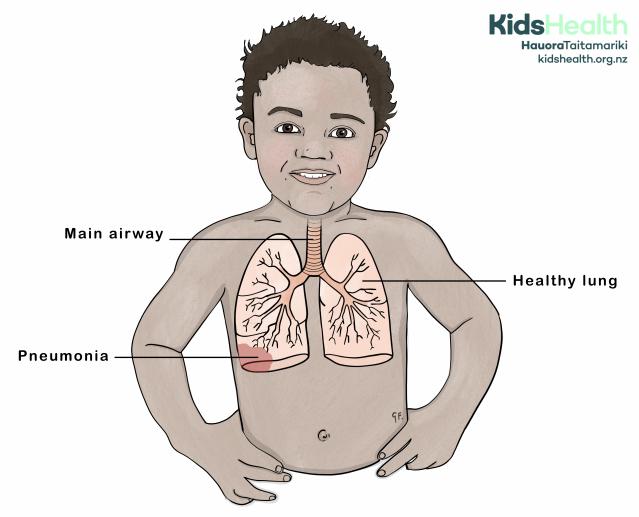
Illustration showing pneumonia affecting part of one lung.
**Source:** [**KidsHealth**](https://www.kidshealth.org.nz/disclaimer-terms-of-use-copyright "Disclaimer, Terms Of Use, Copyright")
transcribeTranscript expand\_more expand\_less
The illustration shows a young male child with an overlay of the lungs and main airway on their chest.
The **main airway** (trachea) is shown in the centre, dividing into the lungs. The child’s right lung shows a patch of infection in the lower part of the lung, shaded red. This is labelled **Pneumonia.** The child’s left lung is labelled **Healthy lung** and appears clear.
At the top right is the **KidsHealth** logo with the website: **kidshealth.org.nz**
## Causes of pneumonia
Either viruses or bacteria cause pneumonia.
In tamariki, especially young tamariki, viral pneumonia is more common.
It can be difficult to tell whether the pneumonia is due to a virus or bacteria.
## How children catch pneumonia
You can catch the viruses that cause viral pneumonia - they can spread easily between people. Most tamariki with a virus just get a cold. Only a few will get pneumonia.
Viral infections, including viral pneumonia, are more common in winter.
Bacterial pneumonia does not usually spread between people.
It's difficult to tell whether pneumonia is viral or bacterial.
Keep your child with pneumonia away from others.
## Children at risk of getting pneumonia
Anyone can get pneumonia. But some tamariki are more likely to get pneumonia than others. Tamariki are at greater risk of getting pneumonia if they:
- haven't had their vaccinations
- are around cigarette smoke
- have a long-lasting condition that affects the lungs
- have any other long-lasting medical condition
- were born premature
- have feeding problems, such as food or liquid going down the wrong way, into the lungs (aspiration)
## Signs and symptoms of pneumonia
Pneumonia causes cough and sometimes a fever.
It also causes trouble breathing which can include:
- putting extra effort into breathing
- breathing faster than usual
- noisy or rattly breathing
- difficulty with feeding
- making a grunting sound with breathing
[Signs That Children Are Struggling To Breathe](https://www.kidshealth.org.nz/signs-that-children-are-struggling-to-breathe "Signs That Children Are Struggling To Breathe")
### Viral pneumonia
Viral pneumonia usually develops over days. It starts with a cold and a runny nose. Then there is a cough, sometimes fever and then breathing problems.
### Bacterial pneumonia
Bacterial pneumonia usually develops faster, over a day. It causes high fever, a cough, and breathing problems. Your child may be very tired and unwell.
Sometimes bacterial pneumonia develops during a viral infection. If this happens, your child will usually have a cold for a few days, and then become more unwell quite quickly.
## When to get medical help for pneumonia
If you are worried that your child may have pneumonia, call Healthline on [0800 611 116](<tel:0800 611 116>) or see a health professional.
### See a health professional urgently
See a health professional urgently if your child:
- is under 3 months old
- is having trouble breathing
- is having less than half their normal feeds
- looks unwell
- suddenly gets worse after beginning to get better
### Call 111
Call [111](tel:111) within New Zealand (use the appropriate emergency number in other countries) and ask for urgent medical help if your child:
- is blue around the mouth
- is struggling to breathe
- is hard to wake
- is floppy
## Diagnosing pneumonia
A health professional can usually diagnose pneumonia after looking at your child and listening to their chest. Sometimes, they may arrange a chest x-ray which will usually show the pneumonia.
If your child looks very unwell, and especially if they're very young, the health professional may ask you to take them to hospital.
## Treatment for pneumonia
Your health professional will give antibiotics to your child if they have bacterial pneumonia. Health professionals may use antibiotics when it is not clear whether your child's pneumonia is viral or bacterial.
Some tamariki may need support with their breathing and feeding.
## Caring for your child with pneumonia at home
If your child is miserable because of pain or fever, you can give paracetamol to make them more comfortable. You must follow the dosage instructions on the bottle. It is dangerous to give more than the recommended dose.
Your child will need rest to help them recover from pneumonia. Encourage them to drink fluids.
If your health professional has given your child antibiotics, make sure they take all the doses until finished.
Keep your child with pneumonia away from other tamariki, so they don't pass the infection to others.
## How long pneumonia lasts
Tamariki usually take a couple of weeks to fully recover. The cough may last up to 4 weeks but should gradually be getting better over this time.
Take your child back to a health professional if:
- you are worried that the cough is getting worse again
- the cough has not stopped after 4 weeks
- your child has had pneumonia before
A long-lasting cough, coughing up phlegm, or repeated pneumonia can be a sign of bronchiectasis. This is a type of scarring in the lungs.
[Bronchiectasis](https://www.kidshealth.org.nz/bronchiectasis "Bronchiectasis In Children")
## Complications from pneumonia
Most tamariki make a full recovery from pneumonia with no lasting effects.
A small number of tamariki get complications and need to go to hospital for treatment.
## Preventing pneumonia
### Vaccination
Vaccination helps to prevent some serious causes of pneumonia, in particular, vaccination against the following diseases:
- pneumococcal disease
- whooping cough
- flu
- Hib (*Haemophilus influenzae* type b)
[Vaccination Overview](https://www.kidshealth.org.nz/vaccination "Vaccination Overview")
### Breastfeeding
Breastfeeding your baby protects them from getting pneumonia by boosting their immune system. Breastfeeding beyond 4 months of age offers the best protection.
### Smoke-free environment
Make sure your child's environment is smoke-free. This will help reduce the chance of your child getting pneumonia. If you want to give up smoking or vaping, contact Quitline or talk with your health professional.
Image

Quitline
If you want to give up smoking or vaping call Quitline free on [0800 778 778](<tel:0800 778 778>). Quitline can provide free support and advice to help you or someone in your whānau quit smoking. Visit their website for more information.
[**Visit Quitline**arrow\_outward](https://quit.org.nz/)
### A warm house
Keeping the house smoke-free, mould-free, dry, warm and well-insulated will also decrease your child's risk of developing pneumonia.
[Keeping Your Home Warm & Dry](https://www.kidshealth.org.nz/healthy-homes/keeping-your-home-warm-dry "Keeping Your Home Warm & Dry")
### Treatment for long-lasting conditions
Make sure your child keeps up with their treatment for any medical conditions such as asthma.
### Clean hands
Make sure everyone in the whānau washes their hands regularly and thoroughly, and dries them well.
Image

Healthline
Healthline is available 24 hours a day, 7 days a week on [0800 611 116](tel:0800611116). Call Healthline if you need advice about a child of any age who is unwell, hurt, or has any symptoms of sickness. It's free to callers throughout New Zealand, including from a mobile phone.
[**Call Healthline 0800 611 116**](tel:0800611116)
Acknowledgements expand\_circle\_down expand\_circle\_up
Illustration by Dr Greta File. Property of [KidsHealth](https://www.kidshealth.org.nz/disclaimer-terms-of-use-copyright "Disclaimer, Terms Of Use, Copyright").
## External links and downloads
- ## [Experts discuss pneumonia in New Zealand children](https://www.kidshealth.org.nz/node/1080)
A 2009 New Zealand Herald article, written by 3 New Zealand paediatricians, discusses the serious consequences pneumonia can have and how it can be prevented.
Last reviewed
2 August 2024
### Topics:
[Pneumonia](https://www.kidshealth.org.nz/topics/pneumonia)
[Lungs](https://www.kidshealth.org.nz/body/lungs)
[All ages](https://www.kidshealth.org.nz/age/all-ages)
[All genders](https://www.kidshealth.org.nz/gender/all-genders)
share
cancel
- [email Share via email](<mailto:recipient@email.com?&subject=You might be interested in Pneumonia In Children&body=This is a page by KidsHealth.org.nz — New Zealand's Trusted Voice On Children's Health: https://www.kidshealth.org.nz/pneumonia-in-children>)
- content\_copyCopy link
status
- print Print this page
print
qr\_code\_2 Get QR code
cancel
https://www.kidshealth.org.nz/nc/2y
[arrow\_forward Browse QR Posters](https://www.kidshealth.org.nz/kidshealth-qr-poster-collection)
[step\_out Back to top](https://www.kidshealth.org.nz/pneumonia-in-children#canvas)
## You might also be interested in
- ## Is My Child Sick?
Colds and fever are a normal part of childhood. You know your child best. If you’re worried at any stage, always seek help.
[Learn more arrow\_right\_alt](https://www.kidshealth.org.nz/is-my-child-sick)
- ## Cough In Children
Coughing is common in tamariki (children), especially when they are preschool age. A cough that lasts longer than 4 weeks may be a sign of more serious disease.
[Learn more arrow\_right\_alt](https://www.kidshealth.org.nz/cough-in-children)
- ## Fever In Children
Fevers are common in tamariki (children). Fever by itself does not tell you whether your child is seriously sick. Even an ordinary cold can cause a high fever.
[Learn more arrow\_right\_alt](https://www.kidshealth.org.nz/fever-in-children)
- ## Vaccination Overview
Vaccination on time is the most effective way to protect hapū māmā (pregnant mothers), pēpi (babies) and tamariki (children) from preventable disease.
[Learn more arrow\_right\_alt](https://www.kidshealth.org.nz/vaccination)
## Footer
[ ](https://www.kidshealth.org.nz/)
Your trusted source for accurate and reliable information about the health and wellbeing of tamariki & rangatahi in Aotearoa.
KidsHealth is a [**Paediatric Society of New Zealand \| Te Kāhui Mātai Arotamariki o Aotearoa**arrow\_outward](https://www.paediatrics.org.nz/) initiative, supported by [**Health New Zealand \| Te Whatu Ora**arrow\_outward](https://info.health.nz/)
- [Linkedin](https://nz.linkedin.com/company/kidshealth-new-zealand)
## Do you need help?
For free medical advice, call Healthline
[**0800 611 116**](tel:0800611116)
For emergencies, call 111
[**111**](tel:111)
For free parenting help & advice, call PlunketLine
[**0800 933 922**](tel:0800933922)
[Find a healthcare provider on Healthpoint](https://www.healthpoint.co.nz/)
- [About KidsHealth](https://www.kidshealth.org.nz/about-kidshealth)
- [Accessibility](https://www.kidshealth.org.nz/accessibility)
- [Feedback](https://www.kidshealth.org.nz/contact)
- [Disclaimer, Terms Of Use, Copyright](https://www.kidshealth.org.nz/disclaimer-terms-of-use-copyright)
- [Privacy](https://www.kidshealth.org.nz/privacy)
© The Paediatric Society of New Zealand 2004 - 2025
[](https://www.kidshealth.org.nz/pneumonia-in-children) |
| Readable Markdown | ## Pneumonia animation
## Key points about pneumonia
- pneumonia is an infection of the lungs
- pneumonia can cause cough, fever and trouble breathing
- either viruses or bacteria cause pneumonia
- viral pneumonia is more common in tamariki
- most tamariki make a complete recovery from pneumonia
- if you are worried about your child's breathing, see a health professional
## What is pneumonia?
Immunisation helps to prevent some serious causes of pneumonia.
Pneumonia is an infection of the lungs. It often affects only part of the lungs.
## Causes of pneumonia
Either viruses or bacteria cause pneumonia.
In tamariki, especially young tamariki, viral pneumonia is more common.
It can be difficult to tell whether the pneumonia is due to a virus or bacteria.
## How children catch pneumonia
You can catch the viruses that cause viral pneumonia - they can spread easily between people. Most tamariki with a virus just get a cold. Only a few will get pneumonia.
Viral infections, including viral pneumonia, are more common in winter.
Bacterial pneumonia does not usually spread between people.
It's difficult to tell whether pneumonia is viral or bacterial.
Keep your child with pneumonia away from others.
## Children at risk of getting pneumonia
Anyone can get pneumonia. But some tamariki are more likely to get pneumonia than others. Tamariki are at greater risk of getting pneumonia if they:
- haven't had their vaccinations
- are around cigarette smoke
- have a long-lasting condition that affects the lungs
- have any other long-lasting medical condition
- were born premature
- have feeding problems, such as food or liquid going down the wrong way, into the lungs (aspiration)
## Signs and symptoms of pneumonia
Pneumonia causes cough and sometimes a fever.
It also causes trouble breathing which can include:
- putting extra effort into breathing
- breathing faster than usual
- noisy or rattly breathing
- difficulty with feeding
- making a grunting sound with breathing
[Signs That Children Are Struggling To Breathe](https://www.kidshealth.org.nz/signs-that-children-are-struggling-to-breathe "Signs That Children Are Struggling To Breathe")
### Viral pneumonia
Viral pneumonia usually develops over days. It starts with a cold and a runny nose. Then there is a cough, sometimes fever and then breathing problems.
### Bacterial pneumonia
Bacterial pneumonia usually develops faster, over a day. It causes high fever, a cough, and breathing problems. Your child may be very tired and unwell.
Sometimes bacterial pneumonia develops during a viral infection. If this happens, your child will usually have a cold for a few days, and then become more unwell quite quickly.
## When to get medical help for pneumonia
If you are worried that your child may have pneumonia, call Healthline on [0800 611 116](<tel:0800 611 116>) or see a health professional.
### See a health professional urgently
See a health professional urgently if your child:
- is under 3 months old
- is having trouble breathing
- is having less than half their normal feeds
- looks unwell
- suddenly gets worse after beginning to get better
### Call 111
Call [111](tel:111) within New Zealand (use the appropriate emergency number in other countries) and ask for urgent medical help if your child:
- is blue around the mouth
- is struggling to breathe
- is hard to wake
- is floppy
## Diagnosing pneumonia
A health professional can usually diagnose pneumonia after looking at your child and listening to their chest. Sometimes, they may arrange a chest x-ray which will usually show the pneumonia.
If your child looks very unwell, and especially if they're very young, the health professional may ask you to take them to hospital.
## Treatment for pneumonia
Your health professional will give antibiotics to your child if they have bacterial pneumonia. Health professionals may use antibiotics when it is not clear whether your child's pneumonia is viral or bacterial.
Some tamariki may need support with their breathing and feeding.
## Caring for your child with pneumonia at home
If your child is miserable because of pain or fever, you can give paracetamol to make them more comfortable. You must follow the dosage instructions on the bottle. It is dangerous to give more than the recommended dose.
Your child will need rest to help them recover from pneumonia. Encourage them to drink fluids.
If your health professional has given your child antibiotics, make sure they take all the doses until finished.
Keep your child with pneumonia away from other tamariki, so they don't pass the infection to others.
## How long pneumonia lasts
Tamariki usually take a couple of weeks to fully recover. The cough may last up to 4 weeks but should gradually be getting better over this time.
Take your child back to a health professional if:
- you are worried that the cough is getting worse again
- the cough has not stopped after 4 weeks
- your child has had pneumonia before
A long-lasting cough, coughing up phlegm, or repeated pneumonia can be a sign of bronchiectasis. This is a type of scarring in the lungs.
[Bronchiectasis](https://www.kidshealth.org.nz/bronchiectasis "Bronchiectasis In Children")
## Complications from pneumonia
Most tamariki make a full recovery from pneumonia with no lasting effects.
A small number of tamariki get complications and need to go to hospital for treatment.
## Preventing pneumonia
### Vaccination
Vaccination helps to prevent some serious causes of pneumonia, in particular, vaccination against the following diseases:
- pneumococcal disease
- whooping cough
- flu
- Hib (*Haemophilus influenzae* type b)
[Vaccination Overview](https://www.kidshealth.org.nz/vaccination "Vaccination Overview")
### Breastfeeding
Breastfeeding your baby protects them from getting pneumonia by boosting their immune system. Breastfeeding beyond 4 months of age offers the best protection.
### Smoke-free environment
Make sure your child's environment is smoke-free. This will help reduce the chance of your child getting pneumonia. If you want to give up smoking or vaping, contact Quitline or talk with your health professional.
Quitline
If you want to give up smoking or vaping call Quitline free on [0800 778 778](<tel:0800 778 778>). Quitline can provide free support and advice to help you or someone in your whānau quit smoking. Visit their website for more information.
[**Visit Quitline**arrow\_outward](https://quit.org.nz/)
### A warm house
Keeping the house smoke-free, mould-free, dry, warm and well-insulated will also decrease your child's risk of developing pneumonia.
[Keeping Your Home Warm & Dry](https://www.kidshealth.org.nz/healthy-homes/keeping-your-home-warm-dry "Keeping Your Home Warm & Dry")
### Treatment for long-lasting conditions
Make sure your child keeps up with their treatment for any medical conditions such as asthma.
### Clean hands
Make sure everyone in the whānau washes their hands regularly and thoroughly, and dries them well.
Healthline
Healthline is available 24 hours a day, 7 days a week on [0800 611 116](tel:0800611116). Call Healthline if you need advice about a child of any age who is unwell, hurt, or has any symptoms of sickness. It's free to callers throughout New Zealand, including from a mobile phone.
[**Call Healthline 0800 611 116**](tel:0800611116)
Acknowledgements
Illustration by Dr Greta File. Property of [KidsHealth](https://www.kidshealth.org.nz/disclaimer-terms-of-use-copyright "Disclaimer, Terms Of Use, Copyright"). |
| Shard | 147 (laksa) |
| Root Hash | 3321840565794181747 |
| Unparsed URL | nz,org,kidshealth!www,/pneumonia-in-children s443 |