ℹ️ Skipped - page is already crawled
| Filter | Status | Condition | Details |
|---|---|---|---|
| HTTP status | PASS | download_http_code = 200 | HTTP 200 |
| Age cutoff | PASS | download_stamp > now() - 6 MONTH | 0.3 months ago |
| History drop | PASS | isNull(history_drop_reason) | No drop reason |
| Spam/ban | PASS | fh_dont_index != 1 AND ml_spam_score = 0 | ml_spam_score=0 |
| Canonical | PASS | meta_canonical IS NULL OR = '' OR = src_unparsed | Not set |
| Property | Value | |||||||||
|---|---|---|---|---|---|---|---|---|---|---|
| URL | https://www.kdnuggets.com/7-steps-to-mastering-natural-language-processing | |||||||||
| Last Crawled | 2026-04-16 08:20:15 (7 days ago) | |||||||||
| First Indexed | 2023-10-04 16:01:51 (2 years ago) | |||||||||
| HTTP Status Code | 200 | |||||||||
| Content | ||||||||||
| Meta Title | 7 Steps to Mastering Natural Language Processing - KDnuggets | |||||||||
| Meta Description | Want to learn all about Natural Language Processing (NLP)? Here is a 7 step guide to help you go from the fundamentals of machine learning and Python to Transformers, recent advances in NLP, and beyond. | |||||||||
| Meta Canonical | null | |||||||||
| Boilerpipe Text | Image by Author
There has never been a more exciting time to get into natural language processing (NLP). Do you have some experience building machine learning models and are interested in exploring natural language processing? Perhaps you’ve used LLM-powered applications like ChaGPT—and realize their usefulness—and want to delve deep into natural language processing?
Well, you may have other reasons, too. But now that you’re here, here’s a 7-step guide to learning all about NLP. At each step, we provide:
An overview of the concepts you should learn and understand
Some learning resources
Projects you can build
Let’s get started.
Step 1: Python and Machine Learning
As a first step, you should build a strong foundation in Python programming. Additionally, proficiency in libraries like NumPy and Pandas for data manipulation is also essential. Before you dive into NLP, grasp the basics of machine learning models, including commonly used supervised and unsupervised learning algorithms.
Become familiar with libraries like scikit-learn, which make it easier to implement machine learning algorithms.
In summary, here’s what you should know:
Python programming
Proficiency with libraries like NumPy and Pandas
Machine Learning basics (from data preprocessing and exploration to evaluation and selection)
Familiarity with both supervised and unsupervised learning paradigms
Libraries like Scikit-Learn for ML in Python
Check out this
Scikit-Learn crash course by freeCodeCamp
.
Here are some projects you can work on:
House price prediction
Loan default prediction
Clustering for customer segmentation
Step 2: Deep Learning Fundamentals
After you’ve gained proficiency in machine learning and are comfortable with model building and evaluation, you can proceed to deep learning.
Start by understanding neural networks, their structure, and how they process data. Learn about activation functions, loss functions, and optimizers that are essential for training neural networks.
Understand the concept of backpropagation, which facilitates learning in neural networks, and the gradient descent as an optimization technique. Familiarize yourself with deep learning frameworks like TensorFlow and PyTorch for practical implementation.
In summary, here’s what you should know:
Neural networks and their architecture
Activation functions, loss functions, and optimizers
Backpropagation and gradient descent
Frameworks like TensorFlow and PyTorch
The following resources will be helpful in picking up the basics of PyTorch and TensorFlow:
PyTorch for Deep Learning
TensorFlow 2.0 Complete Course
You can apply what you’ve learned by working on the following projects:
Handwritten digit recognition
Image classification on CIFAR-10 or a similar dataset
Step 3: NLP 101 and Essential Linguistics Concepts
Begin by understanding what NLP
is
and its wide-ranging applications, from sentiment analysis to machine translation, question answering, and beyond.
Understand linguistic concepts like tokenization, which involves breaking text into smaller units (tokens). Learn about stemming and lemmatization, techniques that reduce words to their root forms.
Also explore tasks like part-of-speech tagging and named entity recognition.
To sum up, you should understand:
Introduction to NLP and its applications
Tokenization, stemming, and lemmatization
Part-of-speech tagging and named entity recognition
Basic linguistics concepts like syntax, semantics, and dependency parsing
The lectures on
dependency parsing from CS 224n
provide a good overview of the linguistics concepts you’d need. The free book
Natural language Processing with Python
(NLTK) is also a good reference resource.
Try building a Named Entity Recognition (NER) app for a use case of your choice (parsing resume and other documents).
Step 4: Traditional Natural Language Processing Techniques
Before deep learning revolutionized NLP, traditional techniques laid the groundwork. You should understand the Bag of Words (BoW) and TF-IDF representations, which convert text data into numerical form for machine learning models.
Learn about N-grams, which capture the context of words, and their applications in text classification. Then explore sentiment analysis and text summarization techniques. Additionally, understand Hidden Markov Models (HMMs) for tasks like part-of-speech tagging, matrix factorization and other algorithms like Latent Dirichlet Allocation (LDA) for topic modeling.
So you should familiarize yourself with:
Bag of Words (BoW) and TF-IDF representation
N-grams and text classification
Sentiment analysis, topic modeling, and text summarization
Hidden Markov Models (HMMs) for POS tagging
Here’s a learning resource:
Complete Natural Language Processing Tutorial with Python
.
And a couple of project ideas:
Spam classifier
Topic modeling on a news feed or similar dataset
Step 5: Deep Learning for Natural Language Processing
At this point, you’re familiar with the basics of NLP and deep learning. Now, apply your deep learning knowledge to NLP tasks. Start with word embeddings, such as Word2Vec and GloVe, which represent words as dense vectors and capture semantic relationships.
Then delve into sequence models such as Recurrent Neural Networks (RNNs) for handling sequential data. Understand Long Short-Term Memory (LSTM) and Gated Recurrent Units (GRU), known for their ability to capture long-term dependencies in text data. Explore sequence-to-sequence models for tasks such as machine translation.
Summing up:
Word embeddings (Word2Vec, GloVe)
RNNs
LSTM and GRUs
Sequence-to-sequence models
CS 224n: Natural Language Processing with Deep Learning
is an excellent resource.
A couple of project ideas:
Language translation app
Question answering on custom corpus
Step 6: Natural Language Processing with Transformers
The advent of
Transformers
has revolutionized NLP. Understand the
attention mechanism
, a key component of Transformers that enables models to focus on relevant parts of the input. Learn about the Transformer architecture and the various applications.
You should understand:
Attention mechanism and its significance
Introduction to Transformer architecture
Applications of Transformers
Leveraging pre-trained language models; fine-tuning pre-trained models for specific NLP tasks
The most comprehensive resource to learn NLP with Transformers is the
Transformers course by HuggingFace team
.
Interesting projects you can build include:
Customer chatbot/virtual assistant
Emotion detection in text
Step 7: Build Projects, Keep Learning, and Stay Current
In a rapidly advancing field like natural language processing (or any field in general), you can only keep learning and hack your way through more challenging projects.
It's essential to work on projects, as they provide practical experience and reinforce your understanding of the concepts. Additionally, staying engaged with the NLP research community through blogs, research papers, and online communities will help you keep up with the advances in NLP.
ChatGPT from OpenAI hit the market in late 2022 and GPT-4 released in early 2023. At the same time (we’ve seen and still are seeing) there are releases of scores of open-source large language models, LLM-powered coding assistants, novel and resource-efficient fine-tuning techniques, and much more.
If you’re looking to up your LLM game, here’s a two-part compilation two part compilation of helpful resources:
Top Free Courses on Large Language Models
More Free Courses on Large Language Models
You can also explore frameworks like
Langchain
and LlamaIndex to build useful and interesting LLM-powered applications.
Wrapping Up
I hope you found this guide to mastering NLP helpful. Here’s a review of the 7 steps:
Step 1: Python and ML fundamentals
Step 2: Deep learning fundamentals
Step 3: NLP 101 and essential linguistics concepts
Step 4: Traditional NLP techniques
Step 5: Deep learning for NLP
Step 6: NLP with transformers
Step 7: Build projects, keep learning, and stay current!
If you’re looking for tutorials, project walkthroughs, and more, check out the
collection of NLP resources
on KDnuggets.
Bala Priya C
is a developer and technical writer from India. She likes working at the intersection of math, programming, data science, and content creation. Her areas of interest and expertise include DevOps, data science, and natural language processing. She enjoys reading, writing, coding, and coffee! Currently, she's working on learning and sharing her knowledge with the developer community by authoring tutorials, how-to guides, opinion pieces, and more. | |||||||||
| Markdown | [](https://www.kdnuggets.com/)
 
- [Blog](https://www.kdnuggets.com/news/index.html)
- [Top Posts](https://www.kdnuggets.com/news/top-stories.html)
- [About](https://www.kdnuggets.com/about/index.html)
- [Topics](https://www.kdnuggets.com/topic)
- [AI](https://www.kdnuggets.com/tag/artificial-intelligence)
- [Career Advice](https://www.kdnuggets.com/tag/career-advice)
- [Computer Vision](https://www.kdnuggets.com/tag/computer-vision)
- [Data Engineering](https://www.kdnuggets.com/tags/data-engineering)
- [Data Science](https://www.kdnuggets.com/tag/data-science)
- [Language Models](https://www.kdnuggets.com/tag/language-models)
- [Machine Learning](https://www.kdnuggets.com/tag/machine-learning)
- [MLOps](https://www.kdnuggets.com/tag/mlops)
- [NLP](https://www.kdnuggets.com/tag/natural-language-processing)
- [Programming](https://www.kdnuggets.com/tag/programming)
- [Python](https://www.kdnuggets.com/tag/python)
- [SQL](https://www.kdnuggets.com/tag/sql)
- [Datasets](https://www.kdnuggets.com/datasets/index.html)
- [Events](https://www.kdnuggets.com/meetings/index.html)
- [Resources](https://www.kdnuggets.com/)
- [Cheat Sheets](https://www.kdnuggets.com/cheat-sheets/index.html)
- [Recommendations](https://www.kdnuggets.com/kdnuggets-recommends)
- [Tech Briefs](https://www.kdnuggets.com/tech-briefs/index.html)
- [Advertise](https://www.kdnuggets.com/media-kit)
- [](https://www.facebook.com/kdnuggets)
- [](https://twitter.com/kdnuggets)
- [](https://www.linkedin.com/groups/54257/)
[Join Newsletter](https://www.kdnuggets.com/7-steps-to-mastering-natural-language-processing#boxzilla-138215)
# 7 Steps to Mastering Natural Language Processing
Want to learn all about Natural Language Processing (NLP)? Here is a 7 step guide to help you go from the fundamentals of machine learning and Python to Transformers, recent advances in NLP, and beyond.
By **[Bala Priya C](https://www.kdnuggets.com/author/bala-priya "Posts by Bala Priya C")**, KDnuggets Contributing Editor & Technical Content Specialist on October 4, 2023 in [Natural Language Processing](https://www.kdnuggets.com/tag/natural-language-processing)
***

Image by Author
There has never been a more exciting time to get into natural language processing (NLP). Do you have some experience building machine learning models and are interested in exploring natural language processing? Perhaps you’ve used LLM-powered applications like ChaGPT—and realize their usefulness—and want to delve deep into natural language processing?
Well, you may have other reasons, too. But now that you’re here, here’s a 7-step guide to learning all about NLP. At each step, we provide:
- An overview of the concepts you should learn and understand
- Some learning resources
- Projects you can build
Let’s get started.
# Step 1: Python and Machine Learning
As a first step, you should build a strong foundation in Python programming. Additionally, proficiency in libraries like NumPy and Pandas for data manipulation is also essential. Before you dive into NLP, grasp the basics of machine learning models, including commonly used supervised and unsupervised learning algorithms.
Become familiar with libraries like scikit-learn, which make it easier to implement machine learning algorithms.
In summary, here’s what you should know:
- Python programming
- Proficiency with libraries like NumPy and Pandas
- Machine Learning basics (from data preprocessing and exploration to evaluation and selection)
- Familiarity with both supervised and unsupervised learning paradigms
- Libraries like Scikit-Learn for ML in Python
Check out this [Scikit-Learn crash course by freeCodeCamp](https://www.youtube.com/watch?v=0B5eIE_1vpU).
Here are some projects you can work on:
- House price prediction
- Loan default prediction
- Clustering for customer segmentation
# Step 2: Deep Learning Fundamentals
After you’ve gained proficiency in machine learning and are comfortable with model building and evaluation, you can proceed to deep learning.
Start by understanding neural networks, their structure, and how they process data. Learn about activation functions, loss functions, and optimizers that are essential for training neural networks.
Understand the concept of backpropagation, which facilitates learning in neural networks, and the gradient descent as an optimization technique. Familiarize yourself with deep learning frameworks like TensorFlow and PyTorch for practical implementation.
In summary, here’s what you should know:
- Neural networks and their architecture
- Activation functions, loss functions, and optimizers
- Backpropagation and gradient descent
- Frameworks like TensorFlow and PyTorch
The following resources will be helpful in picking up the basics of PyTorch and TensorFlow:
- [PyTorch for Deep Learning](https://www.youtube.com/watch?v=GIsg-ZUy0MY)
- [TensorFlow 2.0 Complete Course](https://www.youtube.com/watch?v=tPYj3fFJGjk)
You can apply what you’ve learned by working on the following projects:
- Handwritten digit recognition
- Image classification on CIFAR-10 or a similar dataset
# Step 3: NLP 101 and Essential Linguistics Concepts
Begin by understanding what NLP *is* and its wide-ranging applications, from sentiment analysis to machine translation, question answering, and beyond.
Understand linguistic concepts like tokenization, which involves breaking text into smaller units (tokens). Learn about stemming and lemmatization, techniques that reduce words to their root forms.
Also explore tasks like part-of-speech tagging and named entity recognition.
To sum up, you should understand:
- Introduction to NLP and its applications
- Tokenization, stemming, and lemmatization
- Part-of-speech tagging and named entity recognition
- Basic linguistics concepts like syntax, semantics, and dependency parsing
The lectures on [dependency parsing from CS 224n](https://web.stanford.edu/class/archive/cs/cs224n/cs224n.1224/) provide a good overview of the linguistics concepts you’d need. The free book [Natural language Processing with Python](https://www.nltk.org/book/) (NLTK) is also a good reference resource.
Try building a Named Entity Recognition (NER) app for a use case of your choice (parsing resume and other documents).
# Step 4: Traditional Natural Language Processing Techniques
Before deep learning revolutionized NLP, traditional techniques laid the groundwork. You should understand the Bag of Words (BoW) and TF-IDF representations, which convert text data into numerical form for machine learning models.
Learn about N-grams, which capture the context of words, and their applications in text classification. Then explore sentiment analysis and text summarization techniques. Additionally, understand Hidden Markov Models (HMMs) for tasks like part-of-speech tagging, matrix factorization and other algorithms like Latent Dirichlet Allocation (LDA) for topic modeling.
So you should familiarize yourself with:
- Bag of Words (BoW) and TF-IDF representation
- N-grams and text classification
- Sentiment analysis, topic modeling, and text summarization
- Hidden Markov Models (HMMs) for POS tagging
Here’s a learning resource: [Complete Natural Language Processing Tutorial with Python](https://www.youtube.com/watch?v=M7SWr5xObkA).
And a couple of project ideas:
- Spam classifier
- Topic modeling on a news feed or similar dataset
# Step 5: Deep Learning for Natural Language Processing
At this point, you’re familiar with the basics of NLP and deep learning. Now, apply your deep learning knowledge to NLP tasks. Start with word embeddings, such as Word2Vec and GloVe, which represent words as dense vectors and capture semantic relationships.
Then delve into sequence models such as Recurrent Neural Networks (RNNs) for handling sequential data. Understand Long Short-Term Memory (LSTM) and Gated Recurrent Units (GRU), known for their ability to capture long-term dependencies in text data. Explore sequence-to-sequence models for tasks such as machine translation.
Summing up:
- RNNs
- LSTM and GRUs
- Sequence-to-sequence models
[CS 224n: Natural Language Processing with Deep Learning](https://web.stanford.edu/class/archive/cs/cs224n/cs224n.1224/) is an excellent resource.
A couple of project ideas:
- Language translation app
- Question answering on custom corpus
# Step 6: Natural Language Processing with Transformers
The advent of **Transformers** has revolutionized NLP. Understand the **attention mechanism**, a key component of Transformers that enables models to focus on relevant parts of the input. Learn about the Transformer architecture and the various applications.
You should understand:
- Attention mechanism and its significance
- Introduction to Transformer architecture
- Applications of Transformers
- Leveraging pre-trained language models; fine-tuning pre-trained models for specific NLP tasks
The most comprehensive resource to learn NLP with Transformers is the [Transformers course by HuggingFace team](https://huggingface.co/learn/nlp-course/chapter1/1).
Interesting projects you can build include:
- Customer chatbot/virtual assistant
- Emotion detection in text
# Step 7: Build Projects, Keep Learning, and Stay Current
In a rapidly advancing field like natural language processing (or any field in general), you can only keep learning and hack your way through more challenging projects.
It's essential to work on projects, as they provide practical experience and reinforce your understanding of the concepts. Additionally, staying engaged with the NLP research community through blogs, research papers, and online communities will help you keep up with the advances in NLP.
ChatGPT from OpenAI hit the market in late 2022 and GPT-4 released in early 2023. At the same time (we’ve seen and still are seeing) there are releases of scores of open-source large language models, LLM-powered coding assistants, novel and resource-efficient fine-tuning techniques, and much more.
If you’re looking to up your LLM game, here’s a two-part compilation two part compilation of helpful resources:
- [Top Free Courses on Large Language Models](https://www.kdnuggets.com/2023/03/top-free-courses-large-language-models.html)
- [More Free Courses on Large Language Models](https://www.kdnuggets.com/2023/06/free-courses-large-language-models.html)
You can also explore frameworks like [Langchain](https://www.kdnuggets.com/2023/04/langchain-101-build-gptpowered-applications.html) and LlamaIndex to build useful and interesting LLM-powered applications.
# Wrapping Up
I hope you found this guide to mastering NLP helpful. Here’s a review of the 7 steps:
- Step 1: Python and ML fundamentals
- Step 2: Deep learning fundamentals
- Step 3: NLP 101 and essential linguistics concepts
- Step 4: Traditional NLP techniques
- Step 5: Deep learning for NLP
- Step 6: NLP with transformers
- Step 7: Build projects, keep learning, and stay current\!
If you’re looking for tutorials, project walkthroughs, and more, check out the [collection of NLP resources](https://www.kdnuggets.com/tag/natural-language-processing) on KDnuggets.
**[Bala Priya C](https://www.linkedin.com/in/bala-priya/)** is a developer and technical writer from India. She likes working at the intersection of math, programming, data science, and content creation. Her areas of interest and expertise include DevOps, data science, and natural language processing. She enjoys reading, writing, coding, and coffee! Currently, she's working on learning and sharing her knowledge with the developer community by authoring tutorials, how-to guides, opinion pieces, and more.
### More On This Topic
- [Introduction to Natural Language Processing](https://www.kdnuggets.com/introduction-to-natural-language-processing)
- [Comparing Natural Language Processing Techniques: RNNs, Transformers, BERT](https://www.kdnuggets.com/comparing-natural-language-processing-techniques-rnns-transformers-bert)
- [25 Free Books to Master SQL, Python, Data Science, Machine…](https://www.kdnuggets.com/25-free-books-to-master-sql-python-data-science-machine-learning-and-natural-language-processing)
- [Natural Language Processing: Bridging Human Communication with AI](https://www.kdnuggets.com/natural-language-processing-bridging-human-communication-with-ai)
- [5 Free Courses to Master Natural Language Processing](https://www.kdnuggets.com/5-free-courses-to-master-natural-language-processing)
- [Using DistilBERT for Resource-Efficient Natural Language Processing](https://www.kdnuggets.com/distilbert-resource-efficient-natural-language-processing)
***
[Next post =\>](https://www.kdnuggets.com/2023/10/teradata-design-deploy-responsible-ai-systems-whitepaper)
### [Latest Posts](https://www.kdnuggets.com/news/index.html)
- [Top 7 Docker Compose Templates Every Developer Should Use](https://www.kdnuggets.com/top-7-docker-compose-templates-every-developer-should-use)
- [Breaking Down the .claude Folder](https://www.kdnuggets.com/breaking-down-the-claude-folder)
- [Are AI Agents Your Next Security Nightmare?](https://www.kdnuggets.com/are-ai-agents-your-next-security-nightmare)
- [5 Best Books for Building Agentic AI Systems in 2026](https://www.kdnuggets.com/5-best-books-for-building-agentic-ai-systems-in-2026)
- [Advanced NotebookLM Tips & Tricks for Power Users](https://www.kdnuggets.com/advanced-notebooklm-tips-tricks-for-power-users)
- [5 Useful Things to Do with Google’s Antigravity Besides Coding](https://www.kdnuggets.com/5-useful-things-to-do-with-googles-antigravity-besides-coding)
| Top Posts |
|---|
- [5 Useful Python Scripts to Automate Boring Excel Tasks](https://www.kdnuggets.com/5-useful-python-scripts-to-automate-boring-excel-tasks)
- [Kaggle + Google’s Free 5-Day Gen AI Course](https://www.kdnuggets.com/kaggle-googles-free-5-day-gen-ai-course)
- [5 Fun Projects Using OpenClaw](https://www.kdnuggets.com/5-fun-projects-using-openclaw)
- [Advanced NotebookLM Tips & Tricks for Power Users](https://www.kdnuggets.com/advanced-notebooklm-tips-tricks-for-power-users)
- [Run Qwen3.5 on an Old Laptop: A Lightweight Local Agentic AI Setup Guide](https://www.kdnuggets.com/run-qwen3-5-on-an-old-laptop-a-lightweight-local-agentic-ai-setup-guide)
- [10 LLM Engineering Concepts Explained in 10 Minutes](https://www.kdnuggets.com/10-llm-engineering-concepts-explained-in-10-minutes)
- [5 Useful Things to Do with Google’s Antigravity Besides Coding](https://www.kdnuggets.com/5-useful-things-to-do-with-googles-antigravity-besides-coding)
- [7 Steps to Mastering Retrieval-Augmented Generation](https://www.kdnuggets.com/7-steps-to-mastering-retrieval-augmented-generation)
- [5 Best Books for Building Agentic AI Systems in 2026](https://www.kdnuggets.com/5-best-books-for-building-agentic-ai-systems-in-2026)
- [5 Docker Containers for Small Business](https://www.kdnuggets.com/5-docker-containers-for-small-business)
***
© 2026 [Guiding Tech Media](https://www.guidingtechmedia.com/) \| [About](https://www.kdnuggets.com/about/index.html) \| [Contact](https://www.kdnuggets.com/contact.html) \| [Advertise](https://www.kdnuggets.com/media-kit?utm_source=kdn&utm_medium=footer&utm_campaign=link) \| [Privacy](https://www.guidingtechmedia.com/privacy/) \| [Terms of Service](https://www.guidingtechmedia.com/terms-of-use/)
Published on October 4, 2023 by
[No, thanks\!]() | |||||||||
| Readable Markdown | 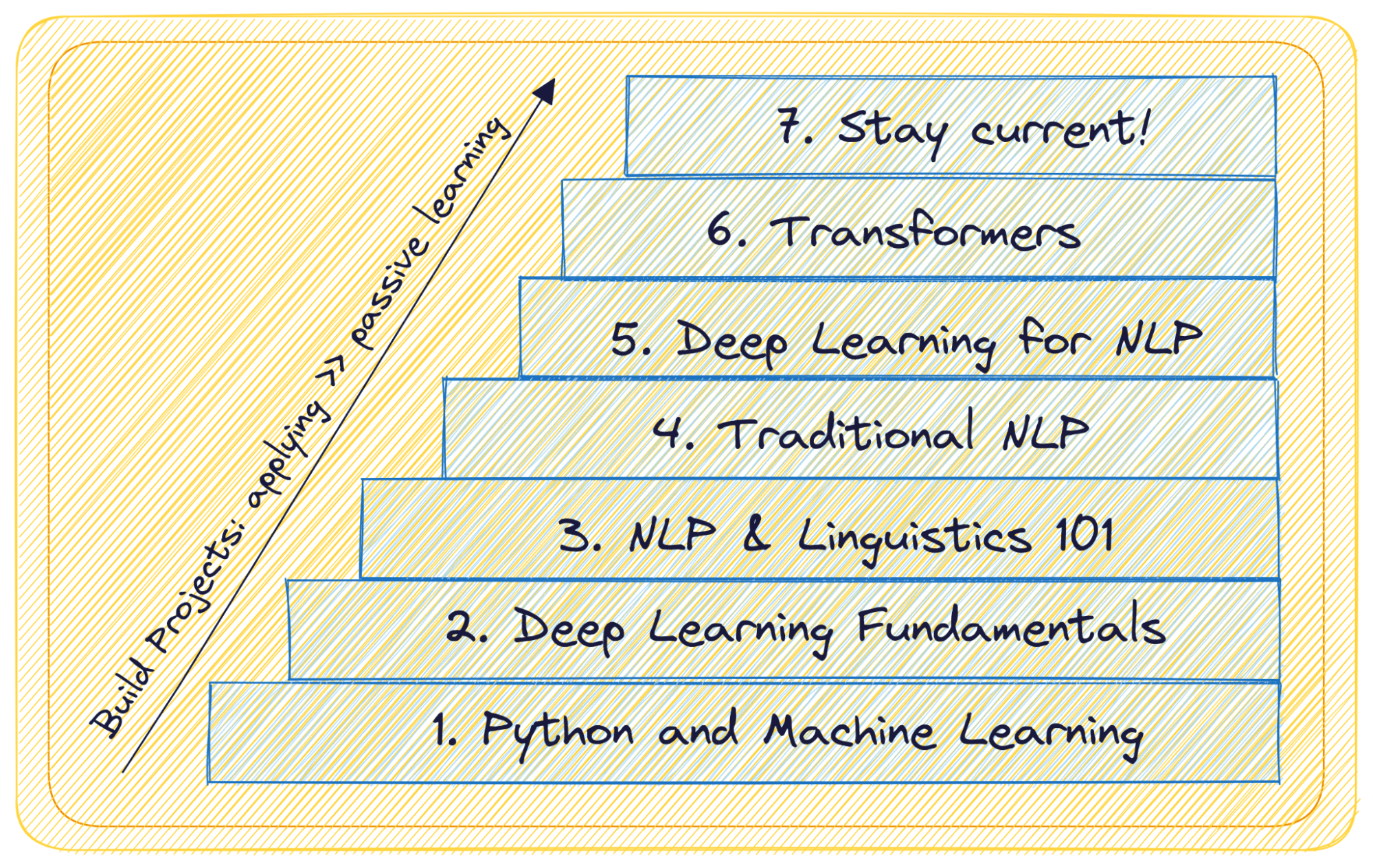
Image by Author
There has never been a more exciting time to get into natural language processing (NLP). Do you have some experience building machine learning models and are interested in exploring natural language processing? Perhaps you’ve used LLM-powered applications like ChaGPT—and realize their usefulness—and want to delve deep into natural language processing?
Well, you may have other reasons, too. But now that you’re here, here’s a 7-step guide to learning all about NLP. At each step, we provide:
- An overview of the concepts you should learn and understand
- Some learning resources
- Projects you can build
Let’s get started.
## Step 1: Python and Machine Learning
As a first step, you should build a strong foundation in Python programming. Additionally, proficiency in libraries like NumPy and Pandas for data manipulation is also essential. Before you dive into NLP, grasp the basics of machine learning models, including commonly used supervised and unsupervised learning algorithms.
Become familiar with libraries like scikit-learn, which make it easier to implement machine learning algorithms.
In summary, here’s what you should know:
- Python programming
- Proficiency with libraries like NumPy and Pandas
- Machine Learning basics (from data preprocessing and exploration to evaluation and selection)
- Familiarity with both supervised and unsupervised learning paradigms
- Libraries like Scikit-Learn for ML in Python
Check out this [Scikit-Learn crash course by freeCodeCamp](https://www.youtube.com/watch?v=0B5eIE_1vpU).
Here are some projects you can work on:
- House price prediction
- Loan default prediction
- Clustering for customer segmentation
## Step 2: Deep Learning Fundamentals
After you’ve gained proficiency in machine learning and are comfortable with model building and evaluation, you can proceed to deep learning.
Start by understanding neural networks, their structure, and how they process data. Learn about activation functions, loss functions, and optimizers that are essential for training neural networks.
Understand the concept of backpropagation, which facilitates learning in neural networks, and the gradient descent as an optimization technique. Familiarize yourself with deep learning frameworks like TensorFlow and PyTorch for practical implementation.
In summary, here’s what you should know:
- Neural networks and their architecture
- Activation functions, loss functions, and optimizers
- Backpropagation and gradient descent
- Frameworks like TensorFlow and PyTorch
The following resources will be helpful in picking up the basics of PyTorch and TensorFlow:
- [PyTorch for Deep Learning](https://www.youtube.com/watch?v=GIsg-ZUy0MY)
- [TensorFlow 2.0 Complete Course](https://www.youtube.com/watch?v=tPYj3fFJGjk)
You can apply what you’ve learned by working on the following projects:
- Handwritten digit recognition
- Image classification on CIFAR-10 or a similar dataset
## Step 3: NLP 101 and Essential Linguistics Concepts
Begin by understanding what NLP *is* and its wide-ranging applications, from sentiment analysis to machine translation, question answering, and beyond.
Understand linguistic concepts like tokenization, which involves breaking text into smaller units (tokens). Learn about stemming and lemmatization, techniques that reduce words to their root forms.
Also explore tasks like part-of-speech tagging and named entity recognition.
To sum up, you should understand:
- Introduction to NLP and its applications
- Tokenization, stemming, and lemmatization
- Part-of-speech tagging and named entity recognition
- Basic linguistics concepts like syntax, semantics, and dependency parsing
The lectures on [dependency parsing from CS 224n](https://web.stanford.edu/class/archive/cs/cs224n/cs224n.1224/) provide a good overview of the linguistics concepts you’d need. The free book [Natural language Processing with Python](https://www.nltk.org/book/) (NLTK) is also a good reference resource.
Try building a Named Entity Recognition (NER) app for a use case of your choice (parsing resume and other documents).
## Step 4: Traditional Natural Language Processing Techniques
Before deep learning revolutionized NLP, traditional techniques laid the groundwork. You should understand the Bag of Words (BoW) and TF-IDF representations, which convert text data into numerical form for machine learning models.
Learn about N-grams, which capture the context of words, and their applications in text classification. Then explore sentiment analysis and text summarization techniques. Additionally, understand Hidden Markov Models (HMMs) for tasks like part-of-speech tagging, matrix factorization and other algorithms like Latent Dirichlet Allocation (LDA) for topic modeling.
So you should familiarize yourself with:
- Bag of Words (BoW) and TF-IDF representation
- N-grams and text classification
- Sentiment analysis, topic modeling, and text summarization
- Hidden Markov Models (HMMs) for POS tagging
Here’s a learning resource: [Complete Natural Language Processing Tutorial with Python](https://www.youtube.com/watch?v=M7SWr5xObkA).
And a couple of project ideas:
- Spam classifier
- Topic modeling on a news feed or similar dataset
## Step 5: Deep Learning for Natural Language Processing
At this point, you’re familiar with the basics of NLP and deep learning. Now, apply your deep learning knowledge to NLP tasks. Start with word embeddings, such as Word2Vec and GloVe, which represent words as dense vectors and capture semantic relationships.
Then delve into sequence models such as Recurrent Neural Networks (RNNs) for handling sequential data. Understand Long Short-Term Memory (LSTM) and Gated Recurrent Units (GRU), known for their ability to capture long-term dependencies in text data. Explore sequence-to-sequence models for tasks such as machine translation.
Summing up:
- RNNs
- LSTM and GRUs
- Sequence-to-sequence models
[CS 224n: Natural Language Processing with Deep Learning](https://web.stanford.edu/class/archive/cs/cs224n/cs224n.1224/) is an excellent resource.
A couple of project ideas:
- Language translation app
- Question answering on custom corpus
## Step 6: Natural Language Processing with Transformers
The advent of **Transformers** has revolutionized NLP. Understand the **attention mechanism**, a key component of Transformers that enables models to focus on relevant parts of the input. Learn about the Transformer architecture and the various applications.
You should understand:
- Attention mechanism and its significance
- Introduction to Transformer architecture
- Applications of Transformers
- Leveraging pre-trained language models; fine-tuning pre-trained models for specific NLP tasks
The most comprehensive resource to learn NLP with Transformers is the [Transformers course by HuggingFace team](https://huggingface.co/learn/nlp-course/chapter1/1).
Interesting projects you can build include:
- Customer chatbot/virtual assistant
- Emotion detection in text
## Step 7: Build Projects, Keep Learning, and Stay Current
In a rapidly advancing field like natural language processing (or any field in general), you can only keep learning and hack your way through more challenging projects.
It's essential to work on projects, as they provide practical experience and reinforce your understanding of the concepts. Additionally, staying engaged with the NLP research community through blogs, research papers, and online communities will help you keep up with the advances in NLP.
ChatGPT from OpenAI hit the market in late 2022 and GPT-4 released in early 2023. At the same time (we’ve seen and still are seeing) there are releases of scores of open-source large language models, LLM-powered coding assistants, novel and resource-efficient fine-tuning techniques, and much more.
If you’re looking to up your LLM game, here’s a two-part compilation two part compilation of helpful resources:
- [Top Free Courses on Large Language Models](https://www.kdnuggets.com/2023/03/top-free-courses-large-language-models.html)
- [More Free Courses on Large Language Models](https://www.kdnuggets.com/2023/06/free-courses-large-language-models.html)
You can also explore frameworks like [Langchain](https://www.kdnuggets.com/2023/04/langchain-101-build-gptpowered-applications.html) and LlamaIndex to build useful and interesting LLM-powered applications.
## Wrapping Up
I hope you found this guide to mastering NLP helpful. Here’s a review of the 7 steps:
- Step 1: Python and ML fundamentals
- Step 2: Deep learning fundamentals
- Step 3: NLP 101 and essential linguistics concepts
- Step 4: Traditional NLP techniques
- Step 5: Deep learning for NLP
- Step 6: NLP with transformers
- Step 7: Build projects, keep learning, and stay current\!
If you’re looking for tutorials, project walkthroughs, and more, check out the [collection of NLP resources](https://www.kdnuggets.com/tag/natural-language-processing) on KDnuggets.
**[Bala Priya C](https://www.linkedin.com/in/bala-priya/)** is a developer and technical writer from India. She likes working at the intersection of math, programming, data science, and content creation. Her areas of interest and expertise include DevOps, data science, and natural language processing. She enjoys reading, writing, coding, and coffee! Currently, she's working on learning and sharing her knowledge with the developer community by authoring tutorials, how-to guides, opinion pieces, and more. | |||||||||
| ML Classification | ||||||||||
| ML Categories |
Raw JSON{
"/Computers_and_Electronics": 949,
"/Computers_and_Electronics/Programming": 580,
"/Computers_and_Electronics/Programming/Scripting_Languages": 287
} | |||||||||
| ML Page Types |
Raw JSON{
"/Article": 998,
"/Article/Tutorial_or_Guide": 979
} | |||||||||
| ML Intent Types |
Raw JSON{
"Informational": 999
} | |||||||||
| Content Metadata | ||||||||||
| Language | en-us | |||||||||
| Author | null | |||||||||
| Publish Time | not set | |||||||||
| Original Publish Time | 2023-10-04 16:01:51 (2 years ago) | |||||||||
| Republished | No | |||||||||
| Word Count (Total) | 1,752 | |||||||||
| Word Count (Content) | 1,242 | |||||||||
| Links | ||||||||||
| External Links | 17 | |||||||||
| Internal Links | 55 | |||||||||
| Technical SEO | ||||||||||
| Meta Nofollow | No | |||||||||
| Meta Noarchive | No | |||||||||
| JS Rendered | No | |||||||||
| Redirect Target | null | |||||||||
| Performance | ||||||||||
| Download Time (ms) | 40 | |||||||||
| TTFB (ms) | 26 | |||||||||
| Download Size (bytes) | 66,781 | |||||||||
| Shard | 26 (laksa) | |||||||||
| Root Hash | 12721586990385703226 | |||||||||
| Unparsed URL | com,kdnuggets!www,/7-steps-to-mastering-natural-language-processing s443 | |||||||||