ℹ️ Skipped - page is already crawled
| Filter | Status | Condition | Details |
|---|---|---|---|
| HTTP status | PASS | download_http_code = 200 | HTTP 200 |
| Age cutoff | PASS | download_stamp > now() - 6 MONTH | 0.1 months ago |
| History drop | PASS | isNull(history_drop_reason) | No drop reason |
| Spam/ban | PASS | fh_dont_index != 1 AND ml_spam_score = 0 | ml_spam_score=0 |
| Canonical | PASS | meta_canonical IS NULL OR = '' OR = src_unparsed | Not set |
| Property | Value |
|---|---|
| URL | https://www.jpmorgan.com/insights/real-estate/commercial-term-lending/cap-rates-explained |
| Last Crawled | 2026-04-19 05:02:43 (2 days ago) |
| First Indexed | 2023-06-22 06:20:34 (2 years ago) |
| HTTP Status Code | 200 |
| Meta Title | Cap Rates, Explained | JPMorganChase |
| Meta Description | Gain a better understanding of cap rates in commercial real estate, including the impact of interest rates and other macroeconomic influences. |
| Meta Canonical | null |
| Boilerpipe Text | Key
takeaways
It’s critical to analyze like-kind comparables, such as property type, location, income/expense, quality/condition and durability, when looking at cap rates. Factors such as actual or projected income and expenses can also make a big difference.
While they aren’t considered a primary driver of cap rates, interest rate changes can influence cap rates as the cost of borrowing will impact return on investments.
Some specific elements that can influence cap rates are property location, condition, asset class, investment size, tenant quality, anticipated rent growth and external economic factors.
In real estate, capitalization rates—commonly called cap rates—are useful risk measurements for
commercial properties
.
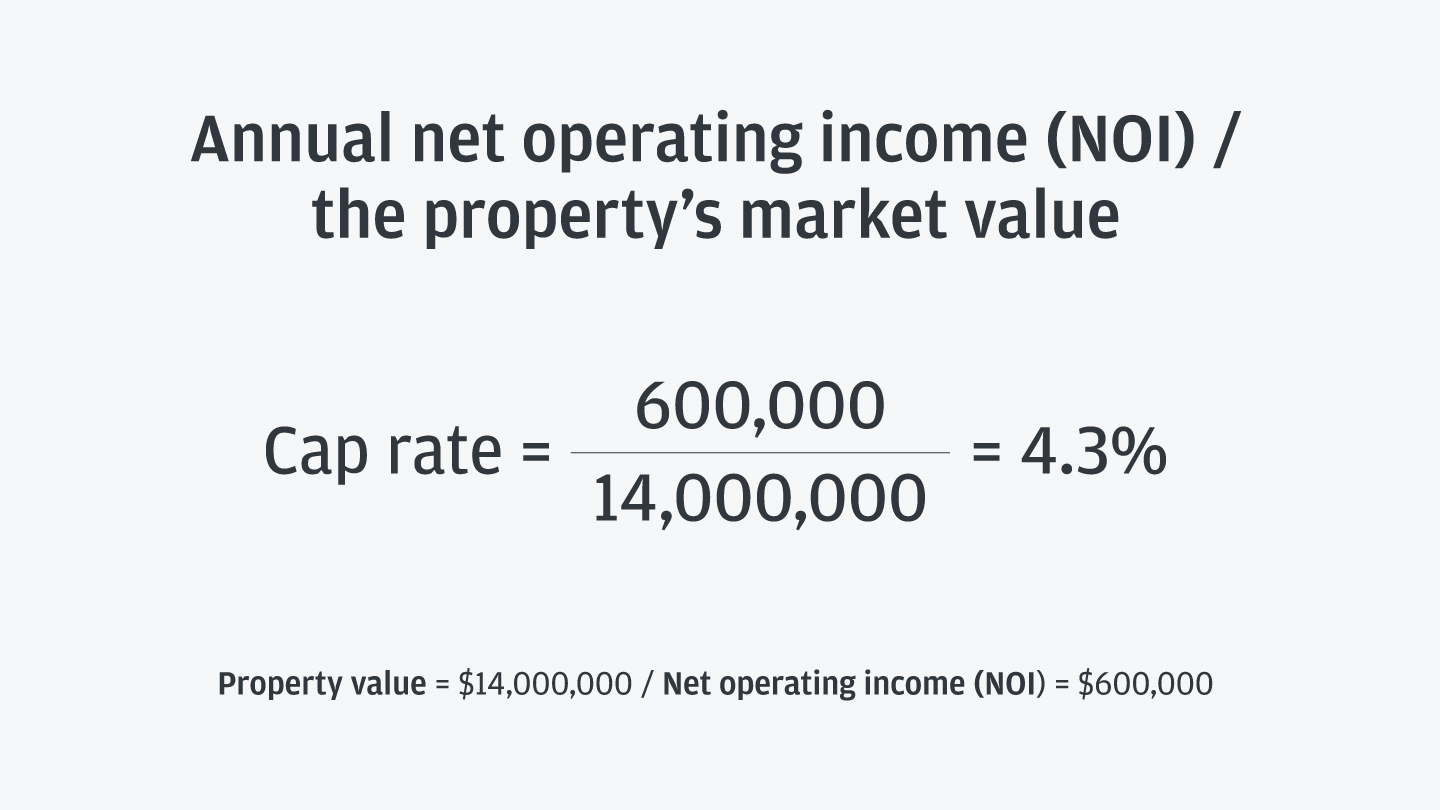
The capitalization rate of a property is calculated by dividing the annual net operating income, or NOI, by the property's market value. For instance, if a property was valued at $14,000,000 and the NOI was $600,000, the cap rate would be 4.3%.
Cap rate levels can also reflect other larger economic factors, such as competition, monetary policy, and real estate zoning and regulations.
Amid market uncertainty, we’re here to help
Connect with a banker
Rising interest rates increase the cost of capital, so fluctuations in the interest rate environment can contribute to rising cap rates.
That’s the case in the current economic environment. While
interest rate hikes
didn’t occur in 2025, rates remain elevated relative to the historically low levels. This increased financing costs, limited transaction volume and made it difficult to assess cap rates. Nationally,
multifamily
cap rates remained unchanged between Q4 of 2024 and Q4 of 2025. During the same time period, office and retail cap rates increased slightly (0.2% and 0.1%, respectively) and
industrial
dropped by 0.1%.
The Fed and the market anticipate more rate
interest rate cuts
in 2026, which would likely lower borrowing costs and decrease cap rates. However, the future of the economy and
interest rates is uncertain
.
4Q 25
Multifamily
Industrial
Office
Retail
Los Angeles
5.00%
5.20%
7.60%
5.90%
San Francisco
4.50%
5.90%
7.40%
5.20%
New York
5.40%
6.00%
6.90%
6.10%
Chicago
6.70%
8.10%
10.10%
8.10%
Seattle
5.00%
5.80%
7.70%
6.30%
Portland
5.60%
6.80%
8.80%
6.90%
Washington DC
5.70%
6.70%
9.80%
6.90%
National
6.10%
7.20%
9.10%
7.30%
4Q 24
Multifamily
Industrial
Office
Retail
Los Angeles
5.00%
5.10%
7.60%
5.70%
San Francisco
4.50%
5.80%
6.90%
5.10%
New York
5.40%
6.00%
6.80%
6.10%
Chicago
6.80%
8.10%
9.80%
8.00%
Seattle
4.90%
5.70%
7.40%
6.20%
Portland
5.50%
6.80%
8.40%
6.70%
Washington DC
5.70%
6.80%
9.30%
6.80%
National
6.10%
7.30%
8.90%
7.20%
Change
Multifamily
Industrial
Office
Retail
Los Angeles
0.00%
0.10%
0.00%
0.20%
San Francisco
0.00%
0.10%
0.50%
0.10%
New York
0.00%
0.00%
0.10%
0.00%
Chicago
-0.10%
0.00%
0.30%
0.10%
Seattle
0.10%
0.10%
0.30%
0.10%
Portland
0.10%
0.00%
0.40%
0.20%
Washington DC
0.00%
-0.10%
0.50%
0.10%
National
0.00%
-0.10%
0.20%
0.10%
Cap rates measure investors’ return expectations, but they’re a forward-looking point-in-time measurement. An investor’s realized returns may differ from their expected ones because of many factors, including:
Rent growth:
Rent growth can accelerate during periods of higher inflation, particularly in apartments with short-term leases. The anticipation of higher rents and greater NOI can offset higher interest rates. Likewise, deteriorating economic conditions can add upward pressure on cap rates and slow rent growth.
Gross Domestic Product (GDP) and unemployment:
Both GDP and unemployment reflect the health of the economy. When GDP is high and unemployment is low, commercial real estate investments tend to have lower cap rates. When GDP is low and unemployment is high, there’s a greater risk associated with investment properties. But remember: Cap rates are typically forward-looking, and individual deals are affected by a building’s unique prospects and an investor’s viewpoint—as well as the prevailing economic conditions and outlook.
Stage in the economic cycle:
In periods of stress, such as the Great Financial Crisis, cap rates have increased while interest rates decreased, a result of investors taking on more risk to own commercial real estate. In expansionary cycles with moderate
interest rate increases
, cap rates may remain unchanged if investors can expect increases in income and still achieve their expected return over their investment horizon.
Location
:
Proximity to the city’s employment center, highways and public transit also influences cap rates. Properties located in high-demand and stable locations generally have lower cap rates, while transitional or outlying neighborhoods usually have higher cap rates due to higher employment volatility and fluctuating demand. This can lead to higher tenant turnover, leasing costs and other factors that impact
operating cash flows.
Asset class:
Cap rates vary across asset classes depending on asset fundamentals, performance outlook and supply and demand, among other factors. In recent years, multifamily and industrial properties have exhibited the lowest cap rates. The weight of several economic measurements may also vary based on asset class. For example, personal income is a major factor for multifamily and
retail properties
, and durable and nondurable goods spending is especially important for industrial properties.
Cap rates are just one unit of comparison used for evaluating commercial real estate; both macroeconomic and property specific characteristics should be considered when determining an appropriate cap rate for any specific property. Various factors, such as supply and demand trends, real estate zoning and regulations, credit worthiness of residents, remaining lease terms and specific lease factors can impact the actual cap rate. An investor’s awareness and diligence can be the differentiator between expectations and outcomes.
Cap rates are among several factors to consider when
growing your multifamily portfolio
.
JPMorgan Chase Bank, N.A. Member FDIC. Visit
jpmorgan.com/cb-disclaimer
for disclosures and disclaimers related to this content. |
| Markdown | [Skip to main content](https://www.jpmorgan.com/insights/real-estate/commercial-term-lending/cap-rates-explained#main)
[](https://www.jpmorgan.com/global)
- Solutions
- Who We Serve
- Insights
- About Us
Menu
- Solutions
- Who We Serve
- Insights
- About Us
- [Careers](https://www.jpmorganchase.com/careers)
- [News](https://www.jpmorgan.com/about-us/corporate-news)
- [Contact Us](https://www.jpmorgan.com/contact-us)
- [Login](https://www.jpmorgan.com/login)
- [Global]()
- Asia Pacific
- Europe
- Latin America
- Middle East & Africa
- North America
- [Global](https://www.jpmorgan.com/global)
Back to all regions
- - [Australia & New Zealand](https://www.jpmorgan.com/AU/en/about-us)
- [Bangladesh](https://www.jpmorgan.com/BD/en/about-us)
- Mainland China
\| [English](https://www.jpmorganchina.com.cn/en/about-us) [中文](https://www.jpmorganchina.com.cn/zh/about-us)
- [Hong Kong SAR, China](https://www.jpmorgan.com/HK/en/about-us)
- [India](https://www.jpmorgan.com/IN/en/about-us)
- [Indonesia](https://www.jpmorgan.co.id/en/about-us)
- Japan
\| [English](https://www.jpmorgan.co.jp/en/about-us) [日本](https://www.jpmorgan.co.jp/ja/about-us)
- Korea
\| [English](https://www.jpmorgan.co.kr/en/about-us) [한국](https://www.jpmorgan.co.kr/ko/about-us)
- [Malaysia](https://www.jpmorgan.com/MY/en/about-us)
- [Pakistan](https://www.jpmorgan.com/PK/en/about-us)
- [Philippines](https://www.jpmorgan.com/PH/en/about-us)
- [Singapore](https://www.jpmorgan.com/SG/en/about-us)
- [Sri Lanka](https://www.jpmorgan.com/LK/en/about-us)
- [Taiwan, China](https://www.jpmorgan.com/TW/en/about-us)
- [Thailand](https://www.jpmorgan.com/TH/en/about-us)
- [Vietnam](https://www.jpmorgan.com/VN/en/about-us)
Back to all regions
- - [Austria](https://www.jpmorgan.com/AT/en/about-us)
- [Belgium](https://www.jpmorgan.com/BE/en/about-us)
- [Channel Islands](https://www.jpmorgan.com/JE/en/about-us)
- [Denmark](https://www.jpmorgan.com/DK/en/about-us)
- [Finland](https://www.jpmorgan.com/FI/en/about-us)
- [France](https://www.jpmorgan.com/FR/en/about-us)
- [Germany](https://www.jpmorgan.com/DE/en/about-us)
- [Greece](https://www.jpmorgan.com/GR/en/about-us)
- [Ireland](https://www.jpmorgan.com/IE/en/about-us)
- [Italy](https://www.jpmorgan.com/IT/en/about-us)
- [Luxembourg](https://www.jpmorgan.com/LU/en/about-us)
- [Netherlands](https://www.jpmorgan.com/NL/en/about-us)
- [Norway](https://www.jpmorgan.com/NO/en/about-us)
- [Poland](https://www.jpmorgan.com/PL/en/about-us)
- [Portugal](https://www.jpmorgan.com/PT/en/about-us)
- Russia
\| [English](https://www.jpmorgan.ru/en/about-us) [Русский](https://www.jpmorgan.ru/ru/about-us)
- [Spain](https://www.jpmorgan.com/ES/en/about-us)
- [Sweden](https://www.jpmorgan.com/SE/en/about-us)
- [Switzerland](https://www.jpmorgan.com/CH/en/about-us)
- Turkey
\| [English](https://www.jpmorgan.com/TR/en/about-us) [Türkiye](https://www.jpmorgan.com/TR/tr/about-us)
- [United Kingdom](https://www.jpmorgan.com/GB/en/about-us)
Back to all regions
- - Argentina
\| [English](https://www.jpmorgan.com/AR/en/about-us) [Español](https://www.jpmorgan.com/AR/es/about-us)
- Brazil
\| [English](https://www.jpmorgan.com.br/en/about-us) [Português](https://www.jpmorgan.com.br/pt/about-us)
- Chile
\| [English](https://www.jpmorgan.com/CL/en/about-us) [Español](https://www.jpmorgan.com/CL/es/about-us)
- Colombia
\| [English](https://www.jpmorgan.com/CO/en/about-us) [Español](https://www.jpmorgan.com/CO/es/about-us)
- Mexico
\| [English](https://www.jpmorgan.com.mx/en/about-us) [Español](https://www.jpmorgan.com.mx/es/about-us)
- [Panama](https://www.jpmorgan.com/PA/en/about-us)
- Peru
\| [English](https://www.jpmorgan.com/PE/en/about-us) [Español](https://www.jpmorgan.com/PE/es/about-us)
- [Venezuela](https://www.jpmorgan.com/VE/en/about-us)
Back to all regions
- - [Bahrain](https://www.jpmorgan.com/BH/en/about-us)
- [Egypt](https://www.jpmorgan.com/EG/en/about-us)
- [Israel](https://www.jpmorgan.com/IL/en/about-us)
- [Lebanon](https://www.jpmorgan.com/LB/en/about-us)
- [Nigeria](https://www.jpmorgan.com/NG/en/about-us)
- [Qatar](https://www.jpmorgan.com/QA/en/about-us)
- [Saudi Arabia](https://www.jpmorgan.com/SA/en/about-us)
- [South Africa](https://www.jpmorgan.com/ZA/en/about-us)
- [United Arab Emirates](https://www.jpmorgan.com/AE/en/about-us)
Back to all regions
- - [United States](https://www.jpmorgan.com/about-us)
- Canada
\| [English](https://www.jpmorgan.com/CA/en/about-us) [French](https://www.jpmorgan.com/CA/fr/about-us)
- For Companies and Institutions
- For Institutional Investors
- For Individuals
- For Employers
Back to menu
For Companies and Institutions
For Companies and Institutions
- [Commercial Banking](https://www.jpmorgan.com/commercial-banking)
We provide credit, financing, treasury and payment solutions to help your business succeed. We also offer best-in-class commercial real estate services for investors and developers.
- [Global Corporate Banking](https://www.jpmorgan.com/global-corporate-banking)
We help clients achieve their long-term strategic goals through financing, liquidity, payments, risk management and investment banking solutions.
- [Investment Banking](https://www.jpmorgan.com/investment-banking)
Providing investment banking solutions, including M\&A, capital raising and risk management, for a broad range of corporations, institutions and governments.
- [Payments](https://www.jpmorgan.com/payments)
Your partner for commerce, receivables, cross-currency, working capital, blockchain, liquidity and more.
Key Links
- [Industries](https://www.jpmorgan.com/industries-we-serve)
- [Insights](https://www.jpmorgan.com/insights)
- [Client Stories](https://www.jpmorgan.com/client-stories)
Back to menu
For Institutional Investors
For Institutional Investors
- [Asset Management](https://am.jpmorgan.com/us/en/asset-management/institutional/)
Putting our long-tenured investment teams on the line to earn the trust of institutional investors.
- [Markets](https://www.jpmorgan.com/markets)
Direct access to market leading liquidity harnessed through world-class research, tools, data, and analytics.
- [Securities Services](https://www.jpmorgan.com/securities-services)
Helping institutional investors, traditional and alternative asset and fund managers, broker dealers and equity issuers meet the demands of a rapidly evolving market.
- [Global Research](https://www.jpmorgan.com/insights/research)
Leveraging cutting-edge technology and innovative tools to bring clients industry-leading analysis and investment advice.
- [Prime Services](https://www.jpmorgan.com/prime-services)
Helping hedge funds, asset managers and institutional investors meet the demands of a rapidly evolving market.
- [Global Liquidity Solutions](https://am.jpmorgan.com/us/en/asset-management/liq/)
Global short-term fixed income strategies designed to help clients manage liquidity through the cycle.
Key Links
- [Insights](https://www.jpmorgan.com/insights)
- [Corporate News](https://www.jpmorgan.com/about-us/corporate-news)
Back to menu
For Individuals
For Individuals
- [Wealth Management](https://www.jpmorgan.com/wealth-management)
With J.P. Morgan Wealth Management, you can invest on your own or work with an advisor to design a personalized investment strategy. We have opportunities for every investor.
- [Private Bank](https://privatebank.jpmorgan.com/nam/en/home)
A uniquely elevated private banking experience shaped around you.
Key Links
- [Why Wealth Management?](https://www.chase.com/personal/investments/why-invest?jp_cdf=whyinvest_jpmnav)
- [Market Commentary](https://www.jpmorgan.com/wealth-management/wealth-partners/insights)
- [Retirement Calculators](https://www.chase.com/personal/investments/investment-tools-resources?jp_cdf=calculators_jpmnav)
Back to menu
For Employers
For Employers
- [Workplace Solutions](https://www.jpmorganworkplacesolutions.com/)
Enhance your equity compensation offering with solutions designed to empower your employees and bring your reward strategy to life.
Key Links
- [Insights](https://www.jpmorgan.com/insights)
- [Corporate News](https://www.jpmorgan.com/about-us/corporate-news)
- Who We Serve
Back to menu
Who We Serve
Who We Serve
- ### [INDUSTRIES WE SERVE](https://www.jpmorgan.com/industries-we-serve)
- [Commercial Real Estate](https://www.jpmorgan.com/commercial-real-estate)
- [Consumer and Retail](https://www.jpmorgan.com/industries-we-serve/consumer-and-retail)
- [Diversified Industries](https://www.jpmorgan.com/industries-we-serve/diversified-industries)
- [Energy, Power & Renewables](https://www.jpmorgan.com/industries-we-serve/energy)
- [Financial Institutions](https://www.jpmorgan.com/industries-we-serve/financial)
- ###
- [Financial Sponsors](https://www.jpmorgan.com/investment-banking/financial-sponsors)
- [Health Care](https://www.jpmorgan.com/industries-we-serve/healthcare)
- [Innovation Economy](https://www.jpmorgan.com/commercial-banking/startups/sectors-served)
- [Media, Telecom and Entertainment](https://www.jpmorgan.com/industries-we-serve/media-telecom-entertainment)
- [Metals & Mining](https://www.jpmorgan.com/industries-we-serve/metals-mining)
- ###
- [Public Sector](https://www.jpmorgan.com/industries-we-serve/public-sector)
- [Technology](https://www.jpmorgan.com/industries-we-serve/technology)
Key Links
- [Insights](https://www.jpmorgan.com/insights)
- [Client Stories](https://www.jpmorgan.com/client-stories)
- All Insights
- Insights by Topic
- Insights by Type
Back to menu
All Insights
[All Insights](https://www.jpmorgan.com/insights)
Explore a variety of insights.
Key Links
- [Client Stories](https://www.jpmorgan.com/client-stories)
- [Global Research](https://www.jpmorgan.com/insights/research)
- [2026 Outlooks](https://www.jpmorgan.com/insights/outlook/jpmorgan-outlook/predictions-and-forecasts)
Back to menu
Insights by Topic
Insights by Topic
Explore a variety of insights organized by different topics.
- ###
- [Banking](https://www.jpmorgan.com/insights/banking)
- [Business Planning](https://www.jpmorgan.com/insights/business-planning)
- [Corporate Responsibility](https://www.jpmorgan.com/insights/corporate-responsibility)
- [Cybersecurity](https://www.jpmorgan.com/insights/cybersecurity)
- [Family Legacy](https://www.jpmorgan.com/insights/family-legacy)
- [Fraud](https://www.jpmorgan.com/insights/fraud)
- ###
- [Global Research](https://www.jpmorgan.com/insights/global-research)
- [Investing](https://www.jpmorgan.com/insights/investing)
- [Markets and Economy](https://www.jpmorgan.com/insights/markets)
- [Payments](https://www.jpmorgan.com/insights/payments)
- [Prime services](https://www.jpmorgan.com/insights/prime-services)
- [Real Estate](https://www.jpmorgan.com/insights/real-estate)
- ###
- [Retirement](https://www.jpmorgan.com/insights/retirement)
- [Securities Services](https://www.jpmorgan.com/insights/securities-services)
- [Sustainability](https://www.jpmorgan.com/insights/sustainability)
- [Technology](https://www.jpmorgan.com/insights/technology)
- [Treasury](https://www.jpmorgan.com/insights/treasury)
- [Wealth Planning](https://www.jpmorgan.com/insights/wealth-planning)
Key Links
- [Client Stories](https://www.jpmorgan.com/client-stories)
- [Global Research](https://www.jpmorgan.com/insights/research)
- [Newsletters](https://www.jpmorgan.com/newsletters)
Back to menu
Insights by Type
Insights by Type
Explore a variety of insights organized by different types of content and media.
- ###
- [Client Stories](https://www.jpmorgan.com/client-stories)
- [Podcasts](https://www.jpmorgan.com/podcasts)
- [Videos](https://www.jpmorgan.com/videos)
Key Links
- [All Insights](https://www.jpmorgan.com/insights)
- [Global Research](https://www.jpmorgan.com/insights/research)
- [Newsletters](https://www.jpmorgan.com/newsletters)
- About Us
Back to menu
About Us
[About Us](https://www.jpmorgan.com/about-us)
We aim to be the most respected financial services firm in the world, serving corporations and individuals in more than 100 countries.
- ###
- [News and Stories](https://www.jpmorgan.com/about-us/corporate-news)
- [Media Center](https://www.jpmorgan.com/contact-us/media)
- [Events and Conferences](https://www.jpmorgan.com/about-us/events-conferences)
- [Security and Resiliency Initiative](https://www.jpmorgan.com/about-us/security-and-resiliency)
- [Contact Us](https://www.jpmorgan.com/contact-us)
Key Links
- [Insights](https://www.jpmorgan.com/insights)
- [Client Stories](https://www.jpmorgan.com/client-stories)
- [Newsletters](https://www.jpmorgan.com/newsletters)
- [Insights](https://www.jpmorgan.com/insights)
- [Real Estate](https://www.jpmorgan.com/insights/real-estate)
- [Commercial Term Lending](https://www.jpmorgan.com/insights/real-estate/commercial-term-lending)
- The role of cap rates in real estate
[Real Estate](https://www.jpmorgan.com/insights/real-estate)
# The role of cap rates in real estate
February 02, 2026
This common metric can help investors assess the potential value of a property.
Overview

## Key takeaways
- It’s critical to analyze like-kind comparables, such as property type, location, income/expense, quality/condition and durability, when looking at cap rates. Factors such as actual or projected income and expenses can also make a big difference.
- While they aren’t considered a primary driver of cap rates, interest rate changes can influence cap rates as the cost of borrowing will impact return on investments.
- Some specific elements that can influence cap rates are property location, condition, asset class, investment size, tenant quality, anticipated rent growth and external economic factors.
## Browse by topic
- [Real Estate](https://www.jpmorgan.com/insights/real-estate)
- [Commercial Term Lending](https://www.jpmorgan.com/insights/real-estate/commercial-term-lending)
- [Commercial Real Estate](https://www.jpmorgan.com/insights/real-estate/commercial-real-estate)
- [Multifamily](https://www.jpmorgan.com/insights/real-estate/multifamily)
- [Investing](https://www.jpmorgan.com/insights/real-estate/investing)
In real estate, capitalization rates—commonly called cap rates—are useful risk measurements for [commercial properties](https://www.jpmorgan.com/commercial-real-estate "Go to Commercial Real Estate").
## The cap rate formula
Calculated by dividing a property’s net operating income by its asset value, the cap rate is an assessment of the yield of a property over one year. For example, a property worth \$14 million generating \$600,000 of NOI would have a cap rate of 4.3%. That means that you can expect a roughly 4.3% annual operating cash flow given the price paid for the property.
You should also note: It’s critical to make an apples-to-apples comparison with cap rates. For example, it matters if you are comparing cap rates based on actual versus projected income.
**What’s a good cap rate?** It varies from investor to investor and property to property. In general, the higher the cap rate, the greater the risk and return.
View text Version
The capitalization rate of a property is calculated by dividing the annual net operating income, or NOI, by the property's market value. For instance, if a property was valued at \$14,000,000 and the NOI was \$600,000, the cap rate would be 4.3%.

View Infographic
View text Version
Cap rate levels can also reflect other larger economic factors, such as competition, monetary policy, and real estate zoning and regulations.
Amid market uncertainty, we’re here to help
[Connect with a banker](https://www.jpmorgan.com/insights/real-estate/commercial-term-lending/cap-rates-explained#contact-ctl)
## The impact of interest rates on cap rates
Rising interest rates increase the cost of capital, so fluctuations in the interest rate environment can contribute to rising cap rates.
That’s the case in the current economic environment. While [interest rate hikes](https://www.jpmorgan.com/insights/real-estate/commercial-real-estate/rising-interest-rates-effect-on-commercial-real-estate "What Fed policy means for multifamily property investors") didn’t occur in 2025, rates remain elevated relative to the historically low levels. This increased financing costs, limited transaction volume and made it difficult to assess cap rates. Nationally, [multifamily](https://www.jpmorgan.com/commercial-real-estate/multifamily-property-loans "Financing for Multifamily Buildings") cap rates remained unchanged between Q4 of 2024 and Q4 of 2025. During the same time period, office and retail cap rates increased slightly (0.2% and 0.1%, respectively) and [industrial](https://www.jpmorgan.com/commercial-real-estate/industrial-property-loans-and-mortgages "Financing for industrial properties") dropped by 0.1%.
The Fed and the market anticipate more rate [interest rate cuts](https://www.jpmorgan.com/insights/real-estate/commercial-term-lending/interest-rate-cuts-impact-on-multifamily-real-estate "How interest rate cuts could impact commercial real estate") in 2026, which would likely lower borrowing costs and decrease cap rates. However, the future of the economy and [interest rates is uncertain](https://www.jpmorgan.com/insights/real-estate/commercial-term-lending/hedging-interest-rates-in-commercial-real-estate "Navigating interest rate uncertainty").
## Sample cap rates
| 4Q 25 | Multifamily | Industrial | Office | Retail |
|---|---|---|---|---|
| Los Angeles | 5\.00% | 5\.20% | 7\.60% | 5\.90% |
| San Francisco | 4\.50% | 5\.90% | 7\.40% | 5\.20% |
| New York | 5\.40% | 6\.00% | 6\.90% | 6\.10% |
| Chicago | 6\.70% | 8\.10% | 10\.10% | 8\.10% |
| Seattle | 5\.00% | 5\.80% | 7\.70% | 6\.30% |
| Portland | 5\.60% | 6\.80% | 8\.80% | 6\.90% |
| Washington DC | 5\.70% | 6\.70% | 9\.80% | 6\.90% |
| National | 6\.10% | 7\.20% | 9\.10% | 7\.30% |
| 4Q 24 | Multifamily | Industrial | Office | Retail |
|---|---|---|---|---|
| Los Angeles | 5\.00% | 5\.10% | 7\.60% | 5\.70% |
| San Francisco | 4\.50% | 5\.80% | 6\.90% | 5\.10% |
| New York | 5\.40% | 6\.00% | 6\.80% | 6\.10% |
| Chicago | 6\.80% | 8\.10% | 9\.80% | 8\.00% |
| Seattle | 4\.90% | 5\.70% | 7\.40% | 6\.20% |
| Portland | 5\.50% | 6\.80% | 8\.40% | 6\.70% |
| Washington DC | 5\.70% | 6\.80% | 9\.30% | 6\.80% |
| National | 6\.10% | 7\.30% | 8\.90% | 7\.20% |
| Change | Multifamily | Industrial | Office | Retail |
|---|---|---|---|---|
| Los Angeles | 0\.00% | 0\.10% | 0\.00% | 0\.20% |
| San Francisco | 0\.00% | 0\.10% | 0\.50% | 0\.10% |
| New York | 0\.00% | 0\.00% | 0\.10% | 0\.00% |
| Chicago | \-0.10% | 0\.00% | 0\.30% | 0\.10% |
| Seattle | 0\.10% | 0\.10% | 0\.30% | 0\.10% |
| Portland | 0\.10% | 0\.00% | 0\.40% | 0\.20% |
| Washington DC | 0\.00% | \-0.10% | 0\.50% | 0\.10% |
| National | 0\.00% | \-0.10% | 0\.20% | 0\.10% |
## How other macroeconomic factors affect cap rates
Cap rates measure investors’ return expectations, but they’re a forward-looking point-in-time measurement. An investor’s realized returns may differ from their expected ones because of many factors, including:
- **Rent growth:** Rent growth can accelerate during periods of higher inflation, particularly in apartments with short-term leases. The anticipation of higher rents and greater NOI can offset higher interest rates. Likewise, deteriorating economic conditions can add upward pressure on cap rates and slow rent growth.
- **Gross Domestic Product (GDP) and unemployment:** Both GDP and unemployment reflect the health of the economy. When GDP is high and unemployment is low, commercial real estate investments tend to have lower cap rates. When GDP is low and unemployment is high, there’s a greater risk associated with investment properties. But remember: Cap rates are typically forward-looking, and individual deals are affected by a building’s unique prospects and an investor’s viewpoint—as well as the prevailing economic conditions and outlook.
- **Stage in the economic cycle:** In periods of stress, such as the Great Financial Crisis, cap rates have increased while interest rates decreased, a result of investors taking on more risk to own commercial real estate. In expansionary cycles with moderate [interest rate increases](https://www.jpmorgan.com/insights/real-estate/commercial-real-estate/rising-interest-rates-effect-on-commercial-real-estate "go to What Fed policy means for multifamily property investors"), cap rates may remain unchanged if investors can expect increases in income and still achieve their expected return over their investment horizon.
- **[Location](https://www.jpmorgan.com/insights/real-estate/investing/how-to-create-a-multifamily-location-strategy "Go to How to Create a Multifamily Location Strategy"):** Proximity to the city’s employment center, highways and public transit also influences cap rates. Properties located in high-demand and stable locations generally have lower cap rates, while transitional or outlying neighborhoods usually have higher cap rates due to higher employment volatility and fluctuating demand. This can lead to higher tenant turnover, leasing costs and other factors that impact [operating cash flows.](https://www.jpmorgan.com/insights/real-estate/commercial-term-lending/calculating-net-operating-income-and-cash-flow "Go to Calculating Net Operating Income and Cash flow")
- **Asset class:** Cap rates vary across asset classes depending on asset fundamentals, performance outlook and supply and demand, among other factors. In recent years, multifamily and industrial properties have exhibited the lowest cap rates. The weight of several economic measurements may also vary based on asset class. For example, personal income is a major factor for multifamily and [retail properties](https://www.jpmorgan.com/commercial-real-estate/financing-for-retail-properties "go to Financing for retail properties"), and durable and nondurable goods spending is especially important for industrial properties.
## The bottom line
Cap rates are just one unit of comparison used for evaluating commercial real estate; both macroeconomic and property specific characteristics should be considered when determining an appropriate cap rate for any specific property. Various factors, such as supply and demand trends, real estate zoning and regulations, credit worthiness of residents, remaining lease terms and specific lease factors can impact the actual cap rate. An investor’s awareness and diligence can be the differentiator between expectations and outcomes.
Cap rates are among several factors to consider when [growing your multifamily portfolio](https://www.jpmorgan.com/insights/real-estate/commercial-term-lending/building-your-commercial-real-estate-portfolio "3 tips for growing your rental property portfolio").
*JPMorgan Chase Bank, N.A. Member FDIC. Visit* [*jpmorgan.com/cb-disclaimer*](https://www.jpmorgan.com/commercial-banking/legal-disclaimer "CB Disclaimer") *for disclosures and disclaimers related to this content.*
## Get in touch
## Related insights

Real Estate
[Using bridge loans with agency financing in multifamily](https://www.jpmorgan.com/insights/real-estate/agency-lending/commercial-bridge-loans-and-agency-lending)
Mar 20, 2026
Bridge loans offer multifamily investors flexible short-term capital. Find out how they can also provide a smooth transition to agency financing.
[Read more](https://www.jpmorgan.com/insights/real-estate/agency-lending/commercial-bridge-loans-and-agency-lending)

Real Estate
[How tariffs impact commercial real estate](https://www.jpmorgan.com/insights/real-estate/commercial-real-estate/tariffs-and-trade-policys-impact-on-commercial-real-estate)
Mar 16, 2026
Tariffs and trade policy uncertainty can impact commercial real estate by increasing construction costs and delaying critical decisions. Find out more about their effects.
[Read more](https://www.jpmorgan.com/insights/real-estate/commercial-real-estate/tariffs-and-trade-policys-impact-on-commercial-real-estate)

Real Estate
[What to know about tax-aware borrowing](https://www.jpmorgan.com/insights/real-estate/housing-market/what-to-know-about-tax-aware-borrowing)
Mar 11, 2026
Individuals can choose to take out loans in a way that may minimize their tax liability – this is called tax-aware borrowing. Learn more about it.
[Read more](https://www.jpmorgan.com/insights/real-estate/housing-market/what-to-know-about-tax-aware-borrowing)

Real Estate
[In the News](https://www.jpmorgan.com/commercial-real-estate/in-the-news)
Mar 04, 2026
Learn from JPMorgan Chase commercial real estate leaders and stay up to date on the latest industry news and media coverage.
[Read more](https://www.jpmorgan.com/commercial-real-estate/in-the-news)

Real Estate
[What to know about office-to-residential conversion](https://www.jpmorgan.com/insights/real-estate/community-development-banking/office-to-residential-conversion-what-to-know)
Feb 27, 2026
Adaptive reuse can turn aging offices into much-needed housing. Learn what makes properties strong candidates for conversion and explore financing tools to support redevelopment.
[Read more](https://www.jpmorgan.com/insights/real-estate/community-development-banking/office-to-residential-conversion-what-to-know)

Real Estate
[Protecting commercial properties from cybersecurity threats](https://www.jpmorgan.com/insights/real-estate/payments/cybersecurity-for-commercial-real-estate-key-strategies)
Feb 06, 2026
Learn how to protect your payments and data from common cybersecurity threats affecting commercial real estate owners and operators.
[Read more](https://www.jpmorgan.com/insights/real-estate/payments/cybersecurity-for-commercial-real-estate-key-strategies)

Real Estate
[Navigating interest rate uncertainty](https://www.jpmorgan.com/insights/real-estate/commercial-term-lending/hedging-interest-rates-in-commercial-real-estate)
Feb 03, 2026
At its January meeting, the Fed held interest rates steady. Learn more about the factors behind the decision
[Read more](https://www.jpmorgan.com/insights/real-estate/commercial-term-lending/hedging-interest-rates-in-commercial-real-estate)

3:00 - Real Estate
[How tax credit equity helped Dupaco return to its roots](https://www.jpmorgan.com/insights/real-estate/community-development-banking/how-htc-and-nmtc-helped-restore-downtown-dubuque-iowa)
Jan 30, 2026
See how both Historic and New Markets Tax Credit from J.P. Morgan helped transform a vacant manufacturing facility and spur community development in Dubuque, Iowa.
[Watch video](https://www.jpmorgan.com/insights/real-estate/community-development-banking/how-htc-and-nmtc-helped-restore-downtown-dubuque-iowa)
You're now leaving J.P. Morgan
J.P. Morgan’s website and/or mobile terms, privacy and security policies don’t apply to the site or app you're about to visit. Please review its terms, privacy and security policies to see how they apply to you. J.P. Morgan isn’t responsible for (and doesn’t provide) any products, services or content at this third-party site or app, except for products and services that explicitly carry the J.P. Morgan name.
[Cancel]() [Proceed]()
- ### SOLUTIONS
- [Asset Management](https://am.jpmorgan.com/asset-management/gim/welcome)
- [Commercial Banking](https://www.jpmorgan.com/commercial-banking)
- [Credit and Financing](https://www.jpmorgan.com/credit-and-financing)
- [Investment Banking](https://www.jpmorgan.com/investment-banking)
- [Markets](https://www.jpmorgan.com/markets)
- [Payments](https://www.jpmorgan.com/payments)
- [Prime Services](https://www.jpmorgan.com/prime-services)
- [Private Banking](https://privatebank.jpmorgan.com/nam/en/home)
- [Securities Services](https://www.jpmorgan.com/securities-services)
- [Wealth Management](https://www.chase.com/personal/investments)
- ### [CAREERS](https://www.jpmorganchase.com/careers)
- ### HELPFUL LINKS
- [About Us](https://www.jpmorgan.com/about-us)
- [Apps](https://www.jpmorgan.com/apps)
- [Events and Conferences](https://www.jpmorgan.com/about-us/events-conferences)
- [Impact](https://www.jpmorgan.com/commercial-banking/impact)
- [Industries](https://www.jpmorgan.com/industries-we-serve)
- [Insights](https://www.jpmorgan.com/insights)
- [Investor Relations](https://www.jpmorganchase.com/ir)
- [Media Center](https://www.jpmorgan.com/contact-us/media)
- [News and Announcements](https://www.jpmorgan.com/about-us/corporate-news)
- [Newsletters](https://www.jpmorgan.com/newsletters)
- ### JPMORGANCHASE SITES
- [Chase](https://www.chase.com/)
- [JPMorganChase](https://www.jpmorganchase.com/)
- [Payments Partner Network](https://partners.jpmorgan.com/)
- ### CONNECT WITH US
- [Alumni Network](https://alumni.jpmorganchase.com/)
- [Client Login](https://www.jpmorgan.com/login)
- [Contact Us](https://www.jpmorgan.com/contact-us)

- [Privacy](https://www.jpmorgan.com/privacy)
- [Terms of Use](https://www.jpmorgan.com/terms-of-use)
- [Accessibility](https://www.chase.com/digital/resources/accessibility)
- [Cookies Policy](https://www.jpmorgan.com/cookies)
- [Regulatory Disclosures](https://www.jpmorgan.com/disclosures)
© JPMorgan Chase & Co. All rights reserved. |
| Readable Markdown | 
## Key takeaways
- It’s critical to analyze like-kind comparables, such as property type, location, income/expense, quality/condition and durability, when looking at cap rates. Factors such as actual or projected income and expenses can also make a big difference.
- While they aren’t considered a primary driver of cap rates, interest rate changes can influence cap rates as the cost of borrowing will impact return on investments.
- Some specific elements that can influence cap rates are property location, condition, asset class, investment size, tenant quality, anticipated rent growth and external economic factors.
In real estate, capitalization rates—commonly called cap rates—are useful risk measurements for [commercial properties](https://www.jpmorgan.com/commercial-real-estate "Go to Commercial Real Estate").

The capitalization rate of a property is calculated by dividing the annual net operating income, or NOI, by the property's market value. For instance, if a property was valued at \$14,000,000 and the NOI was \$600,000, the cap rate would be 4.3%.

Cap rate levels can also reflect other larger economic factors, such as competition, monetary policy, and real estate zoning and regulations.
Amid market uncertainty, we’re here to help
[Connect with a banker](https://www.jpmorgan.com/insights/real-estate/commercial-term-lending/cap-rates-explained#contact-ctl)
##
Rising interest rates increase the cost of capital, so fluctuations in the interest rate environment can contribute to rising cap rates.
That’s the case in the current economic environment. While [interest rate hikes](https://www.jpmorgan.com/insights/real-estate/commercial-real-estate/rising-interest-rates-effect-on-commercial-real-estate "What Fed policy means for multifamily property investors") didn’t occur in 2025, rates remain elevated relative to the historically low levels. This increased financing costs, limited transaction volume and made it difficult to assess cap rates. Nationally, [multifamily](https://www.jpmorgan.com/commercial-real-estate/multifamily-property-loans "Financing for Multifamily Buildings") cap rates remained unchanged between Q4 of 2024 and Q4 of 2025. During the same time period, office and retail cap rates increased slightly (0.2% and 0.1%, respectively) and [industrial](https://www.jpmorgan.com/commercial-real-estate/industrial-property-loans-and-mortgages "Financing for industrial properties") dropped by 0.1%.
The Fed and the market anticipate more rate [interest rate cuts](https://www.jpmorgan.com/insights/real-estate/commercial-term-lending/interest-rate-cuts-impact-on-multifamily-real-estate "How interest rate cuts could impact commercial real estate") in 2026, which would likely lower borrowing costs and decrease cap rates. However, the future of the economy and [interest rates is uncertain](https://www.jpmorgan.com/insights/real-estate/commercial-term-lending/hedging-interest-rates-in-commercial-real-estate "Navigating interest rate uncertainty").
##
| 4Q 25 | Multifamily | Industrial | Office | Retail |
|---|---|---|---|---|
| Los Angeles | 5\.00% | 5\.20% | 7\.60% | 5\.90% |
| San Francisco | 4\.50% | 5\.90% | 7\.40% | 5\.20% |
| New York | 5\.40% | 6\.00% | 6\.90% | 6\.10% |
| Chicago | 6\.70% | 8\.10% | 10\.10% | 8\.10% |
| Seattle | 5\.00% | 5\.80% | 7\.70% | 6\.30% |
| Portland | 5\.60% | 6\.80% | 8\.80% | 6\.90% |
| Washington DC | 5\.70% | 6\.70% | 9\.80% | 6\.90% |
| National | 6\.10% | 7\.20% | 9\.10% | 7\.30% |
| 4Q 24 | Multifamily | Industrial | Office | Retail |
|---|---|---|---|---|
| Los Angeles | 5\.00% | 5\.10% | 7\.60% | 5\.70% |
| San Francisco | 4\.50% | 5\.80% | 6\.90% | 5\.10% |
| New York | 5\.40% | 6\.00% | 6\.80% | 6\.10% |
| Chicago | 6\.80% | 8\.10% | 9\.80% | 8\.00% |
| Seattle | 4\.90% | 5\.70% | 7\.40% | 6\.20% |
| Portland | 5\.50% | 6\.80% | 8\.40% | 6\.70% |
| Washington DC | 5\.70% | 6\.80% | 9\.30% | 6\.80% |
| National | 6\.10% | 7\.30% | 8\.90% | 7\.20% |
| Change | Multifamily | Industrial | Office | Retail |
|---|---|---|---|---|
| Los Angeles | 0\.00% | 0\.10% | 0\.00% | 0\.20% |
| San Francisco | 0\.00% | 0\.10% | 0\.50% | 0\.10% |
| New York | 0\.00% | 0\.00% | 0\.10% | 0\.00% |
| Chicago | \-0.10% | 0\.00% | 0\.30% | 0\.10% |
| Seattle | 0\.10% | 0\.10% | 0\.30% | 0\.10% |
| Portland | 0\.10% | 0\.00% | 0\.40% | 0\.20% |
| Washington DC | 0\.00% | \-0.10% | 0\.50% | 0\.10% |
| National | 0\.00% | \-0.10% | 0\.20% | 0\.10% |
##
Cap rates measure investors’ return expectations, but they’re a forward-looking point-in-time measurement. An investor’s realized returns may differ from their expected ones because of many factors, including:
- **Rent growth:** Rent growth can accelerate during periods of higher inflation, particularly in apartments with short-term leases. The anticipation of higher rents and greater NOI can offset higher interest rates. Likewise, deteriorating economic conditions can add upward pressure on cap rates and slow rent growth.
- **Gross Domestic Product (GDP) and unemployment:** Both GDP and unemployment reflect the health of the economy. When GDP is high and unemployment is low, commercial real estate investments tend to have lower cap rates. When GDP is low and unemployment is high, there’s a greater risk associated with investment properties. But remember: Cap rates are typically forward-looking, and individual deals are affected by a building’s unique prospects and an investor’s viewpoint—as well as the prevailing economic conditions and outlook.
- **Stage in the economic cycle:** In periods of stress, such as the Great Financial Crisis, cap rates have increased while interest rates decreased, a result of investors taking on more risk to own commercial real estate. In expansionary cycles with moderate [interest rate increases](https://www.jpmorgan.com/insights/real-estate/commercial-real-estate/rising-interest-rates-effect-on-commercial-real-estate "go to What Fed policy means for multifamily property investors"), cap rates may remain unchanged if investors can expect increases in income and still achieve their expected return over their investment horizon.
- **[Location](https://www.jpmorgan.com/insights/real-estate/investing/how-to-create-a-multifamily-location-strategy "Go to How to Create a Multifamily Location Strategy"):** Proximity to the city’s employment center, highways and public transit also influences cap rates. Properties located in high-demand and stable locations generally have lower cap rates, while transitional or outlying neighborhoods usually have higher cap rates due to higher employment volatility and fluctuating demand. This can lead to higher tenant turnover, leasing costs and other factors that impact [operating cash flows.](https://www.jpmorgan.com/insights/real-estate/commercial-term-lending/calculating-net-operating-income-and-cash-flow "Go to Calculating Net Operating Income and Cash flow")
- **Asset class:** Cap rates vary across asset classes depending on asset fundamentals, performance outlook and supply and demand, among other factors. In recent years, multifamily and industrial properties have exhibited the lowest cap rates. The weight of several economic measurements may also vary based on asset class. For example, personal income is a major factor for multifamily and [retail properties](https://www.jpmorgan.com/commercial-real-estate/financing-for-retail-properties "go to Financing for retail properties"), and durable and nondurable goods spending is especially important for industrial properties.
##
Cap rates are just one unit of comparison used for evaluating commercial real estate; both macroeconomic and property specific characteristics should be considered when determining an appropriate cap rate for any specific property. Various factors, such as supply and demand trends, real estate zoning and regulations, credit worthiness of residents, remaining lease terms and specific lease factors can impact the actual cap rate. An investor’s awareness and diligence can be the differentiator between expectations and outcomes.
Cap rates are among several factors to consider when [growing your multifamily portfolio](https://www.jpmorgan.com/insights/real-estate/commercial-term-lending/building-your-commercial-real-estate-portfolio "3 tips for growing your rental property portfolio").
*JPMorgan Chase Bank, N.A. Member FDIC. Visit* [*jpmorgan.com/cb-disclaimer*](https://www.jpmorgan.com/commercial-banking/legal-disclaimer "CB Disclaimer") *for disclosures and disclaimers related to this content.* |
| Shard | 195 (laksa) |
| Root Hash | 13979532339076139995 |
| Unparsed URL | com,jpmorgan!www,/insights/real-estate/commercial-term-lending/cap-rates-explained s443 |