ℹ️ Skipped - page is already crawled
| Filter | Status | Condition | Details |
|---|---|---|---|
| HTTP status | PASS | download_http_code = 200 | HTTP 200 |
| Age cutoff | PASS | download_stamp > now() - 6 MONTH | 0.2 months ago |
| History drop | PASS | isNull(history_drop_reason) | No drop reason |
| Spam/ban | PASS | fh_dont_index != 1 AND ml_spam_score = 0 | ml_spam_score=0 |
| Canonical | PASS | meta_canonical IS NULL OR = '' OR = src_unparsed | Not set |
| Property | Value |
|---|---|
| URL | https://www.independenttree.com/properly-plant-tree/ |
| Last Crawled | 2026-04-19 03:36:49 (6 days ago) |
| First Indexed | 2017-04-24 17:05:02 (9 years ago) |
| HTTP Status Code | 200 |
| Content | |
| Meta Title | How to Plant a Tree (And Top Mistakes to Avoid!) - Independent Tree |
| Meta Description | “We have seen thousands of fine trees planted with a few dry roots crowded into a little hole scooped out of sod and covered with the same. This is called |
| Meta Canonical | null |
| Boilerpipe Text | “We have seen thousands of fine trees planted with a few dry roots crowded into a little hole scooped out of sod and covered with the same. This is called planting? When will such abomination cease?”
– H. Garrison (1875). Illinois State Hort. Soc. 9: 366-371.
So, you want to plant a new tree or shrub? Maybe you’ve lost some of your plants during the surge of storms we’ve been hit with, maybe you want to plant one in honor of a loved one or special event, or maybe it’s just because trees are awesome and why wouldn’t you want to plant one… or 2… or 3… or more for that matter!
Remember purchasing a tree is a lifelong investment. How well this investment grows depends on the
type of tree selected and the planting location
, as well as the care provided during planting and the follow-up care after planting.
NOTE:
Moving is stressful on trees too. Trees can lose a significant portion of their root system when dug at the nursery. As a result, trees commonly exhibit what is known as “transplant shock.” Proper site preparation, careful handling to prevent further root damage and good follow-up care reduces shock and promote faster recovery and growth.
You may have heard the expression “Plant a $5 tree in a $100 hole.” These days, you’re unlikely to find a healthy $5 tree for sale, but the key point of the message still holds – plant the tree properly! If you mess up this step, it doesn’t matter what else you do – the tree is doomed.
Improper planting technique is the most common reason why transplanted trees die. Usually, it’s because the tree was planted too deeply.
Tree Planting Tips
Most of our ornamental trees are budded (a process where a single bud of the desired cultivar is placed on the seedling rootstock and allowed to grow). Budding is usually done about 2″ to 3″ above the ground so be sure that the slight crook in the trunk left over from this process is
above the ground.
Don’t plant at the same depth you found the tree in the container!
Many containerized trees (and even many that are balled and burlaped) are placed into the container too deep. This is done to help improve stability while in the nursery or garden center (it’s hard to sell trees that keep falling out of their container). In the short term, the tree can survive this; container soils are usually well-drained. But when you transplant the tree, don’t think that “if that’s how it was planted in the container, then that’s how I should plant it in the ground.”
Look for the
trunk flare
– the base of the trunk where it starts to get wider, just above the roots. You want that to be just above the soil surface – you should see it when the tree is planted.
Dig the hole about 2 to 3 times wider than the container or root ball.
The roots need to be able to easily penetrate into the surrounding soil to help stabilize the tree and take up water and nutrients. If the planting hole is too small, the roots can start growing around in circles instead of spreading out; girdling like this eventually kills the tree.
Dig the planting hole only as deep as the root ball.
This is not the time to “fluff up the dirt”. You want the soil under the tree to be undisturbed to provide a solid foundation for the tree so that, over time, the tree doesn’t sink lower into the ground. If in doubt about depth, err on the side of shallower is better. Planting high is better than planting deep.
Remove any burlap, wire basket and/or nylon rope before planting.
While the burlap
may
disintegrate over time, the wire basket and nylon rope definitely won’t. Instead, they’ll prevent the roots from spreading out, leading to an unstable and poorly developed tree.
If the tree is in a container, gently remove the container while
disturbing the rootball as little as possible
. Prune any roots that may be circling around the rootball.
Don’t add topsoil or potting mix when you fill the planting hole.
There’s no need to provide the tree with “good dirt”; just use whatever came out of the hole when you dug it.
Water well.
Tamp the soil firmly around the tree to eliminate air pockets but don’t stomp on it or try to compact it. Be sure to water your tree in well while planting. To help keep water near the tree when you irrigate, build a small wall of soil around the planting hole.
After the Tree is Planted
There are only three things you need to do to a tree that’s just been planted: mulch, stake (if necessary), and water. That’s it. How hard could that be? Well, you’d be surprised how many people mess it up…
Cover the soil with mulch but keep it away from the tree trunk.
Trees are no different that other plants – they’ll benefit from a nice layer of mulch. Not only does mulch conserve moisture and keep soil temperatures lower during the hot summer months, but it eliminates competition for resources from weeds and grass. And, in the case of trees, it provides a nice buffer around the tree to protect it from “mower blight” or “string trimmer flagellation”. Just don’t place it against the tree trunk where it can lead to mold and rot.
Only stake if necessary.
Contrary to popular belief, staking is generally not necessary. But, if you absolutely must do it, do it right. Use two wooden stakes (not metal ones), one on either side of the tree. Tie the tree using a wide cloth strap that is
loosely
tied. Don’t use wire, nylon cord, or anything else that can bite into the bark. And don’t tie it too tightly – the tree should still be able to move slightly. This slight movement will help to generate stronger roots and, in the case of high winds, the tree is less likely to snap off.
Which brings up another point – tie the tree at about 1/2 of its height; any lower and you’ll end up with a giant lever, with the canopy moving around in the wind and eventually lifting the roots straight up into the air (usually with an explosion of dirt and mulch). Remove the stakes at the end of the first growing season.
Keep watering.
In most areas, including here in northeast Ohio, a newly-planted tree needs about 1 gallon of water per inch of tree trunk diameter. As for how long to keep up the watering routine, here are some general guidelines
For a trunk diameter of less than 2″, water daily for 2 weeks, then weekly until the tree is established.
For a trunk diameter of 2″ to 4″, water daily for 1 month, then weekly
For anything larger than 4″, water daily for 6 weeks, then weekly
And, generally speaking, that’s it. As with anything that’s been newly planted, keep an eye on your new tree for insect or disease problems (which are more common when the plant is stressed, like when it’s been transplanted) and make sure the soil isn’t settling or the roots popping up.
And, of course, if you have any questions give us a call. We’re always happy to discuss options for what to plant, where to plant it and if you’d like, we’ll even
plant it for you
! |
| Markdown | [Skip to content](https://www.independenttree.com/properly-plant-tree/#fl-main-content)
[Now Offering Financing for Tree Services](https://www.independenttree.com/financing/)
[P.O. Box 244, Newbury, OH 44065](https://maps.app.goo.gl/zuKVLY1FvAqizmM16)
[info@independenttree.com](mailto:info@independenttree.com)
[REQUEST AN ESTIMATE](https://www.independenttree.com/request-an-estimate/)
[](https://www.independenttree.com/)
### Serving Eastern Cuyahoga, Geauga, Portage & Lake Counties since 1995
[**440-564-1374**](tel:4405641374)
Menu
- [Home](https://www.independenttree.com/)
- [Tree Services](https://www.independenttree.com/properly-plant-tree/)
- [Pruning & Trimming PRUNING & TRIMMING](https://www.independenttree.com/tree-services/pruning-trimming/)
- [Tree & Shrub Planting TREE & SHRUB PLANTING](https://www.independenttree.com/tree-services/planting/)
- [Structural Support STRUCTURAL SUPPORT](https://www.independenttree.com/tree-services/cabling-bracing/)
- [Emergency Service EMERGENCY SERVICE](https://www.independenttree.com/tree-services/emergency-service/)
- [Tree Removal TREE REMOVAL](https://www.independenttree.com/tree-services/tree-removal/)
- [Tree Health](https://www.independenttree.com/properly-plant-tree/)
- [Insect & Disease Management INSECT & DISEASE MANAGEMENT](https://www.independenttree.com/tree-health/insect-disease-management/)
- [Fertilization & Soil Improvement FERTILIZATION & SOIL IMPROVEMENT](https://www.independenttree.com/tree-health/fertilization-soil-improvement/)
- [Emerald Ash Borer Treatment EMERALD ASH BORER TREATMENT](https://www.independenttree.com/tree-health/emerald-ash-borer-treatment/)
- [Oak Wilt Resources OAK WILT RESOURCES](https://www.independenttree.com/tree-diseases/oak-wilt/)
- [Tick & Mosquito](https://www.independenttree.com/tick-mosquito-control-northeast-ohio/)
- [Blog & Resources](https://www.independenttree.com/properly-plant-tree/)
- [Blog BLOG ARTICLES](https://www.independenttree.com/seasonal-news-tips/)
- [FAQs FAQs](https://www.independenttree.com/faqs/)
- [Tree Care Resources TREE CARE RESOURCES](https://www.independenttree.com/resources/)
- [Tree Diseases TREE DISEASES](https://www.independenttree.com/tree-diseases/)
- [Tree Pests TREE PESTS](https://www.independenttree.com/tree-pests/)
- [About](https://www.independenttree.com/properly-plant-tree/)
- [Our Team OUR TEAM Meet the Independent Tree team and see what we do, who we work with, and what sets us apart](https://www.independenttree.com/about-us/our-team/)
- [Join Our Team JOIN OUR TEAM Apply for a position with Independent Tree](https://www.independenttree.com/about-us/employment-application/)
- [Our Home Grown Commitment HOME GROWN How we support our community, clients, team, environment, and tree care industry](https://www.independenttree.com/about-us/home-grown/)
- [Media Room IN THE NEWS See where Independent Tree is appearing online around the country\!](https://www.independenttree.com/news/)
- [Customer Reviews CUSTOMER REVIEWS See what customers are saying about us, with reviews from Google, Facebook, Angie’s List, etc.](https://www.independenttree.com/about-us/customer-reviews/)
- [Service Area](https://www.independenttree.com/about-us/service-area/)
- [Service Area**OUR SERVICE AREA** City list and map](https://www.independenttree.com/about-us/service-area/)
- [AuroraAURORA, OH](https://www.independenttree.com/aurora-tree-service/)
- [Chagrin FallsCHAGRIN FALLS, OH](https://www.independenttree.com/chagrin-falls-tree-service/)
- [Gates MillsGATES MILLS, OH](https://www.independenttree.com/gates-mills-tree-service/)
- [HudsonHUDSON, OH](https://www.independenttree.com/hudson-tree-service/)
- [Moreland HillsMORELAND HILLS, OH](https://www.independenttree.com/moreland-hills-tree-service/)
- [Pepper PikePEPPER PIKE, OH](https://www.independenttree.com/pepper-pike-tree-service/)
- [Shaker HeightsSHAKER HEIGHTS, OH](https://www.independenttree.com/shaker-heights-tree-service/)
- [Contact](https://www.independenttree.com/contact-us/)
# How to Properly Plant a Tree
May 3, 2017
arrow pointing left
[BACK TO BLOG](https://www.independenttree.com/seasonal-news-tips/)
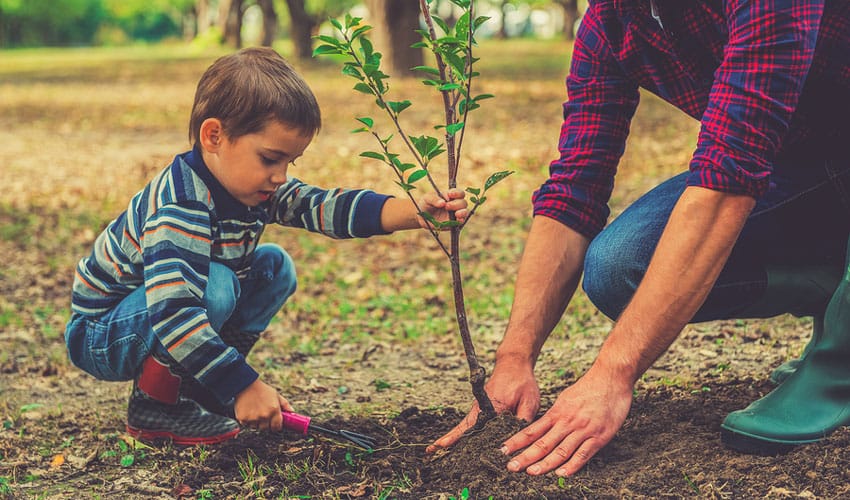
> *“We have seen thousands of fine trees planted with a few dry roots crowded into a little hole scooped out of sod and covered with the same. This is called planting? When will such abomination cease?”* – H. Garrison (1875). Illinois State Hort. Soc. 9: 366-371.
So, you want to plant a new tree or shrub? Maybe you’ve lost some of your plants during the surge of storms we’ve been hit with, maybe you want to plant one in honor of a loved one or special event, or maybe it’s just because trees are awesome and why wouldn’t you want to plant one… or 2… or 3… or more for that matter\!
Remember purchasing a tree is a lifelong investment. How well this investment grows depends on the [type of tree selected and the planting location](https://www.independenttree.com/how-choose-right-tree-planting-location-northeast-ohio/), as well as the care provided during planting and the follow-up care after planting.
> **NOTE:** Moving is stressful on trees too. Trees can lose a significant portion of their root system when dug at the nursery. As a result, trees commonly exhibit what is known as “transplant shock.” Proper site preparation, careful handling to prevent further root damage and good follow-up care reduces shock and promote faster recovery and growth.
You may have heard the expression “Plant a \$5 tree in a \$100 hole.” These days, you’re unlikely to find a healthy \$5 tree for sale, but the key point of the message still holds – plant the tree properly! If you mess up this step, it doesn’t matter what else you do – the tree is doomed.
Improper planting technique is the most common reason why transplanted trees die. Usually, it’s because the tree was planted too deeply.
## Tree Planting Tips
Most of our ornamental trees are budded (a process where a single bud of the desired cultivar is placed on the seedling rootstock and allowed to grow). Budding is usually done about 2″ to 3″ above the ground so be sure that the slight crook in the trunk left over from this process is **above the ground.**
**Don’t plant at the same depth you found the tree in the container\!** Many containerized trees (and even many that are balled and burlaped) are placed into the container too deep. This is done to help improve stability while in the nursery or garden center (it’s hard to sell trees that keep falling out of their container). In the short term, the tree can survive this; container soils are usually well-drained. But when you transplant the tree, don’t think that “if that’s how it was planted in the container, then that’s how I should plant it in the ground.”
Look for the **trunk flare** – the base of the trunk where it starts to get wider, just above the roots. You want that to be just above the soil surface – you should see it when the tree is planted.
**Dig the hole about 2 to 3 times wider than the container or root ball.** The roots need to be able to easily penetrate into the surrounding soil to help stabilize the tree and take up water and nutrients. If the planting hole is too small, the roots can start growing around in circles instead of spreading out; girdling like this eventually kills the tree.
**Dig the planting hole only as deep as the root ball.** This is not the time to “fluff up the dirt”. You want the soil under the tree to be undisturbed to provide a solid foundation for the tree so that, over time, the tree doesn’t sink lower into the ground. If in doubt about depth, err on the side of shallower is better. Planting high is better than planting deep.
**Remove any burlap, wire basket and/or nylon rope before planting.** While the burlap *may* disintegrate over time, the wire basket and nylon rope definitely won’t. Instead, they’ll prevent the roots from spreading out, leading to an unstable and poorly developed tree.
If the tree is in a container, gently remove the container while **disturbing the rootball as little as possible**. Prune any roots that may be circling around the rootball.
**Don’t add topsoil or potting mix when you fill the planting hole.** There’s no need to provide the tree with “good dirt”; just use whatever came out of the hole when you dug it.
**Water well.** Tamp the soil firmly around the tree to eliminate air pockets but don’t stomp on it or try to compact it. Be sure to water your tree in well while planting. To help keep water near the tree when you irrigate, build a small wall of soil around the planting hole.
## After the Tree is Planted
There are only three things you need to do to a tree that’s just been planted: mulch, stake (if necessary), and water. That’s it. How hard could that be? Well, you’d be surprised how many people mess it up…
**Cover the soil with mulch but keep it away from the tree trunk.** Trees are no different that other plants – they’ll benefit from a nice layer of mulch. Not only does mulch conserve moisture and keep soil temperatures lower during the hot summer months, but it eliminates competition for resources from weeds and grass. And, in the case of trees, it provides a nice buffer around the tree to protect it from “mower blight” or “string trimmer flagellation”. Just don’t place it against the tree trunk where it can lead to mold and rot.
**Only stake if necessary.** Contrary to popular belief, staking is generally not necessary. But, if you absolutely must do it, do it right. Use two wooden stakes (not metal ones), one on either side of the tree. Tie the tree using a wide cloth strap that is **loosely** tied. Don’t use wire, nylon cord, or anything else that can bite into the bark. And don’t tie it too tightly – the tree should still be able to move slightly. This slight movement will help to generate stronger roots and, in the case of high winds, the tree is less likely to snap off.
Which brings up another point – tie the tree at about 1/2 of its height; any lower and you’ll end up with a giant lever, with the canopy moving around in the wind and eventually lifting the roots straight up into the air (usually with an explosion of dirt and mulch). Remove the stakes at the end of the first growing season.
**Keep watering.** In most areas, including here in northeast Ohio, a newly-planted tree needs about 1 gallon of water per inch of tree trunk diameter. As for how long to keep up the watering routine, here are some general guidelines
- For a trunk diameter of less than 2″, water daily for 2 weeks, then weekly until the tree is established.
- For a trunk diameter of 2″ to 4″, water daily for 1 month, then weekly
- For anything larger than 4″, water daily for 6 weeks, then weekly
And, generally speaking, that’s it. As with anything that’s been newly planted, keep an eye on your new tree for insect or disease problems (which are more common when the plant is stressed, like when it’s been transplanted) and make sure the soil isn’t settling or the roots popping up.
And, of course, if you have any questions give us a call. We’re always happy to discuss options for what to plant, where to plant it and if you’d like, we’ll even [plant it for you](https://www.independenttree.com/tree-services/planting/)\!
## We Can Help\!
Independent Tree can plant your trees for you! Contact us to learn more about our tree planting and transplanting services.
[Contact Us](https://www.independenttree.com/request-an-estimate/ "Contact Us")
### Recent Articles
[](https://www.independenttree.com/spring-tree-disease-treatment/ "Worried About Spring Tree Diseases? 7 Common Issues in Northeast Ohio")
### [Worried About Spring Tree Diseases? 7 Common Issues in Northeast Ohio](https://www.independenttree.com/spring-tree-disease-treatment/ "Worried About Spring Tree Diseases? 7 Common Issues in Northeast Ohio")
Mar 25, 2026
[](https://www.independenttree.com/avoid-pruning-mistakes-that-kill-trees/ "5 Tree Pruning Mistakes That Kill Northeast Ohio Trees")
### [5 Tree Pruning Mistakes That Kill Northeast Ohio Trees](https://www.independenttree.com/avoid-pruning-mistakes-that-kill-trees/ "5 Tree Pruning Mistakes That Kill Northeast Ohio Trees")
Feb 20, 2026
[](https://www.independenttree.com/snow-damage-recovery/ "How to Help Bent-Over Trees Recover After Ice & Snow in Northeast Ohio")
### [How to Help Bent-Over Trees Recover After Ice & Snow in Northeast Ohio](https://www.independenttree.com/snow-damage-recovery/ "How to Help Bent-Over Trees Recover After Ice & Snow in Northeast Ohio")
Jan 19, 2026
[](https://www.independenttree.com/tree-cavities/ "Should You Fill Tree Cavities or Holes?")
### [Should You Fill Tree Cavities or Holes?](https://www.independenttree.com/tree-cavities/ "Should You Fill Tree Cavities or Holes?")
Dec 2, 2025
[](https://www.independenttree.com/benefits-winter-tree-pruning/ "5 Benefits of Winter Tree Pruning in Northeast Ohio")
### [5 Benefits of Winter Tree Pruning in Northeast Ohio](https://www.independenttree.com/benefits-winter-tree-pruning/ "5 Benefits of Winter Tree Pruning in Northeast Ohio")
Nov 14, 2025
[](https://www.independenttree.com/a-quick-checklist-to-keep-trees-healthy-this-fall/ "Fall Tree Care Checklist for Northeast Ohio: Essential Tasks for Healthy Trees")
### [Fall Tree Care Checklist for Northeast Ohio: Essential Tasks for Healthy Trees](https://www.independenttree.com/a-quick-checklist-to-keep-trees-healthy-this-fall/ "Fall Tree Care Checklist for Northeast Ohio: Essential Tasks for Healthy Trees")
Sep 16, 2025
### Topics
- [Tree & Landscape Care](https://www.independenttree.com/care/)
- [Tree Pests & Diseases](https://www.independenttree.com/tree-pests-diseases/)
- [Best Trees for Northeast Ohio](https://www.independenttree.com/best-trees-for-northeast-ohio/)
- [Company & Community](https://www.independenttree.com/company-community/)
- [Spring Tips for Tree & Landscape Care](https://www.independenttree.com/seasonal-tips-spring/)
- [Seasonal Tips: Summer](https://www.independenttree.com/seasonal-tips-summer/)
- [Seasonal Tips: Fall](https://www.independenttree.com/seasonal-tips-fall/)
- [Seasonal Tips: Winter](https://www.independenttree.com/seasonal-tips-winter/)
#### About The Author



### Alan Kraus
Alan Kraus is the founder and owner of Independent Tree, a full-service tree care company in Northeastern Ohio serving Eastern Cuyahoga, Geauga, Portage & Lake Counties. Alan is a certified arborist with a lifelong love of trees and with roots in the community he serves. [More About Alan \>](https://www.independenttree.com/authors/alan-kraus/)
Posted in [Tree & Landscape Care](https://www.independenttree.com/care/)
## Posts navigation
[← Preventing Oak Wilt in Northeast Ohio](https://www.independenttree.com/prevent-oak-wilt-northeast-ohio/)
[Summer Tree Care in Northeast Ohio: Dos and Don’ts →](https://www.independenttree.com/summer-tree-care-northeast-ohio/)
STAY IN THE LOOP
WITH OUR
LATEST UPDATES
"\*" indicates required fields


[440-564-1374](tel:+1-440-564-1374)
[P.O. Box 244 Newbury, OH 44065](https://maps.app.goo.gl/zuKVLY1FvAqizmM16)
[info@independenttree.com](mailto:info@independenttree.com)
#### Quick LInks
[NE Ohio Tree Diseases](https://www.independenttree.com/tree-diseases/)
[NE Ohio Tree Pests](https://www.independenttree.com/tree-pests/)
[Request a Free Estimate](https://www.independenttree.com/request-an-estimate/)
[Join Our Team](https://www.independenttree.com/about-us/employment-application/)
#### Home Grown
We're proud of our local roots and support for the community. Learn more about our HOME GROWN commitment.
© Copyright 2026 Independent Tree. All Rights Reserved.
[Privacy Policy](https://www.independenttree.com/privacy-policy/) · [Sitemap](https://www.independenttree.com/sitemap/) · Website by [Tree Care Marketing Solutions](https://treecaremarketingsolutions.com/)
[Scroll To Top](https://www.independenttree.com/properly-plant-tree/) [CALL NOW 440-564-1374](tel:+14405641374) |
| Readable Markdown | 
> *“We have seen thousands of fine trees planted with a few dry roots crowded into a little hole scooped out of sod and covered with the same. This is called planting? When will such abomination cease?”* – H. Garrison (1875). Illinois State Hort. Soc. 9: 366-371.
So, you want to plant a new tree or shrub? Maybe you’ve lost some of your plants during the surge of storms we’ve been hit with, maybe you want to plant one in honor of a loved one or special event, or maybe it’s just because trees are awesome and why wouldn’t you want to plant one… or 2… or 3… or more for that matter\!
Remember purchasing a tree is a lifelong investment. How well this investment grows depends on the [type of tree selected and the planting location](https://www.independenttree.com/how-choose-right-tree-planting-location-northeast-ohio/), as well as the care provided during planting and the follow-up care after planting.
> **NOTE:** Moving is stressful on trees too. Trees can lose a significant portion of their root system when dug at the nursery. As a result, trees commonly exhibit what is known as “transplant shock.” Proper site preparation, careful handling to prevent further root damage and good follow-up care reduces shock and promote faster recovery and growth.
You may have heard the expression “Plant a \$5 tree in a \$100 hole.” These days, you’re unlikely to find a healthy \$5 tree for sale, but the key point of the message still holds – plant the tree properly! If you mess up this step, it doesn’t matter what else you do – the tree is doomed.
Improper planting technique is the most common reason why transplanted trees die. Usually, it’s because the tree was planted too deeply.
## Tree Planting Tips
Most of our ornamental trees are budded (a process where a single bud of the desired cultivar is placed on the seedling rootstock and allowed to grow). Budding is usually done about 2″ to 3″ above the ground so be sure that the slight crook in the trunk left over from this process is **above the ground.**
**Don’t plant at the same depth you found the tree in the container\!** Many containerized trees (and even many that are balled and burlaped) are placed into the container too deep. This is done to help improve stability while in the nursery or garden center (it’s hard to sell trees that keep falling out of their container). In the short term, the tree can survive this; container soils are usually well-drained. But when you transplant the tree, don’t think that “if that’s how it was planted in the container, then that’s how I should plant it in the ground.”
Look for the **trunk flare** – the base of the trunk where it starts to get wider, just above the roots. You want that to be just above the soil surface – you should see it when the tree is planted.
**Dig the hole about 2 to 3 times wider than the container or root ball.** The roots need to be able to easily penetrate into the surrounding soil to help stabilize the tree and take up water and nutrients. If the planting hole is too small, the roots can start growing around in circles instead of spreading out; girdling like this eventually kills the tree.
**Dig the planting hole only as deep as the root ball.** This is not the time to “fluff up the dirt”. You want the soil under the tree to be undisturbed to provide a solid foundation for the tree so that, over time, the tree doesn’t sink lower into the ground. If in doubt about depth, err on the side of shallower is better. Planting high is better than planting deep.
**Remove any burlap, wire basket and/or nylon rope before planting.** While the burlap *may* disintegrate over time, the wire basket and nylon rope definitely won’t. Instead, they’ll prevent the roots from spreading out, leading to an unstable and poorly developed tree.
If the tree is in a container, gently remove the container while **disturbing the rootball as little as possible**. Prune any roots that may be circling around the rootball.
**Don’t add topsoil or potting mix when you fill the planting hole.** There’s no need to provide the tree with “good dirt”; just use whatever came out of the hole when you dug it.
**Water well.** Tamp the soil firmly around the tree to eliminate air pockets but don’t stomp on it or try to compact it. Be sure to water your tree in well while planting. To help keep water near the tree when you irrigate, build a small wall of soil around the planting hole.
## After the Tree is Planted
There are only three things you need to do to a tree that’s just been planted: mulch, stake (if necessary), and water. That’s it. How hard could that be? Well, you’d be surprised how many people mess it up…
**Cover the soil with mulch but keep it away from the tree trunk.** Trees are no different that other plants – they’ll benefit from a nice layer of mulch. Not only does mulch conserve moisture and keep soil temperatures lower during the hot summer months, but it eliminates competition for resources from weeds and grass. And, in the case of trees, it provides a nice buffer around the tree to protect it from “mower blight” or “string trimmer flagellation”. Just don’t place it against the tree trunk where it can lead to mold and rot.
**Only stake if necessary.** Contrary to popular belief, staking is generally not necessary. But, if you absolutely must do it, do it right. Use two wooden stakes (not metal ones), one on either side of the tree. Tie the tree using a wide cloth strap that is **loosely** tied. Don’t use wire, nylon cord, or anything else that can bite into the bark. And don’t tie it too tightly – the tree should still be able to move slightly. This slight movement will help to generate stronger roots and, in the case of high winds, the tree is less likely to snap off.
Which brings up another point – tie the tree at about 1/2 of its height; any lower and you’ll end up with a giant lever, with the canopy moving around in the wind and eventually lifting the roots straight up into the air (usually with an explosion of dirt and mulch). Remove the stakes at the end of the first growing season.
**Keep watering.** In most areas, including here in northeast Ohio, a newly-planted tree needs about 1 gallon of water per inch of tree trunk diameter. As for how long to keep up the watering routine, here are some general guidelines
- For a trunk diameter of less than 2″, water daily for 2 weeks, then weekly until the tree is established.
- For a trunk diameter of 2″ to 4″, water daily for 1 month, then weekly
- For anything larger than 4″, water daily for 6 weeks, then weekly
And, generally speaking, that’s it. As with anything that’s been newly planted, keep an eye on your new tree for insect or disease problems (which are more common when the plant is stressed, like when it’s been transplanted) and make sure the soil isn’t settling or the roots popping up.
And, of course, if you have any questions give us a call. We’re always happy to discuss options for what to plant, where to plant it and if you’d like, we’ll even [plant it for you](https://www.independenttree.com/tree-services/planting/)\! |
| ML Classification | |
| ML Categories | null |
| ML Page Types | null |
| ML Intent Types | null |
| Content Metadata | |
| Language | en-us |
| Author | null |
| Publish Time | 2024-04-09 15:05:15 (2 years ago) |
| Original Publish Time | 2017-04-24 17:05:02 (9 years ago) |
| Republished | Yes |
| Word Count (Total) | 1,855 |
| Word Count (Content) | 1,258 |
| Links | |
| External Links | 10 |
| Internal Links | 55 |
| Technical SEO | |
| Meta Nofollow | No |
| Meta Noarchive | No |
| JS Rendered | No |
| Redirect Target | null |
| Performance | |
| Download Time (ms) | 783 |
| TTFB (ms) | 723 |
| Download Size (bytes) | 41,758 |
| Shard | 190 (laksa) |
| Root Hash | 12108229091867231590 |
| Unparsed URL | com,independenttree!www,/properly-plant-tree/ s443 |