ℹ️ Skipped - page is already crawled
| Filter | Status | Condition | Details |
|---|---|---|---|
| HTTP status | PASS | download_http_code = 200 | HTTP 200 |
| Age cutoff | PASS | download_stamp > now() - 6 MONTH | 0.1 months ago |
| History drop | PASS | isNull(history_drop_reason) | No drop reason |
| Spam/ban | PASS | fh_dont_index != 1 AND ml_spam_score = 0 | ml_spam_score=0 |
| Canonical | PASS | meta_canonical IS NULL OR = '' OR = src_unparsed | Not set |
| Property | Value |
|---|---|
| URL | https://www.hopkinsmedicine.org/health/conditions-and-diseases/fever |
| Last Crawled | 2026-04-19 02:10:50 (1 day ago) |
| First Indexed | 2019-04-03 17:45:44 (7 years ago) |
| HTTP Status Code | 200 |
| Meta Title | Fever | Johns Hopkins Medicine |
| Meta Description | A fever is a body temperature that is higher than normal. It usually means there is an abnormal process occurring in the body. |
| Meta Canonical | null |
| Boilerpipe Text | What is a fever?
A fever is a body temperature that is higher than normal. It usually means there is an abnormal process occurring in the body. Exercise, hot weather, and common childhood immunizations can also make body temperature rise.
What causes a fever?
A fever is not an illness by itself. Rather it is a symptom that something is not right within the body. A fever does not tell you what is causing it, or even that a disease is present. It may be a bacterial or viral infection. Or, it could be a reaction from an allergy to food or medicine. Becoming overheated at play or in the sun can also result in fever.
What are the symptoms of a fever?
Normal body temperature ranges from 97.5°F to 98.9°F (36.4°C to 37.2°C). It tends to be lower in the morning and higher in the evening. Most healthcare providers consider a fever to be 100.4°F (38°C) or higher. High fevers may bring on seizures or confusion in children. It's not how high the temperature is, but how fast the temperature goes up that causes a seizure.
A fever has other symptoms besides a higher-than-normal temperature. These are especially important when caring for babies, young children, and disabled people. These groups may not be able to express how they feel. Signs that mean fever include:
Flushed face
Hot, dry skin
Low output of urine, or dark urine
Not interested in eating
Constipation or diarrhea
Vomiting
Headache
Aching all over
Nausea
How is a fever diagnosed?
The best way to diagnose a fever is to take a temperature with a thermometer. There are several types of thermometers, including the following:
Digital thermometer (oral, rectal, or under the armpit)
Tympanic (ear) thermometer (not recommended in babies younger than 6 months of age)
Temporal artery (temperature taken across the forehead area)
Taking a temperature rectally is the most accurate method in children under 3 years of age. In older children and adults, take the temperature under the armpit or in the mouth. Talk with your healthcare provider about the best way to take your temperature.
Most thermometers today are digital, but there are some glass thermometers containing mercury still in use. Mercury is toxic substance and is dangerous to humans and the environment. Because glass thermometers can break, they should be disposed of properly in accordance with local, state, and federal laws. For information on how to safely dispose of a mercury thermometer, contact your local health department, waste disposal authority, or fire department.
How is a fever treated?
You can treat a fever with acetaminophen or ibuprofen in dosages advised by your healthcare provider. Switching between giving acetaminophen and ibuprofen can cause medicine errors and may lead to side effects. Never give aspirin to a child or young adult who has a fever.
A lukewarm bath may reduce the fever. Alcohol rubdowns are no longer recommended.
Call your healthcare provider for guidance anytime you are uncomfortable with the conditions of the fever, and remember to contact your healthcare provider any time a temperature spikes quickly or persists despite treatment.
When should I call my healthcare provider?
Call your healthcare provider right away for a fever in a baby younger than 3 months old.
Call right away or seek immediate medical attention if any of the following occur with a fever:
Seizure
Feeling dull or sleepy
Irregular breathing
Stiff neck
Confusion
Purple spotted rash
Ear pain (a child tugging on his or her ear)
Sore throat that persists
Vomiting
Diarrhea
Painful, burning, or frequent urination
Key points about fevers
A fever is not an illness by itself, but, rather, a sign that something is not right within the body.
Illness, exercise, hot weather, and common childhood immunizations can make body temperature rise.
In addition to an elevated temperature, look for other signs, such as: flushed face, hot skin, low urine output, loss of appetite, headache, or other symptoms of an infection or illness.
Once you have determined that the person has a fever, you may treat it by giving acetaminophen or ibuprofen in dosages advised by your healthcare provider.
Call your healthcare provider if a baby under 3 months has a fever, or seek immediate medical attention if a fever is accompanied by a seizure, lethargy, irregular breathing, stiff neck, confusion, or other signs of a serious illness.
Next steps
Tips to help you get the most from a visit to your healthcare provider:
Know the reason for your visit and what you want to happen.
Before your visit, write down questions you want answered.
Bring someone with you to help you ask questions and remember what your provider tells you.
At the visit, write down the name of a new diagnosis, and any new medicines, treatments, or tests. Also write down any new instructions your provider gives you.
Know why a new medicine or treatment is prescribed, and how it will help you. Also know what the side effects are.
Ask if your condition can be treated in other ways.
Know why a test or procedure is recommended and what the results could mean.
Know what to expect if you do not take the medicine or have the test or procedure.
If you have a follow-up appointment, write down the date, time, and purpose for that visit.
Know how you can contact your provider if you have questions. |
| Markdown | [Skip to Main Content](https://www.hopkinsmedicine.org/health/conditions-and-diseases/fever#skip)
[](https://www.hopkinsmedicine.org/)
Johns Hopkins Medicine Menu
- [Health](https://www.hopkinsmedicine.org/health)
- [School of Medicine](https://www.hopkinsmedicine.org/som)
- [Johns Hopkins Medicine Home](https://www.hopkinsmedicine.org/)
- [About](https://www.hopkinsmedicine.org/about)
- [Patient Care](https://www.hopkinsmedicine.org/patient-care)
- [Research](https://www.hopkinsmedicine.org/research)
- [MyChart](https://mychart.hopkinsmedicine.org/)
- [Schedule an Appointment](https://www.hopkinsmedicine.org/patient-care/johns-hopkins-medicine-request-appointment)
- [Find a Doctor](https://www.hopkinsmedicine.org/profiles)
- [Find a Clinical Trial](https://www.hopkinsmedicine.org/clinical-trials)
- [Pay Your Bill](https://www.hopkinsmedicine.org/patient-care/patients-visitors/billing-insurance/pay-bill)
- [Employment](https://www.hopkinsmedicine.org/employment)
Close
Search
Close
[MyChart Login MyChart](https://mychart.hopkinsmedicine.org/)
[Home](https://www.hopkinsmedicine.org/) [Health Home](https://www.hopkinsmedicine.org/health) [Conditions and Diseases](https://www.hopkinsmedicine.org/health/conditions-and-diseases)
# Fever
## What is a fever?
A fever is a body temperature that is higher than normal. It usually means there is an abnormal process occurring in the body. Exercise, hot weather, and common childhood immunizations can also make body temperature rise.
## What causes a fever?
A fever is not an illness by itself. Rather it is a symptom that something is not right within the body. A fever does not tell you what is causing it, or even that a disease is present. It may be a bacterial or viral infection. Or, it could be a reaction from an allergy to food or medicine. Becoming overheated at play or in the sun can also result in fever.
## What are the symptoms of a fever?
Normal body temperature ranges from 97.5°F to 98.9°F (36.4°C to 37.2°C). It tends to be lower in the morning and higher in the evening. Most healthcare providers consider a fever to be 100.4°F (38°C) or higher. High fevers may bring on seizures or confusion in children. It's not how high the temperature is, but how fast the temperature goes up that causes a seizure.
A fever has other symptoms besides a higher-than-normal temperature. These are especially important when caring for babies, young children, and disabled people. These groups may not be able to express how they feel. Signs that mean fever include:
- Flushed face
- Hot, dry skin
- Low output of urine, or dark urine
- Not interested in eating
- Constipation or diarrhea
- Vomiting
- Headache
- Aching all over
- Nausea
## How is a fever diagnosed?
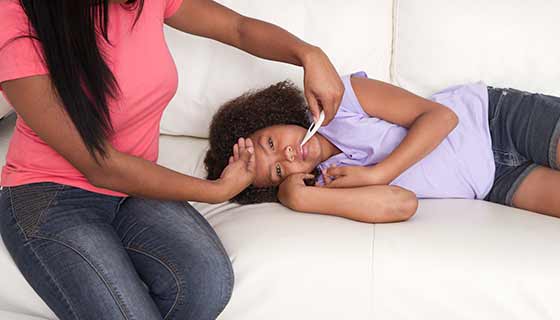
The best way to diagnose a fever is to take a temperature with a thermometer. There are several types of thermometers, including the following:
- Digital thermometer (oral, rectal, or under the armpit)
- Tympanic (ear) thermometer (not recommended in babies younger than 6 months of age)
- Temporal artery (temperature taken across the forehead area)
Taking a temperature rectally is the most accurate method in children under 3 years of age. In older children and adults, take the temperature under the armpit or in the mouth. Talk with your healthcare provider about the best way to take your temperature.
Most thermometers today are digital, but there are some glass thermometers containing mercury still in use. Mercury is toxic substance and is dangerous to humans and the environment. Because glass thermometers can break, they should be disposed of properly in accordance with local, state, and federal laws. For information on how to safely dispose of a mercury thermometer, contact your local health department, waste disposal authority, or fire department.
## How is a fever treated?
You can treat a fever with acetaminophen or ibuprofen in dosages advised by your healthcare provider. Switching between giving acetaminophen and ibuprofen can cause medicine errors and may lead to side effects. Never give aspirin to a child or young adult who has a fever.
A lukewarm bath may reduce the fever. Alcohol rubdowns are no longer recommended.
Call your healthcare provider for guidance anytime you are uncomfortable with the conditions of the fever, and remember to contact your healthcare provider any time a temperature spikes quickly or persists despite treatment.
## When should I call my healthcare provider?
Call your healthcare provider right away for a fever in a baby younger than 3 months old.
Call right away or seek immediate medical attention if any of the following occur with a fever:
- Seizure
- Feeling dull or sleepy
- Irregular breathing
- Stiff neck
- Confusion
- Purple spotted rash
- Ear pain (a child tugging on his or her ear)
- Sore throat that persists
- Vomiting
- Diarrhea
- Painful, burning, or frequent urination
## Key points about fevers
- A fever is not an illness by itself, but, rather, a sign that something is not right within the body.
- Illness, exercise, hot weather, and common childhood immunizations can make body temperature rise.
- In addition to an elevated temperature, look for other signs, such as: flushed face, hot skin, low urine output, loss of appetite, headache, or other symptoms of an infection or illness.
- Once you have determined that the person has a fever, you may treat it by giving acetaminophen or ibuprofen in dosages advised by your healthcare provider.
- Call your healthcare provider if a baby under 3 months has a fever, or seek immediate medical attention if a fever is accompanied by a seizure, lethargy, irregular breathing, stiff neck, confusion, or other signs of a serious illness.
## Next steps
Tips to help you get the most from a visit to your healthcare provider:
- Know the reason for your visit and what you want to happen.
- Before your visit, write down questions you want answered.
- Bring someone with you to help you ask questions and remember what your provider tells you.
- At the visit, write down the name of a new diagnosis, and any new medicines, treatments, or tests. Also write down any new instructions your provider gives you.
- Know why a new medicine or treatment is prescribed, and how it will help you. Also know what the side effects are.
- Ask if your condition can be treated in other ways.
- Know why a test or procedure is recommended and what the results could mean.
- Know what to expect if you do not take the medicine or have the test or procedure.
- If you have a follow-up appointment, write down the date, time, and purpose for that visit.
- Know how you can contact your provider if you have questions.
## Find a Treatment Center
- [Pediatric Infectious Diseases Program (Johns Hopkins All Children's Hospital)](https://www.hopkinsmedicine.org/all-childrens-hospital/services/infectious-disease)
Find Additional Treatment Centers at:
- [Howard County Medical Center](https://www.hopkinsmedicine.org/johns-hopkins-howard-county)
- [Sibley Memorial Hospital](https://www.hopkinsmedicine.org/sibley-memorial-hospital)
- [Suburban Hospital](https://www.hopkinsmedicine.org/suburban-hospital)
## Related
- [Fever in Children](https://www.hopkinsmedicine.org/health/conditions-and-diseases/fever-in-children)
- [West Nile Virus](https://www.hopkinsmedicine.org/health/conditions-and-diseases/west-nile-virus)
- [Rocky Mountain Spotted Fever](https://www.hopkinsmedicine.org/health/conditions-and-diseases/rocky-mountain-spotted-fever)
- [Dengue Fever](https://www.hopkinsmedicine.org/health/conditions-and-diseases/dengue-fever)

## Request an Appointment
[Find a Doctor](https://www.hopkinsmedicine.org/profiles)
- [410-955-5000](tel:410-955-5000) Maryland
- [855-695-4872](tel:855-695-4872) Outside of Maryland
- [\+1-410-502-7683](tel:+1-410-502-7683) International
[Find a Doctor](https://www.hopkinsmedicine.org/profiles)
See More
## Find a Treatment Center
- [Pediatric Infectious Diseases Program (Johns Hopkins All Children's Hospital)](https://www.hopkinsmedicine.org/all-childrens-hospital/services/infectious-disease)
Find Additional Treatment Centers at:
- [Howard County Medical Center](https://www.hopkinsmedicine.org/johns-hopkins-howard-county)
- [Sibley Memorial Hospital](https://www.hopkinsmedicine.org/sibley-memorial-hospital)
- [Suburban Hospital](https://www.hopkinsmedicine.org/suburban-hospital)
## Related
- [ Fevers Fever in Children](https://www.hopkinsmedicine.org/health/conditions-and-diseases/fever-in-children)
- [ Bites and stings West Nile Virus](https://www.hopkinsmedicine.org/health/conditions-and-diseases/west-nile-virus)
- [ Fevers Rocky Mountain Spotted Fever](https://www.hopkinsmedicine.org/health/conditions-and-diseases/rocky-mountain-spotted-fever)
## [](https://www.hopkinsmedicine.org/)
Language Assistance Available:
- [Español](https://www.hopkinsmedicine.org/patient-care/patients-visitors/language-assistance-services#spanish)
- [አማርኛ](https://www.hopkinsmedicine.org/patient-care/patients-visitors/language-assistance-services#amharic)
- [繁體中文](https://www.hopkinsmedicine.org/patient-care/patients-visitors/language-assistance-services#chinese)
- [Français](https://www.hopkinsmedicine.org/patient-care/patients-visitors/language-assistance-services#french)
- [Tagalog](https://www.hopkinsmedicine.org/patient-care/patients-visitors/language-assistance-services#tagalog)
- [Русский](https://www.hopkinsmedicine.org/patient-care/patients-visitors/language-assistance-services#russian)
- [Português](https://www.hopkinsmedicine.org/patient-care/patients-visitors/language-assistance-services#portugese)
- [Italiano](https://www.hopkinsmedicine.org/patient-care/patients-visitors/language-assistance-services#italian)
- [Tiếng Việt](https://www.hopkinsmedicine.org/patient-care/patients-visitors/language-assistance-services#vietnamese)
- [Ɓàsɔ́ɔ̀-wùɖù-po-nyɔ̀](https://www.hopkinsmedicine.org/patient-care/patients-visitors/language-assistance-services#KruBassa)
- [Igbo asusu](https://www.hopkinsmedicine.org/patient-care/patients-visitors/language-assistance-services#ibo)
- [èdè Yorùbá](https://www.hopkinsmedicine.org/patient-care/patients-visitors/language-assistance-services#Yoruba)
- [বাংলা](https://www.hopkinsmedicine.org/patient-care/patients-visitors/language-assistance-services#Bengali)
- [日本語](https://www.hopkinsmedicine.org/patient-care/patients-visitors/language-assistance-services#japanese)
- [한국어](https://www.hopkinsmedicine.org/patient-care/patients-visitors/language-assistance-services#korean)
- [Kreyòl Ayisyen](https://www.hopkinsmedicine.org/patient-care/patients-visitors/language-assistance-services#Creole)
- [العربية](https://www.hopkinsmedicine.org/patient-care/patients-visitors/language-assistance-services#Arabic)
- [Deutsch](https://www.hopkinsmedicine.org/patient-care/patients-visitors/language-assistance-services#German)
- [Polski](https://www.hopkinsmedicine.org/patient-care/patients-visitors/language-assistance-services#Polish)
- [Ελληνικά](https://www.hopkinsmedicine.org/patient-care/patients-visitors/language-assistance-services#Greek)
- [ગુજરાતી](https://www.hopkinsmedicine.org/patient-care/patients-visitors/language-assistance-services#Gujarati)
- [ภาษาไทย](https://www.hopkinsmedicine.org/patient-care/patients-visitors/language-assistance-services#Thai)
- [اُردُو](https://www.hopkinsmedicine.org/patient-care/patients-visitors/language-assistance-services#Urdu)
- [فارسی](https://www.hopkinsmedicine.org/patient-care/patients-visitors/language-assistance-services#Persian)
- [हिंदी](https://www.hopkinsmedicine.org/patient-care/patients-visitors/language-assistance-services#Hindi)
- [Deitsch](https://www.hopkinsmedicine.org/patient-care/patients-visitors/language-assistance-services#PennDutch)
- [ខ្មែរ](https://www.hopkinsmedicine.org/patient-care/patients-visitors/language-assistance-services#Cambodian)
Contact & Privacy Information
[Contact Johns Hopkins Medicine](https://www.hopkinsmedicine.org/patient-care/patients-visitors/contact-us)
[Price Transparency](https://www.hopkinsmedicine.org/patient-care/patients-visitors/billing-insurance/pay-bill/charges-fees) \| [Patient Care Locations](https://www.hopkinsmedicine.org/patient-care/locations)
[Notice of Privacy Practices](https://www.hopkinsmedicine.org/patient-privacy-information) \| [Privacy Statement](https://it.johnshopkins.edu/policies/privacystatement)
[Terms & Conditions of Use](https://www.hopkinsmedicine.org/terms-and-conditions-of-use) \| [Non-Discrimination Notice](https://www.hopkinsmedicine.org/patient-care/patients-visitors/non-discrimination-notice)
[Manage Cookie Preferences]()
[Follow Johns Hopkins Medicine on Facebook](https://www.facebook.com/Johns.Hopkins.Medicine)
[Follow Johns Hopkins Medicine on X](https://x.com/HopkinsMedicine)
[Follow Johns Hopkins Medicine on Linkedin](https://www.linkedin.com/company/johns-hopkins-medicine)
[Follow Johns Hopkins Medicine on Instagram](https://www.instagram.com/HopkinsMedicine/)
[Follow Johns Hopkins Medicine on YouTube](https://www.youtube.com/user/JohnsHopkinsMedicine?sub_confirmation=1)
[Follow Johns Hopkins Medicine on Weibo](https://www.weibo.com/hopkinsmedicine)
Copyright © 2026 The Johns Hopkins University, The Johns Hopkins Hospital, and Johns Hopkins Health System. All rights reserved. |
| Readable Markdown | ## What is a fever?
A fever is a body temperature that is higher than normal. It usually means there is an abnormal process occurring in the body. Exercise, hot weather, and common childhood immunizations can also make body temperature rise.
## What causes a fever?
A fever is not an illness by itself. Rather it is a symptom that something is not right within the body. A fever does not tell you what is causing it, or even that a disease is present. It may be a bacterial or viral infection. Or, it could be a reaction from an allergy to food or medicine. Becoming overheated at play or in the sun can also result in fever.
## What are the symptoms of a fever?
Normal body temperature ranges from 97.5°F to 98.9°F (36.4°C to 37.2°C). It tends to be lower in the morning and higher in the evening. Most healthcare providers consider a fever to be 100.4°F (38°C) or higher. High fevers may bring on seizures or confusion in children. It's not how high the temperature is, but how fast the temperature goes up that causes a seizure.
A fever has other symptoms besides a higher-than-normal temperature. These are especially important when caring for babies, young children, and disabled people. These groups may not be able to express how they feel. Signs that mean fever include:
- Flushed face
- Hot, dry skin
- Low output of urine, or dark urine
- Not interested in eating
- Constipation or diarrhea
- Vomiting
- Headache
- Aching all over
- Nausea
## How is a fever diagnosed?
The best way to diagnose a fever is to take a temperature with a thermometer. There are several types of thermometers, including the following:
- Digital thermometer (oral, rectal, or under the armpit)
- Tympanic (ear) thermometer (not recommended in babies younger than 6 months of age)
- Temporal artery (temperature taken across the forehead area)
Taking a temperature rectally is the most accurate method in children under 3 years of age. In older children and adults, take the temperature under the armpit or in the mouth. Talk with your healthcare provider about the best way to take your temperature.
Most thermometers today are digital, but there are some glass thermometers containing mercury still in use. Mercury is toxic substance and is dangerous to humans and the environment. Because glass thermometers can break, they should be disposed of properly in accordance with local, state, and federal laws. For information on how to safely dispose of a mercury thermometer, contact your local health department, waste disposal authority, or fire department.
## How is a fever treated?
You can treat a fever with acetaminophen or ibuprofen in dosages advised by your healthcare provider. Switching between giving acetaminophen and ibuprofen can cause medicine errors and may lead to side effects. Never give aspirin to a child or young adult who has a fever.
A lukewarm bath may reduce the fever. Alcohol rubdowns are no longer recommended.
Call your healthcare provider for guidance anytime you are uncomfortable with the conditions of the fever, and remember to contact your healthcare provider any time a temperature spikes quickly or persists despite treatment.
## When should I call my healthcare provider?
Call your healthcare provider right away for a fever in a baby younger than 3 months old.
Call right away or seek immediate medical attention if any of the following occur with a fever:
- Seizure
- Feeling dull or sleepy
- Irregular breathing
- Stiff neck
- Confusion
- Purple spotted rash
- Ear pain (a child tugging on his or her ear)
- Sore throat that persists
- Vomiting
- Diarrhea
- Painful, burning, or frequent urination
## Key points about fevers
- A fever is not an illness by itself, but, rather, a sign that something is not right within the body.
- Illness, exercise, hot weather, and common childhood immunizations can make body temperature rise.
- In addition to an elevated temperature, look for other signs, such as: flushed face, hot skin, low urine output, loss of appetite, headache, or other symptoms of an infection or illness.
- Once you have determined that the person has a fever, you may treat it by giving acetaminophen or ibuprofen in dosages advised by your healthcare provider.
- Call your healthcare provider if a baby under 3 months has a fever, or seek immediate medical attention if a fever is accompanied by a seizure, lethargy, irregular breathing, stiff neck, confusion, or other signs of a serious illness.
## Next steps
Tips to help you get the most from a visit to your healthcare provider:
- Know the reason for your visit and what you want to happen.
- Before your visit, write down questions you want answered.
- Bring someone with you to help you ask questions and remember what your provider tells you.
- At the visit, write down the name of a new diagnosis, and any new medicines, treatments, or tests. Also write down any new instructions your provider gives you.
- Know why a new medicine or treatment is prescribed, and how it will help you. Also know what the side effects are.
- Ask if your condition can be treated in other ways.
- Know why a test or procedure is recommended and what the results could mean.
- Know what to expect if you do not take the medicine or have the test or procedure.
- If you have a follow-up appointment, write down the date, time, and purpose for that visit.
- Know how you can contact your provider if you have questions. |
| Shard | 116 (laksa) |
| Root Hash | 4754538707639265316 |
| Unparsed URL | org,hopkinsmedicine!www,/health/conditions-and-diseases/fever s443 |